

Good campaign ideas do not start with a clever slogan. They start with a clear business goal, a specific audience, and a reason for people to care right now. That matters because marketers are operating in a noisier market where AI, personalization, and fragmented channels have made execution faster but attention harder to earn.
The strongest campaigns are not random creative bursts. They are structured systems: one sharp insight, one compelling offer, one channel strategy, one conversion path, and one measurement plan. Recent marketing research keeps pointing in the same direction: teams need better personalization, cleaner data, and more disciplined execution, especially as AI becomes central to campaign planning and customer engagement in reports from Salesforce and Adobe.
This article breaks campaign ideas into a practical framework you can actually use. You will see how to move from vague brainstorming into campaigns that have a purpose, a message, a mechanism, and a measurable outcome. The goal is simple: help you create campaigns that people notice, understand, and act on.
Article Outline
- Why Campaign Ideas Matter More Than Ever
- The Campaign Ideas Framework
- Audience and Insight: Where Strong Campaigns Begin
- Offer, Message, and Creative Angle
- Channel Strategy and Campaign Execution
- Measurement, Optimization, and Campaign Ideas FAQ
Why Campaign Ideas Matter More Than Ever
Campaign ideas matter because attention is expensive, trust is fragile, and generic marketing gets ignored quickly. A weak campaign may still produce activity, but activity is not the same as momentum. The right idea gives every post, email, ad, landing page, and follow-up message a shared reason to exist.
The pressure is higher now because campaign execution has become easier to automate. Tools can help you publish faster, build funnels faster, and personalize more touchpoints, but they cannot rescue a boring idea. That is why campaign planning has to start with strategy before software.
This is also where practical tools can help when the idea is already clear. For example, a campaign that depends on Instagram or Messenger follow-up may fit ManyChat, while a funnel-heavy promotion may fit ClickFunnels or GoHighLevel. The tool should support the campaign idea, not become the idea.
The Campaign Ideas Framework
A useful campaign framework keeps brainstorming from turning into a messy list of random tactics. Instead of asking, “What should we post?” the better question is, “What belief, behavior, or decision are we trying to change?” Once that is clear, campaign ideas become much easier to judge.
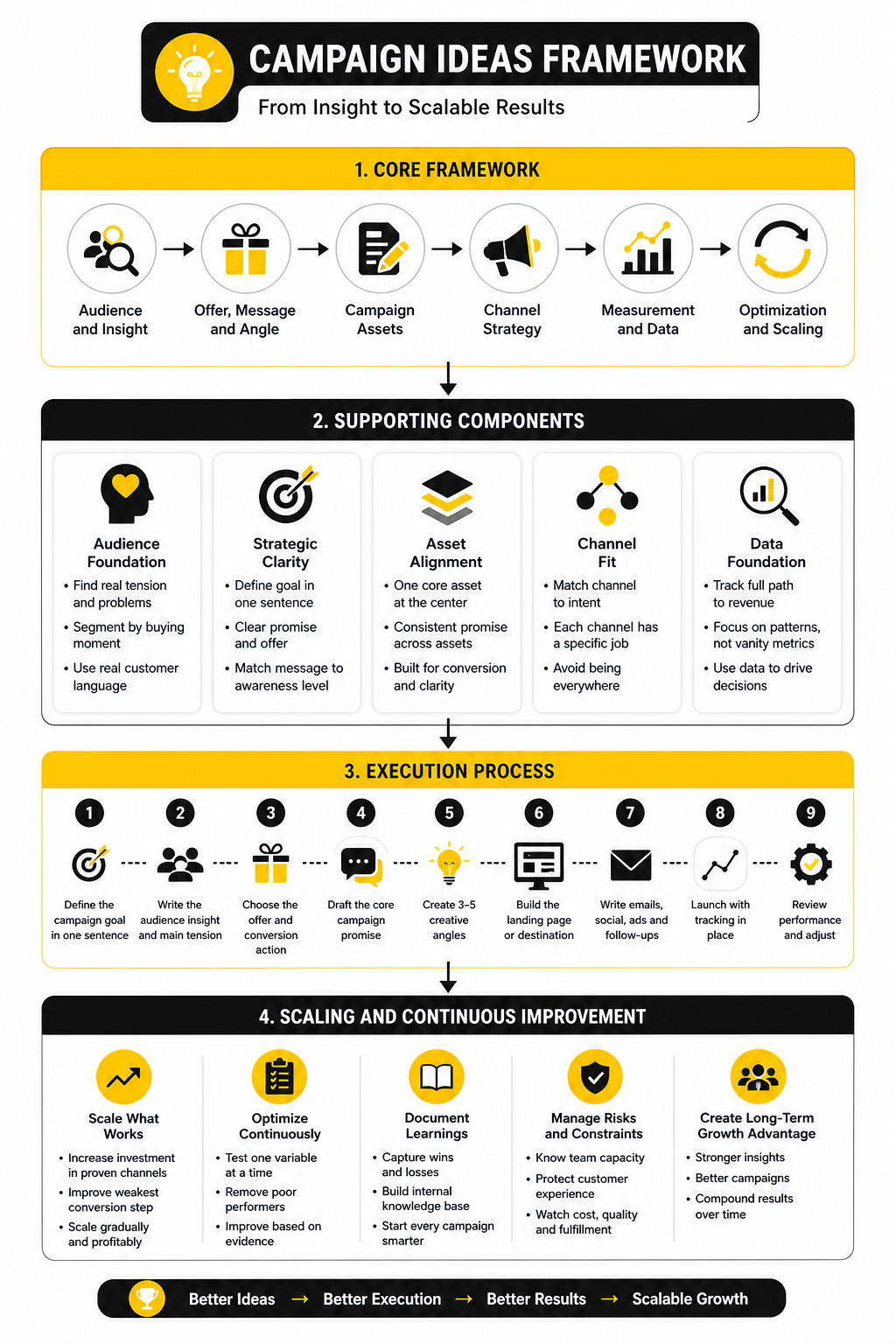
The framework used throughout this article has four parts: audience insight, campaign promise, activation mechanism, and conversion path. Audience insight explains who the campaign is for and what they already care about. The campaign promise gives them a reason to pay attention, while the activation mechanism and conversion path turn that attention into measurable action.
This structure works because it connects creativity with execution. A campaign can be funny, bold, educational, emotional, or direct, but it still needs a job. When every idea is filtered through the same framework, you stop choosing campaigns based on personal taste and start choosing them based on strategic fit.
Audience and Insight: Where Strong Campaigns Begin
The best campaign ideas usually come from a sharp audience insight, not a brainstorming session full of random hooks. An insight is not just a demographic detail like age, job title, or income. It is the tension behind the buying decision: what your audience wants, what is stopping them, and what they need to believe before they act.
This is where many campaigns go wrong. They start with the brand’s announcement instead of the customer’s situation. Nobody wakes up hoping to see another “big news” post from a company, but people do pay attention when a campaign names a problem they already feel and gives them a cleaner way forward.
Strong audience insight often comes from practical signals: sales calls, support tickets, survey responses, social comments, search queries, review patterns, and CRM notes. If you are running a service business or agency, a platform like GoHighLevel can help centralize leads, conversations, pipelines, and follow-ups so campaign ideas are based on real customer behavior rather than guesswork. That matters because campaigns built from actual objections and motivations usually feel more relevant from the first touch.
Look For Tension, Not Just Interest
Interest is easy to spot, but tension is what makes a campaign powerful. Someone may be interested in fitness, software, finance, beauty, coaching, or productivity, but that does not automatically explain why they would act today. Tension reveals the gap between where they are and where they want to be.
For example, a weak campaign angle says, “Try our new marketing tool.” A stronger angle says, “You are losing leads because your follow-up is slower than your competitors.” The second version creates urgency because it connects the offer to a painful business reality.
This is also why campaign ideas should be judged against one clear question: does this idea make the audience feel understood? If the answer is no, the campaign will rely too heavily on discounts, urgency tricks, or excessive content volume. Those can work briefly, but they rarely create lasting demand.
Separate Audience Segments By Buying Moment
Not every audience segment needs the same campaign. Some people are problem-aware and need education. Others are solution-aware and need comparison. Some are ready to buy but need proof, reassurance, or a simpler next step.
A campaign for cold prospects should usually focus on relevance and belief-building. A campaign for warm leads should reduce friction and answer objections. A campaign for past buyers should deepen trust, increase usage, or introduce the next logical offer.
This is where segmentation becomes practical instead of theoretical. Email and SMS tools such as Brevo or Moosend can support different campaign paths for different levels of intent. The important part is not the tool itself; it is making sure the message matches the buyer’s current state.
Use Research To Find Language Your Audience Already Uses
Great campaign ideas often sound simple because they borrow the audience’s own language. That does not mean copying comments word for word in a lazy way. It means noticing repeated phrases, emotional patterns, and objections that appear across multiple sources.
Customer reviews are especially useful because they show how people describe the before-and-after experience. Sales calls reveal the questions people ask when money is on the line. Search data shows what they are actively trying to solve when nobody is watching.
This research helps you avoid vague claims like “save time” or “grow faster.” Instead, you can make the campaign more concrete: “stop chasing missed leads,” “launch a landing page without waiting on developers,” or “turn social attention into booked calls.” Specific language makes campaign ideas easier to understand and much easier to execute.
Offer, Message, and Creative Angle
Once the audience insight is clear, the next job is turning it into an offer people can understand quickly. This is where campaign ideas become real. A campaign without a clear offer is just content with ambition.
The offer does not always have to be a discount. It can be a free trial, a workshop, a waitlist, a diagnostic, a challenge, a calculator, a bundle, a limited launch, a live demo, or a useful resource. What matters is that the audience can instantly see what they get, why it matters, and what to do next.
The message then translates that offer into a reason to act. This is where you decide the core promise, the main objection to overcome, and the proof you need to include. If the offer is the “what,” the message is the “why now.”
Build The Campaign Promise First
The campaign promise is the simplest version of the outcome you are asking people to care about. It should be specific enough to feel useful, but not so narrow that it becomes stiff or overexplained. A good promise gives the campaign direction before you start writing ads, emails, landing pages, or social posts.
Weak promises usually sound like internal marketing language. They talk about features, launches, updates, or brand excitement. Strong promises talk about the result the audience wants or the pain they want removed.
For example, “new AI features now available” is not much of a campaign promise. “Respond to leads faster without hiring another assistant” is stronger because it connects the feature to a business outcome. That type of message gives the rest of the campaign a spine.
Match The Creative Angle To The Buyer’s Awareness
Different buyers need different creative angles. A cold audience may need a campaign that names the problem and makes it feel urgent. A warm audience may need comparison, proof, and a clearer next step.
This is why one campaign idea can produce several creative angles without becoming scattered. You might use an educational angle for search traffic, a proof-driven angle for retargeting, and a direct offer angle for email subscribers. The message stays consistent, but the entry point changes based on where the buyer is in the journey.
A simple way to pressure-test this is to ask what the audience already believes. If they do not believe the problem is urgent, lead with the cost of inaction. If they believe the problem is real but doubt your solution, lead with proof. If they already want the solution, make the path to conversion obvious.
Turn The Idea Into Campaign Assets
This is the point where the process becomes practical. A campaign idea needs assets that carry the same promise across multiple touchpoints. That usually includes a landing page, emails, social posts, ads, follow-up messages, and a conversion mechanism.
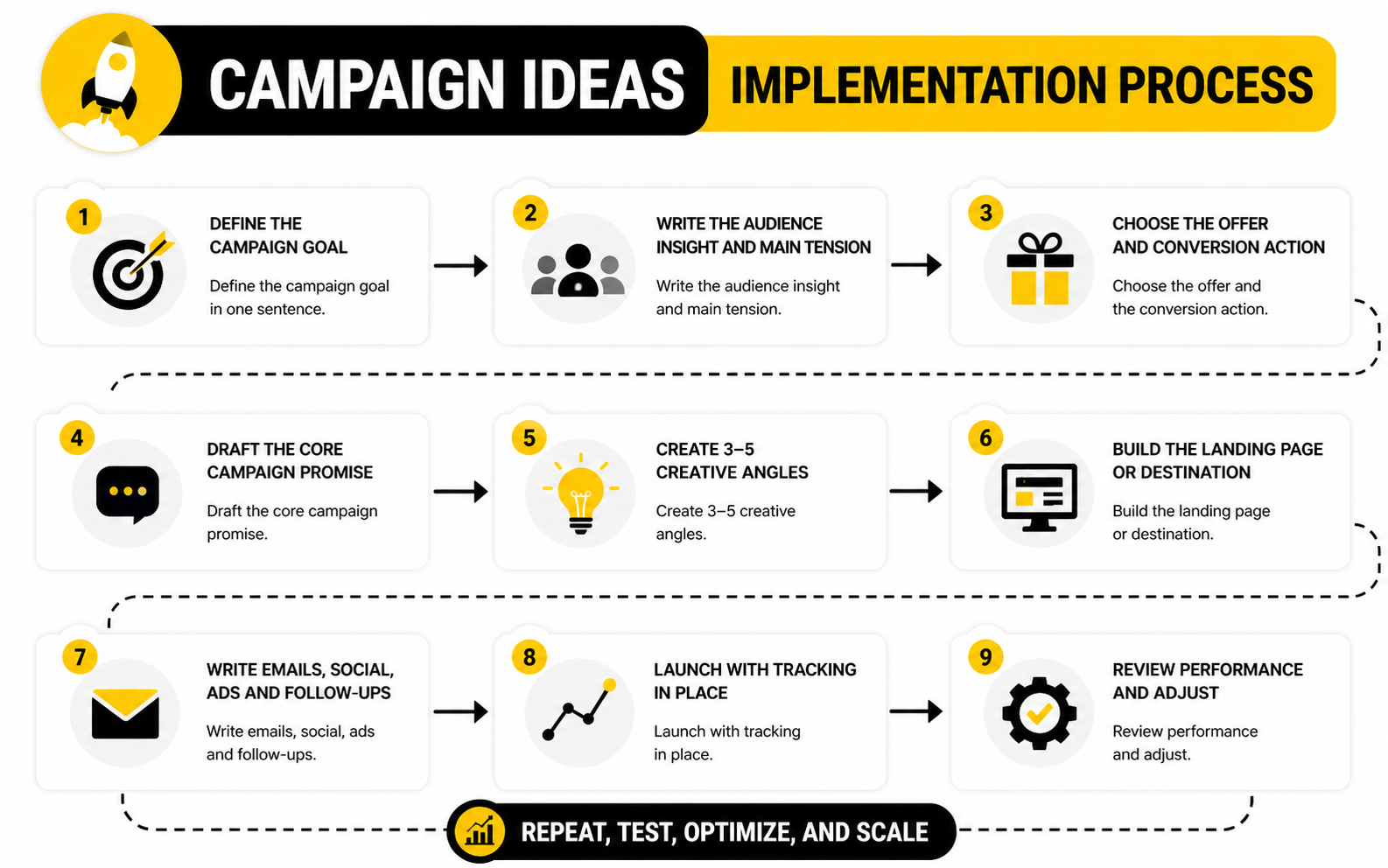
A simple execution process looks like this:
- Define the campaign goal in one sentence.
- Write the audience insight and main tension.
- Choose the offer and the conversion action.
- Draft the core campaign promise.
- Create three to five creative angles.
- Build the landing page or destination.
- Write the email, social, ad, and follow-up assets.
- Launch with tracking in place.
- Review performance and adjust the weakest step.
This sequence prevents the common mistake of creating assets before the strategy is clear. It also keeps the campaign from becoming a pile of disconnected tactics. Every asset should feel like it belongs to the same idea, even when the format changes.
Choose The Right Execution Tool For The Campaign Type
The right tool depends on the campaign mechanism. If the campaign is built around a sales funnel, checkout flow, webinar, or lead magnet, ClickFunnels or Systeme.io can make sense. If the campaign needs CRM, pipeline tracking, booking, automation, and client follow-up in one place, GoHighLevel is usually the more complete choice.
If the campaign depends heavily on landing page testing for ecommerce, Replo may fit better because the page experience is central to the conversion. If the campaign is driven by social scheduling and content distribution, Buffer can help keep publishing organized without turning the campaign into chaos. The point is not to collect tools; the point is to choose the tool that supports the campaign’s job.
This is where discipline matters. Do not build a complex automation when the campaign only needs one strong landing page and three follow-up emails. Do not create a beautiful landing page when the actual bottleneck is slow sales response. Professional implementation means matching the system to the problem, not making the stack look impressive.
Statistics and Data
Campaign data is useful only when it changes what you do next. A dashboard full of impressions, clicks, opens, and conversion rates can look impressive, but the real question is simple: what is the data telling you to fix? Good campaign ideas become stronger when measurement shows which part of the journey is working and which part is leaking attention, trust, or revenue.
The mistake is treating benchmarks like grades. A 2% click rate, a 5% landing page conversion rate, or a high cost per lead means very little without context. The same number can be strong in one market, weak in another, or completely misleading if the offer, traffic source, and audience intent are different.
That is why campaign measurement should focus on patterns, not isolated numbers. You are looking for where people slow down, drop off, ignore the message, or fail to take the next step. Once you see that, the campaign stops being a guessing game and becomes a controlled improvement process.
Track The Full Campaign Path
Every campaign should be measured as a path, not as separate channel reports. The journey usually starts with reach, then moves into engagement, click intent, landing page behavior, lead capture, sales conversation, purchase, and retention. If you only measure one part, you may optimize the wrong thing.
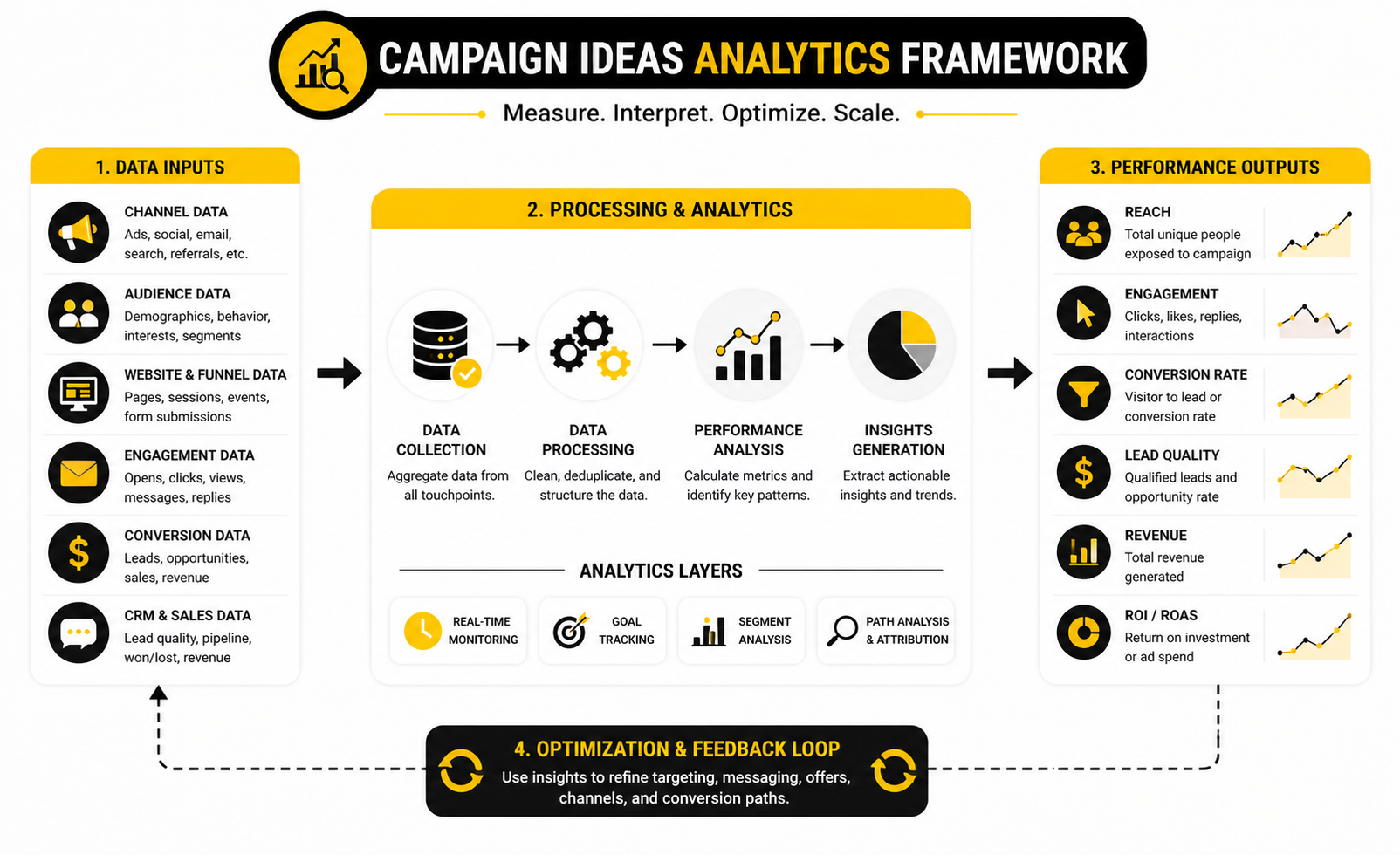
For example, a campaign with strong ad clicks but poor landing page conversion does not need more creative ideas first. It probably needs a better page promise, clearer proof, faster load time, or a stronger offer match. A campaign with strong email opens but weak clicks may have decent subject lines but a weak body message or call to action.
This is where tools matter, but only after the measurement logic is clear. A funnel platform like ClickFunnels can help you see where people drop inside a funnel, while GoHighLevel can connect campaign activity to leads, pipeline stages, calls, bookings, and follow-up. The point is to connect attention to revenue, not just collect prettier reports.
Read Benchmarks Without Becoming A Slave To Them
Benchmarks are helpful when they give you a reality check. They are dangerous when they become the goal. A benchmark tells you what is common; it does not tell you what your campaign is capable of.
Email is a good example. Industry benchmark reports often show that open rates, click rates, and unsubscribe rates vary widely by sector, list quality, and sending behavior. A recent DMA email benchmark report reported a 98% delivery rate and a 2.3% unique click rate, but those numbers should not be copied into your campaign plan as universal targets.
The useful action is comparison over time. If your click rate is below your own baseline, review the offer, call to action, email layout, and audience segment. If unsubscribes rise after a campaign, the issue may not be “too much email”; it may be poor targeting, weak expectation-setting, or a message that feels irrelevant.
Focus On Leading And Lagging Indicators
Strong measurement separates leading indicators from lagging indicators. Leading indicators show whether the campaign is gaining attention and intent early. Lagging indicators show whether that attention eventually turned into pipeline, sales, revenue, or retention.
Leading indicators include impressions, video completion, saves, replies, clicks, landing page scroll depth, form starts, booked calls, and demo requests. Lagging indicators include qualified leads, close rate, cost per acquisition, average order value, payback period, repeat purchase rate, and customer lifetime value. Both matter, but they answer different questions.
This distinction keeps you from panicking too early or celebrating too soon. A campaign may have low immediate revenue but strong qualified call bookings, which means it deserves follow-up and sales analysis before you kill it. Another campaign may generate cheap leads that never buy, which means the top-line lead cost is hiding a deeper quality problem.
Use Cost Metrics To Diagnose Efficiency
Paid campaigns need cost discipline because rising ad costs can quietly destroy a decent idea. The important metric is not just cost per click. You need to understand cost per lead, cost per qualified lead, cost per booked call, cost per sale, and return on ad spend.
Recent Google Ads benchmark analysis from WordStream showed the average cost per lead across industries at $70.11 in 2025, up from $66.69 in 2024. That number matters because it reminds you that campaign ideas cannot rely only on cheap traffic. The offer, landing page, follow-up, and sales process all have to work harder when acquisition costs rise.
A high cost per lead is not automatically bad if the lead quality and customer value are strong. A low cost per lead is not automatically good if the leads waste sales time. The better question is whether each campaign can acquire the right customer at a cost the business can afford.
Measure Message Fit, Not Just Channel Performance
Sometimes the channel gets blamed when the message is the real problem. A campaign may fail on email, paid ads, or social because the promise is unclear, the creative angle is too generic, or the offer does not match the audience’s current buying moment. Switching platforms will not fix that.
Message fit shows up in the data as weak engagement from the right audience. People see the campaign, but they do not click, reply, save, share, book, or buy. That usually means the campaign has not created enough relevance or urgency.
This is where campaign ideas should be tested in controlled ways. Change one major variable at a time: the promise, the offer, the audience segment, the proof, the landing page headline, or the call to action. When you change everything at once, you may get a better result, but you will not know why.
Turn Reporting Into Action
A useful campaign report should end with decisions, not decoration. It should say what worked, what failed, what changed, and what happens next. If the report does not produce an action, it is probably too shallow.
A practical review can be simple:
- Which audience segment responded best?
- Which message created the strongest intent?
- Which channel produced qualified action, not just activity?
- Where did people drop off?
- What should be tested next?
- What should be stopped?
- What should be scaled?
This is how measurement improves future campaign ideas. You are not just judging one campaign; you are building a library of evidence. Over time, that evidence becomes a strategic advantage because your team stops debating opinions and starts making sharper decisions based on real behavior.
Channel Strategy and Campaign Execution
A strong campaign idea still needs the right channel strategy. This is where many teams get sloppy. They either try to be everywhere at once, or they force one campaign format into channels where it does not naturally fit.
The better approach is to choose channels based on intent, behavior, and message depth. Search is useful when people are already looking for a solution. Social is useful when the campaign needs discovery, proof, repetition, and conversation. Email is useful when you already have attention and need to turn it into action.
This does not mean every campaign needs every channel. It means each channel should have a specific job. When that job is clear, execution becomes cleaner, faster, and easier to measure.
Know The Tradeoff Between Reach And Intent
Reach and intent are not the same thing. A short-form video can reach a large audience, but many viewers may have no buying intent. A search ad may reach fewer people, but the people who click may be much closer to making a decision.
This tradeoff should shape your campaign ideas from the beginning. If the goal is awareness, you need a strong hook, a simple message, and content that travels well. If the goal is direct response, you need a sharper offer, stronger proof, and a clear conversion path.
The danger is expecting one channel to do every job. A campaign can fail because the idea is weak, but it can also fail because the channel was asked to carry the wrong type of message. Match the channel to the buyer’s mindset, and your campaign instantly has a better chance.
Build Campaigns Around A Core Asset
Scaling becomes easier when the campaign has one core asset that everything else points back to. That asset might be a landing page, a webinar, a quiz, a lead magnet, a demo page, a sales page, a comparison page, or a booking flow. Without a central destination, attention gets scattered.
For funnel-style campaigns, tools like ClickFunnels and Systeme.io can help turn that core asset into a practical conversion path. For service businesses and agencies, GoHighLevel can connect the campaign destination with booking, CRM, automation, and pipeline follow-up. The asset is not just a page; it is the place where campaign attention becomes measurable intent.
This also makes creative production easier. One core idea can become social posts, email angles, retargeting ads, short videos, sales scripts, and follow-up messages. You are not inventing from scratch every day; you are translating the same campaign promise into formats that fit each channel.
Protect The Campaign From Over-Automation
Automation is useful, but it can quietly weaken a campaign when it removes judgment. A sequence that sends the wrong message to the wrong person at the wrong time does not feel efficient to the buyer. It feels careless.
Use automation for speed, consistency, routing, reminders, and follow-up. Do not use it as an excuse to ignore segmentation, timing, or context. A campaign that treats every lead the same will eventually train people to ignore it.
This matters even more as AI becomes part of campaign planning and execution. Research from Adobe and Nielsen shows how quickly marketers are moving toward AI-assisted personalization and workflow efficiency, but the strategic risk is obvious. Faster output is not the same as better judgment.
Scale What Is Proven, Not What Is Exciting
The most dangerous campaign ideas are the ones that feel exciting before they are proven. They get internal enthusiasm, bigger budgets, more meetings, and more creative production before the market has said anything useful. That is how teams turn a small mistake into an expensive one.
Scale should happen after you see evidence. That evidence might be lower acquisition cost, higher qualified lead rate, stronger booking quality, better sales conversations, higher conversion, or stronger retention. The exact signal depends on the campaign goal, but there must be a signal.
A practical scaling sequence is simple:
- Test the message with a small audience.
- Validate that the offer creates real intent.
- Improve the weakest conversion step.
- Expand the best-performing channel.
- Add supporting channels only when the core path works.
- Increase budget gradually while monitoring quality.
- Document what worked so the next campaign starts smarter.
This keeps the campaign grounded. You are not scaling hope. You are scaling evidence.
Watch For The Hidden Risks
Campaigns do not only fail because of bad creative. They fail because of operational gaps, weak handoffs, unclear ownership, poor tracking, slow follow-up, inconsistent messaging, and offers that the business cannot actually fulfill well. These risks are less glamorous, but they are real.
A campaign that generates demand faster than the team can handle it may damage trust. A promotion that attracts the wrong buyers may create refund requests, poor retention, or low-quality sales calls. A campaign that relies too heavily on one platform may become fragile when costs rise or algorithms change.
This is why expert-level campaign planning includes constraints. You need to know the budget, timeline, team capacity, sales process, fulfillment limits, and data quality before the campaign goes live. Good strategy is not just about what could work; it is also about what the business can support without breaking the customer experience.
Create A Campaign Learning System
The best marketers do not just collect campaign ideas. They build a learning system. Every campaign should leave behind sharper audience insight, stronger messaging, better assets, cleaner benchmarks, and clearer execution rules.
This can be as simple as a campaign review document that records the goal, audience, offer, channels, winning angles, failed angles, conversion data, objections, sales feedback, and next tests. Over time, that document becomes more valuable than another generic swipe file. It shows what works for your market, your offer, and your audience.
This is the real advantage. Anyone can brainstorm campaign ideas. Fewer teams can turn those ideas into repeatable growth because they keep learning from each launch. That is where the compounding starts.
Measurement, Optimization, and Campaign Ideas FAQ
At this stage, the campaign should no longer feel like a loose collection of tactics. You have the audience insight, the offer, the message, the assets, the channels, and the measurement system. Now the goal is to turn that into an ecosystem that can improve every time you launch.
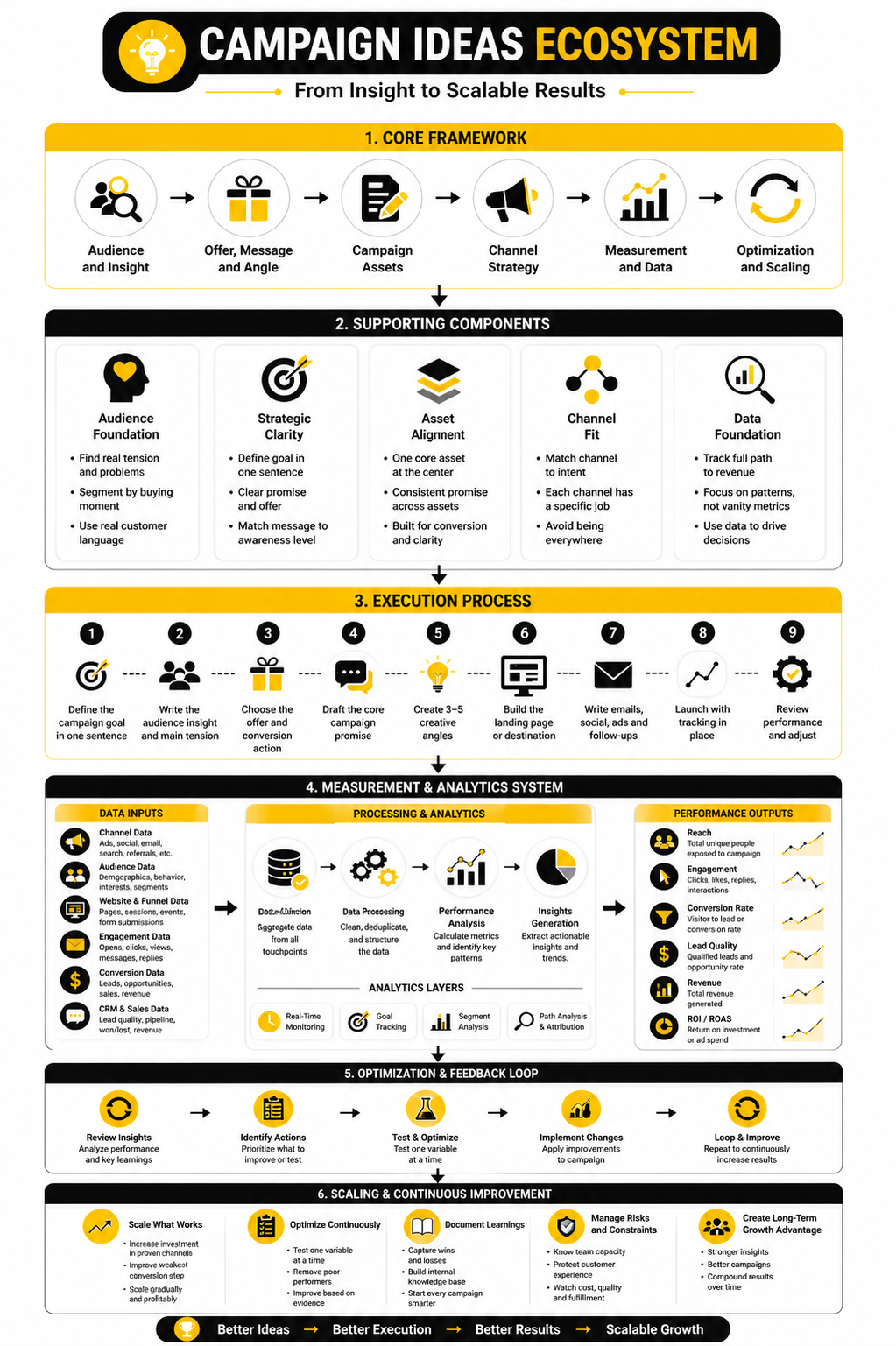
This is where campaign ideas become more valuable over time. Each campaign should teach you something about your audience, your positioning, your offer, your creative, and your conversion path. If you document those lessons properly, your next campaign starts with evidence instead of a blank page.
The final move is simple but important: keep the system practical. Do not overcomplicate it with vanity dashboards, bloated automation, or endless brainstorming. Build campaigns that create attention, convert that attention into action, and make the next campaign smarter.
FAQ - Built for Complete Guide
What are campaign ideas?
Campaign ideas are strategic concepts used to promote a product, service, offer, event, brand message, or business goal. A good campaign idea connects a specific audience insight with a clear promise and a measurable action. It is not just a creative hook; it is the strategic reason the campaign exists.
How do I come up with better campaign ideas?
Start by studying your audience before brainstorming creative angles. Look at customer questions, sales objections, reviews, support tickets, search behavior, and social comments. Better campaign ideas usually come from real customer tension, not from trying to sound clever.
What makes a campaign idea strong?
A strong campaign idea is specific, relevant, timely, and easy to understand. It gives people a reason to care and a reason to act. It also connects naturally to the offer, so the campaign does not feel entertaining but commercially pointless.
How many campaign ideas should I test at once?
Test enough to learn, but not so many that the data becomes messy. For most teams, three to five strong creative angles around one core campaign promise is a practical starting point. That gives you variety without losing strategic focus.
What is the difference between a campaign idea and a marketing tactic?
A campaign idea is the central concept behind the promotion. A tactic is the way that idea gets distributed, such as an email, ad, landing page, social post, webinar, or SMS flow. Tactics should serve the idea, not replace it.
How do I know if a campaign idea is worth launching?
A campaign idea is worth launching when it has a clear audience, a clear offer, a believable promise, and a measurable next step. You should also know what signal would make you scale, adjust, or stop the campaign. If you cannot define success before launch, the idea is not ready.
What are good campaign ideas for small businesses?
Small businesses often do well with campaigns built around local relevance, customer proof, limited-time offers, referral incentives, seasonal needs, educational workshops, and simple lead magnets. The best idea depends on the business model and customer buying moment. A service business may need booked consultations, while an ecommerce brand may need product discovery and repeat purchase campaigns.
What tools help execute campaign ideas?
The right tool depends on the campaign type. GoHighLevel works well for agencies and service businesses that need CRM, booking, automation, and pipeline follow-up. ClickFunnels and Systeme.io are useful when the campaign depends on funnels, sales pages, lead magnets, or checkout flows.
How should campaign performance be measured?
Measure campaign performance across the full path from attention to revenue. That includes reach, engagement, clicks, landing page conversion, leads, qualified opportunities, sales, acquisition cost, and retention. The most useful metrics are the ones that tell you what to improve next.
Why do campaign ideas fail?
Campaign ideas fail when they are too vague, too brand-centered, poorly timed, badly matched to the channel, or disconnected from a real audience problem. They also fail when follow-up is slow, tracking is weak, or the offer does not match the promise. In many cases, the idea is not the only issue; the execution system around it is broken.
How often should a business launch new campaigns?
The right cadence depends on team capacity, sales cycle, and audience size. A small team may be better off running fewer campaigns and improving each one properly. Launching constantly without learning from the data usually creates more noise than growth.
Can AI help generate campaign ideas?
AI can help with brainstorming, angle generation, segmentation, research summaries, and asset drafts. It should not replace strategic judgment. The best use of AI is to speed up the process after the audience insight, offer, and campaign goal are clear.
How do I scale a winning campaign idea?
Scale a winning campaign by increasing investment in the strongest channel, improving the weakest conversion step, and adapting the core idea into new formats. Do not scale just because a campaign gets attention. Scale when the data shows quality intent, manageable acquisition cost, and a path to profitable revenue.
Work With Professionals
Explore 10K+ Remote Marketing Contracts on MarkeWork.com
Most marketers spend too much time chasing clients, competing on crowded platforms, and losing a percentage of every project to middlemen.
MarkeWork gives you a better way. Browse thousands of remote marketing contracts and connect directly with companies desperate to hire skilled marketers like you, without platform commissions and without unnecessary gatekeepers.
If you're serious about finding better opportunities and keeping 100% of what you earn, explore available contracts and create a profile for free at MarkeWork.com.