

Campaigner email marketing works best when you stop treating email as a broadcast channel and start treating it as a revenue system. The inbox is crowded, but email still earns attention because it is direct, measurable, and owned.
The real opportunity is not sending more emails. It is building campaigns around clear segments, stronger offers, better timing, cleaner data, and automation that actually helps people move forward.
Article Outline
- Why Campaigner Email Marketing Still Matters
- The Campaigner Email Marketing Framework
- Core Components Of A High-Performing Email System
- Professional Implementation: From Setup To Launch
- Optimization, Reporting, And Scaling
- FAQ And Final Recommendations
Why Campaigner Email Marketing Still Matters
Email remains one of the few marketing channels where you can reach an audience without renting attention from an algorithm. Social reach can drop overnight, ad costs can rise without warning, and search rankings can shift after one update. A strong email list gives you a direct line to prospects, customers, and repeat buyers.
The numbers still support the channel. Mailchimp’s benchmark data shows average email open rates around 35.63% across all users, with click rates varying heavily by industry and list quality through its email marketing benchmarks. That does not mean every campaign will perform well, but it does prove that inbox attention is still very real when the message is relevant.
Campaigner email marketing matters most for businesses that already have some traffic, leads, buyers, or customer data. At that stage, the job is not just list growth. The job is turning attention into repeatable revenue through better journeys, cleaner targeting, and more useful follow-up.
The Campaigner Email Marketing Framework
A practical email framework has four layers: audience, message, automation, and measurement. Audience decides who should receive the email. Message decides why they should care, automation decides when they receive it, and measurement decides what improves next.
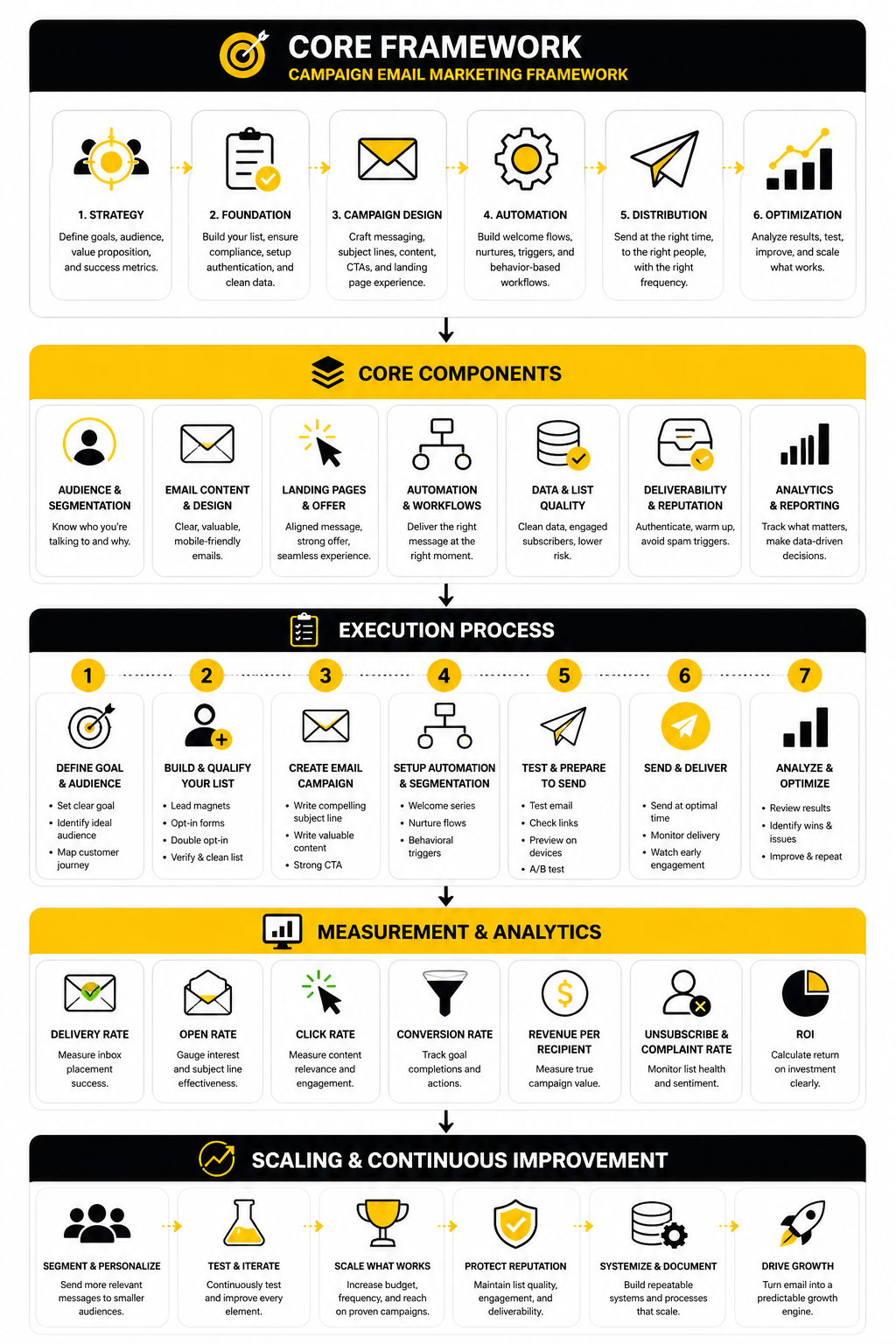
This is where most businesses get email wrong. They start with the email template before they understand the buyer’s situation. A better approach starts with the customer’s intent, then builds the campaign around the next logical step.
For example, a new lead should not receive the same message as a repeat customer. A cold subscriber needs trust, context, and a reason to engage. A returning buyer may need a timely offer, product education, or a reminder that makes the next purchase feel obvious.
Core Components Of A High-Performing Email System
A campaigner email marketing system needs more than a list and a few promotional emails. The strongest programs are built from connected parts that work together: acquisition, segmentation, deliverability, copy, automation, landing pages, and measurement. When one part is weak, the whole system leaks revenue.
The point is not to make email complicated. The point is to make every email easier to understand, easier to act on, and easier to improve. That starts with the core components.
Audience Quality
A bigger list is not automatically a better list. A list full of unqualified subscribers, old contacts, fake emails, or people who never engage will drag down performance. Clean audience quality gives your campaigns a better chance before the first subject line is even written.
This is why permission matters. People who actively opt in are more likely to recognize your brand, open your emails, and click when the offer fits. Mailchimp’s benchmark data shows that average open rates vary widely by industry, with many categories sitting in the low-to-mid 30% range in its email marketing benchmarks, so list quality can quickly become the difference between useful data and noise.
Do not build your strategy around rented attention. Build around people who asked to hear from you, then give them a clear reason to stay subscribed. That is the first filter.
Segmentation
Segmentation is where campaigner email marketing starts becoming personal without becoming creepy. You are not trying to impress people with how much data you have. You are trying to send a more relevant message based on what they actually did, requested, bought, clicked, ignored, or showed interest in.
Useful segments usually come from behavior. New subscribers, active leads, inactive contacts, first-time buyers, repeat customers, high-value customers, webinar registrants, cart abandoners, and trial users all need different messages. Sending everyone the same campaign is easier, but easier is not the same as effective.
A simple segmentation model can start with three groups:
- New contacts who need trust, context, and orientation
- Engaged contacts who need momentum, proof, and the next step
- Inactive contacts who need either reactivation or removal
That alone improves the logic of your campaigns. You stop shouting at everyone and start guiding people based on where they are.
Offer And Message Fit
Email performance depends heavily on the match between the person, the promise, and the timing. A strong email sent to the wrong segment will underperform. A weak offer sent at the perfect moment will still feel flat.
Good message fit starts with one question: what does this person already believe or need right now? A new lead may need education before a sales pitch. A repeat buyer may need a relevant upgrade. A churn-risk customer may need reassurance, help, or a practical reason to re-engage.
This is where tools can help, but they do not replace thinking. Platforms like Brevo, Moosend, and GoHighLevel can support segmentation and automation, but the campaign still needs a clear reason to exist. If the email does not answer “why should I care today?”, the software will not save it.
Deliverability
Deliverability is not glamorous, but it decides whether your email even gets a fair shot. If your sender reputation is weak, your list is stale, or your authentication is misconfigured, your best campaign may never reach the inbox. That is brutal, but it is true.
The 2025 DMA Email Benchmarking Report reported a 98% delivery rate in 2024 and a 2.3% unique click rate, which shows how small the real engagement window can be even when delivery is strong through the Email Benchmarking Report 2025. This is why deliverability cannot be treated as a technical afterthought. It affects revenue directly.
At minimum, a professional setup should include:
- SPF, DKIM, and DMARC authentication
- A clean sending domain
- Regular removal of hard bounces
- Suppression of chronically inactive contacts
- Clear unsubscribe links
- Consistent sending patterns
- Useful content that earns engagement
Deliverability rewards discipline. The inbox is not a place to be reckless.
Automation
Automation should make the customer journey smoother, not colder. The best automations feel timely because they respond to context. The worst automations feel like a machine pushing people through a funnel they never asked to enter.
A basic campaigner email marketing automation stack usually includes a welcome sequence, lead nurture sequence, abandoned checkout sequence, post-purchase sequence, reactivation sequence, and customer education sequence. Each one should have a specific job. If an automation does not move the relationship forward, simplify it.
This is also where broader funnel tools can make sense. If the business needs landing pages, forms, pipeline tracking, SMS, and email in one place, GoHighLevel is a better fit than a simple newsletter tool. If the priority is sales pages and offer funnels, ClickFunnels may fit better. The right choice depends on the system you are building, not the tool with the loudest homepage.
Landing Pages And Conversion Paths
Email does not convert in isolation. The click matters, but the page after the click often decides the outcome. If the email promises one thing and the landing page says another, you create friction immediately.
Every campaign should have a clear conversion path. That might be a product page, booking page, quiz, webinar registration page, sales page, or simple reply prompt. The important thing is that the next step matches the intent created by the email.
For ecommerce and paid traffic campaigns, a dedicated landing page builder like Replo can help teams create campaign-specific pages without waiting on a full development cycle. For service businesses, forms and booking flows through tools like Fillout and Cal.com can remove friction from lead capture and scheduling. Less friction usually means more completed actions.
Measurement
Measurement is where opinion becomes improvement. You do not need a dashboard with fifty metrics. You need a few numbers that tell you whether the campaign is reaching people, earning attention, creating action, and producing revenue.
Open rates can still be useful directionally, but they are less reliable than they used to be because privacy features can inflate or obscure opens. Click rate, conversion rate, revenue per recipient, unsubscribe rate, spam complaint rate, and list growth quality tell a more practical story. GetResponse also notes that Apple Mail Privacy Protection can distort open data in its email marketing benchmark analysis, which is why serious teams look beyond opens.
The simplest reporting habit is to review every campaign against one main goal. If the goal was engagement, judge clicks and replies. If the goal was revenue, judge purchases and revenue per recipient. If the goal was retention, judge repeat activity and churn signals. Clean measurement keeps the team honest.
Professional Implementation: From Setup To Launch
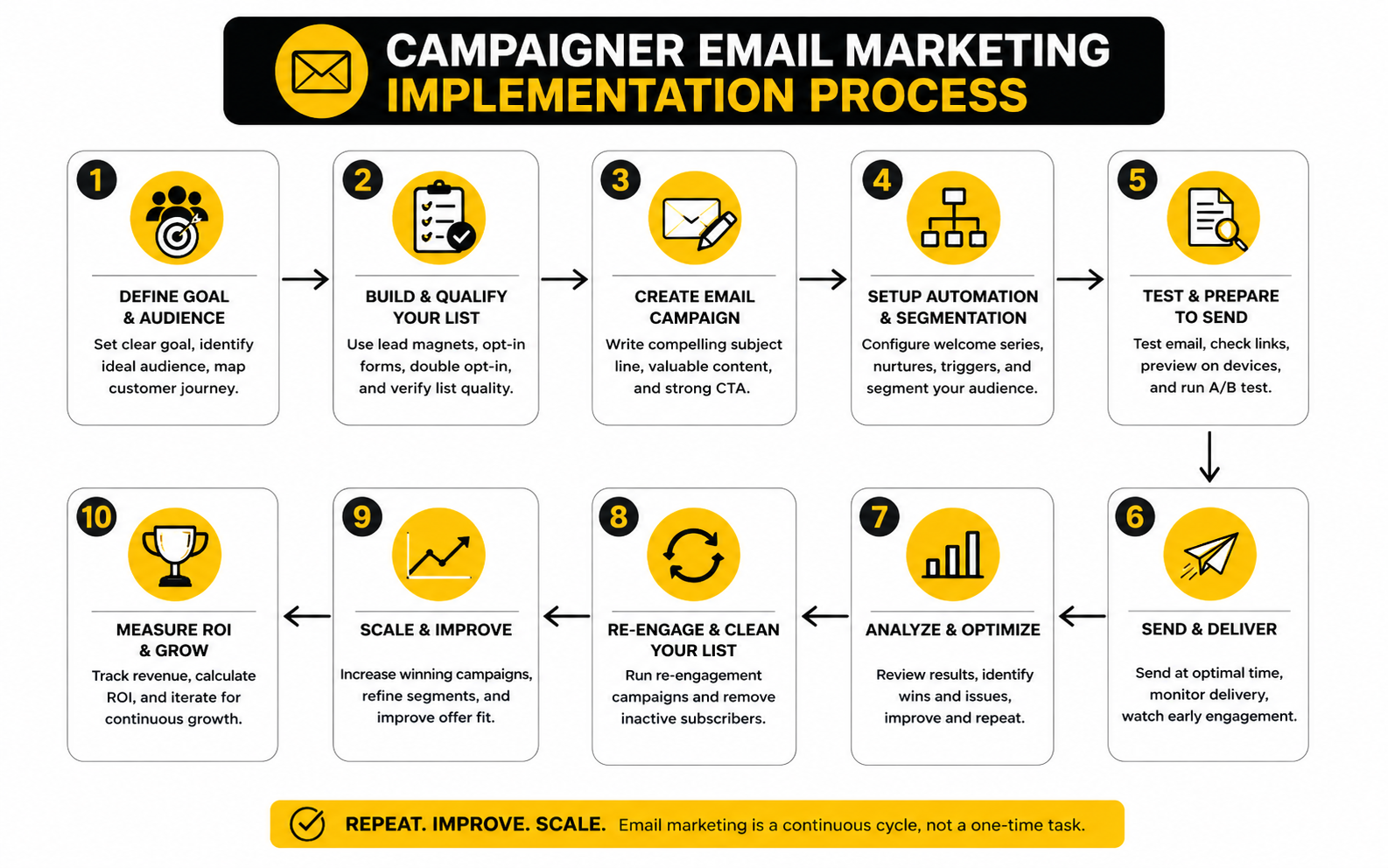
A good campaigner email marketing plan becomes useful only when it turns into a working system. Strategy is important, but implementation is where the gaps show up. This is where you find out whether your data is clean, your offer is clear, your automations make sense, and your landing pages can actually convert the attention you worked hard to earn.
The process should not start with writing emails. It should start with deciding what the campaign is supposed to achieve. A launch campaign, reactivation campaign, onboarding sequence, abandoned checkout flow, and post-purchase journey all need different logic because the reader is in a different state of mind.
This is also the point where discipline matters. Email volume keeps rising, and Litmus notes that overall email volume in 2024 was 13% higher than in 2020 and expected to rise another 13% by 2026 in its segmentation and personalization analysis. More noise means sloppy implementation gets punished faster.
Step 1: Define The Campaign Goal
Start with one clear goal. Not five goals. One.
The campaign might be designed to generate booked calls, recover abandoned checkouts, sell a product, reactivate old leads, onboard new customers, or educate trial users. Each goal needs a different call to action, a different success metric, and a different follow-up path.
This step sounds basic, but it prevents most of the mess later. If the goal is booked calls, the email should push toward a scheduling page, not a vague blog post. If the goal is a sale, the page after the click should remove buying friction, not send people into a confusing content maze.
Step 2: Map The Reader’s Current Situation
Before writing the first email, define what the reader already knows, feels, and needs. A new subscriber does not have the same trust level as a customer who bought from you three times. A cold lead from a guide download does not need the same message as someone who visited your pricing page yesterday.
This is where campaigner email marketing becomes practical. You are not trying to sound clever. You are trying to meet the person where they are and move them one step forward.
A simple mapping exercise works well:
- What triggered this campaign?
- What does the reader likely want right now?
- What objection could stop them?
- What proof or explanation would help?
- What is the smallest next action they should take?
Once those answers are clear, the email sequence becomes much easier to build. You stop guessing and start designing around intent.
Step 3: Prepare The Technical Foundation
Technical setup is not optional anymore. Gmail requires all senders to use SPF or DKIM, while bulk senders need SPF, DKIM, and DMARC configured in the Google email sender guidelines. Yahoo also requires domain alignment for DMARC and easy unsubscribe support in its sender best practices.
That means authentication, sender identity, and unsubscribe handling should be finished before launch. Do not wait until campaigns underperform to check whether the domain is configured correctly. By then, you may already be damaging sender reputation.
A basic technical checklist should include:
- Authenticate the sending domain with SPF, DKIM, and DMARC
- Use a recognizable From name and From address
- Set up branded tracking where available
- Add a physical mailing address where legally required
- Include a clear unsubscribe link
- Test emails across major inbox providers
- Suppress invalid, bounced, and unsubscribed contacts
This is the unsexy work that keeps the revenue work alive. Skip it and everything else gets weaker.
Step 4: Build The List And Segment Logic
Now decide exactly who enters the campaign. The trigger may be a form submission, purchase, tag, page visit, webinar registration, manual import, checkout abandonment, or CRM stage change. The more precise the entry rule, the more relevant the campaign can be.
Segment logic should also include exclusions. Existing customers may need to be excluded from prospect campaigns. Recent buyers should not receive “last chance” offers for something they already purchased. Inactive subscribers may need a re-engagement path before they receive regular promotional sends again.
For teams that want CRM, forms, automations, pipelines, and follow-up in one system, GoHighLevel can make this easier because email does not sit apart from the rest of the sales process. For simpler email-first campaigns, Brevo or Moosend may be enough. The tool should match the complexity of the journey.
Step 5: Create The Email Sequence
A sequence should feel like a logical conversation, not a pile of disconnected messages. Each email needs one job. If one email is trying to educate, sell, handle objections, announce urgency, collect feedback, and push a webinar at the same time, it will feel messy.
A clean sequence usually follows this structure:
- Context email that reminds the reader why they are hearing from you
- Value email that solves a small problem or clarifies the opportunity
- Proof email that reduces doubt with credible evidence or specific detail
- Offer email that presents the next step clearly
- Objection email that addresses the biggest reason people hesitate
- Decision email that gives a direct, respectful reason to act now
Not every campaign needs six emails. Some need two. Some need ten. The right length depends on the buying cycle, price point, urgency, and how much trust already exists.
Step 6: Connect The Conversion Path
Once the emails are drafted, check the path after the click. This is where many campaigns quietly fail. The email creates momentum, but the landing page slows everything down.
The conversion page should match the email’s promise, repeat the core benefit, make the next action obvious, and remove unnecessary decisions. If the call to action is booking a call, use a scheduling flow that does not make people hunt for availability. If the call to action is buying, reduce checkout friction and keep the offer consistent.
For campaign-specific landing pages, Replo can help ecommerce teams move faster. For service funnels, ClickFunnels or Systeme.io can work well when the campaign needs pages, offers, and follow-up in one flow.
Step 7: Test Before Launch
Testing is not just sending yourself a preview and calling it done. You need to check links, personalization fields, mobile layout, unsubscribe behavior, tracking, segmentation rules, automation timing, and exclusion logic. A single broken merge field can make the whole campaign feel careless.
Send test emails to different inboxes and devices. Click every link. Submit the forms. Complete the booking or checkout path. Confirm that the right tags, lists, fields, and CRM stages update after each action.
The point is simple: act like a subscriber before real subscribers see it. Professional implementation means catching friction before it costs you money.
Step 8: Launch In A Controlled Way
Do not blast a large list with a brand-new campaign if you have not validated the setup. Start with a smaller, relevant segment when possible. Watch delivery, bounces, spam complaints, unsubscribes, clicks, and conversions before scaling volume.
The DMA Email Benchmarking Report 2025 shows delivery rates reached 98% in 2024, while unique click rates reached 2.3% in the latest DMA benchmark report. That gap is the reminder. Getting delivered is only the first win; getting action is the real test.
After launch, do not panic over one metric in isolation. Look at the whole path. A low click rate may be a message problem, an audience problem, or an offer problem. A good campaigner email marketing process gives you enough structure to diagnose the issue instead of guessing.
Statistics And Data
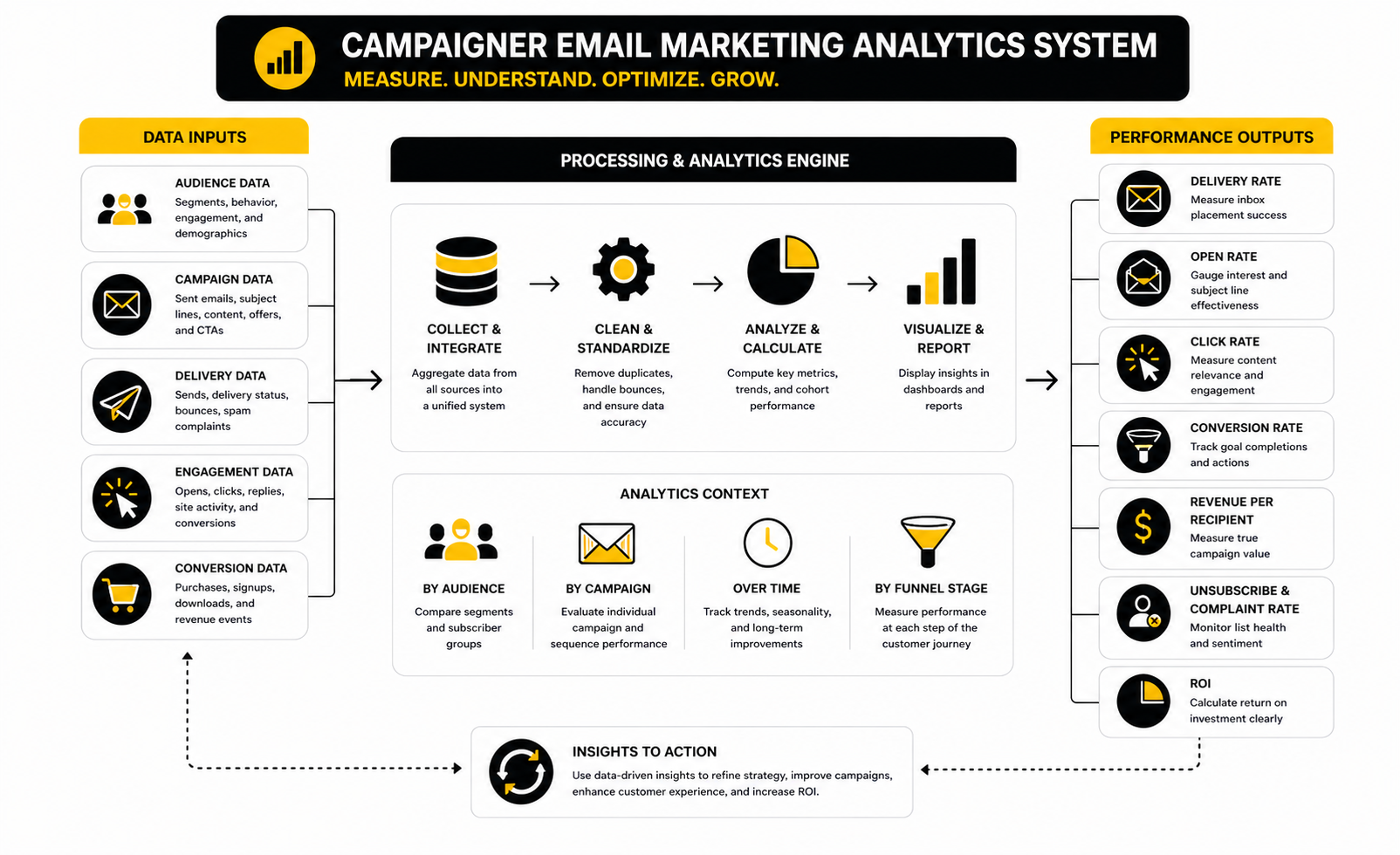
Campaigner email marketing data is useful only when it changes what you do next. A benchmark should never become an excuse. It should help you spot whether the problem is reach, relevance, offer strength, conversion friction, or list quality.
The most important thing is to read the numbers as a system. Delivery tells you whether the email reached the mailbox. Opens suggest attention, but they are imperfect. Clicks show intent. Conversions show whether the promise, page, and offer worked together.
Delivery Rate
Delivery rate is the first health signal because nothing else matters if the email does not arrive. The DMA Email Benchmarking Report 2025 found that delivery rates reached 98% in 2024 in its latest benchmark report. That sounds high, but it also means a business sending 100,000 emails could still lose 2,000 messages before engagement even starts.
Low delivery usually points to technical or list-quality issues. Check authentication, bounce rates, spam complaints, old contacts, and risky acquisition sources before blaming the copy. If delivery is weak, fix the sending foundation first.
Open Rate
Open rate can still help you compare subject lines, sender names, and broad audience interest. But it should not be treated as the final truth. Apple Mail Privacy Protection and similar privacy changes can make opens less precise, so open rate is better as a directional signal than a revenue metric.
The DMA report placed average open rates at 35.9%, while MailerLite’s 2025 benchmark data reported an average open rate of 43.46% in its email marketing benchmarks. The gap is the lesson. Benchmarks vary by dataset, industry, audience type, and methodology, so your own trend line matters more than chasing one universal number.
Click Rate
Click rate is usually more useful than open rate because it shows action. A person clicked because the email created enough interest to move them somewhere else. That makes clicks a stronger signal for message relevance, offer clarity, and call-to-action strength.
The DMA report found unique click rates reached 2.3%, while MailerLite reported an average email click rate of 2.09% in 2025 through its benchmark analysis. If your campaign sits below that range, do not immediately assume the audience is bad. First check whether the email has one clear call to action, a strong reason to click, and a destination that matches the promise.
Click-To-Open Rate
Click-to-open rate helps you understand how persuasive the email was after someone opened it. If opens are healthy but clicks are weak, the subject line may be doing its job while the body copy, offer, or call to action is not. That is a very different problem from poor deliverability.
MailerLite reported a 6.81% average click-to-open rate in 2025 in its industry benchmark report. Use that number carefully. A high-intent abandoned checkout email should usually beat a broad newsletter, while a cold educational campaign may naturally sit lower.
Conversion Rate
Conversion rate is where campaigner email marketing becomes real. A click is not the finish line. The finish line is the purchase, booking, signup, reply, upgrade, renewal, or other business outcome the campaign was built to create.
If clicks are strong but conversions are weak, the problem is probably after the email. The landing page may be unclear, the offer may not match the email, the form may be too long, or the checkout may create friction. This is why email reporting should connect to landing page analytics, CRM data, and revenue tracking instead of stopping inside the email platform.
Revenue Per Recipient
Revenue per recipient is one of the cleanest ecommerce and direct-response metrics because it connects email performance to list value. It tells you how much money each sent email generated on average. That matters more than a vanity open rate.
The formula is simple:
- Take total campaign revenue.
- Divide it by delivered recipients.
- Compare the result by segment, campaign type, and offer.
If one segment produces higher revenue per recipient, send more intelligently to that group. If another segment opens but does not buy, they may need education, a different offer, or a reactivation path instead of more promotions.
Unsubscribe And Complaint Rate
Unsubscribes are not always bad. Sometimes they clean the list and protect engagement. The real problem is a pattern of high unsubscribes or spam complaints after specific campaigns, because that tells you the message, frequency, or targeting is off.
MailerLite reported a 0.22% average unsubscribe rate in 2025 in its benchmark report. Gmail’s sender requirements also expect senders to stay below a reported spam rate of 0.3% in the Google email sender guidelines. Treat those numbers as warning lights, not trivia.
ROI
ROI is the metric leadership cares about, but it is also the one many teams track poorly. Litmus reported that 35% of companies see email ROI of 36:1 or more in its State of Email reports. That is powerful, but it only matters if your tracking can connect campaigns to actual revenue.
At minimum, track campaign cost, platform cost, creative cost, list growth cost, attributed revenue, and assisted revenue where possible. Do not pretend attribution is perfect. Just make it consistent enough to compare campaigns over time.
What The Data Should Make You Do
Data should lead to decisions. If delivery is weak, fix authentication and list hygiene. If opens are weak, test sender identity, subject lines, and segment relevance. If clicks are weak, improve the offer, email structure, and call to action.
If clicks are strong but conversions are weak, fix the page after the click. Tools like Replo, ClickFunnels, and Systeme.io can help when the bottleneck is the landing page or funnel path. If revenue is weak across the board, revisit the audience, offer, and campaign goal before tweaking button text.
Good analytics are not there to make reports look smart. They are there to show you the next constraint. Find the constraint, fix it, and measure again.
Optimization, Reporting, And Scaling
Once the campaign is live and the first data is coming in, the work changes. You are no longer building from assumptions. You are improving from evidence.
This is where campaigner email marketing becomes a real operating system. You look at what people opened, clicked, ignored, bought, booked, unsubscribed from, and complained about, then you make the next campaign sharper. Not louder. Sharper.
Segment Before You Scale
Scaling a weak campaign only makes the weakness more expensive. Before increasing volume, isolate the segments that are already showing strong intent. These may be recent leads, repeat buyers, webinar attendees, pricing-page visitors, or people who clicked but did not convert.
The mistake is assuming the whole list should receive the same next campaign. It should not. A highly engaged segment can handle more direct offers, while a colder segment may need education, trust-building, or a reactivation path first.
Use performance by segment to decide where to push and where to pause. If one group consistently clicks but does not convert, the problem may be offer fit. If another group barely opens, the issue may be relevance, sender recognition, or list fatigue.
Protect Sender Reputation As You Grow
The bigger your list gets, the more reputation matters. A small sender can sometimes get away with messy habits for a while. A larger sender cannot, because mailbox providers have more data to judge patterns quickly.
Google’s sender requirements tell senders to keep spam rates below 0.3% in its email sender guidelines. That is not a vanity benchmark. It is a hard warning that complaints, irrelevant campaigns, and poor targeting can limit your ability to reach the inbox.
The practical move is simple: suppress weak segments before they hurt the whole program. Remove hard bounces, reduce frequency for inactive subscribers, and use re-engagement campaigns before continuing normal promotions. Protecting reputation is not conservative. It is how you keep scaling.
Balance Automation With Human Judgment
Automation can save time, but it can also multiply bad decisions. If the wrong trigger fires, the wrong segment receives the wrong offer at the wrong moment. That feels careless to the reader, even if the workflow looked impressive inside the software.
Review automations like you would review a salesperson’s script. Every message should have context, timing, and a clear next step. If an automation still makes sense six months after launch, keep it. If the offer, audience, or product has changed, update it before it becomes a silent liability.
AI can help with drafting, testing ideas, and summarizing performance, but it should not own the strategy. The recent Sinch Mailgun Email Impact Report 2026 found that fewer than half of organizations can reliably track email ROI, even though 60% of companies that do track ROI report returns above $10 for every $1 spent through its email impact findings. That gap is the point. Better tools do not fix weak measurement or lazy strategy.
Use Testing To Answer Real Questions
Testing is useful only when it answers something specific. “Let’s test everything” usually means the team has no clear hypothesis. Better testing starts with one question that could change future decisions.
Useful tests include:
- Whether a direct subject line beats a curiosity-driven subject line
- Whether one offer angle creates higher click intent
- Whether a shorter email drives more action than a longer one
- Whether a plain-text style message beats a designed template
- Whether a segmented campaign produces higher revenue per recipient than a broad campaign
Do not test tiny details before the big levers are clear. Button color is not the first problem. Audience, offer, timing, and conversion path usually matter more.
Manage Frequency Without Guessing
Frequency is one of the hardest scaling decisions because there is no universal perfect number. Some audiences want frequent updates. Others punish over-sending quickly. The right answer depends on relevance, buying cycle, content quality, and subscriber expectations.
Watch behavior by cohort, not just the total list. If your most engaged buyers keep clicking and purchasing, they may tolerate a higher cadence. If newer leads start unsubscribing after the third message, the nurture path may be too aggressive.
A healthy campaigner email marketing program gives people reasons to stay. That means mixing promotional campaigns with useful education, product guidance, customer support, and timely updates. If every email asks for something, fatigue is coming.
Build A Reporting Rhythm
Reporting should happen on a predictable rhythm, not only when something breaks. Weekly checks can catch deliverability, unsubscribe, and click issues early. Monthly reviews can show campaign patterns, segment performance, and revenue trends.
The report does not need to be fancy. It needs to be useful. Track what was sent, who received it, what happened, what changed, and what the next action is.
A practical monthly review should answer:
- Which campaigns created the most revenue or qualified demand?
- Which segments performed best and worst?
- Which automations need cleanup?
- Which landing pages lost the most clicks?
- Which unsubscribe or complaint patterns need attention?
- What should be tested next?
This turns reporting into a decision tool instead of a screenshot collection.
Know When To Upgrade The System
At some point, the basic setup may become the bottleneck. That can happen when the team needs better CRM visibility, more advanced automation, cleaner lead routing, stronger funnel tracking, or tighter sales follow-up. The issue is not that the old tool is bad. It is that the business has outgrown the workflow.
If email needs to connect with pipelines, booking, SMS, reputation management, and sales follow-up, GoHighLevel can make sense. If the main bottleneck is funnel creation and offer testing, ClickFunnels or Systeme.io may be the cleaner move. If the team mainly needs email campaigns with straightforward automation, tools like Brevo or Moosend may be enough.
Do not upgrade software because the dashboard looks exciting. Upgrade when the current system is slowing execution, hiding important data, or forcing manual work that creates errors. The best platform is the one your team can actually use consistently.
Treat Email As A Long-Term Asset
The highest-leverage shift is thinking beyond individual sends. One campaign can create revenue. A strong email system creates repeatable customer movement.
That means your list, segments, automations, templates, reports, and learnings become assets. Every campaign should make the next campaign smarter. Every test should reduce uncertainty. Every segment should help you understand the market better.
This is the difference between sending emails and building an email marketing engine. One is activity. The other compounds.
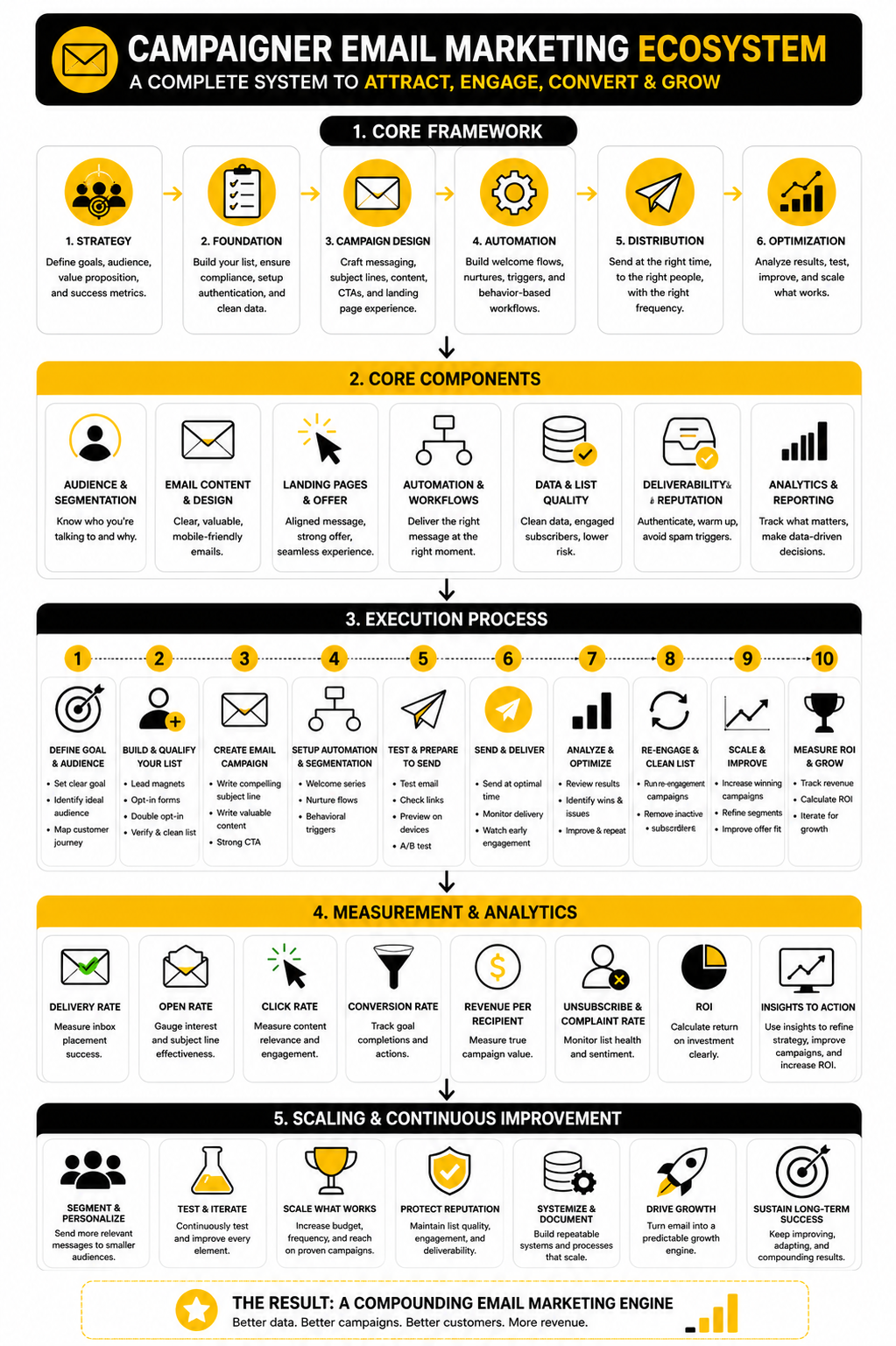
FAQ - Built For Complete Guide
What Is Campaigner Email Marketing?
Campaigner email marketing is the process of planning, sending, automating, and optimizing email campaigns with a clear business goal. It is not just writing newsletters or sending promotions whenever sales feel slow. It is a structured system that connects audience data, messaging, automation, landing pages, and reporting.
The best version of campaigner email marketing is practical. It helps the right people receive the right message at the right moment. That is what turns email from a task into a revenue channel.
Is Email Marketing Still Worth It?
Yes, email marketing is still worth it when the list is clean, the message is relevant, and the offer is strong. Email remains valuable because it is direct, measurable, and less dependent on social algorithms or ad platform changes. You still need strategy, but the channel itself is far from dead.
The mistake is expecting email to work with lazy campaigns. If the audience is cold, the offer is weak, or the follow-up path is broken, performance will suffer. Strong results come from strong systems.
What Metrics Matter Most?
The most useful metrics are delivery rate, click rate, conversion rate, unsubscribe rate, complaint rate, revenue per recipient, and campaign ROI. Open rate can still help directionally, but it should not be the main performance metric anymore. Privacy changes have made opens less reliable than they used to be.
Clicks and conversions usually tell the clearer story. If people click but do not convert, the landing page or offer needs work. If people do not click, the message, audience, or call to action needs attention.
How Often Should You Send Email Campaigns?
There is no universal perfect sending frequency. A daily email can work for one brand and destroy trust for another. The right cadence depends on audience expectations, content quality, buying cycle, and how relevant each campaign is.
Start by watching engagement and unsubscribe patterns. If engaged subscribers keep clicking and buying, you may be able to send more often. If unsubscribes rise or clicks fall, reduce frequency or improve relevance before sending more.
What Is The Biggest Mistake In Campaigner Email Marketing?
The biggest mistake is treating the whole list the same. New leads, inactive subscribers, first-time buyers, repeat customers, and high-value customers should not all receive identical campaigns. That approach is easy, but it leaves money on the table and creates fatigue.
Segmentation fixes a lot of this. Even basic groups based on engagement, purchase history, and campaign intent can improve the quality of your emails. Better targeting usually beats more volume.
Do Small Businesses Need Automation?
Yes, but automation should stay simple at first. A welcome sequence, abandoned checkout flow, post-purchase follow-up, and reactivation sequence can cover a lot of ground. You do not need a giant automation map to get real value.
The key is making every automated email feel useful. Automation should support the customer journey, not turn your brand into a cold machine. Start with the moments where timely follow-up clearly matters.
What Tools Are Best For Email Marketing?
The best tool depends on the system you need. If you want simple email campaigns and automation, platforms like Brevo and Moosend can be a practical fit. If you need CRM, pipelines, SMS, bookings, and advanced follow-up, GoHighLevel may make more sense.
If your campaigns depend heavily on funnels and sales pages, ClickFunnels or Systeme.io can support the broader conversion path. Choose based on workflow, not hype.
How Do You Improve Deliverability?
Start with the basics: authentication, clean lists, clear unsubscribe links, and consistent sending behavior. SPF, DKIM, and DMARC should be set up before serious campaigns go live. A clean sender reputation gives your emails a better chance of reaching the inbox.
List hygiene matters just as much. Remove hard bounces, suppress inactive subscribers, and avoid sending to people who never engage. Deliverability is earned over time.
Should Every Email Sell Something?
No. If every email asks for the sale, subscribers eventually tune out. Strong campaigner email marketing mixes education, proof, product guidance, relationship-building, and direct offers.
That does not mean you should avoid selling. It means your sales emails work better when the list already trusts you. Useful emails make promotional emails easier to accept.
How Long Should An Email Sequence Be?
The sequence should be as long as the decision requires, not longer. A low-risk offer may need two or three emails. A higher-ticket service, software trial, or complex buying decision may need a longer nurture path.
The real question is whether each email has a distinct purpose. If two emails say basically the same thing, combine them. If a key objection is not addressed, add a message that handles it clearly.
What Should You Test First?
Test the big levers first: audience, offer, subject line, email angle, call to action, and landing page. These changes can meaningfully shift performance. Small design tweaks should come later.
A useful test starts with a clear question. For example, you might test whether a direct benefit-driven subject line beats a curiosity-based subject line. Do not test randomly just to feel productive.
When Should You Hire A Professional?
Hire a professional when email has revenue potential but the system is messy, inconsistent, or underperforming. That usually means weak segmentation, poor automation, unclear reporting, low conversions, or deliverability problems. A good marketer can diagnose the whole path instead of only rewriting emails.
This matters because campaigner email marketing touches strategy, copy, data, tech, and analytics. If one piece breaks, results suffer. Professional help can turn scattered activity into a system that compounds.
Work With Professionals
Explore 10K+ Remote Marketing Contracts on MarkeWork.com
Most marketers spend too much time chasing clients, competing on crowded platforms, and losing a percentage of every project to middlemen.
MarkeWork gives you a better way. Browse thousands of remote marketing contracts and connect directly with companies desperate to hire skilled marketers like you, without platform commissions and without unnecessary gatekeepers.
If you're serious about finding better opportunities and keeping 100% of what you earn, explore available contracts and create a profile for free at MarkeWork.com.