

A certified digital marketing professional is not someone who simply collects badges. The real value comes from proving that you understand strategy, channels, data, automation, customer journeys, and implementation well enough to make better marketing decisions.
That matters because digital marketing is no longer a “nice skill.” Global internet use has passed major adoption milestones, social media continues to grow, and marketing teams are now expected to combine creativity with analytics, AI, and commercial judgment. The market still rewards capable marketers, with U.S. employment for market research analysts and marketing specialists projected to grow 7% from 2024 to 2034.
Article Outline
This article is split into six connected parts so each section builds naturally on the last. The goal is not to hype certification as a magic shortcut. The goal is to show how to use certification as a structured path toward practical marketing competence.
- Why Becoming A Certified Digital Marketing Professional Matters
- The Digital Marketing Professional Framework
- Core Skills Every Certified Digital Marketing Professional Needs
- Choosing The Right Certification Path
- Professional Implementation: Turning Certification Into Results
- Career Growth, Tools, Mistakes, And FAQ
Why Becoming A Certified Digital Marketing Professional Matters
A certification can help you organize your learning, but it only matters when it connects to real business outcomes. Employers and clients do not care that you watched lessons if you cannot explain positioning, track performance, improve campaigns, or turn insights into action. That is why the strongest certified digital marketing professional treats the credential as a system for building judgment, not as a trophy.
The demand is also broader than ads. Modern marketers need to understand search, email, funnels, analytics, social platforms, content, automation, creative testing, and customer retention. Reports from Google’s training ecosystem show that current digital marketing education now includes topics like AI tools, video content, and practical exercises, not just basic channel definitions through resources such as Google Skillshop.
There is one important warning: not every certificate pays off. The credential has to match the work you want to do, the tools you will actually use, and the type of marketing role you are targeting. A good certification path should make you more useful on Monday morning, not just more decorated on LinkedIn.
The Digital Marketing Professional Framework
The best way to think about certification is through a simple framework: strategy, execution, measurement, optimization, and systems. Strategy decides who you serve and why they should care. Execution turns that strategy into campaigns across channels.
Measurement tells you what is working, what is wasting money, and what needs to change. Optimization improves the offer, message, targeting, creative, landing page, funnel, and follow-up. Systems make the work repeatable, whether you use email platforms, CRM workflows, landing pages, chat automation, or reporting dashboards.
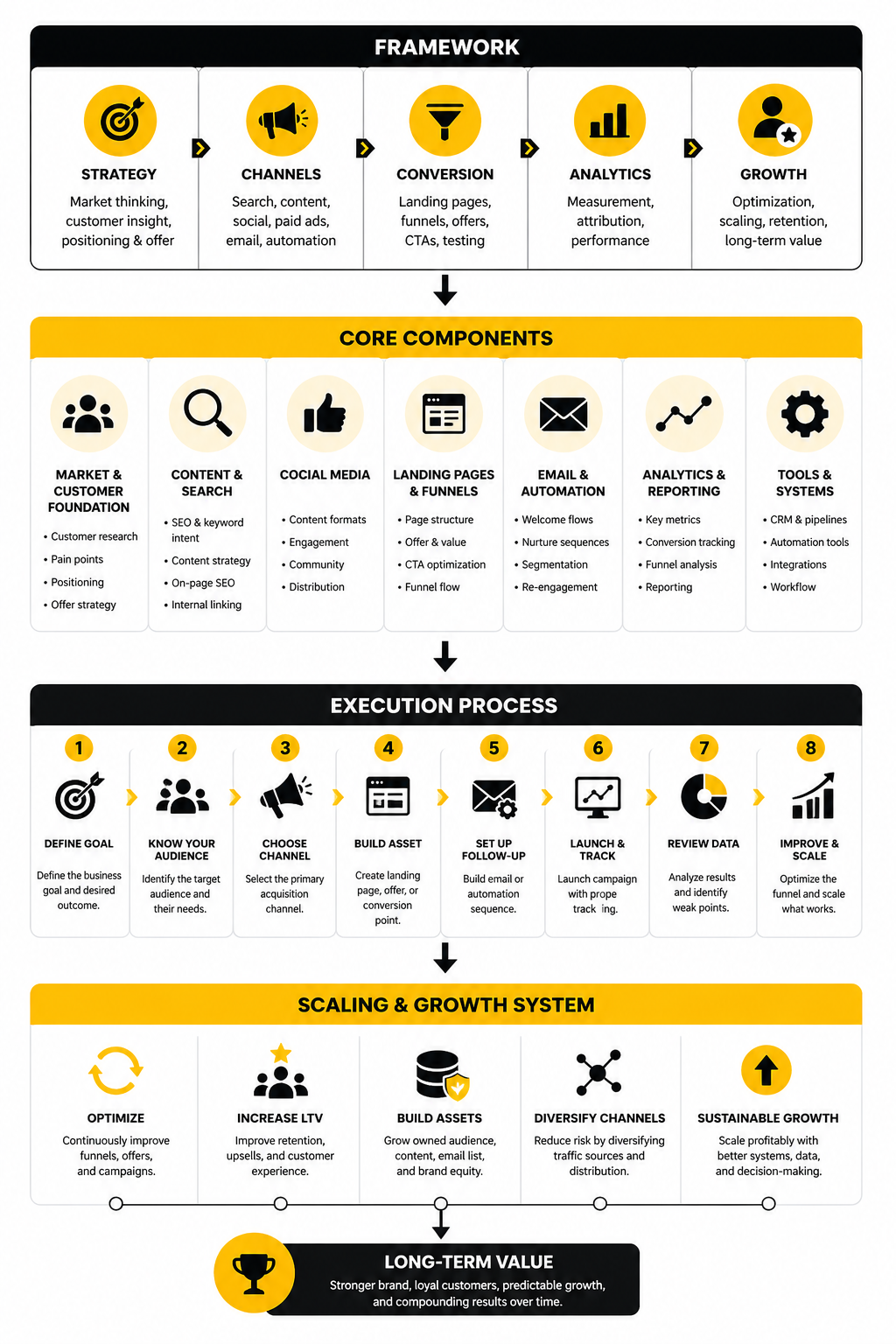
A certified digital marketing professional should be able to move through that framework without getting lost in random tactics. For example, social media posting is not a strategy by itself. Paid traffic is not a strategy by itself either. The professional skill is knowing how each channel supports a business goal and how to prove that connection with data.
Core Skills Every Certified Digital Marketing Professional Needs
A certified digital marketing professional needs more than platform knowledge. Platforms change, dashboards move, algorithms shift, and yesterday’s tactic gets copied fast. The durable skill is understanding how people discover, evaluate, trust, buy, and return.
The first core skill is market thinking. You need to know who the customer is, what problem they are trying to solve, what alternatives they compare, and what promise will make them pay attention. Without that, every channel becomes noisy because the message has no strategic center.
The second skill is channel execution. Search, paid ads, email, social, landing pages, automation, and analytics each have their own rules. But they should never operate as isolated tasks. A strong marketer connects them into one journey.
Strategy Comes Before Tools
Tools are useful, but they are not the strategy. A funnel builder, CRM, chatbot, scheduler, or email platform can speed up execution, but it cannot fix weak positioning. This is where many beginners get stuck: they collect software before they understand the offer.
A practical certification path should teach you how to define the customer, map the buying journey, choose the right channel, and set a measurable goal before launching anything. That order matters. Otherwise, you end up optimizing clicks that do not turn into revenue.
For implementation-heavy marketers, platforms like GoHighLevel can be useful when the work involves CRM pipelines, automation, follow-up, lead capture, and client campaign management. But again, the tool only becomes valuable when the strategy is already clear. Software should support the system, not replace the thinking.
Content, Search, And Social Media
Content is still one of the most important skills because it shapes trust before the sale. A certified digital marketing professional should understand how to create useful content, structure pages for search intent, and adapt ideas for different platforms. The job is not to “post more.” The job is to make the right message visible at the right moment.
Search skills matter because people often reveal intent through what they type. Someone searching for a comparison, tutorial, review, or pricing question is usually much closer to action than someone casually scrolling. That means marketers need to understand keyword intent, page structure, internal linking, and conversion paths.
Social media requires a different rhythm. It rewards consistency, relevance, timing, and format awareness. Tools like Buffer can help manage publishing workflows, but the core skill is still judgment: knowing what deserves to be posted, why the audience should care, and what action the content should create.
Funnels, Landing Pages, And Conversion
A good campaign does not stop at traffic. Once someone clicks, the landing page has to continue the conversation clearly. That means the headline, offer, proof, call to action, and page experience all need to work together.
This is where conversion skill separates serious marketers from casual operators. A certified digital marketing professional should know how to diagnose friction, simplify offers, improve forms, test calls to action, and remove unnecessary steps. Small improvements here can matter more than launching another campaign.
For funnel-focused work, platforms like ClickFunnels, Systeme.io, and Replo can fit different levels of complexity. ClickFunnels is often used for dedicated sales funnels, Systeme.io can suit simpler all-in-one setups, and Replo is useful when ecommerce teams need more control over landing page design. The right choice depends on the business model, not hype.
Email, Automation, And Customer Follow-Up
Email is not old-school. It is one of the few channels where a business can build a direct relationship without depending entirely on a social algorithm. A capable marketer understands welcome flows, lead nurture, segmentation, broadcast campaigns, reactivation, and post-purchase communication.
Automation matters because most customers do not buy the first time they see an offer. They need reminders, education, proof, objection handling, and timely follow-up. The goal is not to spam people. The goal is to make the next useful step obvious.
Tools like Brevo, Moosend, and ManyChat can support different parts of that system. Brevo and Moosend fit email marketing and automation needs, while ManyChat can help with conversational flows on supported messaging channels. A professional uses these tools to improve relevance, not to blast generic messages at everyone.
Analytics And Performance Thinking
Analytics is where opinion meets reality. You can love a campaign, but if it attracts the wrong audience, converts poorly, or produces weak customers, the data will expose it. That is a good thing.
A certified digital marketing professional should be comfortable reading campaign performance, conversion rates, cost per lead, customer acquisition cost, revenue attribution, retention signals, and funnel drop-off. You do not need to become a data scientist. You do need to know which numbers actually matter.
The best marketers use analytics to make decisions, not to decorate reports. They ask better questions: where are people dropping off, which audience converts best, which offer creates higher-quality leads, and which channel deserves more budget. That mindset turns marketing from activity into a commercial function.
Choosing The Right Certification Path
The right certification path depends on what you want the certificate to help you do. A beginner who wants a first marketing role needs a different path than a freelancer selling funnel builds, a founder managing acquisition, or an agency operator building systems for clients. That is why the question is not “Which certificate sounds impressive?” The better question is “Which certification helps me perform the work I want to be paid for?”
A certified digital marketing professional should look for training that covers strategy, execution, analytics, and implementation together. The market is moving too fast for narrow theory, especially with AI changing how marketers research, write, analyze, segment, and automate. LinkedIn’s workforce research says 70% of the skills used in most jobs are expected to change from 2015 to 2030, which is exactly why certification needs to build adaptable thinking, not just tool familiarity.
You also want proof that the curriculum is current. The American Marketing Association’s 2025 skills research was built from 1,200 marketers, more than 450 job postings, and expert interviews, and the pattern is clear: marketers need commercial judgment, AI literacy, channel fluency, and the ability to keep learning. A certificate that ignores those realities is already behind.
How To Evaluate A Digital Marketing Certification
Start with the curriculum. It should cover customer research, positioning, content, search, paid media, email, analytics, testing, reporting, and AI-assisted workflows. If it only teaches surface-level platform buttons, it may help you navigate a dashboard, but it will not make you a stronger marketer.
Then look at the assessment. A serious certification should require you to apply ideas, not just memorize definitions. Projects, campaign plans, audits, dashboards, landing page reviews, and practical exercises are stronger signals than simple multiple-choice quizzes.
Finally, check how the certificate fits your next step. If you want a job, choose a certification recognized by employers or connected to widely used tools. If you want clients, choose training that helps you produce deliverables clients understand: audits, funnel maps, email sequences, campaign reports, automation workflows, and growth plans.
Build A Practical Learning Stack
A useful learning stack has three layers: fundamentals, channel depth, and implementation tools. Fundamentals teach you how markets, offers, customers, and measurement work. Channel depth helps you become competent in the specific areas you plan to sell or manage.
Implementation tools turn knowledge into output. This is where many marketers become more valuable quickly because businesses do not just need advice. They need pages built, leads captured, follow-up automated, reports created, and campaigns improved.
A simple stack could look like this:
- Learn customer research, positioning, and offer strategy.
- Build core channel skills in search, content, email, paid traffic, and social.
- Create landing pages and funnels using tools like ClickFunnels, Systeme.io, or Replo.
- Set up email and automation using platforms like Brevo or Moosend.
- Connect CRM, pipeline, booking, and follow-up workflows with GoHighLevel when the business needs a more complete operating system.
- Review performance weekly and improve one constraint at a time.
Professional Implementation: Turning Certification Into Results
Implementation starts with diagnosis. Before you build anything, review the offer, audience, current traffic sources, conversion points, follow-up process, and reporting setup. A certified digital marketing professional should be able to spot where the growth system is leaking before recommending a new campaign.
The next step is mapping the customer journey. Where does someone first discover the business? What do they need to believe before they opt in, book, buy, or request a quote? What follow-up happens if they do not act immediately?
Once the journey is clear, execution becomes much cleaner. You are not randomly creating assets anymore. You are building the next missing piece in the system.
A Simple Execution Process
A practical process keeps you from overcomplicating the work. It also gives clients, managers, or founders confidence because they can see what is happening and why. This matters because marketing gets messy fast when every idea becomes urgent.
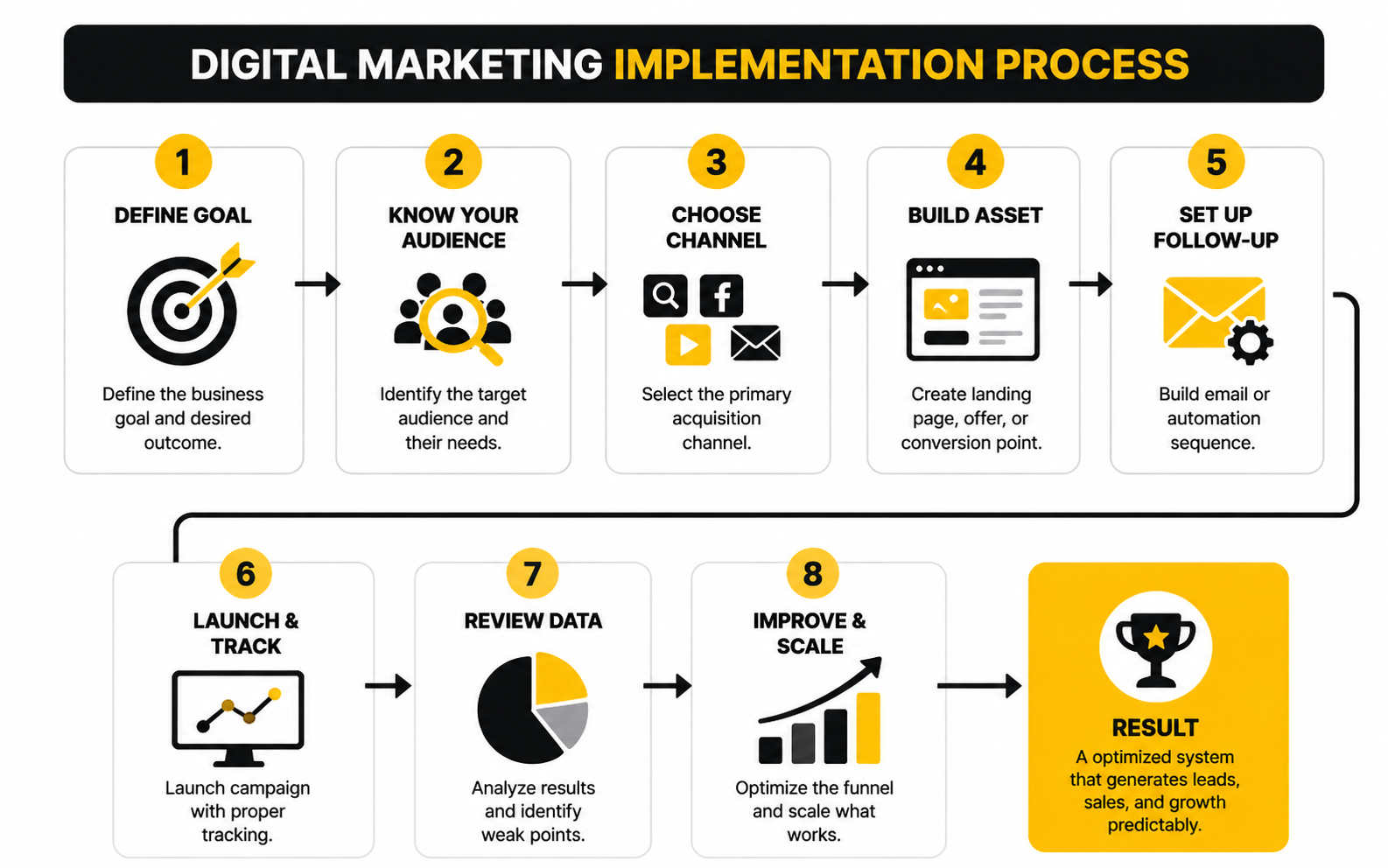
Use this sequence:
- Define the business goal.
- Identify the audience and primary offer.
- Choose the main acquisition channel.
- Build the landing page or conversion point.
- Create the follow-up sequence.
- Launch with clean tracking.
- Review the first data set.
- Improve the weakest step.
This is not glamorous, but it works. Most businesses do not need ten disconnected campaigns. They need one clear path from attention to action, then a disciplined process for making that path better.
What To Build First
Build the asset closest to revenue first. For many businesses, that means the landing page, booking flow, lead form, checkout page, or follow-up sequence. Traffic only helps when the destination can convert.
If the business already gets traffic but few leads, focus on the page and offer. If it gets leads but few sales, focus on qualification, nurturing, reminders, and sales handoff. If it gets sales but weak repeat purchases, focus on retention, segmentation, and post-purchase communication.
This is where certification becomes real. The certificate gives you the structure, but implementation proves whether you can think commercially. A professional marketer does not ask, “What tactic should I try next?” They ask, “Where is the constraint, and what should we improve first?”
Statistics And Data That Actually Matter
Data is useful only when it changes a decision. Random benchmarks can make an article look impressive, but they do not automatically make a campaign better. A certified digital marketing professional needs to know which numbers explain performance, which numbers are only directional, and which numbers are distracting noise.
The bigger market numbers show why measurement matters. U.S. internet advertising revenue reached nearly $300 billion in 2025, up 13.9% year over year, which means more money is moving into channels where performance can be tracked and optimized. But more spend also means more competition, higher expectations, and less patience for vague reporting.
Marketing budgets are not expanding endlessly either. Gartner’s 2025 CMO Spend Survey found marketing budgets remained at 7.7% of overall company revenue, the same level as the previous year. That tells you something important: marketers are being asked to do more with the same share of revenue, so measurement has to support sharper decisions.
The Analytics System
A clean analytics system connects four layers: traffic, engagement, conversion, and revenue. Traffic tells you where attention comes from. Engagement tells you whether the message is relevant enough to hold interest.
Conversion tells you whether the offer and page are strong enough to create action. Revenue tells you whether those actions actually create business value. If you only measure the first two layers, you may optimize for popularity instead of profit.
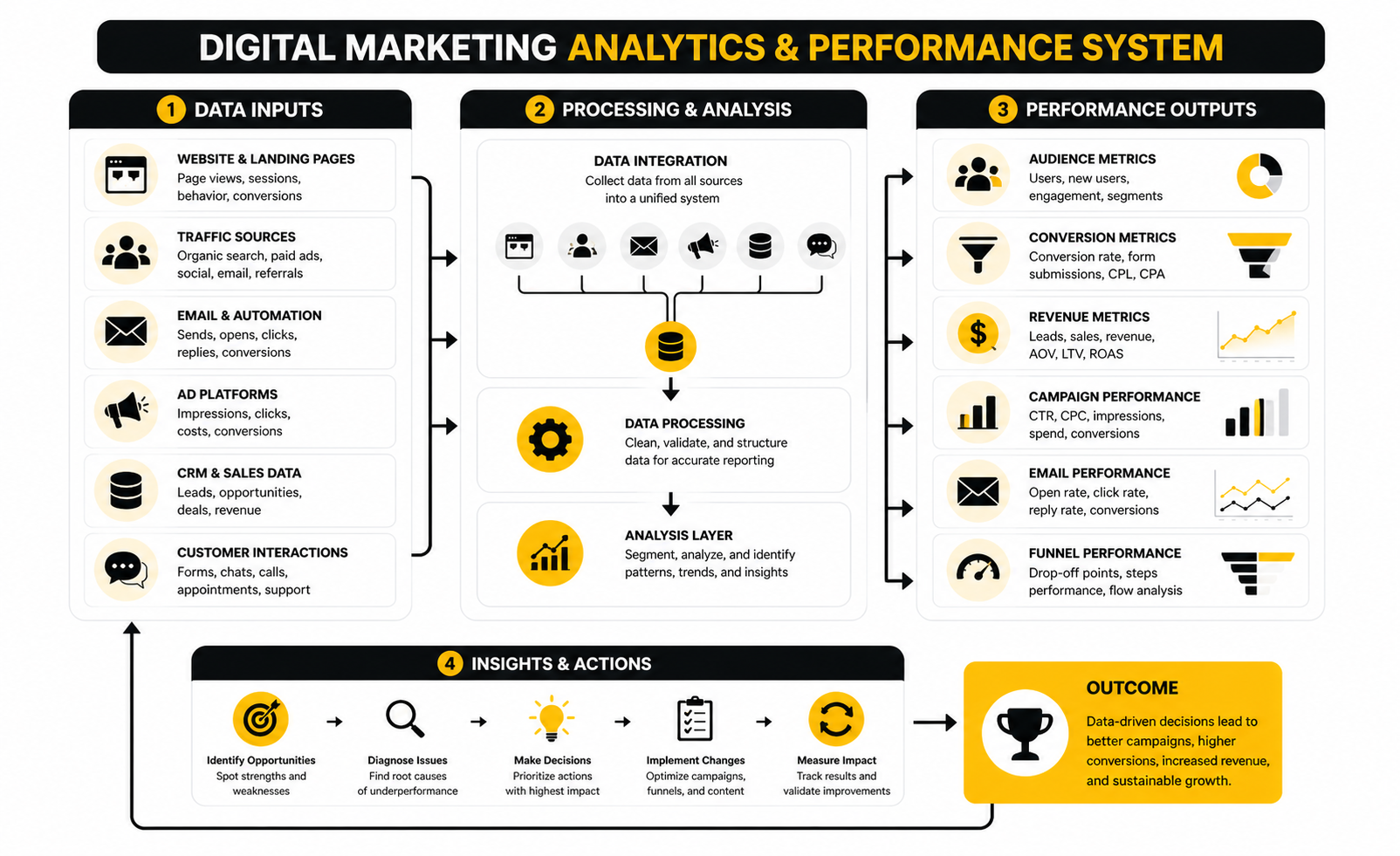
This is where a certified digital marketing professional becomes valuable. They do not just report that traffic increased. They explain whether that traffic came from the right audience, whether it moved people closer to buying, and whether the cost made sense.
Benchmarks Need Context
Benchmarks are useful as a starting point, not as a final verdict. WordStream’s 2025 Google Ads benchmark analysis of more than 16,000 U.S.-based campaigns reported an average search ad click-through rate of 6.66%, average cost per click of $5.26, average conversion rate of 7.52%, and average cost per lead of $70.11. Those numbers can help you spot obvious underperformance, but they cannot tell you whether your economics are healthy.
A $70 lead can be expensive for a low-ticket product and cheap for a high-value service. A 3% conversion rate can be terrible for a warm branded search campaign and acceptable for a cold, high-friction offer. A high click-through rate can still lose money if the landing page attracts curiosity instead of buyers.
So do not worship averages. Use them to ask better questions. Why is this campaign above or below the benchmark? Is the gap caused by targeting, creative, intent, offer, page quality, pricing, follow-up, or sales process?
Performance Signals To Track
The most useful metrics depend on the stage of the customer journey. Early-stage content should be judged by qualified reach, search visibility, useful engagement, and assisted conversions. Middle-stage assets should be judged by opt-ins, booked calls, demo requests, webinar registrations, or comparison-page actions.
Bottom-of-funnel performance needs tighter commercial tracking. Cost per acquisition, sales conversion rate, average order value, customer acquisition cost, payback period, and lifetime value become much more important. These are the numbers that tell you whether growth is sustainable.
A practical scorecard should include:
- Traffic source quality
- Landing page conversion rate
- Lead quality
- Cost per lead
- Sales conversion rate
- Customer acquisition cost
- Revenue per customer
- Retention or repeat purchase rate
- Return on ad spend where attribution is reliable
- Funnel drop-off by step
What The Numbers Should Make You Do
Good data should produce action. If traffic is low but conversion is strong, the next move may be distribution, search growth, paid acquisition, partnerships, or creator collaborations. If traffic is strong but conversion is weak, the problem is probably the offer, page, proof, form, audience match, or call to action.
If leads are cheap but sales are weak, do not celebrate. That usually means the campaign is attracting the wrong people or the follow-up process is not doing enough to qualify and educate them. If sales are strong but margins are thin, you may need to adjust pricing, reduce acquisition costs, improve retention, or shift toward higher-value segments.
This is why reporting should never be a screenshot dump. A certified digital marketing professional should end every performance review with clear decisions: keep, cut, improve, test, or scale. Anything less is just decoration.
Reporting That Builds Trust
A useful report is simple enough for a business owner to understand and detailed enough for a marketer to act on. It should show what changed, why it likely changed, what was learned, and what happens next. The goal is not to prove you were busy. The goal is to make the business smarter.
For client or team reporting, keep the structure consistent. Show the goal, the core metrics, the interpretation, the constraint, and the next action. When possible, connect campaign activity to pipeline, sales, or revenue instead of stopping at clicks and impressions.
Tools can help organize this, but the thinking still matters most. A CRM and automation platform like GoHighLevel can help connect leads, pipelines, follow-up, and campaign activity in one system, while a scheduling tool like Cal.com can make booked-call tracking cleaner when consultations are part of the funnel. The real win is not the dashboard itself. The real win is using the dashboard to make better decisions faster.
Advanced Considerations For Serious Marketers
Once the fundamentals are working, the job changes. You stop asking, “How do we launch this campaign?” and start asking, “How do we make this system stronger without breaking what already works?” That is a different level of thinking.
A certified digital marketing professional needs to understand tradeoffs, not just tactics. More traffic can expose a weak offer. More automation can create a colder customer experience. More tools can create more confusion if the team does not have a clear operating rhythm.
This is where professional judgment matters. The goal is not to do everything. The goal is to choose the next highest-leverage move based on strategy, capacity, data, and risk.
The Tradeoff Between Speed And Quality
Speed matters because marketing rewards momentum. You need to publish, test, learn, and adapt before the market moves on. But speed without quality creates sloppy positioning, weak creative, broken tracking, and campaigns that teach you almost nothing.
Quality matters because trust is expensive to rebuild. A poor landing page, vague offer, messy email sequence, or confusing checkout can damage performance even when the traffic source is strong. So the practical answer is not “move fast” or “perfect everything.” It is to define what must be excellent and what can be improved after launch.
For most campaigns, the offer, message, tracking, and conversion path need to be solid before traffic scales. Creative variations, secondary pages, email refinements, and reporting polish can improve in cycles. That balance keeps the team moving without turning the campaign into a guessing game.
AI Changes The Work, Not The Responsibility
AI is now part of serious marketing work, but it does not remove the need for human judgment. LinkedIn’s Work Change research says 70% of the skills used in most jobs will change by 2030, with AI acting as a major force behind that shift. For marketers, that means the value is moving from simply producing assets to directing better inputs, reviewing outputs, and connecting work to business goals.
A certified digital marketing professional should know how to use AI for research support, content drafts, segmentation ideas, campaign variations, analysis prompts, and workflow acceleration. But they also need to catch weak claims, generic messaging, brand inconsistency, privacy issues, and unsupported recommendations. AI can help you move faster, but it can also help you make bad ideas faster.
The smart approach is simple: use AI to increase throughput, not to outsource responsibility. Let it help with first drafts, summaries, variations, and operational speed. Keep the final judgment on positioning, proof, compliance, customer insight, and strategy in human hands.
Scaling Without Losing The Customer
Scaling is not just spending more. Real scaling means the business can handle more leads, more buyers, more follow-up, more support, and more complexity without creating a worse customer experience. If the backend is weak, growth creates stress instead of profit.
Before scaling acquisition, check the operational basics. Can the sales team respond quickly? Are leads being routed correctly? Are appointment reminders working? Are customers getting the information they need after they buy?
This is where systems matter. A CRM, automation workflows, forms, scheduling, and pipeline tracking can reduce friction when volume increases. Tools like GoHighLevel, Fillout, and Cal.com can support that kind of operational layer when the business needs cleaner lead capture, qualification, booking, and follow-up.
Risk Management In Digital Marketing
Every channel has risk. Paid ads can get more expensive. Organic reach can drop. Search rankings can shift. Email deliverability can decline. Tracking can become less reliable because of privacy changes and platform limitations.
That is why a mature marketer avoids building the entire business on one fragile dependency. Diversification does not mean doing every channel at once. It means building a practical mix of acquisition, retention, and owned audience assets so one platform change does not crush the whole system.
Risk management also includes compliance and trust. Claims need to be accurate, consent needs to be handled properly, and customer data needs to be protected. The AMA’s 2025 skills research highlights gaps in data, analytics, proving ROI, privacy, and compliance as key pressure areas for marketers, which makes these skills more than technical details; they are part of professional credibility.
When To Specialize And When To Stay Broad
Early in your career, it helps to understand the full system. You need enough range to see how search, content, paid traffic, landing pages, email, analytics, and sales follow-up connect. That broad view prevents you from becoming a button-pusher.
Later, specialization can make you more valuable. You might focus on lifecycle marketing, paid acquisition, SEO strategy, ecommerce conversion, marketing automation, analytics, or funnel building. Specialists usually get sharper results because they spend more time solving the same class of problem.
The best path is T-shaped. Build a broad base first, then go deep in the area that matches your strengths and market demand. A certified digital marketing professional who understands the full system and owns one high-value specialty is much harder to replace than someone who only knows scattered tactics.
Common Mistakes That Slow Growth
The first mistake is chasing tools before clarifying the offer. A better platform will not fix a message people do not care about. Start with the customer, the pain, the promise, and the reason to act now.
The second mistake is measuring activity instead of impact. Publishing more, sending more emails, and launching more ads can look productive while the actual funnel stays weak. Track what moves people closer to revenue.
The third mistake is scaling too early. If the page does not convert, the follow-up is weak, or the sales process is messy, more traffic only makes the leak bigger. Fix the constraint first, then add pressure.
The fourth mistake is treating certification as the finish line. The certificate may help you structure your learning, but the real skill comes from applying it, reviewing results, and improving under real conditions. That is the part that turns knowledge into professional value.
Career Growth, Tools, Mistakes, And FAQ
The final layer is turning skill into opportunity. A certified digital marketing professional should not rely on the certificate alone to create career growth. The certificate can open a door, but your portfolio, judgment, communication, and ability to improve results are what keep you in the room.
This is especially important because marketing roles are changing quickly. LinkedIn’s Work Change research expects 70% of the skills used in most jobs to change by 2030, while the AMA’s 2025 research highlights digital marketing, analytics, ROI proof, privacy, and compliance as major marketer skill gaps. That is not a reason to panic. It is a reason to keep building practical proof.
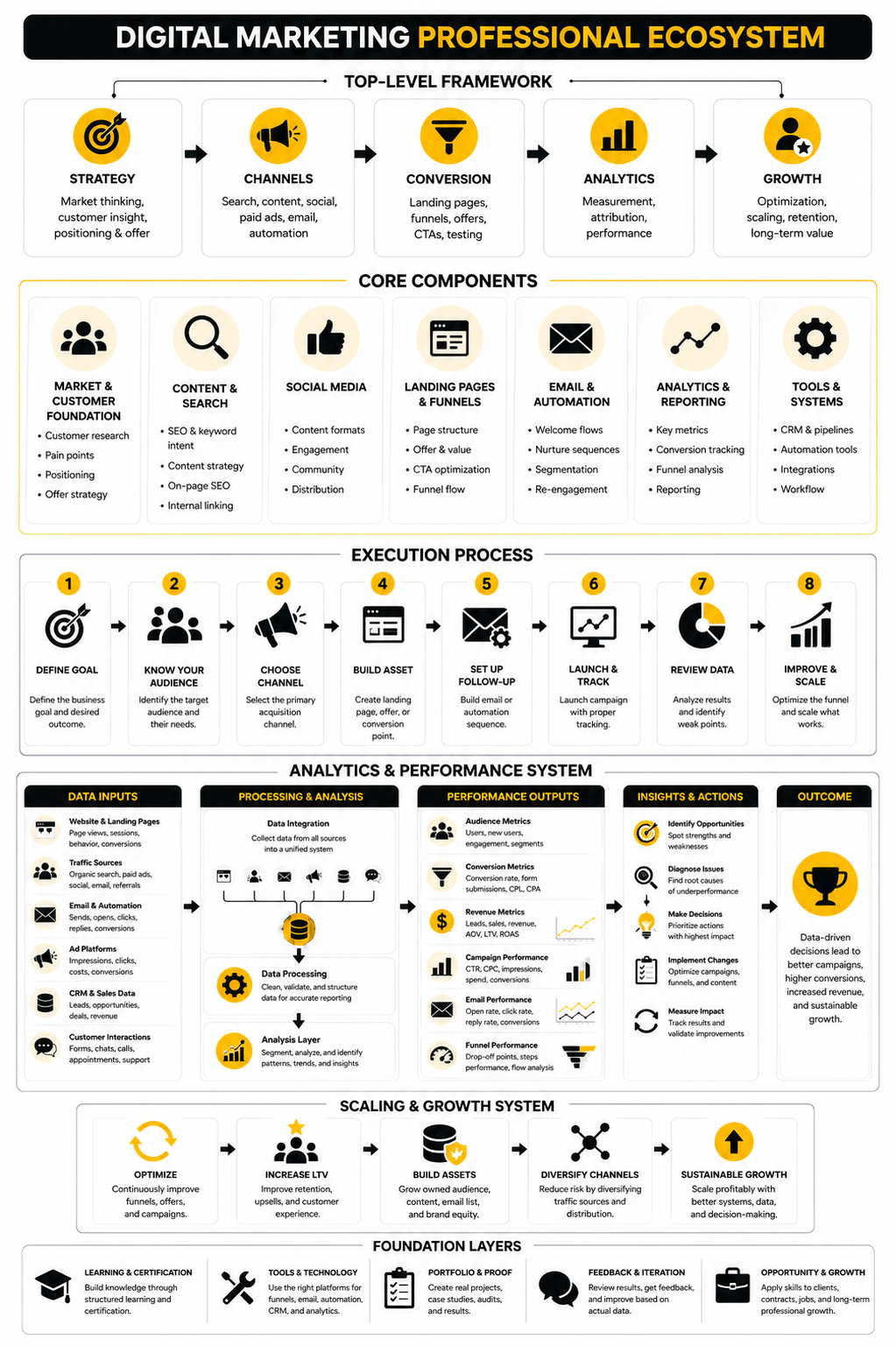
Your ecosystem should include learning, execution, feedback, tools, and opportunity. Learning gives you the foundation. Execution gives you proof. Feedback sharpens your judgment. Tools help you move faster. Opportunity turns that skill into contracts, clients, jobs, and long-term leverage.
FAQ - Built For Complete Guide
What Is A Certified Digital Marketing Professional?
A certified digital marketing professional is someone who has completed structured training in digital marketing and earned a credential that confirms their understanding of core marketing concepts. The best professionals go beyond the certificate and apply those concepts to real campaigns, analytics, funnels, content, and customer journeys. The certificate is useful, but the practical ability behind it matters much more.
Is A Digital Marketing Certification Worth It?
A digital marketing certification is worth it when it helps you build practical skill, understand modern channels, and produce work you can show. It is less useful if it only gives you theory without implementation. Choose a certification that helps you create audits, campaigns, landing pages, email flows, reports, and strategy documents.
Can I Get A Marketing Job With Only A Certification?
You can sometimes get an entry-level opportunity with a certification, but it is stronger when paired with proof of work. Employers want to see that you can think, execute, measure, and communicate clearly. Build a small portfolio alongside the certification so you are not relying on the badge alone.
What Skills Should I Learn First?
Start with customer research, positioning, content, search intent, landing pages, email, analytics, and basic campaign planning. These skills help you understand the full marketing system before you specialize. Once you have that base, go deeper into the area that best matches your goals.
How Long Does It Take To Become A Certified Digital Marketing Professional?
The timeline depends on the certification and your current skill level. Some certificates can be completed in weeks, while deeper programs may take several months. The better question is how long it takes to become useful, because real competence comes from applying the lessons to actual projects.
Which Digital Marketing Channel Should Beginners Focus On?
Beginners should usually start with one channel that teaches transferable thinking. Search teaches intent, content teaches messaging, email teaches follow-up, and paid ads teach testing and economics. Pick one main channel first, then learn how it connects to the rest of the funnel.
Do I Need To Learn AI For Digital Marketing?
Yes, but do not treat AI as a replacement for marketing judgment. Use AI for research support, draft creation, campaign variations, summaries, workflows, and analysis support. Keep strategy, customer insight, claims, compliance, and final decisions under human control.
What Tools Should A Certified Digital Marketing Professional Know?
You should understand tools for analytics, landing pages, email, automation, CRM, scheduling, forms, social publishing, and reporting. The exact stack depends on the business model. For example, GoHighLevel, ClickFunnels, Systeme.io, Buffer, Brevo, and ManyChat can all fit different workflows when used for the right reason.
How Do I Build A Portfolio Without Clients?
Create practical sample projects. Build a funnel map, write an SEO content brief, redesign a landing page concept, create an email welcome sequence, audit a public website, or build a simple campaign plan for a real category. Make it clear that the work is speculative if it was not commissioned.
What Is The Biggest Mistake New Digital Marketers Make?
The biggest mistake is chasing tactics before understanding the customer and offer. New marketers often jump into tools, ads, and templates too quickly. Strong marketing starts with the market, the message, the offer, and the action you want people to take.
How Should I Measure My Progress?
Measure your progress by what you can create and explain. Can you map a funnel, identify a weak conversion point, write a clearer offer, build a campaign, read the numbers, and recommend the next move? If yes, you are building professional skill, not just consuming information.
Should I Become A Generalist Or A Specialist?
Start as a generalist so you understand the whole system. Then specialize once you see which part of marketing you enjoy and where the market pays well. The strongest path is usually T-shaped: broad enough to understand strategy, deep enough to own a valuable specialty.
How Do I Stand Out As A Certified Digital Marketing Professional?
Stand out by showing practical proof. Share audits, process breakdowns, before-and-after improvements, campaign thinking, dashboards, and clear explanations of your decisions. People trust marketers who can make complex work simple and connect actions to business outcomes.
What Should I Do After Getting Certified?
Apply what you learned immediately. Build a portfolio, improve a real business asset, volunteer for a small project, create a case-style breakdown, or apply for contracts where your new skill can be tested. The certificate is the starting point, not the finish line.
Work With Professionals
Explore 10K+ Remote Marketing Contracts on MarkeWork.com
Most marketers spend too much time chasing clients, competing on crowded platforms, and losing a percentage of every project to middlemen.
MarkeWork gives you a better way. Browse thousands of remote marketing contracts and connect directly with companies desperate to hire skilled marketers like you, without platform commissions and without unnecessary gatekeepers.
If you are serious about finding better opportunities and keeping 100% of what you earn, explore available contracts and create a profile for free at MarkeWork.com.