

Email marketing is still one of the most profitable channels in digital marketing, but most businesses quietly overspend on it. The problem isn’t email itself—it’s choosing the wrong platform too early and getting locked into pricing models that scale badly.
Recent data shows email marketing can return over $36 for every $1 spent, and in some cases even higher when optimized properly. But that ROI collapses fast if your software costs spiral as your list grows or if you’re paying for features you never use.
That’s why finding the cheapest email marketing platform isn’t about picking the lowest monthly price. It’s about understanding how pricing actually works, what drives long-term cost, and where hidden fees creep in.
This guide breaks it down step by step so you can make a smart decision from day one.
Article Outline
- Why Cheap Email Marketing Platforms Actually Matter
- How Pricing Models Really Work
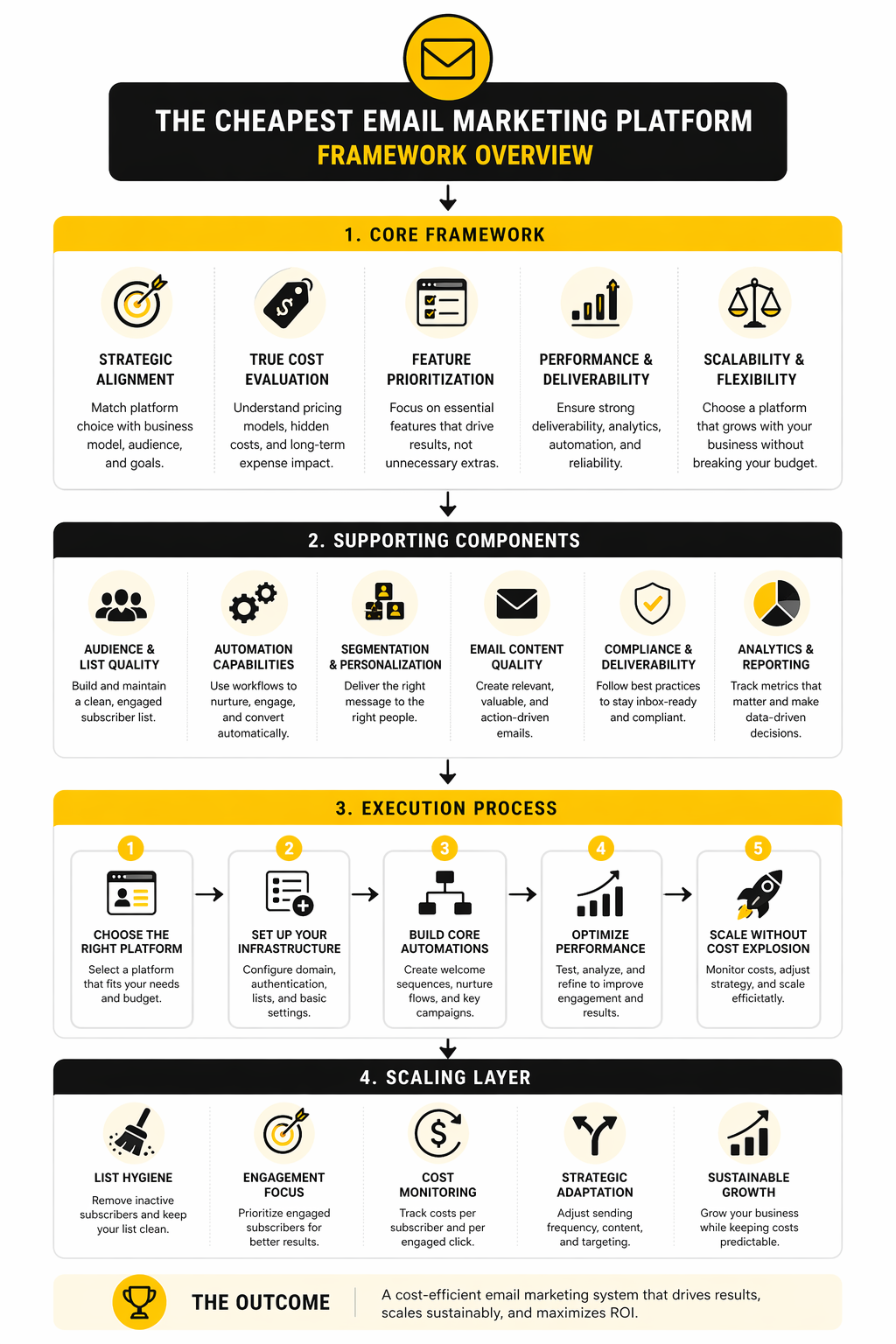
- Framework for Choosing the Right Platform
- Core Features You Should Never Sacrifice
- How Professionals Keep Costs Low at Scale
- Final Recommendations and FAQs
Why Cheap Email Marketing Platforms Actually Matter
Most people think email tools are cheap until they hit scale. That’s when the pricing traps reveal themselves.
A platform that starts at $10 per month can quietly turn into $100+ as your list grows. For example, tools like Mailchimp increase pricing aggressively with subscriber count, and even charge for inactive contacts in some cases, which can inflate costs by 10–20% .
That creates a dangerous pattern. You build your system, automate campaigns, integrate everything—and then switching becomes painful. So you keep paying.
This is exactly why choosing the cheapest email marketing platform early matters more than people think. You’re not just saving money now. You’re preventing future lock-in.
There’s another layer to this.
Affordable platforms often outperform expensive ones for small and mid-sized businesses. Tools like Brevo, MailerLite, and Moosend consistently show up as lower-cost alternatives while still offering automation, segmentation, and analytics .
And here’s the key shift most people miss:
cheap doesn’t mean limited anymore.
Modern platforms compete heavily on features. Many budget tools now include CRM systems, automation workflows, and even AI-driven segmentation—features that used to be enterprise-only.
How Pricing Models Really Work
To find the cheapest email marketing platform, you need to understand how pricing actually works behind the scenes. This is where most people get it wrong.
There are three main pricing models:
1. Contact-Based Pricing
This is the most common—and often the most expensive long-term.
You pay based on how many subscribers you have, regardless of how often you email them.
- Mailchimp is the classic example
- Costs increase every time your list grows
- You may even pay for unsubscribed or inactive contacts
This model punishes growth. The better your marketing works, the more you pay.
2. Email Volume-Based Pricing
This model charges based on how many emails you send instead of how many contacts you store.
Platforms like Brevo use this structure, which can reduce costs significantly—sometimes by 60–75% compared to contact-based pricing at scale .
This is ideal if:
- You have a large list
- You don’t email constantly
- You want predictable costs
If you want to explore a platform built around this model, you can check out Brevo here, which combines email, SMS, and CRM in one system.
3. Hybrid or Feature-Based Pricing
Some tools combine both models or add pricing tiers based on features.
This is where things get tricky.
You might start cheap, but:
- Automation features are locked behind higher tiers
- Advanced segmentation costs extra
- Integrations require upgrades
That’s how platforms hook users early and monetize later.
Framework for Choosing the Right Platform
Instead of chasing the lowest monthly price, you need a simple framework that keeps your costs low over time.
Here’s the practical way to think about it.
Step 1: Estimate Your Growth
Don’t choose based on your current list size. Choose based on where you’ll be in 6–12 months.
If you expect:
- 1,000 → 10,000 subscribers
- Regular campaigns
- Automation sequences
Then your pricing model matters more than your starting plan.
Step 2: Match Pricing to Behavior
Ask yourself:
- Do I send emails frequently? → volume-based pricing wins
- Do I store large lists but send rarely? → volume-based again
- Do I send daily campaigns? → contact-based might be okay
This single decision can cut your costs in half.
Step 3: Avoid Feature Traps
Some platforms look cheap but lack essentials like:
- Automation workflows
- Segmentation
- A/B testing
Then you’re forced to upgrade.
A better approach is choosing platforms that include core features upfront. For example, tools like Moosend are known for offering automation at lower entry pricing compared to competitors.
Step 4: Think Beyond Email
This is where smart marketers save the most money.
Instead of stacking multiple tools (email + CRM + funnels), some use all-in-one platforms.
For example, platforms like GoHighLevel combine:
- email marketing
- CRM
- funnels
- automation
This reduces total software costs—even if the tool itself isn’t the cheapest on paper.
This is where most people have their first realization:
The cheapest email marketing platform isn’t the one with the lowest monthly price.
It’s the one that stays affordable as your business grows.
In the next part, we’ll break down the core components that actually determine value, and how to avoid overpaying for features you don’t need.
Core Features You Should Never Sacrifice
Once you understand pricing models, the next mistake is cutting too deep on features just to save money. This is where many people choose the wrong cheapest email marketing platform and end up paying for it later in lost performance.
There’s a baseline set of features that directly impact your revenue. If your platform lacks these, your campaigns will underperform—even if the tool itself is cheap.
Automation Is Non-Negotiable
Automation is where most of your ROI comes from. Welcome sequences, abandoned cart emails, onboarding flows—these run 24/7 without manual work.
Platforms that restrict automation to higher tiers force you into upgrades quickly. That’s why tools like Moosend stand out—they include automation early, not as an upsell.
Without automation, you’re stuck sending manual campaigns. That limits scalability and burns time.
Segmentation Drives Performance
Sending the same email to everyone doesn’t work anymore. Segmentation allows you to target users based on behavior, interests, or engagement level.
Even simple segmentation can increase open rates and conversions significantly. Campaign Monitor highlights that segmented campaigns can drive higher engagement across industries (campaignmonitor.com).
If your platform doesn’t allow flexible segmentation, it’s not actually cheap—it’s inefficient.
Deliverability Matters More Than Price
A cheap platform that lands in spam is expensive in disguise.
Deliverability depends on:
- infrastructure quality
- IP reputation
- authentication tools (SPF, DKIM, DMARC)
This is where established platforms like Brevo have an advantage. They invest heavily in sender reputation systems that protect your campaigns.
If emails don’t reach inboxes, nothing else matters.
Analytics and Testing Close the Loop
Without data, you’re guessing.
At minimum, your platform should give you:
- open rates
- click-through rates
- conversion tracking
- A/B testing
These features let you improve campaigns over time instead of repeating the same mistakes.
Many low-cost tools now include these capabilities, which is why the gap between budget and premium platforms has narrowed dramatically.
Hidden Costs That Make “Cheap” Expensive
This is where things get real.
A platform can look like the cheapest email marketing platform on the surface and still cost you more over time. The difference comes down to hidden costs.
Paying for Inactive Contacts
Some platforms charge for every contact in your database—even if they never open your emails.
That means:
- old leads
- unsubscribed users
- inactive subscribers
You’re paying for dead weight.
This alone can inflate your bill by 20–30% over time, especially if you’re not cleaning your list regularly.
Feature Paywalls
A common pattern looks like this:
- Low entry price
- Basic features included
- Advanced features locked
Then you realize:
- automation requires an upgrade
- segmentation is limited
- integrations cost extra
Now your “cheap” tool isn’t cheap anymore.
This is why evaluating feature access upfront is critical.
Integration Costs Add Up Fast
Email platforms rarely operate alone.
You may need:
- CRM integration
- landing pages
- funnel builders
- chat automation
If your email tool doesn’t include these, you’ll stack additional tools—and each one adds cost.
This is where all-in-one systems like GoHighLevel can actually become cheaper overall. Instead of paying for five tools, you consolidate into one.
Scaling Penalties
Some platforms scale aggressively in pricing.
You might start at:
- $15/month
But as your list grows:
- $50/month
- $100/month
- $300/month
This happens faster than most expect.
Platforms using email volume pricing or flexible tiers tend to avoid these sharp jumps, which is why they’re often better long-term choices.
The Real Definition of “Cheap” in Email Marketing
At this point, the definition should be clear.
The cheapest email marketing platform is not:
- the lowest monthly fee
- the simplest interface
- the most popular brand
It’s the platform that:
- aligns with your sending behavior
- includes core features upfront
- avoids aggressive scaling costs
- reduces the need for additional tools
This is a strategic decision, not a tactical one.
And once you get it right, your email system becomes a profit engine instead of a recurring expense.
In the next part, we’ll break down how professionals actually implement these platforms in real workflows—and how they keep costs low even as their email lists grow.
How Professionals Keep Costs Low at Scale
This is where theory turns into execution.
Most beginners focus on picking the cheapest email marketing platform. Professionals focus on building a system that stays cheap no matter how big the list gets. That shift changes everything.
They don’t rely on luck or guesswork. They follow a repeatable process that keeps costs predictable while maximizing output.
Step 1: Start With a Lean Stack
The first move is avoiding tool overload.
Instead of stacking five different tools, experienced marketers either:
- choose a platform with built-in automation and CRM
- or combine two tools that cover everything essential
For example, pairing email with funnel builders like ClickFunnels or using all-in-one platforms like GoHighLevel reduces the need for extra subscriptions.
The goal is simple: fewer tools, lower cost, less complexity.
Step 2: Control List Growth Intelligently
This is one of the biggest cost levers—and almost nobody uses it properly.
Instead of blindly growing a list, professionals:
- remove inactive subscribers regularly
- segment engaged vs. unengaged users
- avoid storing low-quality leads
This matters because many platforms charge per contact. Keeping a clean list directly reduces your monthly bill.
List hygiene also improves deliverability, which increases revenue without increasing cost.
Step 3: Build Automation Early
Waiting to set up automation is a mistake.
Professionals implement:
- welcome sequences
- nurture campaigns
- re-engagement flows
from day one.
This ensures every new subscriber generates value immediately. It also reduces the need for constant manual campaigns, saving both time and operational cost.
Platforms like Brevo and Moosend make this accessible even at lower price points.
Step 4: Optimize Sending Frequency
More emails don’t always mean more revenue.
Professionals track engagement data and adjust:
- how often they send
- who receives what
- when campaigns go out
This is especially important if you’re using volume-based pricing. Sending fewer, better emails can significantly reduce costs while maintaining performance.
Step 5: Use Multi-Channel Strategically
Email doesn’t exist in isolation anymore.
Smart marketers combine it with:
- SMS
- chat automation
- funnels
For example, tools like ManyChat can handle chat flows that reduce reliance on email volume.
This spreads communication across channels, which can lower email sending costs and improve overall engagement.
The Execution Framework You Can Follow
At this point, the process becomes concrete. You don’t need a complicated system—you need a clear sequence.
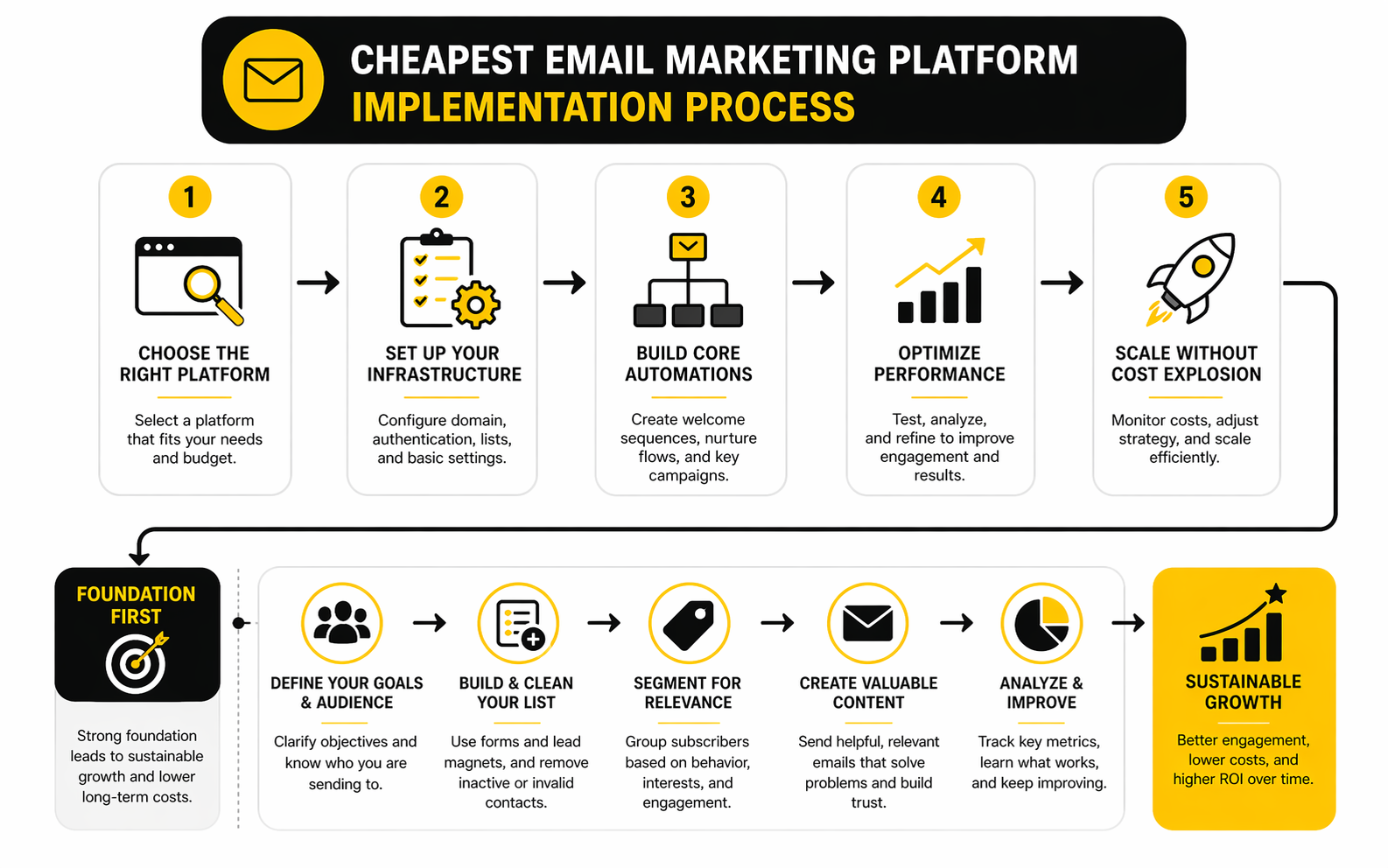
Phase 1: Setup
Start by choosing a platform that aligns with your expected growth and pricing model. Set up your core infrastructure, including domain authentication and basic segmentation.
Then connect your essential tools. This might include a funnel builder like Systeme.io or CRM features inside your email platform.
The goal here is stability, not perfection.
Phase 2: Automation Build
Create your foundational flows:
- Welcome sequence
- Lead nurturing emails
- Basic promotional campaigns
Keep it simple at first. You’re building a system that works without constant input.
This is where your cheapest email marketing platform starts generating real value.
Phase 3: Optimization
Once your system is running, focus on improving efficiency.
- remove inactive subscribers
- refine segmentation
- test subject lines and content
Even small improvements here compound over time.
Phase 4: Scaling Without Cost Explosion
This is the final step most people mishandle.
Instead of letting costs grow uncontrollably, professionals:
- monitor pricing thresholds
- adjust sending behavior
- switch plans or platforms if needed
They treat email marketing like a system that needs ongoing calibration—not a set-and-forget tool.
At this stage, something becomes obvious.
The cheapest email marketing platform is only part of the equation.
The real advantage comes from how you use it.
In the next part, we’ll break down specific platform recommendations and compare them based on real-world use cases so you can choose the best option for your situation.
What the Numbers Actually Tell You
By this point, the cheapest email marketing platform should already look different in your mind. It is not just a pricing decision anymore. It is an analytics decision, because the wrong platform makes it harder to see what is working, what is breaking, and where your costs are quietly rising.
This is exactly why measurement matters. Cheap software without usable reporting turns optimization into guesswork. And guesswork is expensive.
Start With the Metrics That Actually Change Decisions
Most dashboards throw too much information at you. What matters is knowing which numbers should trigger action.
For email, the core signals are:
- delivery rate
- open rate
- click-through rate
- unsubscribe rate
- bounce rate
- spam complaint rate
Brevo’s 2025 benchmark dataset, built from more than 44 billion emails, is useful here because it gives you a broad market reference instead of one-off anecdotes (Brevo benchmark data). That kind of context matters because a 25% open rate can be strong in one category and mediocre in another.
The action this should drive is simple: stop judging performance in isolation. Compare your results against your own history first, then against current market benchmarks.
Why Open Rates Need More Skepticism Now
Open rates still matter, but they are no longer clean. Privacy changes have made them less reliable as a standalone signal.
Brevo’s reporting documentation makes this explicit: open rate calculations now include Apple Mail Privacy Protection activity by default unless you exclude it, which can inflate opens and make campaigns look healthier than they really are (Brevo campaign statistics, Brevo MPP explanation).
That means you should treat open rate as a directional signal, not a final verdict. It is still useful for subject line testing and early trend spotting, but it should not be the number that decides budget, platform quality, or campaign success.
Clicks Tell You More About Real Intent
If you want one metric that gets closer to reality, it is click-through rate. A click shows active engagement, not passive loading behavior.
Brevo’s benchmark framework explicitly positions click-through rate as a truer indicator of intent in a privacy-first environment (Brevo marketing benchmark). That should shape how you evaluate the cheapest email marketing platform, because some tools give much clearer click reporting, segmentation visibility, and conversion tracking than others.
The action here is practical. If opens are stable but clicks fall, your subject line is probably fine and your message-body offer is weak. If opens drop but clicks among openers stay solid, your targeting or subject line likely needs work.
Build a Simple Analytics System Before You Scale
You do not need enterprise reporting. You need a system that helps you spot problems early and improve performance without adding cost.
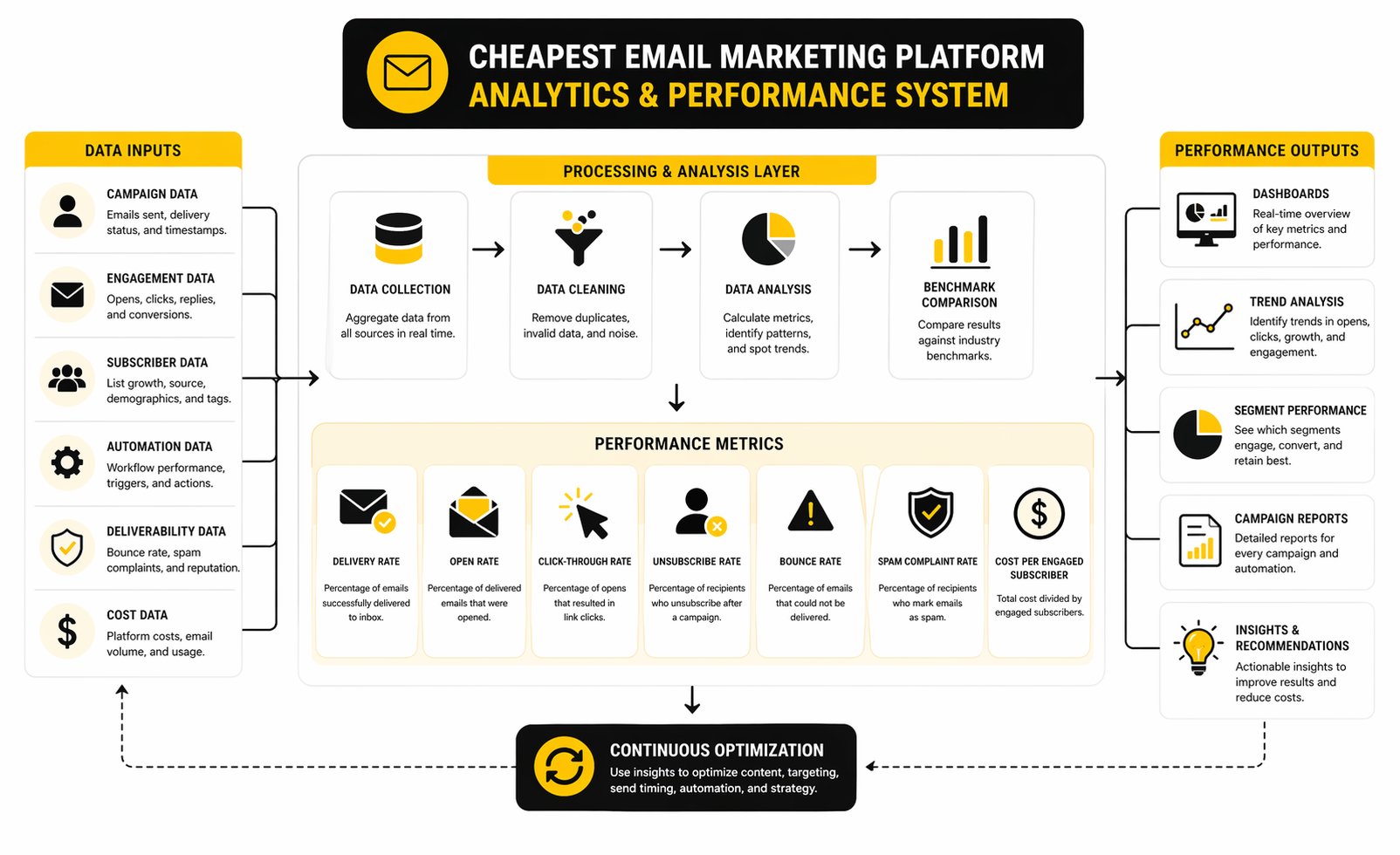
A useful tracking structure looks like this:
- Inbox health: delivery rate, bounce rate, spam complaints
- Attention: open rate trends, preferably with privacy-adjusted context
- Intent: click-through rate and click-to-open behavior
- Retention: unsubscribe rate and inactive subscriber growth
- Economics: platform cost per active subscriber or per engaged click
This is the point where analytics becomes operational. Instead of staring at vanity numbers, you can ask better questions: Are emails landing? Are people engaging? Are you paying for contacts who no longer care?
That last question is especially important. A platform can appear cheap on paper while becoming expensive in practice if your dashboard hides disengagement and encourages list bloat.
Deliverability Benchmarks Are Your Early Warning System
Deliverability problems usually show up before revenue problems. That is why smart operators monitor them closely.
GoHighLevel’s current guidance flags delivered rates at or above 98% as healthy, around 97–98% as a warning area, and under 97% as a red flag (GoHighLevel deliverability stats). That is not just a technical detail. It is the difference between a campaign problem and a system problem.
The action this should drive is immediate. If delivery drops, pause optimization experiments and check domain setup, list quality, and recent sending behavior first. There is no point improving copy when the real issue is that the emails are not making it to the inbox.
Reputation Metrics Usually Explain Cost Problems Too
A lot of people separate performance from price. That is a mistake.
GoHighLevel’s deliverability documentation links low reputation to poor engagement, bounce issues, authentication problems, and sudden sending spikes (domain reputation guidance). Those same issues also drive cost inefficiency because they force you to send more to get the same result, or keep inactive records longer than you should.
This is where the numbers become strategic. Bad reputation does not just hurt campaign performance. It makes your cheapest email marketing platform less efficient by lowering the output you get from every dollar spent.
Benchmarks Should Guide Action, Not Ego
Benchmark data is useful, but only when you use it correctly. It should help you diagnose, not posture.
If your open rate is above benchmark but clicks are weak, you likely have a message problem. If clicks are fine but unsubscribe rates rise, you may have a targeting or frequency issue. If your metrics are all decent but software cost keeps climbing, your pricing model is probably the problem rather than campaign execution.
That is the deeper point. Numbers only matter when they tell you what to do next.
The Best Low-Cost Platforms Make Measurement Easier
This is where platform choice comes back into focus. A cheap tool with poor reporting creates expensive blind spots.
Brevo’s campaign reports and benchmark resources make it easier to separate inflated open activity from real engagement, while GoHighLevel’s reporting emphasizes delivered, bounce, unsubscribe, and complaint trends that matter for long-term sending health (Brevo campaign report tools, GoHighLevel email statistics).
That should influence your buying decision more than flashy templates or a low entry price. Because once your list grows, clear analytics save money every single month.
In the next part, we’ll move from measurement to platform selection and compare the most realistic low-cost options based on business type, growth stage, and long-term value.
Advanced Tradeoffs Most People Miss
By now, you’ve seen how pricing, features, and analytics connect. But this is where things get more nuanced.
The cheapest email marketing platform can still become the wrong choice if you ignore long-term tradeoffs. At scale, small decisions compound—and they don’t always show up immediately.
Simplicity vs. Flexibility
There’s a real tension between tools that are easy to use and tools that are highly flexible.
Simpler platforms:
- are faster to set up
- reduce technical overhead
- work well for small teams
But they often limit:
- advanced automation logic
- deep segmentation
- custom integrations
On the other side, more flexible platforms like GoHighLevel give you full control, but they require more setup and ongoing management.
The decision here is not about skill level. It’s about how complex your marketing needs to become over time. If you plan to build funnels, multi-step automations, and cross-channel campaigns, flexibility becomes more valuable than simplicity.
Short-Term Savings vs. Long-Term Lock-In
A platform that looks cheap today can create switching friction later.
This happens when:
- your automations become deeply embedded
- your integrations rely on platform-specific features
- your team builds workflows around the tool
Switching then requires:
- rebuilding automations
- migrating data
- retraining processes
That cost is rarely visible upfront.
This is why some marketers intentionally choose platforms that are slightly more robust early on. It reduces the risk of expensive migrations later.
All-in-One vs. Specialized Stack
You’ve seen this pattern already, but at an advanced level, the tradeoff becomes more strategic.
All-in-one platforms:
- reduce total software cost
- simplify integrations
- centralize data
Specialized stacks:
- offer best-in-class features in each category
- provide more customization
- allow easier replacement of individual tools
For example, combining Systeme.io with a low-cost email platform can be cheaper early on. But as complexity grows, managing multiple tools can become inefficient.
There’s no universal answer here. The cheapest email marketing platform often depends on whether you prioritize consolidation or specialization.
Volume-Based Pricing vs. Engagement-Based Strategy
This is a subtle but important shift.
If you use volume-based pricing, your cost depends on how many emails you send. That creates a natural incentive to send fewer, more targeted campaigns.
If you use contact-based pricing, your cost depends on how many subscribers you store. That pushes you to clean your list aggressively and prioritize engagement quality.
Both models can be efficient—but only if your strategy aligns with them.
This is where many people lose money. They choose a pricing model that conflicts with how they actually market.
Scaling Without Breaking the System
Scaling email marketing is not just about growing your list. It’s about maintaining efficiency while growth happens.
The Hidden Risk of Rapid Growth
When your list grows quickly, several problems can appear at once:
- rising platform costs
- declining engagement rates
- increased spam complaints
- deliverability pressure
If you don’t adjust your system, growth can reduce profitability instead of increasing it.
This is why professionals monitor not just growth, but cost per engaged subscriber.
If that number rises, something is off—even if your list is getting bigger.
When to Upgrade vs. When to Switch
At some point, every platform hits a limit.
The decision becomes:
- upgrade to a higher tier
- or switch to a different tool
Upgrading makes sense when:
- you’re already optimized
- your workflows depend on the platform
- the added features directly increase revenue
Switching makes sense when:
- pricing jumps aggressively
- you’re paying for unused features
- your strategy no longer fits the platform
This decision is rarely obvious in the moment. But if you’ve been tracking your metrics properly, the answer usually becomes clear.
The Role of Automation in Cost Control
Automation is not just about saving time—it directly impacts cost.
When your system is automated:
- you send fewer manual campaigns
- you rely less on broad broadcasts
- you target users more precisely
This reduces:
- unnecessary email volume
- wasted sends
- subscriber fatigue
Over time, that translates into lower costs and higher efficiency.
Platforms that make automation accessible early—like Moosend—tend to stay cost-efficient longer.
The Real Risk: Over-Optimization
There’s one more trap that doesn’t get talked about enough.
At some point, trying to minimize cost too aggressively can hurt performance.
Examples include:
- cutting email frequency too much
- removing subscribers too aggressively
- avoiding necessary feature upgrades
The result is a system that looks efficient but underperforms.
The goal is not to minimize cost at all costs.
The goal is to maximize return per dollar spent.
At this stage, the picture is complete.
You’re no longer just looking for the cheapest email marketing platform. You’re evaluating systems, tradeoffs, and long-term efficiency.
In the final part, we’ll bring everything together with clear recommendations, practical scenarios, and answers to the most common questions so you can make a confident decision.
Bringing It All Together Into One System
At this point, everything connects.
Pricing models, features, automation, analytics, and scaling decisions all feed into one outcome: whether your email marketing system stays efficient as your business grows.
The cheapest email marketing platform only works if it fits into a system that:
- captures leads efficiently
- nurtures them automatically
- tracks performance clearly
- scales without exploding costs
When you zoom out, the goal is not just choosing a tool. It’s building an ecosystem where each part supports the others instead of adding friction.
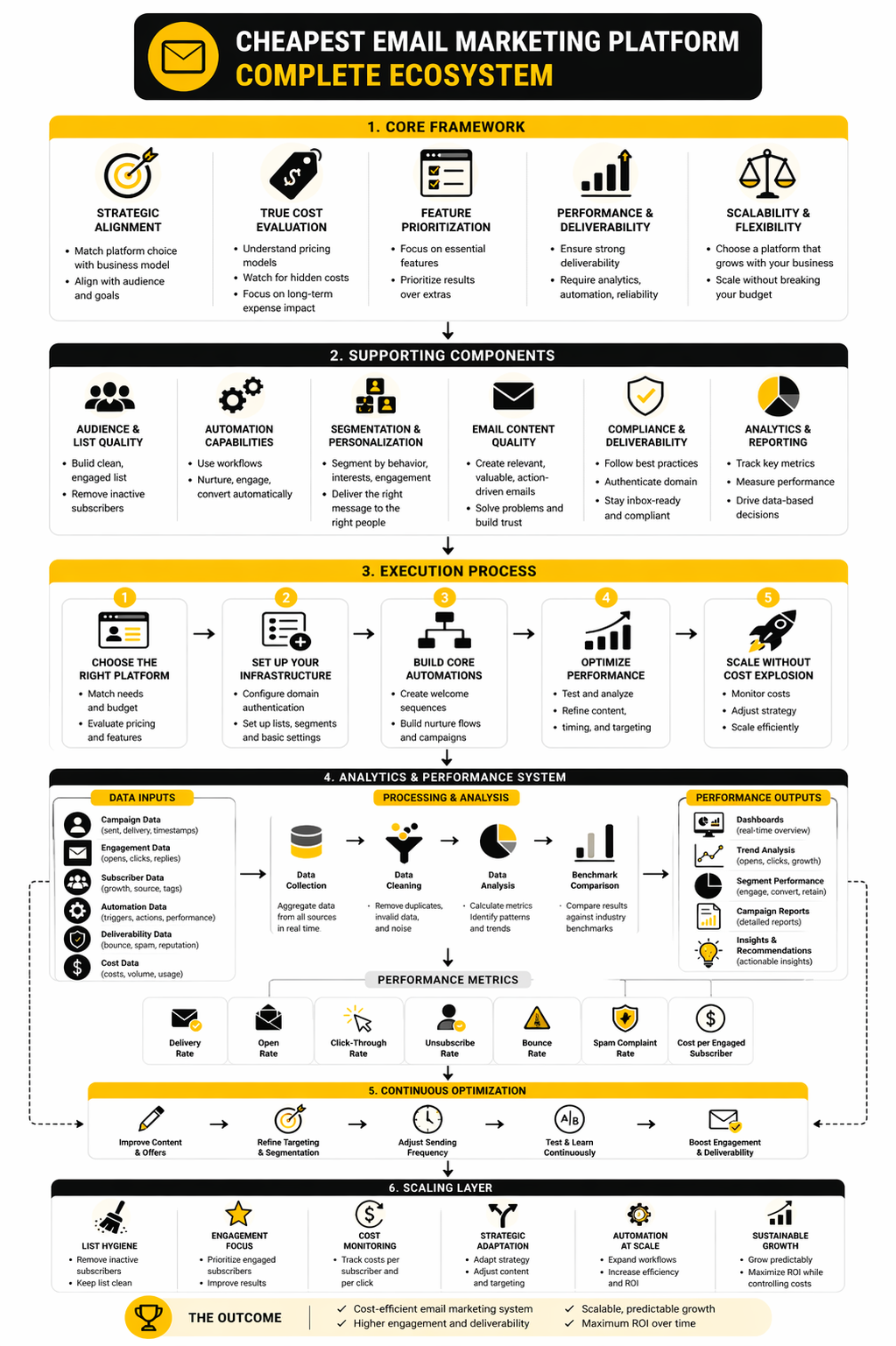
A strong low-cost ecosystem often looks like this:
- a lead capture layer (funnels or forms)
- an email platform with automation and segmentation
- optional CRM or pipeline tracking
- analytics that guide decisions
For example, combining a funnel builder like ClickFunnels or Systeme.io with an efficient email tool like Brevo creates a system that stays affordable while still being powerful.
Or, if you want fewer moving parts, platforms like GoHighLevel consolidate everything into one place, which simplifies scaling.
The key insight is simple but important:
efficiency comes from how the system works together, not just which tool you pick.
FAQ - Built for Complete Guide
What is the cheapest email marketing platform overall?
There isn’t one universal answer. The cheapest email marketing platform depends on how you send emails. Volume-based tools like Brevo are often cheaper for large lists, while tools like Moosend are competitive for smaller businesses with automation needs.
Are free email marketing tools worth using?
Free plans are useful for testing and early-stage projects. However, they usually come with limitations on automation, branding, or sending volume. If you’re serious about growth, you’ll outgrow them quickly.
Is Mailchimp still a cheap option?
Mailchimp can be affordable at very small list sizes, but it becomes expensive as your contacts grow. Its contact-based pricing model is one of the main reasons businesses look for alternatives.
What pricing model is the most cost-efficient?
Email volume-based pricing is often the most efficient if you don’t send daily campaigns. It allows you to store large lists without paying for every contact.
How do I avoid paying for inactive subscribers?
You need a consistent list cleaning process. Remove or suppress inactive contacts regularly, and segment users based on engagement so you’re not paying for people who never open your emails.
Can automation really reduce costs?
Yes, and this is one of the biggest advantages. Automation reduces manual campaigns and allows you to target users more precisely, which lowers unnecessary email volume and improves ROI.
Should I choose an all-in-one platform?
It depends on your strategy. All-in-one platforms like GoHighLevel reduce tool costs and simplify workflows, while specialized tools offer more flexibility but may increase total expenses.
How important is deliverability when choosing a platform?
It’s critical. A cheap platform with poor deliverability is more expensive in practice because your emails won’t reach inboxes. Always prioritize platforms with strong sender reputation systems.
What metrics should I track first?
Start with:
- delivery rate
- open rate trends
- click-through rate
- unsubscribe rate
These give you a clear picture of performance and help you make adjustments early.
When should I switch platforms?
You should consider switching when:
- pricing scales too aggressively
- your workflows outgrow the platform
- you’re paying for features you don’t use
Switching is easier early, so it’s better to make a thoughtful decision upfront.
Is the cheapest option always the best?
No. The best option is the one that stays cost-efficient as you grow. That includes pricing structure, features, and how well the platform fits your long-term strategy.
Work With Professionals
Explore 10K+ Remote Marketing Contracts on MarkeWork.com
Most marketers spend too much time chasing clients, competing on crowded platforms, and losing a percentage of every project to middlemen.
MarkeWork gives you a better way. Browse thousands of remote marketing contracts and connect directly with companies desperate to hire skilled marketers like you, without platform commissions and without unnecessary gatekeepers.
If you're serious about finding better opportunities and keeping 100% of what you earn, explore available contracts and create a profile for free at MarkeWork.com.