

Finding the cheapest email marketing platform sounds simple until you look past the headline price. A tool that looks cheap at first can get expensive fast once your list grows, you need automation, or you realize sends, users, forms, and segmentation are locked behind higher plans.
That is why this article does not treat “cheap” as the lowest sticker price. It treats cheap as the lowest real operating cost for the kind of email program you actually want to run, whether that means a basic newsletter, a store with automations, or an all-in-one system that replaces several separate tools.
Right now, the market proves the point. Tools like Brevo, Moosend, Systeme.io, and GoHighLevel all price email differently. Some charge by sends, some by contacts, some bundle email inside a bigger platform, and some become far more cost-effective only when you use their broader stack.
Article Outline
- What “cheap” really means in email marketing
- The cost framework for comparing platforms
- The core pricing components that change your real bill
- Which types of businesses should choose which kind of low-cost platform
- How to implement a cheaper stack without hurting deliverability or growth
- The best cheap email marketing options by use case, plus final recommendations and FAQ

Why Cheap Email Marketing Matters More Than Most People Think
Email is one of the few channels you actually control, which makes software cost more important than it first appears. If your platform becomes expensive too early, you do not just pay a higher monthly bill. You also end up limiting sends, delaying automation, or splitting your stack across extra tools you never planned to buy.
For a small business, creator, or lean e-commerce brand, that creates a very real tradeoff. You want enough functionality to grow, but you do not want to lock yourself into enterprise-style pricing before your list is even producing reliable revenue. The cheapest email marketing setup is the one that keeps your costs low without forcing a painful migration six months later.
This is also where buyers make the classic mistake. They compare plan prices instead of comparing the full cost of running their workflow. That sounds efficient, but it usually leads to the wrong decision.
The Framework We’ll Use To Judge Cheap Platforms
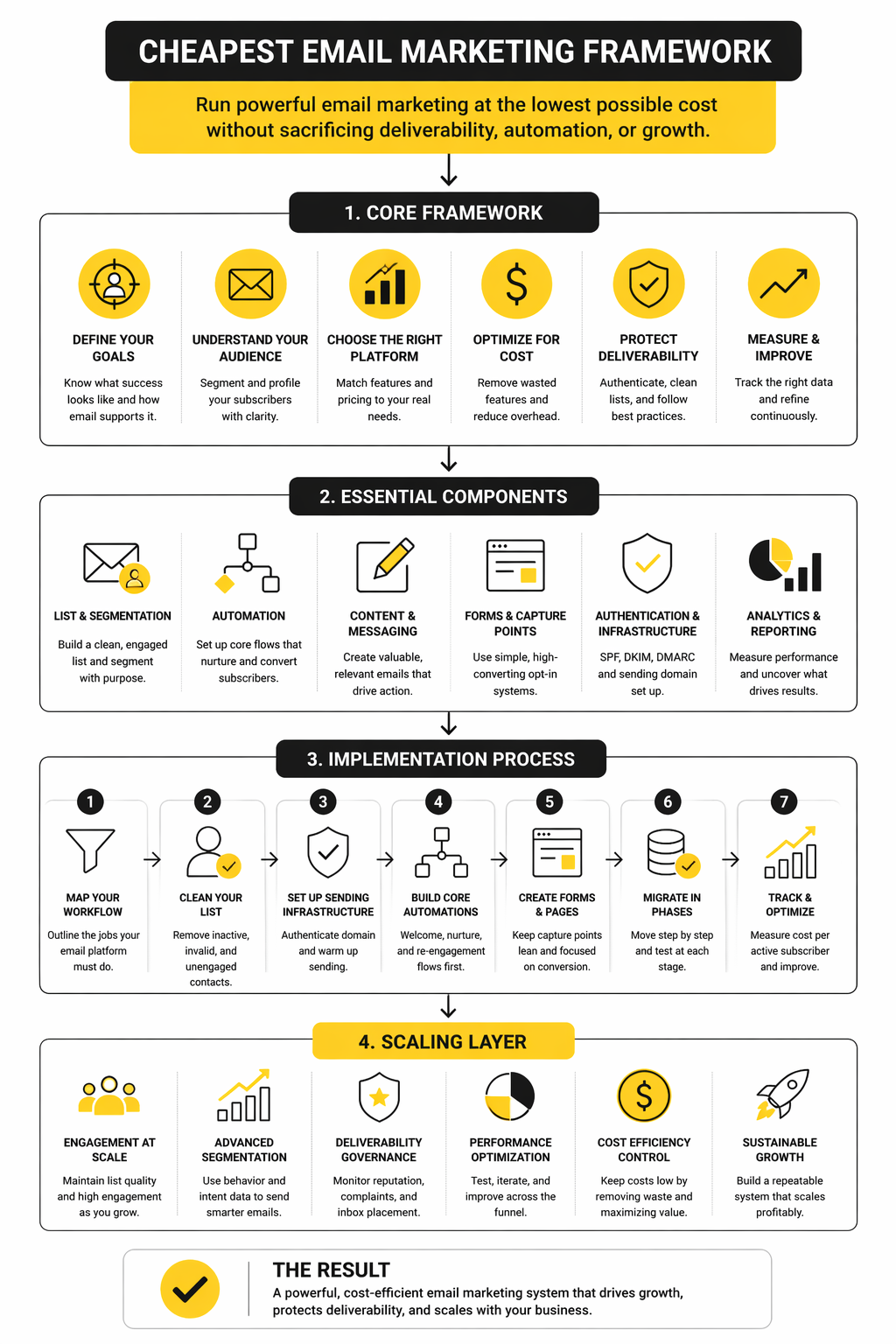
The framework in this article is built around real usage, not marketing copy. Instead of asking which tool has the lowest entry plan, we will ask which tool stays affordable as your list, campaigns, and automation needs become more serious.
That means we will look at four things all the way through the rest of the article: pricing model, feature access, scaling behavior, and replacement value. A platform can be cheap because it has a low monthly fee, but it can also be cheap because it includes landing pages, forms, CRM features, or automation that would otherwise require paying for multiple separate products.
This is especially important with platforms such as Brevo, Moosend, Systeme.io, and GoHighLevel. They are not simply cheaper or more expensive versions of the same thing. They solve different cost problems, and the rest of the article will make that difference clear.
How To Implement A Cheaper Stack Without Hurting Deliverability or Growth
The smartest way to lower email costs is not to swap tools on impulse. It is to rebuild your setup around what you actually send, what needs to be automated, and which features genuinely earn their keep. That is the point where the cheapest email marketing option stops being a bargain headline and starts becoming a stable operating system for your business.
This matters because migrations are where people accidentally create hidden costs. They move fast, import everything, skip authentication, keep bad segments, and then blame the new platform when open rates slip or automations break. A cheaper setup only works when the process is disciplined from day one.
Start With the Workflow Before You Start With the Platform
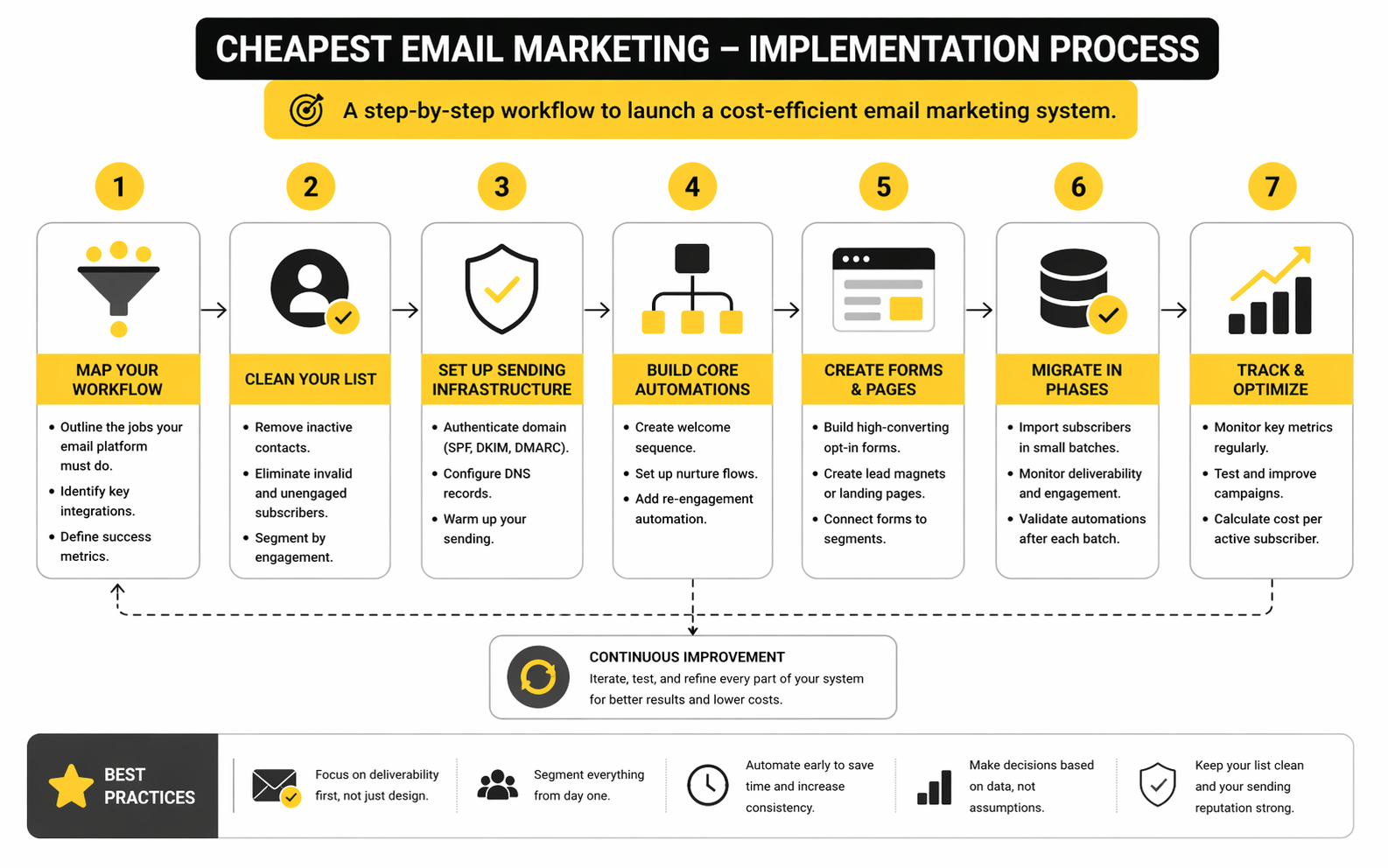
Before you touch a single setting, map the exact jobs your email platform needs to do. Most businesses do not need “advanced email marketing” in the abstract. They need a few concrete things handled well: capture leads, send broadcasts, trigger a welcome sequence, recover abandoned interest, and track enough engagement to make better decisions.
That simple exercise usually exposes where money is being wasted. Maybe you are paying for deep CRM functionality you never use, or maybe you stitched together forms, pages, email, and automation across four tools when one platform like Systeme.io, Brevo, Moosend, or GoHighLevel could replace most of the stack.
Once you see the workflow clearly, the decision gets easier. You are no longer comparing software in general. You are comparing the cheapest way to run your acquisition, nurture, and conversion system.
Clean the List Before You Import Anything
A cheaper platform gets expensive fast when you carry bad data into it. Old unsubscribes, role-based emails, bounced contacts, and dead segments do not just waste money on contact-based pricing. They also drag down engagement and make it harder for your messages to reach the inbox.
So the first practical move is boring, but it pays. Remove unsubscribed contacts, suppress invalid records, archive dead leads you do not plan to email, and separate active subscribers from legacy names you are only keeping “just in case.” That one cleanup step can reduce both your monthly bill and your deliverability risk before the new system sends its first campaign.
This is also where discipline beats feature hype. A lean list on a modest platform often outperforms a bloated list on a more expensive one because inbox placement still depends on sender reputation, authentication, and engagement far more than on dashboard complexity.
Set Up Your Sending Infrastructure Before the First Campaign
If you want cheap email marketing to stay effective, do not start by building newsletters. Start by setting up the technical layer that protects inbox placement. Current guidance across Brevo’s authentication guide, Moosend’s DNS setup documentation, Systeme.io’s domain authentication instructions, and GoHighLevel’s dedicated sending domain setup points in the same direction: authenticate the domain properly, verify senders, and warm up sending rather than blasting a cold list.
That means configuring SPF, DKIM, and ideally DMARC before launch. It also means sending from a branded domain or subdomain that you control instead of relying on the default settings and hoping for the best. Cheap software is not the problem when deliverability falls apart. Rushed implementation usually is.
Treat this as non-negotiable. If you skip the infrastructure layer, you can save on software and still lose far more in missed inbox placement, lower conversions, and extra cleanup later.
Build the Minimum Viable Automation System First
This is where many teams overcomplicate things. They buy a tool because it promises advanced automation, then spend weeks building giant workflows that barely move revenue. A cheaper and better approach is to launch the smallest automation system that covers the moments that matter most.
For most businesses, that system has three parts:
- A welcome sequence for new subscribers
- A follow-up or nurture sequence tied to intent
- A re-engagement or cleanup flow for inactive contacts
That setup is enough to make the platform useful without burying the team in maintenance. On a lower-cost tool like Brevo, Moosend, or Systeme.io, that is usually where you get the best balance between simplicity and leverage. If you need email plus broader client management, appointment handling, and multi-channel follow-up, GoHighLevel can make more sense because it replaces other software at the same time.
The key is not to automate everything. The key is to automate the moments where timing clearly improves results and manual work clearly wastes time.
Keep Forms, Pages, and Capture Points As Lean As Possible
A lot of “email marketing cost” is really stack sprawl. You are not just paying for the sending tool. You are paying for forms, landing pages, scheduling, chat, and little connectors that pile up month after month. Implementation is your chance to collapse that mess.
If your email platform already includes forms and pages, use them first. If you need a stronger standalone form layer, something like Fillout can fit neatly into a lean stack without adding unnecessary complexity. If your funnel needs stronger page design, Replo can be worth it, but only if that lift in conversion is real enough to justify another paid layer.
That is the standard you should use for every extra tool. Does it replace revenue-critical friction, or is it just another subscription that makes the stack feel more sophisticated than it really is? Cheap email marketing becomes expensive the moment add-ons start multiplying without clear returns.
Move in Phases Instead of Migrating Everything at Once
The safest implementation process is phased, not dramatic. Start with domain setup, list hygiene, and one core opt-in source. Then move one welcome flow, one campaign template, and one reporting view. Once that works, bring over the next layer.
This phased approach protects both revenue and sanity. It gives you a clean way to compare performance before and after the move, and it prevents the classic migration problem where everything changes at once and nobody knows what broke. It also keeps you from paying for overlapping tools longer than necessary because you can shut down old subscriptions in a controlled order.
If you run a business where appointments or conversations matter as much as emails, the phased model is even more useful. You can connect a scheduler like Cal.com or a chat layer like Chatbase after the core email engine is stable, rather than trying to wire every customer touchpoint on day one.
Track Cost Per Active Subscriber, Not Just Monthly Subscription Price
Once the new setup is live, do not stop at “the bill is lower.” That is too shallow. Track what the platform costs relative to active subscribers, meaningful sends, and revenue-producing automations.
This is where the best cheap email marketing setups separate themselves from the merely cheap-looking ones. A tool that costs a little more but keeps your active list clean, your automations working, and your stack smaller can be the better deal by a wide margin. A lower headline price means very little if you end up paying elsewhere in poor deliverability, extra software, or painful rework.
So the implementation process should end with a scorecard, not a feeling. Monthly software spend, active contacts, send volume, conversion contribution, and replacement value should all be visible. That is how you know you actually built a cheaper system instead of just switching invoices.
What the Numbers Actually Tell You
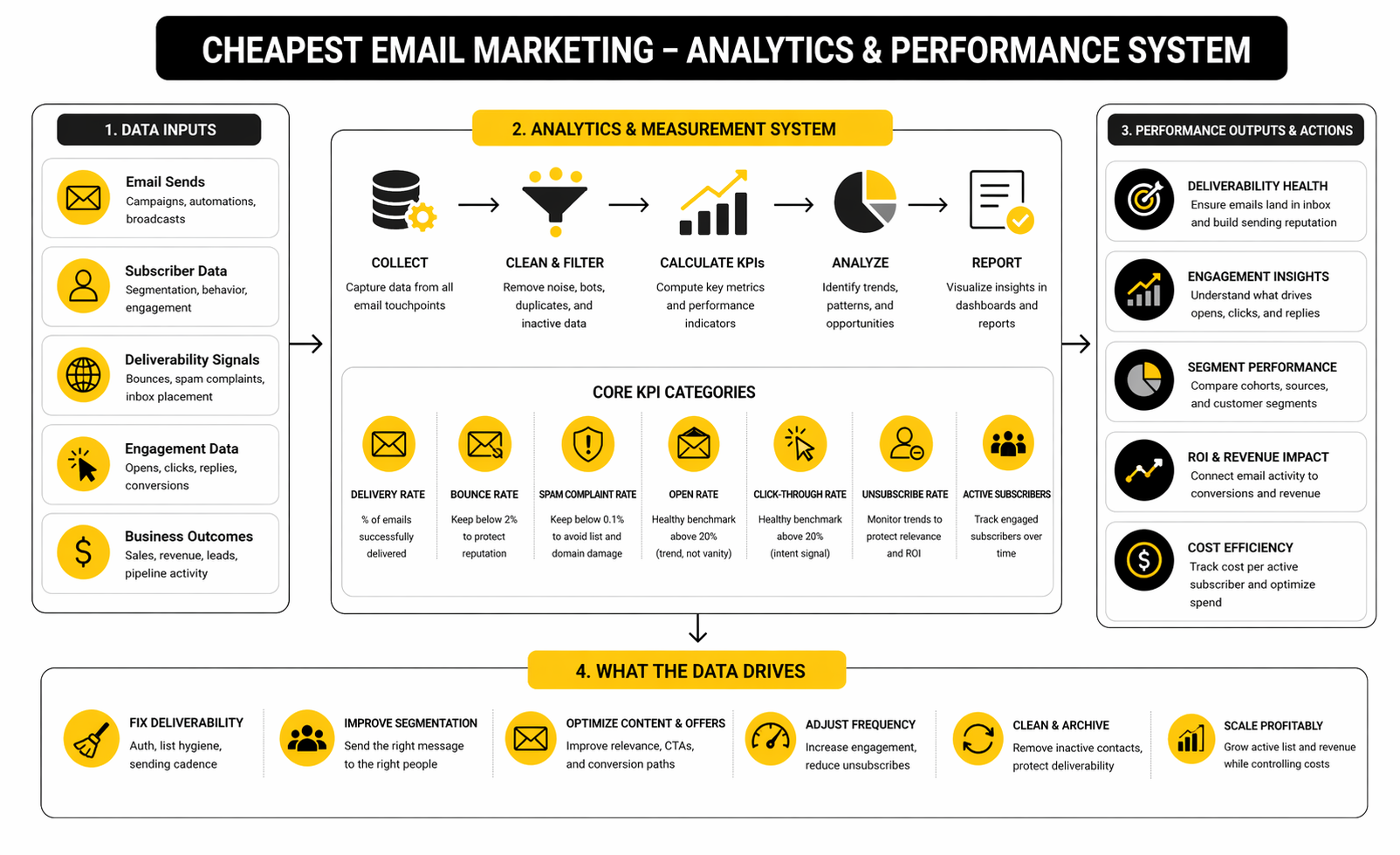
Once your cheaper stack is live, measurement becomes the filter that tells you whether you made a smart cost decision or just bought a lower monthly plan. This is where a lot of teams get lazy. They watch opens, glance at clicks, and assume the system is healthy when the real answer is often hiding in delivery quality, bounce trends, unsubscribe behavior, and the performance gap between active and inactive segments.
The point of analytics is not to collect dashboards. It is to decide what to fix next. A good measurement system tells you whether your cheapest email marketing setup is improving efficiency, protecting deliverability, and producing real commercial value instead of just reducing software spend.
Start With Deliverability, Not Vanity Metrics
If emails are not landing reliably, the rest of the numbers are basically theater. That is why delivery rate, bounce rate, spam complaints, and authentication health should come before any discussion about subject lines or click-through rates. The practical thresholds in Systeme.io’s migration guidance are useful because they frame the basics clearly: open rate above 20%, click-through rate above 2%, bounce rate below 2%, and spam complaints below 0.1% are the kind of guardrails that keep a low-cost setup from quietly degrading.
That does not mean those numbers are universal benchmarks for every industry. It means they are strong operational alarms. If bounce rate climbs, complaints creep up, or delivery starts softening, the right move is usually list cleanup, better segmentation, slower ramping, and tighter sending discipline before you touch copy or design.
Open Rate Still Matters, But It Cannot Carry the Whole Analysis
Open rate remains useful as a directional signal, especially when you compare similar campaigns over time. Brevo’s 2025 benchmark, built from more than 44 billion emails, reported a 21% overall open rate and emphasized the effect of Apple Mail Privacy Protection on how opens should be interpreted. That matters because inflated or privacy-distorted opens can make a weak campaign look healthier than it really is.
So use open rate as a trend line, not a trophy. If it rises after you improve your sender identity, tighten targeting, or write a better subject line, that is useful. If it rises while clicks, conversions, or replies stay flat, it is telling you interest did not actually deepen.
The right action here is simple. Treat opens as an early signal of relevance, then confirm intent somewhere deeper in the funnel.
Click-Through Rate Is Where Intent Becomes Real
Click-through rate is one of the strongest practical filters in any email reporting stack because it measures action, not just visibility. Brevo’s current KPI framework explicitly describes CTR as a true indicator of intent and content relevance, which is exactly why cheap email marketing decisions should be judged on it more heavily than on opens alone. Systeme.io’s operational guidance using a 2% click-through threshold points in the same direction: once clicks sag, the issue is often the offer, structure, or audience fit rather than the delivery layer itself.
This is where interpretation matters. A strong open rate with weak clicks usually means the subject line promised more than the email delivered. A stable open rate with stronger clicks often means segmentation or offer clarity improved, even if the campaign did not look flashy on the surface.
That action path is far more useful than random benchmark chasing. If clicks are weak, simplify the message, cut competing links, sharpen the CTA, and make sure the email is aimed at a narrower audience with clearer intent.
Unsubscribes and Complaints Are Cost Signals, Not Just Reputation Signals
Most marketers look at unsubscribes like a minor annoyance. In reality, they are one of the cleanest indicators that your list, frequency, or message-to-market fit is drifting. They also matter financially because every irrelevant send to the wrong subscriber inflates cost in platforms that price around contact volume, send volume, or both.
Brevo’s benchmark data tracks unsubscribe rate and bounce rate by industry in the same dataset that covers open and click behavior, which is useful because it keeps marketers from evaluating engagement in isolation. If clicks are mediocre and unsubscribes rise at the same time, the problem is not just creative performance. It is that the system is spending money to annoy people.
The action is not “never let people unsubscribe.” The action is to treat rising unsubscribes as a segmentation and frequency issue first. Good cheap email marketing protects margin by keeping the active list genuinely interested, not by forcing extra sends onto people who already checked out mentally.
Platform-Level Performance Gives You Context, Not a Guarantee
Vendor-wide stats are helpful, but they should be used carefully. HighLevel’s monthly performance reports showed very strong infrastructure-level performance at scale, including 96.04% delivery, 38.56% opens, and 4.14% CTR in November 2025 across more than 1.37 billion emails, and 96.48% delivery with 41.27% open rates in January 2026. Those numbers matter because they show what modern infrastructure can support when authentication, sending reputation, and system-level controls are working well.
But they do not mean your account will automatically perform the same way. Platform data tells you the ceiling is strong. Your own list quality, acquisition sources, segmentation, and message relevance determine whether you get anywhere near that level.
That is the right way to interpret vendor benchmarks. Use them to understand what the platform can support, then judge your own setup by your own trend lines and business outcomes.
The Most Useful KPI for Cheap Email Marketing Is Cost Per Active Subscriber
This is the metric most people ignore, and it is one of the most important. If your platform bill is low but half the list is cold, you are not really running a cheap system. You are just spreading a lower software fee across a bloated database.
A better operating metric is cost per active subscriber. Define active however your business needs to define it, but keep it tied to recent opens, clicks, purchases, replies, or site activity. Once you do that, the economics become much clearer because you can see whether the platform is affordable for the audience that still has real commercial value.
This also keeps you honest when comparing tools. A platform that costs a little more but helps you suppress dead contacts, run better automation, and improve engagement can be cheaper in practice than a bargain tool attached to a messy list.
Measure Cohorts, Not Just Campaigns
Campaign-level reporting is useful, but it is not enough. The smarter move is to compare how newer subscribers behave against older ones, how buyers behave against non-buyers, and how acquisition sources perform over time. That is where the real economics of your cheapest email marketing setup become visible.
For example, if one signup source brings subscribers who keep opening and clicking for months, that source deserves more investment even if its immediate conversion rate is lower. If another source inflates the list but produces weak engagement and higher complaint risk, it is making the platform look cheaper than it actually is. You are paying in hidden deliverability drag.
So do not stop at single-campaign reports. Track audience cohorts monthly and let that data decide where list growth is actually worth funding.
What Good Data Should Make You Do Next
Measurement only matters when it changes behavior. If delivery and bounce issues show up, fix authentication, list hygiene, and sending cadence first. If opens are steady but clicks are weak, rewrite the offer and tighten segmentation. If unsubscribes rise, send less often to that segment or make the content more specific. If active-subscriber economics are slipping, archive cold contacts before your “cheap” platform quietly gets more expensive.
That is the whole point of this section. Numbers are not there to make a report look serious. They are there to tell you whether your stack is efficient, whether your audience is still engaged, and whether your cheapest email marketing choice is actually getting cheaper as the system matures.
Advanced Tradeoffs Once You Start Scaling
This is the point where the cheapest email marketing decision gets more nuanced. Early on, low cost is mostly about avoiding bloated plans and paying only for the features you use. As volume rises, the real question becomes whether your platform can keep costs controlled while protecting sending reputation, workflow flexibility, and room to grow.
That tradeoff matters because scale changes what hurts. At a small size, you can tolerate some manual work and a few rough edges. At a larger size, weak segmentation, fragile automations, poor domain setup, or limited reporting can quietly become more expensive than the monthly software bill itself.
Cheap at Small Scale Can Get Expensive at Mid-Market Scale
A platform that feels perfect at 1,000 contacts can become awkward at 25,000 if the pricing model punishes list growth or if critical features sit behind higher plans. This is why the cheapest email marketing option for a beginner is not automatically the cheapest long-term option for a business with heavier automation, more teams, or more complicated lifecycle messaging.
That does not mean you should overbuy from day one. It means you should look for a platform that scales in the same direction as your business. If you mainly need newsletters and light automation, Brevo and Moosend can stay lean for a long time. If you are replacing multiple tools at once, Systeme.io or GoHighLevel may become cheaper in practice because they absorb more of the stack.
The mistake is choosing based on today’s bill alone. The better move is choosing based on how painful the next stage of growth is likely to be.
Deliverability Risk Gets Bigger As Volume Grows
Once you start sending at higher volumes, infrastructure and sending discipline stop being background details. They become the system. Microsoft’s higher-volume sender requirements, summarized in Moosend’s breakdown of the 2025 enforcement changes, made it even clearer that authentication and sender hygiene are not optional for bulk email.
That is why scaling on a cheap platform only works when your operational discipline scales too. Systeme.io’s current help content on large email lists and shared versus dedicated IP logic makes the broader point well: volume alone is not the problem; poor list quality, weak engagement, and bad sending habits are.
So when performance softens at scale, do not assume the platform has failed you. First check domain authentication, complaint rates, inactive segments, sending cadence, and acquisition quality. Those are usually the real pressure points.
Shared Infrastructure Versus Dedicated Control Is a Real Strategic Choice
A lot of teams treat shared versus dedicated sending like a purely technical issue, but it is really a business decision. Shared infrastructure can be cost-effective and perfectly fine when your list is healthy, your volume is moderate, and your sending behavior is consistent. Dedicated control becomes more attractive when your volume is large enough, your operations are mature enough, and your need for predictable performance is high enough to justify the extra complexity.
HighLevel’s recent reporting has leaned heavily into this distinction. Its December 2025 email performance report highlighted strong dedicated-domain results at year-end scale, while its February 2026 performance report showed that very large volumes can still maintain high delivery when the underlying setup is managed well. That does not mean every sender needs dedicated infrastructure. It means dedicated control starts to matter more when email becomes a mission-critical revenue channel.
The practical lesson is simple. Stay on the cheaper path while it serves you, but know the point where buying more control is no longer wasteful. That is often the moment when the business is big enough that missed inbox placement costs more than the upgrade.
The Hidden Risk Is Stack Fragmentation, Not Just Platform Cost
Many businesses obsess over the email plan and ignore the real expense sitting around it. The actual cost creep often comes from fragmented pages, extra form tools, disconnected CRM layers, messy attribution, and manual handoffs between systems. Each tool looks small on its own, but together they create financial drag and operational fragility.
This is why all-in-one platforms keep showing up in serious cost discussions. If Systeme.io can cover pages, email, automation, and sales flow well enough for your model, that simplicity has value beyond the monthly fee. If GoHighLevel replaces your CRM, appointment workflow, and client communication stack, the math changes again.
That does not mean all-in-one is always better. It means you should count integration overhead, tool overlap, and maintenance time as real costs. Once you do, the cheapest email marketing setup often looks different from the cheapest email platform in isolation.
Expert Buyers Watch Exit Cost Before They Commit
One of the smartest strategic questions is also one of the least glamorous: how hard will it be to leave later? A low-cost platform that makes templates hard to recreate, automations hard to document, or data hard to move can become expensive the moment your business outgrows it. That is an exit cost, and it is real.
So before you commit deeply, look at the basics. Can you export contacts cleanly? Can you document automations without needing tribal knowledge? Can key assets like forms, funnels, and sequences be rebuilt without weeks of disruption? A platform that saves you money now but traps you later is not truly cheap.
This is where boring clarity wins again. Use clean naming conventions, keep automation logic understandable, and avoid building a maze just because the builder lets you. Cheap systems stay cheap when they remain portable.
The Best Long-Term Move Is Usually Controlled Simplicity
By the time you reach this stage, the winning pattern is usually obvious. The best cheap email marketing systems are not the most stripped down, and they are not the most feature-packed. They are the systems that stay simple under pressure while still giving you enough control to protect deliverability, segment well, and scale responsibly.
That means saying no to unnecessary complexity even when you can afford it. It also means saying yes to strategic upgrades when the business has clearly earned them. The goal is not to stay on the absolute lowest bill forever. The goal is to keep cost, performance, and operational sanity moving in the same direction.
That is the real expert-level test. If your setup stays lean, interpretable, and effective as the business grows, you chose well. If your costs stay low but your risk, maintenance burden, and fragility keep climbing, you did not really buy cheap. You just delayed expensive problems.
Final Recommendations Before You Choose
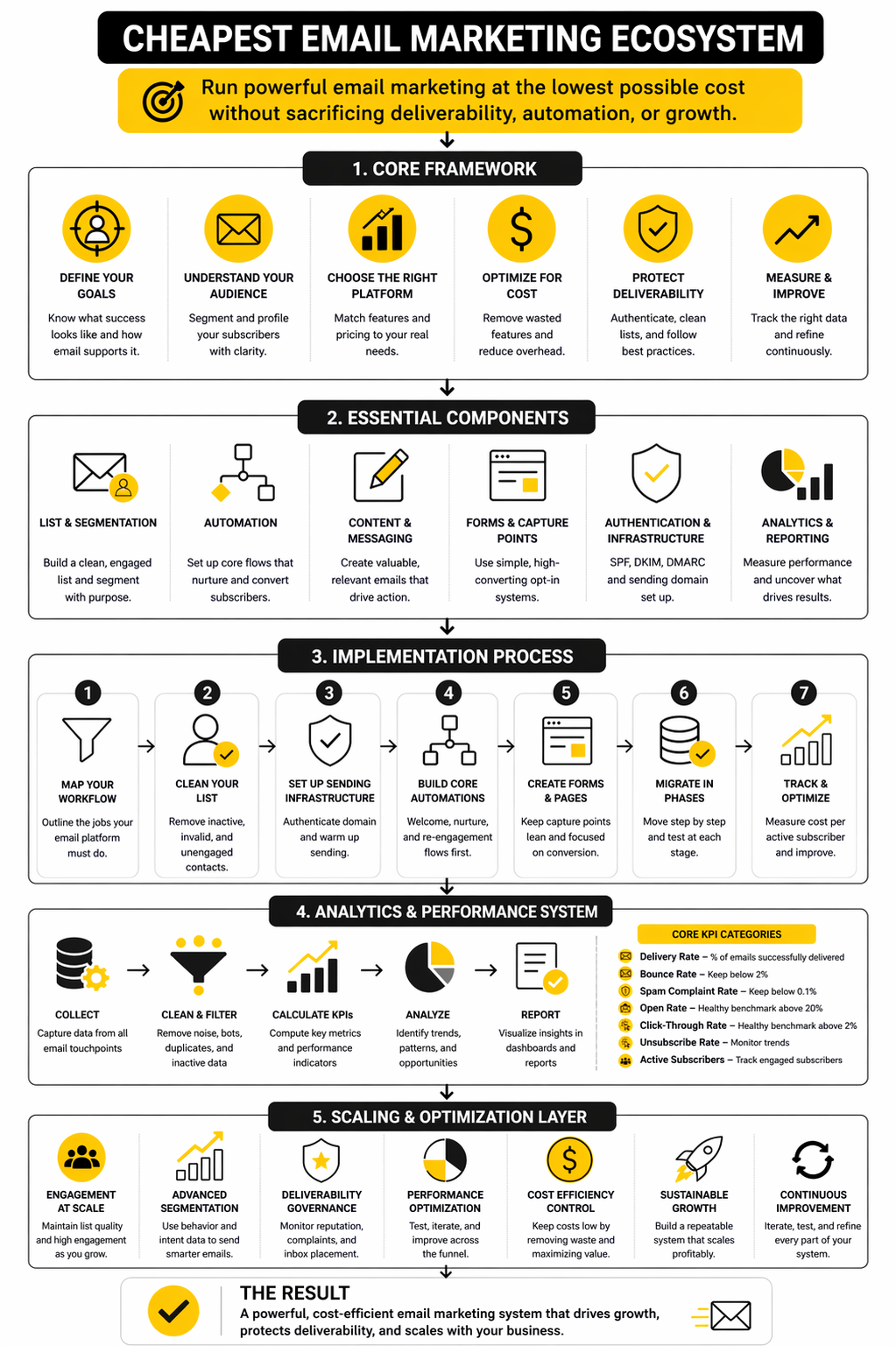
By this point, the pattern should be clear. The cheapest email marketing platform is not always the one with the lowest entry plan. It is the one that matches your sending model, keeps your active-list economics healthy, and does not force you into expensive workarounds later.
If you want a low-cost tool for straightforward email campaigns and a simple growth path, Brevo’s pricing structure is still one of the clearest starting points, especially if send volume matters more than deep CRM complexity. If you want affordable automation with a more traditional email-marketing feel, Moosend’s current offers remain worth a serious look. If you want to keep costs down by collapsing multiple tools into one stack, Systeme.io and GoHighLevel become much more compelling because the savings often come from replacing extra software, not just lowering the email bill.
The real win is not choosing the “best” platform in abstract. It is choosing the one that lets you grow without turning your stack into a fragile mess. When cost, simplicity, deliverability, and operational control stay aligned, that is when cheap actually becomes smart.
FAQ
What is the cheapest email marketing platform for beginners?
For pure entry-level affordability, the answer depends on what you mean by cheap. If you mean the smallest starting bill, tools like Brevo and Moosend are usually easier starting points than heavier all-in-one systems. If you mean cheapest overall business stack, Systeme.io can be the better beginner move because it combines email with funnels and other core tools.
Is free email marketing software enough for a real business?
Sometimes, yes, but only for a while. A free plan is usually enough when you are validating an offer, building an early list, or learning the workflow, and Brevo’s free plan still includes 300 daily sends. The moment your business needs more sending headroom, deeper automation, stronger branding control, or more complex segmentation, free usually becomes a constraint rather than an advantage.
Is it better to pay by contacts or by email sends?
Neither is automatically better. Paying by sends can be excellent when your list is large but your emailing frequency is disciplined, while contact-based pricing can work well when you send frequently to a highly engaged audience. The smarter question is which pricing model fits your behavior without rewarding bloat or punishing healthy growth.
Can the cheapest email marketing tool still have good deliverability?
Yes, but only if the implementation is solid. Cheap software does not automatically mean poor inbox placement, especially when you authenticate properly, warm up responsibly, and keep your list clean. Deliverability problems usually come from bad acquisition, weak hygiene, or reckless sending habits, not from low price alone.
When does a cheap platform become too limited?
It becomes too limited when you start building around its constraints instead of around your customer journey. If you need awkward workarounds for forms, segmentation, automations, reporting, or user access, the low monthly fee is no longer telling the full story. That is the moment to compare the cost of upgrading against the cost of staying stuck.
Is Systeme.io really cheap for email marketing, or only for funnels?
It can be genuinely cheap for email marketing when your business also needs funnels, pages, and light automation in the same place. Its appeal is not just that it sends emails. Its appeal is that it can reduce the number of separate subscriptions you need to operate the business. That is why it often looks much better in real-world cost comparisons than it does in narrow email-only comparisons.
Is GoHighLevel overkill if I only want email marketing?
For many solo operators and simple newsletter businesses, yes, it can be. GoHighLevel makes more financial sense when you also need CRM functionality, pipeline management, appointments, automation depth, and broader client communication. If you are not going to use that ecosystem, a lighter tool is usually the more efficient buy.
What metrics should I watch first after switching platforms?
Start with delivery quality, bounce rate, complaint rate, unsubscribe trend, and click-through performance. Those numbers tell you whether the system is healthy before you get distracted by cosmetic dashboard wins. Once those are stable, then it makes sense to optimize subject lines, offers, timing, and more advanced lifecycle flows.
Should I keep inactive subscribers to make the list look bigger?
No, not if your goal is to run a healthy and genuinely cheap email marketing system. Inactive subscribers often inflate costs, drag down engagement, and create misleading performance reports that make your setup look stronger than it is. A smaller active list is usually more valuable than a larger dead one.
What is the biggest mistake people make when choosing a cheap email platform?
They compare the plan price and stop there. That misses the real economics of setup time, migration cost, feature gaps, list hygiene, reporting quality, and the other tools the platform may or may not replace. Cheap on paper is easy to find, but cheap in operation takes more discipline.
Can I switch platforms later without damaging performance?
Yes, but only if you do it in phases. Clean the list, authenticate the domain, move the most important automations first, and compare results before fully shutting down the old setup. Migration becomes risky when everything changes at once and nobody can tell whether the problem is technical, strategic, or just a broken workflow.
Which platform is usually the safest low-cost option for long-term growth?
There is no universal winner, but there are safer patterns. Brevo is a sensible choice when you want a flexible entry point with multi-channel room to grow, Moosend fits businesses that want focused email automation, and Systeme.io or GoHighLevel are stronger when replacing multiple subscriptions is part of the strategy. The safest route is the one that still looks efficient after your list, workflows, and business complexity grow.
Work With Professionals
Explore 10K+ Remote Marketing Contracts on MarkeWork.com
Most marketers spend too much time chasing clients, competing on crowded platforms, and losing a percentage of every project to middlemen. MarkeWork gives you a better way. Browse thousands of remote marketing contracts and connect directly with companies desperate to hire skilled marketers like you, without platform commissions and without unnecessary gatekeepers.
If you're serious about finding better opportunities and keeping 100% of what you earn, explore available contracts and create a profile for free at MarkeWork.com.