

A lot of people get into the clickbank affiliate world because it looks simple from the outside. Pick a product, grab a link, post it somewhere, and hope commissions show up. That is exactly why so many beginners burn out early: they treat affiliate marketing like a shortcut when it works much better as a system.
The better way to approach a ClickBank affiliate business is to think like an operator, not a gambler. You are not just promoting an offer. You are matching the right market with the right promise, using the right traffic source, and guiding that traffic through a conversion path that makes sense.
That matters even more now because attention is fragmented, audiences are more skeptical, and weak promotion gets ignored fast. The affiliates who last are usually the ones who build repeatable assets, pay attention to offer-market fit, and improve one stage of the funnel at a time instead of chasing a new tactic every week.
Article Outline
- Why ClickBank Affiliate Marketing Still Matters
- The ClickBank Affiliate Growth Framework
- Choosing Offers and Reading Marketplace Signals the Right Way
- Matching Traffic Sources to the Offer
- Building Conversion Assets, Follow-Up, and Testing Loops
- Scaling Sustainably, Staying Compliant, and Avoiding Expensive Mistakes
Why ClickBank Affiliate Marketing Still Matters
ClickBank affiliate marketing still matters because it sits at the intersection of three things that continue to work online: performance-based acquisition, digital product economics, and speed of execution. You do not need to build your own product to learn offer selection, messaging, traffic buying, list building, and conversion optimization. That makes it one of the most accessible ways to understand direct-response marketing in the real world.
It also gives you a faster feedback loop than many other business models. When you choose an offer, run traffic, and watch opt-in or sales behavior, you are getting direct market data instead of vague brand-awareness signals. That is valuable because the skill you are really building is not “posting affiliate links.” It is learning how buyers make decisions and how to move them from curiosity to action.
The mistake is assuming accessibility means easy money. ClickBank can absolutely teach you serious marketing skills, but only if you stop looking for magic offers and start building a framework you can improve over time. That is the shift this article is built around.
The ClickBank Affiliate Growth Framework
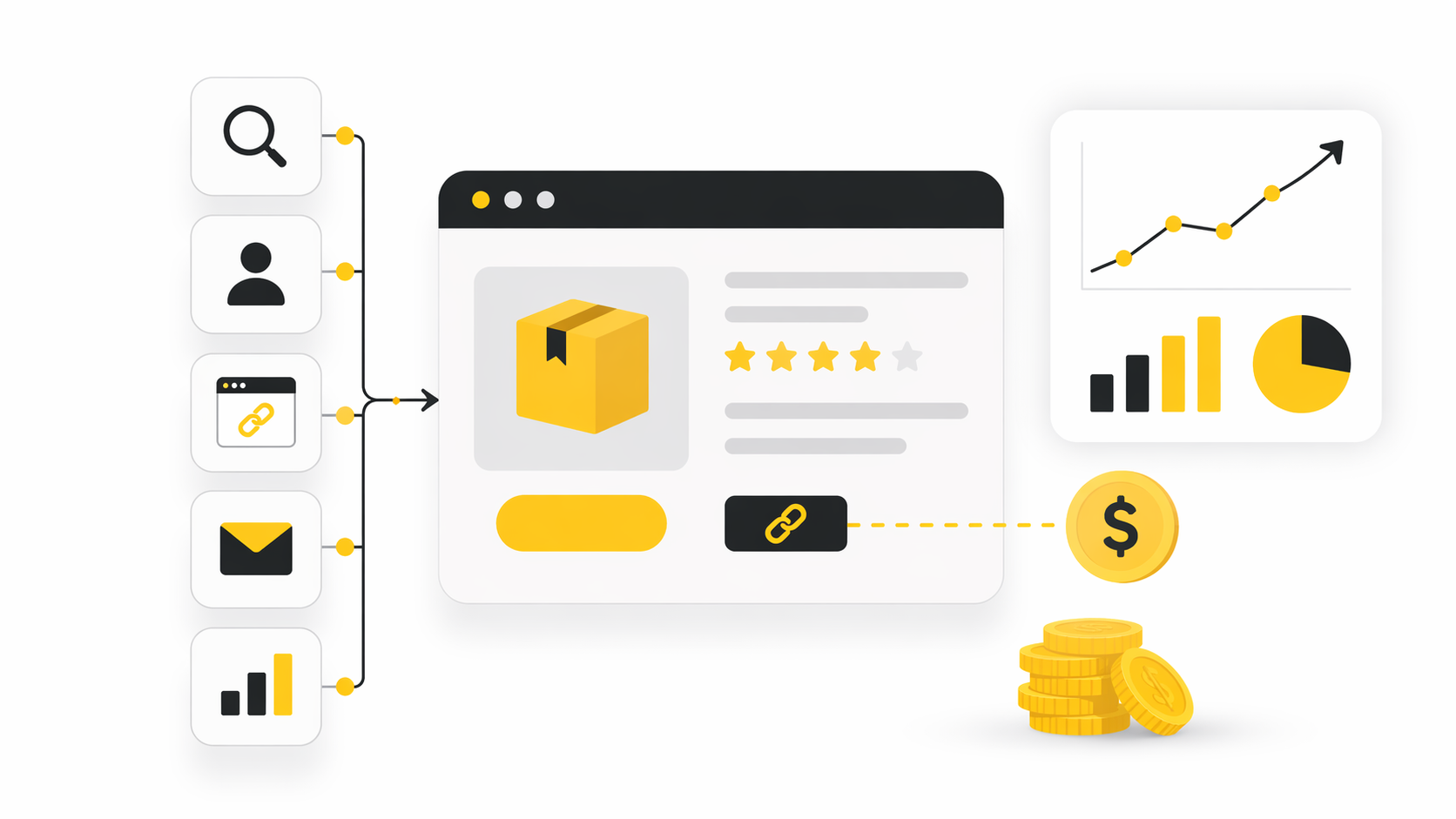
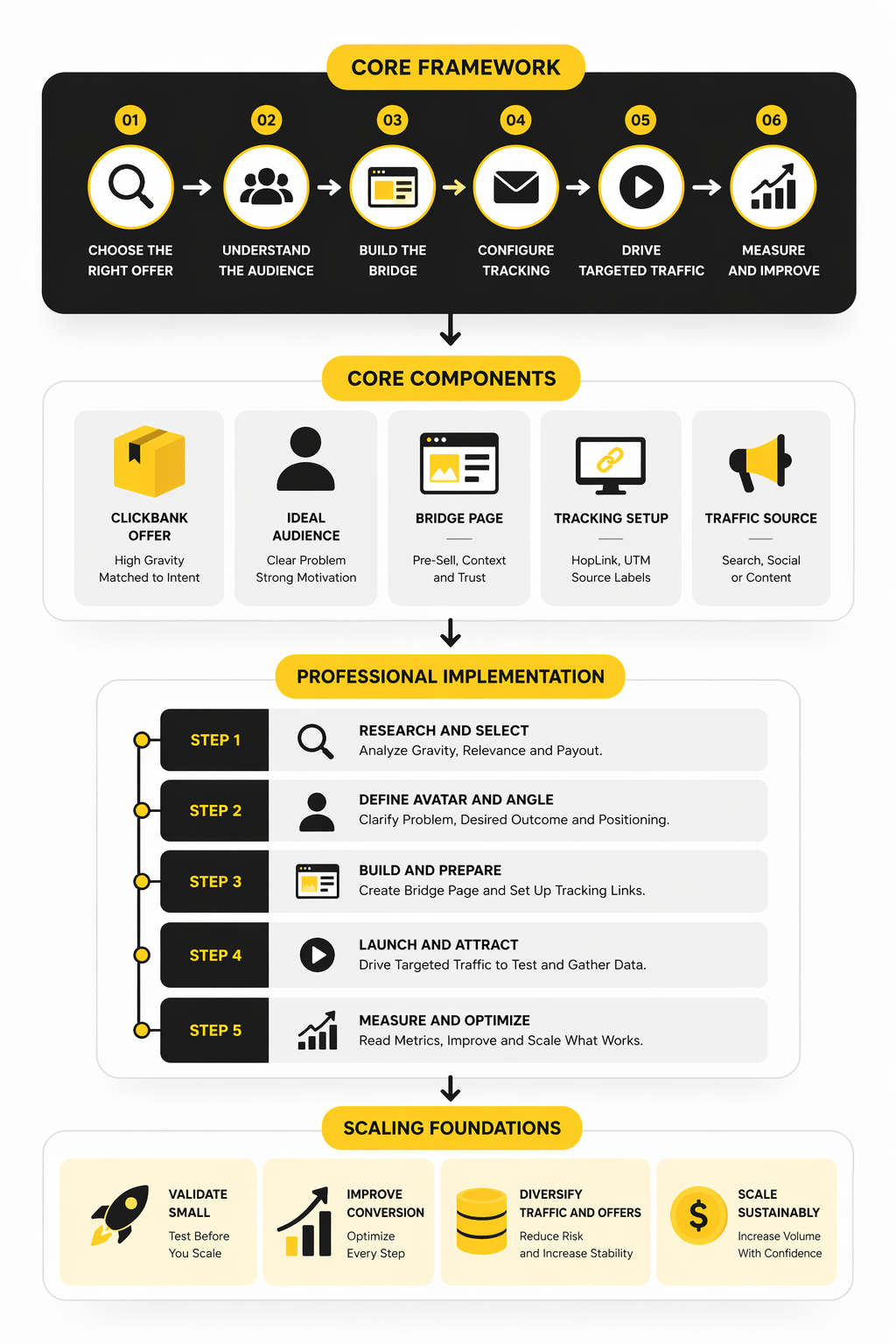
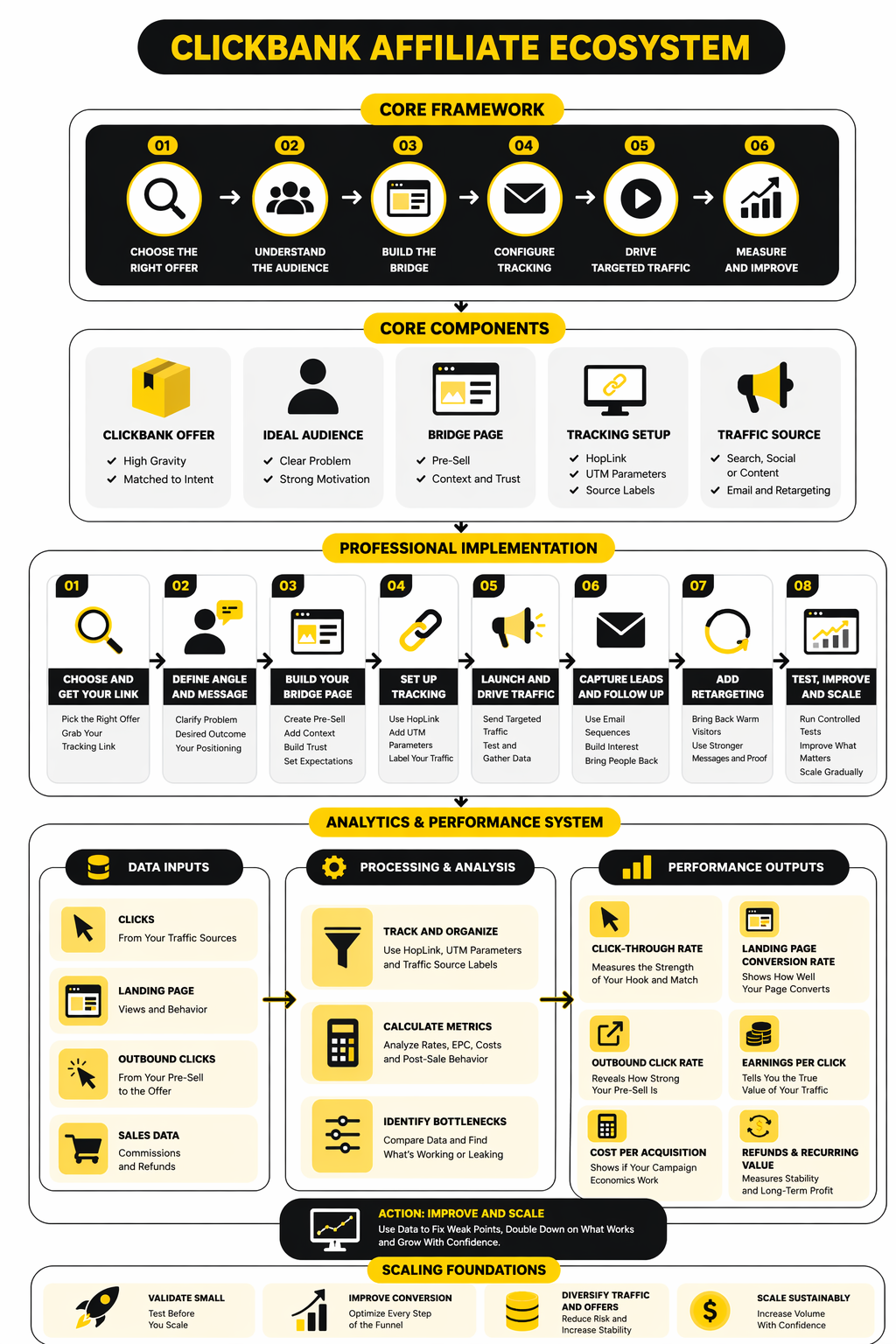
A strong ClickBank affiliate business usually comes down to a simple sequence: choose a market with real buyer intent, pick an offer that fits that market, create a pre-sell path that sets expectations, capture or redirect attention efficiently, and keep improving the numbers that matter. That may sound basic, but most underperforming campaigns fail because one of those pieces is weak or disconnected from the rest. The framework works when every step supports the next one.
This is why random tactics create random results. A great traffic source cannot rescue a weak offer, and a strong offer can still underperform if the bridge page, email follow-up, or audience angle is wrong. When you see experienced affiliates win consistently, they are usually not doing something mysterious. They are making cleaner decisions earlier in the process and measuring what happens after the click.
The rest of this article follows that exact structure. First, we will break down how to choose offers and interpret marketplace signals without fooling yourself. Then we will move into traffic strategy, conversion assets, optimization, and finally the scaling and compliance decisions that separate a serious ClickBank affiliate business from a short-lived experiment.
Choosing Offers and Reading Marketplace Signals the Right Way
This is where most clickbank affiliate beginners either build a foundation or waste the next six months. They open the marketplace, sort by gravity, and assume the highest numbers must be the safest bet. That shortcut feels efficient, but it usually leads to crowded offers, lazy positioning, and traffic that never converts well enough to scale.
A better approach is to treat offer selection like diagnosis, not browsing. You are trying to answer a few practical questions before you ever think about promotion: who already wants this result, how strong is the promise, how believable is the sales path, and how likely is it that the economics hold up after refunds, weak retention, and poor audience fit. Once you start looking at offers this way, the marketplace becomes much easier to read.
The point is not to find a “perfect” offer. The point is to find an offer that gives you enough evidence to test with confidence and enough room to improve performance with better traffic, better pre-sell, or better follow-up. That is a completely different mindset from chasing whatever looks hot this week.
Start With the Market, Not the Product
The fastest way to choose a bad offer is to start with the product page and fall in love with the payout. A high commission can look amazing until you realize the audience is vague, the promise is weak, or the traffic angle feels forced. When that happens, every click becomes expensive because you are trying to manufacture demand instead of meeting it.
Start with the market instead. Ask what the buyer is actively trying to solve, how urgent that problem is, and whether people spend money in that category without needing a long education process first. Markets with pain, desire, or strong ongoing identity usually give you a much better shot than markets where people are only mildly curious.
This matters because traffic only works when the landing message matches an existing motivation. If the market is already searching for relief, speed, certainty, status, or simplicity, your job gets easier. If the market is passive, skeptical, or confused, even a decent ClickBank offer can feel impossible to sell profitably.
What Gravity Actually Tells You
Gravity is useful, but only when you stop treating it like a scoreboard. In practical terms, it tells you that multiple affiliates have recently generated commissions for an offer, with more weight given to recent activity. That makes it a momentum signal, not a quality guarantee.
That distinction matters a lot. A high-gravity offer can still be a bad fit for your traffic source, your audience angle, or your style of promotion. It can also mean the offer is heavily worked already, which raises the bar for differentiation and often punishes generic traffic.
On the other hand, very low gravity is not automatically bad either. Sometimes it means the offer is new, badly positioned, or ignored by affiliates who are only scanning for obvious winners. The real job is to use gravity as one data point inside a broader decision, not as the decision itself.
Look Beyond the Headline Payout
A ClickBank affiliate offer is not just a commission percentage. It is a revenue model, and that model needs to survive contact with real buyer behavior. A product with a flashy front-end payout can still disappoint if the average order value is weak, the upsell path is messy, or the rebill economics do not actually hold.
That is why experienced affiliates pay attention to the whole earnings picture. You want to know whether the offer has a solid initial payout, whether recurring revenue is meaningful, and whether the structure gives you enough room to absorb testing costs. A decent commission on a stable offer is often better than a bigger headline number attached to shaky retention.
This is also where beginners talk themselves into bad bets. They see one attractive number and fill in the rest with hope. The professional move is the opposite: assume the economics are worse than they look until the sales path, retention logic, and audience fit prove otherwise.
Read the Sales Page Like a Skeptical Buyer
A strong sales page does not need to look pretty. It needs to create belief, reduce resistance, and move the buyer toward a clear action without feeling incoherent. When you evaluate a ClickBank offer, do not read the page like an affiliate who wants it to work. Read it like a cold prospect who is looking for reasons to leave.
Pay attention to the opening claim, the pace of the page, the clarity of the mechanism, and the transition to the offer itself. If the copy takes too long to say anything concrete, if the promise feels inflated, or if the call to action appears before trust is built, that friction will show up in your conversion rate. Your traffic will feel it before your spreadsheet does.
You should also check whether the page matches the temperature of the traffic you plan to send. A curiosity-driven ad may work with a long narrative page, while high-intent search traffic often needs a more direct path. The right offer is not just “good.” It has to be good for the way you plan to introduce people to it.
Check the Funnel Behind the Front End
A lot of affiliates judge offers only by the first page and the first payout. That is not enough. You need to understand what happens after the initial click and after the initial purchase, because backend structure changes the economics of the whole campaign.
Look at the checkout experience, upsells, continuity logic, email follow-up, and overall consistency of the customer journey. If the front end makes one promise and the funnel immediately shifts tone, pricing, or positioning, buyers feel that disconnect. Even when the front-end conversion looks decent, weak funnel continuity can damage long-term value and make your campaign harder to scale.
You are not being overly cautious here. You are doing basic business math. If your traffic cost rises even a little, backend weakness goes from annoying to fatal very quickly.
Judge Promo Assets, But Do Not Depend on Them
Some ClickBank vendors give affiliates email swipes, ad angles, landing pages, and basic creative support. That can help, especially when you are moving fast or testing multiple offers. But promo materials are support tools, not a substitute for judgment.
If every affiliate is using the same copy, the same hooks, and the same promises, the market gets saturated fast. What worked for early traffic often stops working once the angle becomes familiar. That is why blindly copying the vendor’s material usually produces average results at best.
Use those assets to understand positioning, objections, and approved claims. Then build your own version that fits your audience and traffic source. The affiliate who can interpret the offer and translate it into a sharper pre-sell usually beats the affiliate who just clones what was already there.
Match the Offer to Your Real Strengths
Not every good ClickBank product is a good product for you to promote. An offer that works through long-form advertorials may fail in short-form social. A product that needs authority and explanation may be a poor match for broad cold traffic. The best offers are not only strong on paper; they fit the way you actually know how to get attention and move people to action.
This is where self-awareness becomes a performance advantage. If you are better at content, lean toward offers that benefit from education, comparison, and buyer guidance. If you are strong with funnels and paid traffic, look for offers with clean economics, believable hooks, and a sales path that can support testing discipline.
A lot of unnecessary failure comes from mismatch, not incompetence. People pick an offer that looks exciting, then try to force it through a channel that does not suit it. When the offer, channel, and operator style line up, the work becomes much more predictable.
Build a Shortlist Before You Commit
You do not need to marry the first promising offer you find. In fact, you should not. Build a shortlist of a few offers in the same market and compare them side by side before you decide where to spend your time and budget.
This comparison process quickly exposes weak positioning. One offer may have stronger economics but weaker copy. Another may have better page structure but a softer promise. A third may be less popular but better aligned with the kind of traffic you can realistically generate.
That shortlist does two useful things. First, it forces you to think comparatively instead of emotionally. Second, it gives you backup options if your first test underperforms for reasons that are specific to the offer and not to the market itself.
The Right Question to Ask Before You Promote Anything
Before you promote a ClickBank affiliate offer, ask one simple question: would this be easier to sell with better messaging, or is the offer fundamentally hard to believe? That question saves a lot of money because it separates fixable problems from structural ones. Some offers need a stronger angle. Others are weak at the core.
If the promise is believable, the market is proven, the economics make sense, and the funnel is coherent, you usually have enough to move into testing. Not because you know it will win, but because you know you are testing something with a real chance. That is what competent offer selection looks like.
From here, the next step is obvious. Once you know how to choose offers and read the marketplace properly, you need to match those offers to the right traffic source instead of sending every campaign through the same channel and hoping for the best.
Matching Traffic Sources to the Offer
Once you have a strong offer shortlist, the next mistake is obvious and expensive: sending every ClickBank affiliate product through the same traffic channel. That is how people end up blaming the offer when the real problem is the mismatch between traffic intent and the way the product needs to be sold. A good offer in the wrong channel can look broken very quickly.
Traffic source selection is really about buyer temperature and message depth. Some audiences are actively searching for a solution and want a direct path to it. Others need a pattern interrupt, a stronger hook, and a bridge page that does more of the persuasion before the sale page ever loads.
That is why channel strategy should follow the offer, not the other way around. A ClickBank affiliate campaign works best when the source, the pre-sell, and the sales page all agree on what stage of awareness the visitor is in. ClickBank itself now highlights both traditional HopLinks and Direct Tracking Links for affiliates who need cleaner routing from stricter traffic sources, which tells you how central traffic-path quality has become.
Search Traffic Works Best When Intent Is Already Strong
Search traffic is one of the cleanest ways to promote a ClickBank affiliate offer when the buyer already knows what they want. If someone is comparing solutions, looking for reviews, or searching around a specific pain point, you can meet them with much more direct messaging. You do not need to manufacture interest from scratch because the interest already exists.
This is why search often performs better with offers that are practical, specific, and easy to evaluate. Products tied to a clear result, clear category, or clear comparison angle tend to fit naturally here. Your job is not to hype the visitor. Your job is to reduce uncertainty and make the next step feel rational.
The catch is that intent-based traffic is unforgiving. Your landing page, bridge page, or direct link path has to work properly across devices, and Google is explicit that broken or non-functional destinations can trigger disapprovals. That makes clean routing, page speed, and transparent messaging part of campaign viability, not just technical polish.
Social Traffic Needs a Stronger Angle and Better Framing
Social traffic is different because the user usually was not searching for your offer. They were scrolling, watching, or browsing. That means your first job is not closing the sale. It is creating enough relevance for the click to feel worth it.
This works well for ClickBank affiliate offers with emotional hooks, visible transformations, or curiosity-driven openings. Health, lifestyle, self-improvement, and creator-economy-style offers often do better here when the ad or post introduces the problem in a way that feels immediate and personal. But that only works if the landing experience stays aligned with what the user clicked for.
Meta is clear that ads and landing pages need to stay consistent in what they promote, and that matters more than most affiliates realize. If the ad suggests one outcome and the page pivots into a different promise, the campaign usually struggles before it ever gets enough data to optimize.
Content Traffic Rewards Depth, Trust, and Searchable Assets
Content traffic sits in the middle. It is slower than a direct paid click, but it often gives you more room to educate, compare, and pre-sell before the visitor sees the offer. That makes it especially useful for ClickBank affiliate products that need context, explanation, or objection handling.
This is where articles, video breakdowns, tutorials, and comparison pieces become powerful. A good content asset can answer the visitor’s real question, build trust, and frame the product as a logical next step instead of a random pitch. That structure is harder to build, but it can create compounding value over time instead of forcing you to start from zero with every click.
ClickBank’s own affiliate strategy guidance keeps pointing back to search-friendly content and YouTube discovery because these channels can keep feeding relevant visitors long after the asset is published. That does not make content easier. It makes it more durable when done properly.
Email and DM Follow-Up Improve the Economics
A lot of affiliates still think only in terms of front-end clicks. That is a weak way to run a business because every campaign becomes dependent on immediate conversion. The smarter move is to build a second chance into the system.
Email does that well because it lets you continue the conversation, handle objections, and bring prospects back when timing improves. Brevo’s 2025 benchmark, built from more than 44 billion emails, still shows email holding up as a strong conversion-support channel, which is exactly why affiliates who capture leads often outlast affiliates who only forward traffic.
Direct messaging can do something similar in social-first campaigns. Tools like ManyChat have become more relevant because they shorten the gap between attention and response, especially when the user is engaging from Instagram or similar platforms. ManyChat’s published case material shows how DM automation is increasingly being used to replace extra funnel friction in creator and education-style campaigns.
Building the Campaign Path Before You Buy More Clicks
This is the part where a ClickBank affiliate campaign stops being theory and becomes a real operating process. Before you scale traffic, you need to know exactly where the user lands, what they see first, what action they are expected to take, and how you will measure the path. Without that, you are not optimizing a campaign. You are guessing with receipts.
The good news is that the setup itself is not complicated once you think in sequence. What matters is discipline. Each stage should have one job, one main action, and one clear measurement attached to it.
A Simple Execution Flow That Actually Works
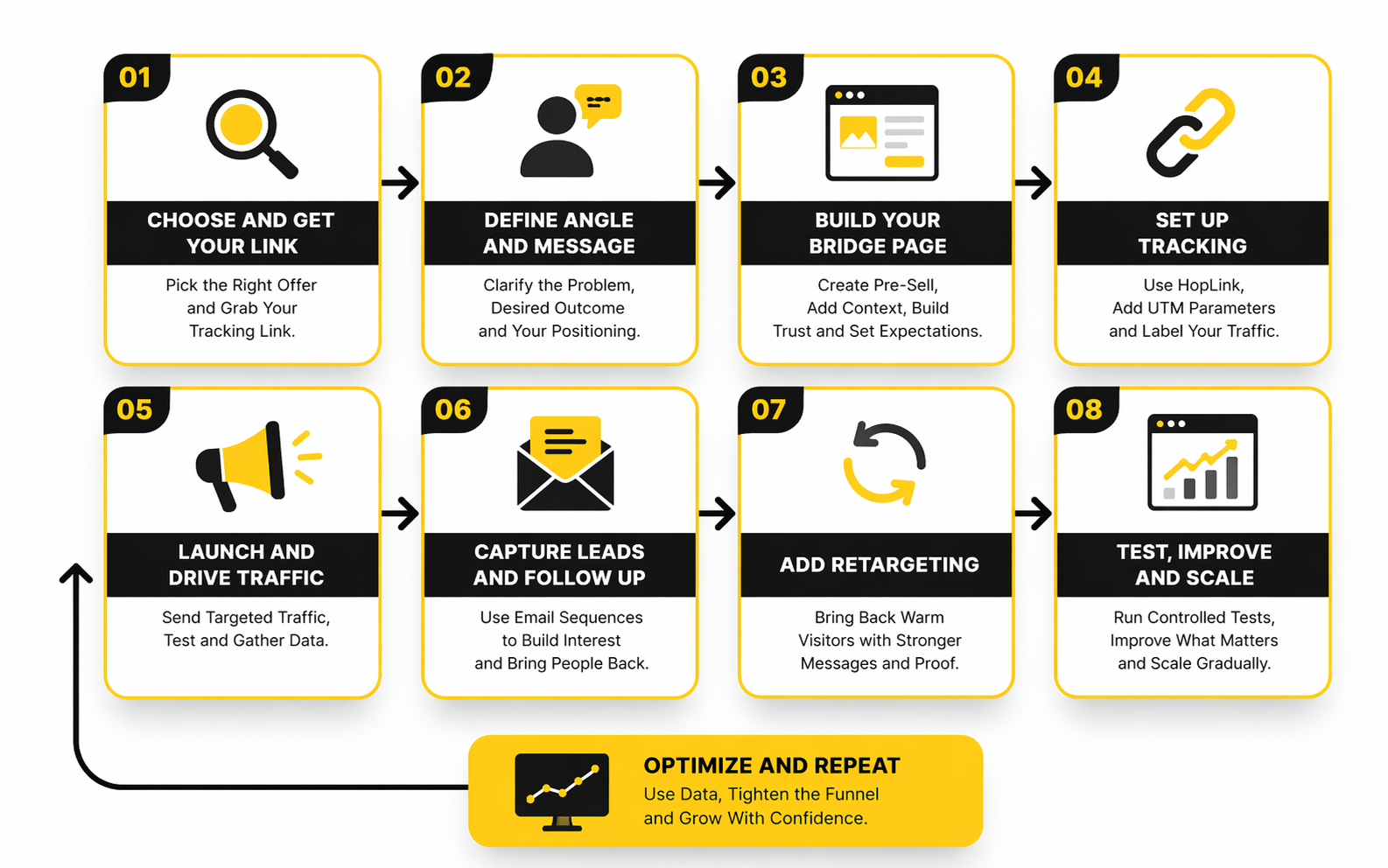
A practical ClickBank affiliate campaign usually follows this sequence:
- Choose one offer and one audience angle.
- Pick one traffic source that fits the awareness level of that audience.
- Decide whether the click should go direct, to a bridge page, or to a lead-capture step first.
- Add tracking IDs so you can separate angles, creatives, and placements.
- Launch with a controlled test budget and review the weakest point in the path before changing everything at once.
This is simple on purpose. Most campaigns do not fail because the operator forgot some advanced tactic. They fail because too many variables were changed at once, the landing path was unclear, or the person running the campaign could not tell which click produced which outcome.
ClickBank’s tracking documentation exists for exactly this reason. If you are not tagging campaigns and traffic variants properly, you are making decisions from blurred data. That is survivable at very small scale, but it becomes brutal once spend starts increasing.
Decide Whether to Use Direct Linking or a Bridge Page
There is no universal answer here. Some ClickBank affiliate campaigns work better with a direct path because the user already has intent and extra steps only create friction. Other campaigns need a bridge page because the click came from cold traffic and the offer needs framing before the buyer sees the sales page.
Use direct linking when the visitor already understands the category, the promise is clear, and the offer page is strong enough to carry the sale. Use a bridge page when you need to shape expectations, compare options, answer objections, or warm up colder traffic. This one decision alone changes the performance of a campaign more than most beginners realize.
If you build a bridge page, keep it focused. Its job is not to tell the entire life story behind the niche. Its job is to move the visitor one step closer to belief and one step closer to action.
Keep the Funnel Tooling Lightweight at First
You do not need a huge software stack to get a ClickBank affiliate campaign live. What you need is a reliable way to build pages, collect leads if that is part of your model, and follow up without your system breaking every other week. The simpler the setup, the easier it is to see what is actually driving results.
For a basic one-page or email-first flow, Systeme.io is often enough. If you want more aggressive page-building flexibility, ClickFunnels can make sense. If your model leans more toward agency-style automation, pipeline handling, or broader workflow control, GoHighLevel gives you more room to centralize moving parts.
The important point is not which platform sounds cooler. It is whether your tools let you launch, test, and adjust without slowing down the core feedback loop. Fancy infrastructure is worthless if it delays your first clean test.
Measure the Right Breakpoint First
When a campaign underperforms, do not immediately assume the offer is bad. First identify where the break actually happens. Is the ad not earning the click, is the bridge page not moving people forward, or is the offer page not converting the traffic you are sending?
That question changes what you fix next. Low click-through rate usually means your hook, audience match, or creative is off. Strong click-through but weak outbound clicks from the bridge usually means your framing is weak. Good traffic flow with weak sales often points back to offer-page fit, audience quality, or the promise-to-page transition.
This is where having a benchmark mindset helps. Unbounce’s broad conversion benchmark work put the median landing-page conversion rate at 6.6% across industries in late 2024, which is not a target you copy blindly, but it does remind you that pages should be judged against real behavioral baselines rather than wishful thinking.
Professional Implementation Means Fewer Variables, Not More Hacks
The professional difference in ClickBank affiliate marketing is usually boring from the outside. It looks like cleaner links, clearer pages, tighter tracking, and smaller test cycles. That is exactly why it works.
Amateurs often stack too many ideas onto the first launch. They test multiple offers, multiple angles, multiple pages, and multiple traffic types at the same time, then wonder why the result is impossible to read. Professionals usually do less at once, but they learn faster because the signal is cleaner.
That is also how you stay compliant while scaling. The FTC still expects clear disclosures when you have a financial relationship to the products you recommend, and that should be built into your pages and content from the start instead of patched in later. Clean process is not just about efficiency. It protects the business you are trying to build.
The next step is where this starts compounding. Once your traffic-source fit and campaign path are set, the focus shifts to the assets that improve conversion after the click: bridge pages, email sequences, retargeting logic, and the testing loops that turn a shaky campaign into a stable one.
Reading the Numbers That Actually Matter
A clickbank affiliate campaign gets easier to improve when you stop treating data like decoration. Most people collect a pile of metrics, stare at dashboards, and still have no idea what to change next. The useful numbers are the ones that tell you where belief breaks, where intent weakens, and where your economics stop making sense.
That is why benchmarks matter only as reference points. They are not goals you copy blindly, and they are definitely not proof that your campaign is healthy. A median number can give you context, but the real value comes from understanding what that number says about your specific traffic, offer, and conversion path.
The bigger point is simple: one number never tells the whole story. In a ClickBank affiliate setup, you need to read metrics as a chain. A weak result at the top of the funnel creates misleading conclusions later, and a decent result in one stage can hide a serious problem somewhere else.
Start With the Few Metrics That Control the Whole Funnel
For most campaigns, the core measurement stack is smaller than people think. You need to know how many people saw the message, how many clicked, how many advanced to the next step, how many bought, and how much value each buyer produced. Everything else is secondary until those numbers are readable.
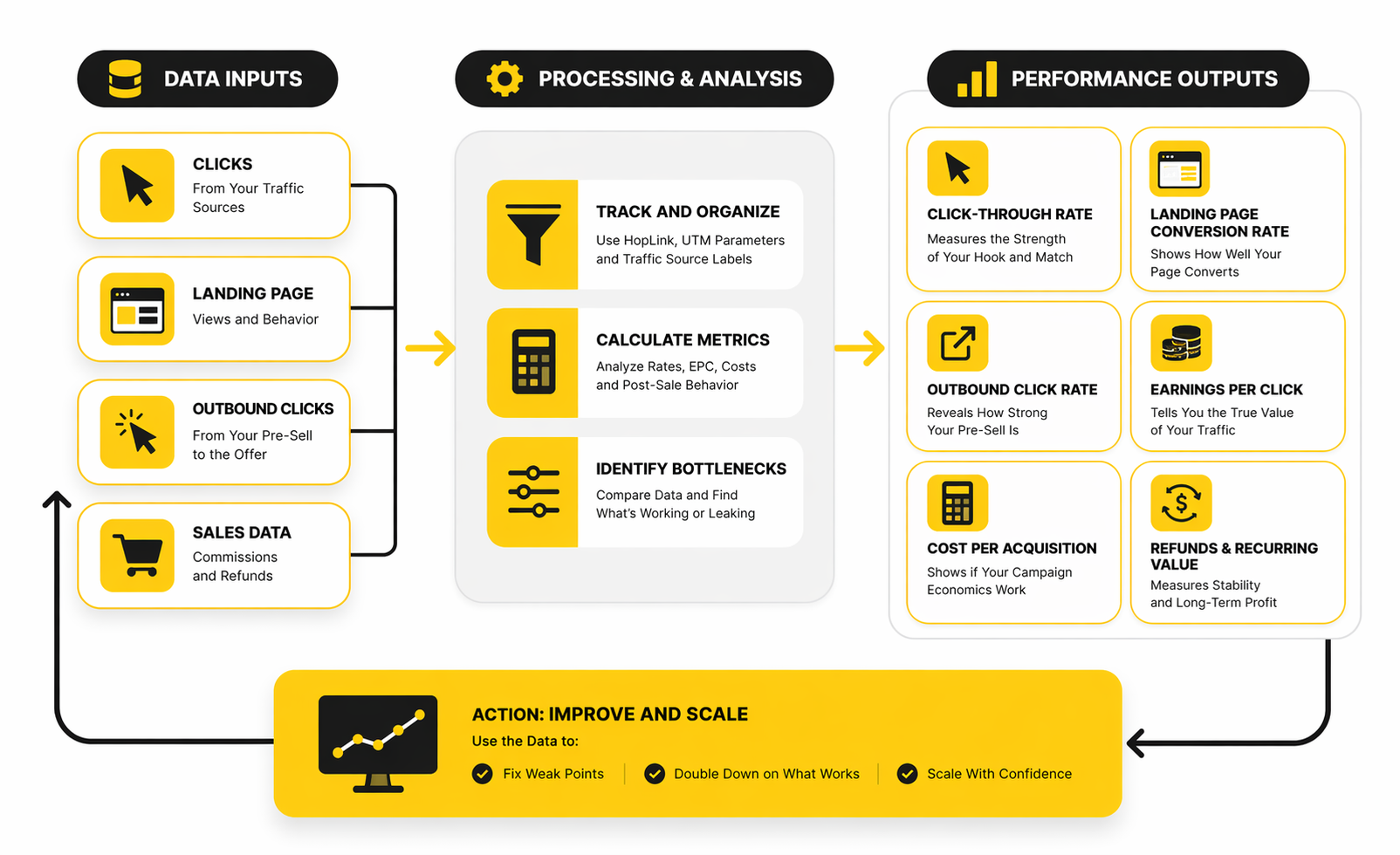
That means your first working dashboard should usually focus on click-through rate, landing-page conversion rate, outbound click rate from your bridge page, earnings per click, cost per acquisition if you are buying traffic, refund behavior, and any recurring revenue signal that matters to the offer. Those numbers are not exciting, but together they tell you whether the system is economically alive. Without them, a ClickBank affiliate business turns into guesswork dressed up as marketing.
This also keeps your decision-making honest. A campaign with high clicks and low sales does not need more creative energy. It needs diagnosis. A campaign with modest clicks and strong conversion may deserve more traffic, not a rebuild.
Use Landing-Page Benchmarks as Context, Not Comfort
Landing-page conversion rate is one of the first numbers people obsess over, usually without enough context. A broad benchmark is useful because it tells you whether your page is wildly underperforming or within a reasonable range for a cold audience. Unbounce’s 2025 landing-page benchmark work put the median conversion rate at 6.6% across industries based on Q4 2024 data.
That does not mean your clickbank affiliate landing page should automatically hit 6.6%. Traffic quality, intent level, offer category, and whether you are asking for an email or a purchase all change what “good” looks like. But if your bridge page is converting far below that kind of baseline for reasonably matched traffic, you should assume friction exists somewhere in the page, message, or audience match.
The right action depends on what the page is supposed to do. If it is a lead-capture step, you test headline clarity, promise alignment, and form friction. If it is a pre-sell page, you test belief-building, transition to the offer, and whether the page actually earns the outbound click instead of just rambling.
Click-Through Rate Tells You If the Hook Is Alive
Click-through rate is not a vanity metric when you interpret it correctly. It tells you whether the first message, creative, or headline is compelling enough for the right audience to act. That makes it a top-of-funnel signal, not a business verdict.
A weak CTR usually points to one of three things: the hook is boring, the audience targeting is off, or the promise feels irrelevant. What it does not tell you is whether the offer is bad. Too many ClickBank affiliates kill a campaign at this stage without realizing the sales argument never even got a fair chance.
The useful move is to separate hook problems from funnel problems. If the CTR is weak, fix the message before touching the offer. If the CTR is strong but the next step dies, the problem is lower in the funnel. That separation saves both time and money.
Outbound Click Rate Exposes Weak Pre-Sell Pages
A lot of affiliates build a bridge page and then never measure whether it is doing its actual job. That is a mistake. The bridge page exists to move the visitor forward with more conviction than they had on arrival. If people land on it and stall, the page is not “educating.” It is leaking intent.
This is one of the clearest performance signals in a ClickBank affiliate funnel because it tells you whether your pre-sell is increasing belief or killing momentum. A weak outbound click rate usually means the page is overexplaining, making the wrong promise, or failing to connect the user’s original reason for clicking with the offer they are about to see.
That is why this metric deserves its own slot in your analytics. It isolates the bridge page from the offer page, which makes optimization much cleaner. Instead of saying “the funnel is bad,” you can say “the bridge page is not handing off qualified intent.”
Building a Simple Analytics System You Can Actually Use
Most affiliates do not need a complicated analytics setup. They need one they can trust. The goal is not to build a prettier dashboard than everyone else. The goal is to know, with minimal confusion, where money is being made and where it is leaking.
A workable system starts by tagging every traffic source, creative angle, and page variant clearly. If you cannot tell which ad, post, keyword, or email generated the click, then even a winning campaign becomes hard to scale because the signal is blurred.
The Minimum Measurement System for a ClickBank Affiliate Funnel
A clean ClickBank affiliate analytics system should answer five questions every day:
- Which traffic source produced the click?
- Which angle or creative generated that click?
- Which page path did the user take next?
- Where did the user drop off or convert?
- What revenue value came back from that path?
That is enough to make real decisions. You do not need a giant enterprise stack to do this well. You need consistent tracking discipline, clean naming, and the habit of reviewing the funnel in sequence instead of staring at one blended total.
This is also where ClickBank’s own tracking parameters become practical instead of optional. If you label traffic sources and link variations properly, you can compare outcomes without guessing which path produced which sale. That is basic operating hygiene, and it matters more than fancy reporting. ClickBank’s affiliate tracking parameter guidance exists for a reason.
Earnings Per Click Is One of the Most Honest Numbers in the Business
Earnings per click is powerful because it ties attention back to economics. A high click volume can make a campaign look healthy while still losing money. EPC cuts through that noise and forces you to ask a harder question: what is each visitor actually worth?
For a ClickBank affiliate running paid traffic, this number becomes one of the clearest go-or-no-go signals. If your traffic costs are higher than what each click is worth, no amount of motivation will rescue the campaign. You either improve the funnel, improve the offer match, or stop buying that traffic.
Even with organic traffic, EPC matters because it helps you prioritize assets. If one article, page, or email sequence consistently produces better EPC than another, that tells you where your audience has stronger purchase intent and where future effort should go.
Email Metrics Matter More After the Opt-In Than Most Affiliates Realize
Once you start capturing leads, your campaign stops depending entirely on first-session conversion. That is where email data becomes genuinely useful. Brevo’s 2025 benchmark, based on more than 44 billion emails, showed an average open rate of 21% and an average click-through rate of 3.96%.
Those numbers are helpful only if you interpret them correctly. An open rate tells you whether the subject line and sender context earned attention. A click rate tells you whether the message itself created enough interest to move people forward. If opens are decent but clicks are weak, the email body is usually the problem. If both are weak, the issue often starts with list quality, expectation mismatch, or poor sequencing.
This matters for any clickbank affiliate model that uses lead capture, content funnels, or repeated follow-up. A mediocre front-end campaign can become profitable when the email layer is strong. A promising campaign can also quietly die if follow-up is weak and nobody notices because they are only watching day-one sales.
Refunds and Retention Tell You Whether the Offer Is Stable
It is easy to celebrate a front-end commission and completely ignore what happens afterward. That is how affiliates convince themselves a campaign is working when it is actually unstable. Refund behavior and retention patterns tell you whether the offer has real buyer fit or just strong sales-page momentum.
This is especially important in ClickBank affiliate campaigns that lean on continuity, upsells, or recurring revenue. A high initial payout can look attractive until refund volume or churn wipes out the economics. That does not always mean the product is bad, but it does mean you need to be careful about which numbers you trust most early on.
The practical takeaway is simple: do not scale from gross excitement. Scale from net signal. If the offer converts but does not hold value after the purchase, the campaign will eventually punish you for believing the wrong metric.
Industry Growth Data Matters Because Competition Is Getting Smarter
Broad industry numbers are not useful for daily optimization, but they do help explain the environment you are operating in. eMarketer projected that US affiliate marketing ad spending would top $10 billion in 2024 and continue growing at a double-digit rate for the next two years. That is not just a headline. It means more advertisers, more creators, more tracking scrutiny, and more competition for the same user attention.
The same pattern shows up in the UK market, where APMA reporting summarized by Modo25 described 17% industry growth to £1.67 billion. The exact number matters less than what it implies: affiliate and partner marketing is not shrinking into irrelevance. It is becoming more professional.
For a ClickBank affiliate, that means sloppy campaigns get exposed faster. Weak pages, loose claims, lazy tracking, and generic traffic angles have less room to survive. The upside is that disciplined operators have more room than ever to win because the market is large enough to reward competence.
What the Data Should Actually Make You Do Next
Data is useful only when it triggers action. If CTR is weak, fix the angle or audience match. If landing-page conversion is weak, tighten message clarity and reduce friction. If outbound clicks are weak, rebuild the bridge page so it actually earns the transition. If sales are weak after a strong handoff, revisit offer fit and sales-page alignment.
That is the entire game in practical terms. The numbers are not there to impress you. They are there to tell you where the next bottleneck lives. Once you understand that, analytics stops being intimidating and starts becoming leverage.
And that is where a clickbank affiliate business becomes much easier to scale intelligently. The next section moves into exactly that: how to use conversion assets, follow-up systems, and controlled testing loops to improve the funnel without creating chaos.
Building Conversion Assets and Testing Loops That Actually Improve Results
At this point, you already have the fundamentals in place: a validated offer, a matching traffic source, and a measurable funnel. What separates average ClickBank affiliate campaigns from scalable ones is what happens next. This is where conversion assets and testing discipline take over.
Most affiliates plateau because they stop at “it works a bit.” They get some clicks, a few sales, and then keep repeating the same setup without tightening it. The professionals do the opposite. They treat every asset as something that can be improved, measured, and replaced if necessary.
This is not about chasing perfection. It is about building a system where each iteration makes the next one easier and more predictable.
Your Bridge Page Is a Leverage Point, Not Just a Step
A lot of ClickBank affiliate setups treat the bridge page as a formality. Something quick, generic, and forgettable. That is a missed opportunity because this page often controls how much of your traffic turns into qualified buyers.
A strong bridge page does three things clearly. It reinforces the problem the visitor already cares about, introduces a believable mechanism or solution, and transitions the user toward the offer without breaking trust. When those three elements align, outbound clicks increase and the traffic arriving at the offer page is warmer and more decisive.
This is also where small improvements compound. A slight increase in outbound click rate combined with a stable sales-page conversion rate can dramatically improve overall earnings per click. That is why experienced affiliates spend more time refining this page than most beginners expect.
Email Sequences Turn One Click Into Multiple Chances
If you are not capturing leads, you are relying entirely on first-session behavior. That is fine for certain high-intent flows, but it limits your upside. Email changes that dynamic by extending the decision window.
A good email sequence does not just repeat the offer. It builds context, answers objections, introduces different angles, and brings the user back when they are more ready to act. This is especially important in niches where the buyer needs time to evaluate or compare options.
Tools like Brevo or Moosend make this part operational without adding too much complexity. The key is not the tool itself. It is whether your sequence is structured around real buyer behavior instead of random promotional bursts.
The difference shows up quickly in the data. Campaigns with structured follow-up tend to extract more value from the same traffic, which gives you more room to test and scale.
Retargeting Closes the Gap Most Funnels Ignore
A large percentage of visitors will not convert on the first visit, even if the offer is strong. That is not failure. That is normal behavior. Retargeting exists to bring those users back when the timing is better or the message is clearer.
This works particularly well for ClickBank affiliate campaigns with higher consideration or stronger competition. If someone showed interest but did not buy, they are already more valuable than a cold visitor. Ignoring that segment means leaving easy improvements on the table.
Retargeting also lets you refine your message. Instead of repeating the same pitch, you can address specific objections, introduce proof, or reposition the offer. That second interaction often performs better because it feels more relevant to the user’s hesitation.
Testing Should Be Controlled, Not Chaotic
Testing is where most affiliates either gain an edge or burn their budget. The difference is not how many things you test. It is how cleanly you isolate what you are testing.
A controlled test changes one meaningful variable at a time. That could be the hook, the headline, the page structure, or the audience segment. When you change too many elements at once, you lose the ability to understand what actually caused the result.
This is where discipline matters more than creativity. A slightly boring, structured testing process usually outperforms a chaotic “try everything” approach. It produces clearer insights, which leads to better decisions, which compounds over time.
Scaling a ClickBank Affiliate Campaign Without Breaking It
Scaling sounds simple in theory. Increase traffic to a winning campaign. In practice, it introduces new pressure on every part of the system. Traffic quality can drop, costs can rise, and parts of the funnel that worked at small scale can start failing under volume.
That is why scaling should be gradual and measured. Increase traffic in steps, monitor the key metrics you already understand, and watch for changes in behavior. If earnings per click drops as volume increases, you need to understand whether the issue is traffic quality, audience saturation, or funnel fatigue.
Scaling is also where diversification becomes important. Relying on one traffic source, one offer, or one angle creates fragility. A stable ClickBank affiliate business spreads risk across multiple entry points while maintaining focus on what is already working.
The Tradeoff Between Speed and Stability
There is always a tension between moving fast and building something stable. Fast testing can help you find opportunities quickly, but it also increases the chance of shallow wins that do not hold up under pressure. Slower, more structured builds take longer to validate but often produce more durable results.
The right balance depends on your situation. If you are early, you need enough speed to find something that works. Once you have a working campaign, you need enough structure to protect and grow it. Many affiliates get stuck because they stay in “fast mode” even when the situation requires stabilization.
This is one of the most important mindset shifts in ClickBank affiliate marketing. You are not just launching campaigns. You are managing systems that need to survive change.
Risk, Compliance, and Platform Dependence
As your campaigns grow, risk becomes more visible. Traffic platforms change policies, ad accounts get reviewed more aggressively, and claims that worked at small scale may not hold up under scrutiny. Ignoring this reality can undo months of progress quickly.
That is why compliance should not be an afterthought. Clear messaging, honest positioning, and proper disclosures are not just legal requirements. They are part of building a business that can operate consistently without constant disruption.
Platform dependence is another risk to manage. If all your traffic comes from one source, you are exposed. Building multiple acquisition paths and owning parts of your audience, like an email list, reduces that exposure and gives you more control over your growth.
What Advanced ClickBank Affiliates Do Differently
At a higher level, the difference is not tactics. It is consistency. Advanced affiliates repeat the same core process with better inputs and tighter feedback loops. They choose offers more carefully, match traffic more precisely, build cleaner funnels, and read their data more honestly.
They also avoid unnecessary complexity. Instead of chasing every new tool or strategy, they focus on improving the few levers that actually move the business. That restraint is what allows them to scale without constantly resetting their progress.
By the time you reach this stage, the mechanics of ClickBank affiliate marketing are no longer confusing. The challenge becomes execution discipline and strategic judgment. And that is exactly what the final part will bring together, along with the most common questions and practical clarifications that come up when you start applying this in the real world.
Scaling Sustainably, Staying Compliant, and Avoiding Expensive Mistakes
By now, the shape of a real ClickBank affiliate business should be clear. It is not just traffic plus a link. It is an ecosystem made up of offer selection, traffic quality, pre-sell structure, measurement discipline, follow-up, and continuous refinement. When those parts work together, you get something durable instead of a few accidental commissions.
That bigger view matters because scale changes the rules. What feels manageable at low volume can become fragile once spend increases or traffic sources get stricter. ClickBank’s own support materials now put serious emphasis on direct tracking links, tracking parameters, and traffic source labeling, which tells you where professional affiliates are expected to operate.
The safest path is not the most complicated one. It is the one where your claims are clean, your tracking is organized, your assets are reusable, and your business is not overly dependent on one unstable tactic. That is how a ClickBank affiliate model survives long enough to become meaningful.
FAQ
What is a ClickBank affiliate?
A ClickBank affiliate is someone who promotes products listed in the ClickBank marketplace and earns a commission when a tracked sale happens through their referral link. In practice, that can include content publishers, paid traffic buyers, email marketers, creators, and niche site operators. The role is simple to describe, but doing it well requires strong judgment around offers, traffic, and conversion systems.
What trips people up is thinking the account itself is the business. It is not. The business is the system you build around that account: your audience angle, your bridge assets, your tracking discipline, and your ability to improve conversion over time.
That is why two people can use the same ClickBank offer and get completely different results. One has a real operating process. The other just has a link.
Is ClickBank affiliate marketing still worth it in 2026?
Yes, but not for the lazy version of affiliate marketing people still fantasize about. The channel remains relevant because affiliate spend continues to grow, with eMarketer projecting US affiliate marketing ad spending would exceed $10 billion in 2024 and continue growing at a double-digit pace after that. That growth matters because it shows performance-based acquisition is still a serious part of the digital marketing economy.
What has changed is the quality threshold. More marketers understand funnels, more creators know how to monetize attention, and more platforms care about landing-page quality, tracking transparency, and compliance. That means sloppy campaigns have less room to survive.
So yes, it is worth it. But it is worth it for people willing to operate like marketers, not for people looking for frictionless passive income on day one.
How much money can a ClickBank affiliate realistically make?
There is no honest fixed number because earnings depend on traffic quality, offer economics, conversion skill, refunds, and whether you are relying on one-time or recurring commissions. A beginner can make almost nothing for months if they keep testing random offers without learning the mechanics. A disciplined operator with a working system can build something meaningful because performance-based models scale when the math works.
The smarter way to think about income is not “how much can I make?” but “how much value does each click and each lead produce?” That mindset forces you to focus on controllable economics instead of fantasy screenshots. Once you know your earnings per click, your cost per acquisition, and your retention behavior, the income conversation becomes much more grounded.
That is also why small wins matter early. A campaign that proves the math at a low level is more valuable than a campaign that looks exciting but has no stable economics underneath it.
Do I need a website to be a successful ClickBank affiliate?
No, but in many cases you are better off having one. A website, landing page, or bridge page gives you more control over messaging, pre-sell, disclosure placement, lead capture, and analytics. That control becomes more important as your campaigns get more sophisticated.
Some affiliates use direct linking and do well, especially when traffic intent is high and the offer page is already strong. ClickBank explicitly supports direct tracking links for affiliates who need a cleaner path from stricter traffic sources. But direct linking gives you less control over the persuasion layer, which means your offer and traffic match need to be tighter.
A website is not mandatory. Control is. A website is simply one of the best ways to create that control.
What kinds of traffic work best for a ClickBank affiliate?
The best traffic depends on the offer and the audience’s level of awareness. Search traffic often works best when people already know the problem they want to solve and are looking for options, reviews, or comparisons. Social traffic can work extremely well when the hook is emotional, visible, or curiosity-driven, but it usually needs a stronger bridge into the offer.
Content traffic works well when the product needs explanation or objection handling. Email works best when you want multiple chances to convert the same prospect instead of forcing everything to happen on the first session. Each source can work, but only when it matches the sales path the offer actually needs.
The expensive mistake is forcing every offer through your favorite channel. The better move is matching the source to the buyer’s intent and the offer’s conversion logic.
Should I send people directly to the offer or use a bridge page first?
That depends on how ready the visitor is and how strong the offer page already is. If someone has clear buying intent and the product page is solid, a direct path can work very well because you are reducing friction. If the traffic is colder or the promise needs context, a bridge page usually performs better because it builds belief before the click to the offer.
A bridge page is especially helpful when you want to compare options, address objections, frame expectations, or collect leads before the sale attempt. It also gives you more room to track behavior and improve weak transitions. That is useful because many funnels do not fail at the offer itself; they fail at the handoff.
The key is not to use a bridge page just because everyone else does. Use it when it earns the next click better than a direct route would.
What metrics should a ClickBank affiliate watch most closely?
The core metrics are simpler than most people think. You need to know click-through rate, landing-page conversion rate, outbound click rate from pre-sell assets, earnings per click, cost per acquisition if you are buying traffic, and the stability signals that come after the sale, like refunds or recurring value. Those numbers tell you where the bottleneck lives.
If the CTR is weak, your hook or audience match is off. If the bridge page gets traffic but weak outbound clicks, your pre-sell is not doing enough to create belief. If the handoff is strong but sales are weak, the offer fit or sales-page alignment may be the issue.
That is why clean tracking matters so much. ClickBank’s affiliate tracking parameters are not just technical extras. They are what allow you to identify where your campaign is actually winning or leaking.
How important is email for long-term ClickBank affiliate growth?
It becomes more important the moment you stop depending entirely on first-session sales. Email gives you a second, third, and fourth chance to move a prospect toward action. That alone can change the economics of a campaign because the same traffic can generate more downstream value.
The broader email channel is still strong enough to justify the effort. Brevo’s 2025 benchmark, based on more than 44 billion emails, reported a 21% average open rate and a 3.96% click-through rate, which is a good reminder that follow-up still matters when the list and message quality are solid. For a ClickBank affiliate, this means a captured lead is often more valuable than an anonymous click.
That is why building even a basic email layer can be a smart move. Tools like Brevo, Moosend, or GoHighLevel can support that layer depending on how simple or advanced you want the system to be.
What tools help a ClickBank affiliate build funnels faster?
The answer depends on how much control you need and how complex your workflow is. If you want a simple funnel and email stack in one place, Systeme.io is often enough to get moving quickly. If you want more aggressive funnel-building features and a mature page-building environment, ClickFunnels is still a common option.
For more advanced workflow automation, CRM-style follow-up, and multi-step campaign operations, GoHighLevel gives you broader infrastructure. If your biggest bottleneck is page design rather than the rest of the funnel, tools like Replo can help create sharper landing experiences.
The main thing is not to overbuild too early. Pick the smallest tool stack that still lets you launch, track, and improve the funnel properly.
Can a beginner start as a ClickBank affiliate without paid ads?
Yes, and that is often a good way to learn because it gives you more time to understand audience behavior before spending heavily. Organic content, search-focused articles, social content, email capture, and comparison-style assets can all work if the offer and message are aligned. It is slower, but it often teaches better habits.
Paid ads can speed up learning because the feedback loop is faster, but they also punish weak judgment immediately. If the offer, hook, landing page, and economics are not aligned, you will feel it in the budget very quickly. That is not always the best environment for someone who has not yet learned to diagnose funnel issues.
A beginner does not need paid traffic to start. A beginner needs a repeatable process and enough patience to learn what good alignment looks like.
What are the biggest mistakes new ClickBank affiliates make?
The first big mistake is choosing offers emotionally. People see a high payout, a flashy niche, or a strong-looking sales page and assume that is enough. It is not. Without audience fit and a believable path to conversion, the offer selection is usually weak from the start.
The second mistake is treating traffic as a generic resource. Not all clicks are equal, and not every channel suits every offer. A lot of campaigns die because the traffic source and the sales path were never designed for each other.
The third mistake is poor measurement. If you are not tracking traffic sources, creative angles, bridge-page behavior, and post-click economics, then you are making changes based on vibes. That is how people burn time while convincing themselves they are testing.
Do I need to disclose affiliate relationships?
Yes, and this is not a gray area you should try to dance around. The FTC’s guidance on endorsements, influencers, and reviews makes it clear that material connections should be disclosed clearly when you recommend products and benefit financially. That applies whether you are publishing content, sending emails, or posting on social platforms.
This matters for trust as much as compliance. Hiding the affiliate relationship does not make your recommendation stronger. It usually makes the overall brand weaker, especially if people feel misled later. Clear disclosure is part of professional positioning.
So yes, disclose. Put it where people can actually see it, and make it understandable without legal gymnastics.
How do I know when to scale a ClickBank affiliate campaign?
You scale when the numbers stay healthy under repeated testing, not when one day looks exciting. That means you understand the funnel well enough to know which traffic source is working, which angle is producing the best result, and whether the sales behavior still looks solid after refunds or follow-up data come in. One lucky result is not enough.
A scalable campaign has predictable economics. You know what a click is worth, what a lead is worth, and how much variation the system can handle before margins start shrinking. If you do not know those things yet, scaling is usually just optimism with a bigger budget attached to it.
The best scaling is gradual. Increase volume, watch the key metrics, and make sure the same logic still holds as more traffic enters the system.