

Cold email marketing still works, but the lazy version is finished. Generic blasts, scraped lists, fake personalization, and aggressive follow-ups are exactly why buyers ignore outreach and inbox providers punish senders. The channel is not dead. Bad execution is.
Modern cold email marketing is a structured outbound system. You need the right audience, a relevant offer, clean data, strong deliverability, legal compliance, useful follow-up, and a sales process that can handle replies quickly. Gmail recommends SPF, DKIM, and DMARC for sending domains through its email sender guidelines, and Yahoo’s sender standards also focus on authentication, complaint control, and responsible sending through its sender best practices.
The point is simple: you are not just sending emails. You are earning the right to start a business conversation with someone who did not ask to hear from you. That requires relevance, restraint, and a system that protects your reputation while creating pipeline.
This complete guide will cover:
- What Cold Email Marketing Is
- Why Cold Email Marketing Still Matters
- The Cold Email Marketing Framework
- Core Components Of A Cold Email System
- How Cold Email Marketing Actually Works
- How To Build A Cold Email Campaign
- Statistics And Data
- Advanced Cold Email Strategy
- Common Cold Email Mistakes
- FAQ - Built For Complete Guide
- Work With Professionals
What Cold Email Marketing Is
Cold email marketing is the process of sending targeted business emails to people who have not previously opted into your list, usually to start a sales, partnership, recruiting, or professional conversation. It is most common in B2B because the goal is usually tied to a clear business problem. A good cold email does not pretend the relationship already exists; it gives the recipient a relevant reason to pay attention.
That makes cold email different from newsletters, lifecycle campaigns, ecommerce promotions, or warm lead nurturing. Those channels usually involve people who already subscribed, bought, visited, or raised their hand in some way. Cold email starts without that permission, so the quality bar is higher.
The best cold emails feel specific, useful, and easy to answer. The worst ones feel copied, self-centered, and careless. That gap is where cold email marketing either becomes a serious growth channel or turns into spam.
Why Cold Email Marketing Still Matters
Cold email matters because it gives you a direct way to reach the exact people and companies you want to work with. You do not have to wait for search rankings, social algorithms, referrals, or paid ads to do all the work. You can define a market, build a focused list, and test whether your message creates real conversations.
It also gives smaller teams leverage. A startup, consultant, agency, recruiter, or SaaS founder can use cold email to validate positioning, book meetings, find partners, test offers, and open doors before they have a large audience. That makes the channel practical when speed matters.
But cold email only works when relevance is high. Average performance is not huge; one 2025 benchmark analyzing 16.5 million B2B cold emails found an average reply rate of 5.8%. That number is not a reason to avoid the channel. It is a reminder that targeting, offer clarity, deliverability, and follow-up decide everything.
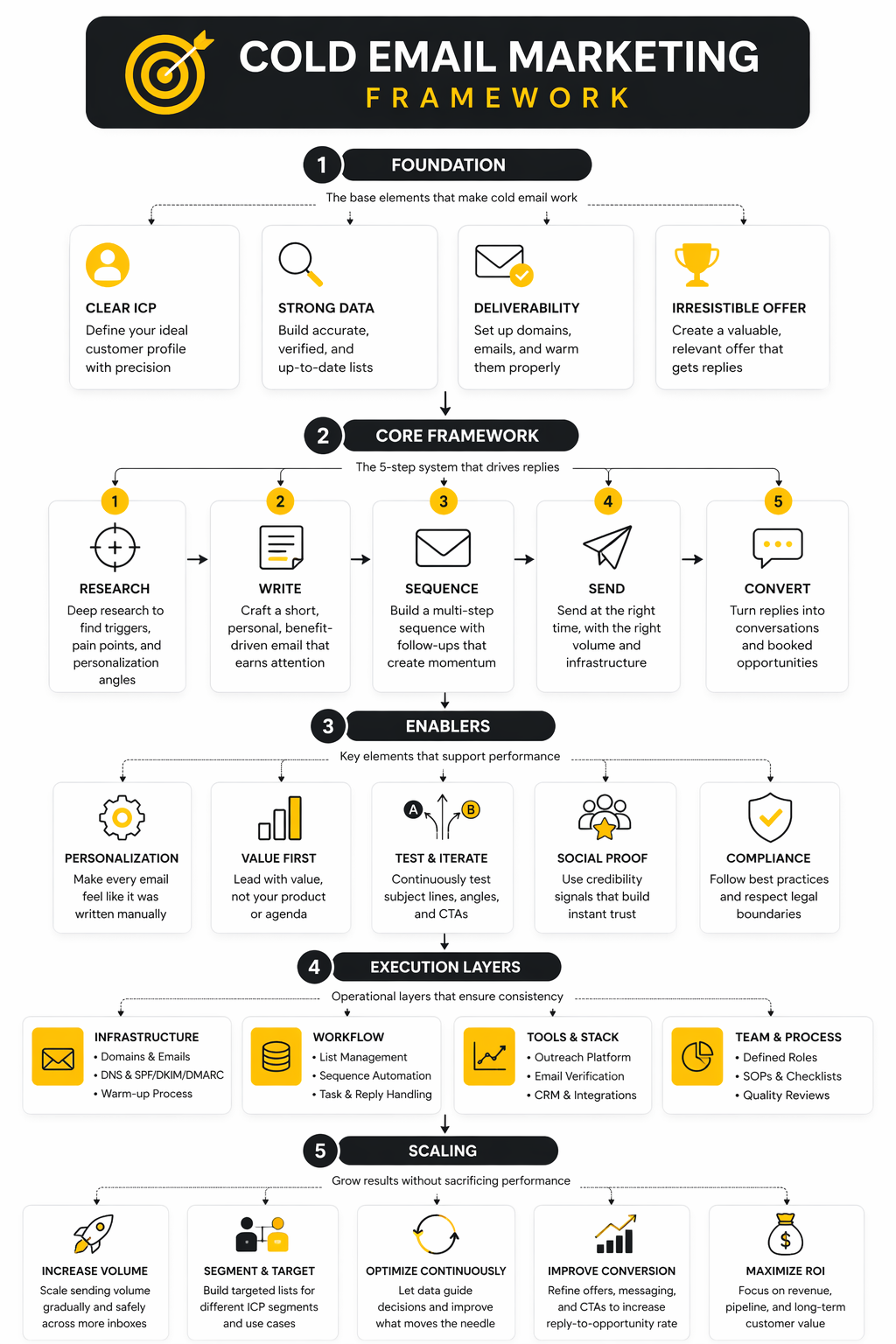
The Cold Email Marketing Framework
A strong cold email marketing system has four layers: audience, message, infrastructure, and follow-up. Each layer supports the next one. If one breaks, the campaign suffers even if everything else looks polished.
The first layer is audience quality. You need to know exactly who you are contacting, why they are relevant, and what business situation makes the outreach reasonable. This includes ideal customer profile, role targeting, buying triggers, exclusions, and list hygiene.
The second layer is message relevance. The email should connect your offer to the recipient’s world quickly. It should not read like a brochure or a pitch deck. It should make the reader think, “This person understands a problem I actually recognize.”
The third layer is deliverability and compliance. Authentication, domain reputation, bounce control, complaint prevention, unsubscribe handling, and truthful sender identity are not minor details. The FTC’s CAN-SPAM guidance makes clear that commercial email must follow rules around accurate headers, non-deceptive subject lines, a valid physical address, and opt-out handling through its business compliance guide.
The fourth layer is follow-up and conversion. Most campaigns do not succeed from one message alone. The follow-up sequence, reply handling, CRM workflow, and sales process turn interest into actual opportunity.
Core Components Of A Cold Email System
A cold email system starts with a narrow audience. “Founders” is not narrow. “B2B SaaS founders hiring their first sales team after raising seed funding” is much more useful because the situation suggests a problem, timing, and possible reason to respond.
Next comes the offer. Your offer does not need to explain everything you do. It needs to create enough interest for a reply, a booked call, a referral to the right person, or permission to send more detail.
Then comes the message. A strong cold email usually includes a relevant opener, a clear problem, a reason to believe you can help, and a low-friction call to action. It should be easy to read on a phone and easy to respond to without thinking too hard.
Finally, you need tracking and follow-up. A CRM like Copper, an automation platform like GoHighLevel, or an email platform like Brevo can help manage contacts, replies, workflows, and pipeline once the strategy is clear.
Professional Implementation
Professional cold email marketing is built around process, not random sending. You define the audience, clean the data, verify contacts, prepare domains, write the sequence, test the message, monitor deliverability, and review performance by segment. Each step protects the next one.
This is why good implementation usually starts slower than beginners expect. You are not trying to send as many emails as possible. You are trying to build a repeatable outbound system that can survive inbox filters, buyer skepticism, and sales follow-up pressure.
The best teams treat cold email like a controlled experiment. They test one market, one offer, one message angle, and one follow-up structure before scaling. When the signal is strong, they increase volume carefully. When the signal is weak, they fix the audience, offer, or message before blaming the channel.
How Cold Email Marketing Actually Works
Cold email marketing works when the message feels relevant enough to deserve attention. That is the entire game. The recipient did not subscribe, request a demo, download a lead magnet, or ask for your pitch, so your email has to earn its place quickly.
The working process is simple, but not easy. You define a narrow audience, collect accurate contacts, verify the data, prepare your sending setup, write a focused sequence, send at a controlled pace, and track what happens. If the signal is strong, you scale carefully. If the signal is weak, you fix the audience, offer, or message before increasing volume.
Reply rates show why this discipline matters. A 2025 benchmark analyzing 16.5 million B2B cold emails found an average cold email reply rate of 5.8%, which means small improvements in targeting and relevance can create a major difference in pipeline. Cold email is not about blasting more people. It is about contacting the right people with a reason that actually makes sense.
Audience Quality Comes First
Your list sets the ceiling for the entire campaign. If the audience is wrong, even excellent copy will struggle. You cannot write your way out of bad targeting.
A strong cold email audience should be built around company fit, role fit, problem fit, and timing fit. Company fit might include industry, size, location, funding stage, tools used, hiring activity, or business model. Role fit means the person has influence over the problem, budget, buying process, or internal conversation.
Timing is where cold email marketing becomes much more effective. A company hiring salespeople, launching a product, changing platforms, raising funding, expanding into a new market, or publicly discussing a problem gives you a more credible reason to reach out. That context makes the message feel less random.
Offer Clarity Beats Clever Copy
Most cold email problems are not copy problems. They are offer problems. If the offer is vague, the email has to over-explain, over-persuade, and overcompensate.
A strong offer is specific enough that the recipient can quickly decide whether it matters. “We help companies grow” is too broad. “We help B2B SaaS teams reduce demo no-shows with automated follow-up” is clearer because the audience, problem, and outcome are obvious.
This does not mean your email should explain the entire service. The first conversion is usually a reply, a booked call, a referral, or permission to send more detail. Keep the offer focused on that next step.
Deliverability Is Part Of The Strategy
Deliverability is not a technical side task. It decides whether your campaign has a chance to work at all. If your emails land in spam, your targeting and copy do not matter.
At minimum, your sending domain should be authenticated, your list should be verified, your bounce rate should stay low, and your sending volume should increase gradually. Gmail recommends setting up SPF, DKIM, and DMARC for sending domains through its email sender guidelines, and Yahoo’s sender guidance also emphasizes DKIM, complaint handling, and clean recipient lists through its sender best practices.
The practical rule is simple: protect the domain before chasing volume. Sending more from a weak setup usually makes the problem worse. A clean, patient system wins longer than an aggressive one.
Compliance Cannot Be Ignored
Cold email can be legal when done correctly, but it is not a free-for-all. In the United States, the CAN-SPAM Act sets rules for commercial email, including accurate header information, non-deceptive subject lines, a valid physical mailing address, and a clear opt-out process through the FTC compliance guide. Other regions may have stricter consent, privacy, and data handling requirements.
This matters beyond legal risk. Compliance affects trust. A clear sender identity, honest message, and easy unsubscribe path make your outreach feel more professional.
If you are emailing across countries, be careful. GDPR, CASL, PECR, and other privacy frameworks can change what is allowed and what documentation you need. When in doubt, get proper legal guidance before scaling.
Follow-Up Creates Most Of The Opportunity
One cold email is rarely enough. People are busy, inboxes are full, and timing is often the reason a good-fit prospect does not reply. Follow-up gives the campaign more chances without forcing everything into the first message.
Good follow-up does not mean repeating “just checking in” until someone gets annoyed. Each message should add a new angle, useful context, proof, or a simpler question. The goal is to make relevance easier to see, not to pressure someone into responding.
A practical sequence might include:
- A short first email focused on the main problem.
- A follow-up with a different pain angle.
- A proof-based message that builds credibility.
- A low-friction question that makes replying easy.
- A respectful close-the-loop email.
Cold Email Marketing Is A System, Not A Template
Templates can help with structure, but they cannot replace strategy. A template does not know your market, your buyer, your timing, your proof, or your offer. If you copy someone else’s email without understanding the logic behind it, you are just borrowing surface-level tactics.
A real cold email system connects the list, message, infrastructure, sequence, CRM, and sales process. When a positive reply comes in, someone needs to respond quickly. When a prospect asks for more detail, the right asset should already exist. When someone is interested later, the CRM should not lose them.
This is where tools can support the process, but they cannot fix weak thinking. A platform like GoHighLevel can help manage workflows and pipeline, Brevo can support email and automation, and Copper can keep sales conversations organized. But the system still needs a strong audience, a clear offer, and disciplined execution behind it.
Statistics And Data
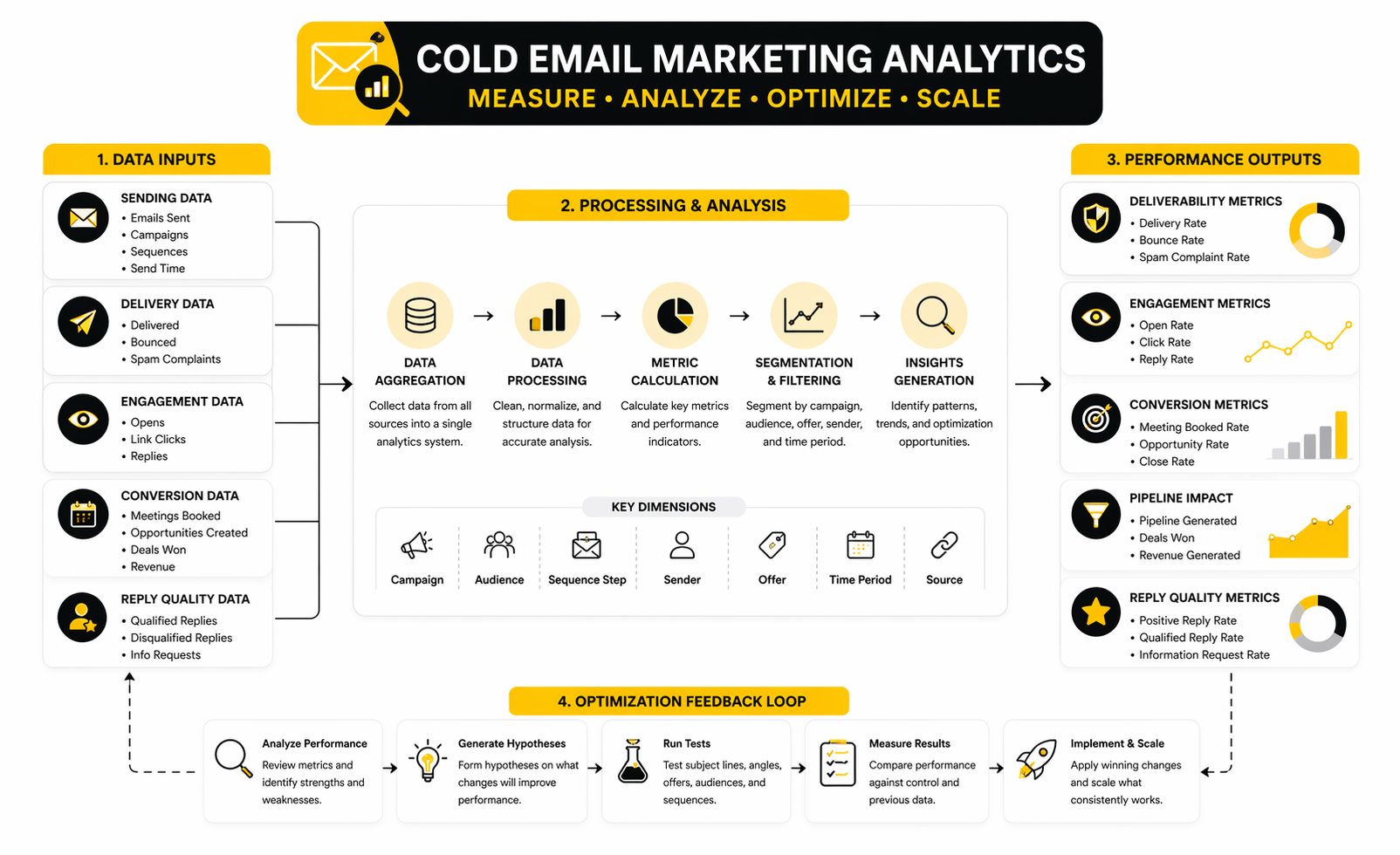
Cold email marketing should be measured like a pipeline system, not a vanity channel. Opens, clicks, and replies are useful, but they do not mean much unless they connect to qualified conversations, booked meetings, sales opportunities, and revenue. The point is not to prove that emails were sent. The point is to prove that the right outreach created the right business outcome.
Benchmarks help you understand whether your campaign is in a normal range, but they should not become the strategy. One 2025 analysis of 16.5 million B2B cold emails found an average reply rate of 5.8%, while other outbound benchmarks often place average reply rates in the low single digits depending on targeting, industry, and list quality. That means a “low” reply rate is not automatically failure, and a “high” reply rate is not automatically success.
The real question is what those replies become. A campaign with fewer replies but stronger-fit prospects can outperform a campaign with more replies from poor-fit leads. This is why measurement needs to follow the whole journey from contact quality to booked calls to closed revenue.
The Cold Email Metrics That Matter
A strong cold email dashboard should separate deliverability, engagement, conversation quality, and revenue. If you mix everything into one number, you will misdiagnose the campaign. A low reply rate could be a list problem, a message problem, a deliverability problem, or a weak offer.
The most useful metrics are:
- Delivery rate, which shows whether emails are reaching receiving servers.
- Bounce rate, which reveals list quality and data hygiene.
- Open rate, which can signal inbox placement and subject-line relevance, but is less reliable because of privacy features.
- Reply rate, which shows whether the email created enough interest to start a conversation.
- Positive reply rate, which separates real opportunities from objections, wrong-person replies, and unsubscribe requests.
- Meeting booked rate, which shows whether replies are turning into pipeline.
- Opportunity rate, which shows whether meetings are with the right buyers.
- Close rate and revenue, which prove whether the campaign is producing business value.
This is the measurement chain that matters. If delivery is weak, fix infrastructure and list quality. If delivery is strong but replies are weak, fix targeting, offer, and message. If replies are strong but meetings are weak, fix the call to action and reply handling. If meetings are strong but sales are weak, the campaign may be attracting the wrong segment.
Deliverability Metrics Come First
Deliverability sits at the top of the analytics system because it controls everything below it. If your emails are not reaching the inbox, the rest of the funnel becomes misleading. You may think the copy is failing when the real issue is authentication, domain reputation, or list quality.
Gmail recommends SPF, DKIM, and DMARC through its email sender guidelines, and Yahoo tells senders to remove invalid recipients, use DKIM, monitor complaints, and maintain clean lists through its sender best practices. These are not small technical chores. They are the foundation of measurable cold email performance.
Watch bounce rate, spam complaints, unsubscribe behavior, and sudden drops in opens or replies. A rising bounce rate usually points to poor data. A complaint problem usually points to bad targeting, misleading copy, or excessive follow-up. A sudden engagement drop may indicate inbox placement problems or reputation damage.
Reply Rate Needs Context
Reply rate is the metric most people obsess over, but it needs context. A reply can be positive, neutral, negative, confused, or completely irrelevant. Counting all replies as success can make a campaign look healthier than it really is.
Positive reply rate is more useful. It tells you how many people are actually interested, willing to talk, asking for details, or pointing you to the right person. That is closer to real demand than raw replies.
Interpret reply rate by segment, not just campaign average. If one audience replies at 2% and another replies at 9%, do not just celebrate the average. Ask what changed: the role, pain point, industry, trigger, company size, offer, or timing. That is where the next improvement usually comes from.
Meetings Are The First Serious Conversion
A booked meeting is where cold email starts to become commercially meaningful. Replies are helpful, but meetings show that the prospect was interested enough to spend time. Still, not every meeting has the same value.
Track meeting booked rate against the number of contacts sent, not only against replies. This gives you a clearer view of how efficiently the campaign turns a list into sales conversations. Then track show rate, qualification rate, and opportunity creation so you know whether the meetings are actually useful.
If people reply positively but do not book, the next step may be too heavy or unclear. Try a softer question, a shorter call, a simple calendar link, or an offer to send one specific resource first. If people book but do not show, the positioning may be interesting but not urgent enough.
Pipeline And Revenue Prove The Campaign
Cold email marketing should eventually connect to pipeline. That does not mean every campaign needs to close deals immediately. It does mean you should know which audiences, messages, and offers create real opportunities.
Track revenue by campaign, segment, source, and message angle. A campaign that generates five small deals may be less valuable than one campaign that creates two high-fit opportunities with larger lifetime value. The scoreboard should reflect your business model, not just activity.
This is also where CRM discipline matters. If replies are not logged, meetings are not tracked, and opportunities are not connected back to the campaign, you will not know what worked. A CRM like Copper or a workflow platform like GoHighLevel can help keep the connection between outreach and pipeline visible.
Benchmarks Should Drive Diagnosis, Not Panic
Benchmarks are useful when they help you ask better questions. If your bounce rate is high, look at data quality and verification. If your reply rate is low, look at audience fit, timing, offer clarity, and message relevance. If your positive reply rate is low, the campaign may be attracting objections rather than interest.
Do not panic because one metric is below a public benchmark. Your market, price point, offer, buyer maturity, sender reputation, and list source all affect performance. A highly targeted enterprise campaign may have fewer replies but higher value. A broad SMB campaign may produce more activity but lower deal quality.
Use benchmarks as a diagnostic tool, not a scoreboard for ego. The best question is always the same: what action should this number drive?
What The Data Should Change
Good cold email analytics should lead to decisions. If a segment produces strong positive replies, write a second sequence for that audience and test another angle. If a message gets opens but no replies, the subject may be working but the offer is not. If a campaign creates meetings that do not convert, the targeting may be too broad or the promise may be attracting the wrong buyers.
The cleanest optimization loop looks like this:
- Review deliverability before judging performance.
- Compare results by audience segment.
- Separate total replies from positive replies.
- Track meetings, opportunities, and revenue.
- Identify the weakest stage in the chain.
- Change one major variable at a time.
- Run the next test with a clear hypothesis.
This keeps the system honest. You are not randomly rewriting emails every week. You are improving the specific part of the campaign that the data says is holding everything back.
Advanced Cold Email Strategy
Advanced cold email marketing is not about sending more emails. It is about making sharper choices before you send. The teams that win usually have better market selection, cleaner data, stronger timing, clearer offers, and tighter follow-up discipline.
At this level, every campaign should answer one strategic question: why this person, why this company, why this message, and why now? If you cannot answer those four questions, the campaign is not ready. Volume will only make the weakness more visible.
The tradeoff is simple. More volume gives you more data, but it also increases risk. Better precision takes more work upfront, but it protects your domain, improves reply quality, and gives sales a cleaner pipeline.
Segment Before You Personalize
Personalization works best when it starts with segmentation. If every email is personalized from scratch without a clear segment strategy, the process becomes slow and messy. If every email is generic, the message feels irrelevant.
The better approach is to group prospects by shared business context. That could be funding stage, hiring activity, industry, technology stack, role, company size, growth trigger, or operational pain. Then you can write messages that feel specific without rebuilding the whole campaign for every single person.
This also makes testing cleaner. If one segment replies and another does not, you can learn something useful. If every email is different, it becomes hard to know whether the audience, offer, timing, or copy caused the result.
Use Buying Triggers Carefully
Buying triggers make cold email more relevant because they give you a reason to reach out. A company hiring a sales leader, launching a new product, changing platforms, raising funding, opening a new location, or expanding into a new market may be facing new problems. That context can turn a cold email from random to timely.
But a trigger is not enough by itself. “Congrats on the funding” became overused because too many senders treated it like personalization when it was really just a generic opener. The trigger only matters if you connect it to a real business implication.
A strong trigger-based email should make the reader feel understood. Do not just mention the event. Explain why that event may create a specific challenge and how your offer relates to that challenge.
Protect Your Primary Domain
Your primary domain is too valuable to risk on careless outbound. If your main company domain gets damaged, the problem can spill into customer communication, sales follow-up, internal operations, and brand trust. That is not worth it.
Many teams use separate sending domains or subdomains for outbound, but the bigger point is discipline. Authenticate every sending domain, warm up carefully, verify contacts, control volume, and remove poor-fit prospects quickly. Gmail and Yahoo’s modern sender expectations make authentication and complaint control central to inbox placement, not optional technical polish.
You should also avoid sudden volume jumps. Inbox providers look for patterns. A domain that goes from quiet to aggressive sending can create suspicion quickly, especially if the list quality is weak.
Keep AI Useful, Not Lazy
AI can help with cold email research, segmentation, copy variations, lead scoring, and reply classification. Used well, it speeds up the boring parts and helps you find patterns faster. Used badly, it creates polished spam at scale.
The danger is fake personalization. Buyers can feel when an email was generated from shallow scraped data. Mentioning a random podcast, LinkedIn post, or company description does not create relevance if the business reason is weak.
Use AI to support judgment, not replace it. Let it summarize accounts, find patterns, draft angles, and classify replies. Then force every message through a human standard: would this email make sense to receive, and is the reason for outreach actually clear?
Balance Automation With Human Follow-Up
Automation is useful for routing leads, sending sequences, tracking replies, and keeping the pipeline organized. It prevents good prospects from getting lost. It also helps teams stay consistent when volume increases.
But the moment someone replies with real interest, automation should become careful. A thoughtful human response can protect the opportunity better than a rigid automated path. This is especially true for high-ticket services, agencies, partnerships, and B2B sales.
Use automation for structure, not laziness. Platforms like GoHighLevel, Brevo, and Copper can support the workflow, but the quality of the campaign still depends on the thinking behind the message and the speed of real follow-up.
Build A Reply Handling System
Most cold email advice focuses on getting replies. Fewer teams think seriously about what happens after the reply arrives. That is a mistake because a slow or awkward response can waste the opportunity you worked so hard to create.
You need a clear system for positive replies, referrals, objections, not-now responses, unsubscribe requests, and out-of-office messages. Each category should have a next step. This keeps the team from improvising every time a prospect answers.
The biggest rule is speed. If someone replies with interest, respond while the problem is still fresh in their mind. Cold email creates a small window of attention, and that window closes fast.
Do Not Let Cold Email Replace Positioning
Cold email can expose a positioning problem quickly. If the right audience keeps ignoring the message, the issue may not be the channel. It may be that your offer is unclear, undifferentiated, too broad, or not urgent enough.
This is useful feedback. Cold email puts your positioning in front of real buyers and shows whether they care. If nobody understands the promise, nobody believes the outcome, or nobody feels the pain strongly enough, the campaign gives you a signal to sharpen the business.
Do not hide behind more templates. Fix the offer. Fix the point of view. Fix the reason someone should take a meeting now instead of later.
Scale Only After Signal
Scaling too early is one of the fastest ways to ruin cold email marketing. A small test can survive weak assumptions. A large campaign amplifies them. If the list is wrong, the offer is vague, or deliverability is unstable, scaling just spreads the damage.
Before scaling, look for real signal: positive replies from the right people, meetings that show up, opportunities that match your ideal customer profile, and early revenue or strong sales feedback. Those signals matter more than open rates. They tell you the market is responding.
When you scale, increase one variable at a time. Add a new segment, a new message angle, a new sending domain, or a higher volume gradually. Controlled growth protects the system and makes the data easier to read.
Know When Cold Email Is The Wrong Channel
Cold email is powerful, but it is not right for every offer. If your audience is too broad, too consumer-focused, too low-value, or too difficult to identify, another channel may work better. If the sale requires heavy education before anyone understands the problem, content, paid search, webinars, or partnerships may be better first steps.
It is also a poor fit when the economics do not support outreach. If the average deal size is tiny and the sales process requires manual follow-up, the numbers can break quickly. Cold email needs enough potential value to justify the research, data, sending setup, and sales effort.
That does not mean the channel is weak. It means the channel has a job. Use cold email when you can clearly identify the right people, reach them professionally, and offer something worth discussing.
Common Cold Email Marketing Mistakes
Cold email marketing usually fails for predictable reasons. The sender targets too broadly, writes too much, makes the offer vague, ignores deliverability, or follows up like a robot. None of those problems are solved by sending more emails.
The biggest mistake is treating cold email like a numbers game only. Volume matters, but only after the audience, message, infrastructure, and reply handling are working. Scaling a weak campaign does not create more opportunity; it creates more noise.
Another common mistake is measuring success too early. A campaign may produce replies quickly, but the real test is whether those replies become qualified conversations, opportunities, and revenue. If the pipeline quality is poor, the campaign needs refinement even if the reply rate looks good.
Turning Cold Email Into A Complete Growth System
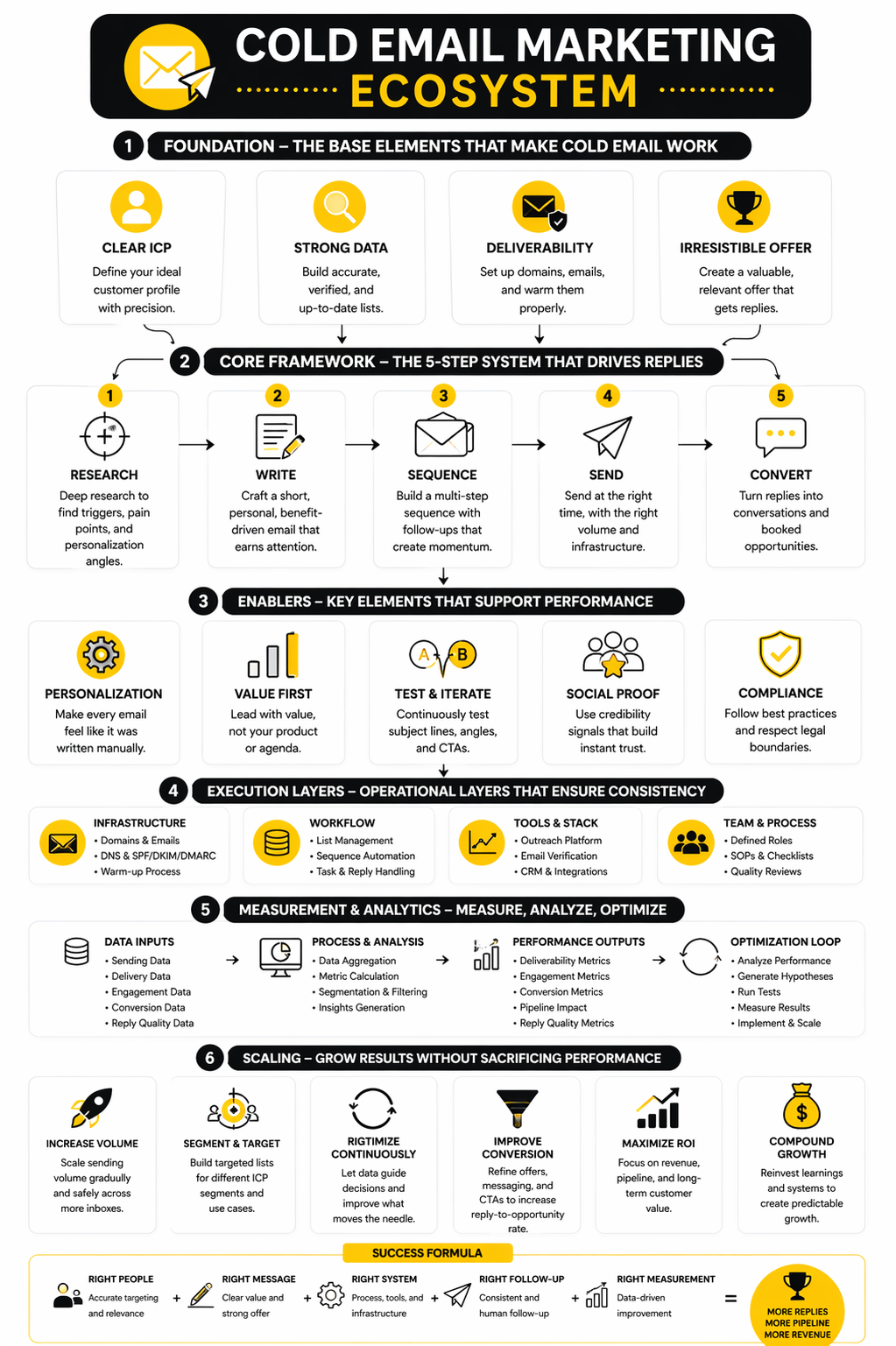
A complete cold email system connects strategy, execution, measurement, and optimization. The strategy defines who you contact and why. The execution layer turns that strategy into lists, sequences, deliverability controls, and follow-up workflows.
Measurement shows where the system is healthy and where it is leaking. If delivery is weak, fix infrastructure. If replies are weak, fix audience fit and offer clarity. If meetings are weak, fix the call to action and reply handling. If sales are weak, fix qualification and positioning.
The strongest teams build cold email marketing like an operating system, not a one-off campaign. They keep improving the list, sharpening the message, protecting the domain, logging outcomes, and feeding sales feedback back into the next test. That is how the channel becomes repeatable.
FAQ - Built For Complete Guide
What Is Cold Email Marketing?
Cold email marketing is targeted outreach to people who have not previously opted into your list, usually to start a business conversation. It is most common in B2B sales, partnerships, recruiting, agencies, and professional services. The goal is not to blast strangers; the goal is to contact relevant people with a clear reason.
Is Cold Email Marketing Legal?
Cold email can be legal when it follows the rules that apply to the recipient’s location and the sender’s activity. In the United States, commercial email must follow requirements around accurate sender information, non-deceptive subject lines, a physical mailing address, and opt-out handling through the FTC CAN-SPAM guidance. Other regions may require stricter consent, privacy, or data processing standards.
Does Cold Email Still Work?
Yes, cold email still works when targeting, relevance, deliverability, and follow-up are strong. It does not work well when it relies on generic templates, weak lists, misleading subject lines, or high-volume spam tactics. The channel rewards precision more than aggression.
What Is A Good Cold Email Reply Rate?
A good reply rate depends on the market, offer, audience quality, and sender reputation. A 2025 benchmark of 16.5 million B2B cold emails found an average reply rate of 5.8%, but averages can be misleading. Positive reply rate, meeting booked rate, and opportunity quality matter more than raw replies.
How Long Should A Cold Email Be?
A cold email should usually be short enough to read quickly on a phone. The recipient should understand who you are, why you are reaching out, why it matters, and what you are asking for without scrolling through a long pitch. Clarity beats length.
How Many Follow-Ups Should You Send?
Most campaigns use a short sequence of several touches, often three to five messages. The right number depends on the audience, offer, and level of relevance. Follow-ups should add useful context or a new angle, not repeat the same “just checking in” message.
What Should A Cold Email Include?
A strong cold email usually includes a relevant opener, a specific problem, a clear outcome, a credibility signal, and a simple call to action. It should feel written for the recipient’s situation. It should not read like a full sales page.
What Is The Best Call To Action For Cold Email?
The best call to action is low-friction and easy to answer. Instead of asking for a big commitment immediately, ask a simple question, suggest a short call, or offer to send one specific resource. The goal is to start a conversation, not close the deal in the first email.
Why Do Cold Emails Go To Spam?
Cold emails can go to spam because of poor domain reputation, missing authentication, high bounce rates, spam complaints, bad list quality, risky wording, or sudden sending volume spikes. Gmail recommends SPF, DKIM, and DMARC through its sender guidelines, and Yahoo also emphasizes authentication, complaint control, and list hygiene through its sender best practices.
Should You Use A Separate Domain For Cold Email?
Many teams use separate sending domains or subdomains to protect their main business domain. That can reduce risk, but it does not replace proper setup. Authentication, gradual sending, clean data, low complaints, and responsible follow-up still matter.
How Do You Personalize Cold Emails Without Wasting Time?
Start with segmentation before one-to-one personalization. Group prospects by shared business context, such as industry, hiring trigger, funding stage, role, tool stack, or growth problem. Then personalize only the parts that make the message more relevant.
What Is The Difference Between Cold Email And Email Marketing?
Cold email is outreach to people who have not opted into your list, usually for a direct business conversation. Email marketing usually refers to campaigns sent to subscribers, customers, leads, or people who have already given permission. The strategy, legal requirements, tone, and expectations are different.
What Tools Help With Cold Email Marketing?
Useful tools depend on your workflow. You may need a CRM, email verification, deliverability monitoring, automation, calendar scheduling, and pipeline tracking. Platforms like GoHighLevel, Brevo, Copper, and Cal.com can support different parts of the system.
How Do You Scale Cold Email Safely?
Scale only after you have real signal from the right audience. Increase volume gradually, protect deliverability, monitor bounce and complaint rates, and keep testing one major variable at a time. The safest scaling strategy is controlled, measured, and based on qualified pipeline rather than vanity metrics.
When Is Cold Email The Wrong Channel?
Cold email is usually a poor fit when the audience is hard to identify, the offer is too low-value, the buying process requires heavy education, or the economics cannot support manual outreach. It may also be weak for broad consumer offers. Use cold email when you can clearly identify the right person and offer something worth discussing.
Work With Professionals
Explore 10K+ Remote Marketing Contracts on MarkeWork.com
Most marketers spend too much time chasing clients, competing on crowded platforms, and losing a percentage of every project to middlemen.
MarkeWork gives you a better way. Browse thousands of remote marketing contracts and connect directly with companies desperate to hire skilled marketers like you, without platform commissions and without unnecessary gatekeepers.
If you're serious about finding better opportunities and keeping 100% of what you earn, explore available contracts and create a profile for free at MarkeWork.com.