

A Constant Contact newsletter still earns attention for one simple reason: it gives you direct access to people who already said they want to hear from you. That matters more now than it did a few years ago, because rented attention on social platforms can disappear behind algorithm shifts, rising ad costs, or audience fatigue. On the email side, Constant Contact keeps leaning into the fundamentals that small businesses and nonprofits actually need, including templates, signup forms, automations, segmentation, and dynamic content blocks that make a basic send feel much more relevant.
The opportunity is real, but so is the pressure to do it well. Email continues to be one of the strongest ROI channels, with Litmus pointing to an average return of about $36 for every $1 spent, while Validity’s 2025 benchmark shows one in six legitimate marketing emails still fails to reach the inbox. That combination is the whole game: newsletters can be incredibly profitable, but only when the message is useful, the audience is well segmented, and the setup is clean enough to protect deliverability.
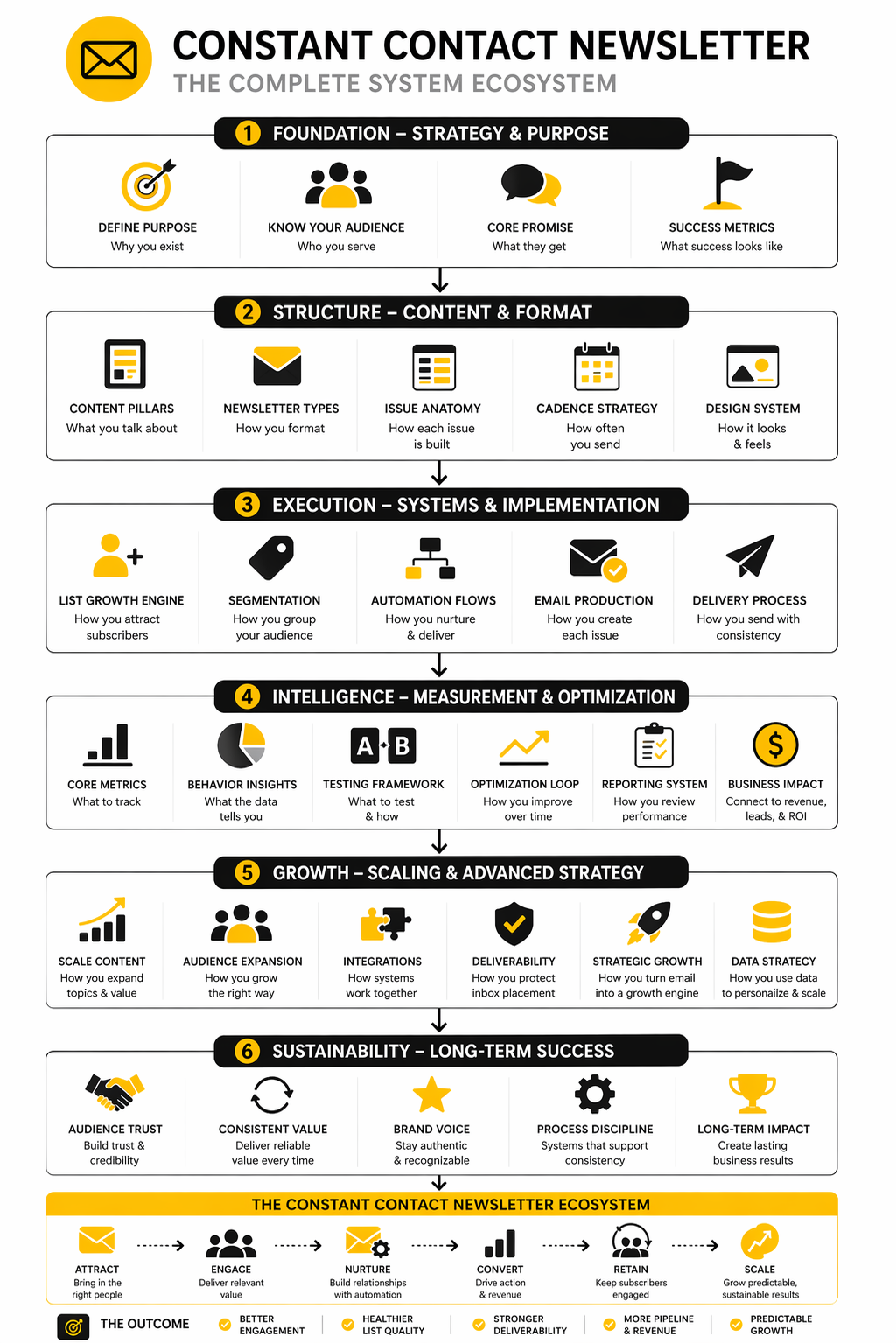
This article is built to help you do that without overcomplicating it. We are not treating a Constant Contact newsletter like a design exercise or a random monthly blast. We are treating it like a repeatable publishing system that builds trust, drives clicks, and becomes more valuable every time you send it.
- Why a Constant Contact Newsletter Still Matters
- The Constant Contact Newsletter Framework
- Core Components of a Newsletter People Open and Read
- Professional Implementation Inside Constant Contact
- Performance Metrics, Testing, and Optimization
- Mistakes to Avoid, When Constant Contact Fits Best, and FAQ
Why a Constant Contact Newsletter Still Matters
For most small teams, the biggest advantage is not that Constant Contact is flashy. It is that the platform is built to reduce friction between idea and execution. You can start with ready-made newsletter templates, collect subscribers through built-in signup tools, and expand into automated welcome emails or follow-up sequences without stitching together a complicated stack on day one.
That simplicity matters because time is usually the real bottleneck. Constant Contact’s 2025 small business research found that 44% of SMBs say email is their most effective marketing channel, and the same report says 42% have less than one hour per day for marketing. A Constant Contact newsletter works best in exactly that environment: limited time, lean teams, and a need for one channel that can nurture existing customers without demanding a full-time operator.
It also fits the broader shift toward first-party data and permission-based marketing. When someone joins your list, opens your emails, clicks your links, or fills out a signup form, you are learning directly from your own audience instead of renting signals from another platform. That makes a newsletter more than a communication asset. It becomes an owned channel you can use to segment readers, personalize content, and build a stronger feedback loop over time.
There is another reason this matters: readers are more selective than ever. Optimove’s 2025 consumer research found that 59% of consumers prefer email over other channels for marketing messages, but the same body of research also shows people feel overwhelmed when brands send too much or send without relevance. So the value of a Constant Contact newsletter is not just access to the inbox. It is the ability to turn that access into a predictable, welcome rhythm instead of another forgettable send.
The Constant Contact Newsletter Framework
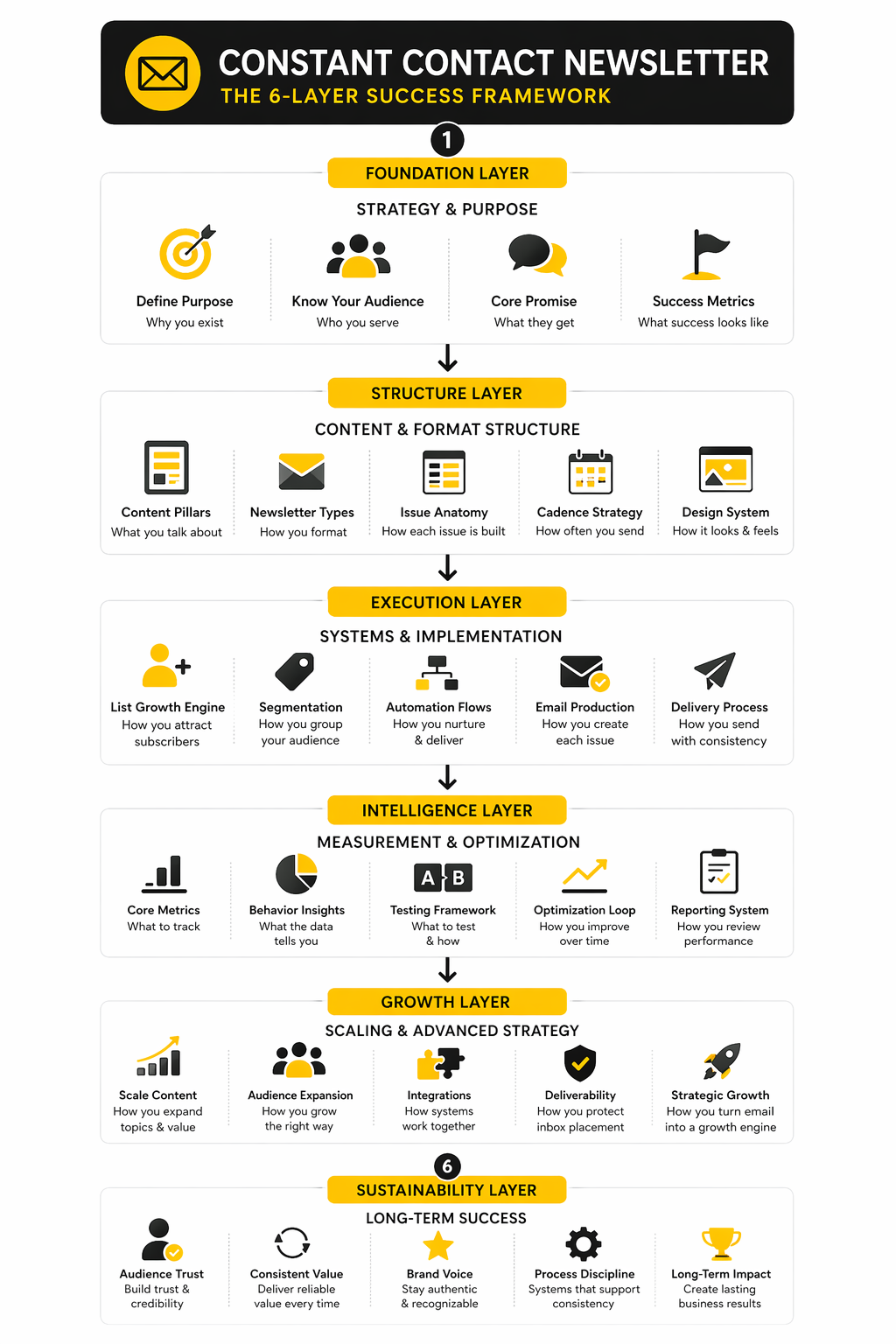
The easiest way to ruin a newsletter is to think about it issue by issue. You end up chasing ideas, changing tone, and sending whatever feels urgent that week. A better approach is to build a simple framework first, because the framework decides what belongs in the newsletter, who it is for, and what the reader should expect every time it lands.
In practice, a strong Constant Contact newsletter usually rests on four decisions. You need a clear audience, a clear promise, a repeatable content structure, and a clear next step. Once those are set, Constant Contact’s tools like segmentation, templates, dynamic content, and automation stop being random features and start acting like leverage.
- Audience
Decide exactly who this newsletter is for. Not everyone on your contact list should receive the same message, and Constant Contact’s segmentation tools are built around that reality. If your audience includes leads, first-time buyers, repeat customers, donors, members, or event attendees, those groups usually need different stories, different offers, and sometimes a different cadence altogether.
- Promise
Every good newsletter makes a quiet promise to the reader. It might be useful local updates, practical education, product guidance, event news, donor impact, or curated recommendations. The promise is what makes somebody keep opening, because they know what kind of value is coming and they do not have to guess whether this edition is worth their time.
- Structure
A professional newsletter has recurring sections, not random blocks. That can be as simple as a short editor’s note, one featured story, two supporting items, and one call to action. Structure reduces production time for your team and reduces cognitive load for the reader, which is exactly what you want if you are publishing consistently rather than improvising every send.
- Next Step
A newsletter should not feel like a hard sell every time, but it should still move the reader somewhere. Sometimes that means reading an article, registering for an event, replying to the email, making a purchase, or simply learning more about a service. When the next step is clear, performance becomes easier to measure, and future optimization stops being guesswork.
That framework sounds basic, but it is what separates a newsletter that looks busy from one that actually works. In the next part, we will build on this foundation by breaking down the core components of a Constant Contact newsletter that gets opened, read, and clicked instead of skimmed and forgotten.
Core Components of a Newsletter People Open and Read
Once the framework is clear, the next job is building a Constant Contact newsletter that feels easy to open, easy to scan, and worth clicking. This is where a lot of brands go wrong. They understand that email matters, but they still send bloated updates, weak subject lines, and generic blocks that could have gone to anyone.
A better newsletter is usually not more creative. It is more deliberate. The strongest versions combine a sharp promise, a clean structure, and relevance at the contact level, which is exactly why Constant Contact keeps investing in segmentation, reusable content blocks, personalization, and automation paths that support more targeted sends instead of one-size-fits-all campaigns. Constant Contact’s product overview
A Subject Line That Earns the Open
Your subject line does not need to sound clever. It needs to set the right expectation and make the email feel immediately relevant. That usually means clarity beats mystery, and specificity beats filler, especially when people are scanning crowded inboxes on mobile.
This is also where a lot of newsletter strategy gets distorted by vanity thinking. If the subject line wins the open but the content underneath does not match the promise, trust drops fast. Constant Contact’s own guidance on improving open rates points to familiar fundamentals that still matter most: list quality, timing, relevance, and the actual content inside the email, not just the line at the top. Constant Contact’s open rate guidance
Personalization can help, but only when it adds real context. Shopify’s roundup of current email data highlights that 77% of email marketers say personalized subject lines improve performance, but that does not mean dropping in a first name and calling it strategy. A strong Constant Contact newsletter uses personalization when it makes the message more timely, more local, or more relevant to what that subscriber actually cares about.
Preview Text That Finishes the Job
A good subject line gets attention. Good preview text converts that attention into intent. This is one of the easiest wins in email, and it is still ignored far too often.
Think of preview text as the second half of the headline. It should add context, clarify the benefit, or tell the reader what is inside without repeating the same words. Mailchimp’s subject line and email best-practice documentation keeps pushing the same point from another angle: the inbox decision happens before the body copy ever gets a chance to work, so the message around the message matters more than many teams think. Mailchimp’s subject line best practices and email best practices
This matters even more on mobile. Many readers are not evaluating your newsletter in a quiet desktop setting with time to spare. They are glancing at it between tasks, which means the subject line and preview text need to work together fast. If those two elements are vague, the rest of the newsletter never gets a fair shot.
A Clear Editorial Structure
The body of a newsletter should feel familiar without becoming stale. Readers do not want to relearn your layout every time, and your team should not be rebuilding the format from scratch for every send. That is why the best newsletter structures are repeatable.
A clean Constant Contact newsletter usually works well with a simple pattern: one lead item, one or two supporting items, and one primary call to action. That keeps the email focused, short enough to finish, and flexible enough to support different content types. Constant Contact’s editor and reusable saved content blocks are clearly moving in this direction, making it easier to preserve a working structure instead of reinventing it every week. Constant Contact’s saved content update
There is a practical benefit here too. The more consistent your structure becomes, the easier it is to spot what is actually driving engagement. When every newsletter has a completely different format, you learn very little from campaign performance. When the structure stays stable, you can test one meaningful variable at a time.
Content That Feels Specific, Not Generic
This is the part people notice immediately, even when they cannot explain it. A newsletter either feels like it was written for a real audience, or it feels like it was sent to a list. The difference usually comes down to how specific the content is.
Specificity shows up in several ways. It can mean local references, product recommendations that fit a subscriber’s category, content based on past clicks, or simply using a voice that sounds like a real operator instead of a committee. Constant Contact’s dynamic content tools are designed for exactly this problem, letting one email show or hide blocks based on contact data such as location, job title, or custom fields. Constant Contact’s dynamic content documentation
That matters because relevance is what keeps newsletters from becoming background noise. Constant Contact’s own segmentation guidance is blunt about it: grouping contacts by shared characteristics helps you send more targeted emails and improve open and click rates. Constant Contact’s segmentation guide The practical takeaway is simple. If your Constant Contact newsletter tries to speak to everyone at once, it usually becomes useful to no one in particular.
One Primary Call to Action
A newsletter can include multiple links, but it should still have one main next step. That does not mean every send needs a hard pitch. It means every send should know what action matters most.
Sometimes the main action is reading a featured article. Sometimes it is booking a demo, registering for an event, browsing a product collection, replying to the email, or downloading a resource. What matters is that the hierarchy is obvious. When everything is styled like the main event, nothing is.
This is also where measurement starts to become honest. Constant Contact defines click rate as the percentage of delivered emails that generated a unique click, which makes it one of the cleanest indicators that your message moved someone from passive reading to active response. Constant Contact’s click rate explanation If your newsletter has no clear primary action, a weak click rate does not really tell you what failed, because the email never made a focused ask in the first place.
Design That Supports Reading
Design matters, but not in the way many marketers assume. Readers are rarely impressed by visual complexity in a newsletter. They are impressed when the email is easy to understand.
That means strong spacing, clean hierarchy, readable text, obvious buttons, and a layout that holds up on smaller screens. Constant Contact’s newer editor updates have been moving toward more granular control over spacing and layout, which is useful because good newsletter design usually comes down to restraint, not decoration. Constant Contact’s November 2025 product update
There is a deeper point here. Design is not a layer you add after the strategy is done. It is part of the strategy because it controls how easily people can consume the message. If the layout creates friction, even strong content loses force.
Segmentation That Changes the Message
Segmentation is where a decent newsletter starts becoming a high-performing one. The most important shift is mental: you stop asking what newsletter to send this week and start asking which version of the message belongs to which group.
That can be simple. New subscribers may need orientation. Existing customers may need use cases, product education, or expansion offers. Inactive contacts may need a lighter cadence or a re-engagement sequence instead of the same weekly send everyone else gets. Constant Contact’s automation path builder supports this move by letting teams trigger messages, update tags, and change list status based on subscriber behavior. Constant Contact’s automation path builder
This matters because engagement is not evenly distributed across a list. The more a Constant Contact newsletter reflects actual subscriber context, the more likely it is to feel timely rather than interruptive. That is one of the clearest advantages smaller brands still have over larger ones: they can often segment faster and publish with more precision.
Deliverability as a Content Problem
Most teams treat deliverability like a technical setting that sits somewhere outside the newsletter itself. That is incomplete. Authentication and infrastructure matter, of course, but deliverability is also shaped by content quality, list hygiene, relevance, and engagement.
That is why the “blast everyone” approach keeps backfiring. Validity’s 2025 benchmark found that roughly one in six legitimate marketing emails did not reach the inbox, and Sinch Mailgun’s 2025 deliverability research shows many senders still underuse inbox placement testing and sender reputation monitoring. Mailgun’s 2025 deliverability report A Constant Contact newsletter with better segmentation, clearer value, and cleaner sending patterns does not just perform better after delivery. It improves the odds of getting delivered in the first place.
There is also a measurement caveat that smart operators should keep in mind. Open rates remain useful, but email platforms and privacy tools have made them less clean than they used to be. Constant Contact explains that opens are tracked using a pixel, which means image loading behavior and privacy protections can distort the picture. Constant Contact’s open tracking explanation That is exactly why click behavior, replies, conversions, and list growth deserve a bigger role in how you judge newsletter quality.
Professional Implementation Inside Constant Contact
A strong newsletter strategy becomes real only when it survives actual execution. This is where Constant Contact has always had a practical advantage for smaller teams. The platform is not trying to turn every business into an advanced lifecycle marketing lab on day one. It is trying to help them publish consistently, segment intelligently, and automate the most important follow-up work without drowning in setup.
The best way to implement a Constant Contact newsletter professionally is to treat the platform like an operating system, not just an email editor. That means defining your core audience groups, choosing one main newsletter template, setting up reusable sections, connecting forms and list sources properly, and building a few automations around welcome flows, follow-ups, or engagement triggers. Constant Contact’s email platform overview and engagement features
That setup matters because consistency compounds. The moment you stop building each send from zero, your newsletter gets easier to produce and easier to improve. In the next part, that is exactly where the article goes next: how to measure performance, what to test, and how to optimize a Constant Contact newsletter without chasing misleading metrics.
Professional Implementation Inside Constant Contact
A Constant Contact newsletter starts feeling professional when the process becomes repeatable. That is the real shift. You stop thinking in terms of one campaign at a time and start building an operating system that helps you collect subscribers, organize them, publish consistently, and improve performance without recreating the entire workflow every week.
That is also where Constant Contact is strongest for smaller teams. The platform is built around practical execution: signup landing pages, embedded forms, segmentation, reusable blocks, automation paths, and contact updates that can happen based on behavior instead of manual cleanup every time you send. The current automation path builder documentation and signup landing page setup make it clear that the tool is not just for sending emails anymore. It is increasingly about managing the full journey from signup to follow-up.
Start With Contact Structure, Not Design
Most newsletter problems begin before the first email is written. The list is messy, old contacts are mixed with new leads, tags are inconsistent, and nobody is fully sure who should receive what. If you skip this step, the Constant Contact newsletter may still go out, but it will never feel sharp because the targeting underneath it is weak.
The smarter move is to define contact groups before touching the template. New subscribers, active customers, lapsed buyers, event registrants, nonprofit supporters, and local leads do not need the same messaging. Constant Contact’s segmentation model is built around that reality, letting you group people by shared attributes and behavior so the newsletter becomes more relevant from the start. Its segmentation guide explains the basics, but the practical takeaway is more important: structure first, design second.
This is also the point where permission and source tracking matter. Signup pages and forms are not just list-growth tools. They are part of your data quality system, because they document consent and help you understand where subscribers came from, which makes later segmentation and automation much easier to trust. Constant Contact’s sign-up landing page guidance
Build One Core Newsletter Template
A lot of teams waste time because they treat each send like a custom design project. That looks productive, but it usually creates slower execution, inconsistent branding, and a newsletter that keeps changing shape. A better implementation process starts with one core template that reflects the structure you actually want to repeat.
In practice, that means locking in the essentials. Use a consistent header, a predictable opening section, a featured content block, one or two supporting blocks, and one primary call to action. Constant Contact’s saved content tools are useful here because they let you preserve blocks you know you will reuse, which cuts production time and keeps the newsletter format stable enough to learn from. Saved content and reusable blocks
This matters more than people expect. A stable template does not make the newsletter boring. It makes the process lighter, which means your team has more energy to improve message quality instead of burning hours on layout decisions that add very little value.
Set Up the Acquisition Path Before You Need It
A newsletter should not rely on manual list uploads and random spreadsheet cleanup. That works for a while, then breaks the moment growth picks up or team ownership gets fuzzy. A more professional setup connects acquisition directly to the system so new subscribers land in the right place immediately.
Constant Contact already supports several useful entry points for this. You can create signup landing pages, embed forms, add website forms, and connect ecommerce or CRM-style data into automation flows depending on your stack. The “first sign-up landing page and welcome series” walkthrough and form guidance from the community hub both point in the same direction: the best list growth is connected, permission-based, and tied to an immediate follow-up sequence.
That follow-up matters. A Constant Contact newsletter performs better when it does not act like the first email somebody ever receives from you. A welcome email or short onboarding series gives context, sets expectations, and warms the relationship before the subscriber joins the normal publishing rhythm.
A Simple Execution Process That Actually Works
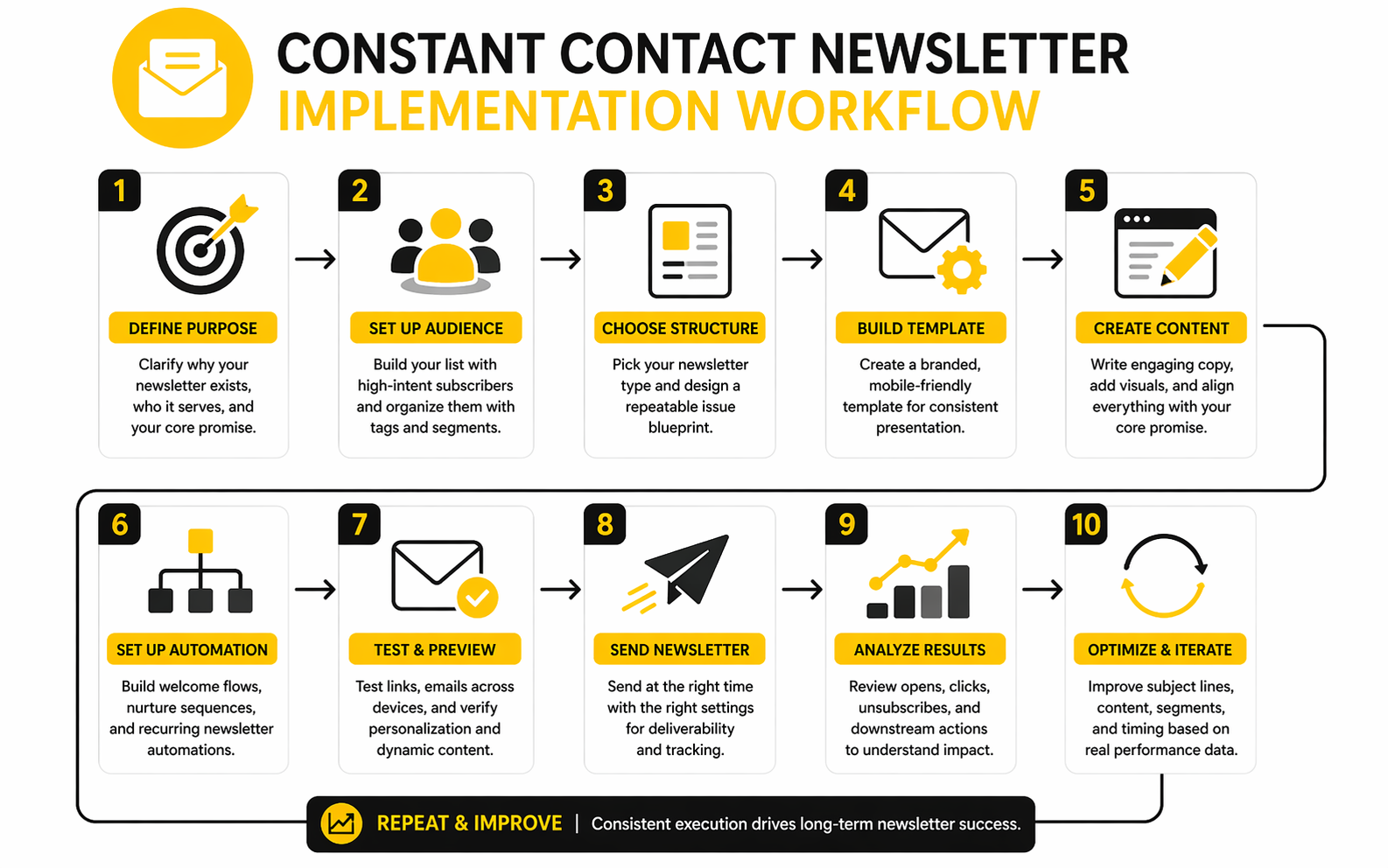
Once the structure is in place, the weekly or monthly workflow should be straightforward. If your process feels chaotic every time, the setup still needs work. A clean execution model is usually enough for most teams.
- Review the audience for this send
Start by deciding whether the newsletter goes to the full active list or a specific segment. That choice should come before the content is finalized, because different audiences may need different headlines, offers, or dynamic blocks. Constant Contact’s segmentation and tagging options make this easier when the list structure is already clean. Current segmentation documentation
- Choose the lead story or main value block
Every newsletter needs a center of gravity. That might be one announcement, one article, one promotion, one event push, or one practical insight. The mistake is trying to give five things equal weight, because then the reader has no idea what matters most.
- Add supporting items without overcrowding the send
Supporting blocks should reinforce the main purpose of the issue, not compete with it. This is where a Constant Contact newsletter benefits from discipline. You do not need to include everything your company did this month just because there is space in the editor.
- Personalize where it helps clarity
Use contact fields, segments, or dynamic content when those elements make the message genuinely more relevant. Constant Contact’s dynamic content tools can show different blocks to different contacts based on stored data, which is useful when one send needs light personalization without turning into a fully separate campaign. Dynamic content setup
- Check the technical basics before sending
This step is less glamorous, but it protects performance. Confirm that the sender identity is consistent, links work, the unsubscribe experience is clear, images load properly, and the newsletter is readable on mobile. Litmus’s latest email client market share data still shows how fragmented inbox environments are, which is exactly why testing across layouts and devices remains necessary. Its February 2026 client market share report
- Schedule with intention, not superstition
There is no single universal best send time, and chasing one magic hour usually wastes energy. What matters more is consistency, audience fit, and building enough history inside your own account to compare performance. The right send time for a local B2B list is not automatically the right send time for a weekend events newsletter or an ecommerce audience.
That process is simple on purpose. Complexity should show up in strategy, not in unnecessary production friction. The more reliably your team can execute those steps, the more likely your Constant Contact newsletter becomes an asset instead of another task that keeps slipping down the list.
Use Automation to Remove Repetitive Work
This is one of the biggest leverage points inside Constant Contact. If you are still handling every contact action manually, you are spending time on tasks the platform can now handle for you. Automation does not just save effort. It also creates a cleaner subscriber experience because follow-ups happen when the action is still fresh.
The Automation Path Builder is especially useful here because it is not limited to sending messages. Contacts can enter a path based on actions or dates, and the system can then apply tags, update lists, or branch them into conditional paths. The trigger documentation and conditional split rules show that this is no longer just about basic autoresponders.
For a Constant Contact newsletter, the best automation use cases are usually straightforward. Welcome sequences, post-signup tagging, re-engagement nudges, event follow-ups, and simple branching based on list behavior do a lot of work without forcing a small team into enterprise-level complexity. That is the sweet spot.
Protect Deliverability During Implementation
A polished newsletter still fails if it cannot reliably reach the inbox. This is why implementation has to include authentication, complaint management, and unsubscribe hygiene instead of treating those as background technical details somebody else will handle later. Once sending volume grows, mailbox providers pay very close attention.
Google’s current sender guidelines define bulk sending at roughly 5,000 messages or more to personal Gmail accounts in 24 hours, and Yahoo’s current requirements also emphasize SPF, DKIM, and a valid DMARC policy for bulk senders. Yahoo’s sender best practices reinforce the same message. Even if your Constant Contact newsletter is below that scale today, implementing clean sender practices early is the smart move because it protects future growth and reduces surprises later.
There is also a content side to this. Mailbox providers respond to engagement signals, complaints, and list quality, not just DNS records. If people do not want the newsletter, the technical setup alone will not rescue performance. That is why professional implementation includes pruning inactive contacts, honoring preferences, and making unsubscribing easy rather than hiding it in the footer.
Make Mobile the Default Reading Experience
A newsletter should be built for mobile first, even if your analytics later show a strong desktop share in a specific segment. The reason is simple: mobile is still a major part of how email gets scanned, opened, and judged. If the layout is cramped or the CTA is hard to tap, the Constant Contact newsletter loses force immediately.
That means writing shorter intros, using cleaner block spacing, keeping buttons obvious, and making sure images support the message instead of pushing the important content down. Litmus’s current market share reporting remains useful here because it reminds you how many different environments your email may appear in. Its latest email client data is not just interesting industry trivia. It is a practical reason to keep the design readable and resilient.
A good test is brutally simple. Open the email on a phone and ask whether the main point is obvious within a few seconds. If it is not, the newsletter probably still needs editing.
Document the Workflow So It Survives Growth
The final step in professional implementation is boring, but it is what makes the system durable. Write down the process. Define who owns list hygiene, who drafts the issue, who reviews links, who approves the send, and what happens after the campaign goes out.
This matters because a Constant Contact newsletter often starts as a founder-led or marketer-led habit and then quietly becomes a company channel. Once that happens, informal workflows start breaking down. Documentation turns the newsletter from a personal routine into a repeatable publishing asset that someone else can run without losing quality.
That is also the bridge into the next section. Once the implementation process is stable, performance becomes much easier to read honestly. You are no longer guessing whether a weak result came from bad timing, list chaos, broken structure, or poor execution. You can finally look at the numbers, test the right variables, and improve the newsletter with intent.
Performance Metrics, Testing, and Optimization
Once the implementation is stable, the next question is simple: is the Constant Contact newsletter actually working. This is where a lot of teams either overreact or look at the wrong numbers. They stare at one percentage, panic, change five things at once, and then wonder why the trend becomes impossible to interpret.
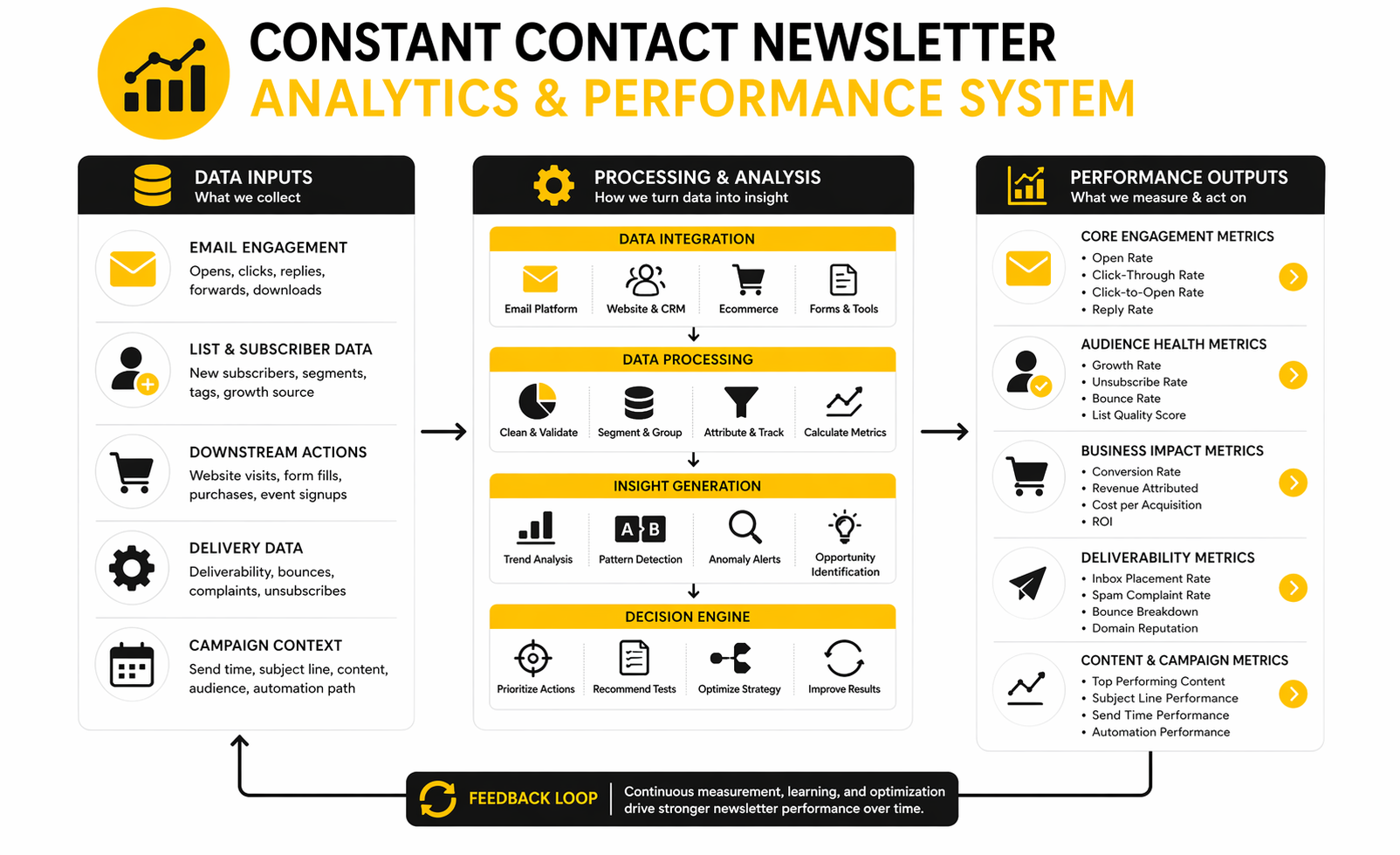
A better approach is to treat analytics like a decision system. The job of the data is not to flatter you. The job is to tell you what is happening in the inbox, what is happening after the click, and what action you should take next.
What the Numbers Actually Mean
The first useful shift is separating attention metrics from outcome metrics. Opens, clicks, bounces, unsubscribes, and spam complaints tell you how the email performed inside the inbox. Conversions, replies, purchases, registrations, and assisted revenue tell you whether the newsletter moved the business forward.
Constant Contact’s own reporting setup reflects that structure. The platform gives you campaign-level visibility into sends, opens, clicks, bounces, unsubscribes, and link performance, and its comparison reporting lets you stack campaigns side by side instead of judging each send in isolation. Its reporting overview and export tools are useful because they push you toward trend analysis, not one-off reactions.
That matters because a single issue can be noisy. Holidays, news cycles, timing shifts, seasonal demand, or even inbox filtering can distort one send. A Constant Contact newsletter becomes easier to improve when you compare a cluster of campaigns and look for patterns instead of trying to diagnose your whole strategy from one Friday morning report.
Open Rate Is Still Useful, but It Is No Longer Clean
Open rate is still worth watching, but it cannot carry the full weight of interpretation anymore. Constant Contact explains that open tracking relies on a transparent tracking pixel, and it also notes that image preloading by Gmail, Yahoo, and Apple Mail can create what it calls proxy opens rather than confirmed human opens. Its current open-tracking documentation is one of the clearest reminders that an open is now a directional signal, not a perfect record of human attention.
That same issue shows up across the industry. Mailchimp’s Apple Mail Privacy Protection guidance says Apple Mail users who enable MPP can inflate open metrics, distort location and email-client reporting, and weaken any automation or resend logic built around opens alone. Its MPP FAQ makes the practical implication obvious: clicks, conversions, and purchases are stronger engagement signals than opens.
So what should open rate do for you now? It should help you compare subject lines, monitor broad list health, and spot sudden anomalies. It should not be the only thing you use to decide whether a Constant Contact newsletter is succeeding, because privacy protections changed that game.
Click Rate Is Usually More Honest
If opens tell you whether the message got a glance, clicks tell you whether the newsletter created movement. That is why click rate is often the cleaner signal, especially in a privacy-distorted environment. Constant Contact itself frames click performance as a core reporting dimension because it shows which links people interacted with and which parts of the email actually pulled attention. Its reporting documentation and success guidance both lean on this logic.
The key is not to treat click rate like a vanity trophy either. A low click rate can mean several different things. The audience may have been wrong, the CTA may have been buried, the main offer may have lacked urgency, or the email may simply have asked too much at once. That is why the number matters only when paired with the actual structure of the send.
Benchmarks help, but only if you use them as context instead of commandments. Mailchimp’s current benchmark resource points to an overall average open rate of 34.23% across its dataset, while Klaviyo’s 2026 benchmark page reports an average campaign open rate of 31% and an average campaign click rate of 1.69%. MailerLite’s more recent benchmark summary puts the 2025 average click rate at 2.09%. Those ranges are useful because they remind you there is no single universal “good” number. The real question is whether your Constant Contact newsletter is improving against its own history and against similar audience types.
Bounce Rate Is a List Quality Signal
Bounce rate is one of the fastest ways to see whether the list itself is becoming a problem. A bounce means the message did not reach that address, and Constant Contact’s guidance is direct about why that matters: repeated attempts to send to bouncing addresses can hurt deliverability because mailbox providers may read those attempts as a spam signal. Its bounce management documentation is not just technical housekeeping. It is performance protection.
This is why bounce rate should trigger action, not excuses. If it rises, something is wrong upstream. Maybe older contacts were never cleaned out. Maybe a bad import slipped in. Maybe a signup source is capturing low-quality addresses. The correct response is not to ignore it because “the content was strong.” The correct response is to fix the contact quality problem before it starts damaging the reputation of the whole sending program.
Constant Contact’s own product team has been signaling that bounce cleanup and more targeted segmentation are major priorities in its 2026 analytics direction. Its March 2026 performance update preview makes sense in context, because better targeting and cleaner lists are still two of the most reliable ways to improve newsletter performance.
Unsubscribe Rate Is Not Always Bad News
A lot of marketers treat unsubscribes like failure. That is too simplistic. A rising unsubscribe rate can absolutely be a warning sign, but some unsubscribes are healthy because they remove people who are no longer a fit for the list.
The real interpretation depends on the pattern. If unsubscribes spike after a sudden increase in frequency, a misaligned promotion, or a segment mismatch, that is useful feedback. If a small number of people opt out while clicks and conversions improve, that may simply mean the Constant Contact newsletter is becoming more focused and more honest about who it serves.
Industry guidance backs that up. ActiveCampaign’s benchmark glossary says unsubscribe rates below 0.5% are generally considered good, and anything under 0.2% is excellent. MailerLite’s benchmark roundup puts the 2025 average unsubscribe rate at 0.22%. Those numbers are not a target to chase blindly, but they do help you separate normal attrition from a genuine relevance problem.
Spam Complaints Matter More Than Most Teams Realize
This is one of the metrics that deserves more attention, especially if your list is growing. Google’s current sender FAQ says senders should keep spam rates below 0.1% and prevent them from ever reaching 0.3%. Yahoo’s sender best practices say the same thing in practical terms: keep spam rates below 0.3% and support one-click unsubscribe for marketing messages. These are not abstract compliance notes. They are inbox placement rules.
That is why a Constant Contact newsletter should never be judged only by opens and clicks. A campaign can look fine on engagement and still slowly damage deliverability if it irritates enough recipients. If complaint rates rise, the action is usually clear: review frequency, tighten targeting, rework expectations at signup, and make unsubscribing easier than reporting spam.
This is also why list growth quality matters more than raw growth speed. Ten thousand disinterested contacts are not an asset. They are a future complaint problem waiting to happen.
Benchmarks Are Reference Points, Not Goals
The reason benchmarks confuse so many teams is that they look precise while hiding huge differences in audience type, industry, offer strength, and send purpose. A nonprofit donor update, a local service newsletter, and an ecommerce promotional send do not behave the same way. They should not be judged the same way either.
That is why the smartest use of benchmarks is not asking whether your Constant Contact newsletter is “above average.” It is asking whether your current performance is healthy enough for your model and whether the trend is moving in the right direction. Mailchimp, Klaviyo, and MailerLite all publish benchmark data, but even when those sources are directionally useful, the spread between them shows exactly why benchmark worship is a trap. Mailchimp’s benchmark page, Klaviyo’s 2026 benchmarks, and MailerLite’s 2025 averages should push you toward smarter questions, not rigid expectations.
A better framework is this: use external benchmarks for orientation, then build your own internal benchmark set from the last 8 to 12 relevant campaigns. That internal baseline is usually more valuable than a broad industry average because it reflects your audience, your cadence, and your actual content model.
The Metrics That Usually Deserve Weekly Review
A Constant Contact newsletter does not need a giant dashboard to become more effective. It needs a tight review loop built around the metrics that actually change decisions. For most teams, that weekly or per-send review should include:
- open rate trends, not just one-send open rate
- unique click rate and the top-clicked links
- bounce rate and bounce type patterns
- unsubscribe rate
- spam complaint signals where available
- downstream actions such as purchases, registrations, replies, or booked calls
This is where Constant Contact’s side-by-side campaign comparison becomes especially useful. When you compare a handful of sends with similar goals, you stop reacting emotionally and start spotting what really changed. Its campaign comparison reporting supports exactly that kind of review.
What the Data Should Make You Do Next
Metrics only matter if they create action. That is the part too many teams skip. They review the report, talk about it for ten minutes, and then send the next issue the same way.
A more useful pattern is linking each metric to a likely response. If open rate dips while click rate stays strong, the subject line or send timing may need work more than the body content. If open rate is stable but click rate drops, the content hierarchy or CTA probably weakened. If bounces rise, list hygiene needs attention immediately. If unsubscribes jump, the message-to-audience fit may have slipped. If complaints rise, that is a deliverability problem first and a creative problem second.
This is also why revenue and conversion context matter so much. Litmus still places average email ROI at roughly $36 for every $1 spent, but that number becomes useful only when your own newsletter can connect attention to business outcomes. A Constant Contact newsletter that drives fewer opens but more registrations or more qualified traffic may be healthier than one with inflated opens and weak downstream action.
The Best Testing Strategy Is Smaller Than You Think
Testing works best when it stays narrow. If you change the subject line, CTA, send time, segment, and layout all at once, the result becomes almost useless because you will not know what actually caused the shift. The smartest testing rhythm is usually one variable at a time.
For most newsletters, that means starting with the highest-leverage elements. Test subject line framing, then CTA clarity, then content hierarchy, then segmentation logic. Keep the structure stable enough that the result teaches you something. Litmus’s 2026 email trends coverage leans in this same direction by emphasizing more holistic metrics like click-through rate, conversion rate, unsubscribe rate, and revenue per email over old-school obsession with opens alone. Its 2026 email trends summary reflects where good analysis is heading.
That is the real message of the data. You do not need more metrics. You need a clearer relationship between the metrics you already have and the decisions you make after each send. Once that connection is in place, the Constant Contact newsletter becomes much easier to optimize with confidence instead of guesswork.
Mistakes to Avoid and Strategic Tradeoffs
By this point, the mechanics of a Constant Contact newsletter are clear. The harder part is knowing what happens when the list grows, the team changes, or the business asks more from the channel than the original setup was built to handle. That is where advanced decisions start to matter, because what works for a small monthly newsletter does not always hold up when segmentation gets deeper, automation gets heavier, and revenue pressure goes up.
This is also where a lot of operators make the wrong move. They assume poor results mean email no longer works, when the real issue is usually one of four things: the wrong platform fit, weak audience structure, shallow testing, or scaling without tightening the operating model. A Constant Contact newsletter can stay highly effective as it grows, but only if you understand the tradeoffs before they become expensive.
Where Constant Contact Scales Well
Constant Contact still makes a lot of sense for organizations that value speed, clarity, and operational simplicity over extreme technical depth. That includes many small businesses, nonprofits, local service brands, event-driven businesses, and lean teams that need one dependable system for newsletters, list growth, basic automations, and campaign reporting. The platform’s current positioning around AI assistance, automation, signup tools, and ecommerce-friendly paths shows that it is still investing in practical breadth rather than trying to become a highly technical enterprise CDP. Its pricing and feature overview and AI content generator documentation make that direction pretty obvious.
That matters because operational simplicity is not a small advantage. Many teams do not fail at email because the strategy is flawed. They fail because the system is annoying enough that execution becomes inconsistent, ownership gets fuzzy, and the newsletter slowly turns into an irregular task nobody wants to manage. A Constant Contact newsletter scales well when the business needs a solid publishing engine more than it needs a deeply customized customer data environment.
There is also a staffing reality here. Constant Contact’s own small business research has shown that many SMBs are working with extremely limited marketing time, with 42% reporting less than one hour a day for marketing. In that kind of environment, a platform that reduces production friction can outperform a more powerful platform that demands more setup discipline than the team can realistically sustain.
Where It Starts to Strain
The tradeoff appears when the business expects the newsletter to behave like a high-granularity lifecycle marketing machine. Once you need very deep behavioral triggers, complex product catalog logic, advanced attribution, or highly customized cross-channel orchestration, the limits of a simpler system start showing up. That does not make Constant Contact weak. It just means the fit changes as the use case becomes more demanding.
This is especially relevant for ecommerce-heavy businesses. Constant Contact does support ecommerce automations and integrations with platforms like Shopify, WooCommerce, Wix, and Squarespace, and its 2026 documentation now highlights templates built for new and past customers across those systems. Its ecommerce automation guidance and ecommerce feature page show real progress. But that is not the same as being a deeply ecommerce-native retention platform built around catalog behavior, predictive product logic, and revenue-first flows at every stage.
That strategic distinction matters more as list size and revenue dependence rise. A Constant Contact newsletter is often excellent when the core need is strong communication with helpful automation. It becomes a tougher long-term fit when the business needs email to operate like a highly granular profit engine tied tightly to product behavior, customer lifetime value, and advanced audience modeling.
The Hidden Risk of Outgrowing Your Own Workflow
One of the biggest scaling problems has nothing to do with software. It comes from the team continuing to run a larger newsletter program with a small-program workflow. That usually means loose segmentation, inconsistent approvals, last-minute copy changes, and reporting reviews that happen only when performance dips badly enough to trigger concern.
This is where growth creates its own kind of drag. The more subscribers you have, the more expensive sloppiness becomes. A broken link, a poorly matched segment, or a badly timed promotion is not just a small mistake anymore. It affects more inboxes, creates more complaints, and teaches less because too many variables were left uncontrolled.
That is why a Constant Contact newsletter needs process upgrades as it grows. The list can scale, the automation can scale, and the template can scale, but the human workflow has to scale too. If it does not, performance starts looking random when the real issue is that the system matured faster than the operating discipline behind it.
AI Can Speed Production, but It Can Also Flatten the Voice
Constant Contact is leaning further into AI content generation, and for many teams that is genuinely useful. It helps produce drafts faster, repurpose messages across channels, and reduce blank-page friction when the issue needs to go out and the team is short on time. Its current AI content generator support page and recent roundup of AI email tools both reflect how central this has become.
The risk is not that AI makes the newsletter bad by default. The risk is that it makes the newsletter interchangeable. If every issue sounds polished but generic, the Constant Contact newsletter may become easier to send while becoming less memorable to read.
That tradeoff matters because newsletters win on familiarity and trust, not just production speed. AI should help create momentum, tighten drafts, and accelerate ideas. It should not replace the judgment that decides what the reader actually needs and how the brand should sound when it lands in the inbox.
Deliverability Gets Harder as Volume Grows
A newsletter that performs well at smaller scale can hit a wall when volume increases, especially if sender setup and list discipline were treated casually early on. This is not theoretical anymore. Google’s sender guidelines continue to recommend SPF, DKIM, and DMARC for better delivery, while Yahoo’s best-practices page says senders should keep complaint rates below 0.3%. Those requirements are not just for giant senders with sophisticated infrastructure. They increasingly shape inbox access for everyone trying to send at meaningful volume. Google’s sender guidelines
This is where many teams learn the wrong lesson. They see performance soften and assume the content is stale, when the deeper issue may be that the newsletter grew without stronger authentication, tighter segmentation, or regular list cleanup. A Constant Contact newsletter can keep performing as it scales, but only if inbox placement is treated as a strategic issue rather than a technical afterthought.
The practical implication is blunt. Growth without hygiene is fragile. A bigger list is only better if the list is engaged, permission-based, and supported by sender practices that keep the channel healthy.
Integration Breadth Is Helpful, but Integration Depth Is What Matters
Constant Contact promotes a large integration library, and that broad compatibility is useful for smaller operators that need to connect forms, ecommerce systems, design tools, and other business apps without a heavy implementation project. Its current ecommerce and integration materials highlight connections across Shopify, WooCommerce, Wix, Squarespace, and broader app ecosystems. Its ecommerce features page and integration guide show that the platform is not isolated.
But integration breadth can be misleading if you do not ask the deeper question. What exactly syncs, how often, and how much behavioral detail is available inside the newsletter workflow. A business may technically “integrate” its tools and still find that the sync is too shallow for the kind of targeting or reporting it really wants.
That is why advanced evaluation should move past the checkbox level. The question is not whether Constant Contact connects to the stack. The question is whether the connection gives your Constant Contact newsletter enough signal to support the kind of audience logic you want to build over the next year, not just next month.
Cost Is Not Just About Subscription Price
People often compare email platforms on monthly plan cost and stop there. That is a shallow comparison. The real cost of a newsletter system includes training time, workflow friction, migration risk, creative hours, list quality issues, and the revenue lost when a platform is either too weak for the strategy or too complex for the team to execute well.
Constant Contact’s current pricing still positions it as accessible for smaller operators, with plans built around different levels of automation, segmentation, and reporting. Its pricing page supports that. But the more important question is not whether the monthly subscription is low enough. It is whether the system helps your team publish consistently and improve performance without wasting hidden hours every single month.
That is why “cheaper” is not always cheaper, and “more advanced” is not always better. A Constant Contact newsletter can easily outperform a more sophisticated setup if the simpler system is the one your team actually uses well.
When Constant Contact Is the Right Fit
The right fit usually looks like this: you need a dependable newsletter program, a straightforward interface, good core automations, manageable segmentation, solid reporting, and enough integrations to connect the business systems that matter. You care about consistency, clarity, and getting campaigns out the door without a giant production burden. In that environment, Constant Contact is often a very sensible choice.
It is also a strong fit when the newsletter itself is central. That may sound obvious, but it matters. If the business grows mainly through recurring updates, community communication, events, education, relationship-building, or offer-driven campaigns that do not require hyper-complex data logic, a Constant Contact newsletter can stay effective for a long time.
This is especially true for teams that want to keep email human. A lot of newsletter success still comes down to a clear message, a strong rhythm, and a list that trusts what it receives. Software matters, but that combination matters more.
When You Should Seriously Reevaluate the Stack
A reevaluation makes sense when the newsletter is no longer the main job to be done. If the business now needs highly advanced lifecycle marketing, deeper customer scoring, more sophisticated multi-branch automation, or richer product-level personalization than the current setup supports cleanly, then the platform decision deserves another look. That is not disloyalty to the tool. It is good operating judgment.
The same applies when reporting questions start becoming more complex than the system answers easily. If stakeholders now want tighter revenue attribution, more advanced cohort analysis, or deeper behavioral segmentation than your current process can support, that tension usually grows over time rather than disappearing on its own. The newsletter may still be functioning, but the strategic fit may be getting weaker.
That is the tradeoff advanced teams need to understand. The goal is not to use the most famous platform or the most feature-heavy platform. The goal is to use the one that matches the real job the business needs email to do now, while still leaving enough room for the next stage of growth.
The Expert-Level Mistake to Avoid
The biggest advanced mistake is not under-testing or over-designing. It is forgetting what the newsletter is for. Once teams get deeper into automations, dashboards, segments, and optimization loops, they sometimes start serving the system instead of the reader.
That is when a Constant Contact newsletter loses its edge. It becomes technically cleaner but emotionally weaker. The sends are more polished, the reporting is more organized, and the content somehow feels less worth opening.
The best operators do not let that happen. They use better systems to make the newsletter more relevant, more useful, and more consistent for the audience on the other side of the screen. That is the standard that matters, and it sets up the final part of this article naturally: the biggest mistakes to avoid in practice, the most common fit questions, and the FAQ that helps tie the whole strategy together.
The final piece is knowing how all of this fits together in the real world. A Constant Contact newsletter is not just a template, a subject line, or a monthly send on the calendar. It is a small publishing system that sits inside a larger business system, which means the quality of the outcome always comes back to the same few things: list quality, message relevance, execution discipline, and a platform that fits the job you actually need done.
That is why the best results usually come from a simple mindset. Build a clear promise. Send to the right people. Keep the structure consistent. Measure what matters. Improve one meaningful variable at a time. If you do that, a Constant Contact newsletter can stay useful far longer than many teams expect, because it keeps doing the one job that still matters most in email: helping the right message reach the right person at the right time.
FAQ
Is Constant Contact good for newsletters?
Yes, especially if the goal is to run a dependable newsletter program without building an overly complex system around it. A Constant Contact newsletter works well for small businesses, nonprofits, local service brands, coaches, consultants, and lean teams that need templates, signup tools, segmentation, and practical automation in one place. It is usually a strong fit when consistency and ease of execution matter more than ultra-advanced lifecycle orchestration.
How often should I send a Constant Contact newsletter?
The right answer depends on audience expectations, not on a generic rule. Weekly can work well for media-style content, ecommerce updates, or active communities, while twice monthly or monthly is often better for smaller brands that want to maintain quality without forcing the cadence. The key is to choose a schedule you can actually sustain, because inconsistency usually does more damage than sending slightly less often.
What should a Constant Contact newsletter include?
A strong issue usually includes one main idea, one clear reason to care, a short supporting structure, and one primary next step. That could be a featured article, an offer, an event, a customer update, or a useful insight, plus one or two supporting items that do not distract from the main point. The best Constant Contact newsletter is rarely the fullest one. It is the one that is easiest to understand and easiest to act on.
How long should a newsletter be?
Long enough to deliver value and short enough to finish comfortably. That sounds obvious, but it is the right test. If the newsletter needs five different sections to explain itself, it is probably trying to do too much at once, and the reader will feel that immediately.
Should every newsletter be promotional?
No, and this is where many teams lose trust. A Constant Contact newsletter performs better when it mixes value with commercial intent in a way that feels honest. Some sends should educate, update, or guide. Others can sell more directly. The problem is not promotion itself. The problem is when every email feels like it was built only to extract something from the reader.
What is more important: open rate or click rate?
Click rate is often the more useful signal because it shows that someone moved from passive attention to active behavior. Open rate still has value, but privacy features and inbox-image loading behavior make it less precise than it used to be. The smartest way to judge a Constant Contact newsletter is to look at opens for directional insight, clicks for engagement quality, and downstream outcomes for business impact.
Why is my Constant Contact newsletter getting opens but not clicks?
This usually means the top of the email is working harder than the body. The subject line may be strong, but the content may not match the promise, the CTA may be buried, or the message may be too broad to create momentum. When this happens, the fix is rarely just “make the button bigger.” It is usually about tightening the value proposition and making the next step more obvious.
How many links should a newsletter have?
Enough to support the reader, but not so many that the issue loses hierarchy. A Constant Contact newsletter can contain several links, but it still needs one main destination or action. If every block is pushing a different priority, the reader ends up deciding that none of them matter very much.
Should I segment my newsletter list or send to everyone?
You should segment whenever the audience meaningfully differs in needs, stage, or intent. New subscribers, repeat customers, local leads, event registrants, and inactive contacts often need different language and different offers. Sending the same Constant Contact newsletter to the whole database is faster in the short term, but it usually reduces relevance and makes performance harder to improve later.
Is Constant Contact good for beginners?
Yes, and that is one of its biggest strengths. The platform is approachable enough for a newer email operator to get started without getting buried in technical setup. At the same time, it still offers enough segmentation, automation, and reporting depth to support a serious newsletter program when the operator has a clearer strategy behind it.
Can a Constant Contact newsletter work for ecommerce?
Yes, but the answer depends on how sophisticated the ecommerce model is. It works well when the business mainly needs promotional sends, product updates, welcome flows, customer follow-up, and practical segmentation. If the business expects deep product-level behavior logic, heavy lifecycle branching, or highly advanced retention flows, the fit may become less ideal over time.
What is the biggest mistake people make with newsletters?
They confuse activity with strategy. They send something because the calendar says it is time to send something, not because they have a clear message for a defined audience. A Constant Contact newsletter gets stronger when every issue has a purpose, a clear reader, and one main action instead of a pile of disconnected updates.
How do I know if my newsletter is improving?
Look for trend improvement, not one lucky send. Better subject lines, cleaner segmentation, more focused content, healthier click behavior, stable unsubscribe patterns, and stronger downstream outcomes are the signals that matter. The newsletter is improving when it becomes easier to produce, clearer to read, and more reliable at moving the audience toward the next step.
When should I switch away from Constant Contact?
Only when the business has clearly outgrown what the platform is best at. That usually happens when your email program needs much deeper behavioral logic, more advanced data orchestration, richer attribution, or a level of complexity that no longer fits comfortably inside a simpler operating model. Until that point, a Constant Contact newsletter can remain a strong option if it is being run with discipline.
Is a Constant Contact newsletter still worth it in a world full of social media and AI tools?
Yes, because owned attention still matters. Social platforms can help you get discovered, and AI can help you produce faster, but email remains one of the few channels where you can build a direct relationship with people who explicitly asked to hear from you. That is still powerful, and it becomes even more valuable when other channels get noisier.
Explore 10K+ Remote Marketing Contracts on MarkeWork.com
Most marketers spend too much time chasing clients, competing on crowded platforms, and losing a percentage of every project to middlemen.
MarkeWork gives you a better way. Browse thousands of remote marketing contracts and connect directly with companies desperate to hire skilled marketers like you, without platform commissions and without unnecessary gatekeepers.
If you're serious about finding better opportunities and keeping 100% of what you earn, explore available contracts and create a profile for free at MarkeWork.com.