

Content marketing agencies are no longer just blog vendors or outsourced writing teams. The best ones help companies clarify positioning, build useful content systems, distribute ideas across channels, and turn audience trust into measurable demand.
That matters because content has become harder, not easier. AI made publishing faster, but it also made average content cheaper and noisier. A strong agency should help you move in the opposite direction: sharper strategy, better judgment, stronger execution, and content your buyers actually want to read.

Article Outline
This article is split into six parts so the selection process stays practical and easy to follow. Each part builds on the previous one, moving from the role of content marketing agencies to evaluation, pricing, implementation, and final decision-making. The full structure is:
- Why Content Marketing Agencies Matter
- The Content Agency Framework
- Core Services Content Marketing Agencies Provide
- How to Evaluate Agency Quality
- Pricing, Contracts, and Engagement Models
- Choosing and Managing the Right Agency
Why Content Marketing Agencies Matter
Content is often the first serious conversation a buyer has with your brand. Before someone books a demo, fills out a form, joins your email list, or speaks to sales, they usually consume your thinking somewhere: search, social, newsletters, videos, comparison pages, webinars, or founder-led posts.
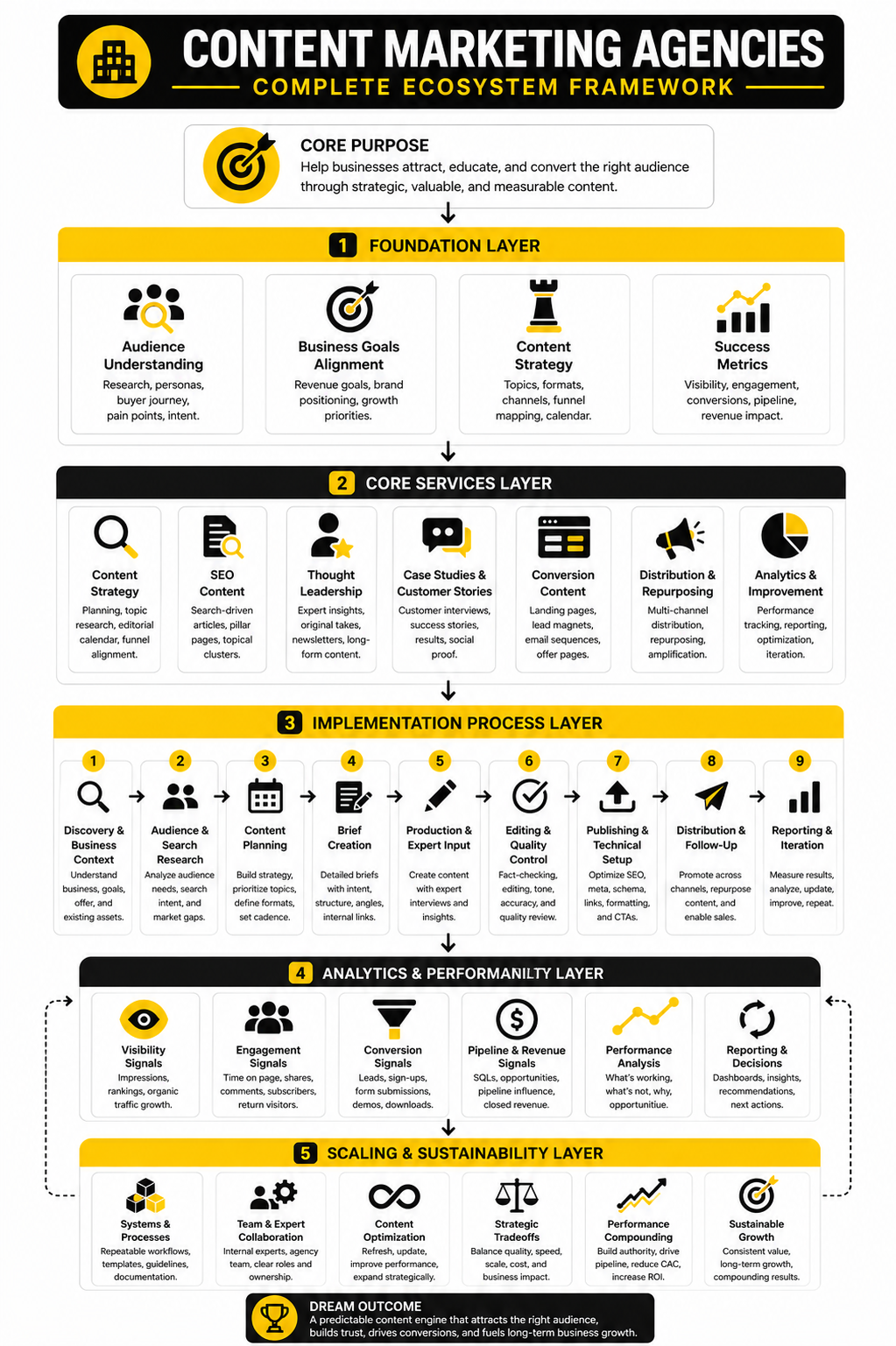
That is why content marketing agencies can be valuable when they do more than produce assets. A good agency turns scattered ideas into a repeatable system: research, strategy, creation, distribution, measurement, and improvement. The output is not “more content” for its own sake; it is a stronger path from awareness to trust to action.
The problem is that the agency market is crowded. Some agencies are strategic partners, some are production shops, and some are simply reselling generic content with a polished pitch. The goal is not to find the loudest agency, but the one that understands your market, your buyers, your offer, and the commercial role content needs to play.
The Content Agency Framework
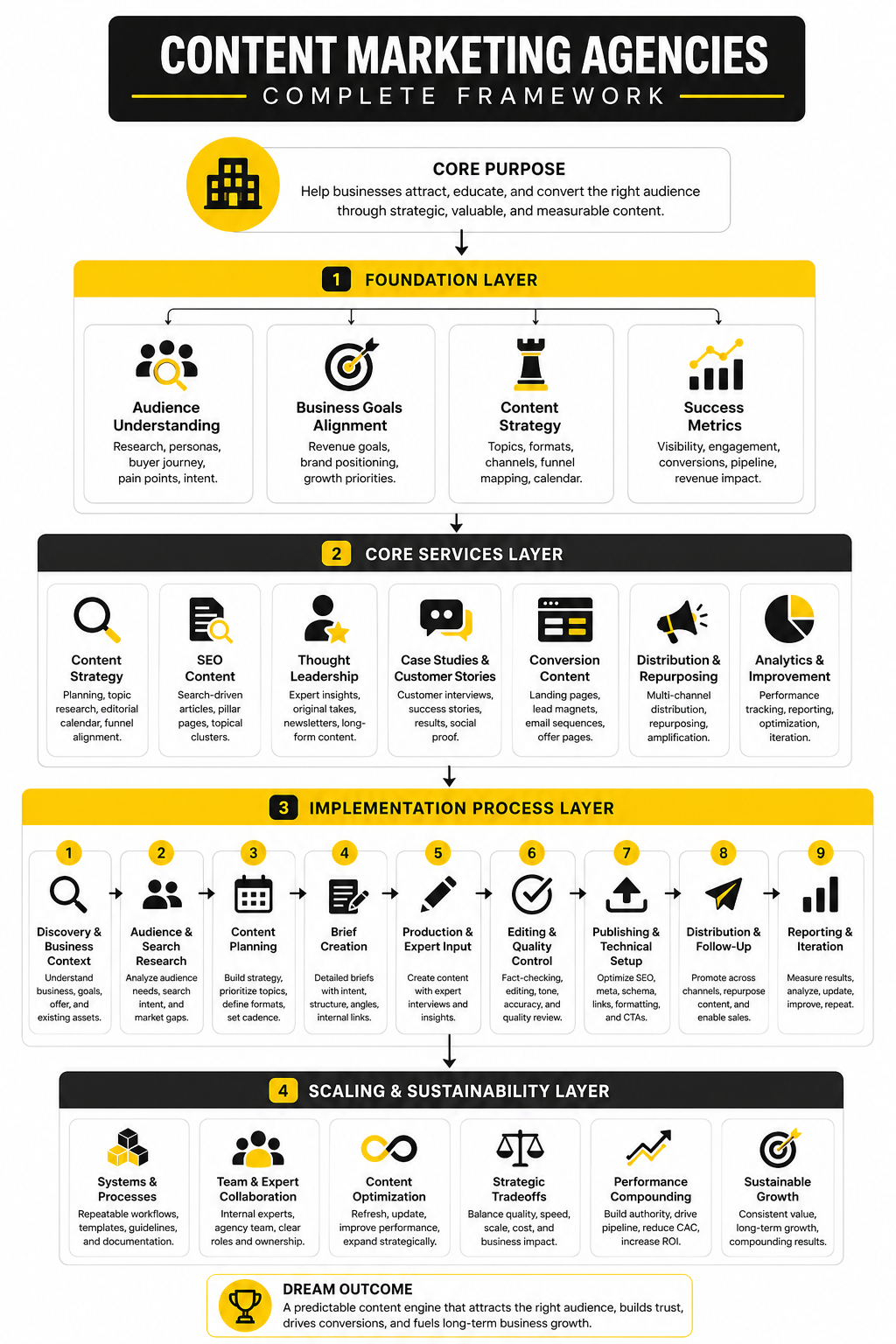
The easiest way to evaluate content marketing agencies is to separate strategy from execution. Strategy answers what should be created, who it is for, why it matters, how it will be distributed, and what business outcome it supports. Execution turns that strategy into articles, landing pages, newsletters, case studies, videos, social posts, lead magnets, and sales enablement assets.
The strongest agencies connect both sides. They do not just ask for keywords and deliver drafts. They investigate customer pain points, study competitors, map buyer journeys, identify content gaps, and build a practical plan your team can actually maintain.
A useful framework looks at four areas: market insight, content strategy, production quality, and distribution support. If one of those is missing, performance usually suffers. Great writing without strategy gets ignored, strategy without execution stalls, and content without distribution depends too much on luck.
Core Services Content Marketing Agencies Provide
The best content marketing agencies are not defined by one deliverable. They are defined by how well they connect the deliverables into a system that helps the business grow. That usually means strategy first, production second, and measurement running through everything.
A weak agency asks, “How many articles do you need?” A strong agency asks, “What does your buyer need to believe before they are ready to buy?” That difference matters because content is not just a publishing activity. It is a trust-building activity.
Content Strategy
Content strategy is where the agency decides what should exist and why. This includes audience research, positioning, topic selection, keyword mapping, funnel planning, editorial calendars, and channel priorities. Without this layer, even well-written content can feel random.
Good strategy also forces trade-offs. Not every keyword is worth chasing, not every trend deserves attention, and not every audience segment needs the same content. The agency should help you focus on the topics where your expertise, buyer demand, and commercial opportunity overlap.
SEO Content
SEO is still one of the biggest reasons companies hire content marketing agencies. Search-led content can bring consistent traffic, but only when it is built around real intent instead of shallow keyword matching. A serious agency will look at search behavior, competing pages, topical depth, internal links, and conversion paths before writing.
The goal is not to stuff “content marketing agencies” into every paragraph. The goal is to create the best useful page for the searcher while supporting the business behind it. That means clear structure, credible information, strong examples, and a next step that fits the reader’s stage of awareness.
Thought Leadership
Thought leadership is where many brands either stand out or disappear into sameness. This is the content that communicates judgment, perspective, and experience. It can show up as executive posts, essays, newsletters, research reports, podcast talking points, or opinion-led articles.
The agency’s job is not to invent fake expertise. It should extract real expertise from founders, executives, sales teams, customer success teams, product leaders, and subject matter experts. Then it should shape those ideas into content that sounds sharp, useful, and recognizably yours.
Case Studies and Customer Stories
Case studies are often closer to revenue than top-of-funnel articles because they reduce buyer risk. A prospect wants to know whether your company has solved a similar problem for someone like them. A good agency knows how to interview customers, find the business tension, explain the solution, and show the outcome without turning the story into a generic testimonial.
This kind of content also supports sales. Sales teams can use case studies in follow-ups, proposals, nurture sequences, and objection handling. That makes them more than website assets; they become proof assets.
Landing Pages and Conversion Content
Content does not stop at education. At some point, the reader needs a clear path toward action. That is where landing pages, comparison pages, lead magnets, webinar pages, email sequences, and offer pages become important.
Some agencies can support this directly, while others work alongside your conversion or growth team. If your content strategy depends heavily on funnels, tools like ClickFunnels, Systeme.io, or GoHighLevel can fit naturally into the implementation stack. The tool is not the strategy, but the right setup can make the strategy easier to execute.
Distribution and Repurposing
Publishing is not distribution. A strong agency should help content travel beyond your blog. That can include email, LinkedIn, YouTube, short-form video, community posts, partner newsletters, paid amplification, and sales enablement.
Repurposing is especially useful when your team has limited time. One strong interview can become an article, a newsletter, several social posts, a short video script, and a sales follow-up asset. Tools like Buffer can help manage scheduling, but the real value comes from having a distribution plan before the content is created.
Analytics and Improvement
Content marketing agencies should be able to explain what is working, what is not, and what should change next. That does not mean obsessing over vanity metrics. It means connecting content performance to search visibility, qualified traffic, assisted conversions, pipeline influence, email engagement, sales usage, and audience quality.
This is where many content programs improve over time. The first version of a strategy is always a hypothesis. The agency should use performance data, sales feedback, customer questions, and market changes to keep sharpening the system.
How Professional Implementation Actually Works
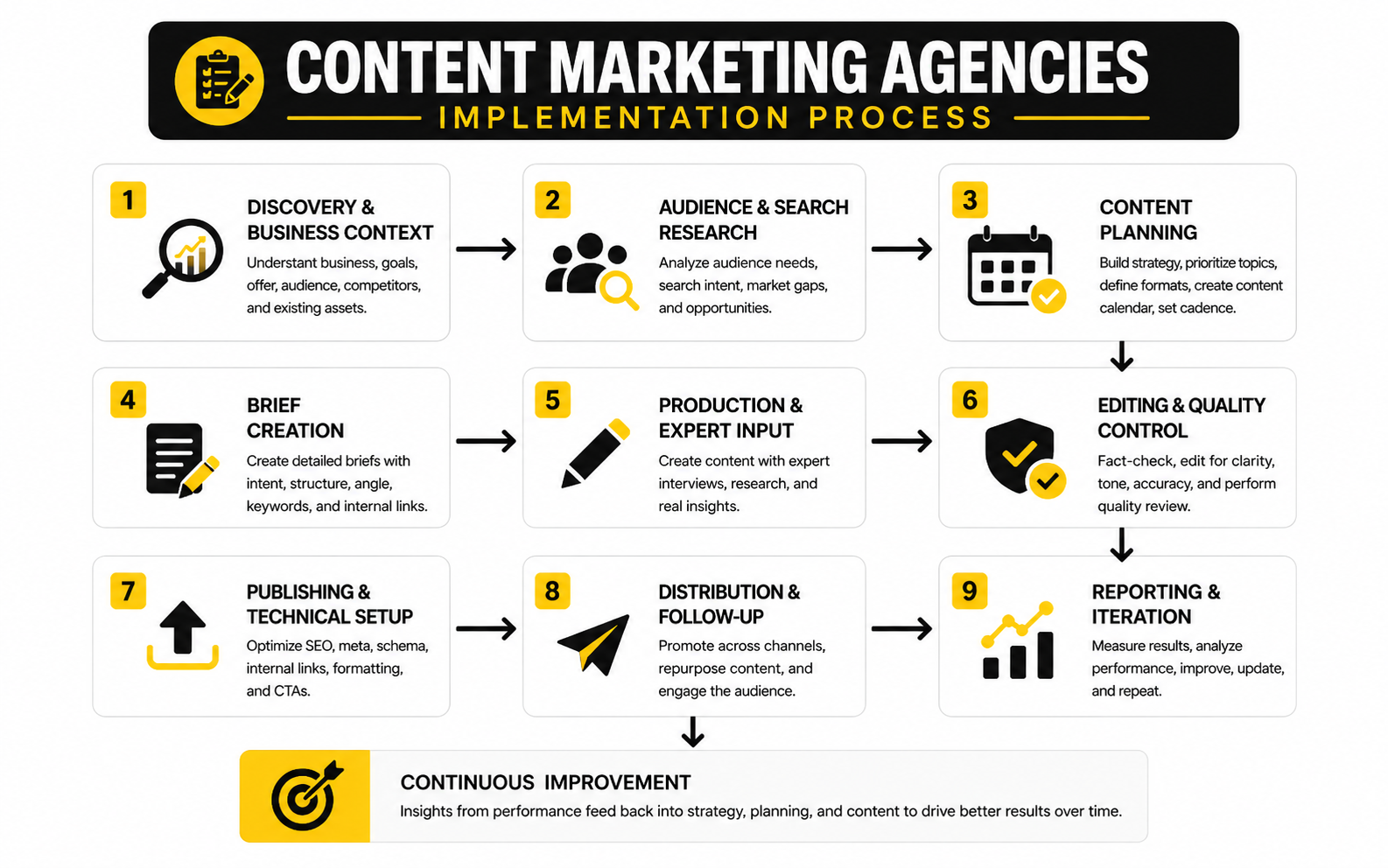
A good strategy is useful, but implementation is where content marketing agencies prove their value. This is the point where ideas become briefs, briefs become drafts, drafts become assets, and assets become part of a working growth system. If the process is vague, the results usually become vague too.
Professional implementation should feel structured without becoming slow. The agency needs enough process to protect quality, but not so much process that every article takes six weeks and fifteen approvals. The best setup is clear, repeatable, and easy for both sides to maintain.
Step 1: Discovery and Business Context
The first step is not writing. It is understanding the business. The agency should learn what you sell, who buys it, why they buy it, what objections slow them down, and where content can help move the conversation forward.
This is also where the agency should review your current assets. Existing blog posts, landing pages, case studies, sales decks, email sequences, webinars, and social content can reveal a lot. Sometimes the fastest win is not creating something new, but improving what already has traction.
Step 2: Audience and Search Research
Once the business context is clear, the agency should study the audience from multiple angles. Search data can show what people are actively looking for, but it does not explain everything. Sales calls, customer interviews, support tickets, review sites, community discussions, and competitor content can all reveal language that keyword tools miss.
This matters because buyers rarely think in neat content categories. They think in problems, risks, deadlines, internal pressure, and outcomes. Strong content marketing agencies translate that messy reality into topics that feel useful, specific, and commercially relevant.
Step 3: Content Planning
Planning turns research into a practical editorial system. This usually includes priority topics, content formats, publishing cadence, funnel stages, ownership, deadlines, and distribution channels. The plan should be clear enough that everyone knows what is being created and why.
This is where discipline matters. A content plan should not become a dumping ground for every idea from every meeting. It should prioritize the assets most likely to support search visibility, buyer education, sales conversations, authority, and conversion.
Step 4: Brief Creation
A strong brief saves time later. It gives the writer the search intent, audience, angle, structure, internal links, external references, product context, examples to avoid, and the action the reader should take next. Without a good brief, even talented writers are forced to guess.
This is one of the easiest ways to spot a serious agency. If their briefs are thin, generic, or copied from SEO tools without judgment, the final content will probably feel generic too. A useful brief gives direction without suffocating the writer.
Step 5: Production and Expert Input
Production is where the article, page, script, email, or asset gets created. But the agency should not work in isolation. For technical, strategic, or high-trust content, expert input from your team is often what makes the piece credible.
The best workflow is simple. The agency interviews or collects notes from the right internal expert, turns that knowledge into a polished asset, and then sends it back for focused review. Your team should not have to rewrite everything, but they should have enough involvement to keep the content accurate and distinct.
Step 6: Editing and Quality Control
Editing is not just proofreading. It should check structure, clarity, accuracy, tone, originality, search intent, conversion flow, and whether the content actually helps the reader. This is where average content becomes useful content.
Quality control is especially important now because AI can produce clean-looking drafts very quickly. Clean is not the same as good. The agency needs human judgment to remove fluff, sharpen claims, verify details, and make sure the final piece sounds like it came from a real brand with real expertise.
Step 7: Publishing and Technical Setup
Publishing should be treated as part of implementation, not an afterthought. Titles, meta descriptions, URL slugs, internal links, schema, image placement, calls to action, and formatting all affect how content performs. A good agency either handles this directly or coordinates clearly with your web team.
If your content program includes landing pages or lead capture, the publishing stack matters too. A campaign may need forms, email follow-up, booking links, CRM routing, or funnel pages. Tools like Fillout, Cal.com, and GoHighLevel can support that workflow when they fit the business.
Step 8: Distribution and Follow-Up
After publishing, the agency should help the content reach the right people. That can mean repurposing the asset for LinkedIn, turning key points into an email, giving sales a short summary, building a newsletter mention, or creating supporting posts for founders and team members. Content should not sit quietly on the website and hope someone finds it.
Distribution also gives the agency feedback. If a topic performs well in email, search, social, or sales conversations, that is a signal. The next round of content should use those signals to improve the plan instead of starting from scratch every month.
Step 9: Reporting and Iteration
Reporting should answer a practical question: what should we do next? Traffic is useful, but it is not the whole picture. The agency should look at rankings, engagement, conversions, assisted pipeline, content decay, internal usage, and qualitative feedback.
The most valuable content marketing agencies use reporting to make better decisions. They update old pages, double down on promising topics, cut weak formats, improve calls to action, and adjust distribution. That is how content becomes a compounding asset instead of a monthly checklist.
Statistics and Data
Measurement is where content marketing agencies move from opinion to evidence. Without data, the relationship can become subjective very quickly. One person likes the article, another person thinks the headline feels weak, and nobody knows whether the content is actually helping the business.
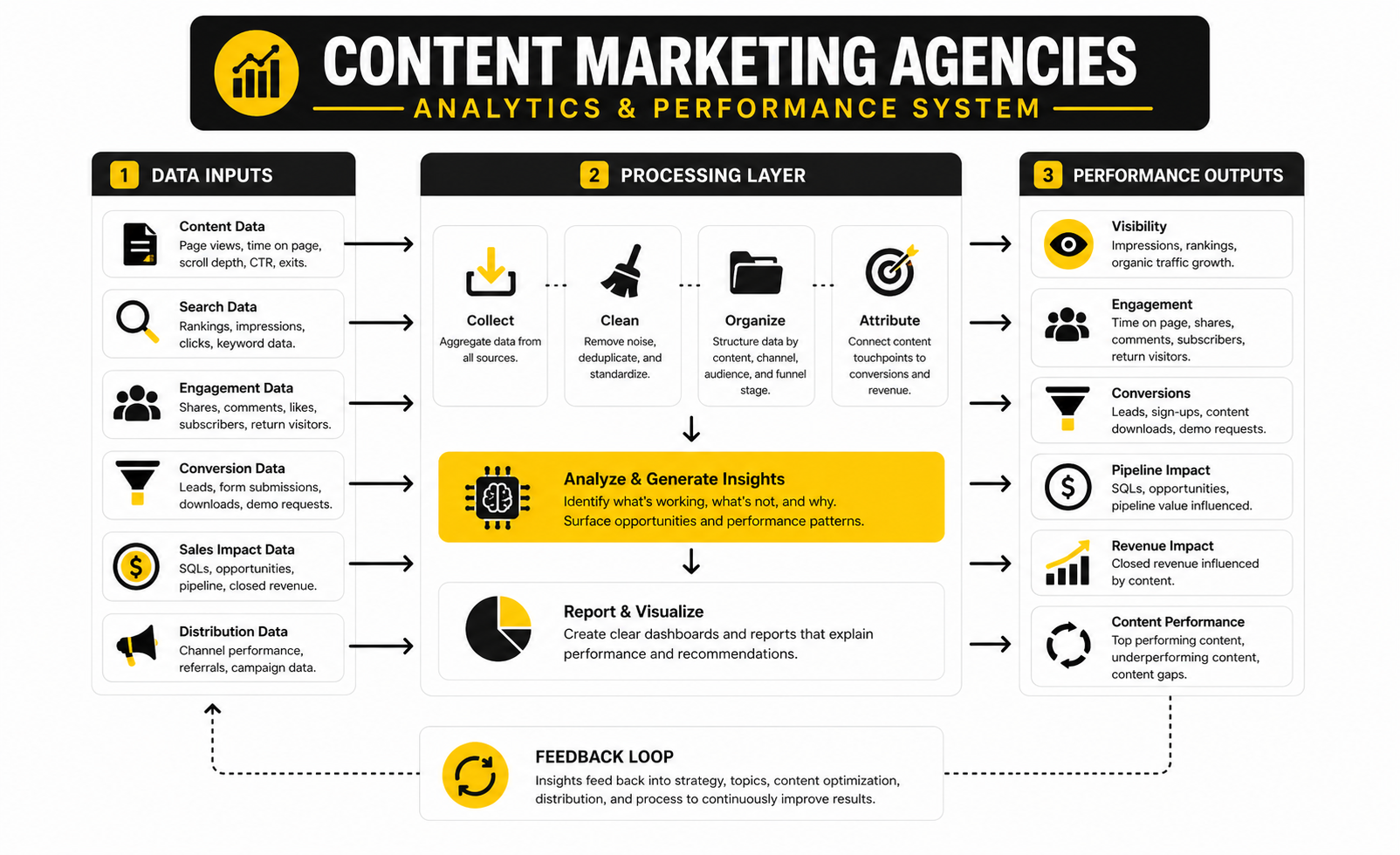
The point is not to drown the team in dashboards. The point is to create a simple measurement system that shows whether content is reaching the right people, earning trust, and creating commercial momentum. Good agencies make the data easier to act on, not harder to understand.
The Metrics That Actually Matter
Not every metric deserves the same attention. Pageviews can show reach, but they do not prove quality. Rankings can show search progress, but they do not prove revenue. Leads can show demand, but they do not prove the content attracted the right buyers.
A practical measurement system should separate metrics into layers. Visibility metrics show whether people can find the content. Engagement metrics show whether the content holds attention. Conversion metrics show whether readers take the next step. Revenue metrics show whether content is influencing pipeline, sales conversations, or customer acquisition.
Benchmarks Need Context
Benchmarks can be useful, but only when they are interpreted carefully. A new B2B SaaS company with a narrow audience should not judge itself against a broad consumer brand with years of domain authority. The same number can be excellent, average, or disappointing depending on the market, sales cycle, channel, and maturity of the content program.
Recent B2B research shows why this context matters. In the 2025 B2B content marketing benchmark research, top-performing teams are separated less by one magic tactic and more by clarity, consistency, audience focus, and better operational discipline. That is the lesson: benchmarks should guide decisions, not replace judgment.
Search Performance Signals
For SEO-focused content, content marketing agencies should watch more than rankings. Impressions, click-through rate, keyword movement, internal links, indexed pages, search intent match, and content decay all matter. A page that moves from position 40 to position 12 may not drive much traffic yet, but it can still signal that the topic is worth improving.
The action depends on the signal. If impressions are rising but clicks are weak, the title and meta description may need work. If rankings stall below page one, the content may need stronger depth, better internal links, or clearer differentiation. If traffic rises but conversions do not, the call to action or offer may not match the reader’s intent.
Engagement Signals
Engagement data helps show whether the content is useful once people arrive. Time on page, scroll depth, return visits, newsletter signups, social saves, comments, replies, and sales team feedback can all reveal quality. These signals are not perfect, but they are valuable when viewed together.
The mistake is treating engagement as entertainment only. In B2B especially, a quiet reader can still be a serious buyer. Someone may read three comparison pages, forward one to a colleague, and never leave a comment. That is why engagement should be combined with conversion and pipeline data instead of judged alone.
Conversion Signals
Conversion tracking turns content from a visibility project into a business asset. This includes form submissions, demo requests, booked calls, email opt-ins, webinar registrations, lead magnet downloads, free trials, and assisted conversions. The specific conversion depends on the business model.
The best content marketing agencies do not force the same call to action everywhere. A top-of-funnel educational article may work better with a newsletter or checklist. A comparison page may deserve a demo CTA. A case study may be useful as a sales follow-up asset even if it never becomes the biggest traffic driver.
Tools like Brevo, ManyChat, and GoHighLevel can support follow-up when content is meant to capture and nurture demand. The important part is not the tool itself. The important part is making sure the reader’s next step is clear, relevant, and trackable.
Revenue and Pipeline Signals
Revenue measurement is harder, but it is where content becomes more credible inside the business. Content can influence a deal long before someone fills out a form, so last-click attribution often undervalues it. That does not mean you ignore revenue data; it means you read it with nuance.
Useful signals include content-assisted opportunities, pages viewed before conversion, sales-reported content usage, influenced pipeline, closed-won journeys, and customer acquisition cost over time. A practical agency will help connect content to CRM data where possible. Even imperfect attribution is better than pretending content only matters when it gets the final click.
What Good Reporting Looks Like
A useful report should explain what happened, why it probably happened, and what should happen next. It should not be a spreadsheet with no interpretation. It should also avoid celebrating numbers that do not matter.
A strong monthly or quarterly report should answer a few simple questions:
- Which content gained visibility?
- Which content attracted qualified readers?
- Which assets supported conversions or sales conversations?
- Which pages need updating?
- Which topics deserve more investment?
- Which activities should be stopped?
How to Turn Data Into Decisions
Data only matters if it changes behavior. If an article is ranking but not converting, improve the offer or internal path. If a topic drives qualified demos, build supporting content around it. If a format consistently underperforms, either fix the strategy or stop producing it.
This is where agencies should bring confident recommendations. They should not hide behind dashboards or vague language. The value is in turning performance signals into sharper priorities, better content, and a cleaner growth system.
Pricing, Contracts, and Engagement Models
By this stage, the question is not whether content marketing agencies can help. The question is what kind of relationship makes sense for your company. A startup that needs its first content engine does not need the same engagement as an enterprise team with internal strategists, legal review, sales enablement, and multiple product lines.
This is where a lot of companies make expensive mistakes. They compare agencies only by monthly retainer, then wonder why the cheaper option creates more internal work, weaker strategy, and slower progress. Price matters, but the real question is value, capacity, and fit.
Retainers Versus Projects
Most content marketing agencies work through retainers, projects, or hybrid models. A retainer usually makes sense when you need ongoing strategy, production, reporting, and iteration. A project can work better when you need a defined asset, such as a content audit, website copy refresh, case study package, or launch campaign.
The tradeoff is simple. Retainers create consistency, but they require trust and clear scope. Projects create focus, but they can become disconnected if there is no longer-term strategy behind them. If your content program is meant to compound over time, a retainer often gives the agency enough room to learn, improve, and build momentum.
What Should Be Included
A serious engagement should define what the agency owns and what your team owns. That includes strategy, briefs, writing, editing, expert interviews, design coordination, publishing, distribution, reporting, and refreshes. If ownership is vague, important work will fall between the cracks.
The scope should also clarify how many revision rounds are included, how quickly feedback is expected, and who approves final content. This sounds boring, but it matters. Many content programs slow down not because the agency cannot write, but because the review process is messy, political, or unclear.
The Hidden Cost of Cheap Content
Cheap content is rarely cheap when you count the cleanup. If your team has to rewrite every article, correct shallow research, rebuild weak briefs, or fix brand voice after delivery, you are paying twice. Worse, weak content can damage trust with buyers who are looking for real expertise.
This is especially risky now because AI has made generic content easier to produce at scale. The market does not need more polished sameness. It needs sharper points of view, better examples, clearer thinking, and stronger usefulness. If an agency’s main advantage is volume, ask very carefully what quality control looks like.
AI, Automation, and Human Judgment
AI can absolutely improve content operations. It can help with research organization, transcript analysis, outline development, repurposing, metadata, workflow documentation, and first-pass drafting. But it should not replace strategic judgment, subject matter expertise, editorial taste, or fact-checking.
This is one of the biggest evaluation points for modern content marketing agencies. The agency should be able to explain where AI fits into its process and where humans stay responsible. If the answer is vague, that is a red flag. Efficiency is useful, but accountability matters more.
Scaling Without Losing Quality
Scaling content is not just about publishing more. It is about increasing output while protecting strategy, accuracy, voice, and performance. That requires better systems, not just more writers.
A scalable content operation usually needs:
- A clear strategy and topic architecture
- Strong editorial guidelines
- Repeatable brief templates
- Expert input workflows
- Consistent review standards
- A distribution process
- Performance reporting
- A refresh schedule for older assets
If any of these pieces are missing, scaling can make the problem bigger. You do not want to produce twenty average assets when five excellent ones would do more for the business.
Strategic Tradeoffs to Discuss Early
The best agency relationships are honest about tradeoffs. You cannot maximize speed, quality, originality, research depth, stakeholder approval, and low cost at the same time. Something has to give.
Before signing, discuss the tradeoffs directly. Do you need fast production or deep subject matter authority? Do you need SEO growth or thought leadership? Do you need sales enablement or top-of-funnel reach? Do you need a team that executes inside your existing process, or one that challenges and rebuilds the process?
These answers affect everything: budget, timeline, deliverables, staffing, and success metrics. A good agency will help you make those decisions instead of pretending one package solves everything.
Red Flags to Watch For
Some warning signs show up before the contract is signed. If the agency promises instant rankings, guarantees revenue without seeing your funnel, avoids talking about your buyers, or pushes a fixed content volume before understanding strategy, be careful. Those are signs of a vendor selling output instead of outcomes.
Other red flags are more subtle. Thin briefs, weak questions during discovery, no clear editorial process, no plan for expert input, and vague reporting can all create problems later. The pitch may sound polished, but the operating system underneath is what you are really buying.
When an Agency Is Not the Right Move
Hiring an agency is not always the best answer. If your positioning is unclear, your offer is still changing every month, or nobody internally can provide expert input, the agency may struggle to produce strong work. Content needs raw material.
In that case, fix the inputs first. Clarify the offer, document customer insights, collect sales objections, and identify internal experts. Then content marketing agencies have something real to build from. That is when the partnership becomes much more powerful.
Choosing and Managing the Right Agency
Choosing between content marketing agencies is not just a procurement decision. It is a strategic decision about who gets to shape how your market understands your company. That is a big deal, especially if your content will influence search visibility, buyer education, sales conversations, and brand trust.
The right agency should make your thinking clearer, not just your calendar busier. They should challenge weak assumptions, simplify messy ideas, and help your team turn expertise into assets that buyers actually use. If the agency only waits for instructions, you are hiring hands. If they bring judgment, you are hiring leverage.
Start With the Business Problem
Before comparing proposals, define the real problem. Do you need more qualified traffic? Better sales enablement? Stronger thought leadership? More conversion-focused landing pages? A cleaner content engine your team can scale?
Different problems require different agencies. A technical SEO content agency may be perfect for search growth but weak at executive thought leadership. A brand storytelling agency may create excellent narratives but lack the operational discipline to publish and optimize consistently. The clearer the problem, the easier it is to avoid hiring the wrong specialist.
Evaluate the Team, Not Just the Pitch
Agency pitches are designed to look good. The better test is who will actually work on your account. Ask about the strategist, editor, writer, project manager, SEO lead, and anyone else involved in the work.
You want to know how decisions get made. Who creates the brief? Who interviews experts? Who edits for quality? Who reviews performance? If the senior team sells the account and disappears after onboarding, the quality of the day-to-day work may not match the pitch.
Look for Clear Thinking
The best content marketing agencies explain their process in plain language. They can tell you how they choose topics, how they define quality, how they handle expert input, and how they decide what to improve next. They do not hide behind jargon.
Clear thinking also shows up in the questions they ask. If they ask about your buyers, sales cycle, positioning, objections, margins, competitors, and internal capacity, that is a good sign. If they only ask how many blog posts you want, be careful.
Build the Relationship Around Feedback
Even a strong agency needs feedback to learn your business. The first few deliverables should improve the working relationship, not create frustration. That only happens when feedback is specific, timely, and connected to strategy.
Instead of saying “this does not feel right,” explain what is missing. Is the tone too generic? Is the argument too soft? Is the product context inaccurate? Is the audience too broad? Good feedback gives the agency something to act on.
Protect the Content System
Once the agency is in place, protect the system. Do not let every stakeholder add random topics, rewrite headlines based on preference, or delay approvals without reason. Content quality depends on focus.
A clean system usually has one strategic owner, one approval path, and a clear definition of success. That does not mean ignoring input. It means collecting input in a way that keeps the process moving and protects the reader experience.
FAQ - Built for Complete Guide
What do content marketing agencies do?
Content marketing agencies help companies plan, create, distribute, and improve content that supports business goals. That can include SEO articles, landing pages, case studies, newsletters, thought leadership, social content, lead magnets, and sales enablement assets. The best agencies connect those deliverables into a clear system instead of treating content as isolated tasks.
How do I choose the best content marketing agency?
Start by defining the business problem you need solved. Then evaluate agencies based on strategy, relevant experience, process, editorial quality, reporting, and the team assigned to your account. Do not choose only by price or portfolio design, because the real value is in how well the agency can understand your market and execute consistently.
Are content marketing agencies worth it?
They can be worth it when they bring strategy, consistency, expertise, and execution your internal team cannot maintain alone. They are less valuable when they only produce generic content without understanding your buyers or commercial goals. The return depends heavily on fit, process, and how clearly the work connects to business outcomes.
How much do content marketing agencies cost?
Pricing varies based on scope, market, content type, seniority, and service depth. A simple writing package will cost less than a full strategy, SEO, editorial, distribution, and reporting engagement. The better question is what internal work the agency removes, what strategic value it adds, and whether the content can support growth over time.
Should I hire an agency or build an internal content team?
An agency makes sense when you need speed, outside expertise, flexible capacity, or a proven process. An internal team makes sense when content is deeply tied to your product, brand, and daily market conversations. Many companies use a hybrid model where internal experts provide insight and the agency turns that insight into consistent output.
What should I ask before hiring a content marketing agency?
Ask how they build strategy, how they research buyers, how they create briefs, how they handle expert interviews, and how they measure performance. Ask who will actually work on your account and what the review process looks like. Also ask what they need from your team, because good content always requires strong inputs.
How long does content marketing take to work?
Content marketing usually takes time because trust, search visibility, and authority build gradually. Some assets, like sales enablement pages or case studies, can help quickly because sales teams can use them right away. SEO-led content often needs more time, especially in competitive markets, because pages must be indexed, ranked, improved, and supported with internal links.
What makes a content agency different from an SEO agency?
A content agency usually focuses on strategy, messaging, editorial quality, buyer education, and multi-channel assets. An SEO agency may focus more heavily on rankings, technical optimization, keyword research, links, and organic visibility. There is overlap, but the best choice depends on whether your biggest gap is search performance, content quality, positioning, or full-funnel execution.
Can content marketing agencies use AI?
Yes, but AI should support the process rather than replace judgment. It can help with research organization, outlines, repurposing, metadata, and workflow speed. The agency still needs human expertise for strategy, accuracy, voice, originality, interviews, editing, and final quality control.
What are the biggest red flags when hiring an agency?
Be careful with agencies that promise instant rankings, push fixed content volume before understanding your business, or avoid detailed questions about your buyers. Weak briefs, vague reporting, generic samples, and unclear ownership are also warning signs. A polished pitch does not matter if the operating process underneath is weak.
How should content marketing agencies report results?
Reporting should explain what happened, why it matters, and what should happen next. Useful reports connect visibility, engagement, conversions, sales usage, and content improvements. A report that only lists pageviews without interpretation is not enough.
What should I prepare before working with an agency?
Prepare your positioning, audience notes, sales objections, customer questions, product information, existing content, and access to internal experts. The agency can help organize this, but they cannot invent real expertise from nothing. The stronger your inputs, the stronger the content will be.
Work With Professionals
Explore 10K+ Remote Marketing Contracts on MarkeWork.com
Most marketers spend too much time chasing clients, competing on crowded platforms, and losing a percentage of every project to middlemen.
MarkeWork gives you a better way. Browse thousands of remote marketing contracts and connect directly with companies desperate to hire skilled marketers like you, without platform commissions and without unnecessary gatekeepers.
If you're serious about finding better opportunities and keeping 100% of what you earn, explore available contracts and create a profile for free at MarkeWork.com.