

Copy writing AI is no longer just a shortcut for writing faster. Used well, it becomes a practical system for research, positioning, drafting, testing, and improving marketing copy without losing the human judgment that makes copy persuasive.
The danger is treating AI like a replacement for strategy. Google’s guidance is clear that AI-assisted content still needs originality, usefulness, and people-first quality, not scaled sameness for search engines Google Search Central. That means the best results come from combining AI speed with clear positioning, real customer insight, and sharp editing.
Article Outline
- Why Copy Writing AI Matters Now
- The Copy Writing AI Framework
- Research Before Writing
- Core Components Of AI-Assisted Copy
- Professional Implementation
- Testing, Optimization, And FAQ
Why Copy Writing AI Matters Now
AI is already part of modern marketing work, especially in content creation, campaign planning, and performance analysis. McKinsey’s latest AI research notes that marketing and sales remain among the functions where AI use is most common McKinsey. That matters because copy is no longer just a creative task; it is also a workflow, data, and speed problem.
The opportunity is obvious. Teams can move from blank page to structured draft faster, create variations for different audiences, and turn customer research into usable messaging. Tools like GoHighLevel AI, ManyChat, and Brevo fit naturally into that workflow when the goal is turning copy into campaigns, conversations, and follow-up.
The risk is also obvious. Bad AI copy sounds polished but empty, because it skips the hard parts: customer pain, proof, offer clarity, and editorial judgment. That is why this article treats copy writing AI as a professional framework, not a magic prompt.
The Copy Writing AI Framework
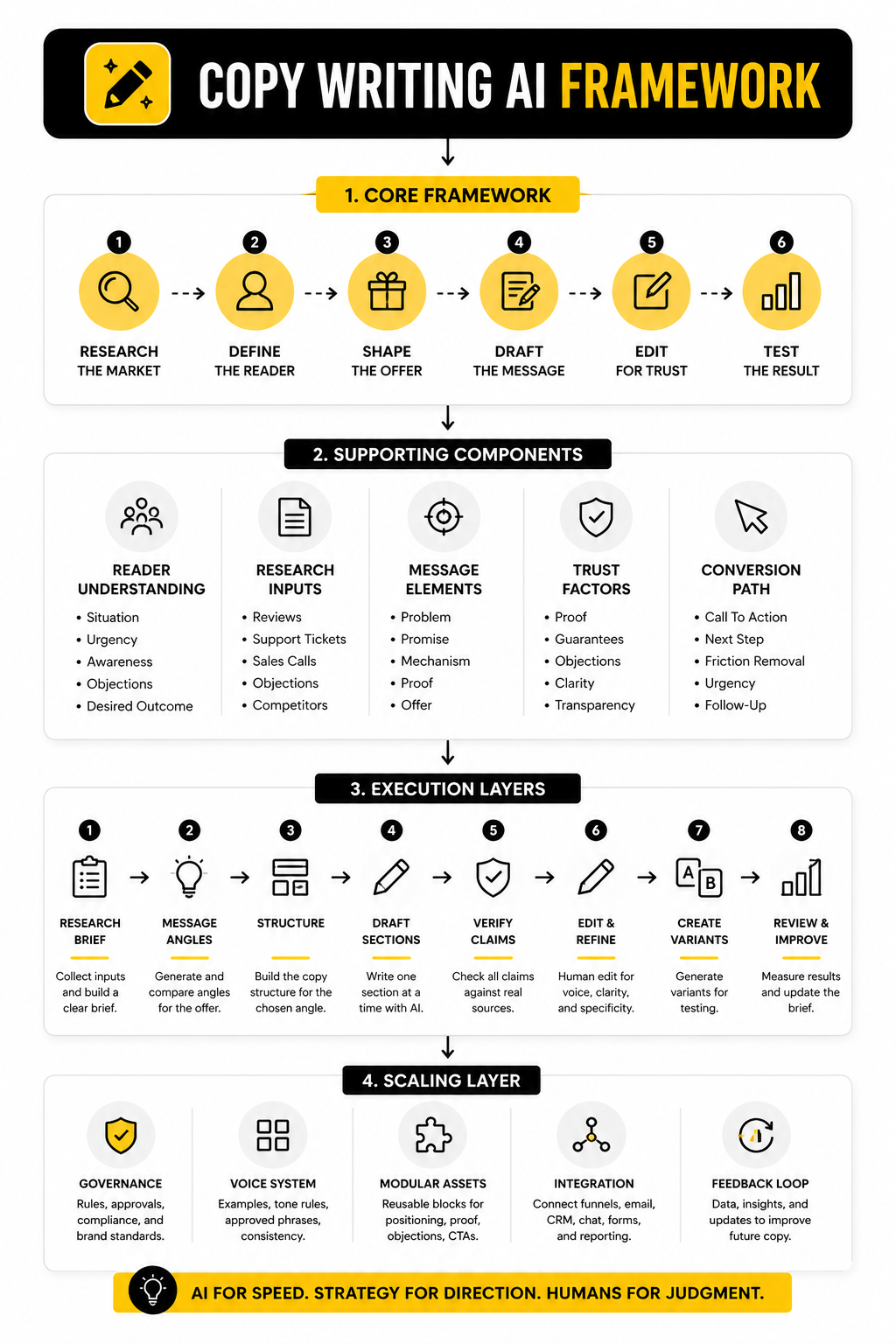
A useful copy writing AI workflow starts before the first draft. The framework is simple: research the market, define the reader, shape the offer, draft the message, edit for trust, and test the result. Each step gives AI a narrower job, which usually produces better output than asking it to “write high-converting copy” from nothing.
This also keeps the human in control. AI can summarize reviews, generate headline angles, rewrite email variants, and create landing page sections, but it cannot decide what your brand should stand for. That judgment still comes from strategy, customer understanding, and performance feedback.
The rest of this six-part article will build that system piece by piece. By the end, you will have a practical way to use AI for copy without publishing generic content, weakening your brand voice, or relying on unsupported claims.
Research Before Writing
The biggest mistake with copy writing AI is starting with the draft. A draft is only as useful as the inputs behind it, so the first job is to collect real language from the market. That includes customer reviews, support tickets, sales call notes, competitor pages, objections, feature requests, and the phrases buyers already use when they describe the problem.
AI is strong at turning messy research into patterns. It can group objections, summarize repeated pain points, compare competitor positioning, and identify emotional triggers that keep showing up across sources. That matters because strong copy usually sounds obvious to the buyer, not clever to the writer.
This is also where professional marketers separate useful AI workflows from lazy automation. Research from the Marketing AI Institute shows that marketers are using AI across understanding, adoption, and buying decisions, but the real advantage comes from applying it to higher-quality inputs. Better research gives the tool better context, and better context gives you copy that feels sharper, more specific, and more believable.
Start With The Reader
Before you ask AI to write anything, define who the copy is for. Not “business owners” or “marketers,” because that is too broad. You need the reader’s situation, urgency, awareness level, objections, desired outcome, and the trigger that made them look for a solution now.
This makes copy writing AI more practical because the model can adapt the message to the reader’s stage. A cold visitor needs clarity and relevance. A warm lead needs proof and differentiation. A buyer close to action needs risk reduction, urgency, and a clear next step.
For example, if someone is choosing a landing page builder, the copy should not start with generic “save time” language. It should speak to the real decision: speed to publish, design control, testing ability, and whether the page supports the offer. That is where a tool like Replo can fit naturally for ecommerce teams that need better landing pages without turning every change into a developer task.
Build A Research Brief
A good research brief gives AI boundaries. It tells the tool what the product does, who it serves, why the buyer cares, what competitors say, what proof exists, and what claims must be avoided. Without that brief, the output usually drifts into vague benefits, inflated promises, or language that sounds like every other brand in the category.
The brief does not need to be complicated. It should be clear enough that a copywriter could use it without guessing. If the AI cannot see the offer, audience, proof, objections, and tone, it will fill the gaps with generic marketing language.
A practical brief can include:
- The target reader and their current situation
- The main problem they want solved
- The desired outcome they care about most
- The product or service promise
- The strongest proof points available
- Common objections and hesitations
- Competitor messages to avoid copying
- Brand voice rules
- Claims that need legal, compliance, or founder approval
Turn Raw Inputs Into Copy Angles
Once the brief is ready, use AI to generate angles before writing full copy. An angle is the core way you frame the offer. It can focus on speed, control, cost, confidence, simplicity, status, risk reduction, or a specific pain the buyer wants gone.
This step matters because most weak AI copy fails before the writing starts. The tool jumps straight into polished paragraphs instead of testing which message is worth building around. Better angles create better headlines, better hooks, stronger emails, and cleaner landing page sections.
You can ask AI to compare angles by audience fit, urgency, believability, and proof required. That helps you avoid claims you cannot support. It also keeps the workflow practical: use AI to expand the strategic options, then use human judgment to choose the one that deserves the page, email, ad, or funnel.
Core Components Of AI-Assisted Copy
Once the research is clear, copy writing AI becomes much easier to control. The goal is not to ask for one perfect draft. The goal is to move through the copy in layers so each part has a specific job and every sentence earns its place.
The strongest AI-assisted copy usually has four core components: the message, the structure, the proof, and the conversion path. If one of those is weak, the copy may still sound professional, but it will not persuade. This is why the process matters more than the tool.
Google’s guidance on AI content keeps the standard practical: content should be helpful, reliable, and made for people rather than produced mainly to manipulate rankings Google Search Central. That same principle applies outside SEO. If the copy does not help the buyer understand, compare, trust, and act, it is not doing its job.
Shape The Message First
The message is the central idea the reader should remember. It connects the reader’s problem to the offer in a way that feels specific, useful, and believable. Before writing headlines, emails, ads, or landing page sections, define the message in one plain sentence.
This is where AI can help you test different versions quickly. You can ask it to create message options based on urgency, simplicity, authority, savings, speed, or risk reduction. Then you choose the version that best matches the reader and the proof you actually have.
Do not skip that last part. A strong message must be supportable. If your proof is thin, the copy should stay grounded and clear instead of pretending the offer is bigger than it is.
Build The Copy Structure
Structure turns the message into a readable path. For a landing page, that path may move from headline to problem, promise, mechanism, proof, offer, objections, and call to action. For an email, it may move from hook to context, value, transition, and next step.
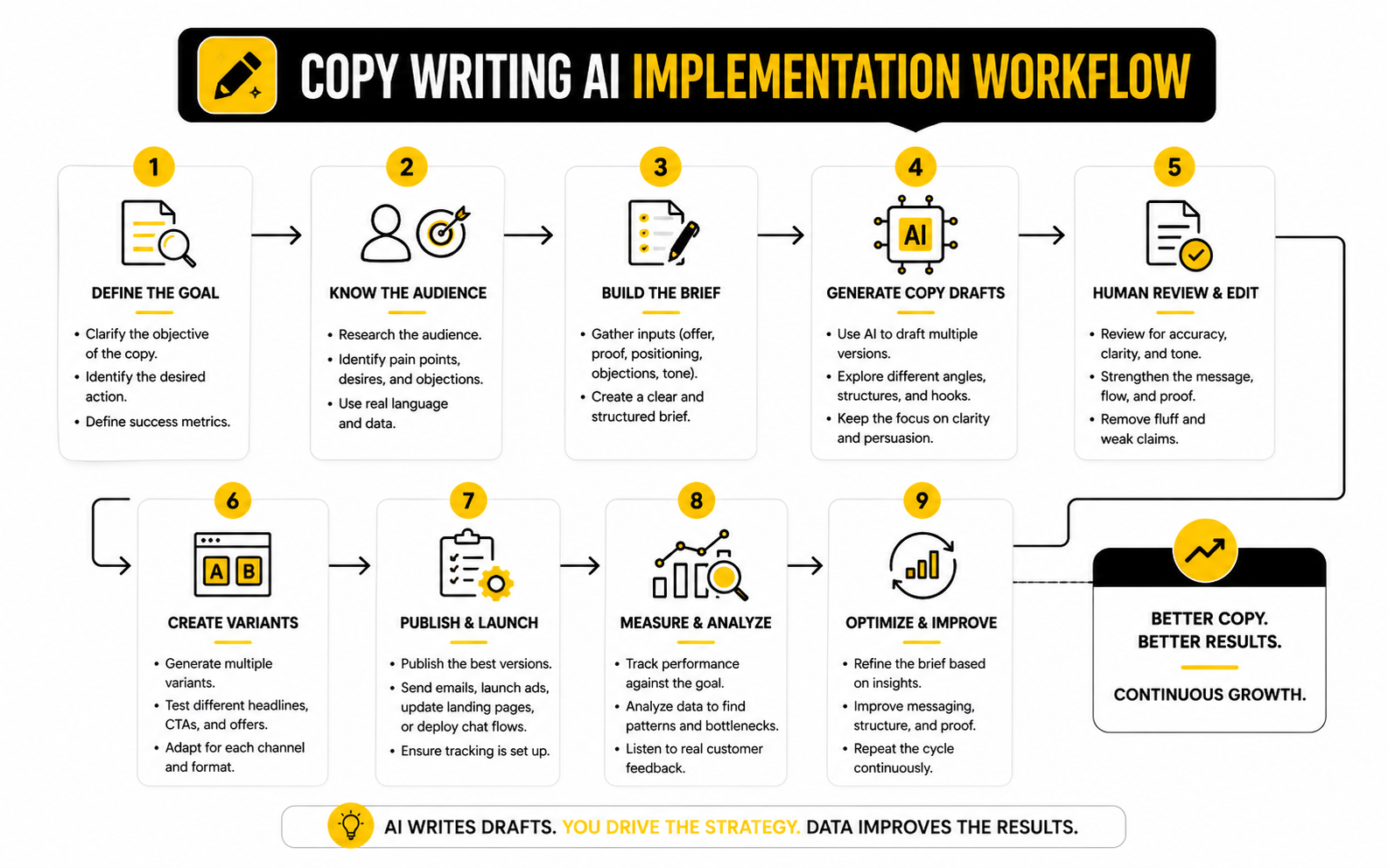
A practical copy writing AI process can look like this:
- Feed the AI a short research brief.
- Ask for three to five positioning angles.
- Choose one angle and request a page or email structure.
- Generate one section at a time instead of the full asset.
- Check every claim against the source material.
- Rewrite for voice, clarity, and specificity.
- Create variants for testing.
- Review performance and update the brief.
This step-by-step approach reduces generic output because the model has less room to wander. It also makes editing easier because you can fix the structure before polishing the language. That is important when AI is used inside a larger marketing system, especially if copy connects to funnels, automations, emails, and sales follow-up through platforms like GoHighLevel, ClickFunnels, or Systeme.io.
Add Proof Without Overclaiming
Proof is where a lot of AI copy breaks. The tool can make claims sound smooth, but smooth is not the same as true. Every performance claim, comparison, statistic, testimonial, and guarantee should be traceable to something real.
Use AI to organize proof, not invent it. Give it customer quotes, case study notes, product data, survey findings, review themes, screenshots, or documented outcomes, then ask it to suggest where each proof point belongs. That keeps the writing persuasive without drifting into hype.
This matters more as AI-generated content becomes easier to produce at scale. Salesforce’s latest marketing research highlights how AI, data, and personalization are reshaping modern marketing teams, based on insights from thousands of marketers worldwide Salesforce. More automation means more responsibility to keep claims accurate, because trust becomes a real advantage when everyone can publish faster.
Create Variants For The Right Reason
AI is excellent for creating variants, but more variants do not automatically mean better copy. You need a reason for each version. One headline might test urgency, another might test specificity, and another might test a different audience pain.
The same logic applies to email subject lines, ad hooks, product descriptions, and call-to-action language. Ask AI to label the strategic difference between each option so you are not just choosing based on taste. That makes testing cleaner because you know what each version is supposed to prove.
This is also where tools can support execution. Buffer can help organize social variations, Moosend can support email campaigns, and Fillout can help collect lead or customer inputs that improve future copy. The point is not to stack software for the sake of it. The point is to connect copy, distribution, and feedback so the system gets sharper over time.
Statistics And Data
Measurement is where copy writing AI becomes a performance system instead of a content shortcut. The point is not to collect random numbers and call it strategy. The point is to understand which copy decisions moved the reader closer to action and which ones only made the asset look busy.
Benchmarks are useful, but only when they are interpreted correctly. A landing page conversion rate, email click rate, or chatbot reply rate does not mean much until you know the audience temperature, traffic source, offer type, price point, and conversion goal. A cold ad click going to a high-ticket consultation page should not be judged the same way as a warm email subscriber clicking a free checklist.
Recent AI marketing research shows why measurement matters now. The 2025 State of Marketing AI Report is based on nearly 1,900 marketers and focuses on AI understanding, usage, buying behavior, outcomes, and adoption barriers. That framing is important because the real question is not “Are marketers using AI?” but “Is AI improving the work that matters?”
Track The Metrics That Match The Asset
Different copy assets need different performance signals. A homepage headline should be judged by clarity, scroll depth, next-page clicks, and qualified conversion behavior. An email subject line should be judged by opens only as a starting signal, because the real value appears in clicks, replies, booked calls, purchases, or pipeline created.
For email, broad benchmarks can help you spot obvious problems, but they should not become your ceiling. MailerLite’s 2025 benchmark report analyzed more than 3.6 million campaigns from 181,000 approved accounts across a full year of sending MailerLite. That kind of data is useful for context, but your list quality, offer, segmentation, and relationship with subscribers will decide what “good” actually means.
The same logic applies to landing pages. Unbounce’s conversion benchmark report uses data from more than 57 million conversions across more than 41,000 landing pages Unbounce. Those numbers can help you compare categories, but they cannot tell you whether your promise is clear, your proof is strong, or your call to action matches the buyer’s intent.
Build A Simple Copy Analytics System
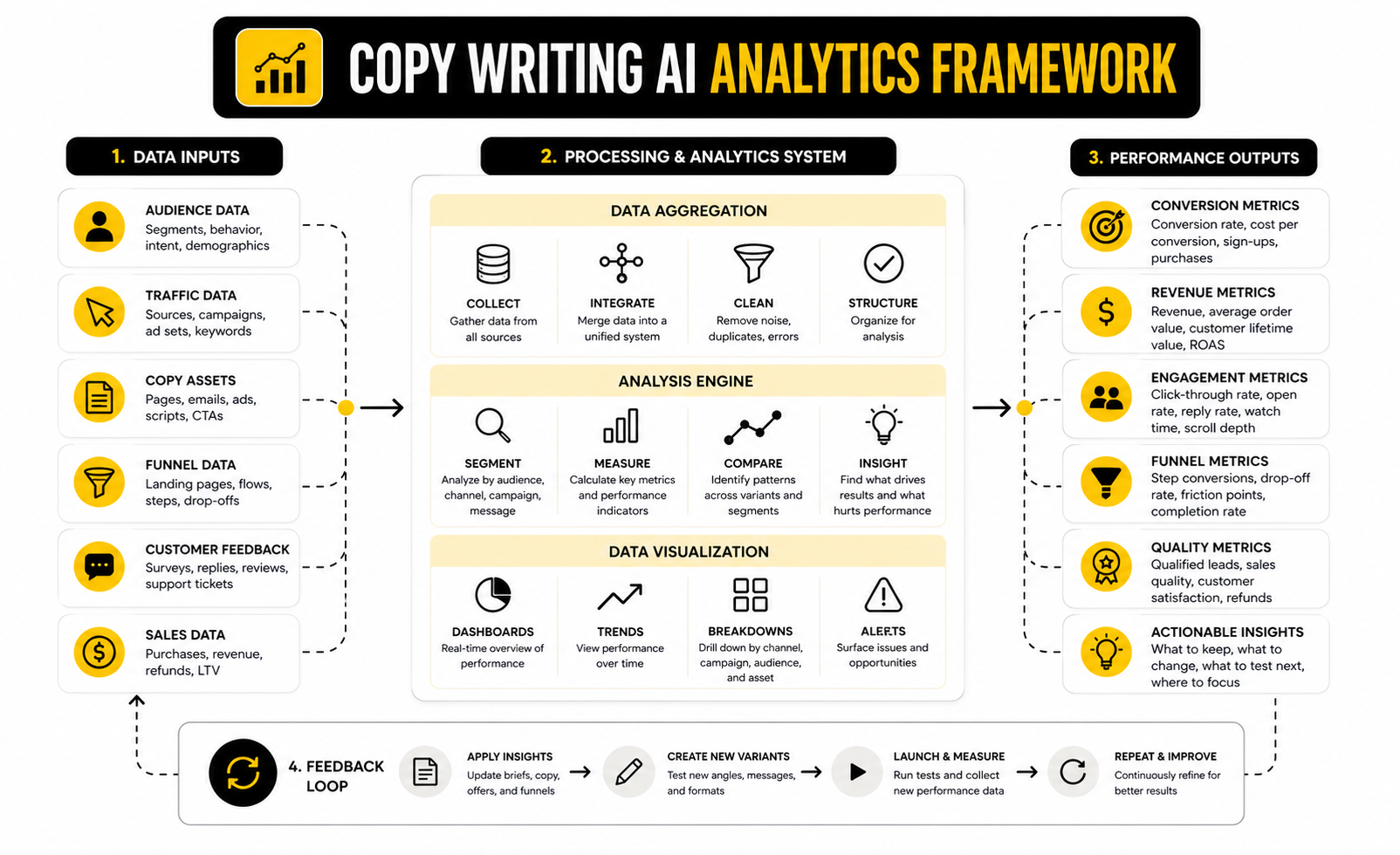
A useful analytics system starts with one question: what is this copy supposed to make the reader do next? Once that is clear, every metric should connect to that action. If the goal is a booked call, you track qualified booking rate, form completion rate, show rate, and close rate, not just page views.
For copy writing AI, the cleanest measurement system usually has four layers:
- Attention: impressions, opens, hook retention, first-screen engagement, scroll depth.
- Understanding: clicks on key sections, FAQ usage, time on page, chatbot questions, reply themes.
- Intent: form starts, button clicks, demo requests, cart adds, booked calls, lead magnet downloads.
- Revenue: purchases, qualified pipeline, close rate, retention, upsells, customer acquisition cost.
This makes optimization much easier because each weak point suggests a different fix. If attention is low, test the hook or subject line. If understanding is weak, improve the explanation, proof, or page flow. If intent is strong but revenue is weak, the issue may be lead quality, offer fit, pricing, or sales follow-up rather than the copy itself.
Use Benchmarks As Direction, Not Judgment
Benchmarks should guide questions, not create panic. If your click rate is below a category average, the answer is not automatically “rewrite everything.” It may mean your audience is colder, your offer requires more consideration, or your call to action asks for too much too soon.
This is where AI can help with analysis. You can feed it campaign results, copy variants, audience segments, and conversion notes, then ask it to identify patterns worth testing. The output should become a shortlist of hypotheses, not a final verdict.
Tools like Brevo, Moosend, and GoHighLevel can support that feedback loop when email, CRM, automations, and funnel data need to stay connected. The practical move is simple: write, measure, learn, and update the brief so the next AI-assisted draft starts from better information.
Turn Data Into Copy Decisions
Data only matters when it changes what you do next. If readers click the call to action but do not complete the form, the copy may be creating interest while the form creates friction. If readers spend time on the page but do not click, the page may be informative but not decisive enough.
AI can help translate those signals into copy tests. For example, low scroll depth may lead to a clearer first-screen promise. High FAQ interaction may lead to moving objections earlier. Strong clicks but weak sales outcomes may lead to tighter qualification copy before the form.
This is the practical advantage of copy writing AI when it is used properly. It gives you speed, but the measurement system gives you direction. Without data, you are just generating more words; with data, you are building a copy system that gets sharper over time.
Professional Implementation
Scaling copy writing AI is not about giving everyone a tool and hoping the output gets better. That usually creates more drafts, more review work, and more brand inconsistency. A professional implementation needs rules, ownership, approval paths, and a clear line between what AI can produce quickly and what a human must still verify.
The tradeoff is simple. AI can increase speed, but speed without control creates risk. The 2025 SAS marketing AI report highlights that stronger adopters are building around data infrastructure, AI literacy, governance, and risk management, which is exactly where serious marketing teams need to focus.
Create A Copy Governance System
Governance sounds boring until the wrong claim goes live. Every team using AI for copy needs standards for sources, claims, tone, approvals, and disclosure. This does not need to slow the team down; it should make good work easier to repeat.
Start with a simple rule: AI can draft, organize, summarize, and suggest, but it should not be the final authority on facts, promises, legal claims, or brand positioning. The FTC’s AI guidance keeps the responsibility on transparency and accountability, which means brands cannot blame the tool when misleading copy reaches customers. If a claim affects money, health, safety, compliance, or business outcomes, it needs human review before publishing.
A practical governance system should define:
- Who owns the copy brief
- Which sources are approved for research
- Which claims require evidence
- Which claims are prohibited
- Who reviews legal or compliance-sensitive copy
- How brand voice is checked
- How AI-generated drafts are stored and versioned
- How performance data updates future prompts
Protect Brand Voice At Scale
Brand voice is often the first thing to break when AI output scales. The copy may be grammatically clean, but it starts sounding interchangeable. That is a problem because buyers remember sharp, specific, human language more than polished filler.
The solution is to build a voice system before scaling output. Give AI examples of approved copy, rejected copy, preferred phrases, banned phrases, tone rules, formatting rules, and product-specific language. Then review output against those standards instead of judging each draft from scratch.
This is especially important when copy moves across channels. A landing page, email sequence, chatbot flow, social post, and sales follow-up should not sound like five different brands. Platforms like ManyChat, Chatbase, and GoHighLevel can support customer conversations and follow-up, but the message still needs one consistent voice behind it.
Decide What Should Not Be Automated
Not every copy task deserves automation. AI is useful for first drafts, variants, summaries, rewrites, outlines, objection mapping, and adapting copy across formats. It is weaker when the work depends on original insight, sensitive positioning, legal nuance, emotional judgment, or strategic differentiation.
This is where expert judgment matters. If the copy defines the category, announces a major offer, handles a sensitive objection, or carries a high-value sales decision, use AI as support rather than the driver. Let it challenge angles, find gaps, and create options, but keep the final message human-led.
Google’s people-first content guidance reinforces the same idea: content should be useful, reliable, and created for people rather than made mainly to manipulate search visibility Google Search Central. For copy writing AI, that means automation should improve the reader’s experience, not just increase publishing volume.
Scale With Modular Assets
The easiest way to scale without losing quality is to create modular copy assets. Instead of generating every campaign from zero, build reusable blocks for positioning, product descriptions, proof points, objections, calls to action, audience segments, and offer explanations. AI can then remix approved material into new formats while staying closer to the brand’s actual message.
This also improves speed because the team is not constantly rebuilding the same foundation. A sales page can feed email copy. Email objections can feed chatbot flows. Customer questions can feed FAQ sections, ad hooks, onboarding messages, and support content.
Tools like Fillout, Copper, and Cal.com can help capture customer inputs, manage relationships, and turn intent into booked conversations. The important part is not the tool stack by itself. The important part is building a feedback loop where real customer behavior keeps improving the copy system.
Watch For The Hidden Scaling Problem
The hidden problem with copy writing AI is not that it writes badly. The hidden problem is that it makes mediocre copy cheap enough to publish everywhere. That creates more noise, more approval work, and more content that technically exists but does not create trust.
A Business Insider report on AI-driven marketing workflows notes that AI has accelerated content production while approval processes, brand consistency concerns, and team pressure still create bottlenecks Business Insider. That is the real scaling challenge. More output does not help if the system cannot review, measure, and improve it.
So the expert move is restraint. Publish fewer weak assets and more useful ones. Use AI to increase thinking speed, testing speed, and production consistency, but do not let it become a machine for filling channels with forgettable copy.
Testing, Optimization, And FAQ
By this point, the system is clear: research feeds the brief, the brief shapes the message, the message becomes structured copy, and performance data improves the next version. That is the full loop. Copy writing AI works best when it is treated as an operating system for better marketing decisions, not just a faster way to fill empty pages.
The final step is connecting the pieces into one ecosystem. Your research tools, AI writing process, funnel pages, email platform, CRM, chatbot, forms, calendar, and reporting should all support the same buyer journey. When those parts are disconnected, the copy gets judged in isolation; when they work together, you can see what the reader actually did after the words did their job.
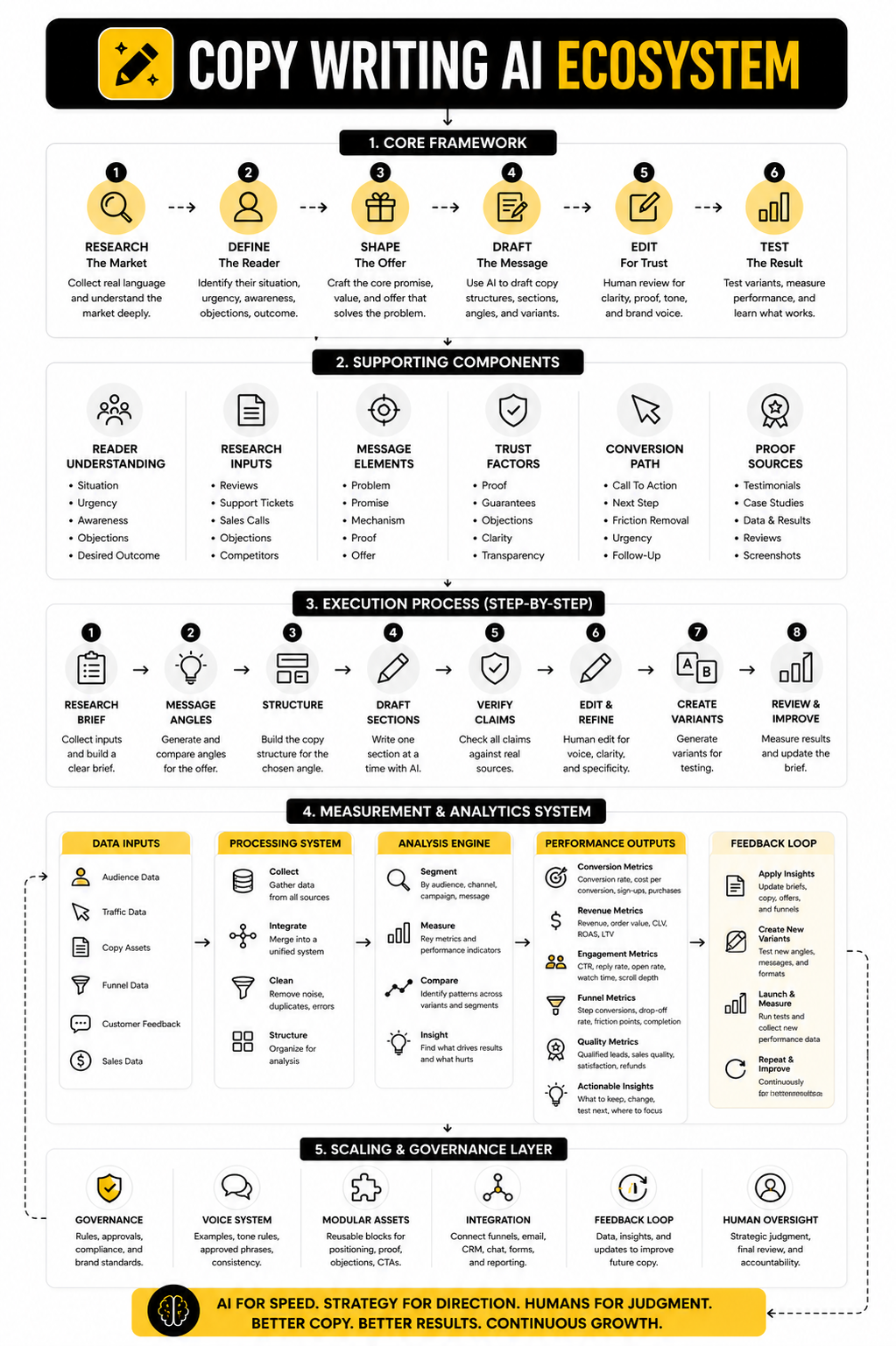
This is where AI becomes genuinely useful for marketers. It helps you generate options, spot gaps, adapt messages across channels, and learn faster from results. But the standard stays the same: clear offer, real proof, useful content, clean measurement, and human judgment.
FAQ - Built For Complete Guide
What Is Copy Writing AI?
Copy writing AI is the use of artificial intelligence to support marketing copy tasks such as research, outlining, drafting, rewriting, testing, and optimization. It can help create emails, landing pages, ads, product descriptions, chatbot flows, and social posts. The best use is not replacing strategy, but speeding up the work around a clear brief.
Is Copy Writing AI Good For SEO?
Copy writing AI can support SEO when the content is useful, accurate, original, and written for real readers. Google’s guidance focuses on helpful, reliable, people-first content rather than whether AI was involved in the writing process Google Search Central. The risk comes from publishing generic, low-value content at scale without adding expertise, proof, or genuine usefulness.
Can AI Replace A Professional Copywriter?
AI can replace some low-level drafting tasks, but it does not replace strong positioning, customer insight, offer strategy, or final editorial judgment. A professional copywriter knows what to remove, what to challenge, and what the buyer needs to believe before taking action. AI is powerful, but it still needs a skilled operator.
What Is The Best Way To Start Using Copy Writing AI?
Start with research and briefs, not full drafts. Give the AI customer pain points, audience details, offer notes, proof, objections, and tone rules before asking for copy. That one change usually improves the quality of the output immediately.
What Copy Assets Can AI Help With?
AI can help with landing pages, emails, ads, social posts, product descriptions, lead magnets, sales scripts, chatbot flows, onboarding messages, and follow-up sequences. It is especially useful for generating variants and adapting one strong message across multiple formats. Tools like GoHighLevel, ClickFunnels, and Systeme.io can help turn those assets into live funnels and campaigns.
How Do You Avoid Generic AI Copy?
Generic AI copy usually comes from generic prompts. Use real customer language, specific positioning, clear proof, brand voice examples, and firm editing rules. Then ask AI to write one section at a time instead of producing the entire asset in one pass.
Should AI Copy Be Disclosed?
Disclosure depends on the context, the platform, and the nature of the content. The safer rule is to be transparent when AI materially affects customer-facing experiences, recommendations, claims, or interactions. The FTC has made clear that there is no AI exemption from consumer protection rules, especially when claims are deceptive or unsupported FTC.
How Do You Measure AI Copy Performance?
Measure the action the copy was designed to create. For a landing page, track clicks, form starts, qualified conversions, and revenue. For email, track clicks, replies, purchases, booked calls, and downstream customer quality instead of relying only on opens.
What Is The Biggest Risk Of Using Copy Writing AI?
The biggest risk is publishing more copy without improving the thinking behind it. AI makes volume easy, but volume can damage trust if the content is vague, repetitive, inaccurate, or overhyped. Strong teams use AI to improve clarity and testing speed, not to flood every channel with average content.
How Often Should AI-Assisted Copy Be Updated?
Update AI-assisted copy when performance data shows a drop, when the offer changes, when customer objections shift, or when new proof becomes available. High-traffic landing pages and key email sequences should be reviewed more often than low-volume assets. The practical move is to keep improving the brief so each new draft starts smarter than the last one.
What Tools Fit Into A Copy Writing AI Workflow?
The right tools depend on the workflow. Brevo and Moosend fit email campaigns, ManyChat fits conversational marketing, Buffer fits social distribution, and Replo fits ecommerce landing pages. The tool matters less than the system connecting research, copy, publishing, and measurement.
What Should A Human Always Review Before Publishing?
A human should always review claims, statistics, pricing, guarantees, testimonials, legal-sensitive language, competitor comparisons, and anything that could mislead the reader. Human review should also check tone, clarity, offer fit, and whether the copy sounds like the brand. AI can draft quickly, but publishing is still a human responsibility.
Work With Professionals
Explore 10K+ Remote Marketing Contracts on MarkeWork.com
Most marketers spend too much time chasing clients, competing on crowded platforms, and losing a percentage of every project to middlemen.
MarkeWork gives you a better way. Browse thousands of remote marketing contracts and connect directly with companies desperate to hire skilled marketers like you, without platform commissions and without unnecessary gatekeepers.
If you're serious about finding better opportunities and keeping 100% of what you earn, explore available contracts and create a profile for free at MarkeWork.com.