

Good copy is not about sounding clever. It is about helping the right person understand why your offer matters, why now, and why you are the safe choice.
That is why copywriting help should not start with wordsmithing. It should start with strategy: the audience, the offer, the promise, the proof, the objections, and the action you want the reader to take.
Clear writing has business value because people trust brands that communicate simply, and plain language improves credibility, transparency, and loyalty. At the same time, buyers expect relevance; 71% of consumers expect personalized interactions, and 76% feel frustrated when they do not get them. So the job is not just to write better sentences. The job is to make every message feel clear, useful, and specific.
Article Outline
- Why Copywriting Help Matters More Than Ever
- The Copywriting Help Framework
- Core Components of High-Performing Copy
- Professional Implementation Across Channels
- Tools, Workflows, and Optimization
- FAQs and Final Copywriting Checklist
Why Copywriting Help Matters More Than Ever
Most weak copy fails before the reader reaches the offer. It talks about the company too early, uses vague benefits, and assumes the audience will connect the dots on their own. They usually will not.
Strong copy does the opposite. It meets the reader where they are, names the problem in language they already use, and makes the next step feel obvious. That matters even more now because businesses are publishing more content, more ads, more emails, and more AI-assisted campaigns than ever.
The pressure is not just volume. The real pressure is differentiation. In B2B content marketing, 61% of marketers expected higher investment in video, 52% in thought leadership, and 39% in AI for content creation in 2025. More content means more noise, and more noise makes clear copy a competitive advantage.
The Copywriting Help Framework
Copywriting help becomes much easier when you stop treating every page, email, or ad as a blank screen. A reliable framework gives you a repeatable way to diagnose what is missing and improve the message without guessing. It also keeps the work practical, which is exactly what you need when copy has to support real sales goals.
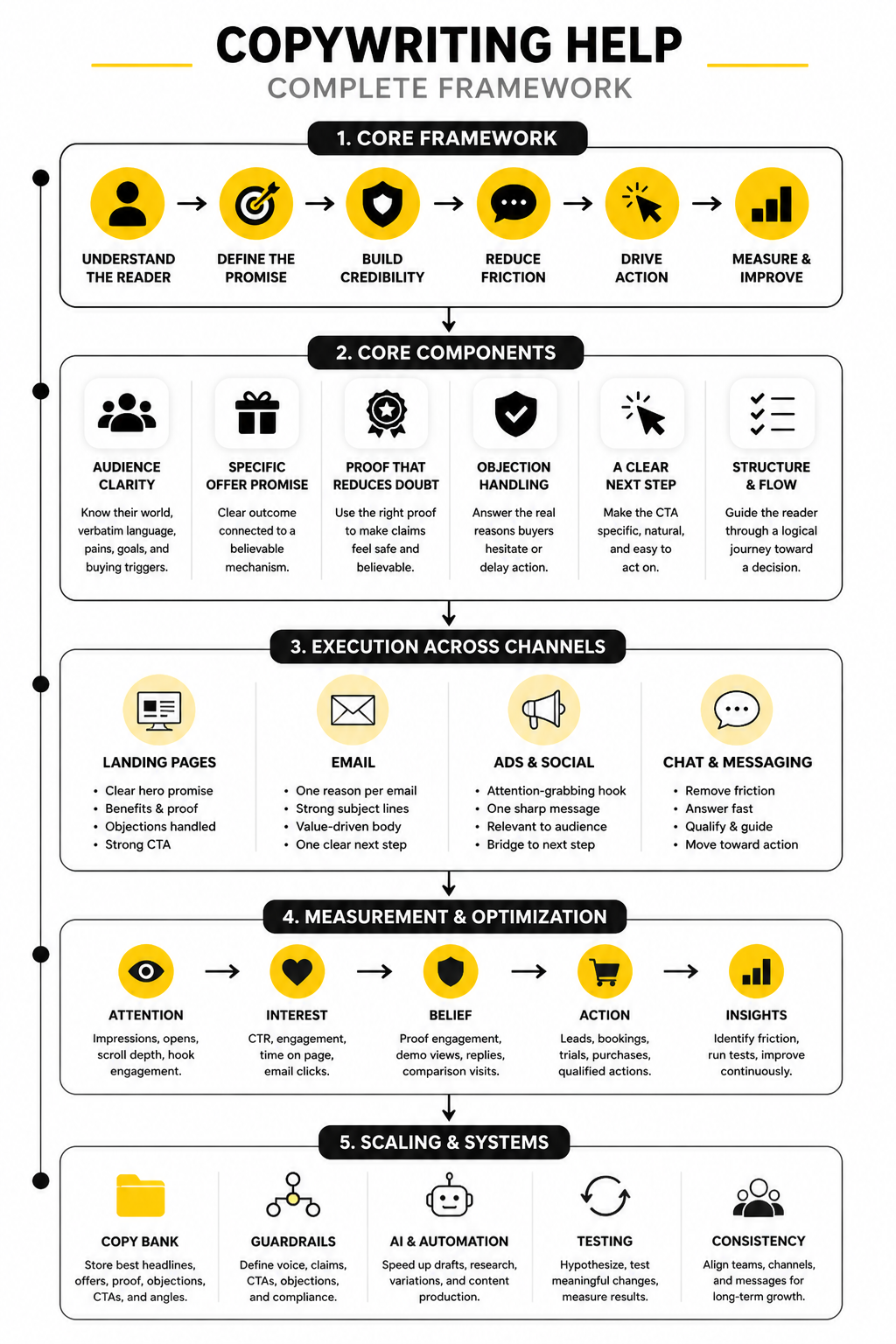
The framework this article will use is simple: audience, offer, message, proof, friction, and action. Each part has a job. If one part is weak, the copy may still sound polished, but it will not persuade as well as it should.
This is also where tools can help, as long as they support the strategy instead of replacing it. For example, automation platforms like GoHighLevel, funnel builders like ClickFunnels, and messaging tools like ManyChat can distribute and test the copy. But the message still has to be built on real customer insight.
Core Components of High-Performing Copy
The framework only works when the pieces underneath it are clear. Copywriting help is useful because it forces you to slow down and ask better questions before writing the final line. That is where most conversion problems are solved.
The strongest copy usually does not come from “better wording” alone. It comes from sharper decisions about who the message is for, what they already believe, what they need to understand, and what would make them feel safe enough to act. Once those decisions are made, the writing becomes much easier.
Audience Clarity
Audience clarity means knowing more than demographics. Age, job title, company size, and income can help, but they rarely explain why someone hesitates, compares, delays, or buys. For copy to work, you need to understand the buyer’s situation in their own words.
This is why voice-of-customer research matters. Reviews, sales calls, support tickets, survey answers, social comments, and CRM notes can show you the exact phrases people use when they describe their pain. That language is often stronger than anything created in a brainstorming session.
Good audience research also prevents the biggest copy mistake: writing for yourself. You may care about the feature set, the backend, the founder story, or the clever positioning. The reader cares about what changes for them.
A Specific Offer Promise
A vague offer creates vague copy. If the promise is unclear, the headline becomes generic, the bullets become fluffy, and the call to action feels weak. Before improving the words, improve the promise.
A strong promise connects the desired outcome with a believable mechanism. It should make the reader think, “That is exactly what I want, and I understand how this helps me get there.” That second part matters because unsupported hype creates resistance.
For example, a landing page builder like Replo is easier to position when the copy explains the practical outcome: building conversion-focused ecommerce pages without waiting on a full development cycle. A funnel platform like ClickFunnels becomes clearer when the copy focuses on turning traffic into a guided buying path. The tool is not the message. The outcome is.
Proof That Reduces Doubt
Proof is not decoration. It is what makes a claim feel safe. Without proof, even a good promise can sound like another marketing statement.
The best proof depends on the offer. For some businesses, it is customer reviews, case studies, demos, screenshots, expert credentials, or before-and-after comparisons. For others, it is transparent pricing, a clear guarantee, a strong onboarding process, or visible product documentation.
This is especially important because online buyers are trained to be skeptical. Research on ecommerce product pages shows that many sites still struggle with product-page UX, with 52% of desktop sites, 62% of mobile sites, and 64% of app experiences rated “mediocre or worse”. That is not just a design issue. It is also a copy issue, because unclear details, missing reassurance, and weak comparison information all create friction.
Objection Handling
Every serious buyer has objections. They may not say them out loud, but they are there. Price, timing, complexity, trust, risk, effort, switching cost, and internal approval can all stop a conversion.
Good copy does not pretend those objections do not exist. It answers them calmly before they become deal-breakers. That might mean explaining setup time, showing who the product is best for, clarifying what is included, or making the next step feel low-risk.
This is where copywriting help often creates quick wins. Many pages already have a decent headline and basic benefits, but they skip the questions a buyer needs answered before taking action. Add those answers, and the same traffic can become much more valuable.
A Clear Next Step
The call to action should not feel like a jump. It should feel like the next logical move after the reader understands the value, believes the claim, and feels their concerns have been addressed. If the CTA appears too early or asks for too much, it creates pressure instead of momentum.
A good CTA is specific. “Get started” can work, but only when the context is obvious. In many cases, “Book a demo,” “Create your first funnel,” “Start your free trial,” or “See how it works” gives the reader more confidence because they know what will happen next.
This is also why the surrounding copy matters. A button cannot carry the whole page. The paragraphs before it must create enough clarity and trust that clicking feels easy.
Professional Implementation Across Channels
Once the core message is clear, implementation becomes the real test. Copy can look strong in a document and still fall apart when it reaches a landing page, email sequence, ad, chatbot flow, or sales follow-up. That is why copywriting help should always include the channel where the message will actually live.
Each channel has its own job. A landing page needs to create confidence quickly. An email sequence needs to build momentum over time. An ad needs to earn attention in a crowded feed. A chatbot needs to remove friction without sounding like a wall of canned responses.
The goal is not to copy and paste the same message everywhere. The goal is to keep the same strategic promise while adapting the angle, depth, proof, and call to action for the moment the reader is in.
Start With the Conversion Goal
Before writing, define the action that matters. This sounds obvious, but it is where many projects get messy. If the goal is unclear, the copy starts chasing multiple outcomes at once.
A product page should not read like a brand manifesto. A cold email should not try to explain every feature. A webinar registration page should not bury the topic under company history. One page, one email, or one message can support a bigger journey, but it still needs one primary job.
This is also how you avoid bloated copy. When you know the conversion goal, you can remove anything that does not help the reader move toward it. That single decision makes the writing sharper immediately.
Map the Reader’s Stage
People do not arrive with the same level of awareness. Some readers know they have a problem but have not compared solutions yet. Others are already shopping and need help choosing. Some only need reassurance before they click.
That difference changes the copy. Early-stage readers need education, context, and problem clarity. Late-stage readers need proof, specificity, comparison, risk reversal, and a clear next step.
This is where segmentation matters. Email and CRM platforms are useful because they let you send more relevant messages based on behavior, interest, or stage, and benchmark research continues to show how central segmentation and personalization are to modern email performance in 2025 email marketing analysis. The copy should feel like it belongs to the reader’s current decision, not like a generic broadcast.
Build the Copy Asset Step by Step
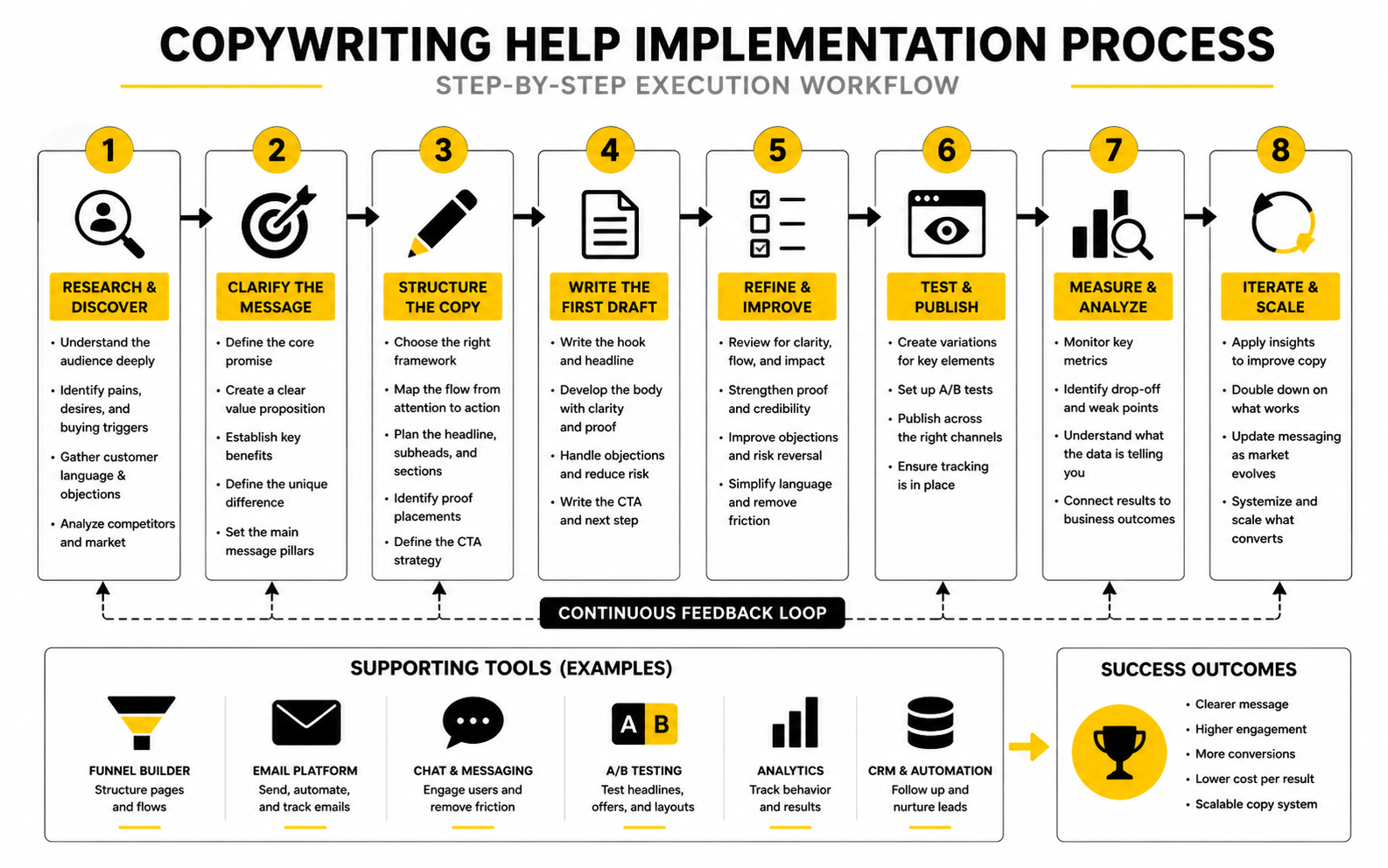
A practical implementation process keeps the work clean. You do not need a complicated system, but you do need a sequence that prevents random edits and last-minute guessing. The best copy usually comes from disciplined order, not creative chaos.
Use this process when you want copywriting help that leads to usable assets:
- Define the audience and buying situation.
- Write the primary promise in one sentence.
- List the strongest reasons to believe the promise.
- Identify the top objections that could stop action.
- Choose the primary call to action.
- Draft the page, email, ad, or script around that structure.
- Cut anything that does not support the conversion goal.
- Review for clarity, credibility, and flow.
- Test the asset against real behavior, not personal opinion.
This process works because it separates thinking from polishing. First you decide what must be said. Then you decide how to say it. Mixing those two too early is how copy gets slow, vague, and over-edited.
Adapt the Message for Landing Pages
Landing page copy has to make the value obvious fast. The reader should quickly understand what the offer is, who it is for, why it matters, and what to do next. If they have to work too hard, they leave.
The top of the page needs the clearest version of the promise. After that, the page should build belief with specific benefits, proof, objection handling, and a low-friction CTA. Design matters, but design cannot rescue a confusing message.
For ecommerce and funnel pages, clarity becomes even more important because checkout friction is expensive. Baymard’s long-running checkout research shows an average cart abandonment rate around 70% across documented studies, which means small moments of confusion can cost real revenue. Copy should reduce that uncertainty wherever the reader is close to buying.
Adapt the Message for Email
Email copy works best when each message has one reason to exist. A welcome email should not do the job of a sales page. A nurture email should not pretend to be a receipt. A cart recovery email should not sound like a random newsletter.
The subject line earns the open, but the body earns the click. Keep the message focused, make the value easy to understand, and give the reader one clear next step. If the email needs three different CTAs, it probably needs to be split into multiple emails.
Tools like Brevo, Moosend, and GoHighLevel can help manage lists, automation, and follow-up. But the platform is only the delivery layer. The copy still has to earn attention and make the click feel worthwhile.
Adapt the Message for Ads and Social
Ad copy has less room to explain, so the angle matters more. You need a hook that connects with a real desire, problem, belief, or moment of frustration. Generic attention-grabbing is not enough.
A strong ad usually makes one sharp point. It might challenge a false belief, highlight a painful problem, introduce a useful mechanism, or present a clear outcome. The job is not to close the whole sale inside the ad. The job is to create enough qualified interest for the next step.
Social content works similarly, but it often needs more consistency. A single post may not convert immediately, yet repeated useful messages can build trust before the reader ever reaches a sales page. Scheduling tools like Buffer and content planning tools like Flick Social can support that rhythm when the strategy is already clear.
Statistics and Data
Measurement is where copywriting help becomes accountable. Without data, copy decisions usually turn into opinions, and opinions are expensive when traffic, ad spend, and sales opportunities are involved. The point is not to worship numbers. The point is to understand what the numbers are trying to tell you.
The best copy metrics are not isolated. A high open rate with a weak click rate tells a different story than a low open rate with a strong conversion rate. A landing page with good traffic and poor form submissions does not automatically need a new design. It may need a clearer promise, stronger proof, better objection handling, or a more realistic call to action.
What to Measure First
Start with the metric closest to the business outcome. For a sales page, that might be purchases, booked calls, trial starts, or qualified leads. For email, it might be clicks, replies, sales, demo requests, or pipeline created. For ads, it might be cost per qualified action, not just click-through rate.
This matters because surface metrics can lie. More clicks are not always better if the copy attracts the wrong people. A longer time on page is not always better if readers are confused. A lower bounce rate is not always better if the page gets more unqualified traffic.
Use benchmarks as context, not as a verdict. For example, recent email benchmark data shows average click rates around 2.09% in 2025, while DMA’s 2025 email report found unique click rates reaching 2.3%. Those numbers are useful, but your real question is sharper: are the right people taking the right action at the right stage?
Build a Simple Measurement System
A practical measurement system should show where attention drops, where belief weakens, and where action fails. You do not need a dashboard with fifty widgets. You need a clean view of the reader’s path from first impression to conversion.
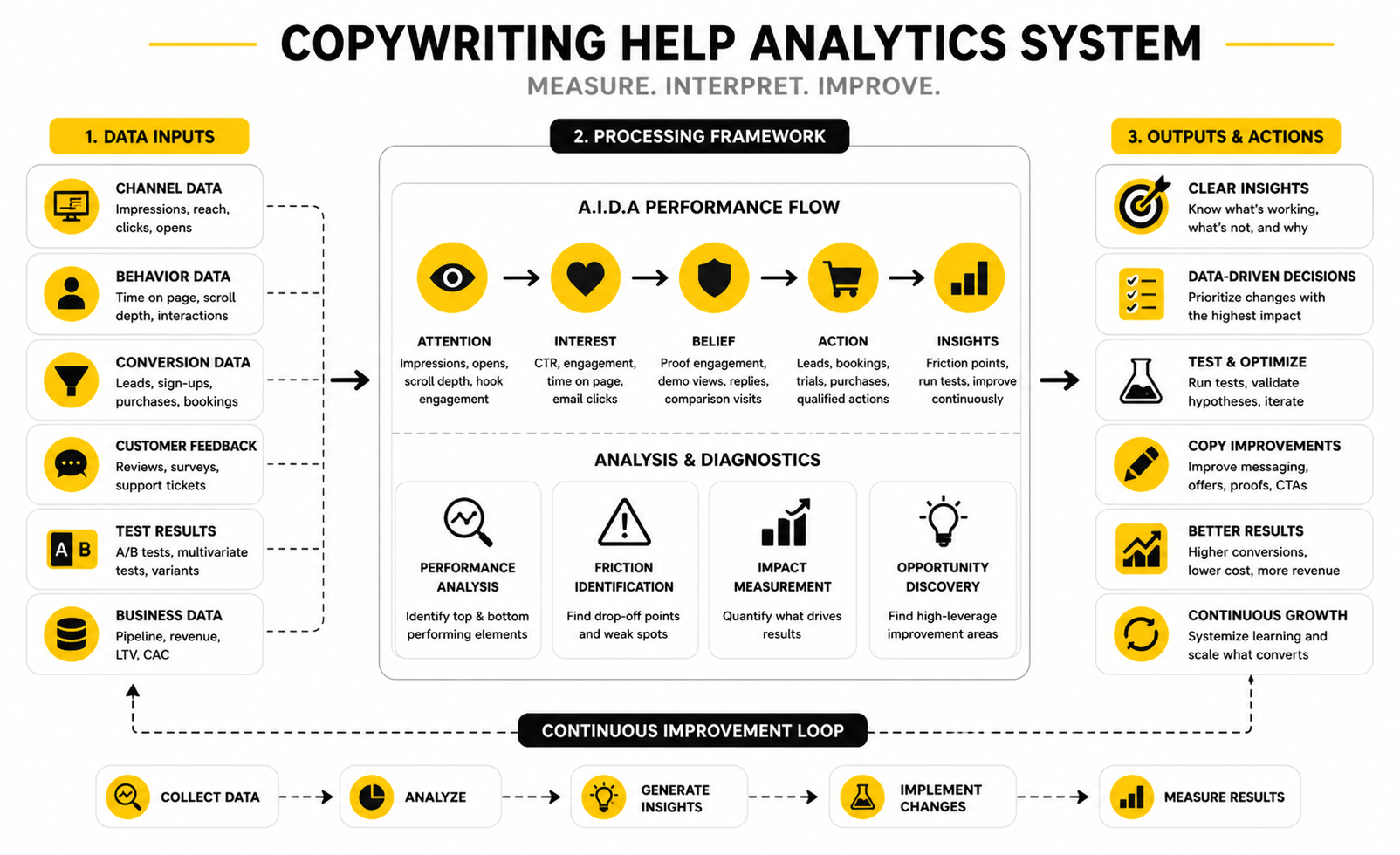
Track the journey in layers:
- Attention: impressions, opens, scroll depth, hook performance, and first-screen engagement.
- Interest: click-through rate, time on key sections, replies, product-page movement, and content engagement.
- Belief: proof-section engagement, demo views, comparison-page visits, testimonial interaction, and objection-related clicks.
- Action: form completions, checkout starts, bookings, purchases, trial starts, and sales-qualified leads.
- Friction: abandonments, rage clicks, drop-off points, unanswered questions, support tickets, and failed form submissions.
This structure keeps analysis practical. If attention is weak, improve the hook, subject line, headline, or opening promise. If belief is weak, improve proof, specificity, and risk reduction. If action is weak, simplify the CTA, reduce friction, and make the next step easier to understand.
Read Conversion Rates Carefully
Conversion rate is one of the most useful metrics, but it is also one of the easiest to misread. A 3% conversion rate can be excellent in one market and weak in another. It depends on the offer, price, traffic source, buying intent, device, audience temperature, and what counts as a conversion.
For landing pages, broad averages can hide huge differences. Unbounce’s B2B conversion benchmark analysis of 41,000 landing pages reported a median conversion rate of 6.6%, but that does not mean every B2B page should hit that number. A free checklist, a high-ticket demo request, and an enterprise consultation are not the same conversion.
For ecommerce, the same logic applies. Public benchmark summaries often place average ecommerce conversion rates in the low single digits, while cart abandonment research from Baymard shows the average documented online cart abandonment rate is about 70.22%. That tells you something important: the closer someone gets to buying, the more expensive copy and UX friction become.
Diagnose the Copy Problem Behind the Metric
Every metric should lead to a copy question. If an email gets opened but does not get clicks, the subject line may be doing its job while the body fails to create urgency or relevance. If a landing page gets clicks on the CTA but few completed forms, the form step may be creating risk, confusion, or too much effort.
If paid ads get cheap clicks but poor conversions, the copy may be overpromising or attracting curiosity instead of intent. If a product page has traffic but low add-to-cart behavior, the value, fit, proof, or comparison details may not be clear enough. If checkout abandonment is high, the issue may be shipping clarity, trust, payment options, return policy, or surprise costs.
This is why copywriting help should include diagnosis before rewriting. Otherwise, you may rewrite a headline when the real problem is the offer. Or you may change the CTA when the real problem is lack of proof. Data keeps you honest.
Use Testing Without Guessing
Testing is not about randomly changing button colors and hoping for magic. Test meaningful copy variables that connect to buyer psychology. The highest-value tests usually involve the promise, audience angle, proof, objection handling, offer structure, CTA language, or page sequence.
A good test starts with a hypothesis. For example, if visitors reach the pricing section but do not convert, the hypothesis might be that the copy has not justified the value before showing the cost. A better test would compare stronger value framing, clearer plan differences, or more relevant proof near the pricing block.
Tools can help manage this process, but they cannot decide what matters. A funnel platform like ClickFunnels, an all-in-one CRM like GoHighLevel, or a landing page workflow like Replo can make testing easier to launch. The real advantage still comes from testing sharper messages, not just swapping surface-level elements.
Turn Data Into Better Decisions
Data should not make the copy colder. It should make it more relevant. When you see where people stop, hesitate, click, reply, or abandon, you get a clearer picture of what they need next.
The best next action is usually specific. Rewrite the opening if attention is weak. Add proof if belief is weak. Clarify pricing if risk is high. Shorten the path if action is too hard. Improve segmentation if the message is attracting the wrong audience.
That is the practical value of measurement. It turns copywriting from “I like this version better” into “this version answers the buyer’s question better.” And that is exactly where better performance starts.
Tools, Workflows, and Optimization
Advanced copywriting help is not just about writing better assets. It is about building a system that keeps the message sharp as campaigns scale. The bigger the business gets, the easier it becomes for copy to drift, duplicate, contradict itself, or lose the original customer insight.
That is why the workflow matters. You need a way to capture what customers are saying, turn that insight into copy, publish it across channels, measure what happens, and update the message without starting from scratch every time. Simple systems win here because complex systems are usually ignored.
Build a Copy Bank Before You Scale
A copy bank is a practical library of usable message assets. It can include customer phrases, objections, proof points, guarantees, headlines, CTA variations, email angles, ad hooks, product descriptions, and positioning notes. This gives your team a shared source of truth instead of making every campaign depend on memory.
The point is not to create a dusty document nobody opens. The point is to organize copy around real buying moments. When someone needs a cart recovery email, they should be able to find the strongest objection-handling language. When someone needs a new landing page hero section, they should be able to find the clearest promise and the most relevant proof.
This is where AI can help, but only if the inputs are good. AI can organize research, generate variations, summarize reviews, and speed up first drafts. It should not invent claims, exaggerate outcomes, or replace strategic judgment.
Use AI Without Making the Copy Feel Generic
AI has made content production faster, but speed creates a new problem: sameness. When everyone uses similar prompts, templates, and tools, the output starts to sound polished but interchangeable. That is dangerous because conversion depends on specificity.
The fix is not to avoid AI. The fix is to feed it better context and edit harder. Use customer language, product details, objections, sales-call notes, positioning rules, brand voice examples, and performance data. Then treat the output as a draft, not the finished asset.
This matters because consumer trust is fragile around machine-made marketing. Research on AI-generated marketing content points to a “trust penalty” when people sense content was created by an algorithm, even when the content is technically polished, as shown in studies on consumer attitudes toward AI-generated marketing content. So the standard is clear: use AI for speed, but keep the copy grounded in human insight.
Keep Claims Tight and Defensible
The more aggressive the promise, the more proof it needs. This is especially true when copy mentions revenue, growth, automation, AI, health, finance, or business opportunity outcomes. Confident copy is good. Unsupported copy is a liability.
Strong copy does not need fake certainty. It can be specific without overpromising. It can explain likely outcomes, common use cases, conditions, limitations, and next steps without weakening the offer.
This is not just a best-practice issue. Advertising and endorsement rules still apply across modern channels, and the FTC’s guidance on advertisement endorsements makes the basic standard clear: marketing claims need to be truthful, clear, and properly supported. If your copy cannot survive a skeptical review, rewrite it before it reaches the market.
Balance Conversion and Brand
Short-term conversion tactics can work, but they can also damage trust if they are overused. False urgency, vague discounts, exaggerated scarcity, and manipulative countdowns may lift clicks temporarily while making the brand feel less credible. That tradeoff is rarely worth it.
Good conversion copy is not pushy for the sake of being pushy. It is clear, relevant, and persuasive because it helps the reader make a better decision. The tone can still be direct. It can still sell. It just should not make the reader feel tricked.
Brand copy and performance copy should not be enemies. Brand gives the message consistency and trust. Performance gives the message discipline and accountability. The best copywriting help brings both together instead of treating them like separate worlds.
Create Channel-Specific Guardrails
As teams scale, copy quality usually breaks at the handoff points. The strategist writes one thing, the media buyer edits another, the email marketer adapts it again, and the sales team uses a completely different version. Suddenly the campaign is not one message. It is six disconnected interpretations.
Guardrails prevent that. They tell everyone what the offer promise is, what claims are approved, what words to avoid, what proof can be used, what objections matter most, and what CTA language fits each stage. This keeps the copy flexible without letting it become chaotic.
A simple guardrail document can include:
- The primary audience and buying situation
- The core promise in one sentence
- Approved proof points and claims
- Top objections and approved responses
- Voice rules and banned phrases
- CTA options by funnel stage
- Compliance notes for sensitive claims
- Examples of strong and weak copy
This is especially useful when tools are involved. A CRM like GoHighLevel, a funnel builder like ClickFunnels, or an email platform like Brevo can move messages fast. Guardrails make sure the speed does not turn into inconsistency.
Know When to Rewrite and When to Reposition
Not every copy problem is a copy problem. Sometimes the offer is confusing. Sometimes the audience is too broad. Sometimes the pricing model creates hesitation. Sometimes the product is being sold to people who do not feel the pain strongly enough.
This is where expert copywriting help becomes more strategic. A rewrite can improve clarity, but repositioning may be needed when the message is aimed at the wrong buyer or built around the wrong value. Better words cannot fix a weak strategic foundation.
Before rewriting everything, ask what the data and customer feedback are really saying. If people understand the offer but do not believe it, strengthen proof. If they believe it but do not act, reduce friction. If they do not care, the positioning needs work. That distinction saves time, budget, and a lot of unnecessary editing.
Final Copywriting Checklist
Before the FAQ, it is worth pulling the whole system together. Good copy is not one headline, one framework, one tool, or one clever phrase. It is the connection between research, positioning, writing, publishing, measurement, and improvement.
That is why copywriting help works best when it looks at the full ecosystem. The copy should match the audience, the offer, the channel, the data, and the trust standard of the market. When those pieces line up, the message feels simple from the outside because the strategy is solid underneath.
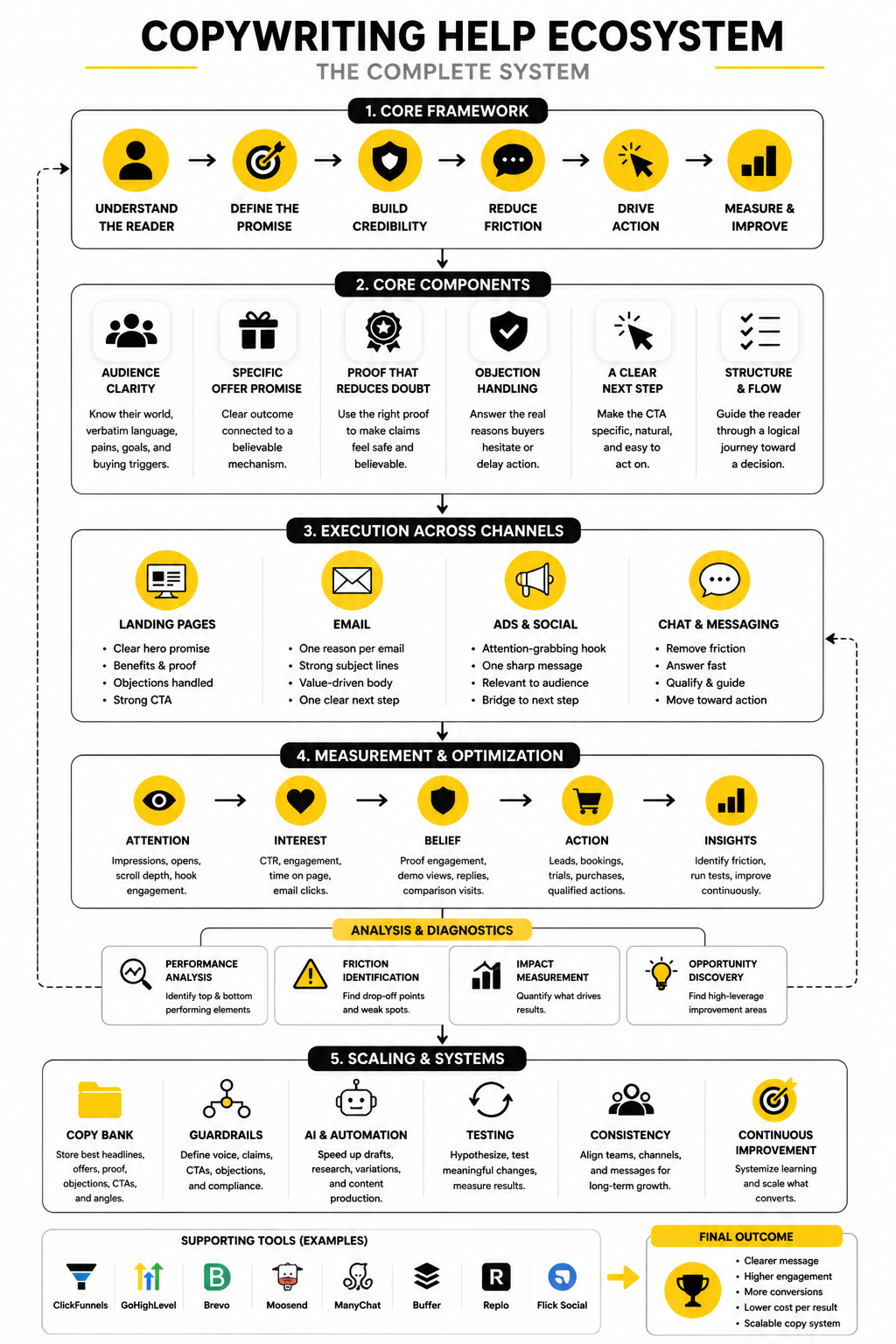
Use this checklist before publishing important copy:
- The audience is clearly defined.
- The promise is specific and believable.
- The offer is easy to understand.
- The strongest proof appears before the biggest ask.
- The copy answers the reader’s most likely objections.
- The call to action is clear and natural.
- The message fits the channel and buyer stage.
- The claims are accurate, supported, and not exaggerated.
- The copy sounds human, not generic or over-automated.
- The performance metrics are connected to a real business outcome.
This is the part many people skip. They write, publish, and hope. Professionals write, publish, measure, learn, and improve.
FAQ - Built for Complete Guide
What is copywriting help?
Copywriting help is support with improving the words, structure, strategy, and persuasion behind marketing assets. It can involve landing pages, emails, ads, product pages, sales pages, scripts, funnels, and follow-up messages. The best copywriting help does not just make copy sound better; it makes the message clearer, more believable, and easier to act on.
When should a business get copywriting help?
A business should get copywriting help when traffic is coming in but conversions are weak, when campaigns are unclear, or when the offer is hard to explain. It is also useful before launching a new product, funnel, email sequence, or sales page. The earlier you fix the message, the less money you waste sending people to copy that does not persuade.
Is copywriting only about writing headlines?
No, headlines matter, but they are only one part of the job. Copywriting also includes audience research, positioning, proof, offer clarity, objection handling, CTA structure, and testing. A great headline can attract attention, but the rest of the copy has to build enough trust for action.
What makes copy high-converting?
High-converting copy is clear, specific, relevant, credible, and action-focused. It shows the reader that you understand their situation and gives them a believable reason to take the next step. It also removes friction instead of creating more questions.
How do I know if my copy is the problem?
Look at where people drop off. If ads get clicks but the page does not convert, the page message may be weak. If emails get opened but nobody clicks, the body copy may not build enough interest. If people reach checkout but abandon, the issue may be risk, clarity, or friction near the buying decision.
Can AI replace a copywriter?
AI can help with drafts, variations, research organization, summaries, and editing. It should not replace strategy, customer insight, compliance judgment, or final human review. AI is useful when it speeds up the process, but risky when it creates generic claims that sound polished without being grounded.
What should I prepare before asking for copywriting help?
Prepare your offer details, target audience, customer research, current copy, analytics, objections, testimonials, competitor context, and the conversion goal. The more real information you bring, the better the copy will be. Good copy depends on good inputs.
How long should sales copy be?
Sales copy should be as long as needed to create clarity, trust, and action. A simple low-cost offer may need less explanation. A complex, expensive, or high-risk offer usually needs more proof, more objection handling, and more context.
What is the biggest copywriting mistake?
The biggest mistake is writing from the company’s perspective instead of the buyer’s perspective. Businesses often lead with features, internal language, or clever phrasing. Buyers want to understand what changes for them, why it matters, and why they should believe you.
How often should copy be updated?
Copy should be reviewed whenever the offer changes, the audience changes, the market shifts, or performance drops. It should also be updated when customer feedback reveals new objections, better language, or stronger proof. Do not rewrite everything constantly, but do not let important copy go stale.
What tools help with copywriting implementation?
The right tools depend on the channel. GoHighLevel can support CRM, funnels, automations, and follow-up. ClickFunnels can help build sales funnels. Brevo and Moosend can support email campaigns, while ManyChat can help with conversational marketing flows.
Should every business use the same copywriting framework?
No. Frameworks are useful, but they should not make every message sound the same. A local service business, SaaS company, ecommerce brand, agency, and creator offer all need different levels of proof, urgency, detail, and trust-building. Use frameworks to think clearly, then adapt them to the buyer and offer.
Work With Professionals
Explore 10K+ Remote Marketing Contracts on MarkeWork.com
Most marketers spend too much time chasing clients, competing on crowded platforms, and losing a percentage of every project to middlemen.
MarkeWork gives you a better way. Browse thousands of remote marketing contracts and connect directly with companies desperate to hire skilled marketers like you, without platform commissions and without unnecessary gatekeepers.
If you're serious about finding better opportunities and keeping 100% of what you earn, explore available contracts and create a profile for free at MarkeWork.com.