

Copywriting is one of those skills people often underestimate until revenue starts depending on it. The words on a landing page, pricing page, sales email, product description, ad, checkout flow, or onboarding sequence do not just fill space. They shape attention, trust, and action.
That matters even more now because media is expensive, channels are crowded, and buyers are doing more homework before they ever talk to sales. IAB’s latest digital video ad spend report shows investment is still climbing in high-performance digital channels, while HubSpot’s 2026 marketing data keeps website, blog, and search content near the top of the ROI conversation. In plain English, distribution still matters, but the message inside the asset matters just as much.
Copywriting has also become harder to fake. Google’s own people-first content guidance is explicit about rewarding helpful, reliable content built for humans, not manipulation. The FTC has also tightened the ground rules with its Consumer Reviews and Testimonials Rule Q&A, which makes deceptive proof and fake social validation a far riskier game. Good copy now has to be clear, useful, credible, and honest at the same time.
AI changes the workflow, but it does not remove the need for copywriting. HubSpot’s 2026 State of Marketing describes AI as baseline rather than differentiator, and Salesforce’s tenth State of Marketing makes the same pressure visible from another angle: teams want more personalized content than they can realistically produce. So the real advantage is not pumping out more words. It is knowing which words matter, where they belong, and how to support them with proof.
That is why this article takes a practical route. We are not going to treat copywriting as a bag of clever tricks or headline formulas ripped out of context. We are going to look at how strong copy works across the full customer journey, and how to put it into production with tools like HighLevel, Brevo, and Manychat when the message is ready to go live.
Article Outline
This guide is built as one continuous article, but the structure is intentional because copywriting breaks when the sequence is wrong. First we will establish why copy still matters, then we will simplify the framework, then we will break down the parts that make copy persuasive, usable, and believable. After that, we will move into channel-specific execution, professional workflow, and the common mistakes that quietly kill performance.

- Why Copywriting Still Matters
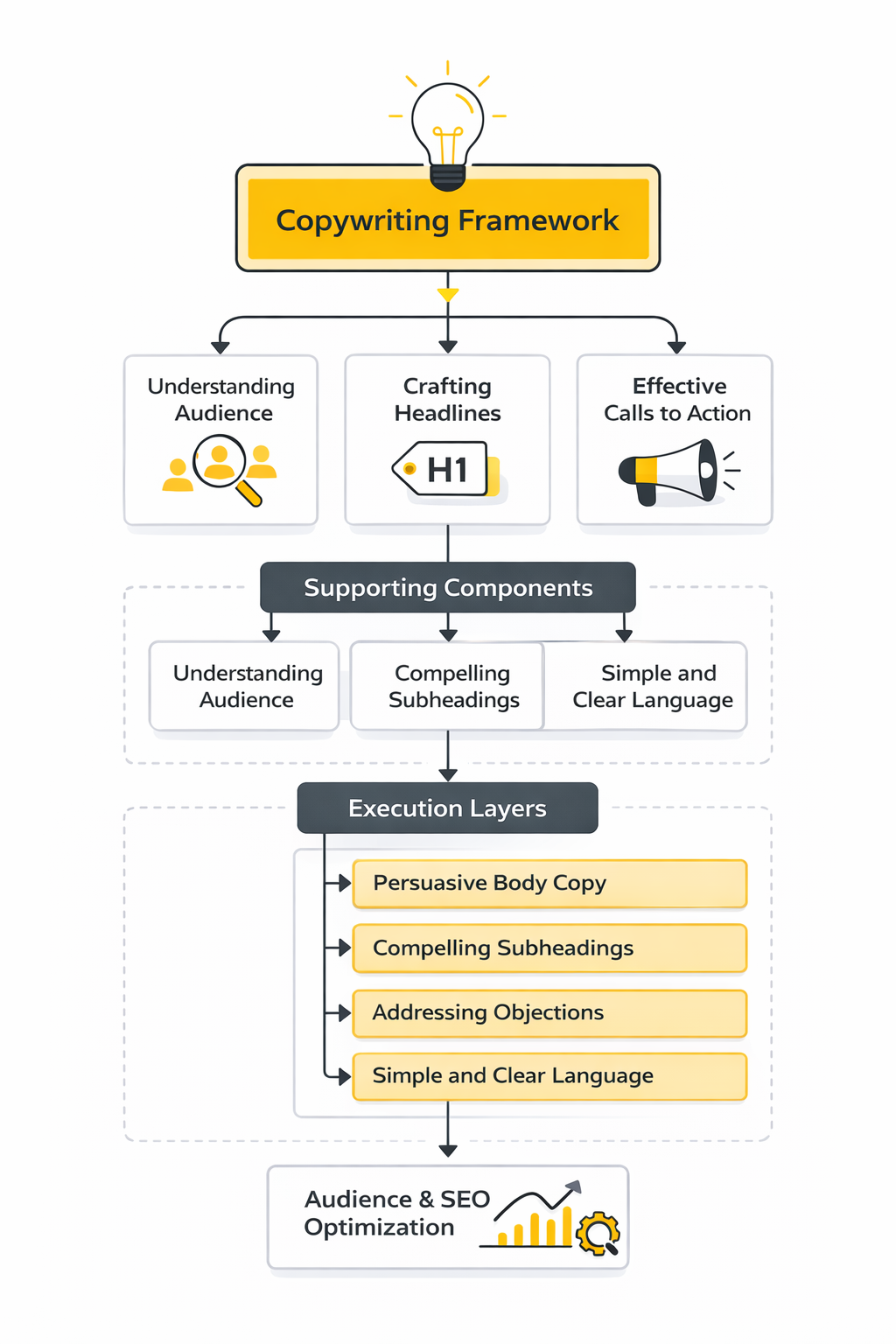
- The Copywriting Framework That Keeps Messages Clear
- Core Components of High-Performing Copy
- Matching Copy to Funnel Stage and Channel
- Professional Implementation: Research, Drafting, and Testing
- Common Mistakes, Better Tools, and FAQ
The logic underneath the article is simple. Strong copy starts with the reader, sharpens the promise, backs it with proof, removes friction, and ends with one clear next step. That sounds obvious, but most weak copy fails because one of those pieces is missing, vague, or out of order.
Why Copywriting Still Matters
Copywriting matters because it is the part of marketing that turns attention into movement. A campaign can buy impressions, a page can look polished, and a product can be genuinely strong, but none of that guarantees action if the message is vague, generic, or hard to trust. That is one reason website, blog, and SEO work still rank as the top ROI-generating channel in HubSpot’s latest marketing data, while digital video ad spend continues to expand faster than total media in IAB’s 2025 report: distribution gets you seen, but copy is what helps people decide.
The bigger shift is that people have become harder to impress and easier to lose. Google’s people-first content guidance pushes brands toward genuinely useful content, while the FTC’s consumer reviews and testimonials rule guidance makes fake proof and deceptive claims a much riskier move than they used to be. In a market where Edelman’s 2025 Trust Barometer shows trust is still under pressure, good copy is no longer about sounding persuasive. It is about being clear, useful, and believable fast.
Copy shapes attention before design can help
People do not politely read every word you publish. Nielsen Norman Group’s research on how people read online and its guidance on homepage clarity make the same point from two angles: users scan first, judge fast, and decide whether to continue in seconds. That means copywriting is not decoration layered on top of design. It is the thing that tells the visitor where they are, what this page is about, and whether it is worth another ten seconds of their attention.
This is where weak copy quietly kills performance. Vague headlines, clever but empty taglines, and generic hero sections force the reader to do interpretive work that the brand should have done already. Strong copy front-loads meaning, uses specific language, and gives the brain something easy to hold on to.
Copy reduces friction at decision points
A lot of buying intent disappears not because the offer is terrible, but because the wording creates uncertainty at the worst possible moment. Baymard’s checkout research still tracks average cart abandonment at 70.19%, and its 2025 abandonment breakdown shows that extra costs, trust concerns, forced account creation, and complicated checkout flows remain major reasons people leave. Some of those are product and UX issues, of course, but many are also copy issues because labels, reassurance text, pricing explanations, and calls to action shape whether the experience feels safe and obvious.
That is why copywriting extends far beyond ads and landing pages. It includes checkout buttons, plan labels, shipping explanations, form instructions, onboarding messages, and cancellation flows. Every one of those micro-decisions either lowers friction or adds doubt.
Copy is how personalization becomes useful
Personalization sounds advanced until you remember what the customer actually sees. They do not experience your CRM, segmentation logic, or automation map. They experience the message on the page, in the inbox, in the chat flow, or in the follow-up sequence, which is why Salesforce’s tenth State of Marketing says 78% of marketers need more personalized content than they can currently produce.
That gap is exactly where disciplined copywriting becomes valuable. AI can speed up production, but it still needs a strong angle, clear voice, credible proof, and a message matched to intent. If you are putting that system into production, it helps to connect the page build in Replo, the conversational follow-up in Manychat, and the full funnel automation inside HighLevel, but the tool stack only works when the core message is solid.
The Copywriting Framework That Keeps Messages Clear
Most bad copy fails for a predictable reason: it asks for action before it has earned understanding. It jumps straight to the CTA, the feature list, or the hype line without first helping the reader see the problem, understand the promise, and believe the claim. Good copywriting follows a cleaner sequence: know the reader, frame the problem, make the promise, support it with proof, remove friction, and then ask for the next step.
This framework is simple on purpose. It gives structure without turning the work into a robotic formula, which matters because the fastest way to make copy feel fake is to force every page into the same template. What stays constant is not the wording. What stays constant is the order of persuasion.
Start with the reader’s job to be done
The first question is not what you want to say. The first question is what the reader came here to solve, compare, avoid, or achieve. Google Search Essentials explicitly recommends using the words people actually use to look for your content, and Nielsen Norman Group’s guidance on clear, specific link labels points in the same direction: familiar language reduces mental drag.
That sounds basic, but it changes everything. When you write from the reader’s job instead of the brand’s internal language, headlines get clearer, subheads get sharper, and the page becomes easier to navigate. Copywriting starts getting stronger the moment you stop trying to sound impressive and start trying to sound unmistakable.
Clarify the problem without turning into melodrama
Once the reader feels seen, the next job is to define the problem in plain English. Not in bloated pain-point theater, and not in abstract positioning language that could apply to every company in the category. Just clear diagnosis.
This matters because readers are looking for recognition before they look for explanation. They want to know that you understand the messy reality of their decision, whether that is wasted ad spend, weak conversion rates, confusing onboarding, or inconsistent follow-up. The best copy does not overheat the pain. It makes the problem feel precise.
Make one promise, then prove it
A strong promise tells the reader what gets better and why this offer is worth their time. It is not a slogan, and it is not a pile of disconnected benefits fighting for attention. It is a clear value claim that can survive contact with scrutiny.
That scrutiny is getting tougher, which is why proof matters more than polish. The FTC’s review and testimonial guidance raises the cost of fake validation, while Google’s guidance on helpful, reliable content keeps pushing the web toward substance over manipulation. In practice, that means good copywriting pairs the promise with specifics like outcomes, comparisons, transparent explanations, and credible evidence rather than inflated adjectives.
Remove friction before asking for action
This is the part many brands skip, and it is expensive to skip it. A user might want the result you are offering and still hesitate because the next step feels confusing, risky, too long, or oddly worded. Nielsen Norman Group’s work on explicitly stating differences between options is useful here because it shows how easily users misunderstand choices when distinctions are buried or implied.
That applies everywhere: pricing tables, service tiers, demo requests, trial offers, form fields, and checkout buttons. Good copy removes ambiguity before the click, not after the dropout. It tells people what happens next, what is included, what is not, and why this path is the right one for their current stage.
End with a next step that matches intent
The final step is the ask, but the ask only works when it fits the moment. A cold visitor usually does not want a hard close, and a ready buyer usually does not want another vague invitation to “learn more.” The CTA has to match intent, effort, and risk.
That is why strong copywriting treats calls to action as part of the offer, not as an afterthought. If the next best move is a short consultation, make scheduling frictionless with something like Cal.com. If the next step is a lead capture or qualification form, keep it clean and specific with a tool like Fillout. The point is not the software itself. The point is that the message and the mechanism should feel like one uninterrupted decision.
By this stage, the framework should feel less like a writing trick and more like a decision path. That is exactly what it is. In the next part, we will break down the core components that make copy perform on the page, inside the funnel, and across the customer journey.
Core Components of High-Performing Copy
High-performing copywriting is not one clever headline or one punchy CTA. It is a sequence of components that work together in the right order, so the reader understands the offer, believes the claim, and knows what to do next. That structure matters because people scan fast, rely on headings and links to orient themselves, and make early click decisions based on how clearly the page describes what is actually there. Nielsen Norman Group+3
Start With a Headline That Earns the Next Line
The headline is not there to sound smart. It is there to tell the reader what this page is about, why it matters, and whether the next few seconds are worth their attention. Google’s guidance on title links and page titles keeps coming back to the same standard: clear, concise, accurate wording helps people decide whether to click, while NN/g’s homepage research says the value proposition should answer the question, “Why should I choose this site or company over others?” Google for Developers+2
That is why strong copywriting usually opens with a direct promise and then uses the subheading to sharpen the mechanism, audience, or result. A weak headline hides behind cleverness, but a strong one reduces interpretation work. Google’s people-first content guidance also warns against headings that exaggerate or try to shock, which is another reminder that clarity beats drama when the goal is sustained trust. Google for Developers+1
Use Body Copy to Reduce Effort
Once the headline earns attention, the body copy has one real job: make the offer easier to understand. Plain-language guidance from Digital.gov recommends shorter words, short sections, active voice, and present tense, while Google’s style guidance explains that active voice makes it clear who is doing what. In practical terms, that means good copywriting sounds direct, concrete, and easy to follow instead of padded, abstract, or overly formal. Digital.gov+1
This is also where structure quietly does heavy lifting. Descriptive headings help readers navigate, informative link text makes choices clearer, and short sections reduce cognitive drag for both scanners and deeper readers. Google’s accessibility and heading guidance, together with NN/g’s research on link labels, all point in the same direction: the easier the wording is to scan and interpret, the more likely users are to keep moving. Google for Developers+2
Make Proof Do Real Work
Proof is the point where the promise either becomes believable or starts to wobble. Testimonials, examples, comparisons, specific outcomes, guarantees, screenshots, and policy clarity can all strengthen copy, but only when they are real, relevant, and close to the claim they support. That matters even more now because the FTC’s reviews and testimonials rule took effect on October 21, 2024, and specifically targets fake, false, or otherwise deceptive reviews and testimonials. Federal Trade Commission
Good proof is not just decorative social proof dropped into the page because “every landing page needs logos.” It should answer the reader’s next skeptical question with something concrete: what changed, for whom, under what conditions, and how do I know this is not inflated. That approach also fits Google’s people-first guidance, which favors content created to benefit people rather than content designed mainly to manipulate rankings or perception. Google for Developers+1
Treat Microcopy as Conversion Copy
A lot of copywriting wins happen in places teams barely notice. Field labels, button text, helper text, validation messages, pricing notes, shipping language, and tiny onboarding prompts all influence whether the next action feels obvious or risky. Baymard’s form-design guidance breaks forms into components like field labels, action buttons, feedback, assistance, and validation, which is a useful reminder that small words often sit right on top of high-friction decisions. Baymard Institute
This is also where vague wording becomes expensive. NN/g shows that generic calls to action like “Get Started” often mislead users, and its more recent microcopy guidance explains that CTAs work by reducing uncertainty and giving users an easy next step. The same logic applies to command labels and checkout flows: brief, informative wording works better than branded jargon, and Baymard’s checkout research shows that ambiguous actions like unnecessary “Apply” buttons still create confusion at the worst possible moment. Nielsen Norman Group+3
Build the Draft in an Execution Sequence
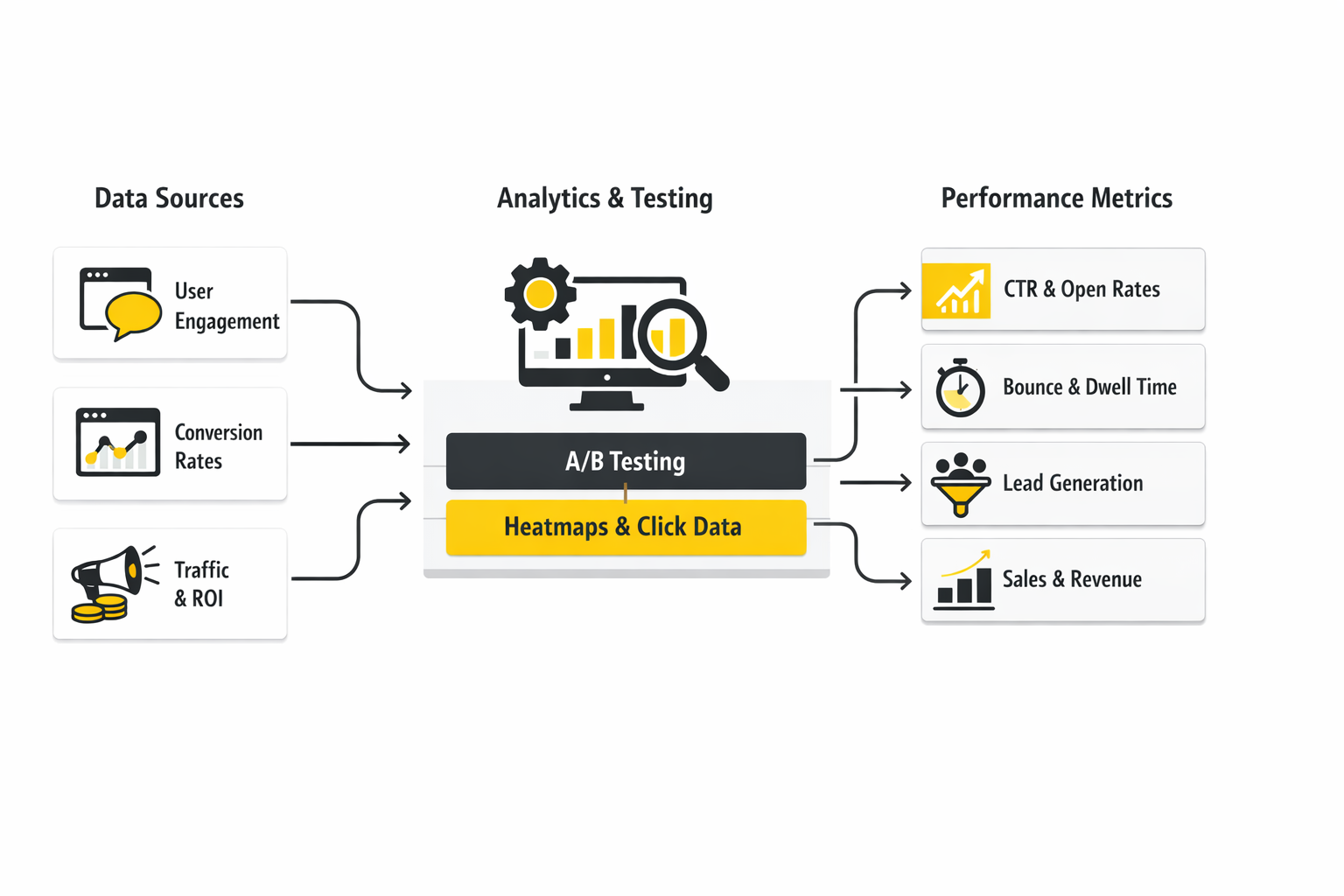
This is where copywriting becomes process instead of performance art. The cleanest implementation work starts by treating the message like a user-flow problem: research first, structure second, proof third, friction fourth, and only then polish. NN/g’s research methods framework recommends combining methods rather than relying on one favorite approach, while Baymard’s user-centered design guidance emphasizes research, validation, and iterative improvement across the lifecycle. Nielsen Norman Group+1
- Mine real customer language before you draft anything. Pull wording from search queries, support tickets, sales calls, demo notes, onboarding questions, and product reviews. Google Search Essentials explicitly recommends using the words people would use to look for your content and placing those words in prominent spots like the title, main heading, and link text. If you are auditing a large site before rewriting it, extracting the live page set with Firecrawl can save a lot of manual cleanup. Google for Developers
- Write the value proposition as one sentence before you open the full draft. That sentence should make the reader, problem, and outcome visible in plain English, because NN/g’s homepage research shows the page needs to answer why someone should choose this company over alternatives. Once that sentence is clear, the headline, subheading, and first CTA usually get much easier to write. Nielsen Norman Group+1
- Pair every important claim with proof right away. Do not write a page full of benefits and promise yourself you will add credibility later, because later usually turns into weak logos and vague testimonials. The safer and stronger move is to connect each promise to something verifiable, especially now that deceptive testimonials and fake reviews carry real legal risk under the FTC rule. Federal Trade Commission
- Fix the path before you obsess over style. Rewrite buttons, field labels, helper text, and validation messages until the user always knows what happens next and what the action means. When that flow needs to go live, tools like Fillout for forms, Brevo for email delivery, and HighLevel for multi-step automation become much more effective because the message is already doing its job. Baymard Institute+3
- Test the copy in small, repeated cycles. NN/g recommends qualitative usability testing to uncover common problems early, and its broader research framework argues that most projects benefit from combining multiple methods rather than forcing one lens onto every decision. Baymard’s user-centered design guidance points the same way: validate, improve, and iterate instead of treating the first live draft like the final truth. Nielsen Norman Group+2
That sequence keeps the work practical. It also stops copywriting from drifting into opinion battles about tone, because the message is being shaped by user language, evidence, and real interaction points rather than personal preference. In the next part, the same components will be matched to funnel stage and channel, because homepage copy, sales emails, paid ads, product pages, and onboarding flows should not all sound like the same asset wearing different clothes. Nielsen Norman Group+1
What the Numbers Are Actually Telling You
Once copywriting is live, the work changes. You are no longer asking whether the message sounds good in a doc or a review call. You are asking whether the words are helping the right people notice, understand, trust, and act.
That sounds obvious, but this is where teams get sloppy. They stare at one number, panic at normal variance, and start rewriting copy before they understand what the metric is actually measuring. The better approach is to treat analytics as a reading system: first attention, then engagement, then intent, then conversion, then revenue.
Start With the Outcome, Then Work Backward
The cleanest way to measure copywriting is to begin with one business result and then trace the path backward to the words that influence it. In Google Analytics, key events are the actions you decide matter most, and Google explicitly notes that those events can also be used in attribution and Google Ads conversion reporting, which makes them useful as the backbone of a practical measurement setup. That is important because copy should not be judged only by pageviews or vanity engagement if the real goal is booked calls, qualified leads, purchases, or retained customers. Google’s key events documentation
For most teams, the structure is simpler than they think. Pick one primary outcome for the page or flow, then define the smaller signals that lead into it. Good copywriting measurement gets cleaner the moment every page has one main job instead of five competing ones.
Watch Leading Signals Before Revenue Arrives
Revenue is the scoreboard, but it is often too slow to help you fix copy quickly. That is why leading signals matter: search clicks, email clicks, form starts, CTA clicks, reply rate, checkout progression, and other actions that show the message is creating forward movement before the final conversion lands. Google Search Console’s Performance report tracks clicks, impressions, CTR, and average position, while Google Analytics defines engagement rate around sessions that last longer than 10 seconds, trigger a key event, or include at least two page or screen views. Search Console’s Performance report documentation GA4 engagement rate documentation
This matters because not all weak results mean the same thing. Low impressions usually point to distribution or discoverability problems. Healthy impressions with weak CTR usually point to message mismatch, which means the copy in the title, headline, meta framing, or offer angle is not earning the next click.
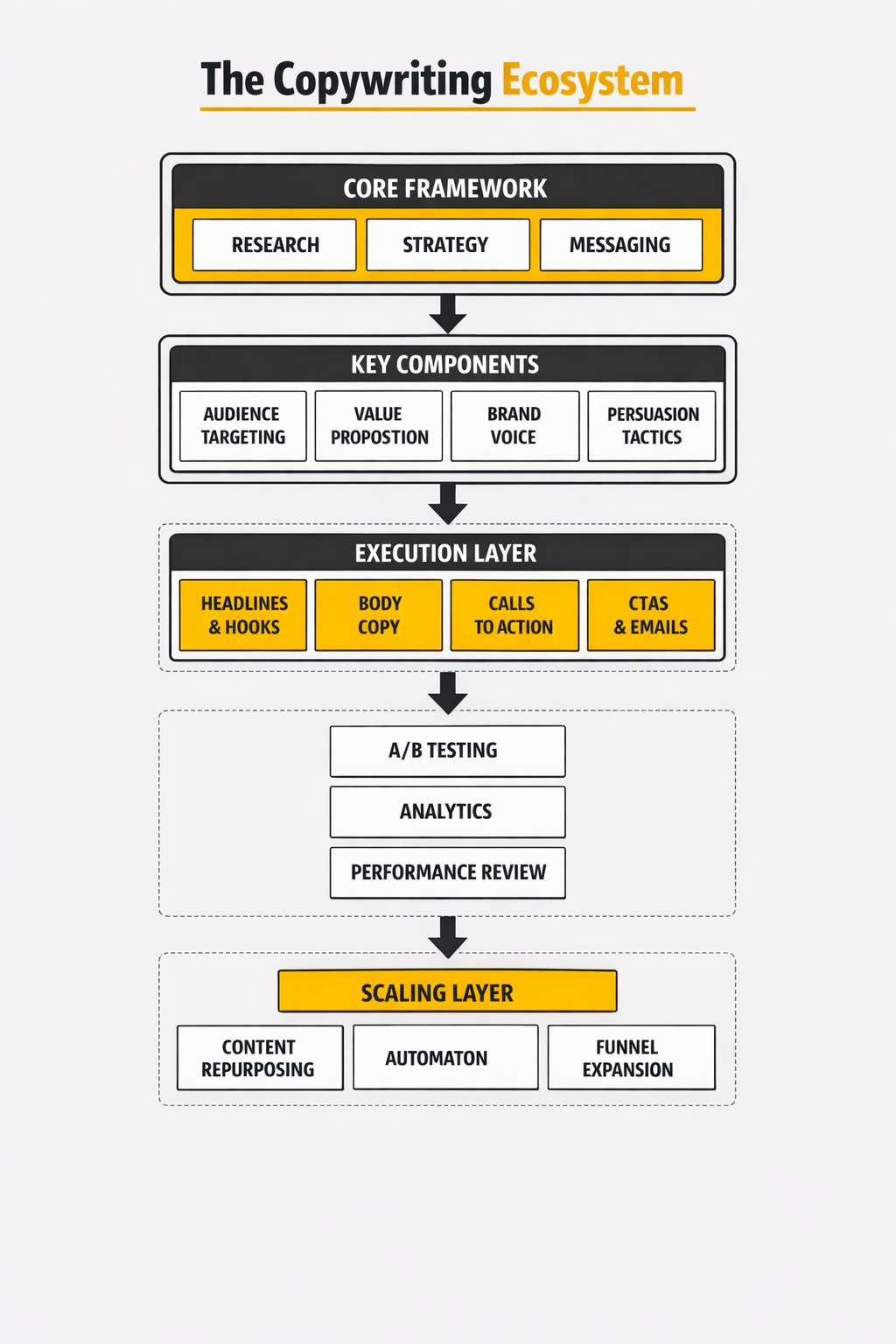
A simple way to read the system is to split the metrics into stages. Attention metrics tell you whether people are seeing the message. Engagement metrics tell you whether they are staying long enough to show interest. Intent metrics tell you whether the copy is creating meaningful movement, and conversion metrics tell you whether that movement becomes business value.
Benchmarks Help, but They Are Not the Goal
Benchmarks are useful because they stop you from evaluating performance in a vacuum. Unbounce’s latest landing page benchmark data puts the median landing page conversion rate at about 6.6% across industries, based on 464 million visits, 41,000 landing pages, and 57 million conversions. That is a helpful reference point, but it is not a universal target because page intent, traffic quality, price point, and conversion definition all change what “good” looks like. Unbounce’s Q4 2024 conversion benchmark summary
That last point matters more than people admit. A page asking for an email address and a page asking for a demo with multiple qualification fields should not be judged by the same number. In copywriting, the right question is not “Is this above average?” but “Is this strong for this stage, this audience, this traffic source, and this ask?”
Read Search Metrics Carefully
Search data is useful, but only if you understand how Google counts it. Search Console explains that impressions are counted when a user visits the page of results where your link appears, CTR is clicks divided by impressions, and average position reflects the topmost result from your site for that query or page grouping. It also notes that the newest data can be preliminary and that daily reporting outside the 24-hour view uses Pacific Time, which is one reason Search Console and GA4 do not always line up perfectly on the same date. What clicks, impressions, and position mean in Search Console Performance report details
So the action you take depends on the pattern. If impressions are rising but CTR is flat, the copy problem is usually at the search-result layer: title tags, meta framing, and topic alignment. If CTR is healthy but on-page conversion is weak, the problem usually moves deeper into the page, where the promise, proof, structure, or CTA may be breaking down.
Use Engagement Metrics as Clues, Not Verdicts
GA4 engagement rate and bounce rate are useful, but they are definitions, not truth. Google says an engaged session is one that lasts longer than 10 seconds, has a key event, or includes at least two page or screen views, and bounce rate is simply the share of sessions that were not engaged. That means a short visit can still count as meaningful if the copy gets the user to a key event fast, while a longer visit without action can still be a sign of confusion. GA4 engagement rate documentation
This is why copywriting should not be “optimized” against bounce rate alone. A sharper headline can reduce bounce because the page becomes clearer, but a higher bounce rate is not automatically bad if the page is doing a fast job and sending users to the right next step. The real question is whether engagement and conversion are moving in the same direction.
Email Metrics Need Better Judgment Than They Used To
Email still gives copywriters one of the cleanest testing environments, but some of the older habits around interpretation are now shaky. Apple’s Mail Privacy Protection downloads remote content in the background and prevents senders from seeing whether someone actually opened the message, while Mailchimp states that Apple MPP can inflate open-related metrics and explicitly recommends putting more weight on clicks and purchases. Apple’s Mail Privacy Protection explanation Mailchimp’s Apple MPP FAQ
That does not mean open rate is useless. It means open rate is now a weaker directional signal than it used to be, especially when you compare campaigns across segments with different Apple Mail usage. For actual copywriting decisions, click rate, click-to-conversion behavior, reply rate, and downstream revenue are usually stronger signals than opens alone, even though broad email benchmarks such as the DMA’s 2025 email benchmarking report and Mailchimp’s industry benchmark guide can still give you rough context.
Conversion Data Should Change the Message, Not Just the Target
When a page underperforms, teams often react by changing the audience, the offer, or the budget before they audit the copy path. That is backwards. If the traffic is reasonably qualified and the intent is real, the first job is to inspect where people are dropping: after the headline, before the form, between pricing and CTA, or inside checkout.
That is where checkout and form research becomes useful. Baymard’s checkout research still puts average cart abandonment at 70.19%, which is a reminder that even interested users disappear when flows create friction, uncertainty, or extra effort. In practice, that means copywriting measurement should include microcopy checkpoints like field labels, shipping explanations, reassurance text, account-creation friction, and CTA clarity, not just the top-line conversion rate. Baymard checkout research
Test Copy Like a System, Not a Guessing Game
A/B testing only helps when the setup is disciplined. Optimizely defines statistical significance as the degree to which observed lift would be unusual if there were actually no difference between the variation and the baseline, and its documentation notes minimum traffic and conversion thresholds before a winner can be declared for binary metrics. That means copywriting tests need enough traffic, a clear primary metric, and patience, otherwise the “winner” is just noise wearing confidence. Optimizely on statistical significance
The practical move is to test one message variable at a time when possible. Headline against headline, CTA against CTA, shorter proof block against longer proof block. When everything changes at once, you may get lift, but you will not know which part of the copy actually created it.
Build a Measurement Stack You Will Actually Use
The best measurement setup is not the most complicated one. It is the one your team will check every week, understand quickly, and act on without a debate. For most businesses, that means one analytics layer for on-site behavior, one source for search performance, one reporting view for email or lifecycle messaging, and one clean way to track links across campaigns.
That stack can stay lean. Search Console handles search visibility and CTR, GA4 handles engagement and key events, an email platform like Brevo or Mailchimp handles campaign behavior, and a link tool like Dub can make channel-level click tracking cleaner when you are pushing copy across multiple surfaces. If your sales funnel and follow-up live in one place, HighLevel can help tie pages, forms, automations, and attribution together, while Buffer can help you compare how the same message performs across organic distribution.
The key is not having more dashboards. The key is making sure every metric has a decision attached to it. If CTR drops, you revisit the hook. If engagement is fine but form completion collapses, you audit friction. If opens stay high but clicks stall, you rewrite the email body and CTA instead of celebrating a number that no longer carries the same weight it used to.
That is the real point of measurement in copywriting. The numbers are not there to impress anyone. They are there to tell you where the message is helping, where it is leaking, and what to fix next.
Professional Implementation: Research, Drafting, and Testing
Once you know where copy is leaking, the next challenge is bigger than one rewrite. You need a system that can improve the message across pages, emails, ads, onboarding, and lifecycle flows without flattening everything into the same generic voice. That is where copywriting stops being a writing task and becomes an operating discipline.
Match Copy to Awareness, Not Just Channel
A common mistake at this stage is organizing copy by asset type instead of buyer awareness. Teams create “the ad version,” “the landing page version,” and “the email version,” but the real question is what the reader already knows when they hit each asset. Good copywriting changes its job depending on that context: cold traffic needs recognition and framing, consideration-stage traffic needs proof and contrast, and decision-stage traffic needs clarity, reassurance, and a low-friction next step.
That matters even more as search behavior gets more layered. Google’s AI features and your website documentation explains that AI Overviews and AI Mode can use a “query fan-out” technique across subtopics and supporting pages, while Google’s AI search guidance says users are asking longer, more specific questions and rewarding unique, satisfying content. In practice, that means your copy cannot survive on vague category language anymore. It needs clean structure, visible specifics, and answers that make sense even when a visitor lands in the middle of the journey.
Choose the Tradeoff on Purpose
Advanced copywriting is full of tradeoffs, and weak teams pretend those tradeoffs do not exist. The more specific the promise, the stronger the response tends to be from the right audience, but the narrower the audience may become. The broader the language, the safer the page may feel internally, but the less likely it is to create urgency or recognition.
The same tension shows up between brevity and completeness. Short copy can convert brilliantly when intent is already strong, but complex offers often need more explanation, more proof, and more risk reduction before the reader will move. The job is not to blindly choose short or long copy. The job is to decide what level of detail the decision actually requires.
Use AI as a Multiplier, Not a Substitute for Judgment
AI can speed up research, outlining, versioning, and first-draft production, but it is a terrible replacement for product understanding, customer nuance, and editorial judgment. Google’s guidance on using generative AI content on your website explicitly says generative AI can help with research and structure, but mass-producing pages without adding value may violate its spam policy on scaled content abuse. That is a useful line because it forces a better question: did the workflow create sharper insight, or just more output.
There is also a trust problem here that too many teams ignore. The FTC’s September 2024 crackdown on deceptive AI claims and schemes included actions involving fake reviews and exaggerated AI claims, which is a reminder that “AI-powered” does not excuse bad evidence or invented proof. Strong copywriting teams use AI to accelerate options, then bring in human review for positioning, factual accuracy, offer logic, and brand voice before anything ships.
This is where workflow matters. Capturing raw founder language with Wispr Flow, storing repeatable process guidance in Guideless AI, and turning recurring customer questions into searchable knowledge through Chatbase can make AI-assisted drafting far more useful because the model has real material to work from. Without that source layer, AI copywriting usually drifts toward polished sameness.
Treat Compliance as Part of the Draft, Not a Final Review
A lot of expensive copy problems are not writing problems at all. They are claim problems, disclosure problems, consent problems, or testimonial problems that should have been solved in the draft instead of kicked to legal after the page was already approved internally. The FTC’s policy statement on advertising substantiation makes the standard clear: advertisers need a reasonable basis for express and implied objective claims.
That last word matters: implied. Copywriting does not only communicate through what it states directly. It also communicates through framing, juxtaposition, promise sequencing, testimonial placement, guarantee wording, and comparison language. If a page strongly implies a result, that implication needs support too.
Subscription and trial copy is an especially risky area. In March 2026, the FTC’s negative option rulemaking notice asked for comment on practices that prevent people from understanding terms, enroll them without express informed consent, or deter cancellation. That should tell you something important: the words around billing, renewals, free trials, and cancellation paths are not minor UI details. They are part of the legal and trust layer of the offer.
Accessibility Is Not a Side Quest
At scale, copy starts serving more people, more devices, more entry points, and more contexts. That means accessibility is not a nice extra. It is part of what makes copy usable, understandable, and convertible.
W3C’s Writing for Web Accessibility guidance recommends informative page titles, meaningful link text, clear instructions, concise wording, and headings that convey structure, while its explanation of headings and labels makes clear that descriptive headings help people understand what information is on the page and how it is organized. Its guidance on link purpose says meaningful link text helps users decide whether to follow a link without needing extra context. In plain language, better accessibility usually produces better copywriting because both disciplines reward clarity over cleverness.
This becomes very practical in forms, onboarding, and support content. If labels are vague, instructions are buried, or buttons depend on surrounding context to make sense, users slow down or make mistakes. Good copy reduces that friction for everyone, not just for users working with assistive technology.
Deliverability Is a Copy Problem Too
Email teams often treat deliverability as a technical issue handled by DNS settings and sending infrastructure. That is only half true. Authentication matters, but inbox placement is also shaped by whether the copy matches expectations, whether the sender earned permission, and whether the unsubscribe path feels easier than the spam button.
Google’s current email sender guidelines require all senders to keep spam rates in Postmaster Tools below 0.3%, and the sender guidelines FAQ says senders should stay below 0.1% and avoid ever reaching 0.3% or higher. Google also requires one-click unsubscribe for commercial promotional mail from bulk senders, and Yahoo’s sender best practices and sender FAQs mirror the same pressure with low complaint-rate expectations and one-click unsubscribe requirements for promotional mail.
That should change how you think about email copywriting. Subject lines that overpromise, newsletters that drift from the original sign-up promise, and promo blasts sent to weak segments are not just “creative experiments.” They are reputation risks. If you are scaling sequences through Brevo, HighLevel, or a dedicated outreach stack like ScaledMail, the copy and the targeting have to stay aligned or the infrastructure will not save you.
Build a Feedback Loop That Survives Growth
Small teams can get away with founder intuition for a while. Bigger teams cannot. Once multiple people are writing copy across acquisition, lifecycle, sales enablement, support, and product surfaces, you need a repeatable loop for collecting customer language, documenting winning angles, and retiring weak claims before they spread.
The best version of that loop is boring in a good way. Sales calls feed objections into a central doc, support chats expose confusing language, CRM notes reveal stalled-deal patterns, and experiment logs show which messages actually moved behavior. A CRM like Copper, a central funnel and automation system like HighLevel, and structured intake from forms or schedulers such as Fillout and Cal.com can make that loop easier to maintain, but the principle matters more than the platform.
What matters is that copywriting decisions stop living only in Slack threads and memory. Winning phrases should be captured. Lost deals should be mined. Repeated questions should become new proof blocks, better onboarding copy, sharper FAQs, or stronger offer framing.
That is usually the dividing line between decent copy and professional copywriting. Decent copy can produce a win. Professional copywriting can keep learning after the win, protect trust while scaling, and improve the whole system instead of one page at a time.
In the final part, we will close the article with the mistakes that consistently drag copy down, the tools that actually help, and the FAQ section that ties the whole topic together.
Common Mistakes That Quietly Hurt Good Copy
By this point, the pattern should be obvious: copywriting rarely fails because someone forgot a formula. It usually fails because the message became harder to understand, harder to trust, or harder to act on as the system grew. The fix is almost never “write more hype.” The fix is to make the offer clearer, the proof tighter, and the next step easier to follow. Google for Developers+2
Chasing Cleverness Instead of Clarity
A lot of brands still confuse originality with obscurity. Google’s people-first guidance pushes creators toward content that is helpful and satisfying for humans, while W3C’s writing guidance emphasizes informative titles, meaningful links, clear instructions, and concise wording. That combination matters because copywriting gets stronger when the reader understands the point immediately, not when they pause to decode what the brand was trying to say. Google for Developers+2
Making Claims That the Page Cannot Support
Strong copy can be bold, but it cannot be careless. The FTC’s advertising substantiation policy says objective claims need a reasonable basis, and its reviews and testimonials rule that took effect on October 21, 2024 focuses directly on fake or deceptive review practices. In practice, that means copywriting should never outrun the available proof, whether the claim sits in a headline, testimonial block, pricing table, or AI-flavored promise. Federal Trade Commission+2
Writing One Message for Every Stage of Awareness
The same wording should not carry a cold visitor, a comparison shopper, and a ready buyer with equal force. Google’s Search Essentials and its AI features documentation both reinforce the idea that content needs to be useful, descriptive, and aligned with how people actually search and evaluate information. Good copywriting respects that reality by changing its job across the journey instead of forcing every page, email, and ad into one recycled value proposition. Google for Developers+2
Optimizing Against the Wrong Number
Teams damage good copy all the time by chasing a metric that does not match the job of the page. Google Analytics defines key events as the actions most important to business success, and it defines engagement through signals like time, key events, or multiple page views, which means raw traffic and bounce numbers are only part of the picture. The same problem shows up in email, where Apple’s Mail Privacy Protection and Mailchimp’s guidance both make it clear that open rates are less trustworthy than they used to be, so copywriting decisions should lean more heavily on clicks, replies, conversions, and downstream revenue. Google Podpora+3
Scaling Output Faster Than Review
AI can help you move faster, but speed without review usually creates a larger pile of average copy. Google says generative AI can help with research and structure, but mass-producing pages without adding value can violate its spam policies, and the FTC’s September 2024 AI enforcement sweep showed that AI-themed claims and fake proof are now under real scrutiny. The expert move is simple: use AI to accelerate options, then force human review on angle, evidence, compliance, and brand judgment before anything goes live. Google for Developers+2
Tools That Help Without Replacing Judgment
When the message is already clear, a few tools can make copywriting easier to deploy without turning the job into software theater. For funnel and landing-page execution, ClickFunnels, Systeme.io, and HighLevel AI are all worth comparing once the offer, proof, and CTA are already nailed down. For email and lifecycle messaging, Moosend is another option, and for social distribution a mix of Flick Social, Buffer, and a simple hub like Anything Link can keep the path from content to action cleaner.
The point, though, is not stack accumulation. It is choosing a small ecosystem that helps you test faster, ship cleaner pages, and keep the copy close to the data that shows whether it is working. If the workflow starts hiding the message instead of sharpening it, the tool is no longer helping.
FAQ - Built for Complete Guide
What Is Copywriting, Really?
Copywriting is writing built to help a reader make a decision and take a next step. That next step might be a click, reply, sign-up, purchase, demo request, or even a clearer understanding of the offer before action happens. The strongest copywriting does not just persuade. It explains, reduces friction, and makes the path forward feel obvious. Google for Developers+2
Is Copywriting the Same as Content Writing?
Not quite, even though the two overlap. Content writing often aims to educate, attract search traffic, or build trust over time, while copywriting is more tightly tied to movement and conversion at a specific point in the journey. In practice, the best websites blend both, because useful content earns attention and strong copy turns that attention into action. Google for Developers+2
Is Copywriting Still Worth Learning in the AI Era?
Yes, and arguably more than before. Google’s guidance says AI can support research and structure, but not replace the need to add value, and the FTC’s recent AI enforcement actions show that hype and fake proof create real risk. AI has made average output cheaper. It has not made good judgment, positioning, proof, and reader understanding any less valuable. Google for Developers+2
How Long Should Copy Be?
Copy should be as short as the decision allows and as long as the decision requires. Google’s title-link guidance favors descriptive, concise titles, while Baymard’s checkout and form research shows that users abandon when paths feel confusing or too complicated, which means unnecessary wording can absolutely hurt performance. But for higher-friction offers, shorter is not automatically better, because some decisions need more explanation, more proof, and more reassurance before the click. Google for Developers+2
What Makes a Headline Strong?
A strong headline tells the reader what the page is about and why it is relevant without forcing them to interpret it. Google explicitly says title links are often the primary piece of information people use to decide which result to click, and NN/g says a homepage value proposition should answer why someone should choose this company over others. In other words, a headline works when it is clear, specific, and connected to the actual value of the page, not when it is merely clever. Google for Developers+2
Should Every Page Have One Main Call to Action?
Usually, yes. That does not mean every page can only contain one button, but it does mean the page should have one primary job so the reader does not have to guess what matters most. Google Analytics’ key-event model is useful here because it forces a team to define which action is most important, and W3C’s guidance on meaningful links reinforces the same principle from a usability angle: people move more confidently when choices are clearly labeled and purpose is obvious. Google Podpora+2
How Much Proof Should I Include?
Enough to answer the next skeptical question without burying the page. The FTC’s substantiation policy and reviews rule both point toward the same standard: claims and testimonials need support, and deceptive proof is not just bad marketing but a legal risk. Good copywriting uses proof selectively and close to the claim it supports, so the reader does not have to leap across a credibility gap alone. Federal Trade Commission+2
What Metrics Matter Most for Copywriting?
The most useful metrics are the ones that match the job of the asset. Search Console’s clicks, impressions, and CTR help you judge whether the promise is winning the click, while Google Analytics key events and engagement metrics help you see whether the page is creating meaningful forward motion after the visit. For email, Apple’s privacy changes and Mailchimp’s guidance both make clicks, purchases, and other downstream actions more reliable than opens alone. Google Podpora+4
Can AI Write Copy I Can Publish As-Is?
Sometimes it can produce a usable draft, but publishing it as-is is usually the wrong standard. Google’s documentation encourages using AI in ways that still create original value for users, and its spam policies warn against scaled low-value output. That means AI can speed up outlining, angle exploration, and first drafts, but experienced copywriting still needs human review for proof, nuance, compliance, and brand fit. Google for Developers+2
What Is the Biggest Legal Risk in Copywriting?
The biggest risk is usually not one dramatic sentence. It is the cumulative effect of unsupported claims, misleading implications, fake or manipulated reviews, and sloppy subscription or trial language that changes how a reasonable person understands the offer. The FTC’s substantiation guidance, consumer reviews rule, and March 2026 negative-option rulemaking notice all point to the same lesson: if the page implies a result or obscures an obligation, that wording deserves serious scrutiny before it ships. Federal Trade Commission+3
What Is the Fastest Way to Improve Copywriting?
Start by listening harder before writing faster. Search data, sales calls, support tickets, reviews, and usability testing usually reveal the exact phrases, objections, and points of confusion that stronger copy should address, and NN/g’s research framework keeps stressing the value of combining methods instead of relying on one source. The quickest improvement usually comes from replacing internal jargon with real customer language, tightening the promise, and removing one major friction point at a time. Google for Developers+3
Work With Professionals
Explore 10K+ Remote Marketing Contracts on MarkeWork.com
Most marketers spend too much time chasing clients, competing on crowded platforms, and losing a percentage of every project to middlemen. MarkeWork gives you a better way. Browse thousands of remote marketing contracts and connect directly with companies desperate to hire skilled marketers like you, without platform commissions and without unnecessary gatekeepers. markework.com+1
If you're serious about finding better opportunities and keeping 100% of what you earn, explore available contracts and create a profile for free at MarkeWork.com. markework.com