

primary keyword: klaviyo emailARTICLE PART: PART 1STRUCTUREOpening paragraphs (no Introduction heading)Article outline- define structure based on the topic of the keyword- the full article must be six parts- list the real section names that the rest of the article will continue usingInsert IMAGE 1 as a standalone line where the overview visual should appear.Insert IMAGE 2 as a standalone line where the framework visual should appear.Use natural versions of these section ideas when they fit the topic:- Why it matters- Framework overview- Core components- Professional implementationMASTER GLOBAL ARTICLE RULES (MANDATORY)JSON EXPORT RULEOutput ONLY clean markdown/plain article content compatible with FKE Automator / Markework JSON export.Use ONLY these constructs:- #, ##, ###- plain paragraphs- bullet lists- numbered lists- markdown links like anchor text- boldDo NOT output HTML.Do NOT output <img>, <section>, <div>, <a id>, inline CSS, or WordPress block markup.Do NOT wrap the answer in triple backticks.Do NOT include notes like "here is the article", "continued below", or any explanation outside the article itself.IMAGE MARKER RULE (CRITICAL)When an image is required, place only the exact standalone marker:IMAGE 1IMAGE 2IMAGE 3IMAGE 4IMAGE 5Use the marker on its own line with a blank line above and below it.Do NOT mention the marker inside a sentence.Do NOT add any other image markup.TITLE RULEUse ONLY ONE title in the entire article:# Title CasePart 1 must include the title.Parts 2-6 must not repeat the title.OUTLINE RULEPart 1 must include the article outline as a markdown bullet list.Do NOT use page jumps, HTML anchors, or WordPress-specific navigation.Use the real section names that will appear in the article.ARTICLE CONTINUITY RULEThe full article must feel like one uninterrupted article split across six prompts.If the current part is not Part 1, scan the earlier parts and continue with consistent section order, heading style, and wording.Do NOT repeat sections already covered.Do NOT repeat the outline after Part 1.HEADING RULEIf a suggested heading sounds unnatural or grammatically wrong, rewrite it so it sounds natural while keeping the same meaning.Apply this to all section and subsection headings.TEXT RULE (CRITICAL)Do NOT use choppy keyword-stuffed sentences.Use the keyword naturally inside sentences that sound human.Every section must make sense, build an argument, and transition naturally.Every heading section in this part must have at least 3 sentences.Write conversationally while still sounding professional.Do NOT use fake examples.If you tell a story, it must be real and based on real research.If you cannot fully support a story, do not use it.REAL STORY RULEIf you include a story example, it must include:- high drama- backstory- wall- epiphany- journey- final conflict- dream outcomeEach beat must have at least 3 sentences.If you cannot do that with real sourced information, do not use a story example.NON-REPETITION RULEDo NOT repeat concepts, examples, or claims.CITATION RULEEmbed statistics naturally as markdown links using normal anchor text.Never use "According to".Never use fake citations, fake quotes, fake percentages, or fake case studies.RESEARCH VERIFICATION RULE (MANDATORY)Before generating any article content, conduct external research using live web search.Review 30-50 authoritative sources when possible.Prioritize:- academic research- industry reports- official company case studies- SEC filings when relevant- reputable media publications- direct brand-owned contentCross-check important statistics across at least 3 independent sources.Prefer data from the last 24 months unless older context is necessary.If a claim cannot be verified well enough, do NOT use it.AFFILIATE LINK RULENaturally embed these links only where they genuinely fit the topic and likely click intent:https://manychat.partnerlinks.io/fmgh24bi2e3i https://try.replo.app/filip-konecny https://anything.link/filip-konecny https://r.guideless.ai/filip-konecny https://www.gohighlevel.com/viral-growth-workshop?fp_ref=h8wfn https://app.gohighlevel.com/offers/affiliate-upgrade?fp_ref=h8wfn https://www.gohighlevel.com/297upgrade?affiliate_upgrade_credit_to_%24297=&fp_ref=h8wfn https://www.gohighlevel.com/ai?fp_ref=h8wfn http://gohighlevel.com/5dc?fp_ref=h8wfn https://www.gohighlevel.com/highlevel-bootcamp?fp_ref=h8wfn https://www.gohighlevel.com/protrial?fp_ref=h8wfn https://gohighlevel.com/saasupgrade?fp_ref=h8wfn https://gohighlevel.com/annual?fp_ref=h8wfn https://www.gohighlevel.com/?fp_ref=h8wfn https://www.imallin.com/?aff=b2210814891723f0f24429789399ca6dbf89a7a4032a3b7607c67ec619f7c98d https://www.clickfunnels.com/3-months-for-99?aff=b2210814891723f0f24429789399ca6dbf89a7a4032a3b7607c67ec619f7c98d https://www.plrfunnels.com/plr?aff=b2210814891723f0f24429789399ca6dbf89a7a4032a3b7607c67ec619f7c98d https://www.clickfunnels.com/signup-flow?aff=b2210814891723f0f24429789399ca6dbf89a7a4032a3b7607c67ec619f7c98d https://www.clickfunnels.com/signup-flow?aff=b2210814891723f0f24429789399ca6dbf89a7a4032a3b7607c67ec619f7c98d https://systeme.io/?sa=sa015785516595171cfc6c58e3ca920ac49fade474 https://trymoo.moosend.com/jkaq7e4npkc8 https://flick.social/?fpr=filip86 https://get.brevo.com/1kauejkjf9cj https://join.buffer.com/filip-konecny https://ref.wisprflow.ai/filip-konecny https://refer.cal.com/filip-konecny-yqkw https://firecrawl.link/filip-konecny https://try.fillout.com/filip-konecny-uvil https://go.trycomp.ai/filip-konecny https://link.chatbase.co/filip-konecny https://r.guideless.ai/filip-konecny https://partners.copper.com/filip-konecny https://betterpic.link/filip-konecny https://go.scaledmail.com/filip-konecny https://refer.dub.co/filip-konecny AFFILIATE LINK ENFORCEMENT RULE (CRITICAL – OVERRIDES ALL OTHER LINK RULES) Every outbound link in the article MUST include the correct affiliate parameter. No exceptions. This applies to: - homepage links - pricing pages - feature pages - blog articles - help docs - comparisons - ANY internal page of the brand being linked AFFILIATE PARAMETER MAPPING (MANDATORY) Use these exact mappings: ClickFunnels → ?aff=b2210814891723f0f24429789399ca6dbf89a7a4032a3b7607c67ec619f7c98d Systeme.io → ?sa=sa015785516595171cfc6c58e3ca920ac49fade474 GoHighLevel → ?fp_ref=h8wfn Buffer → ?via=filip-konecny&dub_id=vehZVhQoUlPKyE04 Chatbase → ?via=filip-konecny&dub_id=CiogUKmdaZuA6rY5 Brevo → ?pscd=get.brevo.com&ps_partner_key=NmFiNDgzNTIxYjk4&ps_xid=wo8YcEQVPUA9gn&gsxid=wo8YcEQVPUA9gn&gspk=NmFiNDgzNTIxYjk4 ManyChat → ?source=6ab483521b98&mcdc=9337a07e&ps_partner_key=NmFiNDgzNTIxYjk4&ps_xid=dBp4jF0TQnN4HY&gsxid=dBp4jF0TQnN4HY&gspk=NmFiNDgzNTIxYjk4 Replo → ?via=filip-konecny&dub_id=6qf0AgFup25vqjrk Anything.com → ?via=filip-konecny&dub_id=4Crexqny5KXkAXEV Guideless → ?via=filip-konecny&dub_id=HbThyDKylDIqkQd0 Moosend → ?utm_campaign=Partners&utm_medium=RecommendedBy_6ab483521b98&utm_source=Recommendation&pscd=trymoo.moosend.com&ps_partner_key=NmFiNDgzNTIxYjk4&ps_xid=HWkq9XBssy8Z6N&gsxid=HWkq9XBssy8Z6N&gspk=NmFiNDgzNTIxYjk4 Flick Social → ?fpr=filip86 Wispr Flow → ?utm_source=dub.co&utm_medium=affiliate&utm_campaign=AffiliateProgram&via=filip-konecny&dub_id=c03Ur3VQOV4d159g Cal.com → ?via=filip-konecny-yqkw&dub_id=WRdxs35LnOvwhIDk Firecrawl → ?via=filip-konecny&dub_id=5W9WUmP1QY8SNM9e Fillout → ?via=filip-konecny-uvil&dub_id=WRRPDSmbdXLew9NT Trycomp → ?via=filip-konecny&dub_id=l89IUVwDWzg6O5dn Copper → ?via=filip-konecny&dub_id=VmAakG00s9EKiyxh BetterPic → ?via=filip-konecny&dub_id=yP6jGrsefOXlnyI2 ScaledMail → ?via=filip-konecny&dub_id=eKH37JT0CkzhMif4 Dub.co → ?via=filip-konecny&dub_id=2sLDZ2YHrzrmUFFy HOW TO APPLY PARAMETERS (MANDATORY) If the URL has NO query string: → append using: ?affiliate_parameter Example: https://www.clickfunnels.com/pricing → https://www.clickfunnels.com/pricing?aff=b2210814891723f0f24429789399ca6dbf89a7a4032a3b7607c67ec619f7c98d If the URL ALREADY contains query parameters: → append using: &affiliate_parameter Example: https://www.clickfunnels.com/blog/post?utm_source=google → https://www.clickfunnels.com/blog/post?utm_source=google&aff=b2210814891723f0f24429789399ca6dbf89a7a4032a3b7607c67ec619f7c98d STRICT PROHIBITIONS - NEVER include a non-affiliate version of a supported domain - NEVER mix affiliate and non-affiliate links for the same domain - NEVER leave out parameters “just for citations” - NEVER shorten or cloak links unless explicitly provided that way CITATION ADJUSTMENT RULE Even when citing: - official documentation - pricing pages - feature pages - help articles You MUST still include the affiliate parameter. There are NO exceptions. INTENT PRESERVATION RULE - Keep anchor text natural and readable - Do NOT force keywords into links - Do NOT make links look spammy - Maintain credibility while monetizing all links CTA ASSET RULEDo NOT use remote WordPress banner images or any external image URLs inside the article body.If a CTA needs visual emphasis, do it with strong text and natural markdown links instead.FAQ RULEFAQ belongs only in Part 6.VOICE RULEWrite in Filip's style:- direct- practical- conversational- confident- reader-focused- human, not robotic- occasionally emphatic when something truly matters
Core Components of a High-Performing Klaviyo Setup
A strong Klaviyo email program is built on a handful of components that have to work together. If one piece is weak, the rest of the system gets harder to scale, and the performance issues usually show up later as lower inbox placement, weaker click intent, or flat revenue per recipient. This is why experienced operators do not start by obsessing over templates. They start by making sure the foundation underneath the emails is solid.
The easiest way to think about it is this: Klaviyo email performs best when your data is clean, your list is permission-based, your sending infrastructure is trustworthy, and your audience logic reflects real buying behavior. Those are not glamorous topics, but they are the difference between an account that compounds and one that slowly burns out. Once those pieces are in place, campaigns and automations stop feeling random and start feeling intentional.
A Clean Data Foundation
Everything in Klaviyo email gets better when the underlying data is dependable. Klaviyo is built to unify customer profiles around site behavior, order history, engagement, and custom properties, which is why the platform keeps pushing brands toward a more complete profile model instead of a simple subscriber list. That matters because personalization only works when the system knows enough about the person to make the message relevant.
This is also where zero-party data becomes more useful than most brands realize. Klaviyo’s own training materials define zero-party data as information customers intentionally and proactively share, such as birthdays, preferences, and shopping interests, and that data is stored as profile properties inside the platform for later personalization in the form workflow itself. In practical terms, that gives a Klaviyo email strategy more precision without forcing marketers to guess what a customer wants based on thin signals alone.
The big mistake is collecting extra fields with no plan to use them. If you ask for preference data, that data should power something concrete, such as better welcome flows, more relevant campaign sends, improved product recommendations, or stronger post-purchase follow-up. Otherwise you are just adding friction at the front end and clutter on the back end.
Permission-Based List Growth
A healthy Klaviyo email account grows through consent, not shortcuts. That sounds obvious, but it is still where plenty of brands sabotage themselves by pushing too hard for volume and not hard enough for fit. An email address that comes in through a clear value exchange is worth more than a larger pile of weak contacts who never wanted the relationship in the first place.
Klaviyo’s form analytics system is useful here because it benchmarks popup submit rates against peer data from the last three months, which gives teams a way to judge whether a form is actually pulling its weight instead of guessing inside the analytics view. Klaviyo also updated its filtering on April 1, 2025 to remove more bot and crawler activity from form analytics, making those conversion signals cleaner and less inflated in the help documentation. That is a small but important detail, because bad list-growth decisions often start with bad measurement.
The practical takeaway is simple. Your sign-up form should collect the minimum information needed to create a better next step, not satisfy internal curiosity. If the offer is weak, the timing is wrong, or the form interrupts the experience without enough value, the list may still grow, but the downstream Klaviyo email performance usually tells the truth fast.
Deliverability and Sender Trust
Deliverability is not a technical side quest anymore. It is a core component of any serious Klaviyo email setup because mailbox providers now expect proper authentication and cleaner sending behavior as a baseline, not a bonus. If that trust layer is weak, even strong content can lose before the customer ever sees it.
Google’s current sender guidelines require senders to authenticate with SPF or DKIM, and they recommend DMARC for all senders while making stricter requirements explicit for bulk senders in Google Workspace Admin Help. Google’s sender FAQ also spells out that the bulk-sender threshold starts at about 5,000 messages to Gmail accounts in a day. Yahoo’s sender best-practice guidance is aligned on the bigger principle and keeps the spam complaint target below 0.3%, which makes list quality and segmentation directly relevant to inbox placement rather than just campaign performance.
This is where many brands still get tripped up. They think Klaviyo email deliverability is mostly about subject lines or spam words, when the bigger issue is often that they are mailing too broadly, too often, or to people with low intent. Klaviyo’s own deliverability guidance makes the same point from another angle: healthy opens, clicks, bounce rates, and spam rates are signals you need to monitor continuously because inbox placement is an outcome of overall sending quality, not one isolated trick in the deliverability reference.
Segmentation That Reflects Buying Behavior
Once the data foundation is sound and the infrastructure is trustworthy, the next component is audience logic. This is the part of Klaviyo email that separates smart retention marketing from glorified batch-and-blast. You do not need dozens of segments to win, but you do need segments that reflect how customers actually move toward purchase, repeat purchase, and churn.
Klaviyo has become much more direct about this. Its newer segmentation guidance argues that many brands still lean on open- and click-based audience windows that look clean on dashboards but do not map well to revenue, especially now that Apple’s Mail Privacy Protection makes open data less dependable by downloading remote content in the background and obscuring whether a person actually opened the message in Apple’s privacy explanation and in Klaviyo’s 2026 segmentation framework. That is a meaningful shift because it pushes teams toward purchase behavior, recency, frequency, and customer value instead of vanity engagement.
The strongest Klaviyo email programs treat segmentation as decision logic, not decoration. They build around signals like first purchase, second purchase, category affinity, high-value status, replenishment timing, browse intent, and lapsing behavior. When you do that well, every campaign becomes more relevant, every flow becomes easier to personalize, and the account stops depending on blanket promotions to create movement.
Segmentation, Automation, and Campaign Strategy
Once the foundation is in place, the real work in Klaviyo email is deciding who should hear from you, when they should hear from you, and what message actually fits that moment. This is where a lot of brands get sloppy. They build a few flows, send a weekly campaign, and assume the machine is running when what they really have is a loose collection of tactics with no sequencing logic behind them.
A better approach is to treat Klaviyo email like a controlled system. Segments decide eligibility, flows handle high-intent moments, and campaigns fill the gaps without stepping on automated revenue opportunities. When those three layers are aligned, the customer journey feels coordinated instead of noisy, and the account becomes easier to scale without crushing deliverability or fatiguing the list.
Start With a Tight Segment Architecture
Good segmentation is not about creating as many audiences as possible. It is about building a small set of groups that map to buying intent, lifecycle stage, and commercial value. Klaviyo’s newer segmentation framework leans into exactly that approach, pushing brands toward lifecycle movement, predictive analytics, and revenue-based logic instead of endless manual audience slicing built on weaker engagement signals inside its 2026 segmentation framework.
In practice, that means your first segments should answer business questions, not platform questions. Who just subscribed and has not purchased yet? Who bought once and is likely to buy again? Who is starting to lapse? Who should be protected from over-mailing because they are already inside a flow? Klaviyo’s segmentation product itself now highlights predictive signals like churn risk, customer lifetime value, next order date, and RFM groupings because those are the kinds of inputs that turn segmentation into a decision engine instead of a reporting exercise on the segmentation feature page.
This is also where Klaviyo email gets more powerful than a basic ESP. You are not limited to static newsletter lists. You can build audiences around actions, timing, value, product interest, and projected behavior, which gives every downstream email a better chance of being relevant before copywriting even starts.
Build the Essential Flow Stack First
A mature Klaviyo email account may eventually include dozens of automations, but that is not where you start. The smart move is to build the few flows that match the highest-intent points in the customer journey and make those work well before adding anything fancy. Klaviyo itself keeps steering newer accounts toward a basic checklist, templates, and first messages before expanding the system, which is the right sequencing for almost every brand in the getting started resources.
For most ecommerce brands, the essential stack is straightforward. You want a welcome flow, an abandoned cart flow, a browse abandonment flow if tracking is healthy enough to support it, and a post-purchase flow that strengthens retention. Klaviyo’s own guides still position these as the core automated building blocks because they align with the moments when shopper intent is either being formed, abandoned, or reinforced in the abandoned cart guide, the browse abandonment guide, and the post-purchase guide.
The order matters more than people think. A weak welcome flow leaks value from every new signup. A weak cart flow leaves direct revenue on the table. A weak post-purchase flow makes it harder to convert a first order into a second order, which is usually where retention starts becoming real instead of theoretical.
Keep Campaigns in a Supporting Role
Campaigns still matter in Klaviyo email, but they should not carry the whole program. Automated flows are reacting to behavior, which usually means they hit closer to peak intent than scheduled broadcasts. Klaviyo’s own strategy material has been explicit that revenue per recipient from key flows can dramatically outpace campaigns, which is why experienced teams use campaigns to amplify merchandising, launches, and seasonal pushes rather than replace lifecycle logic with calendar pressure in Klaviyo’s process guide.
That changes how you plan the calendar. You are not asking, what can we send this week just to stay visible. You are asking, what should only a campaign handle, and what should be left to automation because automation is already doing the job better. This shift sounds subtle, but it prevents the classic mistake of over-mailing engaged customers who are already receiving relevant lifecycle emails.
It also forces a better discipline around exclusions. If someone is inside a welcome series, a cart recovery flow, or a post-purchase sequence, campaign eligibility should reflect that reality. Klaviyo’s post-purchase strategy guidance calls this out clearly because overlapping automations and campaigns can create clutter fast when nobody is managing flow priority and send frequency carefully in the post-purchase strategy article.
A Practical Klaviyo Email Execution Process
This is the point where implementation stops being conceptual and becomes operational. A Klaviyo email system works when the team can move from data setup to message delivery without breaking relevance, deliverability, or reporting. The simplest way to do that is to follow a repeatable sequence instead of improvising every part of the build.
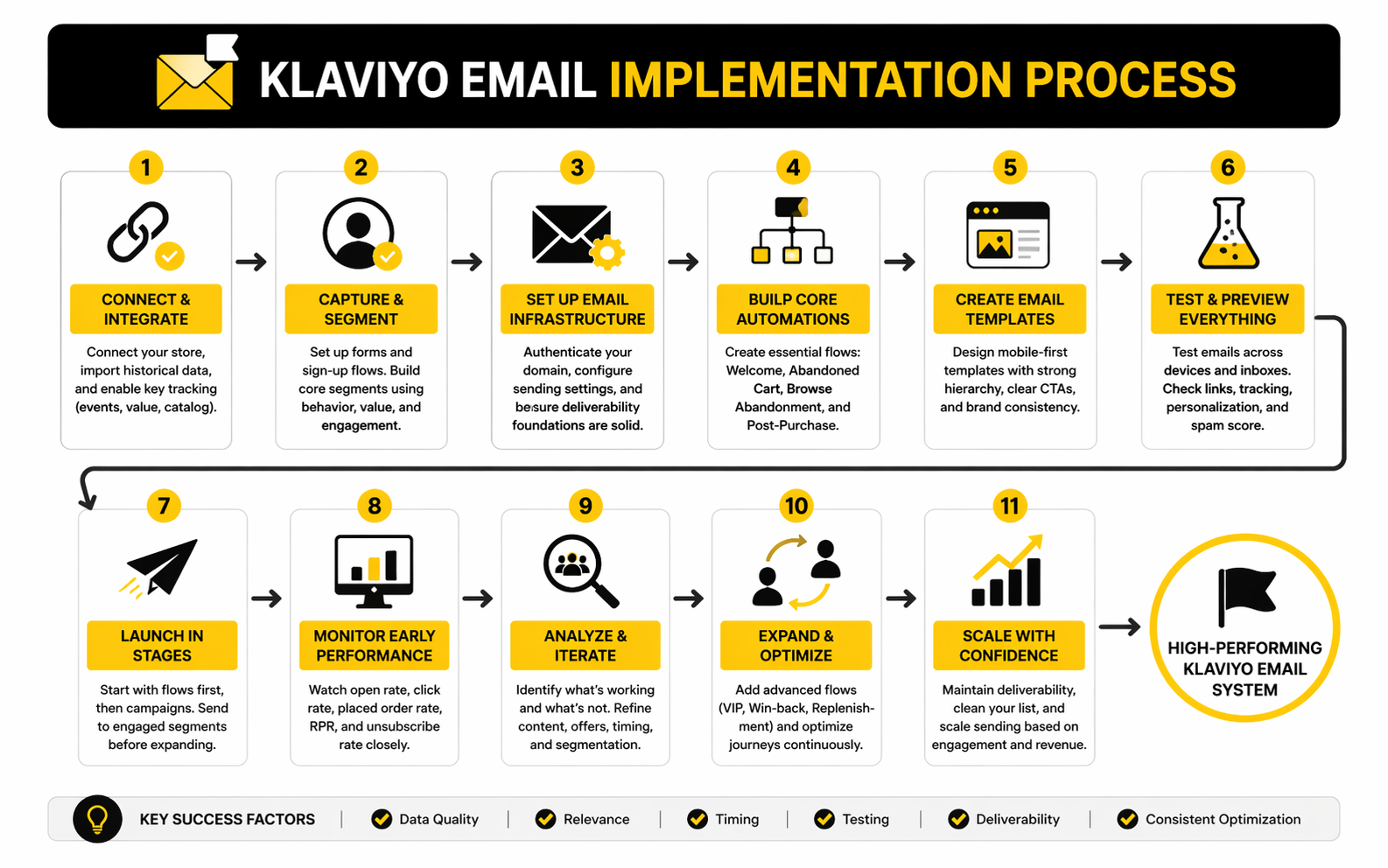
A practical execution process usually looks like this:
- Confirm the ecommerce integration is syncing the events you actually need, especially viewed product, added to cart, started checkout, placed order, and fulfilled order.
- Authenticate the sending setup correctly so SPF, DKIM, and ideally DMARC are in place before volume ramps, which aligns with both Klaviyo’s authentication guidance and Google’s sender requirements in Klaviyo’s authentication reference and Google’s sender guidelines.
- Create your baseline segments for subscribers, customers, repeat customers, lapsing customers, and flow exclusions before building messages.
- Launch the core flow stack in order of revenue impact, starting with welcome, then cart, then post-purchase, then browse abandonment if event quality is strong enough.
- Add campaigns only after the flow layer is working cleanly, with exclusion logic that protects customers from message pileups.
- Review engagement, complaints, unsubscribe trends, and revenue per recipient every week so the system improves through iteration instead of guesswork.
That sequence works because it respects the way mailbox providers and customers both behave. Trust comes first, relevance comes second, and scale comes third. If you try to reverse that order, Klaviyo email starts to feel impressive in the dashboard but unstable in the real world.
Where Execution Usually Breaks
Most implementation problems are not caused by one catastrophic mistake. They happen when small gaps stack up. Tracking is incomplete, flow timing is too aggressive, segments are too broad, and campaign exclusions are an afterthought, so the account slowly becomes noisy and performance gets harder to diagnose.
Deliverability pressure tends to expose these weaknesses first. Google’s current FAQ makes it clear that spam rate is calculated daily, that senders should aim to stay below 0.1%, and that 0.3% is the line you do not want to touch in the sender FAQ. That means a sloppy campaign strategy is not just annoying for subscribers. It can directly affect whether future Klaviyo email sends make it to the inbox.
The other common break point is overbuilding too early. Teams get excited about advanced branches, complex conditional splits, and edge-case automations before they have clean performance on the basics. The better move is almost always to simplify first, stabilize second, and expand only after the core flows and segments are clearly earning their place.
What the Numbers Are Really Saying
By this point, the structure of a Klaviyo email program should be clear. The next question is whether the system is actually working, and that is where measurement matters. The problem is that a lot of teams track too many numbers, obsess over the wrong ones, and then make changes based on noise instead of signal.
The goal is not to collect more metrics. The goal is to understand which metrics reveal whether your Klaviyo email setup is healthy, profitable, and sustainable. That means reading numbers in context, knowing which ones point to revenue, and spotting which ones are really early warnings in disguise.
Benchmark Data Is a Reference Point, Not a Goal
Benchmarks help because they tell you whether you are in the right neighborhood. Klaviyo’s 2026 benchmark data, built from more than 183,000 customers, puts average campaign open rates at 31%, average campaign click rates at 1.69%, and average campaign placed order rates at 0.16%. Across the broader market, the DMA’s 2025 benchmarking report showed 98% delivery rates, 35.9% open rates, and 2.3% unique click rates.
Those numbers are useful, but they are not the finish line. A brand with a lower open rate and far better revenue per recipient can easily be running a stronger program than a brand with inflated opens and weak buying intent. This is why benchmark data should shape questions, not override judgment.
The best use of benchmarks is diagnostic. If your Klaviyo email click rate is far below comparable averages, you probably have a relevance or offer problem. If your open rate looks fine but your order rate is weak, the problem is probably not awareness. It is what happens after the open.
Revenue Per Recipient Is the Metric That Brings Discipline
If there is one metric that forces clarity, it is revenue per recipient. Klaviyo defines RPR as the amount of revenue generated per message recipient and frames it as one of the clearest ways to compare campaigns, messages, and entire flows on commercial impact instead of vanity engagement in its RPR guide. That matters because a Klaviyo email program exists to drive profitable customer action, not just inbox activity.
This is also where the difference between flows and campaigns becomes impossible to ignore. Klaviyo’s 2026 benchmark highlights show that flows account for only 5.3% of send volume but generate nearly 41% of total email revenue, with average revenue per recipient that is nearly 18 times higher than campaigns. That single comparison tells you a lot about where leverage actually lives.
What should this drive in practice? It should push more attention toward welcome sequences, cart recovery, browse abandonment, post-purchase, replenishment, and win-back logic before anyone asks for more campaign volume. If your Klaviyo email program is underperforming on revenue, the first question should usually be whether your automated system is strong enough, not whether you need to send more broadcasts.
Clicks and Orders Tell You More Than Opens
Open rate still has value, but it has to be handled carefully. Apple’s Mail Privacy Protection prevents senders from reliably knowing whether a person actually opened an email because remote content can be downloaded in the background regardless of engagement in Apple’s privacy documentation. That means open rate is now more directional than definitive.
Click rate is much more useful because it reflects active intent. Klaviyo’s 2026 benchmarks show average campaign click rates at 1.69% and average automated flow click rates at 5.58%, which reinforces the larger pattern that relevance and timing drive action better than broad send volume. Even more telling, average campaign placed order rate sits at 0.16% while automated flows average 2.11%, which is not a small gap. It is a structural one.
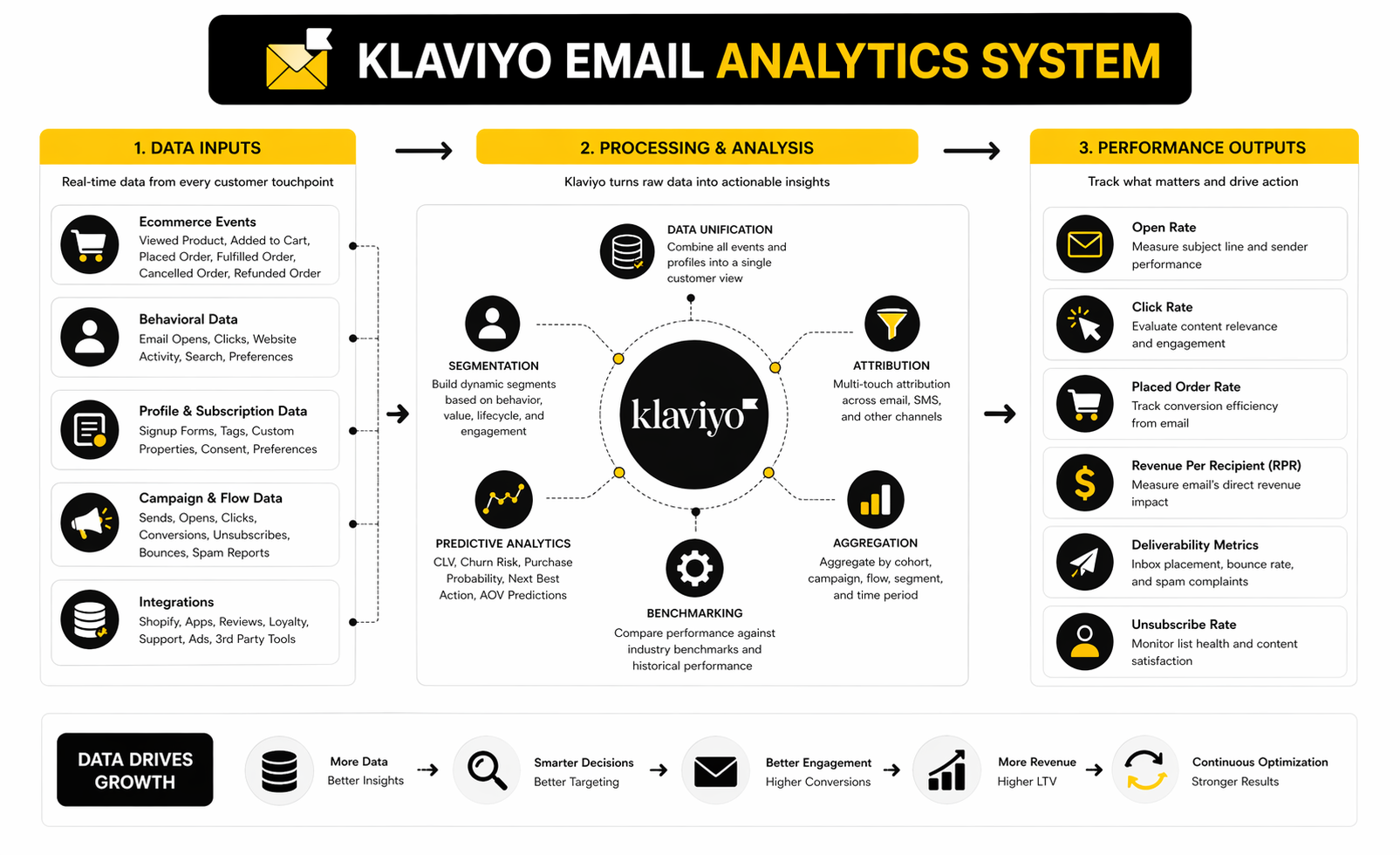
This is why measurement inside Klaviyo email should move in layers. Opens can tell you whether the message earned initial attention. Clicks tell you whether the offer and message architecture created intent. Orders and revenue per recipient tell you whether the email actually contributed commercial value. When those layers do not line up, that mismatch usually reveals the problem faster than any isolated dashboard number.
Health Metrics Matter Because They Protect Future Revenue
A Klaviyo email program can look productive right up until mailbox providers decide it is not trustworthy. That is why measurement cannot stop at revenue and clicks. You also need to watch the signals that protect deliverability, because weak sender health eventually turns into lost reach and lost sales.
Google’s sender FAQ states that bulk senders become ineligible for mitigation when user-reported spam rates are above 0.3%, and Yahoo’s sender guidance uses the same 0.3% spam-rate threshold. That should immediately reframe how you look at complaint rates. They are not just a customer-experience metric. They are a platform-risk metric.
Unsubscribes, bounce rates, and complaints should all trigger action, but not panic. A small spike after a strong promotion does not automatically mean the system is broken. A repeating pattern of elevated complaints, rising unsubscribes, and falling clicks usually means your Klaviyo email strategy is pushing too hard, targeting too loosely, or promising something in the subject line that the body does not deliver.
What the Data Should Make You Do Next
The real value of analytics is not the reporting itself. It is the decision that follows. If your open rate is healthy but click rate is weak, the next move is usually to improve the offer, simplify the call to action, tighten segmentation, or reduce link clutter. If click rate is healthy but order rate is soft, the issue may be landing page friction, mismatched product selection, or a disconnect between email promise and on-site experience.
If flow revenue per recipient is strong and campaign revenue per recipient is weak, that does not mean campaigns are useless. It means campaigns need a clearer job. They may be better used for launches, category pushes, seasonal moments, and brand storytelling while automations do the heavy lifting on conversion-rich lifecycle moments. That is a much smarter interpretation than simply deciding campaigns are underperforming and should be sent more often.
If complaint rates or unsubscribes start climbing, the action is even more direct. Mail fewer people, exclude low-intent segments, reduce overlap with flows, and tighten the relevance of each send. Klaviyo email rewards precision. The data is useful because it keeps telling you the same truth: better targeting usually beats more volume.
Professional Implementation and Long-Term Scaling
A Klaviyo email program gets harder, not easier, once it starts working. Early wins usually come from fixing obvious gaps like missing flows, weak segmentation, or poor authentication. The next phase is different. Now the challenge is protecting performance while the account gets bigger, the team gets busier, and more revenue starts depending on the system.
This is where experienced operators separate themselves from enthusiastic beginners. They stop asking only how to send better emails and start asking how to run Klaviyo email as an operating system. That means governance, testing discipline, channel coordination, and a much sharper understanding of tradeoffs.
Scaling Too Fast Can Break What Was Working
One of the biggest mistakes in Klaviyo email is assuming that more volume automatically means more revenue. It often does for a while, and that is exactly why the trap is so convincing. Then complaints rise, click quality drops, and inbox placement starts getting weaker even though the team thinks it is being more aggressive in the right direction.
Google’s sender FAQ makes the risk plain: bulk senders that stay above a 0.3% user-reported spam rate remain ineligible for mitigation, and Gmail updates those measurements daily in Postmaster-related guidance. Klaviyo’s own deliverability documentation points back to the same operational reality by emphasizing engagement, list hygiene, and content testing as ongoing disciplines rather than one-time setup tasks in the deliverability reference.
The practical takeaway is simple. If a Klaviyo email account grows by increasing relevance, it usually compounds. If it grows by increasing pressure, it usually creates invisible damage first and visible damage later.
Advanced Programs Need Stronger Flow Governance
A small account can survive a little chaos. A larger one cannot. Once you have welcome flows, cart recovery, browse abandonment, post-purchase, win-back, replenishment, VIP messaging, and campaign calendars all moving at once, the real problem becomes orchestration.
This is why advanced Klaviyo email teams treat flow governance as part of performance, not just project management. They define which automations have priority, which segments are excluded from which sends, and how long a customer should wait before moving from one message environment to another. Klaviyo’s post-purchase strategy content keeps reinforcing that overlap management matters because customers should not feel like they are being hit from multiple directions with disconnected goals in the post-purchase strategy article.
There is also a revenue reason to get this right. Klaviyo’s benchmark data shows flows producing nearly 41% of email revenue from only 5.3% of send volume, which means flow clutter is not a minor operational annoyance. It directly affects one of the highest-efficiency parts of the channel. When automation carries that much financial weight, governance stops being optional.
Segmentation Has to Mature With the Business
Basic segmentation can get a brand off the ground, but scale demands more nuance. Once the customer base gets larger, a flat logic model starts hiding important differences between new buyers, loyal repeat buyers, discount-trained buyers, seasonal buyers, and high-value customers with different product affinities. If those groups are all treated the same, performance usually starts leveling off even though the list is bigger.
Klaviyo’s newer segmentation direction reflects that shift. Its product and strategy materials keep leaning into predictive analytics, lifecycle grouping, cohort views, and value-based segmentation because those approaches help teams act on future behavior instead of only reacting to past events on the segmentation feature page and in its cohort analysis announcement. That is a meaningful step up from building every audience around opens, clicks, and broad recency windows.
For a serious Klaviyo email program, the question eventually becomes less about who engaged and more about who is likely to matter next. Who is trending toward a second order? Who is at risk of lapsing? Which cohorts are improving over time, and which ones are decaying faster than they used to? Those are scaling questions, and they require a more strategic segmentation model than most brands start with.
Testing Has to Move Beyond Subject Lines
There is nothing wrong with testing subject lines. The problem is stopping there. Once a Klaviyo email program reaches a certain size, the higher-leverage tests are often deeper in the system. Offer strategy, audience definition, send suppression rules, creative hierarchy, landing page continuity, and flow timing can all matter more than a marginal headline improvement.
Klaviyo’s deliverability and benchmarking materials keep pointing toward that broader view. Engagement quality shapes inbox outcomes, and revenue per recipient makes it easier to see whether changes actually improve business performance instead of just boosting a soft metric in the deliverability reference and in the RPR framework. Klaviyo also notes that the top 10% of automated flows drive $16.15 in revenue per recipient, with abandoned cart flows leading at $27.12, which is a strong reminder that the upside in flow optimization can be large when the fundamentals are already in place.
That should change how testing is prioritized. Instead of only asking which subject line wins, advanced teams ask which audience definition drives the cleanest click quality, which delay sequence protects margin without hurting conversion, and which content structure creates stronger downstream purchase behavior. That is a much more mature use of Klaviyo email than endlessly swapping headlines and emojis.
Cross-Channel Coordination Becomes More Important as You Scale
As a brand grows, email stops operating in a vacuum. Customers see paid media, onsite experiences, SMS, support communications, loyalty messages, and post-purchase touchpoints all at once. If Klaviyo email is being managed like a standalone channel, it eventually starts colliding with the rest of the customer experience.
Klaviyo has been increasingly explicit about this broader role. Its channel strategy content frames email as one part of a larger owned-marketing system, and its benchmark materials show how different channels support different commercial moments rather than performing the same job in the channel strategy article and on the email benchmarks page. That matters because a scaling program should coordinate timing and role clarity, not just add more touchpoints.
This is also where process discipline helps. If email is promoting one offer while paid traffic is landing on another message, conversion friction grows. If post-purchase email is trying to nurture a second order while support issues remain unresolved, retention suffers. Klaviyo email becomes much more effective when it is aligned with merchandising, creative, customer service, and retention planning instead of being treated like an isolated CRM function.
The Best Long-Term Strategy Is Usually More Selective, Not More Aggressive
This is the part many teams resist because it sounds less exciting. But in mature accounts, improvement often comes from removing noise rather than adding complexity. That might mean suppressing lower-intent audiences, simplifying overbuilt flows, narrowing campaign eligibility, or sending less often to the wrong people so the right people engage more often.
Klaviyo’s deliverability guidance on engagement-based sending points in exactly that direction, recommending consistency, list hygiene, and audience management over indiscriminate volume increases in the deliverability training and the engagement-based segmentation article. The logic is straightforward: mailbox providers respond to patterns, and customers do too.
So the expert-level version of Klaviyo email is not endless automation, endless campaigns, or endless personalization tokens. It is a cleaner system with sharper targeting, stronger governance, and better commercial judgment. That is what allows the channel to keep scaling without turning into a volume machine that quietly weakens its own results.
For most brands, the end goal is not just to send better messages. It is to build a Klaviyo email system that keeps getting smarter as data improves, automations mature, and customer behavior becomes easier to read. Once you reach that point, the channel stops being a simple retention tactic and starts acting like a coordinated ecosystem that supports acquisition efficiency, conversion quality, repeat purchase, and long-term customer value.
That is the real payoff. Klaviyo email works best when strategy, infrastructure, measurement, and governance all reinforce each other instead of competing for attention. When those pieces are aligned, the account becomes easier to optimize, easier to scale, and much harder to destabilize with random tactical changes.
FAQ
Is Klaviyo email only for ecommerce brands?
Klaviyo email is strongest in ecommerce because the platform is built around customer profiles, event data, product catalogs, and revenue attribution. That said, it can also work for subscription businesses, service brands, and companies with strong lifecycle marketing needs. The real question is not whether a brand sells online, but whether it can feed Klaviyo enough meaningful customer data to power segmentation and automation well.
How many flows should a brand launch first?
Most brands should start with a small core flow stack instead of trying to automate everything at once. A welcome flow, abandoned cart flow, post-purchase flow, and sometimes browse abandonment flow usually create the best early return because they map to high-intent moments. Once those are performing cleanly, Klaviyo email can expand into replenishment, win-back, VIP, and category-specific automations without creating unnecessary complexity too early.
What matters more in Klaviyo email: campaigns or flows?
Flows usually matter more for revenue efficiency, while campaigns matter more for reach, launches, merchandising pushes, and planned communication. Klaviyo’s 2026 benchmark data shows flows generating nearly 41% of email revenue from just 5.3% of sends, which tells you where the leverage really sits. That does not make campaigns unimportant, but it does mean the smartest accounts build the automated layer first and let campaigns play a more strategic supporting role.
Are open rates still useful?
Open rates are still useful, but they are no longer a clean truth signal because Apple Mail Privacy Protection can inflate them by loading remote content in the background in Apple’s privacy documentation. In practice, open rate is best used as directional context rather than as the final verdict on performance. For a Klaviyo email program, clicks, placed order rate, revenue per recipient, unsubscribe rate, and complaint rate usually tell a more reliable story.
What is a good revenue per recipient target?
There is no universal target because revenue per recipient changes by industry, price point, offer strategy, list quality, and customer lifecycle stage. What matters more is whether your Klaviyo email revenue per recipient is improving over time and whether flows are materially outperforming campaigns, which they usually should. If RPR is weak, that usually points to poor segmentation, weak offer-message fit, or an automation layer that is not pulling enough commercial weight.
How often should you email your list?
There is no perfect number that works for every brand, and that is exactly why fixed “best practice” send schedules often fail. Frequency should be driven by engagement, buying cycle, offer strength, and how much overlap already exists between flows and campaigns. Klaviyo’s Smart Sending controls are built for this problem because they help limit message volume across active campaigns and flows when subscriber fatigue becomes a risk in the Smart Sending documentation.
What is the biggest deliverability mistake brands make?
The biggest mistake is usually not one technical failure. It is continuing to send too broadly, too often, or to low-intent subscribers long after the signals have gone bad. Gmail’s sender guidance makes the stakes clear by flagging 0.3% spam complaint rate as a danger zone, so a sloppy Klaviyo email strategy can quietly damage future reach even if short-term revenue still looks acceptable.
Should you use Klaviyo email together with SMS?
For many brands, yes, but only when the channel roles are clear. Email is usually better for richer storytelling, merchandising depth, longer-form lifecycle education, and revenue-efficient automation, while SMS is better for urgency, reminders, and concise high-intent nudges. Klaviyo’s broader channel strategy increasingly reflects that owned-channel performance improves when brands let each channel do the job it is best suited for instead of copying the same message across everything in its channel strategy guidance.
How important is list growth compared with optimization?
Both matter, but list growth without quality control usually creates more future problems than future revenue. A bigger list does not help much if those subscribers are poorly qualified, weakly engaged, or joining without a clear value exchange. Klaviyo email gets stronger when acquisition and retention work together, which is why clean forms, consent pages, and preference capture matter almost as much as the emails themselves in Klaviyo’s sign-up forms and subscribe pages reference and its consent pages guide.
Does Klaviyo attribution show the full picture?
It shows a useful picture, but it still needs interpretation. Klaviyo’s attribution settings now allow brands to adjust windows and models, which is important because different businesses have different buying cycles and different touchpoint complexity in Klaviyo’s attribution model documentation and its omnichannel attribution update. A smart operator uses Klaviyo email attribution as a strong directional system, then checks whether the interpretation still matches actual customer behavior and channel overlap.
What should a new brand do in its first 30 days with Klaviyo?
The first month should be focused and boring in the best possible way. Connect the store correctly, authenticate sending, capture consent properly, build the core segments, and launch the essential flows before getting distracted by advanced experiments. That sequence gives a Klaviyo email program a chance to build trust, collect usable data, and generate early revenue without stacking complexity on top of shaky foundations.
When is it worth bringing in professionals?
It is worth bringing in professionals when the account has enough traffic, enough customer data, or enough revenue dependency that mistakes start becoming expensive. That usually happens well before a team feels fully “ready,” especially when flow overlap, attribution questions, deliverability risk, and cross-channel coordination start creating friction. A strong Klaviyo email specialist does not just write emails. They help turn a scattered retention setup into a structured revenue system.
Work With Professionals
Explore 10K+ Remote Marketing Contracts on MarkeWork.com
Most marketers spend too much time chasing clients, competing on crowded platforms, and losing a percentage of every project to middlemen. MarkeWork gives you a better way. Browse thousands of remote marketing contracts and connect directly with companies desperate to hire skilled marketers like you, without platform commissions and without unnecessary gatekeepers.
If you're serious about finding better opportunities and keeping 100% of what you earn, explore available contracts and create a profile for free at MarkeWork.com.