

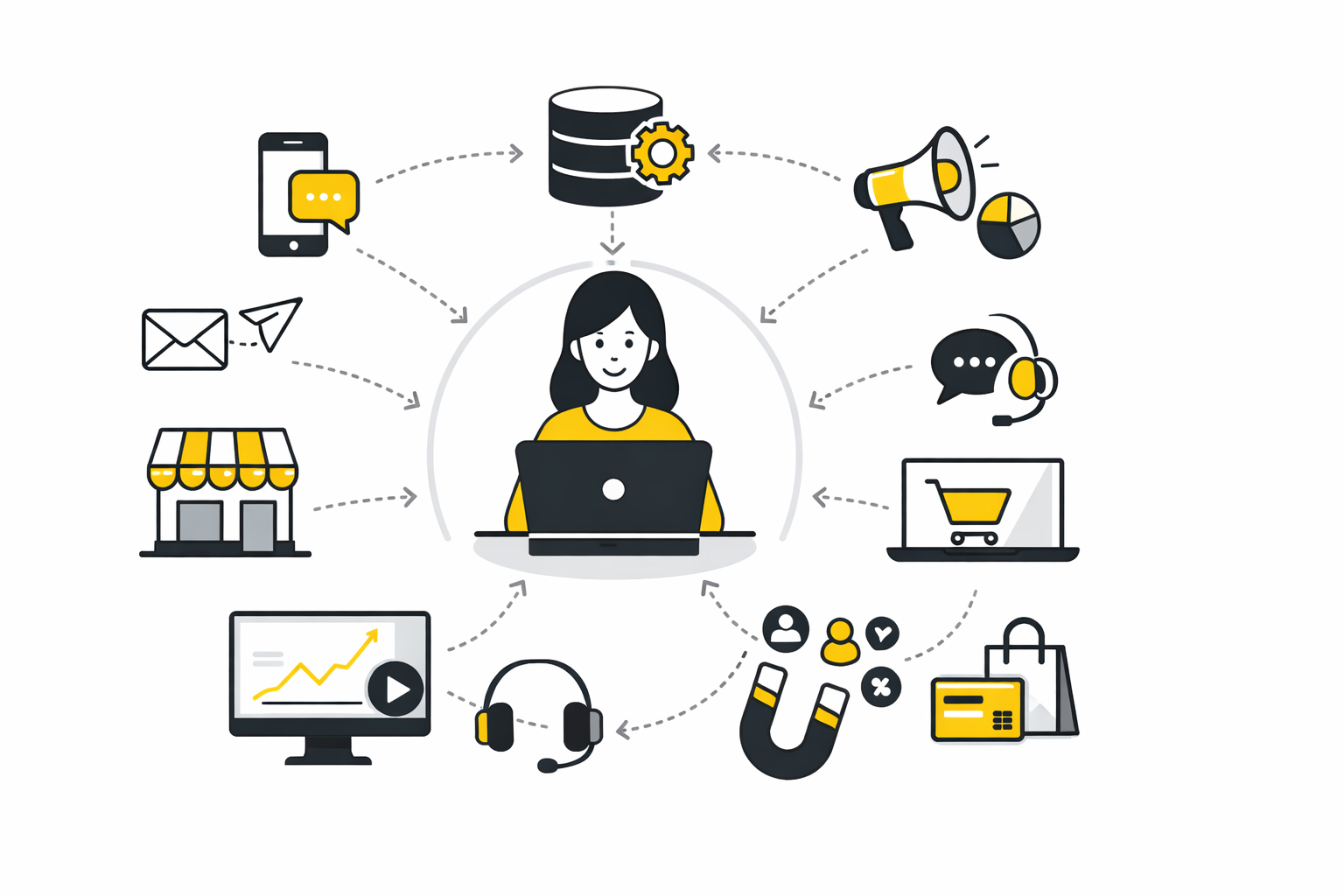
A real omnichannel marketing system is not built by adding more channels. It is built by connecting the few things that determine whether the experience feels smooth or fragmented. Once the strategy is clear, the work shifts from theory to infrastructure, workflows, and execution discipline.
This is where a lot of teams discover the uncomfortable truth. They do not have an omnichannel problem because they are missing ideas. They have an omnichannel problem because customer data lives in one place, campaign logic lives in another, reporting lives somewhere else, and nobody fully owns the handoffs in between. Research from IAB’s State of Data 2024, Google’s retail guide, and Shopify’s unified commerce content all point toward the same conclusion: connected experiences depend on connected systems.
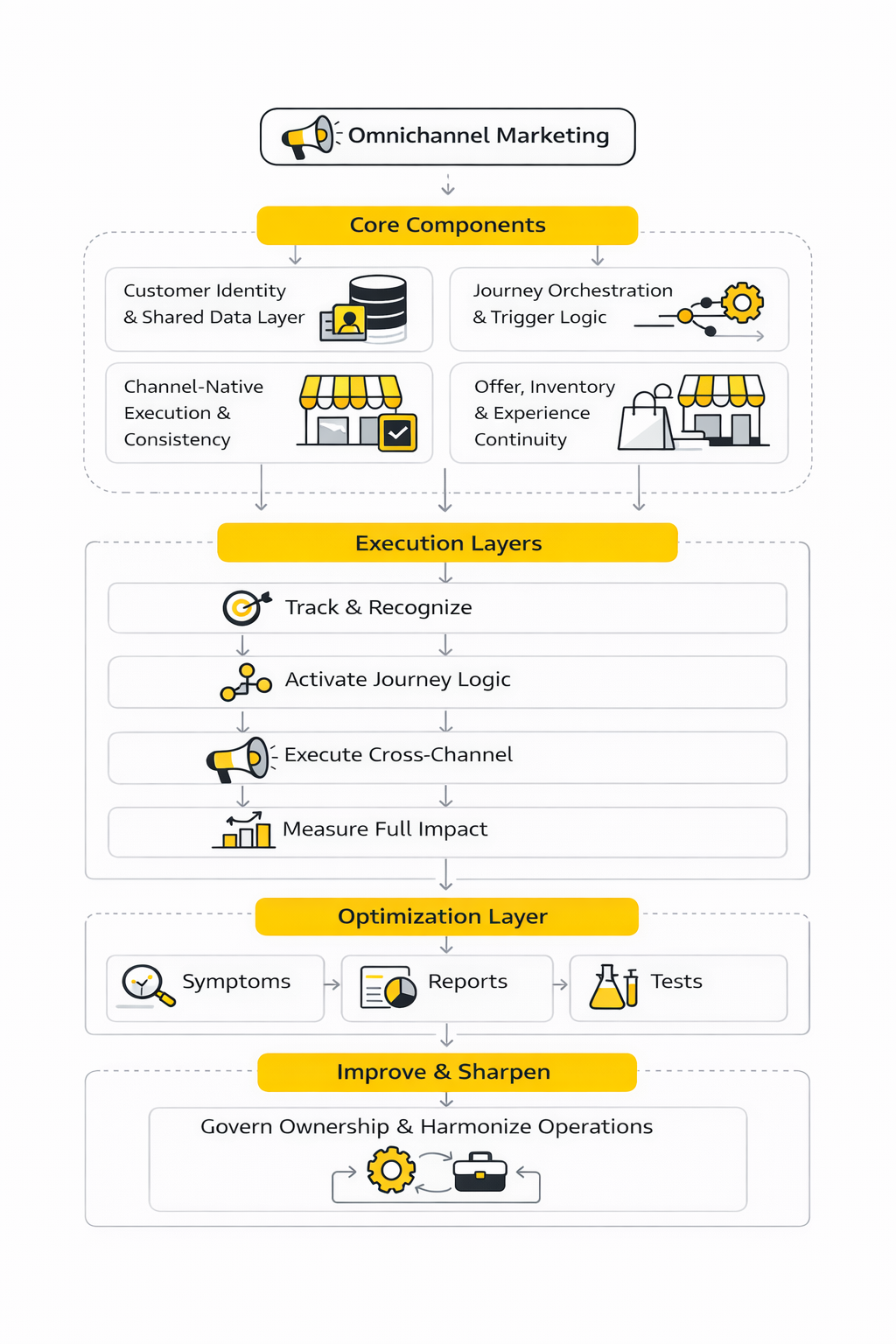
The core components below are the pieces that make omnichannel marketing actually work. Miss one of them, and the rest starts to wobble.
Customer Identity and a Shared Data Layer
Everything starts with recognition. If your business cannot tell that the person who clicked an ad, browsed a product page, opened an email, and walked into a store is probably the same customer, then every downstream interaction becomes less relevant. You do not need perfect identity resolution to improve omnichannel marketing, but you do need a shared customer view that combines meaningful behavioral, transactional, and engagement signals.
That matters even more now because first-party data is doing more of the heavy lifting. IAB’s 2024 research shows that brands, agencies, and publishers are actively reworking their data strategies around privacy-compliant collection and activation, which is exactly what omnichannel execution now depends on. The days of lazy targeting and platform dependency are fading, and that is forcing marketers to get serious about customer data quality.
In practical terms, this means building a data layer that can combine profile data, purchase history, browsing behavior, messaging engagement, support context, and consent status in one usable structure. For some companies that lives inside a CRM. For others it sits in a CDP, warehouse, or commerce stack. What matters is not the acronym. What matters is whether the next touchpoint can react to what just happened.
This is also where tool choice becomes strategic instead of cosmetic. A business using Brevo, GoHighLevel, or Copper is not really choosing email software or CRM screens. It is choosing how customer context will be stored, updated, and activated across the journey. That decision has more impact on omnichannel marketing than most creative debates ever will.
Journey Orchestration and Trigger Logic
Once you can recognize customers with reasonable accuracy, the next question is timing. Omnichannel marketing only feels smart when the next message, offer, or prompt reflects what the customer just did. That is why orchestration matters so much. It turns raw data into sequenced interactions.
This is where a lot of brands still operate like disconnected campaign machines. One team blasts a promo email, another runs retargeting, another pushes SMS, and none of it accounts for whether the person already converted, switched devices, asked for help, or abandoned because of a stock issue. The result is noise disguised as marketing.
A stronger setup uses trigger logic tied to real behavior. Someone watches a product demo but does not book a call, so they get a follow-up with a relevant case study. Someone adds to cart but stalls, so they receive a reminder only if the product is still available and the pricing has not changed. Someone engages on Instagram and then lands on the site, so the homepage or landing page reflects that entry context instead of pretending they arrived cold.
This is why omnichannel marketing increasingly overlaps with automation design. Twilio’s 2024 personalization research makes the point clearly: AI and personalization are only as effective as the underlying data and orchestration systems behind them. Automation is not the point by itself. Automation becomes valuable when it removes friction without making the brand feel robotic.
For leaner businesses, conversational and lifecycle tools can play an outsized role here. ManyChat can help bridge social engagement into direct messaging flows, while Chatbase can support always-on conversational entry points when customers need answers before moving forward. Used well, these are not just engagement tools. They become routing tools inside the broader customer journey.
Channel-Native Execution Without Losing Consistency
One of the biggest mistakes in omnichannel marketing is assuming that consistency means sameness. It does not. A connected customer experience should feel coherent, but that does not mean every channel should carry the exact same message in the exact same format. People behave differently in search, email, SMS, paid social, organic social, web, chat, marketplaces, and in-store environments. Smart omnichannel execution respects that.
The brand promise should stay recognizable, but the delivery should adapt. Search often captures active intent. Email is usually better for depth, follow-up, and sequencing. SMS is stronger when urgency or immediacy matters. Social works best when attention still needs to be earned. In-store or sales-assisted touchpoints carry a very different expectation because the customer is now closer to decision and wants clarity, confidence, or reassurance rather than more discovery content.
That is why omnichannel marketing depends on modular content, not duplicated content. The same offer might appear as a short paid social hook, a richer landing page, a reminder email, and a support script, but each version should match the channel’s role in the journey. Research in the Journal of Business Research and a recent Journal of Marketing Management paper on personalised omnichannel journeys both reinforce the idea that the design of the touchpoint and the stage of the journey shape how personalization is experienced.
This is also where content operations start to matter more than marketers usually admit. If paid campaigns, email flows, on-site modules, and sales enablement assets are produced in isolation, message drift becomes inevitable. A practical fix is to create one central messaging spine for each major audience and offer, then adapt the execution by channel. That keeps omnichannel marketing aligned without flattening it.
For teams pushing more content volume, scheduling and social coordination tools can support this layer, but only if they sit inside a larger system. Buffer or Flick can help with distribution and workflow, but they should serve the journey rather than become the strategy.
Offer, Inventory, and Experience Continuity
A lot of omnichannel marketing breaks not because the messaging fails, but because the underlying experience does. The ad is relevant, the email is strong, the landing page converts, and then the customer hits a wall because inventory is inaccurate, pricing is inconsistent, checkout is clumsy, or support has no visibility into the journey. At that point the problem is no longer marketing copy. The problem is continuity.
This is especially obvious in retail, ecommerce, and location-based businesses. Google’s omnichannel guidance makes the point that online and offline performance are deeply connected, which means marketing cannot be judged or managed as if each sale lives in a sealed channel. Shopify’s guidance on unified commerce and order management pushes in the same direction by emphasizing integrated customer and order data across touchpoints.
The practical lesson is simple. If your campaign promises “pick up today,” your operations need to make that true. If your email promotes a product bundle, the website, support team, and checkout flow need to reflect the same offer. If a salesperson or store associate cannot see relevant customer context, your omnichannel marketing system loses force at the exact moment it should become most persuasive.
This is why the best omnichannel teams work closely with commerce, service, and operations. Marketing can open demand, but continuity is what converts that demand into trust. A disconnected post-click experience can quietly destroy the value of otherwise excellent acquisition work.
Measurement That Reflects the Real Journey
If you measure omnichannel marketing with siloed dashboards, you will optimize for the wrong things. That sounds harsh, but it is true. Teams that reward last-click outcomes, isolated platform ROAS, or single-channel engagement rates often end up underinvesting in the touchpoints that actually move the customer forward earlier in the journey.
Modern measurement needs to be broader and more honest. It has to account for assisted conversions, lag time between touchpoints, offline influence, repeat purchase behavior, and the difference between channel credit and channel contribution. Google’s retail reporting and its measurement guidance for omnichannel customer experience both push marketers to stop thinking in terms of isolated online versus offline wins and start measuring the combined impact.
That means your KPI stack usually needs layers. At the channel level, you still track efficiency. At the journey level, you track movement, conversion quality, and drop-off points. At the customer level, you track retention, repeat behavior, lifetime value, and responsiveness to personalization. And at the business level, you track whether the whole system is becoming easier to scale profitably.
This part is not glamorous, but it is decisive. A weak measurement model will slowly train the team to sabotage good omnichannel marketing because the reporting cannot see what is working. A stronger model gives you permission to invest in the full journey instead of only the last visible click.
Governance, Ownership, and Operating Rhythm
The final component is the one companies underestimate the most: ownership. Omnichannel marketing fails surprisingly often because everybody touches it and nobody really owns it. The CRM team owns lifecycle. Paid owns acquisition. Ecommerce owns the site. Retail owns stores. Sales owns pipeline. Support owns post-purchase. Each function works hard, but the customer still experiences the seams.
That is why high-performing omnichannel systems usually create clear operational rules. Someone defines customer stages. Someone owns journey logic. Someone manages naming conventions, event tracking, and data hygiene. Someone decides which team has authority when priorities conflict. Without those decisions, omnichannel marketing turns into a coordination fantasy.
The good news is that this does not require a giant transformation project on day one. It requires a repeatable operating rhythm. Teams review journey friction, not just channel metrics. They inspect handoffs, not just campaign results. They fix broken experiences, not just underperforming ads. That is the shift from channel marketing to omnichannel marketing in the real world.
With those components in place, the next question becomes practical: how do you implement all this without turning your stack, your team, and your reporting into a mess. That is where the work gets more tactical, and it is exactly where we are going next.
The Numbers That Matter in Omnichannel Marketing
By this stage, the temptation is to start collecting stats just to make the article look authoritative. That is not useful. The only numbers worth paying attention to in omnichannel marketing are the ones that tell you where customer expectations are moving, where execution is breaking, and which signals should change your next decision.
The broader pattern is clear. Customer journeys are more fluid, channel boundaries matter less to buyers than they do to internal teams, and brands still struggle to measure the full effect of connected experiences. That is why the right data should not just decorate a strategy deck. It should tell you what to fix, what to prioritize, and what to stop pretending is working.
Customer Expectations Are Rising Faster Than Most Systems
One of the clearest signals comes from customer expectation research. Salesforce’s latest connected customer research, based on 16,000+ consumers and business buyers worldwide, shows that comfort with AI and automated engagement depends heavily on context, trust, and use case. That matters because omnichannel marketing is not simply about being present across channels anymore. It is about making the experience feel relevant without crossing the line into something that feels careless or intrusive.
Google’s recent consumer research shows the same shift from a different angle. In its Asia-Pacific omnichannel analysis, highly confident shoppers showed a 1.4x increase in purchase value and were 18x more likely to recommend the brand. That is a powerful signal because it reframes the goal. Omnichannel marketing is not only about pushing conversion. It is about increasing confidence during the journey, which then lifts both revenue quality and downstream advocacy.
The action here is straightforward. If your channels are creating uncertainty, making customers repeat steps, or sending conflicting signals, the problem is larger than friction. You are suppressing both order value and word of mouth. That is why better continuity is not just a CX project. It is a commercial lever.
Measurement Still Lags Behind Customer Behavior
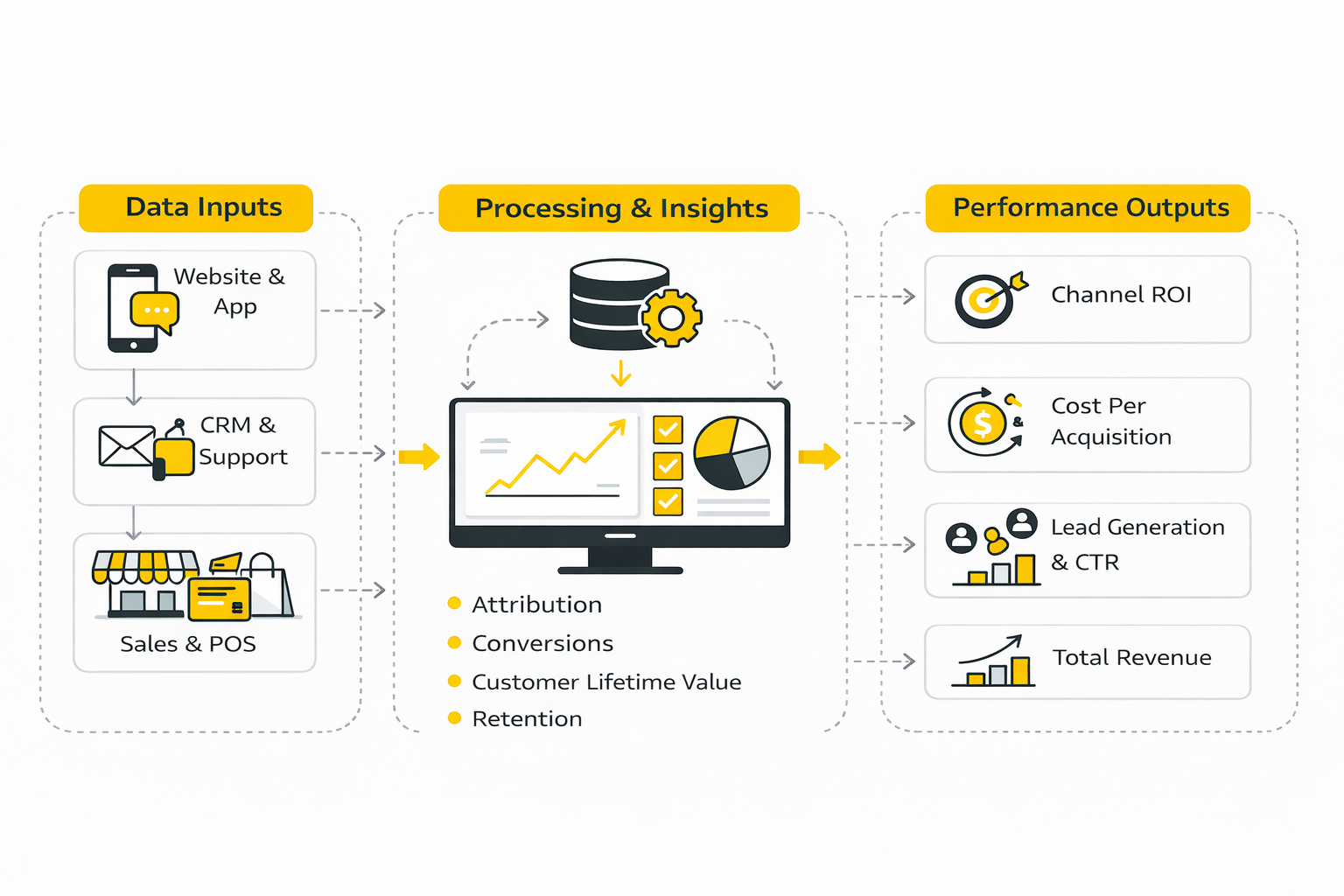
One of the most important insights in this space is not a flashy percentage. It is the gap between how customers actually shop and how brands still report performance. Google’s omnichannel measurement guidance makes the point directly: online and offline sales are intrinsically linked, so measurement should be omnichannel too. That sounds obvious, but many teams are still optimizing budget around platform-reported conversions, isolated ecommerce outcomes, or last-click logic that ignores store visits, delayed decisions, and cross-device behavior.
That measurement gap has real consequences. If a paid search click leads to a store visit, or a YouTube view drives a later branded search, or an email follow-up helps a high-value customer complete a purchase offline, a siloed dashboard will often under-credit the actual value of the touchpoint. The wrong dashboard then trains the team to cut or underinvest in the channels that are quietly making the full journey work.
This is where omnichannel marketing gets serious. If your reporting model cannot see cross-channel contribution, your optimization decisions will push the system in the wrong direction. You will think you are improving efficiency while slowly stripping away the interactions that create confidence and conversion.
First-Party Data Has Moved From Advantage to Requirement
There is a reason first-party data keeps showing up in serious measurement conversations. The IAB’s measurement and innovation work in retail media highlights how first-party data supports more relevant experiences, better audience creation, and more credible measurement in a privacy-conscious environment. That is not just a retail media point. It reflects the broader direction of omnichannel marketing.
In practical terms, this means brands that still depend on fragmented identifiers or loosely connected platform data are working at a disadvantage. If you cannot tie engagement, purchase behavior, and customer status together inside your own system, your personalization will stay shallow and your reporting will stay incomplete. You might still run campaigns, but you will struggle to learn from them properly.
The action this should drive is not “collect more data.” It is “collect the right signals and make them usable.” Source, product interest, lifecycle stage, purchase history, consent status, and service interactions usually matter far more than bloated profile fields nobody trusts. Better data design beats bigger data every time.
Inventory Visibility and Channel Coordination Are Still Differentiators
Some of the most useful omnichannel data is operational, not promotional. Google’s 2024 European omnichannel study found that 84% of omnichannel retailers let store assistants access stock data from other stores and online. That number matters because it shows where the market is heading. Connected inventory visibility is no longer a nice touch for advanced retailers. It is increasingly part of the baseline experience.
Why does that matter for marketing? Because every demand-generation dollar becomes more valuable when the business can fulfill the promise across channels. A local inventory ad, a pickup message, or a product page with misleading availability does not fail in the ad account. It fails in the customer experience. That means marketing performance and operations are more tightly linked than many reporting models admit.
The right interpretation is not that every brand now needs a massive commerce transformation project. It is that omnichannel marketing should be evaluated partly by whether the experience after the click supports the promise before the click. If your measurement ignores that, you are only measuring half the job.
Personalization Ambition Is Outrunning Execution
Another pattern worth paying attention to is the gap between what brands want to deliver and what their systems can reliably support. McKinsey’s latest thinking on personalized marketing argues that AI and generative AI are expanding the ability to scale tailored experiences, but that opportunity only becomes real when the underlying operating model can support it. In other words, ambition is cheap. Execution is the bottleneck.
Adobe is even more direct in its recent journey orchestration framing, noting that 78% of consumers expect a seamless experience across digital and physical channels, while only 45% of brands meet that expectation. That is one of the most useful benchmark gaps in the whole conversation because it explains why so many omnichannel strategies feel impressive internally and inconsistent externally.
The action here is not to panic and buy more AI tooling. It is to close the gap between promise and delivery. If your team cannot yet execute clean identity handling, suppression logic, handoff rules, and consistent offers, then advanced personalization will only magnify the mess. Better orchestration beats more complexity.
What Good Omnichannel Benchmarks Actually Look Like
Most teams ask for benchmarks too early. They want to know what a good click-through rate, return on ad spend, open rate, or assisted conversion share should be before they have even agreed on how the customer journey works. That usually leads to false comparisons because benchmarks are only useful when they match the journey type, the channel role, and the business model.
A stronger benchmark model uses layers. At the channel level, you still care about efficiency, response, and cost. At the journey level, you track progression, abandonment, repeat touchpoints, and time to conversion. At the customer level, you look at repeat purchase rate, average order value, retention, and responsiveness to coordinated experiences. And at the business level, you care about whether the full system is producing more profitable growth with less friction.
This is important because omnichannel marketing should not be judged by a single vanity metric. A paid campaign with modest last-click efficiency might still be a strong performer if it increases store visits, lifts branded search, improves lead quality, or shortens the path to purchase. A lifecycle flow with average click rates might still be extremely valuable if it reduces churn or increases reorder frequency. The benchmark has to match the role.
Performance Signals Worth Watching Closely
There are a few signals that deserve more attention than they usually get. One is journey completion rate across channel combinations, not just by individual channel. Another is suppression quality, because duplicate or contradictory messaging often reveals deeper orchestration problems. A third is lag time between first touch and conversion, which helps you understand whether your reporting window is hiding actual influence.
You should also watch confidence indicators wherever you can measure them. That can include assisted conversion patterns, content depth before purchase, repeat sessions before conversion, appointment show rates, and post-purchase satisfaction tied to acquisition source or journey type. Google’s confidence research is useful here because it suggests that the emotional quality of the journey has measurable economic value, not just branding value.
The practical takeaway is simple. Metrics that reveal journey quality are usually more useful than metrics that only reveal channel activity. Omnichannel marketing wins when the system reduces friction and increases confidence, not when one dashboard happens to look cleaner in isolation.
What the Data Should Drive Next
If the numbers above point to anything, it is this: omnichannel marketing should become more disciplined, not more bloated. Customer expectations are rising. Measurement is still catching up. First-party data is now foundational. Cross-channel continuity affects both conversion and loyalty. And many brands are still overestimating how connected their customer experience really is.
That should drive a very specific set of actions. Tighten the customer view. Measure the journey, not just the final click. Connect marketing promises to operational reality. Simplify the first orchestration layers before adding complexity. And judge performance by whether the full experience becomes easier, more confident, and more profitable over time.
From here, the conversation naturally shifts into optimization and scaling. Once you know what to measure and how to interpret it, the next step is improving the system without losing the consistency that made it work in the first place.
In the end, omnichannel marketing is not really about channels. It is about continuity. The brand remembers what happened, responds in context, and makes the next step easier for the customer instead of harder. When that happens consistently, the experience feels more trustworthy, the marketing feels more relevant, and the business becomes easier to grow.
That is also why so many companies struggle with it. Omnichannel marketing exposes every weak handoff inside the business. Bad data, conflicting goals, messy ownership, thin reporting, and disconnected operations all become visible once the customer starts moving across touchpoints. The upside is that when you fix those seams, you do not just improve campaigns. You improve the way the whole commercial system works.
The strongest teams treat omnichannel marketing as a long-term operating advantage. They do not chase perfect orchestration across every channel on day one. They choose the journeys that matter, clean up the data that matters, align the people who matter, and build a system that gets smarter with each iteration. That is the version worth building.
FAQ - Built for Complete Guide
What is omnichannel marketing in simple terms?
Omnichannel marketing is the practice of creating one connected customer experience across multiple touchpoints. Instead of treating email, ads, website visits, social engagement, chat, stores, sales, and support as separate worlds, it makes them work together. The customer should feel like they are dealing with one brand that remembers context, not six disconnected departments.
That distinction matters because customer behavior is already cross-channel. Recent customer expectation research from Salesforce and Google shows that people expect smoother movement between digital and physical touchpoints than many brands still deliver.
What is the difference between multichannel and omnichannel marketing?
Multichannel means a brand uses more than one channel. Omnichannel means those channels are connected in a way that preserves customer context. That sounds like a small difference, but it changes everything operationally.
A multichannel business can send emails, run ads, publish on social media, and operate stores without those experiences really talking to each other. Omnichannel marketing goes further by aligning data, timing, offers, reporting, and customer state so the journey feels continuous rather than fragmented.
Why does omnichannel marketing matter so much now?
It matters because customers no longer follow neat, linear journeys. They research on mobile, compare on desktop, ask questions in chat, visit a store, come back later through email, and expect the brand to keep up. That is not unusual behavior anymore. It is normal behavior.
There is also a real commercial reason. Google found that more confident shoppers generated higher purchase value and were dramatically more likely to recommend the brand. Omnichannel marketing matters because smoother journeys increase confidence, and confidence tends to lift both conversion quality and loyalty.
What channels count in an omnichannel marketing strategy?
Any customer-facing touchpoint that influences the journey can count. That includes paid search, paid social, organic social, email, SMS, website experiences, landing pages, apps, live chat, marketplaces, in-store interactions, sales calls, customer support, and post-purchase communication. The right set depends on how customers actually buy from the business.
The mistake is thinking omnichannel marketing means being everywhere. It does not. It means connecting the channels that matter most to the journey and giving each one a clear role.
What is the first step to building an omnichannel marketing strategy?
The first step is not choosing software. It is selecting one high-value customer journey to fix. That journey should matter commercially, involve multiple touchpoints already, and have visible friction the team can improve.
Starting there keeps omnichannel marketing manageable. It gives the business a chance to prove value with one connected journey before trying to coordinate everything at once. That is usually how strong systems are built in real life.
Do small businesses need omnichannel marketing too?
Yes, but not in the bloated enterprise version people often imagine. A smaller business can still benefit enormously from connecting its site, CRM, email, social DMs, booking flow, and follow-up process. Omnichannel marketing is about coherence, not company size.
In fact, smaller teams can sometimes move faster because fewer departments are involved. A lean stack built around tools like GoHighLevel, Brevo, or ManyChat can create a surprisingly strong omnichannel marketing foundation when the journey logic is clear.
What data is most important for omnichannel marketing?
The most important data is the data that changes the next customer interaction. That usually includes source, product or service interest, lifecycle stage, purchase history, consent status, engagement history, and service or sales status. You do not need endless data fields. You need reliable signals that help the system respond intelligently.
That is why first-party data matters so much now. Work from IAB and IAB Europe keeps pointing back to the same reality: stronger identity and measurement depend on better owned data, especially as privacy expectations and platform changes keep rising.
How do you measure omnichannel marketing properly?
You measure it in layers. Channel metrics still matter, but they are not enough on their own. You also need journey metrics, customer metrics, and business metrics to understand whether the system is actually improving performance.
That means looking at assisted conversions, time to conversion, repeat purchase behavior, suppression quality, retention, average order value, and cross-channel progression instead of obsessing over one platform dashboard. Google’s omnichannel measurement guidance is useful here because it explicitly argues for measurement that reflects online and offline impact together.
What are the biggest mistakes teams make with omnichannel marketing?
The first big mistake is trying to do too much too early. Teams attempt to launch every channel, every automation, every segment, and every dashboard at once, then wonder why nothing feels stable. The second big mistake is treating software like strategy. Tools matter, but they do not replace journey design, clean data, or clear ownership.
Another common problem is forcing the same message into every channel. Omnichannel marketing needs consistency, but it does not need sameness. Each touchpoint should support the same relationship while still respecting the role of that channel in the journey.
Is personalization the same thing as omnichannel marketing?
No. Personalization and omnichannel marketing overlap, but they are not the same. Personalization is about tailoring messages or experiences. Omnichannel marketing is about coordinating the full journey across touchpoints.
You can have personalization without continuity, and it often feels awkward when you do. McKinsey’s recent work on the next frontier of personalized marketing makes this point indirectly: scale is improving, but the real advantage still depends on having an operating model capable of supporting relevant, connected experiences.
How important is AI to omnichannel marketing right now?
AI is becoming more useful, but it is not the foundation. It can help with analysis, segmentation, content production, journey optimization, and conversational support. It can speed up parts of omnichannel marketing that used to take too much manual effort.
But AI does not solve weak customer data, undefined lifecycle stages, or broken channel handoffs. If those basics are messy, AI usually scales the mess faster. If the system is clean, then AI becomes a leverage layer instead of a distraction.
Does omnichannel marketing only apply to ecommerce and retail?
Not at all. Ecommerce and retail make the concept easier to see because the channel shifts are obvious, but the principle applies across B2B, SaaS, service businesses, healthcare, education, hospitality, real estate, and more. Anywhere a customer moves across multiple touchpoints before, during, and after conversion, omnichannel marketing matters.
In B2B especially, it often shows up in the relationship between content, paid acquisition, CRM workflows, sales outreach, booking flows, and customer success. The same core rule applies: the buyer should not have to restart the journey every time they switch touchpoints.
How long does it take to see results from omnichannel marketing?
That depends on the starting point, but one connected journey can often show useful results quickly if the friction is clear enough. Cart recovery, demo booking, onboarding, and reactivation sequences can usually reveal measurable improvements faster than broad brand initiatives. The biggest gains often come from removing broken handoffs, not adding flashy new tactics.
The more important question is not how fast everything changes. It is whether the business is building a system that gets better over time. Omnichannel marketing works best when each improvement strengthens the next one.
Which tools are useful for omnichannel marketing execution?
The right tools depend on the business model, but the best ones usually play specific roles inside the system. A CRM or lifecycle platform manages customer state and orchestration. A landing page or storefront tool supports the experience layer. Messaging and conversational tools help with triggered engagement. Scheduling and social workflow tools help distribution.
That is why the stack should be chosen by coordination value, not by feature hype. Businesses may combine tools like GoHighLevel, Brevo, Replo, ManyChat, Chatbase, Fillout, Cal.com, or Buffer, but only if those tools fit one coherent journey design.
What does great omnichannel marketing look like in practice?
It looks calmer than most people expect. The customer moves from touchpoint to touchpoint without obvious friction. Messages arrive in the right order. Offers stay consistent. The website reflects the traffic source. Sales or support already know the context. Reporting shows what is contributing across the journey instead of only what got the last click.
That is what makes great omnichannel marketing feel powerful. It does not feel like the brand is everywhere. It feels like the brand is paying attention.
Work With Professionals
Explore 10K+ Remote Marketing Contracts on MarkeWork.com
Most marketers spend too much time chasing clients, competing on crowded platforms, and losing a percentage of every project to middlemen.
MarkeWork gives you a better way. Browse thousands of remote marketing contracts and connect directly with companies desperate to hire skilled marketers like you, without platform commissions and without unnecessary gatekeepers.
If you're serious about finding better opportunities and keeping 100% of what you earn, explore available contracts and create a profile for free at MarkeWork.com.