

Core Components of a High-Performing SMS Strategy
If the framework explains how SMS marketing works, the core components explain what actually makes it perform.
This is the part most brands underestimate. They assume the channel itself is the advantage, when the real advantage comes from building a system that respects attention, matches intent, and removes friction from the moment someone opts in to the moment they buy.
Get these pieces right and SMS becomes a revenue channel. Get them wrong and it turns into expensive annoyance.
Permission-Based List Growth Comes First
A strong SMS program starts with the quality of the list, not the size of it.
That matters because text messaging is regulated more tightly than many marketers realize. In the US, carrier guidance from CTIA says promotional texts should be sent only after express written consent, and the same framework expects clear disclosure, brand identification, and simple opt-out handling through standard keywords like STOP or HELP (CTIA messaging principles, CTIA messaging overview, FCC guidance on unwanted texts).
So the first component is not copywriting. It is clean acquisition.
That usually means building opt-in flows that set expectations before the first message ever goes out. A simple popup, checkout checkbox, quiz funnel, or lead form works well when it tells people what they will receive and why it is worth giving you access to their phone. If you are building dedicated opt-in pages, tools like ClickFunnels, Systeme.io, or Fillout can make that process much easier to manage without duct-taping multiple tools together.
The point is simple: if your list growth is vague, forced, or misleading, the rest of your SMS marketing strategy is already broken.
The Offer Has to Feel Worth the Interruption
A text message is not an email newsletter squeezed into fewer characters.
It is an interruption, which means the value has to be obvious right away. That can be a discount, early access, a product restock alert, an appointment reminder, a shipping update, or a genuinely useful prompt tied to behavior.
This is where weak SMS marketing usually falls apart. Brands send messages because the calendar says to send something, not because the customer has a good reason to care. When that happens, unsubscribe risk goes up and engagement drops fast.
The best messages tend to do one of three things:
- save time
- save money
- reduce uncertainty
That is why SMS works especially well in moments where urgency already exists. Cart abandonment is the classic example. Checkout research still shows roughly 70% of online carts are abandoned, which means there is already strong buyer intent sitting on the table. A well-timed text can recover part of that demand because it arrives while the decision is still warm, and recent benchmark data from Omnisend shows cart recovery texts sent within one hour can convert up to three times better than messages sent after 24 hours.
That is a huge lesson.
SMS marketing works best when the offer matches a moment that already matters to the customer.
Segmentation Turns Blasts Into Relevant Messages
Once someone opts in, the next job is relevance.
You do not build that with one giant list. You build it with segmentation. People who just subscribed should not get the same message as repeat buyers. Someone who abandoned a cart yesterday should not get the same text as someone who has not purchased in six months.
At a practical level, useful SMS segments often include:
- new subscribers
- first-time customers
- repeat customers
- VIP buyers
- inactive subscribers
- recent browsers
- abandoned cart users
- back-in-stock watchers
This is not just a nice optimization. It is the difference between sounding helpful and sounding lazy.
Modern platforms make this far easier than it used to be because they combine behavioral data, order history, and engagement signals in one place. That is one reason companies like Klaviyo position unified customer data and cross-channel automation as core to performance, and why platforms such as Brevo and Moosend are often used by teams that want email and SMS working together instead of fighting each other.
The logic is straightforward: SMS marketing gets powerful when it feels like the message was sent to one person, not to everybody.
Personalization Should Be Useful, Not Creepy
A lot of marketers talk about personalization as if dropping a first name into a text solves everything.
It does not.
Real personalization is about context. It means the message reflects what the customer did, what they care about, or what stage of the journey they are in. That could mean referencing the exact product left in cart, sending a reorder reminder based on past buying cadence, or notifying a subscriber that a waitlisted item is back.
That kind of relevance matters because consumers increasingly expect brand communication to be tailored, not generic. Survey-based marketing research from major platforms keeps pointing in the same direction: customers respond better when messaging reflects their preferences and recent behavior, and they tune out when it does not (Klaviyo consumer research, Omnisend retention analysis).
There is an important line here, though.
Good personalization feels timely and convenient. Bad personalization feels invasive. Smart SMS marketing stays on the useful side of that line by using only the data that improves the message and ignoring the rest.
Automation Is Where SMS Starts Scaling
Manual campaigns have a place, especially for launches, flash sales, and seasonal promotions.
But the real engine of SMS marketing is automation. Automated flows work because they are tied to behavior, not guesswork. Instead of asking, "What should we send today?" you build messages that trigger when something meaningful happens.
The highest-value SMS automations usually include:
- welcome flows
- abandoned cart recovery
- browse abandonment
- post-purchase follow-up
- shipping and delivery updates
- back-in-stock alerts
- win-back sequences
These flows work because they align message timing with user intent. A welcome text lands right after signup. A cart reminder lands while the product is still fresh in memory. A back-in-stock alert lands when interest already exists.
That timing advantage is exactly why SMS has become such a strong companion to email. Recent ecommerce reporting from Omnisend highlights how automated email and SMS flows now account for a meaningful share of revenue at scale, with one roundup noting examples where automated flows drove 37% of total sales in 2025. The exact number will vary by brand, but the pattern is clear: automation is not a nice extra anymore. It is the system doing the work.
Message Structure Has to Be Tight
Because SMS gives you so little space, structure matters more than marketers expect.
The best texts are short, specific, and instantly clear. They identify the brand, communicate the reason for the message, present one clear action, and make opting out easy. Carrier and compliance guidance reinforces all of that because transparency is not optional in text messaging (CTIA messaging overview, Twilio compliance guidance, Sinch SMS compliance guide).
A good promotional message usually has four parts:
- who the brand is
- why the customer should care
- what to do next
- how to unsubscribe
That does not mean every text must sound stiff or overly formal. It means every message should be unmistakably clear. In SMS marketing, clarity beats cleverness almost every time.
The Landing Page or Checkout Experience Has to Match the Promise
A great text can still fail if the click leads to a weak destination.
This is one of the most overlooked components in SMS marketing. The message creates urgency, but the page has to convert it. If the landing page loads slowly, the offer is confusing, or checkout introduces friction, the text did its job and the site wasted it.
That matters even more on mobile because the whole journey is compressed. The user receives the text on a phone, taps the link on a phone, and often buys on a phone. Shopify’s recent mobile commerce coverage points to a market where mobile buying continues to grow rapidly, with global mobile commerce volume projected to reach hundreds of billions of dollars and keep expanding. If your post-click experience is not built for small screens, your SMS marketing is effectively fighting with one hand tied behind its back.
This is why professionals care so much about alignment. The copy in the text, the promise on the landing page, and the final checkout flow all need to feel like one seamless path.
Measurement Keeps the Channel Honest
SMS marketing can look amazing on the surface because open rates are naturally high.
That is why you cannot stop at opens. A serious program tracks what actually matters: click rate, conversion rate, revenue per recipient, unsubscribe rate, list growth rate, recovery rate for automated flows, and the downstream effect on repeat purchase behavior.
This is where a lot of brands make bad decisions. They see strong opens and assume performance is healthy, even when the messages are not driving profitable action. Open rates tell you the message was seen. They do not tell you whether it was worth sending.
Useful measurement asks sharper questions:
- Did this text generate clicks?
- Did those clicks convert?
- Did the campaign lift revenue without increasing opt-outs?
- Did the automation recover revenue that would otherwise have been lost?
- Did the message strengthen the customer relationship or just squeeze a short-term sale?
Once you start measuring SMS that way, the channel becomes much easier to improve.
The next step is execution. Because knowing the pieces is one thing, but building them into a professional, compliant, and repeatable system is where the real work begins.
How Professionals Implement SMS Marketing at Scale
Once the strategy is clear, implementation becomes a systems problem.
That is the point where a lot of businesses either level up or make a mess. They know SMS marketing can work, but they launch too fast, skip compliance details, send generic campaigns, and then wonder why deliverability slips or opt-outs spike.
Professionals do the opposite. They build the channel in the right order so every part supports the next one.
Start With Compliance, Not Creativity
This is not the fun part, but it is the part that protects everything else.
Before writing a single campaign, you need clear consent language, proper disclosure, and a clean record of how people opted in. Carrier and platform guidance keeps coming back to the same basics: make the call to action explicit, tell people what kind of messages they are signing up for, mention that message frequency may vary, and make opting out simple with language like STOP or HELP (Twilio’s U.S. SMS compliance guide, Klaviyo’s compliance guide, CTIA’s messaging best practices).
That groundwork is not optional. It affects legal exposure, carrier trust, and long-term list health.
If you are sending business texts in the US through local long-code numbers, registration matters too. Providers like Twilio outline that A2P 10DLC registration is part of the normal setup process for application-to-person messaging, and that has real implications for deliverability and filtering.
Choose the Right Stack Before You Start Sending
SMS marketing is not just a texting tool.
At a minimum, the stack needs to connect list growth, segmentation, automation, attribution, and the page where the click goes. If those systems are disconnected, the channel becomes harder to personalize, harder to measure, and much harder to scale without mistakes.
That is why implementation usually starts with a practical tool decision. Some businesses want an all-in-one system that can handle funnels, pages, and entry-point offers, which is where something like ClickFunnels or Systeme.io fits naturally. Others care more about email-SMS orchestration and CRM-style workflows, where platforms like Brevo or Moosend make more sense.
The right choice is the one that removes friction from execution. The wrong choice is the one that forces your team to patch together workarounds every week.
Build the Opt-In Path Like a Real Conversion Flow
Professionals do not treat SMS signup like a random checkbox buried in the footer.
They build it like a conversion asset. That means deciding exactly where the opt-in should happen, what incentive supports it, how expectations are framed, and what happens immediately after the signup.
The strongest opt-in paths usually live in places where intent already exists:
- checkout opt-in points
- popups tied to exit intent or scroll depth
- quiz funnels
- landing pages for special offers
- waitlists for launches or restocks
- post-purchase signup prompts
This matters because consumer willingness to subscribe is already there when the value is clear. Recent SimpleTexting survey data reported that 84% of consumers are opted in to receive texts from businesses in 2025, which tells you the resistance is not to the channel itself. The resistance is to weak reasons for joining.
A good opt-in flow answers one question immediately: why should this person give you access to their phone?
Map the Customer Journey Before You Write Messages
This is where implementation gets serious.
Instead of brainstorming random promotions, professionals map the customer journey and assign SMS to the moments where speed and visibility matter most. That keeps the channel focused and prevents over-sending.
A simple implementation map often includes:
- signup
- welcome sequence
- browse intent
- cart abandonment
- purchase confirmation
- shipping updates
- replenishment or reorder reminder
- win-back attempt
- VIP or loyalty offers
That sequence creates logic. Each message belongs to a stage, and each stage has a job.
Without that map, SMS marketing turns into scattered activity. With it, the channel becomes predictable.
Turn the Process Into a Live Workflow
This is where the execution process becomes tangible.
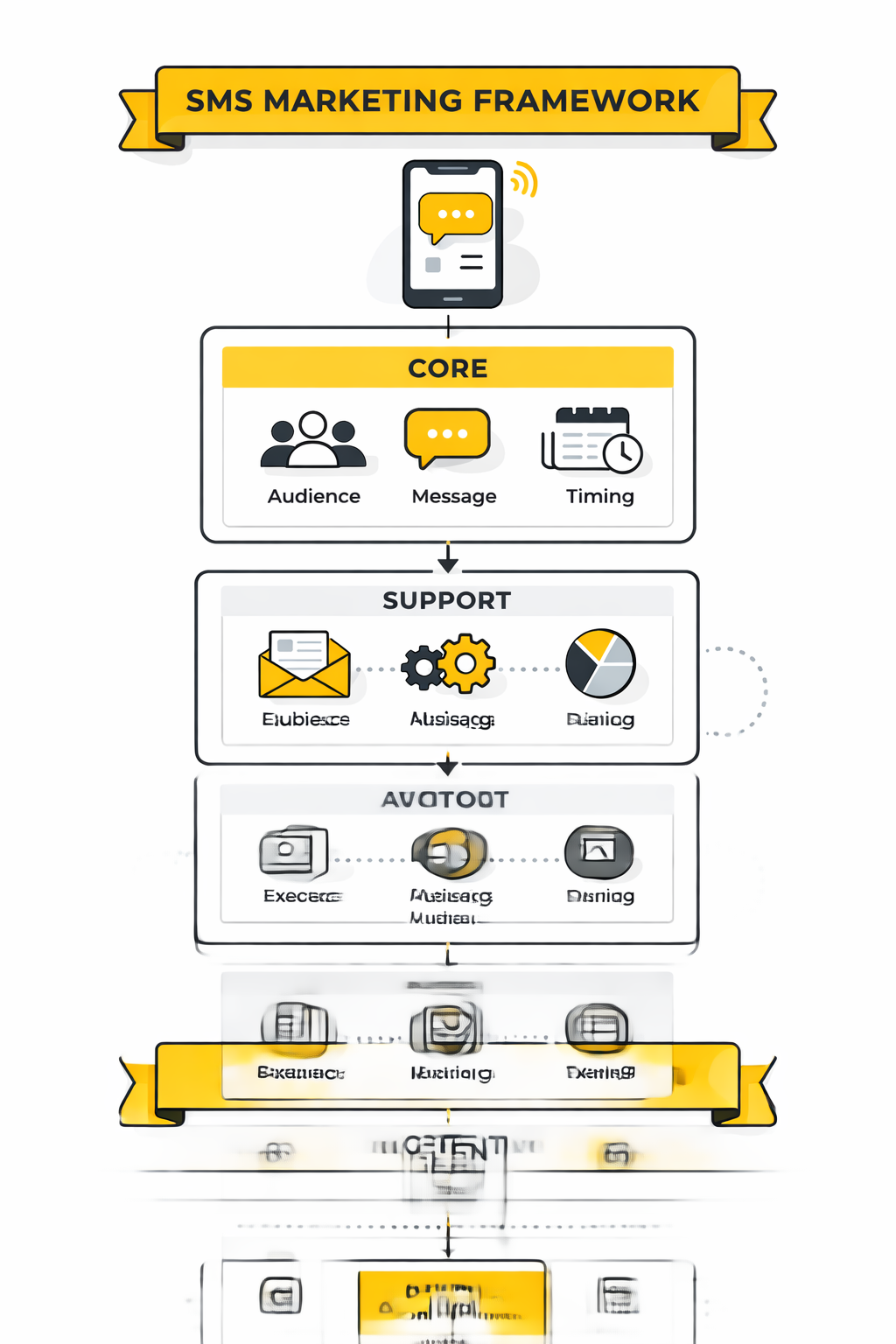
A professional SMS marketing workflow usually looks like this:
- capture consent through a clear opt-in
- sync subscriber data into your platform
- place the subscriber into the right segment
- trigger the right automation or campaign path
- send the message at a timing window that matches intent
- move the click to a mobile-first landing page or checkout
- track revenue, unsubscribes, and downstream behavior
- adjust the flow based on performance
What matters here is not complexity. It is order.
For example, if you trigger a welcome text before data is synced correctly, segmentation breaks. If segmentation breaks, personalization gets weaker. If personalization gets weaker, opt-outs rise and conversion falls. SMS marketing is powerful, but it is still a chain, and weak links show up fast.
Launch With Core Automations Before You Add More Campaigns
A lot of teams make the mistake of leading with broadcast campaigns because those are easy to see and easy to ship.
The smarter move is to launch the automations that respond to buyer behavior first. These flows usually outperform generic sends because they arrive when the user has already created context through an action.
In most businesses, the first set of automations should be:
- welcome flow
- abandoned cart flow
- post-purchase flow
- shipping or transactional support messages where appropriate
- win-back flow for inactive customers
This approach is grounded in how the channel performs in practice. Platform guidance from Sinch, Klaviyo, and Attentive all emphasizes behavior-driven use cases like welcomes, reminders, and retention sequences because they create relevance without requiring constant manual campaign planning (Sinch’s SMS marketing guide, Klaviyo’s SMS strategy guide, Attentive SMS best practices).
Get those flows live first, and you create a baseline revenue engine. Then campaigns become an amplifier instead of a crutch.
Write Messages for Action, Not Applause
Professionals rarely overcomplicate SMS copy.
They know the channel rewards speed, clarity, and momentum. A text should be understood in seconds, not admired for clever phrasing. That usually means one message, one reason, one action.
A strong implementation process asks these questions before any send goes live:
- Is the brand immediately recognizable?
- Is the reason for the text obvious?
- Is there one clear next step?
- Does the page after the click match the promise?
- Is opt-out language properly handled?
If the answer to any of those is no, the message is not ready.
That discipline matters because SMS is an intimate channel. People forgive mediocre emails. They do not forgive sloppy texts nearly as easily.
Make Mobile Experience Part of the SMS Build, Not an Afterthought
Every SMS campaign is really a mobile journey.
The text lands on mobile, the click happens on mobile, and the conversion often finishes on mobile. So implementation is not finished when the message is written. It is finished when the entire post-click path feels smooth on a phone.
That is why serious teams test:
- page load speed
- link tracking
- button placement
- form length
- checkout friction
- autofill behavior
- coupon application logic
This part matters more every year because mobile commerce keeps taking a larger share of online transactions. Shopify’s mobile commerce coverage points to a global market where mobile shopping continues to dominate ecommerce activity, which means bad mobile UX can quietly destroy SMS results even when the message itself is solid.
Put differently, the text opens the door. The mobile experience decides whether the sale walks through it.
Set Guardrails for Frequency and Fatigue
Implementation is not only about sending messages. It is also about knowing when not to send them.
That requires frequency controls, suppression rules, and logic that prevents people from getting hit by overlapping campaigns and automations. Someone who just bought should not receive a hard-sell cart reminder. Someone who unsubscribed from promotions should not keep getting promotional texts because the automation was never updated.
This is where professional SMS marketing feels different from amateur execution. There are rules in place to protect the subscriber experience:
- send windows based on time zone
- exclusions for recent purchasers
- suppression for recent clicks or conversions
- caps on promotional frequency
- priority rules when multiple automations could fire
These guardrails are not restrictive. They are what keep performance healthy over time.
Measure Implementation Quality, Not Just Revenue
Revenue matters, obviously.
But when professionals review an SMS marketing setup, they look beyond top-line sales. They want to know whether the system itself is healthy. That includes delivery rate, click rate, unsubscribe rate, segment growth, automation recovery rate, and how each flow affects repeat purchase behavior.
This is important because a channel can look successful for a while even while it is building long-term problems. Aggressive sends can spike short-term revenue while quietly damaging list trust. Weak segmentation can generate clicks while dragging down customer experience. Bad opt-in language can create growth that later becomes a compliance headache.
Healthy implementation asks harder questions:
- Are new subscribers converting after signup?
- Are automation flows firing correctly?
- Are campaign clicks reaching the intended page?
- Are unsubscribe rates rising after certain message types?
- Are repeat buyers engaging differently than first-time buyers?
That is how you keep SMS marketing from becoming guesswork.
The next stage is where good programs become great ones. Once the foundation is in place, the game shifts from basic execution to optimization, channel coordination, and compounding long-term growth.
Advanced Optimization and Long-Term Growth Strategies
Once SMS marketing is producing revenue, the challenge changes.
You are no longer asking whether the channel works. You are asking how to keep it profitable as volume grows, audiences diversify, and customer expectations get sharper. That is where advanced strategy matters, because scaling SMS is not about sending more texts. It is about protecting trust while increasing relevance.
Treat SMS as an Owned-Channel Profit Center
At an early stage, SMS marketing often gets judged campaign by campaign.
That is useful at first, but it becomes limiting once the program matures. At scale, the better way to think about SMS is as part of your owned-channel system, alongside email, loyalty, site personalization, and customer support. That shift matters because owned channels do not just create one-off conversions. They reduce dependence on rising acquisition costs and strengthen retention over time.
This is one reason orchestration matters so much now. Multi-channel research from Customer.io found that campaigns combining at least two channels performed 60% better than single-channel campaigns, while newer orchestration coverage from Attentive points to brands gaining an average of $29 in additional revenue per newly engaged customer through strong owned-channel strategy. The lesson is clear: SMS marketing becomes more valuable when it is part of a coordinated system, not when it is forced to do everything by itself.
Optimize for Lifetime Value, Not Just Immediate Revenue
This is where advanced operators separate themselves from everyone else.
It is easy to fall in love with short-term SMS revenue because the feedback loop is fast. You send a campaign, clicks come in, sales follow, and the result looks fantastic. But if that performance comes from over-discounting, over-sending, or relying too heavily on urgency, you can quietly damage margin and train customers to wait for the next text.
A smarter approach is to connect SMS marketing to lifetime value and repeat purchase behavior. Shopify’s enterprise retention guidance cites an average ecommerce repeat customer rate of 28.2%, and Klaviyo’s retention strategy guidance keeps pushing brands to track repeat purchase rate and retention alongside engagement signals instead of treating clicks as the finish line (retention strategy guidance, marketing automation guidance). In practice, that means asking a better question after every major SMS push: did this message create a customer who comes back, or did it just create a discounted order?
Use Cohort Analysis to Find What Actually Scales
Averages can hide problems.
You can improve top-line SMS metrics while making the customer base weaker underneath. That is why advanced teams use cohort analysis. Instead of looking only at aggregate campaign performance, they compare how different groups behave over time based on when they subscribed, what they bought first, which offer brought them in, and which messages they received.
That matters because not all growth is equal. A subscriber acquired through a strong welcome offer may become a repeat buyer. Another acquired through an aggressive one-time discount may never return. Klaviyo’s cohort analysis framework is useful here because it focuses on identifying purchase patterns over time rather than reacting to isolated campaign spikes (cohort analysis overview, attribution and repeat purchase measurement).
Once you start reading SMS marketing through cohorts, a lot of decisions get easier. You can see which flows produce valuable customers, which offers attract low-quality buyers, and which segments are worth heavier investment.
Deliverability Gets Harder as You Grow
Small programs can get away with messy execution for a while.
Larger programs cannot. As volume rises, carriers and providers watch patterns more closely, filtering gets more aggressive, and weak practices start causing real damage. That means advanced SMS marketing is not just about creative strategy. It is also about deliverability discipline.
CTIA’s latest messaging security guidance is built around preserving trust in the messaging ecosystem and preventing unwanted messages, including monitoring for abuse patterns and blocking risky traffic when necessary (CTIA messaging security best practices). Sinch’s current SMS guide makes the same practical point from the marketer’s side: explicit consent, message clarity, sensible frequency, and effortless opt-out are not nice extras. They are part of keeping the channel usable over time (Sinch SMS marketing guide).
So as you scale, you need to watch for warning signs:
- falling delivery rates
- rising carrier filtering
- opt-out spikes
- complaint patterns
- sudden drops in click performance after volume increases
If those show up, the answer is usually not “send harder.” It is almost always “clean up the system.”
Frequency Strategy Is a Tradeoff, Not a Formula
A lot of marketers want a perfect answer for how often to text.
There is no universal number. Frequency depends on purchase cycle, audience expectations, category, message relevance, and how well SMS is coordinated with your other channels. That is why rigid advice usually fails.
The more useful way to think about frequency is as a tradeoff between attention and fatigue. If you send too little, you leave revenue on the table and lose momentum. If you send too much, you get short-term lift followed by rising opt-outs and weaker trust. Bloomreach’s recent comparison of email and SMS makes this point well by arguing that channel performance should be judged by revenue and retention, not vanity numbers like opens alone (Bloomreach on revenue-focused SMS measurement).
This is exactly where segmentation earns its keep. Your VIP buyers may tolerate more frequent texts because the offers feel relevant. New subscribers may need a lighter touch until intent is proven. Inactive subscribers may need a re-entry sequence before you resume normal promotional volume.
The Best SMS Programs Reduce Discount Dependence
There is a trap that catches a lot of brands once SMS starts working.
They discover that discounts drive fast clicks, so they keep leaning harder on discounts. Eventually the list becomes conditioned to promotional urgency, margins get squeezed, and the channel stops working without a code attached to every message.
Advanced SMS marketing avoids that trap by expanding the kinds of value it delivers. That can include:
- back-in-stock alerts
- early access for VIPs
- replenishment reminders
- shipping and service updates
- education tied to product usage
- loyalty prompts based on behavior
This matters because not every useful message has to be a price cut. Attentive’s 2025 consumer research emphasizes that timing, targeted content, and loyalty-driven experiences shape whether people stay engaged and buy at full price, not just whether they receive another discount (2025 UK SMS and email marketing report, consumer trends highlights). If your SMS marketing only works when you slash price, you do not have a channel advantage. You have a discount dependency.
Service and Experience Messages Often Create More Value Than Promotions
This point gets missed all the time.
Promotional texts are visible, so they get most of the attention. But service-oriented SMS marketing often does more to protect conversion and increase repeat purchase behavior than another broadcast sale ever could. Shipping updates, support follow-ups, resolution texts, replenishment reminders, and delivery clarity all reduce uncertainty, and uncertainty is one of the biggest conversion killers online.
Shopify’s enterprise content notes that 89% of people are likely to make another purchase after a positive customer service experience. That stat matters because it reframes what “marketing” really means inside SMS. Not every valuable text needs to look promotional. Some of the most profitable messages are the ones that make the customer feel informed, reassured, and taken care of.
That is especially relevant as your program scales. Support and operations data should not live in a separate universe from lifecycle marketing. The businesses that connect those dots create better retention.
Scaling Requires Better Data Hygiene, Not Just Better Copy
At a certain point, your results stop improving through copy tweaks alone.
The bigger gains come from identity resolution, event tracking, clean segmentation logic, and more reliable attribution. If your data is fragmented, you will fire the wrong flows, miss high-intent moments, and misread what is working.
That is why mature SMS marketing programs invest in stronger infrastructure. Attentive has published examples showing that better identity and server-side tracking can increase conversion rates and materially improve triggered-message revenue because more customer actions are actually recognized in time to use them (Attentive signal and conversion lift example). The same broader principle shows up across the ecosystem: cleaner data produces better timing, better targeting, and better orchestration.
This is not glamorous work, but it is leverage. When the data layer improves, everything built on top of it gets smarter.
Strategic Tradeoffs Become More Important Than Tactics
The early game of SMS marketing is tactical.
You launch a welcome flow, recover carts, test a few offers, and clean up the opt-in path. The later game is strategic. You have to decide what kind of channel you want SMS to be inside your business.
There are real tradeoffs:
- more volume vs. more selectivity
- more promotions vs. more service
- broader reach vs. tighter segmentation
- short-term revenue vs. long-term trust
- discount-led growth vs. experience-led retention
There is no single perfect balance. But there is one rule that holds up: the best SMS marketing programs do not optimize one metric in isolation. They balance revenue, retention, deliverability, and brand experience at the same time.
That is harder. It is also what makes the channel durable.
Where SMS Marketing Is Headed Next
The direction of travel is obvious.
SMS is moving away from isolated campaigns and toward deeper orchestration with email, push, onsite behavior, customer data, and AI-assisted decisioning. Customer.io’s mobile messaging trends point to a future where multi-channel journeys are central to growth, not optional extras (mobile messaging trends). Bloomreach makes the same argument from a different angle, pushing brands to evaluate customer moments across channels rather than asking which single channel “wins” (Bloomreach on orchestration and intent).
That means the future of SMS marketing is not more noise. It is better timing, better coordination, and more precise relevance.
And that is the real takeaway. SMS stays powerful when it feels personal, timely, and useful. The moment it becomes lazy, repetitive, or purely extractive, performance starts slipping. The brands that win long term are the ones that never forget they are messaging a person, not just targeting a phone number.
FAQ - Built for Complete Guide
What is SMS marketing in simple terms?
SMS marketing is the practice of sending permission-based text messages to customers for promotions, reminders, updates, and lifecycle communication. The reason it remains so effective is that it reaches people in a place they check constantly and usually read quickly, which is why modern lifecycle platforms still treat it as a high-impact owned channel when used with consent and strong timing (Customer.io’s 2026 guide). customer.io
The important word there is permission-based. SMS marketing is not just “texting customers.” It is a structured channel that depends on clear opt-in, relevant messaging, and a real business reason for every send.
Is SMS marketing better than email marketing?
Not on its own. It is better for speed, urgency, and immediate visibility, while email is better for longer storytelling, richer formatting, and more detailed nurturing.
The strongest programs stop treating this like a cage match. More recent orchestration guidance from providers focused on lifecycle marketing keeps pushing the same idea: coordinated channels outperform siloed ones because each channel handles a different customer moment better (Attentive orchestration guide, Customer.io mobile messaging trends). Attentive+1
Do I need consent before sending marketing texts?
Yes, absolutely.
In the US, compliance guidance from carriers, platforms, and regulators is clear that promotional SMS requires clear consent and clear disclosure about what the subscriber is agreeing to receive. Twilio’s current compliance resources and CTIA messaging principles both emphasize explicit calls to action, transparent signup language, and easy opt-out handling (Twilio compliance guide, Twilio opt-in explainer, CTIA messaging principles). Twilio+2
That is not just a legal checkbox. It is also part of deliverability and long-term trust.
How often should a business send SMS campaigns?
There is no universal number, and anyone giving you one without context is oversimplifying.
Frequency depends on your category, purchase cycle, how strong your segmentation is, and whether SMS is coordinated with email and other lifecycle channels. The better question is not “How many texts can I send?” but “How many relevant texts can I send before value drops and fatigue rises?”
That is why you should let performance tell you the answer. If unsubscribe rates rise, click quality falls, or delivery weakens after frequency increases, the market is telling you to tighten the strategy.
What types of SMS messages usually perform best?
The strongest performers are usually tied to behavior or urgency.
That includes welcome flows, cart recovery, back-in-stock alerts, shipping updates, appointment reminders, replenishment prompts, and VIP early access. Lifecycle providers and SMS platforms continue to emphasize these use cases because they match real customer intent instead of forcing attention without context (Customer.io SMS guide, Sinch SMS marketing guide). customer.io+1
Promotional blasts still have a place. They just should not be the whole strategy.
What should I measure first in SMS marketing?
Start with click-through rate, conversion rate, revenue per message, unsubscribe rate, and list growth quality.
Those metrics show whether your SMS marketing is persuasive, profitable, and sustainable. Open rate is usually much less useful because SMS is naturally seen at very high levels, so it tells you little about whether the message was actually good.
Once those basics are stable, move deeper into automation recovery rate, cohort behavior, repeat purchase impact, and segment-level profitability.
Can small businesses use SMS marketing effectively?
Yes, and in some ways small businesses have an advantage.
They can move faster, stay more personal, and build tighter segmentation earlier. They also do not need a giant tech stack to get started. A clean opt-in flow, one strong welcome sequence, one abandoned cart flow, and a mobile-friendly checkout path are often enough to prove the channel.
If you want a simpler funnel-first setup, tools like ClickFunnels, Systeme.io, or Fillout can help build the acquisition side of the process without making execution overly complicated.
How do I grow an SMS list without annoying people?
By making the value obvious before the signup happens.
The cleanest list growth comes from moments where intent already exists: checkout, quizzes, waitlists, restock alerts, special offer pages, and post-purchase enrollment opportunities. Consumer survey data from SimpleTexting found that a large share of consumers are already opted in to receive business texts, which suggests the issue is rarely the channel itself. It is usually the weakness of the offer or the lack of clarity around what people will receive (SimpleTexting 2025 statistics). Twilio
So the fix is not pressure. It is a better reason to subscribe.
When should I use automation instead of one-time campaigns?
Use automation when the message should be triggered by behavior. Use campaigns when the message is tied to a broader event, launch, or promotion.
That sounds simple, but it is one of the biggest strategic dividing lines in SMS marketing. Automation handles predictable moments like signup, abandonment, replenishment, and reactivation. Campaigns handle planned moments like seasonal offers, product drops, and time-sensitive announcements.
If you reverse that logic, the channel gets noisy fast. Automation should carry the steady revenue load. Campaigns should amplify what matters.
What are the biggest mistakes in SMS marketing?
The most expensive mistakes are usually predictable.
They include weak consent practices, poor segmentation, over-sending, relying too heavily on discounts, ignoring mobile landing-page friction, and measuring vanity metrics instead of business outcomes. As programs grow, another major mistake is forgetting that carriers and providers pay attention to trust signals, filtering risk, and bad traffic patterns, which is why current compliance and messaging-security guidance keeps stressing discipline and transparency (Twilio compliance guide, CTIA security best practices). Twilio+1
Most SMS problems are not channel problems. They are systems problems.
Does SMS marketing work outside ecommerce?
Yes.
Ecommerce gets most of the attention because the feedback loop is so visible, but SMS marketing also works in service businesses, healthcare reminders, event management, education, local business marketing, real estate follow-up, travel updates, and appointment-driven businesses. The core advantage stays the same: speed, visibility, and clarity.
What changes is the use case. In one business it may drive purchases. In another it may reduce no-shows, shorten response time, or improve service experience.
How do I know if my SMS strategy is scalable?
A scalable SMS strategy keeps working as list size, complexity, and message volume increase.
That means deliverability stays healthy, segmentation stays accurate, automations fire correctly, and revenue grows without a matching surge in complaints or opt-outs. This is also where cohort analysis becomes more useful than averages, because it helps you see whether new subscribers and new customer groups are becoming valuable over time or just inflating surface-level metrics (Klaviyo cohort analysis, Shopify retention overview). Klaviyo+1
If volume goes up and trust stays intact, you are scaling. If volume goes up and list quality starts slipping, you are only expanding activity.
What is the best next step if I am starting from zero?
Keep it tight.
Set up a compliant opt-in path, connect your SMS platform to your store or CRM, create a welcome flow, build an abandoned cart sequence, test your mobile checkout path, and start measuring revenue per message alongside unsubscribes. That is enough to learn very quickly what the channel can do.
Do not start with ten automations and endless campaigns. Start with the core system, make it work, and then build from evidence.
Final Takeaway
SMS marketing works because it is direct, fast, and hard to ignore. But that is also why sloppy execution gets punished faster here than in most other channels.
The brands that win do not treat SMS like a shortcut. They treat it like a high-trust owned channel that needs strong consent, smart segmentation, clean timing, real measurement, and a mobile-first path to conversion. Once those pieces are in place, the channel becomes one of the most reliable ways to drive attention and action.
That is really the whole story.
SMS marketing is not powerful because it is trendy. It is powerful because it reaches people at the right moment when the message actually matters.
Work With Professionals
Explore 10K+ Remote Marketing Contracts on MarkeWork.com
Most marketers spend too much time chasing clients, competing on crowded platforms, and losing a percentage of every project to middlemen.
MarkeWork gives you a better way. Browse thousands of remote marketing contracts and connect directly with companies desperate to hire skilled marketers like you, without platform commissions and without unnecessary gatekeepers.
If you're serious about finding better opportunities and keeping 100% of what you earn, explore available contracts and create a profile for free at MarkeWork.com.