

If you searched for coursera google digital marketing, the program you are almost certainly trying to evaluate is the Google Digital Marketing & E-commerce Professional Certificate on Coursera. The live Coursera listing presents it as a beginner-level, self-paced 8-course series with more than 1.29 million enrollments, a 4.8 rating drawn from 48,566 reviews, and an estimated pace of about six months at 10 hours per week. Coursera also says no prior experience is required, which tells you exactly how Google wants this credential positioned: as an entry point, not an advanced specialist certification. Coursera+1
That entry-level angle matters because the market this certificate points toward is still expanding. The U.S. Census Bureau says e-commerce sales reached $1.2337 trillion in 2025 and accounted for 16.4% of total retail sales for the year, while IAB says U.S. internet advertising revenue hit a record $259 billion in 2024. In plain English, businesses are still spending heavily on online acquisition, online conversion, and online retention, which is exactly the territory this program is built to cover. Census.gov+1
Article Outline
This article is built for readers who do not just want a course summary. It is designed to answer the practical questions behind the search itself: what the program actually teaches, how current it is, where it is strong, where it is thin, and whether it can help you move toward real work. These are the six section names the full article will use from start to finish:
- Why This Certificate Matters
- The Program Framework At A Glance
- Core Skills Across Search, Social, Email, and Analytics
- The E-commerce and Customer Loyalty Layer
- Turning The Certificate Into Professional Execution
- Cost, Credibility, and Who Should Take It

Why This Certificate Matters
The biggest reason this certificate deserves attention is that it is broader than the average “digital marketing course” headline suggests. Google’s own program page says the certificate covers strategy, search, social, email, analytics, e-commerce store building, customer loyalty, and AI productivity, while the Grow with Google page adds that it is aimed at entry-level digital marketing or e-commerce roles and is endorsed by both the 4A’s and the American Advertising Federation. That makes the program more useful than a narrow ads-only course, especially for someone who needs a working map of the field before choosing a specialty. Coursera+1
There is also a real employability angle behind the branding. Google says its Career Certificates are recognized by more than 150 U.S. employers, and both Google and Coursera state that 75% of certificate graduates report a positive career outcome within six months of completion. That does not mean the certificate magically replaces experience, but it does mean the program sits inside a larger hiring and career-support system instead of ending at a PDF badge. Grow with Google US+1
What makes this especially relevant for serious learners is the applied format. Coursera says the certificate includes over 190 hours of instruction and practice-based assessments, and the official program page says learners create portfolio-style work such as customer personas and social media calendars. That is still not the same thing as managing a real budget for a real business, but it is much closer to job prep than passive video watching. Coursera
The Program Framework At A Glance
The current version of the certificate is best understood as a full-funnel beginner framework rather than a single-channel course. Coursera’s live listing shows an 8-course sequence that starts with foundations, moves into customer acquisition and engagement, then into email and analytics, and only after that shifts into e-commerce operations, loyalty, and AI-assisted job search. That sequence matters because it shows Google is trying to teach how digital marketing connects to the whole customer journey, not just how to run one tactic in isolation. Coursera+2
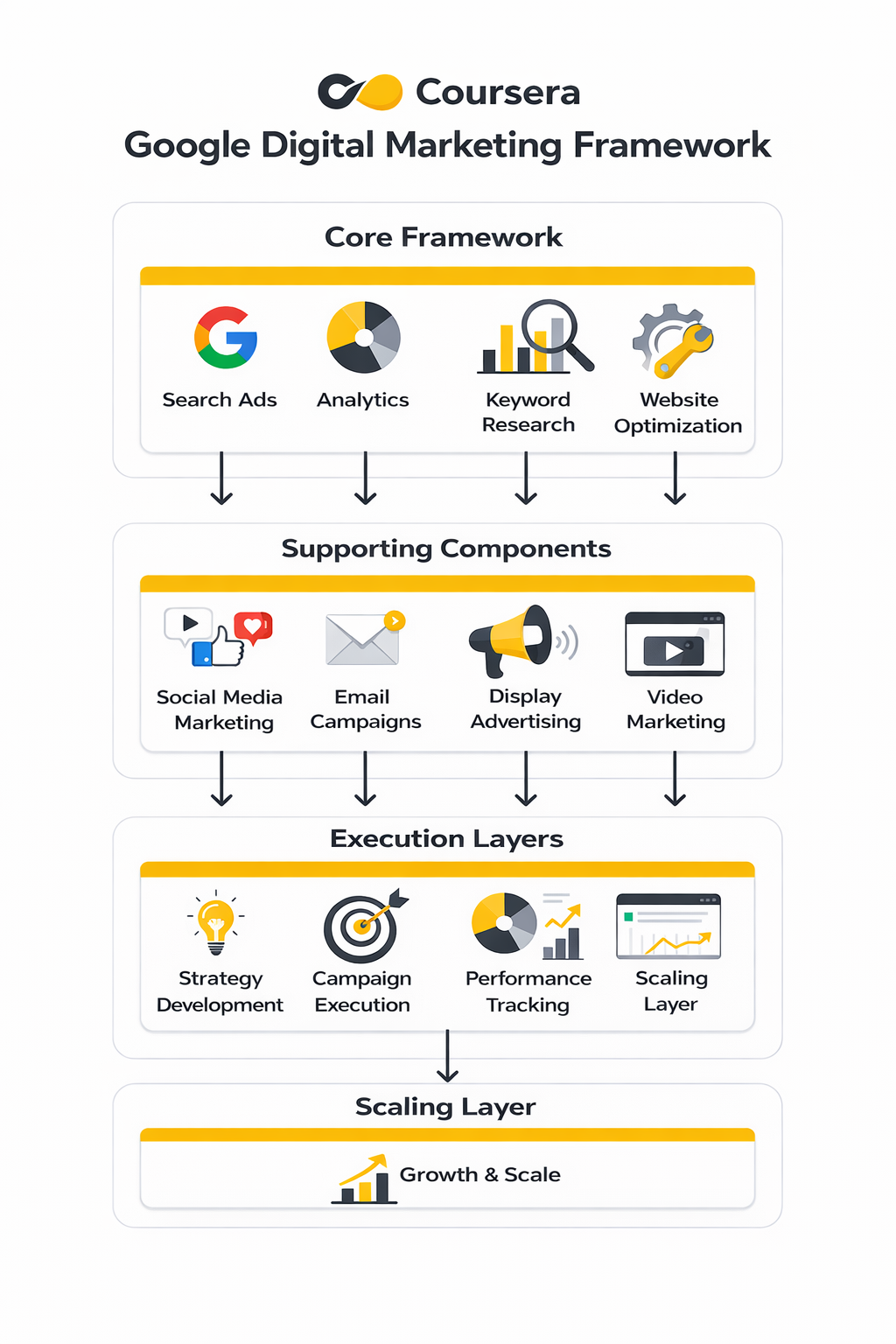
Coursera currently organizes the path around these official course titles: Foundations of Digital Marketing and E-commerce, Attract and Engage Customers with Digital Marketing, From Likes to Leads: Interact with Customers Online, Think Outside the Inbox: Email Marketing, Assess for Success: Marketing Analytics and Measurement, Make the Sale: Build, Launch, and Manage E-commerce Stores, Satisfaction Guaranteed: Develop Customer Loyalty Online, and Accelerate Your Job Search with AI. That final AI job-search course is important because it confirms the certificate is now doing two things at once: teaching execution skills and packaging learners for hiring. If you are evaluating the live Coursera Google digital marketing program today, this 8-part structure is the framework you should use, not older summaries floating around the web. Coursera+2
The cleanest way to read that framework is in four layers. First, Google builds basic marketing language and customer-journey thinking; second, it moves into traffic and audience acquisition through search, social, and email; third, it adds measurement and e-commerce operations; and fourth, it closes with retention, loyalty, and job-search packaging. That is a smart sequence for beginners because it mirrors how actual marketing work tends to flow from attention to conversion to repeat business. Coursera+2
This is also where smart learners separate themselves from passive ones. The certificate gives you the map, but the real jump happens when you practice the same ideas in live tools, whether that means scheduling content in Buffer, building email sequences in Brevo, testing chat flows in Manychat, or organizing lead and campaign workflows in HighLevel. That bridge between structured learning and messy real execution is where this certificate starts becoming professionally useful instead of just academically complete.
Core Skills Across Search, Social, Email, and Analytics
The reason the coursera google digital marketing certificate feels more practical than many beginner programs is that it does not stay at the level of abstract marketing theory. Coursera breaks the middle of the program into courses on search and display acquisition, social media execution, email marketing, and analytics and measurement. That sequence matters because it mirrors how modern digital work actually happens: you attract attention, shape engagement, build owned audience relationships, and then measure what moved the business.
Just as important, the certificate stays firmly in beginner territory while still introducing the right working vocabulary. The live Coursera listing describes the program as beginner level, while the individual courses point learners toward real tools like Google Ads, Google Search Console, Google Analytics, Hootsuite, Canva, Mailchimp, HubSpot, and Shopify. That breadth is useful because it helps a new marketer understand how channels connect, even if deeper specialization still has to come later.
Search Skills Start With Intent, Not Tricks
The search section of the certificate is stronger than many people expect from a beginner credential. Coursera says Attract and Engage Customers with Digital Marketing teaches SEO, SEM, display advertising, keyword research, Google Ads fundamentals, Google Search Console, personas, and the marketing funnel. That is a smart foundation because it trains you to think about search as a combination of user intent, relevance, visibility, and measurement rather than a bag of hacks.
That framing lines up with Google’s own documentation. The SEO Starter Guide defines SEO as helping search engines understand content and helping users decide whether to visit a site from search, while Google Search Console highlights queries, impressions, clicks, position, indexing, and issue detection. In other words, the certificate is teaching the right beginner instinct: good search work starts with understanding what people want, making pages useful, and then checking whether Google can actually discover and interpret those pages.
The paid side is introduced in a similarly practical way. Google’s paid search guide explains that search ads appear in the search results, rely on keyword targeting, and are measurable through clicks, traffic, ROI, and ongoing optimization, which matches Coursera’s focus on SEM, audience targeting, and Google Ads basics. That makes this section especially valuable for beginners who need to understand the relationship between organic search and paid search before they ever touch a live budget.
Social Media Is Taught As A Repeatable System
The social media course avoids one of the biggest traps in entry-level marketing education: making social seem like random posting. Coursera says From Likes to Leads: Interact with Customers Online is built around the five core pillars of social media marketing: strategy, planning and publishing, listening and engagement, analytics and reporting, and advertising. That is the right way to teach the channel because strong social teams do not just publish content; they plan, monitor, respond, analyze, and adjust.
The course also goes beyond surface-level platform talk. Its module breakdown includes choosing platforms, building target audience profiles, creating a social media calendar, using Hootsuite, using Canva, social listening, reporting, paid social, and ad budgeting. That matters because beginners often overfocus on creative ideas and underfocus on workflow, timing, reporting, and the discipline required to keep a brand presence consistent.
This is also one of the easiest places to turn course knowledge into real operating skill. Once you understand planning and publishing, a tool like Buffer can help you turn a content calendar into an actual posting rhythm, while Manychat becomes useful when social campaigns need automated conversations, DM flows, or lead capture. The certificate does not depend on those platforms, but using tools like that after the coursework is how theory starts becoming muscle memory.
Email Marketing Is Treated As Owned Media, Not An Afterthought
A lot of beginner marketers underestimate email because it looks older than search or social. Google does not make that mistake. Coursera describes Think Outside the Inbox: Email Marketing as a course on strategy, campaign execution, list building, segmentation, automation, workflows, subject lines, preview text, copywriting, safe handling of user data, and measuring results, and the main certificate page calls email one of the core channels learners use to attract and engage customers.
That emphasis is exactly right because email is the closest thing many brands have to a durable owned audience. Social reach can fluctuate, ad costs can rise, and search rankings can move, but a well-managed email list gives a business a direct line to subscribers who already know the brand. The certificate’s focus on workflows, segmentation, and analysis is a sign that Google is teaching email as a lifecycle channel, not just a newsletter slot.
There is another reason this section matters: real email work has legal and operational discipline attached to it. The FTC’s CAN-SPAM guide requires accurate header information, non-deceptive subject lines, a physical postal address, and a clear opt-out method, which fits Coursera’s inclusion of personally identifiable information, contact management, and email best practices. When you are ready to practice beyond the course environment, an email platform like Brevo or a broader automation stack like HighLevel gives you a real place to build lists, workflows, and campaign reporting.
Analytics Is Where The Certificate Starts Feeling Like Real Work
The analytics section is where the program becomes more than a channel sampler. Coursera says Assess for Success: Marketing Analytics and Measurement covers KPIs, media plans, performance goals, Google Analytics, Google Ads, ROI, ROAS, A/B testing, spreadsheets, pivot tables, and data visualization for stakeholder reporting. That is important because beginner marketers often know how to launch activities but not how to prove whether those activities worked.
Google’s own analytics materials reinforce that direction. The Google Analytics beginner guide starts with setting up a property, learning the interface, and configuring conversions, while Google’s analytics overview says the platform is designed to understand the customer journey and improve marketing ROI. That is the exact mindset a new marketer needs: metrics are not there to decorate a dashboard, they are there to support decisions.
This is also where the certificate quietly teaches one of the most valuable habits in digital marketing: connecting channel metrics to business outcomes. Search Console lets you inspect queries, clicks, impressions, position, indexing, and site issues, while Google Analytics is built to measure actions that matter to the business, including conversions and event-based behavior. Once you start thinking that way, optimization stops being guesswork and starts becoming a sequence of test, measure, learn, and improve.
The limitation is also worth stating clearly. Because the program is beginner-level and spreads attention across multiple channels, it introduces analytics discipline rather than taking learners deep into advanced attribution, warehouse-level analysis, or custom enterprise reporting. That is not a flaw. It is exactly what an entry-level certificate should do before the next section of the program shifts from marketing channels into online store operations, conversion flow, and customer loyalty.
The E-commerce and Customer Loyalty Layer
Up to this point, the article has focused on acquisition and measurement. The next layer of the coursera google digital marketing certificate matters because it forces you to think beyond traffic and into the mechanics of selling, fulfilling, retaining, and improving. On Coursera, Make the Sale: Build, Launch, and Manage E-commerce Stores is described as the sixth course in the certificate and walks learners through creating a mock online store, building it in Shopify, adding the essential business information, and creating product listings.
That shift is more important than it sounds. A lot of beginner marketing programs stop at campaign thinking, which leaves learners with a distorted view of how online growth actually works. Google’s certificate does something better here by connecting promotion to the store itself, because the landing page, product page, checkout flow, and post-purchase experience all shape whether traffic turns into revenue.
The loyalty course continues that same logic. Coursera says Satisfaction Guaranteed: Develop Customer Loyalty Online covers customer loyalty strategies, client relationship management, customer satisfaction measurement, store performance monitoring, and updating an e-commerce store based on data. That means the certificate is not treating the sale as the finish line. It is treating the sale as the start of the next decision: whether the customer comes back.
What The Store-Building Module Actually Changes
The e-commerce section changes the way beginners think about execution because it makes the offer tangible. Instead of talking about “brand awareness” in the abstract, the course pushes you toward concrete assets: store setup, product information, product listings, merchandising choices, and the operational details that make an online store usable. That is exactly where a new marketer starts understanding the difference between attention and transaction.
This is also where product data quality becomes a real business issue, not just a technical chore. Google’s documentation for Merchant Center explains that retailers can add and manage product listings for free, and free listings for products can appear across Google surfaces including Search, Maps, YouTube, the Shopping tab, Images, Lens, and Gemini. That only works well when the information is clean, because Google’s product data specification makes it clear that titles, descriptions, pricing, brand details, GTIN data, and category accuracy help products match the right searches.
That is why this section of the certificate is more valuable than a beginner might realize. When you build a mock store, you are not just practicing layout decisions. You are learning how merchandising, product copy, product structure, and technical accuracy all influence visibility and conversion. Once you start applying that in the real world, tools like Replo for higher-converting page builds or HighLevel for funnel and lead flow management can help you move from a training environment into a functioning sales system.
Loyalty Is Treated As A Revenue System, Not A Nice Extra
The loyalty layer is where the certificate gets much closer to how mature online businesses actually grow. Coursera’s customer loyalty module says learners explore rewards programs, dynamic remarketing, post-purchase follow-ups, and customer satisfaction measurement. That is the right emphasis because profitable digital marketing is rarely just about getting the first order. It is about reducing the distance between the first order and the second.
This part of the program also teaches a more disciplined view of customer relationships. The course description highlights client relationship management and performance monitoring, which means the learner is being pushed to think in loops: sell, follow up, measure, improve, and retain. That is exactly the mindset employers want, because retention work is usually less glamorous than acquisition, but it often has a stronger effect on margin, forecasting, and long-term growth.
There is also a trust layer here that matters more than ever. The FTC’s consumer reviews and testimonials rule FAQ says the rule addressing deceptive reviews and testimonials went into effect on October 21, 2024, and the agency’s press release on fake reviews and testimonials makes clear that fake or false reviews are a compliance risk, not a clever growth tactic. So when you think about loyalty after this certificate, think honest follow-up, legitimate feedback collection, real service recovery, and credible retention mechanics. A stack built around Brevo for lifecycle email, Fillout for post-purchase surveys, and Manychat for conversational follow-up can make that process operational without turning it into spam.
Turning The Certificate Into Professional Execution
This is the point where a lot of people make the wrong move. They finish the coursework, add the certificate to LinkedIn, and assume that completion alone should signal job readiness. In practice, the certificate is much more useful when you treat it as a blueprint for a repeatable operating process.
The good news is that Google already gives you most of the building blocks. The certificate covers customer personas, channel strategy, email workflows, analytics, e-commerce store setup, loyalty, and performance improvement, while Google Analytics documentation explains that recommended e-commerce events such as add_to_cart, begin_checkout, and purchase are how online sales behavior gets measured in GA4. Put those ideas together and you get something much more powerful than course completion: you get a working system you can actually run.
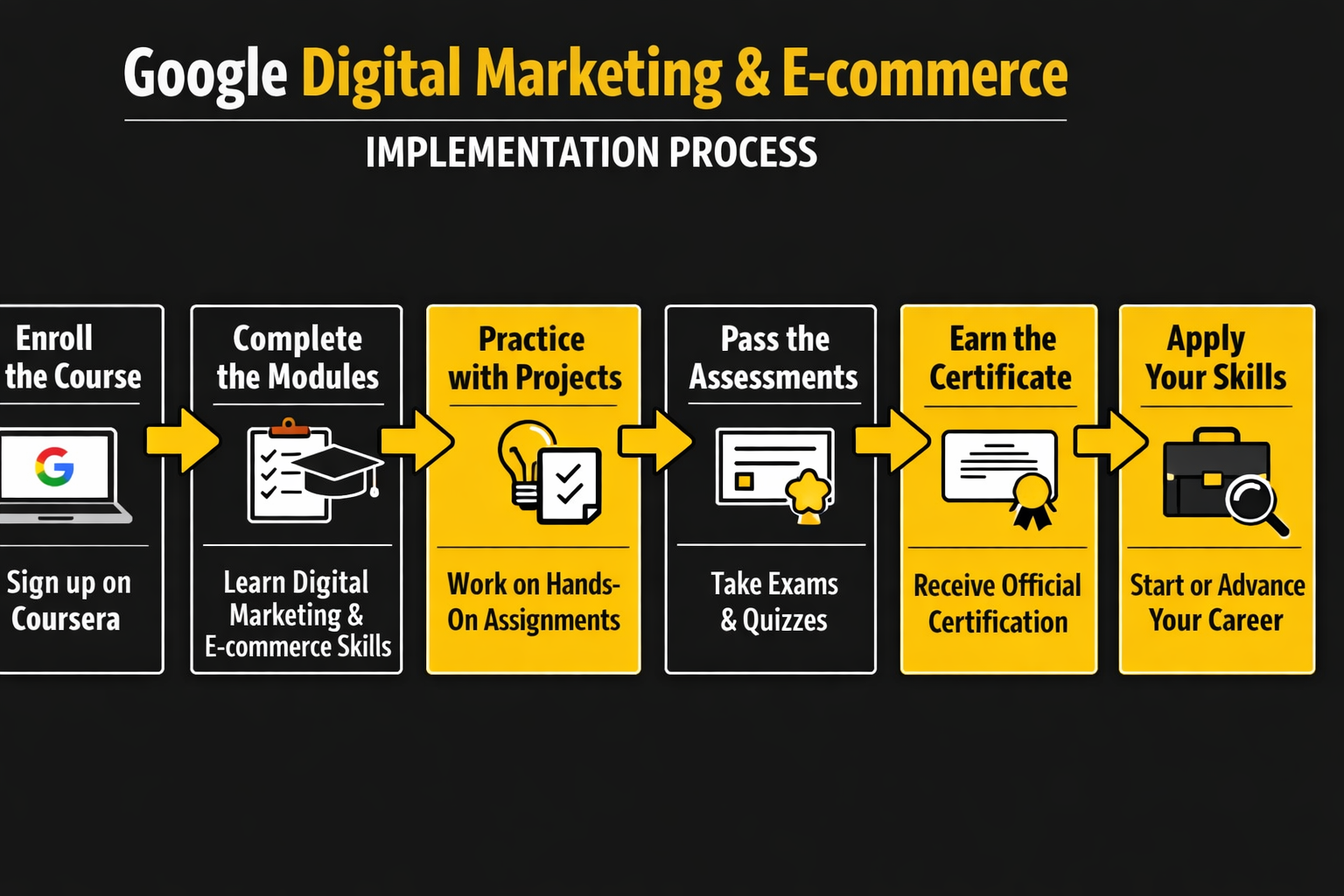
A Practical Process You Can Run After The Coursework
The easiest way to turn the certificate into something employers respect is to run one clean implementation cycle from beginning to end. Not ten half-finished ideas. One offer, one audience, one store or landing path, one reporting setup, and one retention loop. That gives you proof that you can connect strategy to execution instead of just repeating marketing vocabulary.
- Pick one product, service, or offer and define the buyer clearly. Start with a narrow audience and a clear promise, not a broad market and vague positioning. The certificate’s earlier work around personas and funnels is meant to make this step easier, because execution gets dramatically cleaner when you know exactly who the page is for and what action you want them to take.
- Build the storefront or conversion path before you chase traffic. Use the store-building logic from Make the Sale to get the basics right first: product titles, descriptions, imagery, pricing clarity, shipping expectations, and the page sequence that leads to checkout. If the business is more service-led than product-led, a focused landing build in Replo or a broader funnel setup in HighLevel can serve the same role.
- Set up measurement before launch, not after. Google’s Measure ecommerce documentation and the purchase event setup guide make it clear that e-commerce tracking should be tied to real user actions, not just traffic counts. At a minimum, you want visibility into view, add-to-cart behavior, checkout progression, and completed purchases, because otherwise you will not know whether a weak result came from poor traffic, weak product pages, or a broken checkout experience.
- Launch acquisition in a controlled way across the channels you already understand. This is where the earlier parts of the certificate come back into play. Use search for intent capture, social for reach and engagement, and email for follow-up and owned attention, but keep the first test small enough that you can still see what is happening. That is also the moment when tools like Buffer for publishing rhythm or Flick for social workflow support can help you stay consistent instead of improvising every day.
- Build the post-purchase and retention layer immediately. Do not wait until sales arrive to think about retention. The loyalty course is built around follow-ups, remarketing, and satisfaction tracking for a reason: once someone buys, you need a next step, whether that is onboarding, reorder timing, cross-sell education, support, or feedback collection. This is where Brevo, Manychat, Chatbase, or Copper can help turn customer communication into a structured system rather than a pile of disconnected messages.
- Review performance weekly and change one thing at a time. Coursera’s loyalty and analytics sections both emphasize monitoring performance and updating the store based on data, which is exactly the right operating habit. One week you may improve product copy, the next week your checkout friction, the next week your remarketing sequence, but the discipline is the same every time: measure, interpret, adjust, and test again.
That is where this certificate starts becoming genuinely useful in the market. It is not because the brand name does the heavy lifting by itself. It is because the program gives beginners enough structure to run a complete digital cycle from offer to storefront to measurement to loyalty, which is far closer to real marketing work than most entry-level certificates ever get.
What The Numbers Actually Mean
The implementation process from the last section only becomes valuable when you can tell where it is breaking. This is the part of coursera google digital marketing that most beginners underestimate, because dashboards feel technical until you realize they are just answering one practical question: are you failing on visibility, persuasion, checkout, or retention. Google’s own reporting stack is built for exactly that sequence, with Search Console explaining impressions, clicks, CTR, and average position for search performance and GA4 e-commerce tracking built around events such as add_to_cart, begin_checkout, and purchase. Google Podpora+5
Build One Clean Measurement System First
Before you compare yourself to any benchmark, make sure all your tools are speaking the same language. Google Ads says a conversion action is a specific activity that is valuable to your business, and Google Analytics says importing Google Analytics key events into Google Ads gives you a more consistent way to measure important actions while reducing discrepancies between platforms. That means the smartest setup is usually one measurement spine: Search Console for search visibility, GA4 for on-site behavior, and Google Ads using the same key events so reporting and bidding are not chasing different definitions of success. Google Podpora+2
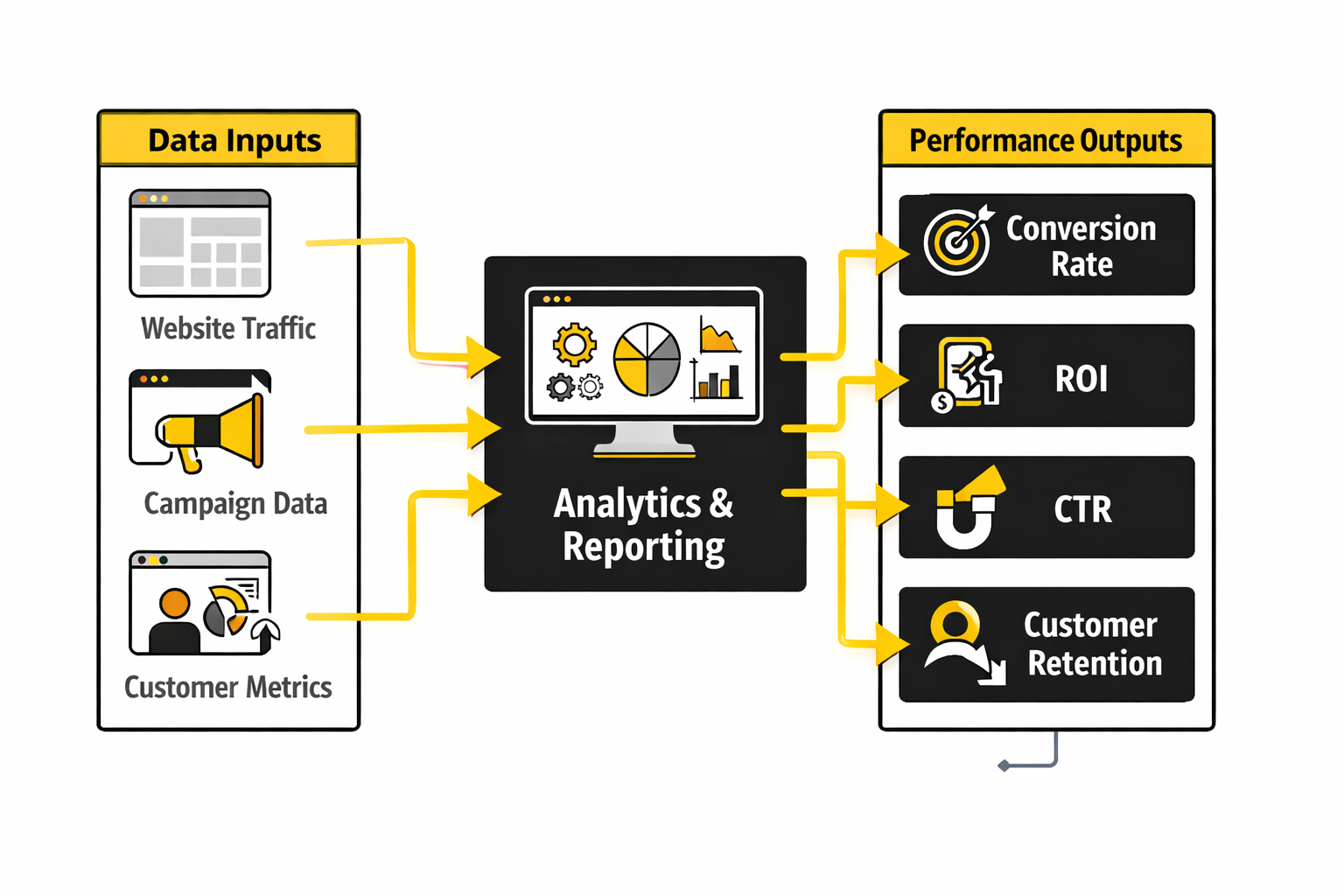
Once that system is in place, the numbers become easier to interpret. Search Console tells you whether people are seeing and choosing your result, while GA4 tells you what they do after they land, and the e-commerce event model lets you see the exact step where momentum drops. If you want a cleaner operating setup after the certificate, a reporting and automation layer like HighLevel can help centralize lead and funnel reporting, but the core logic still starts with Google’s own measurement framework. Google Podpora+4
Search Numbers Tell You Whether You Have A Visibility Problem Or A Message Problem
Search Console’s definitions matter more than most new marketers think. An impression means your link was seen or potentially seen in search results, a click is counted when someone goes to a page outside Google, and average position is the average position of your topmost result across impressions. That sounds simple, but it stops you from making sloppy decisions based on one surface metric. Google Podpora+2
Here is the practical way to read those numbers. If impressions are healthy but CTR is weak, your problem is usually the search snippet, the intent match, or the promise in the headline rather than the topic itself. If CTR is respectable but conversions on the landing page stay weak, then SEO is not the bottleneck anymore and the next fix belongs on the page, the offer, or the checkout path. Google Podpora+4
Average position needs even more caution. Google explicitly notes that Search Console reports the average topmost position for your site or page, which means it is useful for trend reading but weak as a vanity score when viewed without query or page filters. So if the number moves, do not celebrate or panic first. Filter by page, query, and device, then decide whether the change reflects real ranking improvement or just a shift in which queries are generating impressions. Google Podpora+1
Conversion Benchmarks Only Help When You Segment Them
Most ecommerce benchmarks agree on one thing: conversion rates are usually low enough that small improvements matter a lot. Shopify says global ecommerce conversion rates tend to sit around 2% to 3%, Dynamic Yield’s benchmark page currently shows a global average of 2.79%, and IRP Commerce’s February 2026 market data reports an overall average conversion rate of 1.59%. Those differences are not a contradiction. They are the warning label telling you that category mix, device mix, store maturity, and measurement methodology all change the baseline. Shopify+2
That is why a blended “good conversion rate” number can mislead you. Dynamic Yield’s category benchmarks, based on data from 200M+ monthly users, 400+ brands, and 300M+ total sessions, show much wider variation under the hood: over the past twelve months Food & Beverage has seen conversion rates around 6%, while Luxury & Jewelry sat around 0.9%. A low-ticket replenishment category and a high-consideration premium category should not be judged by the same target, and the certificate becomes more useful the moment you start thinking that way. Mastercard Dynamic Yield+1
Cart behavior tells you even more than the final conversion rate. Baymard’s current synthesis of 50 studies puts documented online cart abandonment at 70.22%, which is a useful reminder that losing people between product interest and payment is normal, but still expensive. The action is in the pattern: if product page engagement is solid and add_to_cart is happening but begin_checkout stays weak, the friction is often trust, shipping clarity, timing, or pricing surprise; if begin_checkout is healthy and purchase is weak, the leak is more likely inside payment, form friction, or checkout usability. Baymard Institute+3
This is where benchmark data should drive diagnosis instead of ego. If your store converts at 1.8%, that number is neither good nor bad until you compare it against your category, device mix, and traffic quality. A store with colder paid traffic and a more expensive product can outperform strategically while still sitting below a cheaper, repeat-purchase category on raw conversion rate. Shopify+2
Email Metrics Matter More When You Read Them In The Right Order
Email benchmarks are useful, but only when you stop treating open rate as the whole story. Current benchmark datasets cluster in a similar range: Mailchimp reports an overall average open rate of 35.63% and a click rate of 2.62%, the DMA’s 2025 benchmark reports 35.9% opens and 2.3% unique clicks, and Brevo’s 2025 benchmark shows an overall 31.22% open rate and 3.64% click-through rate. The big takeaway is not the exact decimal. It is that healthy email programs usually land in the low-to-mid 30s on opens and low single digits on clicks, which means you should judge performance in bands, not in fantasy targets. Mailchimp+2
The ecommerce slice is even more revealing. Mailchimp’s benchmark puts ecommerce emails at 29.81% open rate and 1.74% click rate, while Brevo reports 38.58% opens and 2.08% clicks for ecommerce. That spread is exactly why email data needs context. Your list source, consent quality, sending frequency, promotions, and audience warmth all influence the result, so the right question is not “why am I not matching someone else’s average?” but “which part of my funnel is suppressing response?” Mailchimp+1
There is also a technical layer that many beginners miss. Google requires bulk senders to use authentication, and Yahoo says senders should keep spam complaint rates below 0.3% while supporting unsubscribe requirements for marketing mail. So if opens or clicks fall sharply, do not start by rewriting copy. First check domain authentication, complaint rates, unsubscribe friction, and inbox placement, because a deliverability problem can make perfectly decent creative look weak. Google Podpora+2
That is another reason lifecycle tooling matters after the certificate. A platform like Brevo can make segmentation, automation, and campaign reporting much easier to manage, but the principle stays the same whether you use Brevo, Mailchimp, or something else: opens tell you whether the subject line and sender relationship earned attention, clicks tell you whether the content created intent, and conversions tell you whether the offer actually deserved the click. Mailchimp+2
The Signal Should Always Tell You What To Do Next
Good measurement is not about collecting more numbers. It is about shortening the time between signal and decision. When the certificate teaches analytics and measurement, this is the real professional habit it is trying to build: every metric should point to the next action, not just decorate a dashboard. Google Podpora+2
- Low impressions and weak position usually mean you need better topic coverage, stronger relevance, or improved discoverability, not prettier button colors. Google Podpora+1
- Healthy impressions but weak CTR usually point to a snippet, messaging, or intent-match problem. Google Podpora+1
- Healthy CTR but weak add-to-cart or lead action usually means the landing page is underperforming the promise that got the click. Google for Developers+1
- Healthy add-to-cart and weak purchase rate usually means checkout friction, trust issues, or payment complexity are doing the damage. Google for Developers+2
- Strong first purchase and weak repeat engagement usually means your retention system is thin, which brings the article to the final evaluation layer: whether this certificate is worth the money, how credible it looks to employers, and who should actually take it. Mailchimp+2
Where The Certificate Reaches Its Limit
The coursera google digital marketing certificate is strongest when you treat it as a foundation, not a finish line. Google’s own skills page says it prepares learners for a field with a median entry-level salary of $71,000, and Grow with Google says the broader Career Certificates ecosystem connects learners to an Employer Consortium of more than 150 U.S. companies. That is real signal, but the program is still positioned as beginner-level training, so the built-in tradeoff is obvious: it gives you a working map of the field, but not specialist depth in any one lane.
That tradeoff is not a flaw. It is actually the reason the certificate works for career changers and new marketers in the first place. Google’s materials say the program exposes learners to tools like Google Ads, Google Analytics, Mailchimp, Shopify, and Canva, which is exactly the kind of breadth a beginner needs before choosing whether to go deeper into paid media, SEO, lifecycle email, conversion optimization, or ecommerce operations.
The ceiling shows up when real pressure enters the room. Once money is on the line, employers do not just want someone who knows the vocabulary of funnels, audiences, and retention. They want someone who can diagnose why a campaign is underperforming, explain the tradeoff between scale and efficiency, and make a sensible next move without getting distracted by shiny tactics.
Search Is Changing, But The Core Discipline Is Not
One of the biggest strategic mistakes a new marketer can make after finishing this certificate is assuming that search now needs a totally different playbook because Google has added AI features. Google Search Central says the opposite in its current guidance on AI features and your website: the same foundational SEO best practices still matter, there are no additional requirements to appear in AI Overviews or AI Mode, and there is no special markup you need to add. That is a very useful reality check because it pulls you away from gimmicks and back toward durable work.
The advanced lesson here is simple but important. Google also says pages eligible for AI features still need to be indexed and eligible to show in Search with a snippet, and it specifically recommends making important content available in text, keeping internal links strong, and making sure Merchant Center and Business Profile information stay up to date. So if you want to scale beyond the course, do not chase mythical “AI SEO” shortcuts. Build cleaner site architecture, stronger product and category pages, more reliable comparison content, and better commercial intent matching.
There is also a measurement twist that matters. Google says traffic from AI features is included in the overall Search Console Performance report, and it notes that clicks from search results pages with AI Overviews have often been higher quality because users are more likely to spend more time on site. That means serious marketers cannot judge search by clicks alone anymore. You have to read search traffic alongside engagement, assisted conversions, and downstream revenue, not just raw sessions.
The Scaling Risks Beginners Usually Miss
The first scaling risk is platform dependence. Because the certificate introduces search, social, email, analytics, and ecommerce in one path, a lot of new marketers come out of it thinking in channels instead of systems. That works for a while, but the moment ad costs rise, rankings shift, or a social platform changes distribution, channel-first thinking starts to break.
The safer approach is to build an owned data layer as early as possible. Google Ads describes enhanced conversions as a way to improve conversion measurement and unlock stronger bidding by sending hashed first-party conversion data in a privacy-safe way. In practice, that means the marketers who scale best are the ones collecting consented customer data cleanly, passing it into their reporting stack, and connecting ad activity to real business outcomes instead of surface-level platform metrics.
That shift becomes even more important when the sale or lead does not close online in the same session. Google now recommends using Google Ads Data Manager for imports rather than relying on older legacy workflows for offline conversions, which tells you exactly where professional execution is heading: more first-party data, cleaner syncing, and better durability between platforms. Once you reach that stage, a stack built with Fillout for cleaner data capture, Brevo for lifecycle messaging, and HighLevel for CRM and funnel orchestration starts to make practical sense.
Breadth Stops Helping Once You Avoid Choosing A Specialty
The second risk is staying broad for too long. Broad exposure is exactly what makes the certificate useful at the start, but once you have the fundamentals, refusing to specialize becomes a form of procrastination. You do not become more employable by lightly touching twelve tools. You become more employable by getting unusually good at one commercial problem.
That is why the smartest move after the certificate is usually to pick one lane and push hard for ninety days. If you choose paid acquisition, get serious about conversion tracking, query intent, creative testing, landing page quality, and offline revenue feedback. If you choose content and SEO, get serious about crawlability, category structure, snippet quality, internal linking, and the way product or service pages answer real buying questions.
Email and retention can be an especially strong lane because they force you to think in customer value, not just traffic. The certificate already introduces segmentation, workflows, and post-purchase communication, but advanced operators go further by building win-back logic, lead scoring, onboarding sequences, and feedback loops that actually change the product or offer. That is where tools like Manychat, Chatbase, and Copper stop being “extra software” and start becoming part of the operating system.
How To Turn The Certificate Into Real Leverage
The strongest learners do one thing that average learners avoid: they turn coursework into evidence. The credential can help open the door, especially with Google’s employer network and the program’s strong brand recognition, but evidence is what keeps the conversation going. That means your next job is not just to finish the certificate. It is to make your judgment visible.
A practical upgrade path looks like this:
- Choose one specialty and build around it for one quarter. Do not try to become a complete digital marketing department overnight. Pick the commercial problem you want to solve best, then let every project, readout, and experiment reinforce that identity.
- Create one live or realistic end-to-end case. That case should include the offer, audience, acquisition channel, measurement setup, follow-up logic, and the changes you made after reading the data. The point is not to make the results look huge. The point is to show that you know how to think.
- Upgrade your measurement before you upgrade your budget. Google’s own documentation around ecommerce events and enhanced conversions makes it clear that better tracking creates better decisions. Many marketers do the reverse and scale spend before they can trust the reporting, which is how waste starts.
- Build one owned audience loop. Capture leads or customers, follow up intelligently, and pass learning back into the offer. A lightweight setup using Brevo, HighLevel, or even link-level tracking with Dub can do more for your long-term growth than chasing one more vanity metric.
- Document your decisions, not just your deliverables. Employers and clients care about the reasoning behind the work. A screenshot of a dashboard matters less than a clear explanation of what the numbers suggested, what you changed, and why that change was the highest-leverage move.
That is the level where this certificate starts paying off properly. Not because it magically turns someone into an expert, but because it gives a disciplined learner enough structure to build expert habits on top of it. Once you see that clearly, the closing question becomes much sharper: what does this certificate actually cost, how much credibility does it carry in the market, and who is it truly the right fit for today?
Cost, Credibility, and Who Should Take It
At this point, the decision comes down to value, not curiosity. The live Coursera program page says the Google Digital Marketing & E-commerce Professional Certificate is an 8-course series, requires no previous experience, is designed to be completed in under six months, and in the U.S. and Canada costs $49 per month after a 7-day free trial, which is why Coursera says many learners finish it for under $300. That pricing model makes the certificate accessible enough for self-funded learners, but it also creates a quiet pressure to move consistently instead of dragging the program out for months. Coursera’s program page Coursera+1
Credibility is where the program punches above its price. Coursera says the certificate has more than 1.29 million enrollments, and the same page ties it to over 116,000 open jobs in digital marketing and e-commerce with a $71,000 median entry-level salary in the U.S., while Grow with Google says graduates can connect with an Employer Consortium of more than 150 U.S. companies. None of that guarantees a job, but it does mean the badge sits inside a recognizable hiring ecosystem rather than floating around as an isolated course completion. Coursera’s listing and Grow with Google’s certificate hub Coursera+2
The certificate is also more portable than many people realize. Coursera labels it a shareable certificate that you can add to your LinkedIn profile, and the program page says learners may be able to use the credential toward up to 9 ACE-recommended college credits or 7 ECTS credits, depending on the institution. That combination matters because it turns the program into more than a line on a résumé; it becomes a credential you can use in hiring conversations, profile optimization, and in some cases academic progression too. Coursera’s details page, Coursera Help on sharing certificates, and ACE’s course listing Coursera+3
The best fit is pretty clear. This certificate makes the most sense for career changers, founders who need a real operating map, junior marketers who want broader commercial context, and freelancers who have been “doing content” or “running ads” without fully understanding the full customer journey. It is much less compelling for experienced specialists who already manage serious budgets, already run strong reporting systems, or already know exactly which lane they want to own.
That last point matters. If you already know you want to become an advanced paid media buyer, a technical SEO specialist, or a lifecycle CRM operator, the certificate is still useful, but mostly as a cleanup layer for fundamentals and vocabulary. In that case, its real value is speed and structure, not depth.
Build A Real Operating Stack After The Certificate
The smartest learners do not stop at the badge. They turn the certificate into a lightweight execution stack they can actually use with clients, employers, or their own projects, which means moving from “I completed the course” to “I can build a working acquisition, conversion, and retention system.” That is where the learning starts compounding.
A practical post-certificate setup usually looks simple. You might use Buffer for publishing discipline, Brevo for email and lifecycle flows, Manychat for conversational follow-up, Replo for higher-converting page builds, and HighLevel if you want an all-in-one funnel, CRM, and automation layer. If your work becomes more service-led than store-led, a booking and routing setup through Cal.com, an AI assistant through Chatbase, or a cleaner link hub through Anything.link can make your system feel much more professional without getting bloated.
For marketers who want to move faster, the real edge is documentation and speed of execution. A tool like Wispr Flow can help you get ideas out faster, while Fillout gives you a cleaner way to collect leads, surveys, and qualification data, and Guideless can help organize repeatable workflows. None of that replaces the course. It simply turns the course into something more valuable: an operating system you can actually run.
FAQ
Is the Coursera Google digital marketing certificate worth it?
For most beginners, yes. The live Coursera page still positions it as a beginner-level, no-experience-needed credential with more than 1.29 million enrollments, over 190 hours of instruction and practice, and a path into entry-level digital marketing and e-commerce roles. That makes it one of the stronger broad-entry options on the market, as long as you understand that it is a foundation and not a substitute for real execution. Coursera program listing Coursera+1
How much does the certificate cost right now?
Coursera currently says the certificate costs $49 per month after a 7-day free trial in the U.S. and Canada, and the program page says many learners can finish it for under $300 if they stay on pace. Coursera Plus is a separate option that currently shows $59 per month after a 7-day free trial or an annual plan that is being promoted at a discount, but the certificate page itself gives the clearest answer for this specific program. The practical move is simple: use the certificate page price for your planning, then move fast enough that the monthly model stays cheap. Coursera certificate page and Coursera Plus pricing Coursera+1
How long does it take to finish?
Coursera says the program is designed to be completed in under six months at under 10 hours per week. That estimate is realistic for most part-time learners, but motivated students can finish faster because the certificate is self-paced. The real variable is not difficulty so much as consistency. Coursera program page Coursera+1
Is it beginner friendly, or do you need experience first?
It is explicitly built for beginners. Coursera’s FAQ says no background knowledge is necessary, and the program page repeats that no degree or experience is required. That is one of the biggest reasons the certificate works so well for career changers and business owners who need a structured starting point. Coursera FAQ Coursera+1
Can you start for free?
You can usually test the experience before committing. Coursera says many certificate programs offer a 7-day free trial, and it also says many courses now let learners preview the first module for free, including graded assessments in that first module. That is enough to check the teaching style and platform feel before you decide whether the full subscription is worth it. Coursera enrollment options and Coursera preview help Coursera+1
Does the certificate actually help with getting a job?
It can help, but mostly by making you easier to understand and trust at the entry level. Coursera says 75% of certificate graduates report a positive career outcome within six months, and Grow with Google says graduates can connect with an Employer Consortium of more than 150 U.S. companies. That is meaningful support, but it works best when the certificate is paired with a portfolio, clean LinkedIn positioning, and at least one real or realistic project you can talk through in detail. Coursera program page and Grow with Google Coursera+1
Is the certificate alone enough to get hired?
Sometimes it is enough to get noticed, but it is rarely enough by itself to win the role. The certificate teaches the right foundation across search, social, email, analytics, ecommerce, and loyalty, yet employers still want evidence that you can apply those ideas under real constraints. The fastest way to close that gap is to build one live case study, one clean reporting example, and one clear story about how you used data to improve something. Coursera skills and outcomes Coursera
What tools does the program cover?
Coursera says learners work with tools and platforms including Google Ads, Google Analytics, Google Search Console, Mailchimp, HubSpot, Hootsuite, Canva, Shopify, Constant Contact, Google Sheets, and Google Trends. That mix is one of the program’s strongest features because it gives beginners enough tool exposure to understand how channels and workflows connect. It is broad rather than deep, which is exactly what an entry-level professional certificate should be. Coursera FAQ and program page Coursera+1
Can you add the certificate to LinkedIn?
Yes. Coursera labels it a shareable certificate and says you can add it to your LinkedIn profile, résumé, or CV, and Coursera’s help documentation explains how to place certificates in LinkedIn’s licenses and certifications section. That matters more than it sounds because clean profile presentation often shapes whether recruiters or clients take a second look. Coursera certificate page and Coursera sharing help Coursera+1
Does it count for college credit?
Potentially, yes. Coursera says learners can earn an ACE recommendation of up to 9 college credits or 7 ECTS credits for completing the certificate, and ACE lists the course in its National Guide because Coursera is an ACE Authorized Instructional Platform. The important catch is that each institution decides whether to accept the recommendation, so this should be treated as a possible advantage rather than a guaranteed transfer. Coursera FAQ and ACE National Guide listing Coursera+1
Is this better than a narrow Google Ads or Meta certificate?
It depends on where you are starting. This certificate is better when you need a full commercial map of digital marketing and e-commerce, while a narrower credential makes more sense when you already know your lane and want channel-specific depth. In practice, the Google certificate is usually the better first move for beginners, and the niche certifications become more valuable after you decide where to specialize. Coursera program scope Coursera
Who should skip this certificate?
Experienced specialists should think twice. If you already run advanced paid search accounts, manage serious lifecycle email systems, or handle technical SEO and measurement every day, the certificate will probably feel too broad and too entry-level for the time involved. In that case, you will usually get a better return by going deeper into your specialty, your own portfolio, or a tool-specific workflow stack.
What should you do immediately after finishing?
Do not let the certificate sit there as a passive badge. Build one focused project, install clean tracking, create one performance readout, and turn the whole thing into a short case study you can show in interviews or client conversations. That is the move that converts course completion into market value.
Work With Professionals
Explore 10K+ Remote Marketing Contracts on MarkeWork.com
Most marketers spend too much time chasing clients, competing on crowded platforms, and losing a percentage of every project to middlemen.
MarkeWork gives you a better way. Browse thousands of remote marketing contracts and connect directly with companies desperate to hire skilled marketers like you, without platform commissions and without unnecessary gatekeepers.
If you're serious about finding better opportunities and keeping 100% of what you earn, explore available contracts and create a profile for free at MarkeWork.com.