

Most people searching for coursera google digital marketing are not looking for a vague course roundup. They want to know whether the Google Digital Marketing & E-commerce Professional Certificate on Coursera is actually useful, whether it still feels current, and whether it can help them get real traction in digital marketing. That is the right question, because there are plenty of online certificates that look polished on the surface and leave you with nothing but a badge.
This one is different for a simple reason: it sits at the intersection of a real platform, a real brand, and a market that is still moving hard toward online acquisition, retention, and commerce. The latest U.S. Census retail e-commerce data says U.S. e-commerce sales hit $1.2337 trillion in 2025 and accounted for 16.4% of total retail sales, while the IAB/PwC Internet Advertising Revenue Report: Full Year 2024 says U.S. digital ad revenue reached a record $259 billion. That matters because it tells you the same thing from two angles: brands are still spending online, and they still need people who can drive results there.
The problem is that demand alone does not make a certificate valuable. What matters is whether the program teaches the right mix of channels, tools, measurement, and practical workflow so you can move from “I watched the videos” to “I can actually do the job.” That is exactly how this article is structured.
- Why the Coursera Google Digital Marketing Certificate Matters Right Now
- How the Certificate Is Structured
- What You Learn Across the Core Courses
- Where the Program Helps Most and Where It Falls Short
- How to Turn the Certificate Into Real Experience
- Is It Worth It for Your Career in 2026
Why the Coursera Google Digital Marketing Certificate Matters Right Now
The timing still works in this certificate’s favor. The Coursera program page and Google’s own certificate overview both position it around a field with 116,000 open jobs in digital marketing and e-commerce in the U.S., along with a $71,000 median entry-level salary based on Lightcast job postings data. That does not mean every graduate walks into a great job overnight, but it does mean the certificate is pointed at a real hiring category rather than a made-up niche.
The broader market backdrop supports that story. The Bureau of Labor Statistics outlook projects 6% growth from 2024 to 2034 for advertising, promotions, and marketing managers, with about 36,400 openings a year on average across the decade. That is not an entry-level stat and it should not be used that way, but it does show that the wider marketing ecosystem is not fading out.
What makes the certificate especially relevant is the kind of work it targets. Google’s official description says the program teaches campaign management, customer acquisition, analytics, e-commerce store setup, loyalty, and practical AI usage through tools and assignments designed around entry-level work on Grow with Google and Coursera. In plain English, it is not trying to turn you into a CMO; it is trying to make you useful fast.
That positioning is important because digital marketing has become less forgiving. The old playbook of “post more content and hope” is weaker now than it was a few years ago, while performance pressure is higher. WARC’s Global Ad Trends: Media’s new normal points to digital-native and cross-border e-commerce brands pushing performance-led spend, and that creates demand for people who understand traffic, conversion, reporting, and retention together instead of as separate silos.
So the real value proposition is not prestige alone. It is that the certificate gives beginners a way into the logic of modern digital marketing: attract attention, turn that attention into action, measure what happened, and improve from there. That is the framework employers actually care about, even when the job title changes.
How the Certificate Is Structured
One of the easiest ways to misunderstand this program is to think it is just one broad course. It is not. Google’s official curriculum page lists seven core courses in the certificate, and both Google and Coursera now also include an optional “Accelerate Your Job Search with AI” course layered on top of the main learning path on Grow with Google and Coursera.
Google says many learners finish in three to six months, the program is self-paced, and the U.S./Canada price is $49 per month after a 7-day free trial through Coursera in its current FAQ on Google Career Certificates. Coursera also says the certificate includes more than 190 hours of instruction and practice-based assessments, which is a meaningful amount of guided work for a beginner program. That matters because the value here is not just the videos; it is the repeated exposure to the same marketing logic across channels and tasks.
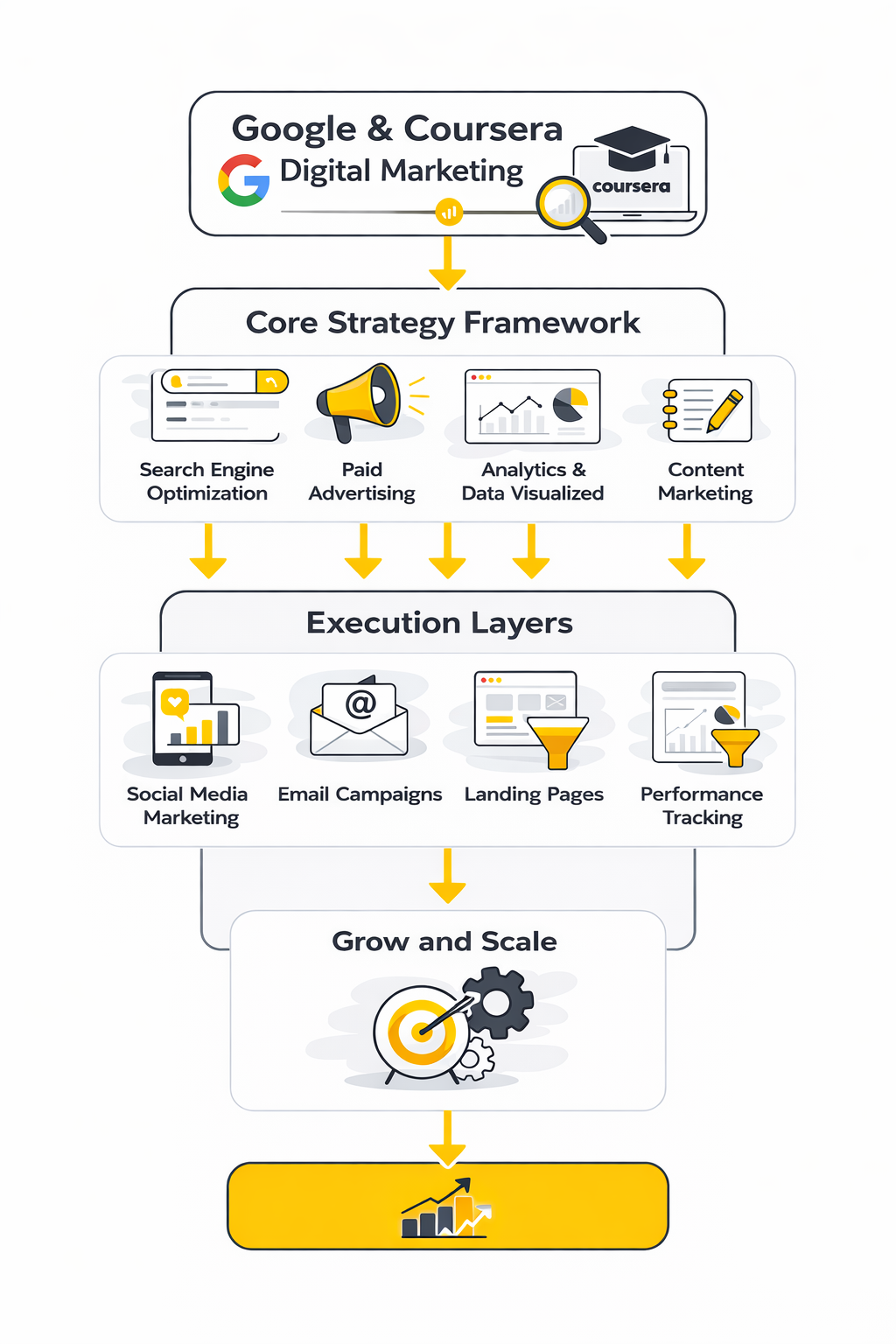
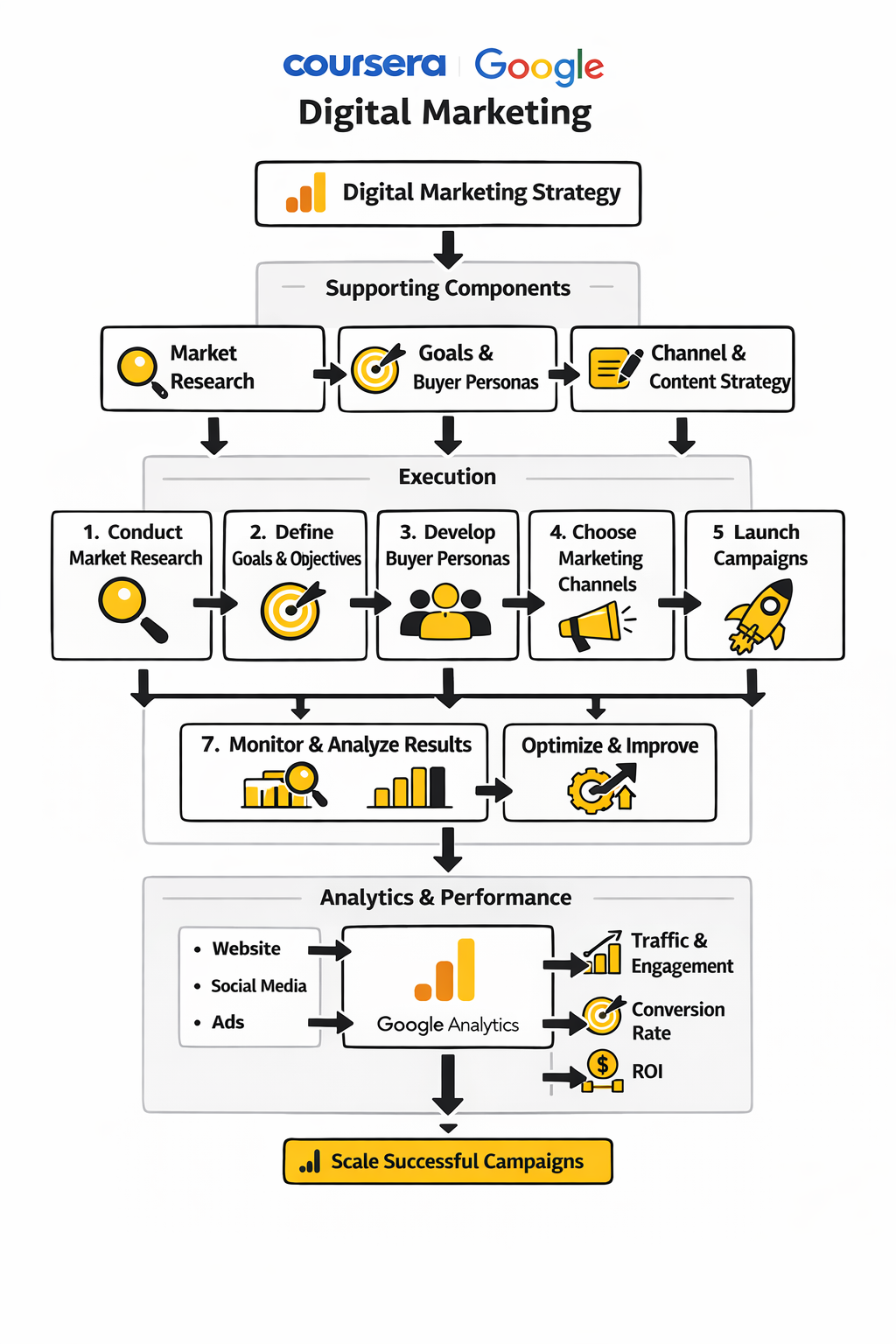
Here is the practical flow of the certificate as it stands now:
- Foundations of Digital Marketing and E-commerce introduces the field, the customer journey, the marketing funnel, and the role digital marketing and e-commerce play inside a business on Coursera.
- Attract and Engage Customers with Digital Marketing moves into SEO, SEM, display advertising, Google Search Console, and Google Ads fundamentals on Coursera.
- From Likes to Leads: Interact with Customers Online focuses on social media strategy, content planning, engagement, analytics, and paid social on Coursera.
- Think Outside the Inbox: Email Marketing covers strategy, copy, segmentation, automation, workflows, and campaign analysis on Coursera.
- Assess for Success: Marketing Analytics and Measurement shifts into media plans, goals, reporting, and data interpretation on Coursera.
- Make the Sale: Build, Launch, and Manage E-commerce Stores brings in Shopify, product listings, customer experience, checkout, shipping, and store operations on Coursera.
- Satisfaction Guaranteed: Develop Customer Loyalty Online closes the loop with retention, satisfaction, loyalty, portfolio building, and more AI-supported tasks on Coursera.
- Accelerate Your Job Search with AI is the optional add-on course that focuses on resumes, applications, interview prep, and job-search organization with AI tools on the main Coursera certificate page.
That sequence is smarter than it first looks. It starts with awareness and traffic, moves through social and email, then forces you into measurement, e-commerce operations, and retention, which is much closer to how real businesses work than a random collection of disconnected tutorials. Instead of teaching digital marketing as a set of trendy channels, it teaches it as a system.
The other thing worth noticing is that the tool exposure is broad but still beginner-friendly. Google’s official materials repeatedly reference platforms such as Canva, Constant Contact, Google Ads, Google Analytics, Hootsuite, HubSpot, Mailchimp, and Shopify on Grow with Google and Coursera. That does not make you an expert in every platform, but it does help you stop feeling lost when a job description starts listing tools.
That structure is also why the certificate works best for a specific kind of learner: someone who needs a guided path more than endless optionality. If you already want places to practice the social and email parts outside the coursework, tools like Buffer and Brevo can help you turn the lessons into something tangible instead of leaving them stuck inside course assignments. In the next section, we will get into what you actually learn across these courses, and which skills are genuinely useful once you leave the platform.
What You Learn Across the Core Courses
This is the part that decides whether the coursera google digital marketing certificate feels useful or forgettable. A lot of beginner programs stay trapped in theory, but Google’s curriculum is built around the mechanics of attracting traffic, converting interest, measuring performance, and keeping customers engaged through the sequence shown across the official certificate page and the individual course breakdowns on Coursera. That does not mean every lesson is advanced, but it does mean the program is trying to teach the actual operating system behind entry-level digital marketing work.
What stands out is that the certificate does not treat channels as isolated tricks. The flow from search and acquisition to social engagement, email marketing, measurement, store operations, and loyalty is the real lesson. That structure quietly teaches a bigger point: marketing is not just content or ads, it is a connected system.
Search, SEO, and Paid Traffic
The first serious skill block shows up in Attract and Engage Customers with Digital Marketing, where the program starts teaching how people discover businesses online. That includes SEO basics, search engine marketing, keyword thinking, ad fundamentals, audience targeting, and the logic behind matching an offer to search intent. This matters because beginner marketers often jump straight to posting content without understanding how demand already exists in search.
That course is especially useful because it makes you think in terms of relevance rather than noise. You are not just learning that Google Ads exists; you are learning why keywords, landing pages, and audience fit matter when real money is involved. For someone trying to break into digital marketing, that shift from “visibility” to “qualified traffic” is one of the most important mindset upgrades in the whole certificate.
It also helps that the search section connects naturally with the rest of the program. Once you understand how users arrive, you start seeing why weak messaging, bad page structure, or poor offer design can kill performance downstream. That is a much more valuable lesson than memorizing platform definitions.
Social Media and Content That Leads Somewhere
The social side of the certificate is handled in From Likes to Leads: Interact with Customers Online, and the course title gives away the main idea. The point is not to chase vanity metrics. The point is to understand how social content supports brand awareness, engagement, and eventually conversion when it is tied to a real strategy.
This is where the program gets more practical than many people expect. It moves beyond “post often” advice and into planning, channel selection, messaging, performance analysis, and the relationship between organic and paid social. That is a better foundation than most free content online, which tends to flatten every platform into the same advice.
It is also where beginners usually discover that content marketing is harder than it looks. Good social work is not just creativity; it is consistency, positioning, timing, and feedback loops. If you want to push this part beyond the coursework, using a scheduling and workflow tool like Buffer or a content support tool like Flick can turn the lessons into something you actually practice instead of something you simply finish.
Email Marketing and Lifecycle Thinking
A lot of beginners underestimate email because it feels older than newer channels, but that is exactly why the certificate’s Think Outside the Inbox: Email Marketing course matters. Email forces you to think about segmentation, message timing, subscriber intent, campaign goals, and automation rather than surface-level visibility. In other words, it pushes you closer to revenue logic.
That is a big step forward because strong marketers do not think only in acquisition terms. They think about what happens after the click, after the signup, and after the first purchase. Email is one of the cleanest ways to learn that discipline because bad assumptions show up fast in open rates, click rates, unsubscribes, and conversion behavior.
The course also helps learners see why lifecycle marketing is so important in e-commerce and lead generation. A business that only knows how to get attention will always be fragile. A business that can follow up, educate, recover abandoned interest, and reactivate customers has a much stronger engine.
If you want to build real muscle here, it helps to test the principles in a live tool. A platform like Brevo is useful for getting hands-on with lists, automations, and campaigns, while ManyChat can help you understand how conversational flows and follow-up sequences fit into modern lead capture.
Analytics, Testing, and Reporting
The most underrated part of the certificate is probably Assess for Success: Marketing Analytics and Measurement. This is where the program moves from channel activity into business accountability, covering campaign measurement, Google Analytics, Google Ads data, budgets, A/B testing, spreadsheets, and stakeholder reporting. That shift is a big deal because the market does not reward marketers for being busy; it rewards them for being able to explain results.
This course is also where the certificate becomes more than a content program. Once you start working with metrics, you have to define success, compare outcomes, interpret weak spots, and make a case for what should change next. Those are the habits that make someone employable, because they show you can connect activity to decisions.
There is another practical benefit here. Analytics work teaches humility fast. A headline you loved might underperform, an audience you assumed was strong might convert badly, and a campaign that looked exciting might not justify the budget. Learning to read that honestly is one of the most valuable professional habits the certificate can build.
E-commerce Operations and Customer Loyalty
The last major skill block is where the program gets more grounded in real business operations. In Make the Sale: Build, Launch, and Manage E-commerce Stores, learners work through how online stores function, including customer experience, product listings, and building a mock store with Shopify. Then Satisfaction Guaranteed: Develop Customer Loyalty Online brings the focus to retention, service, and long-term customer value.
That pairing matters because it stops digital marketing from becoming a traffic-only discipline. A lot of beginner marketers can talk about impressions, clicks, and engagement, but the stronger ones understand what happens when a customer lands on the site, browses a product page, reaches checkout, receives support, and decides whether to come back. That is where marketing starts blending into real commercial performance.
This is also the point in the certificate where learners see how broad modern digital work has become. You are not just learning promotion. You are learning how messaging, store experience, fulfillment expectations, and loyalty strategies all shape outcomes together.
For readers who want to turn this section into something more tangible, it can be smart to practice with tools that support the customer journey beyond the store itself. A lead capture layer like Fillout, a customer messaging tool like Chatbase, or even a conversion-focused landing page builder like Replo can help you see how acquisition, onboarding, and retention connect in the real world.
What the Skill Mix Really Adds Up To
When you step back, the strongest thing about the certificate is not any single course. It is the way the program teaches beginners to think across the full path from discovery to loyalty using the live structure shown on the Google certificate overview and Coursera’s program page. That is why the learning path feels more useful than a random collection of digital marketing tutorials.
The certificate will not make you a deep specialist in SEO, paid media, email, analytics, and e-commerce all at once. That would be an unrealistic promise. What it can do is give you a real operating base, a practical vocabulary, and enough channel awareness to start doing the work with intention instead of guessing.
That distinction matters more than most people realize. The beginner who understands how all the pieces connect is usually in a better position than the beginner who only knows isolated tactics. In the next section, that becomes the key question: where does the certificate genuinely help, and where does it still leave gaps you need to close yourself?
Where the Program Helps Most and Where It Falls Short
The biggest strength of the coursera google digital marketing certificate is that it gives beginners a structured way to learn how modern digital marketing actually fits together. Google and Coursera position it as job-ready training with hands-on projects, practical AI training, and career support rather than just passive lessons, which is exactly why it has stayed relevant while a lot of lightweight online certificates have faded into the background. Google also says its Career Certificates are recognized by more than 150 U.S. employers, and that 75% of graduates report a positive career outcome within six months of completion, which gives the credential more signal than a generic course badge. Grow with Google US+1
That said, the certificate helps most at the foundation level, not at the finish line. It can give you a real vocabulary for channels, metrics, funnels, store operations, and reporting, and it can reduce the chaos that beginners feel when every platform seems to speak a different language. What it cannot do on its own is prove that you can improve conversion rates, manage live budgets, or make sound decisions when results are messy and incomplete.
That distinction matters even more now because hiring is moving further toward demonstrated skill. LinkedIn’s 2025 recruiting research says skills-based hiring continues to gain ground as employers try to close talent gaps faster, which makes a practical certificate more useful than it would have been in an older degree-first environment. But “skills-based” does not mean “certificate-only.” It means you need evidence that the skills are usable. LinkedIn Business Solutions+1
Where the program really helps is in giving you a map. It shows you what search, social, email, analytics, e-commerce, and loyalty look like when they are part of one system, and that is a serious advantage for anyone coming in cold. Where it falls short is exactly where most online programs fall short: the jump from controlled coursework to messy real-world execution is still yours to make.
There is also a subtler weakness that people should be honest about. Because the certificate is broad, it makes you conversant across several areas without turning you into a deep specialist in any one of them. That is not a flaw in the design; it is the design. The mistake is assuming breadth alone will carry you through an interview or a client conversation without a body of work behind it.
How to Turn the Certificate Into Real Experience
This is the section most people should care about most. If you finish the certificate and stop at completion, you will have learned something useful, but you still may not be especially convincing to an employer, client, or founder. If you finish the certificate and then turn the coursework into visible, testable, outcome-focused work, the value changes completely.
Google’s own support ecosystem points in this direction. The company says Career Certificate learners get access to tools like resume support, mock interviews, networking help, and an employer job platform, which is valuable, but those resources work best when you have real project material to show. In other words, the certificate opens doors more effectively when you walk up to those doors carrying proof, not just completion. Grow with Google US+1
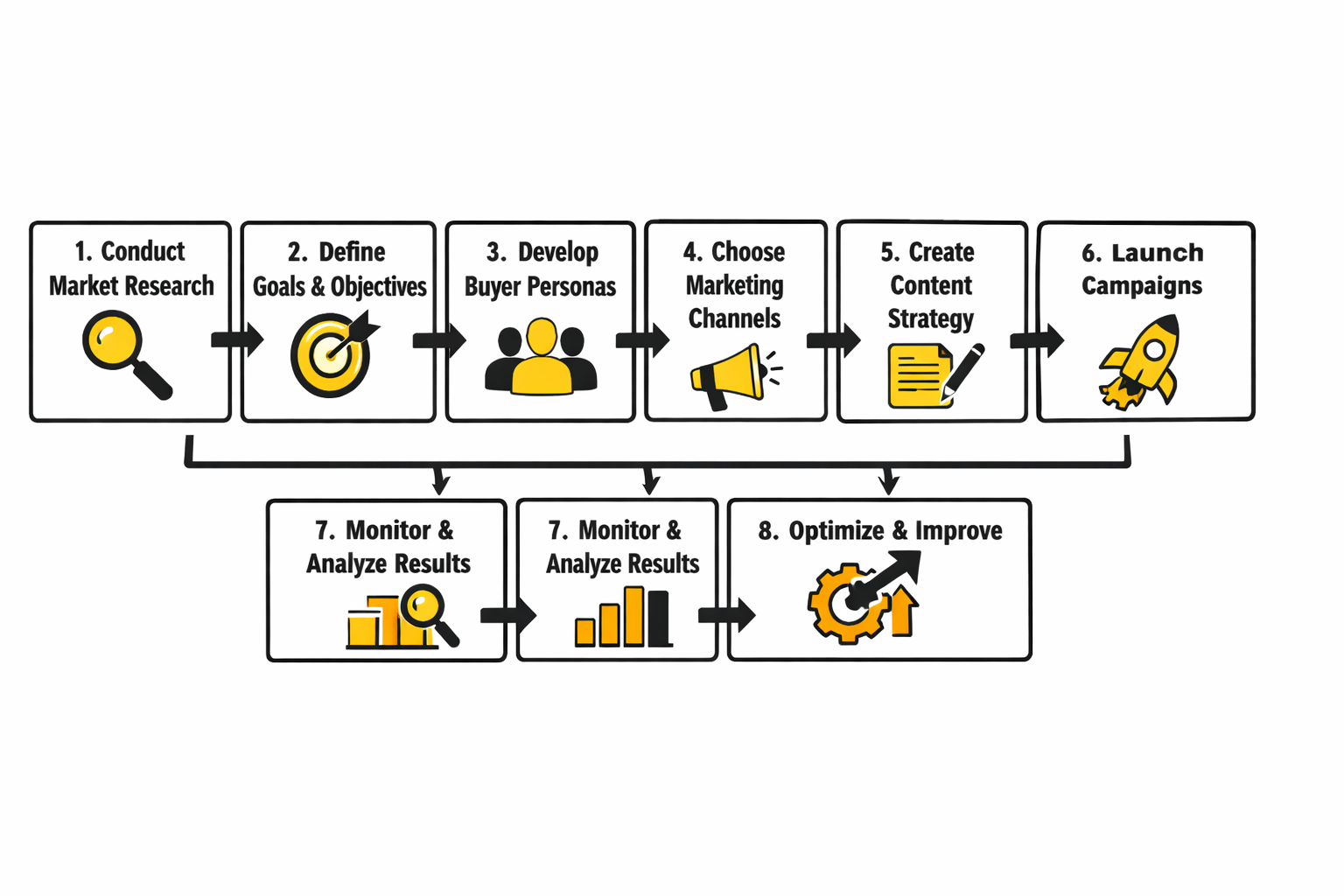
Here is the practical process that makes the certificate worth more in the real world:
- Pick one narrow business problem, not a fake “marketing project.” The fastest way to get traction is to choose a clear problem like generating leads for a local service, improving email follow-up for a simple offer, or building a cleaner acquisition path for a small product. This works because employers and clients do not hire “someone who knows digital marketing” in the abstract. They hire someone who can help move a specific metric or fix a specific bottleneck.
- Build a tiny working funnel around that problem. That might mean a landing page, a lead form, a welcome email sequence, a content plan, and a basic reporting sheet. You do not need a giant tech stack for this. A setup using GoHighLevel, Systeme.io, or ClickFunnels is often enough to make the process tangible and give you something real to explain.
- Create assets that connect directly to the funnel instead of creating random content. Write one email sequence, draft one paid search angle, outline one social campaign, and define one measurement plan. This is where the certificate starts becoming practical, because you are no longer studying search, social, email, and analytics as separate units. You are forcing them to work together, which is exactly how real marketing becomes legible.
- Track what happens and write down your decisions. Even if your project is small, document the assumptions you made, the metric you cared about, what underperformed, and what you changed next. This habit matters because analytics and reporting are where beginner marketers usually separate themselves from hobbyists. The person who can explain decisions clearly is already more credible than the person who only says they “managed a campaign.”
- Package the work like a case study, not a class assignment. A strong case study is simple: problem, audience, offer, channel mix, execution, measurement, lessons, and next steps. It should read like something a real operator would recognize, not like a homework submission. A clean presentation layer using something like Anything.link for a compact link hub or Fillout for lead capture demos can make that body of work easier to share.
- Repeat the process two or three times with different channel emphases. One project proves initiative. A small portfolio of projects starts proving range. By the time you have one lead-gen example, one email or automation example, and one e-commerce or conversion example, the certificate begins to look less like your main story and more like the training base behind your actual work.
That process is more important than people think. LinkedIn’s recruiting research keeps pointing toward skills-first evaluation, and Google’s own certificate support leans heavily on job readiness, employer access, and practical training. The common thread is obvious: learning matters, but evidence travels further. LinkedIn Business Solutions+2
There is another reason this process works so well in 2026. Coursera and Google both now emphasize AI skills inside the certificate ecosystem, and broader marketing research is pointing in the same direction, with HubSpot’s 2026 marketing data showing that AI use is becoming deeply embedded in content and workflow planning. That means your portfolio should not pretend AI does not exist. It should show that you know how to use it for research, iteration, and speed without outsourcing your judgment to it. Grow with Google US+2
The smartest implementation mindset is not “How do I finish all the modules?” It is “How do I turn each module into proof?” That shift changes how you take notes, how you build projects, and how you talk about your learning. It also protects you from the most common post-certificate disappointment, which is realizing too late that completion alone does not feel concrete enough.
So the professional implementation play here is straightforward. Use the certificate to build a system-level understanding of digital marketing, then immediately translate that understanding into visible work products, simple funnels, measured experiments, and clean case studies. In the next section, we will get even more specific about how to use that body of work to create real momentum with employers, freelance clients, or your own business.
The Numbers That Actually Matter
Once you start turning the coursera google digital marketing certificate into real work, the next question is brutally simple: what numbers actually deserve your attention? That matters because the market is large enough now that guessing is expensive. U.S. retail e-commerce reached $1.2337 trillion in 2025 and 16.4% of total retail sales, while the IAB/PwC full-year report put 2024 U.S. internet ad revenue at $258.6 billion. In a market that competitive, analytics is not a “nice to have.” It is the thing that tells you whether your traffic is useful, whether your message is landing, and whether your funnel is leaking money. Census.gov+1
Start With a Measurement System, Not a Dashboard
The most practical lesson inside the certificate’s analytics track is that measurement should follow the customer journey, not the other way around. Google’s own GA4 guidance is built around recommended events for the actions that move a business forward, including ecommerce steps like add_to_cart, begin_checkout, and purchase, plus lead-generation events like generate_lead, qualify_lead, disqualify_lead, and working_lead. That is the right way to think about analytics because it forces you to measure intent, not just visits. Google Podpora+1
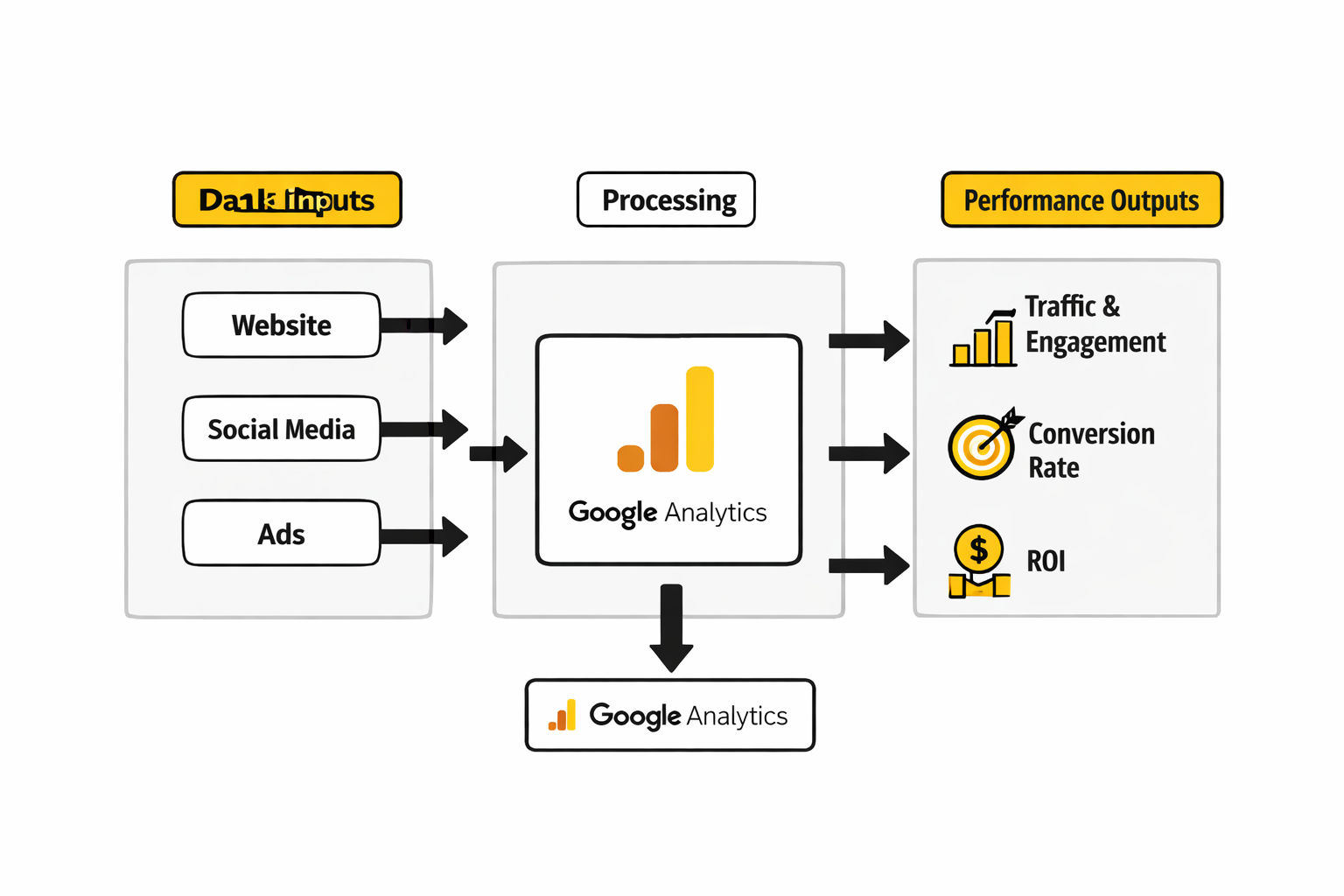
A clean measurement system usually looks like this:
- Traffic enters through a channel, campaign, keyword, or post.
- Interest appears through page views, product views, scroll depth, or engaged sessions.
- Commercial intent shows up through events like add to cart, form start, generate lead, or booked call.
- Decision friction becomes visible at begin checkout, shipping step, payment step, or qualification stage.
- Real business value lands at purchase, qualified lead, scheduled meeting, closed deal, or repeat order.
That sequence sounds obvious, but it changes everything. If you only watch traffic, you will overvalue channels that send cheap clicks. If you only watch purchases, you will miss where the drop-off starts. Google’s setup around key events and importing those conversions into Google Ads is useful because it lets you align reporting and bidding around actions that actually matter instead of vanity events. Google Podpora+1
Benchmarks Help Only When They Change a Decision
Benchmarks are useful, but only if they push you toward a specific action. Shopify’s own guidance says a “good” ecommerce conversion rate often sits around 2% to 3%, while Unbounce says its large 2024 benchmark dataset found a 6.6% median landing-page conversion rate across all industries. Those two numbers are not contradictory. They are measuring different environments, which is exactly why careless benchmarking leads people into bad decisions. Shopify+1
Here is the practical interpretation. If your ecommerce store converts at 1.8%, that does not automatically mean disaster, because product category, device mix, price point, and traffic quality all move the number. But if your product pages get plenty of visits and your cart abandonment rate is sitting near the Baymard-referenced global average of 70.19%, the likely action is not “buy more traffic.” The likely action is to reduce checkout friction, simplify the form, improve shipping clarity, strengthen trust signals, or fix mobile usability. Baymard Institute+1
This is also why platform-level benchmarking should stay in context. Shopify now supports benchmark comparisons inside reports, which is useful because peer context is better than guessing in a vacuum. But even a solid benchmark should act like a flashlight, not a verdict. It should show you where to inspect, not tell you that one raw percentage explains the whole business. Shopify Help Center
The Email Numbers Most People Misread
Email is where a lot of marketers still fool themselves. MailerLite’s 2025 benchmark dataset, built from 3.6 million campaigns across 181,000 approved accounts, reported an average open rate of 43.46%, an average click rate of 2.09%, and an unsubscribe rate of 0.22%. But the more important part of that report is not the open rate itself. It is the warning that Apple privacy changes inflate opens, which is why MailerLite explicitly says click rate is a more reliable engagement indicator than open rate. mailerlite.com
That should drive a very specific behavior. If your opens look healthy but clicks are weak, the problem is usually not subject lines anymore. It is offer quality, audience fit, email structure, or weak calls to action. And if unsubscribes climb while opens stay high, the lesson is even sharper: attention is not the same as relevance.
The most useful recent email benchmark for action, not ego, comes from Klaviyo’s current benchmark material. Klaviyo says its 2026 benchmark data from more than 183,000 customers shows that automated flows generate nearly 41% of total email revenue from just 5.3% of sends, while flows deliver 5.58% click rates versus 1.69% for campaigns and 13 times higher placed-order rates. That should tell you exactly what to build next: welcome flows, browse-abandon sequences, cart recovery, and post-purchase retention before you obsess over sending more one-off blasts. Klaviyo
If you want to make that lesson tangible in your own portfolio, build one automated sequence and measure it end to end. An email stack is only impressive when it connects to downstream behavior, which is why pairing your campaigns with a CRM or pipeline layer like Copper or GoHighLevel can make your reporting much more credible. For lead generation, a booked call through Cal.com is often a better success signal than a raw form submission because it is closer to real commercial intent.
Attribution, Value, and the Difference Between Activity and Results
A lot of beginner marketers still read performance through a last-click lens because it feels simple. Google Ads explicitly warns that attribution models exist because customers often interact with multiple ads before they convert, and relying on last click can ignore meaningful earlier interactions in the path. Google Analytics and Google Ads both now make it much easier to review attribution reports and compare attribution models, which matters because channel decisions get distorted fast when you credit only the final touchpoint. Google Podpora+1
The next level is value, not just conversion count. Google Ads’ conversion value rules let you adjust reported value based on geography, device, and audience, and Smart Bidding is designed to optimize toward conversions or conversion value rather than just clicks. That matters because not every lead, order, or customer is worth the same amount. Once you understand that, the action becomes obvious: stop reporting “we got 100 leads” as if that ends the conversation, and start asking which leads were actually worth pursuing. Google Podpora+1
Performance Signals Outside the Ad Platforms Still Matter
Analytics is not only about campaigns. It is also about what happens after the click. Google’s performance documentation says Core Web Vitals are built around real-world usage data and measured through LCP, INP, and CLS, while Search Console groups URLs into poor, need-improvement, and good experiences based on field data from actual users. Google’s own training material also points to research showing that when a site meets Core Web Vitals thresholds, people were 24% less likely to abandon the page. Google for Developers+2
That should drive a different kind of action than most marketers take. If ad metrics look fine but conversion rates are weak on mobile, you should not automatically rewrite the ad or change the audience first. You should inspect the landing page, the load experience, the layout shift, the form friction, and the checkout flow. Fast diagnosis beats louder promotion almost every time.
The core idea of this whole section is simple. Good digital marketing measurement is not about collecting more numbers. It is about choosing the few numbers that reveal where revenue is being created, where intent is getting lost, and what you should fix next. In the final section, that becomes the big decision most readers came here for in the first place: is this certificate actually worth it for your career in 2026, and for which kind of person does it make the most sense?
The Strategic Tradeoffs Most Beginners Miss
Breadth Helps You Start, but It Does Not Make You Hard to Replace
One of the smartest things about the coursera google digital marketing certificate is also one of its biggest limits. It is built for beginners, requires no prior experience, and now has more than 1.29 million enrollments on Coursera, which makes it a strong on-ramp but a weak moat by itself. That means the certificate can absolutely help you get oriented, but it is not rare enough to be your edge once you start competing with other applicants who finished the same material. Coursera+1
This is where a lot of people misread the value of the program. They assume the credential is the product, when the real product is the capability you build on top of it. The stronger interpretation is this: the certificate lowers the cost of getting competent, but it does not remove the need to become distinctive.
That tradeoff becomes even clearer when you look at how Google describes the wider certificate ecosystem. Google emphasizes practical AI training, self-paced learning, resume tools, mock interviews, and access to an employer consortium of more than 150 U.S. companies, which is useful support, but it still points toward the same conclusion. The program is designed to help you enter the market faster, not to exempt you from market competition once you get there. Grow with Google US
Search Has Changed Faster Than Most Beginners Realize
The second tradeoff is harder, because it is happening under your feet while you learn. Google’s own documentation now says AI Overviews and AI Mode are part of how people explore information in Search, and it also says there are no special tricks required to appear there beyond solid technical foundations and helpful, reliable, people-first content. That is an important reality check, because it means the search game is still grounded in fundamentals even as the surface area changes. Google for Developers
At the same time, Google Ads says ads can appear above, below, and in some cases within AI Overviews, with eligibility already extending across major campaign types and many markets. In plain English, marketers are now operating in a search environment where organic visibility, AI-generated summaries, and paid placements are becoming more tightly interwoven. If you treat SEO, paid search, and landing-page quality as separate disciplines, you will read the market too slowly. Google Podpora
That is why advanced learners should be careful about becoming “channel loyalists” too early. A beginner who only wants to master one dashboard can feel productive fast, but the stronger operator learns how intent moves across search, pages, offers, email, remarketing, and conversion friction. The certificate gives you the map; the next stage is learning how the map changes when platforms change.
AI Makes Execution Faster, but It Also Raises the Standard
There is a tempting mistake waiting for anyone who finishes this kind of program in 2026: using AI to speed up output without upgrading judgment. The World Economic Forum’s Future of Jobs Report 2025 says employers expect 39% of workers’ core skills to change by 2030, while analytical thinking remains the top core skill and technology skills like AI and big data are among the fastest-rising areas of demand. That combination matters because it tells you the market is not rewarding tool use alone. It is rewarding people who can combine tools with reasoning, prioritization, and interpretation. World Economic Forum+1
This is exactly where average certificate holders start to flatten out. AI can draft subject lines, ad variants, briefs, outlines, and reporting summaries faster than ever, but the ease of production makes weak strategy more visible, not less. When everyone can generate acceptable-looking assets, the real differentiator becomes whether you can choose the right angle, define the right audience, spot the wrong metric, and know what to test next.
So the advanced tradeoff is not “AI or no AI.” It is whether you use AI as leverage or as a crutch. Google is already framing commercial discovery as more assistive and more fluid in 2026, which means marketers who can direct AI well will move faster, while marketers who rely on it blindly will ship polished mediocrity at scale. blog.google+1
How to Scale Beyond the Certificate Without Losing the Plot
Choose a Commercial Lane After the Foundation Stage
Once you have the certificate fundamentals, the next move is not “learn everything.” The next move is to choose a lane where businesses actually spend money and where your work can be measured clearly. For most people, that means leaning toward one of four paths: acquisition, lifecycle/email, e-commerce conversion, or analytics and reporting.
This is where the program’s breadth becomes useful instead of limiting. Because you have seen search, social, email, analytics, store operations, and loyalty in one framework, you can choose a specialty without becoming blind to the rest of the funnel. That makes you more commercially useful than someone who knows one tactic well but cannot connect it to revenue.
The important thing is to pick based on business mechanics, not just personal taste. If you like creative work but avoid measurement, you will eventually hit a ceiling. If you like dashboards but never learn offer positioning or messaging, you will become dependent on other people to create the ideas you analyze.
Build Owned Systems, Not Just Platform Familiarity
A lot of beginner marketers scale badly because they stay trapped inside borrowed platforms. They know how to post, launch, or click through ad settings, but they do not know how to build an owned system that captures leads, nurtures interest, and preserves customer data over time. That is risky, because platform rules, placements, and discovery surfaces can shift much faster than your business model.
That is why advanced learners should spend time building operating infrastructure, not just campaign assets. A simple workflow using GoHighLevel for CRM and automation, ManyChat for conversational lead capture, or Replo for landing-page testing can teach you more about how real funnels behave than another week of passive course consumption. The exact stack matters less than the principle: own the relationship, instrument the funnel, and make it easy to see what happens next.
This is also the stage where strong marketers stop thinking in isolated campaign terms and start thinking in systems. Search drives qualified interest, pages clarify the offer, forms and chat reduce friction, email and automation continue the conversation, and reporting tells you where the chain breaks. Once you can build and explain that system, the certificate starts looking like the beginning of your training rather than the main proof of your competence.
Learn to Talk in Economics, Not Just Marketing Language
One of the clearest ways to tell whether someone has moved beyond the beginner stage is how they explain performance. Beginners talk about reach, clicks, impressions, and maybe open rates. Better operators talk about lead quality, conversion cost, contribution to revenue, repeat purchase behavior, sales velocity, and whether the economics still work once friction and waste are exposed.
This matters because hiring managers and clients do not really need another person who can narrate dashboard activity. They need someone who can interpret tradeoffs. If a cheaper lead source produces worse close rates, or a stronger landing page lifts conversion but hurts average order value, someone has to understand that tension and recommend the better path.
That is why your post-certificate growth should include more finance awareness than most people expect. You do not need an MBA to become useful here, but you do need to understand that “more conversions” is not always the same thing as “better business.” Once you start making decisions through margin, retention, qualification, and lifetime value, your marketing judgment gets much harder to replace.
Keep Your Portfolio Close to the Market
There is one more advanced mistake worth avoiding: building a portfolio that only proves you finished educational tasks. A strong portfolio should feel like a response to current market conditions, not a museum of course exercises. That means showing work that reflects how search is changing, how automation is being used, how reporting supports decisions, and how a real business problem moved from diagnosis to action.
This is where fresh, compact proof tends to beat polished bulk. One sharp teardown of a weak funnel, one measured automation build, one before-and-after landing-page experiment, or one acquisition case study tied to clear commercial outcomes usually does more for credibility than a dozen generic deliverables. The certificate gives you enough structure to produce that kind of work, but only if you keep testing it against live reality.
That is the deeper strategic point of Part 5. The certificate is still a good entry point, but the people who get the most from it are the ones who treat it as a launchpad into sharper positioning, owned systems, current-market awareness, and stronger economic thinking. In the final part, that leads to the decision readers usually care about most: who should take this program, who should skip it, and whether it is actually worth the time and money in 2026.
Is It Worth It for Your Career in 2026
At this point, the honest answer is yes, but only if you judge the coursera google digital marketing certificate by the right standard. It is still one of the clearest beginner-friendly ways to learn the mechanics of digital marketing and e-commerce from a major brand, and the official program page still positions it as a self-paced path to entry-level skills with AI training, more than 190 hours of content, and a curriculum built around real channels like search, social, email, analytics, and Shopify-based store work. The mistake is expecting the certificate itself to be the finish line when it works much better as a launchpad into proof of work, specialization, and better positioning. Coursera+2
The people who should say yes are beginners who need structure, career changers who want a credible first signal, and freelancers or operators who need a cleaner system for understanding how acquisition, conversion, and retention fit together. Google still says the field has more than 116,000 open jobs in the U.S. with a $71,000 median entry-level salary, and it also says certificate completers get access to employer consortium opportunities, resume tools, mock interviews, and career support. That combination makes the program most useful for someone who wants a broad, practical foundation and is willing to build portfolio evidence immediately after or during the coursework. Coursera+2
The people who should probably skip it are the ones who already know exactly which specialist lane they want and need deeper execution instead of broad orientation. If you already run paid accounts, manage retention systems, or build growth models professionally, the Google certificate will likely feel too foundational. In that case, the smarter move is usually to use the certificate outline as a coverage check, then go much deeper in one commercial lane, ideally while building systems in tools like GoHighLevel, Replo, or ManyChat instead of spending most of your time inside beginner coursework. Coursera+3
The practical verdict is simple. If you want a respected, structured entry point into digital marketing, this is still a strong buy in 2026. If you want an automatic shortcut to expertise or income, it is not. Grow with Google US+1
What the Winning End State Looks Like
The best outcome is not “I finished seven courses and an optional AI job-search add-on.” The best outcome is that you leave the program with one clear specialty direction, two or three compact case studies, a working understanding of measurement, and a simple operating stack you can actually explain to an employer or client. When that happens, the certificate becomes credible because it is attached to evidence, not because the badge alone carries magical weight. Coursera+2
In practical terms, the strongest post-certificate setup is usually a small personal marketing system. That can mean a portfolio hub, a landing page, a lead form, a short email sequence, a reporting sheet, and one strong case study that shows how you think. If you want to make that system cleaner, tools like Anything.link, Fillout, and Guideless can help you package your work so it feels like professional proof instead of scattered learning notes. Coursera+1
FAQ
Is the Coursera Google Digital Marketing certificate worth it?
For most beginners, yes. The program is still one of the clearest structured paths into digital marketing and e-commerce, with official backing from Google, a large enrollment base on Coursera, practical AI content, and a curriculum that covers the main commercial channels instead of just one platform. It becomes much more valuable when you pair it with real projects, but even on its own it is a solid foundation for someone starting from zero. Coursera+2
Is it beginner-friendly if I have no experience?
Yes, that is exactly who it is built for. The official Coursera page says no degree or prior experience is required, and the first course begins with entry-level roles, customer journeys, and marketing fundamentals rather than assuming you already know campaign terminology. That makes it a better entry point than many advanced tactic-heavy courses that throw beginners into dashboards too early. Coursera+1
How long does it take to finish?
Google and Coursera both frame the program as something many learners complete in under six months, depending on pace. Because it is self-paced, the real answer depends on whether you are treating it as light weekly study or as a serious reskilling block. The better question is not just how fast you can finish, but whether you are building proof alongside it so the time creates visible career leverage. Coursera+1
How much does the certificate cost?
The program is sold through Coursera’s subscription model rather than a one-time lifetime fee. Google’s FAQ says the U.S. and Canada price is $49 per month after a 7-day free trial, while Coursera also lists the certificate as included with Coursera Plus, which can make more sense if you plan to complete multiple programs. The cost is reasonable for a career-entry certificate, but it becomes expensive if you drag it out without producing portfolio work. Grow with Google US+2
Can you take it for free or get financial aid?
You can at least start without paying upfront, because Coursera lists the certificate as “enroll for free,” and many Coursera programs can be previewed or accessed through a free-trial window. Google also states that learners may be eligible for financial aid through Coursera and points applicants to the “Financial aid available” link on the course page. So the real answer is that full completion usually is not permanently free, but access barriers are lower than many people expect. Coursera+3
Do employers actually recognize it?
Google says its Career Certificates are recognized by more than 150 U.S. employers, including companies in its employer consortium, and that completers get access to an exclusive job platform. That does not guarantee interviews or offers, but it does mean the credential has more employer visibility than a random certificate from an unknown provider. Recognition helps, but your portfolio and your ability to explain your work still decide whether that recognition turns into opportunities. Grow with Google US+1
Can it count for college credit?
Yes, at least in some settings. Google’s page for the Digital Marketing & E-commerce Certificate says this specific certificate carries an ACE recommendation for 9 college credits, while Google’s broader Career Certificates FAQ notes that schools vary in how they choose to award credit. So it can create an academic pathway, but you should still confirm the policy directly with the institution you care about. Grow with Google US+1
Does it teach Google Ads and Google Analytics?
Yes, but at a beginner-to-early-practical level rather than at a deep specialist level. The official course lineup includes search and acquisition work, analytics and measurement, Google Ads exposure, and Google Analytics concepts as part of the certificate path. That is enough to make you conversant and operational, but not enough on its own to make you an advanced media buyer or measurement architect. Grow with Google US+2
Is this the same thing as a Google Ads certification?
No, and that distinction matters. The Google Digital Marketing & E-commerce Professional Certificate is a broad career certificate covering search, social, email, analytics, e-commerce, and loyalty, while a Google Ads certification is a narrower platform credential focused specifically on advertising skills. In practice, the Google certificate is the better choice for someone building a foundation, while platform certifications make more sense once you already know which lane you want to specialize in. Coursera+1
Is it enough to get a job by itself?
Usually not by itself, and it is better to be honest about that. The certificate can absolutely help you become interviewable and can give you a recognized starting credential, but the stronger candidates will still be the ones who show practical projects, clean case studies, and a basic system for how they think about performance. The certificate opens doors more effectively when it is attached to visible evidence. Grow with Google US+1
Is it useful for freelancers, not just job seekers?
Yes, especially if you use it to organize your service thinking. Freelancers benefit from the program’s broad view because client work rarely lives inside one tidy channel, and the certificate helps connect search, social, email, reporting, e-commerce, and loyalty into one operating model. The key is to turn what you learn into one or two service packages, a stronger audit process, and a few proof-driven examples rather than stopping at completion. Grow with Google US+1
Does the program include AI training now?
Yes. Google’s current Career Certificates FAQ says the certificates include practical AI training, and the Coursera listing for this specific program also highlights new AI skills. That is useful, but the smart way to treat it is as leverage for research, drafting, and faster iteration rather than as a replacement for judgment, analysis, or strategy. Grow with Google US+1
Should I choose this certificate or a more specialized one?
If you are still figuring out where you fit inside digital marketing, the Google certificate is usually the better first move because it gives you breadth across the full commercial funnel. If you already know you want deep social-media execution, paid media specialization, or another narrow lane, a more focused program may get you to usable depth faster. The right choice depends less on brand preference and more on whether your current bottleneck is confusion or specialization. Coursera+2
Work With Professionals
Explore 10K+ Remote Marketing Contracts on MarkeWork.com
Most marketers spend too much time chasing clients, competing on crowded platforms, and losing a percentage of every project to middlemen. MarkeWork gives you a better way. Browse thousands of remote marketing contracts and connect directly with companies desperate to hire skilled marketers like you, without platform commissions and without unnecessary gatekeepers. markework.com+1
If you're serious about finding better opportunities and keeping 100% of what you earn, explore available contracts and create a profile for free at MarkeWork.com. markework.com+1
Work With Professionals
Explore 10K+ Remote Marketing Contracts on MarkeWork.com
Most marketers spend too much time chasing clients, competing on crowded platforms, and losing a percentage of every project to middlemen. MarkeWork gives you a better way. Browse thousands of remote marketing contracts and connect directly with companies desperate to hire skilled marketers like you, without platform commissions and without unnecessary gatekeepers. markework.com+1
If you're serious about finding better opportunities and keeping 100% of what you earn, explore available contracts and create a profile for free at MarkeWork.com. markework.com+1
I’m building the final ecosystem from the article’s actual structure now: framework at the top, then core components, implementation, measurement, and scaling.