

CPA affiliate marketing still attracts beginners because the promise sounds simple: drive a click, get an action, earn a commission. That part is true, but it also hides where most people lose money, burn traffic, and quit too early. The channel rewards precision, not hype.
What makes this model worth taking seriously is that it sits right at the intersection of performance media, conversion psychology, and offer selection. Brands keep spending in affiliate because they only pay when something measurable happens, and the broader affiliate market has kept growing, with the UK’s classic CPA affiliate segment alone reaching £1.67 billion in 2023 with 17% year-over-year growth. That kind of spend tells you one important thing: this is not a fringe tactic anymore.
At the same time, the easy version of affiliate is getting squeezed. Search platforms are clearer about what counts as thin affiliate content, and Google’s own documentation makes the distinction blunt: affiliate pages that add real value can perform, while cookie-cutter pages built to rank without substance can become a liability for the whole site via its spam policies on thin affiliate and site reputation abuse. So the real conversation is no longer whether CPA affiliate marketing works. It is whether you can build it in a way that is trackable, compliant, and durable.
This article breaks that down from the ground up, then moves into execution, traffic, optimization, and scaling without pretending the business is easier than it is.
Article Outline
- Why CPA Affiliate Marketing Matters
- The CPA Affiliate Marketing Framework
- Core Components of a CPA Campaign
- Choosing Offers, Traffic Sources, and Funnels
- Optimization, Compliance, and Risk Control
- Scaling CPA Affiliate Marketing Into a Real Business
Why CPA Affiliate Marketing Matters
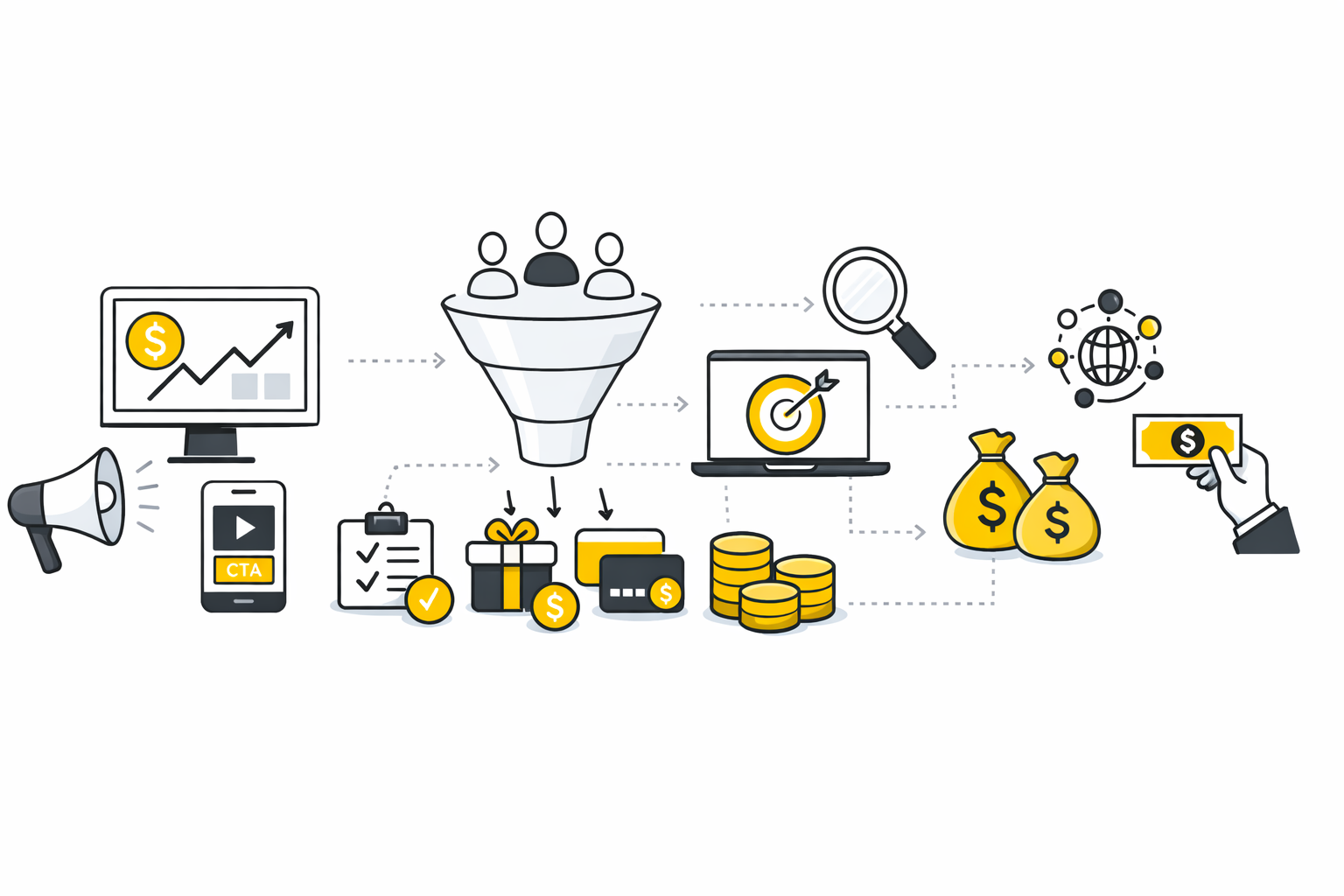
CPA affiliate marketing matters because it aligns incentives in a way few other online business models do. The advertiser wants a measurable action, the affiliate wants a payout tied to performance, and the network or platform sits in the middle to handle tracking, approval, and payments. When the system is healthy, every side can see what success looks like.
That performance-first structure also makes CPA more flexible than people expect. An action does not always mean a sale. It can be a lead form, a booked appointment, an app install, a free trial, a qualified call, or another conversion event the advertiser actually values. That is why CPA campaigns show up across software, finance, local services, education, e-commerce, and mobile apps instead of living in one narrow corner of marketing.
There is also a strategic reason the model keeps pulling in serious operators. You do not need to own inventory, build the product, manage fulfillment, or carry support overhead. Your job is narrower and harder at the same time: match the right traffic with the right offer and make the economics work. That sounds limiting until you realize it gives you room to become very good at one thing, which is finding intent and turning it into action.
The catch is that the bar is higher now. Compliance matters more, disclosures matter more, and platforms are less tolerant of lazy pages that recycle the same claims and layouts. The FTC’s guidance around material connections and endorsements is not optional just because the traffic comes through a creator account, review article, or social post. If money changes hands and your recommendation could influence a decision, transparency is part of the job.
That shift is healthy. It pushes CPA affiliate marketing away from loophole chasing and toward actual marketing skill. The people who win now tend to understand audiences, landing pages, tracking, creative testing, and unit economics. In other words, the model starts working once you treat it like a business and not a shortcut.
The CPA Affiliate Marketing Framework
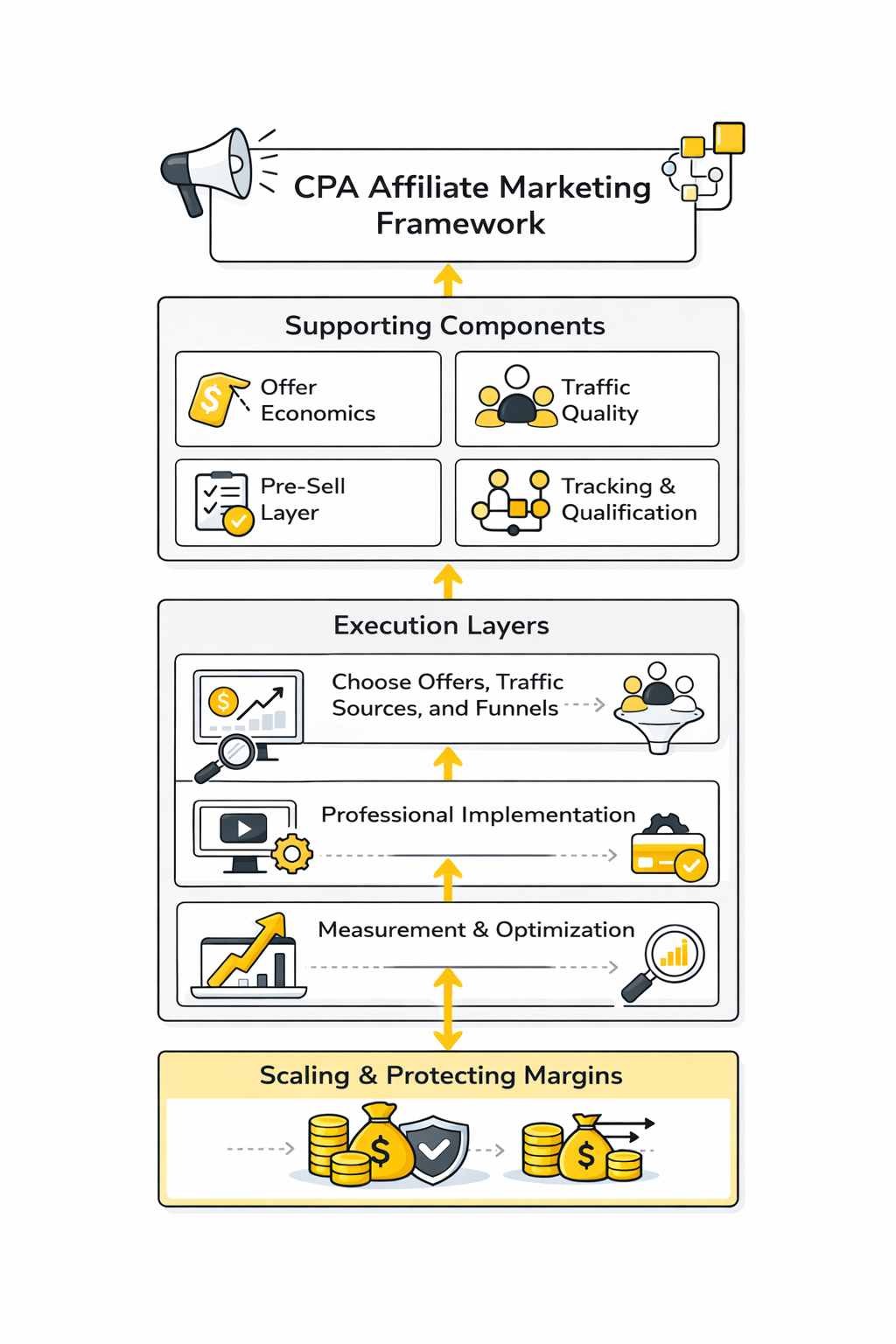
The cleanest way to understand CPA affiliate marketing is to see it as a four-part system: traffic, pre-sell, offer, and tracking. Traffic brings attention. The pre-sell frame shapes intent. The offer captures the action. Tracking tells you whether the first three pieces are producing profitable behavior or just activity that looks exciting in a dashboard.
Most beginners obsess over the offer and ignore the system around it. That is backwards. A decent offer can fail with weak positioning, mismatched traffic, or a bad handoff. A good operator looks at the full chain instead. They ask where the user came from, what promise got the click, what page sets the expectation, and whether the final action feels like the natural next step.
This is also where the channel gets more professional. The modern version of CPA affiliate marketing is rarely just “send traffic straight to a link.” In many cases, it works better when you insert a controlled step between the traffic source and the advertiser. That might be a quiz, a comparison page, a free tool, an email capture flow, a chatbot sequence, or a booking page. Those assets do two things at once: they improve conversion quality and they give you more control over the economics of the funnel.
For example, if you are collecting leads before routing users to an offer, tools like Fillout can help create cleaner qualification flows, while ManyChat fits naturally when conversational follow-up increases the chance of an action. If the offer needs a stronger on-page conversion environment, Replo is the kind of landing-page layer that can matter more than squeezing another few cents out of a click.
What Happens Inside the Framework
A user first encounters a message somewhere. That could be a search result, a short-form video, a review article, a newsletter mention, a paid ad, or a community recommendation. The message creates a micro-commitment by promising a solution, shortcut, comparison, or next step.
From there, the user lands on an asset that either qualifies or persuades. This is the part too many affiliates skip. The bridge page should reduce confusion, narrow the audience, and make the eventual action feel specific rather than generic. In practical terms, that means stronger headlines, clearer benefits, better matching between intent and offer, and fewer wasted clicks from the wrong people.
Then the advertiser or merchant page takes over, and that handoff has to feel consistent. If the traffic was primed for one promise and the offer page delivers another, conversion rates collapse fast. CPA affiliate marketing becomes much easier to understand once you stop treating the click as the finish line and start seeing it as a transfer of trust.
Why This Framework Beats Random Promotion
Random promotion creates random data. You might get a conversion here and there, but you will not know why it happened, which means you will not know how to repeat it. A framework gives you controlled variables. You can test angle against angle, page against page, and traffic source against traffic source without rebuilding the whole business every week.
It also protects you from one of the most common mistakes in this space: mistaking gross revenue for a working campaign. A campaign is not proven because it got actions. It is proven when the action quality holds, the payout stays stable, the traffic source remains compliant, and the margin survives after all costs are counted. That is the difference between a lucky streak and an actual system.
The other advantage is portability. Once you understand how to structure traffic, pre-sell, offer alignment, and measurement, you can move across niches much more intelligently. The surface changes, but the mechanics stay familiar. That is why experienced affiliates often look calm in markets that feel chaotic to everyone else.
Professional Implementation Starts With Control
Professional implementation does not begin with scale. It begins with control over the pages, links, and data you rely on every day. That is why even smaller affiliates increasingly use dedicated routing, CRM, and attribution tools instead of depending entirely on a network dashboard.
For link management and cleaner attribution, Dub is one of the more practical additions to an affiliate stack because it helps you organize links and understand what is actually driving clicks. When the campaign needs lead handling, follow-up, or pipeline visibility, GoHighLevel fits the way many serious operators structure funnels around calls, forms, and nurturing instead of hoping the first click does everything. And if the conversion path depends on stronger scheduling behavior, Cal.com can become part of the action chain instead of leaving bookings to chance.
That is the bigger idea to keep in mind as this article moves forward. CPA affiliate marketing is not just about finding a payout and throwing traffic at it. It is about building a controlled path from attention to action, then improving that path until the economics are reliable enough to scale. In the next part, we’ll move deeper into the core components that determine whether a campaign has real potential or is dead on arrival.
Statistics and Data
This is where CPA affiliate marketing stops being opinion and starts becoming evidence. Once a campaign is live, the numbers tell you whether the traffic is aligned, whether the funnel is doing real work, and whether the offer is producing value that can survive scaling. The mistake is not looking at data. The mistake is looking at the wrong data and drawing the wrong conclusion from it.
Good measurement is less about collecting more dashboards and more about understanding what each signal is actually saying. A decent click-through rate can hide a weak bridge page. A healthy front-end conversion rate can hide poor lead quality. A rising cost per click can be completely manageable if downstream conversion quality improves enough to offset it.
That is why benchmarks matter, but only when they are used correctly. They help you spot whether a campaign is broken, average, or promising. They do not replace judgment, and they definitely do not replace a clean feedback loop between traffic, funnel, and payout.
Start With Market-Level Numbers, Then Zoom In
Broad industry data is useful because it tells you whether you are operating in a growing channel or a shrinking one. That matters more than people admit. It affects advertiser appetite, network competition, payout stability, and how much room there is for serious operators to keep building.
The wider affiliate space still has real momentum. The UK market alone saw brand spend in affiliate and partner marketing reach £1.67 billion in 2023, and a more recent APMA policy submission says the channel drove more than £19 billion in annual e-commerce revenue in 2024. For anyone building in CPA affiliate marketing, that matters because it confirms the model is still attracting budget, still driving measurable outcomes, and still big enough to reward operators who know what they are doing.
What these top-level numbers should drive is confidence in the category, not laziness in the campaign. A growing market does not make a weak offer stronger. It just means the opportunity is real enough that disciplined execution can still compound.
Conversion Benchmarks Matter Only When You Know the Funnel Stage
One of the most common mistakes in CPA affiliate marketing is talking about conversion rate as though it is one number. It is not. There is click-to-landing-page conversion, landing-page-to-lead conversion, lead-to-qualified-lead conversion, qualified-lead-to-sale conversion, and sometimes booked-call-to-show or show-to-close rates on top of that. If you compress all of that into one neat percentage, you lose the ability to diagnose the campaign.
That is why stage-specific benchmarks are more useful than broad averages. Unbounce’s most recent benchmark research, summarized by MarketingProfs and published in fuller form by Unbounce, puts the median landing page conversion rate across industries at 6.6%. Ruler Analytics’ 2025 benchmark work shows an overall website conversion average of 2.9% across fourteen industries, with paid search averaging 6.6% and substantial variation by vertical.
That spread should change how you think. If your bridge page converts at 3%, that might be weak in one context and perfectly acceptable in another. The number becomes useful only when it is tied to the traffic source, the offer type, and the stage being measured.
What a Good Front-End Signal Actually Looks Like
A good front-end signal is not simply “high conversion.” It is a conversion rate that makes sense for the promise, the page, and the traffic temperature. In CPA affiliate marketing, front-end numbers only deserve trust when they stay stable across enough clicks to mean something and when downstream quality confirms they are not inflated by weak users.
This is why message match is measurable, not just creative theory. If click-through rate is solid but landing-page conversion is poor, the promise may be attracting curiosity without intent. If landing-page conversion is strong but qualified lead rate is soft, the page may be overselling or under-filtering. If qualified lead rate looks healthy but payout realization is unstable, the handoff to the advertiser may be where trust is breaking.
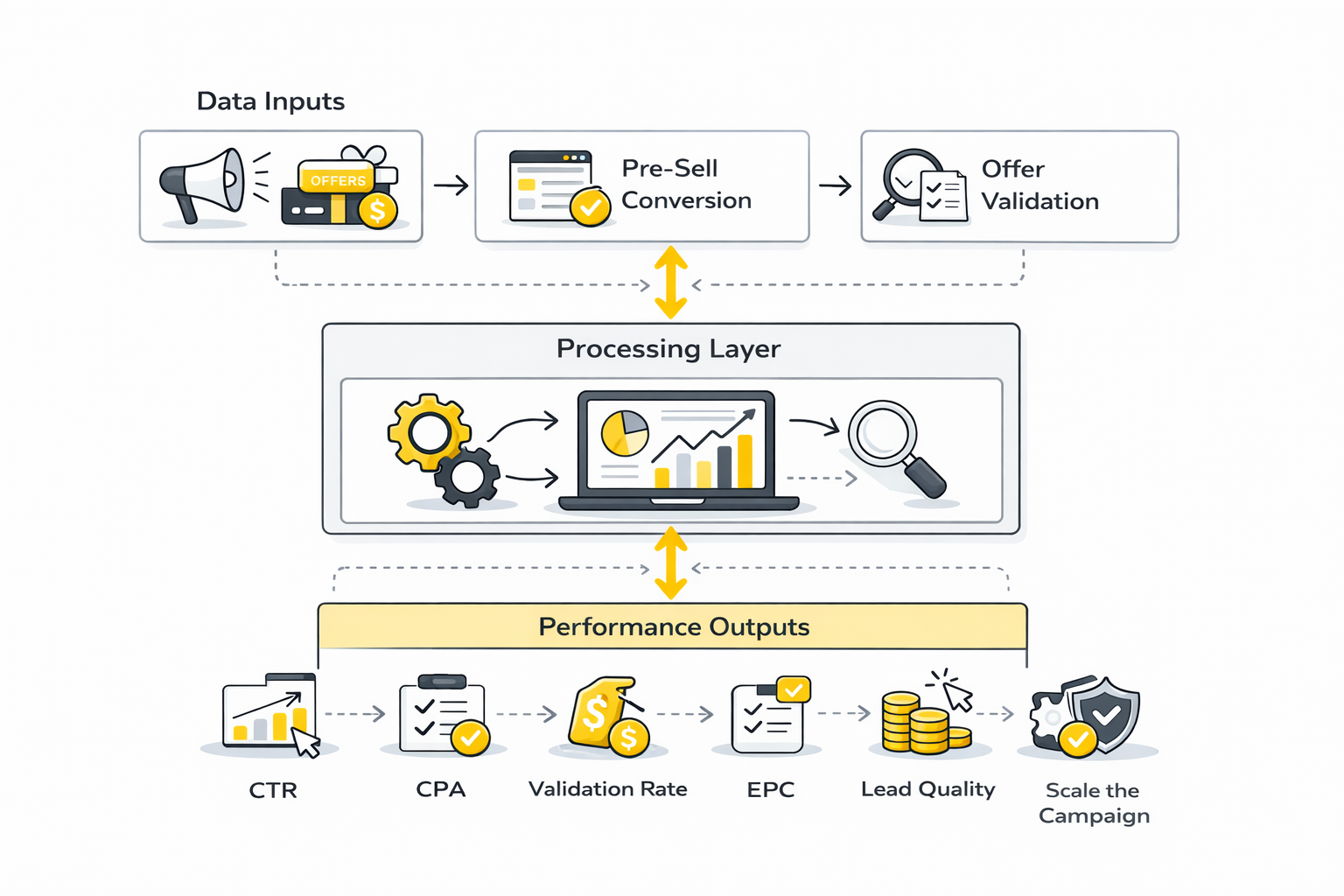
The analytics system should reflect that chain. Track the source, angle, page version, action type, and downstream quality indicator in a way that lets you follow the user journey without guessing. That is where tools for routing and campaign organization, like Dub, become more than convenience tools. They help preserve clarity when campaigns start branching across multiple offers and traffic sources.
Cost Per Click Means Less Than Most Beginners Think
A lot of new affiliates fixate on cost per click because it feels immediate and easy to compare. But in CPA affiliate marketing, a cheaper click is only better if it produces actions that survive the rest of the funnel. Cheap traffic that collapses on qualification is still expensive.
The number that matters more is the relationship between traffic cost and validated action value. A rising CPC can be fine if pre-sell quality improves. A falling CPC can be dangerous if it brings in weaker users who never become approved conversions. That is why cost signals should always be read next to conversion quality, not in isolation.
This is also one reason paid search remains attractive for certain CPA models despite higher acquisition costs. Ruler Analytics’ data showing paid search converting at 6.6% on average is not a promise that your campaign will hit the same number. It is a reminder that higher-intent traffic often gives you more room to work with if the offer and page alignment are strong.
Email and Follow-Up Data Reveal Hidden Profit
If your CPA campaign includes opt-ins, reminders, or post-conversion nurturing, email and messaging metrics become part of the economics. They are not side reports. They help explain whether the campaign is building momentum after the first action or leaking opportunity in silence.
Brevo’s 2025 benchmark report, based on billions of messages sent in 2024, shows an overall email open rate of 31.22% and click-through rate of 3.64%. Those figures matter because they create a rough baseline for evaluating whether your follow-up is doing its job. If your open rates are healthy but clicks stay weak, the message may be attracting attention without enough relevance. If clicks are strong but downstream appointments or conversions stay soft, the handoff page may be the real problem.
That is exactly why CRM-linked follow-up systems matter in CPA affiliate marketing. When you use something like GoHighLevel to connect forms, workflows, reminders, and pipeline stages, you stop treating follow-up as an afterthought. You can see whether lead speed, sequence timing, and contact persistence are helping the campaign earn more value from the same traffic.
Benchmarks Should Trigger Questions, Not Ego
Benchmarks are useful because they help you ask better questions. They are dangerous when they become vanity tools. A conversion rate above a published average does not automatically mean the campaign is strong, and a number below benchmark does not automatically mean it is broken.
What matters is where the number sits inside the rest of the system. If your landing page converts below the median but your lead quality is excellent and the payout is stable, the campaign may still be healthy. If your landing page converts far above the median but advertiser approval is weak, your “win” may just be low-friction junk traffic packaged as success.
This is the discipline most people skip. They chase whatever number feels flattering and ignore the one that explains profitability. In CPA affiliate marketing, the numbers that matter most are usually the ones that force you to face an uncomfortable truth.
The Most Useful Metrics to Watch Every Week
Weekly review works best when it stays focused on signals that actually change decisions. You do not need fifty metrics. You need the handful that tell you whether the campaign is getting stronger, weaker, cleaner, or riskier.
The most useful weekly metrics usually include:
- click-through rate from source to bridge
- landing page or bridge-page conversion rate
- cost per click and effective cost per action
- qualified lead rate or validation rate
- booked-call or downstream action rate when relevant
- payout realization after reversals or scrub
- speed-to-lead and follow-up engagement for lead-based funnels
Each of these numbers should lead to an action. If click-through rate drops, revisit the angle or audience match. If bridge-page conversion drops, inspect message match and page clarity. If validation rate drops, tighten qualification or reassess the traffic source. A metric without a decision attached is just decoration.
What the Data Should Drive Next
The point of analytics in CPA affiliate marketing is not to prove that you are working hard. It is to tell you what to change next with the least amount of wasted motion. Good data creates narrower decisions, which means faster improvements and fewer expensive guesses.
If the front end is weak, improve the promise and page match. If the middle of the funnel is weak, tighten qualification and follow-up. If the back end is weak, question the offer, the advertiser, or the traffic quality before blaming the page again. The path forward usually becomes obvious once the numbers are being read in sequence rather than as isolated snapshots.
That is the practical advantage of measurement. It turns optimization from emotion into process. And once that process is stable, you are finally in a position to deal with the harder part of CPA affiliate marketing: protecting margins, staying compliant, and reducing the risks that can wipe out a campaign even when the numbers look good at first glance.
Scaling CPA Affiliate Marketing Into a Real Business
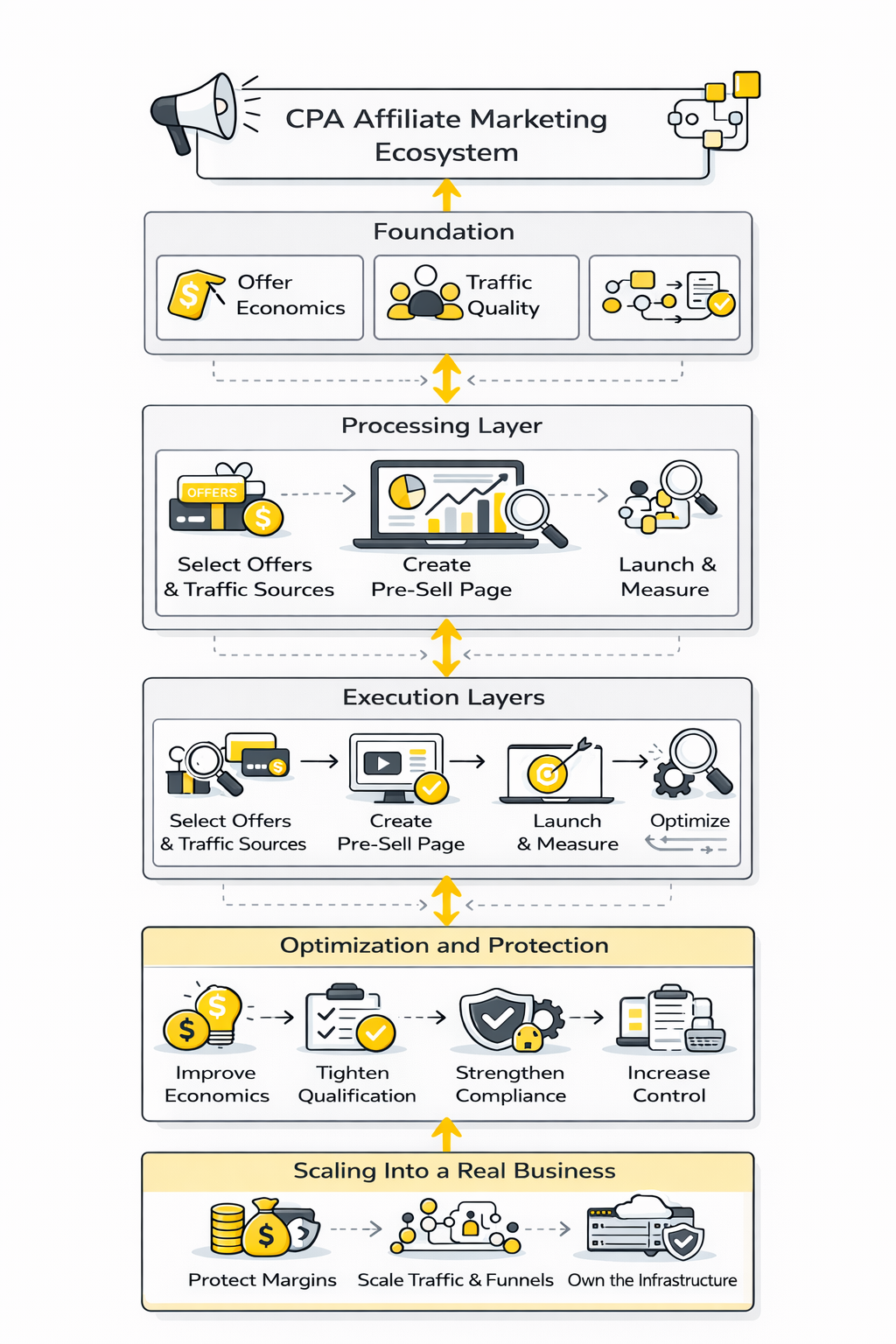
The final shift in CPA affiliate marketing is mental as much as operational. At first, you are trying to prove that one campaign can work. Later, you are trying to build a system that can survive changing offers, rising costs, stricter platform rules, and the normal chaos that comes with performance marketing.
That shift changes how you use time. You stop spending most of your energy hunting for the next shiny payout and start investing more effort into infrastructure, process, and repeatability. The operators who last are usually not the ones with the flashiest screenshots. They are the ones who know how to keep margin, maintain control, and build assets around the campaign instead of living campaign to campaign forever.
A real business in CPA affiliate marketing usually has a few clear traits. It has defined traffic playbooks, repeatable funnel structures, consistent qualification logic, clean attribution, reliable follow-up, and some level of owned audience or first-party data. It also has a much lower tolerance for chaos because every messy shortcut eventually becomes a tax on growth.
Build Assets Around the Offer, Not Just Traffic Toward It
One of the smartest ways to make CPA affiliate marketing more durable is to build assets that still have value even if one offer disappears. That can mean an email list, a comparison site, a niche content hub, a lead database with permissioned follow-up, or a workflow stack that can be repurposed across several campaigns. Without that layer, you stay dependent on individual offers and outside platforms for nearly all of your leverage.
This is why owned infrastructure matters so much. A strong landing page system through Replo, cleaner forms through Fillout, and a CRM-follow-up layer through GoHighLevel are not just tactical tools. They help you turn isolated campaigns into a reusable operating system.
The point is not to stack software for the sake of it. The point is to make sure your business keeps some control even when an advertiser changes terms, a network pauses approvals, or one traffic source gets more expensive. That kind of control is where long-term upside starts to live.
Standardize What Works
Once a campaign proves itself, standardization becomes more important than creativity. Not because creativity stops mattering, but because repeated execution creates the base that creative testing builds on. If every campaign uses different naming, different links, different page structures, and different qualification logic, you make learning slower and scaling harder.
This is where a lot of affiliates stall. They keep producing “new” campaigns without ever formalizing the process behind the last one. In CPA affiliate marketing, growth often comes from documented repetition. When you know your preferred launch sequence, review cadence, and funnel checks, you can expand with much less wasted motion.
Standardization also protects your data. A tighter naming and routing layer through something like Dub gives you cleaner campaign reads over time, which matters once your traffic and offer mix start becoming more complex. Reliable operations beat improvised genius more often than people want to admit.
Use AI and Automation Carefully
AI and automation can absolutely help modern CPA affiliate marketing, but only when they are plugged into a sound process. They can speed up content ideation, response flows, lead qualification, internal workflow handling, and repetitive optimization tasks. What they cannot do is invent trust, fix weak economics, or make misleading pages safer.
That is where selective implementation wins. If the campaign benefits from conversational guidance, tools like Chatbase or Anything.com may fit parts of the user journey, while Guideless can make sense where guided decision flows improve clarity. But the same rule still applies: automation should support a good conversion path, not camouflage a weak one.
Google’s current spam documentation and its newer site reputation and scaled-content policies make that boundary even more important because automated or mass-produced content that adds little value creates direct search risk for affiliate operators through documented spam enforcement rules and policy expansions introduced in 2024. So yes, use AI where it helps. Just do not confuse speed with value.
FAQ - Built for Complete Guide
What is CPA affiliate marketing in simple terms?
CPA affiliate marketing is a performance model where you earn a commission when a user completes a specific action. That action could be a lead form, a free trial, an app install, a booked call, or another measurable event that an advertiser values. The reason the model stays popular is simple: brands like measurable outcomes, and affiliates like getting paid for actions instead of vague exposure.
Is CPA affiliate marketing beginner-friendly?
It is beginner-accessible, but that does not make it easy. The model looks simple from the outside because the payout is tied to a defined action, yet the real work sits in offer selection, traffic quality, pre-sell structure, and measurement. Beginners can absolutely start, but they do better when they treat the process like disciplined marketing rather than a fast-money shortcut.
How much money do you need to start?
That depends on your traffic model more than the affiliate model itself. Organic content, SEO, email, or community-based strategies can start with much lower direct acquisition cost, while paid traffic usually requires enough budget to test without panicking after the first few misses. In practice, the bigger issue is not starting budget alone but whether you have enough room to gather meaningful data before making decisions.
What types of offers work best in CPA affiliate marketing?
The best offers are usually the ones with clear user intent, understandable friction, and stable validation standards. A smaller payout tied to a believable next step often beats a bigger payout attached to a clumsy or mistrusted action. The real question is not “What pays most?” but “What can this audience realistically complete at a viable cost?”
Do you need a website to do CPA affiliate marketing?
Not always, but having your own page layer gives you a major advantage. A website, landing page, quiz, or pre-sell bridge gives you more control over message match, qualification, tracking, and compliance. Even when a direct-link campaign is possible, owning part of the journey usually makes the campaign easier to optimize and less dependent on someone else’s environment.
Is paid traffic required?
No, but paid traffic changes the speed of feedback. Organic channels can work well, especially when the offer matches strong intent and the content adds real value. Paid traffic simply forces the economics into the open faster because every weak assumption shows up as a cost.
What is the difference between CPA and traditional affiliate marketing?
Traditional affiliate marketing often centers on revenue share or commissions tied directly to completed sales. CPA affiliate marketing focuses on a defined action, which may happen earlier in the funnel and may not require an immediate purchase at all. That difference makes CPA more flexible across lead-gen and service-based niches, but it also makes validation quality and downstream tracking more important.
How do you know whether a campaign is actually profitable?
You know by looking past front-end vanity metrics. A campaign is profitable when the action payout, validation rate, traffic cost, tool cost, and reversal risk still leave margin after real-world friction shows up. That is why experienced affiliates care so much about approved conversions and downstream quality rather than celebrating raw lead volume too early.
What are the biggest mistakes people make?
The most common mistakes are chasing payout size, skipping pre-sell, misreading weak data, and scaling before lead quality is proven. A lot of people also ignore compliance until a platform, advertiser, or network forces the issue. In CPA affiliate marketing, the campaigns that break usually give warnings first, but those warnings get missed because the wrong numbers were getting attention.
Can CPA affiliate marketing work with SEO?
Yes, but only when the page adds original value and is not just a thin route to an affiliate action. Google has been explicit for years that affiliate pages need substantial added value to stay on the right side of search quality expectations, and that guidance remains relevant now through its spam policies and older but still useful explanation of affiliate content and added value. If your page helps users compare, decide, qualify, or solve a real problem, SEO can absolutely support a CPA model.
Do you have to disclose affiliate relationships?
Yes, and this is one of the easiest places to lose credibility if you get careless. If there is a material relationship that could affect how a recommendation is perceived, it needs to be disclosed clearly enough for normal people to understand it. The FTC’s current guidance on endorsements, influencers, and reviews makes that expectation very clear.
What metrics matter most at the start?
At the beginning, the most useful metrics are click-through rate, bridge-page or landing-page conversion rate, effective cost per action, validation rate, and any downstream signal that shows lead quality. You do not need fifty dashboards. You need a short list of numbers that tell you whether traffic, message, and offer are working together or fighting each other.
When should you scale a campaign?
Scale only after the campaign has proved more than one thing. It should show stable conversion behavior, acceptable lead quality, clean tracking, and enough margin left after real costs. If the system is still fragile, more traffic usually does not fix it. It just exposes the weakness faster.
Is CPA affiliate marketing still growing?
The broader affiliate and partner channel is still very much alive, and recent UK data points are a useful signal of that. APMA’s reporting shows close to £1.7 billion in affiliate spend in 2023, with later submissions describing more than £19 billion in e-commerce revenue driven in 2024. That does not guarantee easy wins, but it does confirm that performance-based partnerships remain a serious commercial channel.
Work With Professionals
Explore 10K+ Remote Marketing Contracts on MarkeWork.com
Most marketers spend too much time chasing clients, competing on crowded platforms, and losing a percentage of every project to middlemen. MarkeWork gives you a better way. Browse thousands of remote marketing contracts and connect directly with companies desperate to hire skilled marketers like you, without platform commissions and without unnecessary gatekeepers.
If you're serious about finding better opportunities and keeping 100% of what you earn, explore available contracts and create a profile for free at MarkeWork.com.