

CPC marketing is paid advertising where you pay when someone clicks your ad, not simply when your ad appears. In platforms like Google Ads, the actual CPC is often lower than your maximum bid because the auction also considers ad quality, relevance, and expected user experience, not only how much you are willing to pay.
That matters because cheap clicks are not automatically good clicks. The real goal is not to lower CPC at all costs; it is to buy qualified traffic at a price your funnel, offer, and margins can support. Recent Google Ads benchmark data shows average CPCs can vary widely by industry, with overall PPC averages around $5.26 per click, so the right target depends heavily on your market, intent, and conversion economics.
This article will continue across six parts:
- Part 1: CPC Marketing Foundations And Article Roadmap
- Part 2: Why CPC Marketing Matters For Growth
- Part 3: The CPC Marketing Framework
- Part 4: Core Components Of A Profitable CPC Campaign
- Part 5: Professional CPC Implementation
- Part 6: Optimization, Measurement, Mistakes, And FAQ
CPC Marketing Foundations And Article Roadmap
CPC marketing works best when you treat every click as a small investment decision. You are not buying traffic in the abstract; you are buying a chance to move a specific person toward a specific action. That action might be a lead, a booked call, a product sale, a trial signup, or a return visit from someone already comparing options.
The basic formula is simple: CPC tells you what you pay for traffic, conversion rate tells you how well that traffic turns into outcomes, and revenue per conversion tells you whether the campaign can scale. A campaign with a high CPC can still be profitable if the buyer intent is strong and the offer converts well. A campaign with a low CPC can still lose money if the visitors are curious but not commercially serious.
This is why CPC marketing sits at the intersection of media buying, copywriting, analytics, landing page design, and sales strategy. The ad gets the click, but the landing page earns the conversion. Tools like ClickFunnels, GoHighLevel, and Brevo can support that journey when you need funnels, CRM follow-up, or email automation, but the strategy has to come first.
Why CPC Marketing Matters
CPC marketing matters because it gives businesses a direct way to test demand. Instead of waiting months for organic rankings or broad brand awareness to compound, you can put an offer in front of people already searching, browsing, comparing, or ready to act. That makes CPC useful for fast validation, predictable lead generation, and controlled scaling.
It also forces discipline. When every click has a visible cost, vague marketing becomes expensive very quickly. You have to know who you are targeting, what promise you are making, where the traffic lands, and how much a lead or customer is actually worth.
The wider advertising market keeps moving toward measurable digital channels. Global marketers spent close to $1.1 trillion on advertising in 2024, and digital advertising drove most of the growth. That does not mean every business should spend more on ads; it means the competition for profitable attention is real, and weak CPC strategy gets punished.
Framework Overview
A strong CPC marketing framework starts with economics, not keywords. Before choosing campaigns, bids, or creative angles, you need to know your acceptable cost per lead, acceptable cost per acquisition, average order value, close rate, retention value, and payback window. Without those numbers, you are guessing.
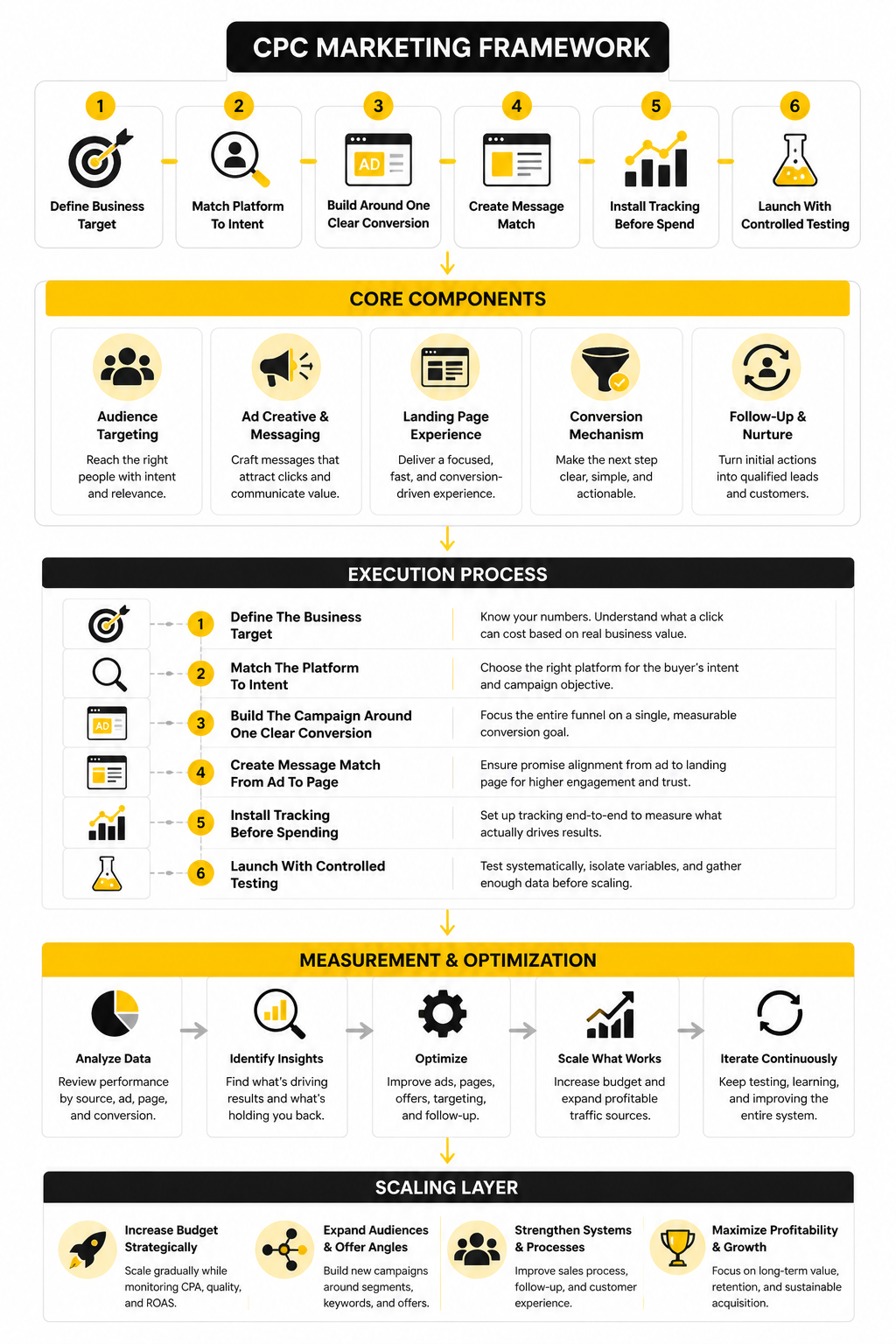
The practical framework looks like this:
- Offer economics: What can you afford to pay for a lead or customer?
- Audience intent: Who is most likely to click and convert?
- Traffic source: Which platform matches that intent best?
- Ad message: Why should this person click now?
- Landing experience: Does the page continue the same promise?
- Follow-up system: What happens after the click or conversion?
- Optimization loop: Which data decides what gets scaled, paused, or rebuilt?
Each part affects the next. Better targeting improves click quality. Better messaging improves click-through rate. Better landing pages improve conversion rate. Better follow-up increases revenue per click, which gives you more room to compete in the auction.
Why CPC Marketing Matters For Growth
CPC marketing matters because it gives you controlled access to demand. You can decide who sees your offer, what they see, where they land, and how much you are willing to pay for the opportunity. That control is powerful, but only when you connect ad spend to business outcomes instead of treating clicks as the finish line.
The biggest mistake is thinking CPC is just a traffic channel. It is really a feedback system. Every campaign tells you whether your market cares about the offer, whether your message is clear, whether your landing page is persuasive, and whether your follow-up process can turn attention into revenue.
That is why experienced marketers do not ask, “How do I get the cheapest clicks?” They ask, “Which clicks can I profitably buy again and again?” Cheap traffic can make a dashboard look healthy while quietly wasting budget. Profitable traffic gives you a system you can scale with confidence.
CPC Marketing Makes Demand Measurable
Organic marketing is valuable, but it often takes time before the signal becomes clear. CPC marketing gives you faster feedback because you can launch a campaign, send traffic to a focused page, and measure what people actually do. That does not make paid traffic easy, but it does make it useful for testing.
You can test different offers, angles, audiences, and landing pages without waiting months for search rankings or social reach to build. If people click but do not convert, the problem may be the page, the offer, or the mismatch between promise and intent. If people do not click at all, the message probably is not strong enough or the audience is wrong.
This is where CPC becomes strategic. The click is not just a cost; it is a signal. When enough signals point in the same direction, you can make smarter decisions about content, positioning, pricing, and sales follow-up.
CPC Marketing Connects Budget To Intent
Not all traffic is equal. Someone searching for a solution right now has a different level of intent than someone casually scrolling through a feed. CPC marketing lets you choose where on that intent spectrum you want to compete.
Search campaigns usually capture active demand. Social campaigns often create or redirect demand. Retargeting campaigns reconnect with people who already showed interest. Each channel can work, but each one needs a different expectation and a different conversion path.
This is why matching intent matters more than chasing platform trends. A landing page for cold social traffic may need more education and trust-building. A page for high-intent search traffic should usually get to the point faster. When the ad, audience, and page match the buyer’s state of mind, your CPC has a much better chance of turning into profit.
CPC Marketing Exposes Weak Funnels Quickly
Paid clicks are honest. If your funnel is unclear, CPC marketing will show it fast. You may get impressions, clicks, and even form fills, but the numbers will eventually reveal whether the campaign is producing real business value.
A weak funnel usually breaks in one of a few places. The ad promises something the page does not deliver. The page asks for too much commitment too soon. The follow-up is slow, generic, or nonexistent. Or the offer attracts the wrong people because the targeting is too broad.
This is why tools matter, but only after the strategy is clear. A funnel builder like ClickFunnels can help you build conversion paths faster. A CRM and automation platform like GoHighLevel can help you manage leads and follow-up. But neither tool fixes a weak offer, a vague message, or traffic that was never qualified in the first place.
CPC Marketing Helps You Scale What Already Works
The best use of CPC marketing is not to rescue a broken business model. It is to amplify something that already has signs of demand. If your offer converts through organic traffic, referrals, email, or direct sales, paid clicks can help you reach more of the right people faster.
This is where the math becomes practical. Once you know your conversion rate, lead quality, sales rate, and customer value, you can decide how much you can afford to pay per click. You are no longer guessing whether the campaign “feels expensive.” You are comparing cost against expected return.
That clarity changes how you manage campaigns. You can raise bids when the traffic is profitable. You can cut keywords, audiences, or placements that attract low-quality clicks. You can improve the page instead of blaming the platform. This is the professional mindset: spend more where the numbers support it, and stop feeding what does not move the business.
CPC Marketing Improves The Whole Customer Journey
A strong CPC campaign does more than generate leads or sales. It forces you to improve the entire journey from first impression to final conversion. You have to make the offer sharper, the page clearer, the tracking cleaner, and the follow-up more useful.
That improvement often carries over into other channels. A better headline can improve organic landing pages. A stronger lead magnet can help email growth. A clearer sales page can improve referral traffic. The discipline you build through CPC marketing can make the rest of your marketing more effective.
This is the part many beginners miss. Paid traffic is not separate from brand, content, sales, or retention. It touches all of them. When you use CPC marketing properly, you are not just buying clicks; you are building a more measurable growth system.
The CPC Marketing Framework
A profitable CPC marketing system is not built by opening an ad account and guessing your way through campaigns. It starts with a clear framework that connects the offer, the audience, the platform, the page, and the follow-up system. When those pieces work together, CPC marketing becomes much easier to diagnose and improve.
The framework also keeps you from overreacting to surface-level metrics. A high CPC is not automatically bad, and a low CPC is not automatically good. What matters is whether the campaign can turn paid attention into qualified action at a cost the business can support.
This is where execution becomes practical. You need a process that lets you make decisions in the right order, because fixing the wrong thing first wastes time and budget. Start with the economics, then build the campaign around the buyer’s intent.
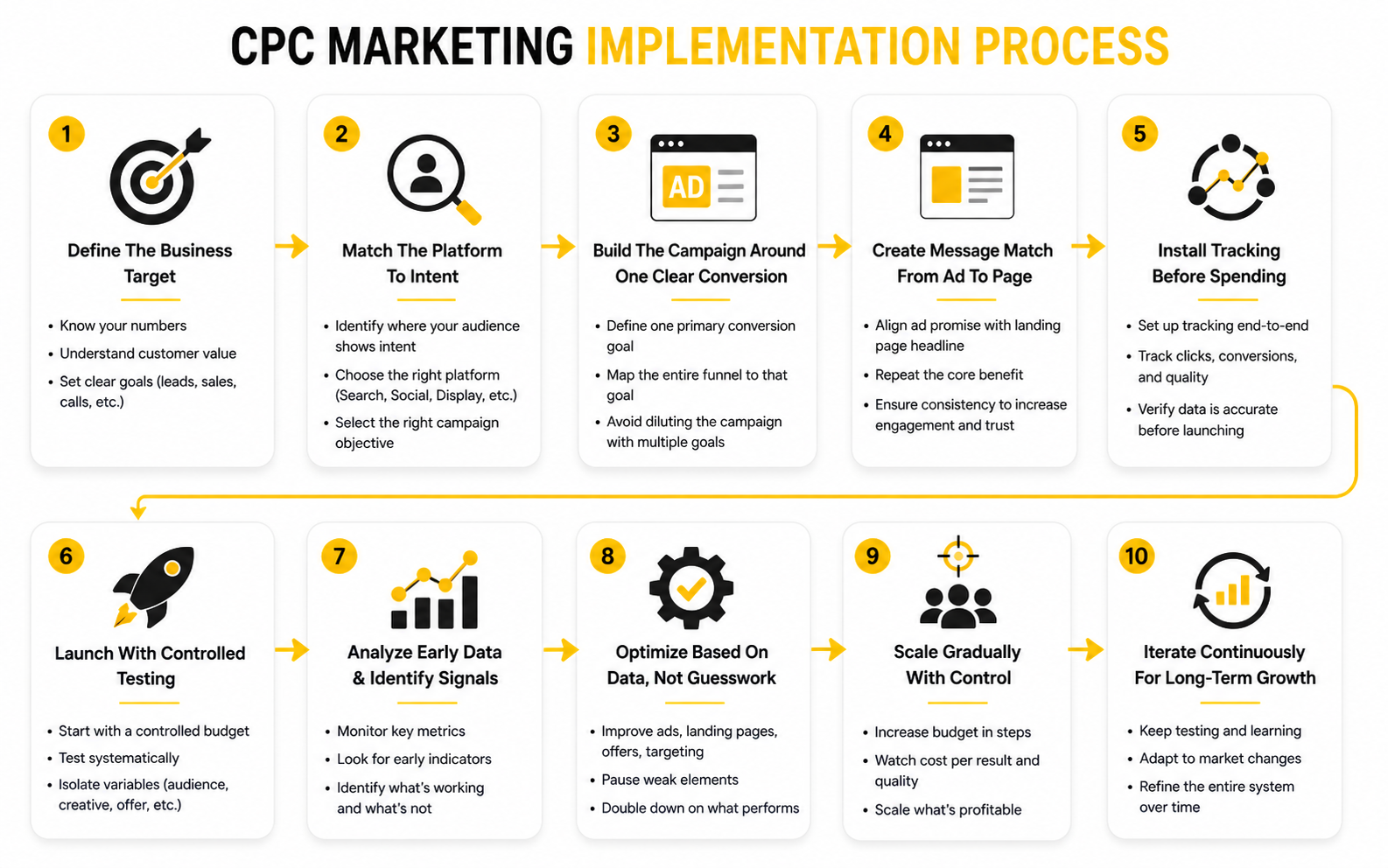
Step 1: Define The Business Target Before The Campaign
Before you write an ad, choose a keyword, or build an audience, define the number that makes the campaign viable. For ecommerce, that may be target cost per purchase or return on ad spend. For lead generation, it may be target cost per qualified lead, booked call, or closed customer.
This step matters because CPC alone does not tell you enough. If a lead is worth $500 in expected revenue, a $12 click might be completely reasonable. If a lead is worth $40, that same click could destroy the campaign before the sales team even gets involved.
Use real business numbers wherever possible. Look at average order value, gross margin, close rate, refund rate, retention, and sales cycle length. Once you know what a conversion is worth, you can decide what a click can cost.
Step 2: Match The Platform To The Buyer’s Intent
Different platforms capture different kinds of demand. Search ads usually work well when people already know the problem and are actively looking for a solution. Social ads often work better when the audience needs education, curiosity, or a stronger emotional reason to engage.
This distinction affects the whole campaign. A Google Search campaign should usually be built around intent, relevance, and a direct landing page. A Meta campaign may need stronger creative, more proof, and a softer conversion path because the user did not necessarily open the app to solve that problem.
Platform auctions also reward more than bids. Google’s ad auction considers factors like expected clickthrough rate, ad relevance, landing page experience, Ad Rank thresholds, auction competitiveness, search context, and asset impact when calculating actual CPC. Meta’s auction also considers bid, estimated action rates, and ad quality, which means weak creative and poor relevance can make traffic more expensive even when your targeting looks right.
Step 3: Build The Campaign Around One Clear Conversion
A CPC campaign should not ask one ad to do five jobs. If the goal is a booked call, build around that. If the goal is a product purchase, build around that. If the goal is a lead magnet, build around that and judge the campaign by lead quality, not just form fills.
This keeps the message focused. The keyword, ad copy, landing page, call to action, thank-you page, and follow-up should all point toward the same next step. When every piece supports the same outcome, you reduce friction and make the data easier to read.
For simple funnels, ClickFunnels can help you move quickly from ad click to landing page to conversion path. For service businesses that need pipeline tracking, lead follow-up, and appointment workflows, GoHighLevel can be a practical fit. The tool is not the strategy, but the right setup makes the strategy easier to execute.
Step 4: Create Message Match From Ad To Landing Page
Message match is simple: the page should continue the promise made in the ad. If the ad talks about a specific service, problem, benefit, or audience, the page should make that connection obvious immediately. When people click and feel like they landed somewhere unrelated, they leave or hesitate.
This is especially important in CPC marketing because every mismatch has a cost. You paid for the click, so the landing page has to remove doubt quickly. The headline, first paragraph, proof points, offer, and call to action should all confirm that the visitor is in the right place.
Do not make users work to understand the offer. Make the value clear, show who it is for, explain what happens next, and reduce the perceived risk. That alone can improve campaign economics without touching the bid.
Step 5: Install Tracking Before Spending Seriously
Tracking should be set up before the campaign gets meaningful budget. At minimum, you need to track clicks, landing page visits, conversions, and the source of each lead or sale. For lead generation, you also need a way to connect leads to quality, appointments, opportunities, and closed revenue.
This is where many CPC campaigns become messy. The ad platform may show conversions, but the sales team may know that half of those leads are poor quality. If those systems do not talk to each other, optimization becomes dangerous because the algorithm may chase cheap conversions instead of valuable customers.
A CRM can help close that gap. If you are running lead generation campaigns, GoHighLevel can connect landing pages, forms, appointments, pipelines, and follow-up in one place. For email-heavy nurture, Brevo can support segmentation and automation after the first conversion.
Step 6: Launch With Controlled Testing
The first version of a campaign is not supposed to be perfect. It is supposed to produce clean enough data to show what deserves improvement. That means you need a controlled launch with clear budgets, focused targeting, and a small number of meaningful variables.
Do not test everything at once. If you change the audience, offer, landing page, and ad creative at the same time, you will not know what caused the result. Start with a strong hypothesis, isolate the biggest variable, and let the campaign collect enough data before making major changes.
This is also where patience matters. Cutting too quickly can kill a campaign before it has enough signal. Waiting too long can waste money on a bad assumption. The goal is not emotional decision-making; the goal is disciplined learning.
Step 7: Optimize Based On Revenue, Not Vanity Metrics
Once the campaign is running, the optimization loop should move from traffic metrics to business metrics. Click-through rate can help diagnose ad relevance. CPC can show cost pressure. Conversion rate can show landing page performance. But revenue, qualified pipeline, and acquisition cost decide whether the campaign is actually working.
This is the professional difference. Beginners optimize for cheap clicks because they are easy to see. Strong marketers optimize for profitable outcomes because they understand the full journey.
The process is straightforward, but not always comfortable. Pause what attracts poor-fit traffic. Improve what gets clicks but fails to convert. Scale what produces qualified leads or profitable customers. That is how CPC marketing becomes a growth system instead of a budget leak.
CPC Marketing Statistics And Performance Data
CPC marketing data is useful only when it helps you make a decision. Benchmarks can show whether your campaign is roughly in range, but they should not become your strategy. A $5 click can be cheap in one industry, expensive in another, and completely irrelevant if the traffic never turns into pipeline or revenue.
The most useful numbers are the ones that connect ad spend to business value. CPC tells you what attention costs. Click-through rate shows whether the message earns interest. Conversion rate shows whether the page turns interest into action. Cost per lead, cost per acquisition, and return on ad spend show whether the campaign deserves more budget.
Recent search advertising benchmark data puts the average CPC across industries at about $5.26, with major differences by category. That number is a reference point, not a target. If your customers are worth thousands, you may be able to pay more. If your margins are thin, even “average” CPC can be too high.
The Numbers That Actually Matter
The first number to watch is cost per qualified action, not cost per click. A click is only the beginning of the journey. If 100 clicks produce 10 leads but only one is qualified, your real cost per qualified lead is much higher than the platform dashboard suggests.
The second number is conversion rate by traffic source. Search, social, display, retargeting, and branded campaigns should not be judged by the same expectation. High-intent search traffic may convert faster, while cold social traffic may need more education and follow-up before it becomes valuable.
The third number is revenue per click. This is where CPC marketing becomes serious. If every click generates more expected revenue than it costs, you have room to scale. If not, you need to improve targeting, offer, landing page, follow-up, or unit economics before increasing spend.
How To Read CPC Without Getting Misled
CPC rises when competition increases, targeting gets tighter, quality drops, or the auction becomes more expensive. That does not automatically mean the campaign is failing. A higher CPC can be acceptable when the click comes from stronger intent or produces better conversion quality.
Google’s own auction model makes this clear because actual CPC is not just your bid. It is influenced by factors like expected click-through rate, ad relevance, and landing page experience, which are also reflected in Google’s Quality Score components. In practical terms, better relevance can help you compete more efficiently, while weak relevance can make every click harder to justify.
Do not optimize CPC in isolation. If lowering CPC also lowers lead quality, you did not improve the campaign. You just bought cheaper problems. The right move is to compare CPC against conversion rate, lead quality, and customer value before deciding what to change.
Building A Clean Measurement System
A clean analytics system should follow the customer from the ad click to the final business outcome. That means tracking the campaign, the landing page, the conversion event, the follow-up, and the sale. Without that connection, you are optimizing with missing information.
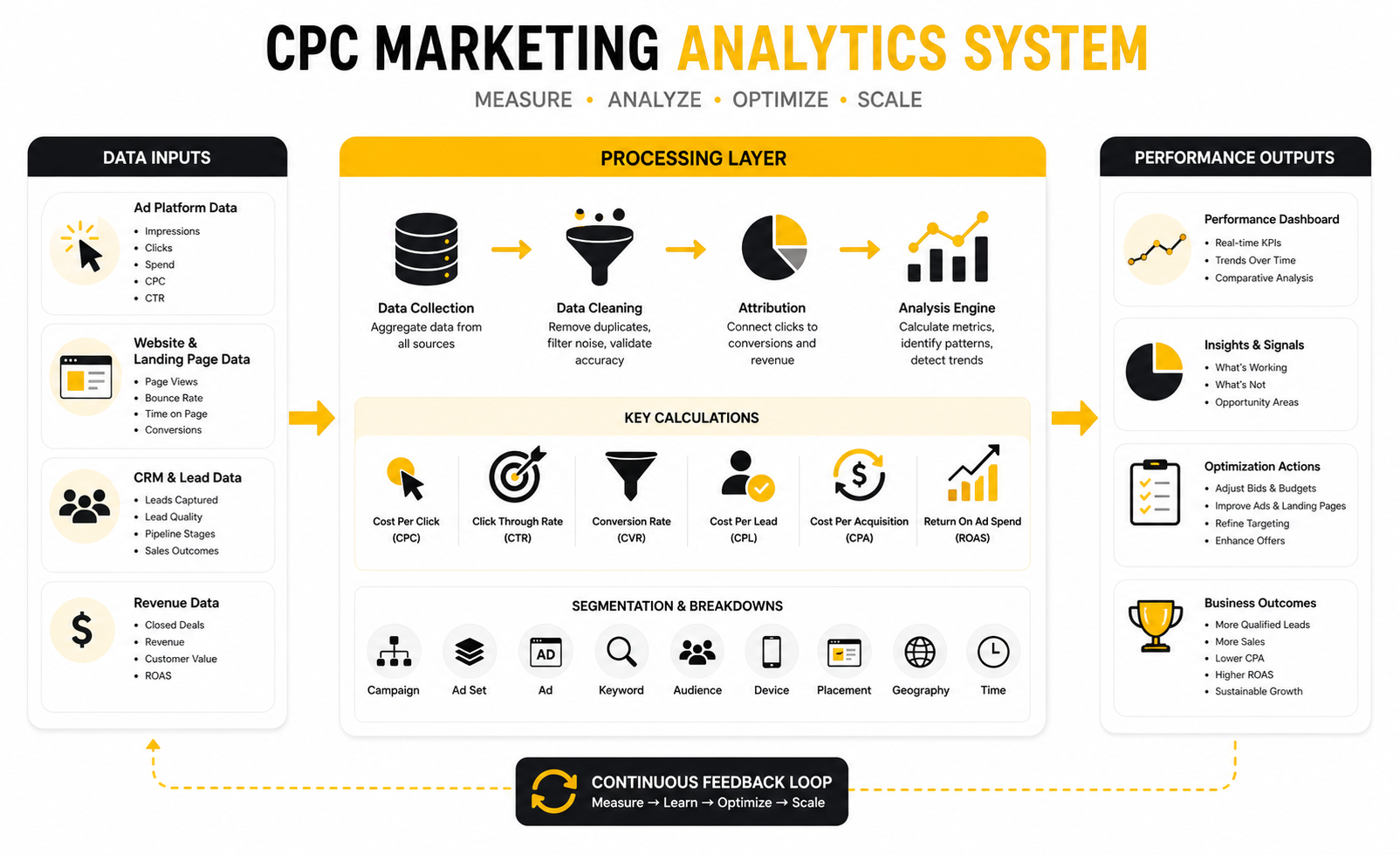
At a minimum, your measurement system should answer these questions:
- Which campaign, keyword, audience, or creative generated the click?
- Which landing page did the person visit?
- Did the visitor convert into a lead, sale, trial, or booked appointment?
- Was the conversion qualified?
- Did the lead become an opportunity or customer?
- How much revenue came from that source?
- How long did it take to recover the ad spend?
This is where many campaigns quietly break. The ad platform may report conversions, but the CRM may show weak lead quality. The landing page may look strong, but the sales team may say the prospects are not ready. A platform like GoHighLevel can help connect forms, appointments, pipelines, and follow-up, while tools like Brevo can support email nurturing when the buying journey is not immediate.
What Benchmarks Can And Cannot Tell You
Benchmarks are useful for spotting obvious problems. If your CPC is far above your industry range and your conversion rate is weak, you probably have a relevance, targeting, or landing page issue. If your CPC is normal but your cost per acquisition is too high, the problem may be conversion rate, offer strength, sales close rate, or customer value.
They cannot tell you whether your campaign is profitable. Only your own economics can do that. A business with strong retention can afford higher acquisition costs than a business that makes a single low-margin sale.
Use benchmarks as a diagnostic tool, not a scoreboard. Compare your campaign to the market, then compare it to your own targets. The second comparison matters more.
Turning Data Into Action
Good CPC marketing optimization is not random tweaking. Each metric should point to a likely action. If impressions are low, the issue may be budget, bid, audience size, or keyword volume. If impressions are strong but clicks are weak, the message probably needs work.
If clicks are strong but conversions are weak, look at the landing page, offer, load speed, proof, and call to action. If conversions are strong but revenue is weak, inspect lead quality, sales process, pricing, and follow-up. Each stage tells you where the friction is.
The point is to avoid emotional decisions. Do not pause a campaign just because CPC feels high. Do not scale a campaign just because the dashboard looks busy. Let the numbers show where the system is healthy, where it is leaking, and what deserves the next serious test.
Professional CPC Implementation
Professional CPC marketing is less about finding one magical campaign and more about building a system that survives real market pressure. Costs rise, competitors copy angles, platforms change automation rules, and audiences get tired of the same messages. If your campaign only works when conditions are perfect, it is not a growth asset yet.
The next level is learning how to make tradeoffs. You may need to accept a higher CPC to reach stronger intent. You may need to spend more on creative testing before the campaign becomes efficient. You may need to slow down scaling because the sales team cannot handle lead volume without hurting close rates.
This is where discipline matters. Advanced CPC work is not more complicated for the sake of looking smart. It is more precise because the cost of sloppy decisions gets bigger as the budget grows.
Scaling Without Breaking The Campaign
Scaling a CPC campaign is not just increasing the daily budget. When you push more spend into an auction, you may reach broader audiences, weaker intent, or more expensive placements. That means the same campaign that looked profitable at $100 per day may behave differently at $1,000 per day.
The safer approach is controlled scaling. Increase budgets gradually, monitor cost per qualified outcome, and watch whether lead quality changes as volume grows. If the campaign starts producing cheaper leads but worse sales conversations, the scale is fake.
You can also scale horizontally. Instead of forcing one campaign to carry everything, build new campaigns around different keyword groups, audiences, offers, geographies, or funnel stages. This reduces dependence on a single traffic pocket and gives you more ways to find profitable demand.
Managing The Tradeoff Between Automation And Control
Modern ad platforms push advertisers toward automation, and in many cases that can help. Automated bidding can process signals faster than a human can manually adjust every keyword, placement, or audience segment. But automation still needs clear goals, clean conversion data, and enough volume to learn from.
The danger is feeding the algorithm the wrong objective. If you optimize for form submissions without measuring lead quality, the platform may find more people who submit forms but never buy. If you optimize for purchases without enough data, the campaign may struggle to learn and spend inconsistently.
Use automation when the tracking is trustworthy and the campaign has enough signal. Keep more manual control when the offer is new, the data is thin, or the conversion quality varies widely. The goal is not to fight the machine; it is to give it the right job.
Protecting CPC Campaigns From Bad Data
Bad data is one of the fastest ways to ruin CPC marketing. The campaign may appear to perform well inside the ad platform while the business quietly loses money. This usually happens when the wrong conversion event is tracked, duplicate leads are counted, offline sales are missing, or low-quality leads are treated the same as real opportunities.
You need a clear conversion hierarchy. A page view is weaker than a form submission. A form submission is weaker than a qualified lead. A qualified lead is weaker than a booked appointment. A booked appointment is weaker than a closed customer.
This hierarchy should shape your reporting and your bidding strategy. If your CRM can pass quality and revenue data back into the decision process, your optimization becomes much smarter. A setup like GoHighLevel can help service businesses track pipeline stages and follow-up, while ClickFunnels can be useful when the priority is building focused conversion paths quickly.
Handling Rising CPCs Without Panicking
Rising CPCs are not automatically a crisis. Paid media markets are competitive, and benchmark data shows Google Ads averages around $5.26 CPC and $70.11 cost per lead across industries, with large swings depending on category and intent. Your job is not to force CPC down blindly; your job is to protect profit.
There are several ways to handle higher click costs. You can improve ad relevance, tighten keyword intent, raise conversion rate, increase average order value, improve sales close rate, or add better follow-up. Each lever changes the economics in a different way.
The worst response is cutting quality to chase cheap traffic. That usually creates a bigger problem downstream. A better response is to ask why the CPC is rising and whether the traffic still produces enough business value to justify the cost.
Using Creative As A Performance Lever
Creative is not just decoration. In CPC marketing, creative affects click-through rate, audience quality, conversion intent, and sometimes even auction efficiency. Weak creative attracts the wrong people or gives the right people no reason to act.
Strong creative makes the buyer feel understood quickly. It speaks to a real problem, offers a specific next step, and makes the promise believable. On visual platforms, creative fatigue can also become a serious issue because the same audience may see the same message repeatedly.
Build creative testing into the process instead of treating it as an emergency fix. Test angles, hooks, proof points, formats, and calls to action. For social-heavy campaigns, a planning tool like Buffer can help coordinate publishing and content workflows, but the performance still depends on the quality of the message.
Improving The Post-Click Experience
The click is expensive, so the post-click experience has to work hard. A slow page, vague headline, weak offer, or confusing form can waste traffic that was otherwise qualified. This is why landing page improvement often produces better results than constantly rebuilding campaigns.
Focus on clarity first. The visitor should immediately understand what the offer is, who it is for, why it matters, and what to do next. Then strengthen proof, reduce friction, and make the call to action obvious without making the page feel desperate.
For ecommerce or product-led campaigns, landing page quality can become a major profit lever. A page builder like Replo can help teams build and test more focused commerce pages. For lead generation, the same principle applies: make the landing page match the ad promise and remove anything that distracts from the next step.
Knowing When Not To Scale
Sometimes the smartest CPC marketing decision is to stop pushing. If the offer has weak margins, the sales process is inconsistent, or the audience is too narrow, scaling can expose the weakness instead of solving it. More traffic does not fix a broken economic model.
You should also be careful when early results come from a very small sample. A few cheap conversions can make a campaign look better than it really is. Before scaling, check whether the numbers hold across enough clicks, enough conversions, and enough sales conversations to trust the pattern.
The best campaigns earn the right to scale. They show consistent intent, acceptable acquisition costs, and real downstream value. When those signals are in place, increasing spend becomes a strategic move instead of a gamble.
Optimization, Measurement, Mistakes, And FAQ
At this point, CPC marketing should feel less like “running ads” and more like managing a complete growth system. The campaign is only one part of that system. The offer, tracking, landing page, CRM, sales process, follow-up, and reporting all decide whether paid clicks become profitable customers.
The final stage is making sure the system keeps improving. Markets change, costs shift, competitors react, and customer behavior moves. A campaign that worked six months ago can slowly decay if nobody is watching the right signals.
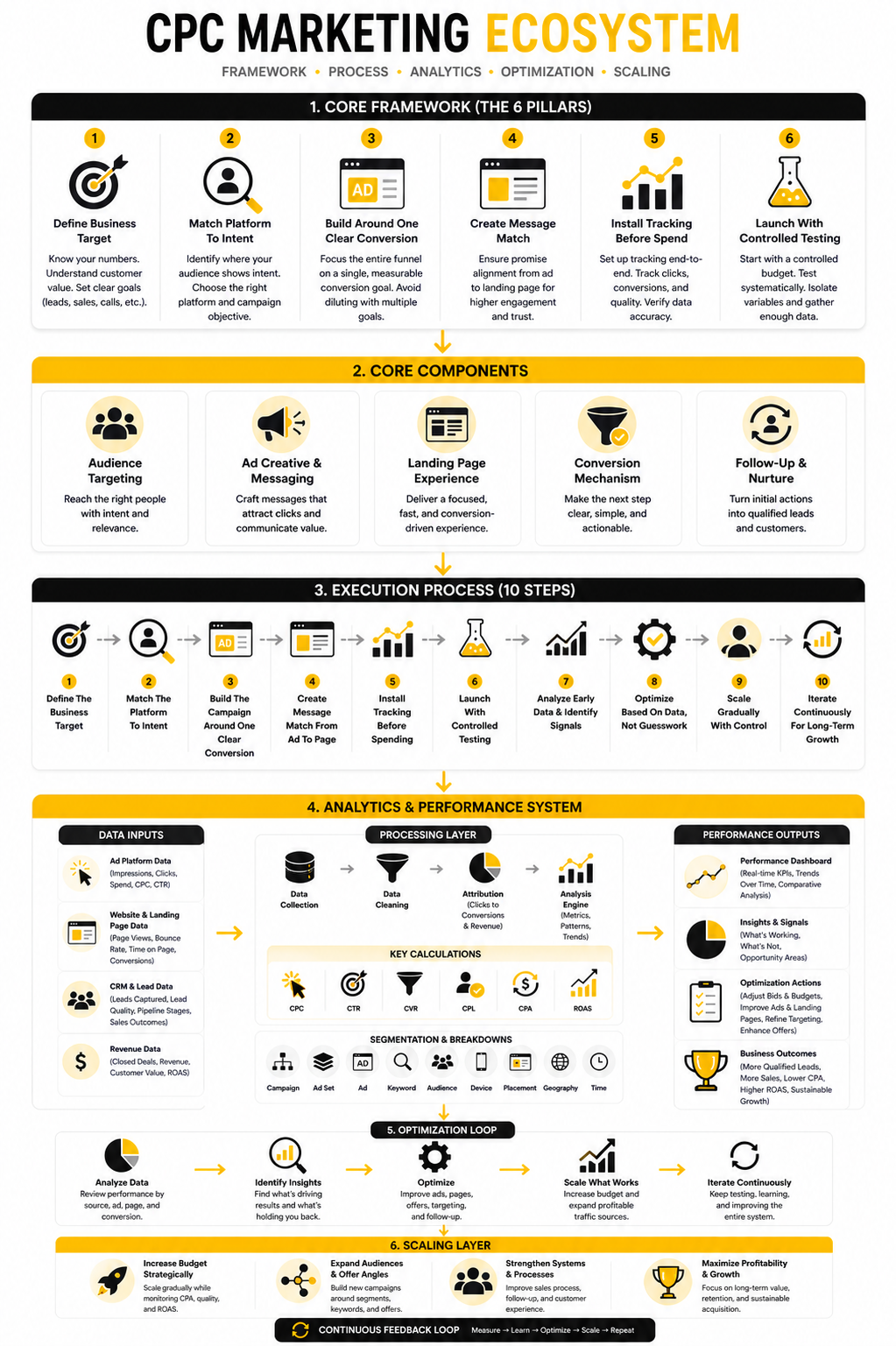
The strongest CPC systems have one thing in common: they create feedback loops. Ad data shows which messages attract attention. Landing page data shows which visitors become leads or buyers. CRM data shows which conversions become real revenue. When all three layers work together, you can stop guessing and start making sharper decisions.
Common CPC Marketing Mistakes To Avoid
The first mistake is optimizing too early. If a campaign has only a handful of clicks or conversions, the data may not be stable enough to support big decisions. You still need judgment, but judgment should not become panic.
The second mistake is trusting platform conversions without checking business quality. A campaign can generate many cheap leads while sales gets buried in low-intent conversations. That is not growth; that is operational noise.
The third mistake is treating CPC marketing as a one-time setup. Strong campaigns need ongoing creative testing, search term review, landing page improvement, and follow-up refinement. If nobody owns the system after launch, performance usually slips.
When CPC Marketing Is Not The Right Move
CPC marketing is not the right first move when the offer is unclear. Paid traffic exposes weak positioning quickly because users have little patience and many alternatives. If you cannot explain the offer clearly in one page, ads will not magically fix it.
It may also be a poor fit when margins are too thin. If the business cannot afford enough clicks to test properly, the campaign may never gather useful data. In that case, organic content, partnerships, outbound sales, or referral systems may be a better starting point.
The same is true when the sales process is broken. If leads are not followed up quickly, calls are missed, or the team has no qualification process, more traffic can create more waste. Fix the bottleneck before feeding it.
FAQ - Built for Complete Guide
What is CPC marketing?
CPC marketing is a paid advertising model where you pay when someone clicks your ad. It is commonly used in search, social, display, shopping, and retargeting campaigns. The goal is not just to get clicks, but to buy qualified traffic that can become leads, sales, trials, bookings, or other valuable actions.
How is CPC different from PPC?
CPC means cost per click, which is the amount paid for one click. PPC means pay per click, which describes the broader advertising model. In everyday marketing conversations, people often use them closely together, but CPC is the metric and PPC is the channel model.
What is a good CPC?
A good CPC depends on your industry, offer, conversion rate, and customer value. Recent benchmark data places average Google Ads CPC around $5.26, but that number is only useful as context. A good CPC is one that helps you acquire customers profitably.
Why is my CPC so high?
CPC can be high because of strong competition, narrow targeting, weak ad relevance, low expected click-through rate, poor landing page experience, or expensive commercial intent. In Google Ads, Quality Score is shaped by expected CTR, ad relevance, and landing page experience, which can influence how efficiently you compete. The fix is not always lowering bids; sometimes the better move is improving relevance and conversion quality.
Should I focus on lowering CPC?
Not always. Lowering CPC is useful only if traffic quality stays strong. If cheaper clicks produce weaker leads or fewer customers, the campaign may look better while the business performs worse.
What metrics should I track in CPC marketing?
Track CPC, click-through rate, conversion rate, cost per lead, cost per qualified lead, cost per acquisition, revenue per click, and return on ad spend. For lead generation, also track booked calls, show rates, close rates, and pipeline value. The deeper metrics matter because they show whether the campaign is producing real business outcomes.
How much budget do I need to start?
You need enough budget to generate meaningful data without putting the business at risk. The right amount depends on your CPC, conversion rate, and sales cycle. If clicks are expensive, you need a larger test budget to learn anything useful.
Which platform is best for CPC marketing?
The best platform depends on buyer intent. Google Search is strong when people are actively looking for solutions. Meta, LinkedIn, TikTok, YouTube, and display channels can work when the campaign needs to create demand, retarget visitors, or educate a colder audience.
Do landing pages really affect CPC performance?
Yes, because landing pages affect conversion rate and, in some platforms, ad quality signals. A better page can make the same traffic more profitable by turning more clicks into qualified actions. The page should match the ad promise, load quickly, explain the offer clearly, and make the next step obvious.
How long should I run a CPC test?
Run the test long enough to collect data across a meaningful number of clicks and conversions. A small local campaign may need a different timeline than a national ecommerce campaign. The key is to avoid making major decisions from tiny samples while also refusing to keep spending on obviously poor signals.
Can CPC marketing work for small businesses?
Yes, but small businesses need tighter strategy because wasted spend hurts faster. The campaign should focus on clear intent, local relevance where applicable, simple conversion paths, and fast follow-up. A smaller budget can work when the offer, audience, and tracking are disciplined.
What is the biggest CPC marketing mistake?
The biggest mistake is optimizing for the platform dashboard instead of the business result. Clicks, CTR, and conversions matter, but they are not the finish line. Profit, qualified pipeline, and customer acquisition quality matter more.
Work With Professionals
Explore 10K+ Remote Marketing Contracts on MarkeWork.com
Most marketers spend too much time chasing clients, competing on crowded platforms, and losing a percentage of every project to middlemen.
MarkeWork gives you a better way. Browse thousands of remote marketing contracts and connect directly with companies desperate to hire skilled marketers like you, without platform commissions and without unnecessary gatekeepers.
If you're serious about finding better opportunities and keeping 100% of what you earn, explore available contracts and create a profile for free at MarkeWork.com.