

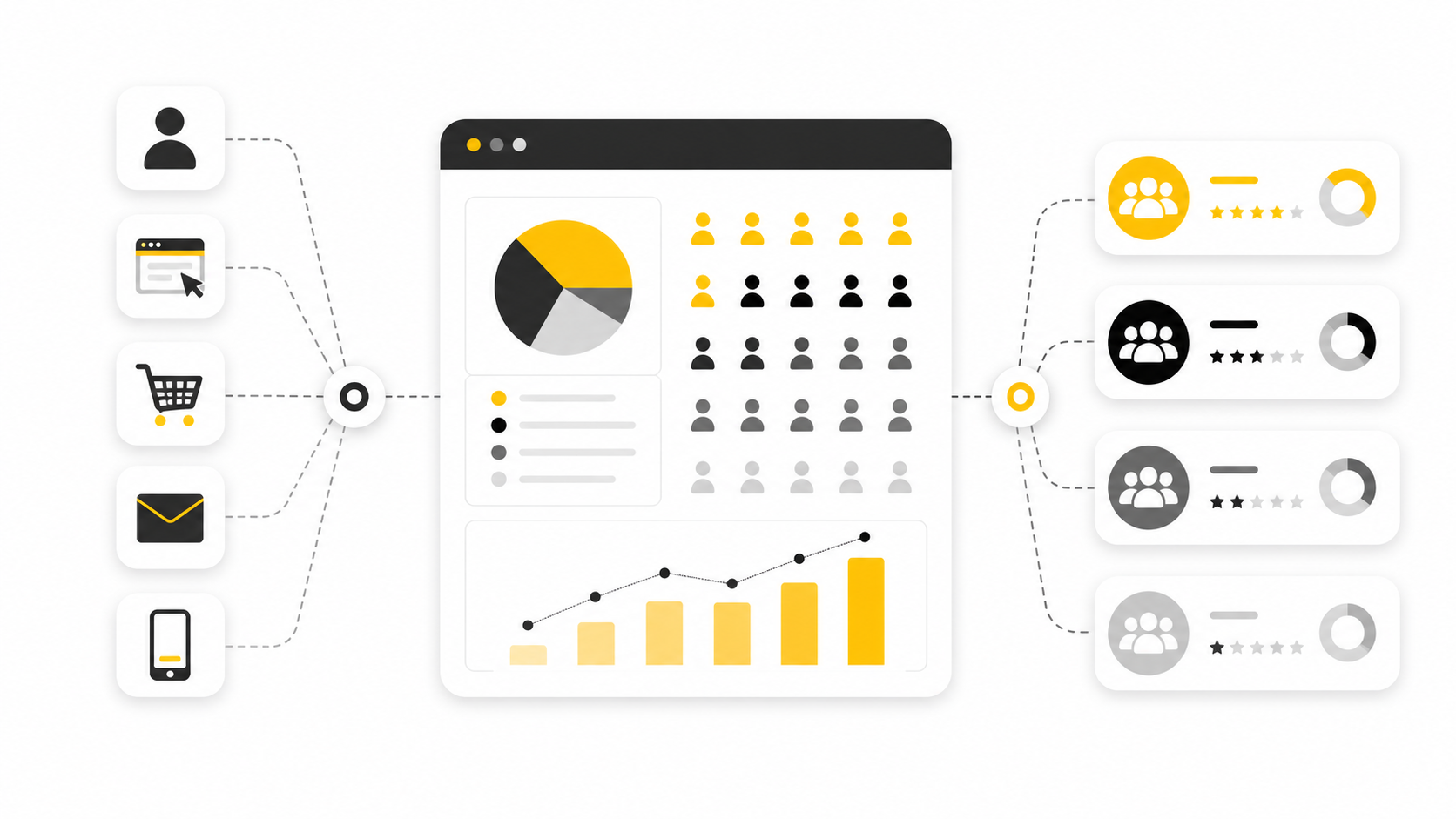
Customer segmentation is the practice of grouping customers by shared traits, behaviors, needs, or value so your marketing can speak to people with more relevance. It is not just a reporting exercise. Done well, it changes what you say, who you say it to, when you say it, and what offer you put in front of each group.
This matters because generic marketing is getting weaker. Customers now expect brands to understand context, and research from McKinsey has shown that faster-growing companies generate significantly more revenue from personalization than slower-growing peers. Segmentation is the practical layer between raw customer data and that kind of personalization.
Article Outline
This guide is split into six parts so each section can build on the last without rushing the work. The goal is to move from strategy to execution, not just define customer segmentation and leave you with theory. Each section below is the real section name the article will continue using.
- Why Customer Segmentation Matters
- Customer Segmentation Framework Overview
- Core Components of Strong Customer Segmentation
- Common Customer Segmentation Models
- Professional Implementation Process
- Customer Segmentation Tools, Mistakes, Metrics, and FAQ
Why Customer Segmentation Matters
Customer segmentation matters because customers do not behave like one single audience. A first-time visitor, a loyal repeat buyer, a high-value account, and a disengaged customer may all sit in the same CRM, but they should not receive the same message. Treating them the same usually leads to wasted spend, weaker conversion rates, and a customer experience that feels careless.
The bigger point is relevance. Salesforce’s recent marketing research highlights that most marketers see personalized, two-way engagement as the direction of customer communication, yet many teams still struggle to use data effectively for those moments. Customer segmentation gives teams a cleaner way to turn that data into useful action instead of drowning in dashboards.
It also protects your marketing from becoming too dependent on one channel or one campaign idea. When you understand your segments, you can adjust email, ads, landing pages, sales outreach, retention flows, and product messaging around the same customer logic. That makes segmentation less of a “marketing tactic” and more of a business operating system.
Customer Segmentation Framework Overview
A useful customer segmentation framework starts with a simple question: what difference should this segment make in how we act? If a segment does not change your offer, message, budget, channel, timing, or follow-up, it is probably just a label. Good segmentation should lead to decisions.
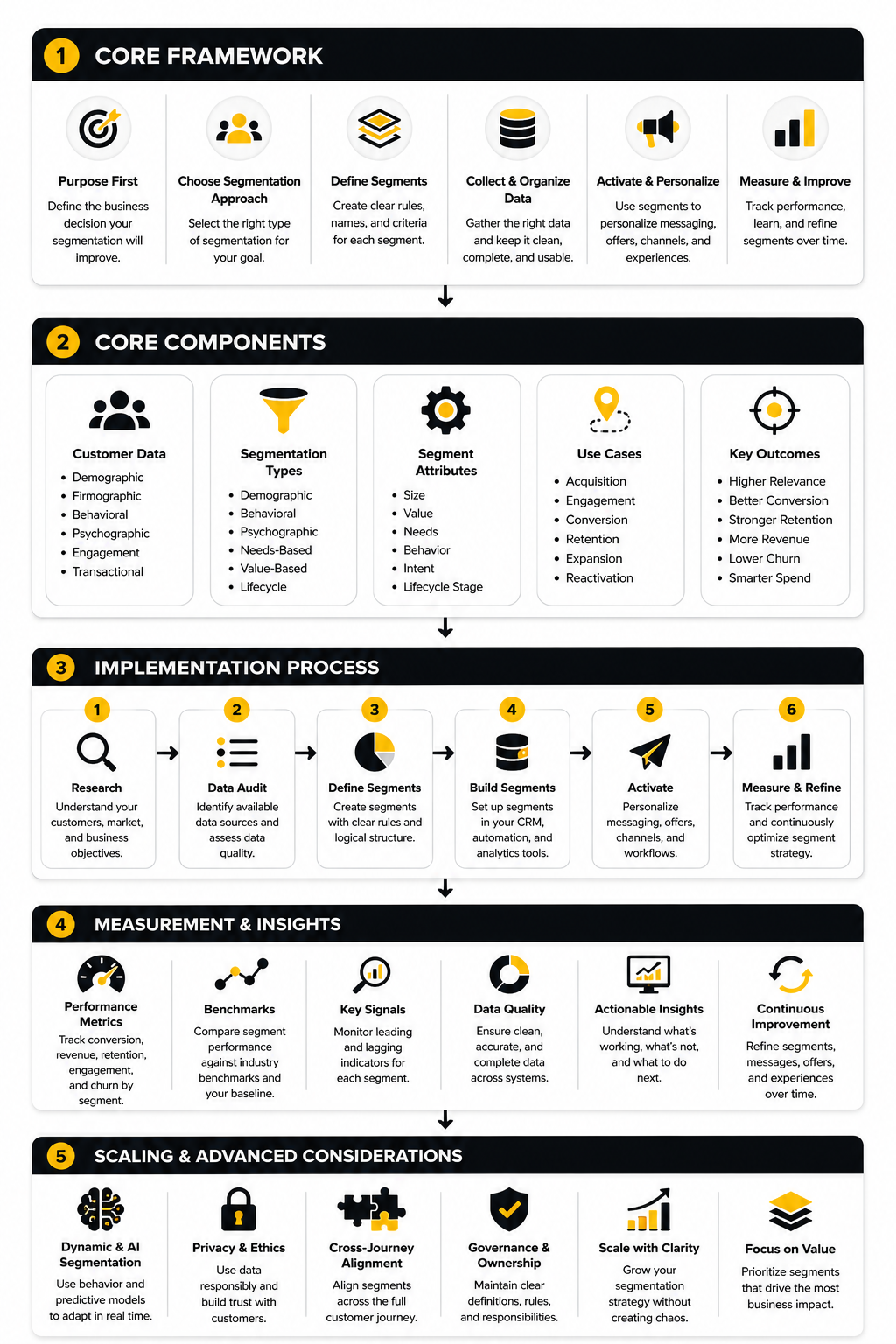
The framework in this article uses four layers: business goal, customer data, segment logic, and activation. The business goal defines what you are trying to improve, such as acquisition efficiency, retention, expansion, or lifecycle conversion. The customer data gives you the raw material, while the segment logic turns that data into groups your team can actually use.
Activation is where most segmentation projects either win or die. A beautiful cluster analysis means very little if nobody can launch a campaign from it, build a landing page for it, or brief sales on what to do next. That is why the rest of this guide keeps coming back to practical implementation instead of treating customer segmentation as an analytics-only project.
Core Components of Strong Customer Segmentation
Strong customer segmentation starts with a clear business goal. That sounds obvious, but it is where many teams go wrong. They group customers because the data is available, not because the business needs a better decision.
A useful segment should help you decide what to do next. That could mean changing the offer, rewriting the message, choosing a different channel, adjusting the sales motion, or prioritizing a retention campaign. If the segment does not change an action, it is not a strategic segment yet.
Customer segmentation also needs a balance between data and judgment. Data can show patterns, but people still need to interpret what those patterns mean commercially. The best segmentation work combines numbers, customer context, and practical marketing execution.
Business Goals
Before you segment customers, define the business outcome you want to improve. A retention team might segment customers by churn risk, product usage, support history, or renewal timing. An acquisition team might care more about intent signals, lead source, budget fit, or buying urgency.
This keeps the work grounded. You are not trying to create the most complex customer segmentation model possible. You are trying to build segments that help the business grow with less waste and more precision.
The goal also affects how detailed your segments should be. A small ecommerce brand might only need a few lifecycle segments at first, while a larger B2B company may need segments by industry, company size, buying committee, and sales stage. Complexity is only useful when the team can act on it.
Customer Data
Customer data is the raw material of segmentation, but more data does not automatically mean better segmentation. You need data that is accurate, usable, and connected to the decisions you want to make. A messy CRM full of old fields and inconsistent tags can create segments that look precise but perform badly.
Useful customer data usually comes from several places. It can include website behavior, purchase history, email engagement, product usage, support tickets, sales notes, survey responses, firmographic data, and customer lifetime value. Each source adds a different layer of understanding.
The key is to avoid treating every data point as equally important. Some data shows who the customer is, while other data shows what they are doing right now. In many campaigns, current behavior is more useful than a static profile because it points to timing and intent.
Segment Logic
Segment logic is the rule or model that decides who belongs in each group. In simple cases, this can be rule-based, such as customers who bought twice in the last 90 days or leads who requested a demo but did not book a call. In more advanced cases, it can involve predictive scoring, clustering, or machine learning.
The logic should be easy enough for your team to understand. If nobody can explain why a customer belongs in a segment, it becomes harder to trust the campaign strategy. This is especially important when sales, customer success, and marketing all need to act on the same segmentation system.
Good segment logic also needs boundaries. Segments should not overlap so much that customers receive conflicting messages. They should be specific enough to guide action, but not so narrow that every campaign becomes impossible to manage.
Customer Needs
Customer segmentation becomes much more powerful when it reflects customer needs, not just company convenience. Two customers may have the same demographic profile but completely different motivations. One may want speed, another may want support, and another may want the lowest-risk option.
This is where qualitative research matters. Interviews, surveys, sales calls, support conversations, and review analysis can reveal why customers behave the way they do. Without that layer, segmentation can become too mechanical.
Need-based segmentation also improves messaging. Instead of saying the same thing to everyone, you can speak to the real job each customer is trying to get done. That makes campaigns feel more relevant without making them feel creepy.
Activation Channels
A segment only creates value when it can be activated. That means your email platform, CRM, ad accounts, landing pages, sales workflows, or customer success tools need to recognize and use the segment. Otherwise, the work stays trapped in a spreadsheet.
For many teams, activation starts with lifecycle messaging. New leads, first-time buyers, repeat customers, inactive users, high-value accounts, and at-risk customers should not all receive the same journey. Each group needs a different next step.
This is also where tools matter, but tools should follow strategy. A platform like GoHighLevel can help teams connect CRM records, automation, pipelines, and follow-up workflows in one place. That is useful only when the underlying customer segmentation logic is already clear.
Measurement
Every segment should have a performance signal. If you cannot measure whether a segment is useful, you will not know whether to keep it, change it, or remove it. This is where segmentation becomes an ongoing system rather than a one-time project.
The right metric depends on the goal. Acquisition segments might be judged by conversion rate, cost per qualified lead, pipeline value, or close rate. Retention segments might be judged by repeat purchase rate, churn reduction, renewal rate, customer lifetime value, or support burden.
Measurement should also include negative signals. A segment that converts well but creates low-quality customers may not be worth scaling. Customer segmentation is not just about getting more response; it is about getting better-fit action from better-fit customers.
Common Customer Segmentation Models
Once the foundation is clear, the next step is choosing the right customer segmentation model. This is where teams often overcomplicate things. You do not need every model at once; you need the one that fits the decision you are trying to improve.
A model is simply a lens. It helps you look at your customers from a specific angle, such as who they are, what they do, what they need, or how valuable they are to the business. The best teams often combine several models, but they start with a simple version they can actually use.
The important part is not sounding advanced. The important part is creating segments that your team can activate consistently across campaigns, sales conversations, onboarding, retention, and reporting. That is where customer segmentation starts to become a practical growth system.
Demographic Segmentation
Demographic segmentation groups customers by personal attributes such as age, gender, income level, education, occupation, household status, or location. It is one of the most familiar forms of segmentation because the data is usually easy to collect. For consumer brands, it can help shape offers, creative direction, product bundles, and channel choices.
The weakness is that demographics rarely explain the full reason behind a buying decision. Two customers with the same age and income can have completely different priorities, objections, and buying triggers. That is why demographic segmentation works best as a starting layer, not the whole strategy.
Use it when demographic differences clearly affect demand, pricing sensitivity, communication style, or product fit. Avoid using it as a lazy shortcut for customer understanding. A customer profile may tell you who someone is, but it does not automatically tell you why they buy.
Firmographic Segmentation
Firmographic segmentation is the B2B version of demographic segmentation. It groups companies by traits such as industry, company size, revenue, location, funding stage, business model, or team structure. For B2B marketers, this is often the first useful filter because the same product can mean very different things to a startup, a local service business, and an enterprise team.
This model is especially useful for sales prioritization. A CRM full of leads becomes easier to work when accounts are grouped by fit, urgency, and commercial potential. It also helps marketing create sharper landing pages, case study angles, outbound messaging, and lead nurturing flows.
The mistake is assuming company traits are enough. A 200-person software company and a 200-person healthcare provider may both have budget, but they will not buy the same way or care about the same proof. Firmographic segmentation becomes stronger when it is paired with behavioral, needs-based, or account-level intent data.
Behavioral Segmentation
Behavioral segmentation groups customers by what they do. That can include pages visited, products viewed, emails clicked, forms submitted, purchases made, features used, support tickets opened, or time since last engagement. This is often one of the most actionable segmentation models because behavior points to intent.
For example, someone who visited a pricing page three times is showing a different signal than someone who only read one top-of-funnel article. A repeat buyer who has not purchased in 120 days needs a different message than a new subscriber who has never bought. These behavioral differences are where customer segmentation can directly improve timing and relevance.
Behavioral segmentation also works well with automation. Tools like ManyChat can help brands trigger conversational follow-up based on specific customer actions, while platforms like Brevo can support segmented email and marketing automation campaigns. The point is not to automate everything; it is to respond faster and more appropriately when the customer gives you a signal.
Psychographic Segmentation
Psychographic segmentation groups customers by attitudes, motivations, values, lifestyle, beliefs, aspirations, or fears. This model goes deeper than surface-level traits because it tries to understand the emotional and strategic reasons behind a decision. It is especially useful when several customer groups buy the same product for different reasons.
For example, one customer may choose a tool because it saves time, while another chooses it because it gives them more control. Another may care most about status, simplicity, safety, creativity, or expert support. Those motivations should change the message.
The challenge is that psychographic data is harder to collect cleanly. You usually need interviews, surveys, reviews, sales call notes, or customer research to understand it properly. That extra work is worth it when messaging feels flat and your team cannot explain why different customers respond to different promises.
Needs-Based Segmentation
Needs-based segmentation groups customers by the problem they are trying to solve. This is one of the strongest strategic models because it connects segmentation directly to value. Instead of asking only who the customer is, it asks what the customer needs to accomplish.
This approach is especially useful when your product serves several use cases. A marketing automation platform might serve agencies, local businesses, coaches, ecommerce stores, and B2B service providers, but each group may need a different outcome. One wants client management, another wants lead follow-up, another wants sales funnels, and another wants retention campaigns.
Needs-based segmentation forces clarity. It makes you define the real reason a customer would care, then build campaigns around that reason. This is also where positioning improves, because your segments are tied to customer pain instead of internal labels.
Value-Based Segmentation
Value-based segmentation groups customers by commercial value. That can include revenue, profit margin, lifetime value, purchase frequency, average order value, expansion potential, referral potential, or strategic importance. This model helps teams stop treating every customer as equally valuable when the business impact is clearly different.
This does not mean ignoring smaller customers. It means matching effort to opportunity. High-value customers may deserve more personalized onboarding, sales attention, loyalty offers, or proactive support, while lower-value groups may be served better with scalable education and automation.
Value-based customer segmentation is especially useful when budgets are tight. It helps you decide where to invest human time and where automation is enough. That decision matters because personalization can create stronger results, but poorly executed personalization can also create negative experiences, with Gartner research showing that bad personalization can increase regret and reduce future purchase intent.
Professional Implementation Process
Customer segmentation becomes real when it moves from theory into a repeatable process. This is the part where the team stops saying “we should personalize more” and starts building the system that makes better targeting possible. The process does not need to be complicated, but it does need to be disciplined.
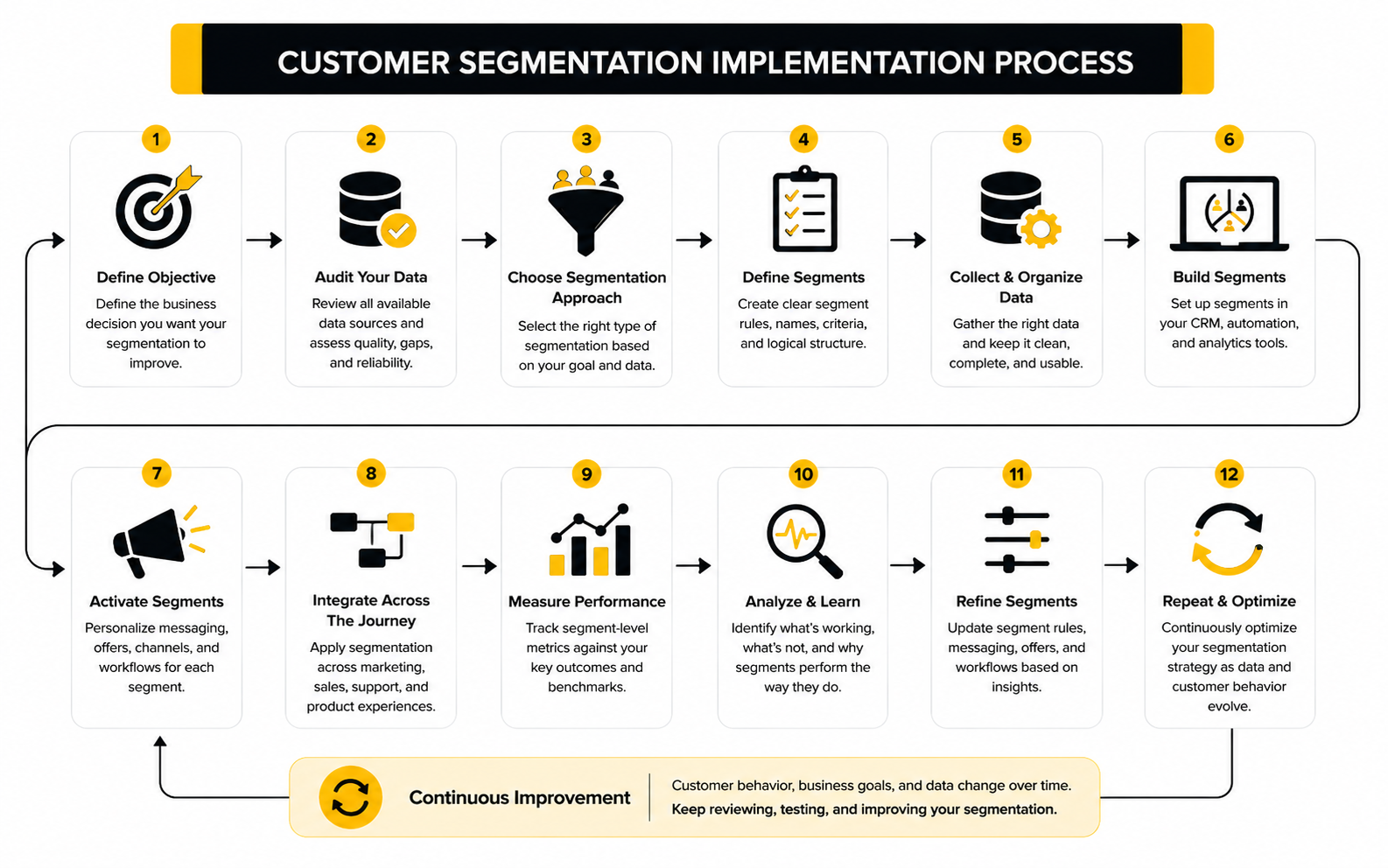
A professional implementation process should create segments that are clear, usable, measurable, and easy to maintain. That means the work has to involve more than marketing alone. Sales, customer success, analytics, product, and leadership may all have useful context about which customer groups matter most.
The goal is not to create a perfect segmentation system on the first attempt. The goal is to launch a practical version, learn from real performance, and improve it over time. That is how segmentation becomes an operating rhythm instead of a one-off workshop.
Step 1: Define the Decision
Start by naming the decision your segmentation needs to improve. Are you trying to reduce churn, improve lead quality, increase repeat purchases, grow expansion revenue, improve onboarding, or make paid ads more efficient? One clear decision will produce better segmentation than ten vague goals.
This step matters because different goals require different segment logic. Churn prevention may depend on usage and support behavior, while acquisition may depend on intent, source, industry, or offer fit. If the goal is unclear, the segments will probably become too broad or too decorative.
Write the decision in plain language. For example, “We need to know which trial users deserve sales follow-up within 24 hours” is much stronger than “We need better customer segmentation.” The first version tells the team exactly what the segment must help them do.
Step 2: Audit the Data You Already Have
Before adding new tools or fields, inspect the customer data you already collect. Look at CRM records, purchase history, email engagement, website events, product usage, support conversations, sales notes, form submissions, and survey responses. You may already have enough information to build useful first segments.
The audit should separate reliable data from noisy data. A field that is filled in only 20% of the time may not be ready for segmentation. A tag that different team members use differently can create confusion instead of clarity.
This is also where teams should identify missing signals. You may realize you are tracking lead source but not buying intent, or tracking purchases but not reason for churn. Those gaps become priorities for future data collection.
Step 3: Choose the Segmentation Model
Choose the model that matches the decision. If the goal is lifecycle messaging, behavioral and lifecycle segmentation may be enough. If the goal is sales prioritization, firmographic and value-based segmentation may be more useful.
Do not choose a model just because it sounds sophisticated. A simple rule-based segment that drives action is better than an advanced model nobody trusts. The strongest customer segmentation systems are usually understandable before they become advanced.
You can layer models later. Start with the smallest useful version, then add depth when performance data proves it is worth the extra complexity. This keeps the team focused and prevents the segmentation project from turning into a permanent planning exercise.
Step 4: Build the Segment Rules
Once the model is chosen, define the exact rules for each segment. For example, a high-intent lead might be someone who visited a pricing page, opened two sales emails, and requested a demo within the last 14 days. A churn-risk customer might be someone with declining usage, unresolved support issues, and no recent engagement.
Rules need to be specific enough to automate. If a segment depends on vague interpretation, it will be hard to maintain across systems. This is why naming, definitions, and ownership matter more than most teams expect.
Document each segment in plain English. Include who qualifies, why the segment exists, what action should happen, and which metric proves whether it is working. That document becomes the source of truth when the team starts building campaigns.
Step 5: Activate the Segments
Activation is where customer segmentation starts producing value. Push the segments into the channels where decisions happen, such as email, SMS, ads, CRM pipelines, sales tasks, onboarding flows, landing pages, reporting dashboards, or customer success playbooks. A segment that lives only in analysis is unfinished.
This step should include a clear message and offer strategy for each group. A high-intent lead may need a direct sales CTA, while an early-stage subscriber may need education. A loyal buyer may need a loyalty offer, while an inactive customer may need a reactivation reason.
Landing pages can also be aligned with segments. If you are building segment-specific pages for campaigns, a tool like Replo can help ecommerce teams create tailored page experiences without waiting on a full development cycle. The important thing is to make the segment visible in the actual customer journey, not just in the backend.
Step 6: Test and Refine
After launch, measure each segment against the business goal you defined at the start. Look at conversion rate, revenue, retention, engagement, sales velocity, average order value, churn, or any other metric tied to the original decision. Do not judge the whole system by one campaign.
Refinement is where the process gets stronger. You may discover that one segment is too broad, another is too small, and another has strong engagement but weak revenue. That is normal, and it is exactly why segmentation should be treated as a living system.
Keep the feedback loop practical. Review performance, adjust the rules, clean the data, improve the message, and test again. Customer segmentation is not a static spreadsheet; it is a way to keep your marketing closer to what customers are actually doing.
Statistics and Data
Customer segmentation data only matters when it helps you make a better decision. A dashboard full of segment names, percentages, and campaign metrics can look impressive, but it can still leave the team unsure what to do next. The job of measurement is to show which customer groups are creating value, which ones need a different approach, and which ones should not receive more budget yet.
The strongest analytics setup connects each segment to a business outcome. That means you are not only tracking opens, clicks, impressions, or page views. You are tracking whether each segment moves closer to revenue, retention, expansion, repeat purchase, or another result that actually matters.
This is where customer segmentation becomes much more useful than basic reporting. Instead of asking, “Did the campaign work?” you ask, “Which segment responded, why did they respond, and what should we change next?” That question gives you direction.
What to Measure by Segment
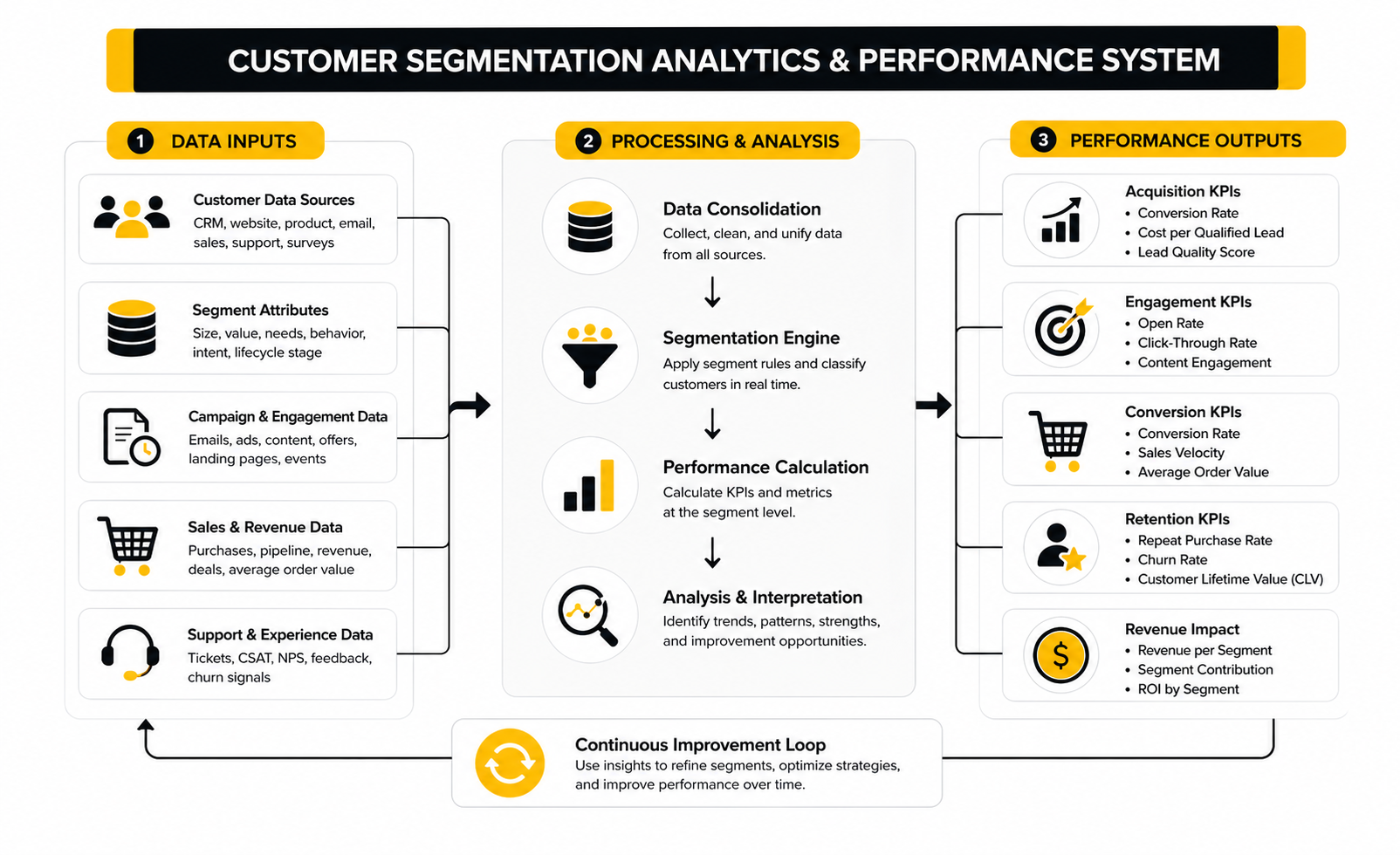
Every segment should have a small set of primary metrics. Acquisition segments may need cost per lead, qualified lead rate, booked calls, close rate, and payback period. Retention segments may need repeat purchase rate, churn risk, product usage, renewal rate, and customer lifetime value.
Do not measure every segment with the same scorecard. A high-intent lead segment should not be judged by the same signals as a dormant customer segment. One is about speed to conversion, while the other is about reactivation and trust.
The point is to match the metric to the purpose of the segment. If the segment exists to improve sales follow-up, measure sales movement. If it exists to improve onboarding, measure activation and early retention. If it exists to improve loyalty, measure repeat behavior and long-term value.
Benchmarks Are Useful, But Context Wins
Benchmarks can help you understand whether performance is unusually weak or unusually strong, but they should not become the strategy. Industry averages hide huge differences in audience quality, offer strength, list health, price point, sales cycle, and brand trust. A campaign can beat a benchmark and still fail commercially if it attracts the wrong customers.
Recent marketing benchmark research keeps pointing in the same direction: teams need clearer measurement, better first-party data, and stronger links between campaign activity and business outcomes. Supermetrics’ 2025 marketing data research highlights how heavily marketers now rely on first-party data, while Nielsen’s 2025 annual marketing report emphasizes the need for clearer cross-channel measurement. Those trends matter because customer segmentation depends on both: reliable data and a way to see what changed.
Use benchmarks as a temperature check, not a final verdict. If your segmented email campaign has a lower click rate than an industry average but produces higher-quality pipeline, the campaign may still be working. If your conversion rate looks strong but refund rates or churn rise afterward, the segment may be attracting the wrong fit.
Performance Signals That Actually Matter
The best performance signals show movement, not just attention. A click is useful, but it is only one step. A booked call, product activation, repeat purchase, expansion conversation, or renewal is a much stronger signal that the segment is responding in a valuable way.
This is why segmented reporting should include both leading and lagging indicators. Leading indicators show early interest, such as visits, clicks, replies, demo requests, trial starts, or feature usage. Lagging indicators show business impact, such as revenue, retention, margin, lifetime value, and churn.
You need both because waiting only for revenue can slow decisions, while reacting only to engagement can mislead you. A segment that clicks often but never buys needs a different offer or qualification filter. A segment that engages less but closes at a higher rate may deserve more budget and more direct sales attention.
How to Read Segment Performance
When a segment performs well, do not immediately scale it blindly. First, understand what worked. Was it the audience, the timing, the message, the offer, the channel, or the follow-up? Scaling without that answer can turn a winning segment into a noisy one.
When a segment performs badly, do not delete it immediately either. Bad performance can mean the segment is wrong, but it can also mean the offer is weak, the message is unclear, the channel is mismatched, or the timing is off. Measurement should help you diagnose the problem before you make a decision.
A practical review should ask three questions. First, did this segment behave differently from the average customer? Second, did that difference create business value? Third, what action should we take next? If the answer to the third question is unclear, the reporting is not finished.
Segment Size and Segment Value
A large segment is not automatically more valuable than a small one. Some of the most profitable customer segmentation work happens in smaller groups with high intent, high urgency, or high lifetime value. A small segment can justify serious attention if it converts faster, stays longer, or spends more.
At the same time, tiny segments can become hard to operate. If a segment is too small, you may not have enough data to make confident decisions. You may also create unnecessary campaign complexity for a group that does not move the business.
The practical answer is to look at both size and value. A segment should be large enough to act on and valuable enough to deserve attention. If it is small but strategically important, treat it as a priority account or high-touch group rather than a broad marketing audience.
Data Quality and Attribution
Customer segmentation is only as trustworthy as the data behind it. If your CRM fields are outdated, your lifecycle stages are inconsistent, or your tracking is broken, segment performance will be distorted. You may think one audience is underperforming when the real issue is bad data capture.
Attribution also needs a realistic view. Customers rarely move through one clean path, especially in B2B, high-ticket ecommerce, or longer consideration purchases. A segmented campaign may not get the final click, but it may still improve trust, speed up sales, or reduce hesitation.
This is why segment analytics should combine platform data with business data. Email, ad, CRM, ecommerce, and product analytics should be connected wherever possible. Tools like GoHighLevel can help smaller teams keep CRM activity, pipeline movement, and follow-up performance in one system, which makes segmentation easier to measure without stitching everything together manually.
Turning Data Into Action
The final step is turning the numbers into decisions. If a high-intent segment converts well, increase follow-up speed, build a stronger offer, or send the group to a more direct landing page. If a loyal segment has high repeat purchase behavior, build retention campaigns, referral prompts, or early access offers.
If a segment has weak engagement but strong value, test clearer messaging before cutting budget. If a segment has strong engagement but weak revenue, tighten qualification or change the offer. If a segment has high churn, improve onboarding, support, education, or expectation-setting before trying to sell more.
This is the real purpose of customer segmentation analytics. Not more charts. Better action.
Advanced Customer Segmentation Strategy
Once the basics are working, customer segmentation becomes less about creating more groups and more about making better tradeoffs. This is where mature teams separate themselves. They do not chase complexity for its own sake; they decide where precision is worth the extra operational cost.
The big risk is building a segmentation system that looks smart but slows everyone down. Too many segments can fragment reporting, confuse creative direction, and make campaigns harder to manage. Too few segments can hide important differences and force customers into journeys that do not fit.
The right balance depends on your business model, sales cycle, data quality, team size, and campaign volume. A founder-led service business does not need the same segmentation structure as a multi-product ecommerce brand or an enterprise SaaS company. The goal is to create enough detail to improve decisions without creating a system nobody can maintain.
Static Segments vs Dynamic Segments
Static segments are fixed groups based on relatively stable traits. These might include industry, company size, region, customer type, or acquisition source. They are useful because they are easy to understand and simple to report on over time.
Dynamic segments change as customer behavior changes. A lead can move from cold to high-intent after visiting a pricing page, opening sales emails, or submitting a form. A customer can move from active to at-risk if usage drops, support tickets rise, or buying frequency slows.
Most serious customer segmentation systems need both. Static segments give you structure, while dynamic segments give you timing. If you only use static segments, your messaging may miss the moment; if you only use dynamic segments, your team may lose the bigger strategic picture.
Personalization vs Privacy
Customer segmentation should make marketing feel more useful, not more invasive. That line matters. People may appreciate relevant recommendations, but they do not want to feel watched, manipulated, or trapped inside a profile they never agreed to.
This is why first-party data is becoming more important. Research from Twilio Segment’s CDP Report 2025 points to companies using customer data platforms to power targeted campaigns, proactive support, and personalized recommendations from data they can connect more directly to customer relationships. That direction makes sense because segmentation is stronger when it is based on permissioned, reliable data instead of weak assumptions.
The practical rule is simple: use data to help the customer, not just extract more from them. If a segment makes the experience faster, clearer, more relevant, or more supportive, it usually feels natural. If it only exists to pressure people harder, it will damage trust.
AI and Predictive Segmentation
AI can make customer segmentation faster and more adaptive, especially when there is enough data to detect patterns humans would miss. Predictive models can help estimate churn risk, purchase likelihood, next-best offer, lead quality, or expansion potential. That can be powerful when the model is tied to a clear action.
But AI does not remove the need for strategy. A predictive score is only useful if the team knows what should happen when the score changes. If a customer is marked as high churn risk, does success reach out, does the email journey change, does the offer change, or does the product experience adapt?
The best use of AI is not replacing human judgment. It is helping teams spot patterns faster, prioritize better, and test more intelligently. Keep humans responsible for the business logic, the customer promise, and the ethical boundary.
Segmentation Across the Full Customer Journey
Advanced segmentation should not stop at acquisition. Many teams obsess over lead targeting, then treat every customer the same after purchase. That is a mistake because retention, expansion, loyalty, and referrals often depend on what happens after the first conversion.
A strong customer journey may include separate segments for new leads, active prospects, first-time buyers, onboarding customers, repeat buyers, loyal customers, at-risk customers, and inactive customers. Each group has a different need, and each one deserves a different next step. This is not about sending more messages; it is about sending better ones.
This journey view also helps teams avoid channel tunnel vision. Email, SMS, ads, sales calls, landing pages, support, and product experiences should not run on disconnected logic. When the same segmentation strategy guides the journey, the customer experience feels more coherent.
The Risk of Over-Segmentation
Over-segmentation happens when teams create more customer groups than they can meaningfully serve. It often starts with good intentions. The team wants more personalization, so they keep splitting the audience into smaller and smaller slices.
The problem is that every new segment creates work. It may need separate messaging, creative, automations, reporting, QA, and performance review. If the team cannot support that work, segmentation becomes clutter.
A useful test is whether each segment has a distinct action. If two segments get the same offer, same message, same timing, and same follow-up, they probably do not need to be separate. Keep the structure lean until the data proves that more detail will create more value.
The Risk of Under-Segmentation
Under-segmentation is the opposite problem, and it is just as damaging. This happens when teams rely on broad lists like “newsletter subscribers,” “all leads,” or “past customers” even though those groups contain people with very different intent, value, and needs. It is easier to manage, but it usually creates weaker marketing.
The damage often shows up quietly. Conversion rates flatten, unsubscribe rates rise, sales teams complain about poor lead quality, and loyal customers receive messages that feel irrelevant. Nothing looks obviously broken at first, but the customer experience slowly gets worse.
The fix is not to create dozens of segments overnight. Start by finding the biggest meaningful difference inside the broad audience. For example, separate new leads from high-intent leads, first-time buyers from repeat buyers, and active customers from inactive customers. Small improvements in segmentation can create a much cleaner operating system.
Governance and Ownership
Customer segmentation needs ownership or it will decay. Fields get outdated, tags get misused, automation rules conflict, and teams start creating their own private definitions. Before long, nobody trusts the data.
Assign clear ownership for segment definitions, data hygiene, campaign activation, and reporting. Marketing may own the messaging, but sales and customer success should help validate whether the segments reflect reality. Analytics or operations should help keep the system clean.
Governance does not need to be bureaucratic. A simple segment dictionary, regular review cadence, and clear approval process can prevent most problems. The goal is to keep customer segmentation useful as the business changes.
Scaling Segmentation Without Losing Clarity
Scaling customer segmentation means building a system that can grow without becoming chaotic. That usually requires shared definitions, cleaner data capture, better automation, and reporting that connects segment performance to business outcomes. It also requires discipline around what not to segment.
As the system grows, prioritize segments that affect money, risk, or customer experience. High-value customers, high-intent prospects, churn-risk accounts, expansion-ready customers, and poor-fit leads usually deserve more attention than minor audience differences. Not every interesting pattern deserves a campaign.
This is where connected tools can help, but only if the strategy is already clear. A CRM and automation platform like GoHighLevel, a form builder like Fillout, or a chatbot platform like Chatbase can support better data capture and activation. The software is useful, but the real advantage comes from knowing exactly which customer differences matter.
Customer Segmentation Tools, Mistakes, Metrics, and FAQ
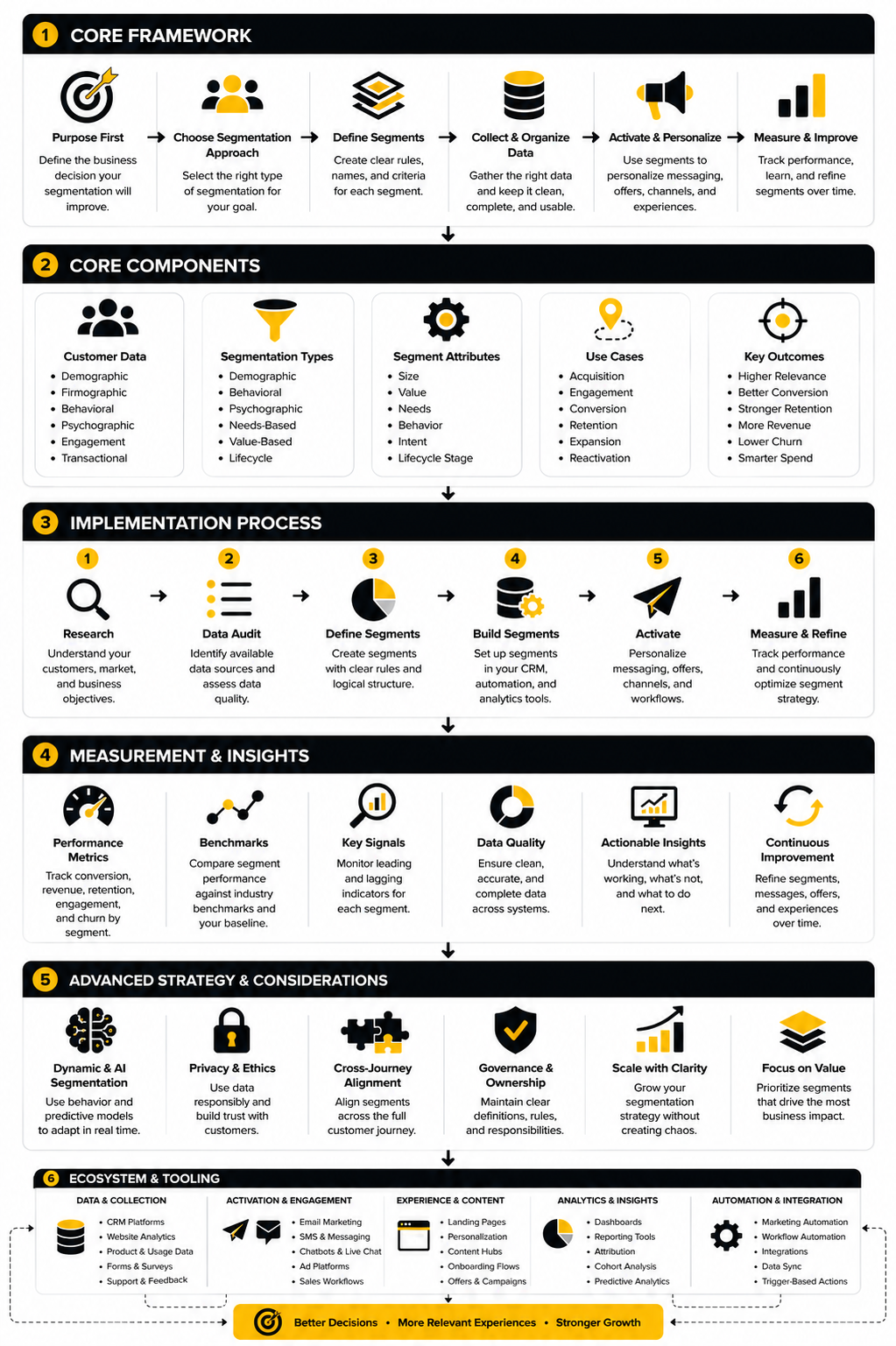
By this point, the pattern should be clear. Customer segmentation is not one campaign, one dashboard, or one CRM field. It is a system that connects customer understanding to marketing action.
The final layer is the ecosystem around that system. You need tools that capture useful data, workflows that activate the right message, metrics that show what is working, and guardrails that stop the team from making the experience feel messy or invasive. When all of those pieces work together, segmentation becomes a serious advantage.
Choosing the Right Tools
The best customer segmentation tool depends on what you need the segment to do. If your main challenge is follow-up, CRM and automation matter most. If your challenge is conversion, landing pages and funnel tools may matter more. If your challenge is research, forms, surveys, interviews, and customer feedback systems become more important.
A practical stack usually starts with a CRM, an email or messaging platform, a form or survey tool, analytics, and a place to document segment definitions. A platform like GoHighLevel can help combine CRM, automation, pipelines, and follow-up. For ecommerce landing page testing, Replo can support segment-specific page experiences, while tools like Fillout can help collect cleaner customer data before it ever reaches your CRM.
Do not buy tools before you know the workflow. Software will not fix unclear segmentation logic. Start with the customer decision, then choose the tool that helps your team act on it faster and more consistently.
Common Customer Segmentation Mistakes
The first mistake is creating segments that do not change anything. If every segment receives the same email, offer, landing page, and sales process, the segmentation is cosmetic. It may look organized, but it is not helping the customer or the business.
The second mistake is relying too heavily on one data type. Demographics, behavior, value, intent, and customer needs each show a different part of the picture. A strong customer segmentation strategy uses the right combination instead of pretending one field can explain everything.
The third mistake is letting segments decay. Customers move, needs change, buying behavior shifts, and data gets old. A segment that was accurate six months ago may need new rules, cleaner data, or a different action today.
A Simple Review Cadence
Customer segmentation should be reviewed on a regular rhythm. For fast-moving campaigns, review performance weekly or biweekly. For broader strategic segments, monthly or quarterly review is usually more realistic.
The review should not become a long meeting full of vague opinions. Look at segment size, conversion, revenue, retention, engagement, churn, and campaign cost. Then decide what changes: the rule, the message, the offer, the channel, or the follow-up.
Keep a simple decision log. When a segment changes, document why it changed and what you expect to improve. This keeps the system from becoming a collection of random edits.
FAQ - Built for Complete Guide
What is customer segmentation?
Customer segmentation is the process of grouping customers by shared traits, behaviors, needs, or value so a business can market, sell, and support them more effectively. The goal is not to label people for the sake of it. The goal is to understand meaningful differences and act on them.
A good customer segmentation system helps teams decide what message to send, which offer to show, which channel to use, and when to follow up. It turns customer data into practical action. That is why segmentation matters across acquisition, retention, sales, onboarding, and customer success.
Why is customer segmentation important?
Customer segmentation is important because different customers need different things. A new lead, loyal buyer, inactive customer, and high-value account should not be treated the same. When they are, marketing becomes generic and less effective.
Segmentation helps improve relevance. It can also reduce wasted spend because teams stop pushing the same campaign to people with completely different intent. The result is usually clearer messaging, better prioritization, and a more useful customer experience.
What are the main types of customer segmentation?
The main types include demographic, firmographic, behavioral, psychographic, needs-based, lifecycle, and value-based segmentation. Each type gives you a different view of the customer. None of them is perfect on its own.
Demographic and firmographic segmentation explain who the customer is. Behavioral segmentation shows what the customer is doing. Needs-based and value-based segmentation explain why the customer matters and what kind of action may be worth taking.
What is the difference between customer segmentation and market segmentation?
Market segmentation looks at the broader market. It helps a company understand different groups of potential buyers in the market as a whole. Customer segmentation focuses more specifically on current customers, leads, subscribers, accounts, or users inside your own business data.
The two are connected, but they are not identical. Market segmentation often shapes positioning and go-to-market strategy. Customer segmentation usually shapes campaigns, sales workflows, lifecycle marketing, retention, and personalization.
How do you create customer segments?
Start with the business decision you want to improve. Then audit the data you already have, choose the segmentation model that fits the goal, define clear segment rules, activate those segments in your marketing and sales tools, and measure performance. That process keeps the work practical.
The most important step is clarity. Every segment should have a purpose, a definition, an owner, and a next action. If you cannot explain what changes because the segment exists, the segment is not ready.
How many customer segments should a business have?
There is no perfect number. A small business may only need a handful of segments, while a larger company may need more detailed segmentation by lifecycle stage, customer value, product usage, or account type. The right number depends on how many segments your team can actually serve well.
A good rule is to keep segments as simple as possible until performance data proves you need more detail. More segments create more work. Add complexity only when it improves decisions, revenue, retention, or customer experience.
What data is needed for customer segmentation?
Useful data can include purchase history, website behavior, email engagement, product usage, support interactions, sales notes, form responses, company size, industry, location, customer lifetime value, and churn signals. The best data depends on the goal of the segmentation. You do not need every possible data point to start.
Quality matters more than volume. Clean, reliable, actionable data beats a huge database full of inconsistent fields. If the data cannot guide a real decision, it probably does not belong at the center of your segmentation strategy.
How often should customer segments be updated?
Dynamic segments should update continuously or near real time when customer behavior changes. Examples include high-intent leads, churn-risk customers, inactive subscribers, or recently converted buyers. Static segments can usually be reviewed less often.
Even stable segments need periodic review. Markets change, products change, and customer behavior changes. A quarterly review is a practical minimum for most teams, while active campaigns may need weekly performance checks.
What is a good example of customer segmentation?
A practical example is separating leads by intent. Someone who downloaded a beginner guide may need education, while someone who visited a pricing page several times and requested a demo may need direct sales follow-up. Both are leads, but they should not receive the same message.
Another example is segmenting customers by lifecycle stage. First-time buyers may need onboarding and confidence-building, while loyal repeat buyers may respond better to early access, referral offers, or loyalty campaigns. The segment changes the next action.
What is the biggest customer segmentation mistake?
The biggest mistake is creating segments that nobody uses. Many teams build segments in a spreadsheet or dashboard, then never connect them to campaigns, sales workflows, landing pages, reporting, or customer success. That turns segmentation into documentation instead of growth work.
The second big mistake is over-segmentation. Too many segments can overwhelm the team and make campaigns harder to manage. A useful segment should always earn its place by creating a better action.
Can small businesses use customer segmentation?
Yes, and small businesses often benefit from simple segmentation quickly. They do not need advanced machine learning or a complex data warehouse to start. They can begin with lifecycle stages, purchase behavior, lead source, customer value, or intent signals.
For example, a small business can separate new leads, active prospects, first-time buyers, repeat customers, and inactive customers. That alone can make follow-up more relevant. The system can become more advanced later.
How does customer segmentation improve personalization?
Customer segmentation improves personalization by giving the business a reason to change the message, offer, timing, or channel. Without segmentation, personalization often becomes shallow, such as using someone’s first name while sending the same generic campaign. That is not enough.
Real personalization comes from understanding context. A customer who is comparing options needs different content from someone ready to buy. A loyal customer needs different treatment from someone at risk of leaving.
Is AI useful for customer segmentation?
AI can be useful when there is enough clean data and a clear business goal. It can help identify patterns, predict churn risk, score leads, recommend offers, or find groups that humans might miss. It can also support faster testing and more adaptive customer journeys.
AI is not a shortcut for strategy. The team still needs to decide what each segment means and what action should happen next. A predictive model without a clear workflow is just another score nobody uses.
How do you measure whether customer segmentation is working?
Measure segmentation by the outcome it was created to improve. For acquisition, that may mean conversion rate, cost per qualified lead, sales velocity, pipeline value, or close rate. For retention, it may mean repeat purchase rate, churn reduction, renewal rate, usage, or customer lifetime value.
Also compare segments against each other and against your baseline. If a segment behaves differently and creates better business results, it is useful. If it does not change action or performance, it needs to be refined or removed.
Work With Professionals
Explore 10K+ Remote Marketing Contracts on MarkeWork.com
Most marketers spend too much time chasing clients, competing on crowded platforms, and losing a percentage of every project to middlemen.
MarkeWork gives you a better way. Browse thousands of remote marketing contracts and connect directly with companies desperate to hire skilled marketers like you, without platform commissions and without unnecessary gatekeepers.
If you're serious about finding better opportunities and keeping 100% of what you earn, explore available contracts and create a profile for free at MarkeWork.com.