

Data driven marketing is the discipline of using customer, campaign, and revenue data to make better marketing decisions. Not louder decisions. Not more complicated decisions. Better decisions.
The goal is simple: understand what is happening, why it is happening, and what to do next. That matters because modern marketers are dealing with fragmented channels, rising acquisition costs, privacy changes, AI tools, and customers who expect relevance without feeling tracked.
A strong data driven marketing system connects strategy, measurement, execution, and learning. Salesforce reports that 84% of marketers use first-party data, while only 31% are fully satisfied with their data unification. That gap is exactly where most marketing teams either win or waste money: Salesforce marketing statistics.
Article Outline
- Why Data Driven Marketing Matters Now
- The Data Driven Marketing Framework
- Core Components of a Strong Data Strategy
- Professional Implementation Across Channels
- Measurement, Optimization, and AI
- Common Mistakes, Best Practices, and FAQs
Why Data Driven Marketing Matters Now
Data driven marketing matters because guessing has become too expensive. Paid media platforms are more competitive, organic reach is harder to predict, and customer journeys rarely happen in one clean path. A buyer may see a short-form video, read a comparison page, join an email list, talk to a chatbot, abandon checkout, and convert after a retargeting ad.
That kind of journey cannot be managed well with opinions alone. It needs clean data, clear attribution, useful segmentation, and a feedback loop that tells the team what is actually moving revenue. Nielsen’s 2025 Annual Marketing Report focuses heavily on how marketers are adapting to changing technology, AI, and measurement pressure, which shows how central data has become to modern growth work: Nielsen 2025 Annual Marketing Report.
This does not mean every decision should be robotic. The best teams still use creativity, instinct, positioning, and brand judgment. Data simply gives those decisions a sharper edge, because it shows where attention turns into intent, where intent turns into revenue, and where the funnel quietly leaks money.
The Data Driven Marketing Framework
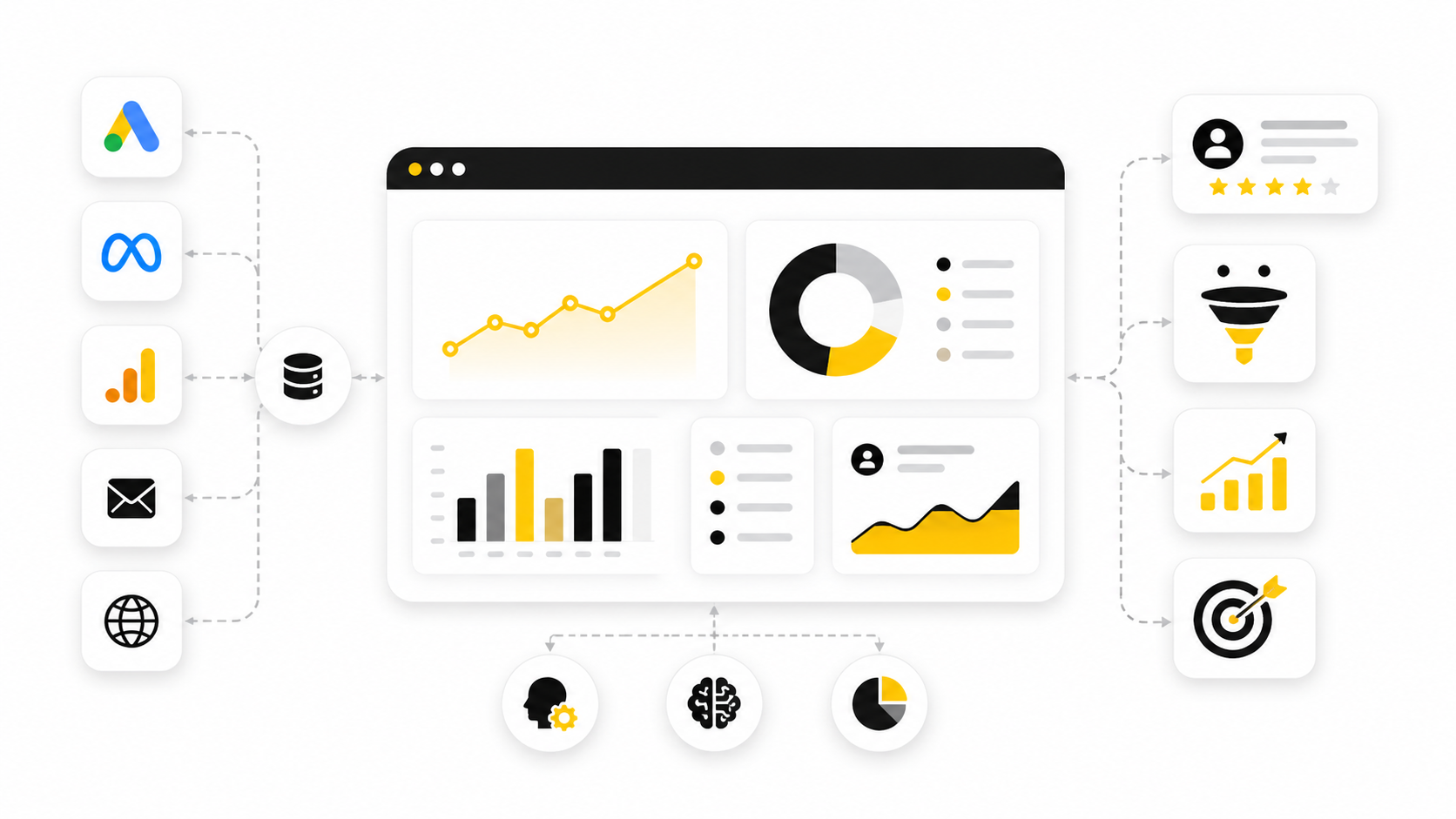
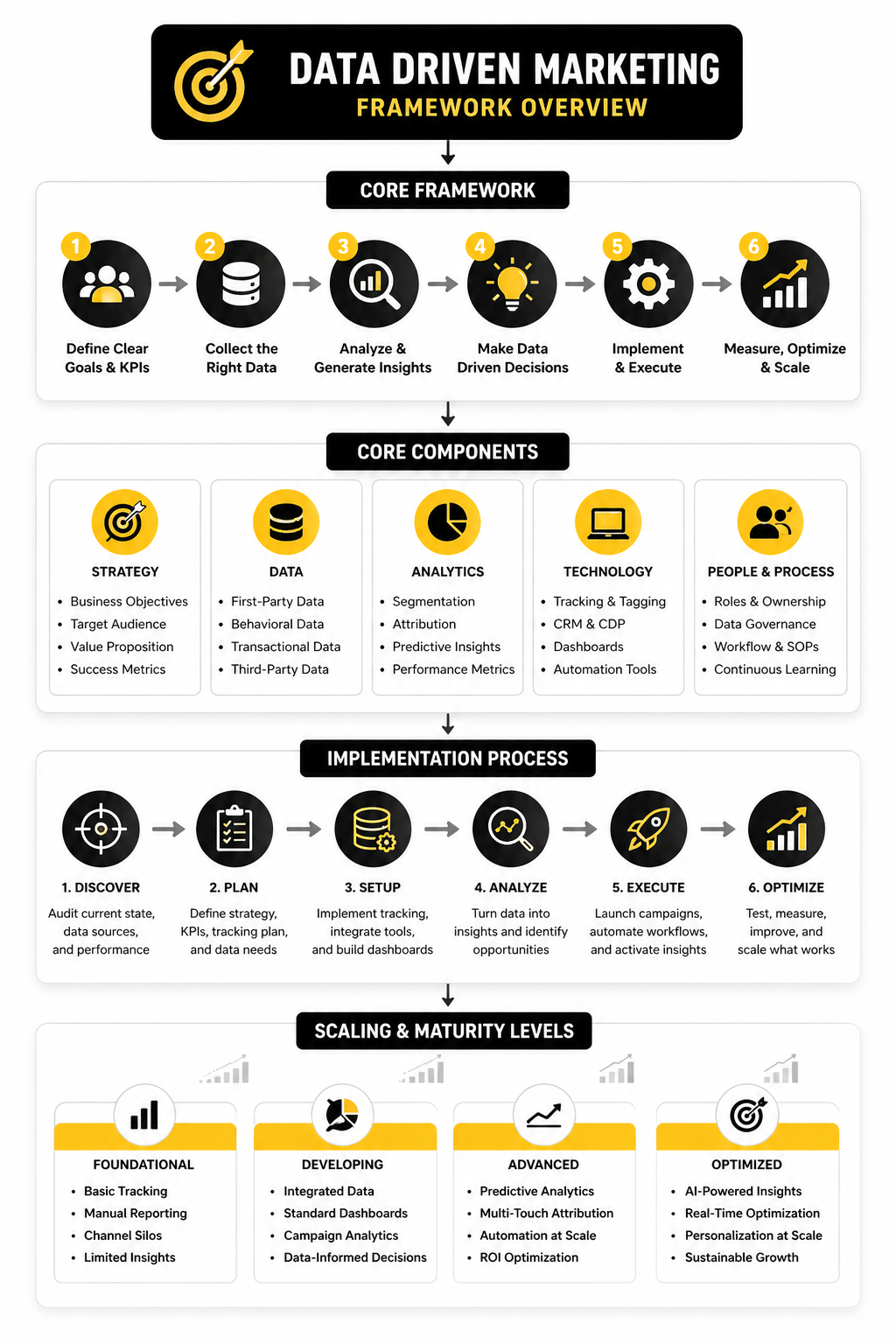
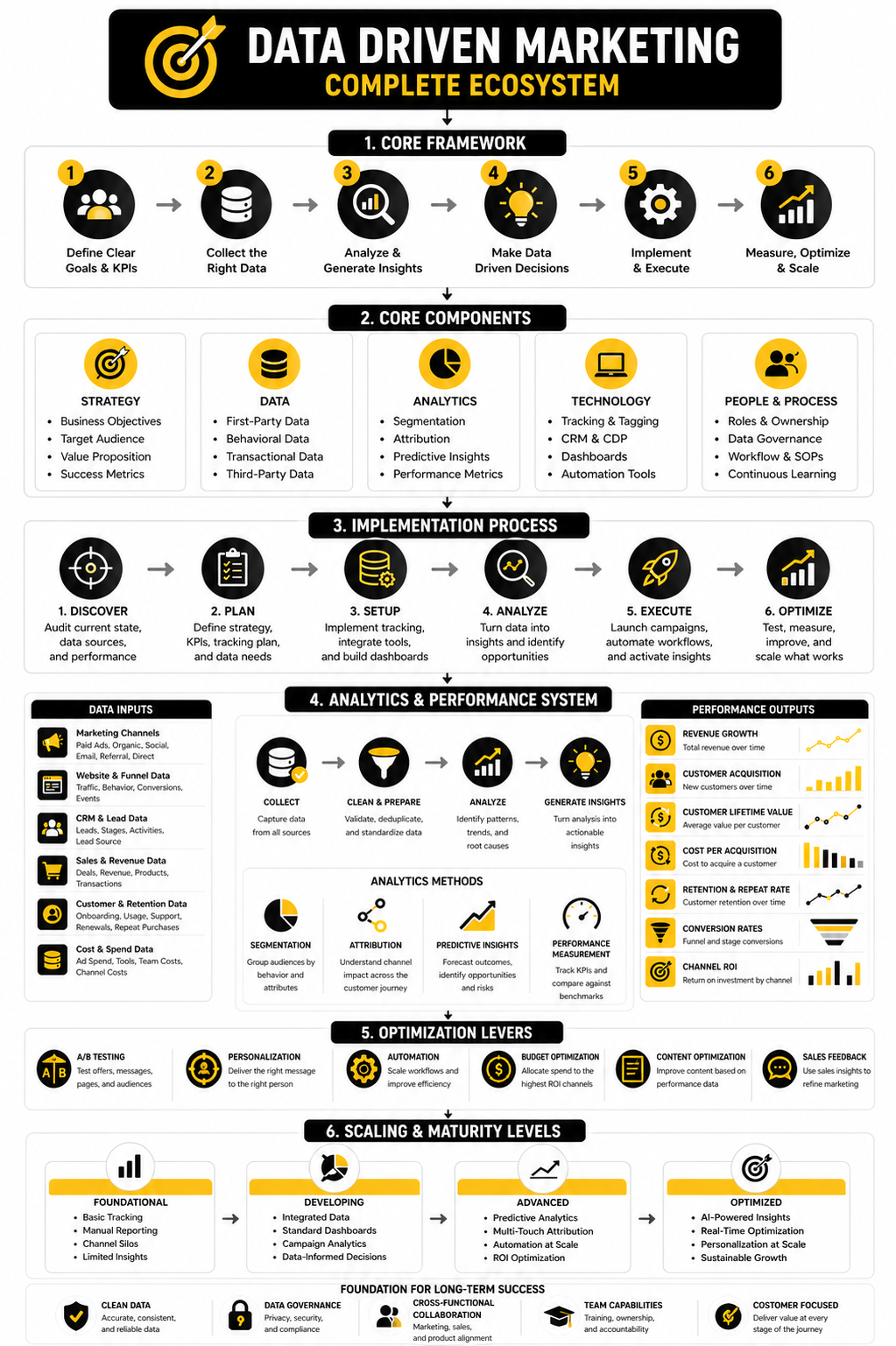
A practical data driven marketing framework has four layers: collect, connect, decide, and improve. First, the business collects useful data from owned channels, paid campaigns, CRM activity, web analytics, ecommerce behavior, surveys, and customer support. Then it connects that data into a view that marketers can actually use.
The decision layer is where strategy happens. This is where teams define audiences, choose offers, personalize messages, score leads, adjust budgets, and prioritize experiments. Tools can help here, especially platforms that combine CRM, automation, funnels, and AI workflows, such as GoHighLevel AI, but the tool is never the strategy by itself.
The improvement layer is the part many teams skip. They launch campaigns, read surface-level metrics, and move on too quickly. A serious data driven marketing system keeps learning from every campaign, so each email, ad, landing page, funnel, and follow-up sequence makes the next decision stronger.
Core Components of a Strong Data Strategy
A strong data driven marketing strategy starts with the right data, not the most data. This is where many teams make the first mistake. They track everything they can, but they do not separate useful signals from noise.
The core job is to collect data that helps you make decisions about audience, offer, message, timing, channel, and revenue. That usually means combining first-party customer data, campaign performance data, website behavior, sales activity, and retention data. Salesforce’s marketing research shows that 84% of marketers use first-party data, but only 31% are fully satisfied with their ability to unify customer data, which tells you where the real problem usually sits: Salesforce marketing statistics.
First-Party Data
First-party data is the information people give you directly or create through their interactions with your business. It includes email signups, purchase history, CRM records, product usage, survey answers, booked calls, form submissions, support tickets, and owned website behavior. This data is valuable because it comes from your own relationship with the customer.
That does not mean you should collect it carelessly. Privacy expectations are higher, and people are more aware of how their data gets used. Forrester’s 2025 privacy research highlights that consumers are increasingly privacy-aware and cautious about AI-driven use of personal information: Forrester privacy insights.
The practical move is simple. Ask for data when it improves the experience, explain why you need it, and use it in ways that feel helpful rather than creepy. A quiz, booking form, chatbot, or preference center can all work well when the exchange is clear, especially with tools like Fillout for forms or ManyChat for conversational capture.
Customer Identity and Data Unification
Data driven marketing breaks down fast when the same person looks like five different people across five different tools. Someone may click an ad, read a landing page, join an email list, book a call, and later buy through a sales rep. If those actions sit in separate systems, your team sees fragments instead of a customer journey.
Customer identity is the process of tying those interactions together responsibly. It helps marketing understand which channels create qualified demand, which messages influence conversion, and which customers are most likely to buy again. Without this layer, attribution becomes guesswork with dashboards attached.
This is why CRM and automation systems matter. A platform like GoHighLevel can be useful for agencies and service businesses that want CRM, pipelines, messaging, forms, calendars, automation, and reporting in one operating system. The important part is not having a shiny dashboard; it is having a reliable place where customer activity turns into action.
Segmentation
Segmentation is where raw data starts becoming useful. Instead of treating every visitor, lead, subscriber, and customer the same, you group people based on behavior, intent, value, stage, or need. That lets you send better messages without pretending every customer is identical.
Good segmentation does not need to be complicated at the start. You can segment by lead source, product interest, purchase status, engagement level, lifecycle stage, company size, average order value, or booked-call status. The point is to make marketing more relevant, not to create fifty audience groups nobody can manage.
McKinsey’s work on personalized marketing shows how segmentation and personalization can improve commercial performance when businesses use customer data responsibly and practically: McKinsey personalization research. This is where data driven marketing becomes very real. The right message to the right segment at the right moment usually beats a generic blast to everyone.
Measurement and Attribution
Measurement tells you what happened. Attribution tries to explain what contributed to the outcome. You need both, but you should not confuse either one with perfect truth.
A clean measurement system tracks the basics first: traffic, conversion rate, cost per lead, cost per acquisition, revenue, retention, lifetime value, and payback period. Then it adds context, such as channel mix, campaign objective, audience quality, and sales cycle length. This helps the team avoid celebrating cheap leads that never buy or killing campaigns that influence revenue indirectly.
Attribution is useful when it is treated as a decision aid, not a religion. Last-click attribution can undervalue awareness and education. Multi-touch attribution can look precise while still being incomplete. The smarter approach is to combine platform data, CRM data, sales feedback, incrementality thinking, and common sense.
Testing and Experimentation
Testing is the engine of data driven marketing. Without experimentation, data becomes a reporting habit instead of a growth system. You look at charts, talk about performance, and still keep doing the same things.
Good testing starts with a business question. Will a clearer offer improve landing page conversion? Will a shorter form increase qualified leads or just bring in low-quality volume? Will a different onboarding email reduce churn? Each test should connect to a decision the team is ready to make.
The best teams also protect tests from random chaos. They define the hypothesis, choose the metric, set a reasonable time window, and avoid changing five things at once. This is not glamorous, but it works because it turns marketing from opinion battles into controlled learning.
Data Quality
Bad data makes confident teams wrong faster. Duplicate contacts, missing source fields, broken tracking, inconsistent naming, bot traffic, offline sales gaps, and messy CRM stages can all distort decisions. The danger is not just inaccurate reporting; it is making budget and strategy decisions based on a false picture.
Data quality needs ownership. Someone has to define naming conventions, required fields, lifecycle stages, UTM rules, dashboard logic, and cleanup routines. If nobody owns it, the system will decay.
This is especially important as AI enters more marketing workflows. IAB’s 2025 State of Data work highlights how AI is becoming more central to media planning, activation, analytics, and optimization: IAB State of Data 2025. AI can help you move faster, but it will not magically fix weak inputs. In data driven marketing, cleaner inputs almost always create better outputs.
Professional Implementation Across Channels
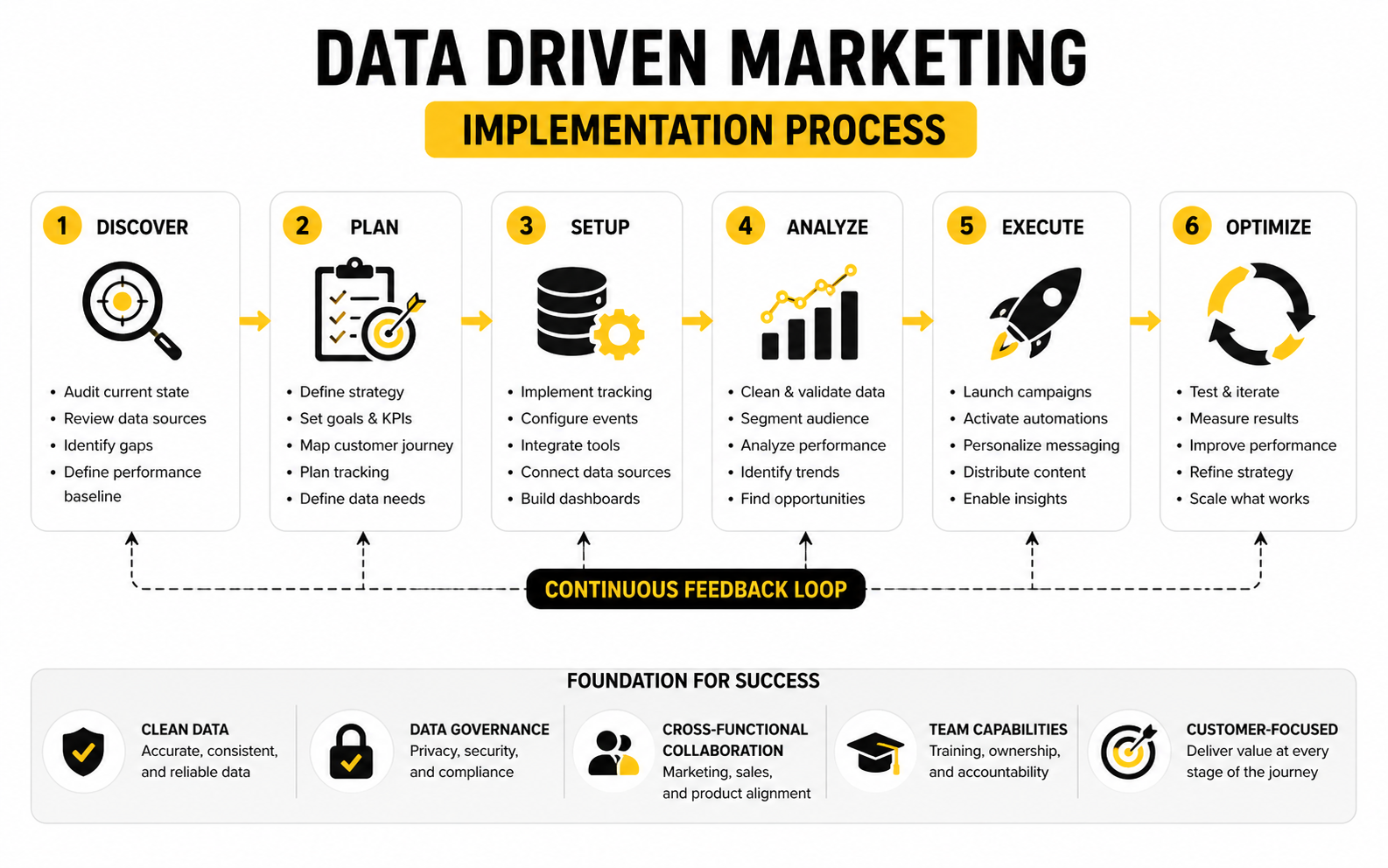
Implementation is where data driven marketing stops being a concept and becomes a working system. This is also where teams usually discover the uncomfortable truth: the strategy was not the hard part. The hard part is getting clean tracking, clear ownership, useful workflows, and consistent execution across every channel.
Start with the customer journey, not the tool stack. A business needs to know how people move from first touch to qualified lead, from qualified lead to buyer, and from buyer to repeat customer. Once that journey is clear, the team can decide what needs to be tracked, where automation should help, and which decisions should stay human.
Step 1: Map the Customer Journey
The first step is to map the real buying journey in plain language. Do not start with dashboards, attribution models, or complicated naming systems. Start by writing down how someone becomes aware of the business, what makes them interested, what they need before they trust you, and what finally pushes them to act.
This map should include every major touchpoint that influences the decision. That might include paid ads, organic search, social content, email, landing pages, sales calls, checkout pages, onboarding, support, and retention campaigns. Nielsen’s 2025 marketing research keeps pointing toward the same pressure: marketers need clearer measurement across fragmented customer journeys, not more disconnected channel reports: Nielsen 2025 Annual Marketing Report.
Once the journey is mapped, data driven marketing becomes easier to implement because every metric has a purpose. You are not tracking page views just because the analytics tool offers them. You are tracking the moments that help you understand whether people are moving closer to revenue.
Step 2: Define the Metrics That Actually Matter
The second step is choosing metrics that connect to business outcomes. This sounds obvious, but many teams still optimize for numbers that look good in reports and do very little for growth. Clicks, impressions, open rates, and likes can be useful, but they should not become the scoreboard by themselves.
A better measurement plan separates activity metrics from outcome metrics. Activity metrics show whether people are engaging. Outcome metrics show whether the business is getting closer to revenue, retention, and profit.
For most teams, the practical metric stack looks like this:
- Traffic quality by channel
- Landing page conversion rate
- Lead-to-qualified-lead rate
- Cost per qualified lead
- Sales conversion rate
- Customer acquisition cost
- Average order value or contract value
- Payback period
- Customer lifetime value
- Retention or repeat purchase rate
This is where discipline matters. If a metric does not help you make a decision, remove it from the main dashboard. Data driven marketing should simplify decision-making, not bury the team under decorative reporting.
Step 3: Build the Tracking Foundation
After the journey and metrics are clear, the tracking foundation comes next. This includes analytics setup, conversion events, CRM fields, UTM standards, lead source rules, form tracking, call tracking, checkout tracking, and campaign naming conventions. Boring? Yes. Essential? Absolutely.
The goal is to make sure every important action can be connected back to a source, segment, campaign, and customer stage. If someone books a call after clicking an ad, the sales team should know which campaign brought them in. If that person becomes a customer, marketing should be able to see which touchpoints helped create the opportunity.
For service businesses, agencies, and local businesses, an all-in-one CRM and automation platform like GoHighLevel can make this easier because forms, calendars, messaging, pipelines, and follow-up automation can live closer together. For funnel-heavy businesses, ClickFunnels can be a fit when the priority is building and testing conversion paths quickly. The best choice depends on the business model, but the principle is the same: tracking must support action.
Step 4: Connect Channels to One Operating Rhythm
Data driven marketing works best when channels are connected by one operating rhythm. Paid media should not live in one world, email in another, sales in another, and reporting somewhere else. Each channel should feed the next decision.
That means paid campaigns should inform landing page tests. Landing page behavior should inform email segmentation. Email engagement should inform sales prioritization. Sales objections should inform ad creative, content, and funnel messaging.
This is where practical automation helps. Email platforms like Brevo or Moosend can support lifecycle campaigns, while social scheduling tools like Buffer can help keep content execution consistent. None of these tools replace strategy, but they can keep the machine moving once the strategy is clear.
Step 5: Create Feedback Loops Between Marketing and Sales
A marketing dashboard is incomplete if it does not include sales reality. Leads are not equal just because they filled out the same form. Some leads are ready to buy, some are researching, and some are simply not a fit.
The sales team should regularly feed back which campaigns bring serious buyers, which messages create confusion, and which objections keep showing up. That information is gold. It turns campaign data into market intelligence.
This feedback loop can be simple. Review source quality weekly, update CRM stages consistently, tag common objections, and compare campaign promises with sales-call reality. Data driven marketing gets much stronger when sales feedback is not treated as anecdotal noise but as another layer of decision data.
Step 6: Turn Insights Into Campaign Changes
The final implementation step is the one that separates serious teams from dashboard collectors. Insights must turn into changes. If the data shows that one segment converts better, that should influence budget, messaging, and follow-up.
This does not mean changing campaigns randomly every day. It means setting a rhythm for decisions. Weekly reviews can handle tactical changes, monthly reviews can handle channel and offer decisions, and quarterly reviews can handle positioning, budget allocation, and strategic bets.
IAB’s 2025 State of Data report describes AI as increasingly important across planning, activation, analytics, and optimization, but the same basic rule still applies: tools only matter when they improve decisions and execution: IAB State of Data 2025. Data driven marketing is not about admiring reports. It is about making the next campaign sharper than the last one.
Statistics and Data
The point of statistics in data driven marketing is not to decorate the article with impressive numbers. The point is to know which numbers deserve attention, what they reveal, and what decision they should trigger. A metric is only useful when it changes what you do next.
This is why strong teams separate measurement into three levels: channel performance, customer movement, and business impact. Channel performance tells you whether a campaign is getting attention. Customer movement tells you whether that attention is becoming intent. Business impact tells you whether the whole system is producing revenue, retention, and profit.
What Marketing Analytics Should Actually Measure
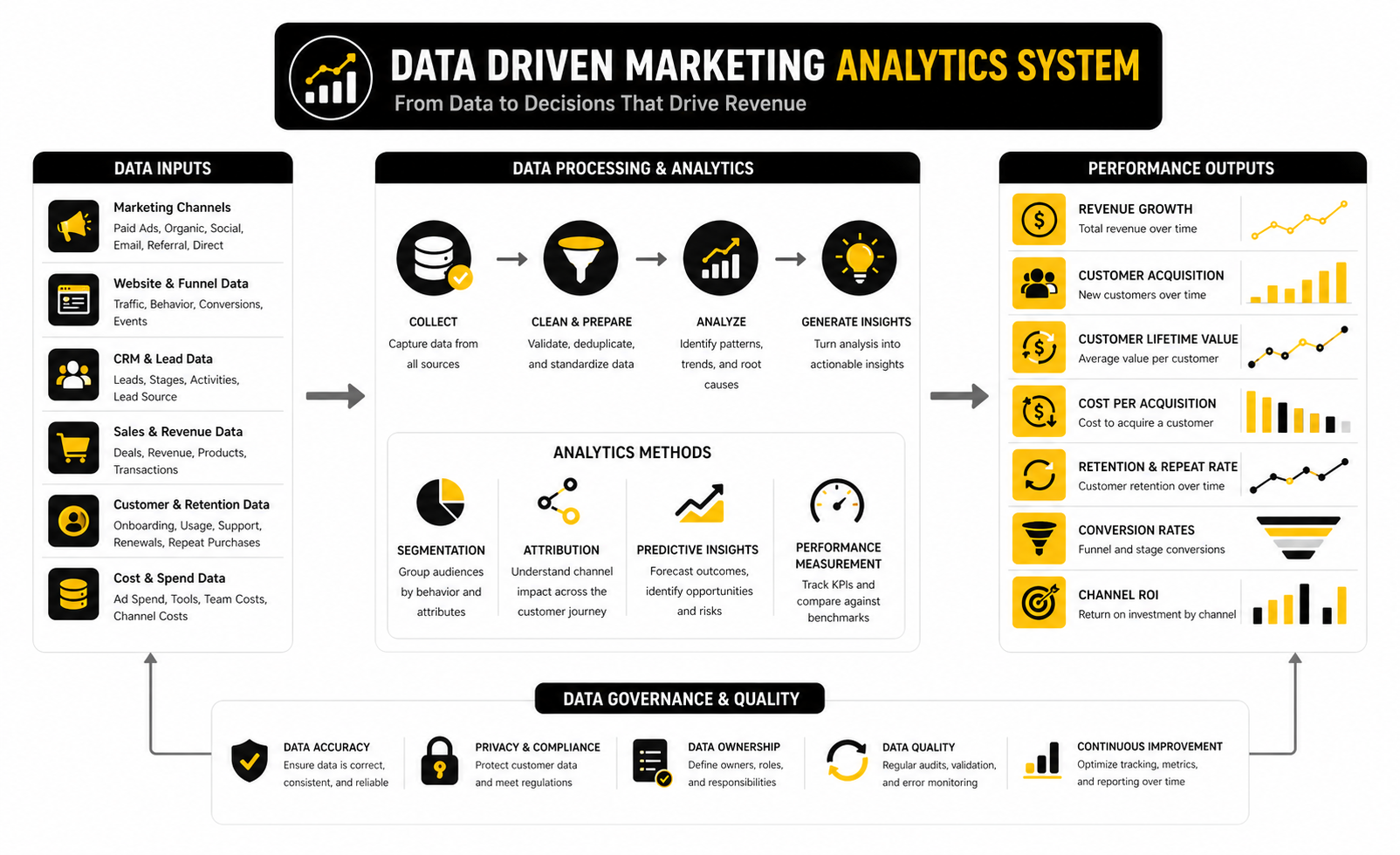
Marketing analytics should start with the buyer journey, not with whatever the dashboard shows first. If someone sees an ad, visits a page, downloads a guide, joins an email sequence, books a call, and later becomes a customer, each step should tell you something different. The goal is not to give every touchpoint perfect credit; the goal is to understand what is helping people move forward.
A practical analytics system should answer five questions:
- Where are qualified people coming from?
- Which messages create real intent?
- Which landing pages or funnels turn attention into action?
- Which leads become customers?
- Which customers stay, buy again, or become more valuable over time?
This matters because marketing teams are under pressure to prove business results, not just engagement. Nielsen’s 2025 marketing research focuses on using data to create clarity across fragmented channels, especially as marketers balance brand building, performance, shoppable media, and AI-driven change: Nielsen 2025 Annual Marketing Report.
Benchmarks Are Starting Points, Not Targets
Benchmarks can be useful, but they are dangerous when teams treat them like universal truth. A 3% conversion rate might be excellent for a high-ticket B2B offer and weak for a low-friction ecommerce lead magnet. A low cost per lead can look great until sales confirms that the leads are unqualified.
The smarter way to use benchmarks is to compare them against your own funnel stage, offer type, channel, audience temperature, and sales cycle. Cold traffic should not be judged the same way as branded search. A webinar registration should not be judged the same way as a demo request.
Use benchmarks to spot obvious problems, then use your own data to make decisions. If your landing page conversion rate is far below similar campaigns, test the offer, page clarity, proof, and form friction. If your lead volume is strong but revenue is weak, stop celebrating lead cost and investigate qualification, follow-up speed, sales handoff, and audience targeting.
The Numbers That Matter Most
A clean data driven marketing dashboard should focus on a small group of numbers that show whether the business is improving. Too many dashboards become performance theater. They are full of charts, but nobody knows what should change after the meeting.
For most businesses, the highest-value numbers are:
- Cost per qualified lead
- Lead-to-customer conversion rate
- Customer acquisition cost
- Revenue by channel
- Payback period
- Customer lifetime value
- Retention rate
- Repeat purchase rate
- Average order value or average contract value
- Marketing-sourced pipeline or revenue
These metrics force better conversations. Instead of asking, “Did the campaign get clicks?” the team asks, “Did this campaign attract people who were likely to buy?” That shift is everything.
Attribution Needs Context
Attribution helps you understand which touchpoints contributed to a result, but it should never be treated as a perfect scoreboard. Last-click attribution often overvalues bottom-of-funnel channels because they are closest to the sale. First-click attribution can overvalue discovery channels and ignore the nurturing work that happened later.
Multi-touch attribution gives a broader view, but it still depends on tracking quality, channel visibility, cookie limitations, CRM hygiene, and offline data. That is why serious marketing teams use attribution as one input, not the final answer. It should be combined with customer research, sales feedback, incrementality testing, and profitability analysis.
This is especially important in 2025 because AI is changing how campaigns are planned, optimized, and measured. IAB’s State of Data 2025 highlights AI’s growing role across media planning, activation, analytics, optimization, and performance measurement: IAB State of Data 2025. That creates more speed, but it also increases the need for clean definitions, trustworthy data, and human judgment.
Signal Quality Beats Data Volume
More data does not automatically mean better marketing. In many teams, more data simply creates more confusion. The real advantage comes from signal quality: data that is accurate, relevant, timely, and tied to decisions.
A high-quality signal might be a returning visitor viewing pricing twice. It might be a lead replying to an email with a buying question. It might be a customer using a product feature that strongly predicts retention. These signals are more useful than vanity metrics because they tell the team where attention is turning into intent.
This is where tools should support the operating system. A CRM like GoHighLevel can help connect lead source, pipeline stage, follow-up, and revenue for service-based businesses. A funnel platform like ClickFunnels can help test conversion paths. The tool is useful only when it makes the next decision clearer.
What Performance Signals Should Trigger
Data driven marketing becomes powerful when the team agrees in advance what different signals mean. If conversion rate drops, what happens? If cost per qualified lead rises, who investigates it? If email engagement falls, does the team test segmentation, subject lines, offer relevance, or list quality?
Here is a practical way to interpret common signals:
- Rising traffic with flat conversions usually points to audience quality, offer clarity, or landing page friction.
- Lower cost per lead with lower sales quality usually points to weak targeting or a lead magnet that attracts the wrong people.
- Strong email opens with weak clicks usually points to curiosity without enough offer relevance.
- Strong clicks with weak conversions usually points to page mismatch, weak proof, unclear CTA, or form friction.
- High demo bookings with low close rate usually points to qualification problems, expectation mismatch, or sales process issues.
- Strong acquisition with weak retention usually points to onboarding, product fit, customer success, or promise mismatch.
The important part is not just noticing these signals. The important part is acting on them with discipline. One signal should lead to one investigation, one hypothesis, and one controlled improvement.
Reporting Should Drive Decisions
A good report is not a museum of metrics. It is a decision document. It should show what changed, why it likely changed, what the team recommends, and what will happen next.
This is why weekly reports should stay tactical. They should focus on campaign movement, pipeline quality, conversion issues, and short-term fixes. Monthly reports should look at trends, channel mix, budget efficiency, and offer performance. Quarterly reports should look at bigger strategic questions like positioning, customer economics, retention, and market shifts.
Salesforce’s marketing data shows that 88% of marketers use analytics or measurement tools, while only 31% are fully satisfied with their data unification ability: Salesforce marketing statistics. That gap is the real warning. Most teams do not need more charts; they need cleaner connections between data, decisions, and execution.
Measurement, Optimization, and AI
The next layer of data driven marketing is where the system starts to scale. Once the basics are working, the team has to decide how far to automate, how much to personalize, and where human judgment still matters. This is where advanced marketing becomes less about collecting data and more about making smart tradeoffs.
The temptation is to chase every new tool, every new AI workflow, and every new dashboard feature. Don’t. The better move is to ask a harder question: which parts of the marketing system become more profitable, more consistent, or more useful when data and automation are applied?
Personalization Has to Earn Trust
Personalization works when it feels relevant. It fails when it feels invasive. That difference matters because customers are more aware of data use, privacy tradeoffs, and AI-powered targeting than they were a few years ago.
A useful personalization strategy starts with clear customer intent. Someone who downloaded a pricing guide, abandoned a checkout page, or booked a consultation has given you a stronger signal than someone who casually liked a post. Data driven marketing should respond to those signals with helpful next steps, not aggressive follow-up that makes the buyer uncomfortable.
This is why zero-party and first-party data are becoming more important. Supermetrics’ 2025 marketing data research shows that 87% of organizations prioritize first-party data, while only 16% prioritize zero-party data: Supermetrics 2025 marketing data report. That gap is an opportunity. When customers directly tell you their goals, preferences, or challenges, your marketing can become more relevant without relying only on inferred behavior.
AI Should Improve Decisions, Not Replace Strategy
AI is now part of the marketing stack, but it should not be treated like a magic growth lever. It can help with audience research, content production, campaign analysis, lead scoring, testing ideas, reporting summaries, and customer support. But if the data is messy or the offer is weak, AI just helps you move faster in the wrong direction.
McKinsey’s 2025 global AI research points to the same reality: companies seeing stronger value from AI tend to have clearer strategy, operating models, technology, data foundations, adoption practices, and human validation processes: McKinsey State of AI 2025. That is the part many teams miss. AI performance is not only a software issue; it is an operating system issue.
In practical terms, use AI where speed and pattern recognition matter. Let it summarize campaign performance, identify segments worth testing, draft message variations, or surface common objections from calls and support tickets. Keep humans responsible for positioning, claims, ethics, brand judgment, final creative direction, and decisions that affect customer trust.
Predictive Signals Need Human Review
Predictive marketing can be powerful, especially when a business has enough clean historical data. It can help estimate which leads are likely to convert, which customers may churn, which accounts deserve sales attention, and which offers should be shown next. But prediction is not the same as certainty.
A predictive model may find patterns that are statistically useful but strategically misleading. It may overvalue past behavior and miss changes in the market. It may also reflect bias in the data, especially if old sales processes favored certain customer types or ignored others.
So the right approach is not blind trust. Treat predictive scores as a prioritization layer, then review the outcomes. If high-scoring leads do not close, fix the model, the data, or the qualification logic. If low-scoring segments start converting because the market changed, update your assumptions quickly.
Privacy Is a Growth Strategy
Privacy is not just a legal checkbox. It is part of brand trust. If people feel that a business uses their information carelessly, personalization starts to feel like surveillance.
Privacy-first data driven marketing means collecting only what you can justify, explaining the value exchange clearly, and giving people reasonable control over their preferences. It also means keeping data secure, limiting access, and avoiding sloppy third-party tracking that can create reputational risk. Deloitte’s 2025 marketing trends highlight first-party data as a way to turn privacy pressure into stronger customer trust and loyalty: Deloitte Digital 2025 marketing trends.
This is not soft advice. It affects performance. When customers trust the brand, they are more likely to share accurate information, respond to relevant offers, and stay in the relationship longer. That makes privacy a revenue issue, not just a compliance issue.
Scaling Requires Governance
Small teams can often manage data driven marketing with a few tools, a shared dashboard, and weekly discipline. Scaling is different. As more channels, campaigns, team members, and automations get added, the system can become fragile fast.
Governance keeps the machine from turning into chaos. It defines who owns campaign naming, data quality, CRM stages, dashboard logic, consent rules, AI usage, testing priorities, and reporting standards. Without governance, every team creates its own version of the truth.
This is where a simple ruleset helps:
- Use one naming convention for campaigns and sources.
- Define required CRM fields before campaigns launch.
- Document what counts as a qualified lead.
- Review automation workflows before scaling spend.
- Keep reporting definitions consistent across teams.
- Audit data quality monthly.
- Decide which AI outputs need human approval.
This may sound operational, but it is strategic. The bigger the business gets, the more growth depends on consistency. A data system that cannot be trusted cannot be scaled.
The Tradeoff Between Speed and Accuracy
Every marketing team wants faster answers. The problem is that faster reporting can create false confidence when the data is incomplete. Early campaign numbers can be useful, but they are often not enough to judge revenue quality, retention, or payback.
This creates a real tradeoff. If you wait too long, you waste budget on campaigns that should have been adjusted earlier. If you move too fast, you kill campaigns before the sales cycle has enough time to mature.
The answer is to match the decision to the maturity of the signal. Creative fatigue, click-through rate, and landing page issues may show up quickly. Lead quality, close rate, retention, and lifetime value need more time. Data driven marketing gets better when teams stop forcing every decision into the same time window.
Advanced Teams Measure Incrementality
At some point, attribution is not enough. A campaign may appear to drive conversions because it captures demand that already existed. Another campaign may look weak in last-click reporting but actually creates new demand that closes later.
Incrementality asks the better question: what happened because of this marketing activity that would not have happened otherwise? That can involve holdout groups, geo tests, lift studies, matched market tests, or controlled experiments. It is not always easy, but it gives a cleaner read on true business impact.
This matters most when budgets get larger. Small attribution errors can become expensive at scale. If data driven marketing is going to guide major budget decisions, the team needs to know whether marketing is creating growth or simply taking credit for conversions that were already likely to happen.
Tool Choice Should Follow the Operating Model
A tool stack should support how the business actually sells. An ecommerce brand, a B2B SaaS company, a local service business, and a creator-led education business do not need the same setup. The right stack depends on funnel complexity, sales cycle, data volume, team size, and the kind of decisions the business needs to make.
For example, a service business that needs lead capture, SMS, email, booking, pipelines, reviews, and automation in one place may benefit from GoHighLevel. A business focused on fast funnel creation and offer testing may prefer ClickFunnels. A lean digital business that wants simple funnels, email, and automation in one platform may look at Systeme.io.
The mistake is choosing tools before defining the operating model. Decide how leads will be captured, qualified, nurtured, sold, onboarded, and retained. Then choose the tools that make that process easier to run, easier to measure, and easier to improve.
Common Mistakes, Best Practices, and FAQs
The final layer of data driven marketing is learning how to keep the system useful over time. A team can build clean tracking, connect the right tools, and create strong dashboards, but the work does not stop there. Markets change, channels change, privacy rules change, AI tools change, and customer expectations change.
That means your marketing system needs maintenance. Review the data, challenge assumptions, clean the CRM, audit automations, compare attribution against sales reality, and keep asking whether the numbers are helping you make better decisions. If the data does not lead to action, it is just decoration.
Common Mistakes to Avoid
The biggest mistake is treating data driven marketing as a software purchase. A tool can help you collect, organize, and act on information, but it cannot fix a weak offer, unclear positioning, poor follow-up, or messy internal ownership. Strategy comes first, then systems, then tools.
Another common mistake is optimizing too narrowly. If you only optimize for cheaper leads, you may attract people who never buy. If you only optimize for last-click revenue, you may underfund the channels that create demand before buyers are ready.
The third mistake is moving too fast without enough context. Early data can show directional signals, but it may not reveal customer quality, retention, or lifetime value. Strong teams know when to act quickly and when to let the data mature.
Best Practices for Long-Term Success
Start with a simple system that people can actually use. Define the customer journey, choose a few meaningful metrics, keep source tracking clean, and create a regular reporting rhythm. Complexity can come later, but clarity has to come first.
Build around first-party data because it gives you a stronger foundation for personalization, privacy, and customer trust. Deloitte’s 2025 marketing trends frame first-party data as a way to turn privacy pressure into stronger customer loyalty: Deloitte Digital 2025 marketing trends. That is the right mindset.
Use AI carefully and practically. McKinsey’s 2025 AI research shows that value from AI depends on more than adoption; it depends on strategy, operating model, data foundations, adoption, and human oversight: McKinsey State of AI 2025. In plain English: AI is powerful, but it still needs a grown-up system around it.
FAQ - Built for Complete Guide
What is data driven marketing?
Data driven marketing is the practice of using customer, campaign, sales, and revenue data to guide marketing decisions. It helps teams understand what is working, what is wasting budget, and where the next improvement should happen. The goal is not to remove creativity, but to make creative and strategic decisions more precise.
Why is data driven marketing important?
It is important because modern customer journeys are fragmented across search, social, email, ads, websites, sales calls, and retention channels. Without data, teams often make decisions based on opinions or isolated channel metrics. With the right data, marketers can connect activity to actual business outcomes.
What data should marketers collect first?
Start with data that helps you make real decisions. That usually includes traffic source, lead source, conversion events, CRM stage, customer value, campaign cost, and revenue. Avoid collecting unnecessary personal data just because a tool allows it.
What is the difference between first-party and third-party data?
First-party data comes directly from your own audience, leads, customers, website, CRM, and owned channels. Third-party data is collected by outside providers and sold or shared across platforms. First-party data is becoming more important because privacy expectations, platform restrictions, and signal loss have made rented data less reliable.
How does AI fit into data driven marketing?
AI can help analyze patterns, summarize reports, generate campaign variations, personalize messaging, score leads, and support customer conversations. It works best when the business already has clean data and a clear strategy. If the inputs are messy, AI can simply make bad decisions faster.
What are the most important marketing metrics?
The most important metrics are the ones tied to revenue and customer quality. These often include cost per qualified lead, conversion rate, customer acquisition cost, revenue by channel, payback period, lifetime value, retention rate, and repeat purchase rate. Vanity metrics can still provide context, but they should not drive the main strategy.
How do you know if your data is reliable?
Reliable data is consistent, complete, and connected to the customer journey. If lead sources are missing, CRM stages are unclear, tracking is broken, or dashboards disagree with sales reality, the data needs work. A monthly data quality audit can prevent small issues from turning into expensive decisions.
What tools are useful for data driven marketing?
The right tools depend on the business model. A service business may need CRM, automation, forms, calendars, pipelines, and messaging in one place through a platform like GoHighLevel. A funnel-focused business may prefer ClickFunnels, while a lean digital business may choose Systeme.io.
How often should marketing reports be reviewed?
Weekly reviews should focus on tactical campaign performance, funnel issues, and immediate blockers. Monthly reviews should look at channel trends, budget efficiency, lead quality, and offer performance. Quarterly reviews should focus on bigger strategy, customer economics, retention, positioning, and long-term growth.
What is the biggest risk in data driven marketing?
The biggest risk is false confidence. A dashboard can look professional while the underlying data is incomplete, biased, or disconnected from revenue. That is why data should always be checked against sales feedback, customer research, profitability, and common sense.
How can small businesses start with data driven marketing?
Small businesses should start with a simple setup. Track where leads come from, what actions they take, how many become customers, and which campaigns produce profitable revenue. You do not need an enterprise data stack to make better decisions; you need clean basics and a consistent review rhythm.
Is data driven marketing only for paid ads?
No. Data driven marketing applies to email, SEO, content, social media, funnels, sales follow-up, customer retention, and product marketing. Paid ads often make the need for measurement more urgent because money is being spent directly. But every marketing channel improves when decisions are based on useful evidence.
How does privacy affect data driven marketing?
Privacy changes how marketers collect, store, and use customer information. The best approach is to collect data transparently, explain the value exchange, protect customer information, and avoid unnecessary tracking. Privacy-first marketing is not just safer; it can also build stronger trust.
What should a data driven marketing strategy include?
A strong strategy should include customer journey mapping, data collection rules, segmentation, measurement, attribution, testing, reporting, and optimization. It should also define who owns data quality and who decides what changes after each review. Without ownership, even good systems slowly fall apart.
What is the fastest way to improve data driven marketing?
The fastest improvement usually comes from cleaning the basics. Fix source tracking, define qualified leads, connect CRM data to campaign performance, and remove vanity metrics from the main dashboard. Once the team can trust the data, every decision gets easier.
Work With Professionals
Explore 10K+ Remote Marketing Contracts on MarkeWork.com
Most marketers spend too much time chasing clients, competing on crowded platforms, and losing a percentage of every project to middlemen.
MarkeWork gives you a better way. Browse thousands of remote marketing contracts and connect directly with companies desperate to hire skilled marketers like you, without platform commissions and without unnecessary gatekeepers.
If you're serious about finding better opportunities and keeping 100% of what you earn, explore available contracts and create a profile for free at MarkeWork.com.