

Dental marketing used to be simpler. A practice could rely on location, referrals, insurance participation, and the occasional mailer, then expect a reasonably steady flow of patients. That still matters, but it is no longer enough when people compare providers through search, reviews, maps, and increasingly detailed online research before they ever call the front desk.
That shift matters because the demand side is still enormous. Dental care in the United States represents about $136 billion in annual spending, while untreated oral disease is tied to nearly $46 billion in lost productivity, which tells you two things at once: oral health is important, and many patients still delay or struggle to access care. At the same time, access is uneven, with nearly 58 million people living in dental health professional shortage areas, so the practices that communicate clearly, show up consistently, and remove friction from the patient journey gain a real advantage.
The attention battle is also more fragmented than many owners realize. In BrightLocal’s latest survey, 97% of consumers said they read reviews for local businesses, the average consumer used six different review sites, and Google was no longer the only meaningful discovery layer because people were also using AI tools and healthcare-specific platforms. In healthcare, that behavior is even sharper: Press Ganey notes that 59% of consumers rely on online search to find healthcare providers, while Healthgrades reports that 76% of people say a positive online reputation influences their choice of doctor.
The practical takeaway is simple. Dental marketing is no longer a side project for slow weeks. It is the operating system that connects demand, trust, visibility, patient experience, and production.
Article Outline
- Why Dental Marketing Matters Now
- The Dental Marketing Framework
- Local Search and Practice Visibility
- Reviews, Reputation, and Social Proof
- Patient Conversion Systems That Fill the Schedule
- Professional Implementation and Measurement

Why Dental Marketing Matters Now
The biggest mistake practices make is treating marketing as promotion instead of patient access. When people need a new dentist, they usually are not looking for clever branding first. They are looking for confidence, convenience, proof, and a reason to believe your practice will solve their problem without wasting their time.
That is exactly why visibility and trust now work together. Google’s own guidance continues to emphasize useful, satisfying, non-commodity content, while Google Business Profile guidance makes it clear that complete, well-managed listings are foundational for local presence and avoiding visibility issues. In plain English, the practices that present accurate information, strong proof, and genuinely helpful content are better aligned with how modern search works.
There is also an economic reason this cannot be ignored. The ADA’s late-2025 market update described a continued fiscal squeeze from wages, supplies, and reimbursement pressure, while another ADA update showed dentist busyness slipping slightly and staffing pressure remaining elevated, especially for hygienists. When margin pressure rises, random marketing gets expensive fast. Disciplined dental marketing becomes less about “getting your name out there” and more about protecting chair time, production quality, and lifetime patient value.
The Dental Marketing Framework
A useful dental marketing framework starts with one idea: every channel should move the same patient journey forward. That journey usually begins with awareness, turns into evaluation, then becomes contact, scheduling, attendance, treatment acceptance, retention, and referral. When a practice treats those stages as separate problems, marketing gets messy and hard to measure.
A better approach is to build around four connected layers. First comes visibility, meaning your practice can actually be found in local search and map results. Second comes trust, where reviews, photos, messaging, and provider credibility reduce anxiety and answer silent objections. Third comes conversion, where the website, forms, phone handling, and scheduling process make it easy to take action. Fourth comes retention, where reminders, follow-up, education, and reactivation keep the relationship alive after the first visit.
This framework matters because modern discovery does not happen in one place. Consumers now move across multiple review platforms and increasingly use video content while researching local businesses, while healthcare buyers pay close attention to up-to-date online information before choosing a provider. So the goal is not to chase every tactic. It is to create a system where each touchpoint reinforces the next one.
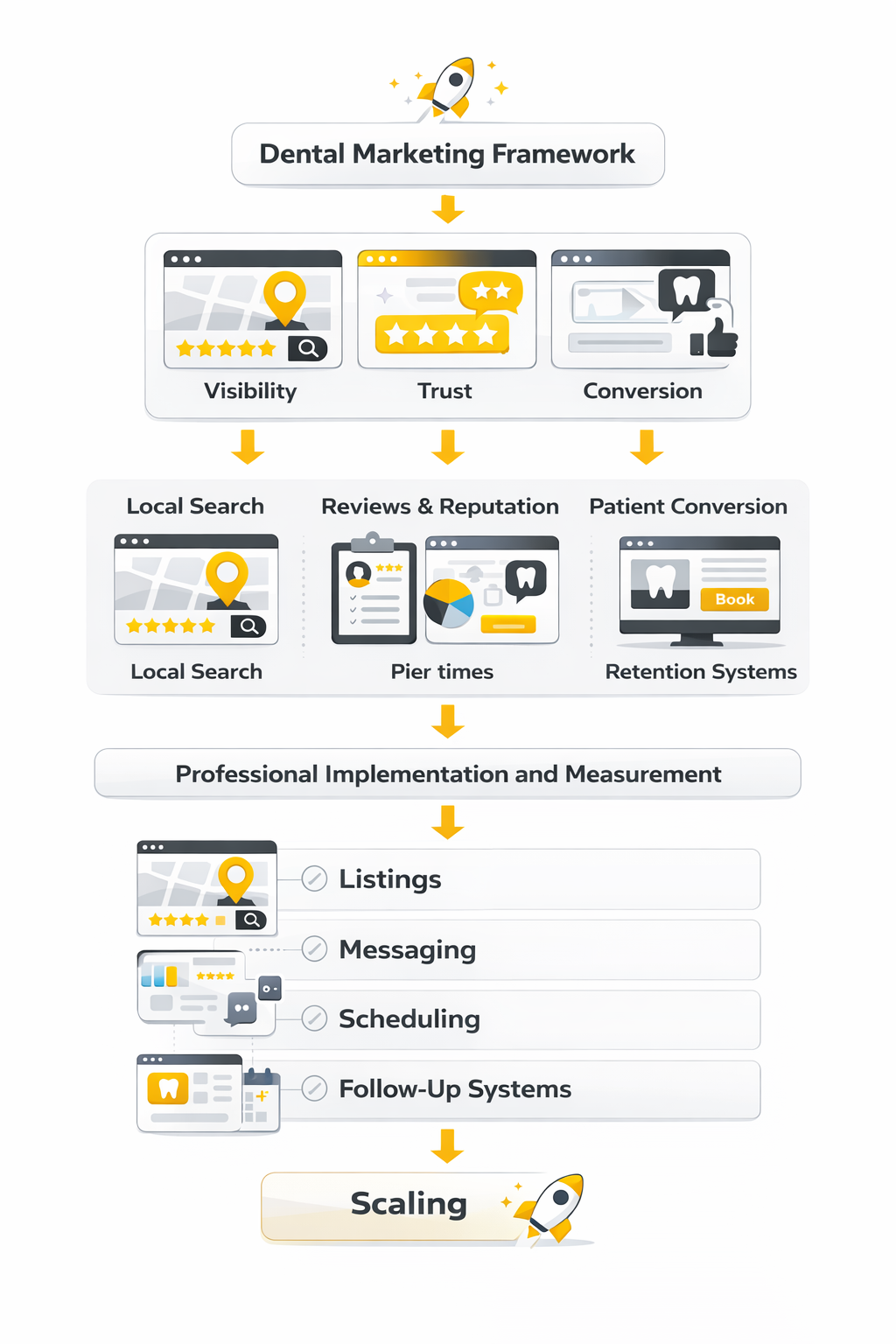
In the rest of this article, that system will be unpacked one layer at a time. We will start with how dental practices earn visibility in local search, then move into reputation, conversion, and the professional implementation details that separate scattered activity from real growth. That is where dental marketing stops feeling abstract and starts becoming a repeatable growth engine.
Local Search and Practice Visibility
If dental marketing has a front door, this is it. Before a patient reads your about page, watches a video, or compares treatment options, they usually search for a local solution and make a fast judgment based on what appears in search and maps. That means visibility is not just a traffic problem. It is a trust problem, a conversion problem, and often the difference between a full schedule and a quiet one.
The important shift is that local discovery no longer happens only in one search bar. BrightLocal’s 2025 consumer research found that local intent is spread across search engines, maps, and social platforms, with Google still leading but map-based behavior remaining significant enough that businesses cannot afford to ignore it. The same research also showed that one in five consumers conduct local searches directly within maps, which is exactly why dental marketing has to be built for map visibility, not just traditional website SEO.
Your Google Business Profile Is the Real Homepage for Many Patients
A lot of practices still think their website is the first impression. In reality, for many searches, the Google Business Profile gets there first and shapes the decision before the patient ever clicks through. That profile carries your reviews, categories, hours, photos, location details, and often the basic credibility test a patient uses to decide whether you are even worth considering.
Google is unusually direct about this. Its own guidance says businesses with complete and accurate information are more likely to show up in local search results, and it specifically highlights verification, updated hours, review responses, and photos as visibility factors that help customers understand what the business offers. For a dental office, that means profile management is not admin work pushed to the side. It is core dental marketing infrastructure.
The category choice matters more than many practice owners realize. Google states that categories help connect businesses with people searching for relevant services and that the selected categories affect local ranking. So if a practice wants to compete for discovery around high-intent treatments, the profile has to describe the business clearly and specifically rather than relying on vague or incomplete setup.
Map Visibility Wins Before Traditional SEO Finishes Loading
This is where a lot of practices lose momentum. They invest in a website redesign, publish a few blog posts, and assume the SEO box is checked, while the actual map listing is incomplete, under-reviewed, or poorly categorized. Then they wonder why nearby competitors with weaker websites keep getting the calls.
The reason is simple: map results compress decision-making. People can compare proximity, star ratings, review volume, hours, and photos in seconds, which makes local search brutally practical. BrightLocal’s research shows that maps are now a default local search destination for a meaningful share of consumers, so dental marketing needs to be engineered for that behavior instead of treating it like a side channel.
This also changes how you think about competition. You are not just competing against the practice with the best website. You are competing against the practice that looks easiest to trust right now, on the device in someone’s hand, during a moment of need. That is why local visibility is one of the highest-leverage parts of dental marketing: it influences who gets considered before the website has a chance to persuade.
Service Pages Need to Match Real Patient Intent
Once a patient clicks through, the website has to continue the same conversation the search result started. Google’s Search documentation still centers on making pages easy for search engines to understand and useful for people to navigate, while its local business structured data guidance makes clear that business details such as hours and service-related information help search systems interpret local entities and display richer results. In practice, that means a dental site should organize pages around real patient intent, not internal jargon.
That usually leads to cleaner structure. Instead of hiding everything under one generic services page, strong dental marketing gives each major service a focused page with plain-language explanations, treatment relevance, location signals, and a clear next step. A patient searching for emergency care, Invisalign, implants, cosmetic bonding, or pediatric dentistry is not looking for a broad corporate overview. They want fast confirmation that your practice handles their exact problem.
This is also where many practices overcomplicate things. They publish thin pages stuffed with city names, hoping local SEO will do the rest. It usually backfires because the content feels manufactured. Better pages are specific, useful, and written for anxious human beings who need clarity, not for algorithms alone.
Reviews Turn Visibility Into Action
Local visibility without social proof is fragile. A practice may appear in the right searches, but if the review profile looks stale, thin, or inconsistent, patients keep scrolling. BrightLocal’s latest review research shows that consumers increasingly expect stronger star ratings, fresher reviews, and enough review volume to feel confident, with 74% caring only about reviews from the last three months and 47% unwilling to use a business that has fewer than 20 reviews.
That changes how dental marketing should approach review generation. The goal is not to chase vanity metrics or beg for praise after every appointment. The goal is to build a steady, compliant flow of honest reviews that reflect the current patient experience, because recency and consistency now matter almost as much as the average rating itself. BrightLocal also found that owner responses influence trust, which lines up with Google’s own recommendation to respond to reviews as part of profile management.
There is another reason this matters. After reading positive reviews, many consumers continue their research by visiting the business website, which means reviews do not finish the sale on their own. They create momentum. Dental marketing works best when the review profile and the website feel like they belong to the same trustworthy practice instead of telling two completely different stories.
Local Search Works Best When the Next Step Is Obvious
A surprising number of practices lose patients after doing the hard part well. They appear in maps, earn the click, and then send visitors into a clumsy path with weak calls to action, confusing forms, or no easy way to book. That is not a traffic problem anymore. It is a conversion leak.
This is why the strongest dental marketing systems connect search visibility to action with almost no friction. The path from listing to appointment request should feel obvious on mobile, fast on desktop, and consistent across every page. Whether a practice uses internal tools or a platform built for follow-up, automation, and pipeline management like GoHighLevel, the principle stays the same: make it easy for motivated patients to move immediately while interest is still high.
When that connection is missing, the practice pays twice. First, it spends time or money to earn attention. Then it wastes the opportunity by forcing patients to work too hard after they arrive. Good dental marketing removes that friction before the patient has a reason to choose someone else.
Reviews, Reputation, and Social Proof
A dental practice can rank well and still lose the patient in the last ten seconds before contact. That moment usually comes when someone compares ratings, reads a few recent reviews, checks the photos, and decides whether the practice feels credible enough to trust with pain, money, and anxiety. In dental marketing, that is the reputation layer, and it is often where growth either compounds or stalls.
The numbers are blunt. BrightLocal’s latest review research found that 74% of consumers only pay attention to reviews written in the last three months, 47% would not consider a business with fewer than 20 reviews, and review responses continue to influence trust and purchase decisions. In healthcare specifically, Press Ganey reported that provider ratings below four stars can materially change whether patients move forward, which tells you reputation is not cosmetic anymore. It is part of access.
That has a practical consequence for dental marketing. You do not need manufactured praise or gimmicky campaigns. You need a repeatable process that captures fresh, honest feedback from real patients, addresses problems fast, and makes the public-facing reputation reflect the actual experience inside the practice.
Patient Conversion Systems That Fill the Schedule
Once visibility and trust are doing their job, the next challenge is operational. A lot of practices think they have a lead problem when they really have a conversion problem. The patient was interested, clicked through, maybe even called, but the process after that point was slow, confusing, or inconsistent.
This matters because modern patients increasingly expect consumer-grade convenience. Press Ganey’s healthcare consumer research found that online scheduling meaningfully influences provider choice, while Kyruus Health’s benchmark work showed that many consumers will delay care, switch providers, or abandon the process when digital access is poor or provider information is inaccurate. That means dental marketing is not finished when a prospect lands on the site. It is only working if the path to booking feels easy enough to complete immediately.
The strongest practices treat conversion as a designed system. The website, forms, call handling, text follow-up, reminders, and reactivation steps all need to work together. When they do, marketing stops being a top-of-funnel expense and starts acting like a revenue system.
Step 1: Make the First Action Frictionless
Patients do not arrive with perfect focus and unlimited patience. They are often searching between work tasks, late at night, or while comparing multiple providers at once. That is why the first action has to be obvious, fast, and available on mobile without forcing unnecessary effort.
Healthcare access data keeps pointing in the same direction. Consumers want accurate online information and they want to schedule on their terms, not only when the front desk is free. Press Ganey’s 2026 update highlighted accurate online information and the ability to schedule or reschedule online as two of the most influential experience signals in provider choice, which is exactly why good dental marketing simplifies the first click instead of burying it under clutter.
This is where many practices quietly lose money. They send paid or organic traffic to pages with no clear next step, weak mobile usability, or contact forms that ask for too much too soon. A cleaner system gives the patient one or two obvious choices, such as calling now or requesting an appointment, then removes everything that slows those choices down.
Step 2: Respond Fast While Intent Is Still Hot
Speed matters more than most teams admit. A patient who submits a form for an implant consult at 9:12 p.m. is not raising a hand for next week. They are signaling intent right now, while they still feel the problem strongly enough to take action.
That is why response systems belong inside dental marketing, not outside it. If the first reply is delayed, generic, or inconsistent, the practice starts losing warm demand it already paid to generate. A simple automation stack that confirms the request, routes the lead, and triggers follow-up can close that gap, whether it is built internally or through a system like GoHighLevel that combines forms, automation, pipelines, and messaging in one place.
The point is not to automate everything into a robotic mess. The point is to acknowledge the patient immediately, preserve momentum, and make sure no genuine inquiry disappears into a front-desk black hole. That one fix alone often changes the economics of dental marketing more than another round of traffic acquisition.
Step 3: Use Scheduling as a Conversion Tool, Not Just an Admin Function
Scheduling is usually treated like operations, but patients experience it as part of the brand. When booking feels clumsy, restrictive, or slow, confidence drops. When it feels simple and flexible, the practice seems more trustworthy and more modern before the first visit even happens.
That pattern shows up repeatedly in healthcare data. Press Ganey found that a large share of consumers judge providers through the booking experience, and MGMA highlighted Experian Health survey results showing that nearly nine in ten patients consider digital self-scheduling important. The opportunity here is bigger than convenience alone. Better scheduling reduces friction for patients while also reducing call load for staff who are already stretched thin.
A good dental marketing process therefore treats scheduling as a persuasion layer. The offer is not just treatment availability. It is ease, speed, and control. When a patient feels they can book without hassle, the leap from interest to appointment gets much smaller.
Step 4: Build Reminder and Confirmation Flows That Protect the Schedule
A filled schedule on paper is not the same as a filled schedule in reality. No-shows, late cancellations, and incomplete pre-visit communication quietly wreck marketing efficiency because the practice has already done the hard work of winning attention and securing the appointment. Now it has to protect the visit.
The evidence here is practical rather than glamorous. Recent studies and reviews continue to show that reminders improve attendance, with some findings suggesting personalized phone reminders can outperform SMS alone for certain patient groups, especially older populations. Broader reviews of dental appointment adherence also point to communication quality, convenience, and reminder strategy as recurring factors in whether patients actually show up.
The takeaway for dental marketing is simple. Confirmation flows should not be an afterthought. They should include timely reminders, clear instructions, easy rescheduling options, and escalation for higher-value cases where a personal call is worth the effort. A reminder system is not just about attendance. It is about protecting acquisition costs and preserving production.
Step 5: Keep the Conversation Going After the First Contact
Many practices stop communicating once the appointment is booked. That is a mistake because the patient journey is still fragile between first contact and chair time. Unanswered questions, insurance confusion, uncertainty about what to expect, or plain old distraction can weaken commitment faster than teams realize.
This is where structured follow-up becomes powerful. A confirmation message, a short pre-visit explainer, intake instructions, and a clean reminder sequence reduce anxiety and make the practice feel organized. Research on modern dental communication increasingly connects clear, ongoing communication with stronger satisfaction and better continuity of care, which is exactly what effective dental marketing should reinforce.
Practices that want to go further can also use simple messaging or chatbot workflows to handle routine questions and route intent after hours. Tools built around conversational follow-up, including systems such as ManyChat or AI support layers like Chatbase, can help reduce dead time between inquiry and answer when they are used carefully and kept aligned with privacy requirements. The key is not novelty. It is responsiveness.
Professional Implementation and Measurement
This is the point where dental marketing usually separates into two camps. One camp keeps collecting tactics with no operating rhythm, which creates motion without real control. The other builds a measurable system with owners, response times, reporting, and clear weekly adjustments.
The second approach wins because it turns execution into a discipline. Kyruus Health’s access research and Press Ganey’s consumer findings both point to the same pattern: accurate information, easier scheduling, and lower friction directly influence whether patients choose and stay with providers. So professional implementation is not about making marketing look sophisticated. It is about making patient acquisition and retention more reliable.
A practical implementation rhythm usually starts with a few non-negotiables. Someone owns the Google Business Profile. Someone owns reviews and response standards. Someone owns lead routing and follow-up timing. Someone owns website conversion pages and monthly reporting. Without that ownership, dental marketing slips back into the usual pattern where everyone assumes someone else is handling it.
That is also why tools matter only after process is clear. Software can help centralize pipelines, automate reminders, manage forms, and organize attribution, but it cannot fix fuzzy accountability. Once the workflow is defined, platforms like GoHighLevel can genuinely help operationalize the system. Before that, even the best software just gives chaos a dashboard.
The next step is measurement, and not the vanity kind. A practice needs to know where inquiries come from, how many convert into booked appointments, how many show, how many start treatment, and which sources actually produce value rather than noise. That is where dental marketing stops being a creative discussion and becomes an operating lever the owner can trust.
What the Numbers Actually Tell You
Most dental marketing reports look busy without being useful. They throw impressions, clicks, followers, and pageviews into one dashboard, then leave the owner with no clear answer to the only question that matters: is this activity turning into booked patients, completed visits, accepted treatment, and real production. Good measurement cuts through that noise.
The right way to read marketing data is to follow the patient journey you built in the earlier sections. Visibility tells you whether people can find the practice. Reputation tells you whether they trust what they find. Conversion tells you whether they take action. Retention tells you whether the value compounds after the first appointment. If you cannot connect the numbers to those stages, the reporting is decoration.
The Metrics That Actually Matter
A dental practice does not need fifty KPIs. It needs a small set of signals that explain where momentum is building and where it is breaking. That is what makes measurement useful instead of overwhelming.
The first group is visibility metrics. These include search impressions, map views, branded versus non-branded searches, local ranking movement, and website visits from high-intent pages such as implants, emergency dentistry, Invisalign, or cosmetic treatment. These numbers matter because they tell you whether your dental marketing is entering consideration at all. They do not prove growth on their own, but they show whether the front end of the system is alive.
The second group is trust metrics. Review volume, review recency, average rating, response rate, and profile completeness all matter because patients do not assess quality in a vacuum. BrightLocal’s latest consumer review research found that 74% of people only pay attention to reviews from the last three months, which means an old five-star profile can still underperform if it looks inactive. That one number should change how a practice thinks about reputation, because it shifts the goal from “good average rating” to “fresh and believable trust signal.” (brightlocal.com)
The third group is conversion metrics. This is where dental marketing becomes commercially serious. You want to know how many calls, forms, texts, chat conversations, online bookings, and qualified treatment inquiries came in, how fast they were handled, how many became booked appointments, and how many of those appointments actually showed. Without that chain, traffic metrics are almost meaningless.
Benchmarks Need Context, Not Worship
Benchmarks are helpful, but only if you use them correctly. Too many practices treat industry averages like commandments when they should be treated as orientation points. A cosmetic-heavy office, a family practice, an emergency-focused clinic, and a multi-location specialty group will naturally behave differently.
Still, some external numbers are useful because they explain patient expectations. BrightLocal’s 2025 search behavior research found that one in five consumers now conduct local searches directly in map apps, which tells you map visibility is not a side metric anymore. If your reporting only tracks website SEO and ignores Google Business Profile activity, your dental marketing dashboard is missing part of the battlefield. (brightlocal.com)
Healthcare-specific access data sharpens the picture even more. Press Ganey reported that 80% of healthcare consumers say online scheduling influences their choice of provider, and 24% will look elsewhere if booking is not easy enough. That does not mean every dental office needs the same scheduling setup, but it does mean a weak booking flow is not a minor inconvenience. It is a measurable source of lost demand. (pressganey.com)
Kyruus Health’s 2024 benchmark report adds another layer. It found that many consumers skip or delay care when they encounter inaccurate provider information or digital friction in the access process. For a dental practice, that means reporting should include data accuracy checks, scheduling completion rates, and drop-off points, not just campaign-level traffic summaries. (info.kyruushealth.com)
How to Read Performance Signals Without Fooling Yourself
This is where discipline matters. A rise in traffic can look like success while booked appointments stay flat. A surge in leads can feel exciting while show rates fall. More reviews can look positive while new patient quality declines. Dental marketing only improves when the numbers are read as a sequence rather than in isolation.
For example, if search impressions are rising but conversions are not, the likely problem is not visibility. It is probably weak messaging, poor trust signals, clumsy mobile UX, or a confusing booking path. If calls and forms are rising but appointments are not, the problem is probably response handling, follow-up, or qualification. If appointments are up but production is not, the issue may sit deeper in case acceptance, treatment mix, or retention.
This is why smart reporting always asks what the number should lead you to do. Data should trigger decisions, not just summaries. If a metric cannot point to an action, it probably does not deserve space on the main dashboard.
Build an Analytics System Around the Funnel
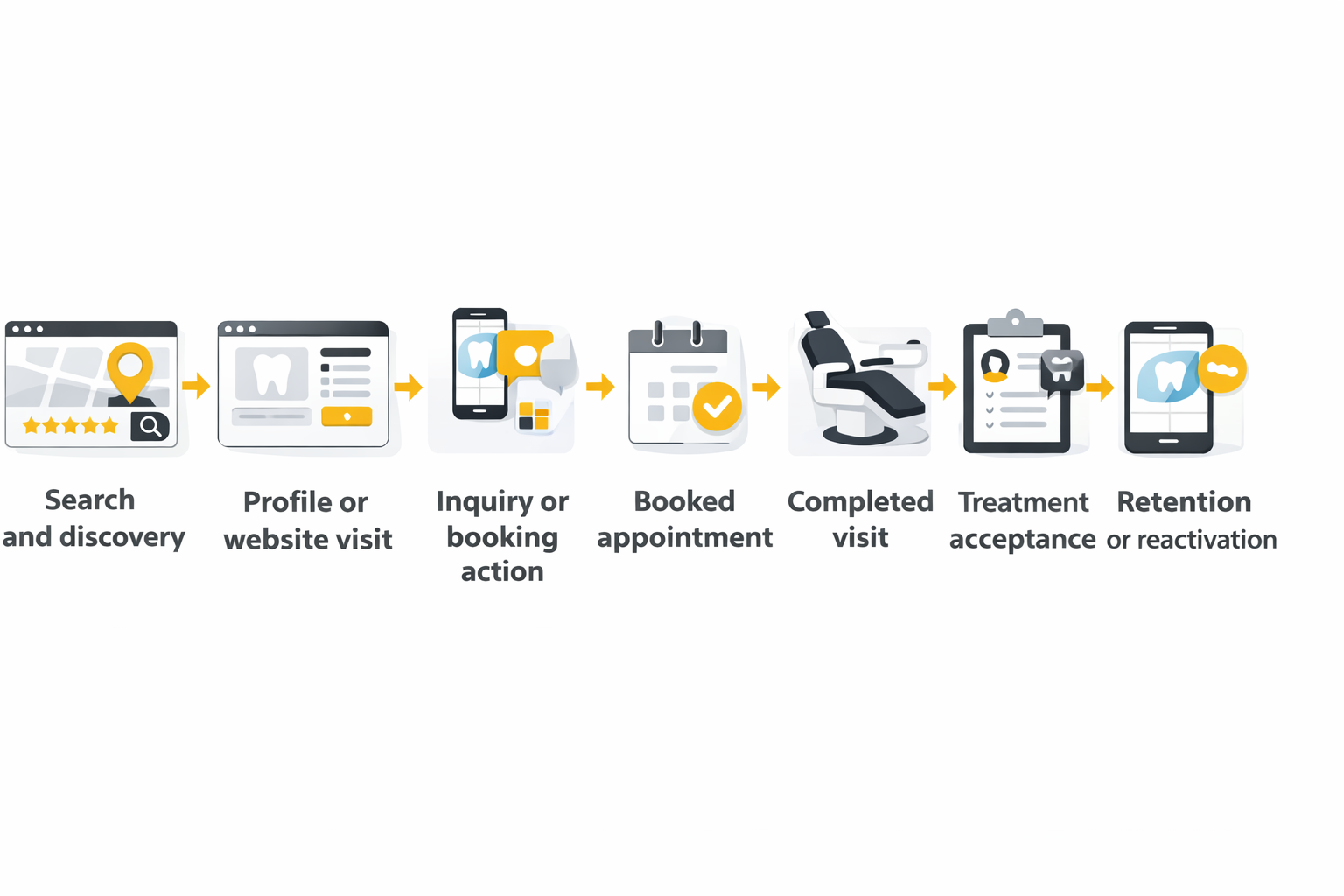
The cleanest way to measure dental marketing is to build a funnel that mirrors the patient journey. It does not have to be complicated. It just has to be consistent enough that every lead source can be tracked through to revenue outcomes.
A practical funnel usually includes these stages:
- Search and discovery
- Profile or website visit
- Inquiry or booking action
- Booked appointment
- Completed visit
- Treatment acceptance
- Retention or reactivation
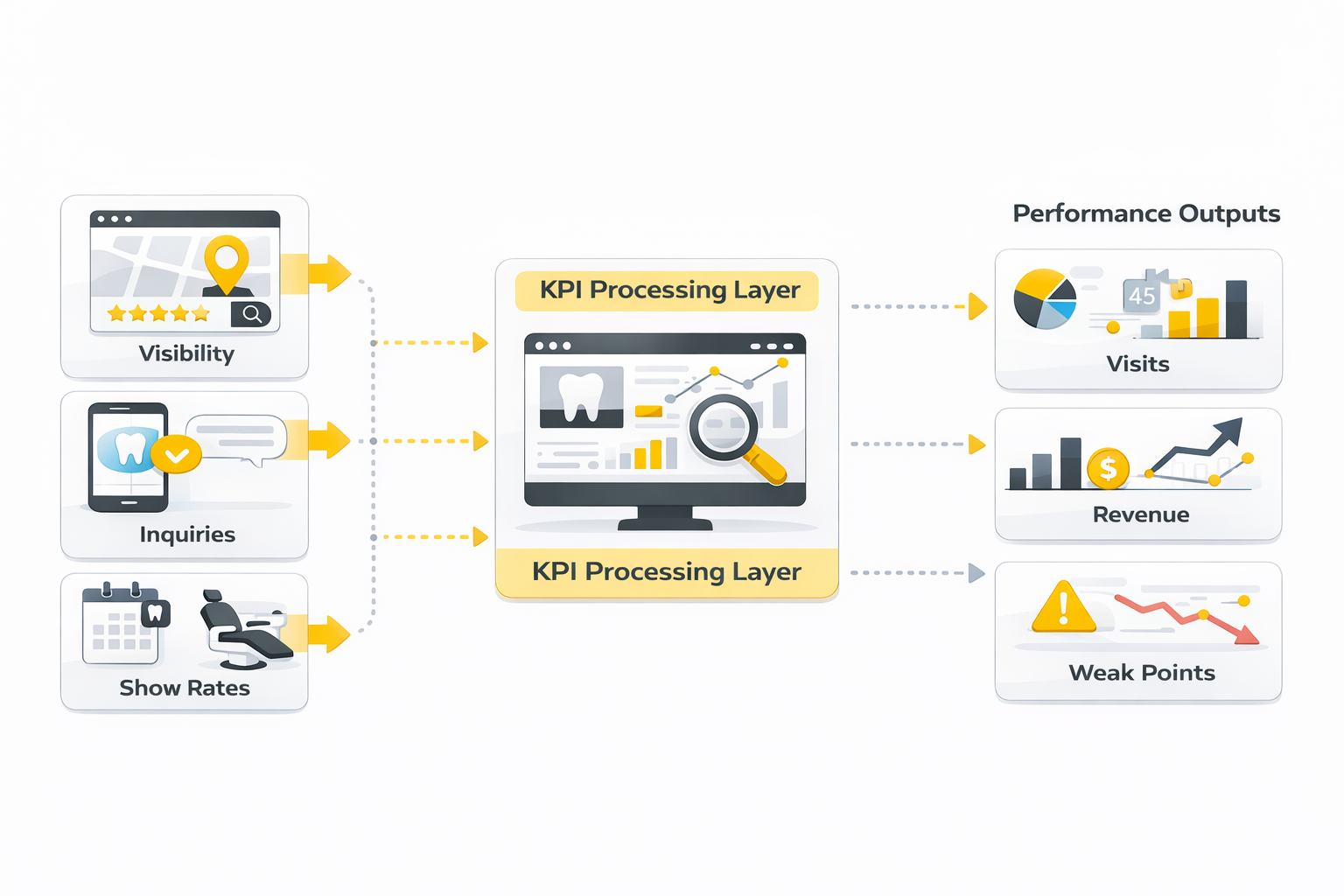
Once that structure is in place, the numbers start to mean something. You can see whether your implant page generates inquiries but weak case starts, whether your emergency campaigns produce fast bookings but low long-term value, or whether your review generation process is lifting local visibility month by month. That is the point where dental marketing stops being a vague growth effort and starts acting like an operating system.
This is also where tooling becomes genuinely useful. A platform that can centralize lead capture, automate follow-up, and organize pipeline stages can make measurement much easier, especially for practices that are tired of juggling forms, spreadsheets, texts, and front-desk notes. Systems such as GoHighLevel are attractive for exactly this reason: they can connect campaign activity to downstream actions instead of leaving attribution scattered everywhere.
The Most Important Ratios to Watch
Raw counts matter less than ratios because ratios reveal health. A practice can celebrate 100 leads, but if only 20 become booked appointments, that tells a different story than 40 booked from 60 leads. Dental marketing becomes much easier to improve when you watch the relationships between stages.
The key ratios usually include inquiry-to-booking rate, booking-to-show rate, show-to-treatment-start rate, and cost per booked appointment. Review acquisition rate is another underrated ratio because it tells you whether the public reputation is keeping pace with patient volume. If the practice is serving hundreds of patients but collecting only a trickle of fresh reviews, the brand signal will eventually lag behind reality.
The reason these ratios matter is simple. They show where effort is leaking out of the system. If inquiry-to-booking is weak, fix intake and follow-up. If booking-to-show is weak, fix reminders and pre-visit communication. If treatment-start is weak, fix trust, financing communication, and case presentation. The number should always point to the next move.
What Good Reporting Looks Like in Practice
Good reporting is boring in the best possible way. It is consistent, understandable, and tied to operational decisions. It does not try to impress with complexity. It helps the owner or marketing lead spot changes early and act before waste compounds.
A useful monthly view of dental marketing usually answers a short list of questions. Did qualified visibility increase or decline. Which channels produced the most booked appointments. Which sources generated the best show rates. Which services produced the strongest treatment value. Where did the funnel weaken compared with the previous month. When those questions are answered clearly, the dashboard becomes a decision tool instead of a vanity report.
That is also why weekly snapshots can be more valuable than one big monthly recap. If review velocity drops, if form response times slow, or if a booking page starts underperforming, waiting until the end of the month costs too much. The earlier the signal appears, the faster the practice can protect performance.
Data Should Change Behavior
This is the final point, and it matters. Measurement is not there to prove that marketing exists. It is there to improve outcomes. If a practice keeps tracking the same numbers without changing page structure, intake process, review strategy, or follow-up timing, the dashboard is not doing its job.
The best dental marketing teams use analytics to create small, compounding improvements. They refine service pages when rankings rise but inquiries lag. They tighten response workflows when leads come in but bookings do not follow. They increase review requests when trust signals go stale. They improve scheduling when access friction starts costing conversions. That is how numbers become growth.
In the next section, the focus shifts from measurement to strategic priorities and common mistakes. That is where the data becomes even more useful, because once you know what the signals mean, it becomes much easier to decide what deserves attention first and what should be ignored.
Strategic Tradeoffs, Risks, and What Changes as You Scale
By this point, the basics of dental marketing are clear. You need visibility, trust, conversion systems, and clean measurement. The harder part is what happens after those pieces start working, because growth creates its own problems and the next gains usually come from better choices, not more activity.
This is where mature dental marketing starts to look less like promotion and more like resource allocation. Every added channel, new service page, automation, or campaign has a cost in attention, staff time, compliance exposure, and operational complexity. If the practice keeps stacking tactics without making tradeoffs, growth gets noisy fast.
Do Not Grow Demand Faster Than the Practice Can Absorb It
One of the easiest ways to waste money is to generate more demand than the schedule, staffing model, or treatment capacity can handle. ADA data showed average wait times for new patients at 13.4 days in Q4 2025, while a meaningful share of dentists also reported either being too busy or overworked, which is a reminder that demand generation and operational readiness have to stay connected.
That matters because not all growth is good growth. If a practice is already bottlenecked on hygiene, struggling with front-desk response times, or booking high-value consults too far out, pushing harder on acquisition can lower the patient experience and make the brand feel less dependable. In other words, dental marketing can succeed on paper while making the real business harder to run.
The smarter move is usually more selective. Grow the types of cases you can serve well, at the pace the team can actually support, and let operational constraints shape the marketing plan instead of pretending those constraints do not exist. That is a much more durable path than chasing top-line lead volume for its own sake.
Better Patients Beat More Patients
This is one of the most important shifts a practice can make. Early-stage dental marketing often focuses on raw new-patient numbers because that is the easiest success story to tell. Advanced dental marketing cares more about fit, treatment mix, show rate, case acceptance, retention, and how well the acquired patient matches the economics of the practice.
That does not mean every office should chase only high-ticket dentistry. It means the channel mix should reflect the business model. An emergency-focused practice, a fee-for-service cosmetic office, a pediatric practice, and a multi-location family group should not use the same growth logic because their ideal patient journey, margin profile, and follow-up burden are different.
This is also where measurement from the previous section becomes decisive. When a practice can see which channels create completed visits and accepted treatment rather than just leads, it becomes much easier to stop funding noise. Dental marketing gets better when it stops rewarding activity and starts rewarding fit.
Multi-Location Growth Raises the Difficulty
Scaling from one office to several changes the job. What worked as a simple local brand often becomes much harder when multiple locations need accurate profiles, distinct local relevance, consistent messaging, and reliable reporting. The ADA notes that the dental workforce continues to move toward larger practices and DSO affiliation, which means this challenge is becoming more common, not less.
Google’s business profile guidance is very clear on the operational side of this. Businesses should be represented consistently in the real world, addresses and service areas should be accurate, categories should be limited to what truly describes the business, and there should be only one profile per business because duplicate or conflicting profiles can create display problems in Search and Maps.
That creates a real strategic tension. A growing group wants brand consistency, but each location also needs enough local specificity to rank and convert in its own market. In practice, that usually means each office needs its own properly governed profile, its own location page, its own review stream, and enough local detail that the brand does not look cloned. Dental marketing gets harder at scale because centralization and local relevance have to coexist.
Automation Helps Until It Starts Replacing Judgment
Automation is one of the most useful levers in modern dental marketing, but it has a limit. It is excellent for confirmation messages, follow-up triggers, routing inquiries, reactivation sequences, and basic after-hours coverage. It becomes dangerous when a practice assumes every patient interaction should be standardized or delegated to software.
Healthcare communication carries more sensitivity than ordinary lead generation. HHS guidance makes clear that covered providers using remote communication technologies still need to operate in ways that are consistent with HIPAA Privacy, Security, and Breach Notification requirements. That means convenience cannot be separated from data handling, and any marketing automation touching patient information has to be designed with compliance in mind.
The practical rule is simple: automate speed, not empathy. Let systems acknowledge inquiries, reduce delay, and organize follow-up, but keep human judgment in the moments where trust, nuance, financing concerns, fear, or treatment complexity actually decide the outcome. That balance is where dental marketing stays efficient without becoming cold.
AI Can Speed Up Production, but It Can Also Dilute the Brand
A lot of practices are now tempted to solve content production with AI alone. The appeal is obvious. It is faster, cheaper, and easier to fill a website with treatment pages, FAQ content, city pages, and educational posts. The problem is that scale by itself is not a strategy.
Google’s own guidance is pretty direct here. It says there are no special requirements to appear in AI Overviews or AI Mode beyond the usual SEO fundamentals, and it separately warns that generating many pages without adding value for users may violate spam policies on scaled content abuse. It also emphasizes accuracy, quality, and relevance for automatically generated content.
That should change how dental practices use AI in marketing. AI is useful for research support, outlining, structuring drafts, and helping teams work faster. It is a bad substitute for real expertise, local specificity, clinical judgment, and useful patient education. When every page starts sounding interchangeable, dental marketing may become more efficient to produce but weaker at building trust.
Review Strategy Can Create Legal Risk if It Gets Too Clever
Reviews are powerful, but this is an area where shortcuts can become expensive. The FTC’s Consumer Reviews and Testimonials Rule went into effect on October 21, 2024, and it addresses deceptive and unfair conduct involving reviews and testimonials while authorizing courts to impose civil penalties for knowing violations.
That matters because some review tactics still get pitched as harmless growth hacks when they are anything but. Selectively asking only happy patients, suppressing negative feedback, incentivizing only positive reviews, posting misleading testimonials, or outsourcing reputation management without oversight can all create exposure that is completely avoidable. In dental marketing, trust is an asset, but manipulated trust is a liability.
The right approach is more boring and more durable. Ask consistently, make it easy for patients to respond honestly, monitor feedback quickly, and improve the underlying experience instead of trying to engineer perception. That is slower than gaming the system, but it compounds better and keeps the practice out of trouble.
The Next Level Is Fewer Priorities, Executed Better
Most practices do not need more channels. They need sharper priorities. Once the main growth engine is working, the biggest wins usually come from improving a handful of leverage points such as faster response time, better case-type targeting, stronger review recency, cleaner location governance, or tighter conversion pages.
This is also where discipline starts to outperform creativity. Google continues to frame success around helpful, reliable, people-first content rather than special tricks for AI search experiences. That is useful because it pushes dental marketing back toward the fundamentals that actually last: clear service pages, trustworthy business information, useful patient education, and consistent operations behind the promise.
So the advanced version of dental marketing is not louder. It is more selective, more compliant, more operationally aware, and more aligned with the actual economics of the practice. That is the difference between a marketing program that looks busy and one that genuinely scales.
In the final section, the article will close by pulling these ideas into a practical conclusion and a concise FAQ so the framework is easier to apply without overcomplicating it.
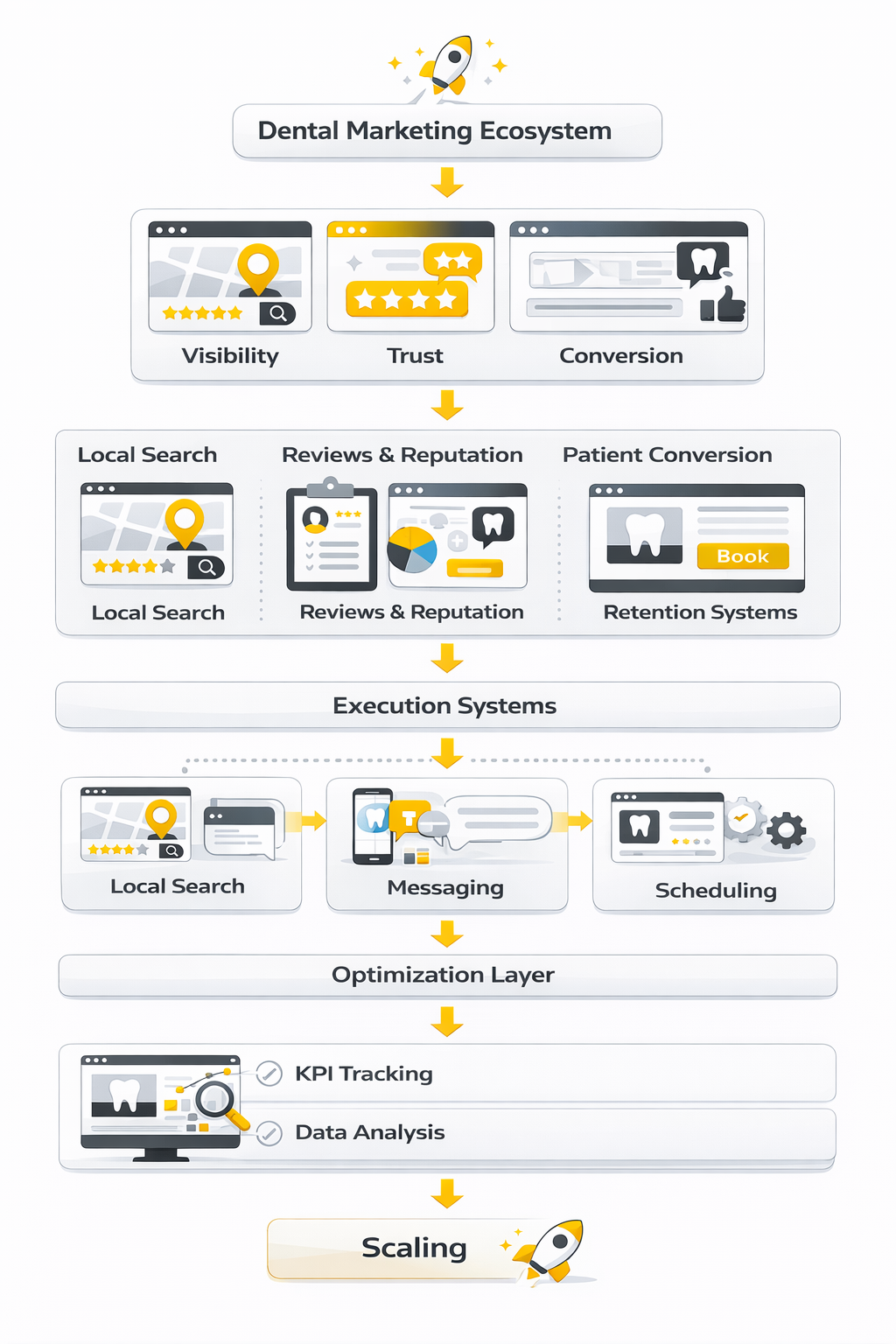
By now, the bigger pattern should be obvious. Dental marketing works when the practice stops treating visibility, reputation, conversion, retention, and measurement as separate projects and starts running them as one connected system. That is the real shift from random promotion to controlled growth.
The strongest practices are rarely the ones doing the most. They are the ones doing the right small set of things consistently, measuring what matters, fixing friction fast, and aligning marketing with what the team can actually deliver. That is how dental marketing becomes sustainable instead of exhausting.
FAQ
What is dental marketing in plain English?
Dental marketing is the system a practice uses to attract attention, build trust, generate appointments, and keep patients engaged over time. It includes local visibility, reviews, website conversion, follow-up, reactivation, and patient communication. The reason it matters so much now is that patients compare options quickly, and first impressions are usually digital long before they are personal.
Why is dental marketing different from general local marketing?
Dental care is higher trust, more emotional, and often more expensive than many local services. Patients are not just choosing convenience. They are choosing who will handle pain, anxiety, appearance, and long-term health. That means dental marketing has to do more than get clicks. It has to reduce fear, answer objections, and make the next step feel safe.
What should a dental practice focus on first?
The first focus should be the parts of the system that directly affect discoverability and conversion. In most cases, that means the Google Business Profile, review generation, core service pages, mobile usability, and a clear booking path. There is no point buying more attention if the basic trust and conversion layers are weak.
Is SEO still worth it for dental marketing?
Yes, but only when it is tied to real patient intent. Good dental marketing uses SEO to help the practice show up for nearby treatment-related searches, not to publish endless filler content. The goal is not traffic for its own sake. The goal is qualified local demand from people who are actually likely to book.
How important are reviews compared with the website?
Both matter, but they do different jobs. Reviews often decide whether a patient gives the practice a chance, while the website helps confirm whether the practice feels like the right fit. In strong dental marketing, the review profile and the website reinforce each other instead of creating two different impressions.
Should a practice invest more in Google Ads or organic marketing?
That depends on urgency, competition, and the economics of the practice. Paid search can create demand faster, especially for high-intent treatments, while organic visibility tends to compound over time and lower dependence on ad spend. The best dental marketing strategy usually uses paid channels for speed and organic channels for stability, then shifts resources based on what actually produces booked and completed visits.
How long does dental marketing usually take to work?
Some improvements can produce results quickly, especially fixing conversion leaks, improving response speed, or tightening scheduling. Other parts, such as local authority, content performance, and reputation momentum, usually build over months rather than days. The mistake is expecting every channel to move at the same speed. Good dental marketing combines short-term wins with long-term compounding assets.
What is the biggest mistake dental practices make with marketing?
The biggest mistake is treating marketing as a collection of disconnected tactics. A practice runs ads, posts on social media, asks for a few reviews, and updates the site occasionally, but nothing is tied together. Dental marketing gets better when the practice builds one coherent system and measures how each part moves the patient closer to treatment and retention.
How much automation is too much?
Automation becomes too much when it starts replacing judgment in moments that need empathy, nuance, or trust. Automated confirmations, reminders, lead routing, and reactivation can be extremely useful. But patients should not feel like they are trapped in a machine when they have questions, anxiety, or complex treatment concerns. The best dental marketing uses automation to speed up service, not to remove humanity.
Does social media matter for dental marketing?
Yes, but not always in the way people think. Social media is often less important as a direct appointment engine than as a trust layer that supports credibility, personality, and familiarity. For many practices, it works best when it reinforces local presence, showcases team and environment, and supports reputation rather than trying to carry the whole growth plan by itself.
How should a practice measure whether dental marketing is actually working?
The clearest measurement path is to follow the patient journey. Track visibility, inquiries, bookings, show rates, treatment starts, and retention rather than stopping at clicks or impressions. When dental marketing is measured this way, the practice can see exactly where momentum is building and where revenue leaks are hiding.
What does a healthy dental marketing system look like?
A healthy system is simple enough to manage and strong enough to compound. The practice is visible in local search, reviews stay fresh, the website makes booking easy, follow-up happens quickly, reminders protect the schedule, and reporting connects activity to real patient outcomes. That kind of dental marketing does not feel flashy every day, but it is the version that tends to win.
Work With Professionals
Explore 10K+ Remote Marketing Contracts on MarkeWork.com
Most marketers spend too much time chasing clients, competing on crowded platforms, and losing a percentage of every project to middlemen.
MarkeWork gives you a better way. Browse thousands of remote marketing contracts and connect directly with companies desperate to hire skilled marketers like you, without platform commissions and without unnecessary gatekeepers.
If you're serious about finding better opportunities and keeping 100% of what you earn, explore available contracts and create a profile for free at MarkeWork.com.