

A digital ad is not just a paid post, search result, banner, or video placement. It is a controlled buying decision: you pay to put a message in front of a specific audience, then measure whether that attention turns into business. That makes digital advertising powerful, but also unforgiving.
The market is still growing fast. U.S. internet advertising revenue reached nearly $300 billion in 2025, while global marketers spent close to $1.1 trillion on advertising in 2024. More money in the system means more competition, higher expectations, and less room for lazy campaigns.
Article Outline
- Why Digital Ads Matter Now
- The Digital Ad Framework
- Audience, Offer, Message, and Channel
- Creative, Landing Pages, and Conversion Paths
- Measurement, Optimization, and Scaling
- Digital Ad Tools, Workflows, and FAQs
Why Digital Ads Matter Now
Digital ads matter because buyers do not move in straight lines anymore. Someone might discover a product on YouTube, compare it on Google, get reminded on Instagram, click an email, and finally convert after seeing a retargeting ad. The job of a digital ad strategy is to make those moments feel connected instead of random.
This is also why “running ads” is not a strategy by itself. A campaign can get clicks and still fail if the offer is weak, the landing page is confusing, or the follow-up system is slow. Tools like GoHighLevel, ClickFunnels, and ManyChat can help, but only when the underlying system is clear.
The Digital Ad Framework
A strong digital ad framework starts with one simple question: what has to happen after the click? If the answer is vague, the campaign will usually become expensive guesswork. The best advertisers design the full path first, then choose the platform.
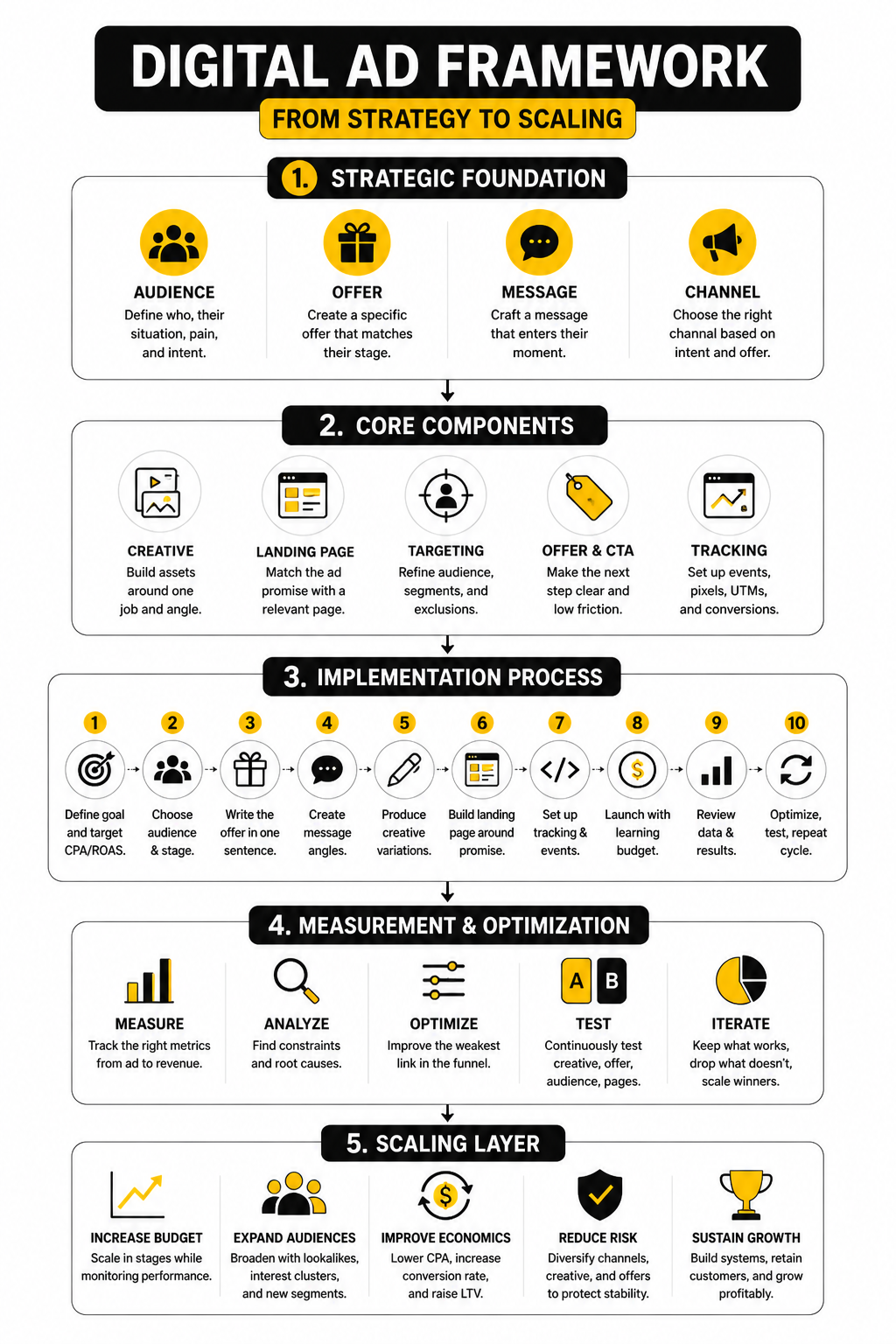
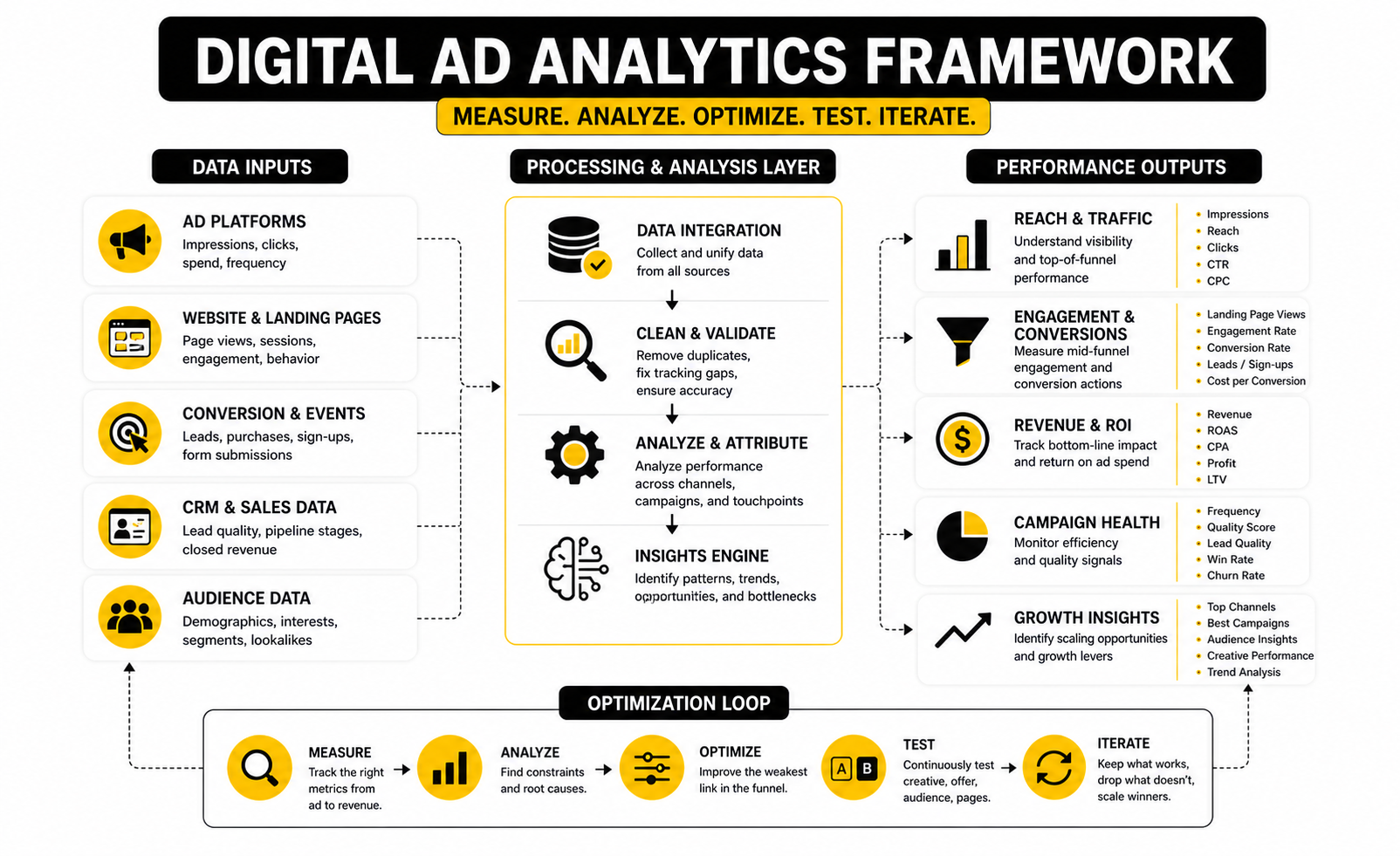
The framework used in this article is simple: audience, offer, message, channel, creative, destination, follow-up, and measurement. Each part affects the next one, so treating them separately creates gaps. When all eight parts work together, digital ads become easier to diagnose, improve, and scale.
Audience, Offer, Message, and Channel
A digital ad starts working before anyone writes the first headline. The real work begins with deciding who the ad is for, what they are being offered, why they should care now, and where the message should appear. When those four decisions are weak, the campaign usually needs too much budget to learn too little.
The mistake is thinking the platform will solve the strategy. Meta, Google, TikTok, LinkedIn, and YouTube can all produce results, but none of them can fix an unclear buyer, a bland offer, or a message that sounds like everyone else. Strong campaigns usually look simple from the outside because the hard strategic choices were made before launch.
Define the Audience Before You Define the Ad
The audience is not just an age range, job title, interest, or lookalike segment. A useful audience definition explains the situation the buyer is in, the problem they are trying to solve, and the trigger that makes them more likely to act today. That is what gives a digital ad its angle.
This matters even more as targeting becomes less predictable. Privacy changes, consent requirements, and weaker third-party signals mean advertisers cannot rely on tracking alone to find perfect buyers. The safer play is to build campaigns around clear intent, first-party data, and messages that make the right person self-identify.
A practical audience definition should answer three questions. Who feels the pain most clearly? What are they comparing you against? What would make them trust the next step? If you cannot answer those, spending more will usually only expose the weakness faster.
Make the Offer Specific Enough to Act On
The offer is the reason someone moves. It can be a free trial, demo, consultation, discount, guide, webinar, product bundle, or direct purchase, but it needs to feel concrete. A vague “learn more” campaign can work for major brands with massive budgets, but most businesses need a sharper reason to click.
The offer should match the buyer’s stage of awareness. A cold audience may need education, proof, or a low-friction lead magnet before they are ready for a sales call. A warmer audience may respond better to a direct demo, limited promotion, or comparison page because they already understand the category.
This is where funnel tools can help when they are used with discipline. A simple landing page built with ClickFunnels, Systeme.io, or Replo can outperform a beautiful website page if it gives the visitor one clear next step. The point is not more software; the point is less confusion.
Write the Message Around the Buyer’s Moment
A digital ad message should not try to say everything. It should enter the conversation already happening in the buyer’s head and move that conversation forward. That means the headline, hook, visual, and call to action need to match the specific moment the audience is in.
For search ads, the message usually needs to mirror intent because the person is actively looking for something. Google’s own Quality Score system evaluates expected clickthrough rate, ad relevance, and landing page experience, which is a useful reminder that the ad and destination cannot be treated as separate pieces. If the search term, ad promise, and landing page do not line up, the campaign is fighting itself.
For social ads, the message has to earn attention before it can sell anything. The first line, first frame, or first three seconds matter because the user did not open the app to see your offer. A strong social ad usually leads with a problem, contrast, belief shift, demonstration, or outcome that feels immediately relevant.
Choose the Channel Based on Intent
Channels are not interchangeable. Search captures demand that already exists, while social and video can create demand by showing the right idea to the right audience before they search. Retargeting works differently again because it speaks to people who already interacted with the brand.
The best channel depends on the offer and the buying motion. A local emergency service may start with Google because the intent is urgent. A new ecommerce product may need short-form video, creator content, and retargeting because buyers need to see the product in use before they care.
The key is to stop asking which platform is “best” in isolation. The better question is where the buyer’s intent is easiest to identify and influence. Once that is clear, the digital ad has a job instead of just a placement.
Creative, Landing Pages, and Conversion Paths
Once the audience, offer, message, and channel are clear, the work becomes more practical. This is where the digital ad stops being a strategy document and turns into assets, pages, tracking, follow-up, and decisions. Most campaigns do not fail because one tiny setting was wrong; they fail because the execution path was messy.
A strong implementation process keeps every step connected. The ad should make a promise, the landing page should continue that promise, and the conversion path should make the next action obvious. When that chain breaks, people hesitate, leave, or click around without converting.
Build the Creative Around One Job
Every ad creative should have one job. It might need to stop the scroll, qualify the viewer, explain the offer, create urgency, show proof, or drive a direct click. Trying to make one digital ad do all of those things at once usually creates a weak ad that says too much and lands too softly.
The best creative briefs are simple but specific. They define the buyer, the hook, the core promise, the proof point, the format, and the action you want after the ad. That gives designers, copywriters, editors, and media buyers enough structure to create variations without drifting away from the strategy.
For social and video campaigns, creative volume matters because fatigue can arrive quickly. That does not mean throwing random ideas into the account. It means producing controlled variations around different hooks, objections, angles, formats, and calls to action so the campaign can learn what actually moves people.
Match the Landing Page to the Ad Promise
The landing page should feel like the next sentence after the ad. If the ad talks about a free audit, the page should not open with a broad company introduction. If the ad promises a fast comparison, the page should not bury that comparison below generic brand copy.
Google’s Quality Score framework is useful here because it connects ad relevance, expected clickthrough rate, and landing page experience into one diagnostic system. That is a clear reminder that the click is not the finish line. The platform is also evaluating whether the destination is useful and relevant to the person who clicked.
For conversion-focused campaigns, dedicated pages often beat general pages because they remove distractions. Builders like Replo, ClickFunnels, and Systeme.io are useful when the goal is to move one audience toward one action without forcing them through the full website.
Turn the Process Into a Repeatable Workflow
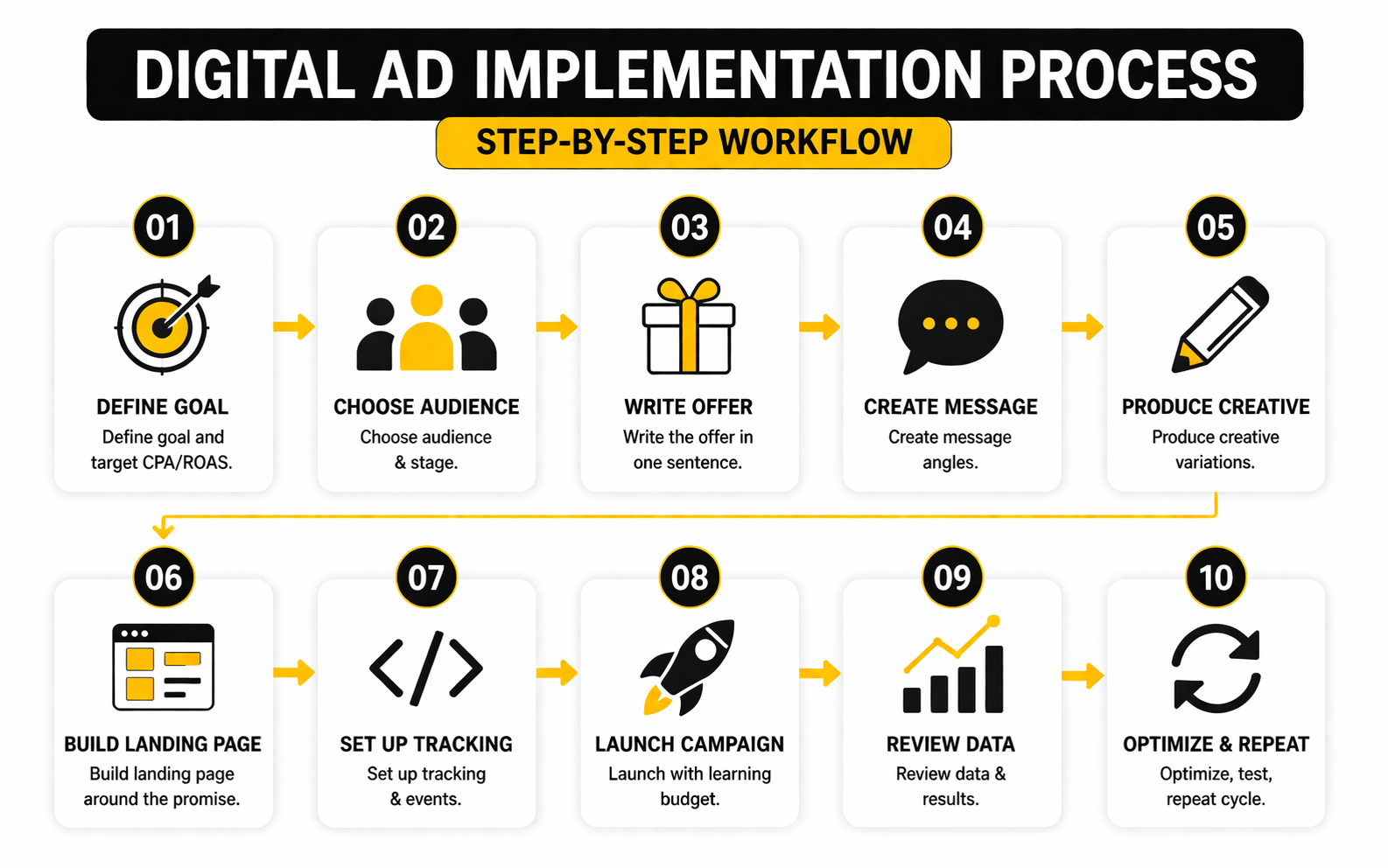
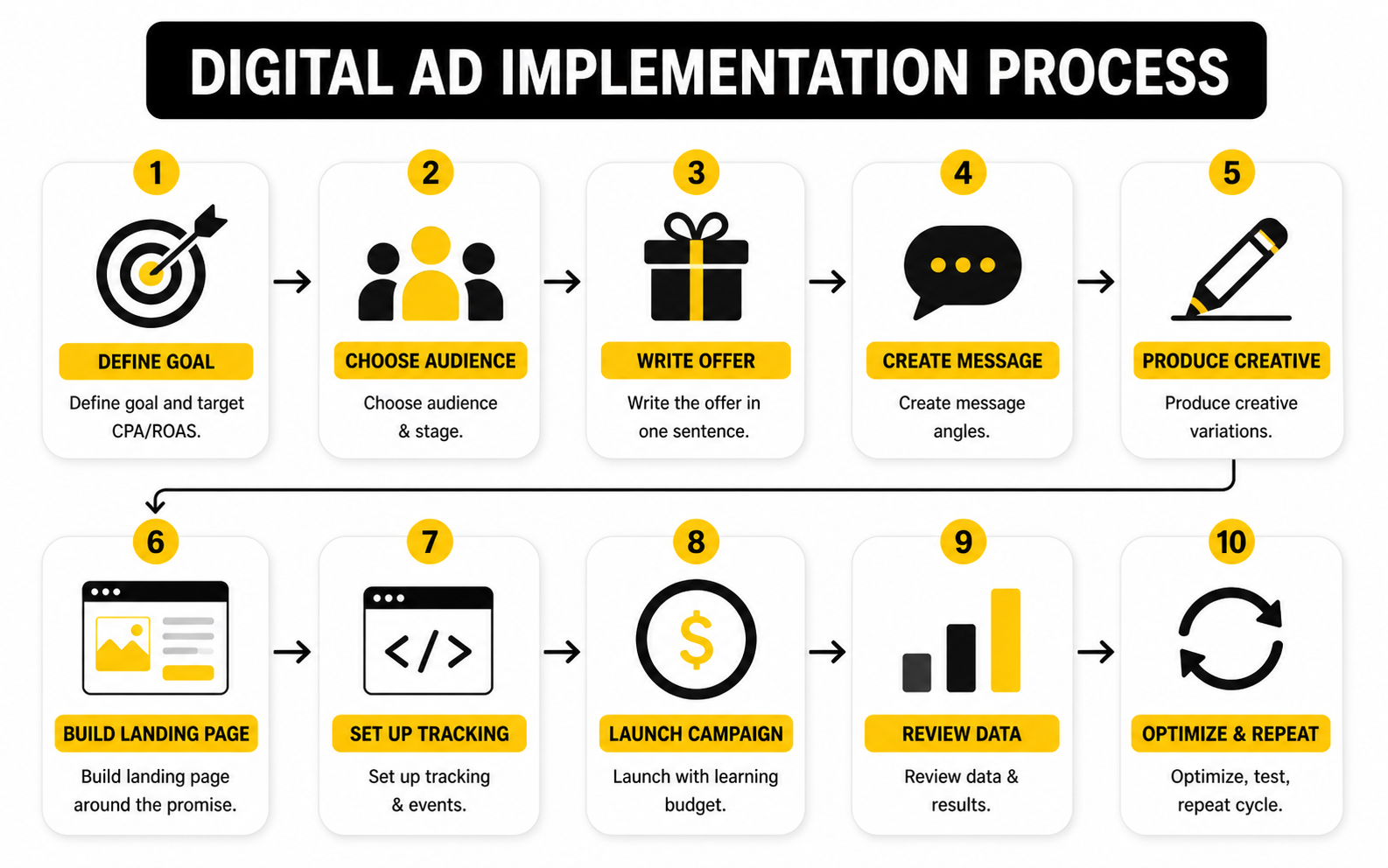
Implementation gets easier when the team follows the same sequence every time. Start with the campaign goal, then define the audience, offer, message, creative angles, landing page, tracking, budget, and review rhythm. That order matters because each decision shapes the next one.
A practical digital ad workflow can look like this:
- Define the conversion goal and the acceptable cost per result.
- Choose the audience and the buyer stage.
- Write the offer in one clear sentence.
- Create three to five message angles.
- Produce creative variations for each angle.
- Build the landing page around the strongest promise.
- Set up tracking, events, UTMs, and lead routing.
- Launch with a learning budget instead of a scaling budget.
- Review performance by audience, creative, page, and follow-up.
- Kill weak variables, keep useful learnings, and test the next constraint.
This process prevents emotional decision-making. Instead of asking whether an ad is “good,” you ask where the system is leaking. Maybe the clickthrough rate is fine but the page is weak. Maybe the page converts but lead quality is poor. Maybe the lead quality is strong but the follow-up is too slow.
Connect the Follow-Up Before You Spend
Follow-up is part of the campaign, not an afterthought. If someone submits a form, starts a chat, books a call, or claims an offer, the next few minutes matter. A digital ad can generate interest, but the follow-up system has to turn that interest into a real sales conversation.
This is where automation can protect speed and consistency. A business can use GoHighLevel to route leads, trigger SMS or email follow-up, and manage pipeline stages. For conversational campaigns, ManyChat can help move people from comment, DM, or click into a guided response flow.
The important part is not automation for its own sake. The important part is removing dead air between intent and response. When someone raises their hand, the system should know what happens next.
Measurement, Analytics, and Performance Data
Digital ad data is useful only when it changes what you do next. A dashboard full of numbers can feel productive, but most of it is noise unless it helps you diagnose a real decision. The goal is not to admire reports; the goal is to know what to fix, what to keep, and when to scale.
That matters because the market is not getting quieter. U.S. internet advertising revenue reached $294.6 billion in 2025, and global ad spending was already close to $1.1 trillion in 2024. When more money enters the auction, weak measurement becomes expensive fast.
Know Which Numbers Actually Matter
The most useful metrics depend on the job of the campaign. A prospecting campaign needs signals like reach quality, hook rate, clickthrough rate, landing page engagement, and cost per qualified action. A retargeting campaign needs different signals because the audience already knows something about the brand.
The mistake is judging every digital ad by the same number. A low cost per click can still be worthless if visitors do not convert. A high cost per lead can still be profitable if those leads close at a strong rate and produce high lifetime value.
Start with the business outcome, then work backward through the funnel. Revenue, pipeline, booked calls, purchases, qualified leads, landing page conversions, clicks, and impressions are connected, but they are not equally important. The further a metric is from revenue, the more carefully it needs to be interpreted.
Read Benchmarks Without Copying Them Blindly
Benchmarks are useful for context, not for strategy. Google Ads benchmarks show an average conversion rate of about 7.52% across industries in 2025, but that number should not become your target by default. Your offer, audience, price point, location, funnel, and sales process can make a “good” conversion rate very different from the average.
A benchmark should trigger a question, not an emotional reaction. If your conversion rate is far below the category average, the issue might be the offer, search intent, landing page, lead form, page speed, or trust signals. If your conversion rate is much higher, you still need to check lead quality, close rate, and revenue before celebrating.
The same logic applies to cost per click, clickthrough rate, and cost per lead. A cheap click from the wrong person is not a win. A more expensive click from a buyer with strong intent can be the best traffic in the account.
Build an Analytics System You Can Trust
A proper analytics system connects platform data, website data, CRM data, and sales outcomes. The ad platform can tell you what it thinks happened after a click, but it cannot always tell you whether the lead was qualified, followed up with, or closed. That is why the measurement setup has to go beyond the ad account.
At minimum, every campaign should use clean naming conventions, UTMs, conversion events, CRM source tracking, and a simple review cadence. This does not need to be fancy. It just needs to be consistent enough that you can compare campaigns without guessing what each number means.
For service businesses, a CRM like GoHighLevel can help connect ad leads to pipeline stages, booked appointments, and closed revenue. For ecommerce and landing page teams, tools like Replo or ClickFunnels are more useful when their conversion data is tied back to the ad source instead of viewed in isolation.
Diagnose the Funnel Before You Change the Budget
Do not raise or cut budget until you know where the constraint is. If impressions are low, the issue may be budget, audience size, bids, or approvals. If impressions are strong but clicks are weak, the creative or message is probably not earning attention.
If clicks are strong but conversions are weak, the landing page may not match the ad promise. If conversions are strong but sales are weak, the issue may be lead quality, sales follow-up, pricing, or qualification. Each signal points to a different fix, so treating every problem as a media buying problem is a fast way to waste money.
A simple diagnostic flow keeps decisions grounded:
- Low reach means the campaign may not be entering enough auctions.
- Low clickthrough rate means the message is not creating enough interest.
- Low landing page conversion means the page, offer, or traffic match is weak.
- Low lead quality means the targeting, promise, or qualification step needs work.
- Low close rate means the sales process or expectation setting needs attention.
- Low profit means the full economics need to be reviewed, not just the ad account.
Use Data to Scale With Control
Scaling is not just spending more. Scaling means increasing spend while protecting the economics that make the campaign worth running. If a digital ad works at $50 per day but collapses at $500 per day, the original result was not stable enough to scale aggressively.
Before increasing spend, look for consistency across several signals. The campaign should have enough conversions to reduce random noise, the landing page should be converting reliably, and the sales or revenue data should support the platform results. More budget should amplify a working system, not cover up a fragile one.
The practical move is to scale in stages. Increase budget carefully, watch whether cost per result rises, check whether lead quality changes, and keep testing new creative before fatigue hurts performance. Data is not there to make the campaign feel safe; it is there to show you where the risk is.
Advanced Strategy, Tradeoffs, and Scaling Risks
A digital ad system becomes more difficult once the easy wins are gone. Early campaigns can improve through obvious fixes like clearer creative, better landing pages, and faster follow-up. After that, growth depends on tradeoffs, not tricks.
This is where many advertisers get uncomfortable. Scaling usually means accepting higher costs, broader audiences, messier attribution, and more creative pressure. The goal is not to avoid those tensions; the goal is to manage them without breaking the economics of the campaign.
Balance Automation With Human Judgment
Ad platforms are increasingly automated, and that is not automatically bad. Machine learning can help with bidding, placement selection, audience expansion, and creative delivery when the conversion data is clean. The problem starts when advertisers hand over control before the campaign has enough quality signals.
Automation needs direction. If the conversion event is too shallow, the platform may optimize for cheap leads instead of valuable customers. If the landing page attracts the wrong people, the algorithm can scale the wrong pattern very efficiently.
The practical move is to automate only after the system is giving the platform the right feedback. Optimize toward meaningful events when possible, keep CRM data connected, and review lead quality instead of trusting platform numbers blindly. A digital ad account should get smarter over time, not just spend faster.
Protect the Economics Before You Chase Volume
More leads are not always better. More purchases are not always better either if acquisition costs climb faster than margin, retention, or lifetime value. Scaling only matters when the extra volume is still worth the extra spend.
That is why contribution margin matters more than surface-level return on ad spend. A campaign can show strong revenue but still create cash pressure if refunds, fulfillment costs, discounts, sales labor, or churn are ignored. You need to know what a customer is actually worth before you decide how much you can pay to acquire one.
This is especially important when competition is rising. U.S. digital advertising revenue grew 13.9% year over year in 2025, which means more advertisers are competing for attention, inventory, and outcomes. When auctions get more expensive, the businesses with cleaner economics can afford to stay in longer.
Prepare for Weaker Attribution
Attribution will not become perfectly clean again. Privacy rules, consent choices, browser changes, app tracking limits, and platform reporting gaps all make it harder to know exactly which touchpoint deserves credit. That does not mean measurement is dead, but it does mean single-source certainty is dangerous.
Google’s decision to keep third-party cookies in Chrome while continuing Privacy Sandbox work shows the industry is not moving in a perfectly straight line. Even with that shift, advertisers still face a privacy-first environment where first-party data, modeled reporting, conversion APIs, and incrementality testing matter more. IAB Europe’s 2025 research found that attribution without cookies and lack of standardization remain major barriers, which is exactly why advanced teams do not rely on one report alone.
The better approach is triangulation. Use platform reporting to optimize daily decisions, analytics data to understand on-site behavior, CRM data to judge quality, and periodic experiments to check whether ads are creating incremental results. No single view is perfect, but together they are much harder to fool.
Build Creative Systems, Not Just Creative Assets
Creative is not a one-time deliverable. It is an operating system for learning what your market responds to. If the team only produces new ads when performance drops, the campaign is already under pressure.
A stronger system keeps new ideas moving before fatigue becomes a crisis. That means documenting winning hooks, rejected angles, common objections, proof points, customer language, and format patterns. It also means separating creative testing from random creative chaos.
For most teams, the winning rhythm is simple. Keep the core offer stable long enough to learn, test fresh angles around that offer, and retire ads based on performance trends instead of personal taste. The creative system should make the media buyer more informed every week.
Use First-Party Data Carefully
First-party data is becoming more important because it is collected through direct relationships with customers, leads, subscribers, and visitors. It can improve segmentation, remarketing, modeling, and follow-up, but only when people have given permission and the data is accurate. Bad data does not become powerful just because you own it.
This is where CRM hygiene matters. Duplicate contacts, unclear source fields, missing consent, and inconsistent pipeline stages can damage both reporting and optimization. If the database is messy, the digital ad system will eventually inherit that mess.
Tools like GoHighLevel, Brevo, and Moosend can support this kind of follow-up and segmentation, but the tool is not the strategy. The strategy is collecting useful consented data, keeping it organized, and using it to make the next message more relevant.
Know When Not to Scale
Sometimes the smartest move is to stop scaling. If customer support is overloaded, fulfillment is slipping, lead quality is dropping, or cash flow is getting tight, more ad spend can turn a good campaign into an operational problem. Growth exposes weak systems.
A digital ad campaign should match the capacity of the business behind it. There is no point generating more booked calls than the sales team can handle well. There is no point driving more orders if the delivery experience creates refunds, complaints, or churn.
The expert move is patience with discipline. Scale when the numbers, operations, and customer experience can handle the extra demand. Hold back when the campaign is only making the dashboard look good while the business underneath is getting weaker.
Digital Ad Tools, Workflows, and FAQs
The final layer is the ecosystem around the campaign. A digital ad does not live alone inside Meta, Google, TikTok, LinkedIn, or YouTube. It connects to creative production, landing pages, forms, calendars, email, SMS, CRM stages, sales calls, reporting, and customer retention.
That ecosystem is where serious advertisers build an advantage. Anyone can launch a campaign, but not everyone can keep the message, offer, data, follow-up, and customer experience aligned as spend increases. The businesses that win usually treat ads as one part of a revenue system, not a standalone traffic button.
Choose Tools Based on the Workflow
The best tool stack is the one that supports the exact workflow you need. If the campaign depends on fast lead response, pipeline tracking, and appointment booking, a platform like GoHighLevel can make sense. If the campaign depends on landing pages and direct-response funnels, ClickFunnels, Systeme.io, or Replo may be a better fit.
For campaigns that rely on conversation, DMs, or comment-to-message flows, ManyChat can help turn attention into guided action. For email follow-up, Brevo and Moosend can support segmentation and nurture sequences. The point is simple: choose tools that reduce friction, not tools that add more dashboards.
Keep the System Simple Enough to Improve
Complexity feels impressive until something breaks. Too many audiences, too many offers, too many landing pages, and too many attribution views can make the campaign harder to understand. A clean system is easier to fix because every result has a clearer cause.
Start with one primary offer, one main conversion path, and a small group of creative angles. Once the campaign has stable signals, add complexity only where it improves learning or profit. That is how a digital ad system becomes scalable without becoming chaotic.
FAQ - Built for Complete Guide
What is a digital ad?
A digital ad is a paid message shown through an online channel such as search, social media, video, display, email sponsorship, retail media, or connected TV. Its job is to create a measurable action, such as a click, lead, purchase, booking, download, or visit. The format matters less than the system behind it because the ad only works when the audience, offer, creative, landing page, and follow-up fit together.
What makes a digital ad effective?
An effective digital ad speaks to a clear audience with a specific promise and sends people to a relevant next step. It does not rely only on clever copy or attractive design. It works because the message matches the buyer’s intent, the offer feels worth acting on, and the conversion path is easy to complete.
Which platform is best for digital ads?
There is no single best platform. Google is often strong when people are already searching for a solution, while Meta, TikTok, LinkedIn, and YouTube can be better for demand creation, education, and retargeting. The right platform depends on your audience, offer, buying cycle, budget, and how much explanation your product needs.
How much should I spend on digital ads?
Spend enough to collect useful data without risking money the business cannot afford to lose. A small test budget should prove whether the audience, offer, creative, and landing page can create meaningful signals. Once the campaign shows consistent results and the economics make sense, budget can increase in controlled stages.
What is a good conversion rate for a digital ad campaign?
A good conversion rate depends on the industry, traffic source, offer, price point, and buyer intent. Google Ads benchmarks can provide context, but they should not become your only target because averages hide huge differences between markets. The better question is whether your conversion rate supports profitable customer acquisition.
Why do digital ads get clicks but no conversions?
Clicks without conversions usually mean the ad created curiosity, but the landing page or offer did not finish the job. The page may not match the promise, the form may ask for too much, the proof may be weak, or the next step may feel unclear. Do not blame the traffic first; diagnose the full path after the click.
How often should digital ad creative be refreshed?
Creative should be refreshed when performance trends show fatigue, not just because a calendar says so. If clickthrough rate drops, frequency rises, or cost per result increases while other variables stay stable, the market may be tired of the current angle. Strong teams keep new hooks and formats ready before performance collapses.
What is the difference between paid search and paid social?
Paid search captures existing intent because people are actively looking for something. Paid social often creates or shapes demand by interrupting the feed with a relevant idea, story, demonstration, or offer. Search usually needs tighter keyword-to-page alignment, while social usually needs stronger hooks and more creative testing.
Should a digital ad send traffic to a homepage?
Usually, no. A homepage has to serve many audiences and many goals, so it often creates too many distractions for paid traffic. A dedicated landing page is usually better because it continues the ad promise and focuses the visitor on one clear action.
What metrics should I check first?
Start with the metric closest to the business outcome, then work backward. Revenue, profit, qualified leads, booked calls, purchases, cost per acquisition, conversion rate, clickthrough rate, and cost per click all matter in context. Do not optimize for cheap clicks if the campaign needs qualified customers.
How do I know when a digital ad is ready to scale?
A campaign is ready to scale when results are consistent, the conversion path is proven, lead or customer quality is acceptable, and the economics still work after follow-up and fulfillment costs. One lucky day is not enough. Scaling should amplify a system that already works, not rescue one that is unstable.
What is the biggest digital ad mistake?
The biggest mistake is treating the ad as the whole campaign. The ad only creates the first move. The offer, landing page, tracking, CRM, follow-up, sales process, and customer experience decide whether that attention turns into revenue.
Work With Professionals
Explore 10K+ Remote Marketing Contracts on MarkeWork.com
Most marketers spend too much time chasing clients, competing on crowded platforms, and losing a percentage of every project to middlemen.
MarkeWork gives you a better way. Browse thousands of remote marketing contracts and connect directly with companies desperate to hire skilled marketers like you, without platform commissions and without unnecessary gatekeepers.
If you're serious about finding better opportunities and keeping 100% of what you earn, explore available contracts and create a profile for free at MarkeWork.com.