

Digital advertising companies used to be judged mostly by media buying skill. Today, that is not enough. The market now includes performance agencies, platform specialists, creative studios, retail media teams, analytics partners, automation consultants, and full-funnel growth firms.
That shift matters because digital ad budgets are still moving upward, but the margin for sloppy execution is getting smaller. U.S. internet advertising revenue reached $294.6 billion in 2025, while privacy changes, AI-driven campaign automation, retail media, creator ads, and rising competition have made “just run ads” a weak strategy.
The right partner now has to connect four things: audience insight, creative quality, media execution, and revenue measurement. Miss one of those, and the campaign may still look busy while quietly wasting money.
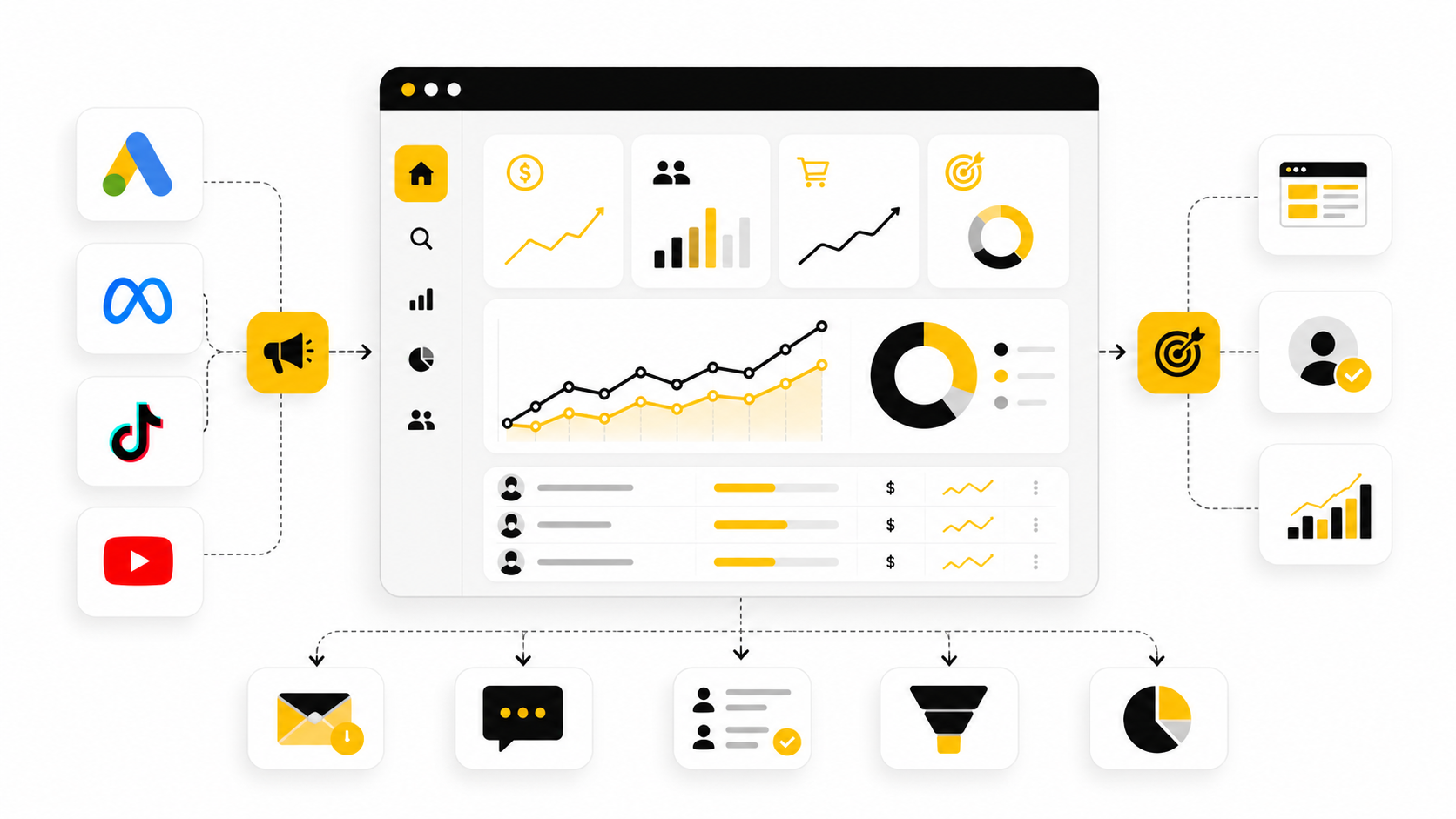
This article breaks the topic into six parts:
- Why Digital Advertising Companies Matter
- The Digital Advertising Company Framework
- Core Services Digital Advertising Companies Provide
- How To Compare Digital Advertising Companies
- Professional Implementation And Campaign Management
- FAQs About Digital Advertising Companies
Why Digital Advertising Companies Matter
Digital advertising companies matter because paid media has become both more powerful and more complex. A small team can now reach buyers across search, social, video, retail media, display, podcasts, creators, and connected TV, but each channel has its own economics, attribution problems, creative rules, and learning curve. That creates opportunity for brands that know what they are doing and expensive confusion for brands that do not.
The biggest mistake is treating all digital advertising companies as interchangeable. A Google Ads specialist, a Meta creative agency, an Amazon Ads partner, and a B2B LinkedIn agency may all “do ads,” but they solve different problems. One may be strong at demand capture, another at product discovery, another at account-based marketing, and another at lifecycle retargeting.
The stronger companies do not start with platforms. They start with the business model. They ask where demand already exists, where demand needs to be created, what the offer can support, how long the buying cycle is, and how success should be measured beyond surface metrics like clicks and impressions.
Digital advertising is also becoming more automated at the platform level. Google has pushed AI-powered Search campaign tools such as AI Max for Search, while Meta continues expanding Advantage+ automation for targeting, placements, budgets, and creative delivery through systems like Andromeda. That does not make agencies irrelevant. It makes strategic judgment, creative testing, clean data, and offer quality more important.
The Digital Advertising Company Framework
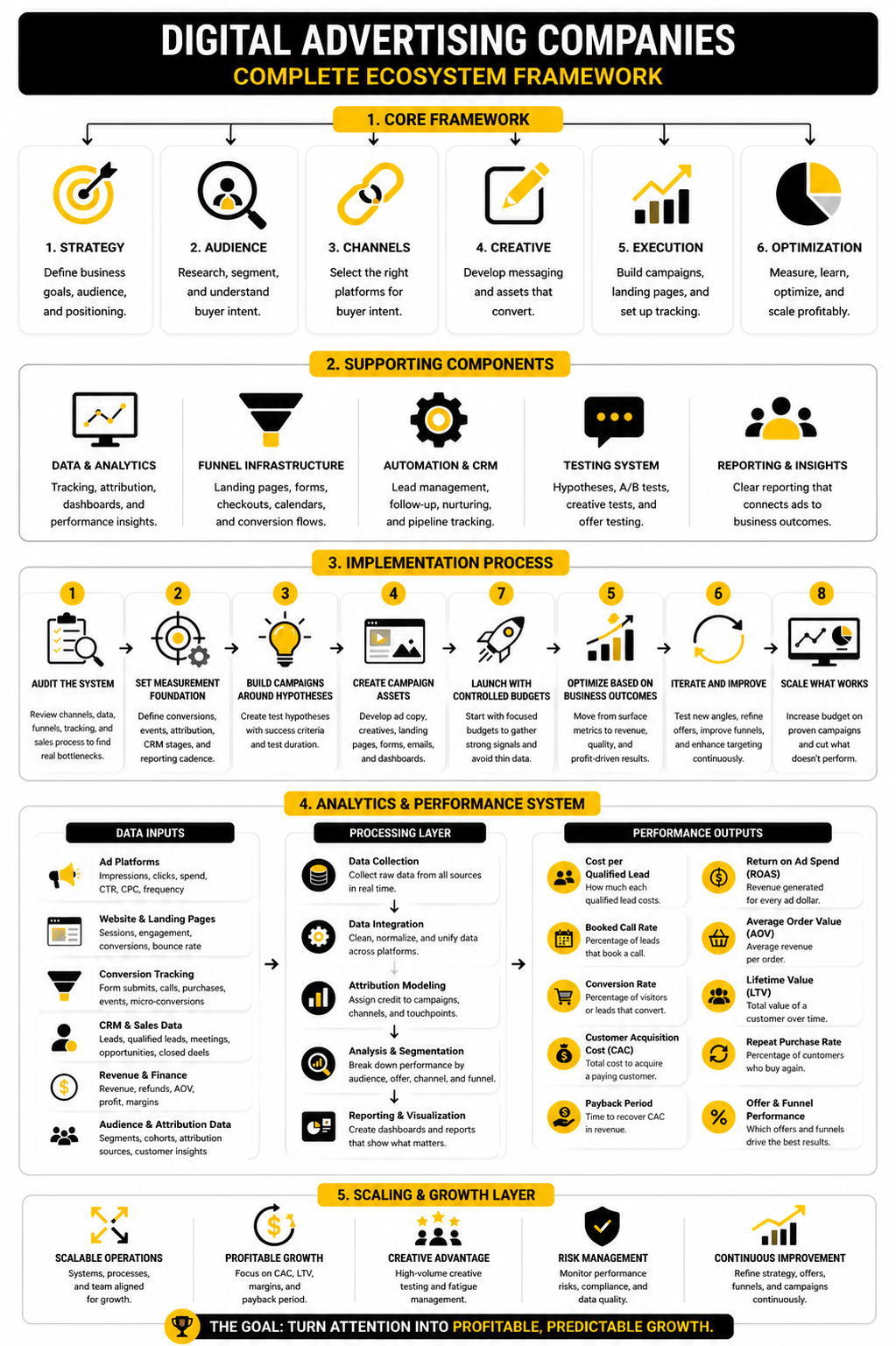
A practical way to evaluate digital advertising companies is to look at them through a simple framework: strategy, channel fit, creative production, media buying, measurement, and optimization. These six areas show whether a company can actually grow revenue or only manage ad accounts. Good execution usually comes from the system, not from one impressive tactic.
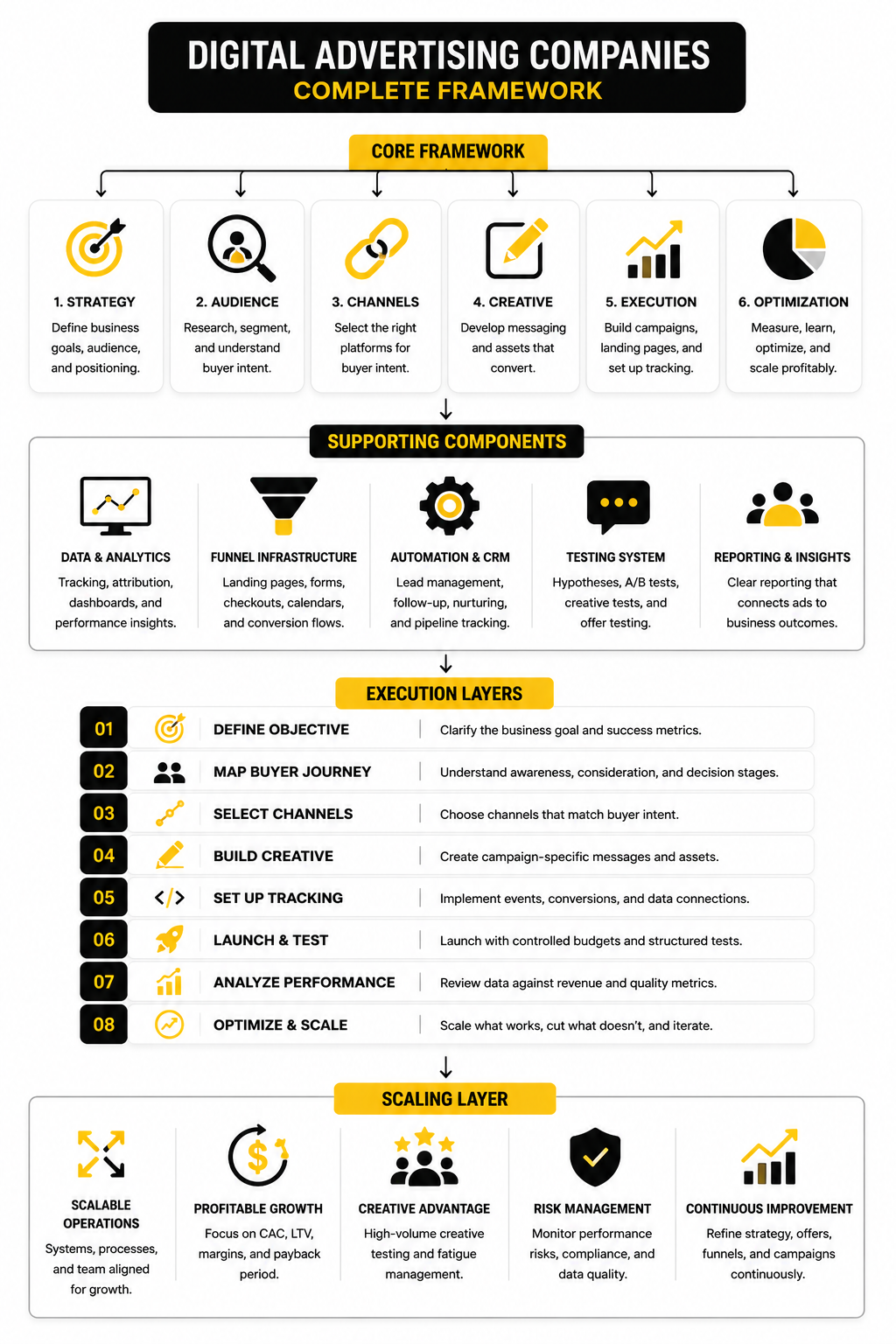
Strategy comes first because the campaign needs a reason to exist. A company should be able to explain who the campaign is for, what stage of awareness it targets, why the offer is strong enough, and how the budget should be split between testing and scaling. If that thinking is missing, the campaign becomes guesswork with dashboards attached.
Channel fit comes next. Search works well when people already know what they want. Social and creator ads can create demand when the product needs education or emotional appeal. Retail media is powerful when shoppers are already close to purchase, which is one reason global retail media keeps attracting more budget in markets tracked by firms like EMARKETER.
Creative production is where many campaigns win or lose. Platforms can optimize delivery, but they cannot rescue a weak message forever. The best digital advertising companies build repeatable creative testing systems, not one-off ad concepts that depend on luck.
Measurement is the final filter. A serious partner should be comfortable discussing conversion tracking, CRM data, incrementality, contribution margin, customer lifetime value, and payback period. For service businesses that need ads, landing pages, lead capture, follow-up, and pipeline visibility in one place, platforms like GoHighLevel can fit naturally into the operating system behind the campaigns.
Core Services Digital Advertising Companies Provide
Most digital advertising companies offer some mix of strategy, campaign setup, creative, tracking, optimization, and reporting. The difference is depth. A basic provider may launch campaigns and send monthly reports, while a stronger partner helps shape the offer, build the funnel, improve conversion rates, and connect ad spend to sales outcomes.
Paid search is usually focused on capturing existing demand. It works best when buyers are actively comparing options or searching for a solution. Search-heavy digital advertising companies need strong keyword strategy, landing page discipline, negative keyword management, conversion tracking, and a clear view of lead quality.
Paid social is more creative-led. Meta, TikTok, LinkedIn, Pinterest, Reddit, and YouTube each reward different formats and behaviors. A strong social advertising company knows how to test hooks, angles, offers, formats, audiences, and landing pages without confusing activity for progress.
Retail media and marketplace advertising are more commerce-driven. Amazon Ads, Walmart Connect, Instacart, and other retail networks sit close to the transaction, which makes them attractive for consumer brands. The tradeoff is that competition can be intense, reporting can be fragmented, and teams need to understand merchandising, inventory, pricing, reviews, and paid placement together.
Conversion infrastructure is becoming a bigger part of the job. Ads rarely succeed in isolation. Landing pages, forms, calendars, email follow-up, SMS, chat, and sales handoff all affect performance, which is why tools like ManyChat for messaging automation or Replo for ecommerce landing pages can be useful when they match the campaign model.
How Digital Advertising Companies Think About Strategy
Strong digital advertising companies do not begin with a media plan. They begin with the commercial reality of the business. That means looking at the offer, sales cycle, margins, customer value, competitive pressure, and the level of demand already in the market.
This is where inexperienced partners often get exposed. They may know how to build campaigns, but they do not always know how to diagnose whether paid media is the right lever yet. A weak offer, slow landing page, unclear pricing model, or poor follow-up process can make even a technically correct campaign look like a failure.
The better approach is simple: match the advertising strategy to the buyer’s intent. If people are already searching for the solution, search and shopping campaigns may deserve priority. If the market needs education, paid social, video, creator partnerships, and retargeting usually become more important.
Market Positioning Comes Before Channel Selection
Before choosing channels, digital advertising companies need to understand how the brand should be positioned. A premium service should not advertise like a discount offer. A new category product should not expect the same short buying cycle as a known commodity.
Positioning affects the entire campaign. It shapes the hook, the creative angle, the landing page, the call to action, and the budget split between awareness and conversion. When this is rushed, companies often end up with ads that technically run but do not create enough belief to produce action.
This matters even more now because digital ad spend keeps growing while attention gets harder to earn. U.S. internet advertising revenue reached $294.6 billion in 2025, which means buyers are surrounded by more paid messages than ever. The answer is not louder advertising. The answer is sharper advertising.
Channel Fit Depends On Buyer Intent
Every channel has a job. Search captures demand. Social can create demand. Retail media influences shoppers close to purchase. Connected TV and online video can build familiarity before buyers are ready to click.
Good digital advertising companies explain this clearly instead of pretending one platform can solve every problem. Google’s AI-powered Search tools now include broader matching, creative enhancements, and landing page expansion through AI Max for Search campaigns, which can help advertisers reach more relevant queries. But automation still needs direction, clean conversion data, and a business goal that makes sense.
Retail media is another example. Nielsen describes retail media networks as a major development in modern advertising because they combine ad placements with commerce data near the point of purchase. That can be powerful for consumer brands, but it is not automatically useful for every business, especially companies without retail distribution or ecommerce volume.
Creative Strategy Separates Average Companies From Strong Ones
Creative is not just design. It is the argument your ad makes in a few seconds. The best digital advertising companies treat creative as a testing system, where each concept answers a specific question about the market.
One ad might test pain awareness. Another might test proof. Another might test price sensitivity, urgency, comparison, founder credibility, product demonstration, or social proof. Over time, this gives the team real insight into what buyers care about, not just which image got the cheapest click.
This is why creative volume matters, but only when it has thinking behind it. Randomly producing more ads does not create a strategy. Producing more precise tests does.
The Digital Advertising Company Framework In Practice
The framework becomes useful when it turns into operating discipline. A digital advertising company should be able to show how strategy becomes campaigns, how campaigns become tests, how tests become decisions, and how decisions improve business outcomes. That is the difference between activity and execution.
A practical workflow usually looks like this:
- Define the business objective.
- Map the buyer journey.
- Select channels based on buyer intent.
- Build campaign-specific creative.
- Set up conversion tracking.
- Launch with controlled tests.
- Review performance against revenue, not vanity metrics.
- Scale what works and cut what does not.
This workflow sounds basic, but many campaigns fail because one step is skipped. The most common failure is launching ads before the funnel is ready. For lead generation, that often means weak forms, slow response times, and poor sales visibility; for ecommerce, it often means landing pages that fail to explain the product fast enough.
Funnel Infrastructure Is Part Of Advertising
Modern advertising does not stop at the click. Once someone clicks, the next steps matter just as much: landing page, form, checkout, calendar, chatbot, email, SMS, CRM, and sales follow-up. Digital advertising companies that ignore this part are managing traffic, not growth.
For service businesses, a tool like GoHighLevel can support the post-click workflow because it combines funnels, CRM, automations, calendars, and follow-up in one place. For ecommerce teams that need stronger campaign landing pages, Replo can make sense when the goal is to test product pages or advertorial-style pages without waiting on a full development cycle.
The key is not the tool itself. The key is whether the advertising company can connect the tool to the strategy. A funnel builder without a clear offer is just software, and software does not fix weak positioning.
Professional Implementation And Campaign Management
Once strategy is clear, implementation becomes the test of whether a digital advertising company can actually execute. This is where ideas turn into account structures, creative briefs, landing pages, tracking events, budgets, experiments, and weekly decisions. It is also where many campaigns quietly fall apart because the setup looks complete, but the operating rhythm is weak.
Professional implementation is not about launching everything at once. It is about building enough structure to learn quickly without creating chaos. A good partner knows what needs to be controlled, what can be automated, and what should be left flexible until the data is strong enough.
The process should feel calm, not mysterious. If a company cannot explain what happens before launch, during the first two weeks, and after the first meaningful data review, that is a warning sign. Digital advertising companies should make execution easier to understand, not harder.
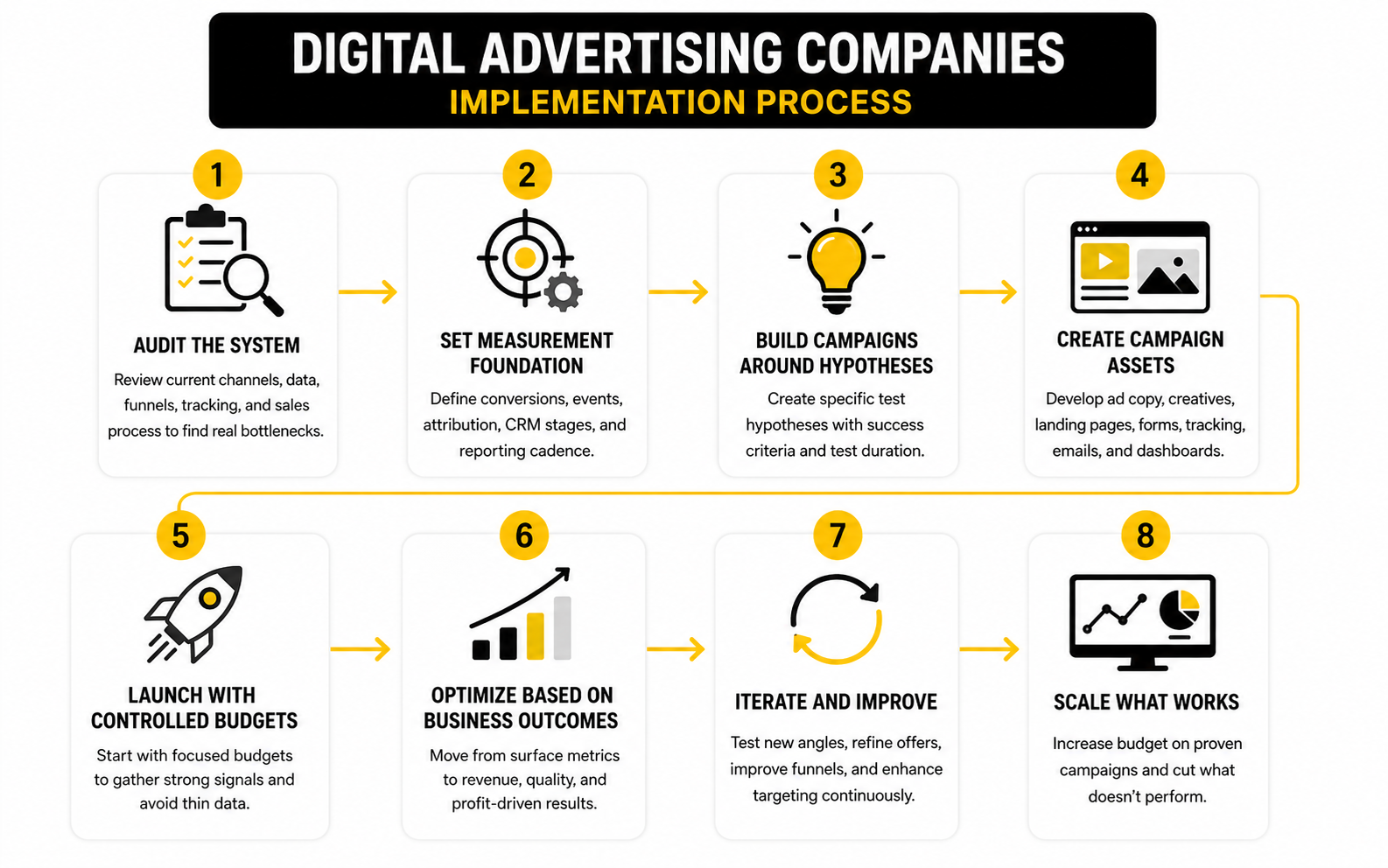
Step 1: Audit The Existing Growth System
The first step is an honest audit. Before creating new campaigns, the company should review the current traffic sources, conversion paths, analytics setup, landing pages, CRM workflow, sales process, creative assets, and past campaign data. This prevents the team from repeating old mistakes under a new campaign name.
The audit should also identify the real bottleneck. Sometimes the problem is poor targeting. Sometimes the landing page is unclear. Sometimes leads are coming in, but the sales team follows up too slowly or cannot see where each lead came from.
This is why the best digital advertising companies look beyond the ad account. They want to understand the full path from first impression to closed revenue. Without that view, optimization becomes too narrow.
Step 2: Set The Measurement Foundation
Measurement has to be built before launch, not patched together afterward. That means defining primary conversions, secondary conversions, attribution windows, CRM stages, revenue events, and reporting cadence. If the business sells through calls or sales reps, the ad platform alone will not tell the full story.
This is especially important as platforms lean harder into automation. Google’s AI Max for Search campaigns can expand matching, customize text, and use final URL expansion to improve relevance, but it still depends on useful conversion signals. Meta’s Advantage+ automation also relies on large-scale delivery systems that benefit from clear objectives and strong creative inputs.
In plain English, the machines need better instructions. Bad tracking teaches platforms the wrong lesson. Clean tracking gives digital advertising companies a much better chance of scaling what actually creates revenue.
Step 3: Build Campaigns Around Clear Test Hypotheses
Every campaign should test something specific. One campaign might test whether high-intent search demand can convert profitably. Another might test whether a new landing page improves lead quality. Another might test whether a creator-style video outperforms polished brand creative.
This matters because vague testing creates vague conclusions. If five things change at once, the team may not know why performance improved or declined. A disciplined testing plan makes each campaign easier to interpret.
Good digital advertising companies write these assumptions down before spending heavily. They define what success looks like, how long the test should run, and what decision will be made afterward. That one habit protects brands from emotional optimization.
Step 4: Create The Campaign Assets
Execution needs assets, not just ideas. The team has to produce ad copy, visuals, videos, landing pages, forms, emails, SMS flows, tracking links, and reporting dashboards. This is where speed matters, but only if quality stays high.
For ecommerce campaigns, landing page flexibility can make testing much easier. A platform like Replo can help teams build and test campaign-specific pages without turning every change into a development project. For lead generation, a platform like GoHighLevel can support forms, calendars, CRM stages, and follow-up automations in one connected workflow.
The point is not to collect tools. The point is to remove friction between ad traffic and buyer action. When the implementation stack is slow, even good strategy gets delayed.
Step 5: Launch With Controlled Budgets
A professional launch is controlled. The team should avoid spreading the budget across too many channels, audiences, and creative ideas too early. Thin data leads to weak conclusions, and weak conclusions lead to bad scaling decisions.
The first phase should focus on signal quality. Are the right people clicking? Are they staying on the page? Are they converting? Are sales conversations happening? Are low-quality leads being filtered out?
This stage is where patience matters. Digital advertising companies that promise instant scale often skip the learning phase. That may look exciting in a kickoff call, but it can become expensive quickly.
Step 6: Optimize Based On Business Outcomes
Optimization should move from surface metrics to business outcomes as soon as possible. Click-through rate, cost per click, and cost per lead can be useful, but they are not the final score. A campaign with a cheap cost per lead can still fail if the leads never buy.
The better review looks at cost per qualified lead, booked call rate, sales acceptance rate, conversion rate, average order value, payback period, and customer lifetime value. For ecommerce, this often includes contribution margin, return rate, repeat purchase behavior, and new-customer acquisition cost. For B2B and services, it often includes pipeline value and close rate.
This is where a serious digital advertising company earns its fee. They do not simply report what happened. They explain what should change next.
Statistics And Data That Actually Matter
Data should make digital advertising companies more decisive, not more distracted. The goal is not to collect every possible metric. The goal is to understand which numbers explain performance, which numbers predict revenue, and which numbers should trigger action.
The market-level numbers show why this discipline matters. Digital advertising is not a side channel anymore; it is one of the main ways companies compete for attention and demand. U.S. internet advertising revenue reached $294.6 billion in 2025, which means more competition, more automation, and less room for lazy measurement.
Benchmarks can help, but they should never become excuses. A benchmark tells you what is common, not what is acceptable for your business. A campaign can beat the average and still lose money if the offer, margin, close rate, or customer value does not support the economics.
The Core Measurement System
A proper analytics system connects four layers: ad platform data, website behavior, conversion events, and revenue outcomes. Each layer answers a different question. The ad platform shows delivery, the website shows engagement, the conversion layer shows action, and the revenue layer shows whether the action was worth paying for.
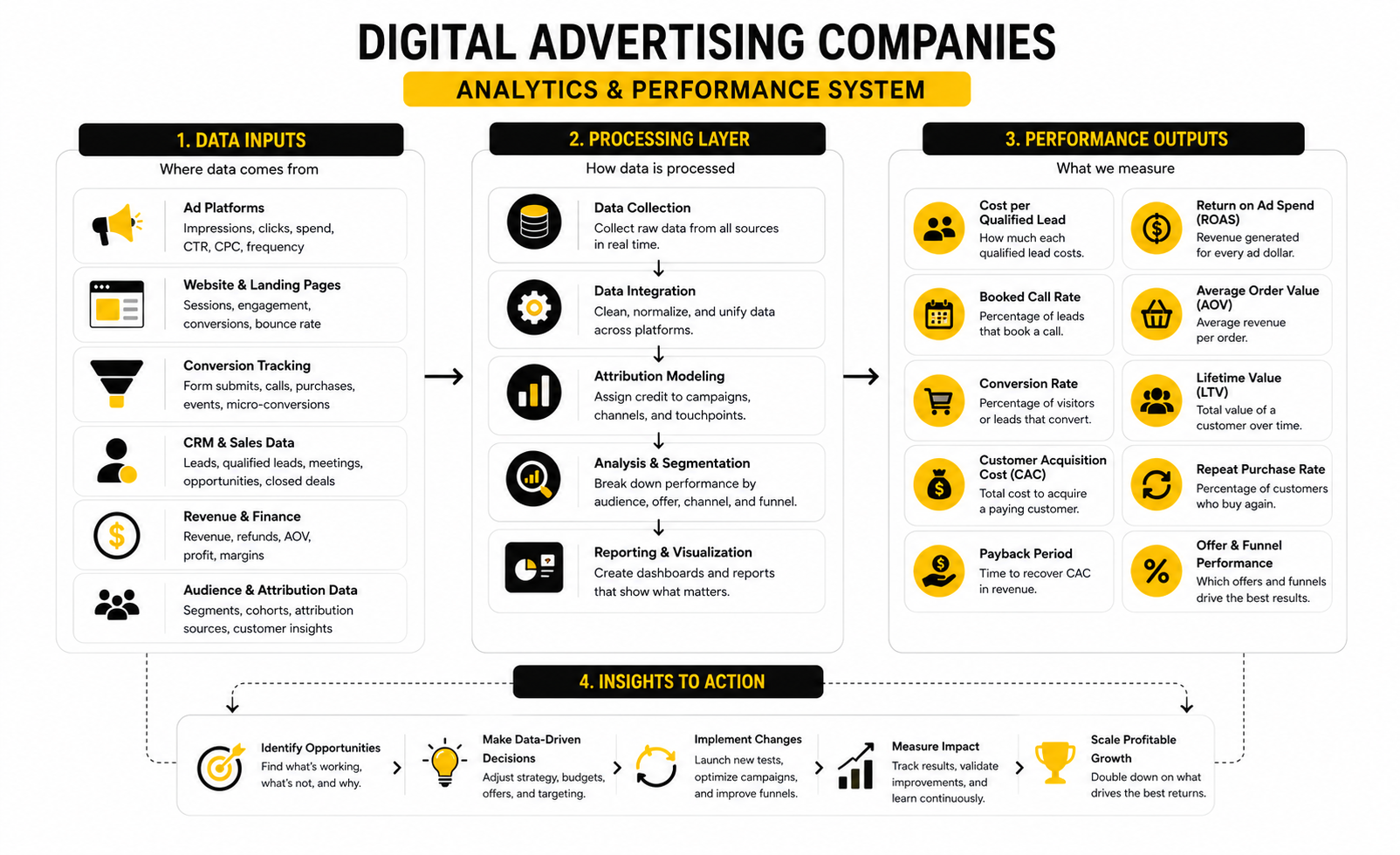
This is where many digital advertising companies separate themselves from basic campaign managers. Basic reporting stops at clicks, impressions, cost per click, and cost per lead. Better reporting follows the full journey from spend to pipeline, order value, retained customers, and profit.
The simplest useful measurement stack usually includes:
- Platform metrics such as impressions, reach, clicks, click-through rate, cost per click, and frequency.
- Website metrics such as landing page conversion rate, scroll depth, session quality, page speed, and form starts.
- Lead or order metrics such as cost per lead, cost per qualified lead, booked calls, purchases, average order value, and refund rate.
- Revenue metrics such as customer acquisition cost, payback period, return on ad spend, gross margin, lifetime value, and pipeline value.
What Benchmarks Can And Cannot Tell You
Benchmarks are useful for spotting obvious problems. If a search campaign has extremely low click-through rates, the issue may be keyword intent, ad relevance, or the offer. If the cost per lead is reasonable but sales quality is poor, the problem is probably not the ad click; it is the targeting, funnel, qualification process, or sales handoff.
Recent Google Ads benchmark data from WordStream and LocaliQ shows that search advertising costs have continued rising across many industries, which makes conversion quality more important than cheap traffic. The useful takeaway is not that every business should chase a universal average. The useful takeaway is that digital advertising companies need to manage toward unit economics, not vanity efficiency.
A low cost per click can be a trap. Cheap traffic is only good when it produces buyers. Expensive traffic can be profitable when it brings high-intent customers with strong lifetime value.
The Metrics That Should Drive Decisions
Every metric should have a job. If a number does not change what the team does next, it probably does not belong in the main report. This keeps reviews focused and prevents the classic agency problem: long dashboards, short insight.
For most businesses, the decision metrics are straightforward:
- Cost per qualified opportunity shows whether campaigns are attracting the right people.
- Conversion rate by landing page shows whether the offer and page are doing their job.
- Creative fatigue signals show when performance is declining because the audience has seen the same message too often.
- Revenue by campaign or channel shows which traffic sources deserve more budget.
- Payback period shows whether the business can afford to scale.
- Retention or repeat purchase rate shows whether the campaign is bringing valuable customers, not just first-time buyers.
The best digital advertising companies explain what changed, why it likely changed, and what they will do because of it. That final part matters most. Reporting without action is just documentation.
How To Interpret Return On Ad Spend
Return on ad spend is useful, but it is often misunderstood. A 3x ROAS can be excellent for one business and terrible for another. The difference comes down to margins, fulfillment costs, refunds, repeat purchases, and how much profit the business needs after advertising.
For ecommerce, ROAS should be interpreted next to gross margin and new-customer acquisition cost. For service businesses, ROAS may be less useful than cost per booked call, show-up rate, close rate, and revenue per closed client. For B2B, pipeline quality and sales cycle length usually matter more than immediate platform-reported revenue.
This is why digital advertising companies should not optimize blindly toward the number the ad platform likes most. Platform-reported ROAS can be directionally useful, but it is not a complete business truth. The stronger the connection between ad data and actual revenue, the better the decisions become.
Why Attribution Needs A Practical View
Attribution is messy because buyers rarely move in a straight line. Someone may see a social ad, search the brand later, read reviews, click a retargeting ad, and finally convert through email. Giving one channel all the credit can distort the budget.
That does not mean attribution is useless. It means it should be used with judgment. Digital advertising companies should compare platform data, analytics data, CRM data, and business results instead of pretending one dashboard has the full answer.
A practical attribution review asks better questions. Which channels create first interest? Which channels capture existing demand? Which channels assist conversion? Which campaigns bring customers who actually stay? Those answers are more useful than arguing over a perfect model that does not exist.
Advanced Considerations Before You Scale
Scaling paid media is not just increasing the budget. It is increasing spend without breaking the economics, the creative system, the sales process, or the customer experience. This is where digital advertising companies need to be strategic, because the tactics that work at a small budget often behave differently when the account starts spending more.
The first tradeoff is speed versus control. Moving fast can help a brand capture momentum, but scaling too quickly can push campaigns into weaker audiences, raise costs, and expose weaknesses in fulfillment or sales follow-up. A strong partner knows when to push harder and when to slow down because the signal is not strong enough yet.
The second tradeoff is automation versus human judgment. Platforms are moving fast toward AI-led delivery, with tools like Google AI Max for Search campaigns and Meta’s Andromeda-powered Advantage+ automation showing how much more decision-making is being handled inside the ad systems. That does not remove the need for digital advertising companies. It raises the standard for the work humans still control: offer, creative direction, tracking quality, budget logic, and interpretation.
The Risk Of Scaling Bad Signals
The most dangerous moment in advertising is when early results look good but the underlying signal is weak. Cheap leads may not be qualified. A high ROAS may come from returning customers instead of new buyers. A strong click-through rate may reflect curiosity rather than purchase intent.
Digital advertising companies need to pressure-test the signal before recommending scale. That means checking lead quality, sales notes, order value, refund patterns, repeat purchases, and audience overlap. If the campaign only looks good inside the ad platform, the business is not ready to scale confidently.
This is especially important when campaigns optimize around shallow conversions. A form submit, add to cart, or landing page view can help early learning, but these signals should eventually be replaced or supported by deeper business events. The closer the optimization signal gets to real revenue, the smarter the scaling decision becomes.
Creative Fatigue Becomes A Growth Constraint
As spend rises, creative fatigue becomes one of the biggest limits. The same ads reach the same audiences more often, performance softens, and the team starts blaming the platform when the real issue is message exhaustion. This is why creative production must become a repeatable system before scaling.
Digital advertising companies should build creative pipelines around angles, not just formats. One angle may focus on speed. Another may focus on risk reduction. Another may focus on comparison, proof, simplicity, status, affordability, or urgency. This gives the campaign more ways to speak to the market without repeating itself.
The best teams also separate winning concepts from winning executions. A specific video may fatigue, but the underlying message may still be strong. When a company understands that difference, it can refresh creative without abandoning what already works.
Budget Allocation Should Follow Confidence
Budget should move toward confidence, not excitement. If one channel has strong conversion quality, clean tracking, and room to grow, it deserves more spend. If another channel has attractive engagement but weak revenue proof, it should stay in testing until the business case improves.
A practical budget model usually separates spend into three buckets:
- Core spend for campaigns with proven economics.
- Testing spend for new audiences, channels, offers, and creative angles.
- Expansion spend for promising opportunities that need more data before becoming core.
This prevents the team from overcommitting too early. It also keeps innovation alive without letting experiments drain the budget. Good digital advertising companies protect both sides: stable performance and future growth.
Channel Expansion Needs A Reason
Adding more channels can look sophisticated, but it can also create noise. A brand does not need TikTok, LinkedIn, YouTube, Reddit, Amazon, Google, Meta, and connected TV just because those options exist. It needs channels that match the buyer journey and the business model.
Retail media is a good example. U.S. retail media spend is expected to keep rising, with EMARKETER projecting $69.33 billion in 2026, up from $58.79 billion in 2025. That growth matters for consumer brands with marketplace presence, but it does not mean every business should rush into retail media.
The right question is not “Which channel is hot?” The right question is “Where does this buyer become easier to reach, persuade, or convert?” Digital advertising companies that answer that clearly are far more valuable than agencies that chase every trend.
The Hidden Risk Of Tool Sprawl
As campaigns mature, teams often add more tools: landing page builders, analytics platforms, call tracking, CRM systems, email platforms, chatbots, dashboards, and attribution products. Some of this is useful. Too much of it creates operational drag.
The problem is not the software. The problem is disconnected workflows. If lead data lives in one place, sales notes in another, revenue in another, and campaign reporting somewhere else, the team spends more time reconciling numbers than improving performance.
This is why implementation discipline matters. A lead generation business may be better served by centralizing more of the workflow in GoHighLevel, while a content-heavy social team may use a scheduling tool like Buffer to keep publishing consistent around paid campaigns. The test is simple: does the tool make the advertising system clearer and faster, or does it add another place for work to disappear?
What Expert-Level Guidance Looks Like
Expert guidance is usually less flashy than people expect. It is not a constant stream of new hacks. It is the ability to make calm decisions when the data is noisy, the platform is changing, and stakeholders want quick answers.
Strong digital advertising companies know when to hold a test steady, when to cut a campaign, when to refresh creative, when to change the offer, when to improve the landing page, and when to tell a client that paid media is not the real bottleneck. That honesty is valuable. It saves money.
The best partner should make the business smarter over time. After a few months, the company should understand its buyers better, know which messages resonate, see which channels support profitable growth, and have a clearer system for turning attention into revenue. That is the real point of hiring digital advertising companies in the first place.
FAQs About Digital Advertising Companies
Digital advertising companies work best when they are part of a complete growth system. The strongest results usually come from connected strategy, creative, media buying, analytics, follow-up, and sales execution. When those pieces work together, advertising becomes easier to scale because each part supports the next.
FAQ - Built for Complete Guide
What do digital advertising companies do?
Digital advertising companies help businesses plan, launch, manage, and optimize paid campaigns across online channels. This can include search ads, paid social, video ads, display, retail media, creator campaigns, landing pages, tracking, reporting, and conversion optimization. The best companies connect ad performance to real business outcomes instead of only reporting clicks and impressions.
How are digital advertising companies different from marketing agencies?
A marketing agency may cover a wider mix of services, including branding, content, PR, SEO, email, and strategy. Digital advertising companies focus more specifically on paid media and the systems around it. Some agencies do both, but the important question is whether they can manage paid acquisition profitably.
Are digital advertising companies worth it?
They can be worth it when the business has a clear offer, enough margin, and a realistic budget. A good partner can improve targeting, creative testing, funnel performance, tracking, and budget allocation. A poor partner can waste money quickly, so the decision depends heavily on fit and execution quality.
What should I look for before hiring one?
Look for strategic thinking, clear reporting, channel expertise, creative process, technical tracking ability, and honest communication. Ask how they measure qualified results, not just cheap leads or traffic. Also ask what they would need from your team to make the campaign successful.
How much do digital advertising companies charge?
Pricing varies by service depth, ad spend, industry, and complexity. Some charge flat monthly retainers, some charge a percentage of ad spend, and some use hybrid models. The real issue is not the fee alone, but whether the company can help create profitable growth after media costs and management costs are included.
Which platforms should a digital advertising company manage?
The right platforms depend on buyer intent and business model. Search is often strong for demand capture, social is useful for demand creation, retail media fits commerce-heavy brands, and LinkedIn can work for B2B when deal value supports the cost. A serious partner should recommend channels based on economics, not trend-chasing.
How long does it take to see results?
Some campaigns show early signals within days, but meaningful conclusions usually need enough traffic, conversions, and sales feedback. Lead quality, sales cycle length, average order value, and budget all affect the timeline. The smartest approach is to define early learning goals before expecting full-scale performance.
What metrics should I care about most?
The most useful metrics are the ones closest to revenue. Cost per qualified lead, booked call rate, conversion rate, customer acquisition cost, return on ad spend, payback period, average order value, and lifetime value usually matter more than impressions or clicks. Platform metrics are helpful, but they should not be treated as the final truth.
Can digital advertising companies help with landing pages?
Many can, and in a lot of cases they should. Ads and landing pages are connected, so improving one without the other limits performance. For ecommerce landing page testing, tools like Replo can help teams move faster without waiting on heavy development work.
Can they help with follow-up and automation?
Yes, especially for lead generation campaigns. Follow-up speed, reminders, nurture sequences, booking flows, and pipeline tracking can heavily influence paid media performance. For service businesses, GoHighLevel can be useful when ads, CRM, calendars, automation, and sales follow-up need to work together.
Should I hire a specialist or a full-service company?
Hire a specialist when one channel or one problem clearly matters most. Hire a full-service partner when the bottleneck spans strategy, creative, funnel, analytics, and sales execution. The wrong full-service company becomes bloated, but the right one can reduce friction across the whole growth system.
What are the biggest red flags?
Be careful with companies that promise guaranteed results, avoid discussing revenue quality, hide behind confusing dashboards, or recommend more spend before fixing obvious funnel problems. Also be cautious when a partner talks only about platform tactics and never about the offer, margins, sales process, or customer journey. Paid media is too expensive for shallow thinking.
Work With Professionals
Explore 10K+ Remote Marketing Contracts on MarkeWork.com
Most marketers spend too much time chasing clients, competing on crowded platforms, and losing a percentage of every project to middlemen.
MarkeWork gives you a better way. Browse thousands of remote marketing contracts and connect directly with companies desperate to hire skilled marketers like you, without platform commissions and without unnecessary gatekeepers.
If you're serious about finding better opportunities and keeping 100% of what you earn, explore available contracts and create a profile for free at MarkeWork.com.