

A digital content agency used to mean a team that wrote blog posts, designed a few graphics, and maybe kept a social calendar alive. Today, a good digital content agency is something much more valuable: a partner that connects strategy, editorial planning, SEO, video, design, distribution, repurposing, and measurement into one working system. That shift matters because most brands do not have a content shortage anymore. They have a coordination problem.
Recent research from Adobe, Canva, and Content Marketing Institute points in the same direction: teams are being pushed to produce more content, use AI more intelligently, and still prove business impact. At the same time, Forrester’s latest B2B buying research shows how often purchase journeys stall, while Gartner’s sales survey shows buyers increasingly prefer self-service when they are learning. That means content is no longer just a marketing asset. It has become part of the buying experience itself.
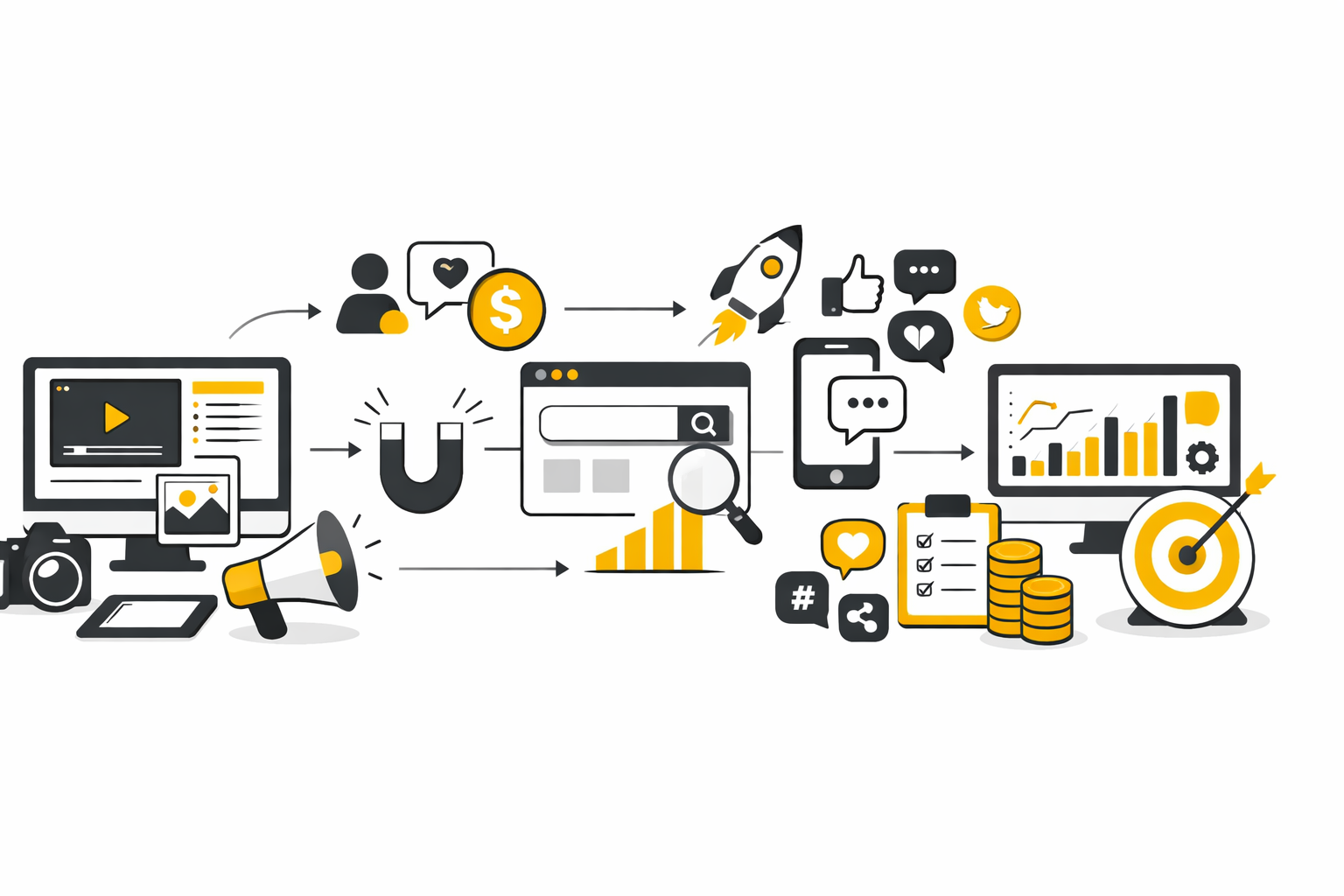
That is why the best digital content agency is not a content mill and not just a loose collection of freelancers with a polished proposal deck. It is a team that turns audience research into a repeatable engine for publishing, distribution, and conversion. Research from LinkedIn and Bain, plus channel data from HubSpot, Wistia, and BrightEdge, all reinforce the same practical point: brands grow when their message is familiar, useful, visible, and adapted to the way people actually discover information.
A lot of companies try to fix the execution gap with software alone. Tools like HighLevel, Manychat, and Buffer can absolutely support the stack, but software does not decide what the audience needs to hear, which formats deserve the budget, or how one strong idea should turn into search content, email, social clips, sales enablement assets, and conversion pages. Google still centers its guidance on helpful, reliable, people-first content, so publishing more noise is not the answer. Building a smarter system is.
Adobe’s framing around the content supply chain is useful here because it captures what modern content work really is: planning, creating, activating, and measuring as one operating model. That is the standard a serious digital content agency should be held to. If the agency cannot connect those moving parts, it is not building growth. It is just producing deliverables.
This guide is organized in six parts:
- What a Digital Content Agency Actually Does
- Why a Digital Content Agency Matters Now
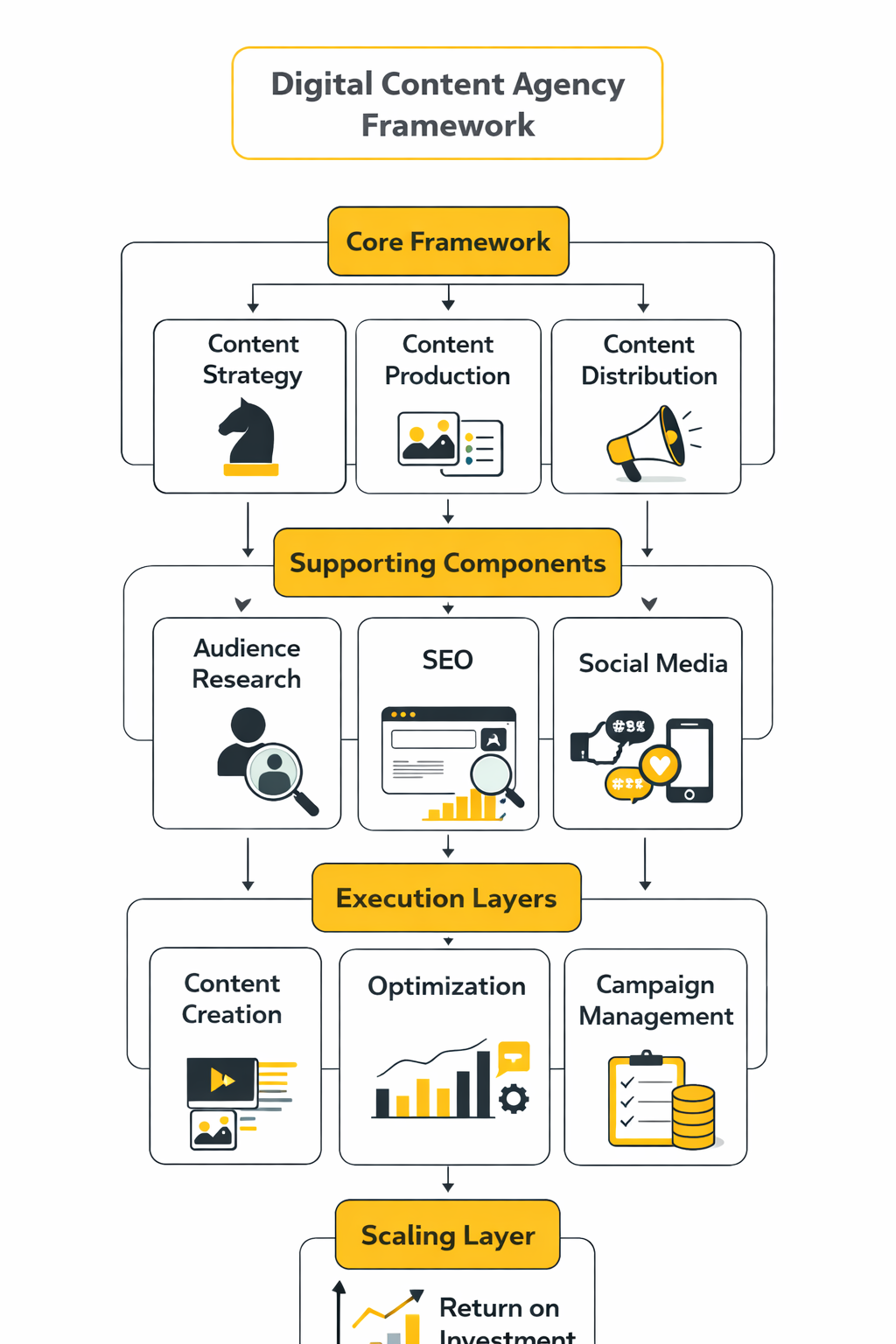
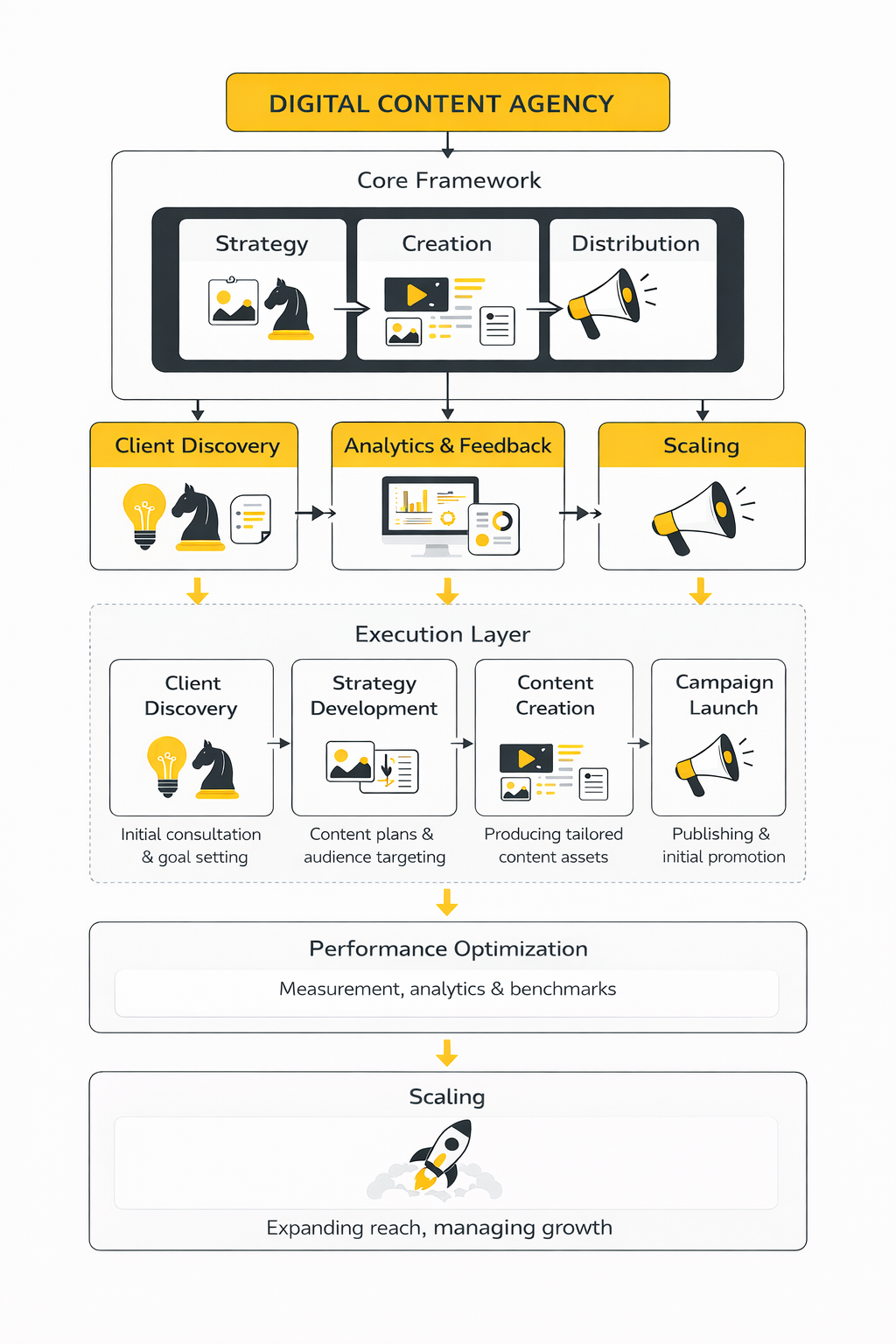
- Framework Overview: The Digital Content Agency Model
- Core Components: Services, Systems, and Team Roles
- Professional Implementation: Hiring, Onboarding, Pricing, and KPIs
- Common Mistakes, Red Flags, and Frequently Asked Questions
That order is deliberate. First, we need to define the role properly, because most confusion starts there. Once that foundation is clear, the rest of the decisions around hiring, structure, process, and performance become much easier.
What a Digital Content Agency Actually Does
So what does that look like in practice? A real digital content agency decides what a brand should say, which formats deserve attention, how that message should change by channel, and how performance should be measured after the content goes live. That scope has expanded because content demand keeps climbing while operations stay messy; Adobe’s latest research says more than 60% of marketers have already seen content demand grow 5x or more, and CMI found that 45% of B2B marketers still do not have a scalable content creation model. Adobe for Business+1
It turns strategy into a working system
The best digital content agency does not start with deliverables. It starts with audience questions, search behavior, buyer objections, content gaps, subject-matter access, and the commercial outcomes the client actually cares about. That is why the job looks a lot like building an operating system: Adobe frames modern content work as a content supply chain, and LinkedIn’s 2024 benchmark describes the strongest marketing organizations as more agile, data-driven, and customer-centric than the old campaign-first model ever allowed. Adobe pro podnikání+1
A weak agency asks, “How many posts do you need this month?” A strong one asks which themes should own the category, which formats should carry authority, which assets can be repurposed, and which workflows keep quality high when volume rises. That difference is not cosmetic. It is the reason some teams publish constantly and still feel invisible, while others build compounding visibility from a smaller number of stronger ideas. Content Marketing Institute+1
It adapts one message across the channels buyers actually use
A modern digital content agency is not just a writing team, because buyer discovery no longer happens in one place. CMI’s 2025 benchmark shows that 61% of B2B marketers expect their organizations to increase investment in video, Wistia’s 2025 report is built on more than 100 million videos and 1,300-plus surveyed professionals, and HubSpot’s 2025 social report says 84% of marketers expect consumers to search for brands on social media. That combination changes the agency brief completely, because the same core message now has to work as an article, a video, a short clip, a landing page, an email, and a social search asset. Content Marketing Institute+2
That is why channel translation matters so much. A thought-leadership piece might become a search-focused article for organic discovery, a short-form video for reach, a carousel for social saves, a nurture email for warm leads, and a tighter sales asset for bottom-funnel conversations. When a digital content agency gets this right, it is not “making more content.” It is extracting more business value from the same strategic idea. brightedge.com+2
It ties content to conversion instead of vanity metrics
This is the part many agencies still get wrong. They can publish, schedule, and report, but they stop before content becomes action. Google’s own guidance still says SEO works best when it supports helpful, reliable, people-first content, while BrightEdge’s 2025 research says organic search remains the primary driver and converts far better than AI search referrals. So the agency’s job is not to chase empty impressions. It is to create content that earns discovery and then moves visitors into the next useful step. Google for Developers+1
In practical terms, that usually means pairing content with infrastructure. A guide may need a cleaner conversion path in Replo or ClickFunnels, lead capture through Fillout, conversation flows in Manychat, email nurture through Brevo, and follow-up or pipeline management inside HighLevel. That setup is not a side issue. It is the difference between content that looks busy and content that creates movement.
Why a Digital Content Agency Matters Now
Buyers want to learn before they want to talk
This role matters now because the buying journey has become more self-directed and more frustrating at the same time. Gartner reported in March 2026 that 67% of B2B buyers prefer a rep-free experience, and Forrester’s latest business buying research says 86% of B2B purchases stall during the process. Put those two findings together and the implication is hard to ignore: buyers want autonomy, but most companies still make it too hard to understand, compare, and trust what they are selling. Gartner+1
That is exactly where a digital content agency earns its seat. It can build the educational layer that lets buyers move at their own pace, whether that means category pages, comparison content, expert explainers, short videos, FAQs, nurture sequences, or better landing pages. When content does its job, sales does not disappear. Sales gets brought in later, with a better-informed prospect and far less wasted motion. Gartner+2
Buying groups are bigger than the visible audience
Another reason this matters is that the audience you can see is not the full audience making the decision. LinkedIn’s research on hidden buyers describes them as high-influence stakeholders from functions like finance, procurement, or legal who often do not show up in normal campaign data, and LinkedIn’s work with Bain says brand familiarity across the whole buying group is the most important factor shaping B2B purchase choices. That means content cannot be written only for the loudest persona or the person who filled out the form. It has to create clarity and confidence across the broader decision group. linkedin.com+1
This is one of the biggest reasons a serious digital content agency can outperform an overstretched in-house team. Someone has to think about the executive buyer, the evaluator, the blocker, the legal reviewer, and the skeptical finance stakeholder at the same time. When that work is done well, content stops behaving like isolated marketing collateral and starts behaving like consensus-building infrastructure. linkedin.com+1
AI raises the standard instead of lowering it
A lot of teams assumed AI would make content easier by default. The reality is harsher. HubSpot’s 2025 trend data says 56% of marketers believe the internet is flooded with AI-generated content, CMI found that only 4% of B2B marketers have a high level of trust in generative AI outputs, and Google still frames successful search content around usefulness rather than shortcuts. So the strategic value of a digital content agency is not that it can press the AI button faster. It is that it can combine AI with editorial judgment, brand voice, review processes, and distribution discipline. blog.hubspot.com+2
That is the real shift. The market does not reward raw content volume the way it once did, and it definitely does not reward generic output that sounds like everyone else. A digital content agency matters now because brands need a team that can create clarity under pressure, scale without losing trust, and turn content into something much closer to a growth system than a publishing calendar. Content Marketing Institute+2
Framework Overview: The Digital Content Agency Model
The clearest way to understand a modern digital content agency is to stop thinking in terms of isolated services and start thinking in terms of a connected operating model. Adobe now frames the content lifecycle as planning, creating, managing, activating, and measuring, while Google keeps the quality bar centered on helpful, reliable, people-first content. Put those together and the job becomes much clearer: a digital content agency exists to move one strong market insight through a repeatable chain until it becomes visibility, trust, and commercial action. Adobe pro podnikání+1
That model matters because most teams are still not operationally ready for the volume they are trying to publish. CMI found that 45% of B2B marketers lack a scalable model for content creation, and only 19% say AI is integrated into daily processes and workflows. So the framework is not just a nice way to organize the work. It is the difference between content that compounds and content that collapses under its own production pressure. Content Marketing Institute
Start with market intelligence, not content ideas
A strong digital content agency begins with signals, not slogans. That means search behavior, sales objections, customer language, competitor positioning, internal subject-matter expertise, and the practical questions buyers ask before they are ready to convert. Google’s own guidance pushes creators to evaluate whether content is genuinely useful to people, and that is only possible when the agency understands the real problems, vocabulary, and expectations behind the query. Google for Developers+1
This is where the research system needs to be tighter than most brands expect. Intake can run through a structured form in Fillout, expert interviews can be scheduled through Cal.com, raw source material can be collected and organized with tools like Firecrawl, and voice notes or fast internal capture can be cleaned up with Wispr Flow. The point is not the tool stack itself. The point is that a digital content agency should have a deliberate way to gather truth before it starts drafting anything. Google for Developers+1
Build one pillar into a multi-format content system
Once the research is solid, the next move is to design the editorial architecture. This is the stage where a digital content agency decides which ideas deserve pillar treatment, which supporting articles should surround them, which formats can widen reach, and which assets should support conversion later. Google’s Search Essentials still emphasizes basics like using the words people actually search for, making links crawlable, and helping Google understand images and video, so structure is not a cosmetic concern. It is part of discoverability. Google for Developers+1
This is also where format choices become strategic instead of fashionable. CMI reports that videos are now the most effective B2B content type and that 61% of marketers expect to increase investment in video, while Wistia’s latest report says 8 in 10 B2B teams use LinkedIn as their primary video channel. So the right framework usually starts with one source asset, then plans its derivatives on purpose: article, video, short clips, carousel, email, landing page, and sales-support content. Content Marketing Institute+1
The execution loop that makes the framework real
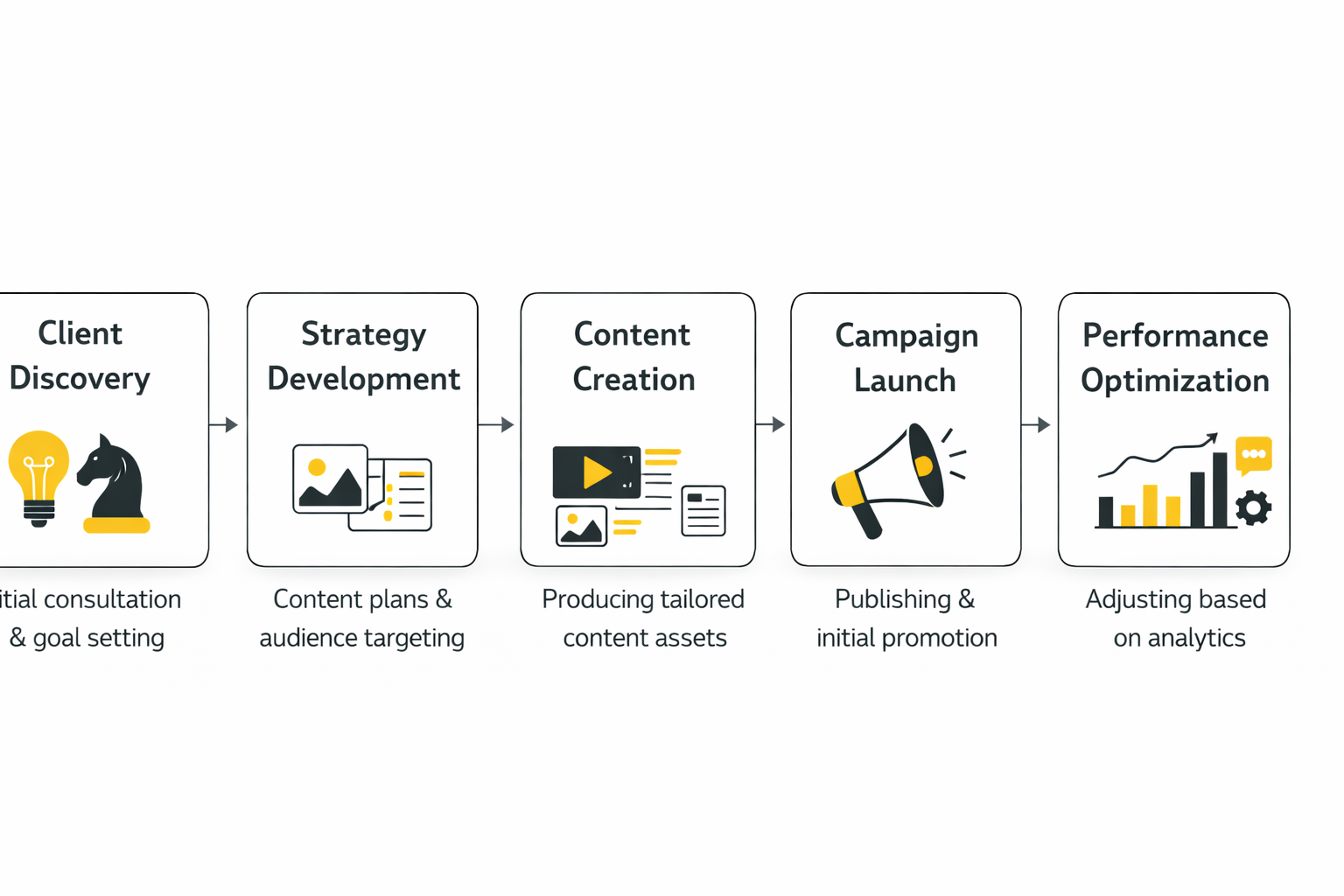
This is the point where the process has to become visible, or the framework stays theoretical. A competent digital content agency should be able to show the client exactly how an idea moves from research to revenue, who owns each stage, and what gets measured before the next cycle begins. If that workflow is vague, the strategy usually is too. Adobe pro podnikání+1
- Define the commercial target first. Before the brief is written, the agency should decide whether this asset is meant to earn search visibility, create demand, nurture leads, support a launch, or help sales close more efficiently. That keeps the content from drifting into “interesting but disconnected” territory.
- Extract the source material. This is where interviews, transcripts, customer calls, product notes, market research, and internal expertise get turned into raw material. The agency is not inventing authority here. It is organizing it.
- Create the primary asset. Usually that means one strong anchor piece with enough substance to support repurposing later. Google’s documentation still rewards content that is helpful, reliable, and created for people, so the source asset has to carry real depth before anything gets chopped into smaller pieces. Google for Developers+1
- Atomize for channels without diluting the message. One thoughtful article can become a LinkedIn video script, short clips, an email sequence, a social post series, a founder talking-point sheet, and a conversion page angle. HubSpot’s 2025 social research says 84% of marketers expect consumers to search for brands on social media, which is exactly why channel versions need to be intentional rather than copied and pasted. offers.hubspot.com
- Distribute with a real publishing system. Scheduling and amplification often run better with tools like Buffer or Flick, while outreach, nurture, and campaign follow-up can sit inside Brevo or Moosend. The important part is that distribution is planned at the same time as creation, not treated as an afterthought once the asset is already live.
- Capture response and feed it back into the next cycle. Comments, watch time, assisted conversions, sales feedback, search terms, and objection patterns should all reshape the next brief. When the loop is working, every published asset makes the next one smarter.
The beauty of this model is that it gives the client something most agencies still fail to provide: continuity. Instead of constantly asking what to create next, the team is running an engine that already knows how to research, produce, adapt, distribute, and learn. That is what makes a digital content agency feel strategic in practice rather than strategic only in a proposal deck. Content Marketing Institute+2
The loop closes with conversion and measurement
A framework is only useful if it can prove movement. BrightEdge’s 2025 research shows that AI search is growing fast but still accounts for less than 1% of referral traffic, while organic search remains the primary driver and delivers most conversions. That matters because it tells a digital content agency how to think about channels: AI discovery can influence early research, but conversion still needs strong search visibility, strong pages, and strong follow-through. brightedge.com
That is why the workflow needs measurement decisions before launch, not after. Google Analytics documents make it clear that teams can configure recommended events and create or modify key events to track meaningful actions like form submissions, confirmations, and other business outcomes. In practice, the agency often pairs content with pages in Replo, lead capture in Manychat or Fillout, CRM follow-up in HighLevel or Copper, and sometimes an on-site assistant through Chatbase. Not every client needs that exact stack, but every serious client does need the same principle: content should be tied to visible business actions, not just impressions and applause. Google for Developers+2
Once this framework is in place, the next question becomes much more practical. Which services, systems, and people actually make it run well without creating bottlenecks, duplicated work, or inconsistent output?
Reading the Numbers That Matter
A digital content agency does not become valuable because it can produce a dashboard. It becomes valuable when it can tell the difference between activity, traction, and business progress. That distinction matters because content usually works across several outcomes at once: CMI’s 2025 benchmark found that content helped B2B marketers create brand awareness most often, but it also supported demand generation, lead nurturing, loyalty, and revenue, while only 22% of marketers said their overall approach was extremely or very successful. Content Marketing Institute+1
That gap is exactly why measurement deserves its own section. The strongest teams in CMI’s research were more likely to have effective strategy, scalable creation models, the right technology, and stronger measurement discipline, which tells you something important: better reporting is not a finishing touch. It is one of the things that separates content teams that feel busy from content teams that actually compound results. Content Marketing Institute+1
Start with outcomes, not dashboards
The first measurement mistake most brands make is asking one metric to explain everything. Content can create awareness at the top of the funnel, help prospects compare options in the middle, and support revenue near the bottom, so one asset may succeed in more than one way. CMI’s latest data makes that plain: 87% of B2B marketers said content helped create brand awareness in the last 12 months, 74% said it helped generate demand or leads, 62% said it helped nurture subscribers or leads, and 49% said it helped generate sales or revenue. Content Marketing Institute
That means a digital content agency should define the win condition before the asset goes live. If the goal is discovery, the right question is whether the content earned qualified visibility. If the goal is demand capture, the right question is whether the content produced key actions from the right visitors. Blending those into one vague “performance” score is how teams end up overvaluing traffic spikes and undervaluing content that quietly moves real buyers forward. Google Podpora+1
Build a layered analytics system
The cleanest way to measure content is to track it in layers. Google Search Console already separates core search signals like clicks, impressions, click-through rate, and average position, while Google Analytics organizes user behavior around engagement and key events. A good digital content agency uses those layers together so discovery, attention, action, and attribution do not get mashed into one confusing report. Google Podpora+2
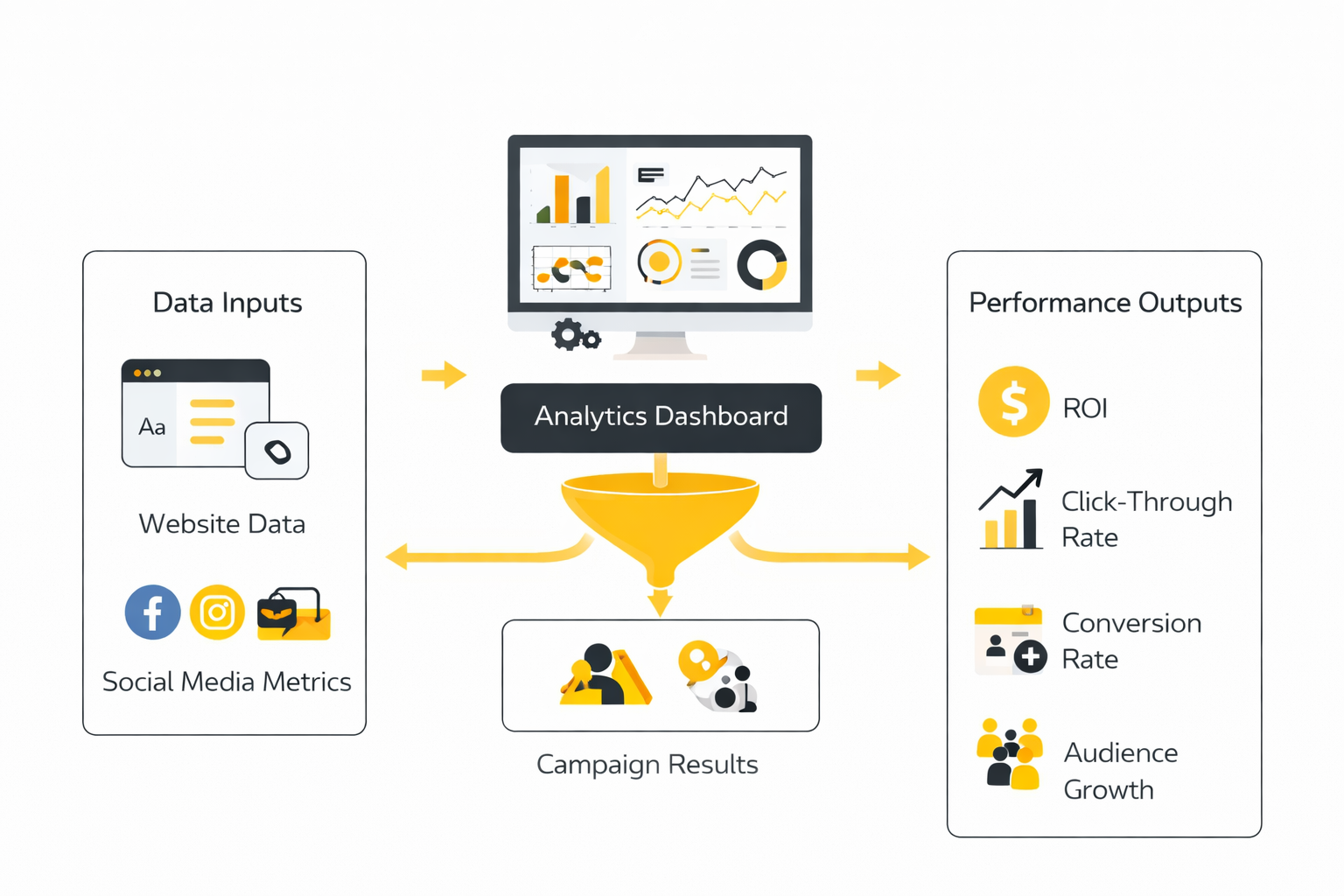
A practical scorecard usually has four layers:
- Discovery Track impressions, clicks, CTR, and query-level visibility in Search Console, then compare that with social discovery patterns. This matters more now because HubSpot’s 2025 report shows 84% of marketers expect consumers to search for brands on social media, while BrightEdge found that AI search is growing quickly but still accounts for less than 1% of referral traffic, with organic search remaining the main conversion driver. The action here is simple: if impressions rise but clicks do not, the problem is usually message fit, query intent, or packaging rather than raw visibility. Google Podpora+2
- Engagement Measure what people actually do after the click. Google defines an engaged session as one that lasts longer than 10 seconds, has a key event, or includes two or more page or screen views, and it calculates average engagement time based on time the site was actually in focus. That is a better layer than pageviews alone because it helps a digital content agency spot whether the content is being consumed or merely opened. Google Podpora+1
- Conversion Turn important actions into trackable key events. Google describes a key event as an action that is particularly important to business success, and its attribution path reports show which channels initiate, assist, and close those actions across the journey. In other words, this is where content stops being “interesting” and starts being measurable against actions like form submissions, booked calls, trial starts, or qualified chats. Google Podpora+2
- Operational efficiency The last layer is internal, but it still matters. CMI’s top performers were more likely to have scalable creation models and better measurement, which is a strong reminder that content performance is partly a production problem. If a digital content agency cannot see time to publish, repurposing rate, review bottlenecks, and cost per qualified outcome, it will eventually confuse hard work with efficient growth. Content Marketing Institute+1
This is also where the stack needs to talk to itself. Wistia reports that more than half of marketers connect their video platform to a CRM or email tool so video analytics can sit next to the rest of their marketing data, which is the right instinct. Whether that reporting lives in HighLevel, Brevo, Copper, or a cleaner lead-capture flow built with Fillout, the principle is the same: disconnected channel reports make smart content look weaker than it really is. wistia.com+2
Use benchmarks carefully
Benchmarks help most when they stop you from overreacting. Brevo’s 2025 benchmark, based on more than 44 billion emails, shows an overall open rate of 31.22% and click-through rate of 3.64%, with EMEA slightly stronger at 33.21% opens and 4.05% CTR. That is useful context, but it is not a target carved in stone, especially because Brevo also notes that its methodology accounts for Apple Mail Privacy Protection. So if a digital content agency is serious about signal quality, it should treat clicks, click-to-open rate, and downstream key events as more decision-worthy than opens alone. brevo.com
The same rule applies to video. Wistia’s 2025 data shows that longer videos tend to have lower engagement rates, but it also explicitly warns that this does not mean shorter is always better because longer videos can still earn more total watch time. Their benchmarks also show how-to videos under one minute averaged 82% watched, while how-to videos between one and 30 minutes still held over 50% watched on average. The correct interpretation is not “make everything short.” It is “match the format to the job, then judge performance against the intent of that format.” wistia.com+1
Search data needs the same restraint. Search Console tells you which queries and pages earn impressions, clicks, and CTR, but it also warns that position is based on Search Console heuristics and can shift with search features and layout. So average position is useful for diagnosing discoverability, but it is a poor KPI to celebrate on its own. A digital content agency should care more about whether a page is earning the right clicks and leading to the right next action than whether it moved from position 8.3 to 6.9. Google Podpora+1
What the numbers should make you do
When impressions rise and CTR stays weak, the usual fix is not more publishing. It is a better promise. Rework the title, tighten the opening angle, improve metadata, and make sure the page is matching the query intent you are actually being shown for in Search Console. Google Podpora+1
When engagement looks healthy but key events stay flat, the content is probably doing its educational job but failing at the handoff. That is a conversion design problem, not a content consumption problem. In that situation, a digital content agency should test a sharper CTA, reduce form friction, improve the landing experience in tools like Replo, or route warm visitors into a more direct flow with Manychat or Chatbase. Google Podpora+2
When video or social engagement looks strong but attributed conversions look weak, the next step is not to dismiss the channel. It is to inspect assisted paths. Google’s attribution reports are built for exactly this problem, because they show which channels initiate, assist, and close key events instead of rewarding only the last visible touchpoint. Google Podpora+1
And when a team is producing more content every quarter without a proportional lift in qualified actions, the numbers are usually pointing to one of three issues: weak topic selection, weak distribution, or weak repurposing discipline. CMI’s top performers stand out because they align goals, understand their audience, create higher-quality content, and measure performance effectively. That is the deeper lesson in the data. The winning digital content agency is rarely the one publishing the most. It is the one learning the fastest from what the numbers are actually saying. Content Marketing Institute+1
Once that measurement logic is in place, the next step gets easier to judge: which services, systems, and roles does a digital content agency actually need to run this model without bottlenecks or wasted motion?
Core Components That Hold Up at Scale
The hardest part of running a digital content agency is not getting work out the door. It is keeping the work sharp when volume rises, channels multiply, and every stakeholder wants their own version of the message. That is why the strongest agencies stop thinking in terms of disconnected services and start thinking in terms of one connected content supply chain with planning, creation, activation, and measurement working together. Adobe pro podnikání+2
That operating model matters because scale exposes weaknesses fast. Content Marketing Institute’s recent research shows that many teams still struggle with scalable creation models, differentiation, and consistency, even when budgets or output expectations rise. In other words, growth does not automatically make a digital content agency better organized. It usually makes weak systems more visible. Content Marketing Institute+2
Service scope should follow the buying journey
A digital content agency gets stronger when its service mix reflects the buyer journey instead of the agency’s internal org chart. Buyers increasingly prefer to research on their own, hidden stakeholders still influence decisions behind the scenes, and high-quality thought leadership helps open doors with those less visible decision-makers. That means content strategy, search, email, video, landing pages, and sales-support assets should be designed as one journey, not sold as unrelated line items. gartner.com+2
This is where agencies often overcomplicate things. You do not need fifteen service categories. You need enough capability to move a prospect from discovery to trust to action. In practice, that usually means a smaller, tighter stack built around publishing, conversion, and follow-up tools such as HighLevel, Brevo, Buffer, and landing page systems like Replo when a cleaner conversion path is needed.
Build around editorial leadership, not just production capacity
A surprising number of agencies try to scale by adding more writers, editors, or designers before they tighten editorial leadership. That is backwards. Google’s guidance still centers on helpful, reliable, people-first content, and its quality framework keeps pointing back to experience, expertise, authoritativeness, and trust. Without strong editorial direction, more production simply creates more polished confusion. Google for Developers+2
That editorial layer is what turns raw expertise into usable assets. Someone has to decide which claims need sourcing, where subject-matter input is thin, which topic deserves a pillar asset, and how far a piece can be repurposed before it loses precision. A digital content agency that treats editorial judgment as overhead will usually end up with higher output but weaker authority, and that is a bad trade once trust becomes the real differentiator. edelman.com+2
Use AI to compress labor, not replace expertise
AI has absolutely changed the economics of agency work, but not in the simplistic way people hoped. Content Marketing Institute’s research shows AI adoption is climbing while trust in raw generative output remains limited, and Adobe keeps framing AI as part of a broader content workflow rather than a substitute for strategy, review, or governance. The smart move is to use AI to speed up research synthesis, outlines, repurposing, transcription, and production support, while keeping humans responsible for judgment, positioning, and final accountability. Content Marketing Institute+2
That distinction matters more as the web gets noisier. If a digital content agency uses AI mainly to produce more generic material, it trains itself to look efficient while becoming easier to ignore. If it uses AI as leverage inside a strong editorial system, it can move faster without flattening voice or weakening trust. Tools like Wispr Flow, Firecrawl, and Guideless are useful in that second model because they support workflow and synthesis rather than pretending to replace expertise.
Professional Implementation: How to Keep Quality While You Scale
Once the service model is clear, implementation becomes the real test. This is where many agencies start promising strategy but end up delivering task management. A scalable digital content agency needs a client operating model that protects quality, speeds up approvals, and reduces the amount of time wasted translating half-formed internal opinions into endless revisions. Adobe pro podnikání+2
Onboarding should extract knowledge before it asks for output
Most onboarding failures come from rushing into production before the agency has earned enough context. Google’s quality guidance makes it obvious why that is dangerous: content quality depends on real usefulness, real experience, and clear responsibility for what is being published. A good digital content agency therefore spends the first phase pulling out customer language, product nuance, sales objections, legal constraints, and internal expertise before it locks the content calendar. Google for Developers+2
This is where lightweight systems help. Intake can start in Fillout, expert sessions can be organized through Cal.com, and structured follow-up can live inside Copper or HighLevel. The exact stack is flexible, but the principle is fixed: the agency should pull insight out of the client in a repeatable way instead of rediscovering the same context every month.
Review workflows need governance, not more meetings
As agencies grow, review usually becomes the first real bottleneck. Adobe’s recent product and workflow documentation keeps returning to the same issue: file shuffling, version drift, scattered feedback, and approval delays waste time and weaken content quality. So one of the most professional things a digital content agency can do is design approval paths in advance, with clear owners for brand, legal, subject-matter review, and final sign-off. Adobe pro podnikání+2
This sounds operational, but it is strategic. Every unclear approval path increases revision loops, slows publishing, and teaches teams to water down bold ideas before anyone even objects. The agencies that scale cleanly are usually the ones that reduce approval chaos early, not the ones that hire more people to absorb it.
Pricing should reward clarity and iteration, not just volume
This is one of the biggest strategic tradeoffs in the whole business. If a digital content agency prices itself mainly by asset count, clients naturally start measuring value by volume, and the work drifts toward throughput. That may feel efficient for a while, but it usually punishes research depth, strong distribution planning, and the iterative improvements that actually move performance.
A better model is to anchor pricing to operating scope. That means the fee reflects how much strategic planning, editorial leadership, channel adaptation, workflow management, and performance analysis the engagement requires. Deliverables still matter, obviously, but they should sit inside the system rather than define the system. When the commercial structure rewards focus and iteration, the agency can make better decisions about where to go deeper, where to repurpose, and where not to create another asset just to justify the invoice.
Scaling breaks when repurposing turns into duplication
Repurposing is one of the best advantages a digital content agency can create, but it has a limit. Research from Wistia and Content Marketing Institute keeps showing that video, thought leadership, and multi-format content matter more, which pushes agencies to spread good ideas across more channels. That is smart right up until every channel starts receiving a thinner, lazier version of the same message. wistia.com+2
The expert move is to repurpose by intent, not by format count. A long-form article can become a short-form video, but the video should be built for attention and retention, not just read aloud. An email should not feel like a blog excerpt with a subject line attached. A landing page should not copy the thought-leadership piece word for word when its job is to create action. If that discipline slips, a digital content agency starts calling duplication a strategy.
The risk at scale is not only quality loss. It is strategic drift.
There is a more subtle problem that shows up once the operation is working: the agency becomes so good at publishing that it stops challenging the plan. Content Marketing Institute’s recent enterprise research stresses strategy, alignment, personalization, and operating model decisions as the real levers at scale, which is a useful warning. Efficient execution is valuable, but it can also hide the fact that the wrong topics, the wrong offers, or the wrong audience assumptions are being executed very well. Content Marketing Institute+2
That is why the best digital content agency keeps a strategic checkpoint built into the rhythm of the engagement. It reviews whether the audience assumptions still hold, whether the hidden buyers are being addressed, whether the content is helping sales conversations, and whether channel effort still matches business reality. Without that reset, scale becomes a trap: the machine keeps moving, but it is no longer moving in the right direction. linkedin.com+2
By this point, the pattern should be clear. The value of a digital content agency is not just that it can create content. It is that it can build a system for authority, distribution, conversion, and learning without losing trust as it grows. That sets up the final piece of the article naturally: the mistakes, red flags, and practical questions that separate a genuinely useful agency from one that only sounds good in a pitch.
Common Mistakes and Red Flags
By the time a company gets to agency selection, the surface-level questions are usually easy. The harder questions are operational: how strategy gets translated into production, how expertise gets protected, how performance gets judged, and whether the system can survive scale without getting noisy. That is where a strong digital content agency separates itself from a polished pitch deck. Adobe pro podnikání+2
Selling deliverables before diagnosing the problem
One of the clearest red flags is an agency that offers a package before it has understood the audience, the offer, the buying journey, and the existing gaps in content, conversion, and distribution. Google’s own guidance keeps pushing creators toward helpful, people-first content, which is impossible to do well if the work starts with a deliverable quota instead of a diagnosis. A serious digital content agency earns the right to recommend output only after it understands what the business is trying to move. Google for Developers+1
That is why “we publish 20 pieces a month” is not automatically reassuring. High output can be useful, but only when it comes after clear topic selection, strong editorial judgment, and a distribution plan that matches buyer intent. If volume is being used to substitute for thinking, the client usually ends up paying for motion instead of progress. Content Marketing Institute+1
Mistaking AI speed for expertise
Another common mistake is treating AI as the strategy. Google does not say content fails because software touched it; the risk is content created primarily to manipulate rankings rather than benefit people, and that is exactly what happens when agencies let AI flatten nuance, evidence, and voice. A capable digital content agency uses AI to compress labor around synthesis, formatting, repurposing, and workflow, while keeping humans responsible for sourcing, judgment, and final accountability. Google for Developers+2
This tradeoff becomes more important as the market fills with interchangeable material. Faster drafting is useful, but it does not create authority by itself, and it definitely does not create trust in competitive categories. If the agency cannot explain where expertise enters the process, the output will usually sound efficient and forgettable at the same time. Google Services+1
Reporting activity while hiding business impact
A weak reporting system usually overemphasizes pageviews, impressions, follower growth, and other soft signals that feel encouraging but do not tell you whether the content changed behavior. Google Analytics is explicit that key events are the actions particularly important to business success, and its attribution path reports exist precisely to show how channels initiate, assist, and close those actions. So if a digital content agency cannot connect content to meaningful actions, it is not measuring performance deeply enough. Google Podpora+1
The practical fix is not to stop looking at awareness metrics. It is to put them in the right place. Discovery tells you whether the message is being seen, engagement tells you whether people care, and key events tell you whether the work is creating commercial movement. Google Podpora+1
Running approvals like an endless group chat
A lot of agencies talk about creativity and completely ignore approval design. Adobe’s content supply chain model keeps pointing to planning, creation, activation, and analytics as a connected system, and that only works when ownership is clear enough for work to move without constant re-briefing. A digital content agency that cannot define who reviews what, in what order, and by what standard will almost always lose speed and courage at the same time. Adobe pro podnikání
This is not glamorous, but it matters. Every unclear approval path increases revision cycles, blurs accountability, and encourages safer, weaker work because nobody wants to restart the thread. The best agencies reduce chaos early so strategy does not get diluted during production. Adobe pro podnikání+1
Using proof, endorsements, or partnerships carelessly
The final red flag is credibility theater. Testimonials, customer proof, influencer mentions, affiliate partnerships, and case-study claims can all help, but the FTC’s endorsement guidance is clear that endorsements and material connections need to be handled transparently. That matters for a digital content agency because trust is not built only through strong ideas. It is also built by how honestly the agency presents proof, incentives, and results. Federal Trade Commission+1
This becomes especially important when agencies recommend platforms, software, or growth stacks. There is nothing wrong with using proven tools like HighLevel, ClickFunnels, or Systeme.io, but the recommendation should come from fit, not hidden incentives. Once readers or clients feel they are being routed through a sales script instead of an honest system, trust drops fast and rarely comes back cleanly. Federal Trade Commission
FAQ - Built for Complete Guide
What is the difference between a digital content agency and a traditional content marketing agency?
In practice, the line is not rigid, but a digital content agency usually has a more operational role across formats, channels, and conversion systems. It is not just planning articles or campaigns; it is often responsible for turning one strategic idea into search content, video, email, social distribution, landing pages, and measurable next steps. The more modern the buying journey becomes, the more that broader operating model matters. Adobe pro podnikání+1
When should a company hire a digital content agency instead of building in-house?
A company should usually hire outside help when demand is rising faster than internal coordination, when leadership wants results across multiple channels, or when the in-house team lacks the editorial depth to turn expertise into a repeatable publishing system. Adobe’s content supply chain framing is useful here because it shows how much content work now depends on connected planning, production, activation, and analytics rather than isolated creative tasks. If the problem is complexity rather than pure headcount, a digital content agency often makes more sense than simply adding one more internal marketer. Adobe pro podnikání+1
How long does it usually take before content starts showing results?
Some signals appear quickly, but serious results tend to arrive in layers. Search visibility, engagement quality, and assisted conversions often move before direct revenue becomes obvious, which is one reason Google Analytics attribution paths and key events matter so much in the first place. A good digital content agency sets expectations around staged progress instead of pretending every content investment should behave like paid traffic on day one. Google Podpora+1
Should a digital content agency guarantee rankings, leads, or revenue?
No serious agency should guarantee outcomes it does not fully control. Google’s own documentation on helpful content and Search Essentials focuses on creating eligible, useful, people-first content rather than offering a formula for guaranteed rankings, and that should shape the tone of any responsible proposal. A confident digital content agency can promise rigor, process, transparency, and iteration, but it should be careful with certainty language around rankings or pipeline. Google for Developers+1
How involved does the client need to be?
Usually more involved than they expect at the start and less involved than they fear once the system is running. The strongest work still depends on subject-matter access, product nuance, sales objections, and real examples that cannot be guessed from a website alone, especially if the goal is to publish content that demonstrates experience and expertise rather than generic fluency. A strong digital content agency reduces the time burden over time, but it does not eliminate the need for real source material. Google Services+1
Which channels should a digital content agency prioritize first?
That depends on where discovery and conversion are most likely to happen for the category, not on which platform is currently fashionable. Google Search still matters because Search Essentials define the basics of discoverability, while newer buyer behavior data from Gartner reinforces that people increasingly prefer to research on their own terms before speaking with sales. In most cases, the smart starting point is one strong discovery channel, one strong nurture channel, and one clean conversion path. Google for Developers+1
Is AI-generated content acceptable now?
AI-assisted content is acceptable when it improves workflow without replacing judgment. Google’s guidance focuses on whether content is helpful and created to benefit people, while Content Marketing Institute’s research shows marketers are using AI more heavily even though trust in raw generative output remains limited. So the right question is not whether AI touched the content, but whether the agency added real expertise, review, and accountability before publishing. Google for Developers+1
What should be included in monthly reporting?
Monthly reporting should include discovery metrics, engagement quality, key events, and interpretation. Google Analytics already defines engaged sessions and key events in a way that makes this cleaner than old vanity dashboards, and attribution paths help explain whether content initiated demand, assisted it, or closed it. A good digital content agency should not just send numbers; it should explain what changed, why it changed, and what action that should trigger next month. Google Podpora+2
What is a reasonable first 90-day plan?
A strong first 90 days usually focuses on diagnosis, system setup, one or two anchor assets, and the first measurement loop. That means audience and topic research, source extraction from experts, workflow design, conversion tracking, and a small number of high-leverage assets that can be repurposed across channels instead of a flood of disconnected posts. If a digital content agency spends the first quarter creating noise before it has built clarity, it is usually optimizing for appearances. Adobe pro podnikání+2
Should a digital content agency also handle distribution?
Usually yes, or at least own the distribution strategy even if some channel execution stays internal. Content that is created without a clear activation plan tends to underperform, which is why Adobe’s content supply chain model treats activation and analytics as part of the same system as creation. Distribution does not always mean managing every channel every day, but it should absolutely mean designing how the asset will reach the right audience. Adobe pro podnikání
Do you need video, or can written content still carry the strategy?
Written content still matters, but video has become too important to ignore in most serious content systems. Wistia’s 2025 report shows how central video has become to modern marketing programs, while Content Marketing Institute’s research continues to rank video among the most effective B2B content types and one of the main areas where marketers expect investment to rise. The practical answer is not “video everywhere.” It is “use video where it improves trust, clarity, or reach more efficiently than text alone.” wistia.com+1
What tools should a digital content agency already know how to connect?
The exact stack varies, but the agency should be comfortable connecting publishing, capture, nurture, and CRM layers. In practical terms, that often means landing pages in Replo, forms in Fillout, automation and pipeline flows in HighLevel, scheduling in Cal.com, and messaging or chatbot layers in Manychat or Chatbase. The tool list matters less than the agency’s ability to make the system measurable and usable without creating extra operational drag. Google Podpora+1
How do you know the engagement is actually working?
You know it is working when the content is creating the right sequence of behavior, not just isolated spikes. That usually looks like stronger discoverability, meaningful engagement, rising key events, better assisted-conversion visibility, and a healthier handoff into sales or self-serve conversion paths. A digital content agency should be able to show that chain clearly enough that you can see both what improved and where the next bottleneck sits. Google Podpora+2
Work With Professionals
Explore 10K+ Remote Marketing Contracts on MarkeWork.com
Most marketers spend too much time chasing clients, competing on crowded platforms, and losing a percentage of every project to middlemen.
MarkeWork gives you a better way. Browse thousands of remote marketing contracts and connect directly with companies desperate to hire skilled marketers like you, without platform commissions and without unnecessary gatekeepers.
If you're serious about finding better opportunities and keeping 100% of what you earn, explore available contracts and create a profile for free at MarkeWork.com.