

Digital display advertising has evolved into one of the most versatile tools for brands aiming to reach broad audiences while retaining precise targeting capabilities. Unlike search-based campaigns, which capture active intent, display advertising allows companies to proactively engage users as they navigate websites, apps, and social platforms. By leveraging visual storytelling, interactive formats, and strategic placements, businesses can drive awareness, retention, and conversion simultaneously.
The effectiveness of display campaigns lies in their ability to combine reach with personalization. Sophisticated programmatic platforms now allow advertisers to deliver tailored messaging based on demographics, behavior, and contextual signals. For example, a study found that brands utilizing dynamic display creatives experienced up to 75% higher engagement compared to static banners.
Beyond reach and targeting, display advertising supports remarketing strategies that re-engage users who have already interacted with a brand. This continuity strengthens brand recall and guides potential customers through the conversion funnel. When executed strategically, digital display campaigns become a powerful lever for both short-term engagement and long-term brand equity.
Article Outline
- Why Digital Display Advertising Matters
- Display Advertising Framework Overview
- Core Components of Display Campaigns
- Professional Implementation Strategies
- Analytics and Optimization
- Advanced Considerations and Scaling

The following sections will dive deeper into each layer of the display advertising ecosystem, exploring how brands can implement, measure, and scale campaigns effectively while maximizing ROI.
Why Digital Display Advertising Matters
Digital display advertising goes beyond traditional banners. It provides brands the ability to reach audiences at scale while delivering tailored messaging that aligns with user behavior and context. Its strategic value lies in the combination of visibility, targeting, and creative flexibility, which makes it a key driver for both brand awareness and direct response campaigns.
Companies leveraging programmatic platforms can dynamically adjust creatives, optimizing in real time for engagement and conversions. Brands using data-driven personalization in display ads have reported significantly higher click-through rates than generic campaigns. Moreover, display advertising supports retargeting, ensuring users who previously engaged with a brand remain in the conversion funnel.
The measurable nature of digital display campaigns allows marketers to tie impressions, clicks, and conversions directly to ROI. With advanced tracking and attribution tools, it’s possible to analyze performance across devices, platforms, and creative variations. This data-driven approach enables informed decisions on budget allocation and creative strategy, which can dramatically increase the efficiency of marketing spend.
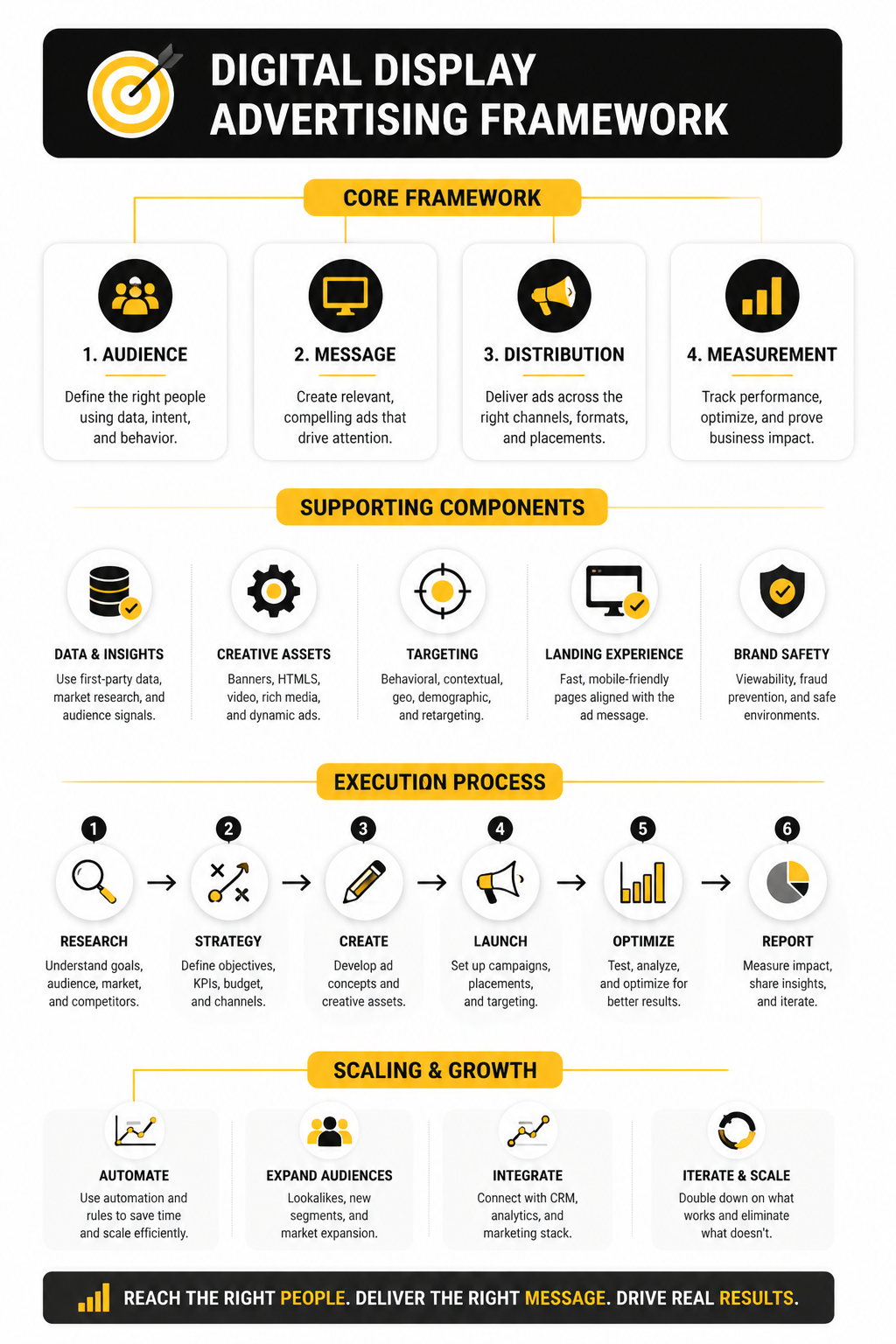
Display Advertising Framework Overview
The framework for successful digital display advertising integrates several critical components:
- Audience Targeting: Leveraging demographics, interests, and behavioral signals to reach the right users at the right time.
- Creative Strategy: Designing engaging visuals and messaging that capture attention and drive action.
- Placement & Bidding: Determining the optimal networks, ad exchanges, and bidding strategies for maximum reach and ROI.
- Measurement & Optimization: Continuously analyzing performance metrics to refine targeting, creative, and budget allocation.
This structure ensures campaigns are both strategic and adaptive, providing a blueprint for consistent results across industries and platforms.
Core Components of Display Campaigns
Breaking down the framework, core components include:
- Programmatic Buying: Automated ad purchasing based on audience data to maximize reach and efficiency.
- Creative Variations: Multiple ad formats—such as banners, videos, and rich media—to test engagement.
- Retargeting Mechanisms: Strategies for re-engaging users who have interacted with previous content.
- Analytics Infrastructure: Tools that track user behavior, ad performance, and conversion metrics across channels.
Each of these components interlocks to create a cohesive system where creative, data, and technology drive performance simultaneously. By prioritizing these areas, brands can maximize the effectiveness of their display advertising campaigns while reducing wasted spend.
Implementing Digital Display Advertising Campaigns
Executing a digital display advertising strategy requires a systematic approach that connects strategy, technology, and creative execution. The process begins with defining campaign objectives, which could range from brand awareness to driving conversions. Clear goals ensure that all subsequent decisions—from targeting to creative—are aligned and measurable.
Step 1: Audience Segmentation and Targeting
Start by analyzing audience demographics, behavior, and interests. Tools like programmatic platforms and first-party data allow marketers to create granular segments. For instance, retargeting users who visited a product page but didn’t convert can significantly increase conversion rates, with some campaigns showing up to a 70% lift in engagement when implemented effectively.
Step 2: Creative Development
Once the audience is defined, craft multiple creative variations for each segment. Banner ads, animated GIFs, and rich media should all be designed to capture attention while delivering a clear message. Testing different designs and messaging helps identify what resonates best with each audience segment.
Step 3: Placement Strategy and Bidding
Next, choose optimal placements across ad networks and exchanges. Programmatic bidding allows for automated purchasing of ad space at scale, dynamically adjusting bids to maximize ROI. This step ensures that ads are delivered in the right context, to the right user, at the right time.
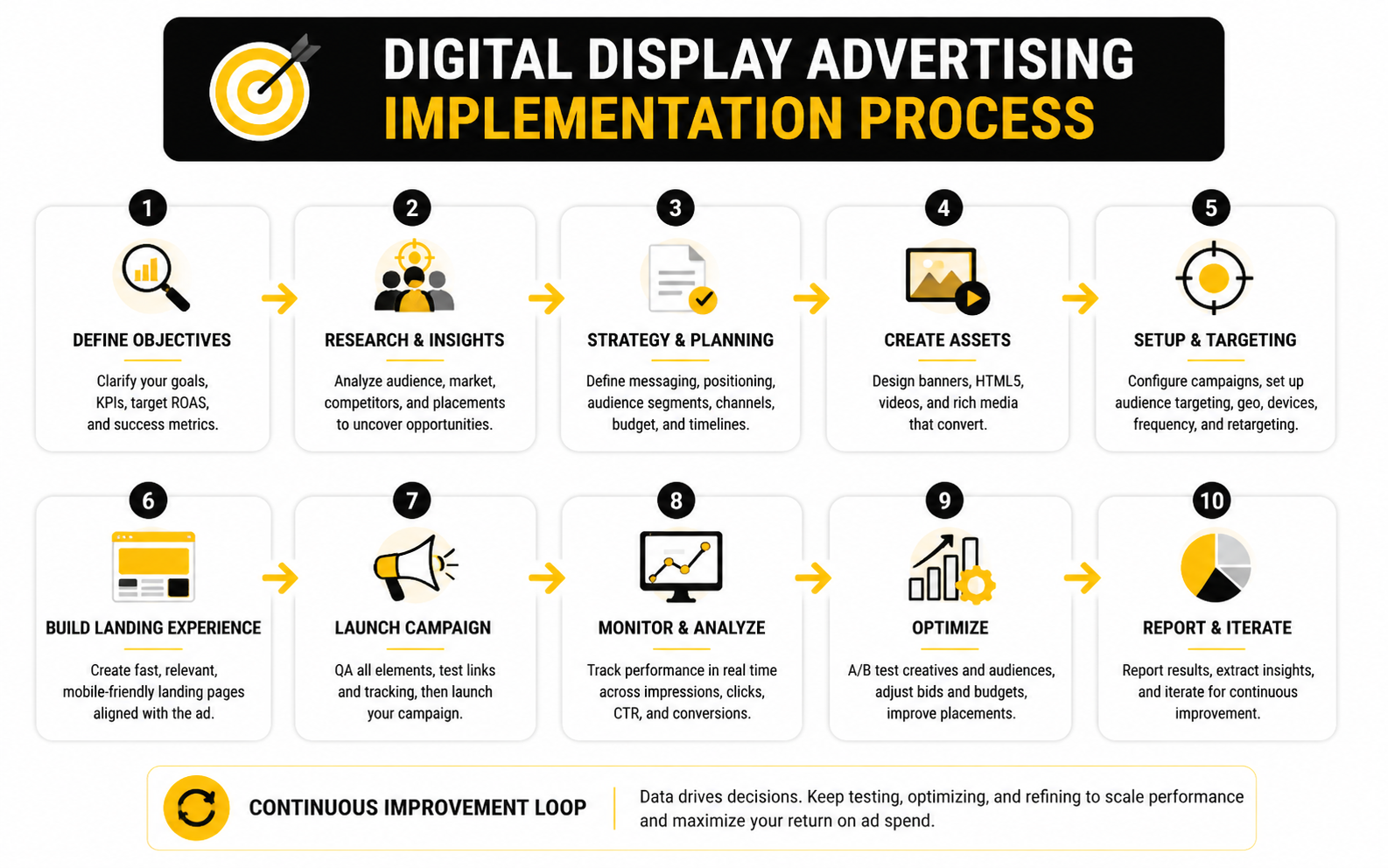
Step 4: Launch and Monitor
After setup, launch the campaign and monitor performance metrics in real time. Metrics such as impressions, clicks, CTR, and conversion rates provide insights into effectiveness. Early monitoring allows for rapid adjustments, preventing wasted spend and optimizing campaign performance.
Step 5: Continuous Optimization
Finally, continuously test and refine creative, targeting, and bidding strategies. Use A/B testing and performance analytics to determine which combinations yield the best results. Ongoing optimization is crucial for maintaining efficiency and maximizing return on investment, ensuring that the digital display advertising strategy evolves with market dynamics.
Tracking and Measuring Campaign Success
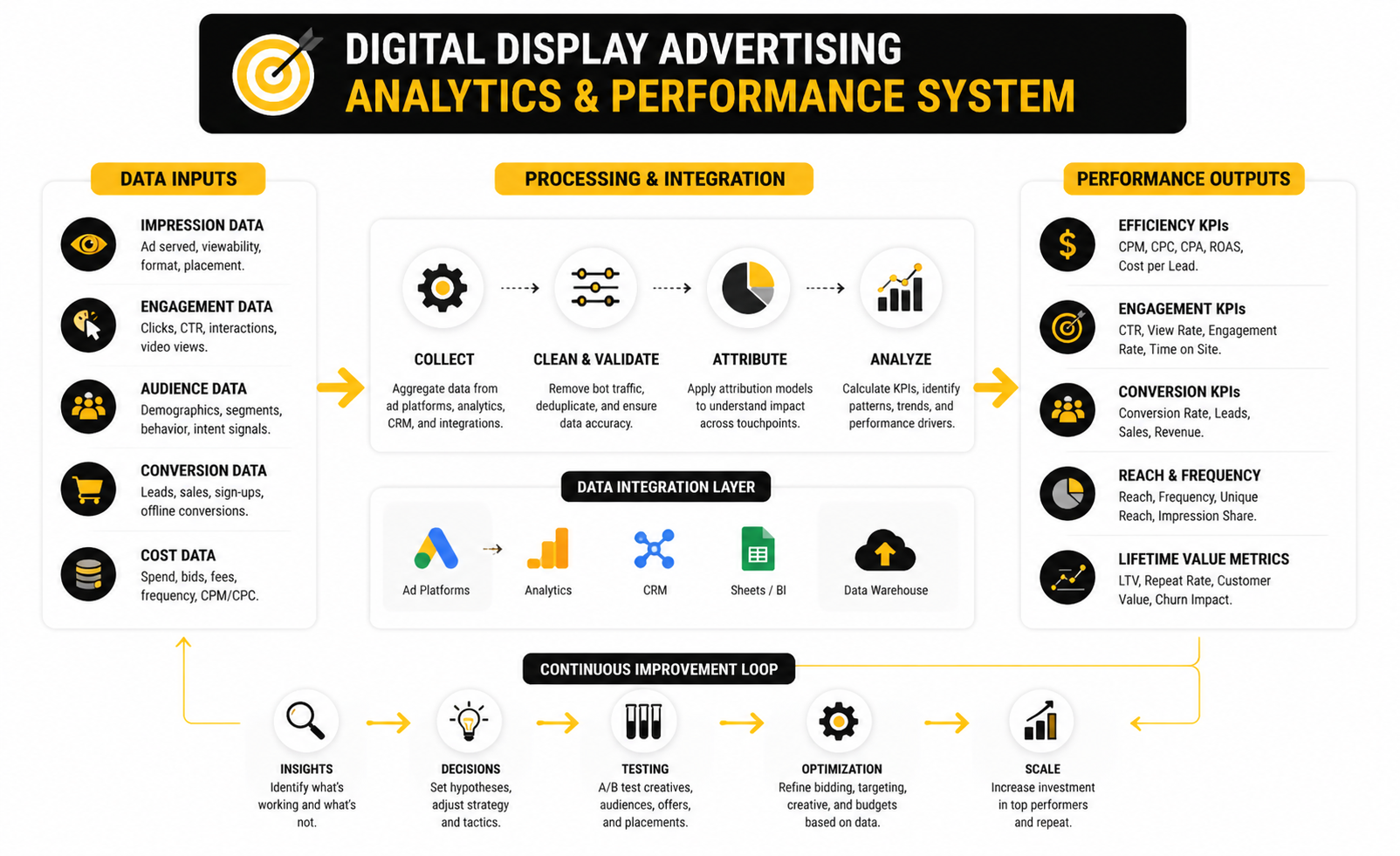
Digital display advertising is only as effective as the insights you extract from it. Metrics go beyond clicks—they tell a story about engagement, audience behavior, and ROI. Without a clear understanding of performance, campaigns can overspend while delivering minimal results.
Key Metrics to Monitor
To measure success accurately, focus on several core performance indicators:
- Impressions and Reach: Gauge how many users have seen your ads and the breadth of your audience.
- Click-Through Rate (CTR): Measures the percentage of viewers who engage with your ad, indicating relevance and appeal.
- Conversion Rate: Tracks the proportion of users completing a desired action, directly reflecting campaign ROI.
- Cost Metrics (CPC, CPM, CPA): Understanding these helps optimize bidding strategies and budget allocation.
- Viewability and Engagement: High viewability paired with meaningful engagement signals that creatives resonate with your audience.
Interpreting the Data
Numbers alone are not actionable without context. For example, a high CTR may seem positive, but if conversions are low, it signals a disconnect between creative messaging and landing page experience. Benchmarking against industry standards provides a frame of reference for evaluating performance. For instance, campaigns that exceed the average CTR for display ads typically indicate strong creative alignment with audience targeting.
Driving Action from Analytics
Data should inform tactical adjustments and strategic decisions. If engagement is lower than expected, consider refining audience segments, testing alternative creatives, or adjusting placements. Continuous monitoring and iterative optimization ensure campaigns stay efficient, relevant, and high-performing, turning raw numbers into meaningful business outcomes.
Scaling and Strategic Tradeoffs in Digital Display Advertising
As campaigns grow, managing scale without sacrificing performance becomes a critical challenge. Expanding your reach often increases costs, and oversaturation can reduce engagement. Striking the right balance between reach, frequency, and cost efficiency is key to sustainable growth.
Advanced Considerations
Scaling digital display advertising demands strategic insight:
- Audience Segmentation: Deep segmentation allows precise targeting but can fragment reach if over-applied. Testing multiple segments reveals the most profitable ones.
- Creative Rotation: Rotating creatives prevents ad fatigue. However, each variation increases tracking complexity and requires more sophisticated analytics to determine performance.
- Bid Management: Automated bidding optimizes cost-per-action but must be balanced with manual adjustments to respond to sudden market shifts or seasonal trends.
- Platform Diversification: Expanding to new networks can increase reach but introduces variability in inventory quality and performance benchmarks.
Risks and Mitigation
- Ad Fraud: Ensure campaign safety by using verified platforms and third-party monitoring to detect invalid traffic.
- Brand Safety: Display ads can appear next to inappropriate content. Implement strict placement controls and leverage contextual targeting.
- Data Misinterpretation: Over-reliance on surface-level metrics like impressions can mislead decision-making. Focus on conversion and engagement metrics for actionable insights.
Expert-Level Optimization
- Attribution Modeling: Advanced attribution helps determine which touchpoints truly drive conversions, allowing smarter budget allocation.
- Incrementality Testing: Conduct controlled experiments to measure the real lift from display campaigns rather than assuming all conversions are ad-driven.
- Dynamic Creative Optimization (DCO): Tailor creatives in real-time to individual users, maximizing relevance and engagement across segments.
- Cross-Channel Coordination: Synchronizing digital display with search, social, and email marketing ensures consistent messaging and reinforces brand recall.
Scaling requires not only budget but also systemized processes, analytics sophistication, and continual optimization. Brands that master these elements see measurable ROI improvements and can confidently expand their digital display presence without eroding performance.
Final Ecosystem and Integration
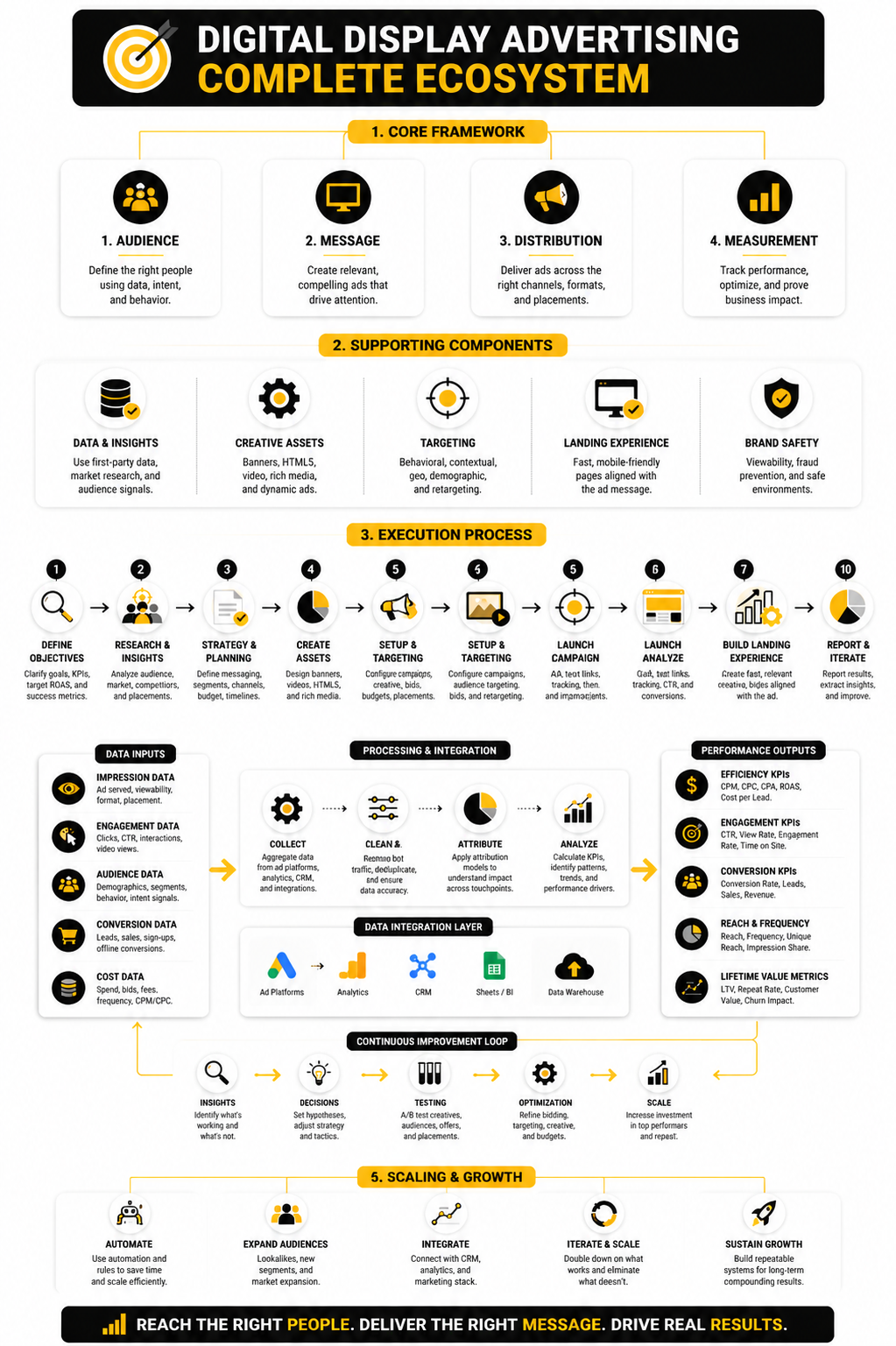
Building a high-performing digital display advertising strategy requires understanding the full ecosystem: from core frameworks and creative execution to analytics and optimization. Each layer interacts with the others, and a weakness in one segment can ripple through the system, affecting overall performance. Visualizing this interconnected system helps marketers plan, execute, and scale campaigns effectively.
FAQ - Built for Complete Guide
1. What is digital display advertising?
Digital display advertising is the practice of placing visual ads—such as banners, videos, or interactive creatives—across websites, apps, and social platforms to reach a targeted audience.
2. How does targeting work in display campaigns?
Targeting uses demographic, behavioral, contextual, and retargeting data to ensure ads are shown to users most likely to engage. The more precise your data, the higher the efficiency.
3. What metrics are most important?
Engagement rate, click-through rate (CTR), conversion rate, and return on ad spend (ROAS) are critical. Impressions and reach are helpful, but they don’t tell the full story without conversion context.
4. How often should creatives be refreshed?
Creative rotation should occur every 2–4 weeks or sooner if performance drops. Fresh visuals reduce ad fatigue and maintain audience engagement.
5. Is programmatic advertising necessary?
Programmatic allows automated bidding and audience targeting at scale. While not mandatory, it significantly increases efficiency for campaigns targeting multiple segments.
6. How do I measure attribution?
Use multi-touch attribution models to track the user journey across channels. This clarifies which campaigns contribute most to conversions and revenue.
7. What are the risks of scaling too fast?
Rapid scaling can lead to increased costs, audience saturation, and decreased ROI. Controlled, data-driven expansion mitigates these risks.
8. How do I ensure brand safety?
Implement strict placement controls, avoid controversial publishers, and use verified networks to protect your brand reputation.
9. Can display advertising work for small budgets?
Yes. Targeted campaigns focusing on high-value segments and measurable goals can yield meaningful results even with limited spend.
10. What’s the role of A/B testing?
A/B testing creatives, placements, and audiences allows marketers to optimize campaigns incrementally, ensuring the best-performing strategies are scaled efficiently.
Work With Professionals
Explore 10K+ Remote Marketing Contracts on MarkeWork.com
Most marketers spend too much time chasing clients, competing on crowded platforms, and losing a percentage of every project to middlemen.
MarkeWork gives you a better way. Browse thousands of remote marketing contracts and connect directly with companies desperate to hire skilled marketers like you, without platform commissions and without unnecessary gatekeepers.
If you're serious about finding better opportunities and keeping 100% of what you earn, invite readers to explore available contracts and create a profile for free at MarkeWork.com.