

Digital marketing is how businesses attract attention, build trust, capture demand, and turn that demand into measurable revenue using online channels. It includes search, social media, email, paid ads, content, landing pages, automation, analytics, and customer journeys. Done well, it is not “posting more” or “running ads”; it is a connected system that moves the right people from first touch to repeat purchase.
That system matters because buyers now research, compare, ignore, click, subscribe, leave, return, and buy across multiple digital touchpoints. Global advertising spend passed roughly $1.1 trillion in 2024, and digital channels drove most of that growth. At the same time, marketing budgets have been tight, with Gartner reporting 2025 marketing budgets at 7.7% of company revenue, so every channel has to justify its role.
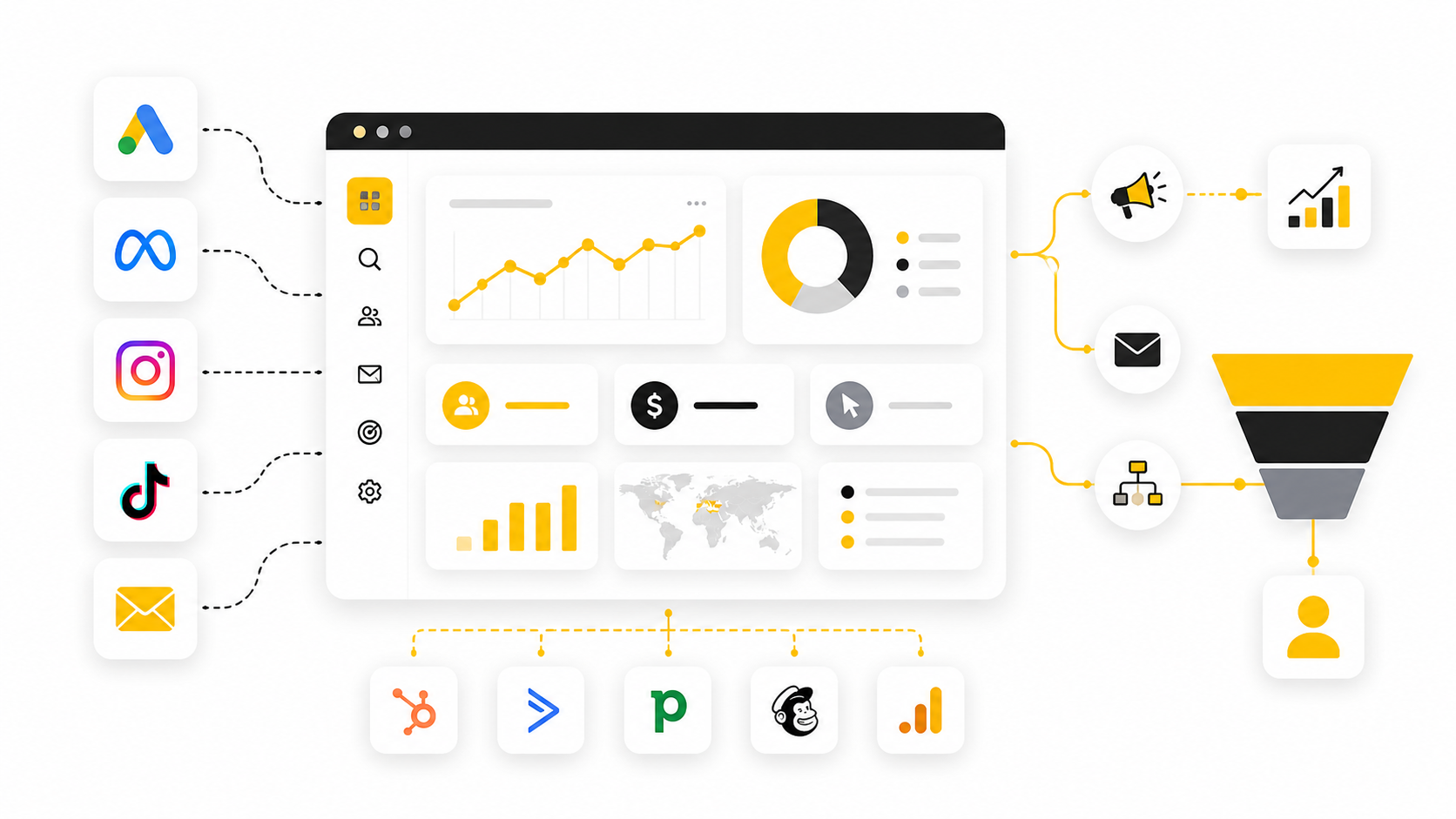
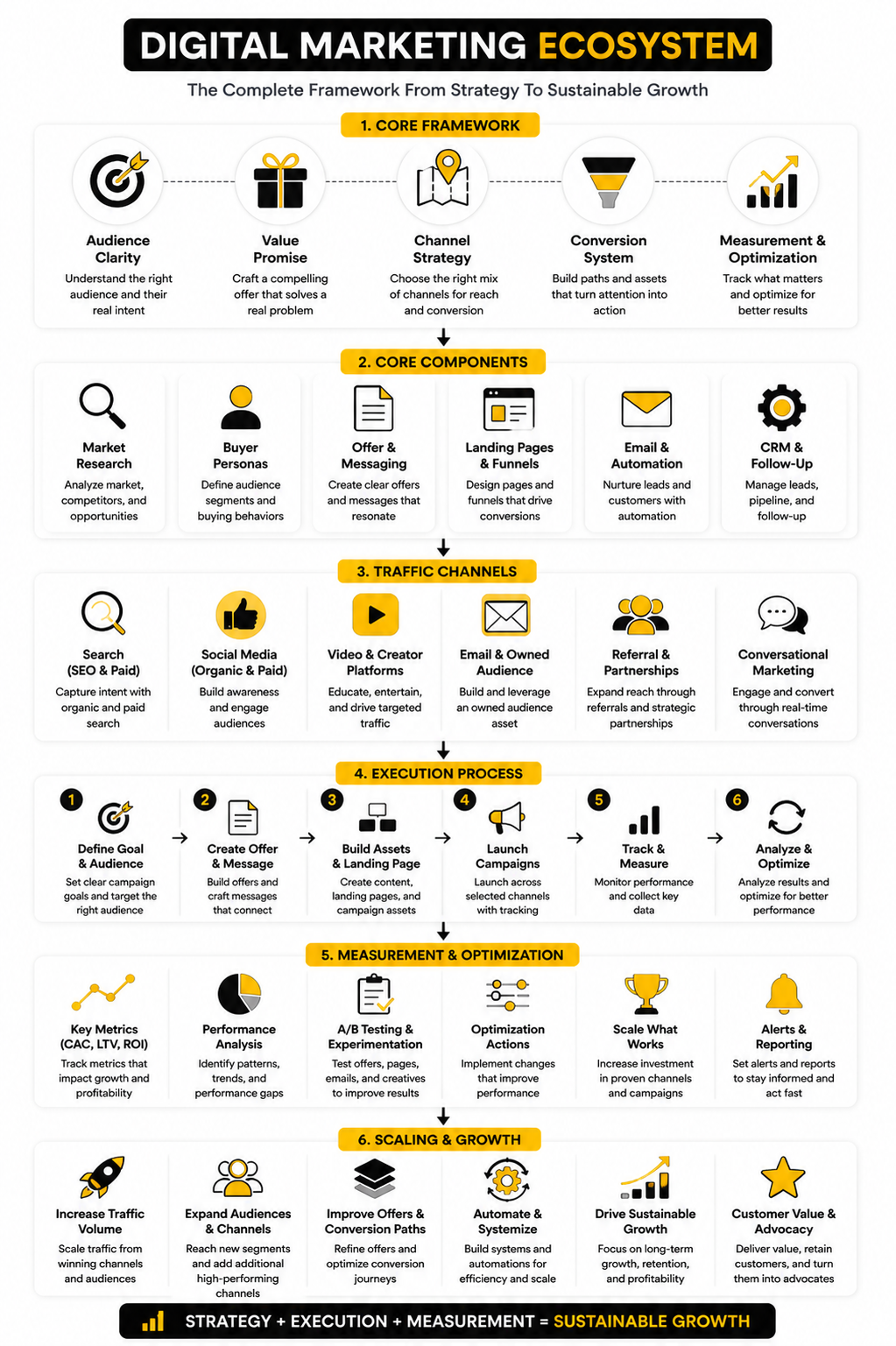
This article breaks digital marketing into a practical six-part system:
- Digital Marketing Fundamentals
- Strategy, Positioning, and Audience Research
- Traffic Channels That Create Demand
- Conversion Systems, Funnels, and Automation
- Measurement, Optimization, and Scaling
- Digital Marketing Tools, Workflows, and FAQs
Digital Marketing Fundamentals
Digital marketing is the process of using online platforms and digital communication to create awareness, generate leads, convert customers, and increase lifetime value. The important word is process. A random campaign can create activity, but a process creates repeatable outcomes.
The mistake many businesses make is treating digital marketing as a list of isolated tactics. They build a website, publish content, send emails, run ads, and post on social media without connecting those actions to one clear commercial path. Strong digital marketing connects the message, audience, offer, channel, follow-up, and measurement into one operating system.
That is why the best digital marketing plans are not built around trends first. They are built around buyer behavior. Once you know what people need, what they already believe, where they spend attention, and what stops them from buying, the channel decisions become much easier.
Why Digital Marketing Matters Now
Digital marketing matters because attention, trust, and buying intent are now fragmented. People may discover a brand through a TikTok video, verify it through Google, compare it on YouTube, join an email list, and finally convert through a retargeting ad or sales call. If those touchpoints feel disconnected, the business leaks revenue.
It also matters because digital channels are measurable in a way traditional marketing often is not. You can see which pages attract visitors, which ads create leads, which emails drive clicks, and which offers produce customers. That visibility makes digital marketing especially valuable for lean teams that need smarter allocation, not just bigger budgets.
The pressure is real. Digital video ad spend in the U.S. reached $64 billion in 2024 and was projected to hit $72 billion in 2025, while email, search, social, and automation continue competing for budget. Businesses that understand the full system can invest with more confidence instead of chasing whatever channel feels loudest this month.
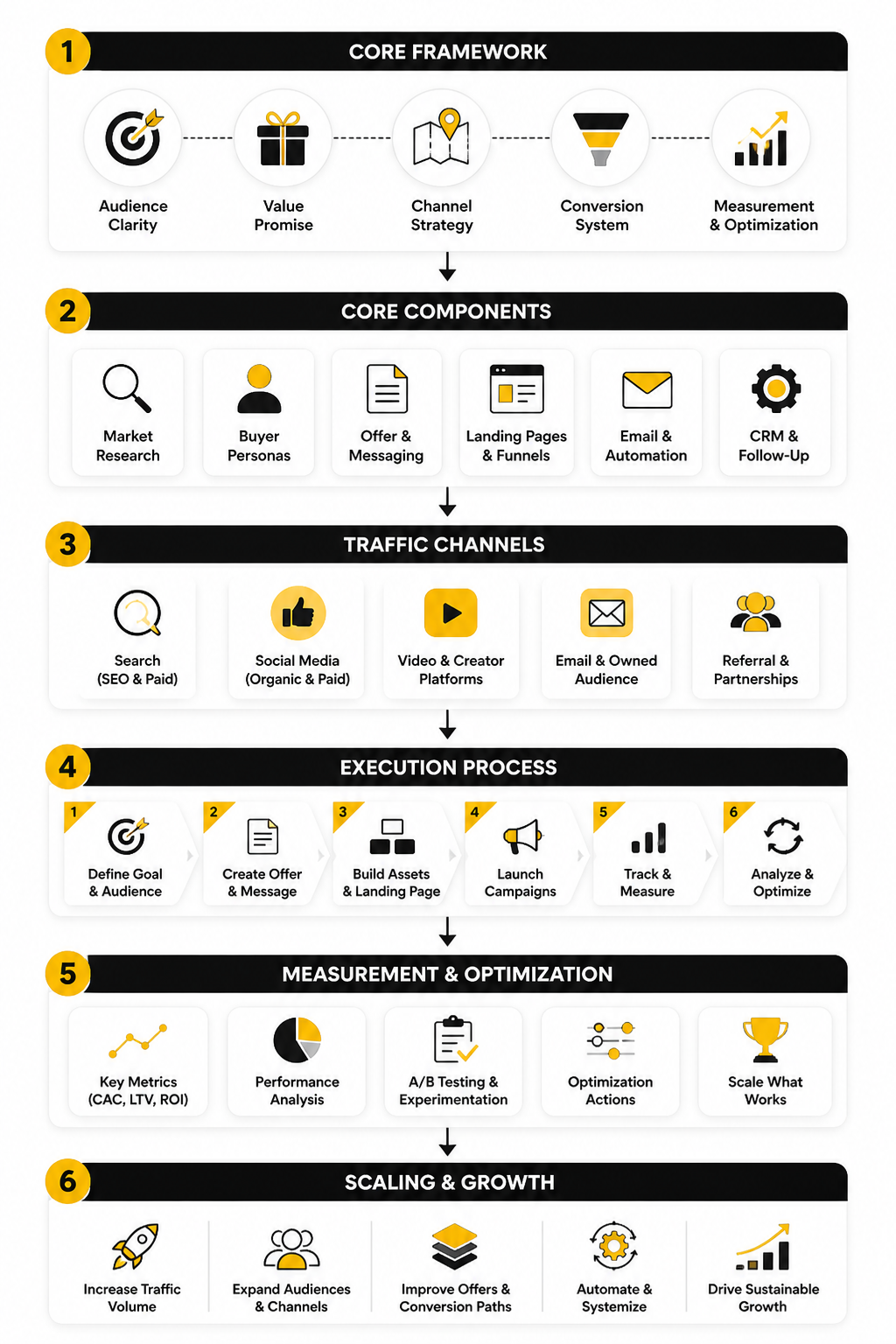
The Digital Marketing Framework
A useful digital marketing framework has four layers: strategy, traffic, conversion, and optimization. Strategy defines who you serve, what problem you solve, and why your offer deserves attention. Traffic brings the right people into your world through search, social, partnerships, paid media, creators, email, and content.
Conversion turns that attention into action. This is where landing pages, lead magnets, sales pages, checkout flows, booking pages, webinars, forms, CRM follow-up, and email sequences matter. Tools like GoHighLevel, ClickFunnels, Systeme.io, and ManyChat fit here when the business needs structured follow-up instead of scattered manual work.
Optimization is the layer that keeps the system honest. It looks at what is actually happening: which audience converts, which page loses people, which message creates replies, which ad wastes spend, and which offer deserves more traffic. Without this layer, digital marketing becomes expensive guessing.
Core Components of Digital Marketing
The first core component is audience research. You need to understand the customer’s problem, desired outcome, buying triggers, objections, language, and decision criteria. Without that, even good design and strong tools will struggle because the message will feel generic.
The second component is channel selection. Search captures demand, social creates and distributes attention, email builds owned relationships, paid ads accelerate testing, and content compounds authority over time. Each channel has a job, and the goal is not to use all of them at once; the goal is to use the right ones in the right order.
The third component is conversion architecture. This includes the offer, landing page, lead capture, checkout, booking flow, CRM, email automation, and retargeting. A business can have plenty of traffic and still underperform if the path from interest to action is unclear.
Professional Implementation
Professional digital marketing starts with one simple question: what commercial outcome are we building toward? That outcome could be booked calls, ecommerce sales, trial signups, demo requests, newsletter growth, community growth, or customer retention. The clearer the outcome, the easier it becomes to choose channels, create assets, and measure progress.
A professional implementation also avoids tool-first thinking. Software helps, but it cannot fix weak positioning, unclear offers, poor audience research, or lazy follow-up. Use platforms like Brevo, Buffer, Moosend, or Fillout when they support a real workflow, not because another marketer mentioned them in a list.
The rest of this article builds that workflow step by step. Part 2 will move from the broad definition into strategy, positioning, and audience research. That is where digital marketing becomes much easier, because the best campaigns usually come from sharper thinking before the campaign ever goes live.
Strategy, Positioning, and Audience Research
Digital marketing gets much easier when the strategy is sharp before the first campaign goes live. This is where many businesses go wrong. They start with channels, tools, and content calendars when they should be starting with the market, the buyer, the offer, and the reason anyone should care.
A strong strategy answers four practical questions. Who are we trying to reach? What problem are they actively trying to solve? Why should they choose us instead of every other option? What action should they take next?
When those answers are vague, digital marketing becomes noisy. When those answers are specific, the website copy improves, the ads get clearer, the content has a point, and the follow-up feels relevant instead of random.
Start With the Market, Not the Channel
The channel is never the strategy. Search, social, email, paid ads, webinars, communities, and automation are distribution choices. They only work when the business understands the market well enough to know what people already want, what they misunderstand, and what they need to believe before they buy.
This matters even more because buyers are doing more of the journey on their own. A 2025 Gartner survey found that 61% of B2B buyers prefer a rep-free buying experience, and 73% actively avoid suppliers who send irrelevant outreach. That is a brutal warning for lazy messaging.
The practical takeaway is simple. Your digital marketing has to help people make progress before they talk to you. If your content, landing pages, emails, and offers do not answer real buying questions, people will keep researching somewhere else.
Define the Buyer With Real Intent
A buyer persona is useful only when it explains behavior. Age, job title, company size, and industry are not enough. You need to know what triggers the search, what pressure the buyer feels, what result they want, and what risk they are trying to avoid.
Good audience research looks for intent. Someone searching “best CRM for agencies” is in a very different state than someone reading “how to follow up with leads.” Both could eventually buy a CRM, but they need different messages at different moments. Treating them the same is how campaigns become bland.
Use customer interviews, sales call notes, search queries, support tickets, review mining, analytics, and social conversations to build a clearer picture. The goal is not to create a cute persona document. The goal is to understand the buyer well enough that your digital marketing feels obviously relevant.
Sharpen the Positioning
Positioning is the mental shortcut you want the market to remember. It explains what you do, who it is for, why it is different, and why that difference matters. Without positioning, every campaign has to work too hard because the audience has no simple reason to place you in their mind.
Weak positioning sounds like this: “We help businesses grow online.” That could mean anything. Stronger positioning is more specific: “We help local service businesses turn missed calls, form fills, and cold leads into booked appointments through automated follow-up.” Now the buyer can recognize themselves.
This is where digital marketing becomes more efficient. Clear positioning improves paid ads because the promise is sharper. It improves SEO because topics become easier to prioritize. It improves email because the message speaks to a real problem instead of generic business growth.
Build the Offer Before the Funnel
A funnel cannot save a weak offer. It can only make the offer easier to understand, easier to trust, and easier to act on. Before building landing pages or automation, make sure the offer is strong enough to deserve attention.
A strong offer usually has five parts:
- A specific audience
- A painful or valuable problem
- A clear outcome
- A believable mechanism
- A low-friction next step
That last part matters. The next step should match the buyer’s level of awareness. A cold visitor may need a useful guide, checklist, demo video, quiz, or diagnostic first, while a high-intent visitor may be ready to book a call, start a trial, or buy directly.
Map the Customer Journey
The customer journey is the path from first awareness to purchase and beyond. It usually includes awareness, consideration, conversion, onboarding, retention, and advocacy. The mistake is assuming everyone enters at the same point.
Some people have never heard of the problem. Some know the problem but not the solution. Some are comparing vendors. Some are ready to buy and only need proof, pricing clarity, or a final nudge.
Your digital marketing should meet each stage with the right asset. Educational content helps people understand the problem. Comparison pages help them evaluate options. Case studies and demos reduce risk. Email sequences and retargeting bring people back when timing was the only issue.
Research the Language Buyers Already Use
The best copy often comes from the market, not the marketer. Buyers describe their pain, frustration, goals, and doubts in plain language. Your job is to collect that language and turn it into clear messaging.
Look at reviews, Reddit threads, YouTube comments, search suggestions, sales objections, competitor testimonials, and customer emails. Pay attention to repeated phrases. Those repeated phrases often reveal the real emotional and practical reasons people buy.
This is especially important in digital marketing because people move fast online. If your message sounds like internal company language, they will scroll past it. If it sounds like the problem already in their head, they stop.
Choose a Strategic Angle
A strategic angle is the main idea that makes your marketing feel distinct. It could be speed, simplicity, specialization, premium expertise, lower risk, better automation, stronger reporting, a unique process, or a contrarian point of view. The right angle depends on what the audience values and what competitors fail to communicate well.
Do not choose an angle just because it sounds clever. Choose one that is true, relevant, and defensible. A small agency, for example, might win by being highly specialized rather than pretending to offer every digital marketing service under the sun.
Once the angle is clear, it should show up everywhere. It should influence the homepage, lead magnet, ad hooks, email subject lines, sales deck, onboarding flow, and content themes. Consistency builds memory, and memory is underrated.
Turn Strategy Into a Working Brief
Before campaigns start, put the strategy into a simple working brief. This keeps the team aligned and stops every new idea from becoming a distraction. The brief does not need to be fancy; it needs to be useful.
Include these pieces:
- Target audience
- Core problem
- Desired outcome
- Main promise
- Proof points
- Key objections
- Primary channels
- Main conversion goal
- Follow-up plan
- Success metrics
This brief becomes the filter for every campaign decision. If an idea does not support the audience, promise, channel, or conversion goal, it is probably a distraction. That discipline is what separates professional digital marketing from random activity.
Traffic Channels That Create Demand
Once the strategy is clear, digital marketing moves into execution. This is where attention becomes the raw material. The job is not to be everywhere; the job is to show up in the places where your buyer already spends attention, asks questions, compares options, and looks for proof.
A good traffic plan combines intent and discovery. Intent channels help you reach people already looking for a solution. Discovery channels help you reach people who have the problem but have not started actively searching yet. The strongest digital marketing systems usually use both, because demand capture without demand creation eventually becomes limiting.
Search Marketing
Search marketing works because it meets people at the moment they are actively trying to solve something. That includes SEO, paid search, local search, YouTube search, and increasingly search experiences influenced by AI summaries. The format changes, but the behavior is the same: people type or speak a problem, and they want a useful answer fast.
For SEO, the process starts with mapping topics to buying intent. Top-of-funnel content can educate, but commercial pages need to answer comparison, pricing, use case, and implementation questions. A software company, agency, consultant, ecommerce brand, or local business should not treat every keyword equally.
Paid search has a different role. It can validate demand faster, test offers, and capture high-intent buyers while organic rankings build over time. The caution is simple: paid search gets expensive fast when the landing page, offer, tracking, and follow-up are weak.
Social Media and Creator-Led Distribution
Social media is where digital marketing becomes more human. People may not open an app looking for your offer, but they do respond to useful ideas, strong opinions, proof, entertainment, and relatable expertise. That makes social powerful for creating demand before the buyer enters search mode.
The execution mistake is posting content without a point. Every post should support one of a few jobs: educate the market, build trust, show proof, handle objections, create conversation, or move people toward a next step. If a post does none of those things, it is probably just noise.
Creator-led distribution has also become harder to ignore. U.S. creator ad spend was projected to reach $37 billion in 2025, which shows how seriously brands now treat creators as media channels. For smaller businesses, the lesson is not “hire influencers immediately”; it is to build content that feels native to the platform instead of corporate and forgettable.
Email and Owned Audience Growth
Email is still one of the most practical channels in digital marketing because it gives you a direct line to people who already raised their hand. Social reach can fluctuate, ad costs can rise, and search visibility can shift. An owned list gives you a reusable audience asset.
The process starts with a reason to subscribe. That could be a checklist, guide, diagnostic, webinar, discount, calculator, mini-course, community invite, or useful newsletter. The offer must match the buyer’s stage, because a weak lead magnet fills the list with people who never had real intent.
Once people subscribe, the follow-up matters more than the form. Tools like Brevo, Moosend, and ScaledMail can support newsletters, nurture sequences, segmentation, and promotional campaigns. But the tool is not the strategy; the real leverage comes from sending relevant messages based on what the person needs next.
Paid Advertising
Paid advertising is best used as an acceleration layer, not a magic fix. It can bring targeted traffic into a tested offer, amplify content that already works, and create predictable volume when the economics make sense. It can also burn money quickly when the funnel is unclear.
The U.S. digital advertising market reached nearly $300 billion in revenue in 2025, which tells you two things at once. First, digital ad platforms remain central to growth. Second, competition for attention is intense, so average creative and vague offers are punished.
A practical paid strategy separates testing from scaling. Testing is where you validate audiences, hooks, landing pages, and offers with controlled spend. Scaling is where you increase budget only after the numbers show that acquisition cost, conversion rate, and customer value can support it.
A Practical Channel Execution Process
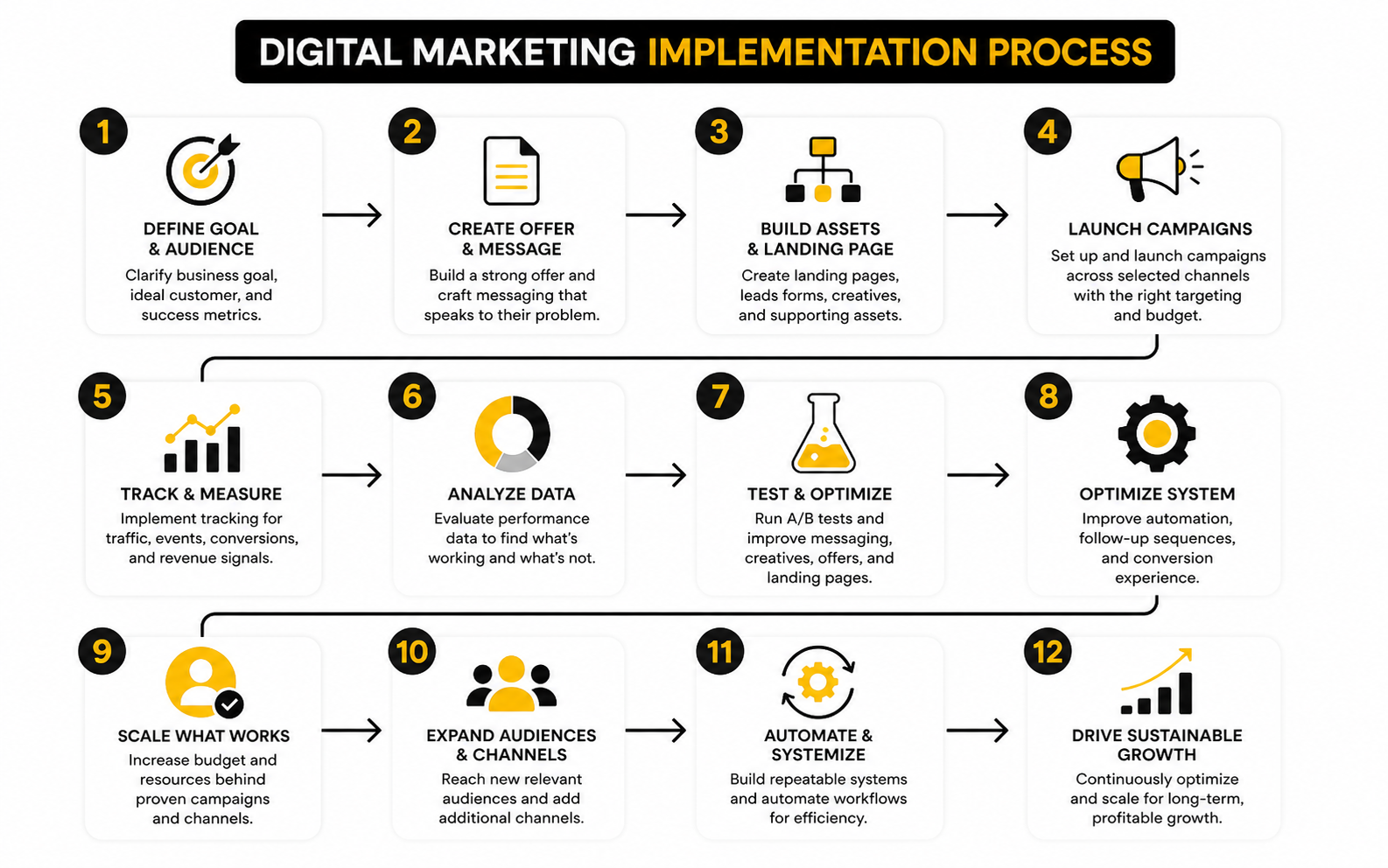
The execution process should be boring in the best possible way. You choose one primary audience, one main offer, one core conversion goal, and a small set of channels that match the buyer journey. Then you build assets, launch, measure, and improve.
A simple process looks like this:
- Define the campaign goal.
- Choose the audience segment.
- Match the segment to one buying stage.
- Select the channel based on intent or discovery.
- Build the message around a clear problem and outcome.
- Create the landing page, content asset, or conversion path.
- Set up tracking before launch.
- Launch with a controlled test.
- Review results against the original goal.
- Improve the weakest step before adding more budget.
This is not glamorous, but it works because it prevents scattered execution. Instead of asking, “What should we post this week?” you ask, “What does this buyer need to believe before taking the next step?” That question produces better campaigns.
Content as the Bridge Between Channels
Content connects the digital marketing system because it gives every channel something useful to distribute. Search needs content to rank. Social needs content to earn attention. Email needs content to nurture. Sales needs content to answer objections and create confidence.
The best content is not just informational. It moves the buyer forward. A strong comparison page helps someone choose. A practical checklist helps someone diagnose a problem. A case study reduces perceived risk. A founder video can make the brand feel more trustworthy.
Content investment is still moving toward formats that can carry trust and attention. In B2B marketing, 61% of marketers expected to increase investment in video in 2025, while 52% planned to increase thought leadership content and 40% planned to increase paid advertising, based on Content Marketing Institute’s 2025 benchmark research. That mix makes sense because modern buyers need both education and proof.
Landing Pages and Conversion Paths
Traffic without a conversion path is wasted attention. Every channel should point somewhere intentional: a product page, lead form, booking page, quiz, checkout, newsletter signup, webinar registration, or sales page. The destination should continue the conversation started by the ad, post, search result, or email.
A good landing page does not need to be complicated. It needs a clear promise, specific audience fit, believable proof, friction removal, and one obvious next action. Tools like Replo can help ecommerce teams build more focused landing pages, while ClickFunnels and Systeme.io are useful when the business needs funnel pages, opt-ins, checkout flows, and simple automation in one place.
The key is message match. If the ad promises a fast quote, the page should not bury the quote form under a general brand story. If the search keyword is commercial, the page should not behave like a beginner’s guide.
Follow-Up and Lead Handling
Most leads do not convert the first time they interact with a business. That does not mean they are bad leads. It often means the timing, trust, budget, urgency, or internal decision process is not ready yet.
Follow-up turns interested people into future opportunities. That can include email sequences, SMS reminders, retargeting ads, chatbot conversations, sales tasks, booking links, and CRM pipeline updates. For service businesses and agencies, GoHighLevel is especially relevant when leads need fast response, appointment booking, pipeline management, and automated follow-up in one system.
This is where execution discipline pays off. A business can generate fewer leads and still produce more revenue if the follow-up is faster, clearer, and more consistent. In digital marketing, the money is often not in the first click; it is in what happens after the click.
Measurement, Optimization, and Scaling
Digital marketing becomes dangerous when teams only measure what is easy to see. Impressions, clicks, likes, opens, and views can be useful, but they are not the business result. The real question is whether the system is creating qualified demand, converting that demand efficiently, and producing customers at a cost the business can sustain.
Measurement is not about drowning in dashboards. It is about knowing which signals matter at each stage of the customer journey. If you track the wrong number, you will optimize the wrong behavior, and that is how teams end up celebrating traffic while revenue stays flat.
Statistics and Data
The data should guide decisions, not decorate reports. U.S. digital advertising revenue reached $294.6 billion in 2025, growing 13.9% year over year, which tells us digital channels are still where serious money is moving. But that does not mean every business should simply spend more; it means competition is rising, and weak measurement gets punished faster.
Budgets are also under pressure. Marketing budgets remained at 7.7% of company revenue in 2025, so most teams are not operating with unlimited room for experimentation. That makes performance clarity more important than ever.
The useful interpretation is this: digital marketing is growing, but tolerance for vague results is shrinking. Leaders want to know which campaigns create pipeline, which channels influence revenue, and which parts of the customer journey deserve more budget. If your reporting cannot answer that, it is not measurement yet; it is just activity tracking.
Build a Measurement System Around the Funnel
A clean measurement system follows the customer journey from first touch to revenue. At the top, you measure reach, traffic quality, content engagement, search visibility, and audience growth. In the middle, you measure lead capture, email engagement, webinar attendance, form completion, booking rates, and return visits.
At the bottom, you measure sales-qualified leads, opportunities, close rates, average order value, customer acquisition cost, payback period, and lifetime value. This is where marketing and sales need to stop arguing about attribution and start looking at the same journey. If marketing celebrates leads that sales cannot close, the system is broken.
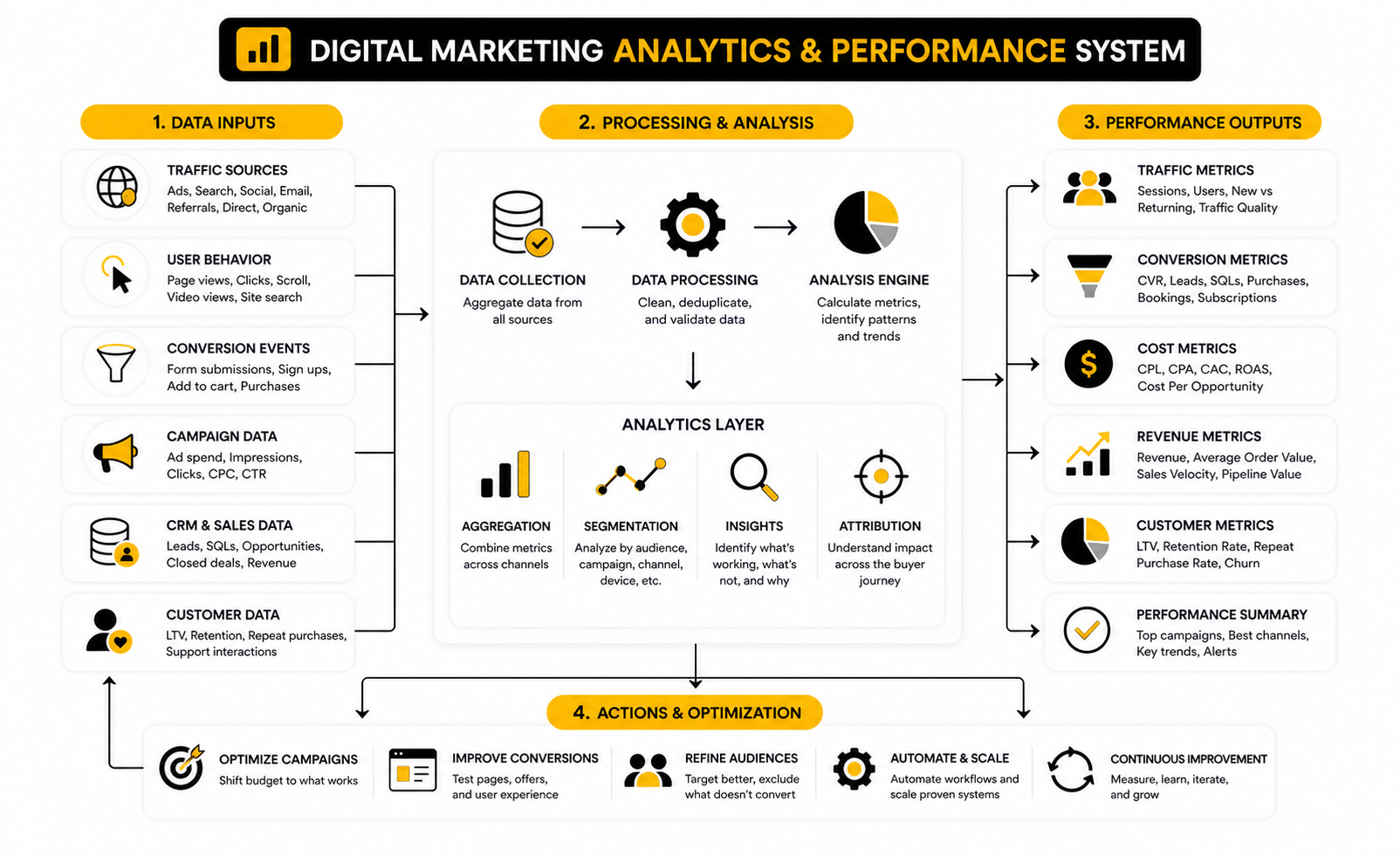
The point is not to track every metric forever. The point is to connect leading indicators to lagging results. If qualified traffic rises but conversions fall, the landing page or offer may be the problem. If leads rise but revenue does not, lead quality, sales follow-up, or nurture may need attention.
Separate Vanity Metrics From Decision Metrics
A vanity metric makes performance look good without helping you make a better decision. Follower count, raw impressions, and total traffic can be vanity metrics when they are disconnected from buyer intent. They are not useless, but they are incomplete.
Decision metrics tell you what to do next. Cost per qualified lead, landing page conversion rate, booked-call show rate, email revenue per subscriber, sales cycle length, and retention rate can change the way you allocate budget. These numbers create action.
For example, a social post with low reach but high qualified replies may be more valuable than a viral post that attracts the wrong people. A search page with modest traffic but strong demo requests may deserve more internal links and content support. A paid campaign with expensive clicks may still work if the close rate and customer value justify the cost.
Use Benchmarks Carefully
Benchmarks are useful for context, but they are not the target. A benchmark can tell you whether a metric looks unusually weak or unusually strong compared with similar channels. It cannot tell you whether your economics work.
This matters because industries, offers, price points, traffic sources, and buyer journeys vary massively. A 2% landing page conversion rate might be terrible for a simple lead magnet and excellent for a high-ticket consultation. A high email open rate means very little if the emails do not create replies, clicks, sales, or retention.
Use benchmarks as diagnostic prompts. If conversion is far below the market range, investigate message match, page speed, offer clarity, traffic quality, and trust signals. If performance is above average but revenue is still weak, the problem may be after conversion, not before it.
Track Channel Performance by Role
Each digital marketing channel should be measured according to its job. Search should often be judged by qualified organic traffic, rankings for commercial intent, assisted conversions, and pipeline influence. Paid search should be judged by cost per qualified action, conversion rate, revenue, and payback.
Social media should not only be judged by likes. It can support reach, trust, authority, community growth, direct conversations, retargeting audiences, and creator partnerships. Email should be judged by list quality, engagement depth, click intent, sales contribution, and retention impact.
This prevents bad decisions. If you judge every channel only by last-click conversions, you may underfund channels that create demand and overfund channels that simply capture it. Digital marketing works best when channels are measured by their real role in the system.
Read the Patterns, Not Just the Snapshot
One week of data can mislead you. Campaign performance moves because of seasonality, budget shifts, creative fatigue, competitor activity, platform learning, tracking changes, and buyer behavior. Looking at a single snapshot often creates panic or false confidence.
Look for patterns over time. Is cost per lead rising while lead quality falls? Are email clicks stable but sales declining? Are demo requests increasing from one page but not another? These patterns point to decisions.
The best teams review data with a simple rhythm. Weekly reviews catch obvious issues and fast opportunities. Monthly reviews reveal channel performance and campaign direction. Quarterly reviews decide where the next serious investment should go.
Turn Analytics Into Optimization
Optimization should focus on the weakest constraint in the system. If traffic volume is too low, the issue may be channel reach or distribution. If traffic is strong but conversion is weak, the issue may be offer clarity, page quality, proof, or friction.
If leads are converting but sales are poor, the issue may be qualification, follow-up speed, sales process, or buyer expectations. If customers buy but do not stay, the issue may be onboarding, product fit, customer success, or retention communication. This is why digital marketing analytics should not stop at the lead.
The practical move is to optimize one major variable at a time. Change the headline, offer, audience, landing page, follow-up sequence, or pricing presentation with a clear hypothesis. Random tweaking creates noise; focused testing creates learning.
Make Reporting Useful for Decisions
A good marketing report should help someone decide what to keep, fix, stop, or scale. It should not be a massive spreadsheet that nobody reads. Keep the report focused on goals, trends, insights, and next actions.
A useful report can include:
- What changed this period
- Which channels created qualified demand
- Which campaigns underperformed
- Where conversion improved or declined
- What the data suggests
- What action should happen next
That last point matters most. Reporting without action is theater. The whole purpose of measurement in digital marketing is to make better decisions faster, with less ego and less guessing.
Digital Marketing Tools, Workflows, and Advanced Growth Decisions
At this stage, the question is no longer “Which channel should we use?” The better question is, “What kind of growth system are we building, and what tradeoffs are we willing to accept?” That is where digital marketing becomes more strategic and less tactical.
Every serious growth system has constraints. Budget, team capacity, creative output, data quality, sales follow-up, technical setup, compliance, and customer experience all affect performance. Scaling means identifying which constraint is holding the system back and fixing that before adding more complexity.
The Build Versus Buy Decision
One of the first advanced decisions is whether to build a custom marketing stack or use integrated platforms. A custom stack gives more flexibility, but it usually requires stronger technical skill, cleaner operations, and more maintenance. An integrated platform is often faster to launch, but it can limit how deeply you customize workflows.
For agencies, local service businesses, and sales-led companies, GoHighLevel can make sense when the priority is CRM, pipelines, appointment booking, automations, and client management in one place. For creators, coaches, and funnel-heavy offers, ClickFunnels or Systeme.io may be more practical when speed matters more than technical depth.
The right choice depends on the workflow, not the logo. If the team needs fast campaign deployment, simple automations, and fewer moving parts, an all-in-one setup can be a win. If the business has complex data requirements, multiple products, enterprise reporting, or custom lifecycle logic, a more modular stack may be worth the extra work.
AI Should Support the System, Not Replace It
AI is now part of modern digital marketing, but it should not become the strategy. It is useful for research, content drafts, ad variations, workflow automation, chatbot support, segmentation ideas, and reporting summaries. It is risky when teams use it to produce generic content at scale without judgment.
Marketing teams are clearly adopting AI, with Salesforce’s State of Marketing report highlighting AI use across content creation, predictive analytics, personalization, and customer experience. That matters because AI is becoming normal, not special. The edge will not come from using AI; the edge will come from using it with better inputs, sharper positioning, stronger data, and human review.
A practical AI workflow keeps people in control. Use AI to accelerate the first draft, summarize research, find patterns, and generate options. Then let human strategy decide what is true, useful, differentiated, and safe to publish.
Personalization Has to Earn Trust
Personalization can improve digital marketing performance, but only when it feels helpful. There is a thin line between “this brand understands me” and “this brand is watching me.” Cross that line, and conversion gains can turn into trust problems.
The safer approach is to personalize around expressed intent and useful context. Someone who downloaded a pricing guide can receive pricing-related follow-up. Someone who visited a product comparison page can receive comparison content. Someone who answered a quiz can receive recommendations based on their own answers.
This is why zero-party and first-party data matter. Forms, quizzes, preference centers, surveys, booking questions, and customer behavior can all improve relevance without relying only on third-party signals. Tools like Fillout can help collect structured intent data, while ManyChat can support conversational segmentation when messaging flows are actually useful.
The Risk of Over-Automation
Automation is powerful, but too much automation can make a brand feel dead. Nobody wants to feel like they are trapped inside a sequence that does not understand them. This is especially dangerous in service businesses, high-ticket offers, and relationship-driven sales.
Use automation for speed, consistency, routing, reminders, segmentation, and follow-up. Do not use it to avoid real conversations when a real conversation is what the buyer needs. The best digital marketing systems combine automation with human judgment.
A simple rule works well: automate the predictable, personalize the important. Confirmation emails, reminders, lead routing, abandoned checkout messages, and basic nurture can be automated. Pricing objections, complex questions, strategic fit, and high-value opportunities often deserve human attention.
Scaling Creative Without Diluting the Brand
Creative fatigue is one of the hidden scaling problems. Ads stop working, social hooks get stale, emails become predictable, and landing pages lose impact when the same angles are reused too long. More budget usually makes this problem show up faster.
Scaling creative means building a repeatable production rhythm. That includes new hooks, new formats, new proof points, new objections, new use cases, and new audience-specific messages. It does not mean changing the brand voice every week.
The strongest teams build creative libraries. They track which angles work, which objections convert, which testimonials reduce friction, and which formats create qualified action. Over time, digital marketing becomes less dependent on random inspiration and more dependent on structured creative learning.
Channel Diversification Without Chaos
Relying on one channel is risky. Search rankings can shift, ad costs can rise, social algorithms can change, and email deliverability can weaken. But diversifying too early creates chaos because the team spreads itself thin before one channel is working properly.
The right move is sequenced diversification. Start with the channel that best matches your buyer and offer. Build proof, messaging, conversion paths, and measurement there. Then expand into the next channel with lessons from the first.
For example, a strong search article can become social posts, email content, a webinar outline, sales enablement material, and retargeting creative. A high-performing paid ad angle can become a landing page headline, sales email, and organic content theme. That is how you diversify without starting from zero every time.
Managing Privacy, Compliance, and Data Quality
Modern digital marketing has to respect privacy and data quality. Consent, preference management, unsubscribe handling, tracking accuracy, data retention, and platform rules are not optional details. They affect trust and performance.
This does not mean marketers should become lawyers. It means the system should avoid sloppy data practices. Collect what you need, explain why it matters, store it carefully, and use it in ways that improve the customer experience.
Poor data creates bad decisions. Duplicate contacts, broken tracking, messy UTM structures, unclear lead sources, and unmaintained CRM fields can make reports look precise while being completely misleading. Before scaling spend, clean the foundation.
When to Scale and When to Stop
Scaling should happen when the system has evidence. That means the offer converts, the economics work, the sales process can handle more volume, and the team can fulfill without damaging customer experience. Scaling before that point usually multiplies problems.
Stop or pause when the data shows a structural issue. If the audience is wrong, more budget will not fix it. If the offer is unclear, more traffic will expose the weakness faster. If follow-up is slow, more leads will simply create more missed opportunities.
The mature move is not always to push harder. Sometimes the best digital marketing decision is to narrow the audience, rewrite the offer, rebuild the landing page, improve onboarding, or fix the CRM before buying another click. That discipline protects profit, trust, and momentum.
Bringing the Digital Marketing System Together
At this point, digital marketing should look less like a pile of tactics and more like a connected ecosystem. Strategy defines the buyer and offer. Channels create and capture demand. Conversion paths turn attention into action. Measurement shows what is working, what is leaking, and what deserves more investment.
The real advantage comes from integration. A search visitor should land on a page that matches their intent. A lead should enter a follow-up sequence that reflects what they asked for. A sales conversation should be informed by the content, forms, emails, and pages that person already engaged with.
This is why the final system matters. The goal is not to run more campaigns forever. The goal is to build a digital marketing engine that learns, improves, and compounds over time.
FAQ - Built for Complete Guide
What is digital marketing?
Digital marketing is the use of online channels to attract, engage, convert, and retain customers. It includes SEO, paid ads, social media, email, content, automation, landing pages, analytics, and customer relationship management. The best version is not random promotion; it is a system that connects audience research, traffic, conversion, and measurement.
Why is digital marketing important?
Digital marketing matters because buyers now research, compare, and make decisions across online touchpoints before they ever speak to a business. If your brand is not visible, useful, and easy to trust during that journey, competitors can win the conversation before you enter it. It also gives businesses clearer data, faster testing, and more control over how they acquire customers.
What are the main types of digital marketing?
The main types include search engine optimization, paid search, paid social, organic social media, email marketing, content marketing, video marketing, influencer marketing, affiliate marketing, conversion optimization, and marketing automation. Each one has a different job. The right mix depends on your audience, offer, budget, timeline, and sales process.
How do I start with digital marketing?
Start with strategy, not tools. Define your audience, clarify the problem you solve, shape a strong offer, and choose one primary conversion goal. Then select one or two channels that match buyer intent and build a simple path from first touch to next action.
Is SEO still worth it?
SEO is still worth it when your audience uses search to understand problems, compare options, or find providers. It is less useful when treated as generic blog production with no commercial intent. Strong SEO connects useful content, technical quality, topical authority, and conversion-focused pages.
Are paid ads better than organic marketing?
Paid ads are faster, but organic marketing can compound. Paid channels help test offers, capture demand, and scale proven campaigns, while organic channels build trust, search visibility, and owned audience value over time. Most serious digital marketing systems eventually use both.
How much should a business spend on digital marketing?
There is no universal number that works for every business. A new offer may need a testing budget, while a proven offer can justify more aggressive spending. The better question is whether customer acquisition cost, conversion rate, lifetime value, and payback period support the investment.
What tools are best for digital marketing?
The best tools depend on the workflow. GoHighLevel is useful for CRM, automation, booking, and follow-up. ClickFunnels and Systeme.io are practical for funnels and offer flows. Brevo, Moosend, Buffer, and ManyChat can support email, social, and conversational marketing when they fit the process.
How long does digital marketing take to work?
Paid campaigns can create data quickly, but sustainable performance usually takes time because messaging, targeting, conversion paths, and follow-up need testing. SEO and content often take longer because authority and rankings build gradually. The fastest path is usually a focused offer, clear tracking, and a disciplined testing process.
What metrics should I track?
Track metrics that connect to decisions. Useful numbers include qualified traffic, conversion rate, cost per lead, cost per customer, booked-call rate, sales-qualified leads, close rate, average order value, lifetime value, retention, and payback period. Avoid celebrating surface-level metrics unless they clearly support revenue or strategic growth.
What is the biggest digital marketing mistake?
The biggest mistake is doing more before fixing the foundation. More ads, more posts, more emails, and more tools will not solve weak positioning, unclear offers, poor landing pages, slow follow-up, or bad tracking. Fix the system first, then scale.
Can small businesses compete with larger brands?
Small businesses can compete when they are more specific, faster, and closer to the customer. They do not need to outspend large brands everywhere. They need sharper positioning, better local or niche relevance, stronger proof, and faster response to real buyer signals.
Work With Professionals
Explore 10K+ Remote Marketing Contracts on MarkeWork.com
Most marketers spend too much time chasing clients, competing on crowded platforms, and losing a percentage of every project to middlemen.
MarkeWork gives you a better way. Browse thousands of remote marketing contracts and connect directly with companies desperate to hire skilled marketers like you, without platform commissions and without unnecessary gatekeepers.
If you're serious about finding better opportunities and keeping 100% of what you earn, explore available contracts and create a profile for free at MarkeWork.com.