

Every small business today faces an online world where visibility, connection, and customer engagement happen digitally. A digital marketing agency for small business isn’t just a luxury — it’s become a strategic partner that helps owners navigate complex online channels, boost visibility, and drive measurable growth. In 2026, about 58 % of small businesses rely on digital marketing to connect with customers, and most owners still struggle with traffic and lead generation without professional support.
As digital ecosystems evolve, investing in digital marketing isn’t just about publishing ads and posts. It’s about purposeful audience targeting, measurable campaigns, and strategic planning that fits a small business budget and growth trajectory.
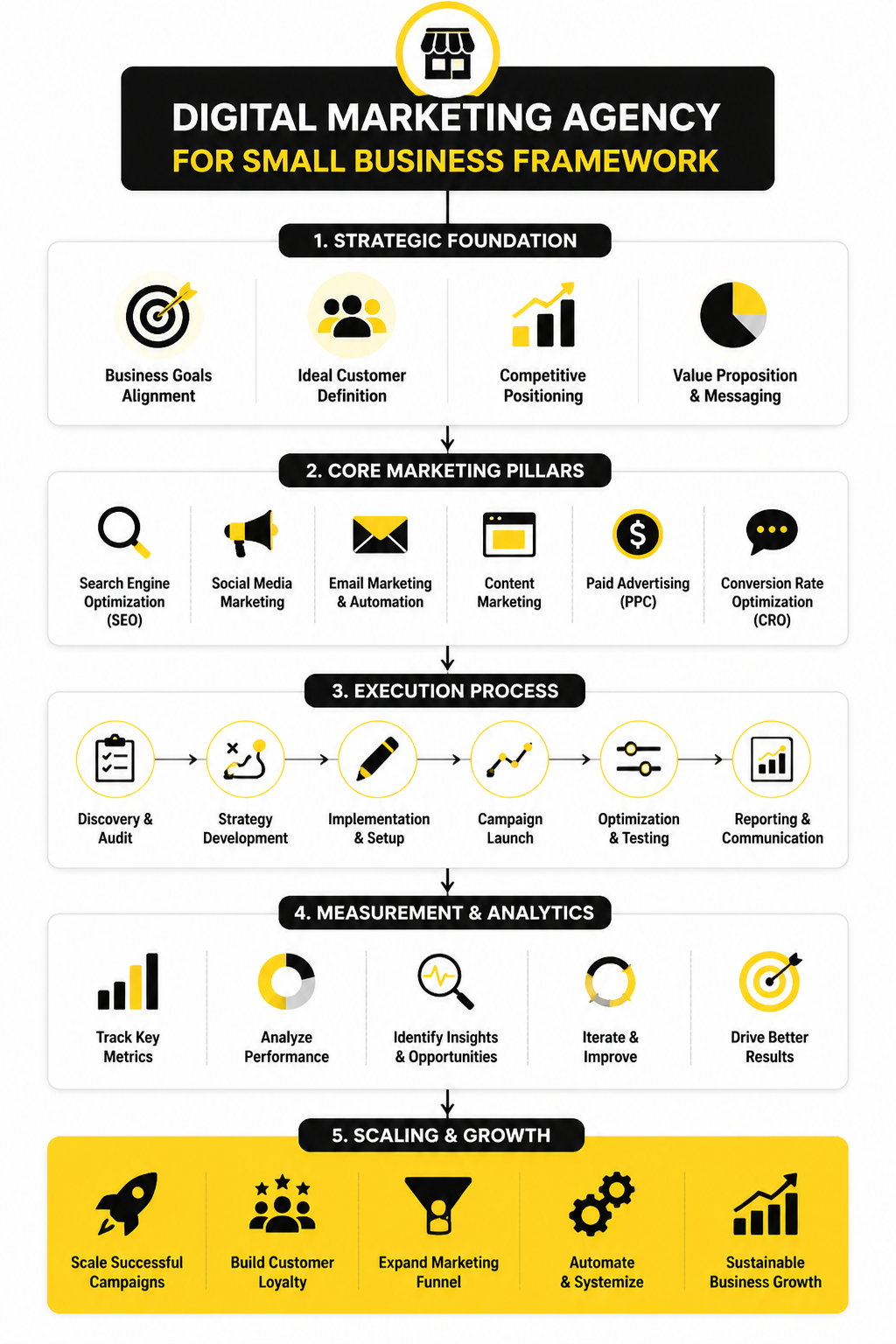
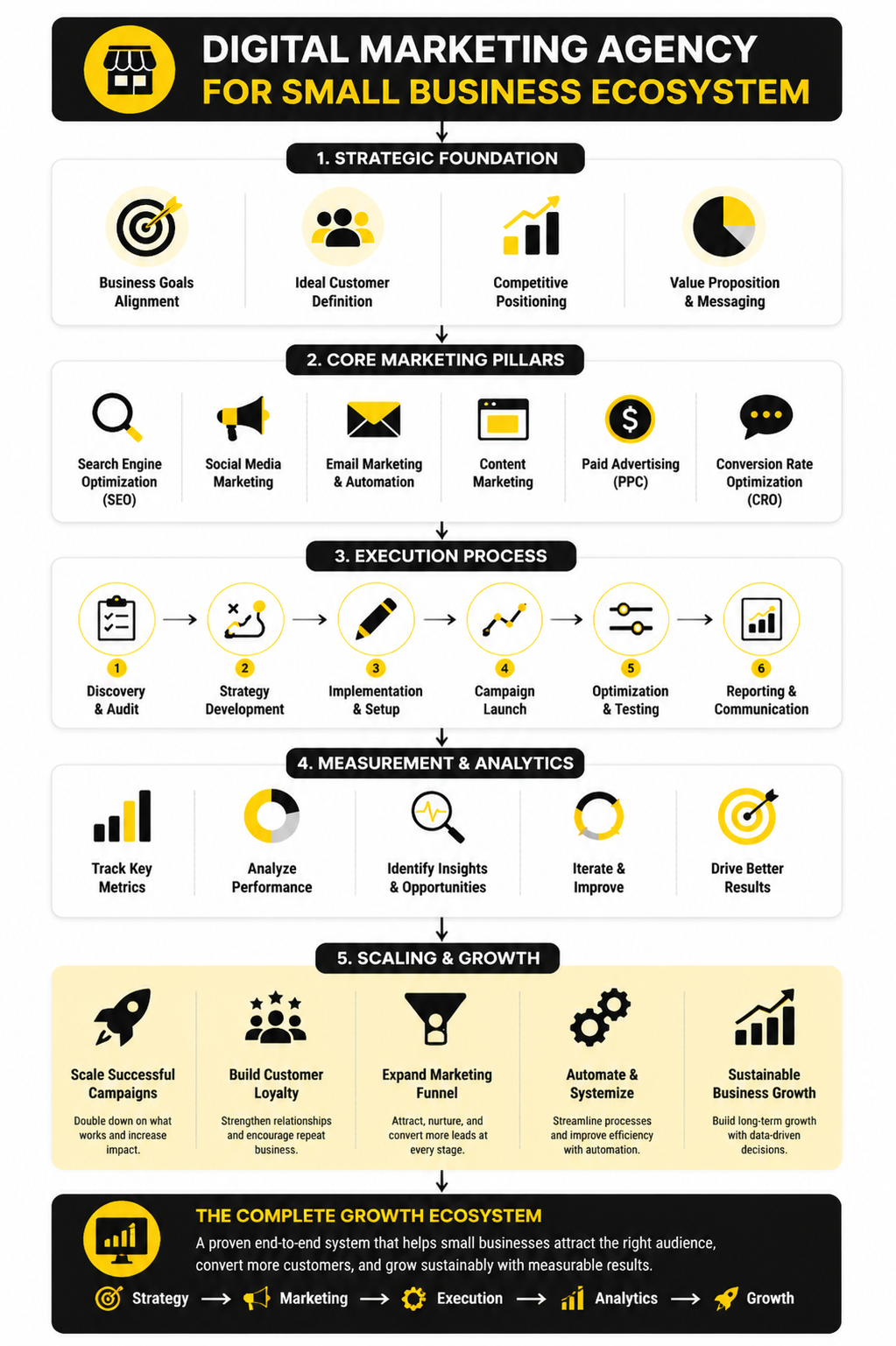
Below is the structure we’ll follow through this article:
- Why Digital Marketing Matters for Small Businesses
- Core Components of Small Business Digital Marketing
- A Framework for Choosing the Right Agency
- How Professional Implementation Drives Results
- Common Mistakes to Avoid
- How to Measure Success and ROI
Across the sections, we’ll unpack what small businesses should expect from a digital marketing agency, how they work together effectively, and what decisions lead to real growth — not just noise.
Why Digital Marketing Matters for Small Businesses
For a digital marketing agency for small business, the foundation of value lies in what digital marketing itself delivers. Traditional advertising — newspapers, flyers, or billboards — can be costly, hard to measure, and limited in reach. Today’s consumers begin almost every purchase journey online, making visibility on search engines, social platforms, reviews, and local listings essential for discovery, credibility, and growth. Small businesses that invest in digital strategies can compete with larger brands without proportionally larger budgets, because online channels allow precise audience targeting and measurable outcomes.
Given this shift, the role of an agency becomes less about delivering generic marketing and more about crafting a strategy that matches goals with the channels that actually deliver results. Expert support helps small businesses move beyond sporadic posts or ads and into intentional campaigns that build trust and generate reliable leads over time.
Core Components of Small Business Digital Marketing
Effective digital marketing for a small business isn’t a single tactic — it’s a coordinated mix of components that work together to drive visibility, engagement, and conversions. An agency’s job is often to bring these elements into a unified strategy rather than treating them as isolated efforts.
Website and Technical Foundation
A well‑designed, mobile‑friendly website is a business’s digital storefront. It must load quickly, clearly communicate key offerings, and be structured so search engines can index it effectively. Technical health — such as secure hosting, intuitive navigation, and proper analytics tracking — enables every other marketing effort to work.
Search Engine Optimization (SEO)
SEO helps a small business show up in organic search results when potential customers look for related products or services. Local SEO — optimizing for “near me” searches and local directories — is particularly impactful because it captures high‑intent traffic from people ready to make a purchase.
Content and Social Media
Content marketing — including blogs, videos, and social posts — builds audience awareness, educates prospects, and supports SEO by generating relevance signals to search engines. Social media extends reach, fosters brand personality, and drives community engagement, which deepens customer relationships and trust.
Paid Advertising
Pay‑per‑click (PPC) campaigns on platforms like Google and social networks provide immediate visibility and lead generation. When aligned with strategic goals, these ads allow precise demographic, interest, and behavior targeting — ensuring budget efficiency and measurable ROI.
Email and Retention Marketing
Email marketing strengthens customer retention by nurturing leads and encouraging repeat purchases. Small businesses often see high returns from email campaigns because they re‑engage an already interested audience with relevant offers and content.
Together, these components form a foundation that helps small businesses attract new customers, improve visibility where buyers are actually searching online, and turn casual interest into measurable sales outcomes. An agency’s expertise lies in orchestrating these elements so they reinforce each other rather than compete for attention.
How a Small Business Digital Marketing Agency Implements Strategy
Once a small business and its digital marketing agency agree on goals and target audiences, the real work begins: turning strategy into action. Implementation is where planning meets execution — and where measurable results start to form. Agencies follow structured workflows that ensure clarity, consistency, and progress every step of the way.
Discovery and Audit
This first phase is about understanding your business deeply. An agency will:
- Gather insight on your business goals, long‑term vision, and key performance indicators (KPIs).
- Conduct market research, including competitor analysis and audience segmentation.
- Audit your current digital assets — website performance, search presence, content, and social profiles — to reveal gaps and opportunities.
This baseline ensures the strategy addresses real needs and not assumptions.
Strategy and Planning
With data in hand, the agency translates insights into a tailored action plan that aligns with your business outcomes. This phase includes:
- Defining specific channels (SEO, paid ads, email, social media) based on where your audience engages most.
- Setting SMART goals — specific, measurable, achievable, relevant, and time‑bound — to guide campaign success.
- Allocating budget and resources so every tactic has a clear purpose and a measurable expected outcome.
This strategic alignment prevents wasted spend and ensures every team member knows what success looks like.
Implementation and Setup
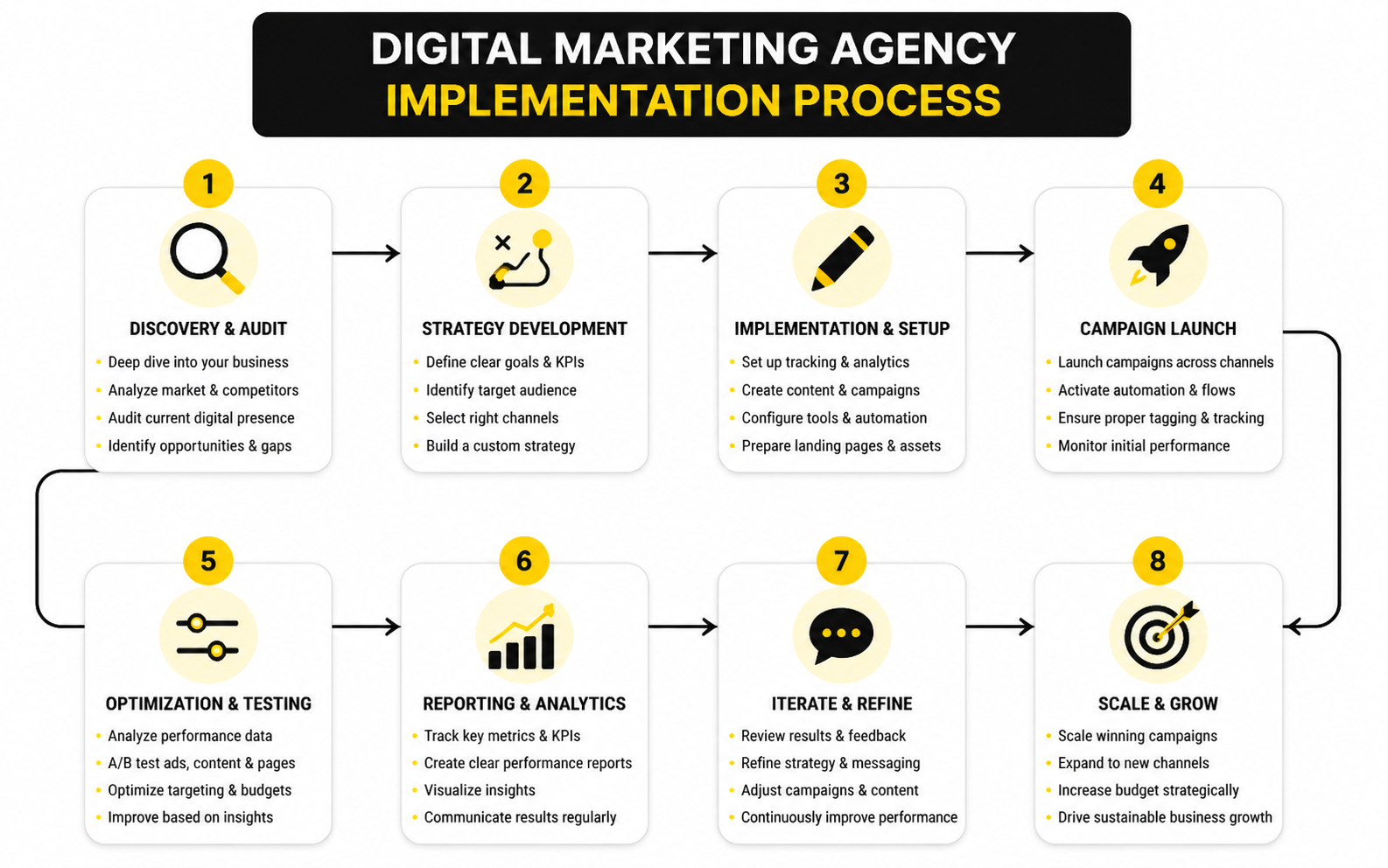
Here’s where the strategy becomes tangible:
- Website and Conversion Paths: The agency ensures your site and landing pages are optimized for user experience and lead capture.
- SEO and Content Activation: Keyword research, on‑page SEO, content calendars, and publishing schedules begin producing momentum.
- Paid Campaign Launches: Ads are created, audiences are defined, and tracking pixels or tags are installed to measure engagement accurately.
- Email and Automation: Lead nurture sequences are configured so prospects receive timely, relevant content.
- Social Channel Activation: Profiles are refreshed, branded content is scheduled, and community engagement begins.
These setup tasks lay the groundwork for performance tracking and optimization.
Monitoring and Optimization
Implementation is not “set and forget.” A professional agency continually monitors performance data to refine campaigns:
- Weekly or monthly reporting tracks metrics tied to your goals (leads, conversions, traffic growth).
- Optimization — adjusting bids, refining audience segments, tweaking messaging — improves performance over time.
- Frequent communication ensures you understand what’s working and why.
This iterative process maximizes return on investment and keeps strategy aligned with evolving business needs.
Review and Iteration
After key performance periods (often 60–90 days), agencies conduct formal reviews to assess:
- Whether goals were met or need revising.
- What tactics produced the best results.
- How future efforts can scale based on real data.
This rhythm of planning, execution, review, and refinement keeps your small business’s digital marketing efforts agile and effective.
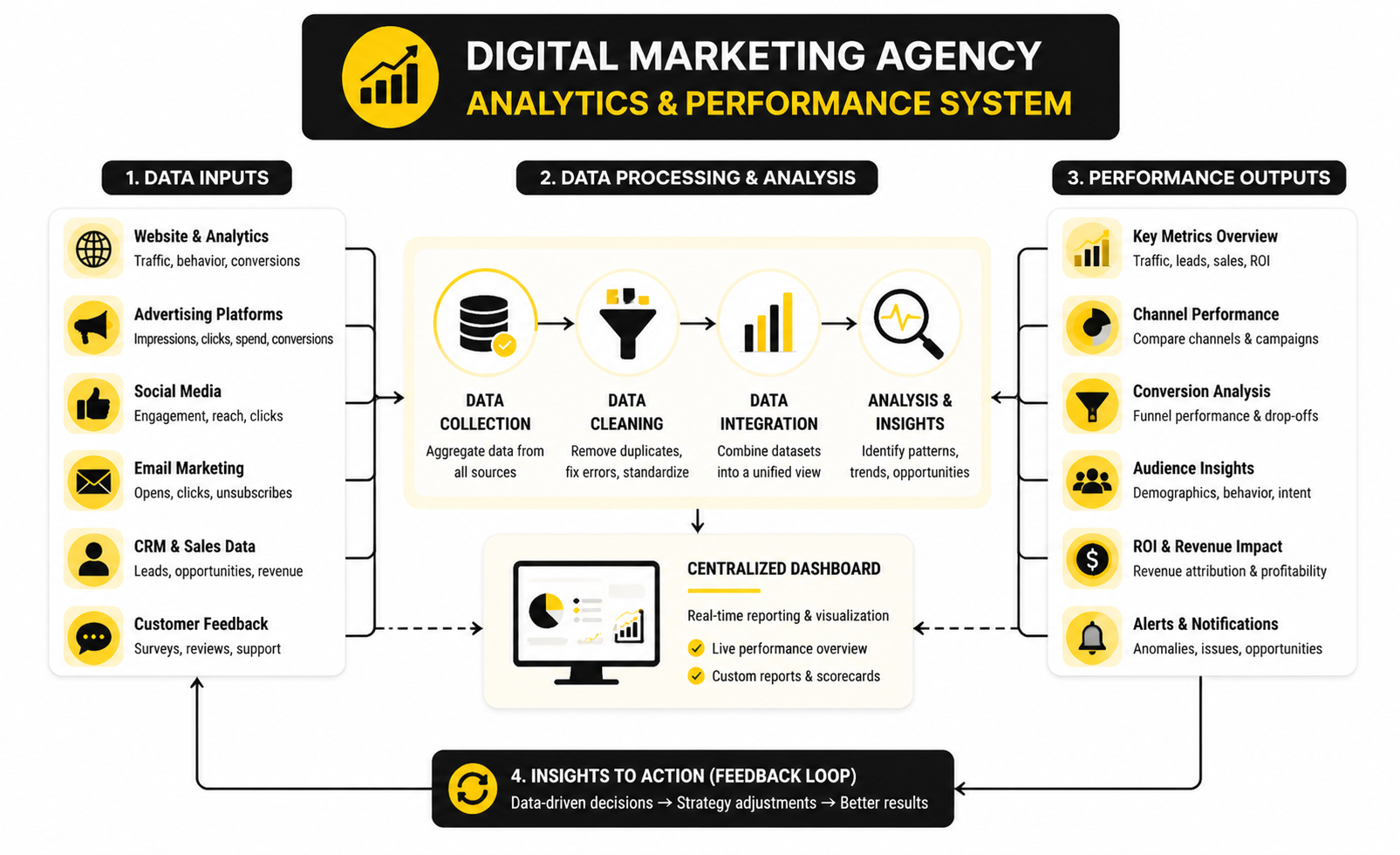
Measurement, Analytics, and What the Data Really Means
For any digital marketing agency for small business, measurement isn’t an afterthought — it’s the heartbeat of continuous improvement. Without real data, decisions are guesses. With the right numbers, a small business can pinpoint what’s working, where budgets are most effective, and what needs adjustment to grow revenue and customer engagement.
Key Metrics That Drive Decision Making
A digital marketing agency doesn’t just collect numbers — it interprets them in the context of your business goals. Here are the core performance signals that matter most and why they should influence your strategy. (turn0search2)
Customer Acquisition Cost (CAC)
This tells you how much you spend in total marketing and sales to gain a new customer. When CAC is too high relative to what a customer spends with you, your strategy isn’t sustainable. Tracking CAC by channel helps you decide where to invest more and where to pull back. (turn0search2)
Customer Lifetime Value (CLV)
CLV estimates the total revenue a customer will generate over their relationship with your business. When viewed against CAC, it reveals whether your marketing spend is profitable over the long run — a balance good agencies watch closely. (turn0search2)
Return on Investment (ROI) and Return on Ad Spend (ROAS)
ROI shows how many dollars come back for every dollar spent across all channels, and a “good” benchmark in digital marketing is generally around 5:1 — $5 returned for every $1 invested. Exceptional campaigns often exceed 10:1, while anything under 2:1 usually signals inefficiency. (turn0search10)
Traffic Quality Metrics
Numbers like session duration, bounce rate, and traffic source breakdowns matter because they show not just quantity but relevance. A thousand visits that leave immediately tell a very different story than 200 engaged visitors who convert. These metrics help refine SEO, content focus, and messaging.
Conversion Rates
Conversion rates — whether for newsletter signups, lead forms, or purchases — are among the most actionable metrics. For context, average email conversion rates reported across industries are around 2–3 %, and strong campaigns regularly exceed that with segmentation and optimization. (turn0search7)
Benchmarks and Why They Matter
Benchmarks give you context for your numbers. Without them, you’re comparing results to nothing. Here’s how benchmarks inform strategy:
- Email Marketing ROI: Channels like email can deliver extraordinary ROI — often in the range of $36+ for every $1 spent — making them indispensable for small businesses focused on retention. (turn0search0)
- SEO Traffic Share: Over 53 % of all website traffic often comes from organic search, which explains why SEO is a cornerstone of most small business digital strategies. (turn0search0)
- Channel ROI Expectations: Paid search may deliver 2:1–8:1 ROAS once campaigns mature, while content and SEO typically require time to build but outperform many paid channels over the long term. (turn0search1)
Knowing these benchmarks lets a digital marketing agency for small business set realistic expectations, forecast growth, and advise when a tactic deserves more budget or needs to be reconsidered.
Turning Data Into Action
The most important part of analytics is asking practical questions:
- Is CAC trending up or down, and what channels are driving that change?
- Is our CLV improving as we retain more customers through email and loyalty campaigns?
- Are impressions and clicks translating into meaningful leads or just noise?
A good agency will show you not just dashboards, but stories the data tells and specific steps to improve performance. They’ll distinguish between what looks good on paper and what actually grows your business — helping you avoid vanity metrics like page views alone and focus on revenue and customer lifetime value. (turn0search2)
Ultimately, measurement systems transform a digital marketing agency for small business from a cost center into a growth partner by making every dollar spent accountable and every campaign smarter than the last.
Advanced Considerations for Scaling and Strategic Tradeoffs
Partnering with a digital marketing agency for small business is not just about launching campaigns — it’s about navigating strategic tradeoffs, scaling intelligently, and managing risks. Small businesses often face resource constraints, making it crucial to prioritize channels and initiatives that provide the highest return while avoiding overextension.
Balancing Growth and Budget
Scaling campaigns too quickly can dilute effectiveness. Agencies advise:
- Phased Channel Expansion: Start with the channels most likely to produce early wins — often SEO and email marketing — before adding paid social or display campaigns.
- Budget Allocation by Performance: Continuously shift spend toward high-performing campaigns while reducing underperforming ones. (spocket.co)
- Testing Before Scaling: A/B tests and pilot campaigns allow businesses to validate messaging, creative, and targeting without committing the full budget upfront.
This disciplined approach avoids overspending while still maintaining growth momentum.
Risk Management and Market Adaptation
Digital landscapes change rapidly. Agencies guide businesses in mitigating risk through:
- Diversified Channel Mix: Avoid reliance on a single platform for leads or sales. A balanced approach across organic search, paid advertising, and email ensures resilience.
- Data-Driven Pivoting: Regular analysis identifies when campaigns underperform due to market shifts, algorithm changes, or seasonality.
- Compliance and Brand Safety: Agencies help small businesses adhere to advertising policies and privacy regulations, reducing exposure to fines or account suspensions. (tecinv.com)
Operational and Team Considerations
Scaling also involves internal processes:
- Integration With Sales: Marketing leads must flow smoothly into sales or customer support for follow-up, conversion, and nurturing.
- Internal Knowledge Transfer: Agencies often provide training or documentation so the small business team can maintain campaigns effectively between agency interactions.
- Automation for Efficiency: Tools like GoHighLevel and ClickFunnels allow automation of repetitive tasks, ensuring the small business maximizes time and resources.
Strategic Tradeoffs
Every marketing decision involves tradeoffs:
- Investing heavily in paid campaigns may deliver quick traffic but can reduce ROI if organic channels aren’t strong.
- Focusing on long-term SEO growth delays immediate results but builds sustainable traffic and lowers CAC over time.
- Prioritizing engagement on social platforms may improve brand awareness but requires ongoing content creation and community management.
A skilled agency helps weigh these tradeoffs, creating a strategy that balances short-term impact with long-term growth. (growthfolks.io)
By considering these advanced factors — budget, risk, internal operations, and tradeoffs — small businesses can scale confidently, knowing their digital marketing is strategically sound and adaptable to change.
FAQ – Built for Complete Guide
What does a digital marketing agency for small business actually do?
A digital marketing agency for small business creates, manages, and optimizes online campaigns that help small companies reach customers on search engines, social media, email, and other digital channels. They build strategies based on your goals, audience, and industry.
How much should a small business expect to spend on digital marketing services?
Costs vary widely based on services and goals, but many small businesses budget monthly retainers or project‑based fees. An agency will typically align recommendations with your revenue, expected ROI, and desired outcomes rather than a one‑size‑fits‑all number.
How long does it take to see results from digital marketing?
Some channels like paid ads can produce traffic quickly, while SEO and content marketing often require several months to build momentum. A good agency sets realistic timelines and benchmarks to measure progress.
Can small businesses handle digital marketing without an agency?
Yes, many start in‑house using tools and basic skills. However, agencies bring specialized expertise, efficiency, and strategic perspective that can save time and improve results once goals become more ambitious.
What makes a good digital marketing agency for small business?
A good agency understands your industry, communicates clearly, sets measurable goals, demonstrates transparent reporting, and adapts based on data. They align their work with your bottom‑line business objectives.
Should a small business focus more on SEO or paid advertising first?
That depends on your timeline and budget. SEO builds sustainable organic traffic over time, while paid advertising can drive quicker visibility. Many effective strategies blend both with priority based on your specific context.
How does performance measurement work with an agency?
Agencies track key metrics like traffic, leads, conversions, customer acquisition cost, and ROI. They share reports regularly and explain what the numbers mean, helping you see where to adjust strategy.
What risks should small businesses be aware of with digital marketing?
Potential risks include overspending on ineffective channels, relying on a single traffic source, and ignoring data signals. A professional agency mitigates these by testing, diversifying, and optimizing campaigns.
How does an agency tailor strategy to a small business’s target audience?
Agencies research your customers’ behaviors, preferences, and search patterns, then craft messaging and channel plans that meet them where they are. Audience insights shape content, ads, and timing.
Can results from a digital marketing agency be guaranteed?
No credible agency guarantees specific outcomes like exact revenue figures because market conditions, competition, and customer behavior vary. What agencies do guarantee is strategic discipline, transparency, and continuous optimization toward agreed goals.
Work With Professionals
Explore 10K+ Remote Marketing Contracts on MarkeWork.com
Most marketers spend too much time chasing clients, competing on crowded platforms, and losing a percentage of every project to middlemen. MarkeWork gives you a better way. Browse thousands of remote marketing contracts and connect directly with companies desperate to hire skilled marketers like you, without platform commissions and without unnecessary gatekeepers.
If you're serious about finding better opportunities and keeping 100% of what you earn, invite readers to explore available contracts and create a profile for free at MarkeWork.com.