

A digital marketing agency is no longer just a vendor you hire to run ads or post on social media. For a lot of businesses, it has become the team that connects traffic, leads, sales conversations, follow-up, and measurement into one working system. That shift matters because the modern customer journey is messy, fragmented, and increasingly shaped by search, reviews, content, email, video, automation, and AI-assisted buying behavior. Google’s own consumer journey research and Salesforce’s latest State of Marketing report both point to the same reality: customers expect fast, relevant, connected experiences, while many brands still struggle to deliver them consistently. Google Business+2
That is exactly where a good digital marketing agency earns its keep. It brings strategy, channel expertise, creative execution, data discipline, and operational speed to a problem most internal teams do not have enough time or specialization to solve on their own. And as digital ad investment keeps climbing, with the IAB reporting $258.6 billion in U.S. internet ad revenue for 2024, the cost of weak execution keeps getting more expensive. IAB
- Why a Digital Marketing Agency Matters
- The Modern Agency Growth Framework
- Core Services That Drive Revenue
- How Professional Agencies Execute and Optimize
- How to Choose the Right Digital Marketing Agency
- Costs, Common Mistakes, and What Good Results Look Like
Hiring a digital marketing agency is not really about outsourcing random marketing tasks. It is about building a system that turns attention into action and action into measurable revenue. When businesses try to manage SEO, paid media, content, email, analytics, conversion rate optimization, and reporting in isolation, they usually end up with disconnected campaigns and vague explanations for why growth stalled.
That problem has become more serious because buyer journeys are more complex than they were even a few years ago. People compare options across search results, review platforms, social content, landing pages, email follow-up, and direct conversations before they decide to buy. Google highlights that customers now move through increasingly complex paths to purchase, and Adobe’s 2025 customer engagement research shows that consistency across those touchpoints is a real expectation, not a nice bonus. Google’s journey analysis and Adobe’s 2025 customer engagement report make that painfully clear. Google Business+1
A capable digital marketing agency helps close that gap by doing two things at the same time. First, it creates demand through channels like search, paid ads, content, email, and social. Second, it makes sure the business can actually capture and convert that demand with strong landing pages, better messaging, cleaner tracking, and sharper follow-up processes.
This matters even more for local and mid-sized businesses because visibility and conversion are tightly linked. Google says its tools connected more than 19 million U.S. businesses to customers at no cost in 2024 through actions like calls, bookings, directions, and reviews, which tells you how much commercial intent now flows through digital discovery moments. If your business appears in the right places but the offer, page, or follow-up is weak, you lose revenue after the hard part is already done. Google’s economic impact FAQ lays out just how central these digital touchpoints have become. economicimpact.google
The bigger reason businesses turn to agencies, though, is execution speed. Internal teams often know what they should do, but they cannot move fast enough across strategy, creative, media buying, analytics, and optimization. A good agency compresses that learning curve, gives the business access to specialists it could not justify hiring one by one, and keeps decisions tied to performance instead of opinion.
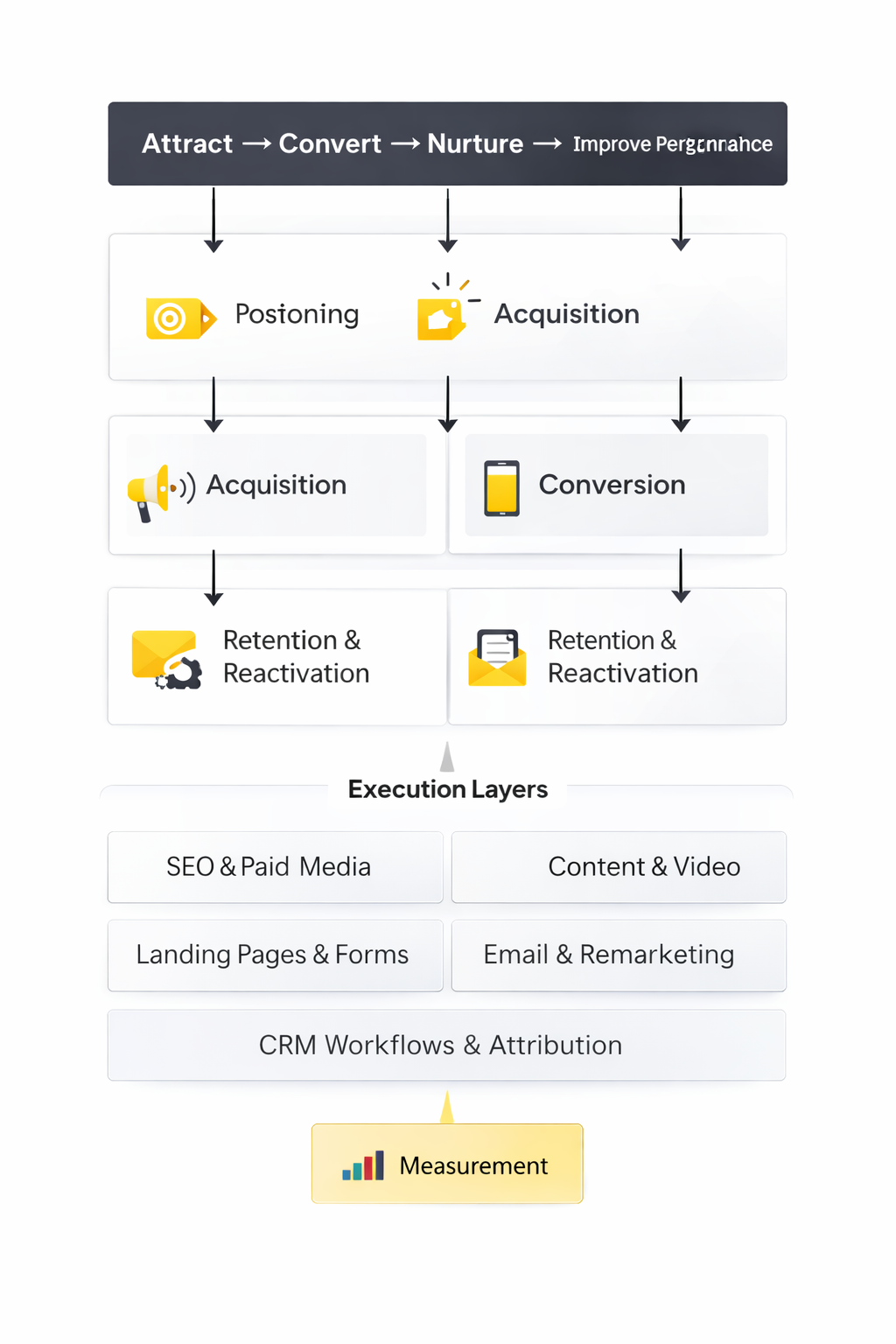
The best digital marketing agency work is built on a framework, not a pile of disconnected tactics. The framework is simple to describe even if it takes real skill to execute: attract the right audience, convert interest into leads or sales, nurture intent, and improve performance through measurement. That sounds obvious, but most underperforming campaigns break because one of those stages is weak and nobody notices until budget has already been burned.
In practice, that means a professional agency usually works across five connected layers. The first is positioning, where the offer, audience, and message are clarified. The second is acquisition, where channels such as SEO, paid search, paid social, content, video, and local discovery bring in qualified traffic. The third is conversion, where landing pages, forms, calls to action, and sales handoff decide whether traffic becomes pipeline. The fourth is retention and reactivation, where email, remarketing, CRM workflows, and content keep the relationship moving. The fifth is measurement, where reporting, attribution, and testing show what deserves more budget and what should be cut.
That framework matters because modern marketing performance is rarely created by one channel alone. HubSpot’s current marketing benchmarks, Content Marketing Institute’s 2025 B2B research, and Google Ads documentation around goal-based campaign systems all reinforce the same practical lesson: the winners are not just publishing more or spending more, they are building coordinated systems that connect intent, creative, targeting, landing pages, and follow-up. HubSpot+2
A strong agency framework also leaves room for the right tools without becoming tool-obsessed. Agencies often use platforms such as ClickFunnels, Systeme.io, and Fillout to test and improve conversion paths, while using delivery and follow-up tools like Brevo, Moosend, Buffer, or Flick when those choices fit the client’s funnel and workflow. The point is never the software itself. The point is building a cleaner system that gets more value from the traffic you already pay for.
What separates experienced agencies from average ones is how they connect this framework to business outcomes. They do not treat impressions, clicks, and follower counts as the finish line. They care about qualified leads, booked calls, close rates, customer value, and the conversion leaks between each stage, because that is where real growth usually hides.
That is the lens the rest of this article will use. Next, we will break down the core services that actually move revenue inside a digital marketing agency, and which of them matter most depending on your business model, sales cycle, and growth stage.
Once you understand the framework, the next question is obvious: what does a digital marketing agency actually do day to day that moves revenue, not just vanity metrics. This is where a lot of businesses get misled, because agencies often sell channels as if each one works independently. In reality, the strongest agencies build a stack of services that match buying intent, conversion friction, and the client’s sales process.
That stack usually includes search visibility, paid acquisition, conversion-focused content, lifecycle follow-up, and performance measurement. The exact mix changes by industry, but the principle stays the same: a digital marketing agency should not be paid to create activity alone. It should be paid to improve how efficiently the business turns attention into qualified demand.
SEO still matters because search traffic often arrives with clearer intent than interruptive channels. Someone actively looking for a solution, a service provider, or a comparison page is already further down the decision path than a casual social media scroller. Google’s own documentation keeps the fundamentals refreshingly simple: create helpful, reliable, people-first content, use language real people search for, and make your site easy for search engines to understand and crawl through Search Essentials and Google’s people-first content guidance.
That sounds basic, but execution is where most companies fall apart. They publish thin pages, chase keywords that do not match buyer intent, or treat SEO like a publishing quota instead of a trust-building system. A serious digital marketing agency approaches SEO more like product-market fit for content, building pages that deserve to rank because they answer real questions, support real decisions, and create a cleaner path to conversion.
It also pays attention to technical friction, because search visibility and on-site experience are connected more than many brands admit. Google says Core Web Vitals are used by its ranking systems, and it also makes clear that a good page experience can contribute to search success when several results are similarly relevant. That means SEO is not just about copy and backlinks anymore; it is also about speed, usability, structure, and making the page satisfying enough that the visit actually leads somewhere useful.
Paid media is where a digital marketing agency can produce fast feedback, but it is also where money gets wasted fastest when strategy is weak. Search ads, paid social, retargeting, display, YouTube, and marketplace ads all have a place, but only if the offer, audience, creative, and landing experience are tightly aligned. Google has pushed harder into automation and goal-based optimization across its ad stack, which means agencies now need stronger inputs and cleaner measurement, not just bid tweaks and surface-level reporting through Google Ads guidance and newer platform updates on AI-powered campaign workflows.
This is the uncomfortable truth many businesses discover too late: paid traffic does not fix a bad offer. It simply exposes it faster. A strong agency uses paid media to test positioning, surface conversion bottlenecks, and scale proven economics, while a weak one keeps asking for more budget before the fundamentals are working.
Paid social deserves its own nuance because it serves different roles depending on the business model. For some companies, it is a direct-response engine. For others, it is better used to create familiarity, collect leads, retarget engaged audiences, and support the channels that close later. Meta’s own lead ad documentation frames this clearly: lead ads are built to help businesses find interested prospects and collect information directly, but the outcome depends heavily on the form design, follow-up speed, and campaign setup through Meta’s lead ads overview and its lead ad best practices.
Content is one of the most misunderstood services inside a digital marketing agency because businesses often treat it like a branding extra instead of a conversion asset. In practice, good content does several jobs at once. It helps a brand get discovered, explains complex offers, handles objections before a sales conversation starts, and gives paid and email channels something worth amplifying.
That is one reason content budgets have stayed relevant even while marketers get more selective. In the latest B2B Content Marketing Benchmarks & Trends research for 2025, 46% of B2B marketers said they expected their content marketing budget to increase, and 61% said investment in video would rise. That tells you where professional teams see leverage right now: not in pumping out generic articles, but in formats and assets that move trust and help audiences make decisions.
Video is especially hard to ignore now. Wyzowl’s latest video marketing research found that 91% of businesses use video as a marketing tool, while HubSpot’s current marketing statistics hub says short-form video is the top-performing content format for marketer ROI. A competent digital marketing agency reads that trend correctly. It does not turn every client into a full-time creator brand, but it does recognize that modern content needs to explain, demonstrate, compare, and reassure in formats people are actually willing to consume.
A lot of businesses obsess over traffic and still leave money sitting in the inbox. That is a mistake. Email remains one of the few channels a company can control directly, and it becomes even more valuable when acquisition costs rise and buyers need more than one touchpoint before they act.
This is why lifecycle marketing is such an important part of professional agency work. Welcome flows, abandoned inquiry follow-up, lead nurturing, sales reminders, reactivation campaigns, and post-purchase sequences all improve the return on traffic you already earned. Tools such as Brevo, Moosend, and Systeme.io can make this easier to build, but the real value comes from message timing, segmentation, and clarity of offer, not from the dashboard itself.
The numbers back that up. Mailchimp’s current benchmark data shows an overall average open rate of 35.63% across users, with meaningful variation by industry, which is exactly why serious agencies benchmark by context instead of chasing one universal number. A sharp digital marketing agency uses email less like a newsletter habit and more like a pipeline tool that keeps leads warm, customers active, and missed opportunities from staying missed.
For local and service-based businesses, one of the highest-value services an agency can provide is often the least glamorous. It is not a trendy ad tactic. It is making sure the business is easy to find, easy to trust, and easy to contact when someone searches with intent.
Google is explicit about this. A Business Profile on Google helps turn people who find a company on Search and Maps into customers, and Google also says that businesses can improve local ranking by focusing on relevance, distance, and prominence through its guidance on local ranking factors and Business Profile setup. For a digital marketing agency working with local brands, that means profile completeness, service information, review quality, accurate categories, fresh photos, and a disciplined response process are not side tasks. They are core revenue infrastructure.
Trust signals matter here more than marketers sometimes admit. Reviews, response quality, clear contact information, and consistent brand details often influence who gets the call before the website even has a chance. That is also why fake-review shortcuts are dangerous: Google has tightened enforcement around manipulative reviews, and public trust damage can cost more than any short-term lift ever delivers, as covered in reporting on Google’s crackdown by The Verge and The Guardian.
The final service that separates a real growth partner from a busy agency is conversion work. Traffic without conversion discipline is expensive entertainment. This is where landing pages, offer structure, form design, booking flows, chat, call routing, and follow-up logic stop being minor details and start becoming the reason campaigns win or fail.
Google’s performance guidance for advertisers consistently pushes toward a simpler, faster, lower-friction user experience, especially on mobile, through resources on mobile site optimization and page experience. That lines up with what good agencies see in real campaigns every week: you usually do not need more traffic first. You need fewer leaks. Sometimes the win is a better headline, a tighter form, a more specific promise, or a cleaner booking path built in tools like ClickFunnels or Fillout.
That is why the best digital marketing agency teams are rarely obsessed with channels alone. They think in systems. They know SEO helps paid search, paid search exposes landing page problems, landing pages shape lead quality, email follow-up rescues abandoned intent, and reporting tells you where the next constraint is hiding. The next section is where that thinking becomes operational, because professional implementation is what turns a nice-looking strategy into repeatable performance.
A digital marketing agency proves its value in the implementation phase, not in the pitch deck. This is where strategy gets translated into tracking, creative assets, campaign architecture, landing pages, workflows, reporting, and weekly decisions. If those pieces are built loosely, even smart ideas break under pressure once real traffic and real budget hit the system.
The strongest agencies do not treat execution like a one-time setup. They treat it like an operating rhythm. That means clear priorities, clean handoffs, disciplined measurement, and constant refinement based on what the market is actually doing instead of what the team hoped would happen.
Professional implementation starts with business truth, not channel excitement. Before a serious digital marketing agency launches anything, it needs to understand the offer, margins, sales cycle, close rate, seasonality, customer objections, and what a qualified lead actually looks like. Without that foundation, the agency may still generate clicks, but it will struggle to generate the kind of pipeline the client can close profitably.
This step matters because marketing performance is shaped long before the ads go live. Salesforce’s State of Marketing makes the point clearly by showing how strongly top-performing teams are focusing on data quality, personalization, and connected execution rather than isolated campaigns. In other words, the implementation process has to begin with alignment around revenue goals and operational constraints, otherwise the reporting will look busy while the business still feels disappointed.
A good agency also defines what success means in plain language. That usually includes target cost per lead, lead-to-call rate, sales-qualified lead thresholds, booked meetings, revenue contribution, and expected time to signal. These are not just reporting metrics. They are guardrails that stop the engagement from drifting into vague marketing theater.
This is the step too many agencies rush, and it is one of the costliest mistakes in the whole process. A digital marketing agency should set up measurement before serious spend begins, because once campaigns are running, bad tracking contaminates every decision that follows. You cannot optimize what you cannot trust.
Google’s guidance across Google Analytics 4, web conversion setup in Google Ads, and the Measurement Protocol shows how much modern performance tracking now depends on structured events, connected platforms, and a setup that can capture more than simple pageviews. That means a professional agency should define conversion events properly, connect ad platforms to analytics, validate form completions, and make sure the CRM or lead destination reflects what happened after the click.
This is also where attribution expectations need to be handled honestly. No tracking setup is perfect. A smart agency knows that platform-reported conversions, analytics reports, CRM outcomes, and actual revenue often tell slightly different versions of the same story, so the goal is not fantasy-level precision. The goal is decision-grade clarity that is good enough to guide spend, testing, and channel priority with confidence.
Once the measurement layer is stable, the agency can turn the plan into tangible assets. This is where messaging frameworks become ad copy, search themes become campaign structures, offers become landing pages, and follow-up logic becomes automation. It is also where a digital marketing agency separates itself from freelancers stitching together disconnected tasks, because professional execution depends on all of those elements working as one system.
The best teams usually build around a small number of clear user journeys first. They do not launch ten half-finished funnels just to look comprehensive. They launch the highest-intent path, the clearest offer, the cleanest landing page, and the most reliable follow-up sequence, then expand once the core path is producing trustworthy data.
That often means using practical tools that speed up deployment without making the operation harder to manage. A team might build landing paths in ClickFunnels or Systeme.io, collect better-formatted lead data with Fillout, route inquiries into CRM workflows with Copper, and keep scheduling friction low through Cal.com. None of those tools replaces strategy, but they can remove avoidable friction and make implementation faster, cleaner, and easier to improve.
This is the point where the execution process becomes real. A capable digital marketing agency does not hit publish on everything at once and hope the dashboards sort themselves out later. It launches in phases, checks conversion paths, verifies lead routing, tests page behavior on real devices, and confirms that the right people are seeing the right message before scale is introduced.
That controlled approach matters because the first days of a launch are usually diagnostic, not triumphant. Search terms come in differently than expected. Audiences behave unevenly. Landing pages reveal friction. Sales teams discover that some leads look good in-platform but weak in practice. The agency needs to catch those issues fast, while the budget is still small enough to protect.
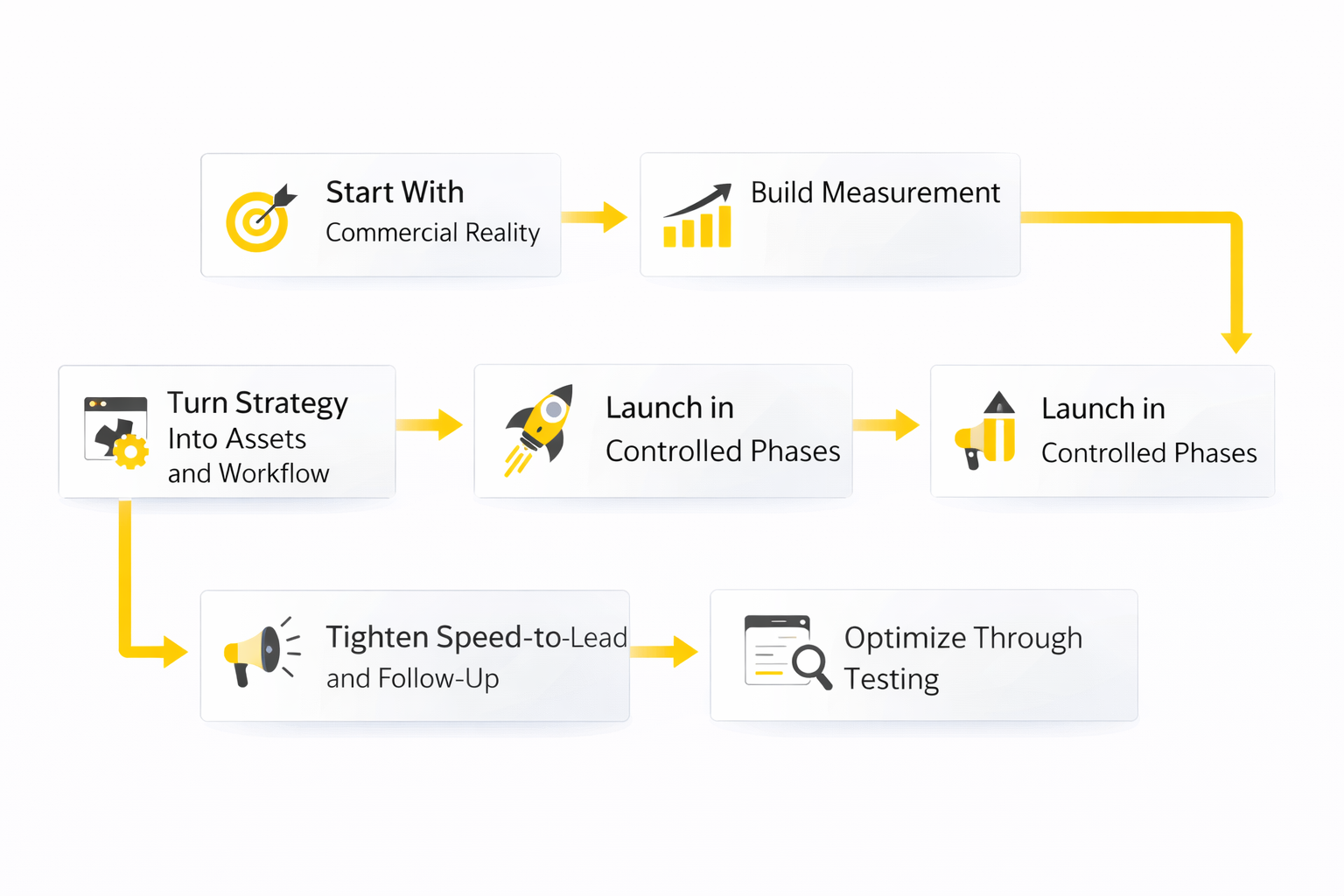
A practical rollout often follows a sequence like this:
- Finalize offer, audience, and primary conversion goal.
- Validate analytics events, conversion actions, and CRM routing.
- Launch a narrow campaign set with tightly matched messaging.
- Watch search terms, click quality, form behavior, and booking flow.
- Review sales feedback alongside platform data.
- Expand budget only after the early signal is credible.
That last point is the one many teams ignore. Budget should be the reward for clarity, not the substitute for it. If a digital marketing agency cannot explain why early performance looks the way it does, scaling usually magnifies confusion rather than results.
Once leads start arriving, operations matter just as much as media buying. This is one of the most overlooked realities in agency execution. A digital marketing agency can generate demand, but if the client responds slowly or inconsistently, performance degrades even when the campaigns are doing their job.
The old lead-response research still holds up because it captures a human truth that has not changed: intent decays fast. The MIT lead response study found that the odds of contacting a lead drop dramatically even between five and thirty minutes, and more recent sales guidance from HubSpot continues to reinforce the need for near-immediate response. That is why experienced agencies build alerts, auto-replies, calendar routes, qualification logic, and ownership rules early, instead of treating follow-up as somebody else’s problem.
This is also where lifecycle automation starts paying off. Email confirmation, reminder sequences, missed-call recovery, nurture tracks, and re-engagement flows turn a simple lead form into an actual pipeline mechanism. Tools like Brevo, Moosend, and ScaledMail can support that layer well when the strategy behind the messages is solid.
Optimization is where mature agencies earn long-term trust. A weak agency makes surface edits and calls that optimization. A strong digital marketing agency builds a repeatable testing process that looks at audience quality, search intent, creative angles, landing-page friction, lead qualification, and downstream revenue patterns together.
Google’s work on experimentation and incrementality and its guidance on AI-powered data strategy make an important point: marketing measurement is strongest when teams test causality, not just observe correlations. In practical terms, that means agencies should not overreact to every daily fluctuation. They should form a hypothesis, run a clean test, review signal quality, and then decide whether to scale, revise, or remove an element.
That process usually focuses on a few high-leverage questions at a time. Is the offer wrong, or is the audience wrong. Is lead volume improving while lead quality is slipping. Is the landing page underperforming because the message is weak, the form is too long, or the traffic source is mismatched. Those are the decisions that actually improve performance, and they require patience, structure, and evidence.
Reporting should make the next move obvious. That sounds simple, but many agency reports still drown clients in screenshots, platform jargon, and data that is technically accurate but strategically useless. A professional digital marketing agency reports in layers, showing channel performance, funnel movement, conversion quality, and business impact in one connected narrative.
This is especially important now because fragmented data is still one of the biggest operational barriers in modern marketing. Adobe’s 2025 AI and Digital Trends reporting and its category-specific research on connected customer experience keep highlighting the same problem: teams have more data than ever, but they often struggle to unify it well enough to act with confidence. Good reporting solves that by reducing noise, identifying constraints, and showing where the next gain is most likely to come from.
A solid agency report should answer a few brutal questions every time. What happened. Why did it probably happen. What changed since the last period. What are we doing next. If the client finishes the report with more confusion than clarity, the report failed, no matter how polished it looked.
By this point, the pattern should be obvious. Professional implementation is not flashy because it is built on process discipline. A digital marketing agency that executes well aligns commercial goals, installs trustworthy measurement, launches with control, protects speed-to-lead, tests methodically, and reports in a way that drives better decisions.
That is the real difference between an agency that creates movement and one that creates momentum. Movement looks active. Momentum compounds. In the next section, we will get into the buying side of this decision and break down how to choose the right digital marketing agency without getting trapped by impressive presentations and underwhelming delivery.
A digital marketing agency should be judged by its measurement system, not by how many charts it can fit into a monthly report. The point of analytics is not to produce more data. It is to reduce uncertainty, reveal bottlenecks, and help the business make better decisions about budget, messaging, channels, and follow-up.
This is where many companies get misled. They see traffic going up, impressions climbing, or social engagement improving, and assume the system is working. Sometimes it is. Sometimes those numbers are just noise wrapped in a good-looking dashboard.
The most useful agency reporting usually works in layers. The first layer is visibility and traffic quality, which includes impressions, click-through rate, sessions, engaged sessions, and search terms. The second layer is conversion behavior, which includes landing-page conversion rate, form completion, booked calls, qualified leads, and cost per lead. The third layer is business outcome, which includes sales-qualified opportunities, close rate, customer acquisition cost, and revenue.
That layered view matters because no single metric can tell the whole story. A digital marketing agency might lower cost per click and still hurt performance if the traffic gets weaker. It might increase lead volume and still damage growth if those leads do not become serious opportunities. Strong reporting connects top-of-funnel efficiency to bottom-of-funnel quality so the client can see where momentum is real and where it is fake.
This is also why a high-performing campaign can look underwhelming in the first snapshot. Salesforce’s latest State of Marketing report shows that marketers are still struggling with data quality and personalization execution, which means disconnected systems can distort what success really looks like until CRM outcomes and platform data are viewed together. Salesforce+1
Benchmarks are useful, but only when they are treated like context instead of law. An average email open rate, a common click-through rate, or a broad conversion benchmark can help you see whether a campaign is wildly off track. What it cannot do is tell you whether your economics work for your offer, price point, audience quality, and sales cycle.
Take email as an example. Mailchimp’s current email marketing benchmarks show an average open rate around 34.23%, with significant differences by industry. That is helpful because it gives a business a rough frame for whether its subject lines and audience targeting are completely broken, but it does not tell you whether the sequence is generating qualified conversations or revenue. Mailchimp+1
The same logic applies to content and social. HubSpot’s current marketing statistics show that short-form video is the top ROI-driving content format cited by marketers, but that does not mean every business should suddenly flood its channels with clips. It means a digital marketing agency should evaluate whether the format matches the buyer journey, the offer, and the team’s ability to produce useful material consistently. HubSpot+2
A mature agency analytics setup is supposed to answer a sequence of practical questions. Did the right audience arrive. Did they engage with the page. Did they convert. Did the lead reach the right destination. Did the sales team respond. Did that lead become revenue. If any link in that chain is missing, the business can end up arguing over symptoms instead of fixing the actual constraint.
That is why the analytics stack matters so much. A digital marketing agency should be connecting ad platforms, site analytics, forms, CRM records, calendar bookings, and follow-up systems into one view of performance. Adobe’s current reporting on data and insights for digital trends makes the problem plain: fragmented data blocks real-time personalization and slows decision-making, which is exactly what happens when marketing reports stop at clicks and never connect to customer outcomes. business.adobe.com+1
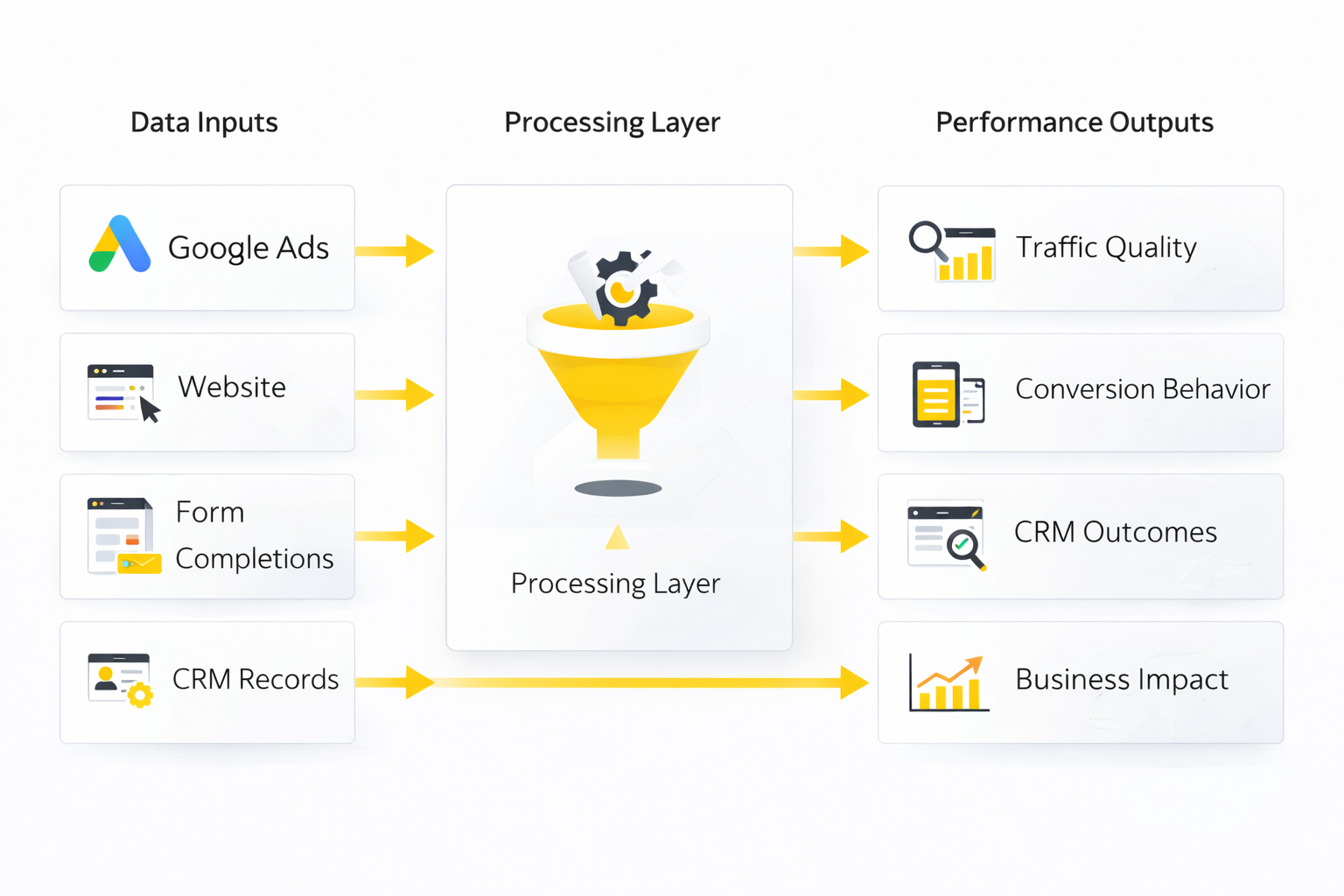
In practical terms, the analytics system should make it easy to spot where friction lives. If ad click-through rate is strong but landing-page conversion is weak, the page or offer likely needs work. If landing-page conversion is healthy but booked-call rate is low, the follow-up path or lead quality may be the issue. If booked calls are happening but sales close rate is poor, the problem may sit with positioning, qualification, pricing, or the handoff into sales.
Good signals are rarely dramatic in isolation. They usually show up as patterns that reinforce each other across the funnel. Search terms become more commercial. Bounce and abandonment fall on priority pages. Conversion rate rises without a collapse in lead quality. Sales feedback becomes more positive. Customer acquisition cost becomes more stable instead of swinging wildly month to month.
That stability is more important than many businesses realize. A digital marketing agency that produces one lucky spike is less valuable than one that creates a predictable system the business can budget around. Consistency gives the company confidence to hire, forecast, and invest. Volatility creates panic, overreaction, and constant channel switching.
This is also where qualitative input matters. Sales teams, support teams, call recordings, and demo notes often reveal why the numbers moved before the dashboard does. A smart agency does not dismiss that input as anecdotal. It uses it to interpret performance faster and test smarter.
Bad signals are not always a reason to panic, but they are a reason to diagnose carefully. A falling click-through rate can suggest creative fatigue, weak targeting, or a less competitive offer. A rising cost per lead can mean the market is more expensive, but it can also mean the campaign is still reaching people who click without buying. A strong lead volume with weak downstream conversion often points to a qualification problem, not a scaling success.
This is where shallow agency reporting becomes dangerous. If the report celebrates lower cost per click while revenue quality is getting worse, the business is being trained to optimize the wrong thing. That is how companies burn budget for months while thinking the campaign is improving.
Email metrics are a good example of this trap. High open rates can mean the subject line worked, but low click rates or weak reply activity may show that the message itself failed to move intent. Mailchimp’s reporting resources on open and click rates and email campaign reports make it clear that these metrics should be read together, not in isolation. Mailchimp+1
Data only becomes useful when it changes what the team does next. That sounds obvious, but a surprising amount of agency reporting ends with no clear action at all. The client sees the numbers, the agency explains them, and then everyone meets again next month with the same unresolved bottlenecks still sitting in the funnel.
A better system ties each signal to a likely next step. Weak CTR may call for new creative angles or tighter keyword targeting. Strong CTR but poor landing-page conversion may call for a sharper offer, stronger proof, or a simpler form using tools like Fillout. Healthy lead generation but poor follow-up may call for better automation through Brevo or Moosend, faster scheduling through Cal.com, or a cleaner CRM handoff through Copper.
That action bias is what separates a reporting culture from an optimization culture. A digital marketing agency should not just tell you what happened. It should help you decide what to change, what to keep, and what to stop funding.
The temptation with data is to chase universal answers. What is a good cost per lead. What is a normal conversion rate. What click-through rate should we expect. Those questions are understandable, but they often lead businesses into false certainty because averages hide too much. A branded search campaign, a cold social campaign, a local service offer, and a high-ticket B2B funnel do not play by the same rules.
That is why the best agency benchmarks are internal before they are external. Compare current performance to your own past performance, to your sales capacity, to your margins, and to the true value of a converted customer. External data can set the frame, but your own funnel tells you whether the economics are actually working.
This becomes even more important as teams adopt more AI-driven workflows. Adobe’s recent AI and Digital Trends report keeps pointing back to a central issue: more technology does not automatically produce better decision-making if the underlying data, workflow, and interpretation are weak. A digital marketing agency that cannot translate numbers into commercial judgment will still produce sophisticated-looking confusion. business.adobe.com+1
For the business owner or operator, the goal is not to become a full-time analyst. The goal is to know enough to challenge weak reporting and recognize real momentum when it appears. You should be able to ask simple, sharp questions. Are we attracting the right people. Are they converting. Are those leads qualified. Are we responding fast enough. Is revenue improving in a way that justifies the spend.
If your digital marketing agency can answer those questions clearly, the analytics system is probably doing its job. If the answer is buried under vanity metrics, vague explanations, or endless talk about platform changes without business context, something is off. Data should make the path forward clearer, not harder to see.
That clarity matters because the next decision is a buying decision. Once you know how to read the signals, you are in a much stronger position to evaluate agency promises, spot weak operators early, and choose a digital marketing agency that can actually execute instead of just present well.
Choosing a digital marketing agency is not mainly about finding the most impressive presentation. It is about finding the team that can understand your economics, work inside your constraints, and improve performance without creating operational chaos. Plenty of agencies can talk about growth. Far fewer can connect strategy, execution, measurement, and accountability in a way that survives real budget pressure.
That distinction matters even more now because the environment is getting less forgiving. Salesforce’s current State of Marketing report highlights the same pressure many business owners already feel: marketers are expected to prove ROI, unify data, and make AI useful without breaking trust or efficiency. A digital marketing agency that cannot operate clearly under those conditions is not just unhelpful. It becomes expensive noise. (salesforce.com)
The first question is not whether the agency is famous, large, or loud on LinkedIn. The first question is whether it fits your business model. A digital marketing agency that does great work for venture-backed SaaS companies may be the wrong partner for a local service business, an ecommerce brand with thin margins, or a B2B company with a six-month sales cycle.
Fit shows up in the questions the agency asks early. Does it care about margins, close rates, lead qualification, fulfillment capacity, and lifetime value. Does it understand whether your growth problem is visibility, conversion, follow-up, or positioning. If the conversation stays trapped at the level of channels and deliverables, you are probably talking to a production vendor, not a strategic operator.
That is also why case studies need to be read carefully. A good-looking result means very little if the underlying conditions were completely different from yours. The best agency partner can explain not just what worked for someone else, but why that logic should or should not apply to your situation.
A strong digital marketing agency usually has visible signs of process discipline. It can explain how onboarding works, how tracking gets verified, how campaign changes are approved, how reporting is structured, and what happens when lead quality becomes a problem. That may sound less exciting than creative work or media strategy, but this is often where agency relationships succeed or fail.
Google’s current Premier Partner overview is useful context here because it shows that at least some external qualification systems reward sustained performance, certifications, and company-level capability rather than raw self-promotion. It is not a perfect filter, and it should never replace due diligence, but it can help separate agencies that take platform competence seriously from those that just borrow platform language in sales calls. (business.google.com)
The same goes for ecosystem credibility in other stacks. HubSpot’s partner program framework and Impact Awards criteria show that retention, managed revenue, reviews, and customer impact still matter in how professional service partners are evaluated. Again, none of this guarantees the right fit. It just gives you better questions to ask. (hubspot.com HubSpot)
This is where weak agencies often get exposed. A good digital marketing agency should be able to talk honestly about tradeoffs, because growth decisions always come with them. More lead volume may reduce lead quality. Faster testing may create more creative waste. Short-term paid wins may mask long-term brand weakness. Heavy automation may improve efficiency while hurting trust if the customer experience becomes too generic.
Google’s recent research with BCG on AI in advertising agencies points to a real shift here: agencies are becoming more advanced in AI use across measurement, insights, and creative. That is useful, but it also means clients need to ask a better question than “Do you use AI?” They need to ask where AI actually improves speed or quality, where humans still make the critical judgment calls, and how quality control works when automation is involved. (business.google.com)
A mature agency will not pretend there are no compromises. It will tell you where the likely pressure points are and how it plans to manage them. That kind of honesty is a much better signal than universal confidence.
The sales process usually tells you a lot about how the engagement will feel later. If an agency promises fast results without understanding your baseline, that is a red flag. If it talks endlessly about impressions, reach, and clicks before asking about revenue quality, that is a red flag too. If it cannot explain ownership of data, accounts, landing pages, or creative assets, that problem will get worse after the contract is signed.
Another red flag is channel absolutism. Any digital marketing agency that claims SEO is always the answer, or paid ads are always the answer, or AI content is now enough to replace real strategy, is oversimplifying a system that is always contextual. You want a partner that can explain why a channel fits, not one that tries to force every client into the same operating model.
Reporting language is another giveaway. If the agency avoids direct answers on attribution, margin sensitivity, or how long it typically takes to reach reliable signal, it may be protecting itself from accountability rather than protecting your expectations. Clear operators are usually comfortable saying what they know, what they do not know yet, and what data they will need in order to decide.
Early wins are not the hardest part. Sustainable scaling is. A digital marketing agency may perform well at a small spend level and still struggle once the campaign expands, the sales team gets busier, the creative needs multiply, and the reporting questions become more complex.
That is why you should ask what breaks first when scale starts working. Does creative production slow down. Does lead response time collapse. Does measurement get messy across more channels. Does the agency still review search terms, calls, landing pages, and downstream CRM outcomes with the same discipline once account complexity rises. These are not theoretical questions. They are where many promising relationships start to drift.
The broader market pressure is moving in the same direction. Forrester’s 2026 predictions emphasize tighter budgets and less tolerance for tech experimentation that fails to produce measurable value. That makes scalable operating discipline even more important. Agencies will increasingly be judged not by how innovative they sound, but by whether they can produce trusted business outcomes repeatedly. (forrester.com)
This point matters more than most businesses realize. A digital marketing agency should make your business stronger over time, not more dependent and less informed. You should come out of the relationship with clearer positioning, better data, stronger conversion assets, cleaner workflows, and more internal understanding of what drives growth.
That does not mean the agency has to hand over every process and disappear. It means the relationship should build capability, not hide behind mystery. Your team should understand the funnel better after six months, not feel even more confused than when the engagement started.
This is especially important in areas like reporting and infrastructure. Account ownership, CRM structure, landing-page control, analytics access, and ad account permissions should all be clean from the start. If the setup makes it hard to leave, it will also make it harder to see what is really happening.
A few sharp questions can save a lot of pain later. Ask how the agency defines a qualified lead for businesses like yours. Ask how it validates tracking before scaling spend. Ask what metrics it treats as leading indicators and which ones it uses to judge business impact. Ask what it needs from your team in the first 30, 60, and 90 days to give the engagement a fair chance.
You should also ask how it handles underperformance. This is a big one. A credible digital marketing agency should be able to describe its diagnosis process, how it prioritizes changes, and how it communicates when results are below plan. That answer will tell you more than any polished proposal ever could.
If the agency supports conversion infrastructure too, this is the right moment to ask about the tools it prefers and why. A team might reasonably recommend ClickFunnels, Systeme.io, Fillout, Copper, or Cal.com depending on your funnel and workflow. The real test is not whether it has favorite tools. The test is whether it can justify them in terms of speed, reliability, and commercial fit.
The right agency decision rarely feels like magic. It usually feels like clarity. You understand what the agency is going to do, how performance will be measured, what your team is responsible for, what tradeoffs are likely, and what early success should look like. That kind of clarity is calming because it replaces vague hope with operational logic.
The wrong decision often feels exciting at first and confusing later. The promises are broad, the deliverables are busy, and the numbers look active, but the business never becomes more certain about why growth is or is not happening. That is the trap to avoid.
The final part of this article will bring everything together by looking at costs, common mistakes, realistic expectations, and the questions people ask most often before hiring a digital marketing agency.
By the time a business reaches the hiring decision, cost becomes the obvious question. That is fair, but it is also where a lot of companies make the wrong comparison. The real decision is not whether a digital marketing agency is cheap or expensive. It is whether the agency can create economics that make sense for your margins, sales cycle, and growth target. clutch.co+2
Pricing is all over the place because scope is all over the place. Clutch’s 2026 pricing guide says digital marketing agency pricing commonly ranges from $5,000 to $50,000 per month, while its advertising services guide places many projects in the $10,000 to $49,999 range and notes common hourly rates around $100 to $149. For SEO specifically, Ahrefs’ 2024 survey of 439 people found that 63% of businesses spend between $500 and $5,000 per month, with average agency SEO pricing at $3,209 per month. Those numbers are useful as directional context, not as a promise of what your business should pay. clutch.co+2
What actually drives cost is complexity. A local service business with one market, one offer, and one conversion path usually needs a much simpler engagement than a multi-location brand, a B2B company with long sales cycles, or an ecommerce operation juggling creative production, paid media, email, and CRO at the same time. That is why smart buyers judge pricing alongside required speed, channel count, reporting depth, and the cost of bad execution, not just the monthly retainer line. clutch.co+2
The biggest mistake is hiring too little strategy for too much execution. Businesses often want a digital marketing agency to launch quickly, keep fees low, handle multiple channels, and somehow still build the tracking, conversion system, and follow-up infrastructure properly. That combination usually creates fragile campaigns, weak reporting, and the false impression that “marketing is not working” when the real issue is underbuilt implementation. Salesforce+2
Another common mistake is judging performance too early or too late. Too early, and the business kills a campaign before the signal is reliable. Too late, and it keeps funding underperformance because the reporting stays vague. A good digital marketing agency sets expectations around learning periods, early indicators, and downstream quality so that the business can stay patient without becoming passive. Salesforce+2
The healthiest sign that an agency relationship is working is not just more traffic or even more leads. It is a cleaner system. Search intent becomes sharper, conversion rates get stronger, follow-up gets faster, reporting gets easier to trust, and the business becomes more confident about where the next dollar should go. That kind of improvement compounds because it strengthens the entire operating model, not just one campaign. Salesforce+2
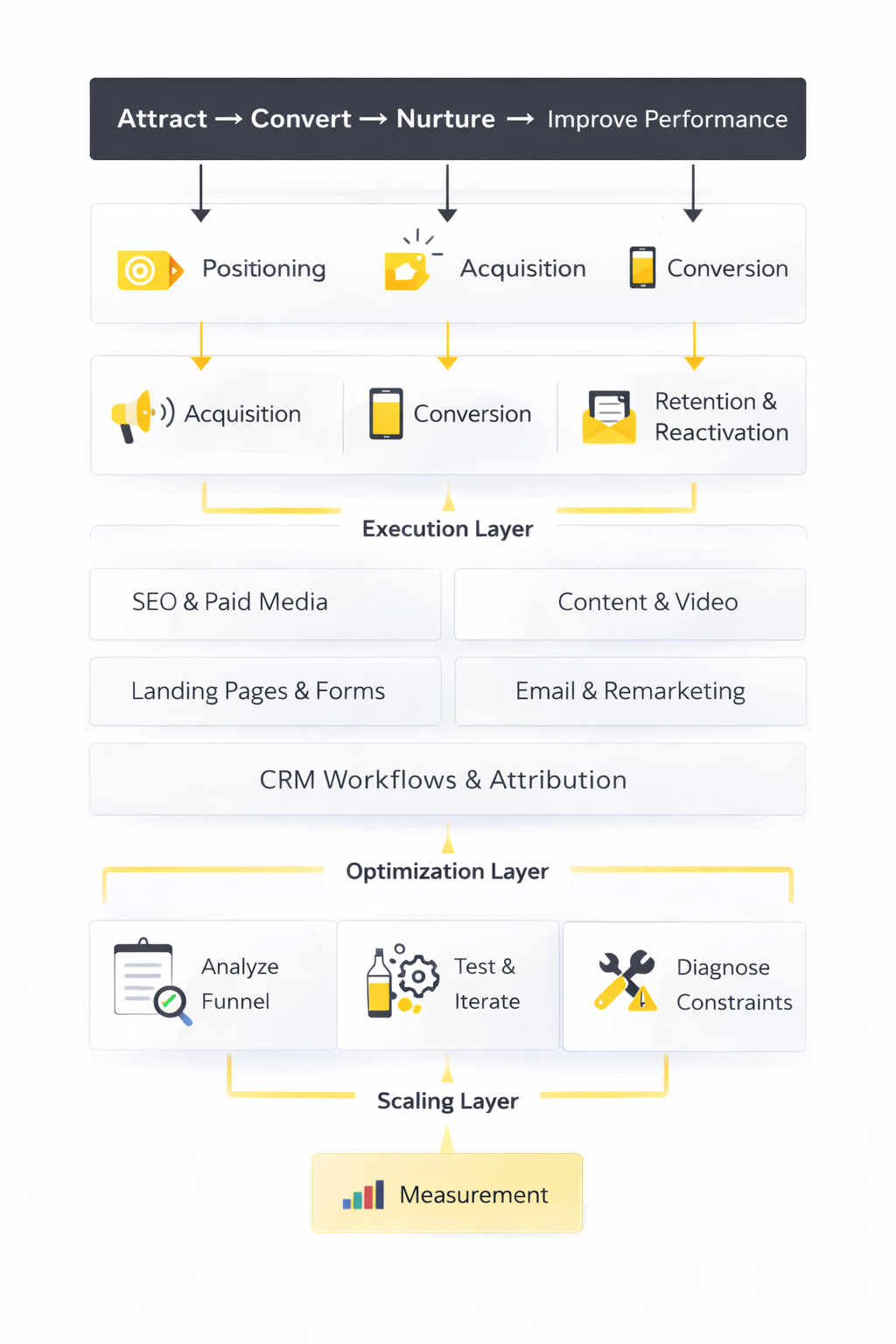
A strong digital marketing agency also helps a business avoid expensive overcorrections. It does not chase every platform update, every AI trend, or every new content format just because the market is noisy. It stays focused on commercial outcomes, uses benchmarks carefully, and builds an ecosystem that can absorb new tools without losing strategic clarity. That matters more now because many teams still struggle to unify data and make AI genuinely useful in day-to-day marketing operations. Salesforce+2
In practical terms, good results usually feel less dramatic than people expect. They feel steadier. Fewer wasted leads, better handoff into sales, more reliable acquisition economics, stronger content support, and clearer decisions about what to scale next. When that starts happening, a digital marketing agency stops feeling like an outsourced vendor and starts functioning like a growth system the business can actually build around.
A digital marketing agency helps businesses attract, convert, and retain customers through channels like SEO, paid media, content, email, analytics, and conversion optimization. The good ones do not just run tactics. They connect those tactics into a system that supports revenue, tracking, and follow-up.
That system matters because buyers now move across search, ads, reviews, email, and multiple touchpoints before they decide. Salesforce’s latest marketing research and Google’s customer journey guidance both reinforce how fragmented and expectation-heavy that path has become. Salesforce+1
It can be, especially when the business cannot justify hiring multiple specialists in-house. A small business usually does not need a giant agency stack. It needs a focused setup that improves visibility, conversion, and speed-to-lead without wasting budget.
The key is fit. If the offer is weak, the follow-up is slow, or the market is too narrow to support aggressive scaling, an agency will not magically solve that. But if the fundamentals are solid and execution is the bottleneck, a digital marketing agency can compress the learning curve fast.
There is no single correct number because scope changes everything. Clutch’s 2026 pricing guide says digital marketing agency pricing commonly ranges from $5,000 to $50,000 per month, while Ahrefs’ SEO pricing survey found most businesses spending $500 to $5,000 per month on SEO specifically. clutch.co+1
That means price should be tied to the work being done, not copied from somebody else’s retainer. A smaller company may need focused help with local search, landing pages, and email. A larger company may need full-funnel strategy, creative production, multi-channel media buying, and CRM integration.
Some channels move faster than others. Paid search and paid social can generate signal quickly, while SEO, content authority, and lifecycle optimization usually take longer to mature. That is normal, and a serious agency should explain the difference before the work starts.
What matters most is not just speed but signal quality. Early traction should tell you whether targeting, conversion, and lead routing are working. Real momentum tends to come when the agency has enough clean data to improve the system instead of guessing.
That depends on the business model, but most strong engagements revolve around some mix of SEO, paid acquisition, landing pages, conversion optimization, email automation, and reporting. Content usually plays a support role across the funnel rather than living in its own silo. The right mix is the one that matches buying intent and sales friction.
Current industry research supports that broader view. Content Marketing Institute’s 2025 research shows continuing investment in video, thought leadership, and paid promotion, while Salesforce’s latest report highlights the importance of data, personalization, and connected execution. Content Marketing Institute+1
A specialist agency can be the right call when you already know the constraint. If you have strong sales operations and just need better paid media, or you already rank well and need better CRO, narrow expertise can be powerful. A full-service digital marketing agency usually makes more sense when the problem spans multiple parts of the funnel.
The danger is pretending a narrow problem is broader than it is, or broader than it really is. If the issue sits across tracking, landing pages, lead handling, and media, a single-channel fix may underperform even if the specialist is competent. The smartest choice is the one that matches the real bottleneck.
Start with layered metrics, not isolated ones. Look at traffic quality, conversion rate, qualified lead rate, speed-to-lead, close rate, customer acquisition cost, and revenue contribution. Those numbers tell a much fuller story than clicks or impressions alone.
This matters because surface metrics can improve while the business gets worse underneath. Mailchimp’s guidance on reading open and click rates together is a good example of the broader principle: metrics make more sense when read in relationship, not in isolation. Mailchimp+2
Look for clarity, not hype. A good digital marketing agency can explain its process, define success in commercial terms, show how it validates tracking, and talk honestly about tradeoffs. It should ask sharp questions about margins, lead quality, handoff into sales, and what capacity your team actually has.
You can also look for signs of operational maturity. Partner ecosystems like Google and HubSpot do not guarantee fit, but they can show that an agency takes training, retention, and platform competence seriously. That is useful context when paired with direct questions about execution and accountability. clutch.co+1
Yes, and this is one of the clearest cases where agency help can matter. High traffic with weak sales usually points to a conversion problem, a message mismatch, bad lead quality, weak follow-up, or a broken handoff into sales. More traffic is often the wrong first answer.
A capable digital marketing agency will usually diagnose the funnel before pushing more spend. That might mean revising the offer, improving forms with tools like Fillout, tightening landing pages in ClickFunnels, or improving follow-up flows in Brevo or Moosend.
SEO is still worth it because high-intent search traffic can be incredibly valuable when the business has pages that deserve to rank and convert. Paid ads are useful too, especially for testing offers and generating faster signal, but they do not replace search visibility. The strongest systems usually use both with different roles.
Google’s search guidance still emphasizes helpful, reliable content and technically sound pages, while ad platforms keep getting more automated and input-sensitive. That means SEO and paid media are less like substitutes and more like complementary pieces of the same growth machine. HubSpot+1
Yes, but this is an area where you should ask better questions. “We use AI” means almost nothing now. The useful question is where AI improves speed, research, reporting, testing, workflow, or personalization without hurting quality and trust.
That distinction matters because many teams are still struggling with data unification and operational readiness. Salesforce’s latest research and Google’s recent agency-focused AI work both suggest that AI gets valuable when it sits on top of a disciplined system, not when it is used as a substitute for one. Salesforce+1
One is hiring based on pitch quality instead of operating quality. Another is underinvesting in tracking, conversion infrastructure, and follow-up while expecting strong performance anyway. A third is judging success only by top-of-funnel metrics and missing what is happening deeper in the funnel.
There is also a serious expectation mistake that shows up all the time. Businesses either want instant results from channels that need time, or they stay too patient with vague reporting that never reaches commercial clarity. The answer is not more optimism. It is better definitions, cleaner measurement, and faster diagnosis.
Usually the right answer is to let the agency recommend tools and then pressure-test the logic. The choice should be based on workflow, handoff reliability, speed, and how easy the system will be to maintain later. Tool preference on its own is not the issue. Tool fit is.
That means a digital marketing agency might reasonably suggest Systeme.io, ClickFunnels, Copper, or Cal.com depending on the funnel. What you want is a clear explanation of why that stack reduces friction and improves outcomes.
Success should look like growing clarity and improving economics. The funnel gets easier to understand, the reporting gets more trustworthy, the conversion path gets tighter, and the business gains confidence about what to scale next. Strong agency work usually produces better decisions before it produces dramatic bragging rights.
That matters because durable growth is usually built through compounding improvements, not one lucky spike. If the system becomes cleaner, more measurable, and more commercially predictable, the agency is probably doing the right work.
Most marketers spend too much time chasing clients, competing on crowded platforms, and losing a percentage of every project to middlemen. MarkeWork gives you a better way. Browse thousands of remote marketing contracts and connect directly with companies desperate to hire skilled marketers like you, without platform commissions and without unnecessary gatekeepers.
If you're serious about finding better opportunities and keeping 100% of what you earn, explore available contracts and create a profile for free at MarkeWork.com.