

A digital marketing agency is no longer just a vendor that runs ads or posts on social media. For a lot of companies, it has become the outside growth team that connects strategy, creative, media buying, analytics, conversion, and customer retention into one system. That shift matters because digital channels now account for 61.1% of total marketing spend, while overall marketing budgets have stayed flat at 7.7% of company revenue. gartner.com+1
That creates a very practical problem. Businesses are expected to win in search, paid media, content, email, social, and analytics at the same time, even as the tech stack keeps getting more crowded and operationally harder to manage. The martech ecosystem expanded again in 2024, with 14,106 products in the landscape, which helps explain why more companies look to specialized partners instead of trying to build every capability in-house. chiefmartec
The best way to think about a digital marketing agency is simple: it should reduce complexity, sharpen strategy, and turn disconnected marketing activity into measurable business growth. When that happens, the agency is not just producing deliverables. It is building a repeatable engine that helps the business get discovered, earn trust, convert attention, and improve results over time. Nielsen+2

Article Outline
- Why Businesses Turn to a Digital Marketing Agency
- The Modern Agency Growth Framework
- Core Services That Actually Move Revenue
- How Agencies Build Measurement and Attribution
- Choosing the Right Agency Without Getting Burned
- Scaling the Relationship for Long-Term Performance
Why Businesses Turn to a Digital Marketing Agency
The short answer is pressure. Digital advertising in the US alone reached about $258.6 billion in 2024, up nearly 15% year over year, which tells you how competitive the market has become and how expensive mediocre execution can be. At the same time, marketers are pushing more investment into video, paid distribution, AI-assisted workflows, and personalization, which raises the bar for both speed and expertise. IAB+2
Buyer behavior is another reason agencies matter more than they used to. Research on modern B2B buying shows many buyers make first contact only after they are already deep into their evaluation process, while older Google research on the “zero moment of truth” showed shoppers consult far more information sources before deciding than they once did. In other words, brands have to show up earlier, across more touchpoints, and with more consistency than most internal teams can realistically manage without help. Demand Gen Report+1
Trust is part of the equation too. The 2025 Edelman Trust Barometer continues to show that trust shapes how people respond to institutions and brands, and BrightLocal’s consumer research shows reviews, business listings, and reputation signals still play a major role in local discovery and decision-making. A capable digital marketing agency brings structure to that trust-building work instead of leaving it scattered across random campaigns and channels. Edelman+2
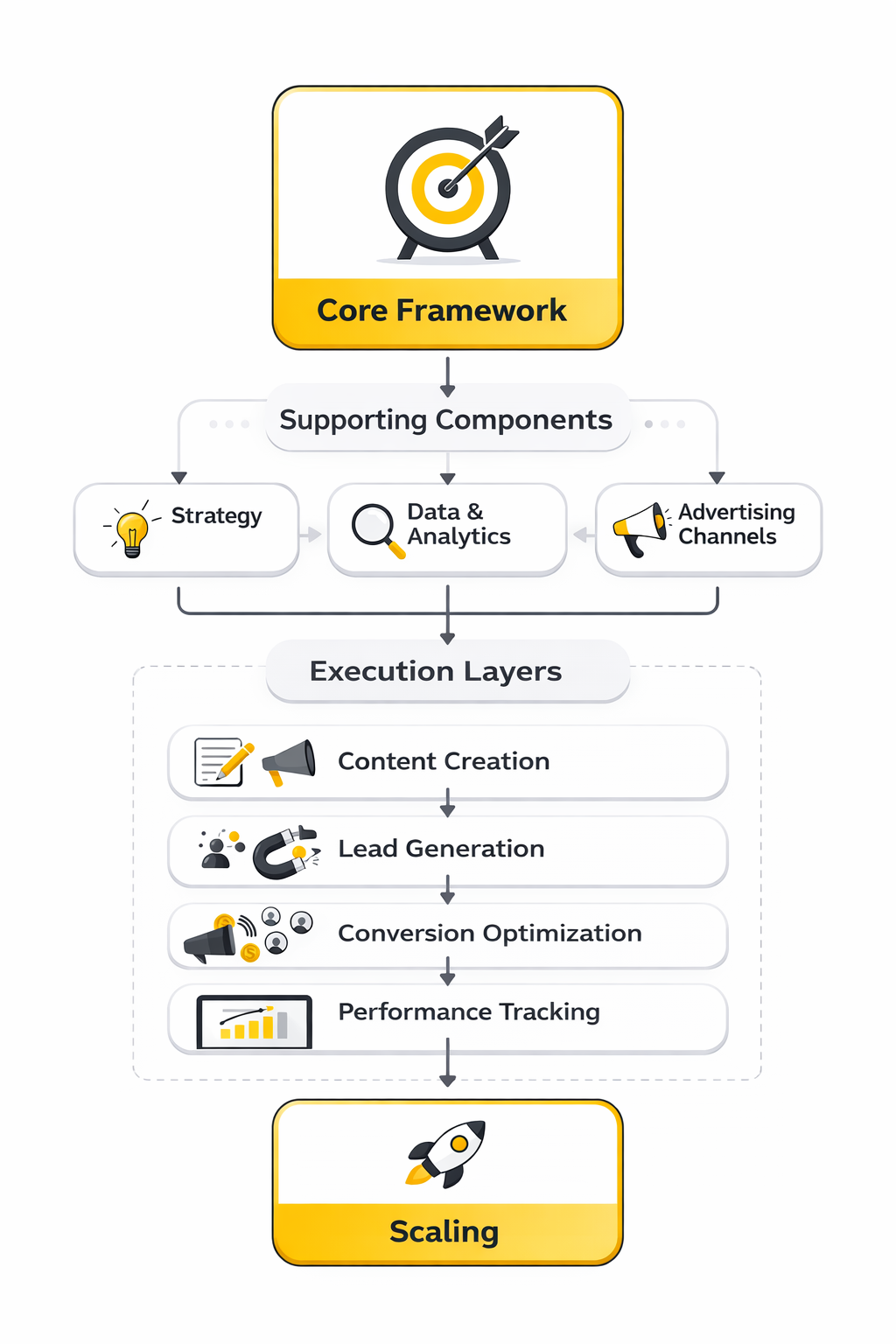
The Modern Agency Growth Framework
A useful way to evaluate any digital marketing agency is to ignore the buzzwords and look for a real operating framework. Strong agencies usually work across four layers: visibility, conversion, retention, and measurement. That sounds obvious, but it is exactly where weaker agencies break down, because they often overfocus on traffic and underbuild everything that turns traffic into revenue. Nielsen+1
Visibility is about getting found in the right places. That includes search, paid media, social distribution, local discovery, and content assets that match actual customer intent. With consumers using Google and YouTube daily at enormous scale and with review platforms still influencing local decisions, a modern agency has to connect brand discovery with intent capture instead of treating awareness and performance as separate universes. Google Business+2
Conversion is where strategy becomes commercial. This is where landing pages, offer design, creative testing, CRO, lead forms, and funnel logic matter, and it is why many agencies build around tools such as ClickFunnels or Systeme.io when a business needs faster campaign deployment. The point is not the tool itself. The point is that the agency should have a repeatable method for turning attention into qualified action. Demand Gen Report+1
Retention is where a lot of growth gets left on the table. Email nurture, segmentation, remarketing, CRM follow-up, and lifecycle messaging are not side tasks anymore, especially when personalization can lift revenue and improve ROI when executed well. That is why serious agencies often connect campaign work with platforms like Brevo, Moosend, Buffer, or Copper as part of a broader retention system rather than a one-off send calendar. McKinsey & Company+1
Measurement is the layer that keeps everything honest. If an agency cannot tell you what changed, why it changed, and what should happen next, then you are not looking at a growth partner. You are looking at outsourced activity, and those are very different things.
How Agencies Build Measurement and Attribution
The difference between a busy marketing operation and a profitable one usually comes down to measurement. A competent digital marketing agency does not just launch campaigns and report vanity metrics. It builds a system that tracks what happens before the click, after the click, and ultimately inside the revenue pipeline. When that system works, marketing decisions stop being guesses and start becoming repeatable growth experiments.
The pressure to get this right is real. Marketing teams now operate in a world where digital channels dominate spending, yet leadership expects clearer proof of ROI. Industry measurement research highlighted by Nielsen’s cross-media analysis and guidance published through Google’s marketing ROI measurement resources both emphasize the same point: fragmented data leads to underestimating what actually drives growth.
That is why the measurement layer inside a digital marketing agency matters so much. When attribution, reporting, and analytics are connected, teams can see which channels generate demand, which messages convert attention, and which campaigns deserve more investment.
The Data Foundation Behind Effective Campaigns
Before any campaign scaling happens, agencies usually establish a reliable data foundation. Without this step, performance reporting becomes unreliable, and strategic decisions get distorted by incomplete information.
A strong digital marketing agency typically focuses on three foundational elements:
- Accurate tracking infrastructure across websites, landing pages, ads, and CRM systems
- Clear event definitions for actions like leads, sign-ups, purchases, or bookings
- Unified reporting dashboards that combine campaign data with pipeline or revenue results
Modern marketing stacks are built around dozens of tools, and integration is often where companies struggle. The growing complexity of marketing technology ecosystems has been documented repeatedly, with the 2024 Martech Landscape identifying more than 14,000 products in the space. That explosion of software makes it easy to accumulate tools but much harder to maintain clear data flow between them.
Agencies that understand this challenge focus less on adding tools and more on connecting them properly. Analytics platforms, CRM systems, advertising dashboards, and email platforms must share consistent definitions of leads and conversions. Without that consistency, optimization becomes guesswork rather than strategy.
Turning Analytics Into Decisions
Once the data layer is stable, the next step is turning raw metrics into decisions. This is where many organizations stall because dashboards alone do not improve results. Someone still needs to interpret the data and act on it.
The agencies that perform well usually apply a structured optimization cycle:
- Collect performance data from paid media, search visibility, email engagement, and landing pages
- Identify performance gaps by comparing campaigns against category benchmarks or historical trends
- Form hypotheses about what could improve results
- Run controlled tests on targeting, messaging, creative, or landing pages
- Scale the winning variants while removing underperforming elements
This process sounds simple, but it requires discipline. Digital channels move quickly, and the temptation to constantly launch new campaigns often replaces careful testing. Research published through Google’s measurement guidance and broader industry benchmarking reports from HubSpot’s marketing statistics hub reinforce how organizations that consistently test creative and targeting outperform those relying purely on instinct.
A digital marketing agency therefore acts as both analyst and operator. It reads the signals inside the data, proposes improvements, and executes those changes without disrupting ongoing performance.
Making Campaign Execution Systematic
The moment when strategy becomes tangible is when the agency translates plans into a repeatable operating process. Without that structure, marketing remains reactive, with campaigns launching inconsistently and lessons disappearing between teams.
This is where execution frameworks become visible.
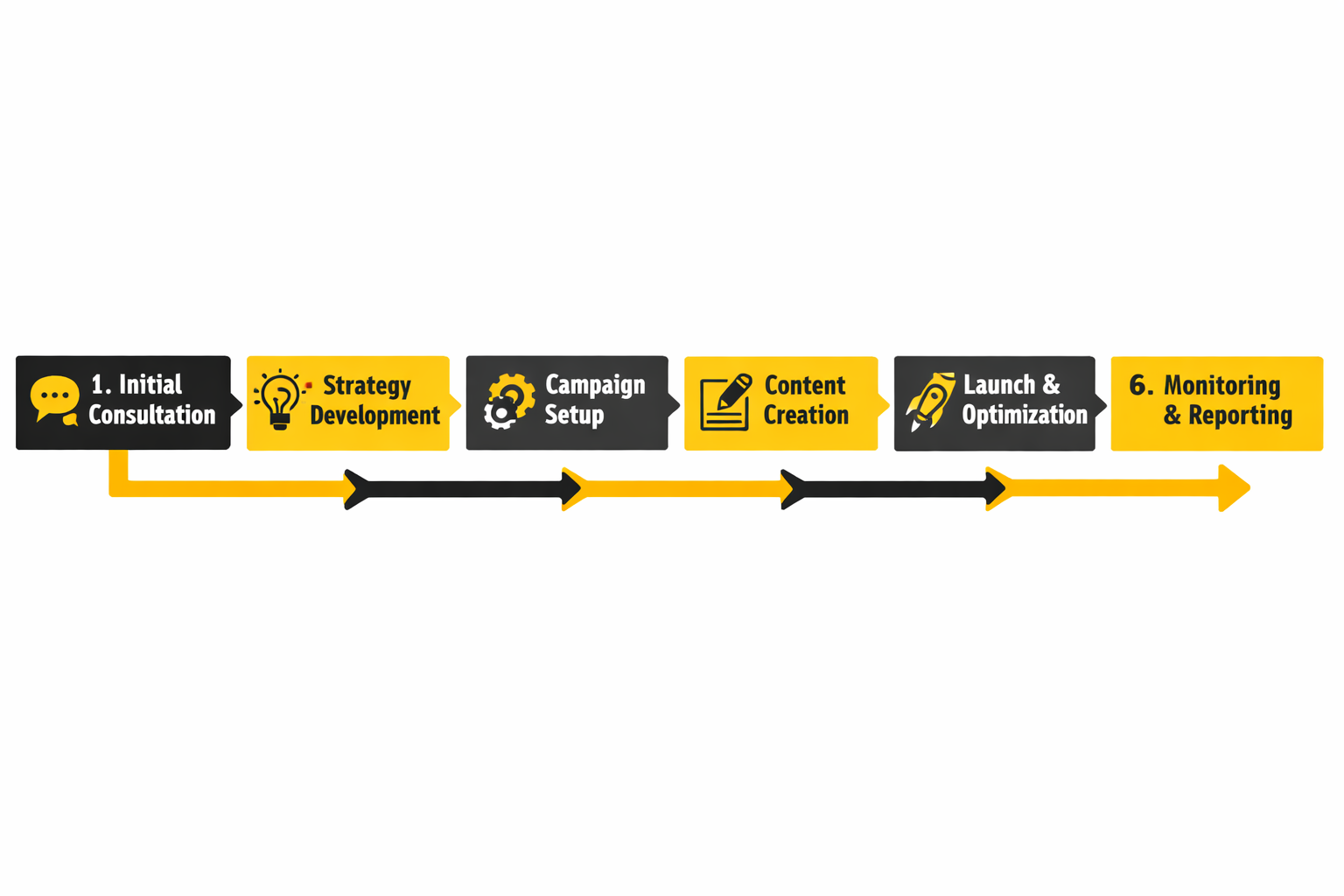
A practical implementation model used by many high-performing agencies follows a structured cycle:
- Market and audience analysis The agency identifies the specific customer segments most likely to convert. That includes evaluating existing customer data, analyzing competitor positioning, and studying search demand or audience behavior patterns.
- Offer and messaging alignment Campaign messaging is designed around real buyer questions, objections, and motivations. This stage connects ad creative, landing page structure, and value proposition so the experience feels consistent.
- Campaign deployment Paid media, search content, social distribution, and funnel infrastructure go live together. When speed matters, agencies often deploy campaigns through rapid funnel builders like ClickFunnels or streamlined marketing systems like Systeme.io, allowing landing pages and lead flows to launch without long development cycles.
- Lead capture and routing Leads are collected through structured forms, booking tools, or signup systems. Platforms such as Fillout and scheduling tools like Cal.com help reduce friction between initial interest and the next step in the customer journey.
- Automated follow-up and nurturing New prospects enter email sequences, remarketing audiences, or CRM pipelines that continue the conversation. Automation platforms like Brevo or Moosend allow agencies to personalize communication and keep leads engaged while the sales process unfolds.
- Measurement and optimization loops Campaign data flows back into analytics dashboards where the agency reviews performance weekly or monthly. This feedback loop informs the next round of creative tests, budget shifts, and strategic improvements.
This structure turns marketing into an operating system rather than a collection of isolated projects. Each campaign produces insight that improves the next campaign, creating momentum instead of repetition.
Integrating AI and Automation Into Agency Workflows
Artificial intelligence is beginning to reshape how digital marketing agencies operate, but the shift is less about replacing strategy and more about accelerating execution. Automation tools now assist with campaign analysis, reporting, content production, and customer interaction, allowing teams to move faster without expanding headcount.
Marketing leaders are increasingly investing in AI-enabled workflows. Coverage of emerging marketing technology in industry reports and strategic guidance from platforms like Google’s AI marketing research show how automation helps teams process larger datasets and identify opportunities that might otherwise be overlooked.
In practical agency work, this often means integrating tools such as:
- conversational support systems like Chatbase
- workflow automation tools such as Guideless
- data extraction systems like Firecrawl
These systems do not replace human strategy. They remove repetitive operational work so strategists can focus on testing new ideas, improving messaging, and strengthening the overall marketing system.
Why Implementation Discipline Matters
A digital marketing agency ultimately earns its reputation through execution. Strategy, creative thinking, and technical expertise all matter, but none of them generate revenue without disciplined implementation.
When the process works, several things happen simultaneously. Campaigns launch faster, insights accumulate instead of disappearing, and marketing investment becomes easier to defend because results are tied directly to measurable outcomes.
That discipline is exactly what separates a partner that simply runs marketing tasks from one that genuinely drives business growth.