

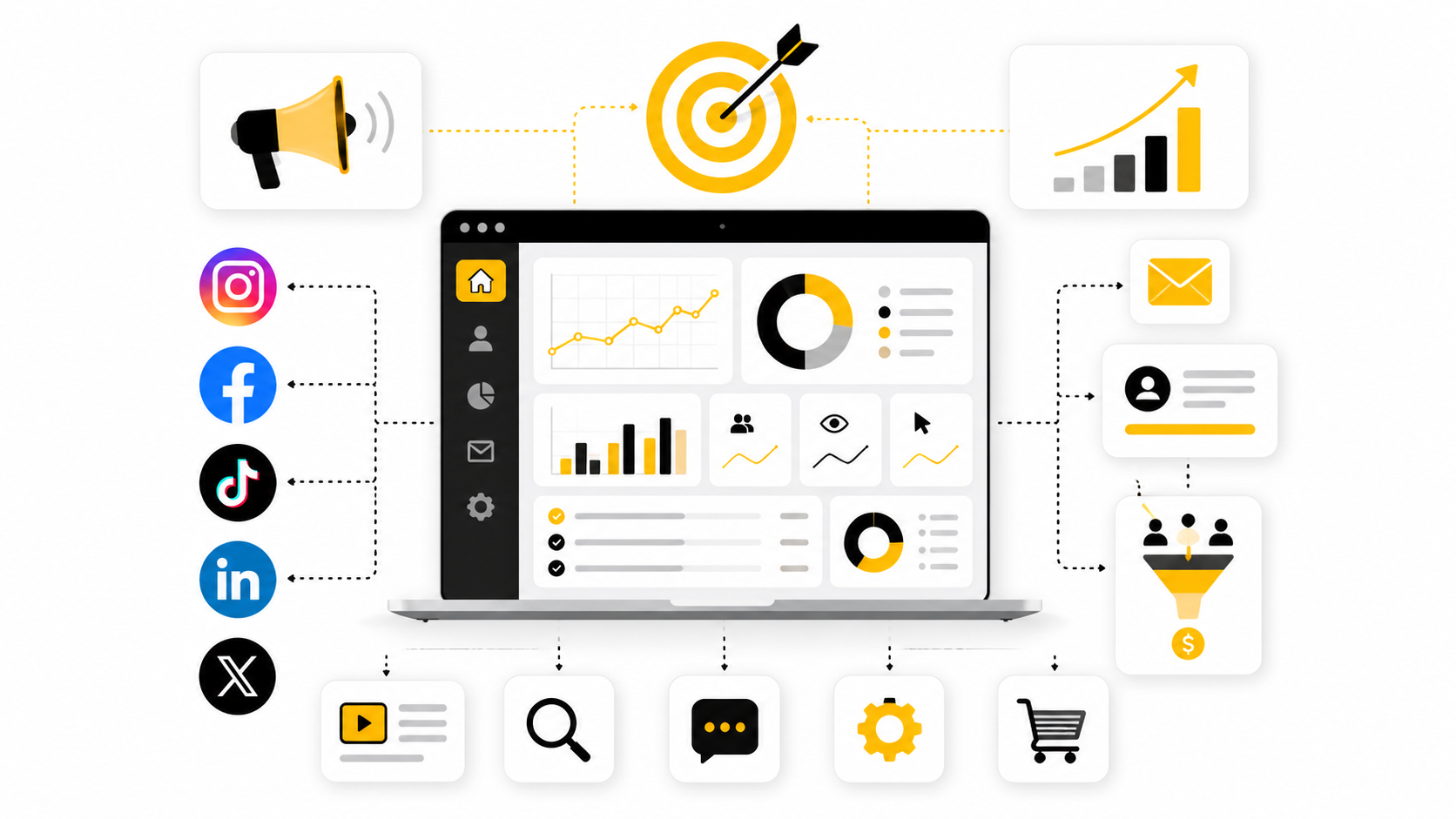
Digital marketing and social media marketing are no longer separate conversations. Search, social, email, paid ads, websites, automation, content, creators, communities, and customer data now work together as one growth system.
That matters because the audience is already there. In April 2026, there were 6.12 billion internet users worldwide and 5.79 billion social media user identities, which means most brands are not fighting for access anymore. They are fighting for attention, trust, and conversion.
Article Outline
This full article will continue across six parts using this structure:
- Why Digital Marketing And Social Media Marketing Matter
- The Digital Growth Framework
- Core Components Of A Modern Marketing System
- Professional Implementation And Channel Strategy
- Measurement, Optimization, And Scaling
- Tools, Workflows, FAQs, And Final Recommendations
Why Digital Marketing And Social Media Marketing Matter
Digital marketing gives your business the system. Social media marketing gives that system a public voice, a discovery engine, and a place where people can interact before they ever speak to sales.
That is the big shift. People do not move in a straight line from ad to landing page to purchase anymore. They search on Google, watch short-form videos, check comments, compare creators, read reviews, visit a website, join an email list, and come back later when the offer feels safe.
The money has followed that behavior. Global ad revenue was expected to reach $1.08 trillion in 2025, with digital advertising accounting for 73.2% of that revenue. That does not mean every business should spend aggressively on ads, but it does mean every serious business needs a digital system that can attract, educate, retarget, and convert demand.
The Digital Growth Framework
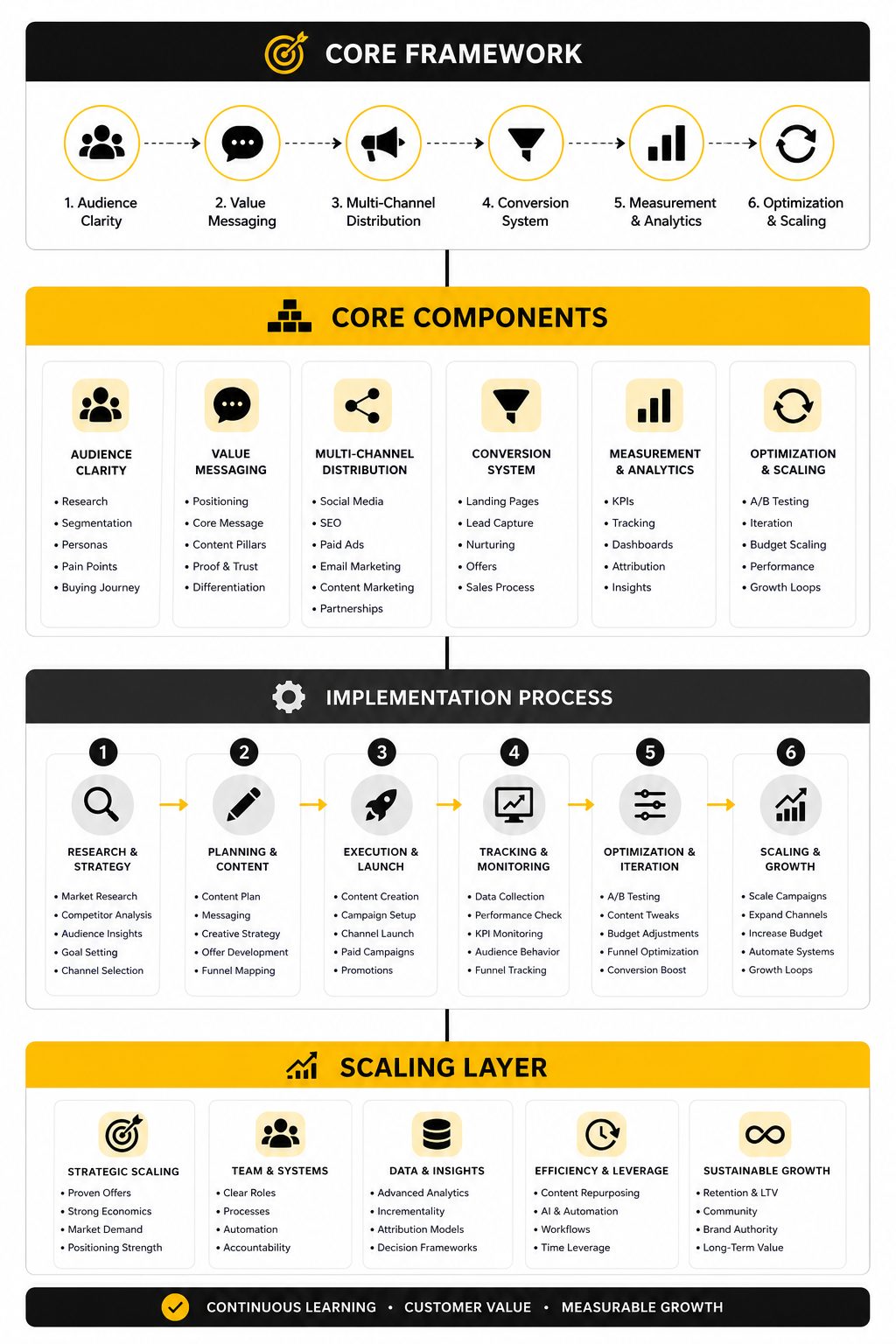
A strong framework keeps digital marketing and social media marketing from becoming random posting, random ads, and random tools. The goal is not to be everywhere. The goal is to build a repeatable path from attention to trust to revenue.
The framework starts with positioning because weak positioning makes every channel harder. Then it moves into content, distribution, conversion assets, automation, sales follow-up, retention, and reporting. Each layer has a job, and when one layer is missing, the whole system leaks.
Social media sits inside this framework, not outside it. HubSpot’s 2025 social trends research found that 84% of marketers expected consumers to search for brands on social media, which makes social content part of search visibility, brand proof, customer education, and conversion support.
How This Article Will Build From Here
Part 2 will go deeper into the digital growth framework and show how the pieces connect. Part 3 will break down the core components, including websites, funnels, content, social platforms, email, paid traffic, CRM, and automation.
Part 4 will focus on professional implementation, because strategy is useless when execution is messy. Part 5 will cover measurement and optimization so you know what to fix, what to scale, and what to stop doing.
Part 6 will bring the whole system together with practical tool recommendations, workflows, FAQs, and final guidance. The aim is simple: help you understand digital marketing and social media marketing as one connected growth engine, not a pile of disconnected tactics.
The Digital Growth Framework
The cleanest way to understand digital marketing and social media marketing is to stop thinking in isolated channels. A business does not grow because it posted on Instagram, launched one ad, or published one blog post. It grows when each channel has a clear role inside a larger system.
That system needs to answer four questions. Who are we trying to reach? Why should they care now? What path should they take next? How will we measure whether the path is working?
This is where most brands get stuck. They confuse activity with strategy. Posting more, emailing more, or spending more does not automatically create better results if the message, offer, audience, and follow-up are weak.
Start With Positioning Before Channels
Positioning comes before content, ads, funnels, automation, and social media. Without it, every campaign becomes harder because the audience has to work too hard to understand why you matter. Strong positioning makes the right people feel like the offer was built for them.
A useful positioning statement should be simple enough for your team to repeat without a slide deck. It should define the audience, the problem, the outcome, and the reason your solution is different. This becomes the foundation for every headline, video hook, landing page, email sequence, and sales conversation.
This matters even more now because people discover brands in more places than ever. Search engines remain a major discovery channel, with 32.8% of connected consumers discovering new brands through online search, but social platforms, creators, communities, and ads all shape the same buying decision. If your positioning changes from channel to channel, the buyer feels friction instead of confidence.
Map The Buyer Journey As A Loop
The old funnel is too neat for how people actually buy. A person may see a short video, search the brand, read comments, compare alternatives, ignore three retargeting ads, join an email list, then finally purchase after a useful follow-up message. That is not a straight line. That is a loop.
A modern digital growth framework should treat the journey as a set of repeating stages: discovery, evaluation, conversion, experience, retention, and advocacy. Social media is especially strong at discovery, proof, and advocacy, while websites, landing pages, email, CRM, and sales processes usually carry more of the conversion work.
This is why BCG’s 2025 marketing research argues that digital transformation has pushed customer journeys into unpredictable, nonlinear patterns. The practical takeaway is simple. Your marketing should not depend on one perfect path. It should create multiple useful touchpoints that help the buyer move forward whenever they are ready.
Build Around Owned, Paid, And Earned Media
Every serious marketing system needs a balance of owned, paid, and earned media. Owned media includes your website, email list, CRM, blog, landing pages, SMS list, community, and customer data. Paid media includes search ads, social ads, influencer partnerships, sponsorships, and retargeting. Earned media includes reviews, referrals, shares, PR, creator mentions, comments, and organic search visibility.
The mistake is relying too heavily on one bucket. Pure organic social can be unstable because algorithms change. Pure paid traffic can get expensive if the offer or conversion path is weak. Pure owned media can grow slowly if there is no consistent discovery engine feeding it.
The strongest approach is to connect all three. Paid and social create reach, owned assets capture and nurture demand, and earned signals build trust. When these pieces work together, digital marketing and social media marketing become less reactive and much more predictable.
Turn Attention Into A Next Step
Attention is useful, but it is not the finish line. A post that gets views but gives people no clear next step is incomplete. A paid ad that sends traffic to a weak page is expensive noise.
Every channel should lead somewhere logical. A short-form video can lead to a profile visit, a lead magnet, a product page, or a direct message. A blog post can lead to an email opt-in, comparison page, consultation, or trial. A webinar can lead to a sales call, an offer page, or a follow-up sequence.
This is where tools can help, but only after the strategy is clear. A platform like GoHighLevel can make sense when a business needs CRM, automation, pipeline management, booking, and follow-up in one place. But the tool is not the strategy. The strategy is the path you design from first touch to revenue.
Make The Framework Measurable
A framework only becomes useful when you can measure it. That does not mean tracking every tiny metric until nobody knows what matters. It means choosing the few numbers that show whether the system is moving in the right direction.
At the top of the journey, useful metrics include reach, qualified traffic, profile visits, search visibility, and engagement quality. In the middle, look at email opt-ins, landing page conversion rate, direct message volume, webinar registrations, saved posts, return visitors, and product page views. At the bottom, track sales calls booked, checkout conversion, revenue, cost per acquisition, customer lifetime value, and retention.
The point is not to worship dashboards. The point is to find the constraint. When you know where the system is leaking, you can fix the right thing instead of guessing.
Core Components Of A Modern Marketing System
Once the framework is clear, implementation becomes much easier. You are not asking, “What should we post today?” or “Should we try another ad?” You are building the core pieces that make digital marketing and social media marketing work as one system.
A modern marketing system needs five things: a clear offer, useful content, a conversion path, follow-up automation, and measurement. When one of those pieces is missing, performance usually drops. When all five work together, each campaign becomes easier to improve.
This is also where execution gets real. Strategy sounds smart in a document, but growth happens when the system is built, tested, measured, and refined.
The Offer Comes First
The offer is the center of the system. Not the logo. Not the posting schedule. Not the tool stack. The offer is what people are actually saying yes or no to.
A strong offer makes the outcome obvious. It explains who it is for, what problem it solves, why it is different, and what the buyer should do next. If that message is vague, every channel has to work harder than it should.
This is especially important in social media marketing because people are moving fast. A viewer may give you three seconds before deciding whether to keep watching, click, save, comment, or leave. Clear offers make those moments count.
Content Turns Positioning Into Trust
Content is how your positioning becomes visible. It gives people proof that you understand their problem and can help them make a better decision. Good content does not just fill a calendar. It moves the buyer one step closer to confidence.
The strongest content systems usually include education, proof, comparison, objection handling, product explanation, and timely commentary. Each type has a different job. Educational content creates awareness, proof content builds confidence, and objection-handling content removes friction before the sales conversation.
Video deserves special attention because it has become a core format across social platforms, websites, ads, and email. In 2025, 46% of marketers identified video as their most important content type, which makes sense because video can show tone, personality, proof, and product context faster than most formats.
The Website And Funnel Convert Interest
Your website or funnel is where interest becomes measurable. Social content can create curiosity, but the conversion asset has to turn that curiosity into a lead, booking, purchase, trial, or message. This is why weak landing pages quietly destroy good campaigns.
A good conversion path should be focused. One page should usually have one main job, one primary audience, and one obvious next step. If the page tries to explain everything to everyone, it often converts no one.
This is where dedicated funnel and landing page tools can make implementation faster. A platform like ClickFunnels can be useful when the goal is to build sales funnels, lead capture pages, checkout flows, and offer-specific campaigns without waiting on a full development cycle.
Email And CRM Keep The Conversation Alive
Most buyers do not convert the first time they see you. That is normal. The problem is when businesses spend money and energy creating attention, then fail to follow up properly.
Email, CRM, SMS, and pipeline automation solve that problem. They help you segment leads, send relevant messages, track sales opportunities, and keep the relationship moving after the first click. This is not about spamming people. It is about making sure serious prospects do not disappear because your system is disorganized.
Email is still powerful because it is an owned channel. Social platforms can change reach overnight, but your email list and CRM give you a more stable way to communicate. Industry benchmark data continues to show email as one of the most efficient channels, with email marketing often cited around $36 returned for every $1 spent.
The Execution Process
Implementation should follow a simple order. Build the foundation first, then layer channels on top of it. This prevents the classic mistake of driving traffic into a system that is not ready to convert.
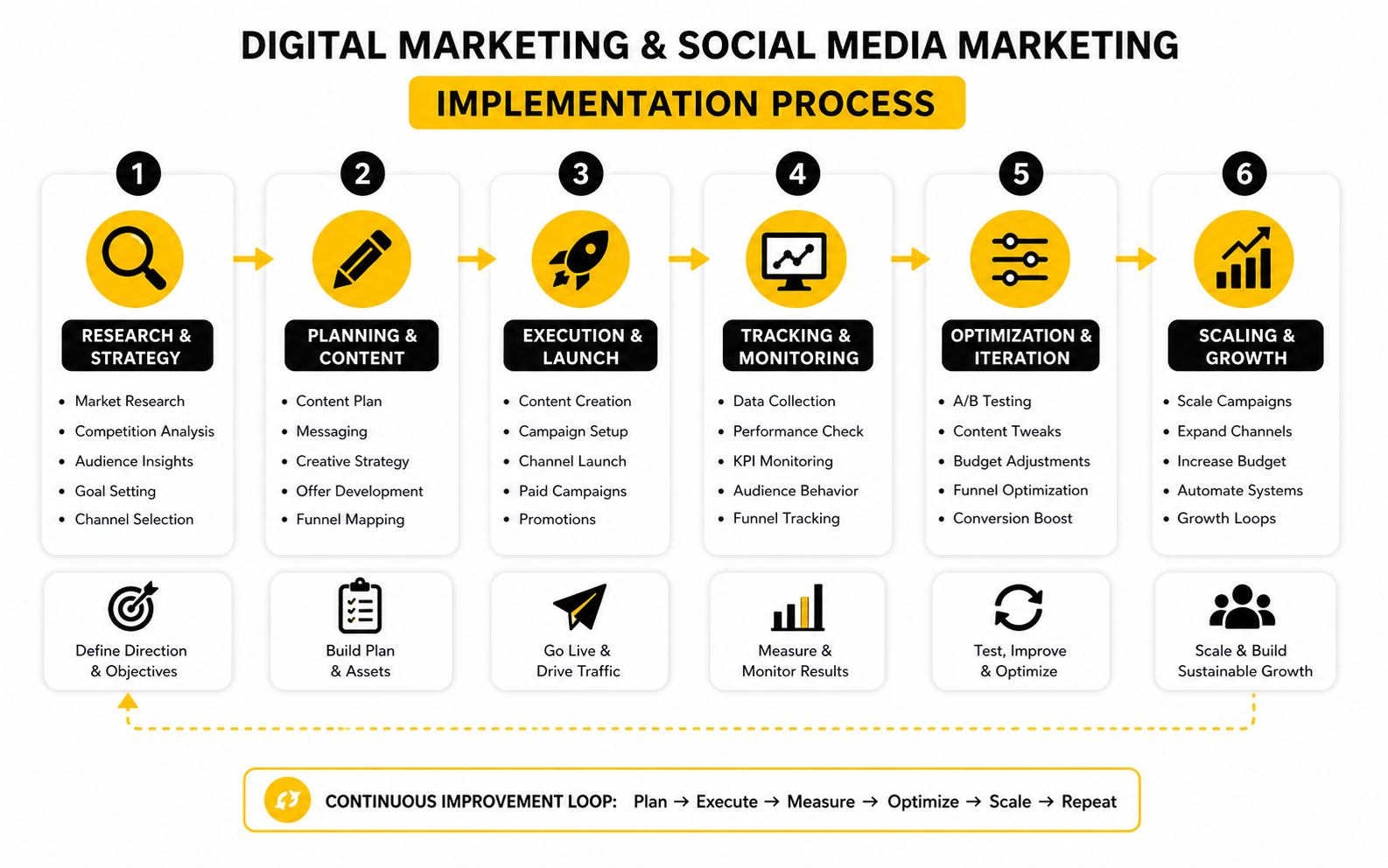
A practical execution process looks like this:
- Define the audience, problem, offer, and promise.
- Build the core conversion path, including the landing page, booking flow, checkout, or lead form.
- Create content pillars that support discovery, education, proof, and objection handling.
- Choose the main distribution channels based on where the audience already spends time.
- Set up email, CRM, retargeting, and follow-up automation.
- Launch with a small testing budget or a focused organic campaign.
- Review the data, find the biggest leak, and improve one constraint at a time.
That order matters. You do not need a complicated system on day one, but you do need a complete enough path for people to move forward. Simple and complete beats fancy and broken.
Social Media Becomes Stronger When It Has A Job
Social media should not be treated as a dumping ground for random updates. Each post should have a job inside the broader marketing system. Some posts attract new people, some build trust, some explain the offer, and some push people toward a clear next step.
This also makes content planning easier. Instead of asking what to post, you ask which part of the buyer journey needs support. If people do not understand the problem, publish educational content. If they understand the problem but hesitate to buy, publish proof, comparison, and objection-handling content.
Scheduling tools can help once the strategy is defined. A platform like Buffer can make sense for planning, publishing, and reviewing social content across multiple platforms, especially when consistency is the current bottleneck.
Automation Should Support The Human Decision
Automation is not there to remove the human part of marketing. It is there to make sure the right message reaches the right person at the right time. That distinction matters.
A good automation flow might welcome a new lead, deliver a resource, ask a qualifying question, send a useful follow-up, and notify sales when someone is ready for a conversation. A bad automation flow blasts the same generic message to everyone and calls it personalization.
This is where tools like ManyChat can fit naturally for social messaging, comment-to-DM flows, lead capture, and simple conversational automation. Used well, automation makes social media marketing more responsive without making the brand feel robotic.
Statistics And Data
Measurement is where digital marketing and social media marketing stop being opinions. Without data, every decision becomes a debate about taste, preference, or whatever the loudest person in the room believes. With the right data, you can see what is attracting attention, what is creating trust, what is converting, and what is quietly wasting money.
But data is only useful when it is tied to a decision. A high engagement rate is not automatically good. A low cost per click is not automatically profitable. A viral post is not automatically valuable if it attracts the wrong audience and sends no one toward the next step.
The goal is not to collect more numbers. The goal is to understand what each number means, where it fits in the customer journey, and what action it should trigger.
Start With The Metrics That Match The Stage
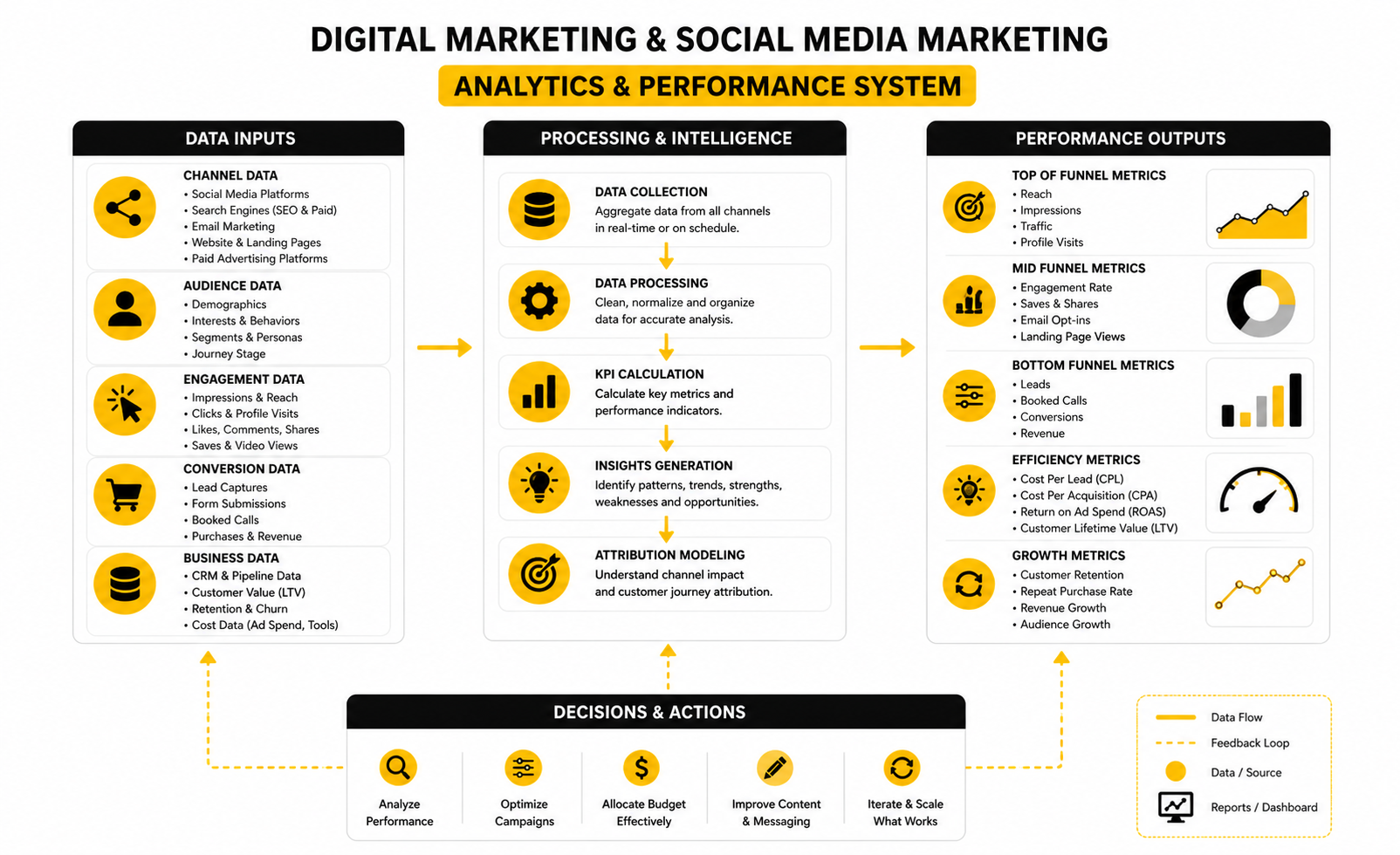
Every metric belongs to a stage of the journey. Top-of-funnel metrics show whether people are noticing you. Middle-of-funnel metrics show whether they are becoming interested and educated. Bottom-of-funnel metrics show whether that interest is turning into revenue.
For awareness, track reach, impressions, video views, search visibility, profile visits, and branded search growth. These numbers show whether your content and campaigns are getting in front of enough relevant people. They do not prove the business is growing yet, but they tell you whether the market is seeing you.
For consideration, track saves, shares, comments with buying intent, email opt-ins, landing page visits, return visitors, product page views, direct messages, and webinar registrations. These are stronger signals because they show active interest, not passive exposure. For conversion, track bookings, trials, checkout starts, sales calls, purchases, revenue, cost per acquisition, and customer lifetime value.
Benchmarks Are Useful, But They Are Not The Target
Benchmarks help you avoid flying blind. They give you a rough idea of whether your numbers are obviously weak, average, or strong. But they should never become your strategy.
For example, global social media adoption reached 5.24 billion active social media user identities at the start of 2025, which confirms that social platforms are massive discovery environments. That does not mean every brand should chase every platform. It means the audience is reachable, and your job is to choose the platforms where your buyers already spend attention.
Email benchmarks work the same way. MailerLite’s 2026 benchmark data shows the average 2025 email open rate at 43.46% and the average click rate at 2.09%, but those numbers should be interpreted carefully. Open rates can be inflated by privacy changes, while click rate and downstream conversion usually tell you more about whether the message actually moved people.
Traffic Quality Matters More Than Traffic Volume
More traffic is not always better. Bad traffic makes dashboards look exciting while the business stays flat. Good traffic brings people who understand the problem, match the offer, and have a realistic path to buying.
This is why source-level reporting matters. Organic search, paid search, paid social, organic social, referrals, email, and direct traffic often behave differently. A channel with fewer visitors can be more valuable if those visitors convert at a higher rate or become better customers.
Conversion rate benchmarks can help you evaluate this, but they must be read in context. Ruler Analytics’ 2025 cross-industry data puts the average conversion rate across fourteen industries at 2.9%, while also showing that high-ticket and complex buying decisions often convert lower. That is not automatically a problem. A lower conversion rate can still be healthy if the average order value, sales quality, and lifetime value are strong.
Social Media Metrics Need Better Interpretation
Social media analytics are easy to misread. Likes are visible, so people overvalue them. Revenue is harder to connect, so people undervalue the content that quietly supports sales.
The better approach is to separate social metrics into three groups: attention signals, trust signals, and action signals. Attention signals include reach, impressions, watch time, and profile visits. Trust signals include saves, shares, meaningful comments, repeat viewers, and positive sentiment. Action signals include link clicks, direct messages, lead form completions, bookings, and purchases.
This is where social media marketing becomes more mature. A post with fewer views but more sales conversations may be more valuable than a post with huge reach and no commercial intent. A video with modest engagement but strong retention may be worth turning into an ad, email, or landing page section.
Paid Media Must Be Judged By Economics
Paid ads should not be judged only by click-through rate or cost per lead. Those numbers matter, but they are not enough. The real question is whether paid traffic can acquire customers at a cost the business can afford.
A simple paid media scorecard should include cost per click, landing page conversion rate, cost per lead, lead-to-sale rate, cost per acquisition, average order value, gross margin, payback period, and lifetime value. That sounds like a lot, but each metric answers a different question. Clicks show ad-market fit, landing page conversion shows message-match, sales rate shows lead quality, and customer value shows whether scaling makes sense.
This matters because digital advertising keeps taking a larger share of total media spend. WPP Media projected digital advertising to represent 73.2% of global ad revenue in 2025, which means competition is not going away. If your economics are weak, more budget will only make the leak bigger.
Reporting Should Lead To Action
A good report does not just show what happened. It tells the team what to do next. That is the difference between analytics and decoration.
Your weekly report should answer three practical questions. What improved? What declined? What is the highest-impact constraint to fix next? If the answer is not clear, the report is probably too cluttered.
For most businesses, the best reporting rhythm is simple. Review channel performance weekly, conversion performance monthly, and strategic performance quarterly. Weekly reviews help you catch obvious problems, monthly reviews reveal patterns, and quarterly reviews tell you whether the overall system is moving toward stronger revenue, retention, and profitability.
The Most Important Number Is The Constraint
Every system has a constraint. Sometimes the problem is not enough qualified traffic. Sometimes the traffic is fine, but the landing page is weak. Sometimes leads are coming in, but sales follow-up is slow. Sometimes customers buy once but never come back.
This is why digital marketing and social media marketing need shared reporting. Social data alone cannot explain revenue. Website data alone cannot explain brand trust. CRM data alone cannot explain why demand rose or dropped in the first place.
The job is to connect the signals. When the full picture is visible, optimization becomes much more precise. You stop guessing, stop chasing random tactics, and start fixing the one part of the system that will actually move growth.
Measurement, Optimization, And Scaling
Once the system is measurable, the next challenge is knowing how to scale it without breaking it. This is where many businesses make expensive mistakes. They see one campaign working, increase spend too quickly, add too many channels, or automate too much before the foundation is stable.
Scaling digital marketing and social media marketing is not just doing more. It is doing more of what is already proven, while protecting the parts of the system that made it work in the first place. That means keeping the message sharp, the offer clear, the follow-up reliable, and the economics healthy.
The best marketers do not scale chaos. They scale constraints after they understand them.
The Tradeoff Between Focus And Reach
More channels can create more reach, but they also create more complexity. Every new platform needs content, creative testing, analytics, moderation, community management, and a clear role in the customer journey. If the team is already struggling to execute well on two channels, adding three more usually creates noise.
Focus is powerful because it gives you enough repetition to learn. You see which hooks work, which objections appear, which audiences respond, and which offers convert. That learning compounds faster when the team is not constantly switching platforms and formats.
Reach becomes useful after the core message is validated. Once you know that an offer converts, a landing page works, and follow-up is producing revenue, expanding into another channel becomes a strategic move instead of a guess.
Attribution Will Never Be Perfect
Attribution is helpful, but it is not the truth. It is a model. It tries to assign credit to touchpoints, even though real buyers often move across devices, platforms, dark social, private messages, podcasts, creator recommendations, search results, and email before converting.
This is why overtrusting last-click attribution is dangerous. It can make brand content, organic social, creator partnerships, and educational content look weaker than they are because those channels often influence demand before the final click happens. The sale may be recorded as search or direct, but the trust may have been built somewhere else.
Privacy changes have made this even more important. Google’s Privacy Sandbox updates show that Chrome continues to focus on user choice and privacy-preserving advertising technologies rather than giving marketers perfect individual-level tracking, which means measurement needs to become more resilient and less dependent on one clean user path through the internet: Chrome’s Privacy Sandbox updates.
Use Incrementality To Avoid False Confidence
When budgets grow, you need better proof. A platform dashboard may say a campaign generated conversions, but that does not always mean the campaign created new demand. Some people may have bought anyway.
Incrementality testing helps answer the harder question: what happened because of the marketing that would not have happened otherwise? That is a much stronger question than “Which ad platform claimed the sale?” It forces the team to think like operators, not dashboard readers.
This matters most when you are scaling paid media, creator campaigns, retargeting, and promotions. If a campaign is only capturing people who were already ready to buy, it may still have value, but it should not receive the same budget as a campaign that creates new demand profitably.
AI Should Improve Judgment, Not Replace It
AI is already part of modern marketing execution. It can help with research, drafts, segmentation, creative variations, reporting, customer support, and workflow speed. McKinsey’s 2025 global AI survey found that 88% of organizations reported regular AI use in at least one business function, which shows how quickly this has moved from novelty to normal operations.
The risk is using AI to produce more mediocre output faster. More captions, more emails, more ads, and more posts do not help if the strategy is weak. AI can multiply clarity, but it can also multiply confusion.
Use AI for leverage, not laziness. Let it speed up research, versioning, analysis, and workflow handoffs. Keep humans responsible for positioning, taste, customer insight, offer strategy, ethics, and final judgment.
First-Party Data Becomes A Strategic Asset
First-party data is information your business collects directly from customers, leads, subscribers, buyers, and site visitors. It includes email engagement, purchase history, form responses, preferences, CRM notes, booking behavior, survey answers, and product usage. This data becomes more valuable as third-party tracking gets less reliable.
The point is not to collect data aggressively. The point is to earn it by giving people a good reason to share it. Useful lead magnets, quizzes, consultations, communities, product onboarding, and customer feedback loops can all help you learn more while improving the customer experience.
This is where digital marketing and social media marketing should connect tightly. Social creates interest, but owned channels help you turn that interest into a durable relationship. If every campaign only sends people back to a platform you do not control, you are renting attention without building an asset.
Creator And Community Marketing Need Better Discipline
Creator marketing can be powerful, but it is easy to treat it like rented reach. That is a mistake. The best creator partnerships work because the creator has trust with a specific audience, not just because they have followers.
Recent industry coverage shows creator spending continues to rise, with U.S. creator ad spending projected to reach $37 billion in 2025. The important lesson is not simply that brands should spend more on creators. The lesson is that attention is shifting toward people and communities buyers already trust.
The strategic tradeoff is control versus credibility. Branded content gives you more control, but creator content often feels more natural. The answer is not to script creators into sounding like ads. Give them a clear brief, a real product experience, strong proof points, and enough room to speak in their own voice.
Scaling Breaks Weak Operations
A campaign can look successful at low volume and fail at scale. Leads increase, but the sales team responds too slowly. Orders increase, but fulfillment struggles. Customer support gets overwhelmed. Content output grows, but quality drops.
This is why scaling has to include operations. Before increasing budget, check whether the business can actually handle the additional demand. Marketing should not create growth the company cannot deliver.
The practical move is to scale in controlled stages. Increase spend gradually, monitor lead quality, review conversion rates, watch customer feedback, and check team capacity. If quality drops, pause and fix the bottleneck before pushing harder.
Expert-Level Marketing Is Constraint Management
At the advanced level, growth is less about finding magic tactics and more about managing constraints. One month, the constraint may be awareness. Another month, it may be landing page conversion. Later, it may be sales follow-up, retention, onboarding, or creative fatigue.
This is why the best teams build learning loops. They do not just launch campaigns. They document assumptions, test specific changes, review results, and turn what they learn into better creative, better offers, and better customer journeys.
That is the real advantage. Not a secret platform. Not a hack. Not a trend. A business that learns faster from the market will usually beat a business that just publishes more content and hopes the algorithm cooperates.
Tools, Workflows, FAQs, And Final Recommendations
The final system should be simple enough to run consistently and strong enough to improve over time. That means choosing tools and workflows based on the job they perform, not because they are popular. A lean stack that your team actually uses will beat a messy stack full of disconnected software.
Think of the ecosystem in layers. You need a place to publish and convert, a way to capture leads, a system for follow-up, a workflow for content production, and a reporting rhythm that tells you what to improve next. Once those layers are connected, digital marketing and social media marketing become much easier to manage.
The smartest setup is usually not the most complicated one. Start with the fewest tools needed to make the customer journey work, then add complexity only when the business has earned it.
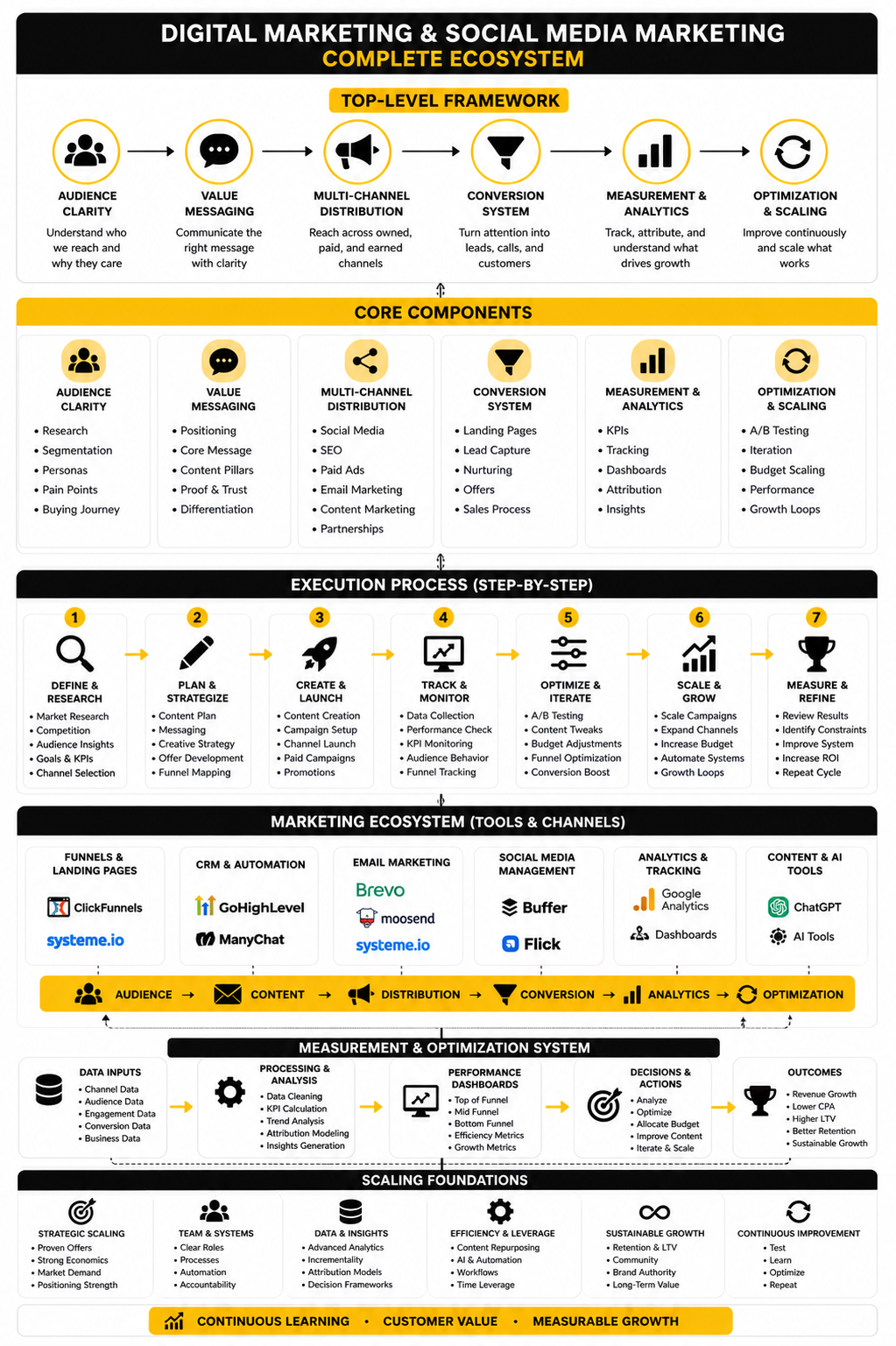
A Practical Tool Stack
A practical stack should support the system without becoming the system. For all-in-one CRM, pipeline, booking, automation, and client communication, GoHighLevel can make sense for agencies, consultants, local businesses, and service-based teams. For focused funnels, offer pages, and checkout flows, ClickFunnels is useful when speed matters more than building a full custom website.
For email marketing, newsletters, and customer communication, tools like Brevo, Moosend, or Systeme.io can help depending on how much automation, funnel building, and simplicity you need. For social scheduling and publishing discipline, Buffer fits naturally when consistency is the bottleneck. For comment-to-DM flows, lead capture, and conversational automation, ManyChat can support social campaigns without forcing everything into manual replies.
The rule is simple. Pick tools that remove friction from the customer journey. If a tool creates more admin work than growth, it is not helping.
FAQ - Built for Complete Guide
What is the difference between digital marketing and social media marketing?
Digital marketing is the full online growth system. It includes websites, SEO, paid ads, email, landing pages, CRM, analytics, automation, content, and social media. Social media marketing is one part of that system, focused on platforms where people discover, engage with, and talk about brands.
The two should not compete with each other. Social media creates attention, trust, and conversation, while the wider digital system captures demand and turns it into measurable business results. When they work together, the whole customer journey becomes stronger.
Is social media marketing enough by itself?
Social media can be powerful, but it is risky to depend on it alone. Algorithms change, reach can fluctuate, accounts can get restricted, and followers do not automatically become customers. You need owned assets like email, CRM, landing pages, and customer data to protect the relationship.
That does not make social media less important. It makes it more useful when it has a clear job inside the bigger system. The goal is to use social platforms to create demand, then move serious prospects into channels you control.
Which digital marketing channel should a business start with?
Start with the channel closest to your customer’s existing behavior. If they search before buying, SEO and paid search may matter first. If they discover solutions through people, creators, and communities, social media may be the stronger starting point.
The better question is not “Which channel is best?” The better question is “Where does our buyer already look for answers, proof, and recommendations?” That answer should guide the first channel choice.
How often should a business post on social media?
Posting frequency depends on the platform, content quality, team capacity, and audience behavior. Posting more can help only when the content is useful, relevant, and consistent with the brand’s strategy. Posting weak content daily usually creates more noise than growth.
A practical starting point is to publish often enough to learn. That means testing hooks, formats, topics, and calls to action while watching retention, saves, shares, comments, profile visits, and conversions. Consistency matters, but quality and learning matter more.
What metrics matter most in digital marketing and social media marketing?
The most important metrics are the ones tied to the customer journey. At the top, track reach, search visibility, profile visits, and qualified traffic. In the middle, track saves, shares, email opt-ins, landing page visits, direct messages, and return visitors.
At the bottom, track booked calls, trials, purchases, revenue, cost per acquisition, lifetime value, and retention. A metric is only valuable if it helps you make a better decision. Vanity metrics should never replace business outcomes.
How long does it take to see results?
Paid campaigns can generate signals quickly, but profitable scaling usually takes testing. Organic social and SEO often take longer because they depend on consistency, trust, and compounding visibility. Email and CRM performance can improve faster if the list or lead flow already exists.
The honest answer is that timelines depend on the offer, audience, budget, market, creative quality, and execution speed. A strong system can show early signals within weeks, but durable growth usually comes from repeated testing and optimization over months.
Should small businesses use automation?
Yes, but only where automation improves the experience. A small business can use automation for lead follow-up, appointment reminders, onboarding, abandoned cart recovery, review requests, email sequences, and simple customer support. These workflows save time and reduce missed opportunities.
The danger is automating bad communication. If the message is generic, pushy, or irrelevant, automation only makes the problem faster. Automation should feel timely and helpful, not robotic.
Is AI good for marketing?
AI is useful when it supports strategy, research, production, personalization, analysis, and workflow speed. It can help create drafts, summarize customer feedback, generate creative variations, organize campaign ideas, and identify patterns. Used well, it gives marketers more leverage.
But AI should not replace customer insight, positioning, taste, ethics, or final judgment. The market is already crowded with AI-generated sameness. The advantage comes from using AI to sharpen human strategy, not to remove it.
How should a business choose between SEO, paid ads, email, and social media?
Choose based on intent, timeline, and economics. SEO is strong when people actively search for the problem or solution. Paid ads are useful when the offer and conversion path are proven enough to justify spend.
Email is strongest for nurturing and retention, while social media is powerful for discovery, trust, and community. Most growing businesses eventually need a mix, but they should not launch every channel at once. Build the strongest path first, then expand.
What is the biggest mistake businesses make with digital marketing?
The biggest mistake is treating tactics as strategy. They post because they think they should post. They run ads because competitors run ads. They buy tools before they know the customer journey.
Real strategy starts with the buyer, the offer, the message, and the path to conversion. Tools and channels come after that. When the foundation is weak, more activity just creates more confusion.
How do you know when it is time to scale?
Scale when the core economics are working. That means the offer converts, lead quality is acceptable, follow-up is consistent, customers are satisfied, and the acquisition cost makes sense compared with customer value. Scaling before those signals are stable can turn small problems into expensive ones.
A smart scaling process is controlled. Increase budget or output gradually, watch the constraint, and protect quality. If performance drops, fix the bottleneck before pushing harder.
What should a complete digital marketing system include?
A complete system should include clear positioning, a strong offer, content that builds trust, a conversion path, lead capture, email or CRM follow-up, analytics, and a repeatable optimization rhythm. It does not need to be fancy. It needs to be connected.
Social media should feed the system, not sit outside it. Paid ads, SEO, email, automation, and sales should all support the same customer journey. That is how digital marketing and social media marketing become one growth engine instead of disconnected tasks.
Work With Professionals
Explore 10K+ Remote Marketing Contracts on MarkeWork.com
Most marketers spend too much time chasing clients, competing on crowded platforms, and losing a percentage of every project to middlemen.
MarkeWork gives you a better way. Browse thousands of remote marketing contracts and connect directly with companies desperate to hire skilled marketers like you, without platform commissions and without unnecessary gatekeepers.
If you're serious about finding better opportunities and keeping 100% of what you earn, explore available contracts and create a profile for free at MarkeWork.com.