

When people search for digital marketing companies near me, they usually are not looking for theory. They are trying to solve a real business problem fast. Leads have slowed down, competitors are showing up first on Google, ad costs feel messy, or the website is getting traffic without turning that attention into booked calls, store visits, or sales.
That search is also more meaningful than it looks. Google still says local results are driven mainly by relevance, distance, and prominence, which means the agency you choose needs to understand both marketing performance and local visibility in Search and Maps. Businesses with a complete Google Business Profile are more likely to appear in local results, and Google’s own performance reporting shows just how much customer action can happen directly from that profile through calls, website clicks, bookings, and direction requests.
The challenge is that “near me” results can create a false sense of safety. Just because an agency is close by does not mean it is qualified, and just because an agency looks polished online does not mean it can manage SEO, paid search, local listings, landing pages, reporting, and conversion tracking as one connected system. At the same time, local fit does matter, because consumer behavior in local search is still heavily trust-driven: recent research found that 84% of consumers search for local businesses online daily, 75% read at least four reviews before deciding, and 53% will walk away from a business with inaccurate listings.
This article is built to help you make that decision without guessing. Instead of giving you a random list of agencies, it will show you how to judge whether a nearby digital marketing company can actually grow your business, what signals separate serious operators from slick sales teams, and how to compare local agencies with remote specialists when both options are on the table.
Article Outline
- Why Local Search Still Shapes Agency Buying Decisions
- A Simple Framework for Choosing the Right Nearby Agency
- What Strong Digital Marketing Companies Actually Do
- How Professional Implementation Looks in Practice
- Red Flags, Pricing Reality, and Questions to Ask Before You Sign
- How to Choose the Best Fit for Your Business and Next Steps
Why Local Search Still Shapes Agency Buying Decisions
The phrase digital marketing companies near me is not just a location filter. It signals high intent. The business owner typing it in usually wants faster communication, local market knowledge, and some confidence that the agency understands the customer behavior in that region. That instinct is not wrong, especially when local rankings, reviews, map visibility, and conversion paths all influence whether someone contacts your business or your competitor instead.
There is also a practical reason local agencies stay attractive. Google Business Profile remains one of the most important storefronts for local discovery, and Google openly ties local visibility to relevance, distance, and prominence. A nearby agency is often better positioned to understand service areas, neighborhood-level search intent, seasonal demand, and the difference between ranking broadly in a metro area versus converting people who are ready to act now.
But proximity by itself is a weak buying standard. Search results can show agencies with strong branding but shallow execution, and directories can highlight firms that are good at packaging rather than delivery. That is why the smarter move is to treat “near me” as the starting point, not the final filter. You want local context, but you also need proof that the team can manage the channels that actually drive revenue. Clutch’s current pricing data shows just how large the spread can be in agency engagements, with digital marketing work commonly ranging from $5,000 to $50,000 per month, so choosing based on convenience alone can get expensive quickly.
A Simple Framework for Choosing the Right Nearby Agency
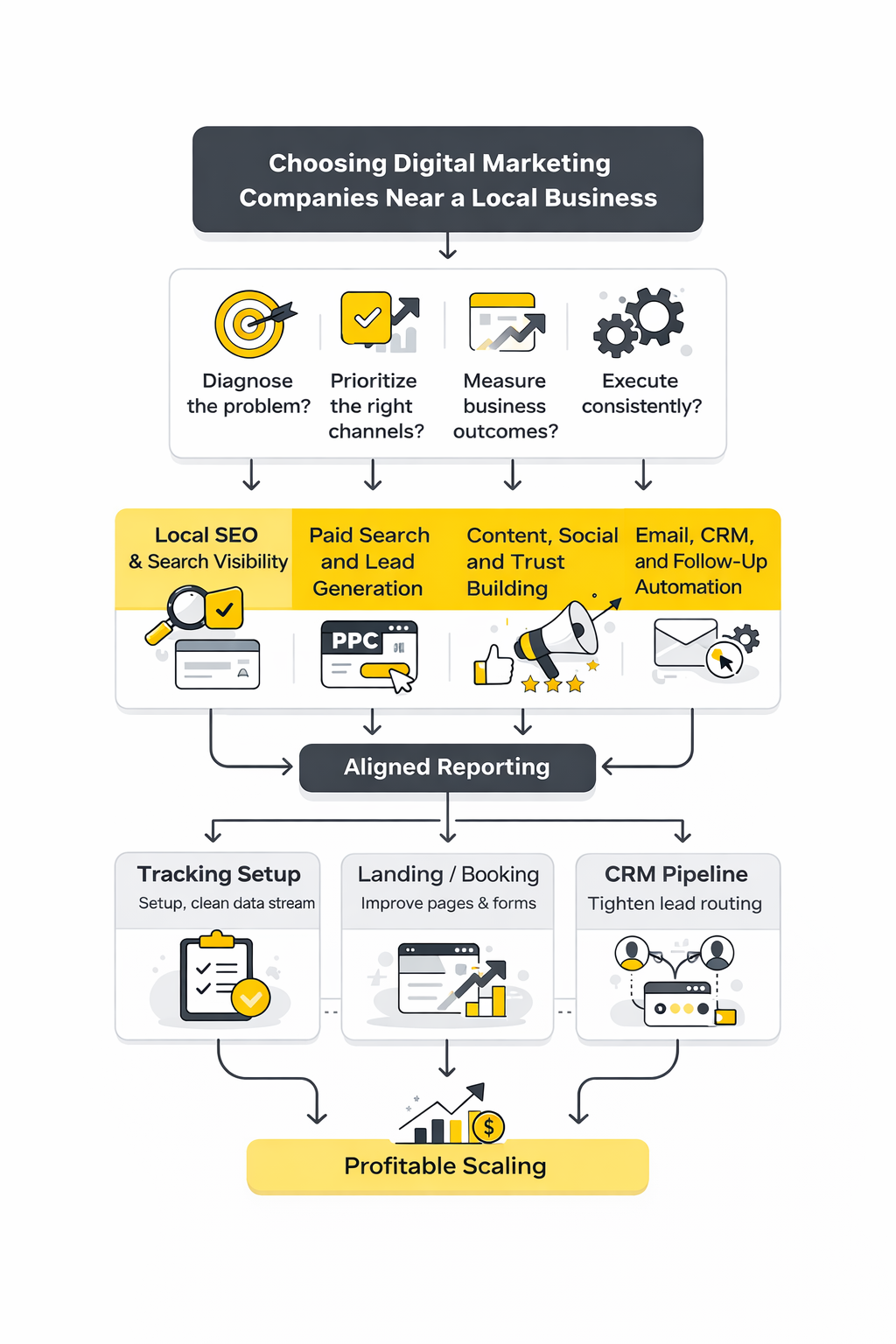
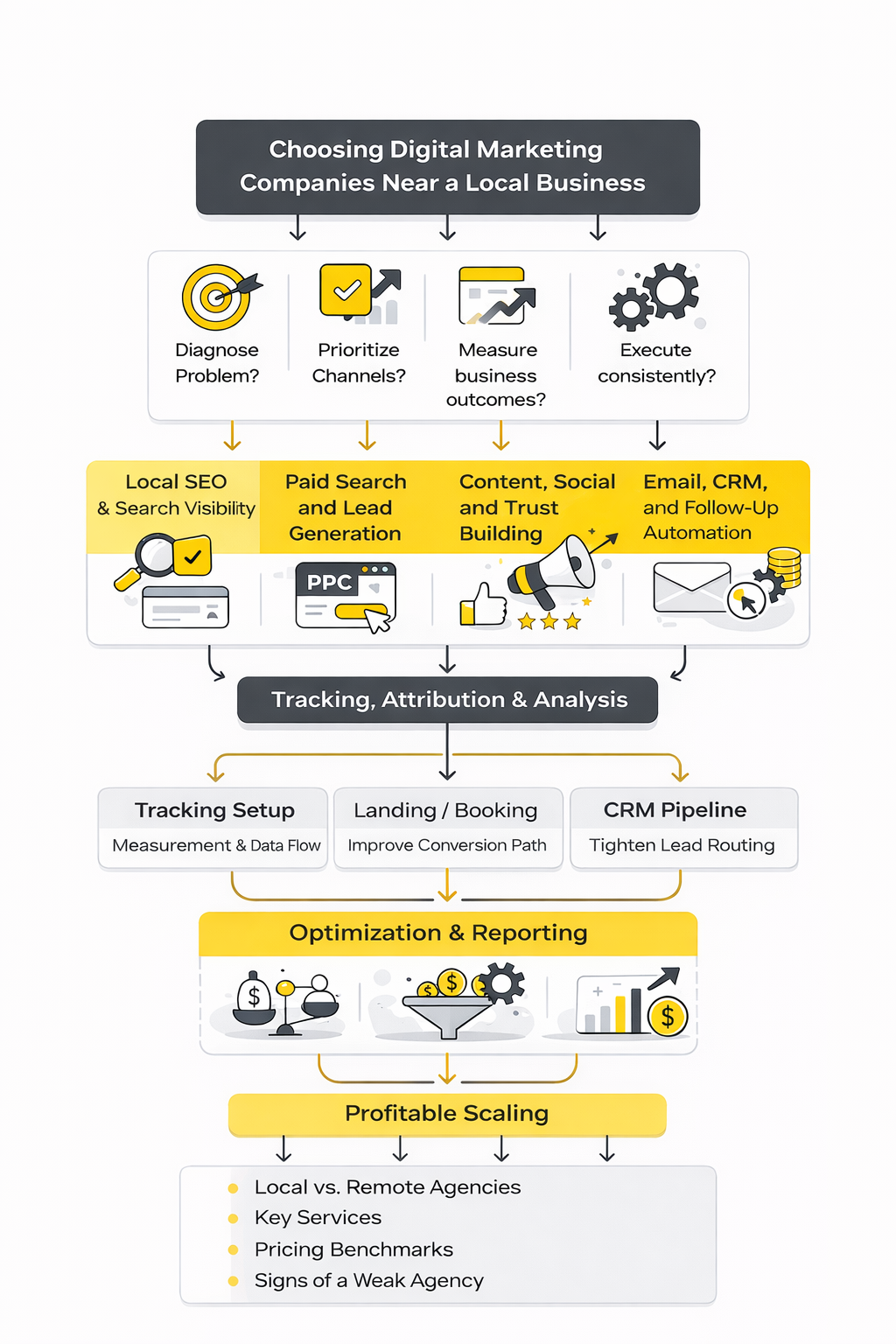
The easiest way to evaluate local agencies is to stop asking, “Who is closest?” and start asking four better questions: Can they diagnose the problem, can they prioritize the right channels, can they measure business outcomes, and can they execute consistently? That framework sounds simple, but it immediately removes a lot of noise from the buying process.
First, the agency should be able to explain where your growth bottleneck really is. For one business, the problem is weak local SEO and poor map visibility. For another, it is wasted ad spend. For another, the traffic is there, but the landing pages, forms, offer structure, or follow-up process are breaking conversion. This matters because channel performance is uneven. Recent benchmark data shows Google Ads search campaigns averaged a $70.11 cost per lead in 2025, while broader benchmark reporting put average search ad CPC at $5.26 and conversion rate at 7.52% across industries. Those numbers are useful only if an agency can connect them to your margins, close rate, and lead quality.
Second, they need a clear view of channel mix. Marketing teams are getting results from different places depending on business model, but current HubSpot reporting still shows strong ROI from channels like email, content, website SEO, and paid social. A serious agency should be able to explain why your business needs local SEO first, or paid search first, or retention systems first, instead of trying to sell everything at once.
Third, they should measure what happens after the click. That includes calls, booked appointments, qualified leads, closed revenue, repeat purchase behavior, and response speed. This is where many local agency relationships go sideways. The dashboard looks busy, impressions go up, and reports get longer, but the owner still cannot tell what actually produced customers. Google Business Profile performance data, review trends, ad benchmarks, and CRM conversion tracking only become useful when they are tied back to real business outcomes.
Finally, the agency should have a repeatable operating system. That means monthly priorities, reporting that makes sense, a clear owner on each deliverable, and enough technical depth to connect local SEO, paid media, landing pages, and follow-up automation. If an agency cannot explain that framework clearly in the sales process, it usually will not become clearer after you sign.
What Strong Digital Marketing Companies Actually Do
A strong local agency does not sell channels in isolation. It builds a system that helps a business get found, get chosen, and get paid. That sounds obvious, but it is exactly where a lot of nearby firms fall apart, because they are really selling disconnected services instead of one operating model tied to revenue.
When people search for digital marketing companies near me, they usually land on agencies that promise SEO, PPC, social media, web design, and email all at once. The serious firms can explain how those pieces connect. They know a Google Business Profile can drive direct calls and website visits, they know the website has to convert that traffic, and they know lead follow-up has to happen quickly enough for the marketing spend to matter in the first place. Google’s Business Profile performance reporting reflects that exact chain by tracking calls, clicks, bookings, and other customer actions from Search and Maps.
The easiest way to spot quality is to look for connected thinking. A good agency will talk about search visibility, offer positioning, landing page structure, lead capture, CRM handoff, pipeline reporting, and retention as one flow. A weak agency usually stays stuck at the surface level, where impressions, rankings, and post frequency sound impressive but never quite explain where the money came from.
Local SEO and Search Visibility
Any agency worth considering should be strong on local search basics first. Google still makes local ranking factors very clear: relevance, distance, and prominence matter, and complete, accurate business information helps a company show up for nearby searches. That means local SEO work is not just “doing keywords.” It includes Google Business Profile optimization, category selection, services, photos, review generation, local landing pages, NAP consistency, and website signals that support geographic relevance. Google’s local ranking guidance remains the cleanest place to see how this works.
This is why a nearby agency can be helpful when it truly understands the local market. It should know whether the business needs city pages, service-area optimization, neighborhood relevance, or just a cleanup of broken location signals. It also should understand that local visibility is fragile. Google’s own small business guidance keeps stressing accurate, fresh profile information because outdated listings and stale content reduce trust and can hurt discoverability. Google’s June 2025 small business bulletin made that point directly.
A capable agency also knows rankings are not the finish line. Visibility only matters if it produces calls, clicks, and sales opportunities. That is why the best teams treat local SEO as part of a wider acquisition system instead of a standalone monthly retainer with a rankings spreadsheet attached.
Paid Search and Lead Generation
Strong digital marketing companies also know when SEO is too slow to solve the immediate problem. If a business needs demand now, paid search can create faster access to high-intent traffic, but only if the agency understands bidding, keyword control, landing pages, conversion tracking, and lead qualification. Otherwise, paid media becomes an expensive way to buy noise.
That distinction matters even more because search advertising is not cheap anymore. Recent benchmark data showed average Google Ads search CPC at $5.26 and average search conversion rate at 7.52%, while separate 2025 benchmark reporting put average cost per lead for Google search campaigns at $70.11. (search benchmark data) Those numbers are not there to scare you. They are there to remind you that an agency must be able to connect ad spend to gross margin, sales capacity, and actual close rate.
The better agencies treat paid search like controlled testing. They do not just launch campaigns and hope the dashboard turns green. They pressure-test the offer, study search intent, remove bad traffic, and refine the page experience so every click has a stronger chance of becoming a qualified lead instead of a vanity metric.
Content, Social, and Trust Building
A lot of businesses searching for digital marketing companies near me really need trust building as much as traffic generation. That is where content and social come in. Done properly, these channels help a brand look active, credible, and easier to choose when someone compares multiple options after a search or referral.
Good agencies do not confuse activity with strategy here. They understand that social content should support awareness, proof, and conversion, while analytics should show what content earns attention and what content earns action. Buffer’s recent platform data shows meaningful differences in engagement across channels, with higher median engagement in its 2025 baseline on LinkedIn, Facebook, and Instagram than on some other major platforms. (Buffer’s 2026 engagement report) That does not mean every local business should rush onto every platform. It means platform choice should be deliberate.
This is also one of the easiest places to tell whether an agency is guessing. If the team cannot explain why a local service business should prioritize review proof, educational short-form content, testimonials, and remarketing assets over random trend-chasing, they are probably creating content to stay busy. Solid execution is calmer than that. It focuses on the content formats that reduce buyer hesitation and move prospects closer to action.
When agencies manage this well, they usually rely on tools that make scheduling, approvals, and reporting less chaotic. A small business does not need a bloated stack to do that. It needs a process that is easy to run consistently, whether the agency uses something lightweight for planning and reporting like Buffer or a broader platform tied to the rest of the sales process.
Email, CRM, and Follow-Up Automation
This is the part too many local agencies either ignore or hand-wave away. They bring in leads, then assume the client will take it from there. In reality, weak follow-up destroys good marketing faster than almost anything else. If inquiries sit too long, if no one nurtures cold leads, or if repeat buyers never hear from the business again, the acquisition channels end up looking worse than they really are.
Email still matters because it gives businesses a direct line to prospects and customers they already own. Brevo’s current benchmark reporting keeps showing how email fits into a wider messaging mix alongside SMS, push, and chat rather than disappearing from the stack. (Brevo’s 2025 benchmark) That is exactly how smart agencies use it. They connect email to forms, quote requests, abandoned actions, post-purchase flows, win-back campaigns, and list segmentation instead of treating newsletters as the whole strategy.
The agencies that really stand out usually have strong CRM and automation discipline. They know that lead routing, reminder sequences, pipeline stages, call tracking, and reactivation campaigns are not “extra.” They are part of implementation. That is one reason many operators standardize on platforms built around capture, nurture, close, and reactivation workflows, such as GoHighLevel. The tool itself is not the point. The point is that a professional agency should already have a repeatable way to manage the handoff from traffic to booked revenue.
Reporting That Actually Helps You Decide
The final piece is reporting, and this is where polished agencies can still fail badly. Many reports are technically accurate and strategically useless. They show clicks, reach, impressions, sessions, follower growth, and keyword movement, but they do not answer the one question a business owner actually cares about: what is working, what is not, and what should we change next month?
Useful reporting connects channel data to business decisions. Local search performance should tie back to calls and direction requests. Paid campaigns should tie back to lead quality and cost per acquisition. Email and automation should tie back to reactivation, conversion, and customer value. When that link is missing, the agency is often hiding behind marketing vocabulary because it does not have enough control over outcomes.
That is why the best local agencies usually sound more operational than promotional. They talk about attribution gaps, response times, offer friction, booking flow drop-off, and review velocity. They know marketing is not just about generating attention. It is about building a system you can measure, improve, and trust.
How Professional Implementation Looks in Practice
This is where the gap between average and excellent agencies becomes obvious. Plenty of firms can talk through strategy on a sales call, but the real test is what happens after kickoff, when tracking has to be fixed, landing pages have to go live, calls have to be routed, and reports have to reflect reality instead of hopeful assumptions. If you are comparing digital marketing companies near me, this is the section that should change how you evaluate them.
A professional implementation process is not glamorous, but it is what protects your budget. Google’s current guidance on measurement keeps coming back to the same point: you need clear conversion actions, clean event setup, and reliable tagging before campaign optimization can mean much. Google Ads conversion setup and GA4 event guidance both make that painfully clear.
The agencies that get this right are usually less flashy and more systematic. They do not jump straight to “let’s run ads” or “let’s post more content.” They begin by making sure the business can measure the actions that matter, route leads correctly, and improve weak points one by one.
The First 30 Days Should Look Structured, Not Chaotic
A serious onboarding process should start with an audit, not a creative brainstorm. That means checking analytics, tag setup, Google Business Profile access, ad account history, call tracking, form flows, CRM stages, landing pages, review velocity, and sales handoff. If any of those pieces are broken, the agency is driving with a cracked dashboard.
This is also the stage where a strong team defines what counts as success. Google Ads asks advertisers to create specific conversion actions because optimization depends on knowing which customer activities are valuable to the business. Google’s conversion measurement framework is blunt about that. Without those actions in place, campaigns can still run, but they are running with weak feedback loops.
The same principle applies to analytics. GA4 now revolves around events and key events, which means the agency needs to decide exactly what behaviors matter on the site, then configure those behaviors properly so the business can see what is working. Google’s key event documentation and event setup guidance both point to the same implementation reality: if you measure the wrong things, the rest of the reporting stack gets fuzzy fast.
What a Real Delivery Workflow Looks Like
Once the basics are in place, the work should become visible in a step-by-step operating rhythm. This is the point where the agency proves whether it has a real process or just a sales presentation. A good workflow usually moves in a fixed sequence, because each step makes the next one more reliable.
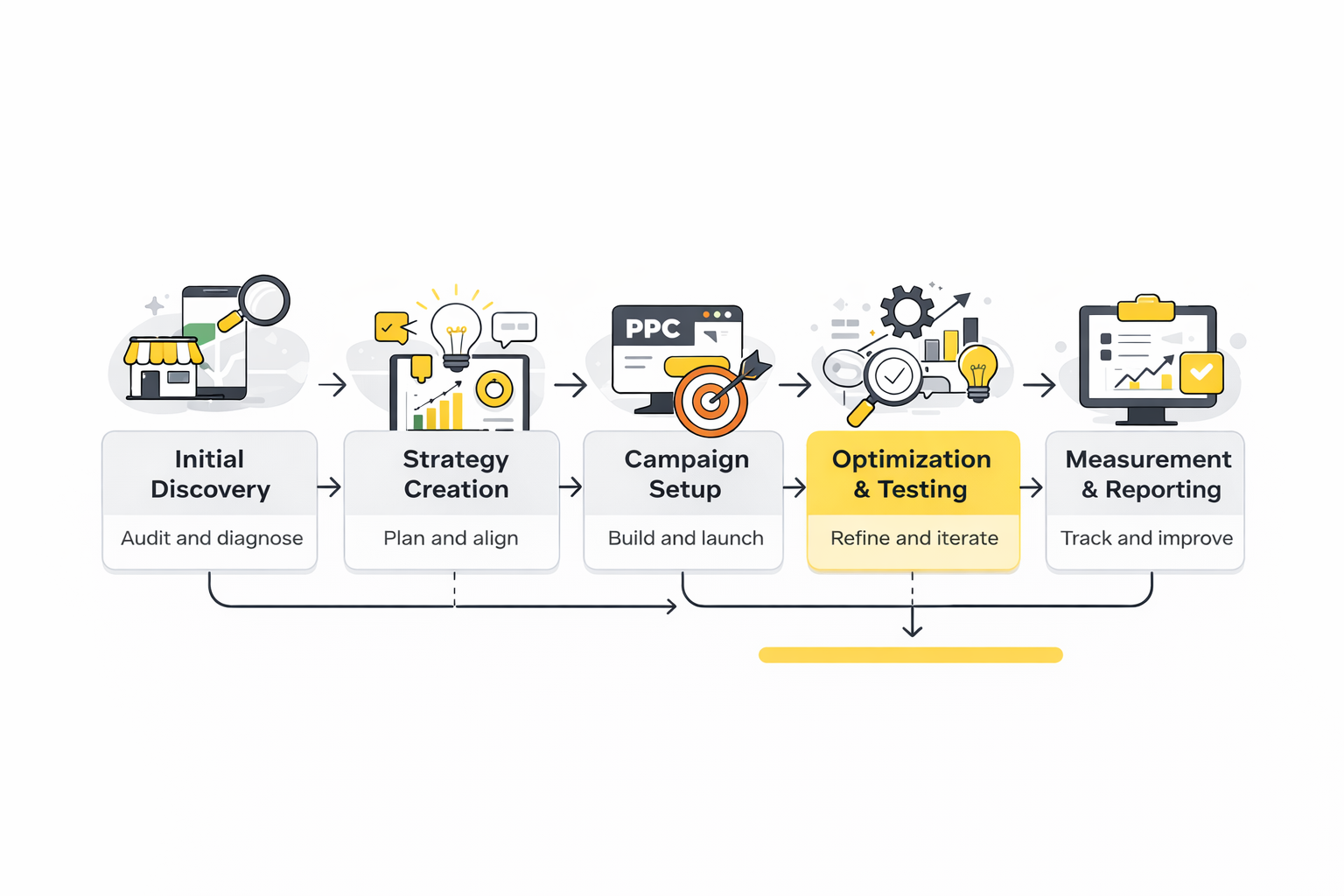
- Audit the current funnel
- Define primary conversion actions
- Fix tracking and attribution
- Improve the landing or booking experience
- Launch or refine acquisition channels
- Tighten lead routing and follow-up
- Review results and adjust monthly priorities
The audit phase should answer a few hard questions right away. Where are leads coming from now, where are they leaking out, which pages get traffic without converting, and how many inquiries are never followed up correctly? If an agency cannot answer those within the first month, it usually means it is still operating too high up in the clouds.
Then comes conversion design. Google’s setup flow for web conversions and imported conversions is built around this idea because ads need a destination action, not vague intent. Website conversion setup, conversion imports from Analytics, and lead-focused enhanced conversions all exist for one reason: better optimization depends on better inputs.
After that, the agency should improve the user journey itself. That may mean rewriting the offer, shortening forms, cleaning up mobile layouts, removing extra clicks, or changing the call-to-action structure entirely. When this step is skipped, businesses blame traffic channels for a conversion problem that is really a page problem.
Lead Capture and Follow-Up Need the Same Level of Attention as Traffic
This part is easy to underestimate until it starts costing real money. An agency can improve rankings and drive qualified traffic, but if form submissions disappear into a cluttered inbox or nobody follows up quickly, performance will still feel weak. That is not a marketing issue anymore. It is an implementation issue.
Professional agencies usually solve this with a clear lead pipeline. Contacts should enter the CRM in the right stage, move through visible statuses, and trigger actions when the next step is overdue. HubSpot’s lifecycle stage guidance and its newer lead pipeline automation documentation reflect how modern teams handle this handoff between marketing and sales. The point is not that every business needs HubSpot. The point is that the process cannot stay manual and vague forever.
This is also why agencies that work with local service businesses often standardize their stack. They want lead forms, booking flows, reminders, missed-call text back, pipeline updates, and reactivation campaigns tied together in one place. For some teams, that is exactly why a platform like GoHighLevel becomes attractive. It gives the agency a way to operationalize follow-up, not just report on traffic after the fact.
If the business relies on appointment booking, the implementation should make that step feel almost frictionless. Fewer clicks, fewer fields, better reminders, and clear calendar sync matter more than people think. That is one reason many operators also lean on simple booking infrastructure like Cal.com when they want a cleaner scheduling layer without turning the whole website into a project.
Reporting Should Create Decisions, Not Just Documents
By the time the agency gets to reporting, most of the important work has already happened. The tracking is either reliable or it is not. The landing flow either converts or it does not. The CRM either shows lead movement clearly or it turns every month into an attribution argument.
That is why strong agencies keep reporting close to execution. Google Business Profile performance can show calls, website clicks, bookings, and direction requests directly from Search and Maps. Business Profile insights make that data easier to inspect over time, which helps local businesses separate visibility from action. The agency should combine that with ad conversion data, landing page behavior, and CRM outcomes so the client can see the whole path instead of disconnected screenshots.
The best reporting discussions are usually short and honest. What improved, what stayed flat, what broke, and what gets fixed next month. If the report cannot answer those questions, it is probably trying to impress you instead of helping you decide.
What You Should Expect Before You Sign
Before hiring any agency, you should be able to picture how the first 60 to 90 days will work. Not the fantasy version with instant wins and vague “optimization,” but the real version with access requests, measurement fixes, asset reviews, test launches, and regular check-ins. The more clearly an agency can explain that process, the less likely it is to waste the first quarter of the relationship.
This is a useful filter when you are still searching for digital marketing companies near me. Ask how they define a conversion, how they validate their tracking, how they handle lead routing, how often they change campaign inputs, and what they expect from your internal team. If the answers stay abstract, that is the answer.
A good implementation process does not guarantee results by itself, but it gives results a real chance. And that is exactly what most businesses are actually trying to buy.
What the Numbers Actually Tell You
By the time you get to reporting, the biggest mistake is treating metrics like proof on their own. They are not. Numbers only become useful when they help you decide whether your agency should fix visibility, improve conversion, tighten targeting, speed up follow-up, or rethink the offer entirely.
That is especially important when comparing digital marketing companies near me. Many agencies can show dashboards full of movement, but not all movement is progress. A rise in clicks without qualified leads, or a drop in cost per lead with worse lead quality, can push a business in the wrong direction fast.
The right way to read marketing data is to separate it into four layers: visibility, engagement, conversion, and revenue quality. Visibility tells you whether people can find you. Engagement shows whether they are interested enough to act. Conversion tells you whether your pages and forms are doing their job. Revenue quality tells you whether the leads were worth paying for in the first place.
Start With Visibility, But Do Not Stop There
Local visibility still matters because it determines whether your business even gets a chance to compete. Google Business Profile performance data surfaces actions like calls, website clicks, bookings, messages, and direction requests, which is useful because local discovery often starts before someone reaches the website. Google’s Business Profile performance reporting makes that connection very direct.
But visibility is easy to misread. More impressions can mean stronger demand, better rankings, broader coverage, or simply weaker targeting that puts you in front of less qualified people. That is why direction requests, calls, and website clicks usually matter more than raw views for local service businesses.
The same logic applies to review and listing data. Recent local search research found that 84% of consumers search for local businesses online daily, 75% read at least four reviews before deciding, and 53% say inaccurate listings will drive them away. Those numbers matter because they point to action, not trivia. If your profile is incomplete, your reviews are stale, or your business information is inconsistent, the problem is not just ranking. It is lost trust before the sales conversation even begins.
Paid Media Benchmarks Need Context
Paid search benchmarks are useful, but only when you read them with discipline. Current search advertising benchmarks show an average Google Ads search CPC of $5.26 and an average cost per lead of $70.11. Those numbers are helpful because they remind you that paid traffic is expensive enough to punish sloppy execution.
Still, a benchmark is not a target. A business with high ticket value, strong close rates, and healthy margins may be thrilled with a cost per lead above the average. Another business with weak sales follow-up and narrow margins can lose money even when its cost per lead looks efficient on paper.
This is where good agencies separate themselves from average ones. They do not just compare your numbers to industry norms and call it analysis. They ask whether the campaign is producing leads that turn into booked calls, qualified opportunities, closed revenue, and repeat customers. If they stop at CPC or CPL, they are only analyzing the front half of the system.
Conversion Tracking Is the Backbone of the Whole System
A lot of reporting problems are really tracking problems in disguise. Google Ads and GA4 both rely on clean event setup, meaningful conversion definitions, and consistent measurement logic. If those pieces are wrong, every optimization decision built on top of them gets shakier.
Google’s current documentation on website conversion setup, conversion actions, and GA4 key events all point in the same direction. You have to define which actions matter before the platform can optimize for them properly. That sounds basic, but in real agency work it is one of the most common sources of wasted spend.
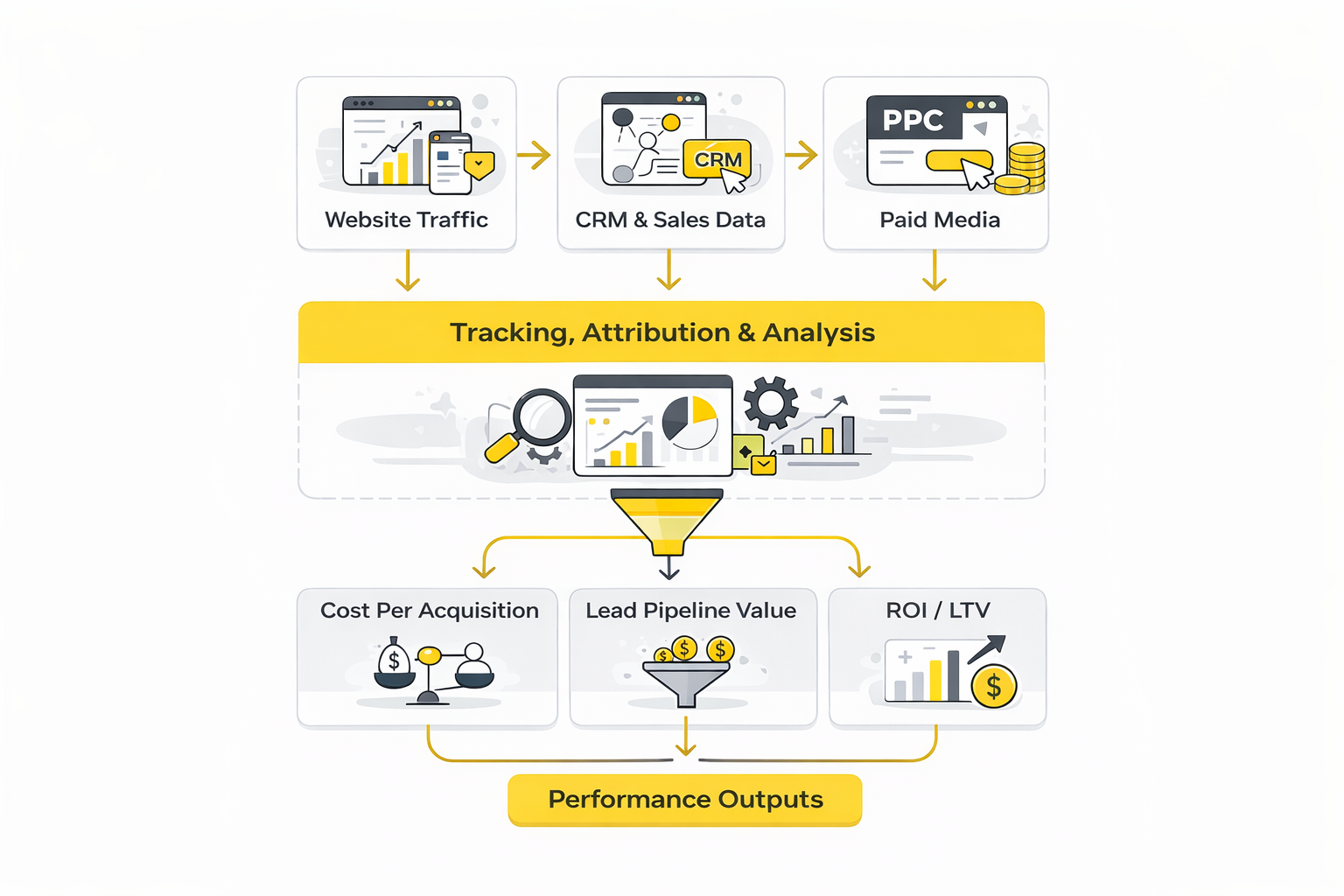
The practical takeaway is simple. If a local agency cannot explain exactly how it tracks phone calls, form fills, booked appointments, purchases, and qualified leads, then the report is not reliable yet. You do not need a more colorful dashboard in that situation. You need better measurement architecture.
Engagement Metrics Matter When They Explain Intent
A lot of businesses dismiss engagement metrics because they have been burned by vanity reporting before. That instinct is fair, but it can go too far. Engagement metrics are useful when they help explain buyer intent on the path to conversion.
Email is a good example. Brevo’s current benchmark data shows average performance in the neighborhood of 21% open rate and 3.96% click-through rate across industries. Those numbers do not tell you whether your email strategy is good by themselves, but they do tell you whether people are opening, noticing, and acting on what you send.
The right move is to connect those metrics to downstream behavior. If open rates are solid but click rates are weak, the content or call to action likely needs work. If click rates are healthy but revenue is flat, the issue may be on the landing page, the offer, or the sales follow-up sequence. That is how engagement data becomes useful instead of decorative.
Social metrics work the same way. Buffer’s recent platform reporting shows different median engagement patterns across networks, with stronger median engagement on some platforms than others in its 2026 analysis. Buffer’s latest engagement report matters less as a scoreboard and more as a reminder that platform choice should follow audience behavior, not habit. A nearby agency should be able to explain why a local business belongs on a specific platform, what that channel is expected to do, and how success will actually be measured.
Lead Quality Is the Metric That Keeps Everything Honest
This is the number many agencies avoid because it exposes whether the rest of the system is working. A campaign can generate cheap leads that never close, or expensive leads that become highly profitable customers. Without lead quality, cost metrics are incomplete.
That is why businesses should push agencies to connect channel reporting to CRM stages and sales outcomes. If a lead becomes an opportunity, books a consultation, shows up, buys, and renews, that path matters more than whether the original click looked efficient in isolation. Good agencies understand this and build reporting around movement through the pipeline, not just movement through ad platforms.
This also changes how you compare local firms. If one agency promises lower lead costs and another promises better close quality, the cheaper option is not automatically better. The smarter question is which one can prove that the leads will be worth more after the handoff to sales.
What Action the Data Should Drive
Good measurement should always lead to a next move. If local actions from Google Business Profile are flat, fix listings, reviews, photos, and category relevance. If search traffic is rising but leads are weak, improve landing pages, forms, and offer clarity. If paid search cost per lead is climbing, revisit targeting, search terms, conversion definitions, and lead qualification. If email engagement is healthy but pipeline movement is slow, the issue is probably downstream from the inbox.
This is why the best reporting meetings are rarely complicated. They focus on what changed, why it likely changed, and what gets adjusted now. Everything else is just dashboard theater.
If you are still evaluating digital marketing companies near me, this is the section to remember. Do not ask only what they report. Ask what decisions their reporting helps you make. That answer will tell you a lot about whether the agency is built to perform or just built to present.
Red Flags, Pricing Reality, and Questions to Ask Before You Sign
By this point, the biggest risk is not choosing the wrong channel. It is choosing the wrong operating partner. When businesses search for digital marketing companies near me, they often compare portfolios, websites, and sales calls, but the more important comparison is how each agency handles accountability, pricing pressure, data quality, and growth once the easy wins are gone.
That matters because agency relationships tend to feel best at the start. The strategy deck looks clean, the kickoff feels organized, and everyone is optimistic. The harder test comes later, when cost per lead rises, the local market gets more competitive, the first landing page stops performing, or the business needs the agency to coordinate across ads, SEO, CRM, and sales follow-up without dropping the thread.
The agencies worth keeping are usually the ones that stay useful when complexity increases. They can tell you what to simplify, what to stop doing, and what to scale. The weaker ones often do the opposite. They respond to every performance wobble by adding more tactics, more tools, more dashboards, and more invoices.
Pricing Should Reflect Scope, Not Sales Pressure
Agency pricing is one of the easiest places to get manipulated because most businesses do not have a clean frame of reference. Current market data from Clutch still shows a very wide range, with digital marketing engagements commonly falling between $5,000 and $50,000 per month. That spread is not automatically a problem. It just means pricing has to be tied to actual scope, seniority, execution depth, and channel complexity.
A local business does not always need a premium retainer. Sometimes it needs a focused engagement that fixes local SEO, tightens conversion tracking, cleans up the offer, and stabilizes paid search. Other times the business really does need a broader operating partner managing creative, reporting, automation, and multiple acquisition channels. The price should follow that reality.
This is where good questions save money. Ask exactly what work is included each month, who is doing it, what gets delivered, what is considered out of scope, and what has to be approved separately. If the pricing feels vague, the future invoices usually will not get clearer.
Cheap Agencies Can Be Expensive in Disguise
Low retainers look attractive when the business already feels pressure on margin. The problem is that bargain pricing often hides inexperience, shallow execution, or overreliance on templated work. If the agency wins clients by being dramatically cheaper than the market, it has to recover that margin somewhere.
Usually that shows up in one of three ways. The team assigns junior labor to strategy-heavy work, it spreads the same playbook across very different businesses, or it minimizes real implementation and leans harder on reporting theater. None of those outcomes help much when your market gets tighter or your cost per lead starts climbing.
This is why businesses should care about total economic impact, not just monthly retainer size. Google’s own guidance on high-quality lead generation and value-based bidding keeps pointing toward lead quality, conversion value, and business outcomes rather than raw lead volume. That logic applies to agency buying too. A cheaper partner that creates low-quality leads or poor tracking can cost more than a more expensive partner that drives better customers and cleaner decisions.
Tool Lock-In Is a Bigger Risk Than Most Businesses Expect
A lot of agencies now package delivery around their preferred software stack. Sometimes that is a good thing. Standardization can speed up onboarding, reduce errors, and make reporting easier to interpret. But it can also create dependency if the client never really controls the assets, accounts, automations, or customer data.
This gets serious fast when an agency manages your CRM, landing pages, call tracking, or email systems inside accounts you do not own. If the relationship ends badly, extracting forms, contacts, workflows, and campaign history can become a painful project instead of a simple transition. That is not a technical inconvenience. It is a negotiating disadvantage.
The right question is not whether the agency uses a platform. Of course it does. The real question is whether ownership and portability are clear from day one. If they are not, you are not just hiring an agency. You are renting access to parts of your own sales system.
AI Can Improve Agency Delivery, But It Can Also Hide Mediocre Thinking
This is one of the newer tradeoffs businesses need to understand. AI absolutely can help agencies move faster. It can support campaign analysis, workflow automation, segmentation, first-draft copy, chat handling, and internal reporting. HubSpot’s current marketing data shows 94% of marketers plan to use AI in content creation processes in 2026, which tells you the tools are already embedded into normal execution.
That said, speed is not the same as judgment. Some agencies now use AI to produce more output without improving the underlying strategy at all. The client gets more posts, more summaries, more creative variations, and more “insights,” but the work is not meaningfully closer to revenue.
A strong agency uses AI to remove low-value labor and improve consistency. A weak agency uses it to manufacture the appearance of sophistication. That is why you should ask what the team automates, what still gets human review, and where senior thinking actually shows up in the process.
Scaling Breaks Weak Systems First
Almost every agency can look competent at small scale. A few campaigns, one location, a manageable budget, and one main offer are not that hard to keep under control. The real pressure starts when the business adds more locations, more ad spend, more sales staff, more service lines, or a stronger need for segmented follow-up.
That is where operational weaknesses become visible. Tracking inconsistencies multiply. Messaging drifts across offers. Landing pages become harder to maintain. CRM stages stop reflecting reality. The agency begins to struggle not because marketing stopped working, but because the system was never designed to scale cleanly.
This is why mature agencies think in terms of architecture, not just tactics. They want cleaner pipelines, more disciplined measurement, clearer account structure, stronger asset ownership, and reporting that still makes sense after the business doubles. If an agency cannot explain how its model holds up under growth, it may only be optimized for early-stage momentum.
Questions That Separate Serious Agencies From Smooth Talkers
Before you sign, the goal is not to interrogate the agency for sport. It is to see whether they can think clearly when the conversation moves past selling. A few questions usually reveal that fast.
- How do you define a qualified lead for a business like mine?
- Which conversion actions do you track, and how do you verify they are accurate?
- What parts of the stack will I own directly if we stop working together?
- How do you decide when to shift budget between SEO, paid search, social, and retention?
- What does month three look like if month one and two do not produce the expected signal?
- Who actually does the work after the sale, and how senior is that team?
- How do you connect marketing performance to pipeline movement or closed revenue?
These questions matter because they force the agency to talk about operations instead of image. A good answer sounds specific, calm, and grounded in process. A weak answer usually turns abstract, defensive, or strangely polished.
The Best Choice Is Not Always the Closest Choice
This is the final strategic tradeoff many businesses have to make. The appeal of nearby agencies is real. Local knowledge, in-person meetings, and market familiarity can be valuable. Google’s local ranking system still revolves around relevance, distance, and prominence, so a team that understands local search behavior can absolutely have an edge.
But proximity is only one variable. The better question is whether the agency understands your economics, your sales cycle, your service geography, and the real constraints inside the business. A great remote specialist can beat a mediocre local firm every day of the week. A great local operator can also outperform a remote agency that never truly understands the market. The point is to judge capability first and distance second.
That is the mindset shift that makes this whole search more useful. Instead of asking which digital marketing companies near me look most impressive, ask which one can still help when tracking breaks, competition rises, budgets tighten, and growth gets messy. That is the agency decision that actually holds up.
FAQ
How do I choose between local and remote agencies?
The smart answer is not automatically local or automatically remote. A nearby agency may understand local search behavior, service areas, and regional competition better, which matters because Google still evaluates local visibility through relevance, distance, and prominence. Google’s local ranking guidance is the clearest reminder that geography still matters, but only when the agency can actually execute.
A remote agency can still be the better choice if it has deeper expertise in your niche, stronger systems, and cleaner reporting. The real test is whether the team understands your economics, your sales cycle, and the exact bottleneck you need fixed first. That matters a lot more than whether its office is fifteen minutes away.
Are digital marketing companies near me always better for local SEO?
Not always. They may have an edge if they know the neighborhoods, local search patterns, and regional competitors, but local SEO still depends on execution quality more than zip code alone. A weak agency in your city will still lose to a stronger specialist elsewhere.
That said, local context can absolutely help. If the agency understands service-area pages, review generation, Google Business Profile optimization, and city-level search intent, proximity can become a real advantage. Just do not mistake familiarity for competence.
What services should a good agency offer first?
A good agency should start with the services tied to your biggest growth constraint, not with the biggest menu. For one business that means local SEO and listings cleanup. For another it means paid search, landing page fixes, and better follow-up automation.
This is why strong agencies usually begin with an audit. They want to know whether your problem is visibility, conversion, lead quality, response speed, or retention before they recommend a stack of services. If they pitch everything immediately, that is usually a warning sign.
How much should I expect to pay?
Pricing varies a lot because scope varies a lot. Current market data still shows digital marketing engagements commonly ranging from $5,000 to $50,000 per month, which sounds broad because it is broad. A small local business with one location and one main channel should not be buying the same engagement as a multi-location company with layered reporting and CRM needs.
The better question is what the retainer includes. You want to know who is doing the work, how much strategy is involved, what is delivered monthly, and what counts as extra. Good pricing feels explainable. Bad pricing feels mysterious until the invoices start stacking up.
How long should it take to see results?
That depends on the channel and the starting condition of the business. Paid search can create signal faster, while local SEO usually takes longer because profile strength, review growth, local relevance, and site trust do not move overnight. If tracking is broken or the website converts badly, even good traffic can take longer to show up as meaningful results.
The more useful timeline question is this: when should you expect clarity? A capable agency should be able to tell within the first one to three months whether the tracking is reliable, whether the offer is resonating, and where the main friction points are. That early clarity is often more important than early vanity wins.
What metrics actually matter most?
The best metrics are the ones that help you make decisions. For local businesses, that usually means calls, form submissions, booked appointments, direction requests, qualified leads, close rates, and customer value. Google Business Profile reporting is helpful because it surfaces actions like calls, website clicks, bookings, and directions directly from local search behavior. Google’s performance reporting is useful precisely because it focuses on action, not just exposure.
You still want visibility data, but only as context. Impressions, rankings, clicks, and engagement are supporting metrics. The core question is whether those signals are producing better customers and better revenue decisions.
What is a red flag during the sales process?
The biggest red flag is vague confidence. If the agency speaks in polished language but cannot explain how it tracks conversions, how it defines a qualified lead, or how it changes course when performance stalls, you are probably buying presentation more than execution.
Other warning signs show up fast too. Guaranteed rankings, unclear ownership of accounts, no discussion of CRM handoff, and an urge to skip the audit phase usually mean the process is weaker than it sounds. Calm specificity is a better sign than aggressive certainty.
Should I hire one full-service agency or several specialists?
That depends on your internal capacity. One strong operator can create a cleaner system if it truly understands how SEO, paid media, landing pages, email, and CRM fit together. That reduces coordination headaches and usually makes reporting easier to interpret.
Several specialists can work well too, but only if someone is actively connecting the pieces. Without that layer of coordination, businesses often end up with channel-level wins and company-level confusion. If you go the specialist route, make sure someone owns the full funnel.
How important are reviews when hiring an agency?
Reviews matter, but not in a simplistic way. They help you see whether the agency is trusted, responsive, and consistent. They are especially relevant because recent local search research found that 75% of consumers read at least four reviews before deciding and 53% say inaccurate listings can drive them away, which tells you how trust and accuracy shape local decisions generally.
Still, reviews should be one input, not the whole case. You also want process clarity, strategic fit, proof of measurement, and a realistic plan for your specific business model. A five-star agency that cannot explain implementation is still risky.
What if my agency sends reports but I still do not know what is working?
That usually means the reporting is descriptive, not operational. It may show activity without translating that activity into decisions. A useful report should tell you what changed, why it likely changed, what result that created, and what the agency is going to adjust next.
If you cannot get that level of clarity, push for fewer metrics and better interpretation. This is where many businesses finally realize they do not have a traffic problem or a dashboard problem. They have an accountability problem.
Can a good agency help even if my website is weak?
Yes, but only if it is honest about the limitation. No serious agency should pretend that stronger traffic can fully compensate for a weak offer, clunky mobile experience, long forms, or poor page structure. Those issues reduce the value of every visit you pay for or earn.
A good agency will usually want to fix the conversion path early. That may mean a better landing page, clearer messaging, a shorter booking flow, or a stronger lead form. If the site is weak and the agency ignores it, your budget will feel the difference.
Do I need marketing automation right away?
Not always right away, but usually sooner than many businesses think. Once leads start coming in from multiple channels, manual follow-up gets messy fast. That is when reminders, email sequences, missed-call handling, appointment confirmations, and pipeline updates start becoming important.
The key is to add automation where it removes friction, not where it adds complexity. Strong agencies use it to speed up response time, protect lead value, and make reporting cleaner. Weak agencies use it because it sounds advanced.
Work With Professionals
Explore 10K+ Remote Marketing Contracts on MarkeWork.com
Most marketers spend too much time chasing clients, competing on crowded platforms, and losing a percentage of every project to middlemen.
MarkeWork gives you a better way. Browse thousands of remote marketing contracts and connect directly with companies desperate to hire skilled marketers like you, without platform commissions and without unnecessary gatekeepers.
If you're serious about finding better opportunities and keeping 100% of what you earn, explore available contracts and create a profile for free at MarkeWork.com.