

A digital marketing company is no longer just the team you hire to run a few ads or post on social media. Today, the job is much bigger. The best firms connect strategy, content, paid media, analytics, CRM, testing, and conversion optimization into one operating system that helps a business grow without guessing.
That shift happened for a reason. Global ad spending was projected to pass the $1 trillion mark in 2025, with digital taking more than 75% of the total, while the U.S. digital ad market alone reached $259 billion in 2024 after 15% year-over-year growth. In plain English, the market got too big, too fast, and too technical for most businesses to manage well with scattered freelancers, disconnected tools, or a part-time internal effort. eMarketer’s 2025 forecast and the IAB/PwC Internet Advertising Revenue Report make that pretty clear.
At the same time, the consumer journey has become messier, measurement has become harder, and personalization expectations have gone up. Google’s marketing research notes that only 44% of senior marketing analytics professionals use attribution, marketing mix models, and incrementality testing together, while Salesforce’s latest State of Marketing is based on insights from nearly 4,500 marketers focused on AI, data, and personalization. That is exactly why choosing the right digital marketing company matters so much now: you are not just hiring execution, you are hiring coordination, judgment, and a system for turning attention into revenue. Google’s measurement research and Salesforce’s Tenth Edition State of Marketing both point in the same direction.
Article Outline
- Why a Digital Marketing Company Matters More Than Ever
- The Growth Framework a Modern Digital Marketing Company Uses
- The Core Services That Actually Drive Results
- How Professional Implementation Works Behind the Scenes
- How to Choose the Right Digital Marketing Company
- Final Takeaways and FAQ
Why a Digital Marketing Company Matters More Than Ever
Most businesses do not struggle because marketing channels do not exist. They struggle because every channel creates partial data, every platform wants credit for the sale, and every team member sees only one slice of the funnel. A capable digital marketing company steps in to unify that picture, set priorities, and decide what deserves budget now versus what can wait.
That matters even more in a market where retail media, connected TV, and social were all projected for double-digit growth in 2025, which means brands are being pulled into more platforms and more complexity at the same time. If your business is trying to scale across search, paid social, email, landing pages, content, and lead nurturing without one clear operating model, costs rise faster than results. The problem is rarely “we need more tactics.” The problem is usually “we need one team that knows how the tactics work together.” IAB’s 2025 ad spend outlook supports that shift toward channel complexity.
There is also the personalization layer. McKinsey’s 2025 research on marketing personalization highlights that customers increasingly expect tailored digital experiences, and Deloitte has reported that 80% of surveyed consumers prefer brands that offer personalized experiences. That raises the bar for any business that wants to compete online, because generic campaigns are easier than ever to produce and easier than ever to ignore. McKinsey’s personalization analysis and Deloitte’s personalization findings show why strategic execution matters more than raw activity.
A serious digital marketing company helps close that gap by bringing structure to messy growth. Instead of asking, “Should we run SEO, ads, or email?” the better firms ask harder questions first: where is demand already happening, where is conversion friction killing performance, where is first-party data weak, and where is measurement too blurry to trust. That is the difference between marketing that looks busy and marketing that compounds.

The Growth Framework a Modern Digital Marketing Company Uses
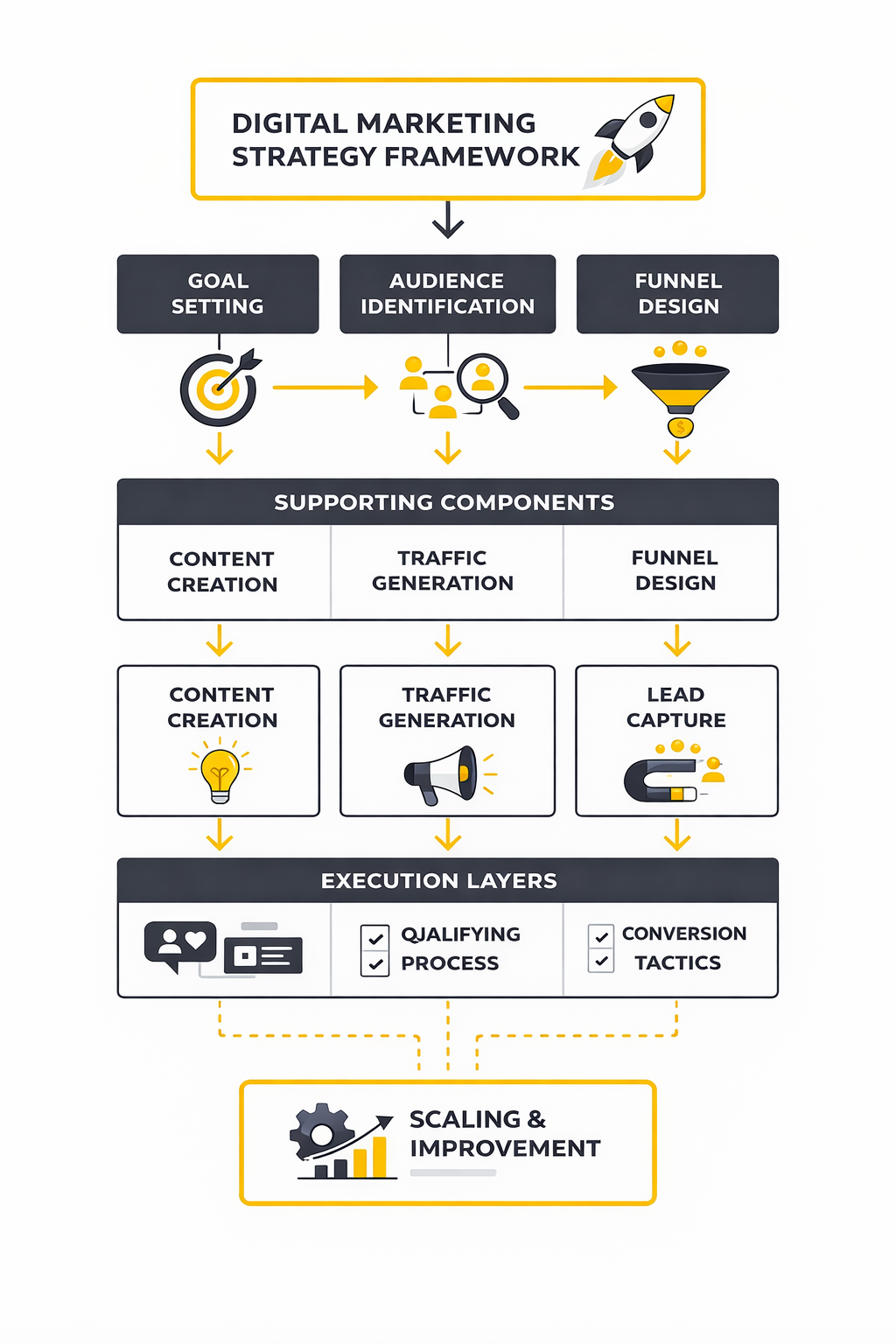
A modern digital marketing company usually works inside a simple but powerful framework: attract qualified attention, convert that attention efficiently, nurture leads or customers, and improve the system through measurement and testing. That sounds obvious on paper, but it is exactly where weaker providers break down. They may be good at one move, like buying traffic or designing creatives, but they never build the full loop.
Google’s recent measurement research describes this well through a broader performance framework built around measurement and insights, media and personalization, creative and content, and people and process. That is useful because it reflects what high-performing marketing really looks like in practice. Strong results do not come from one magic channel. They come from a company that can connect data, media, messaging, and execution without losing speed. Google’s AI-powered marketing framework is one of the clearest recent explanations of that model.
This is also where many businesses decide whether they need a vendor or a real growth partner. A vendor will do what you ask. A real digital marketing company will challenge your assumptions, tighten your offer, improve your landing pages, clean up tracking, and tell you when the funnel is the problem rather than the traffic. That kind of intervention is often what unlocks performance.
In practical terms, the framework usually rests on five connected layers:
- Positioning and offer clarity so the market understands why your business is worth choosing.
- Traffic acquisition through channels like SEO, paid search, paid social, content, partnerships, and referral loops.
- Conversion infrastructure including landing pages, forms, funnels, CRM routing, and follow-up sequences.
- Retention and expansion through email, automation, remarketing, and customer experience improvements.
- Measurement and experimentation so budget decisions are based on evidence instead of platform claims.
That is why many companies pair execution with systems that keep data and follow-up in one place. Tools for funnels, email automation, scheduling, forms, CRM, and content workflow can make a real difference when they support a clear strategy, whether that means building offers inside ClickFunnels, running lifecycle email through Brevo, or managing publishing rhythm with Buffer. The point is not the tool itself. The point is having a digital marketing company that knows where each tool fits and where it does not.

What Comes Next
Now that the structure is clear, the next part moves into the services that matter most. Not every digital marketing company should sell the same package, and not every business needs the same mix. The difference between wasted spend and profitable growth usually comes down to knowing which components actually drive revenue in your situation and which ones are just there to look impressive.
What the Numbers Are Really Telling You
By the time a business hires a digital marketing company, the usual question is no longer whether digital matters. That part is settled. The better question is what the numbers actually mean, which metrics deserve attention, and which ones are quietly pushing the team toward bad decisions.
The broad market data sets the context first. Digital was projected to take more than 75% of global media ad spending in 2025, while the U.S. internet advertising market reached $258.6 billion in 2024 after 15% year-over-year growth. Those are not just big headline figures from eMarketer’s 2025 forecast and the IAB/PwC 2024 Internet Advertising Revenue Report. They tell you that competition is getting denser, platform costs are under pressure, and a digital marketing company cannot rely on sloppy execution anymore because the market is too mature and too expensive for that.
That is the first interpretation that matters: bigger digital markets do not automatically mean easier growth. They usually mean more budget chasing the same attention, more sophisticated competitors, and more need for measurement discipline. So when a digital marketing company talks about performance, the real question is not “Are the channels growing?” It is “Can this business still buy attention profitably and convert it efficiently in a more crowded market?”
Which Metrics Matter and Which Ones Mislead
A lot of reports look impressive while saying almost nothing useful. Impressions can rise while revenue stalls. Click-through rate can improve while lead quality collapses. Cost per lead can fall while the sales team quietly stops trusting the pipeline. This is why a serious digital marketing company organizes analytics around business outcomes first and channel metrics second.
The numbers that usually matter most sit in a simple chain:
- Traffic quality
- Conversion rate
- Cost to acquire
- Lead or customer quality
- Revenue contribution
- Retention or repeat value
That sequence matters because each metric changes how you interpret the next one. A cheap lead is only good news if it converts downstream. Strong traffic is only valuable if the page experience and offer can turn it into action. A digital marketing company that reports top-of-funnel growth without connecting it to pipeline, sales, or retention is often showing motion instead of progress.
This is also where benchmarks can become dangerous. Industry averages are useful for orientation, but they are terrible as a substitute for strategy. The point of a benchmark is to help a digital marketing company spot obvious underperformance, not to convince a business that average results are good enough.
The Benchmarks That Actually Help
Some benchmark data is still worth using because it helps diagnose where the friction probably sits. The IAB revenue report shows where advertiser money continues flowing across search, social, video, retail media, and other formats, which gives a decent market map of where attention is being bought at scale. That is useful because a digital marketing company should understand not only your channel performance, but also the broader market’s direction and cost pressure. IAB’s 2024 revenue report remains one of the best reference points for that.
Email benchmarks are another example. They are not there to tell you your business is healthy just because your open rate looks normal. They matter because they help isolate whether the issue is deliverability, list quality, segmentation, creative, or message timing. Current data from Mailchimp’s email marketing benchmarks, Litmus State of Email research, and the 2025 Email Benchmark Report all point toward the same practical takeaway: performance improves when relevance improves, not when volume increases blindly.
The same principle applies to conversion benchmarks. A digital marketing company should treat them as diagnostic clues, not promises. If paid traffic underperforms, the cause may be the offer, the audience, the landing page, the speed, the trust signals, or the follow-up process. The benchmark only tells you that something is off. It does not tell you where.
How Good Teams Read Performance Signals
The difference between weak reporting and strong analysis usually comes down to interpretation. A weak team sees lower cost per click and celebrates. A strong digital marketing company asks whether those clicks are bringing qualified buyers or just cheaper noise. A weak team sees more conversions in-platform and assumes performance improved. A strong team checks whether CRM-qualified opportunities moved in the same direction.
That is why marketers are putting more weight on mixed measurement models. Google has highlighted that only 44% of senior marketing analytics professionals use attribution, marketing mix models, and incrementality testing together, which is a useful warning sign from Google’s measurement guidance. It means most teams are still making decisions with partial visibility, and partial visibility gets expensive when budgets rise.
A digital marketing company should be reading signals across layers at the same time. Platform metrics tell you what happened inside the channel. Site analytics tell you what happened after the click. CRM data tells you what happened after the handoff. Revenue data tells you whether the whole system was worth funding. Once those four views line up, decision-making gets much cleaner.

Why Measurement Systems Matter More Than Individual Reports
Most reporting problems are really system problems. If conversion events are wrong, the dashboard is wrong. If lead stages are messy, pipeline reporting is wrong. If sales never closes the feedback loop, campaign optimization becomes guesswork. This is why a digital marketing company that takes analytics seriously spends a lot of time on definitions, tracking logic, and CRM alignment before it tries to impress anyone with charts.
This is also why incrementality has become a much bigger deal. Google lowered the minimum spend threshold for incrementality experiments in 2025 from $100,000 to $5,000, based on its recent experimentation and incrementality update. That matters because it makes causal testing more accessible, and causal testing is far more useful than simply asking which platform claimed the conversion.
In plain English, attribution shows who got credit. Incrementality asks what would not have happened without the marketing. That is a much better question. A good digital marketing company should care less about platform bragging rights and more about whether spend created real additional business.
What the Data Should Drive You to Do
Metrics only matter if they change action. That is where many analytics conversations fall apart. Teams gather numbers, build dashboards, talk about trends, and then do nothing differently the next month. A serious digital marketing company uses data to force decisions.
Here is what different signals should typically trigger:
- High traffic with weak conversion rate usually points to a page, offer, or trust problem.
- Good conversion rate with weak lead quality usually points to targeting, qualification, or messaging mismatch.
- Strong lead volume with weak close rate usually points to CRM handoff, sales process, or poor-fit acquisition.
- Rising acquisition costs with stable conversion usually points to market competition, audience fatigue, or creative stagnation.
- Healthy acquisition with weak repeat value usually points to retention, onboarding, or lifecycle marketing gaps.
That is the practical value of measurement. It tells a digital marketing company where to intervene first. Without that, teams either keep feeding the wrong channel or rebuild the wrong part of the funnel.
Data Without Context Can Waste a Lot of Money
This is worth saying directly. More data does not automatically mean better decisions. Salesforce’s current Tenth Edition State of Marketing is built on insights from nearly 4,500 marketers and keeps circling back to the same pressure points: AI, data, personalization, and operational readiness. That should tell you something important. The problem is no longer access to dashboards. The problem is whether teams can turn fragmented information into coordinated action.
That is why the right digital marketing company should be slightly skeptical by default. It should question platform-reported success, compare marketing numbers to sales reality, and push for cleaner testing before bigger budgets. In a crowded market, disciplined interpretation is an edge.
The next step is where buyers usually make or lose the whole decision. Once you understand how a digital marketing company should measure performance, the obvious question is who is actually capable of doing this well. Not who sounds polished. Not who has the nicest service page. Who can be trusted to diagnose the real problem, prioritize correctly, and execute without hiding behind vanity metrics.
How to Choose the Right Digital Marketing Company
By this point, the pattern is hard to ignore. A digital marketing company is not just a supplier of services. It is a force multiplier when the fit is right, and a budget leak when the fit is wrong.
That is why choosing one should never come down to who promises the most channels for the lowest monthly fee. The better decision is slower and more strategic. You are trying to find a team that can diagnose accurately, prioritize ruthlessly, execute consistently, and tell the truth when the market is rejecting your offer instead of hiding behind activity metrics.
Start With the Business Model, Not the Agency Pitch
The first filter is whether the digital marketing company actually fits your economics. A business with high customer lifetime value, longer sales cycles, and a consultative buying process needs a very different growth system from an ecommerce brand trying to improve repeat purchase rate and paid media efficiency. The same service menu cannot solve both problems equally well.
This matters even more now because the market is pushing marketers toward more AI, more personalization, and more data coordination at the same time. Salesforce’s current State of Marketing is built around that exact pressure, drawing on insights from nearly 4,500 marketers dealing with AI, data, and personalization tradeoffs, while McKinsey’s 2025 personalization work makes the same broader point: more sophisticated customer expectations demand a stronger operating model, not just more software. Salesforce’s Tenth Edition State of Marketing and McKinsey’s 2025 personalization analysis both reinforce that shift.
A serious digital marketing company should be able to explain how it would work inside your business model before it talks about deliverables. It should know which KPI matters most, where the bottleneck probably sits, what must be measured first, and what should not be scaled yet. If that conversation never happens, you are probably hearing a pitch, not a diagnosis.
The Best Agencies Prioritize Ruthlessly
One of the biggest signs of maturity is restraint. A weak digital marketing company tries to impress you with everything it can do. A strong one narrows the field fast and tells you where the highest-leverage move sits right now.
That is important because digital advertising keeps getting larger and more competitive. The IAB/PwC Internet Advertising Revenue Report for full-year 2024 shows U.S. internet advertising revenue reached $258.6 billion in 2024, up 14.9% year over year. In a market like that, trying to be “everywhere” before the fundamentals work is usually how businesses burn cash.
So when you evaluate a digital marketing company, listen for what it would not do yet. A good partner should be able to say, clearly and without hedging, that email cleanup matters before more traffic, or that landing page clarity matters before new ad spend, or that CRM handoff matters before another content sprint. That kind of prioritization is not a limitation. It is a sign the team understands tradeoffs.
Watch for the Real Red Flags
Some warning signs show up early if you know what to look for. One is when a digital marketing company talks mainly about platform metrics and barely mentions sales outcomes, retention, or customer quality. Another is when it presents a polished reporting stack but stays vague about attribution limits, experiment design, or CRM feedback loops.
A more subtle red flag is overconfidence around AI. AI is clearly becoming more central to campaign operations, creative workflows, and measurement support, but official platform guidance is also moving in a direction that demands better testing and stronger oversight, not blind trust. Google’s 2025 measurement guidance emphasizes experimentation and incrementality more heavily, including broader access to lift testing at lower spend levels, which should tell you something important: automation is rising, but proof still matters. Google’s experimentation guidance and Google Ads’ 2025 highlights point the same way.
Another red flag is false certainty around benchmarks. Any digital marketing company can quote average click-through rates, open rates, or conversion ranges. The better one explains what those numbers can and cannot tell you. Benchmarks are useful for spotting unusual friction. They are not a substitute for strategy, fit, or operational discipline.
Scaling Creates New Problems, Not Just Bigger Wins
Many businesses imagine scale as a smooth upward curve. In reality, scale usually exposes weaknesses that were hidden at smaller volume. The channel that worked at a modest budget may saturate. The creative that converted well may fatigue. The CRM that held together when lead volume was low may break when follow-up demand rises.
This is why scaling with the wrong digital marketing company can actually make things worse faster. More spend poured into a weak funnel does not solve the funnel. It just buys more expensive proof that the system was not ready. A better partner understands that scale is a systems question, not just a media-buying question.
That systems view matters because growth is becoming more cross-functional. Personalization expectations are climbing, AI is reshaping workflows, and measurement models are getting more complex, which means the agency’s job increasingly touches data readiness, operations, offer clarity, creative iteration, and lifecycle messaging. McKinsey’s 2025 personalization research and Salesforce’s current marketer survey both support that broader interpretation of what modern marketing teams now have to manage.
The Build-or-Buy Tradeoff Is Usually the Wrong Framing
A lot of companies ask whether they should hire in-house, use freelancers, or hire a digital marketing company. Fair question, but it is usually framed too simply. The real issue is not who owns the work. The real issue is whether the business has access to the right mix of strategy, execution, analytics, creative, and process discipline at the speed the market requires.
In some cases, a lean internal team with outside specialists works best. In others, one capable digital marketing company can move faster because it already has the channel depth, systems knowledge, and implementation process in place. What matters is not ideology. It is whether the model reduces coordination drag and improves decision quality.
That is also where tooling becomes a practical consideration instead of a shiny distraction. The right setup might include funnel builders such as ClickFunnels or Systeme.io, lifecycle tools such as Brevo or Moosend, and coordination layers like Cal.com or Copper. But again, the tool is not the strategy. The tool only becomes useful when the digital marketing company knows exactly what job it is supposed to perform in the growth system.
Expert-Level Guidance Usually Sounds Less Exciting and More Useful
This is one of the clearest truths in marketing. The advice that actually makes money is often less dramatic than the advice that sounds impressive in a pitch. It is usually about clearer offers, cleaner tracking, fewer priorities, stronger landing pages, better follow-up, tighter testing, and more honest interpretation of results.
That may sound less exciting than promises about omnichannel domination or AI-powered growth engines, but it is usually the difference between performance that compounds and performance that resets every quarter. Google’s current focus on experimentation and measurement, combined with the broader market’s continued spending growth, makes that tradeoff even sharper: there is more pressure to scale, and more need to prove what is truly working. Google’s recent measurement guidance and the IAB/PwC 2024 revenue report both reinforce that reality.
So the best digital marketing company for most businesses is not the loudest one. It is the one that can look at the whole system, call the bottleneck correctly, build the missing pieces, and stay disciplined when the pressure to chase shiny tactics shows up.
The Right Partner Should Make the Business Clearer, Not More Confused
That is the final test before the close. After the sales calls, proposals, dashboards, and case-study talk, ask one simple question: does this digital marketing company make the path forward clearer? Not noisier. Not busier. Clearer.
A good partner should leave you with better priorities, better definitions, better measurement, and a better sense of what needs to happen next. It should reduce confusion rather than monetize it. And that matters more than ever because the businesses winning now are rarely the ones doing the most marketing. They are usually the ones running the clearest system.
The final part brings everything together with the closing takeaways and the FAQ, because once the theory is done, the practical questions get very specific very fast.
Final Takeaways
By now, the shape of the decision should be clear. A digital marketing company is valuable when it brings structure to growth, connects channels to revenue, and helps a business make better decisions under pressure. It becomes expensive when it hides behind deliverables, vanity metrics, or bloated service lists that never address the real bottleneck.
That is the practical takeaway more businesses need to hear. You do not need more tactics by default. You need clearer priorities, cleaner measurement, stronger conversion paths, tighter follow-up, and a partner that can tell the difference between activity and actual progress.
The market is only getting more demanding from here. Digital took more than 75% of global media ad spend in 2025, while U.S. internet advertising revenue hit $258.6 billion in 2024, which means competition is not easing up for anyone. eMarketer’s 2025 forecast and the IAB/PwC 2024 revenue report point to the same reality: disciplined execution matters more now because the cost of sloppy marketing keeps rising.
A strong digital marketing company should make the business simpler to understand, not more confusing. It should know what to fix first, what to ignore for now, what to measure carefully, and where scale will break if the system is not ready. That is what professional help is supposed to look like.
FAQ - Built for Complete Guide
What does a digital marketing company actually do?
A digital marketing company helps businesses attract attention online, convert that attention into leads or sales, and improve the process over time. That can include strategy, SEO, paid advertising, content, email, CRM automation, analytics, landing pages, and conversion optimization. The better firms do not just execute tasks. They connect those pieces into one working growth system.
When should a business hire a digital marketing company?
A business should usually hire a digital marketing company when growth has become too important or too complex to run through scattered freelancers, occasional experiments, or an overstretched internal team. This often happens when ad spend rises, lead quality becomes inconsistent, conversion rates stall, or reporting stops matching sales reality. If the business is losing time because no one owns the full funnel, outside help starts making sense.
Is hiring a digital marketing company better than building in-house?
Not automatically. The better option depends on whether the business can access the right mix of strategy, execution, analytics, creative, and operational discipline. Sometimes an internal team supported by outside specialists works best. In other cases, one strong digital marketing company is faster because it already has the systems, talent, and process in place.
How much should a digital marketing company know about my industry?
Enough to understand the buying journey, the economics, and the quality signals that matter. It does not need to have worked with your exact business model a hundred times, but it should quickly understand how customers discover you, how long they take to decide, and which conversion points matter most. Industry familiarity helps, but diagnosis and strategic clarity matter more than niche buzzwords.
What services matter most when choosing a digital marketing company?
The answer depends on the bottleneck. Some businesses need better demand capture through search or paid media. Others need stronger landing pages, better email follow-up, or cleaner CRM workflows. A good digital marketing company should not push every service equally. It should identify which services should lead, which ones should support, and which ones should wait.
How do I know whether a digital marketing company is focused on real outcomes?
Look at how it talks about performance. A serious team will ask about revenue, sales quality, retention, pipeline, customer lifetime value, and attribution limits. A weaker one usually stays at the level of clicks, impressions, follower growth, or lead volume alone. The language tells you a lot before the work even begins.
How long does it take to see results from a digital marketing company?
That depends on the channel mix and the condition of the current system. Paid media and landing page fixes can sometimes produce useful feedback quickly, while SEO, content authority, and lifecycle improvements often take longer to compound. The key is not demanding instant perfection. The key is seeing whether the digital marketing company is finding the right constraints and improving the right signals early.
What are the biggest red flags when evaluating a digital marketing company?
Watch for vague promises, service overload, weak discussion of measurement, and too much confidence in platform-reported success. Be careful with any digital marketing company that cannot explain attribution limits, does not ask about sales outcomes, or avoids talking about what it would prioritize first. Another warning sign is when the proposal sounds polished but the operating process stays fuzzy.
Should a digital marketing company use AI in its work?
Yes, but with judgment. AI can speed up research, production, workflow support, audience analysis, and campaign optimization. But that does not remove the need for strategy, quality control, testing, and business context. Salesforce’s current marketing research, based on nearly 4,500 marketers, centers heavily on AI, data, and personalization, which shows where the industry is moving. Salesforce’s Tenth Edition State of Marketing makes that shift clear. The right digital marketing company uses AI to improve execution, not to replace thinking.
What metrics should I expect a digital marketing company to track?
At a minimum, you should expect a digital marketing company to track traffic quality, conversion rate, acquisition cost, lead or customer quality, revenue contribution, and retention where relevant. Channel metrics still matter, but only when they are connected to business outcomes. The best teams also compare platform data with CRM and sales data instead of trusting one dashboard in isolation.
Are benchmarks useful when evaluating performance?
Yes, but only as context. Benchmarks can help a digital marketing company spot obvious underperformance in areas like email engagement, conversion rate, or paid media efficiency. Mailchimp’s current benchmark data, for example, shows wide differences by industry, which is useful for orientation. Mailchimp’s email marketing benchmarks are a good example. But benchmarks should never replace business-specific strategy or funnel diagnosis.
Why do some digital marketing companies produce lots of activity but weak results?
Because activity is easier to sell than disciplined prioritization. It is simpler to launch campaigns, publish content, and produce reports than it is to fix offer clarity, measurement, handoff issues, and conversion friction. A digital marketing company creates real value when it solves the hardest constraint first, even if that work is less visible at the beginning.
Can a digital marketing company help small businesses, or is it mainly for larger brands?
It can absolutely help small businesses, but the model has to fit. Smaller companies usually benefit most when the digital marketing company focuses on a narrow set of high-leverage actions instead of trying to build a giant multi-channel machine too early. The right partner should simplify the path to traction, not overwhelm the business with enterprise-style complexity.
What should happen in the first 30 to 60 days with a digital marketing company?
The early phase should usually focus on diagnosis, tracking validation, funnel mapping, offer clarity, and initial implementation priorities. That may include fixing analytics, rebuilding landing pages, cleaning up CRM flows, or tightening paid media structure before heavier scaling starts. If a digital marketing company rushes straight into full-channel execution without understanding the system, that is usually a bad sign.
What is the biggest mistake businesses make when hiring a digital marketing company?
The biggest mistake is buying a service package instead of solving a growth problem. Businesses often ask for SEO, ads, content, or email before they know where the bottleneck really sits. The better move is to choose a digital marketing company that can diagnose the system honestly, build around the economics of the business, and focus effort where it will actually change results.
Work With Professionals
Explore 10K+ Remote Marketing Contracts on MarkeWork.com
Most marketers spend too much time chasing clients, competing on crowded platforms, and losing a percentage of every project to middlemen. MarkeWork gives you a better way. Browse thousands of remote marketing contracts and connect directly with companies desperate to hire skilled marketers like you, without platform commissions and without unnecessary gatekeepers.
If you're serious about finding better opportunities and keeping 100% of what you earn, explore available contracts and create a profile for free at MarkeWork.com.