

A digital marketing consultant is not just someone who runs ads, posts on social media, or tweaks a website. The real job is to connect strategy, channels, data, offers, content, automation, and sales follow-up into one system that can actually grow the business.
That matters because digital marketing has become too expensive to treat casually. Gartner reported that digital channels now account for 61.1% of total marketing spend, while IAB and PwC reported that U.S. internet advertising revenue reached $294.6 billion in 2025. When budgets move online, weak execution gets punished faster.

Article Outline
- Why a Digital Marketing Consultant Matters Now
- The Digital Growth Framework
- Core Components of Digital Marketing Consulting
- Professional Implementation and Channel Execution
- Measurement, Optimization, and Scaling
- Choosing the Right Consultant and Building a Long-Term Growth System
Why a Digital Marketing Consultant Matters Now
Most businesses do not have a traffic problem first. They have a clarity problem. They are running campaigns before the offer is sharp, publishing content before the audience is defined, and buying tools before the funnel is mapped.
A good digital marketing consultant slows that chaos down just enough to make it profitable. They look at where demand comes from, where prospects drop off, what the sales team needs, what the data proves, and which channels deserve more budget. That is different from hiring a freelancer to “do marketing tasks.”
This is especially important now because AI, automation, privacy changes, and platform fragmentation have made marketing more powerful and more fragile at the same time. Salesforce’s latest marketing research highlights how marketers are trying to unify data, personalize experiences, and apply AI without losing trust or control through its State of Marketing report. The opportunity is real, but only when the strategy underneath is clean.
The Digital Growth Framework
A digital marketing consultant should bring a framework, not just opinions. The framework starts with positioning, then moves into acquisition, conversion, retention, measurement, and optimization. Without that order, even good tactics become random.
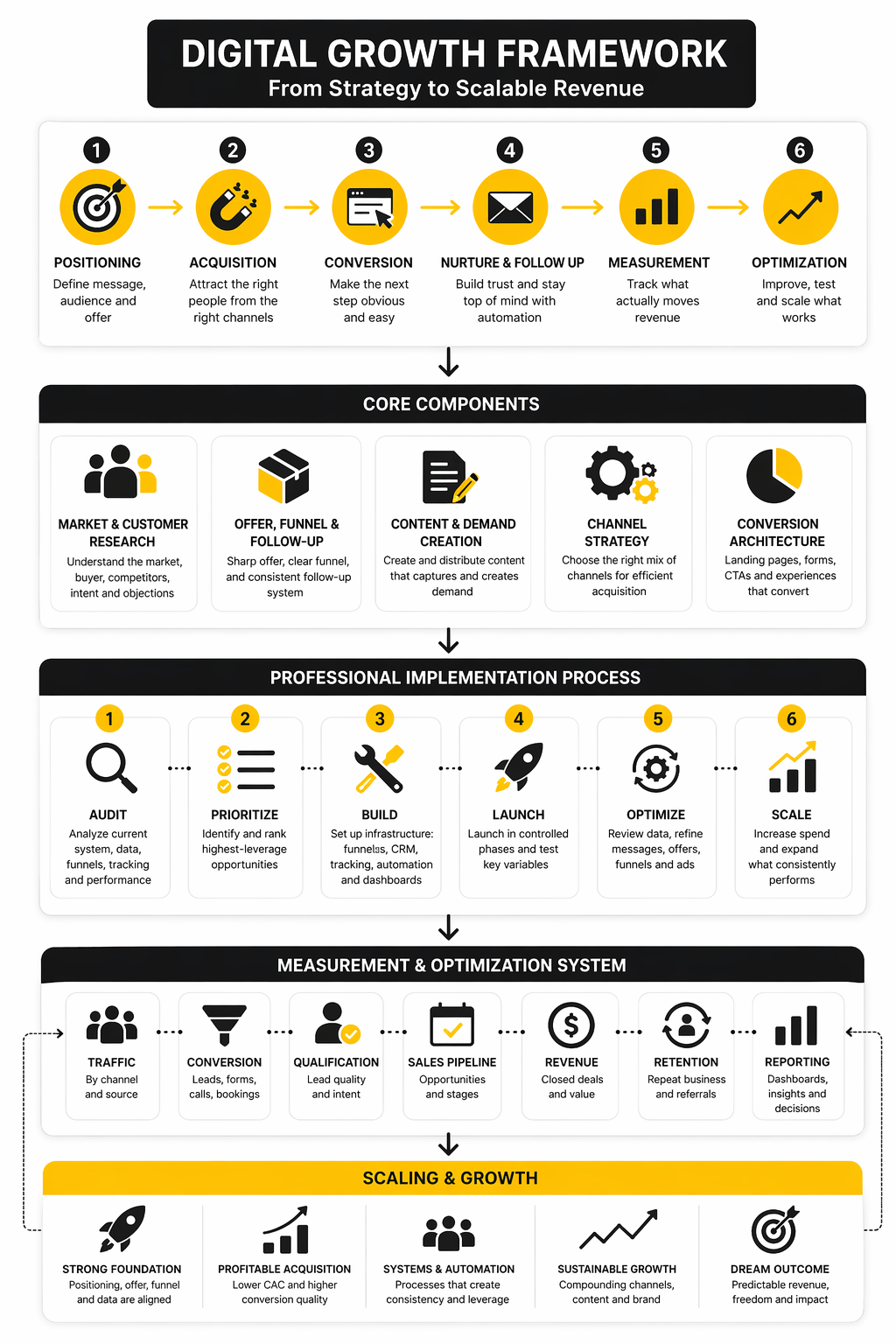
The simplest way to think about the framework is this: attract the right people, give them a clear reason to care, make the next step obvious, follow up consistently, and measure what actually moves revenue. That sounds basic, but most marketing systems break because one of those steps is missing. Strong consulting finds the weak link before more money gets poured into traffic.
Tools can support this framework, but they should not replace it. For example, a consultant might use GoHighLevel for CRM, funnels, automation, and follow-up, or ManyChat when conversational automation fits the customer journey. The tool matters less than the logic behind how leads are captured, qualified, nurtured, and converted.
Core Components of Digital Marketing Consulting
The core work of a digital marketing consultant is diagnosis before execution. They need to understand the market, the customer, the offer, the funnel, the data, and the internal team before recommending another campaign. That is where consulting becomes valuable, because it prevents the business from mistaking activity for progress.
The first component is positioning. A consultant should help clarify who the business serves, what problem it solves, why the offer is different, and why the buyer should act now. Without that, SEO content becomes generic, ads become expensive, and social media turns into noise.
The second component is channel strategy. Search, paid ads, email, organic social, partnerships, automation, and landing pages all behave differently. Gartner’s 2025 CMO research found that marketing budgets stayed flat at 7.7% of company revenue, which means businesses cannot afford to spread money across every channel just because competitors are doing it.
The third component is conversion architecture. Traffic is only useful when the next step is clear. A consultant looks at landing pages, forms, calls to action, booking flows, checkout steps, lead magnets, and follow-up sequences to find the friction that blocks revenue.
Market and Customer Research
Strong consulting starts with the customer, not the platform. A digital marketing consultant should review search intent, buyer objections, competitor positioning, sales conversations, reviews, analytics, and customer behavior before building a plan. This research gives the strategy a spine.
The goal is not to create a giant research document that nobody reads. The goal is to find practical answers: what buyers already believe, what they are comparing, what they do not trust, and what proof they need before taking action. Those answers shape the messaging across the website, ads, email, and sales materials.
This matters even more as personalization becomes a bigger expectation. McKinsey’s work on personalized marketing shows that brands are pushing toward more tailored experiences through AI-supported personalization. But personalization without customer insight is just automation with someone’s first name pasted into it.
Offer, Funnel, and Follow-Up
A consultant should never look at lead generation in isolation. The offer, funnel, and follow-up system determine whether leads become customers. If any of those three are weak, more traffic usually makes the problem louder.
The offer needs to be specific enough that the right person feels understood. The funnel needs to make the next step easy, whether that is booking a call, requesting a quote, joining a webinar, downloading a resource, or starting a trial. The follow-up needs to continue the conversation instead of dumping every lead into the same generic email sequence.
This is where tools can help when the system is already clear. A business that needs CRM, pipelines, landing pages, and automated follow-up may use GoHighLevel, while a business building simpler funnels may prefer ClickFunnels or Systeme.io. The consultant’s job is to choose the stack around the customer journey, not build the customer journey around the stack.
Content and Demand Creation
Content is not just blogging. It is the set of assets that helps a buyer notice the problem, understand the options, trust the business, and move forward. A digital marketing consultant should connect content to demand, not treat it as a publishing calendar.
Some content captures existing demand, such as comparison pages, service pages, SEO articles, and paid search landing pages. Other content creates demand, such as founder-led posts, short videos, educational email sequences, webinars, guides, and social proof. Both matter, but they should not be measured the same way.
The mistake is expecting every piece of content to close a sale immediately. Some content builds trust before the buyer is ready, while other content helps them make the final decision. A consultant should know the difference and build the content system accordingly.
Professional Implementation and Channel Execution
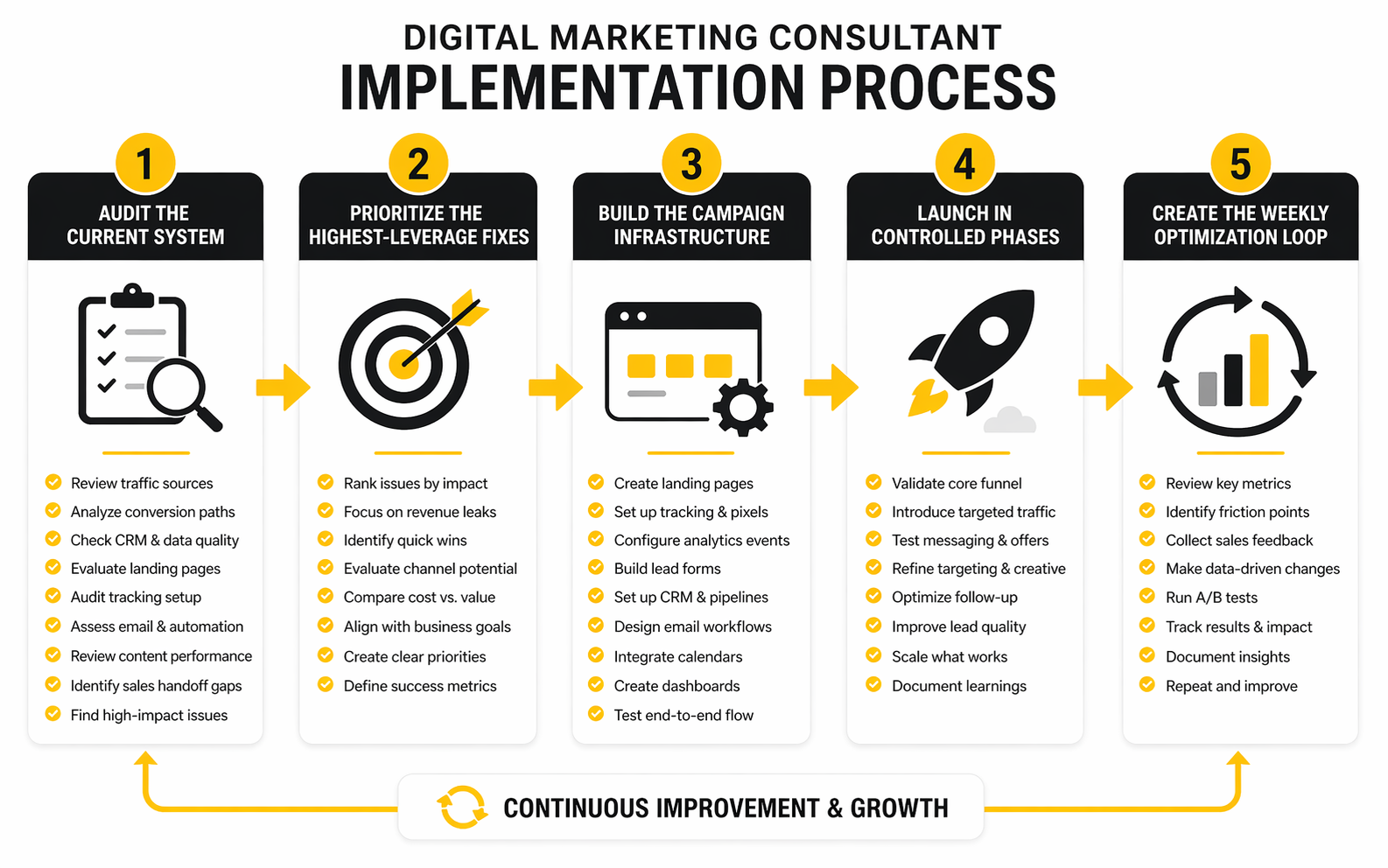
Implementation is where strategy either becomes revenue or disappears into a nice-looking document. A digital marketing consultant should turn the plan into a clear operating rhythm: what gets built, who owns it, what launches first, what gets measured, and what changes when the data comes in. Without that rhythm, even a strong strategy becomes another file sitting in a folder.
Good implementation starts with sequencing. The consultant should not launch SEO, paid ads, email, social, landing pages, automation, and reporting all at once unless the business already has the team to support it. The smarter move is to fix the highest-leverage bottleneck first, then stack the next channel on top of a stronger foundation.
That is why execution should feel structured, not frantic. The process needs a clear path from audit to launch to optimization, because digital marketing gets expensive when every week becomes a new random idea. The goal is not to do more things; the goal is to make the right things work together.
Step 1: Audit the Current System
The first implementation step is a practical audit. This should cover traffic sources, conversion paths, CRM data, landing pages, tracking setup, email sequences, sales handoff, content performance, and paid media efficiency. The point is to find what is already working before rebuilding anything.
A useful audit does not just list problems. It ranks them by business impact. For example, weak tracking is usually more urgent than redesigning a homepage, because bad data makes every future decision shakier.
The consultant should also check whether the business has a real attribution problem or simply a messy reporting problem. Modern buyers move across search, social, email, direct visits, review sites, and sales calls before converting. If those touchpoints are not tracked consistently, the business may cut the very channels that are helping create demand.
Step 2: Prioritize the Highest-Leverage Fixes
After the audit, the consultant should turn findings into priorities. This is where experience matters, because not every visible problem deserves immediate attention. A slow landing page, unclear offer, broken form, weak follow-up sequence, or poor keyword targeting can each hurt performance, but the right first move depends on where the revenue leak is largest.
Paid media is a good example. Google Ads benchmarks from WordStream and LocaliQ show an average 2025 Google Ads conversion rate of 7.52% across industries, but that number is only useful when compared with lead quality, cost per lead, close rate, and profit margin. A campaign can look successful in the ad platform and still fail commercially.
The same logic applies to content and email. Content Marketing Institute’s 2025 B2B research found that marketers expected increased investment in video, thought leadership, AI optimization, and paid advertising. That does not mean every business should copy the trend. It means a consultant should decide which content format best supports the buyer journey for that specific market.
Step 3: Build the Campaign Infrastructure
Once priorities are clear, the consultant needs to build the infrastructure that lets campaigns run properly. This can include landing pages, tracking pixels, analytics events, CRM fields, lead forms, email workflows, calendar booking, pipeline stages, dashboards, and sales notifications. It sounds unglamorous, but this is where a lot of money is won or lost.
A business running lead generation without clean follow-up is basically paying to create missed opportunities. If a lead fills out a form and nobody responds quickly, the campaign is not the only problem. The system is the problem.
For service businesses and agencies, an all-in-one setup like GoHighLevel can make sense when the goal is to connect funnels, CRM, automation, calendars, and pipeline management in one place. For businesses that want a focused funnel builder, ClickFunnels can be useful when the main job is building conversion paths quickly. The decision should come from the workflow, not from whichever tool has the loudest marketing.
Step 4: Launch in Controlled Phases
A digital marketing consultant should launch campaigns in controlled phases instead of trying to make everything perfect before anything goes live. First, the core funnel should work. Then traffic should be introduced. Then messaging, targeting, creative, and follow-up should be refined based on real behavior.
This prevents the business from wasting months polishing assets that the market may not care about. It also keeps the team focused, because each launch phase has a specific purpose. One phase may validate the offer, another may test acquisition cost, and another may improve booked-call quality.
Controlled launch also makes reporting more useful. When too many variables change at once, nobody knows what caused the result. A consultant should protect the business from that confusion by creating clean tests, clear timelines, and simple decision rules.
Step 5: Create the Weekly Optimization Loop
Implementation is not finished when a campaign goes live. That is when the learning starts. A consultant should create a weekly optimization loop that reviews performance, identifies friction, makes changes, and documents what was learned.
The loop should include both numbers and context. Click-through rate, conversion rate, cost per lead, booked calls, show rate, close rate, revenue, and retention all matter, but the sales team’s feedback matters too. A campaign that generates fewer leads but better conversations may be more valuable than one that fills the CRM with low-intent contacts.
This is where email and automation deserve careful attention. MailerLite’s 2025 benchmark data showed an average email open rate of 43.46% and an average click rate of 2.09%, but those numbers should never be treated as the whole story. A consultant should care more about whether the sequence moves people toward a meaningful action, not whether it wins a vanity metric contest.
Measurement, Optimization, and Scaling
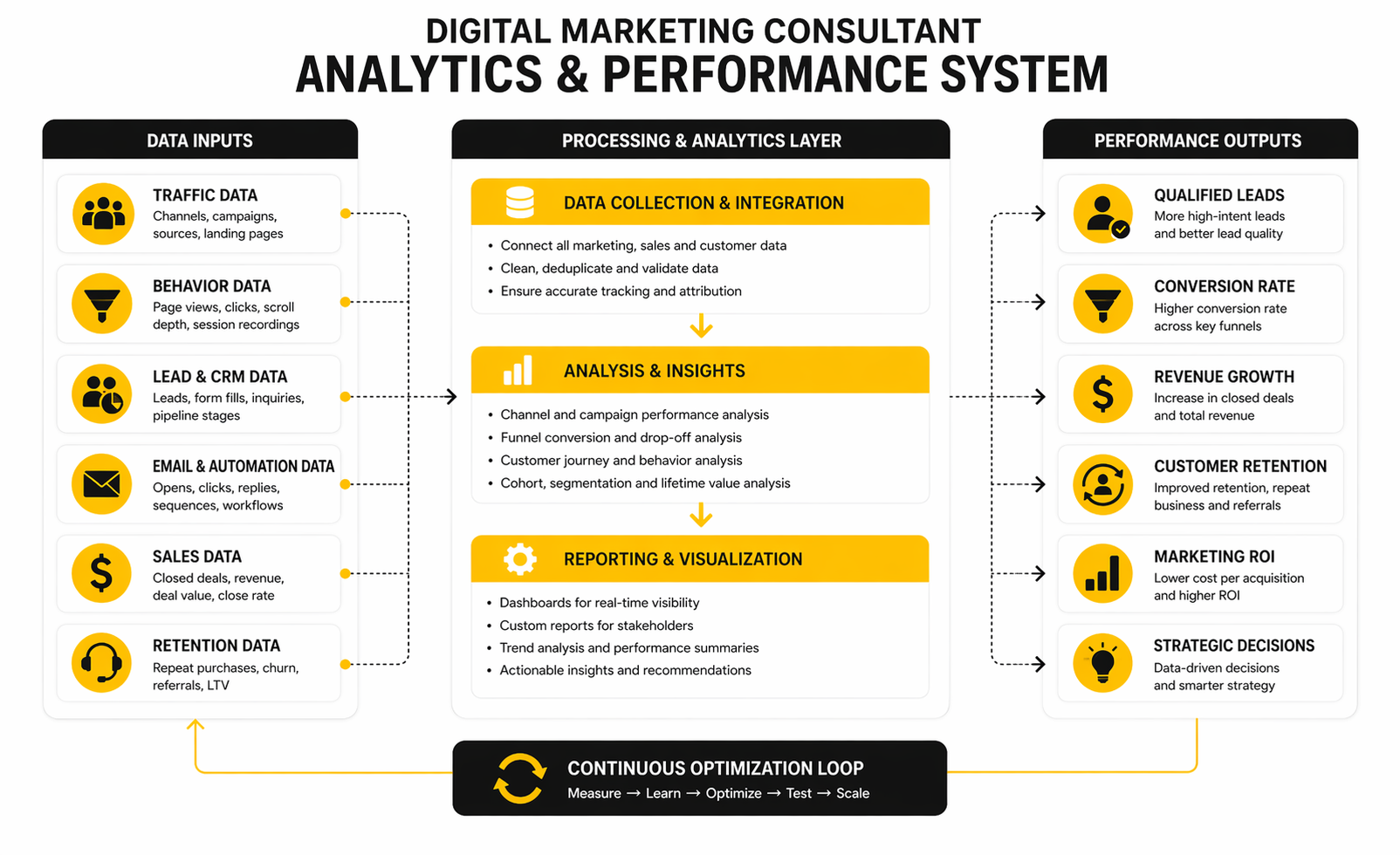
A digital marketing consultant should make measurement simple enough to act on and deep enough to trust. That balance matters because most teams either drown in dashboards or make decisions from one surface-level number. Neither approach is good enough when real budget is on the line.
The point of analytics is not to admire reports. The point is to decide what to keep, what to fix, what to stop, and what to scale. A clean measurement system turns marketing from a guessing game into a managed growth process.
Statistics and Data That Actually Matter
Benchmarks are useful, but only when they are interpreted in context. A Google Ads campaign with a conversion rate below the reported 7.52% average across industries may still be profitable if the leads are high-value and the close rate is strong. A campaign above that average may still be wasteful if the CRM is full of bad-fit leads.
The same is true for budget benchmarks. Gartner’s 2025 CMO Spend Survey found that marketing budgets remained flat at 7.7% of company revenue, which makes efficiency more important than vanity growth. A consultant should not use that number to tell every business what to spend. They should use it as a reminder that every channel needs a job, a target, and a reason to stay funded.
Email benchmarks also need careful interpretation. MailerLite’s 2025 data reported an average 43.46% open rate and 2.09% click rate, but open rates alone are not a business result. The better question is whether the email sequence helps people book, buy, reply, return, or move deeper into the funnel.
The Metrics That Connect Marketing to Revenue
A digital marketing consultant should separate activity metrics from business metrics. Impressions, clicks, likes, views, and open rates show movement, but they do not prove growth by themselves. Revenue, qualified pipeline, acquisition cost, close rate, payback period, retention, and lifetime value tell a much clearer story.
The best reporting usually follows the customer journey. It starts with traffic quality, then measures conversion into leads, then lead qualification, then sales opportunities, then closed revenue. This makes it easier to see whether the problem is acquisition, conversion, sales follow-up, offer fit, or retention.
A simple scorecard might track:
- Traffic by source
- Landing page conversion rate
- Cost per qualified lead
- Lead-to-booked-call rate
- Show rate
- Close rate
- Average deal value
- Customer acquisition cost
- Payback period
- Revenue by channel
What Benchmarks Should Trigger
Benchmarks should create questions, not automatic decisions. If cost per lead rises, the answer is not always to cut the campaign. The consultant needs to check search terms, audience quality, landing page friction, offer strength, sales feedback, and whether competitors have pushed auction costs up.
WordStream’s 2025 Google Ads benchmark data reported an average cost per lead of $70.11, but that number means something different for a $49 product than it does for a $5,000 service. This is where weak reporting gets dangerous. A business can panic over a high lead cost while ignoring the fact that the channel produces the best customers.
The same principle applies to content. HubSpot’s 2026 marketing statistics reported that blog posts were among the top five highest-ROI content formats, but that does not mean every company should publish generic articles every week. A consultant should identify whether content is meant to capture search demand, support sales conversations, build authority, or warm up future buyers.
Attribution Without the Fantasy
Attribution is helpful, but it is not perfect. Buyers do not move in clean straight lines from one ad to one landing page to one purchase. They search, compare, read reviews, watch videos, open emails, ignore emails, ask colleagues, come back later, and then convert.
A digital marketing consultant should build attribution that is useful instead of pretending it is flawless. That means tracking UTMs, CRM source fields, form submissions, call data, pipeline stages, and revenue while still leaving room for judgment. The goal is directional confidence, not fake precision.
This matters even more as privacy changes and multi-touch buying journeys make reporting messier. The consultant’s job is to protect the business from overreacting to incomplete data. When analytics are treated as evidence rather than absolute truth, decisions get calmer and better.
Advanced Tradeoffs a Consultant Has to Manage
Once the basics are working, the job gets more strategic. A digital marketing consultant has to decide where complexity is useful and where it becomes expensive noise. More campaigns, more tools, more dashboards, and more content do not automatically create more growth.
The hard part is choosing what not to do. A business may want SEO, paid ads, newsletters, short-form video, webinars, influencer campaigns, AI workflows, and outbound all at once. The consultant has to protect the company from spreading attention so thin that nothing compounds.
This is where judgment matters more than tactics. The right strategy for a local service business is not the same as the right strategy for a SaaS company, ecommerce brand, agency, coach, or B2B firm with a six-month sales cycle. A serious consultant adapts the system to the economics of the business.
Speed Versus Quality
Speed matters in digital marketing because slow teams miss learning cycles. If it takes three months to approve one landing page, the market has already moved. But speed without quality creates sloppy campaigns that burn trust and budget.
The practical answer is not perfection. It is controlled speed. A consultant should help the business launch assets that are good enough to test, then improve them based on actual behavior instead of internal opinions.
AI has made this tradeoff even sharper. McKinsey’s 2025 AI research found that companies getting stronger value from AI are more likely to use defined processes for human validation of model outputs through their AI operating practices. That is the key point. AI can accelerate research, drafts, segmentation, and analysis, but humans still need to own judgment, positioning, compliance, and taste.
Automation Versus Human Trust
Automation is powerful when it removes friction. It can route leads, send reminders, qualify inquiries, trigger follow-ups, update CRM records, and keep prospects engaged when the team is busy. Used well, it makes the business feel more responsive.
Used badly, automation makes the business feel lazy. Nobody wants to receive ten generic emails after asking one specific question. Nobody wants to talk to a chatbot that blocks them from getting help.
A digital marketing consultant should design automation around intent. A lead who requested pricing needs a different path from someone who downloaded a guide. Tools like ManyChat can be useful for conversational flows, while Brevo or Moosend can support email campaigns, but the real standard is simple: automation should make the customer journey feel easier, not colder.
Paid Growth Versus Organic Growth
Paid acquisition is useful because it creates immediate feedback. You can test offers, landing pages, audiences, and creative quickly. The danger is that the business becomes dependent on rented traffic without building durable demand.
Organic growth is slower, but it can compound. Search content, social authority, email lists, referral systems, partnerships, and brand trust can reduce dependence on paid media over time. The danger is that the business waits too long for organic channels to mature while revenue pressure keeps rising.
A consultant should not turn this into a religious debate. Paid and organic should support each other. Paid campaigns reveal which messages convert, and organic channels turn those winning messages into long-term assets.
Scaling Without Breaking the System
Scaling is not just increasing the budget. It means the offer, funnel, sales process, fulfillment, and retention can handle more demand without quality dropping. Many businesses try to scale marketing before the rest of the operation is ready.
This is why a consultant should watch downstream signals closely. If lead volume rises but response time gets worse, the system is not scaling. If more customers come in but churn rises, marketing may be attracting the wrong people.
Scaling should happen in layers. First, prove the economics. Then increase volume. Then expand channels. Then improve retention and referral loops so growth does not depend only on constant new acquisition.
Tool Stack Discipline
The marketing stack should make execution cleaner, not heavier. Too many businesses buy tools because they are solving emotional discomfort instead of operational problems. They feel disorganized, so they add another platform.
A digital marketing consultant should simplify the stack before expanding it. The basic question is whether each tool helps acquire, convert, retain, measure, or improve customers. If it does not clearly support one of those jobs, it is probably clutter.
For teams that need scheduling, forms, CRM, funnel pages, social planning, or customer conversations, the stack should be chosen around workflow. Cal.com can support scheduling, Fillout can support forms, Buffer can support social publishing, and Chatbase can support customer-facing AI chat. But again, tools do not fix unclear strategy. They only make a clear strategy easier to operate.
Choosing the Right Consultant and Building a Long-Term Growth System
A digital marketing consultant should leave the business with more than campaigns. The real outcome is a stronger growth system that the team understands, trusts, and can improve over time. That means the consultant should transfer clarity, not create dependency.
The right consultant will ask uncomfortable questions early. They will want to know your margins, sales process, close rate, customer quality, retention, offer strength, tracking gaps, and internal capacity. If they only talk about traffic, followers, or ad spend, be careful.
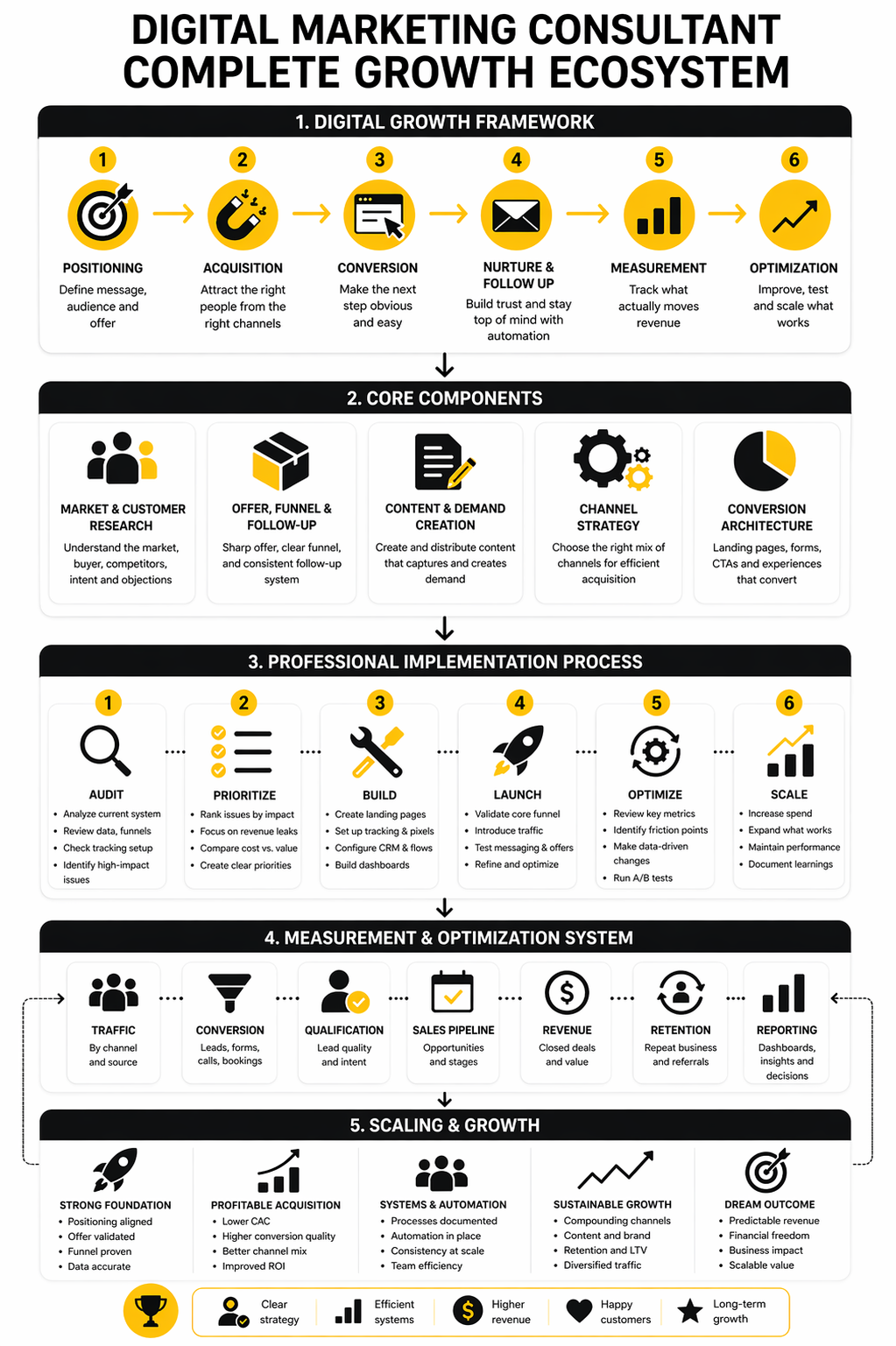
A long-term system connects positioning, acquisition, conversion, follow-up, analytics, and retention. It gives the business a repeatable way to create demand, capture demand, and turn attention into revenue. That is what makes consulting worth paying for.
FAQ - Built for Complete Guide
What does a digital marketing consultant do?
A digital marketing consultant helps a business improve its online growth strategy. The work usually includes market research, positioning, funnel planning, campaign strategy, analytics, conversion optimization, and channel execution. The goal is not just more traffic, but better revenue outcomes from the whole marketing system.
When should a business hire a digital marketing consultant?
A business should hire a consultant when marketing activity is happening but results are unclear, inconsistent, or too expensive. It also makes sense before scaling paid ads, rebuilding a website, launching a new offer, or choosing a major marketing stack. The best time is before wasted spend becomes normal.
How is a consultant different from a marketing agency?
A consultant usually focuses on strategy, diagnosis, planning, and guidance, while an agency often focuses on execution. Some consultants also help implement campaigns, and some agencies offer strong strategic support. The difference is less about the label and more about whether they can connect marketing work to business outcomes.
What should I look for in a digital marketing consultant?
Look for clear thinking, practical experience, honest diagnosis, and the ability to explain tradeoffs. A strong consultant should understand acquisition, conversion, analytics, sales handoff, and customer retention. They should also be willing to say no to tactics that do not fit your business.
How much does a digital marketing consultant cost?
Pricing depends on experience, scope, market, and whether the consultant is advising, implementing, or managing a full system. Some charge hourly, some charge monthly retainers, and some work on project-based strategy. The better question is whether the engagement can improve revenue, reduce waste, or speed up smarter decision-making.
What channels should a consultant help with?
A consultant may help with SEO, paid search, paid social, email, organic social, funnels, landing pages, automation, CRM, analytics, and content strategy. They should not recommend every channel at once. The right channel mix depends on your buyer, offer, budget, sales cycle, and internal capacity.
Can a digital marketing consultant help with AI?
Yes, but AI should support the strategy instead of replacing it. A consultant can help use AI for research, content workflows, customer segmentation, reporting, automation, and creative testing. Human judgment still matters because positioning, trust, compliance, and customer insight cannot be fully outsourced to software.
What tools should a consultant use?
Tools should match the workflow. Some businesses need CRM and automation through GoHighLevel, funnel building through ClickFunnels, email through Brevo, or scheduling through Cal.com. The tool stack should make execution simpler, not create more busywork.
How long does it take to see results?
Some improvements can show up quickly, especially when fixing broken tracking, weak landing pages, poor follow-up, or obvious campaign waste. SEO, brand authority, content, retention, and organic demand usually take longer. A good consultant should set expectations by channel and explain what early signals matter before revenue fully compounds.
What are the biggest red flags?
Big red flags include guaranteed results, vague reporting, obsession with vanity metrics, no interest in sales quality, and tool-first recommendations. Another red flag is a consultant who wants to increase spend before understanding the funnel. Serious growth work starts with diagnosis.
Should a consultant manage campaigns or only advise?
It depends on the business. Some companies need strategic guidance for an internal team, while others need hands-on implementation because they lack capacity. The cleanest setup is usually clear ownership: who decides, who builds, who approves, who measures, and who improves the system.
How do I know if the consultant is working?
You should see better clarity, cleaner priorities, stronger reporting, and more confident decisions. Over time, you should also see improvements in qualified leads, conversion rates, sales conversations, customer acquisition cost, revenue quality, or retention. If the only thing increasing is activity, the engagement needs to be questioned.
Work With Professionals
Explore 10K+ Remote Marketing Contracts on MarkeWork.com
Most marketers spend too much time chasing clients, competing on crowded platforms, and losing a percentage of every project to middlemen.
MarkeWork gives you a better way. Browse thousands of remote marketing contracts and connect directly with companies desperate to hire skilled marketers like you, without platform commissions and without unnecessary gatekeepers.
If you're serious about finding better opportunities and keeping 100% of what you earn, explore available contracts and create a profile for free at MarkeWork.com.