

Digital marketing cost is not one number. It is a stack of decisions: channels, creative, tools, people, testing, tracking, and the patience to let the right campaigns mature.
That matters because marketing budgets are tight, but digital spend keeps rising. Gartner reported that marketing budgets stayed at 7.7% of company revenue in 2025, while IAB and PwC reported U.S. internet advertising revenue reached nearly $300 billion in 2025.
Article Outline
- Digital Marketing Cost: A Practical Guide To Budgeting Without Guesswork
- Why Digital Marketing Cost Matters
- The Digital Marketing Cost Framework
- Core Cost Components
- Channel-By-Channel Cost Breakdown
- Professional Implementation Costs
- Budget Planning By Business Stage
- Hidden Costs That Break Marketing Budgets
- How To Reduce Waste Without Killing Growth
- Digital Marketing Cost Benchmarks And Planning Scenarios
- Tools, Systems, And Automation Costs
- Frequently Asked Questions
Why Digital Marketing Cost Matters
The real problem is not that digital marketing is expensive. The real problem is that most businesses do not know which part of the spend is building an asset and which part is simply buying temporary attention.
Paid ads can bring traffic quickly, but they stop working the moment the budget stops. SEO, email, content, landing pages, CRM systems, and conversion tracking usually take longer, but they can reduce dependency on paid traffic over time.
This is why digital marketing cost should be treated as an investment model, not a shopping list. A smart budget separates acquisition, conversion, retention, reporting, and experimentation before money gets thrown into campaigns.
The Digital Marketing Cost Framework
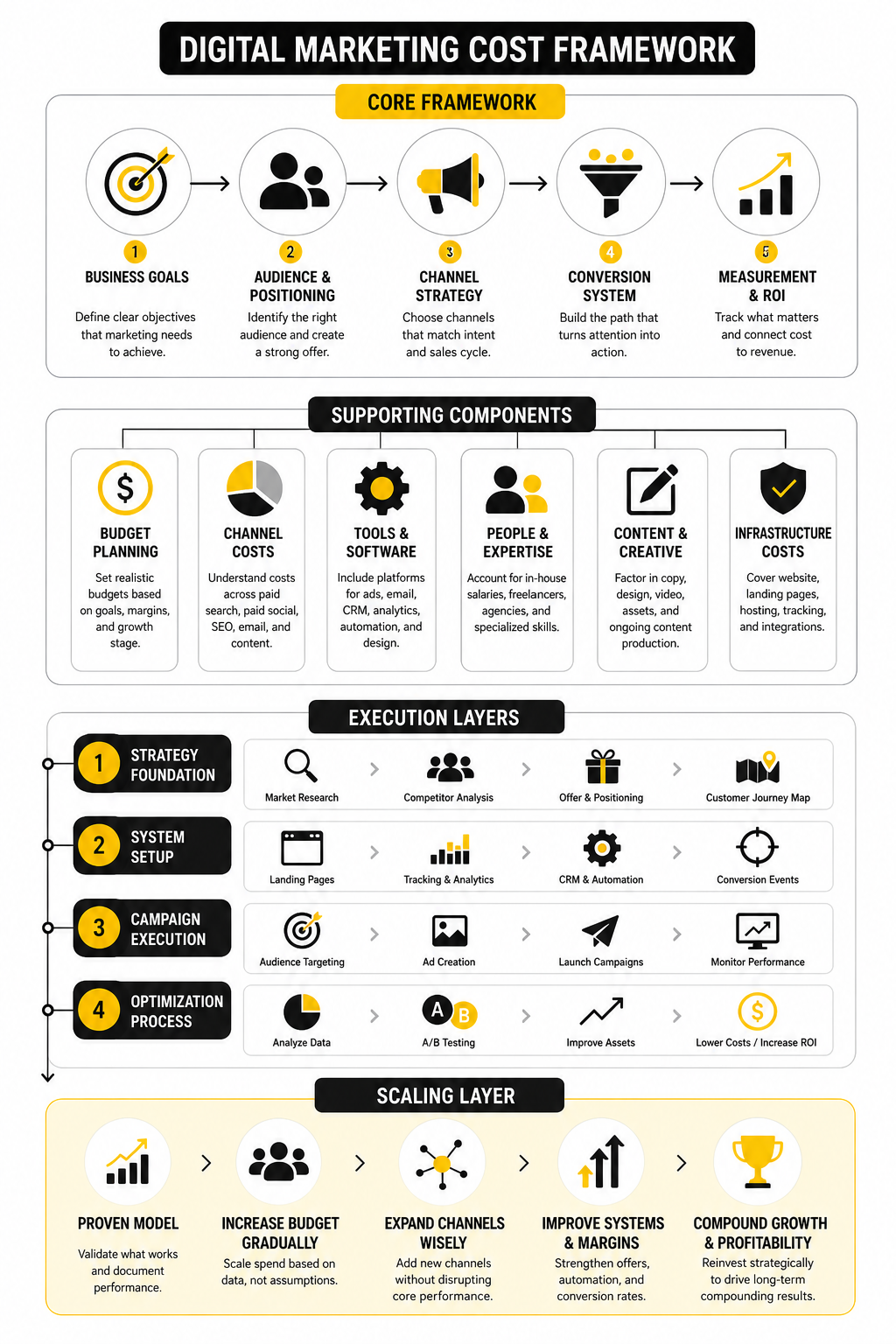
A useful digital marketing budget starts with four questions. What are you trying to sell, who needs to see it, what must happen before they buy, and how will you measure whether the spend worked?
For most businesses, the framework has five layers: strategy, traffic, creative, conversion, and operations. Skip one layer and the whole budget becomes distorted, because cheap traffic is useless without conversion and great creative is wasted without distribution.
This guide will use that structure throughout the article. Instead of asking, “How much does digital marketing cost?”, the better question is, “What must this budget accomplish, and what system needs to exist for that money to produce a return?”
Core Cost Components
The cleanest way to understand digital marketing cost is to separate the budget into four buckets: media, labor, tools, and assets. Media is the money spent to reach people. Labor is the money spent to plan, build, manage, and improve campaigns. Tools are the systems used to publish, track, automate, and report. Assets are the pages, emails, videos, offers, lead magnets, and creative that make the traffic worth paying for.
Most bad budgets overfund media and underfund everything else. That looks efficient on paper because ad spend is easy to see, but it usually creates weak campaigns with poor tracking, thin creative, and landing pages that do not convert. When U.S. internet advertising revenue reached nearly $300 billion in 2025, the lesson was not “spend more because everyone else is spending.” The lesson was that competition for attention is expensive, so the system around the spend has to be sharper.
A practical budget gives every dollar a job. Some dollars should buy reach. Some should improve conversion. Some should build owned assets, like email lists and content libraries. Some should go into testing, because no spreadsheet can perfectly predict which angle, offer, or channel will win before the market reacts.
Media Spend
Media spend is usually the most visible part of digital marketing cost because it shows up directly inside ad platforms. This includes Google Ads, Meta ads, LinkedIn ads, TikTok ads, YouTube ads, creator placements, sponsorships, and retargeting campaigns.
The mistake is treating media spend as the full cost of marketing. It is not. If a business spends $5,000 on ads but has no tested offer, no conversion tracking, and no follow-up system, the real cost is not $5,000. The real cost is $5,000 plus the wasted opportunity to learn something useful.
Media spend should be scaled only when the business can measure what happens after the click. That means tracking leads, booked calls, purchases, cost per acquisition, revenue, payback period, and lifetime value where possible. Without that, the business is not buying growth. It is buying noise.
Labor And Expertise
Labor is where many digital marketing budgets get uncomfortable, because skilled implementation is not cheap. Strategy, copywriting, media buying, design, analytics, landing page optimization, email automation, SEO, and content production all require judgment. Cheap execution often becomes expensive later because poor setup creates messy data and weak campaigns.
This does not mean every business needs a full agency. A small business may start with one strong generalist, a freelancer, or a lean tool stack. A larger company may need specialists for paid search, paid social, lifecycle marketing, creative production, and analytics.
The important thing is to match labor to complexity. If the campaign has multiple channels, several offers, long sales cycles, or high-ticket products, the implementation cost will naturally rise. Trying to run that kind of system with bargain-level support usually creates more waste than savings.
Tools And Software
Tools can either reduce digital marketing cost or quietly inflate it. A CRM, email platform, funnel builder, scheduling tool, analytics dashboard, chatbot, and form builder can all be useful, but only when they support a clear process.
For example, a service business that needs landing pages, follow-up automation, pipeline tracking, and appointment booking may reasonably look at an all-in-one platform like GoHighLevel. A creator or small business selling simple offers may prefer a leaner funnel setup through Systeme.io or a sales-focused builder like ClickFunnels.
The tool is not the strategy. That is the part people forget. A better platform can help you move faster, but it will not fix a weak offer, unclear message, or broken follow-up process.
Creative And Content Assets
Creative is no longer a small side cost. Ads need images, videos, hooks, scripts, landing page copy, email sequences, product visuals, testimonials, and sometimes creator content. The more competitive the channel, the more creative testing matters.
This is especially true in paid social, where performance often depends on fresh angles and fast iteration. Social media ad revenue reached $117.7 billion in 2025, which means brands are not just competing on targeting anymore. They are competing on message, speed, relevance, and trust.
A smart budget treats creative as a recurring input, not a one-time deliverable. One landing page, one ad, and one email sequence is rarely enough. The business needs enough creative variation to discover what the market actually responds to.
Channel-By-Channel Cost Breakdown
Once the core components are clear, the next step is deciding where the money actually goes. This is where digital marketing cost becomes practical, because every channel has a different role, timeline, and risk profile. Paid search captures demand that already exists, paid social creates and shapes demand, SEO compounds slowly, email monetizes attention you already own, and conversion assets turn traffic into measurable outcomes.
The best channel is not always the cheapest one. It is the channel that matches the buyer’s intent, your sales cycle, your offer, and your ability to follow up. A local emergency service, a B2B software company, an ecommerce brand, and a coach selling high-ticket programs should not use the same budget mix.
Paid Search Costs
Paid search is usually strongest when people already know they have a problem and are actively looking for a solution. That is why Google Ads can be powerful for categories with clear purchase intent, like legal services, home repairs, SaaS alternatives, insurance, ecommerce products, and local services. The tradeoff is obvious: the closer a keyword is to money, the more competitive it usually becomes.
A paid search budget should include more than clicks. It needs campaign setup, keyword research, negative keywords, conversion tracking, landing pages, copy testing, and ongoing optimization. If those pieces are missing, the campaign may still get traffic, but it will be hard to know which searches are actually producing revenue.
For many businesses, paid search works best when it is connected to a strong CRM and follow-up process. A lead that costs $80 is not automatically expensive if the sales team responds fast, tracks pipeline value, and closes profitable deals. A lead that costs $20 can be brutally expensive if nobody follows up properly.
Paid Social Costs
Paid social is different because the buyer is usually not searching for you. You are interrupting them with a message, creative angle, offer, or story that earns attention inside a crowded feed. That makes creative testing a major part of the cost.
This is why paid social budgets need room for experimentation. You may need to test different hooks, formats, audiences, landing pages, and offers before the campaign becomes reliable. Social media ad revenue reached $117.7 billion in 2025, which shows how crowded the channel has become.
The practical move is to budget for learning before scaling. Start with controlled tests, identify which messages create qualified attention, then shift money toward the combinations that produce leads, purchases, or booked calls. Do not judge paid social only by the first click. Judge it by the whole journey from impression to conversion to repeat revenue.
SEO And Content Costs
SEO is often described as free traffic, but that is misleading. You may not pay for each click, but you still pay for research, writing, editing, technical fixes, content updates, internal linking, digital PR, and analytics. The cost is front-loaded, while the return usually takes longer.
That delay is the reason many businesses underinvest in SEO. Paid ads feel more immediate, so SEO gets treated like a side project. But when search visibility starts compounding, the economics can become very attractive because each piece of content can keep working after the initial production cost is paid.
Modern SEO also needs to account for AI search behavior. HubSpot’s 2026 marketing data notes that over 92% of marketers are planning or already optimizing for traditional and AI-powered search. That does not mean chasing every trend. It means producing useful, credible, well-structured content that deserves to be found.
Email And Lifecycle Marketing Costs
Email is usually one of the most underpriced parts of the marketing system. The cost of sending campaigns is often low compared with paid acquisition, but the real value comes from segmentation, automation, deliverability, copywriting, and offer timing. A weak email system leaves money sitting inside the list.
This is especially important when paid traffic is expensive. If a business pays to acquire a lead, then only sends one generic follow-up, the acquisition cost is doing too much work. A stronger lifecycle system can educate prospects, recover abandoned checkouts, reactivate old leads, increase repeat purchases, and reduce pressure on ads.
Tools like Brevo, Moosend, and ManyChat can make sense when the business has a clear reason to automate follow-up. The key is not collecting tools. The key is building a sequence that moves people closer to a decision.
Professional Implementation Costs
Professional implementation is where the budget becomes real. Someone has to turn the strategy into campaigns, pages, tracking, copy, creative, automations, reports, and decisions. That work can be done by an internal team, freelancers, consultants, an agency, or some mix of all four.
The right model depends on how much control you need and how fast you need to move. Internal teams build deeper company knowledge, but they require hiring, management, and training. Agencies bring breadth and systems, but they need clear direction and accountability. Freelancers can be efficient, but only when the scope is tight.
This is also where businesses should stop asking for “digital marketing” as one vague service. Be specific. Are you buying strategy, execution, media management, creative production, analytics, funnel building, CRM implementation, or all of it together?
The Implementation Process
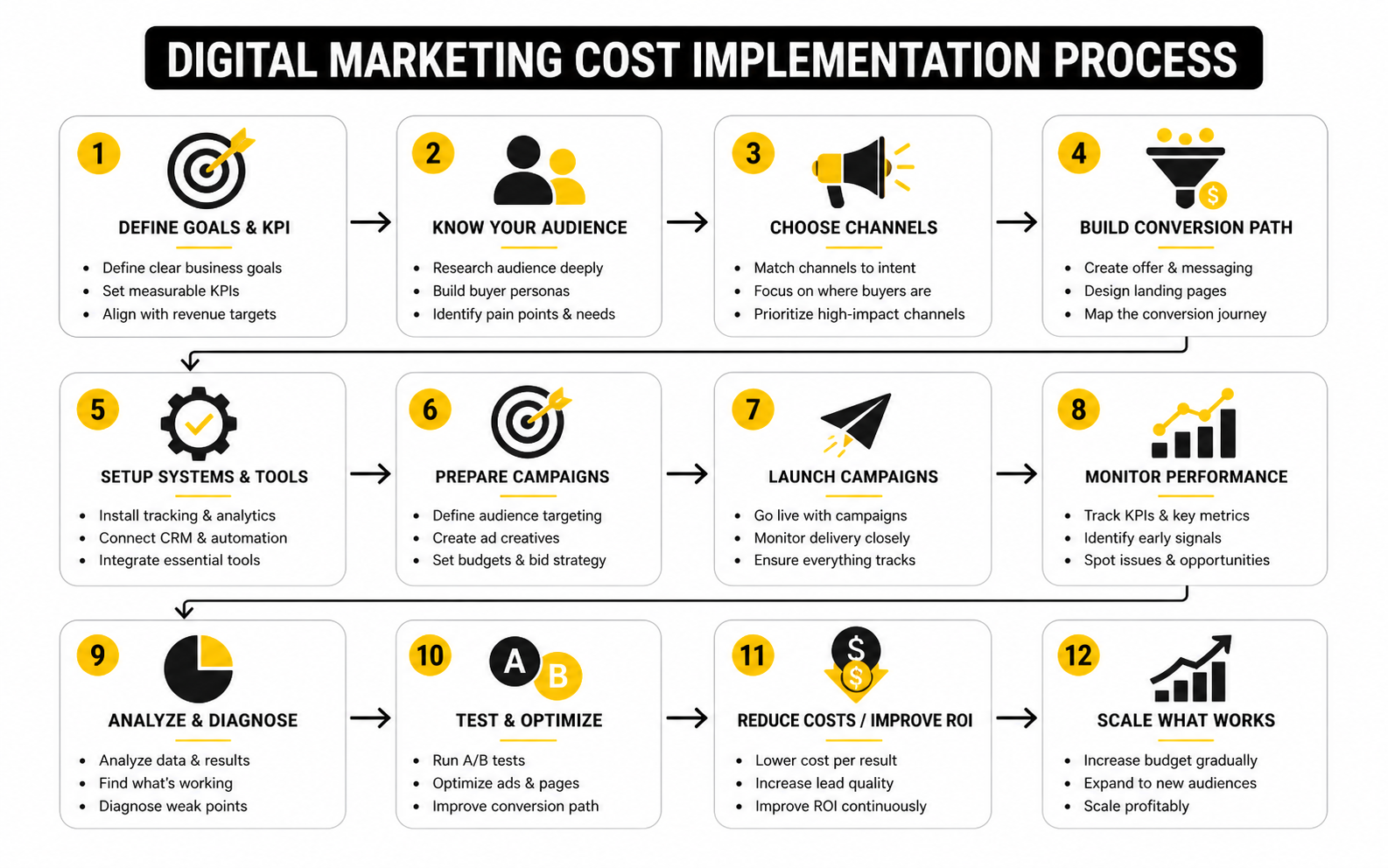
A solid implementation process reduces waste before the campaign ever goes live. It forces the business to define the offer, the audience, the channel, the conversion path, and the measurement system before money is spent at scale. That sounds basic, but it is where many budgets fail.
The process usually looks like this:
- Define the business goal and target customer.
- Choose the primary conversion action.
- Map the customer journey from first touch to sale.
- Build the landing page or funnel.
- Set up tracking and CRM stages.
- Create the first batch of campaign assets.
- Launch with a controlled test budget.
- Review performance by channel, offer, and audience.
- Improve the weakest bottleneck.
- Scale only when the numbers support it.
This process keeps digital marketing cost tied to decisions instead of opinions. If traffic is cheap but leads are weak, fix targeting or the offer. If leads are strong but sales are poor, fix follow-up or qualification. If clicks are expensive but conversion is high, the campaign may still be profitable.
Tracking And Reporting Setup
Tracking is not glamorous, but it protects the budget. Without it, you cannot separate a campaign that feels busy from a campaign that actually makes money. At minimum, the business should track traffic sources, conversion actions, lead quality, pipeline movement, sales, and repeat revenue where possible.
The setup cost may include analytics configuration, pixels, conversion APIs, CRM fields, UTM standards, dashboard building, and call tracking. For appointment-based businesses, tools like Cal.com can help connect booking behavior to campaign performance. For sales-driven teams, a CRM like Copper can help keep opportunities visible instead of buried in inboxes.
The goal is not perfect attribution. Perfect attribution is rare. The goal is good enough visibility to make better budget decisions every week.
Digital Marketing Cost Benchmarks And Performance Data
Benchmarks are useful, but only when you treat them as context instead of commandments. Averages can show whether a campaign is wildly out of range, but they cannot tell you whether your specific budget is healthy. A $70 lead can be cheap for a high-ticket service and expensive for a low-margin product.
That is why digital marketing cost should always be judged against unit economics. Cost per click, cost per lead, and conversion rate matter, but they are only early signals. The real question is whether the campaign can turn attention into profitable revenue within a reasonable payback window.
Recent benchmark data makes one thing very clear: competition is not getting softer. Google Ads cost per lead across industries reached $70.11 in 2025, while average Google Ads CPC reached $5.26 in 2025. Those numbers do not mean every business should expect the same result, but they do prove that sloppy campaigns have less room to survive.
The Metrics That Actually Matter
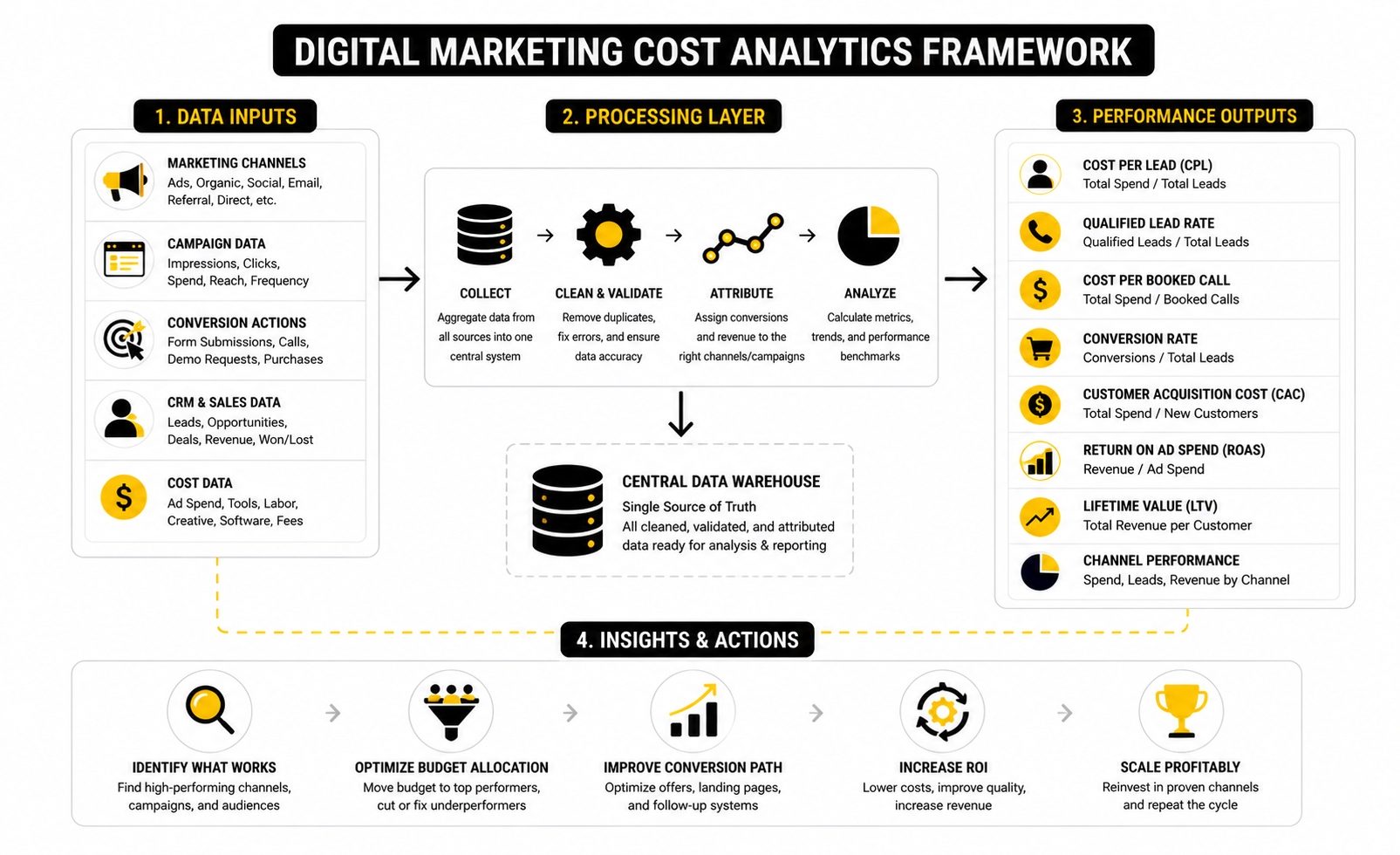
The first layer is traffic quality. This includes impressions, click-through rate, cost per click, landing page engagement, and search terms or audience data. These metrics help you understand whether the campaign is attracting the right people at a reasonable price.
The second layer is conversion quality. This includes lead conversion rate, cost per lead, booked call rate, checkout conversion rate, email opt-in rate, and form completion rate. This layer tells you whether the offer and page are doing their job.
The third layer is commercial quality. This is where many campaigns either become profitable or fall apart. Track qualified lead rate, show-up rate, close rate, average order value, customer acquisition cost, gross margin, payback period, and lifetime value. If you only track platform metrics, you are managing the campaign from the shallow end.
How To Read The Numbers Without Overreacting
One bad week does not mean the strategy is broken. One strong day does not mean the campaign is ready to scale. Digital marketing data needs enough volume to become useful, especially when conversion numbers are small.
Look for patterns instead of isolated spikes. If clicks are expensive but lead quality is strong, the problem may not be traffic. If clicks are cheap but qualified leads are weak, the targeting or message may be attracting the wrong people. If leads are good but revenue is poor, the issue is probably sales process, pricing, follow-up speed, or offer fit.
This is where dashboards help, but only if they are simple. A good reporting setup should show what happened, why it likely happened, and what decision comes next. A wall of charts with no action attached is just expensive decoration.
Budget Signals By Business Stage
A startup should usually measure learning speed before scale. Early digital marketing cost should go toward validating the audience, offer, message, and conversion path. Spending heavily before those pieces are clear can burn cash without creating insight.
A growing business should measure efficiency and repeatability. At this stage, the key question is whether the business can acquire customers predictably without destroying margin. If customer acquisition cost is rising but lifetime value is also rising, the budget may still be healthy.
A mature business should measure portfolio performance. Some channels will generate immediate demand, some will protect brand visibility, and some will build long-term owned assets. Since marketing budgets remained flat at 7.7% of company revenue in 2025, mature teams have to be especially disciplined about which channels deserve more money and which ones need to be fixed, paused, or replaced.
What Good Data Should Make You Do
Good data should create decisions. If a channel has high intent, strong conversion, and profitable acquisition, protect it and improve it. If a channel has weak conversion but strong engagement, test a sharper offer before cutting it. If a channel produces leads that never close, stop celebrating low CPL and investigate lead quality.
The best reporting rhythm is simple: review weekly, decide monthly, and rethink strategy quarterly. Weekly reviews catch obvious problems. Monthly reviews reveal trends. Quarterly reviews give enough distance to decide whether the budget mix still matches the business model.
This is also why marketing analytics should connect to the systems where revenue actually happens. For service businesses, that may mean connecting campaigns to booked appointments, pipeline stages, and closed deals through a platform like GoHighLevel. For funnel-heavy businesses, it may mean watching page performance, checkout behavior, and follow-up sequences inside a builder like ClickFunnels. The point is not to obsess over software. The point is to make sure every important number leads to a better action.
Hidden Costs That Break Marketing Budgets
The obvious digital marketing cost is rarely the one that hurts most. Most budget damage comes from the costs that were not planned: slow follow-up, weak offers, poor data, bad creative, unclear ownership, and tools nobody fully uses. These costs do not always appear on an invoice, but they quietly reduce every campaign’s return.
This is why a business can spend the same amount as a competitor and get a completely different result. One company has clean tracking, fast sales response, sharp landing pages, and a clear offer. The other has scattered tools, slow approvals, and vague reporting. Same media budget. Very different outcome.
The Cost Of Weak Positioning
Weak positioning makes every channel more expensive. If the offer sounds generic, paid ads need more impressions to get attention, landing pages need more persuasion to earn trust, and sales calls need more effort to close the gap. The market does not reward vague messaging.
This is especially painful in competitive categories where buyers compare several options before making a decision. If your promise, audience, and outcome are not clear, you end up paying to educate people who were never a strong fit. That increases cost per lead, lowers close rates, and makes the campaign look worse than it really is.
Strong positioning does not mean louder claims. It means a sharper match between the buyer’s problem, your proof, and the next action you want them to take. When that match improves, the same marketing budget usually starts working harder.
The Cost Of Slow Follow-Up
Speed matters because interest decays fast. A lead that looks valuable today can become cold tomorrow if nobody responds while the problem is still active. Many businesses obsess over reducing ad costs while ignoring the fact that their follow-up process leaks revenue after the lead is already paid for.
This is where automation can protect the budget. Simple confirmation messages, reminders, nurture emails, missed-call follow-ups, and pipeline alerts can reduce waste without adding more ad spend. A platform like GoHighLevel can make sense when the business needs landing pages, CRM stages, automation, booking, and follow-up in one place.
The point is not to automate everything. The point is to make sure every serious inquiry gets handled quickly and consistently. If the sales process is slow, increasing traffic usually just creates more missed opportunities.
The Cost Of Creative Fatigue
Creative fatigue happens when the same message, image, video, or hook gets shown too often. Performance declines, costs rise, and the campaign starts looking broken even though the offer may still be strong. This is common in paid social because attention moves quickly.
The fix is not always a new channel. Often, the fix is a stronger creative production rhythm. That can mean testing new hooks, formats, angles, testimonials, objections, product demonstrations, comparison content, and short-form videos.
This is where the budget needs discipline. Do not make random creative just to “post more.” Build creative around specific hypotheses: a new pain point, a different audience segment, a stronger proof point, or a clearer reason to act now.
How To Reduce Waste Without Killing Growth
Cutting digital marketing cost sounds responsible, but careless cuts can damage growth. The goal is not to spend less everywhere. The goal is to stop funding weak inputs and protect the activities that create measurable progress.
A good cost reduction plan starts by separating waste from investment. Waste is money spent on campaigns with no learning, no tracking, no conversion path, or no strategic purpose. Investment is money spent on assets, experiments, systems, and channels that improve the business’s ability to acquire and retain customers.
Audit Before You Cut
Before reducing the budget, review where money is actually going. Look at ad platforms, freelancers, agencies, software subscriptions, content production, creative tools, landing page tools, automation platforms, and reporting systems. Then ask what each item is supposed to produce.
The important question is not “Can we cancel this?” The better question is “Would performance clearly suffer if this disappeared?” If the answer is no, it may be waste. If the answer is yes, the next question is whether the tool, vendor, or channel can be used better.
A simple audit should check:
- Which campaigns generate qualified leads or revenue
- Which assets are still being used
- Which tools overlap with other tools
- Which reports lead to actual decisions
- Which channels have learning value but need improvement
- Which tasks depend too heavily on one person
Protect The Conversion Path
When budgets tighten, businesses often cut the wrong things. They pause creative, delay landing page improvements, remove analytics support, or reduce follow-up systems while keeping traffic spend active. That is backwards.
Traffic only works when the conversion path can handle it. If the page is weak, the form is clunky, the offer is unclear, or the follow-up is slow, more traffic simply magnifies the leak. A practical budget protects the pieces closest to revenue first.
For ecommerce and funnel-based businesses, this may mean improving landing pages before increasing ad spend. Tools like Replo or ClickFunnels can be useful when page speed, testing, and offer flow matter more than adding another campaign.
Scale In Layers
Scaling should not mean doubling everything at once. That is how budgets get messy. A stronger approach is to scale in layers: improve the winner, add budget gradually, expand creative, test a second audience, then add another channel only when the core system is stable.
This protects cash flow and keeps the team focused. If results drop, you can usually see which layer caused the problem. If everything changes at once, nobody knows whether the issue was budget, creative, targeting, tracking, offer, or timing.
The most useful scaling question is simple: what is the current bottleneck? If the bottleneck is traffic, increase reach. If the bottleneck is conversion, improve the page or offer. If the bottleneck is sales capacity, fix follow-up before buying more leads.
Tools, Systems, And Automation Costs
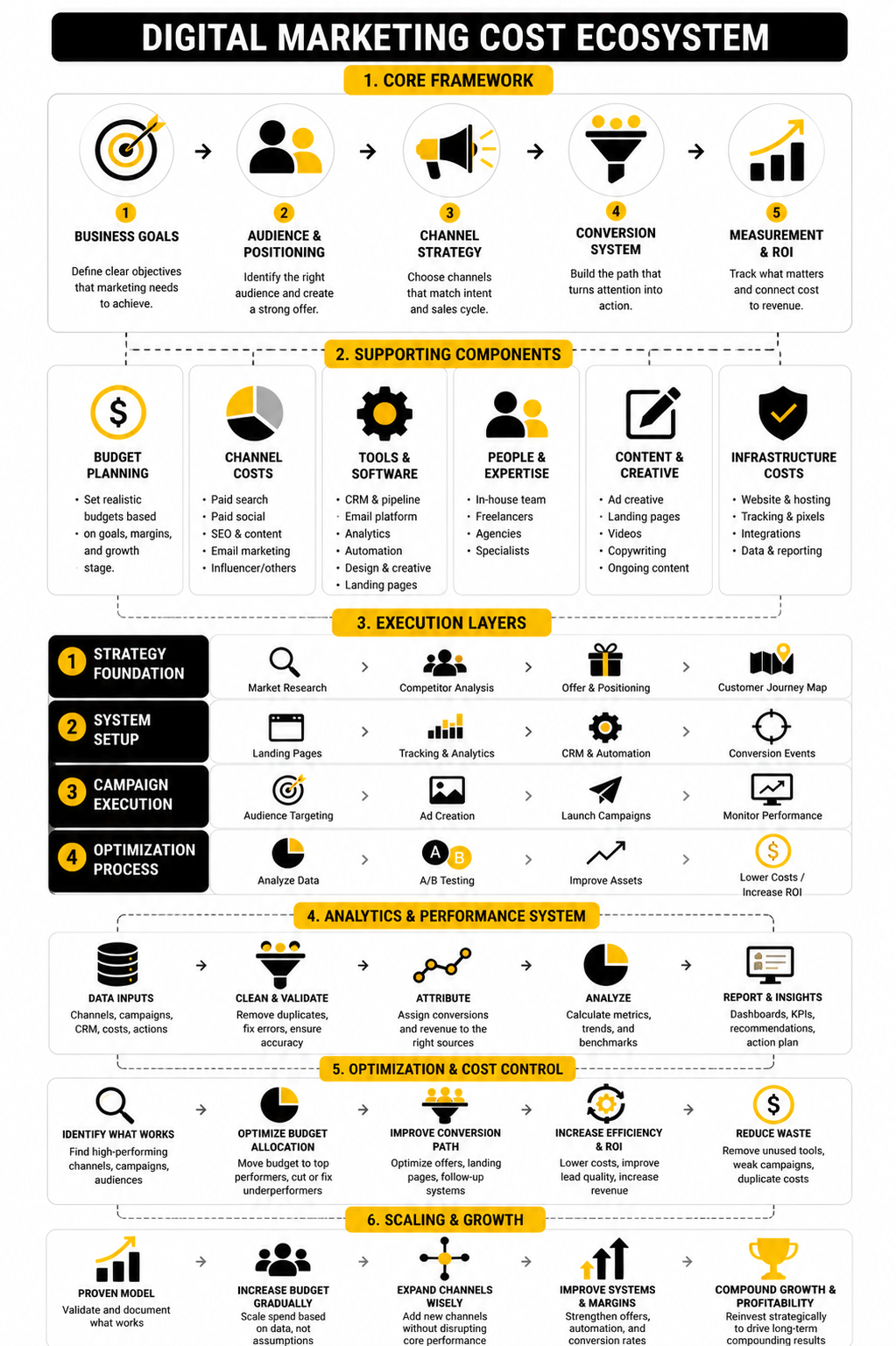
At this point, digital marketing cost is no longer just about campaigns. It becomes an ecosystem. The business needs a way to attract attention, convert that attention, follow up, measure revenue, and improve the system without rebuilding everything from scratch every month.
That is where tools and automation become useful. Not because software magically creates growth, but because the right system reduces manual work, protects leads from slipping away, and keeps the team focused on decisions instead of repetitive admin. The wrong system does the opposite. It adds subscriptions, complexity, and confusion.
A lean marketing stack usually needs a few core pieces: a website or funnel builder, an email platform, a CRM, analytics, scheduling, forms, and a simple reporting process. For some businesses, an all-in-one platform like GoHighLevel keeps the stack cleaner. For others, separate tools make more sense because the team needs more control over each part.
Build The System Around The Customer Journey
The best way to choose tools is to map the customer journey first. What happens when someone discovers you, clicks, opts in, books, buys, ignores you, comes back, or refers someone else? Each step should have a clear owner, clear message, and clear measurement point.
This prevents the classic mistake of buying tools before defining the process. A chatbot is useful only if it answers real buying questions or moves people into a useful next step. A CRM is useful only if the sales team updates it and uses it to make better decisions. An email platform is useful only if the messages are segmented, timely, and connected to the offer.
For example, a business that relies on conversations may benefit from ManyChat for automated chat flows. A business that needs better forms and lead qualification may use Fillout. A business that publishes consistently may use Buffer to organize social distribution. The tool should serve the journey, not become the journey.
Know When Automation Helps And When It Hurts
Automation helps when the task is repeatable, time-sensitive, and easy to define. Lead confirmations, appointment reminders, abandoned cart emails, onboarding sequences, review requests, and reactivation campaigns are good candidates. These workflows reduce waste because they make sure important actions happen every time.
Automation hurts when it replaces judgment too early. If the offer is still unclear, the audience is poorly defined, or the sales process is still changing every week, automating everything can lock the business into a bad process. You do not want to scale confusion.
The practical rule is simple: automate proven steps, not guesses. First prove that the message, offer, and action make sense. Then use automation to make that process faster, more consistent, and easier to measure.
FAQ - Built for Complete Guide
How much does digital marketing cost?
Digital marketing cost can range from a few hundred dollars per month for a very lean small business setup to tens of thousands per month for competitive paid campaigns, agency support, creative production, and advanced tracking. The better question is what the budget needs to achieve. A business trying to validate an offer needs a different budget than a company trying to scale paid acquisition across multiple channels.
What is included in digital marketing cost?
Digital marketing cost usually includes media spend, strategy, labor, creative assets, software, analytics, landing pages, email marketing, automation, SEO, content production, and reporting. Some businesses only count ad spend, but that gives a distorted view. The full cost includes everything required to turn attention into revenue.
Is paid advertising the biggest digital marketing expense?
Paid advertising is often the most visible expense, but it is not always the biggest or most important one. Labor, creative production, landing page development, tracking, and funnel optimization can become just as important. Paid media without those support systems usually becomes more expensive over time.
How much should a small business spend on digital marketing?
A small business should start with a budget it can measure and sustain long enough to learn from. That may mean prioritizing one or two channels instead of trying to be everywhere. The goal should be to validate the offer, conversion path, and follow-up process before scaling spend.
Why does digital marketing cost vary so much by industry?
Costs vary because buyer intent, competition, margins, sales cycle length, and customer value all vary. A legal lead, software demo, emergency service call, and low-priced ecommerce purchase do not have the same economics. Higher-value customers often justify higher acquisition costs, but only when the sales and fulfillment model can support them.
What is a good cost per lead?
A good cost per lead depends on lead quality and customer value. A cheap lead that never buys is expensive. A higher-cost lead can be profitable if it converts into a valuable customer with healthy margins. Always judge CPL alongside qualified lead rate, close rate, average order value, and lifetime value.
How can I reduce digital marketing cost?
Reduce waste before cutting growth activity. Audit unused tools, weak campaigns, duplicate subscriptions, poor landing pages, slow follow-up, and unclear reporting. Then protect the parts of the system closest to revenue, because cutting conversion assets while keeping traffic spend active usually makes performance worse.
Should I hire an agency, freelancer, or in-house marketer?
Use the model that matches your complexity. Freelancers work well for defined tasks, agencies can help when several skills are needed at once, and in-house marketers are useful when the business needs deep daily ownership. Many companies use a hybrid model because no single option is perfect for every stage.
Are marketing tools worth the cost?
Marketing tools are worth the cost when they remove bottlenecks, improve follow-up, clarify reporting, or increase conversion. They are not worth it when they overlap, go unused, or create more complexity than value. Start with the process, then choose the tool.
How do I know if my digital marketing budget is working?
Your budget is working when it produces measurable progress toward business goals. That could mean profitable sales, qualified leads, lower acquisition cost, stronger retention, better conversion rates, or clearer learning. If the budget creates activity but no decision-making improvement, something needs to change.
What should I track first?
Start with the numbers that connect marketing to revenue. Track source, cost, conversion action, lead quality, booked calls, sales, average order value, and customer acquisition cost. Platform metrics are useful, but they should never be the only source of truth.
When should I scale my digital marketing spend?
Scale when the system is already producing consistent results and the bottleneck is reach. Do not scale just because one campaign had a good day. Increase spend gradually, watch lead quality, protect margins, and keep improving creative and conversion assets as the audience expands.
Work With Professionals
Explore 10K+ Remote Marketing Contracts on MarkeWork.com
Most marketers spend too much time chasing clients, competing on crowded platforms, and losing a percentage of every project to middlemen.
MarkeWork gives you a better way. Browse thousands of remote marketing contracts and connect directly with companies desperate to hire skilled marketers like you, without platform commissions and without unnecessary gatekeepers.
If you're serious about finding better opportunities and keeping 100% of what you earn, explore available contracts and create a profile for free at MarkeWork.com.