

Digital marketing for beginners can feel messy at first because every platform seems urgent, every tactic claims to be essential, and every tool promises faster growth. The truth is simpler than that. You do not need to master everything at once to get traction, but you do need to understand where attention lives, how people move from discovery to trust, and which channels deserve your time first.
That matters more now than ever because the internet is already where most customer journeys begin. The latest global data shows 5.56 billion people use the internet, 5.24 billion social media user identities are active worldwide, and retail ecommerce is expected to pass 20% of worldwide retail sales in 2025. At the same time, digital advertising keeps expanding, with internet ad revenue reaching a record $258.6 billion in 2024, which tells you one important thing: brands keep investing online because that is where buyers pay attention.
For a beginner, the goal is not to chase every trend. The goal is to build a practical system that helps people find you, understand what you offer, trust you enough to take action, and come back again. That is the framework this article follows.
Article Outline
- Why Digital Marketing Matters for Beginners
- The Beginner Framework at a Glance
- The Core Channels You Need to Understand
- How to Build Your First Simple Digital Marketing System
- The Tools, Metrics, and Workflows That Make You Look Professional
- Common Mistakes, FAQs, and the Next Step
Why Digital Marketing Matters for Beginners
Digital marketing matters because modern buying behavior is fragmented, and beginners need a way to meet people across that fragmented journey without wasting money. People jump between search, social platforms, reviews, videos, websites, and email before they make a decision, which is exactly why Google now describes customer behavior as a more dynamic path shaped by repeated moments of streaming, scrolling, searching, and shopping rather than a straight funnel (consumer behavior research). If you are new, that can sound intimidating, but it actually gives you an advantage because you can build around how people really behave instead of relying on outdated marketing habits.
Search still plays a huge role in that journey. Google continues to dominate global search with about 89.85% worldwide market share in March 2026, which means showing up when someone is actively looking for information, solutions, or products is still one of the highest-intent opportunities in marketing. That is why beginners should not think of digital marketing as “posting on social media.” They should think of it as building visibility where intent already exists.
The other reason this matters is speed of feedback. Traditional marketing often takes longer to test, costs more to launch, and gives weaker data back to the operator. Digital channels let a beginner publish content, launch a simple landing page, collect leads, run an email sequence through a platform like Brevo, schedule distribution with Buffer, and measure what works quickly enough to improve week by week instead of guessing for months.
The Beginner Framework at a Glance
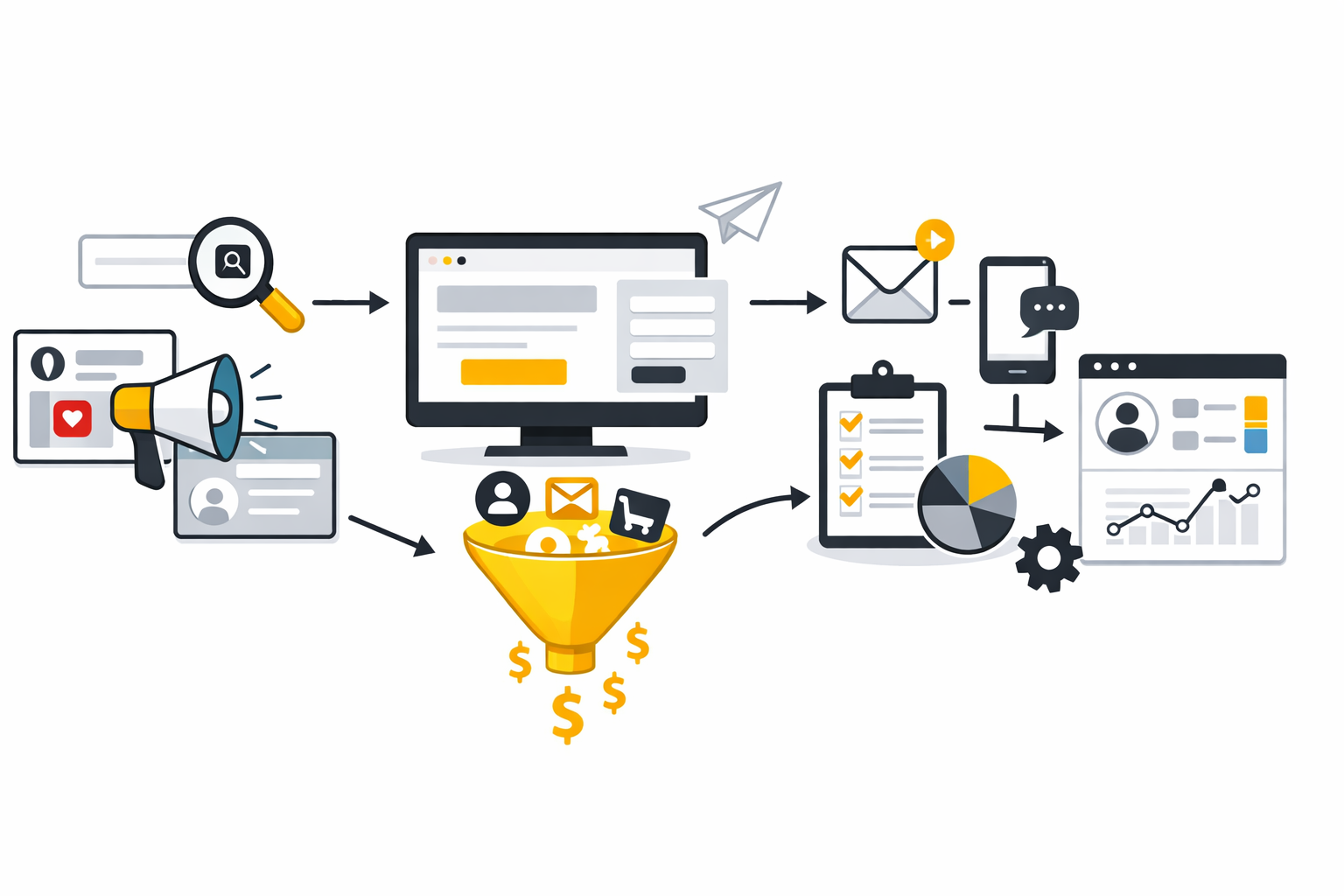
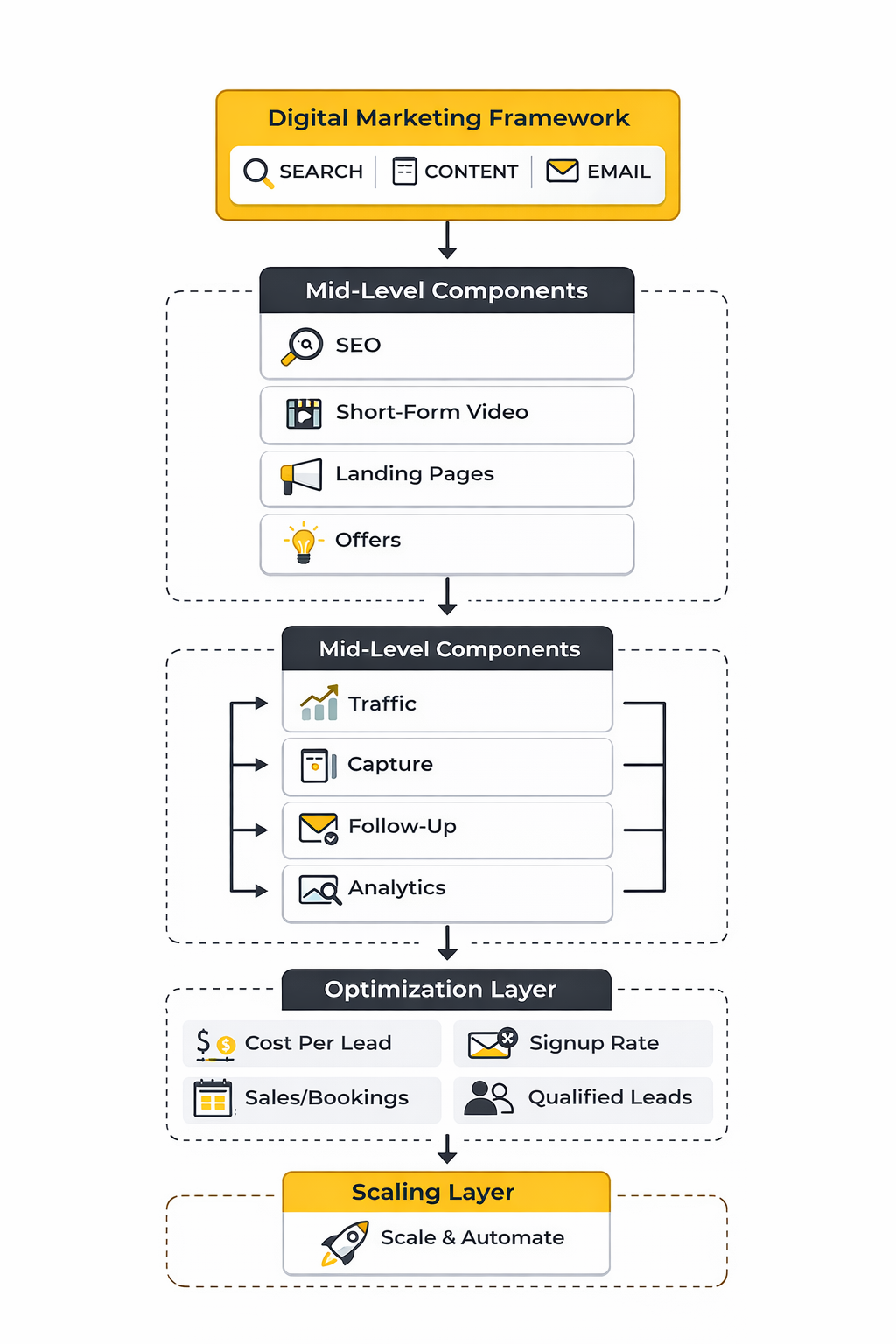
The easiest way to understand digital marketing for beginners is to stop seeing it as a pile of random channels and start seeing it as a simple operating system. At the highest level, that system has four jobs: attract attention, capture interest, convert intent, and retain the relationship. If a tactic does not support one of those jobs, it is usually noise.
That framework helps you stay focused when the ecosystem gets crowded. Search, short-form video, social content, email, landing pages, chat automation, and analytics all have a place, but not all of them should get equal attention on day one. A beginner usually gets farther by connecting a few basics well than by touching every major platform badly.
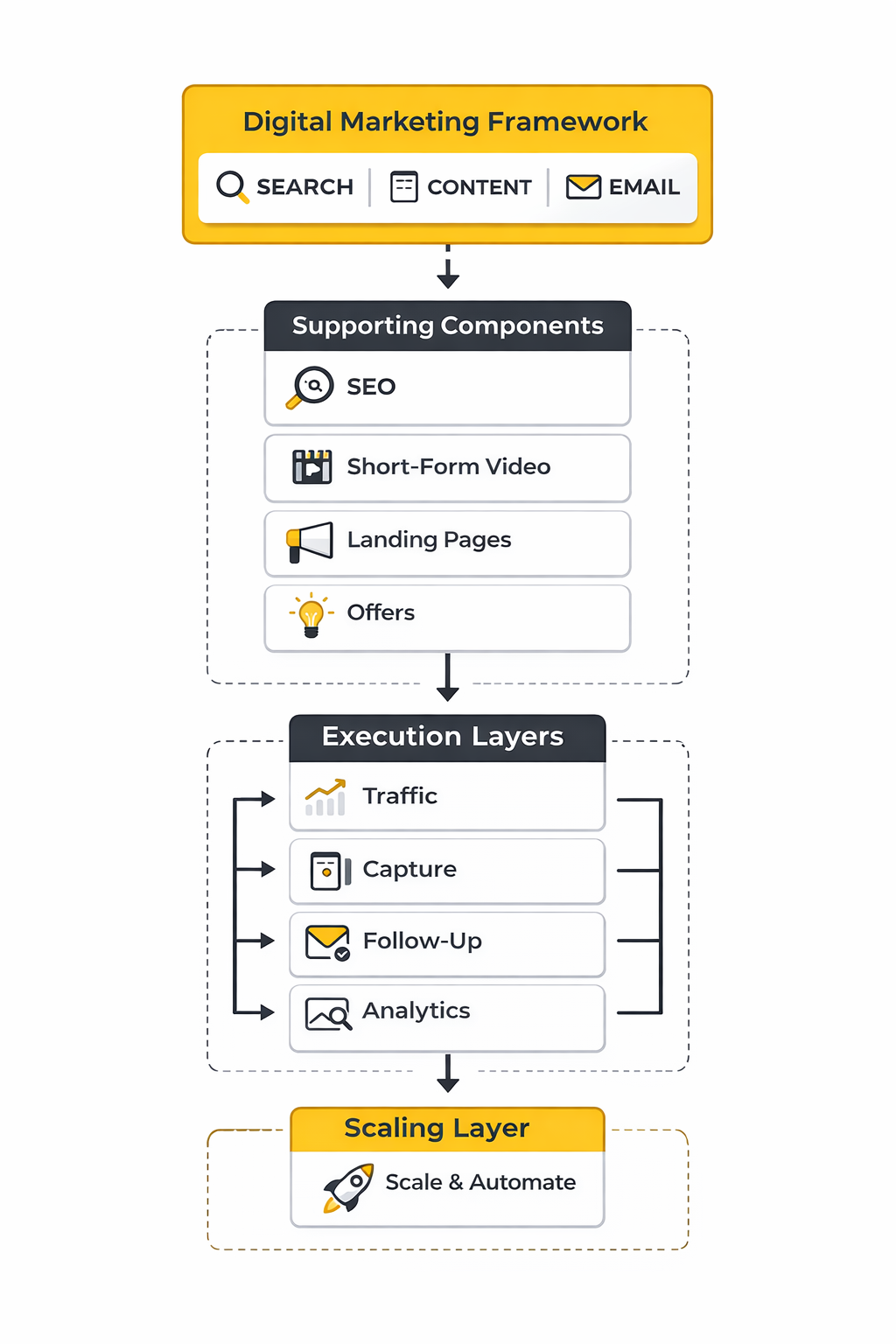
Here is the practical version. You attract attention with content, search visibility, social distribution, or paid reach. You capture interest with a clear page, form, or offer using tools such as Fillout, Systeme.io, or ClickFunnels. You convert intent with persuasive messaging, good timing, and follow-up, sometimes strengthened by chat or automation tools like ManyChat or a CRM stack like GoHighLevel. Then you retain the relationship with email, remarketing, useful content, and consistent follow-up so the first click does not become the last touch.
This is where beginners usually relax, because the job suddenly becomes manageable. You do not need a giant brand budget to make this work. You need a clear offer, a few strong channels, disciplined measurement, and a repeatable process that turns attention into action.
The Core Channels You Need to Understand
When people talk about digital marketing for beginners, they often throw a dozen channels at you at once and make all of them sound equally urgent. That is a mistake. A beginner does better by learning which channels create demand, which ones capture it, and which ones help you keep attention once you have it. HubSpot’s 2026 marketing data shows most brands now use at least three channels, but that does not mean you should build a complicated stack on day one. It means you should understand how the main pieces fit together before you start adding more. HubSpot’s channel research also shows that marketers still report strong ROI from website and SEO work, email, and paid social, which is a useful reality check for anyone tempted to chase only the newest platform.
The easiest way to think about channels is this: search captures active intent, content builds trust, social expands discovery, email keeps the relationship alive, and paid media can accelerate what is already working. Once you see those jobs clearly, the channel mix stops feeling random. You are no longer asking, “Which platform is hottest?” You are asking, “What role does this channel play in moving someone closer to action?”
Search and SEO
Search belongs near the top of the list because it reaches people who are already looking for answers, products, or help. Google still holds roughly 89.85% of worldwide search market share, which makes search visibility one of the clearest ways for a beginner to meet demand that already exists. This is why SEO is not just a “traffic tactic.” It is a way to show up when someone has a problem and is actively trying to solve it.
For beginners, SEO is less about gaming an algorithm and more about matching intent. That means publishing pages and articles that answer real questions, using language your audience actually types into search, and making sure your site is easy to crawl, fast enough to use, and clear enough to understand. When marketers rank website, blog, and SEO among their best-performing channels, that is not because search is glamorous. It is because intent-driven traffic usually converts better than random attention.
There is also a second-order benefit that beginners underestimate. Good SEO makes every other channel stronger because your content becomes easier to find, easier to reference, and easier to reuse across email and social. Even if social platforms introduce someone to your brand first, search often becomes the place where that person verifies whether you are credible enough to trust.
Content Marketing
Content marketing matters because very few people convert the first time they hear your name. They need context, proof, explanations, comparisons, and a reason to believe you understand their problem. That is why content is not just blogging. It includes articles, landing page copy, guides, videos, emails, and short educational posts that help a buyer move from curiosity to confidence. HubSpot’s current marketing statistics show blog posts remain both widely used and among the higher-ROI content formats for marketers, which is a strong signal that useful written content still compounds.
For digital marketing for beginners, content does two jobs at once. First, it gives you something valuable to distribute through search, social, and email. Second, it sharpens your own message, because writing clearly about a customer problem forces you to understand your offer better than most beginners do at the start. That clarity becomes a competitive edge much faster than people expect.
The important part is relevance, not volume. One genuinely useful article, one strong product page, and one clear lead magnet will outperform a pile of generic posts written just to “stay active.” If you want your content to look more professional, build the destination first with a clean funnel or landing page in a platform like Systeme.io, ClickFunnels, or Replo, then create content that naturally leads people there.
Social Media and Short-Form Video
Social media is no longer just a distribution channel where you post links and hope for clicks. It has become a discovery engine in its own right, especially for younger audiences and product-led brands. Recent Sprout Social research found that 41% of Gen Z users turn to social platforms first when searching for information, ahead of traditional search engines in that survey. That shift matters because it changes what beginners should publish and how they should think about visibility.
This does not mean social replaces SEO. It means the two increasingly overlap. Social posts can spark discovery, create repeated exposure, and give your brand a voice people remember, while search often catches the demand once interest becomes more deliberate. Sprout’s 2026 social search coverage makes that overlap clear: content that is built to be found inside social platforms now plays a bigger role in how people discover brands, products, and recommendations.
For a beginner, the practical takeaway is simple. Pick one platform where your audience already spends time, create useful posts around recurring customer questions, and treat consistency as a signal-building exercise rather than a vanity exercise. A scheduler like Buffer or a more niche social growth tool like Flick can help, but the real advantage comes from having something worth saying in the first place.
Email Marketing
Email stays important because it gives you direct access to people who already raised their hand. Algorithms can throttle your reach on social, rankings can move in search, and ad costs can rise without warning. Your email list is different because it is one of the few digital assets you can keep building regardless of platform shifts, which is a big deal for beginners who need stability, not just spikes. HubSpot’s current channel data continues to rank email among the strongest ROI channels, especially in B2C contexts.
This is why email should not be treated as the last step after “real marketing” is done. It is one of the core engines that turns attention into repeatable results. Once someone subscribes, you can welcome them, educate them, answer objections, share offers, and bring them back without paying for every touchpoint again.
For digital marketing for beginners, the smartest move is to keep the system light. Offer one clear reason to subscribe, use a form that does not create friction, and build a short follow-up sequence in a tool like Brevo or Moosend. You do not need a giant automation map at first. You need a welcome flow that feels helpful and gives people a clear next step.
Paid Advertising
Paid advertising is useful, but beginners often reach for it too early and expect it to fix a weak offer. It will not. Paid ads are best used to amplify something that already shows signs of life, whether that is a strong landing page, a compelling lead magnet, or content that is getting traction organically. Marketers still report meaningful ROI from paid social, and retail media spending continues to rise, which tells you paid acquisition is still a major part of the ecosystem when used with discipline.
The real advantage of paid media for beginners is speed of learning. You can test headlines, offers, audiences, and creative much faster than you can with SEO alone. But that only works if you measure the right thing. Cheap clicks mean very little if the page does not convert or if the leads never become customers.
That is why paid ads should usually sit on top of a simple system, not replace it. A form built in Fillout, a landing page in ClickFunnels, or a CRM and automation flow inside GoHighLevel gives that traffic somewhere focused to go. When beginners skip that foundation, they usually blame the ads when the real problem is the system behind them.
What a Beginner Should Focus on First
You do not need to master all five channels before you can start. In most cases, the strongest beginner setup is one intent channel, one relationship channel, and one conversion asset. That might mean search plus email plus a landing page, or social plus email plus a simple funnel. The exact combination can change, but the logic stays the same: attract the right people, capture their interest, and follow up consistently.
That is the difference between random activity and actual marketing. Once you understand the role each channel plays, you stop asking which tactic feels exciting this week and start building a system that can improve over time. The next step is turning that understanding into a simple setup you can actually launch, which is where most beginners either gain momentum or get stuck.
How to Build Your First Simple Digital Marketing System
At this point, digital marketing for beginners stops being a theory problem and becomes a setup problem. You now know the main channels and what job each one plays, but knowing that is not the same as having a working system. What actually moves the needle is connecting a clear offer, one traffic source, one conversion path, and one follow-up sequence in a way that is simple enough to manage every week.
This is where beginners often overcomplicate things. They build too many pages, open too many social accounts, install too many tools, and end up with a stack that looks impressive but does not produce consistent results. A better move is to launch a small system that gives you real feedback fast, then improve it once the basics are working.
The good news is that this setup does not need to be fancy. Google Analytics 4 is built around events and key events, which means you can track the actions that matter most instead of guessing whether traffic is doing anything useful (create or modify key events, about key events, tutorial for setting up a key event). That alone gives beginners a huge upgrade over random posting and vague hope.
Start With One Clear Offer
Every beginner system needs a focal point. That can be a service, a product, a consultation, a free guide, a newsletter, or a trial, but it has to be specific enough that someone understands the value quickly. If your offer is fuzzy, your traffic will be fuzzy too, and no tool will save that.
A clear offer usually answers three things fast: what this is, who it is for, and what happens next. That sounds obvious, but it is where many early digital marketing efforts break down. People put energy into content and promotion before they have built a compelling reason for anyone to act.
This is also why simple usually wins early. One focused landing page can do more work than a bloated website full of generic claims. Unbounce’s current benchmark research draws from 57 million conversions across 41,000 landing pages and found a median conversion rate of 6.6% across industries, which is a useful reminder that focused pages are not just design choices. They are performance assets.
Choose One Primary Traffic Source First
Digital marketing for beginners gets much easier when you stop trying to win everywhere at once. Pick one main source of traffic based on how your audience naturally discovers solutions. If people search for the problem, start with search-driven content. If they spend time following creators or brands in social feeds, start there and build a steady publishing rhythm.
This does not mean you ignore every other channel forever. It means you need one reliable engine before you layer in more complexity. Most beginners fail not because they picked the wrong platform, but because they split their energy across too many platforms to get traction anywhere.
There is also a psychological benefit here. One channel gives you a tighter feedback loop. You can see what content gets clicks, what messaging gets engagement, and what traffic actually turns into signups or inquiries without drowning in noise.
Build a Focused Landing Page or Funnel
Once you have the offer and the traffic source, you need a destination that turns attention into action. That page should not try to explain your entire business history. It should help the visitor understand the offer, trust it, and take the next step with as little friction as possible.
This is where a funnel builder or landing page tool can help, especially if you are not a developer. A beginner can get moving with Systeme.io, build a more sales-focused flow in ClickFunnels, or use Replo if the brand experience matters heavily and you want more control over the page structure. The point is not which brand name you pick. The point is creating one place where the visitor can take a meaningful action without distraction.
That page should be built around one primary call to action. If you want a lead, ask for the lead. If you want a booking, guide toward the booking. If you want a purchase, remove anything that pulls attention away from the purchase. Beginners usually improve fastest when they stop adding options and start reducing confusion.
Create a Simple Capture Mechanism
You need a way to turn anonymous attention into a real contact or customer action. For lead generation, that usually means a form, quiz, chat flow, booking option, or checkout step. The more directly that mechanism fits the user’s intent, the better it tends to perform.
A clean form builder like Fillout works well when you want structured lead capture without extra complexity. If chat is the better path because the audience wants quick answers before committing, ManyChat or Chatbase can make the path feel more conversational. The right mechanism depends less on what feels trendy and more on what removes the most friction for your audience.
You also want to keep the ask proportional to the value. If the offer is a newsletter or a simple download, do not demand a long form. If the offer is a serious consultation or a higher-ticket service, asking a few stronger qualifying questions can actually improve lead quality.
Set Up the First Working Workflow
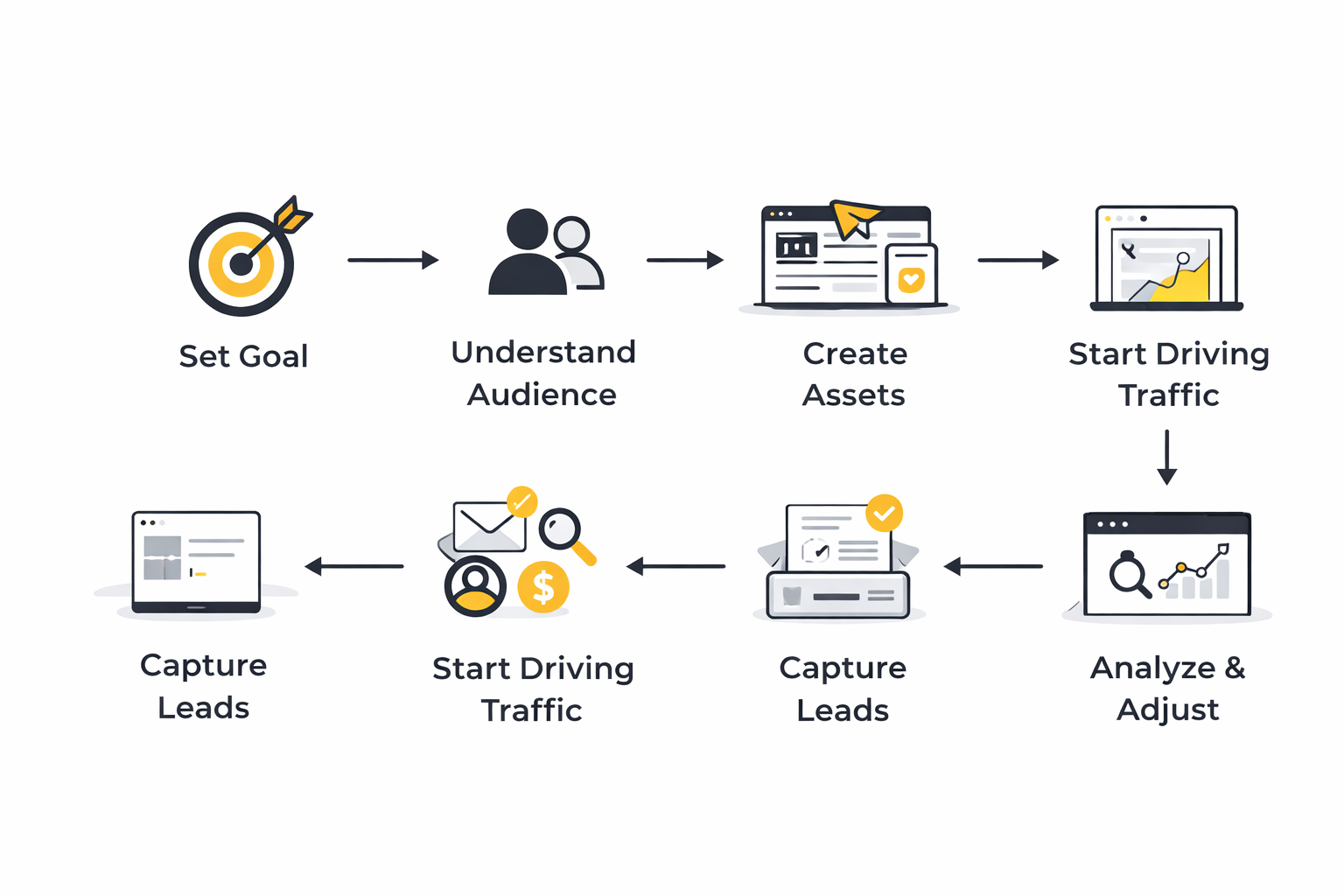
The execution process becomes real when you connect all the pieces into one path. A beginner-friendly workflow looks like this:
- Publish one piece of content or launch one traffic source
- Send people to one focused page
- Capture one action, such as an email signup, form fill, booking, or purchase
- Trigger one follow-up sequence
- Measure what happened and improve the weakest step
That is the whole game at the start. Not glamorous, but very effective when done consistently. If you want a more all-in-one setup, GoHighLevel can combine forms, funnels, CRM, and automation in one place, which reduces the number of tools you need to stitch together.
The reason this matters is that isolated tactics create activity, but connected workflows create momentum. A blog post without a next step is just content. A paid ad without tracking is just spend. A signup form without follow-up is just lost opportunity. Once the steps are linked, you finally have a system instead of a collection of disconnected efforts.
Build a Basic Follow-Up Sequence
Most people who discover you will not act immediately, and that is normal. This is where beginners often lose momentum because they treat the signup as the finish line instead of the start of the relationship. Your follow-up sequence is what turns a cold interaction into familiarity, trust, and eventually action.
A welcome sequence is the easiest place to start. Mailchimp’s current benchmark page shows average email open rates of 35.63% across all users, while Campaign Monitor highlights how strong welcome emails can be, including 91.43% open rates in one cited dataset. The exact benchmark will vary by audience and methodology, but the practical lesson is clear: people pay more attention near the beginning of the relationship, so your first messages matter a lot.
That sequence does not need to be long. A strong beginner version can be three to five emails: a welcome email, a value email, a proof or credibility email, an objection-handling email, and a direct next-step email. Platforms like Brevo or Moosend make that easy to launch without needing advanced automation logic.
Track Only the Metrics That Matter First
Beginners get overwhelmed by dashboards because modern analytics tools can report almost everything. The smarter approach is to ignore most of it at the start and focus on a few measurements that map directly to your workflow. You want to know whether people are arriving, whether they are engaging, whether they are taking the action you care about, and which source is sending the most valuable traffic.
Google Analytics 4 makes this easier when you work from key events instead of vanity numbers. Google defines engaged sessions as sessions lasting longer than 10 seconds, sessions with a key event, or sessions with at least two page or screen views (engagement rate and bounce rate, traffic acquisition report, engagement overview report). That gives you a more useful read on whether traffic has real intent than simply staring at pageviews.
For a beginner system, the core metrics are enough. Track traffic by source, landing page conversion rate, cost per lead if you are using paid traffic, email signup rate, reply or click activity from your follow-up emails, and the final business action that matters most. Everything else can come later. The goal is not to build a prettier report. It is to create a clearer decision-making loop.
Launch Small, Then Tighten the Weakest Step
This is the part many people resist because it feels less exciting than learning new tactics. But digital marketing for beginners usually improves through diagnosis, not expansion. You launch a simple system, look for the weakest step, improve that step, and repeat the process until the overall flow gets stronger.
If traffic is weak, improve the content or the traffic source. If traffic is fine but conversions are weak, improve the page or the offer. If signups happen but sales do not, improve the follow-up sequence, qualification process, or sales message. That kind of structured thinking is what separates beginners who eventually get consistent results from beginners who stay trapped in random activity.
This is also where being practical beats being clever. You do not need a massive tech stack to look professional. You need a clean path, clear messaging, useful follow-up, and measurement that tells you what to fix next. The next part is where that professional layer comes in, because once the system works, the question becomes how to run it with better tools, tighter workflows, and smarter execution.
The Tools, Metrics, and Workflows That Make You Look Professional
Once your first system is live, the next step is not adding more noise. It is learning how to read performance properly. This is where digital marketing for beginners usually levels up, because the difference between guessing and improving comes down to measurement. The point of analytics is not to collect impressive dashboards. It is to understand where people are dropping off, what is working, and which change is most likely to create the next lift.
A lot of beginners think data means memorizing random benchmarks. It does not. Good measurement is really about context. The same click-through rate, landing page conversion rate, or email open rate can mean very different things depending on the offer, the traffic source, the stage of the funnel, and the level of buyer intent.
What the Right Numbers Actually Tell You
The easiest mistake in early marketing is staring at top-of-funnel numbers because they are easy to see. Traffic, impressions, and reach matter, but they only matter when they connect to action. A page with more visitors is not automatically better than a page with fewer visitors. If the second page turns more of those visitors into leads or customers, it is doing the real job better.
That is why professionals tie every metric back to a decision. If traffic is growing but conversions are flat, the issue is probably messaging, offer quality, or page clarity. If conversion rates are solid but traffic is weak, the issue is visibility and distribution. If leads come in but nobody buys, the issue is often qualification, follow-up, or the mismatch between the promise and the actual offer.
This is exactly where beginners should slow down and think instead of reacting emotionally. A number only becomes useful when it points to an action. Otherwise it is just a prettier version of confusion.
Traffic Quality Beats Raw Traffic Volume
Not all visitors are equal. Search traffic from a high-intent query often behaves very differently from social traffic driven by curiosity, and paid traffic can look strong on the surface while still performing badly deeper in the funnel. That is why source quality matters more than raw session counts.
Google Analytics 4 is useful here because it frames engagement around behavior, not just page loads. Google defines an engaged session as one that lasts longer than 10 seconds, has a key event, or includes at least two page or screen views (engagement rate and bounce rate). That matters because it helps you separate accidental visits from people who are actually showing signs of interest.
If one traffic source sends fewer visitors but a much higher share of engaged sessions, that source is often more valuable than the one producing bigger vanity numbers. For a beginner, this can completely change where time and budget go next. Instead of chasing volume, you start backing the channel that sends people who behave like potential buyers.
Conversion Rate Is the Pressure Test
Conversion rate is one of the most useful beginner metrics because it reveals whether your page and your offer are working together. It is not perfect, and it should never be interpreted in isolation, but it is one of the clearest signals you have. If people arrive and do not act, the page is probably not connecting strongly enough.
Current landing page benchmark research from Unbounce is based on 57 million conversions across 41,000 landing pages, and its more recent guidance places the median landing page conversion rate at 6.6% across industries. That is useful as a reference point, but it is not a universal goal. A lead magnet page, a demo request page, and a product checkout page operate under completely different conditions, so their conversion rates should not be judged the same way.
What matters more is trend direction. If your page converts at 3% this month and 5% next month after you simplified the headline, tightened the call to action, and reduced friction in the form, the benchmark did its job. It gave you context, not a scorecard for your self-worth.
Email Metrics Show Relationship Strength
Email is one of the few channels where you can see the health of an audience relationship almost immediately. Open rates, clicks, replies, and unsubscribes all tell part of the story, but none of them should be read mechanically. An open rate can be high because the subject line created curiosity, but that does not mean the body converted. A click rate can be lower than expected because the email answered the question so well that fewer people needed another page. Context matters here too.
Mailchimp’s current benchmark page shows average open rates of 35.63% and average click rates of 2.62% across all users. Those numbers are helpful for calibration, especially when you are just starting and have no internal baseline yet. But they become more useful when paired with your own data over time. A list that opens at 30% but consistently books calls or generates purchases can be healthier than a list opening at 45% with weak downstream action.
This is why professionals do not obsess over a single email metric. They look at sequence behavior. Are people opening the welcome emails but disappearing on the offer email? Are clicks rising after clearer positioning? Are unsubscribes spiking because the content feels too promotional too soon? Those patterns tell you what needs fixing.
Engagement Metrics Need Interpretation, Not Worship
Engagement metrics are helpful, but they are also easy to misuse. Time on site, pages per session, and engagement rate can signal interest, but they can also reflect confusion. A visitor spending a long time on a page is not always a win. Sometimes it means the page is too complicated and the person is working too hard to understand it.
Google Analytics 4 also changed how many marketers think about bounce. In GA4, bounce rate is the inverse of engagement rate, which means it reflects the share of sessions that did not qualify as engaged under Google’s rules (engagement rate and bounce rate). That is useful, but only if you remember what the metric actually means. A high bounce rate on a simple contact page could be bad. A high bounce rate on a page that answers one quick question might not be a problem at all.
The smart move is to read engagement metrics alongside conversion behavior. If engagement is low and conversions are low, the page likely has a serious fit problem. If engagement is low but conversions are strong, the page may actually be doing its job efficiently. This is why numbers need interpretation. Without that, beginners often fix the wrong thing.
How to Set Up a Beginner Analytics System
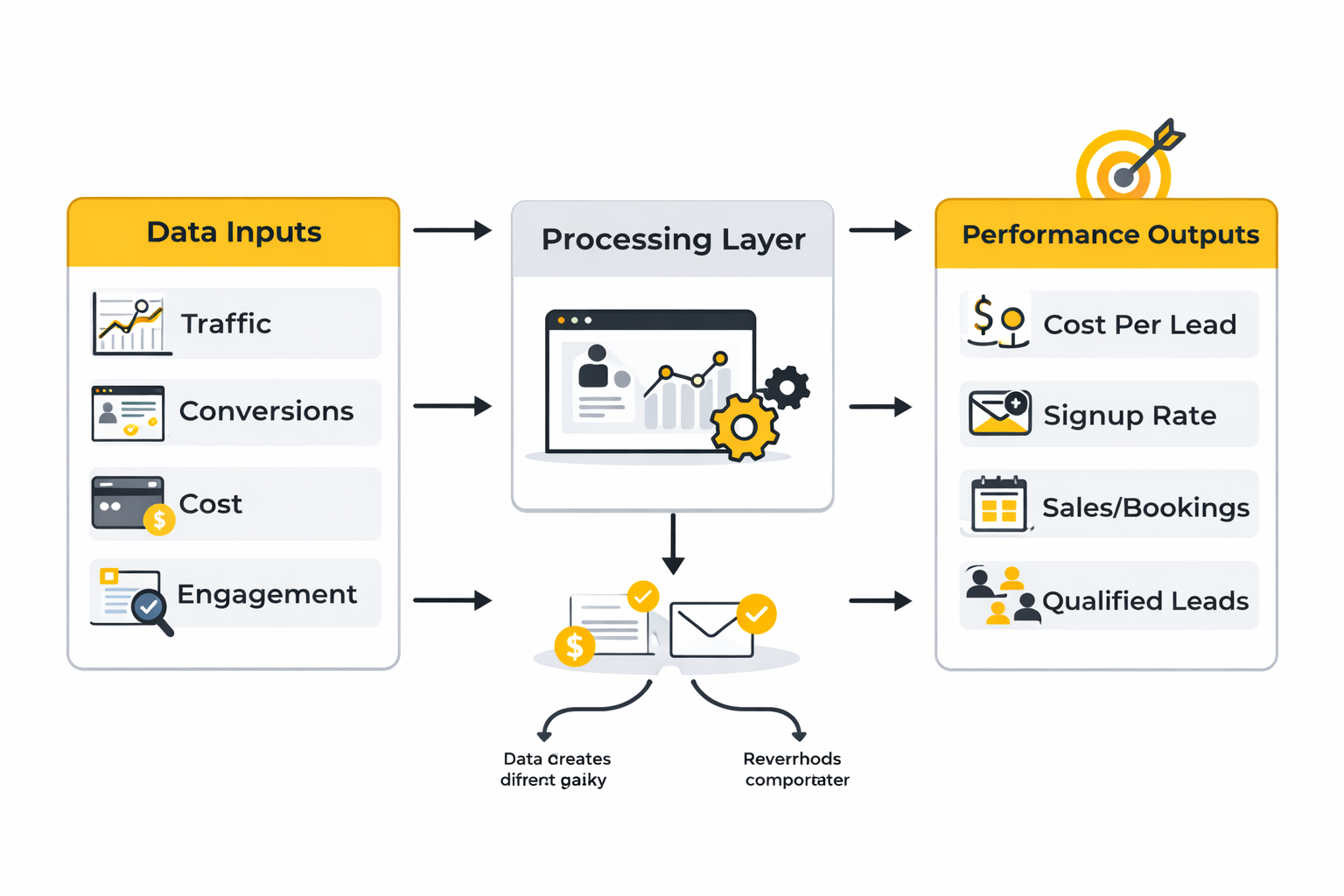
A beginner analytics system should be small enough to manage and strong enough to guide decisions. You do not need dozens of reports. You need one clear view of traffic sources, one clear view of landing page performance, one clear view of key actions, and one clear view of follow-up results. That is enough to make better decisions than most people make when they are drowning in dashboards.
In GA4, the most important setup step is identifying the actions that genuinely matter and marking them properly. Google now uses key events to flag the actions that represent important business outcomes, such as lead submissions, purchases, bookings, or qualified signups (about key events, create or modify key events). For beginners, this is critical because it pulls analytics back toward business reality. You are no longer measuring “activity.” You are measuring progress.
A practical beginner setup usually includes these checkpoints:
- Which source brought the visitor
- Which page they landed on
- Whether they became engaged
- Whether they completed the main key event
- Whether follow-up produced clicks, replies, bookings, or purchases
That setup gives you a functioning decision loop. It tells you whether the issue lives in acquisition, page performance, or nurture. That is enough to improve intelligently without overengineering the system.
The Benchmarks That Actually Help
Benchmarks are useful when they help you ask better questions. They become dangerous when they tempt you to copy someone else’s context. The right way to use benchmarks is to compare your current state against a broad baseline, then look for the next improvement that makes sense for your business model.
For landing pages, the Unbounce data gives you a useful reality check. If your page is converting far below its broad benchmark range, you probably have a friction, relevance, or clarity problem. For email, the Mailchimp benchmarks help you spot whether your subject lines, audience fit, or content rhythm are out of line with reasonable expectations. For web engagement, Google’s definitions help you separate weak visits from meaningful interaction.
But the most important benchmark is still your own trend line. Once you have enough data, your past performance becomes the standard that matters most. Going from a 1.5% landing page conversion rate to 3.5% matters more to your business than whether someone else in another industry reports 7%. The job is not to look average. The job is to get better.
What Actions the Data Should Drive
Data should always end in a move. If a source has weak engagement, tighten the audience or change the message. If a page gets clicks but low conversion, simplify the page and sharpen the offer. If people sign up but do not respond to the follow-up, rewrite the first emails or adjust the promise they opted into.
This sounds basic, but it is where discipline beats intelligence. A lot of beginners keep collecting more numbers instead of acting on the ones they already have. Professional execution looks calmer. You review the system, identify the bottleneck, run one meaningful improvement, then watch the result.
That mindset matters because digital marketing for beginners becomes much less overwhelming once you understand what metrics are really for. They are not there to make marketing feel more technical. They are there to make your next decision more obvious. And once your decisions improve, your results usually follow.
Common Mistakes, Strategic Tradeoffs, and What Changes as You Scale
Once the basic system works, digital marketing for beginners becomes less about learning more tactics and more about making better tradeoffs. This is where a lot of people get stuck. They assume the next stage of growth requires more channels, more tools, and more content, when the real need is usually sharper focus, cleaner positioning, and better allocation of time and budget.
That matters even more in the current environment. Gartner reported in June 2025 that digital channels account for 61.1% of total marketing spend, while a separate 2025 Gartner survey found marketing budgets stayed flat at 7.7% of company revenue. That combination is important because it means digital is still dominant, but the margin for waste is tighter. Beginners who learn discipline early have an advantage.
More Channels Usually Mean More Complexity Before More Growth
Adding channels looks like progress because it feels ambitious. In practice, every new channel creates more creative work, more measurement problems, more messaging variation, and more opportunities for inconsistency. If your first channel is not producing reliable learning yet, opening three more usually spreads the problem instead of solving it.
This is one of the first strategic tradeoffs worth understanding. Depth beats width early. A stronger content engine on one platform, a better landing page, and a tighter email sequence usually create more growth than trying to be average everywhere at once. Scale comes from repeatability, not from digital sprawl.
The same principle applies to tools. Buying more software can make a weak process look sophisticated, but it rarely fixes the core issue. McKinsey’s 2025 analysis of martech argues that technology only becomes a growth engine when the stack is rewired around real business outcomes rather than layered on as disconnected software (rewiring martech). That is a useful warning for beginners who think professionalism means stacking subscriptions.
AI Makes Speed Easier but Differentiation Harder
AI has lowered the cost of producing content, campaigns, drafts, and variations. That is good news for beginners because it makes execution faster. But it also creates a new risk: average content is now easier to produce than ever, which means average content gets ignored faster too.
HubSpot’s 2026 marketing data says 94% of marketers plan to use AI in their content creation processes, and HubSpot’s trend coverage adds that 56% of marketers say the internet is flooded with AI-generated content while 65% say consumers are getting better at recognizing it. That matters because the strategic question is no longer “Should I use AI?” It is “How do I use AI without sounding like everyone else?”
The answer is usually human judgment, not human volume. Use AI to speed up research organization, first drafts, content repurposing, and testing ideas. Do not let it replace your point of view, your customer understanding, or your standards. In crowded markets, clear positioning and useful specificity are now more valuable because so much generic content is flooding the feed.
Search Is Changing, So Diversification Matters
Search is still essential, but the environment around it is shifting. McKinsey reported in late 2025 that about 50% of Google searches already have AI summaries, with that share expected to rise further, and its AI Discovery Survey found half of consumers intentionally seek out AI-powered search engines. That does not mean SEO is dead. It means discovery is fragmenting, and visibility now depends on being present across more than one discovery surface.
This is why smart scaling usually includes diversification, but only after the base system is working. If all your growth depends on one algorithm, one platform, or one source of traffic, you are more fragile than you think. A search update, platform policy shift, or rising ad cost can hit harder than expected when you have no second engine.
A more resilient setup often looks like this: one primary acquisition channel, one owned audience channel, and one backup discovery channel. That mix keeps you from being overexposed to a single platform and gives you more ways to learn what your audience responds to. It is not about being everywhere. It is about not being trapped.
First-Party Data Becomes More Valuable as Privacy Tightens
As you grow, your own data becomes more strategically important. Not “data” in the vague, dashboard-heavy sense. Your email list, your customer records, your purchase history, your lead source data, and your on-site behavior signals. Those assets become more valuable as privacy rules, platform restrictions, and measurement limitations make external targeting less dependable.
Google’s Ads Data Hub documentation now emphasizes workflows that join ad activity with your own uploaded data, including joining first-party data in BigQuery, using consented first-party audience lists, and operating within privacy thresholds where many reports require aggregation across at least 50 users, or 10 for clicks and conversions in some cases. For beginners, the technical details are less important than the strategic message: the better your own data foundation is, the stronger your targeting, reporting, and retention can become.
This is one reason owned channels matter so much. An email list inside Brevo, a CRM pipeline in GoHighLevel, or better contact management through Copper is not just an operational improvement. It is a strategic moat. The more direct relationship data you have, the less dependent you are on borrowed audiences.
Scaling Exposes Weak Positioning Fast
A weak offer can survive a little organic traffic. It usually does not survive scale. Once you push more budget, more traffic, or more attention through a system, weak positioning gets exposed quickly. Pages that were “good enough” at low volume stop converting. Messaging that sounded fine to a warm audience falls flat with colder traffic. Follow-up sequences that worked manually start breaking once the volume rises.
This is why scale is not just multiplication. It is pressure. It forces clarity. It reveals whether your audience actually understands your promise, whether your offer is strong enough to compete, and whether the experience after the click is consistent with what brought the person there in the first place.
For beginners, this is a useful mindset shift. Do not think of scale as “doing more of the same.” Think of it as testing whether the system is truly solid. If it is not, scale will show you where the weakness lives. That can be frustrating, but it is also useful because it turns vague doubts into visible problems you can actually fix.
Automation Helps, but Only After the Logic Is Sound
Automation looks attractive because it promises leverage, and sometimes it delivers exactly that. But automation multiplies the underlying logic of the system. If your messaging is clear and your workflow is strong, automation saves time and improves consistency. If the logic is weak, automation spreads the weakness faster.
That is why the best time to automate is after a manual version has already shown signs of working. Then you know what should happen when a lead comes in, when a reminder should go out, when a follow-up should stop, and when a person should be handed off to a human. Tools like ManyChat, Cal.com, Wispr Flow, or GoHighLevel can help at that stage because they reduce repetitive work without replacing judgment.
The trap is automating too early because it feels like progress. That often creates brittle systems that are hard to manage and even harder to diagnose. Beginners scale better when they earn automation through clarity.
The Real Risk Is Confusing Motion With Progress
This is probably the most expensive mistake in the whole process. Digital marketing gives you endless ways to stay busy. You can redesign pages, test tools, rewrite emails, post more often, run more ads, and still avoid the real issue for months. Motion feels productive because it creates activity. Progress only happens when the bottleneck actually moves.
That is why strategic maturity matters even for beginners. You need the discipline to ask one hard question regularly: what is the current constraint in this system? If it is acquisition, fix acquisition. If it is conversion, fix conversion. If it is retention, fix retention. Most of the time, one weak point is doing far more damage than the rest of the system combined.
That mindset is what makes the whole article practical instead of theoretical. You are not trying to master every corner of digital marketing at once. You are learning how to build a system, read the signals honestly, and make better decisions as the environment gets more competitive. The final part brings that together with the most common questions beginners still have, along with the clearest next step from here.
For most people, the next step after the beginner phase is not doing more. It is building a cleaner ecosystem around what already works. That means your traffic source, landing page, lead capture, follow-up sequence, analytics, and CRM should start behaving like one connected machine instead of a pile of separate experiments.
That is the point where digital marketing for beginners stops feeling chaotic. You know where people discover you, what action you want them to take, how you follow up, and which signals tell you whether the system is improving. Once that foundation is in place, your job becomes refinement rather than reinvention.
FAQ
What is digital marketing for beginners in simple terms?
Digital marketing for beginners is the process of using online channels to attract attention, generate leads, build trust, and create sales without relying only on offline promotion. That includes search, content, social media, email, paid ads, and the systems that connect them. The beginner part matters because the goal is not mastering every channel at once. It is learning how the pieces work together well enough to build a repeatable result.
Which digital marketing channel should beginners start with first?
The best first channel depends on how your audience discovers solutions. If people actively search for the problem you solve, search and SEO are usually the smartest place to begin. If your market responds better to creators, visual content, or fast attention, social may be the better starting point. The rule is simple: begin where real buyer intent already exists instead of choosing a platform just because it feels exciting.
Do beginners need a website before starting digital marketing?
You need a place where people can take action, but that does not always mean a large website. In many cases, one strong landing page is enough to start validating an offer. A simple setup in Systeme.io, ClickFunnels, or Replo can work perfectly well if it clearly presents the offer and gives visitors an obvious next step.
How long does it take for beginner digital marketing to work?
That depends on the channel and the offer. Paid traffic can generate feedback quickly, while SEO and content often take longer to compound. Email and follow-up systems usually start showing value as soon as you have real subscribers. The more realistic way to think about timing is this: some tactics give you speed, others give you durability, and a good system usually blends both over time.
Is SEO still worth learning for beginners?
Yes, especially because search still captures high-intent demand. Google continues to dominate global search share, with around 89.85% worldwide market share in March 2026. That does not mean SEO is easy or static, and AI-driven search is changing discovery patterns, but people still search when they want solutions. For a beginner, that makes SEO one of the most valuable long-term skills to understand.
Do I need paid ads to succeed in digital marketing?
No, but paid ads can accelerate learning when your offer and landing page are already solid. They are not a substitute for clarity. If the message is weak or the page is confusing, ads usually just help you fail faster. A better way to think about paid media is as amplification for something that already shows signs of working.
What metrics should beginners pay attention to first?
Beginners should focus on a small set of metrics tied directly to business progress. That usually means traffic by source, landing page conversion rate, cost per lead if you are buying traffic, email signup rate, and the final action that matters most such as bookings, sales, or qualified leads. Google’s GA4 documentation on key events is useful here because it pushes you to define the actions that actually matter instead of getting lost in vanity numbers.
What is a good landing page conversion rate for beginners?
There is no universal perfect number because intent, offer type, and traffic quality change everything. Still, broad benchmarks help with perspective. Unbounce’s research based on 57 million conversions across 41,000 landing pages puts the median landing page conversion rate at 6.6% across industries. The real goal is not matching a benchmark overnight. It is improving your own page over time by removing friction and making the offer clearer.
Is email marketing still important for beginners?
Absolutely. Email remains one of the best ways to build a direct relationship with people who already showed interest. It gives you a chance to educate, follow up, handle objections, and create repeat attention without paying for every touchpoint again. Current Mailchimp benchmark data shows average open rates of 35.63% across all users, which is one reason email continues to matter even in crowded channels.
Which tools are actually worth using at the beginning?
The answer depends on the system you are building, but beginners usually do well with one page or funnel builder, one email tool, one form or capture system, and one analytics setup. That could mean Fillout for forms, Brevo for email, Buffer for scheduling content, and GoHighLevel if you want a more consolidated stack. What matters most is not owning more tools. It is making sure each tool supports one clear step in the workflow.
Should beginners use AI in digital marketing?
Yes, but carefully. AI is excellent for speeding up research organization, rough drafts, content repurposing, idea generation, and repetitive tasks. The risk is using it to flood the internet with generic content that says nothing useful. Recent HubSpot reporting shows 94% of marketers plan to use AI in content creation processes and 56% say the internet is already flooded with AI-generated content. That is why AI should improve your workflow, not replace your thinking.
Can I learn digital marketing without a formal degree?
Yes. This field rewards execution, pattern recognition, and adaptability more than credentials alone. What matters is whether you can understand a market, build a simple system, interpret the data, and improve the result. A degree can help in some contexts, but a portfolio of real work, better decisions, and measurable outcomes usually matters more.
How do I know when to scale my digital marketing system?
You scale when the system shows repeatability, not just when you feel impatient. That means one or more channels are generating consistent traffic, the page converts well enough to justify more attention, and the follow-up process is strong enough to handle more volume. Scale acts like pressure. If the offer, messaging, or workflow is weak, more traffic will expose that quickly.
What is the biggest beginner mistake in digital marketing?
The biggest mistake is confusing motion with progress. Posting more often, buying more tools, and constantly redesigning pages can feel productive while the real bottleneck stays untouched. Growth usually comes from identifying the current weak point and improving it directly. That might be traffic quality, page clarity, follow-up, or offer strength, but it is rarely all of them at once.
Work With Professionals
Explore 10K+ Remote Marketing Contracts on MarkeWork.com
Most marketers spend too much time chasing clients, competing on crowded platforms, and losing a percentage of every project to middlemen. MarkeWork gives you a better way. Browse thousands of remote marketing contracts and connect directly with companies desperate to hire skilled marketers like you, without platform commissions and without unnecessary gatekeepers.
If you're serious about finding better opportunities and keeping 100% of what you earn, explore available contracts and create a profile for free at MarkeWork.com.