

Digital marketing for law firms is no longer just a website, a few ads, and a referral network with a nicer logo. Clients now compare attorneys the same way they compare any high-trust professional service: they search, read reviews, scan credentials, check responsiveness, and decide whether the firm feels credible before they ever call.
That matters because the legal market is changing fast. The 2025 Clio Legal Trends Report shows how technology, client expectations, and firm operations are becoming tightly connected, while the ABA 2024 Legal Technology Survey continues to track how firms use websites, marketing tools, communications, and analytics in real practice.

Article Outline
This article is structured as one complete six-part guide, so each part builds on the last instead of repeating the same generic advice. The goal is to give law firms a practical system for attracting better-fit matters, improving trust before consultation, and turning marketing activity into measurable intake. These are the real sections the rest of the article will continue using.
- Why Digital Marketing Matters For Law Firms
- The Law Firm Digital Marketing Framework
- Positioning, Practice Areas, And Client Intent
- Website, SEO, And Local Search Foundations
- Content, Reviews, Paid Media, And Conversion
- Professional Implementation, Measurement, And FAQ
Why Digital Marketing Matters For Law Firms
Legal buyers are cautious because the stakes are personal, financial, and often stressful. Someone looking for a divorce lawyer, injury attorney, estate planner, immigration lawyer, or business counsel is not casually browsing; they are trying to reduce risk. Strong digital marketing helps a firm answer the silent questions prospects already have before they speak to anyone.
The bigger issue is that visibility alone is not enough. A firm can rank, advertise, or post every week and still lose inquiries if its message is vague, reviews are thin, intake is slow, or the website does not make the next step obvious. Digital marketing for law firms works best when it connects trust, relevance, and speed into one client journey.
Market pressure also makes this more urgent. The 2025 Report on the State of the US Legal Market describes a legal industry being pushed by changing demand, technology, and new operating models. Firms that treat marketing as a serious business system will have a clearer advantage than firms that treat it as occasional promotion.
The Law Firm Digital Marketing Framework
A strong law firm marketing system starts with the client’s intent, not the firm’s favorite tactic. Some prospects need immediate help and search locally. Others need education, comparison, reassurance, or proof that the lawyer has handled similar issues before.
The framework in this guide follows that path from first search to signed client. It begins with positioning and practice-area clarity, then moves into website structure, SEO, local visibility, content, reviews, paid traffic, intake, automation, and measurement. Each part matters, but the real leverage comes from making them work together.
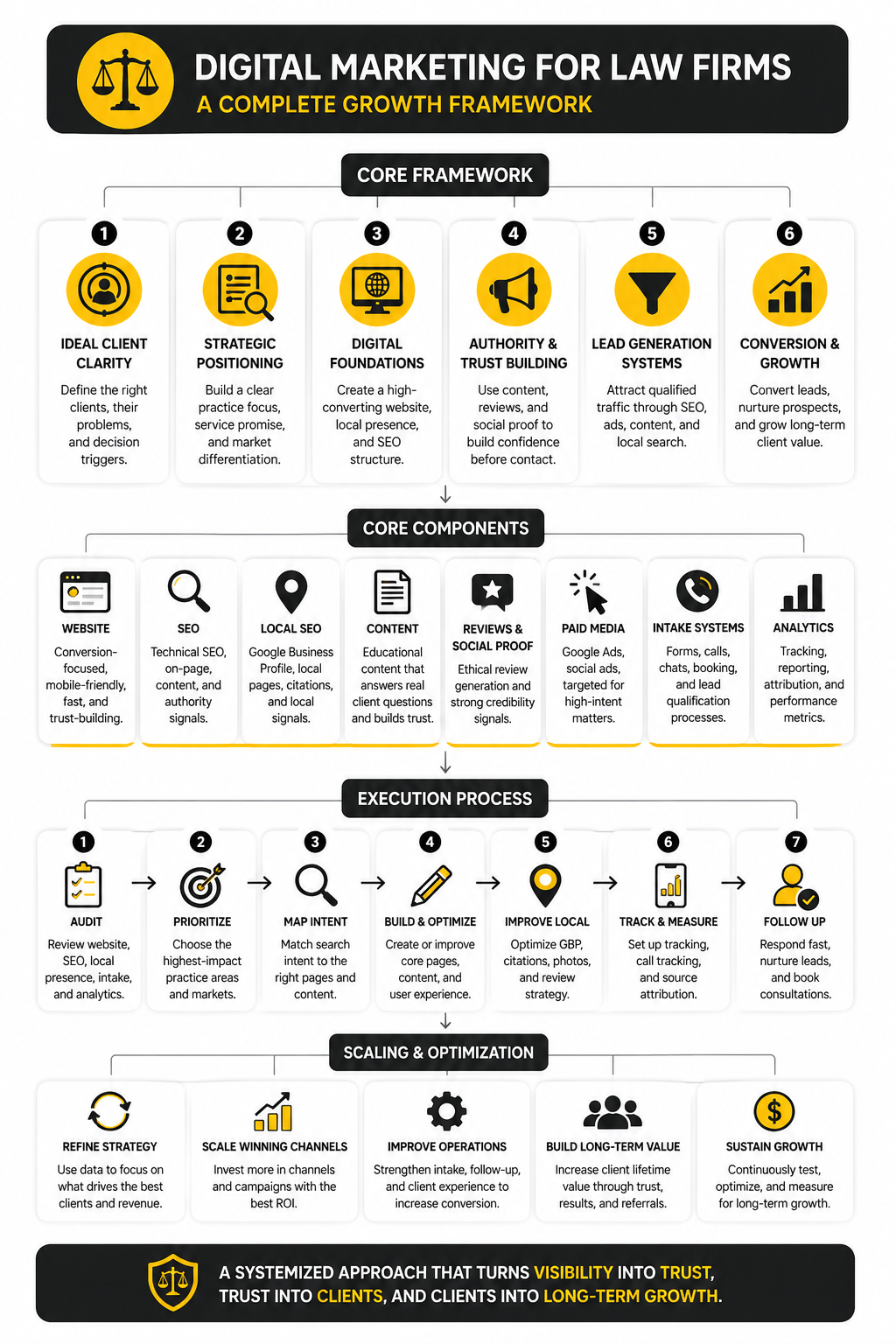
This is where many firms go wrong. They buy leads before fixing intake, publish content before clarifying their audience, or run ads to pages that do not build trust. A better framework makes every marketing channel support the same business outcome: more qualified consultations with people the firm is actually equipped to help.
Core Components Of A Law Firm Marketing System
The first component is clear positioning. A prospect should quickly understand who the firm helps, what problems it handles, where it practices, and why it is credible. Without that clarity, every channel becomes more expensive because the website has to work harder to explain the basics.
The second component is discoverability. This includes organic search, local SEO, Google Business Profile visibility, legal directories when appropriate, and content that matches real client questions. Search matters because high-intent prospects often begin with a problem, not a firm name.
The third component is conversion. Calls, forms, chat, booking links, follow-up workflows, and consultation pages all affect whether attention becomes revenue. Tools such as GoHighLevel can fit here when a firm needs CRM, automation, pipelines, and follow-up in one place, but the tool only helps when the strategy is already clear.
Professional Implementation Starts With Discipline
Professional implementation does not mean making everything complicated. It means the firm stops guessing and starts managing marketing like an operating system. Every channel should have a purpose, every page should support a decision, and every inquiry should be tracked from source to outcome.
That discipline is especially important in legal marketing because trust is fragile. Overpromising, vague claims, thin AI content, slow follow-up, or poor review management can quietly damage a firm’s credibility. The better approach is practical: say what the firm does clearly, support claims with proof, remove friction, and measure what happens.
The next part will build from this foundation into the first real strategic layer: positioning, practice areas, and client intent. That is where digital marketing for law firms starts becoming specific enough to work.
Positioning, Practice Areas, And Client Intent
The next layer is positioning. Before a firm worries about traffic, ads, content, or automation, it needs to be clear about what kind of client it wants and what kind of matter it is built to handle. Digital marketing for law firms becomes much easier when the firm is not trying to sound relevant to everyone.
Good positioning answers four questions quickly. Who do you help? What legal problems do you solve? Where do you practice? Why should someone trust you before they have spoken with you?
That sounds basic, but it is usually where weak campaigns break. A vague firm website says things like “experienced legal representation” and “aggressive advocacy” without giving the prospect anything concrete. A stronger firm makes the client feel understood before asking them to book a consultation.
Start With The Practice Areas That Actually Drive The Firm
Not every practice area deserves equal marketing attention. Some services are profitable, repeatable, and aligned with the firm’s future. Others exist because the firm technically can handle them, even if they are not a strategic growth priority.
A practical law firm marketing plan separates core practice areas from secondary services. Core practice areas should get dedicated pages, deeper content, stronger calls to action, and clearer intake workflows. Secondary services can still be present, but they should not dilute the main message.
This matters because search intent is specific. Someone searching for a probate lawyer has a different problem than someone searching for an estate planning attorney. Someone looking for a business litigation lawyer is not in the same mindset as someone trying to form an LLC.
Match The Message To The Client’s Stage
A legal prospect can be early-stage, urgent, comparison-driven, or ready to hire. Each stage needs a different message. If the firm gives everyone the same generic page, it leaves too much work for the client.
Early-stage prospects need clarity. They want to understand the issue, the possible next steps, and whether their situation is serious enough to contact a lawyer. Content works well here because it can educate without pressure.
Urgent prospects need speed and confidence. They are looking for availability, location, responsiveness, and a clear next action. For this audience, the page should make calling, submitting a form, or booking a consultation simple.
Comparison-stage prospects need proof. They are reading attorney bios, reviews, case focus, fee information where appropriate, and signs that the firm has handled similar matters. This is where weak positioning costs money because the prospect has options.
Build Around Real Client Questions
The best law firm content usually starts with questions clients already ask. What happens next? How long does this take? What should I bring? What mistakes should I avoid? What does a lawyer actually do in this situation?
Those questions create a cleaner content strategy than guessing topics from keyword tools alone. Keyword research is useful, but it should not replace client understanding. The goal is not to publish more pages; the goal is to publish the right pages for the right decision points.
This approach also helps the firm sound human. Legal content can easily become stiff, defensive, or overloaded with disclaimers. Clear answers, plain language, and practical next steps make the firm feel more approachable without weakening professionalism.
Define The Local Market Clearly
Most firms do not compete nationally, even if their website technically can be seen anywhere. They compete in specific cities, counties, regions, and court systems. That local reality should shape the website, SEO strategy, Google Business Profile, and paid campaigns.
Local positioning is more than adding city names to headings. A strong local strategy explains where the firm serves clients, which offices or consultation options are available, and why the firm is relevant in that market. It also keeps the firm from wasting budget on leads outside its realistic service area.
For many firms, this is where intake quality improves. When the marketing clearly defines geography, practice area, and next step, fewer unqualified inquiries slip through. That makes the entire system easier to manage.
Make The Promise Specific Without Overpromising
Legal marketing has to be careful. A firm should not make guarantees, exaggerate outcomes, or imply results it cannot ethically support. But being careful does not mean being bland.
A specific promise can focus on process, responsiveness, clarity, preparation, or client experience. For example, a firm can emphasize practical guidance, direct communication, structured case evaluation, or focused representation in a narrow practice area. Those claims are more believable than empty superlatives.
This is the balance that matters. The firm needs to be confident enough to stand out, but disciplined enough to stay credible. The strongest digital marketing for law firms is not loud; it is clear, useful, and easy to trust.
Website, SEO, And Local Search Foundations
Once the firm knows who it wants to reach, the next step is building the foundation those clients actually interact with. For most firms, that foundation is the website, the search presence, and the local visibility that helps a prospect decide whether the firm is worth contacting. This is where digital marketing for law firms becomes tangible, because strategy turns into pages, search results, calls, forms, and booked consultations.
A law firm website should not behave like a brochure. It should guide a stressed, cautious, high-intent visitor toward the right next step. That means every major practice area, attorney profile, location page, and contact path needs to support trust and decision-making instead of just filling space.
Build The Website Around The Client Journey
A strong law firm website starts with clear paths. A visitor should be able to identify the right practice area, understand whether the firm serves their location, see why the firm is credible, and know exactly how to contact the office. If any of those steps are confusing, the site is leaking opportunities.
The most important pages usually include the homepage, practice area pages, attorney bios, location pages, review or testimonial sections where ethically appropriate, contact pages, and educational content. Each page should have a job. A practice area page should explain the legal problem and invite action, while an attorney bio should build confidence in the person behind the representation.
This is also where design needs restraint. Clean layouts, fast loading, plain language, and obvious calls to action beat clever design that makes the visitor work. A firm can use conversion-focused page builders like ClickFunnels for campaign-specific landing pages, but the core website still needs strong information architecture and credibility.
Create Practice Area Pages That Deserve To Rank
A practice area page should not be a thin summary with a city name added to the title. It should explain the problem, who the firm helps, common scenarios, the legal process, what clients should prepare, and when they should reach out. That is how the page becomes useful to both search engines and real people.
Search visibility depends on relevance, quality, and structure. The 2024 ABA Websites and Marketing TechReport shows that digital presence is now a normal part of law firm operations, which means a weak site is no longer just a missed opportunity. It is a competitive disadvantage.
The practical move is to build one strong page for each priority service before expanding into dozens of smaller topics. A family law firm does not need fifty shallow pages before it has a serious divorce page, custody page, support page, and local consultation path. Depth beats volume when the page matches a real client decision.
Make Local Search A Serious Channel
Local search is one of the most important pieces of digital marketing for law firms because many legal matters are tied to geography. Prospects often search with local intent, compare firms in map results, and look for signs that the attorney is accessible. That makes Google Business Profile, local pages, reviews, and consistent business information essential.
Google states that local results are mainly shaped by relevance, distance, and prominence. A law firm cannot control every part of that system, but it can control the accuracy and completeness of its profile, the quality of its website, the consistency of its listings, and the way it earns legitimate reviews. Those basics are not glamorous, but they compound.
Local SEO also needs to stay honest. Do not create fake offices, stuff city names into awkward copy, or publish location pages for areas the firm does not genuinely serve. The goal is to make the firm easier to find for the right local clients, not to game the map pack for traffic that will never convert.
Follow A Simple Implementation Process
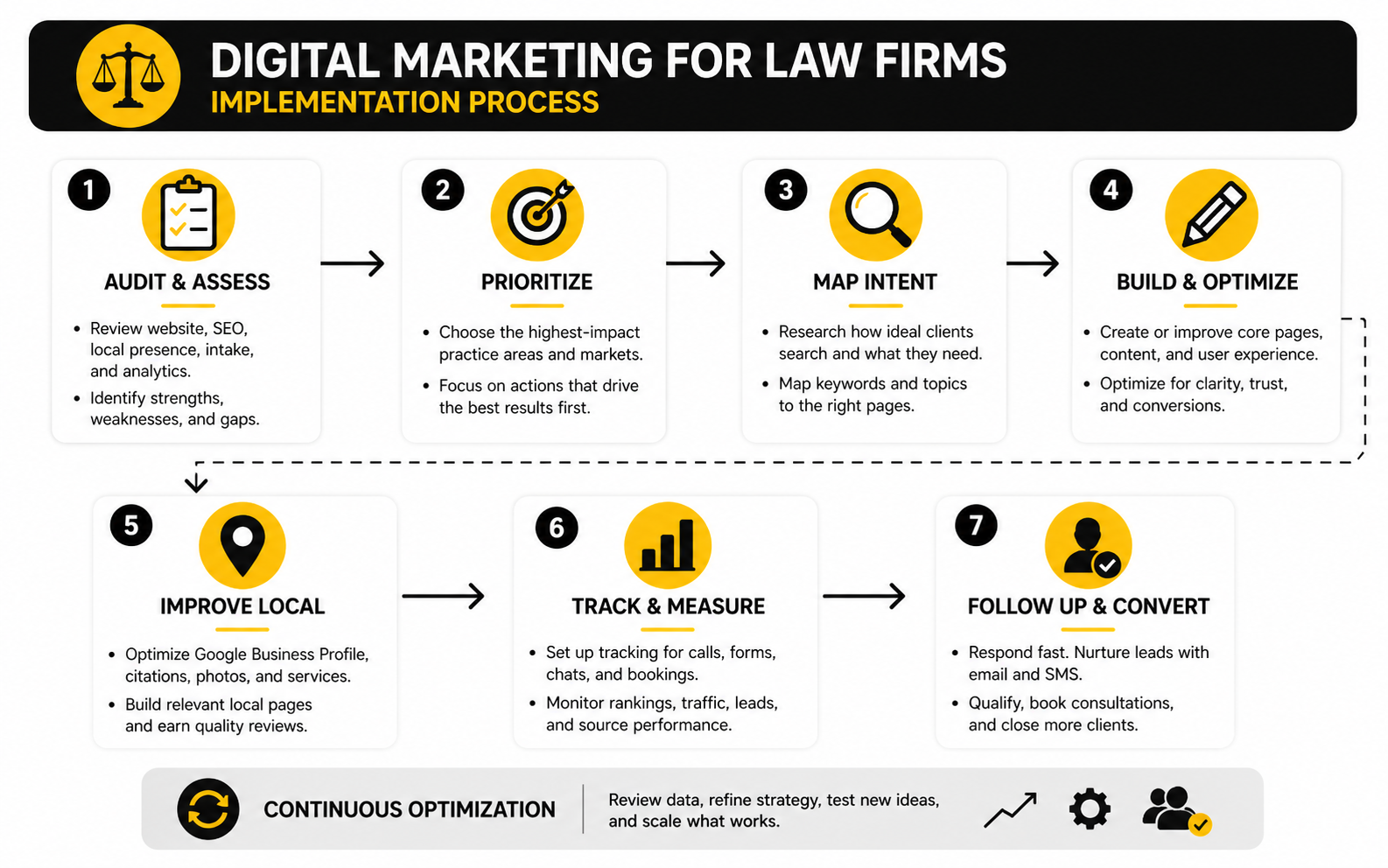
Execution gets easier when the firm follows a clear sequence. Start by fixing the pages that affect revenue first, then expand into supporting content and technical improvements. This keeps the project focused and prevents the firm from spending months on marketing work that does not move intake.
- Audit the current website and search presence. Review the homepage, priority practice area pages, attorney bios, contact paths, Google Business Profile, reviews, and analytics setup.
- Choose the priority matters. Pick the practice areas that are most profitable, strategically important, and realistic to compete for in the firm’s market.
- Map search intent to pages. Decide which pages should target urgent hiring intent, which should educate early-stage prospects, and which should support comparison.
- Rewrite or build the core pages. Focus on clarity, proof, process, location relevance, and strong calls to action.
- Improve local visibility. Update Google Business Profile, confirm business information consistency, add useful photos where appropriate, and create a responsible review request process.
- Track leads properly. Set up call tracking, form tracking, booking tracking, and source attribution so the firm can see what is actually working.
This process is simple on purpose. The firms that win are not always doing more things; they are doing the right things in the right order. Once the foundation is working, content, ads, automation, and follow-up become much more effective.
Fix Intake Before Scaling Traffic
Traffic is not the same as growth. If calls go unanswered, forms sit for hours, or leads are not followed up with consistently, more visitors will only expose a broken intake process faster. That is why implementation has to include the handoff from marketing to the front desk, intake team, or attorney.
A serious intake process defines who responds, how fast they respond, what questions they ask, how consultations are booked, and how non-fit inquiries are handled. It also needs a reliable place to track every lead. A platform like GoHighLevel can support pipelines, reminders, forms, automations, and follow-up, but the firm still has to define the process first.
This part is emphatic because it matters: slow response kills legal leads. A prospect with an urgent issue will not wait patiently while three firms compete for attention. The firm that answers clearly, quickly, and professionally often earns trust before the legal analysis even begins.
Keep The Foundation Measurable
The final piece of this stage is measurement. A firm should know which pages bring inquiries, which channels create consultations, which consultations become clients, and which matters generate the best revenue. Without that visibility, marketing decisions become opinion battles.
Measurement does not need to be complicated at the beginning. Track organic inquiries, local search calls, form submissions, paid campaign leads, consultation bookings, signed clients, and matter value. Those numbers give the firm enough clarity to improve instead of guessing.
The next stage builds on this foundation with content, reviews, paid media, and conversion. Those channels can produce serious results, but only when the website, local presence, and intake process are strong enough to support them.
Statistics And Data
Measurement is where digital marketing for law firms becomes a business decision instead of a guessing game. Rankings, clicks, impressions, and ad spend are useful, but they are not the whole story. The real question is whether marketing is producing qualified consultations, signed matters, and profitable growth.
A firm should treat data as a decision system. If organic traffic is growing but consultations are flat, the issue may be page intent, calls to action, or intake speed. If paid leads are coming in but few are retained, the problem may be targeting, screening, pricing fit, or follow-up quality.
The legal market is already moving in this direction. The 2025 Clio Legal Trends Report connects firm performance with technology, client experience, and operational efficiency, while the 2025 State of the US Legal Market shows why firms are under pressure to adapt as demand, productivity, and technology expectations keep changing.
Track The Metrics That Connect To Revenue
The first mistake is tracking too many numbers with no hierarchy. A law firm does not need a dashboard full of vanity metrics. It needs a clean view of the path from visibility to retained client.
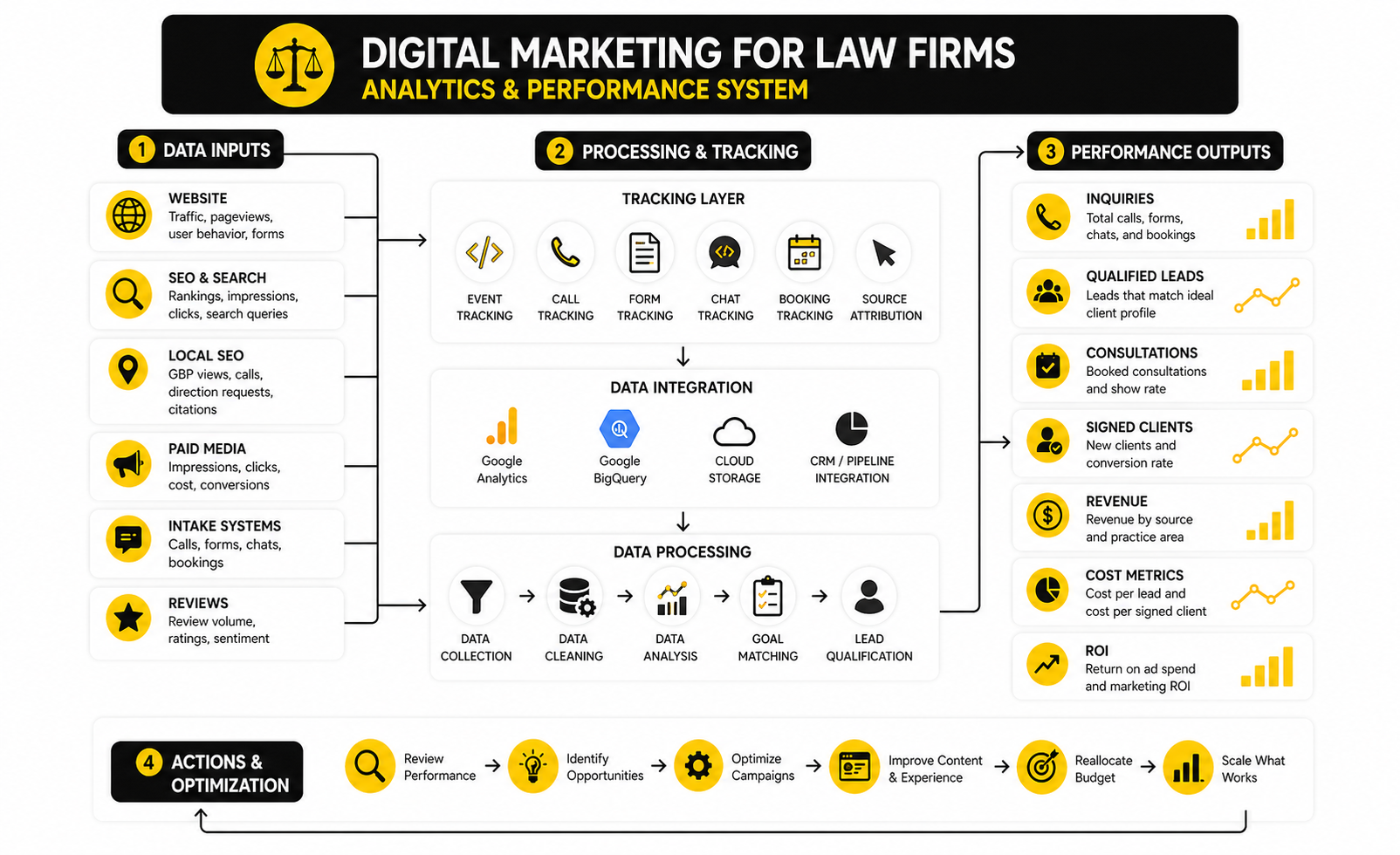
The most useful metrics usually fall into five groups. Visibility shows whether the firm is being found. Engagement shows whether the right people are interacting with the website. Conversion shows whether visitors are becoming inquiries. Intake shows whether inquiries are becoming consultations. Revenue shows whether those consultations are becoming valuable matters.
A practical measurement stack should track:
- Organic search impressions and clicks for priority practice areas
- Google Business Profile calls, direction requests, and website visits
- Form submissions, calls, chats, and booked consultations
- Lead source by channel, campaign, page, and location
- Consultation show rate and signed-client rate
- Cost per qualified lead and cost per retained client
- Revenue by source, practice area, and matter type
These numbers matter because they show where the bottleneck lives. If impressions are low, the firm needs stronger visibility. If traffic is strong but inquiries are weak, the page is not converting. If inquiries are strong but signed clients are weak, the issue is intake, qualification, or fit.
Interpret Benchmarks Carefully
Benchmarks can be useful, but they can also mislead. A personal injury firm in a major city, an estate planning practice in a suburban market, and a boutique business litigation firm should not expect the same cost per lead or conversion rate. Practice area, urgency, competition, geography, fee structure, and intake quality all change the numbers.
That is why benchmarks should be treated as context, not commandments. The firm’s own baseline is often more important than an industry average. If the firm improves from 20 qualified consultations per month to 30 while maintaining matter quality, that is meaningful even if a generic benchmark says something else.
The right question is not “Are our numbers normal?” The better question is “Are our numbers improving in the places that actually affect growth?” A firm that understands its own baseline can make sharper decisions than a firm chasing random averages from broad marketing reports.
Separate Leads From Qualified Opportunities
Not every lead is worth the same. A form submission from someone outside the service area is not equal to a booked consultation for a high-value matter. A phone call from a price shopper is not the same as a referred prospect who has already decided they need representation.
This is why digital marketing for law firms needs qualification metrics. The firm should know not only how many inquiries arrived, but how many were relevant, reachable, financially realistic, and aligned with the firm’s practice areas. Without that layer, a campaign can look successful while quietly wasting staff time.
A simple qualification system can label leads as qualified, unqualified, duplicate, out of area, wrong practice area, no response, or retained. That structure makes reporting far more useful. It also protects the firm from scaling a channel that produces volume without value.
Measure Local Search As Its Own Channel
Local search deserves separate attention because it behaves differently from broader SEO. A prospect may find the firm through Google Maps, read reviews, check hours, visit the website, and call without ever landing on a blog post. If the firm only looks at website analytics, it may undercount the value of local visibility.
Google’s local system is built around relevance, distance, and prominence, so performance should be reviewed through that lens. Relevance depends on how clearly the firm matches the search. Distance depends on the searcher’s location and service area. Prominence is influenced by signals such as reputation, visibility, and overall web presence.
Action comes from the pattern. If profile views are healthy but calls are weak, the profile may need stronger photos, services, descriptions, or review quality. If calls are rising but retained clients are not, intake and qualification need attention. If rankings are inconsistent across locations, the firm may need better local pages, stronger citations, or more focused review generation.
Use Paid Media Data To Buy Clarity
Paid media can work well for certain law firms, but it punishes vague strategy fast. Every click costs money, so weak targeting, broad keywords, poor landing pages, and slow follow-up become expensive very quickly. The data should tell the firm whether it is buying qualified opportunities or simply buying activity.
For paid campaigns, the firm should track cost per qualified lead, cost per consultation, cost per retained client, and revenue by campaign. Click-through rate and cost per click are useful, but they are supporting signals. A cheap lead that never becomes a client is still expensive.
Landing pages also need separate measurement. A focused campaign page built with a tool like ClickFunnels can make testing easier because the message, offer, form, and follow-up path are easier to control. The key is to judge the page by qualified consultations, not by how polished it looks.
Turn Reporting Into Better Decisions
Reporting should lead to action. If a monthly report only lists numbers without decisions, it is not management; it is decoration. A good report should show what changed, why it likely changed, and what the firm will do next.
The firm should review performance by channel and by practice area. Organic search may be working for estate planning but not probate. Paid search may be producing calls for criminal defense but poor fit for business law. Local search may be strong in one office location and weak in another.
This is where a CRM and pipeline system can help. Tools like GoHighLevel can connect forms, calls, automations, opportunities, and follow-up so the firm can see more than surface-level traffic. But the principle is bigger than the tool: marketing data only matters when it helps the firm make better decisions faster.
Content, Reviews, Paid Media, And Conversion
After the foundation is measurable, the next question is where to scale. This is where law firms usually get tempted by more content, more ads, more platforms, and more automation. Some of that can work extremely well, but only when each channel has a clear role in the client journey.
The advanced move is not to be everywhere. The advanced move is to know which channel should create awareness, which should capture demand, which should build trust, and which should help convert the inquiry into a retained client. Digital marketing for law firms gets stronger when each piece has a job and the firm stops treating every tactic as equal.
Use Content To Build Trust Before The Consultation
Content should not exist just to feed a blog. It should answer the questions that block a prospect from taking the next step. A strong content strategy helps people understand their situation, recognize when they need legal help, and feel more confident contacting the firm.
This does not mean giving legal advice that creates risk or confusion. It means explaining process, timing, terminology, preparation, and common decision points in a responsible way. The firm can be useful without pretending every reader has the same facts.
The best content usually supports a priority practice area. A custody lawyer might publish practical explainers around parenting plans, modification questions, and what to bring to a consultation. A business lawyer might create content around contract disputes, founder agreements, employment issues, or risk review before a major deal.
Treat Reviews As Proof, Not Decoration
Reviews are not just reputation badges. They are decision assets. A cautious prospect wants to know whether real people felt heard, guided, and supported during a stressful legal matter.
The risk is that firms sometimes chase review volume without thinking about quality, ethics, or process. Review requests should be timely, compliant, and respectful. They should never pressure clients, promise incentives where prohibited, or imply a specific outcome.
The useful question is simple: what does a prospect learn from the firm’s reviews? If the answer is “not much,” the firm may need a better client experience and a more consistent request process. Strong reviews often reflect strong operations, not just good marketing.
Scale Paid Media Only When The Economics Make Sense
Paid media can create fast visibility, but it can also burn money faster than almost any other channel. Competitive legal keywords are often expensive because multiple firms are bidding for clients with high case value. That does not make paid ads bad; it means the economics have to be managed carefully.
A paid campaign should be judged by retained-client cost and matter quality, not just lead count. If a campaign generates cheap leads that do not fit the firm, it is not working. If a campaign produces fewer leads but better consultations and higher-value matters, it may be worth scaling.
Landing pages matter here because ad traffic is impatient. A focused page should match the search intent, explain the service clearly, show credibility, remove friction, and make the next step obvious. Tools like ClickFunnels can help firms test campaign-specific pages faster, but the message still has to be sharp.
Balance Automation With Human Judgment
Automation is useful when it improves speed, consistency, and visibility. It can confirm form submissions, route leads, remind staff to follow up, send consultation instructions, and keep prospects from falling through the cracks. That kind of operational support is valuable.
But legal services are not a low-trust impulse purchase. A prospect may be dealing with divorce, criminal charges, immigration pressure, injury, debt, probate, or a business dispute. Automation should support the human relationship, not make the firm feel distant or careless.
This is where platforms like GoHighLevel can be helpful for pipelines, follow-up workflows, call tracking, forms, and reminders. The firm still needs judgment around tone, timing, compliance, and when a real person should step in. Automation should make the firm more responsive, not more robotic.
Manage Ethics Before Marketing Gets Aggressive
Legal marketing has constraints for a reason. The ABA Model Rules on communications about legal services allow lawyers to advertise, but the firm still has to avoid misleading claims, improper recommendations, and careless statements about services. State rules can add more specific requirements, so marketing should be reviewed with the firm’s jurisdiction in mind.
This affects ads, landing pages, testimonials, chat scripts, email follow-up, AI-generated content, comparison claims, and even how practice areas are described. A campaign can be persuasive without crossing the line. In fact, clear and restrained marketing usually feels more credible than exaggerated promises.
The safest strategic posture is simple: explain the process, show relevant experience, make next steps easy, and avoid guarantees. That still leaves plenty of room for strong positioning. The firms that win long term do not need hype; they need trust at scale.
Decide What To Own And What To Outsource
As the system grows, the firm has to decide what stays internal and what gets outsourced. Strategy, brand voice, client experience, intake standards, and ethical review should never be fully handed off without oversight. Those are too close to the firm’s reputation.
Execution can often be supported by specialists. SEO, paid media, website development, analytics setup, CRM implementation, and content production may benefit from outside help when the firm lacks time or expertise. The key is to keep ownership of the business goals, not just delegate a list of tasks.
A useful rule is to outsource production, not responsibility. The firm should still know which practice areas matter, what a qualified lead looks like, which claims are appropriate, and how performance will be measured. Vendors can help build the machine, but the firm has to steer it.
Watch For Scaling Problems Before They Become Expensive
Growth creates operational pressure. More leads mean more calls, more screening, more consultations, more follow-up, and more chances for the client experience to break. If the firm scales marketing faster than intake and capacity, quality suffers.
This is why mature digital marketing for law firms includes capacity planning. The firm should know how many consultations it can handle, how quickly staff can respond, which matters should be declined, and when marketing should shift from more volume to better fit. Growth without filtering is not strategy.
The smartest firms build feedback loops between marketing, intake, attorneys, and finance. Marketing shows what is attracting attention. Intake shows what prospects actually need. Attorneys show which matters are worthwhile. Finance shows whether the economics support more investment.
Professional Implementation, Measurement, And FAQ
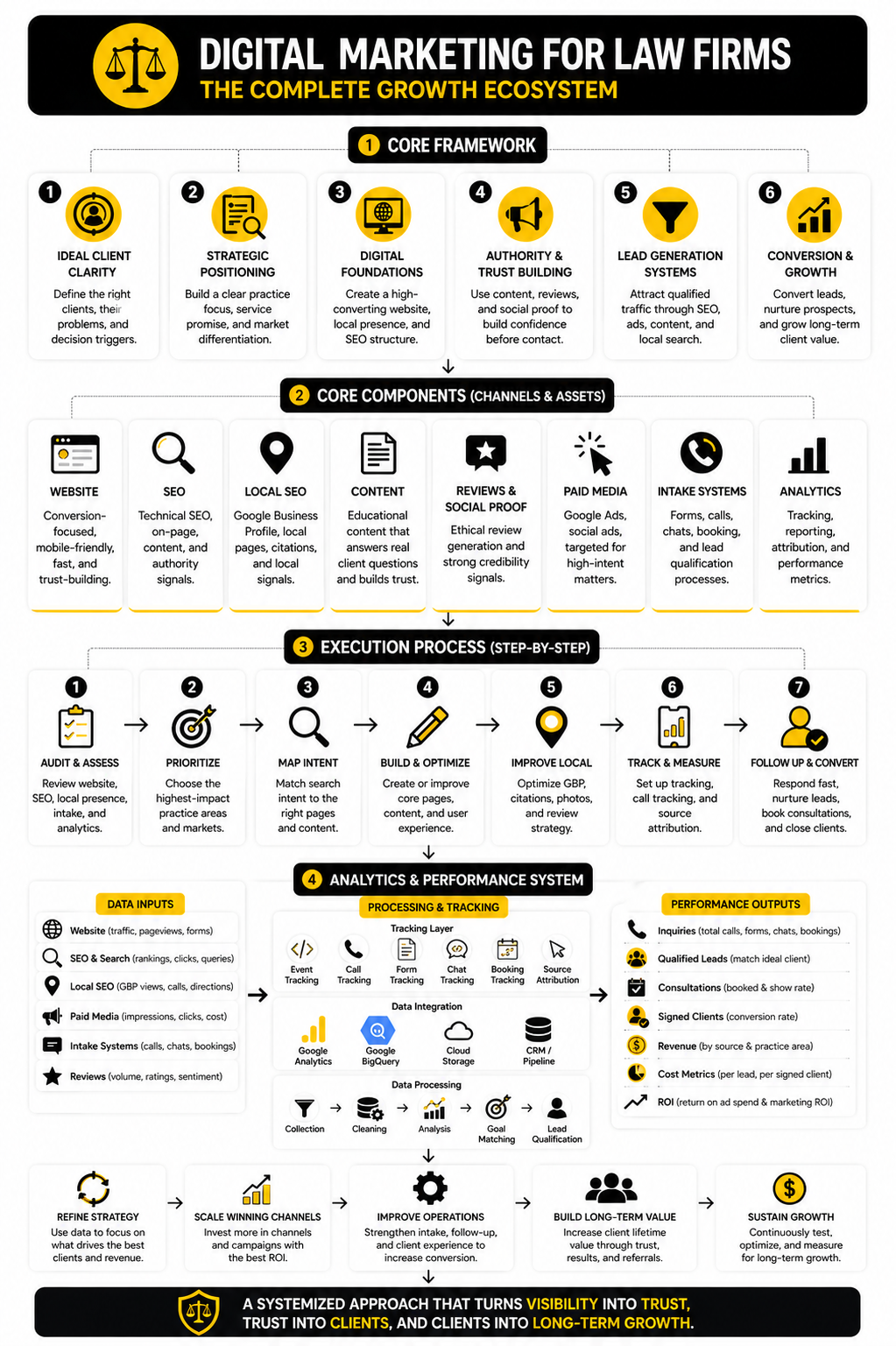
The final stage is pulling the system together. A law firm does not need disconnected campaigns, isolated tools, or reports that nobody acts on. It needs an ecosystem where positioning, search, content, reviews, paid media, intake, automation, and measurement all support the same outcome.
That outcome is not just more traffic. It is more qualified conversations with people who understand what the firm does, trust the firm enough to reach out, and fit the matters the firm actually wants. Digital marketing for law firms works best when every channel makes that path clearer.
Build The Final System Around Fit
A mature marketing system should filter as much as it attracts. That may sound counterintuitive, but it is critical. A firm that attracts the wrong inquiries will waste attorney time, frustrate intake staff, and make marketing look worse than it really is.
The website should make the right visitor feel seen and the wrong visitor self-select out. Practice area pages should be specific enough to clarify fit. Intake forms should collect enough context to route inquiries properly without making the process feel cold or overwhelming.
This is also where follow-up becomes a competitive advantage. A firm can use tools like GoHighLevel to manage pipelines, reminders, automations, and lead tracking, but the message should still sound like the firm. The best system feels organized behind the scenes and human on the front end.
Keep Improving The System In Cycles
Digital marketing is not a one-time rebuild. Search behavior changes, competitors improve, ad costs shift, reviews age, and client expectations keep moving. The firms that stay disciplined review their system in cycles instead of waiting until performance drops.
A useful monthly review looks at visibility, inquiries, qualified consultations, retained clients, and revenue by source. A useful quarterly review goes deeper into practice area performance, local search strength, content gaps, paid campaign economics, intake quality, and capacity. That rhythm keeps the firm focused on practical improvement instead of random marketing activity.
The point is not perfection. The point is momentum. A law firm that improves one page, one intake step, one campaign, and one reporting habit at a time will usually outperform a firm that keeps chasing the newest tactic.
FAQ - Built For Complete Guide
What is digital marketing for law firms?
Digital marketing for law firms is the process of using online channels to attract, educate, qualify, and convert potential legal clients. It usually includes website strategy, SEO, local search, content, reviews, paid ads, intake systems, email follow-up, and analytics. The goal is not just visibility; the goal is better-fit consultations and signed matters.
Why is digital marketing important for law firms?
Digital marketing matters because many clients research attorneys before making contact. They compare websites, reviews, search results, attorney profiles, and response options before deciding who feels credible. A strong digital presence helps the firm build trust before the first conversation.
What should a law firm fix first?
The first priority should be positioning and the website path to inquiry. If the firm is unclear about who it serves, which matters it wants, and what action a visitor should take, traffic will not solve the problem. After that, the firm should improve local visibility, practice area pages, intake, and tracking.
Is SEO still worth it for law firms?
SEO is still worth it when the firm targets the right practice areas and builds useful pages around real client intent. It is not worth it when the strategy depends on thin content, awkward keyword stuffing, or city pages with no substance. Strong SEO helps a firm capture demand from people already searching for legal help.
How important is local SEO for attorneys?
Local SEO is extremely important for many practice areas because clients often want a lawyer who serves their city, county, or region. Google’s local results are shaped by relevance, distance, and prominence, which makes accurate profiles, strong reviews, clear service information, and local website pages important. Local SEO should be treated as its own channel, not just a small SEO add-on.
Should law firms run paid ads?
Paid ads can work when the firm understands its numbers and has a strong landing page, intake process, and follow-up system. They are risky when the firm only tracks lead count and ignores qualified consultations, retained clients, and matter value. Paid media should be scaled only when the economics are clear.
What content should law firms publish?
Law firms should publish content that answers real client questions and supports priority practice areas. Good topics explain process, timing, preparation, risks, common mistakes, and when to contact an attorney. The content should be practical and plainspoken without pretending to give one-size-fits-all legal advice.
How should a law firm measure marketing success?
A law firm should measure success from source to signed matter. Useful metrics include calls, forms, booked consultations, qualified leads, show rate, signed-client rate, cost per retained client, and revenue by practice area. Traffic and rankings matter, but they only become valuable when they connect to business outcomes.
How can a law firm improve conversion?
Conversion improves when the website is clear, fast, credible, and easy to act on. Practice area pages should explain the client’s problem, show the firm’s relevance, and give a simple next step. Intake also matters because a slow or confusing response can waste even the best traffic.
What role do reviews play in law firm marketing?
Reviews help prospects reduce uncertainty. They show whether past clients felt guided, respected, and supported during serious legal situations. A firm should build a responsible review process that is ethical, consistent, and focused on client experience rather than pressure.
Can automation help law firms get more clients?
Automation can help when it improves responsiveness and consistency. It can confirm inquiries, remind staff to follow up, route leads, send consultation instructions, and keep prospects from being forgotten. It should not replace human judgment, especially when the matter is sensitive or the prospect needs reassurance.
What is the biggest mistake law firms make with digital marketing?
The biggest mistake is treating marketing as a collection of tactics instead of a system. A firm may buy ads, post content, redesign a website, or add software without fixing positioning, intake, measurement, or client fit. Strong digital marketing for law firms works because the pieces connect.
Work With Professionals
Explore 10K+ Remote Marketing Contracts on MarkeWork.com
Most marketers spend too much time chasing clients, competing on crowded platforms, and losing a percentage of every project to middlemen.
MarkeWork gives you a better way. Browse thousands of remote marketing contracts and connect directly with companies desperate to hire skilled marketers like you, without platform commissions and without unnecessary gatekeepers.
If you are serious about finding better opportunities and keeping 100% of what you earn, explore available contracts and create a profile for free at MarkeWork.com.