

A plumbing company does not need more marketing noise. It needs more booked jobs. That is the real point of digital marketing for plumbers: showing up when the need is urgent, looking trustworthy in seconds, and making it ridiculously easy for the customer to call, message, or book.
That pressure is getting stronger, not weaker. SOCi’s consumer research shows local business search is now a weekly habit for 80% of U.S. consumers and a daily habit for 32%, Pew reports 91% of U.S. adults own a smartphone, and BrightLocal’s latest survey shows Google still leads as the main source consumers use for reviews at 71%. In plain English, if your plumbing business is hard to find or hard to trust on a phone, you are losing jobs before the phone ever rings. SOCi+2
Google also tells you, pretty openly, what matters most in local visibility. Local results are mainly shaped by relevance, distance, and prominence, and more reviews and positive ratings can help local ranking. A properly built Business Profile is designed to turn people who find you on Search and Maps into new customers, which is why generic “brand awareness” advice is not enough for this category. Google Podpora+2
Here is the structure this article will follow:
- Why Digital Marketing for Plumbers Matters Now
- The Local Lead Generation Framework
- Google Business Profile and Local SEO Foundations
- Paid Search, Local Services Ads, and High-Intent Traffic
- Conversion Systems, Follow-Up, and Review Growth
- Professional Implementation, Metrics, Mistakes, and FAQ
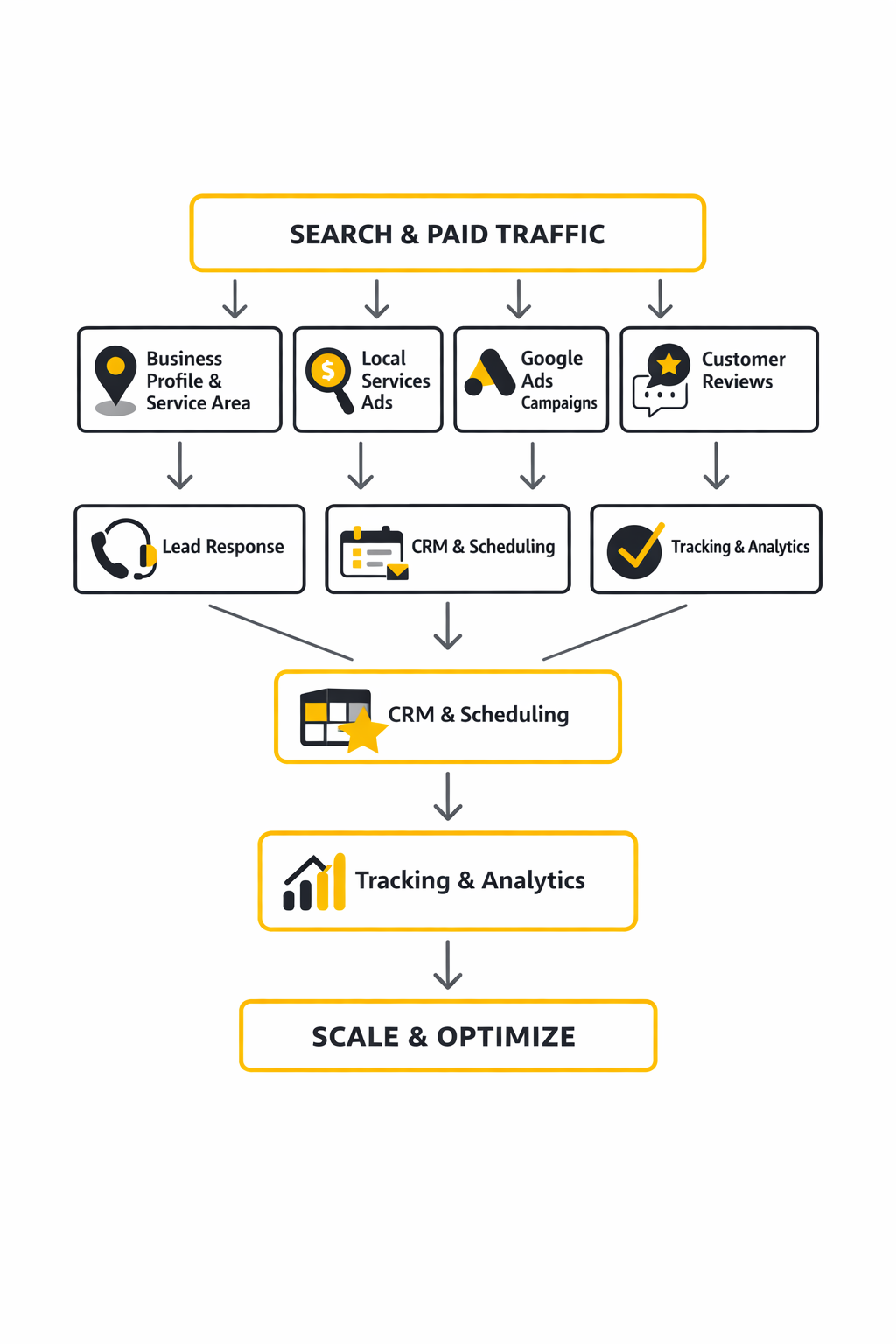
Why Digital Marketing for Plumbers Matters Now
Plumbing demand is local, time-sensitive, and usually inconvenient for the customer. People are not casually researching a burst pipe for three weeks and building a comparison spreadsheet. They are searching, scanning, and deciding fast, which is exactly why Google surfaces plumbers through Business Profiles, Maps, and Local Services Ads that can appear at the top of search results and let prospects call, message, or book directly instead of wandering through a slow funnel. Google Business
The search experience is also becoming more operational. Google says customers can schedule bookings directly through Local Services Ads, and in the U.S. Google can even call businesses on behalf of customers to confirm pricing, availability, or appointment details. That means your marketing is no longer just about getting seen; it has to be accurate enough, fast enough, and connected enough to support real booking behavior. Google Podpora+1
Trust is the second half of the equation, and this is where many plumbing businesses quietly leak revenue. BrightLocal’s 2026 data shows 47% of consumers will not use a business with fewer than 20 reviews, 74% care about reviews from the last three months, and 80% are more likely to use a business that responds to all reviews. For plumbers, that turns reviews from a “nice marketing extra” into part of the sales process itself. BrightLocal+2
There is one more local twist here: plumbers are classic service-area businesses. Google’s own guidance uses plumbers as a direct example of a service-area business, says service areas help people find your profile, and warns that if you do not serve customers at your address, you should remove that address and use an accurate service area instead. So when people talk about digital marketing for plumbers, they should really be talking about local visibility, local proof, and local operations working together. Google Podpora+2
The Local Lead Generation Framework
The easiest way to think about digital marketing for plumbers is as a local demand-capture system. Google and review platforms create the discovery layer, your profile and website create the trust layer, and your phone, forms, chat, and follow-up process create the conversion layer. That model lines up with how Google presents local service businesses and how consumers compare them in real time. Google Business+2
In practice, the framework looks like this:
- Get found through your Google Business Profile, service areas, local SEO, and high-intent search visibility.
- Build trust fast with complete business information, recent reviews, review responses, strong photos, and clear service pages.
- Capture the lead with click-to-call, short quote forms, booking options, and fast mobile pages.
- Book and follow up with dispatch-aware automation, reminders, missed-call recovery, and simple scheduling.
- Turn completed jobs into compounding growth by requesting reviews consistently and feeding that proof back into your rankings and conversion rate.
This matters because most plumbing companies do not actually have a traffic problem. They have a handoff problem. The business shows up, the customer clicks, and then something breaks: the page is thin, the reviews are stale, the service area is confusing, the form is bloated, or nobody follows up quickly enough.
When you build the system properly, the stack gets simpler. Many teams handle the pipeline and automation layer with tools like HighLevel, use a cleaner request flow through Fillout, and add an after-hours site assistant through Chatbase so visitors can start the conversation even when the office is closed. The rest of this article will break down each layer in order, starting with the local foundations that make every other channel work harder.
Google Business Profile and Local SEO Foundations
The next layer of digital marketing for plumbers is the part most companies either rush or half-finish: the local foundation. This is where Google decides whether your business looks clear, trustworthy, and relevant enough to show to nearby searchers, and it is also where customers decide whether to click or keep scrolling. A verified Google Business Profile can help customers find you and build trust, and Google explicitly says complete, accurate business information makes a profile more likely to appear in relevant local searches. Google Podpora+1
Start with the profile, not the homepage
For a plumbing business, the Google Business Profile usually matters before the homepage does. Google says a service business profile can include your business name, website, phone number, hours, reviews, and services, and verification is what gives you control over that information. Categories also matter more than many owners realize, because Google states that the categories you choose affect your local ranking and help connect your business with customers searching for those services. Google Podpora+2
That means the first job is not “do some SEO.” The first job is making the profile complete enough that both Google and the customer instantly understand what you do, where you work, and how to contact you. Google’s own recommendations are plain here: keep business information up to date, include details like hours, phone, website, and photos, and make the profile as complete as possible. Google Podpora+2
For most plumbers, that starting checklist should include:
- A verified profile
- The correct primary category
- Accurate phone, hours, and website
- Real service areas
- A service list that reflects actual revenue-driving jobs
- Recent photos of vans, team members, jobs, and branded presence
None of that is glamorous. All of it matters because Google combines information from your profile, your website, user contributions, and other sources to build what people see in local results. That is why messy business details create friction fast, even before you start thinking about rankings. Google Podpora+1
Set up your service area like an operator
Plumbers are classic service-area businesses, and Google treats them that way. If you serve customers at your business address and also travel out to jobs, Google says you can enter both the address and a service area. If you do not serve customers at your business address, Google says to remove the address and show only the service area instead. Google Podpora+1
This is where a lot of local visibility gets diluted. Owners try to look bigger by stretching coverage too far, but that creates a mismatch between where the business is actually based and where it claims to operate. Google lets you set up to 20 service areas based on cities, postcodes, or other areas you serve, and it also says your address or service area should be accurate and precise. Google Podpora+1
The practical move is simple: define service areas around where your crews can actually respond profitably and fast. In digital marketing for plumbers, inflated coverage is not strategy. It is usually just a slower way to confuse both Google and the customer.
Make every profile field pull its weight
Once the service area is right, the next step is to make each profile field do real work. Google says your business categories help customers understand what you do, recommends choosing the specific category that best describes the business, and notes that you cannot invent your own category. It also lets you add services, custom services, prices, and descriptions, which is useful for plumbing companies that want to clarify jobs like water heater repair, drain cleaning, leak detection, repiping, or emergency callouts. Google Podpora+1
The description matters too, but only if it reads like a real business and not a keyword dump. Google’s guideline is to use the description field for useful information about services, products, mission, and history, and to keep it relevant and honest. That is the right standard for a plumbing company anyway: say what you do, who you serve, and what makes the service experience easier, cleaner, or faster. Google Podpora
Photos are not decoration here. Google says photos and videos help complete the profile and make it more attractive to customers, and verified businesses can add exterior, product, and service-related visuals. For plumbers, that usually means branded vans, clean technician headshots, before-and-after job photos, equipment, and anything that makes the business feel real when someone is deciding in a hurry. Google Podpora+1
There are also a few underused profile elements worth tightening up. Google supports business attributes that appear on Search and Maps, and it also supports local business links that can help customers review service information or take action directly from the profile. Even profile posts can help customers decide to visit or contact the business when you use them for timely updates, service reminders, or seasonal plumbing issues that actually matter to homeowners. Google Podpora+2
Build local pages that deserve to rank
A plumbing website does not need fifty thin location pages. It needs pages that actually help a person solve a local problem. Google’s search guidance is consistent on this: its systems are designed to prioritize helpful, reliable, people-first content, and doorway pages created just to rank for similar queries are considered spam. Google for Developers+1
That changes how you should build local SEO for plumbers. A strong structure is usually one clear service page per core job type, plus location pages only for markets where you genuinely operate and can write something specific and useful. Instead of cloning the same paragraph across ten suburbs, build pages around real differences in response area, service availability, common property issues, emergency coverage, financing, or scheduling expectations, because that is the kind of information a customer can actually use. Google for Developers+2
The page also has to work on a phone first, not as an afterthought. Google uses the mobile version of a site for indexing and ranking, recommends solid Core Web Vitals, and still points to HTTPS and avoiding intrusive interstitials as part of a good page experience. For a plumbing company, that means fast load times, obvious call buttons, short quote forms, readable headings, and no pop-up circus blocking the screen. Google for Developers+1
Teams rebuilding this layer often prefer a simpler stack instead of patching five different tools together. For businesses that want landing pages, forms, pipeline tracking, and follow-up in one place, HighLevel is a practical platform to evaluate, and Fillout is a clean option for shorter service request forms that do not scare people away before they submit.
Add structured data and tracking before you scale traffic
Once the profile and pages are solid, add the extra structure that helps search engines understand the business better. Google says Local Business structured data can communicate details like business hours, departments, and reviews, and its structured data guidelines recommend JSON-LD while also requiring that markup stay accessible and compliant with Search Essentials. Schema.org also includes a dedicated Plumber type under local business classifications, which gives developers a cleaner way to label the business entity itself. Google for Developers+2
This is not magic dust. Structured data does not rescue weak pages, and Google is clear that rich result eligibility depends on following technical and quality guidelines. But on a clean plumbing site, it is a sensible layer because it reduces ambiguity around who you are, where you operate, and what kind of business the site represents. Google for Developers+1
The last piece is measurement. Google Business Profile performance reporting shows views, clicks, and other customer interactions on Search and Maps, and the Profile Strength indicator helps identify missing information such as descriptions, hours, contact details, photos, videos, and posts. Before you spend harder on ads or automation, make sure these local fundamentals are complete enough to deserve the extra traffic. Google Podpora+1
Paid Search, Local Services Ads, and High-Intent Traffic
Once the local foundation is solid, paid acquisition becomes a force multiplier instead of a bandage. For digital marketing for plumbers, that usually means catching urgent demand through Local Services Ads and tightly structured Google Search campaigns, not spraying money across broad awareness channels that do not turn into calls. That discipline matters because WordStream’s 2025 benchmark report covering more than 16,000 campaigns put the average Google Ads cost per lead at $70.11 overall and $90.92 in Home & Home Improvement, which is expensive enough that sloppy targeting gets punished fast. WordStream+1
Start with Local Services Ads where eligible
For many plumbers, Local Services Ads are the most natural paid entry point because Google positions them to generate direct leads rather than page visits. Google says these ads produce phone calls and messages, and that advertisers pay for valid leads rather than clicks. It also requires businesses to pass a screening and verification process that can include business registration, insurance, license checks, background checks, and minimum review requirements depending on category and location. Google Podpora+1
Ranking inside Local Services Ads is not just a bidding game. Google says those listings are ordered through an auction that considers bid and overall profile quality, and its review guidance says star ratings and review volume affect ranking and help providers stand out and book more jobs. For plumbers, that means reviews, response speed, service accuracy, and profile completeness are part of paid performance, not some separate reputation project. Google Podpora+2
Budgeting this channel properly matters more than most owners think. Google says Local Services Ads are set with an average weekly budget, that spend can run above that in a given week, and that monthly spend is capped by a monthly maximum; it also says charged leads may later receive automated credits if Google’s systems determine they were low quality. So the smart move is to start with profitable job types and realistic coverage, then scale after lead quality is clear. Google Podpora
There are also a couple of practical switches worth using once the basics are stable. Google’s direct business search feature allows your Local Services ad to be the only LSA result on searches for your brand name and says you are only charged for leads from new customers, while its booking feature lets eligible advertisers receive bookings through supported partners. That is useful for plumbing companies that already have branded demand and want a cleaner path from search to scheduled work. Google Podpora+1
Build search campaigns around job intent, not one giant keyword list
Search campaigns still matter because not every high-intent query flows through Local Services Ads, and some plumbing businesses need more control over service-specific messaging, landing pages, and bidding. Google’s keyword guidance recommends grouping similar keywords and ads into ad groups based on products or services, while its match type documentation explains how broad, phrase, and exact match control how closely a search needs to relate to your keyword. In practice, that means separate structures for branded terms, emergency plumber searches, drain cleaning, water heater repair, sewer jobs, commercial work, and other real revenue lines instead of one messy campaign talking about everything at once. Google Podpora+1
Geography needs the same precision as dispatch. Google Ads supports targeting by city, postal area, or radius, but it also says location targeting is based on multiple signals and is not guaranteed to be 100% accurate in every situation. For plumbers, that means choosing serviceable areas carefully, excluding places you do not want to drive to, and checking where leads actually come from rather than assuming the map settings are perfect. Google Podpora
The search setup itself has also changed. Google announced that call ads are being deprecated and replaced by call assets within responsive search ads, and Google says responsive search ads automatically test combinations of headlines and descriptions to match what users are searching for. So the job now is not writing one clever ad and hoping for the best; it is giving Google strong assets tied to real plumbing intent. Google Podpora
Measurement is where most paid accounts either become useful or stay expensive. Google supports tracking both calls from ads and calls to a phone number on your website, and in both cases you can count a call as a conversion only when it exceeds a minimum duration you set. For plumbers, that call-length threshold should reflect a real lead, not a misdial, spam call, or two-second emergency hang-up. Google Podpora+1
The execution sequence that keeps spend under control
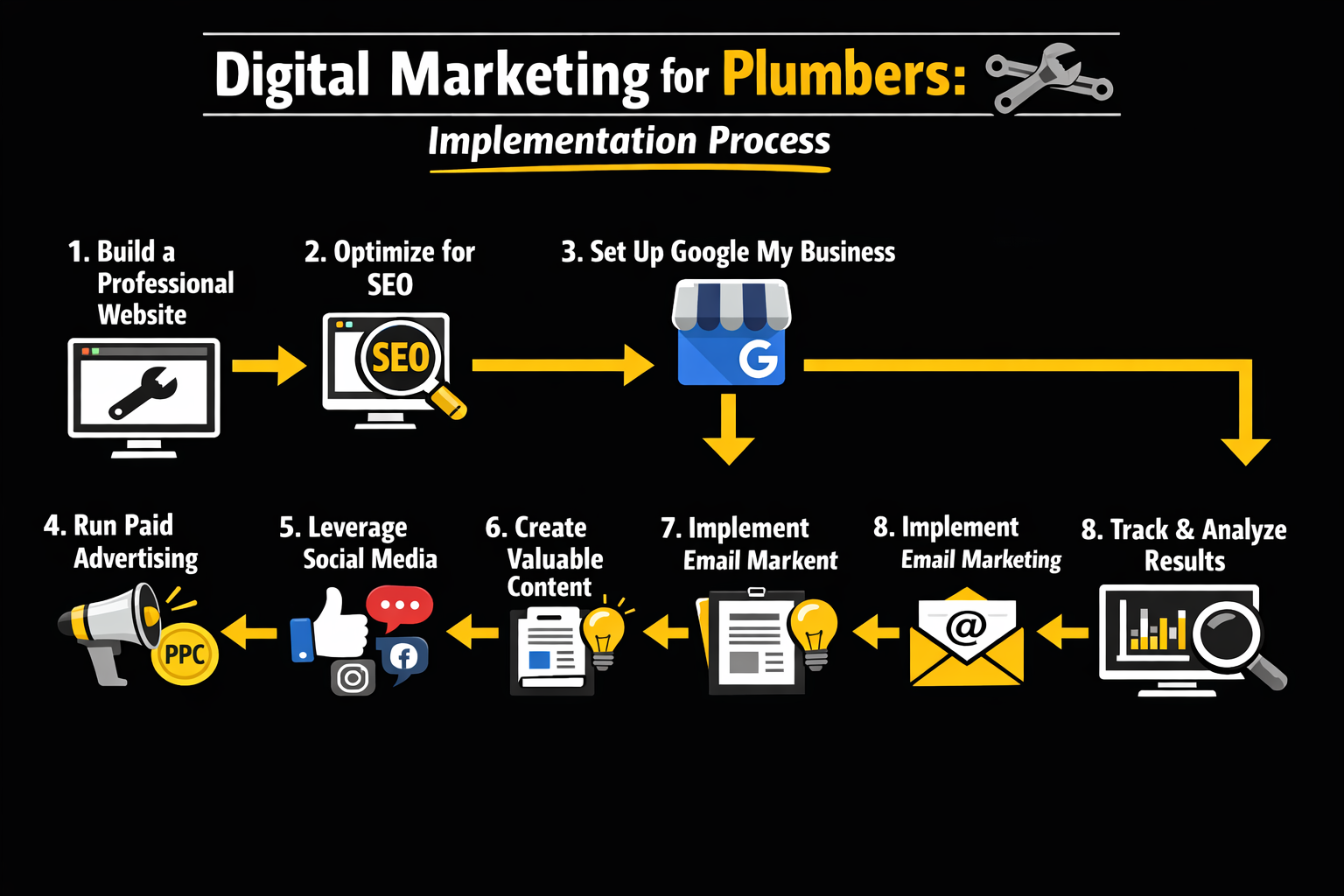
Most plumbing PPC failures are not mysterious. They happen because the business launches too wide, tracks too little, and sends every paid click to the same generic page. A better rollout is boring in the best way: controlled, measurable, and tied to the actual way your crews operate.
- Lock the service map first. Match campaign geography to the places your team can actually serve profitably, and align hours with the times you can really answer or respond.
- Launch Local Services Ads before expanding search volume. Get verification, job types, photos, service areas, and reviews in shape so the lead quality starts from a strong base.
- Build three search buckets first: branded, emergency, and core service campaigns. That gives you cleaner intent signals than stuffing everything into one account structure from day one.
- Match each ad group to one landing path. Emergency queries should land on emergency pages, water heater searches should land on water heater pages, and every page should make the next action obvious.
- Turn on call reporting and website call conversions immediately. Paid search for plumbers without call tracking is basically guesswork with a credit card.
- Review search terms every week. Keep adding negatives, tighten match types where needed, and cut queries that sound busy but do not book.
- Push every lead into one follow-up workflow. The click is only expensive until someone answers fast and gets the job on the board.
Google’s own tools support almost every part of that sequence: ad scheduling, service areas and job types, landing page relevance, the search terms report, and call conversion tracking. The point is to use those controls in the order that protects budget first and adds complexity second. That is how digital marketing for plumbers stays operational instead of theoretical. Google Podpora+4
For teams that need one backend to catch forms, calls, and follow-up in the same place, HighLevel is a practical option to evaluate. For businesses that want estimate or inspection slots to stop bouncing around over email and text, Cal.com is a clean scheduling layer. The exact stack matters less than making sure no paid lead dies in a voicemail box, a forgotten inbox, or a spreadsheet nobody opens.
Make the handoff visible before you scale budget
A lot of plumbers think the ad did its job once the phone rings. Google’s Local Services documentation makes it clear that the lead workflow keeps going inside the lead inbox, where advertisers can review leads, respond, and manage booked appointments, and that phone calls route through dynamic Google forwarding numbers. That means the real system is not ad, then magic; it is ad, response, qualification, booking, and follow-up. Google Podpora
This is where the next section matters most. Traffic without follow-up is just a more expensive way to miss opportunities, and that is exactly why the conversion system, the review engine, and the post-lead workflow deserve their own part of the article.
The Numbers That Actually Matter
The dangerous thing about analytics is that it can make a plumbing business feel informed while it is still flying blind. A dashboard full of impressions, clicks, and traffic spikes looks impressive, but none of it matters if the phone is not ringing, the jobs are not getting booked, or the booked work is not profitable. That is why digital marketing for plumbers needs a measurement system built around visibility, trust, lead capture, booking, and revenue, not vanity numbers.
Google already splits much of this data across different products, and that is part of the problem. Google Business Profile performance shows how people interact with your profile on Search and Maps, Search Console’s Performance report shows clicks, impressions, CTR, and average position for your website in search, and GA4 key events let you mark the actions that actually matter to the business. The point is not to stare at three dashboards separately. The point is to connect them into one story.
Read the funnel in layers
A plumbing company should read performance in layers, because each layer answers a different question. Visibility tells you whether people can find you, trust tells you whether they feel safe choosing you, conversion tells you whether they take action, and economics tells you whether that action was worth paying for. When those layers are separated, you can finally see where the real bottleneck is.
For local visibility, start with the signals Google itself surfaces: Business Profile views, searches, calls, website clicks, messages, and bookings, plus Search Console impressions, clicks, average CTR, and average position. For trust, the review layer matters more than many owners admit. BrightLocal’s 2026 survey found 47% of consumers will not use a business with fewer than 20 reviews, 74% only care about reviews from the last three months, and 80% are more likely to use a business that responds to all reviews.
Then comes the hard truth: traffic is not leads, and leads are not jobs. That is why your measurement system has to continue past the click into phone calls, forms, message threads, booked appointments, closed revenue, and job type. If digital marketing for plumbers stops measurement at “website traffic,” it stops right before the money part.
Build a measurement system you can trust
The cleanest analytics setup for a plumbing business is not complicated, but it does need discipline. Google Business Profile performance data counts unique visitors and profile interactions such as calls, website clicks, messages, and bookings, which makes it useful for local discovery but not for on-site behavior. Google Analytics recommends using UTM parameters so traffic from campaigns and profile links lands in the right acquisition reports, and GA4 key events let you elevate meaningful actions instead of treating every pageview like success.
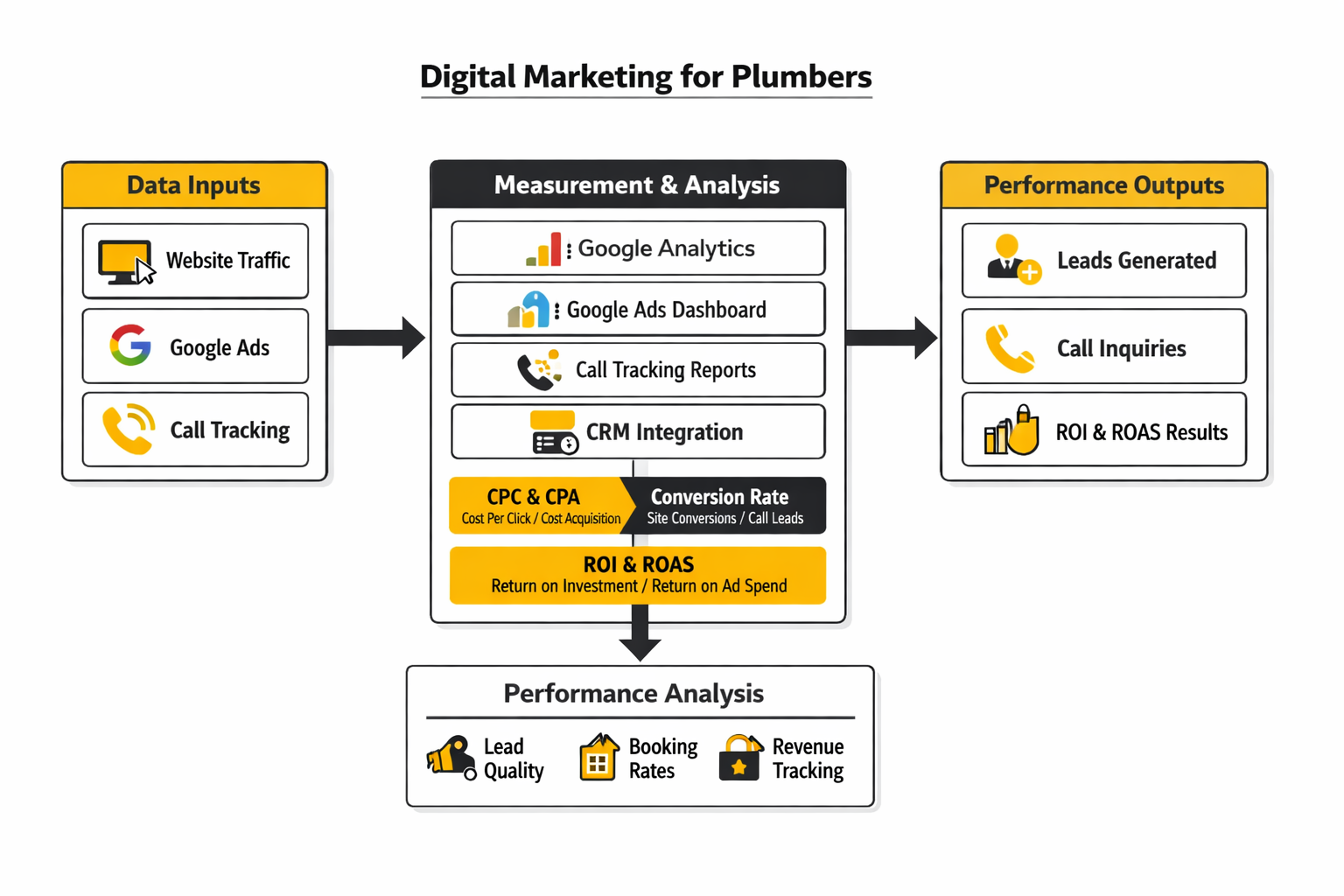
A practical plumbing dashboard should track these seven things every week:
- Profile demand: Business Profile views, searches, calls, website clicks, and messages from Google Business Profile performance
- Organic search traction: impressions, clicks, CTR, and average position from Search Console
- Website lead actions: call clicks, form submissions, booked appointments, and quote requests marked as GA4 key events
- Paid call performance: calls from ads and calls from the website measured through Google Ads phone call conversions
- Lead quality: valid leads, repeat callers, spam, and non-service-area requests inside your ad and CRM workflow
- Sales outcomes: booked jobs, close rate, average ticket, and gross margin by channel
- Reputation velocity: review count, recency, average rating, and review response rate based on what customers now expect in recent local review research
The reason this setup works is simple: each metric has a job. Business Profile data tells you whether the market is discovering you, Search Console tells you whether your pages are earning visibility and clicks, GA4 tells you whether visitors are taking meaningful actions, and CRM data tells you whether those actions turned into booked work. If one piece is missing, the rest of the system starts lying to you.
For teams that want fewer moving parts, this is usually the stage where an all-in-one system starts paying for itself. Platforms like HighLevel can centralize lead capture, pipeline stages, and follow-up, while a CRM like Copper can help teams tie marketing activity back to real opportunities and outcomes. The specific tool matters less than making sure the lead source survives all the way to the booked job.
Know your benchmarks without worshipping them
Benchmarks are useful because they tell you whether your numbers are wildly off, not because they tell you what your business must hit every month. WordStream’s 2025 Google Ads benchmark data puts Home & Home Improvement at an average CTR of 6.37%, CPC of $7.85, conversion rate of 7.33%, and cost per lead of $90.92. That is valuable context, but it is still aggregated category data, not a plumbing-specific law of nature.
Those numbers only become useful when you compare them to job value and close rate. A $110 lead can be fantastic if the job books often and produces strong margin. A $35 lead can be terrible if it is the wrong service area, the wrong job type, or a low-intent caller price shopping every number on the page.
The interpretation matters more than the benchmark itself. If your CPC is high but your booked-job rate is excellent, the problem may not be cost. If your CPL looks cheap but almost none of those leads become work, the channel is not efficient at all; it is just hiding the waste later in the funnel.
Review data is not a side metric
For plumbers, reputation data belongs inside performance reporting because it changes both ranking and conversion behavior. Google says local ranking is shaped by relevance, distance, and prominence, and Google also states that within Local Services Ads, star ratings, review volume, responsiveness, and average response time affect profile quality and ranking. That means review growth is not just a brand exercise. It is part of the lead engine.
The latest review data makes the operational takeaway very clear. BrightLocal reports that 97% of consumers read reviews for local businesses, 94% are open to writing a review, and 83% of people asked to leave one went on to do so. In other words, most plumbing companies do not have a review willingness problem. They have a review process problem.
So the number to watch is not just average rating. Watch review velocity and review freshness. If the business gets great reviews but only asks once every few months, the profile will look weaker than the actual service experience, and that gap will hurt both trust and local performance.
Turn metrics into decisions
The best analytics systems are blunt. They tell you what is broken and what to do next. A plumbing company does not need more reports than it can act on.
Use the data like this:
- Impressions are rising but clicks are flat: your pages or listings are being seen, but the message is weak. Improve titles, service descriptions, review proof, and offer clarity on the pages people actually land on through Search Console and Business Profile performance.
- Clicks are healthy but lead actions are weak: the landing experience is creating friction. Google recommends strong Core Web Vitals, with LCP within 2.5 seconds and INP under 200 milliseconds, so simplify the page, reduce clutter, and fix the mobile experience before buying more traffic.
- Leads are coming in but booked jobs are soft: this is usually a qualification or response problem, not a traffic problem. Google’s Local Services Ads ranking guidance explicitly says missed calls can hurt responsiveness and that profile quality includes average response time.
- Business Profile views are up but calls are not: the listing may lack enough trust to convert. That usually points to stale reviews, weak photos, incomplete service detail, or a mismatch between what searchers expect and what the profile communicates.
- CPL is climbing month over month: do not cut spend automatically. First check whether close rate, average ticket, and gross margin are strong enough to absorb it; if not, narrow geography, tighten search terms, and filter for higher-value jobs.
One more thing matters here. Search Console warns that the newest data can be preliminary, and its Core Web Vitals report is based on real-world field data and groups pages by their worst-performing metric. So when the numbers swing, do not panic over one day or one pretty chart. Look for patterns over a meaningful date range, then make the smallest change that solves the real bottleneck.
Conversion Systems, Follow-Up, and Review Growth
The deeper you get into digital marketing for plumbers, the more obvious one truth becomes: the ad is not the system. The system is what happens between the first click or call and the moment the job is booked, completed, reviewed, and fed back into your marketing engine. Google’s own products now reflect that reality, with lead inboxes, booking options, review workflows, and reporting built around what happens after discovery, not just before it. Google Nápověda+2
Speed wins twice
Fast follow-up matters twice for plumbers. It matters because old but still influential lead-response research found the odds of contacting a lead were dramatically higher when outreach happened within five minutes instead of thirty, and the odds of qualifying that lead were much higher too; it also matters because Google says missed calls can hurt Local Services Ads responsiveness and therefore affect ad ranking. When the customer has a leak, a backup, or no hot water, speed is not a sales trick. It is part of the product. InsideSales+2
That is why the right internal KPI is not “we usually call people back.” It is a concrete response standard tied to channel and time of day: immediate answer during staffed hours, immediate text-back or routed callback after hours, and one owner for every unworked lead. Google’s Local Services documentation makes this operational point very plain by counting answered calls, returned missed calls, messages, bookings, and lead feedback inside the same workflow. Google Nápověda+2
Build one operating system for every lead
Most plumbing companies do not lose leads because their ads were bad. They lose them because calls, forms, message leads, and booked appointments live in different places, which means nobody sees the whole funnel. Google’s lead form assets can send leads directly into a CRM through a webhook, but Google also says downloaded lead data is only available for the last 30 days and API-based export covers up to 60 days, which is a polite way of saying that manual exports are not a real operating system. Google Nápověda+2
A better setup is one inbox, one pipeline, and one booking flow that captures every lead source the same way. If you want a single place to manage calls, forms, pipeline stages, and automation, HighLevel is one practical option; if you want cleaner scheduling for estimates or service windows, Cal.com fits neatly into that handoff; if you want a simple website assistant handling basic pre-qualification after hours, Chatbase can sit on top of the site. The exact stack matters less than making sure every lead enters one visible process instead of disappearing into five disconnected tools.
The other advanced move here is closing the loop back into Google Ads. Google says offline conversion imports let you measure what happens after an ad click or call leads to an offline outcome, and enhanced conversions for leads improve attribution accuracy by matching hashed first-party customer data back to the ad interaction. For plumbers, that means you can stop optimizing for “form submitted” and start optimizing for “water heater replacement booked” or “commercial drain job closed,” which is a much better use of budget. Google Nápověda+1
There is also a channel-ownership lesson hiding in Google’s product changes. Google wound down Business Messages and removed Business Profile chat and call history in 2024, even though customers can still contact businesses through Search and Maps and some eligible accounts can use text or WhatsApp options from the profile. The takeaway is simple: use Google for discovery, but keep the real conversation history, automation, and customer record inside systems you control. Google for Developers+1
Grow reviews without tripping Google’s enforcement
Review growth should be boring, repeatable, and policy-safe. Google explicitly allows businesses to share a review request link or QR code, and even suggests practical placements like receipts, thank-you emails, chat interactions, and WhatsApp messages. That is perfect for plumbers because the best time to ask is right after the job is complete and the customer still remembers the technician, the fix, and the relief. Google Nápověda+1
What you cannot do is just as important. Google prohibits fake engagement, paid reviews, incentives, selective positive-only solicitation, pressuring people to review on-site, and requesting that specific content be included in the review. It also says profile restrictions for fake reviews can include temporarily blocking new reviews, unpublishing existing ratings, and placing a warning on the profile to tell consumers fake reviews were removed. That is not a small slap on the wrist. For a plumbing business, it is a direct hit to trust and lead flow. Google Nápověda+1
The smartest review system is neutral and universal. Ask every completed customer for feedback, do it the same way every time, make it easy with one link, and reply to every review like a real business owner who understands that future customers are reading. Google’s review guidance says helpful replies can show customers that you are responsive, and Local Services Ads says higher star ratings and more reviews affect ranking and typically help providers book more jobs. Google Nápověda+1
If you want to automate the ask without making it feel robotic, tools like Brevo or Moosend can handle simple post-job follow-up, and Manychat can help if your business also uses conversational flows outside Google. The rule is the same no matter which tool you use: automate the timing, not the authenticity.
Scale capacity before you scale spend
One of the easiest ways to wreck digital marketing for plumbers is to scale lead volume faster than the business can absorb it. Google’s Local Services help center literally says you can pause ads if you are too busy to accept new leads, and its platform policies require timely responses before, during, and after service. That is a useful reminder that marketing and operations are now one system whether you like it or not. Google Nápověda+1
This is where strategic tradeoffs get real. Google recommends expanding job types and service areas to improve Local Services Ads performance, but it also says you may still be charged for valid leads when you generally serve an area or category yet are temporarily unwilling or unable to take that work. So more coverage is not always better coverage. Broader settings can increase volume, but they can also increase wasted time, slower response, weaker close rates, and bad customer experiences if dispatch capacity is not there. Google Nápověda+1
The fix is not complicated, but it does require discipline. Review lead quality by job type, service area, and time block; tighten hours if after-hours calls are going unanswered; use lead feedback inside Local Services Ads; and be willing to say no to categories that create busywork without margin. In local service businesses, scaling is not “more leads at any cost.” It is more of the right leads at a pace the field team can actually deliver on. Google Nápověda+2
Use automation carefully as Google broadens search
Google’s ad system is becoming more expansive, and that creates both upside and risk for plumbers. Google says AI Max for Search can widen search term matching, optimize assets, and even choose dynamic landing pages, while ads from existing campaigns can now be eligible to show above, below, or within AI Overviews in Search. That means your campaigns can reach more commercially relevant searches than before, including searches you did not explicitly target with tight keyword lists. Google Nápověda+1
The upside is obvious: more relevant demand capture. The risk is that automation is only as smart as the signals and pages you give it. Google’s own AI Max guidance warns that dynamic landing pages can cause tracking-template problems if the URL setup is not compatible, and its AI Overview guidance says advertisers should rely on AI-powered targeting and strong website quality because ads are matched to both query intent and overview context. In plain English, do not turn on broader automation before your tracking, exclusions, landing pages, and offline conversion feedback are clean. Google Nápověda+2
There is also one mandatory migration plumbers should not ignore. Google has removed the ability to create new call-only ads as of February 2026 and says all existing call ads will stop receiving impressions in February 2027, with responsive search ads plus call assets as the replacement path. For businesses that rely heavily on phone leads, that makes proper call tracking, asset setup, and landing-page alignment even more important than they were a year ago. Google Nápověda+1
Professional implementation is mostly about ownership
At a certain point, the question is not whether digital marketing for plumbers “works.” The question is who owns each part of it. Someone has to own profile accuracy, someone has to own ad structure, someone has to own missed-call recovery, someone has to own review requests, and someone has to own the closed-loop reporting that tells you which jobs came from which channel. Google gives businesses more ways to manage leads, bookings, reviews, and reports than before, but those features only help when someone is actually responsible for them. Google Nápověda+2
That is usually the dividing line between a basic setup and a professional one. A basic setup generates leads. A professional setup decides which leads are worth buying, routes them fast, books them consistently, turns completed work into reviews, and feeds the sales result back into the campaign so the next round of traffic improves. That is the standard to aim for before the final part, where the remaining mistakes, edge cases, and most common questions get cleaned up.
Putting the Full System Together
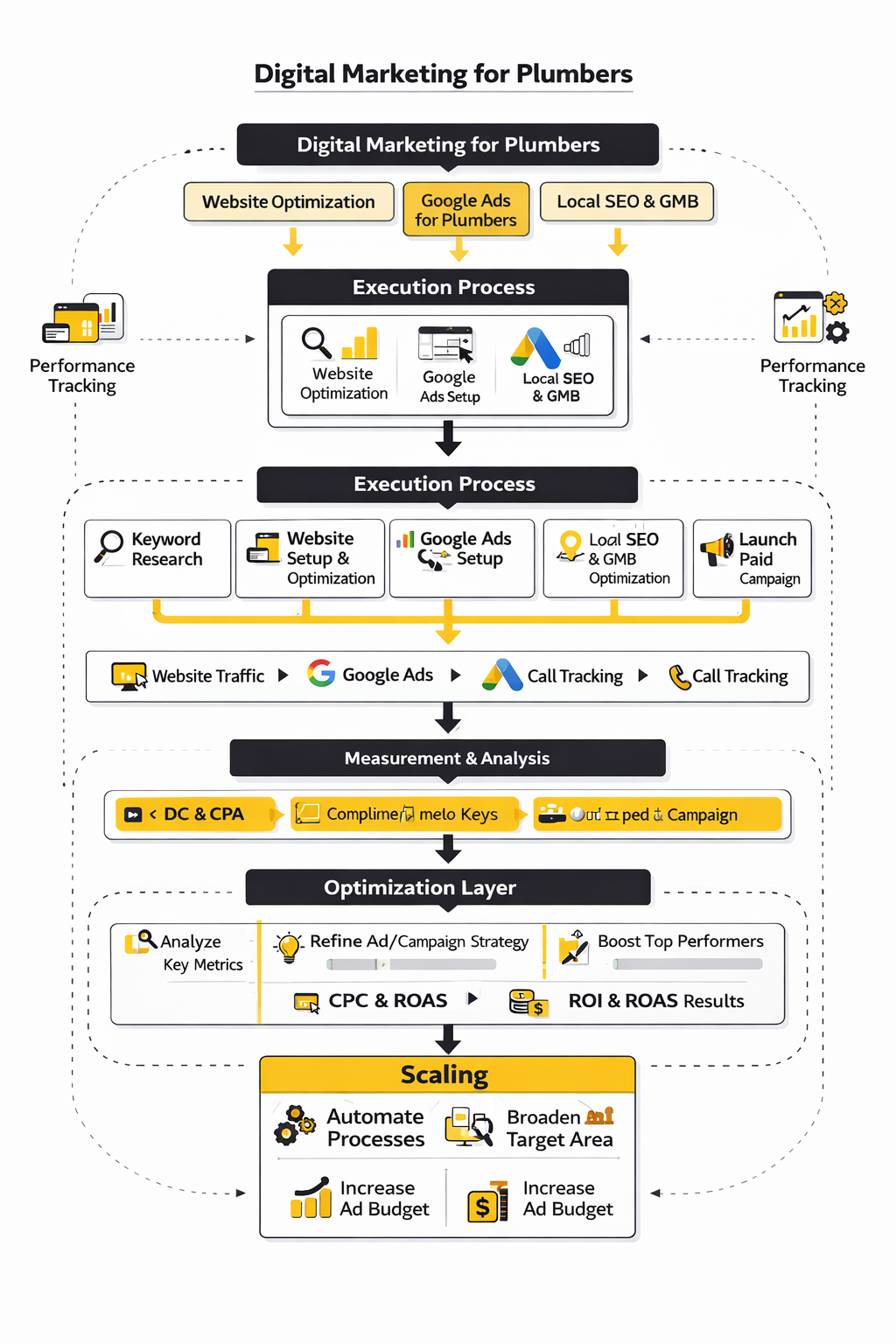
At this point, the full picture should be clear. Strong digital marketing for plumbers is not one tactic, one ad campaign, or one SEO checklist item. It is a connected system built around discovery on Search and Maps, service-area accuracy, high-intent paid traffic, fast lead handling, review growth, and closed-loop tracking that shows which channels actually turn into booked work. Google Nápověda+4
That is why the best-performing plumbing companies stop thinking in channels and start thinking in handoffs. If the profile ranks but reviews are stale, trust drops. If the ads generate calls but nobody measures call quality, spend gets misread. If the service area is too wide, the business looks busy while margin quietly disappears. BrightLocal+2
The practical endgame is simple: make every part of the system visible, assign ownership, and remove weak links one by one. Once that is in place, growth gets calmer because the business is no longer relying on luck, guesswork, or one hero employee remembering to do everything manually. That is the standard a professional plumbing marketing system should hit before more budget gets poured into it. Google Nápověda+3
FAQ - Built for Complete Guide
What should a plumbing company fix first if marketing is underperforming?
Start with the basics that most directly affect visibility and trust: verify the Business Profile, tighten the service area, and make sure the listing actually reflects the work you want to win. Then check whether recent reviews, calls, and website clicks are healthy, because those are the signals that tell you whether discovery is turning into action. In most cases, the fastest wins come from cleaning up the foundation before adding more channels. Google Nápověda+3
Should plumbers focus on SEO or Google Ads first?
If the business needs leads quickly, paid channels can move faster because Local Services Ads and Google Ads can start generating activity as soon as setup, verification, and budget are in place. Organic growth usually compounds more gradually because local visibility still depends on relevance, distance, prominence, and the quality of the site content behind the profile. The better answer for most plumbers is not “SEO or ads,” but “local foundation first, then whichever channel solves the next bottleneck.” Google Nápověda+3
Are Local Services Ads better than standard Google Ads for plumbers?
They solve different problems. Local Services Ads are designed to generate direct leads and charge on a valid-lead basis, while standard Google Ads gives you more control over keywords, landing pages, messaging, and conversion measurement. For many plumbers, Local Services Ads are the cleaner first paid channel, and search campaigns become the second layer once you want tighter control over job-type targeting and landing-page experience. Google Nápověda+3
How many reviews should a plumber aim for?
There is no magic number that guarantees rankings, but there is a very clear trust threshold. BrightLocal’s 2026 survey found that 47% of consumers will not use a business with fewer than 20 reviews, and 74% only care about reviews written in the last three months. So the real target is not just “more reviews.” It is a steady stream of recent, authentic reviews that keeps the profile looking alive. BrightLocal
Do plumbers still need a website if the Google Business Profile is strong?
Yes, because the profile helps people find you, but the website still has to do the heavier work of explaining services, proving relevance, and capturing conversions cleanly. Google’s own guidance focuses on helpful, reliable, people-first content, and it also supports Local Business structured data to help Search understand the business more clearly. A strong profile without a strong site can still win some calls, but it leaves money on the table when customers want more detail before they commit. Google Nápověda+3
Should a plumber hide a home address on Google?
Yes, if the business is a service-area business and customers do not actually come to that address. Google explicitly says that service-area businesses should hide the address from customers when they do not serve them there, and it uses plumbers as a direct example in that guidance. That matters because accurate location setup is part of both compliance and customer trust. Google Nápověda+2
Can a plumbing company pay Google to rank higher in the local results?
Not in the organic local pack. Google says there is no way to request or pay for a better local ranking, because local results are mainly based on relevance, distance, and prominence. What you can pay for is ad placement through Local Services Ads or Google Ads, but that is different from earning stronger unpaid local visibility. Google Nápověda+1
Is call tracking really necessary for plumbers?
Yes, because phone calls are often the conversion, not just a step before the conversion. Google Ads supports call reporting and phone call conversions, including the ability to count only calls above a minimum duration so short junk calls do not get treated like real leads. If a plumbing company is spending on search and not measuring which calls actually matter, it is guessing with expensive traffic. Google Nápověda+2
How fast should a plumber respond to leads?
Fast enough that missed calls are rare and follow-up is immediate when a call is missed. Google’s Local Services documentation makes responsiveness part of performance, and its bidding guidance also says quality service still matters, including responsiveness and reviews. In plumbing, slow response is not just a customer-service problem; it directly weakens lead quality and can hurt how efficiently your paid system performs. Google Nápověda+2
Can AI-written location pages hurt SEO for plumbers?
They can if they are thin, repetitive, or written mainly to manipulate rankings instead of helping customers. Google’s guidance is very consistent here: Search is designed to reward helpful, reliable, people-first content rather than pages created primarily for search engines. So AI is fine as a drafting aid, but publishing ten near-identical city pages with swapped place names is still a bad strategy. Google for Developers+2
What does the Google Verified badge actually mean for Local Services Ads?
It means the advertiser passed Google’s required verification checks for that program. It does not mean the business can claim Google endorses it everywhere, because Google’s Local Services policies say that Google Guarantee or Google Screened status applies to Local Services Ads only and cannot be advertised on your website or other promotional materials as if Google were endorsing the company. So treat the badge as a trust signal inside the ad ecosystem, not as a universal marketing shortcut. Google Nápověda+2
When is it time to bring in outside help?
It is usually time when the business has enough moving parts that nobody clearly owns the whole system anymore. Once discovery, calls, forms, reviews, bookings, and conversion tracking are spread across the Business Profile, Local Services Ads, the website, and Google Ads, execution quality starts depending on process rather than good intentions. That is the moment when a specialist, agency, or strong in-house operator can be worth more than another month of improvised marketing. Google Nápověda+3
Work With Professionals
Explore 10K+ Remote Marketing Contracts on MarkeWork.com
Most marketers spend too much time chasing clients, competing on crowded platforms, and losing a percentage of every project to middlemen.
MarkeWork gives you a better way. Browse thousands of remote marketing contracts and connect directly with companies desperate to hire skilled marketers like you, without platform commissions and without unnecessary gatekeepers. markework.com
If you're serious about finding better opportunities and keeping 100% of what you earn, explore available contracts and create a profile for free at MarkeWork.com. markework.com
I couldn’t generate the image because the image tool hit a rate limit and is temporarily blocked from creating more images right now.
I couldn’t generate the image because the image tool hit a rate limit and is temporarily blocked from creating more images right now.
I couldn’t generate the image because the image tool hit a rate limit and is temporarily blocked from creating more images right now.
I couldn’t generate the image because the image tool hit a rate limit and is temporarily blocked from creating more images right now.
I couldn’t generate the image because the image tool hit a rate limit and is temporarily blocked from creating more images right now.