

Digital marketing modules work best when they are treated as connected skill blocks, not as random lessons on isolated channels. That matters more now because the job itself keeps moving. LinkedIn’s 2025 learning data suggests that about 70% of the skills used in most jobs will change by 2030, which is exactly why a modular approach beats a messy pile of tutorials.
The market is also too broad for one oversized “learn digital marketing” bucket. Global ad spend reached close to $1.1 trillion in 2024, and digital accounted for most of that growth, so the real challenge is not whether digital matters. The challenge is knowing which capabilities belong together, what order to learn them in, and how to turn them into work you can actually ship.
That is where strong digital marketing modules earn their keep. A good module gives you one clear outcome, one measurable skill, and one real workflow you can repeat. Instead of collecting surface-level advice, you build a system you can use across content, search, social, email, paid media, analytics, and automation.

Article Outline
This article is built as one continuous six-part guide, because digital marketing makes more sense when the pieces connect in a logical order. We will start with why digital marketing modules matter, then move into the framework that holds them together, and only then break down the core skill areas. By the end, you will have a practical map for choosing, sequencing, and applying digital marketing modules in real work.
- Why Digital Marketing Modules Matter
- The Framework Behind a Modern Module Stack
- Core Modules for Audience, Messaging, and Content
- Core Modules for Search, Social, and Paid Acquisition
- Core Modules for Email, Automation, and Conversion
- Measurement, Tool Stacks, and Professional Implementation
Why Digital Marketing Modules Matter
Digital marketing modules matter because the customer journey is now split across too many touchpoints for a single broad course to do the job well. Search still drives discovery, and DataReportal reports that 32.8% of internet users aged 16+ discover new brands through search engines, but that is only one part of the picture. Social search is now part of normal behavior too, with Ofcom finding that 43% of UK adults use social media to search online daily and 34% use video-sharing platforms such as TikTok for daily search.
That shift changes how people should learn the craft. You do not need one giant module called “digital marketing.” You need separate but connected modules for discovery, persuasion, conversion, retention, and measurement, because each one uses different tools, different feedback loops, and different success metrics.
The complexity is not only happening on the customer side. The 2025 highlights from The CMO Survey show that nearly two-thirds of companies have increased the number of channels they use, which tells you why marketers are under pressure to be more flexible. When the number of channels expands, modular training becomes practical rather than academic.
There is also a quality problem that modular learning helps solve. Google’s own guidance says search systems are built to reward helpful, reliable, people-first content, so a content module cannot just teach posting frequency or keyword placement. It has to teach audience understanding, editorial judgment, search intent, structure, and distribution together.
A strong digital marketing modules strategy also respects how performance is measured now. Google Analytics was built for event-based measurement instead of the old session-first model, which means marketers need to understand actions, key events, funnels, and attribution more clearly than before. That is why analytics should sit beside every module, not at the very end like a boring afterthought.
The Framework Behind a Modern Module Stack
The simplest way to think about digital marketing modules is this: every module should answer one of five questions. Who are we trying to reach, what are we saying, how do we get attention, how do we turn that attention into action, and how do we measure what happened. Once you frame the work that way, the entire field gets less intimidating and far more useful.
This is also the difference between learning tactics and building capability. Tactics expire, platforms change, and interfaces get redesigned every few months. But a good framework keeps working because it is based on audience, message, channel logic, conversion flow, and measurement discipline.
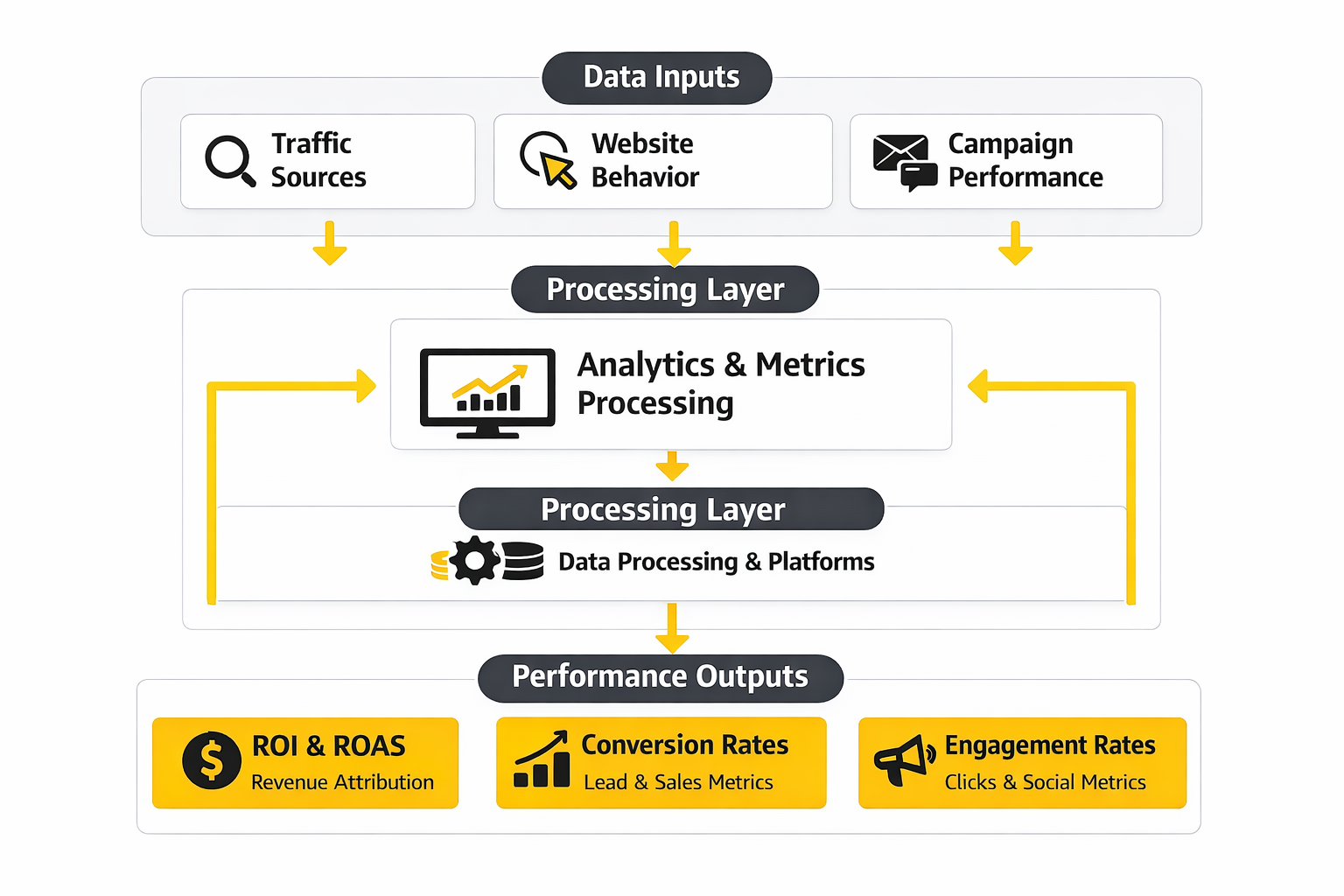
A practical module stack usually looks like this:
- Foundation modules cover audience research, offer clarity, positioning, customer pain points, and messaging. Without this layer, every later module becomes guesswork dressed up as strategy.
- Content modules cover editorial planning, content formats, repurposing, SEO writing, social storytelling, and video basics. This matters because Content Marketing Institute found that 61% of B2B marketers expect their organizations to increase investment in video in 2025, which makes content fluency a core skill rather than an optional extra.
- Acquisition modules cover search, organic social, paid media, partnerships, and channel selection. These modules teach how traffic is earned, bought, or borrowed.
- Conversion modules cover landing pages, forms, offers, email capture, sales pages, and follow-up sequences. This is where traffic stops being a vanity number and starts becoming pipeline or revenue.
- Retention and automation modules cover lifecycle email, CRM workflows, chatbot journeys, remarketing, and customer re-engagement. Email stays in this framework for a reason, and Litmus reports that many teams still see strong returns, with 35% of marketing leaders getting $10 to $36 back for every $1 spent and 30% reporting $36 to $50.
- Measurement and implementation modules cover analytics setup, dashboards, experimentation, reporting, process design, and cross-functional execution. This final layer is what turns scattered activity into a professional operating system.
The best part is that these modules can be learned in sequence and practiced in real tools. For chat automation and lead capture, a hands-on build in ManyChat makes the lesson real. For email and lifecycle workflows, running campaigns inside Brevo or a broader CRM stack like HighLevel gives the module a concrete output, while content distribution becomes easier to test in a scheduler like Buffer and landing page work becomes more tangible in Replo.
That is the logic the rest of this article will follow. We are not going to treat digital marketing modules as a checklist of trendy platforms. We are going to treat them as a system for building real skill, real execution, and real commercial value.
Core Modules for Audience, Messaging, and Content
This is the first part of the article where digital marketing modules stop being abstract and start becoming useful. Once the framework is clear, the next job is building the modules that shape how a brand understands people, explains its value, and publishes content that earns attention. Get these three right and every later module in search, social, paid media, email, and automation becomes easier to execute.
Audience Research Modules Should Start With Real Behavior
The biggest mistake in audience training is starting with demographics and stopping there. Real audience work starts with behavior: where people discover brands, how they search, what they compare, what they trust, and what language they already use when they describe their problem. That matters because the average connected consumer now discovers brands through 5.8 different sources, search still leads global brand discovery at 32.8%, and in the UK a meaningful share of adults now search daily on social and video platforms too, with 43% using social media for search and 34% using video-sharing platforms such as TikTok. DataReportal – Global Digital Insights+2
A good audience module should therefore train marketers to collect five types of evidence, not one. They need search language from query data, buying friction from sales calls, recurring objections from support tickets, emotional cues from reviews and comments, and intent signals from what customers ask before they buy. That is what turns “our audience is small business owners” into something usable, like “our audience is overwhelmed operators who want fewer tools, faster setup, and proof that the system will not create more admin.”
This is also where digital marketing modules should get practical fast. The output of an audience module should be a live research pack: problem statements, trigger events, desired outcomes, trust barriers, and a language bank pulled from real conversations. Even a simple survey workflow built in Fillout can help teams collect structured voice-of-customer data instead of relying on internal guesswork.
Audience modules also need to teach channel-specific behavior, because not every platform plays the same role in the journey. Search still carries more trust for information retrieval, with 59% of users saying they mostly or always trust search engine results, compared with 25% for video-sharing platforms and 19% for social media platforms. That does not mean social and video are weak. It means the audience module has to teach the difference between discovery behavior and trust behavior, because those are not always the same thing. www.ofcom.org.uk
Messaging Modules Turn Insight Into a Clear Promise
Once the audience module produces usable insight, the messaging module has one job: turn that insight into a promise people can understand quickly. Most messaging fails because it sounds polished but generic. In practice, buyers respond better when a brand feels relevant, specific, and grounded in the world they actually live in, which lines up with Edelman’s 2025 brand research showing that 73% of people say trust in a brand would increase if it authentically reflected today’s culture. edelman.com+1
That is why messaging modules should teach more than headline writing. They should cover positioning, value propositions, offer framing, proof points, objection handling, and voice guidelines that can survive across a homepage, a sales deck, an ad, an email sequence, and a creator partnership. If the only output is a tag line, the module failed.
This is where a lot of digital marketing modules need more discipline. A strong messaging module should produce a short category statement, a sharp problem-solution narrative, a before-and-after transformation, a proof stack, and a message hierarchy by audience segment. In other words, it should tell the team what to say first, what to prove next, and what to leave out.
Trust also changes who gets to carry the message. Edelman’s creator research notes that 60% of consumers now trust what a creator says about a brand more than what the brand says about itself, which is a strong reminder that messaging is no longer a top-down exercise where the brand writes a script and everyone else repeats it. The best messaging modules teach how to create a clear core narrative and then adapt it for founders, sales teams, creators, customers, and communities without losing the center of gravity. edelman.com
For B2B teams, this module becomes even more important because the message has to travel through a buying group, not just a single lead. Edelman and LinkedIn report that more than 40% of B2B deals stall because of internal misalignment, and their 2025 work also shows that 73% of B2B decision-makers view thought leadership as a more trustworthy way to assess capabilities than marketing materials or product sheets. That is a massive clue: the messaging module should not train marketers to write prettier brochures, but to build useful points of view that help the buyer group align around a decision. edelman.com+1
The upside is bigger than many teams think. Strong thought leadership can narrow the gap between famous brands and smaller challengers, with Edelman noting that 53% of B2B decision-makers say strong thought leadership makes brand recognition matter less. So one of the most valuable digital marketing modules is the one that teaches a company how to say something worth remembering before it spends more money trying to be seen. edelman.com
Content Modules Should Build Systems, Not Just Posts
Content is where weak strategy gets exposed. If the audience module is vague, content feels random. If the messaging module is fuzzy, content sounds interchangeable. That is why content modules should be built as operating systems for production, not as isolated lessons on blogs, reels, carousels, or newsletters.
A practical content module should teach teams how to create one strong idea and turn it into multiple assets without flattening the quality. That is more urgent than ever because Content Marketing Institute found that 45% of B2B marketers still lack a scalable content creation model, while the same research shows 61% expect their organizations to increase investment in video in 2025. More demand with no scalable model is exactly how teams end up producing too much content and remembering too little of it. Content Marketing Institute
The module should also teach what kind of content people actually reward. Sprout Social’s 2025 research says consumers rank authenticity and relatability among the three most important brand content traits, while 46% say their favorite brands stand out on social because they post original content. That is why content modules should train teams to build original angles, clear opinions, useful demonstrations, and native execution, instead of recycling the same generic talking points across every platform. Sprout Social+1
They should also teach restraint. Sprout’s 2025 findings show that 33% of consumers find it embarrassing when brands jump on every social trend, which is a useful correction to the “post faster and chase everything” mindset. Better content modules teach judgment: what fits the brand, what fits the platform, what deserves a fast response, and what should be ignored. Sprout Social+1
AI belongs inside the content module, but it should be handled like an assistant, not an author. Content Marketing Institute’s 2025 research shows that 54% of B2B teams still use AI on an ad hoc basis and only 19% say it is integrated into daily workflows, while just 4% report a high level of trust in generative AI output. So the right lesson is not “use AI everywhere.” It is “use AI to speed up research, structuring, repurposing, and optimization, then keep a human editor responsible for accuracy, tone, evidence, and taste.” Content Marketing Institute
This is the point where tools can help, but only after the workflow is clear. A scheduler like Buffer or a social planning tool like Flick is useful when the team already knows the audience, the message, the format, and the publishing rhythm. Without that foundation, tools just make bad content more efficient.
The best content modules end with a repeatable production loop. One flagship asset becomes derivative posts, short videos, email content, quote cards, sales follow-up material, and refreshes for search performance. Once that loop is working, the next set of digital marketing modules can do what they are supposed to do: amplify a strong message through search, social, and paid acquisition instead of trying to rescue a weak one.
Core Modules for Search, Social, and Paid Acquisition
Once the audience, messaging, and content modules are in place, the next job is distribution. This is where digital marketing modules either become commercially useful or stay trapped in theory. Search, social, and paid acquisition should not be taught as separate islands, because in real campaigns they constantly feed each other.
A strong acquisition stack works like this: search captures intent, social creates reach and relevance, and paid accelerates what already shows signs of traction. That sequence matters because search still drives discovery at scale, with 32.8% of internet users saying they discover new brands through search engines, while social and video increasingly shape what people notice, remember, and trust. The practical lesson is simple: your digital marketing modules should train people to build one message system and deploy it across three acquisition environments with different rules.
Search Modules Should Teach Discoverability, Not Just Keywords
Search training used to revolve around keyword lists, title tags, and publishing cadence. That is no longer enough. Search modules now need to teach discoverability across classic search results, AI-influenced search behavior, local search surfaces, and the commercial pages that turn curiosity into action.
The pressure is obvious in current market data. HubSpot’s 2026 marketing stats show that over 92% of marketers plan on or are already using SEO optimization for traditional and AI-powered search engines, while nearly 30% report decreased search traffic as consumers turn to AI tools. That means a modern search module cannot pretend the job stops at “rank for a keyword.” It has to teach how to build clear entities, useful category pages, comparison content, product or service explainers, and commercial pages that still make sense when part of the discovery journey starts outside the traditional blue-link result.
This is also where discipline matters. Google’s own documentation says its systems are designed to prioritize helpful, reliable, people-first content created to benefit people rather than manipulate rankings. So a real search module should train marketers to work backward from user tasks, not just search volume, and to ask better questions: what is the searcher trying to decide, what evidence do they need, what friction is still unresolved, and what page format gives the clearest answer?
In practice, the output of this module should be concrete. A good search module produces an intent map, a page architecture plan, a content brief template, an internal linking logic, and a review loop based on actual search query data. That is the difference between “we are doing SEO” and “we are building an acquisition asset that compounds.”
Social Modules Should Teach Distribution, Conversation, and Trust
Social modules have changed just as fast, but in a different direction. The old model was built around frequency, brand consistency, and basic engagement. The better model now is distribution plus dialogue plus proof, because social is where brands are increasingly judged in public, not just seen.
That shift is visible in platform and consumer research. Sprout Social’s 2026 research shows that 66% of people feel more selective about the content they engage with than they did a year ago, and the same study shows that educational content is the top thing consumers want from brands on social, with community-focused content next at 27%. So the social module should not teach posting for the sake of activity. It should teach how to publish material that helps people learn, decide, and participate.
Platform culture matters too. TikTok’s 2025 trend report makes the point bluntly: the old playbook of brands telling consumers what they need is over, and brands now need to work with creators and communities to build content that resonates. That is a useful correction for anyone building digital marketing modules today. Social execution is no longer just brand broadcasting. It is collaboration, adaptation, remixing, response speed, and native creative judgment.
The B2B side is moving the same way. LinkedIn’s 2025 benchmark work found that 94% of marketers see trust as the key to B2B success, while 78% now use video and 55% work with creators or influencers. That tells you what a serious social module should cover: channel role, creator fit, short-form video basics, employee advocacy, comment strategy, and how to turn audience response into new content ideas.
This is also where tools help only after the thinking is right. A workflow in Buffer or Flick can make execution smoother, but only if the team already knows what each platform is for, what kind of proof belongs there, and what a win actually looks like. Otherwise the tool just automates noise.
Paid Acquisition Modules Should Teach Controlled Scale
Paid acquisition is usually where weak training gets expensive. Too many programs teach campaign setup before they teach offer clarity, creative testing, conversion intent, or landing page logic. That is backwards, and it is one of the main reasons teams waste budget while claiming they are still “learning.”
A strong paid module should start with goal design. Google’s own campaign guidance explains that Performance Max is a goal-based campaign type that gives advertisers access to all Google Ads inventory from a single campaign and optimizes in real time across channels using Smart Bidding. In plain English, the platforms are getting more automated, not less, so the marketer’s job moves up the stack: cleaner goals, better assets, tighter inputs, stronger offers, and better interpretation.
The same pattern shows up in Google’s display ecosystem too. Google Ads says it is combining the flexibility of standard Display campaigns with the AI capabilities of Smart Display into a single Display campaign. That should change how digital marketing modules are taught. The lesson is no longer “memorize every tiny manual setting.” The lesson is “understand when automation helps, what signals it needs, where creative testing still matters, and how to keep visibility over performance.”
Paid modules should therefore teach four things in order. First, define the conversion event that actually matters. Second, align creative angles to funnel stage and audience pain point. Third, launch controlled tests with enough budget to learn but not enough to hide sloppy thinking. Fourth, review query data, audience quality, assisted conversions, and creative fatigue before trying to scale.
Google’s own 2025 rollout notes also matter here, because channel performance reporting for Performance Max became available globally in beta. That matters for training because it gives marketers a better view into where results are coming from. A paid module should not only teach how to launch campaigns, but how to diagnose what the automation is actually doing.
How to Turn These Modules Into a Working Acquisition Process
The real value of digital marketing modules shows up when the workflow becomes repeatable. Search gives you durable intent capture, social gives you distribution and conversation, and paid gives you speed. The implementation challenge is turning those three motions into one weekly operating rhythm instead of three disconnected reports.
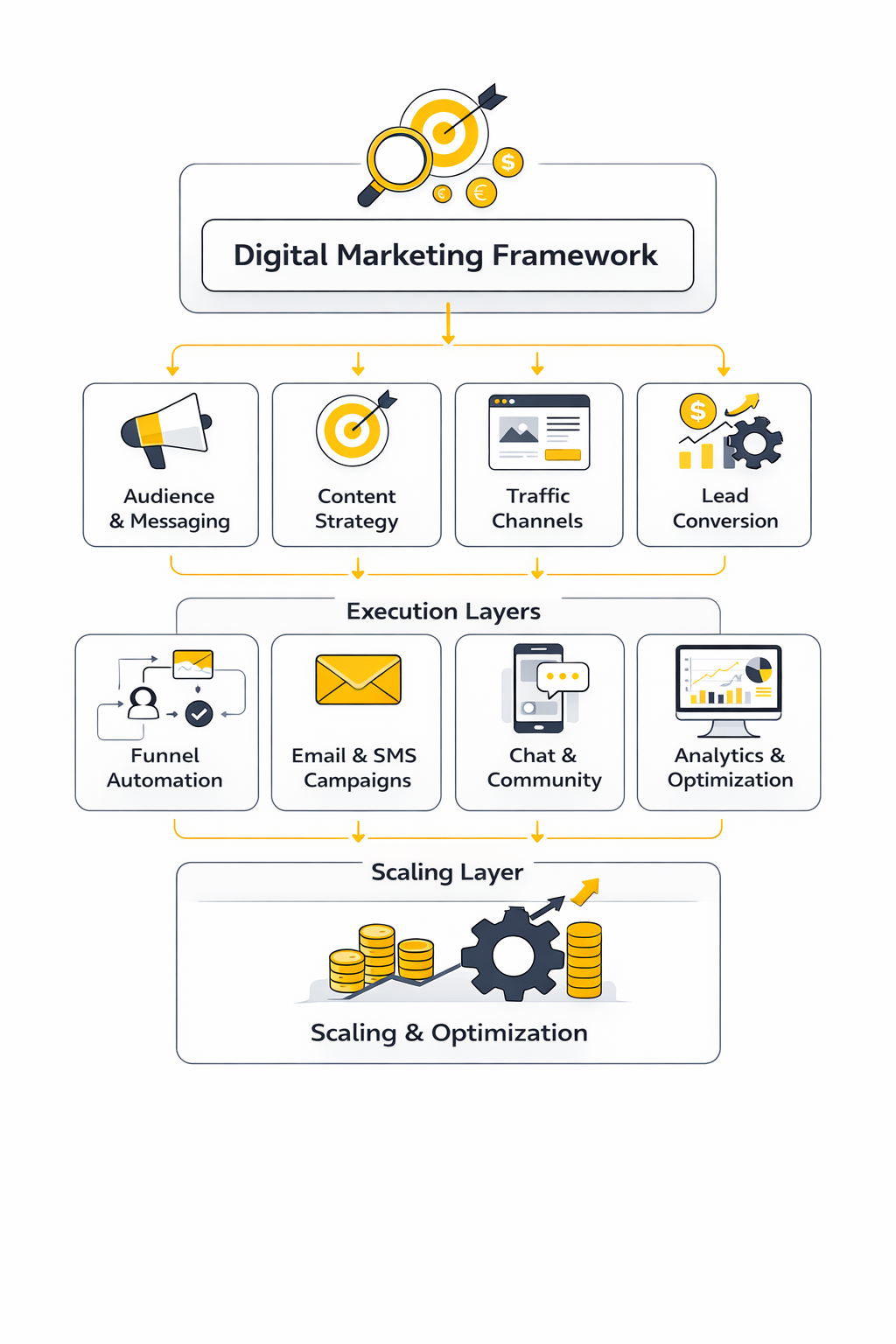
A practical acquisition process looks like this:
- Start with one commercial goal. Pick the action that matters most right now, whether that is a booked demo, qualified lead, free trial, email signup, or completed purchase. Then make sure search content, social creative, and paid campaigns all point toward that same outcome instead of chasing vanity metrics in different directions.
- Build the search layer around high-intent problems. Create pages for comparisons, use cases, category education, pricing logic, objections, and proof. This gives your acquisition system a durable base that can keep working even when paid spend is paused.
- Turn each search insight into social assets. If a topic keeps appearing in search queries or sales calls, turn it into short videos, carousels, founder posts, customer clips, and comment prompts. That is how one strong research thread becomes multiple discovery assets instead of one lonely article.
- Use paid to test angles, not guess at strategy. Launch campaigns around the strongest messages, clearest offers, and best-performing creative patterns. Paid traffic should validate or challenge your assumptions quickly, not replace the need for strategic thinking.
- Route responses into a follow-up system immediately. This is where tools become operational rather than decorative. If you want faster lead handling, chat capture, and nurture workflows, building the handoff inside HighLevel or a conversation flow in ManyChat can make the module tangible very quickly.
- Review the three channels together every week. Look at which search topics drove qualified visits, which social assets created saves, shares, replies, or assisted conversions, and which paid creatives produced efficient downstream actions. Then push the winners back into the content calendar, landing pages, and campaign briefs.
This is what professional implementation actually looks like. You do not build separate search, social, and paid worlds and hope they cooperate later. You build one acquisition system where each module sharpens the others, and that is exactly why digital marketing modules are so useful when they are designed as connected capabilities instead of isolated lessons.
The next part of the article moves from acquisition into the place where most growth systems either become profitable or break down completely. Once traffic starts arriving, the focus shifts to email, automation, and conversion, because attention alone is never the finish line.
What the Numbers Actually Mean
Before moving deeper into email, automation, and conversion, it helps to lock the measurement layer in place. This is one of the most useful digital marketing modules because it tells you whether the work is actually creating business movement or just producing activity that looks busy on a dashboard. Without that layer, teams end up optimizing for clicks, views, and opens while missing the numbers that decide revenue quality, conversion efficiency, and customer value.
The shift in the industry is already clear. HubSpot’s 2026 marketing data shows that the metrics marketers care about most are lead quality and MQLs, lead-to-customer conversion rate, ROI, customer acquisition cost, and lead volume, in that order, which is a strong signal that the profession is moving away from vanity reporting and toward commercial outcomes. The same research also shows that 40% of marketers name lead quality and MQLs as their top success metric, which matters because it tells you the job is not simply to generate more traffic, but to generate traffic that turns into serious pipeline. hubspot.com+1
That is the real purpose of measurement inside digital marketing modules. The numbers are there to help you decide what to scale, what to fix, what to cut, and what deserves another test. They are not there to impress people in a slide deck.
Build the Analytics System Before You Chase Benchmarks
A lot of teams talk about analytics when what they really mean is reporting. Those are not the same thing. Reporting tells you what happened. Analytics gives you a structured way to understand why it happened and what should happen next.
Google’s own guidance makes that shift obvious. GA4 uses an event-based model instead of the older session-first model, and Google now lets you mark the actions that matter most to your business as key events so they can be treated as the core success points in your setup. That matters because modern digital marketing modules should train people to measure specific business actions such as a qualified form submission, booked call, trial signup, checkout start, or completed purchase, not just generic page visits. Google Podpora+2
Google also recommends different event structures for different business models. Its official GA4 documentation says recommended event sets can populate an Ecommerce purchases report for online sales and a Lead acquisition report for lead generation. That is a huge clue for implementation: your analytics system should reflect your business model first, and your dashboard second. Google Podpora+1
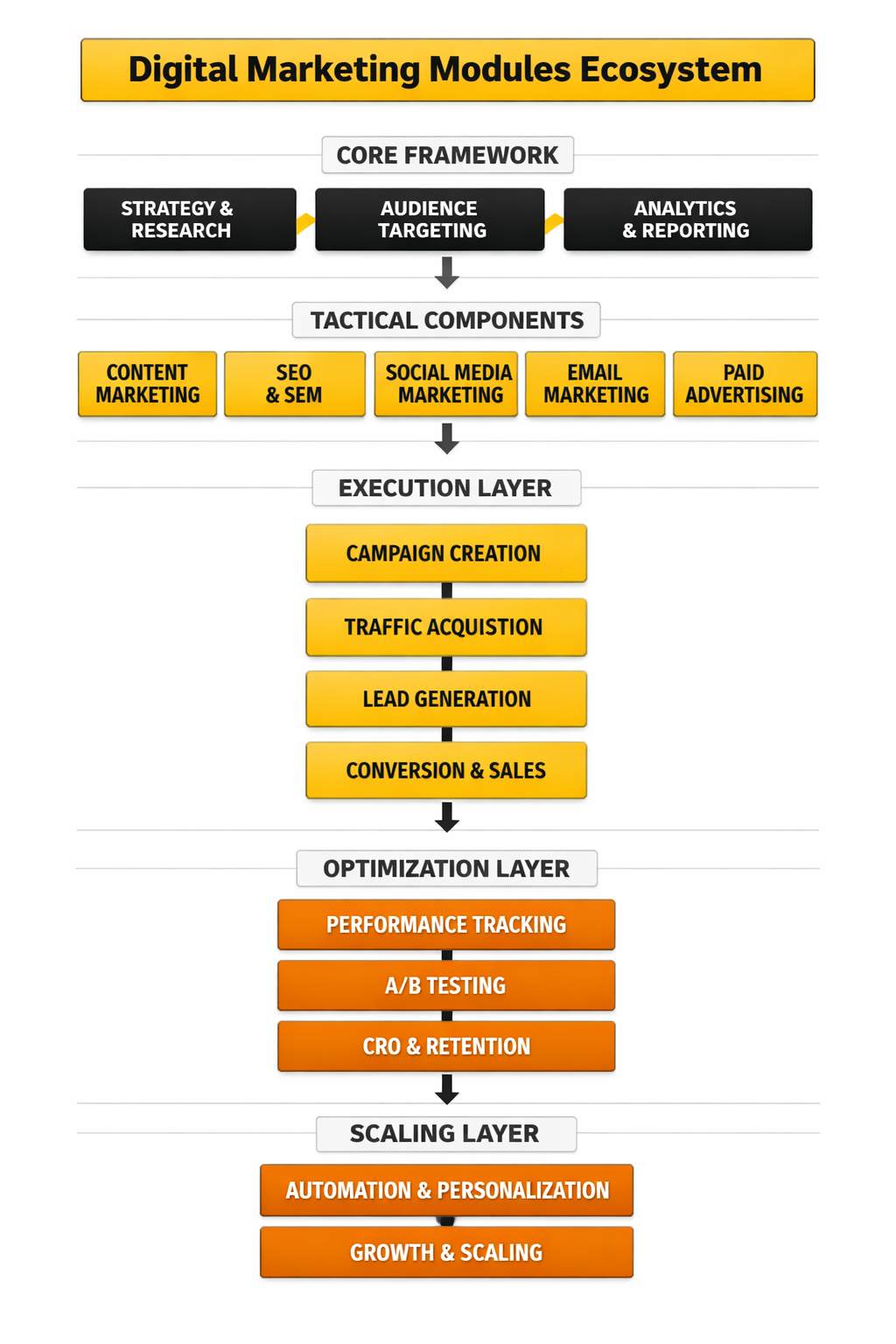
In practice, a clean measurement system for digital marketing modules should answer four questions:
- What is the primary business outcome? This might be revenue, qualified pipeline, booked demos, trial starts, or retained customers.
- What are the key events that lead to that outcome? These are the actions worth measuring inside GA4 and your CRM, not every minor click on the site.
- Which channels influence those events? Search, social, paid, email, and direct traffic all play different roles, so attribution should be interpreted with some humility.
- What decision will each metric drive? If a number does not help you change budget, creative, targeting, landing pages, or follow-up, it probably does not deserve headline status.
That last point is where most dashboards fail. They collect data without defining what the data is supposed to change.
The Metrics That Matter at Each Stage
The smartest way to teach measurement is by separating leading indicators from lagging indicators. Leading indicators tell you whether attention and engagement are moving in the right direction. Lagging indicators tell you whether the business outcome actually happened. Both matter, but they should never be confused.
At the top of the funnel, leading indicators include qualified impressions, search visibility for commercial topics, click-through rate, engaged sessions, video completion, and landing page engagement. These numbers matter because they tell you whether the audience is noticing the offer and finding the first touchpoint relevant enough to continue.
In the middle of the funnel, the numbers get sharper. Form completion rate, cost per qualified lead, lead-to-meeting rate, click-to-open rate in email, and assisted conversions start telling you whether the message is holding up once people move past first contact. Mailchimp’s guidance is useful here because it separates open rate from click-through rate and click-to-open rate, which helps teams see the difference between subject-line performance and actual content engagement. Mailchimp’s benchmark data also says a broad average email open rate is around 34.23%, but it immediately warns that performance varies by industry, audience, and context. So the action is not “chase 34%.” The action is “compare your campaigns against your own segments, intent level, and historical trend.” Mailchimp+2
At the bottom of the funnel, the lagging indicators finally take over. Here the important numbers are lead quality, sales acceptance rate, lead-to-customer conversion rate, CAC, ROAS where appropriate, and revenue by channel or campaign cohort. HubSpot’s 2026 data is especially useful because it shows marketers are prioritizing quality, conversion rate, ROI, and CAC ahead of raw lead volume. That is exactly how digital marketing modules should frame performance review: more leads are not automatically better if the close rate drops or the follow-up team cannot convert them. hubspot.com+1
Benchmarks Are Useful, but Only When You Read Them Properly
Benchmarks help when they stop you from panicking too early or celebrating too soon. They become dangerous when teams treat them like universal targets. A benchmark is context, not truth.
Email is the clearest example. Mailchimp publishes large-scale benchmark data and campaign benchmarking tools built from hundreds of millions of emails, which makes the data directionally useful. But even there, the platform is careful to note that open and click rates vary by industry, audience, and company context. So if your email open rate is below the broad average, the right question is not “why are we failing?” The right question is “is this list colder, broader, or less intent-driven than our previous segment, and what happened to clicks, replies, and downstream conversions?” Mailchimp+2
Paid media benchmarks need the same caution. Google Ads now gives advertisers more visibility into channel performance reporting inside Performance Max, which is useful because it shows more clearly where ads are running. But visibility does not remove the need for judgment. If one channel looks weaker on surface metrics, that does not automatically mean it is underperforming overall, because campaigns often work across multiple touchpoints before the final conversion happens. Google Podpora+1
Value-based bidding makes this even more important. Google says Maximize conversion value is designed to get the highest possible conversion value within budget and can work with a target ROAS when that is the right goal. That means your measurement setup has to define value carefully. If all conversions are treated as equal, the bidding system will optimize toward volume. If higher-value actions are tagged and scored properly, the system has a better chance of finding better customers rather than just cheaper clicks. Google Podpora+1
What the Data Should Make You Do Next
This is where digital marketing modules become practical. Every important metric should have a matching action.
If traffic is rising but key events are flat, the problem is usually one of three things: the audience is wrong, the offer is weak, or the landing experience is leaking intent. In that case, the action is not “publish more.” The action is to tighten targeting, sharpen the message, and simplify the next step.
If email open rates are healthy but click rates are soft, the subject line is doing its job and the body is not. That usually points to weak framing, poor offer clarity, or too many competing calls to action. The fix belongs in copy, structure, segmentation, or landing page continuity, not in subject-line testing alone. Mailchimp+1
If paid campaigns generate conversions but ROAS or downstream quality stays weak, the issue may be conversion definition rather than campaign delivery. Google’s bidding systems can optimize powerfully, but only around the signals you give them. So the action is often to improve value mapping, offline conversion feedback, and CRM handoff, not to blame the platform immediately. Google Podpora+1
If the team keeps reporting channel metrics in isolation, the fix is operational. Build one review rhythm where search, paid, email, social, and sales feedback are discussed together. That is where a connected stack becomes valuable. A CRM and automation layer like HighLevel or Copper can make attribution and lead-stage tracking much easier to manage, but only after the team agrees on which stages, events, and outcomes actually matter.
A Better Way to Teach Statistics Inside Digital Marketing Modules
The best measurement modules do not overwhelm people with dashboards full of disconnected charts. They teach one clean habit: start with the outcome, map the key events, review the signal by funnel stage, and make one clear decision per reporting cycle.
That approach also fits where the broader industry is heading. LinkedIn’s 2025 B2B benchmark data shows that when marketers measure AI ROI, the most consistent return they report is efficiency gains, ahead of revenue growth, conversion rate, lead generation, and return on ad spend. That matters because measurement is no longer just about direct revenue proof on day one. It is also about spotting whether a system is producing faster iteration, cleaner workflows, and better creative throughput before the full revenue impact appears. business.linkedin.com
So the point of the data is not to worship the numbers. It is to make better decisions with less delay. That is exactly why measurement deserves a dedicated place inside digital marketing modules, and it is also why the next section has to deal with conversion, email, and automation. Once the metrics are clear, you can finally improve the follow-up system that turns attention into revenue.
Core Modules for Email, Automation, and Conversion
Email, automation, and conversion are where digital marketing modules stop looking educational and start looking operational. At this stage, the question is no longer how to get attention. The question is how to turn attention into a measurable next step without creating friction, fatigue, or a bloated stack that becomes harder to manage every quarter.
This is also where a lot of teams confuse activity with progress. HubSpot’s 2026 data shows that 75% of marketers plan to maintain or increase their email investment, and email still sits among the more reliable ROI-driving channels, but the channel only earns that status when the system behind it is clean. That is why advanced digital marketing modules need to teach not just campaign creation, but deliverability, segmentation, timing, workflow design, and conversion discipline together. HubSpot+1
Email Modules Should Start With Deliverability, Not Design
A lot of email training starts with subject lines, templates, and send frequency. That is backwards. If the message does not reliably reach the inbox, the design work and copy polish barely matter.
Google’s sender rules make that painfully practical. For senders topping 5,000 messages a day to Gmail accounts, Google requires SPF, DKIM, and DMARC, asks senders to keep spam rates below 0.3%, and requires one-click unsubscribe for marketing and subscribed messages. That is not a technical footnote anymore. It is part of the core craft, and any serious set of digital marketing modules should treat deliverability as part of strategy, not as an IT cleanup job that happens after performance drops. Google Podpora+1
The more advanced lesson is that delivery and deliverability are not the same thing. Litmus makes that distinction clearly: delivery means the server accepted the message, while deliverability is about whether the email actually lands where a subscriber is likely to see it. That difference matters because teams often celebrate send volume while ignoring list fatigue, sender reputation, authentication gaps, and spam-related issues that quietly poison the channel over time. Litmus
This is also why broad benchmarks should be used as context, not as a scoreboard. Mailchimp’s benchmark data shows all-users averages of 35.63% open rate, 2.62% click rate, and 0.22% unsubscribe rate, but those numbers only help when you compare them against your own audience type, intent level, and campaign purpose. A cold newsletter, a customer onboarding sequence, and an abandoned-cart flow should not be judged by the same standard, and advanced digital marketing modules should teach that difference early. Mailchimp
Automation Modules Should Use Behavior, Not Fake Personalization
Automation gets overpraised when people think it means “send more messages with less work.” The better definition is much stricter: automation should reduce response time, improve relevance, and preserve context across the journey. If it does not do those three things, it is usually just scheduled noise.
That is why the best automation modules are built around behavior and first-party data. HubSpot’s 2026 data shows that 93% of marketers say personalization improves leads or purchases, while 47% say they use automation to make marketing processes more efficient. The takeaway is not “automate everything.” The takeaway is that automation works when it responds to real signals such as signup source, viewed pages, product interest, lead stage, prior purchase, or sales-team status. HubSpot
This is where workflow design matters more than feature count. A welcome sequence should set expectations and move a new contact toward one clear next step. A nurture flow should continue the conversation based on what the person already showed interest in. An abandoned-checkout flow should recover intent quickly, but it should not pretend checkout abandonment is only an email problem.
Shopify’s current guidance is a useful reality check here. A strong abandoned-cart sequence can recover about 3% to 5% of lost sales, but the remaining 95% to 97% usually points to deeper checkout issues such as unexpected costs, limited payment options, security concerns, or technical friction. That is exactly the kind of tradeoff advanced digital marketing modules should teach: use automation to recover what is recoverable, but do not let a recovery flow hide a broken buying experience. Shopify
For implementation, the stack should stay as simple as possible for as long as possible. A lean setup in Brevo or HighLevel can handle segmentation, email sequences, CRM stages, and pipeline follow-up without forcing the team into six disconnected tools on day one. If inbound lead volume is high and speed matters, a conversational layer in ManyChat or Chatbase, paired with scheduling in Cal.com, can make the automation module feel tangible very quickly. Brevo+1
Conversion Modules Should Remove Friction Before They Add Complexity
Conversion work gets messy when teams keep adding pages, forms, popups, upsells, and extra steps without checking whether the original journey was already too hard. That is one of the biggest reasons mature digital marketing modules need to cover friction diagnosis, not just funnel design. The smartest conversion improvement is often subtraction.
Google’s guidance on Core Web Vitals is a good place to anchor that discipline. It says a good user experience should target Largest Contentful Paint within 2.5 seconds, Interaction to Next Paint under 200 milliseconds, and Cumulative Layout Shift below 0.1. web.dev also makes the commercial point directly: performance affects whether users actually follow through, and slow sites can hurt revenue while faster experiences improve business outcomes. That means conversion modules should treat speed, responsiveness, and layout stability as part of the revenue system, not as technical polish for later. Google for Developers+1
The same principle applies to forms and page structure. If a landing page asks for too much too early, the form is not “qualifying leads.” It is blocking them. If the offer is clear but the page loads slowly, shifts during interaction, or hides the next step under clutter, the problem is not traffic quality first. It is path quality.
This is where advanced digital marketing modules should teach a sharper conversion sequence. Match one page to one promise. Keep the primary call to action singular and obvious. Only ask for information that genuinely improves routing, follow-up, or qualification, because every extra field and every extra click needs to earn its place. Google for Developers+1
For teams building offers fast, landing page tools such as Replo, ClickFunnels, or Systeme.io can help speed up experimentation. But the advanced tradeoff is easy to miss: faster page creation is useful only when the team is also disciplined about message match, speed, form friction, and post-conversion follow-up. Otherwise the funnel gets bigger while the leak stays exactly where it was.
Scaling These Modules Creates New Risks
The hardest stage is not getting the first flows live. The hardest stage is scaling them without turning the system into a maze. That is where expert-level guidance matters most.
The first risk is over-segmentation. Segmentation is powerful, and HubSpot’s compiled stats still point to segmented email sending outperforming generic blasts, but every new segment creates more creative work, more QA, more reporting complexity, and more room for broken logic. Strong digital marketing modules should therefore teach segment design around meaningful differences in intent, lifecycle stage, or offer relevance, not around every small data point a platform happens to expose. HubSpot+1
The second risk is over-automation. A workflow that sends the right message at the wrong moment is still a bad workflow. Brevo’s own guidance on nurture and automation examples is useful here because the best-performing flows tend to be familiar ones: welcome, follow-up, onboarding, abandoned cart, re-engagement, and milestone messaging. That is a reminder that advanced systems usually win by doing the basics well and connecting them properly, not by building twenty clever branches nobody can maintain. Brevo+1
The third risk is stack sprawl. One tool handles email, another handles forms, another books calls, another scores leads, another sends SMS, and suddenly no one fully trusts the data handoff. At that point, even strong digital marketing modules begin to underperform because the process is fragmented. The expert move is not buying more software first. The expert move is deciding where contact records live, where conversion events are defined, and which system owns the next action after a lead engages.
That is why late-stage growth work needs restraint as much as creativity. The goal is not to build the most elaborate automation map in the company. The goal is to build a system that responds quickly, converts cleanly, and can still be understood by the team six months later.
The final part of the article brings everything together at the professional level. That means turning digital marketing modules into a working implementation model, choosing the right stack for the stage you are in, and finishing with the FAQ that answers the questions readers usually have once the strategy becomes real.
Professional Implementation Turns Modules Into a Working Ecosystem
The final step is where digital marketing modules become a real operating system instead of a reading list. At this level, the goal is not to collect more tactics. The goal is to connect research, content, acquisition, conversion, automation, and measurement into one ecosystem that the team can actually run every week without losing clarity. Google for Developers+2
That ecosystem should be simple enough to manage and strong enough to scale. A lean version usually includes one analytics layer, one CRM or lead-management layer, one publishing workflow, one landing-page or funnel layer, and one automation layer, with clear ownership for each handoff. In practice, that can mean using HighLevel or Copper for relationship and pipeline visibility, Brevo for lifecycle email, Buffer for content operations, Fillout for cleaner form capture, and Replo or Systeme.io when the team needs faster landing-page execution. Google Podpora+2
The professional difference is not the size of the stack. It is the quality of the decisions behind it. Google’s guidance still centers people-first content and useful experiences, while current marketing data keeps pushing teams toward lead quality, conversion efficiency, and cleaner systems rather than more noise, so the right ecosystem is the one that helps you publish better work, measure the right actions, and respond faster when the data tells you something needs to change. Google for Developers+2
FAQ - Built for Complete Guide
What are digital marketing modules, really?
Digital marketing modules are focused skill blocks that teach one part of the growth system clearly enough to be applied in real work. A strong module should produce an output you can use, such as an audience brief, a content system, a campaign structure, a landing page, an automation flow, or a measurement dashboard. That modular approach fits the market better because marketing roles keep evolving and the underlying skills are changing fast. linkedin.com+1
How many digital marketing modules does a business actually need?
Most businesses do not need dozens of modules at the start. They usually need a core set that covers audience research, messaging, content, acquisition, conversion, automation, and measurement, because those are the blocks that keep the system commercially grounded. After that, extra modules should only be added when they solve a real bottleneck instead of just making the stack look more sophisticated. Google for Developers+2
What is the best order for learning digital marketing modules?
The best order is foundation first, distribution second, conversion third, and optimization after that. In practice, that means starting with audience, positioning, and messaging before moving into content, search, social, paid traffic, email, automation, and analytics. That sequence works because it reduces wasted execution and keeps later channel work tied to a clear commercial message. Google for Developers+2
Are digital marketing modules better than one big digital marketing course?
They are usually better when the goal is implementation rather than passive learning. One large course often mixes topics together before the learner has enough context to apply them, while modular learning makes it easier to solve one problem at a time and connect the pieces gradually. That structure also matches how modern work is changing, because professionals increasingly need flexible skill building rather than one static curriculum. linkedin.com+1
Which digital marketing modules matter most for a small business?
For most small businesses, the highest-leverage modules are audience clarity, offer messaging, content, conversion pages, follow-up automation, and simple analytics. That is because smaller teams usually cannot afford channel sprawl, so they need systems that improve message quality, reduce friction, and make lead handling more reliable before they expand into more aggressive scale plays. A small business usually wins more from clarity and process than from adding another trendy channel too early. Google for Developers+2
How long should one module take to implement?
A module should take long enough to produce a working asset, not just a set of notes. For a focused team, that often means one to three weeks for a meaningful module, because the real finish line is something usable such as a message hierarchy, a page template, a campaign brief, or a CRM workflow. The point is not speed by itself. The point is creating a repeatable asset that makes the next module easier to execute. HubSpot+1
How do I know whether a digital marketing module is working?
A module is working when it changes behavior and improves an outcome you can measure. In analytics terms, that means the module should affect a key event, a conversion path, lead quality, or workflow efficiency rather than just increasing internal activity. If the work does not lead to a clearer decision, a better asset, or a measurable improvement, the module probably needs to be simplified or rebuilt. Google Podpora+2
Should every module include analytics?
Yes, because every module should create a feedback loop. Google Analytics continues to move around event-based measurement and key events, which reinforces the idea that marketing work should be tied to observable actions rather than broad vanity metrics. Even a content or messaging module should define what signal counts as success before execution begins. Google Podpora
Can AI replace some digital marketing modules?
AI can speed up parts of many modules, but it does not remove the need for the modules themselves. It is useful for research support, formatting, repurposing, first drafts, and workflow efficiency, but the human work around judgment, evidence, positioning, and commercial prioritization still decides whether the system produces results. That is one reason current marketing reporting keeps focusing on efficiency gains and skill shifts rather than pretending the strategic layer has disappeared. HubSpot+2
What tools should I buy first?
Buy tools only after the workflow is clear. If the business still lacks clean messaging, a solid offer, clear key events, and a reliable follow-up path, another platform will usually create more clutter than progress. The best early purchases are the tools that remove a proven bottleneck, whether that is page creation in ClickFunnels, workflow automation in HighLevel, email delivery in Brevo, or conversational capture in ManyChat. Google for Developers+2
Do I need certifications to use digital marketing modules professionally?
Certifications can help you learn platform mechanics and give clients or employers some confidence that you understand the basics. They are not a substitute for building real systems, though, because clients care more about whether you can improve acquisition, conversion, and reporting than whether you can list badges on a profile. In professional practice, a portfolio of implemented modules usually carries more weight than certificates alone. linkedin.com+1
Should I specialize in one channel or learn the full system?
Early on, it helps to understand the full system even if you later specialize. A specialist who understands how messaging affects paid media, how content supports search, how automation affects conversion, and how analytics defines success will make better decisions inside their own lane. The strongest marketers are often T-shaped: broad enough to connect the modules, deep enough to own one area exceptionally well. linkedin.com+2
When should a company bring in professionals instead of building everything internally?
A company should bring in professionals when the cost of delay, confusion, or wasted spend is becoming more expensive than expert help. That usually happens when the team has traffic but poor conversion, inconsistent reporting, weak follow-up, unclear ownership, or too many tools stitched together without one clean operating model. The right expert support should make the system simpler, more measurable, and easier for the internal team to maintain after the engagement is over. Google for Developers+2
Work With Professionals
Explore 10K+ Remote Marketing Contracts on MarkeWork.com
Most marketers spend too much time chasing clients, competing on crowded platforms, and losing a percentage of every project to middlemen. MarkeWork gives you a better way. Browse thousands of remote marketing contracts and connect directly with companies desperate to hire skilled marketers like you, without platform commissions and without unnecessary gatekeepers. markework.com+1
If you're serious about finding better opportunities and keeping 100% of what you earn, explore available contracts and create a profile for free at MarkeWork.com. markework.com