

Digital marketing packages look simple from the outside. A business pays a monthly fee, gets services like SEO, ads, content, email, funnels, or social media, and expects growth.
But the real value is not the list of deliverables. The value is whether the package connects traffic, conversion, follow-up, and reporting into one system that can actually produce measurable results.
Marketing budgets are under pressure, with Gartner reporting that 2025 marketing budgets stayed flat at 7.7% of company revenue. At the same time, digital channels keep taking a larger share of total ad spend, with DataReportal noting that global advertising spend reached nearly $1.1 trillion in 2024. That is exactly why packaged marketing needs to be clearer, tighter, and more strategic than ever.
Article Outline
- Why Digital Marketing Packages Matter
- The Digital Marketing Package Framework
- Core Components of a Strong Package
- Common Types of Digital Marketing Packages
- How to Match Packages to Business Goals
- Professional Implementation and Optimization
- Pricing Models and Scope Control
- Tools That Help Deliver Digital Marketing Packages
- Mistakes to Avoid When Buying or Selling Packages
- Final Checklist for Choosing the Right Package
- Frequently Asked Questions
Why Digital Marketing Packages Matter
Digital marketing packages matter because most businesses do not need random marketing activity. They need a structured offer that turns scattered tasks into a focused growth system. Without that structure, it is very easy to pay for posts, ads, landing pages, or email campaigns that never connect to revenue.
A good package also makes decisions easier. Instead of asking whether you need SEO, paid ads, automation, content, or funnels in isolation, the package should show how each part supports a specific business goal. That could be lead generation, booked calls, ecommerce sales, retention, local visibility, or audience growth.
This matters even more when budgets are limited. If a company is investing in marketing while costs, competition, and buyer expectations are rising, every deliverable needs a job. The best digital marketing packages are not bloated menus; they are clear operating systems for acquisition and conversion.
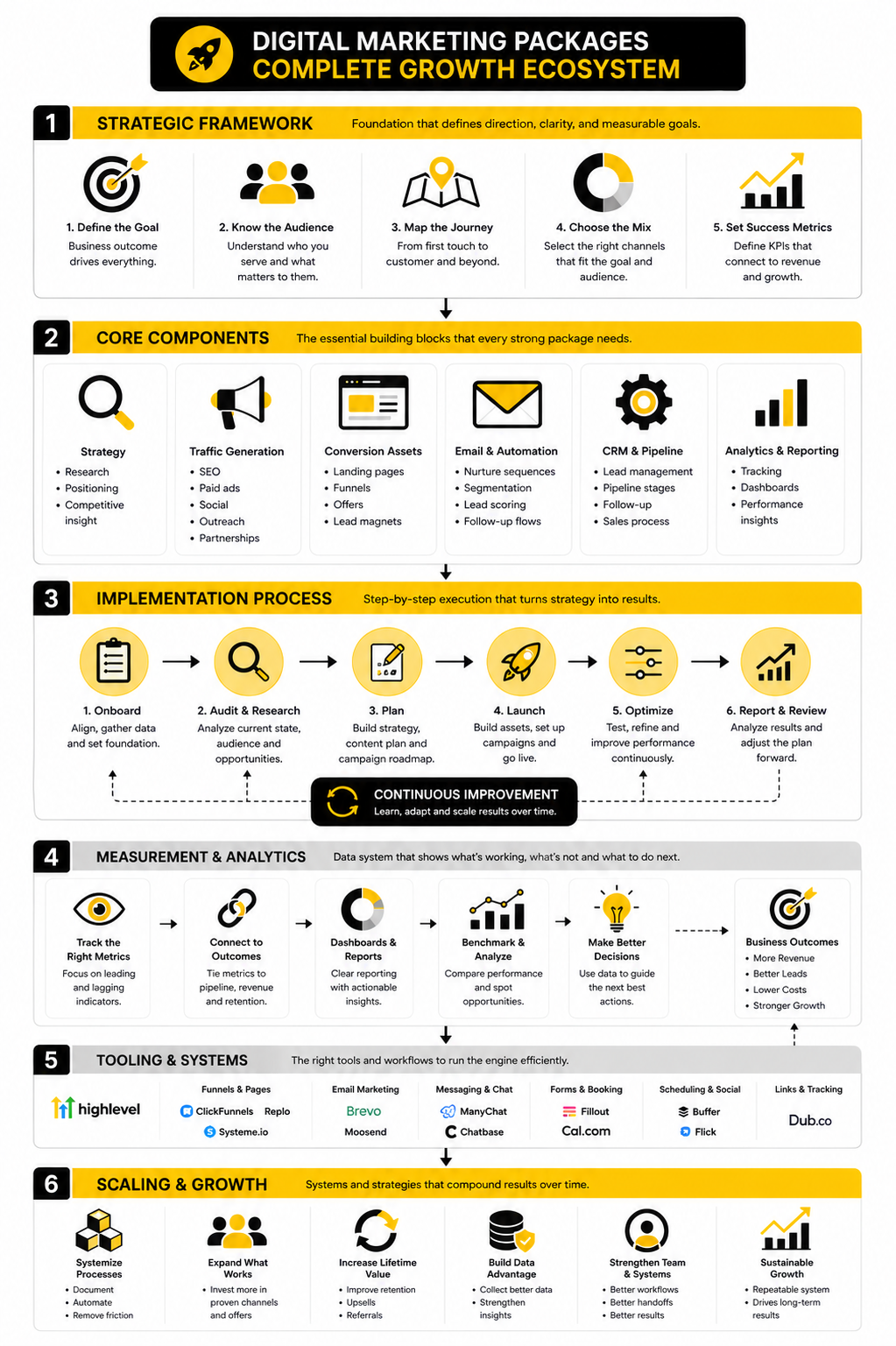
The Digital Marketing Package Framework
A practical digital marketing package starts with one question: what outcome is this package built to create? That answer should shape the channels, deliverables, reporting, and pricing. A lead generation package, for example, should not be built the same way as a brand awareness package or an ecommerce conversion package.
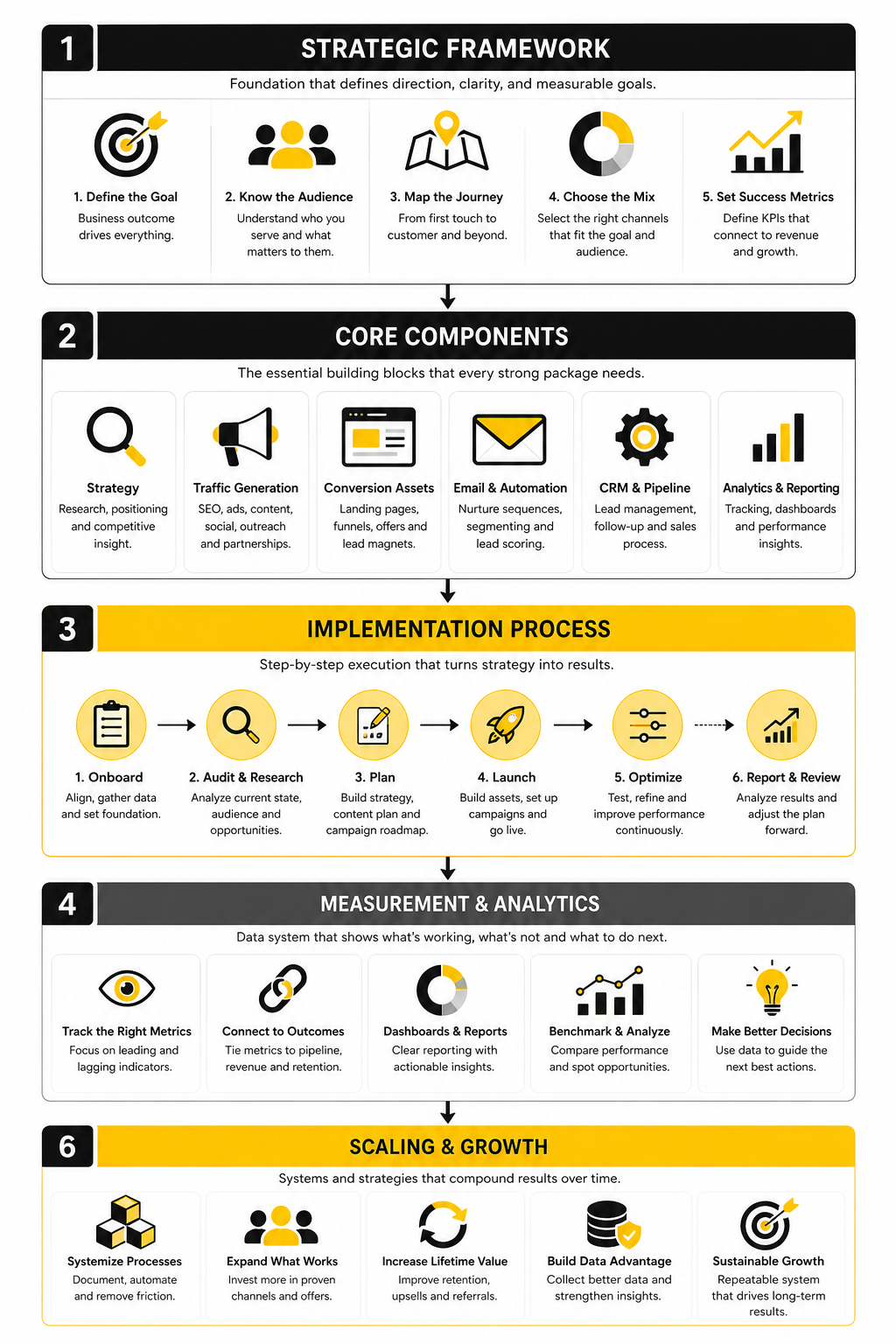
The framework has four layers: strategy, traffic, conversion, and follow-up. Strategy defines the audience, positioning, offer, and funnel. Traffic brings people in through channels like search, paid ads, social, partnerships, or content.
Conversion turns attention into action through landing pages, forms, calls, checkout flows, or messaging. Follow-up keeps prospects moving with email, SMS, CRM workflows, retargeting, and sales automation. Platforms like GoHighLevel, ClickFunnels, and ManyChat fit naturally here when the package includes funnels, CRM, automation, or conversational marketing.
Core Components of a Strong Package
The strongest digital marketing packages are built around outcomes first and deliverables second. That sounds obvious, but it is where many offers fall apart. A business does not really want “eight social posts, two emails, and one landing page”; it wants more qualified attention, better conversion, and a cleaner way to turn interest into revenue.
A good package should make the path from discovery to decision easy to understand. That means the offer needs a traffic source, a conversion point, a follow-up system, and a reporting rhythm. If one of those pieces is missing, the package may still look busy, but it will usually feel disconnected once the work starts.
This is especially important because digital ad investment keeps rising, with U.S. internet advertising revenue reaching a record $259 billion in 2024 and nearly $300 billion in 2025. More money flowing into digital channels means more competition, more noise, and less room for vague execution. Packages need discipline.
Strategy and Positioning
Strategy is the part of the package that decides what everything else should be doing. It defines the audience, the offer, the message, the channel mix, and the main conversion goal. Without this layer, digital marketing packages become a collection of tasks instead of a business growth plan.
Positioning matters because buyers compare faster than ever. If your message sounds like every other agency, consultant, SaaS company, clinic, coach, ecommerce brand, or local service provider, you are forcing people to choose based on price. Strong positioning gives the package a sharper angle before money is spent on traffic.
This section of the work should usually include customer research, competitor review, offer clarity, funnel mapping, and a basic measurement plan. It does not need to become a 60-page strategy deck. It needs to answer the practical question: why should this audience care, and what should they do next?
Traffic Channels
Traffic is where most people start, but it should not be chosen randomly. SEO, paid search, paid social, organic social, creator partnerships, email list growth, and referral campaigns all behave differently. The right channel depends on intent, buying cycle, budget, urgency, and how much trust the market needs before converting.
For example, search works well when people already know what problem they are trying to solve. Paid social can work well when the offer needs education, pattern interruption, or demand creation. Email and SMS perform best when there is already an audience or lead flow that can be nurtured.
This is why a package should never promise every channel at once unless the budget and team can support it. A focused package with two strong channels usually beats a bloated package with six weak ones. More activity is not the same as more growth.
Conversion Assets
Conversion assets are the pages, forms, booking flows, checkout pages, lead magnets, webinars, and sales funnels that turn traffic into measurable action. This is where many campaigns quietly lose money. The ads may work, the content may attract attention, and the audience may be right, but the conversion path creates friction.
A strong package should include the assets needed to capture demand properly. That might mean a landing page built with Replo for ecommerce campaigns, a funnel built with ClickFunnels, or a simpler all-in-one setup with Systeme.io. The tool matters less than the job it performs.
The key is alignment. If the traffic promise says one thing and the landing page says another, conversions drop. If the form asks for too much too soon, leads disappear. If the offer is unclear, the visitor hesitates, and hesitation kills momentum.
Follow-Up and Automation
Follow-up is where a lot of profit gets recovered. Not every lead is ready to buy today, and not every visitor will convert on the first touch. A package that ignores follow-up is leaving warm demand sitting there with no system to move it forward.
This layer can include email sequences, SMS reminders, abandoned cart flows, lead scoring, pipeline stages, chatbot flows, or sales task automation. Tools like GoHighLevel, Brevo, Moosend, and ManyChat fit naturally when the package includes nurture, reminders, campaigns, or conversational lead capture.
This part needs to feel human, not robotic. Automation should reduce delay, improve consistency, and help the buyer take the next useful step. It should not blast people with generic messages just because the software can.
Common Types of Digital Marketing Packages
Most digital marketing packages fall into a few practical categories. The names vary from agency to agency, but the underlying structure is usually similar. Understanding these types makes it much easier to compare offers without getting distracted by fancy labels.
A business should choose the package based on its current bottleneck. If nobody knows the brand exists, it needs visibility. If traffic exists but sales are weak, it needs conversion work. If leads are coming in but not closing, it needs follow-up, CRM, and sales process support.
The mistake is buying the package that sounds the most complete instead of the one that solves the next constraint. Growth usually breaks at one point in the system first. Fix that point before expanding everything else.
SEO and Content Packages
SEO and content packages are built for long-term visibility. They usually include keyword research, content planning, technical improvements, on-page optimization, internal linking, and performance tracking. These packages work best for businesses that can benefit from sustained search demand rather than only short campaign bursts.
The upside is compounding value. A strong content asset can keep bringing in qualified visitors long after it is published. The downside is that SEO usually takes time, and anyone selling it as an instant fix is overpromising.
A practical SEO package should clearly separate technical work, content production, and authority-building activity. It should also explain what will be measured beyond rankings. Traffic is useful, but qualified traffic that supports leads, sales, or pipeline is what really matters.
Paid Advertising Packages
Paid advertising packages focus on speed, testing, and controlled acquisition. They usually include campaign strategy, ad creative, audience setup, landing page alignment, tracking, optimization, and reporting. These packages are useful when the business has a clear offer and wants faster market feedback.
The risk is that paid ads expose weak offers quickly. If the message, targeting, price point, or conversion page is not strong enough, the platform will not magically fix it. Paid media amplifies the system you already have.
That is why paid advertising should rarely be sold as media buying alone. The package should include enough strategy and conversion support to make the traffic useful. Otherwise, the client ends up paying for clicks while the real problem sits somewhere else.
Social Media and Community Packages
Social media packages are usually misunderstood because people focus too much on posting frequency. A serious package should define the role of each channel, the content format, the engagement process, and the path from attention to action. Posting three times per week does not mean much if the content has no point of view and no next step.
For many brands, social works best as a trust-building channel rather than a direct-response machine. Short-form video, carousels, founder-led content, customer education, and community interaction can all support demand, but they need consistency. B2B marketers are increasing investment in video and thought leadership, with 2025 research showing planned increases for video at 61% and thought leadership at 52%.
A useful package should also clarify what is included beyond content creation. Does the team handle comments, messages, repurposing, reporting, influencer coordination, or paid boosting? If not, the scope should say so clearly, because vague social media packages can become messy fast.
Funnel and Lead Generation Packages
Funnel and lead generation packages are built to turn attention into pipeline. They usually include offer strategy, landing pages, lead magnets, forms, tracking, email follow-up, booking flows, and sometimes paid traffic. This type of package is a strong fit when the business needs more qualified leads, booked calls, demo requests, or trial signups.
The most important part is the handoff between marketing and sales. A lead is not valuable just because someone filled out a form. The package should define what happens after the conversion, who follows up, how fast they respond, and what counts as a qualified opportunity.
This is where CRM and automation become practical, not fancy. A business can use GoHighLevel to manage funnels, pipelines, reminders, and automations in one place, or use Fillout when the package needs better forms and lead capture flows. The right setup should make follow-up faster and reduce missed opportunities.
Ecommerce Growth Packages
Ecommerce packages need a different structure because the buyer journey is more transactional but also more measurable. These packages often include paid ads, landing pages, product page optimization, email flows, SMS, retargeting, creative testing, and conversion rate optimization. The goal is not just traffic; it is profitable revenue.
Small changes matter here. Product page clarity, offer framing, checkout friction, shipping expectations, abandoned cart recovery, and post-purchase campaigns can all influence performance. Since average ecommerce conversion rates are often under 2% across many sites, a package that ignores conversion work is incomplete.
A strong ecommerce package should also separate acquisition from retention. Ads may bring in the first purchase, but email, SMS, loyalty, bundles, subscriptions, and post-purchase education often improve the economics. That distinction matters because growth gets much easier when returning customers are part of the plan.
How to Match Packages to Business Goals
Choosing between digital marketing packages should start with the business goal, not the service list. A founder who needs the first 50 qualified leads has a different problem from an ecommerce store trying to improve repeat purchase rate. A local business trying to fill appointments has a different problem from a SaaS company trying to reduce customer acquisition cost.
The easiest way to choose is to identify the current constraint. Is the business invisible? Then traffic and awareness matter. Is there traffic but no action? Then conversion is the issue. Are leads coming in but not closing? Then follow-up, CRM, and sales enablement need attention.
This keeps the decision grounded. Instead of asking, “Which package has the most stuff?” ask, “Which package fixes the next bottleneck?” That one shift can save a lot of wasted budget.
For New Businesses
New businesses usually need clarity before scale. They may not have enough data, proof, or customer feedback to justify a complex package. In this stage, the package should focus on positioning, offer testing, simple landing pages, basic tracking, and one or two reliable traffic channels.
The goal is learning quickly without building unnecessary complexity. A new business does not need a massive automation system before it knows which offer converts. It needs a clean path to test the message, capture interest, and understand what buyers actually respond to.
This is also where simple tools can be valuable. A lean funnel in Systeme.io or ClickFunnels can be enough to validate an offer before investing in a larger stack. Keep it tight, measure honestly, and improve from there.
For Growing Businesses
Growing businesses usually need systems. They already have some proof, some traffic, some customers, or some sales activity, but performance is inconsistent. At this stage, the right package should improve reliability, attribution, conversion, and follow-up.
This is where disconnected marketing becomes expensive. Leads come in from multiple channels, sales conversations happen in different places, reporting is incomplete, and nobody knows which campaigns actually produce revenue. A growth-stage package should reduce that chaos.
The package should also include optimization cycles. That means reviewing campaign performance, testing creative, improving landing pages, cleaning up CRM stages, and tightening nurture flows. Growth is rarely one big move; it is usually a series of smart improvements made consistently.
Professional Implementation and Optimization
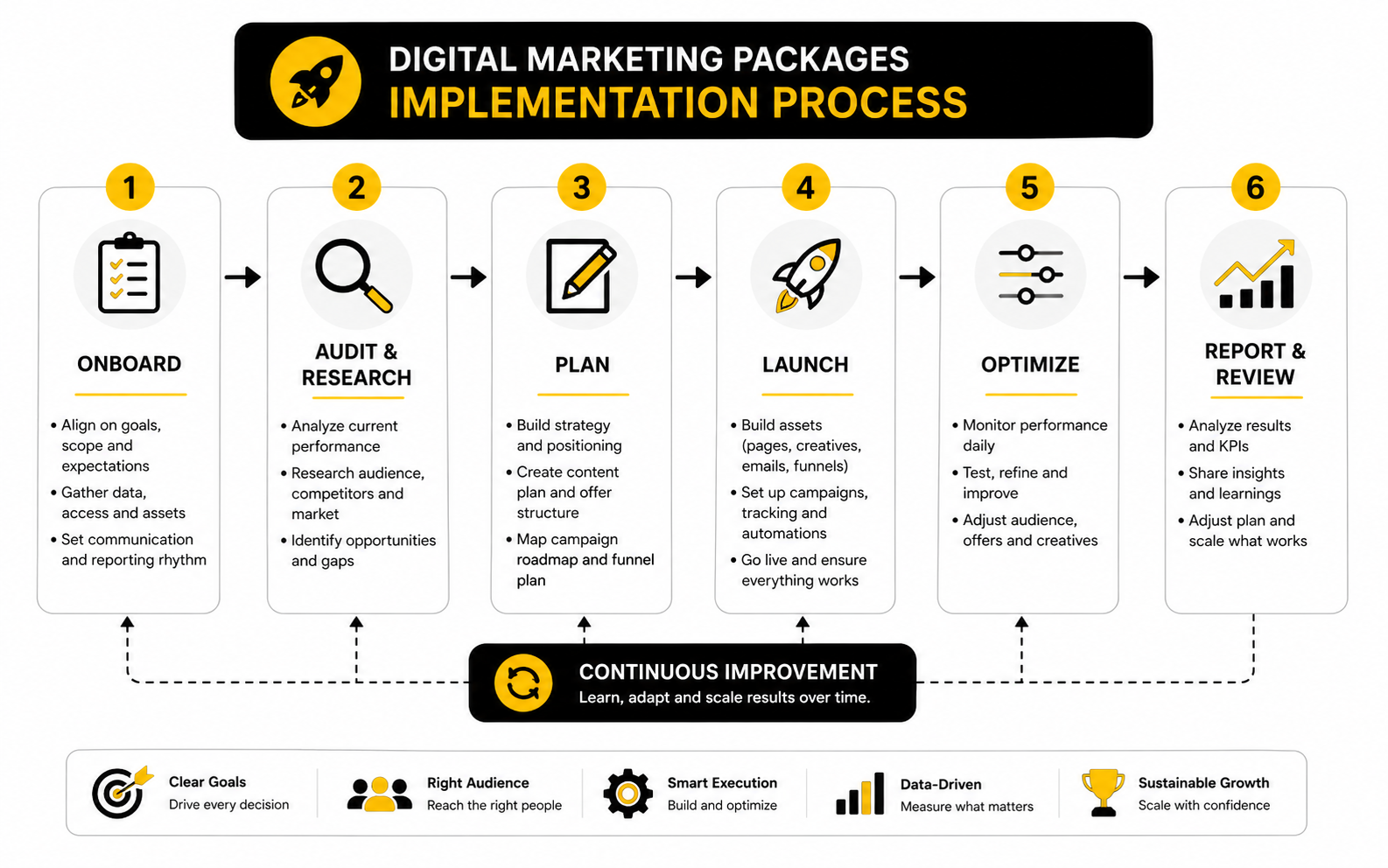
Professional implementation is where the package becomes real. This is the difference between a proposal that sounds good and a marketing system that actually runs. The process should be clear enough that everyone knows what happens first, what depends on what, and how success will be judged.
Implementation also protects both sides. The client sees progress without needing to chase every detail, and the provider avoids random requests that pull the work off track. Good process is not bureaucracy; it is how serious marketing gets delivered without chaos.
A strong implementation process usually moves through discovery, setup, launch, measurement, optimization, and review. Each stage should have a purpose. If a package skips straight to execution without diagnosis, there is a good chance the team will optimize the wrong thing.
Step 1: Diagnose the Current Situation
The first step is understanding what already exists. That includes the offer, audience, website, analytics, CRM, ad accounts, email list, content library, conversion data, and sales process. You cannot build a useful package around assumptions.
This diagnosis should identify the biggest constraint in the system. Sometimes the problem is low traffic. Sometimes it is weak conversion. Sometimes it is slow follow-up or unclear reporting. The package should be adjusted around that reality instead of forcing the business into a generic template.
The output should be practical. A simple audit, prioritized action list, and measurement baseline are often enough. The point is not to impress people with complexity; it is to make the next move obvious.
Step 2: Set the Goal and Success Metrics
Once the current situation is clear, the package needs a measurable goal. That goal could be more booked calls, lower cost per lead, higher conversion rate, better organic visibility, stronger email revenue, or improved retention. Without a defined goal, reporting turns into a list of activity instead of a business conversation.
The metrics should match the package type. SEO packages may track rankings, organic traffic, assisted conversions, and qualified leads. Paid ad packages may track cost per lead, conversion rate, pipeline value, and return on ad spend. Funnel packages may track page conversion, show-up rate, close rate, and revenue per lead.
This is where professional marketers stay honest. Not every metric deserves equal attention. The package should separate leading indicators from business outcomes so nobody confuses movement with progress.
Step 3: Build the Assets
The build stage creates the actual campaign assets. That may include landing pages, ads, emails, automations, tracking events, dashboards, social content, lead magnets, forms, or sales scripts. This is the tangible part of the package, but it should still be guided by the strategy.
Asset quality matters because weak execution can ruin a strong plan. A good offer can underperform if the page is confusing, the form is clunky, the creative is generic, or the follow-up sounds robotic. Every asset should help the buyer take the next step with less friction.
This is also the stage where tool choice becomes operational. A package might use Buffer for social scheduling, Brevo for email campaigns, ManyChat for messaging flows, or GoHighLevel for CRM and automation. The point is not to collect tools; it is to make execution cleaner.
Step 4: Launch in a Controlled Way
A controlled launch reduces avoidable mistakes. Before campaigns go live, tracking should be checked, forms should be tested, automations should fire correctly, and the sales team should know what to expect. This sounds basic, but it is where many campaigns break.
The first launch period should be treated as a learning window. Early data helps reveal whether the offer, audience, creative, page, and follow-up are working together. It is usually too soon to make dramatic conclusions, but it is not too soon to catch obvious friction.
The goal is to move quickly without being careless. Launch, watch the signals, fix the leaks, and avoid emotional decisions based on one good day or one bad day. That discipline is a major part of why professional implementation works.
Step 5: Measure the Right Signals
Measurement is where digital marketing packages either become accountable or become noise. It is not enough to report impressions, clicks, likes, and email opens without explaining what those numbers mean. A professional package should connect channel metrics to pipeline, revenue, retention, or another business outcome that actually matters.
The first rule is simple: every metric needs a decision attached to it. If a number goes up or down and nobody knows what action to take, it is probably not a core performance metric. It may still be useful context, but it should not dominate the report.
This is also why benchmarks need to be handled carefully. A benchmark can show whether performance is wildly off track, but it cannot tell you whether your offer, audience, price, margin, or sales process is healthy. Use benchmarks as a reference point, not as a substitute for thinking.
Statistics and Data
Data should make digital marketing packages easier to manage, not harder. The point is not to dump every possible statistic into a dashboard. The point is to understand which numbers reveal demand, which reveal friction, and which reveal whether the package is moving the business in the right direction.
The digital market is big, competitive, and still growing. U.S. internet advertising revenue reached $294.6 billion in 2025, which means brands are not pulling back from digital channels. They are demanding more accountability from them.
That matters because competition changes how packages should be judged. A campaign can get clicks and still fail if the clicks are too expensive, too broad, or poorly matched to the offer. Strong measurement separates surface activity from meaningful progress.
What Benchmarks Can and Cannot Tell You
Benchmarks are useful when they create perspective. If an email list has a 5% open rate while recent email benchmark data shows average open rates around 43.46% in 2025, that is a signal to investigate deliverability, list quality, subject lines, segmentation, or sender trust. The benchmark does not diagnose the issue by itself, but it points you toward the right questions.
The same applies to click rates, conversion rates, cost per lead, and return on ad spend. A number only becomes useful when it is compared against context. Industry, offer type, audience temperature, price point, seasonality, geography, and sales cycle all change what “good” looks like.
This is where bad reporting becomes dangerous. If a provider cherry-picks the one number that looks good, the client may feel progress while the business stays flat. A real report should show the relationship between traffic, conversion, follow-up, and revenue.
The Metrics That Actually Matter
Most digital marketing packages should track a small set of core metrics. These usually include traffic quality, conversion rate, cost per lead or acquisition, lead-to-sale rate, revenue, retention, and campaign profitability. The exact mix depends on whether the package is built for SEO, paid ads, ecommerce, lead generation, content, or automation.
For SEO, the useful signals go beyond rankings. Organic impressions, qualified landing page visits, conversions, assisted pipeline, and content decay are more helpful than celebrating one keyword move. Rankings are nice, but revenue-connected visibility is better.
For paid campaigns, the useful signals are not just clicks and CPM. Cost per qualified lead, landing page conversion rate, booked call rate, close rate, average order value, and payback period tell a much clearer story. If paid traffic is cheap but sales quality is poor, the campaign is not really efficient.
How to Build a Simple Analytics System
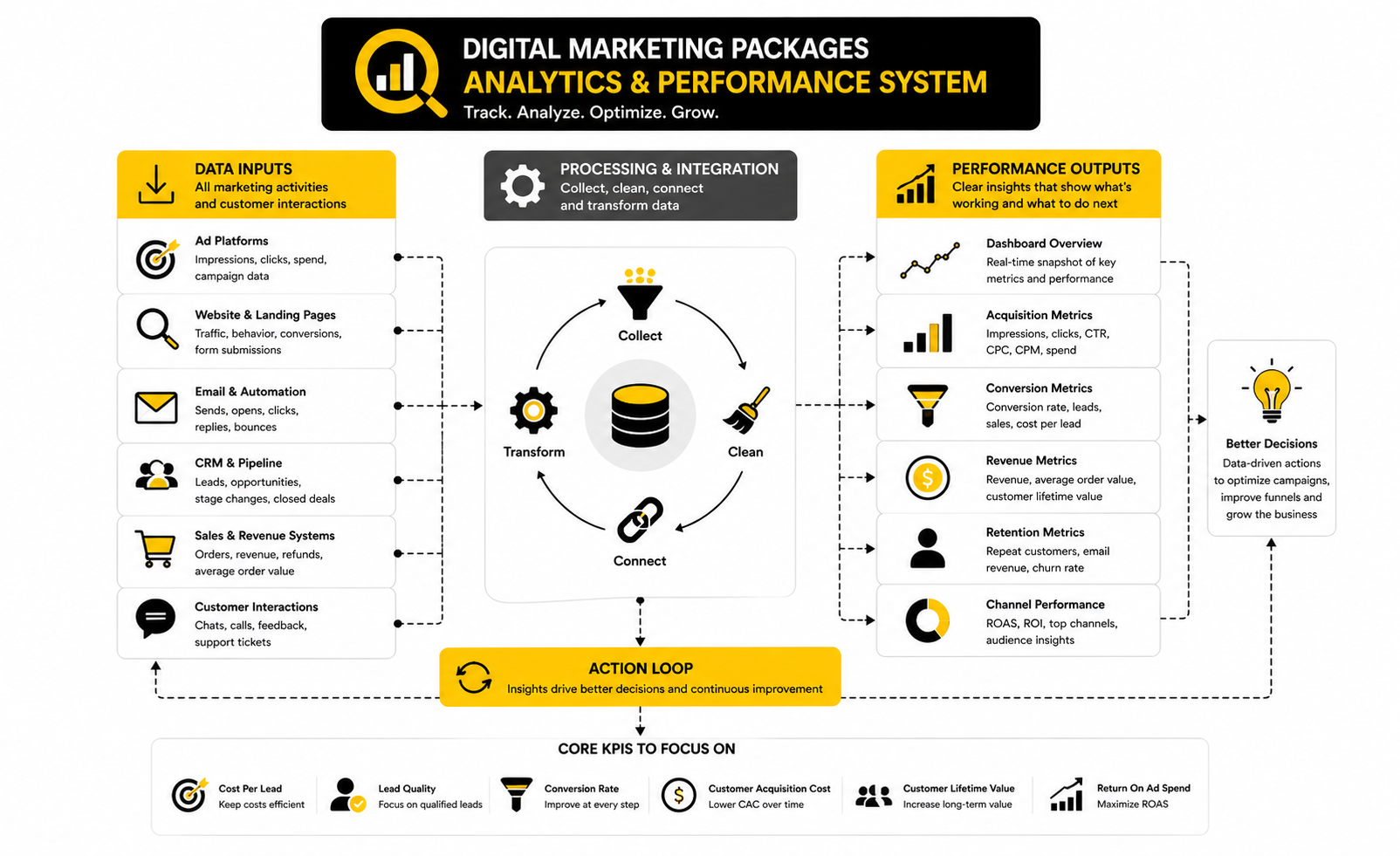
A simple analytics system should show the journey from source to outcome. That means tracking where people came from, what they clicked, where they converted, what follow-up happened, and what business result followed. Without that chain, the package is running partly blind.
The setup does not need to be complicated. Use clean UTM naming, proper conversion events, CRM stages, email campaign tags, landing page tracking, and a dashboard that separates channel activity from business outcomes. If the package uses GoHighLevel, the CRM and pipeline should be part of the measurement system, not just a place where leads sit.
For ecommerce, the analytics system should also connect product performance, cart behavior, checkout completion, email revenue, and repeat purchase behavior. For service businesses, it should connect form fills, calls, appointments, show-up rate, close rate, and revenue. Different business models need different dashboards, but the principle is the same: track the path, not just the platform.
How Often Performance Should Be Reviewed
Performance should be reviewed in layers. Some signals need daily checks, especially during a paid launch or time-sensitive campaign. Other signals need weekly or monthly review because they require enough data to avoid overreacting.
Daily checks should focus on obvious issues: broken forms, tracking problems, rejected ads, abnormal spend, deliverability problems, or sudden performance drops. Weekly reviews should look at channel performance, creative tests, landing page behavior, and lead quality. Monthly reviews should focus on bigger decisions like budget allocation, offer changes, package scope, and strategy.
This rhythm matters because marketing data can trick you. One day of strong results does not prove a campaign is fixed, and one weak day does not mean everything is broken. The job is to spot patterns, not panic at noise.
Turning Data Into Better Decisions
The best data leads to action. If a landing page has traffic but weak conversion, improve the offer, headline, proof, form, or page speed. If leads are converting but not closing, inspect lead quality, response time, sales scripts, and follow-up.
If email open rates are healthy but click rates are weak, the subject line is probably doing its job while the message or offer is not strong enough. If ads get engagement but no conversions, the creative may be attracting curiosity instead of intent. If organic traffic grows but pipeline does not, the content strategy may be targeting the wrong search intent.
This is the real value of measurement inside digital marketing packages. It keeps the package from becoming a fixed checklist. The data shows what to improve next, and the team uses that insight to make the system sharper over time.
Pricing Models and Scope Control
Pricing is where digital marketing packages get real. A package can sound perfect on paper, but if the pricing model does not match the workload, risk, and expected outcome, the relationship will eventually become strained. The business wants results, the provider needs margin, and both sides need a scope that can actually be delivered.
Most packages use one of four pricing models: fixed monthly retainer, project-based fee, performance-based pricing, or hybrid pricing. None of these is automatically better than the others. The right model depends on the channel, the maturity of the business, the amount of unknown work, and how much control the provider has over the outcome.
This matters because marketing budgets are not expanding endlessly. With marketing budgets sitting at 7.7% of company revenue, buyers are more sensitive to wasted spend. Clear pricing and scope make the package easier to approve, manage, and renew.
Fixed Monthly Packages
Fixed monthly packages are the most common because they are easy to understand. The client pays a predictable fee, and the provider delivers a defined set of services each month. This works well for ongoing work like content, SEO, social media, email marketing, CRM management, and campaign optimization.
The risk is that fixed packages can become task traps. If the package promises too many deliverables, the provider gets buried in production and has no room to think strategically. If the package is too vague, the client may expect unlimited support because the monthly fee feels open-ended.
A good fixed package should define deliverables, turnaround times, revision limits, meeting frequency, reporting cadence, and what happens when extra work appears. That does not make the offer less flexible. It makes the relationship healthier.
Project-Based Packages
Project-based packages work best when the outcome is specific and finite. Examples include building a landing page, setting up a funnel, creating an email welcome sequence, auditing analytics, launching a CRM, or preparing a campaign. These packages are useful when the business needs a defined asset rather than ongoing management.
The upside is clarity. Everyone knows what is being built, when it should be delivered, and what the handoff looks like. The downside is that project work can stop right before the most important phase: optimization.
That is why project-based digital marketing packages often work best with an optional support or testing period after launch. A funnel is not truly finished when it goes live. The first round of data usually reveals what needs to be tightened.
Performance-Based Packages
Performance-based pricing sounds attractive because it links payment to results. In theory, that creates alignment. In practice, it only works when attribution is clean, the provider has enough control, and the business has the sales process to convert the demand being generated.
This model can break down fast when the provider is responsible for leads but has no control over offer quality, pricing, sales response time, fulfillment, or customer retention. If those areas are weak, the campaign may look like the problem even when the real issue is elsewhere. That is not fair to either side.
A smarter approach is often hybrid pricing. The provider charges a base fee to cover work and then adds a performance incentive tied to qualified outcomes. This protects execution quality while still rewarding growth.
Scope Creep and Why It Happens
Scope creep usually starts innocently. One extra landing page. A few more email edits. A quick ad variation. Another report. More meetings. More channels. Then suddenly the package is no longer the package.
The problem is not that clients ask for more. That is normal when momentum builds. The problem is when the original offer does not explain what is included, what is optional, and how additional work is priced.
Scope control is not about saying no to growth. It is about keeping the work profitable, focused, and tied to the goal. If a new request supports the goal, price it properly. If it distracts from the goal, park it.
Tools That Help Deliver Digital Marketing Packages
Tools do not create strategy, but they do affect execution. A messy tech stack can slow down a good package, while a clean stack makes campaigns easier to build, measure, and improve. The goal is not to use more tools; it is to remove friction from the system.
The best stack depends on the package type. A lead generation package may need CRM, landing pages, automations, call booking, and reporting. An ecommerce package may need landing pages, email flows, analytics, creative testing, and product page optimization. A content package may need planning, scheduling, research, and performance tracking.
The tradeoff is simple. Specialized tools can be powerful, but they can also create complexity. All-in-one tools can simplify delivery, but they may not be best-in-class for every task. Choose based on workflow, not hype.
CRM and Pipeline Tools
CRM tools matter when leads, sales conversations, and follow-up need structure. If leads are coming in but nobody knows their status, the package has a serious leak. A CRM should make it clear who entered the pipeline, where they came from, what happened next, and whether they turned into revenue.
For agencies and service businesses, GoHighLevel can be useful because it combines CRM, funnels, automations, calendars, messaging, and reporting in one ecosystem. That can reduce tool switching and make delivery easier when the package includes lead generation and follow-up. The benefit is strongest when the team actually commits to using the pipeline properly.
For sales-led businesses that need relationship management, a dedicated CRM like Copper may fit better. The important thing is not the brand name. The important thing is whether the system helps the business respond faster, track opportunities clearly, and learn from the pipeline.
Funnel and Landing Page Tools
Funnel tools are useful when the package needs dedicated conversion paths. A homepage is rarely the best place to send every campaign. Landing pages, lead capture pages, webinar pages, checkout flows, and booking pages give each campaign a more focused job.
ClickFunnels is a natural fit when the package depends on structured funnels, upsells, offers, and direct-response campaigns. Replo is more relevant when ecommerce teams want high-quality landing pages without relying on slow development cycles. Systeme.io can work well when the business wants a simpler funnel, email, and course or offer setup in one place.
The mistake is buying a funnel builder before the offer is clear. A tool can make the page easier to build, but it cannot rescue weak positioning. Start with the offer, then build the funnel around it.
Email, Messaging, and Automation Tools
Email and messaging tools help packages capture more value from existing attention. This matters because not every buyer is ready immediately. The follow-up layer keeps prospects engaged, educated, and moving toward the next decision.
Brevo and Moosend are practical options for email campaigns, automation, and list communication. ManyChat fits when the package uses Instagram, Messenger, WhatsApp, or conversational flows to capture and qualify demand. Chatbase can support packages where website visitors need faster answers before they convert.
The advanced consideration is consent and message quality. Automation should feel timely and useful, not aggressive. If the sequence annoys people, it does not matter how clever the workflow is.
Scheduling, Forms, and Operations Tools
Some of the biggest improvements come from boring operational tools. Better forms, smoother booking, faster qualification, and cleaner internal workflows can improve conversion without increasing traffic. This is why implementation details matter.
Fillout can help when a package needs smarter forms, quizzes, onboarding flows, or qualification steps. Cal.com fits when booked calls, consultations, demos, or appointments are central to the conversion path. Dub.co can help manage trackable links when campaigns, creators, partners, or attribution links need cleaner organization.
These tools are not glamorous, but they reduce friction. And friction is expensive. A buyer who cannot book easily, submit clearly, or understand the next step is a buyer who may never come back.
Mistakes to Avoid When Buying or Selling Packages
The biggest mistake is treating digital marketing packages like shopping lists. More deliverables do not automatically mean more value. In many cases, the smaller package with a sharper goal will outperform the larger package with vague execution.
Another mistake is ignoring the business model. A local service business, ecommerce store, SaaS company, coach, agency, and B2B consultancy should not all buy the same package. The channels, funnel, follow-up, and metrics need to match how the business actually makes money.
The final mistake is failing to define responsibility. Marketing can create demand, improve conversion, and support sales, but it cannot fix every operational issue. If the sales team responds slowly, the offer is weak, or fulfillment creates churn, the package will hit a ceiling.
Buying Based on Deliverables Instead of Outcomes
Buying based on deliverables feels safe because it is concrete. You can count posts, emails, ads, pages, and reports. But countable does not always mean valuable.
A better buying question is: what business outcome is this package designed to improve? Then ask how each deliverable supports that outcome. If the provider cannot explain the connection clearly, that is a warning sign.
This does not mean deliverables are unimportant. They protect scope and expectations. They just should not be the main reason the package exists.
Scaling Too Many Channels Too Early
Scaling too early creates confusion. If a business launches SEO, paid search, paid social, email, influencers, YouTube, webinars, and affiliate campaigns all at once, it may generate activity but not clarity. When results are mixed, nobody knows what worked.
The smarter move is sequencing. Prove the offer. Prove the conversion path. Prove one or two acquisition channels. Then expand.
This is especially important when digital ad revenue keeps climbing and competition is intense, with 2025 U.S. digital advertising revenue reaching $294.6 billion. More competition rewards focus. It punishes random expansion.
Ignoring Sales and Fulfillment
Marketing does not end at the lead. If the package creates demand but the sales process is slow, unclear, or inconsistent, performance will look weaker than it really is. This is why lead generation packages should never be evaluated only by form fills.
The sales handoff needs structure. Who contacts the lead? How fast? What message do they use? What happens if the person does not respond? What counts as qualified?
Fulfillment matters too. If customers buy once and leave disappointed, acquisition gets harder and more expensive. A mature package considers the full customer journey, not just the first conversion.
Final Checklist for Choosing the Right Package
The right package should feel specific, not bloated. It should explain the business problem, the strategy, the channels, the conversion path, the follow-up system, the reporting rhythm, and the responsibilities on both sides. If it cannot do that clearly, it is not ready.
Before buying or selling digital marketing packages, check whether the offer answers these questions:
- What business outcome is this package built to improve?
- Which audience is it targeting?
- Which channels are included, and why?
- What conversion assets need to be created or improved?
- What follow-up system keeps leads or buyers moving?
- Which metrics will be reviewed weekly and monthly?
- What is included in scope, and what costs extra?
- Who owns the creative, accounts, data, pages, and automations?
- What does success look like after 30, 60, and 90 days?
- What happens if the first version does not perform?
This checklist matters because marketing is not one isolated campaign anymore. It is an ecosystem. Traffic, content, offers, funnels, CRM, email, sales, analytics, and retention all influence each other, and the package should make that system easier to run.
FAQ - Built for Complete Guide
What are digital marketing packages?
Digital marketing packages are structured service offers that combine specific marketing activities under one clear plan. They may include SEO, paid ads, content, social media, email marketing, funnels, automation, analytics, or CRM support. The best packages are built around a business goal, not just a list of deliverables.
What should a digital marketing package include?
A strong package should include strategy, traffic generation, conversion assets, follow-up, reporting, and optimization. The exact services depend on the goal, but the package should always explain how each activity supports the outcome. If the package includes work but does not explain the system, it is incomplete.
How much do digital marketing packages cost?
Pricing depends on scope, channel mix, business size, service depth, and whether the package is project-based or ongoing. Simple packages may focus on one channel or one asset, while advanced packages may include strategy, CRM, ads, funnels, content, and automation. The important thing is not the lowest price; it is whether the package can realistically deliver the work promised.
Are monthly marketing packages better than one-time projects?
Monthly packages are better for ongoing activities like SEO, paid ads, content, email, social media, and optimization. One-time projects are better for defined builds like landing pages, funnel setup, audits, or automation setup. Many businesses benefit from a project first and then a monthly optimization package after launch.
Which package is best for a new business?
A new business usually needs a focused package with offer clarity, simple landing pages, basic tracking, and one or two acquisition channels. It should not start with an oversized package before the offer has been tested. The goal is to learn quickly, improve the message, and validate demand before scaling.
Which package is best for lead generation?
A lead generation package should include a clear offer, landing page or form, traffic source, CRM setup, follow-up automation, and lead quality reporting. It should also define what happens after someone becomes a lead. Leads only matter if the business can respond, qualify, and convert them.
Which package is best for ecommerce?
An ecommerce package should focus on traffic, product page quality, landing pages, email flows, retargeting, checkout friction, and repeat purchases. It should measure revenue, conversion rate, average order value, customer acquisition cost, and retention. Ecommerce growth gets stronger when acquisition and retention are managed together.
How do I know if a package is working?
A package is working when the right performance signals move in the right direction over a meaningful period of time. That may mean better lead quality, lower acquisition costs, stronger conversion rates, more qualified traffic, higher email revenue, or clearer pipeline visibility. Do not judge a package only by impressions, likes, or clicks.
How long does it take for digital marketing packages to show results?
The timeline depends on the channel. Paid ads and funnels can show early signals quickly, while SEO and content usually take longer to compound. A serious package should define what will be evaluated in the first month, what needs more time, and which decisions should wait for stronger data.
What is the biggest mistake when choosing a package?
The biggest mistake is choosing based on the number of deliverables instead of the business outcome. More posts, ads, emails, or pages do not automatically mean better performance. Choose the package that solves the next bottleneck in the business.
Should tools be included in the package?
Tools can be included, but they should support the workflow rather than drive the strategy. A package may use platforms like GoHighLevel, ClickFunnels, Brevo, or ManyChat, but the tool is not the strategy. The package should explain why each tool is needed.
Can one package handle everything?
One package can cover a full system, but only if the budget, timeline, and team can support it. Trying to do every channel at once often creates confusion and weak execution. A better approach is to build the core system first, then scale the parts that prove they work.
Work With Professionals
Explore 10K+ Remote Marketing Contracts on MarkeWork.com
Most marketers spend too much time chasing clients, competing on crowded platforms, and losing a percentage of every project to middlemen.
MarkeWork gives you a better way. Browse thousands of remote marketing contracts and connect directly with companies desperate to hire skilled marketers like you, without platform commissions and without unnecessary gatekeepers.
If you're serious about finding better opportunities and keeping 100% of what you earn, explore available contracts and create a profile for free at MarkeWork.com.