

Most digital marketing pricing packages fail for one simple reason: they are built like rate cards, not like offers. The buyer sees a pile of channels, hours, and deliverables, but not a clear business outcome. That makes the package harder to trust, harder to compare, and much harder to buy.
That is a real problem in a market where the money is significant and the scrutiny is getting sharper. U.S. digital ad revenue reached a record $259 billion in 2024, up 15% year over year, while the latest CMO Survey shows marketing leaders still under pressure to justify spend and growth. In other words, buyers are not looking for “more marketing.” They are looking for a package they can understand, defend internally, and believe will move the numbers that matter.
The pricing range alone explains why clarity matters so much. WebFX puts comprehensive digital marketing packages at $1,000 to $10,000+ per month, Ahrefs found most businesses buying SEO sit between $500 and $5,000 per month, and HawkSEM says typical agency retainers usually land between $1,500 and $10,000. When the spread is that wide, the package itself has to explain the difference. If it does not, the buyer assumes the seller is guessing.
- Why Digital Marketing Pricing Packages Matter
- The Framework Behind a Strong Package
- Core Components Every Package Should Include
- How to Price Packages Without Guesswork
- How Professionals Implement and Present Packages
- Common Mistakes, FAQs, and Final Takeaways
Why Digital Marketing Pricing Packages Matter
A strong package does more than organize pricing on a page. It tells the buyer who the offer is for, what problem it solves, how the work will be delivered, and why the price is justified. That clarity helps qualified buyers move faster and helps unqualified buyers rule themselves out before they eat up sales time.
It also protects margins in a way custom proposals rarely do. The more vague the offer, the easier it is for prospects to compare you on surface-level price alone. The more defined the package, the easier it is to show that a $3,000 retainer, a $7,000 retainer, and a $12,000 retainer are not just the same service with different numbers attached.
This is where specialization becomes a pricing advantage, not just a positioning line. In the 2025 Digital Agency Industry Report, specialist agencies grew 43% faster than average, and the same report connects specialization to stronger pricing power, more repeatable delivery, and longer client retention. That is exactly what a smart package is supposed to do: make your expertise easier to see and easier to buy.
Packages also fit the way modern buyers actually evaluate services now. McKinsey’s B2B Pulse research shows buyers have become more comfortable with remote and self-service spending, including larger purchases. That does not mean every deal closes from a pricing page alone, but it absolutely means your offer has to make sense before a sales call starts.
There is another reason this matters: internal consistency. When your team sells one thing, scopes another thing, and delivers a third thing, pricing becomes chaotic fast. A real package forces alignment between sales, strategy, execution, reporting, and client expectations. Without that alignment, even a “premium” retainer turns into a margin leak.
The Framework Behind a Strong Package
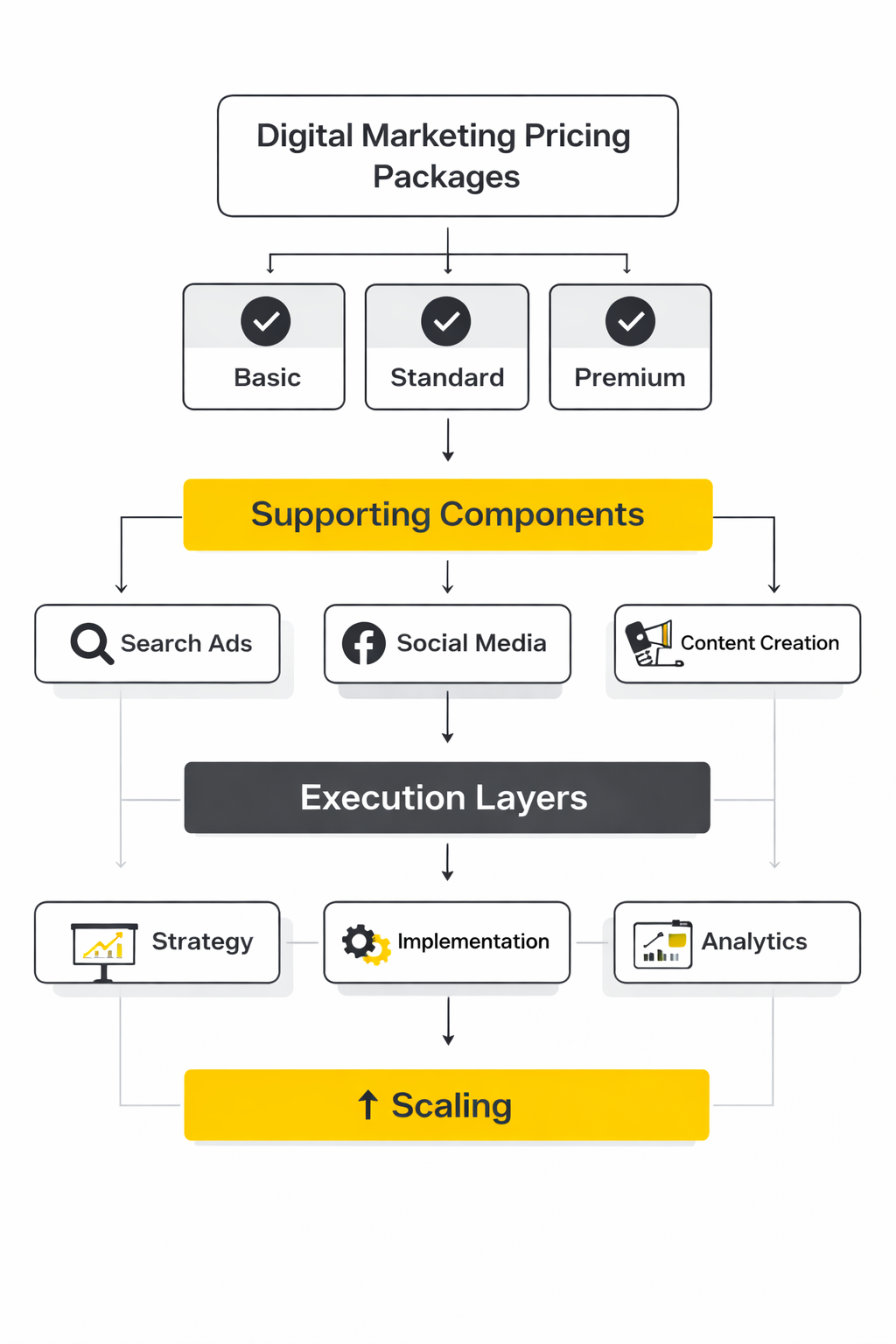
A digital marketing package should be built like an operating model, not like a menu. The core structure is simple: a defined buyer, a defined outcome, a defined scope, a defined cadence, and a defined level of accountability. That is the difference between a package that feels strategic and one that feels like a random bundle of tactics.
This is also why pricing should follow value and context, not just labor inputs. Stripe’s guide to B2B pricing strategy frames pricing as part of long-term customer relationship design, and that is the right way to think about service packages too. A buyer is not really purchasing hours; they are purchasing confidence that a specific problem will be handled in a repeatable way.
In practice, that usually leads to a small number of clearly separated tiers. The pricing team behind SBI Growth’s tiered pricing guidance recommends keeping tiered offers tight because too many options can overwhelm buyers, and the broader research on choice overload and its key moderators points in the same direction when decisions get complex. The exact number is not universal, but the principle is: more options do not automatically create more sales.
Start With the Buyer, Not the Channel
The first mistake people make is building packages around channels like SEO, PPC, email, and social before they define the buyer. That is backwards. A package should begin with a situation the buyer recognizes immediately, such as “we need qualified leads,” “we need better conversion from existing traffic,” or “we need a full acquisition system, not disconnected freelancers.”
This matters because channels are implementation details to the client until those channels are tied to a real business need. A buyer rarely wakes up wanting “12 posts, 2 campaigns, and a dashboard.” They want pipeline, booked calls, better conversion, stronger retention, or cleaner attribution.
The practical test is simple: if the package name and description make sense only to a marketer, it is still too channel-first. If the buyer can see themselves in it within a few seconds, you are getting closer.
Package Outcomes Before Deliverables
Deliverables still matter, but they should sit underneath the promise, not replace it. The package needs to say what result it is designed to help create, then explain the work that supports that result. That keeps the conversation focused on business movement instead of turning into a haggling session over task counts.
This is one reason value-led pricing tends to outperform time-led pricing in complex services. The more your offer is tied to an outcome, the easier it is to explain why one package includes strategy, creative, landing pages, CRM workflows, and reporting while another does not. The buyer may still ask about scope, but they are asking inside a clearer frame.
You can see the same logic in pricing advice that emphasizes matching pricing to long-term value and focusing on outcomes rather than inputs in Stripe’s B2B pricing framework. Service businesses should not copy software pricing blindly, but the principle transfers well: price around the value architecture, not just the task list.
Keep the Tiers Distinct
A weak pricing page shows three tiers that are basically the same package with more meetings and more vague “support” as the price goes up. That does not create clarity. It creates suspicion, because buyers can tell the differences are cosmetic.
Strong tiers are separated by use case, depth, and decision risk. The entry tier solves one urgent problem well, the middle tier adds system depth and better leverage, and the top tier adds integration, speed, and higher-touch accountability. Each one should feel like the right choice for a different stage, not like a manipulated staircase.
That is where research on complexity becomes useful. The academic work on choice overload does not say “three tiers always wins,” but it does show that decision difficulty, uncertainty, and complexity can make bigger choice sets worse. So the practical move is not to make more packages. It is to make fewer packages that are easier to understand.
Build Delivery Around Repeatable Systems
A package is only as good as your ability to fulfill it the same way every time. This is where many offers look impressive on the front end and fall apart in month two, when the team realizes every client has effectively bought a custom engagement hidden inside a fixed price. That is not packaging. That is chaos wearing nicer clothes.
Repeatability is one of the biggest reasons specialized agencies keep their pricing power. The Promethean Research report links specialization to standardized delivery, lower delivery cost, expanding margins, and higher retention because the work becomes easier to systematize. That is exactly the backbone a good package needs.
The stack can vary, but the logic should stay tight. If your package includes lead capture, follow-up, nurturing, and pipeline visibility, an all-in-one layer like HighLevel can simplify fulfillment, while a lighter modular setup with Fillout, Cal.com, and Brevo can work just as well for leaner offers. If conversational automation is part of the promise, tools like Manychat or Chatbase make that layer easier to productize instead of rebuilding it from scratch for every client.
That is the real framework. Start with the buyer, define the outcome, separate the tiers cleanly, and make sure the delivery model is repeatable enough to protect margin. Once that skeleton is solid, the next question is what each package should actually include.