

Uncovering the right digital marketing services near me can transform how a local business attracts traffic, generates leads, and boosts revenue in a world where online presence matters more than ever. Digital marketing isn’t just running ads or posting on social media — it’s a strategic discipline that brings measurable results by meeting customers where they are online and guiding them toward a purchase.
Before you look for digital marketing services near me, it helps to know what a comprehensive service package includes and why it’s essential. This article will walk you through the key concepts and practical frameworks so you can make better decisions for your business.
Article Outline
- Why Digital Marketing Matters for Local Businesses
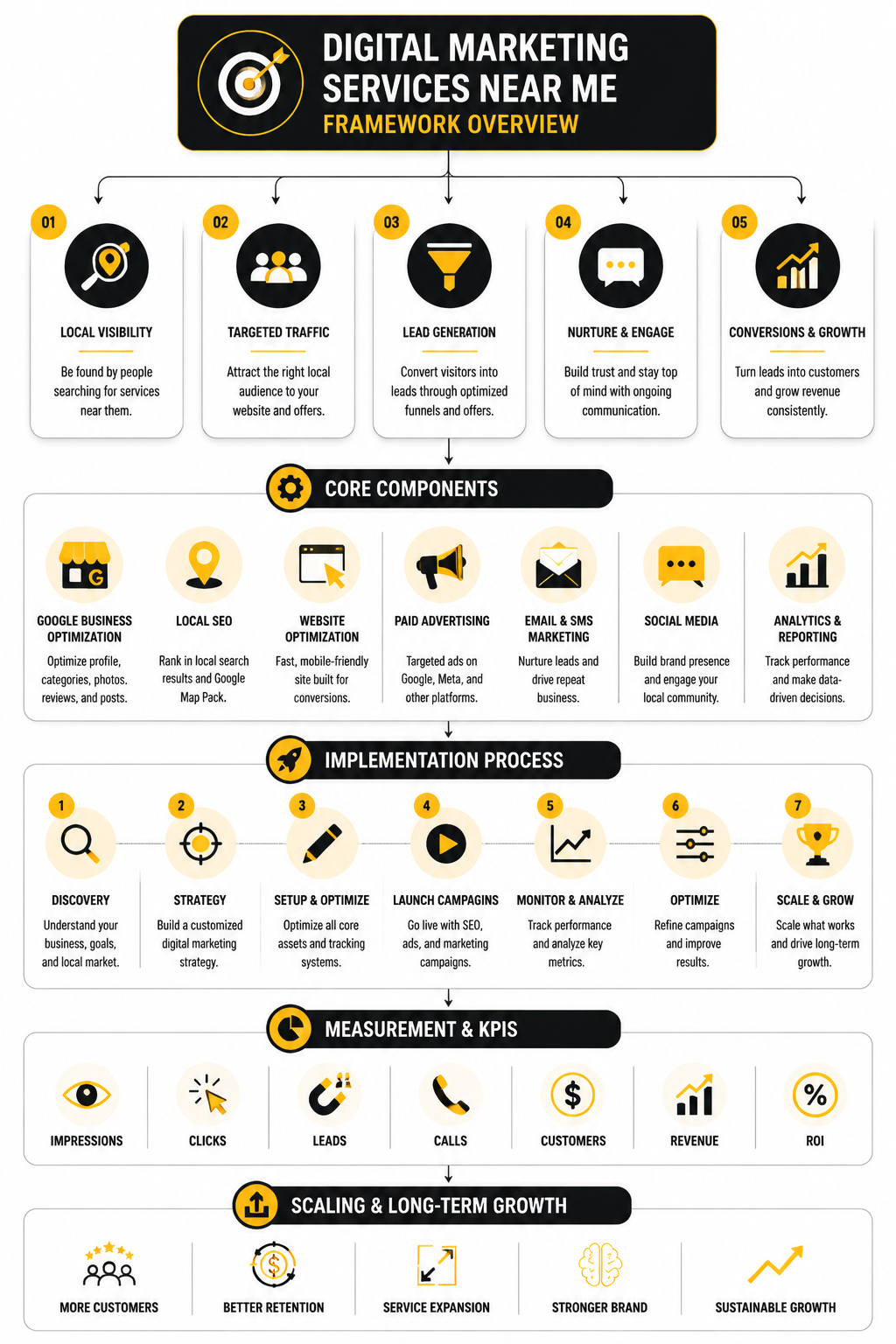
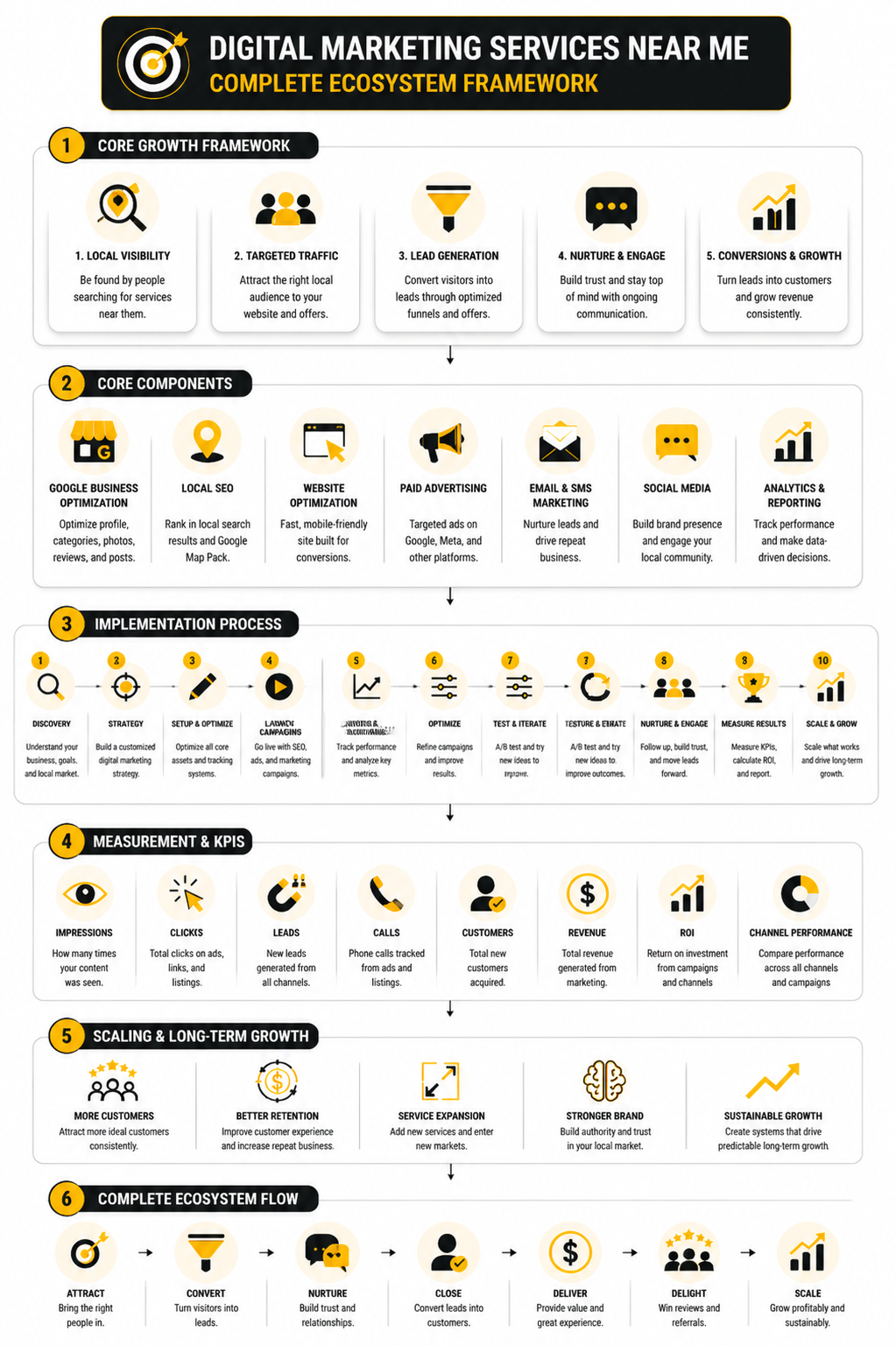
- Overview of a Digital Marketing Framework
- Core Components of Digital Marketing Services
- How Professionals Deliver These Services
- Choosing the Right Local Provider
- Next Steps for Your Business
Local businesses that partner with the right providers don’t just survive online — they compete effectively with bigger brands by putting strategy, data, and execution to work in harmony.
Understanding digital marketing services near me starts with seeing them as a suite of strategic tools, not isolated tactics. Unlike traditional advertising, digital services are measurable, iterative, and integrated across channels like search engines, social media, email, and websites.
In the next sections, we’ll explore why digital marketing matters, what a structured framework looks like, and how professionals implement these services in a local context so you can choose the best partner for your business goals.
Why Digital Marketing Matters for Local Businesses
For any local business exploring digital marketing services near me, understanding why digital marketing matters is the foundation of choosing the right services and partners. In today’s marketplace, your customers live and breathe online — they search for solutions, read reviews, compare competitors, and make decisions before they ever walk through a door or pick up a phone. Digital marketing ensures your business shows up in those moments that matter most.
Digital marketing helps local businesses reach a much wider audience than traditional offline methods ever could. Instead of spending on a billboard that only a fraction of nearby residents might see, you can target precise groups based on location, interests, and online behavior — which means every euro of your marketing budget works smarter, not harder.
Beyond reach, digital marketing delivers measurable results. Tools like search analytics, social insights, and campaign dashboards let you see what’s working in real time, adapt quickly, and invest in strategies that bring the best return. This data-driven aspect is something that traditional ads simply can’t match, giving local businesses a critical edge in competitive markets.
In the context of local business growth, research confirms digital marketing’s role isn’t just theoretical — it delivers tangible outcomes. A recent academic review found a strong positive connection between the adoption of digital marketing strategies — including SEO, social media, email campaigns, and online advertising — and key growth indicators such as sales performance, market reach, customer engagement, and brand awareness.
Digital marketing also levels the playing field. Small and medium-sized businesses often lack the massive budgets of big brands, but digital tools give them access to the same channels and targeting options. With the right local strategy, a neighborhood shop can outrank a national competitor in local search results and connect with customers who are actively searching for its services.
Whether you're a service provider, retailer, or hospitality business, investing in digital marketing is no longer optional — it’s part of being discoverable and competitive in an online-first world. The next section will break down the key components of a strong digital marketing framework so you can see how these concepts translate into action.
How Professionals Implement Digital Marketing Services
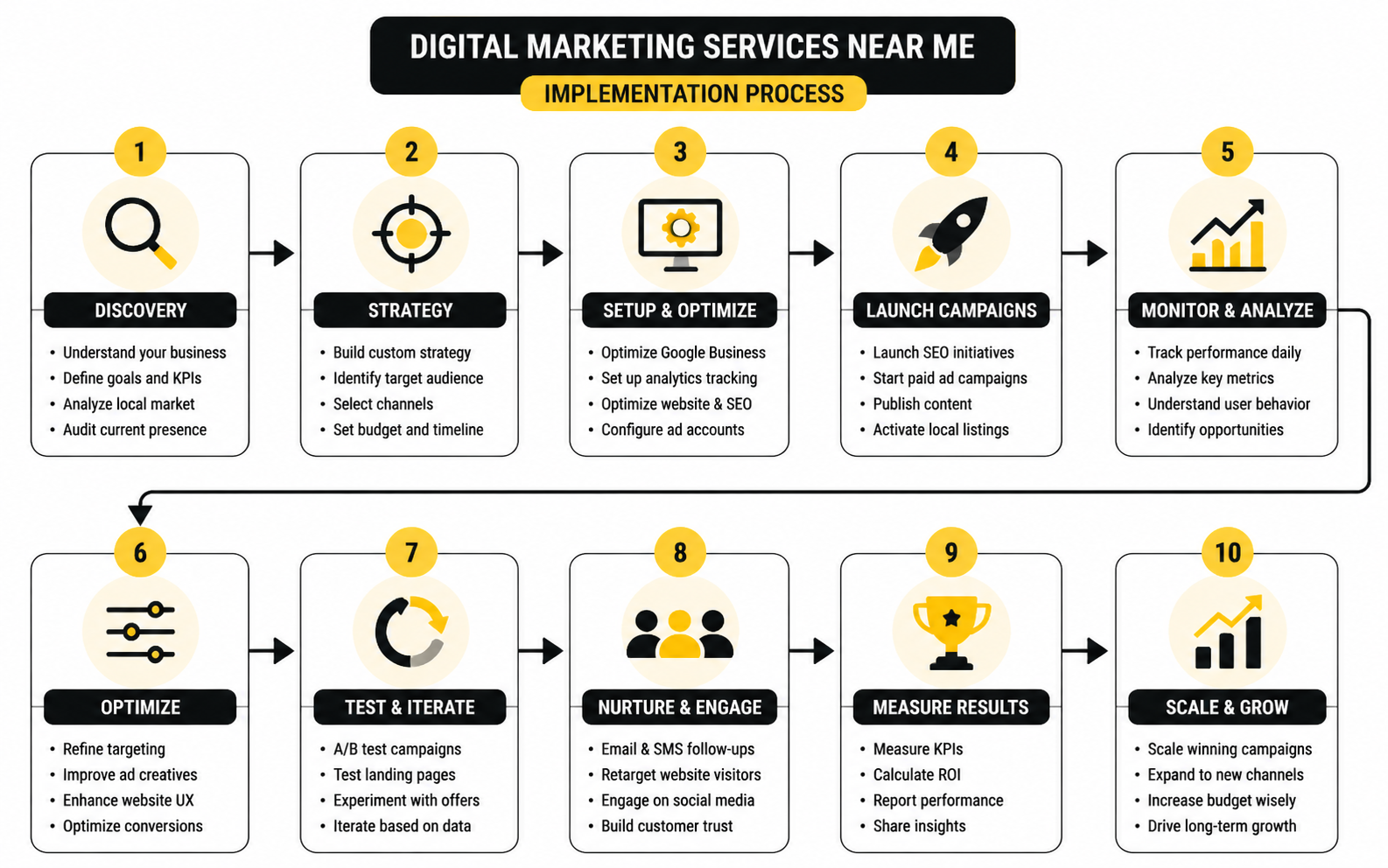
Understanding digital marketing services near me isn’t just about knowing the components — it’s about how these pieces are put into action to generate real results. Implementation is where strategy becomes measurable growth, and local businesses start seeing their online visibility, engagement, and conversions rise. A clear, step‑by‑step process ensures every part of your marketing plan works together efficiently.
A Step‑by‑Step Digital Marketing Process
Successful implementation follows a sequence of connected steps that guide your business from planning to performance improvement. These steps turn high‑level goals into campaigns that reach the right customers and deliver measurable outcomes.
- Define Goals and KPIs
Before launching anything, professionals start with clear objectives that tie directly to business outcomes — like increasing qualified traffic, generating a set number of leads, or improving online sales. These goals must be measurable so you can track performance and adjust as needed.
- Research Audience and Market
The next step is deeply understanding who your ideal customers are: their needs, online behaviors, where they spend time online, and the language they use when searching for services like yours. This insight informs every tactic that follows.
- Build and Optimize Your Digital Presence
A strong digital presence — often starting with a fast, mobile‑friendly website — gives all other efforts a foundation. SEO optimization ensures search engines can find your content, while technical improvements (like secure pages and clear navigation) improve user experience.
- Create Valuable Content
Content is the engine of modern digital marketing. This includes blog posts, landing pages, social media updates, videos, and other assets that educate, inform, or entertain your audience. Well‑crafted content increases visibility, builds trust, and feeds both SEO and social strategies.
- Execute Multi‑Channel Campaigns
With a foundation in place, professional teams run coordinated campaigns across channels like SEO, social media, email marketing, and ads (e.g., search ads or paid social). Each channel serves a purpose — awareness, engagement, or conversion — and is selected based on audience insights.
- Measure, Analyze, and Optimize
After campaigns are live, implementation shifts into a continual improvement cycle. Metrics are collected through analytics tools, compared against KPIs, and used to refine campaigns. What works is scaled; what doesn’t is adjusted or replaced to maximize ROI.
Practical Execution Tips for Local Businesses
For local businesses looking for digital marketing services near me, implementation often focuses on tangible milestones tied to discoverability and customer action. For example:
- Local SEO enhancements ensure you appear in “near me” searches by optimizing your website and business listings for location‑specific terms.
- Targeted social media campaigns are tailored to the platforms where your audience hangs out most, using creative that reflects your brand and local appeal.
- Email campaigns nurture leads captured through your website or social profiles with messaging that speaks directly to their needs.
- Paid ads are deployed with precise geo‑targeting so your ad budget reaches users near your business who are most likely to convert.
These steps are tracked and iterated over weeks and months — not treated as one‑off activities — to build momentum and long‑term growth.
Done well, this implementation framework doesn’t just put your brand online — it creates a repeatable system that continues to attract, convert, and retain customers as your business evolves.
How to Measure Digital Marketing Success and What the Data Means
When you invest in digital marketing services near me, the numbers you track aren’t just analytics for analytics’ sake — they tell a story about how your business is performing online and what to do next. Data without interpretation is like a map without a compass: it looks impressive, but it won’t guide you to better decisions or results.
What the Most Important Metrics Reveal
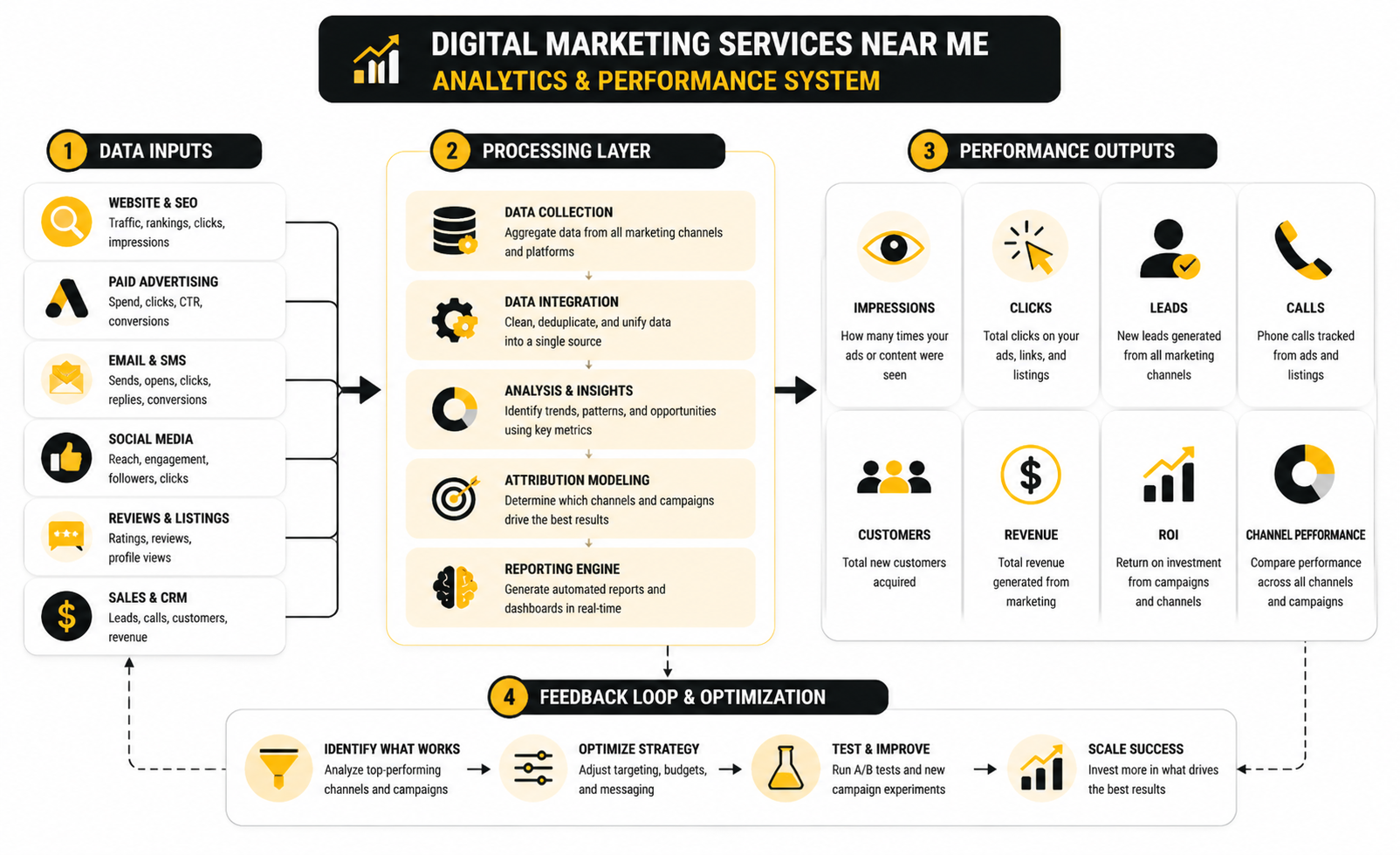
Analytics systems such as Google Analytics 4, ad platform dashboards, and CRM‑linked reporting tools provide the raw data. The key is deciding which metrics matter for your goals, interpreting them correctly, and using them to improve strategy. At a high level, metrics fall into categories that answer different questions about your marketing: acquisition, engagement, conversion, and revenue impact.
- Acquisition metrics like traffic volume, sessions, and traffic sources show whether your digital presence is attracting users. But high traffic alone doesn’t prove success — what matters is who that traffic is and what they do next.
- Engagement metrics such as engagement rate, time on site, and click‑through rate reveal whether your content and ads resonate. A strong CTR indicates compelling messaging or creative, while engagement time reflects content quality.
- Conversion metrics including conversion rate, cost per lead (CPL), and customer acquisition cost (CAC) tie directly to business outcomes. These show whether visitors take valuable actions — like signing up, booking a service, or purchasing — and how much each action costs.
- Revenue and profitability metrics like return on ad spend (ROAS) and overall ROI show whether your investment is paying off. A healthy ROAS means your campaigns generate significantly more revenue than they cost.
Why Benchmarks Matter — and How to Use Them
Raw numbers are only meaningful when compared to benchmarks. Benchmarks are performance reference points that help you decode whether a metric is strong, average, or weak for your industry and channel. For example, a paid search CTR above 3–5 % is typically considered solid, while email open rates above 20–30 % suggest healthy list engagement.
Benchmarks differ significantly by channel and campaign objective, so comparing paid search CTR to display ad CTR would be misleading — each channel has its own context and audience behavior. The goal is not to hit every benchmark, but to understand where your performance stands relative to realistic industry standards and use that insight to prioritize improvements.
Interpreting Performance and Taking Action
Knowing a number is one thing — understanding what it should prompt you to do is another:
- If your CTR is lower than benchmarks, it may indicate that your ad messaging or creative isn’t compelling or that your targeting needs refinement.
- If your conversion rate is strong but your CAC is high, consider optimizing your campaign spend or improving landing page experience to reduce costs.
- A high engagement rate but low conversions suggests interest that isn’t being funneled into action, so you might improve your calls‑to‑action or funnel clarity.
- If ROAS is below target, you may need to adjust campaign allocation toward higher‑performing channels or refine your audience segmentation.
These interpretations are what turn measurement into performance optimization.
Analytics Beyond Vanity Metrics
One of the biggest pitfalls in evaluating digital marketing services near me is focusing on vanity metrics — like impressions, raw traffic, or social “likes” — that don’t correlate directly with business impact. Real performance measurement prioritizes metrics tied to outcomes you care about: leads, sales, profitability, and customer value.
For local businesses, this often means tracking how your campaigns drive foot traffic, online bookings, quote requests, or form submissions — not just how many people saw your content. When you tie digital metrics to real business actions, the data becomes a strategic tool that helps refine your marketing rather than just report it.
In the next section we’ll explore how to choose the right provider near you to implement, measure, and improve your digital marketing efforts based on these insights.
Advanced Considerations When Hiring and Scaling Digital Marketing Services
As you move from understanding the basics of digital marketing services near me to selecting and scaling the right partner, there are strategic trade‑offs and risks that seasoned business owners think about. These are the nuanced decisions that separate doing digital from doing digital well — and they matter if you want predictable, long‑term growth rather than short‑lived wins.
Don’t Treat Services as Isolated Tactics
One advanced challenge is resisting the urge to buy services in silos — for example, paying for SEO and social media without a unified strategy. Experts emphasize that digital marketing services work best as a coordinated system, because each component influences the others: content helps SEO rankings, SEO feeds organic traffic to conversion funnels, and paid media accelerates visibility where organic efforts are slow. When these elements aren’t aligned, the result is busy work that doesn’t move your business forward in a measurable way.
This trade‑off often shows up when budgets are tight. If you have to choose between starting with paid ads for quick visibility or investing in SEO for sustainable demand, weigh the timeline and goals rather than the buzz of a tactic. Paid ads can deliver data and early conversions, but SEO builds compound visibility that reduces long‑term acquisition costs.
Transparency, Reporting, and Accountability
Another critical consideration is how a provider reports performance. Choosing a partner that gives only surface‑level metrics — like “we boosted traffic” — isn’t enough. Look for digital marketing services that tie every activity back to business objectives, such as qualified leads, revenue impact, or customer retention. Transparency in reporting builds trust and lets you compare results over time rather than relying on subjective claims.
This becomes especially important when tracking systems are at risk of giving misleading results. Analytics issues — such as broken conversion tracking or flawed attribution models — can distort how success is measured, making a campaign look ineffective when it’s not or vice versa. Regular audit and validation of tracking setups should be part of your provider’s process so you’re acting on reliable insights.
Scalability and Service Evolution
As your business grows, so too should your digital marketing approach. What worked when you were just getting discovered online might not scale when you’re targeting broader markets or higher lifetime customer value. Scaling isn’t simply doing more of the same — it requires refined processes, repeatable frameworks, and sometimes new services altogether.
For example, early‑stage investments in basic SEO and local listings are crucial, but as you grow, you’ll want to layer in advanced analytics, automation workflows, and conversion rate optimization. Scaling effectively means building a repeatable engine that can handle increased demand without proportionally increasing costs or diluting quality.
Choosing a Partner vs. a Vendor
Perhaps the most strategic trade‑off is choosing between a vendor and a partner. A vendor executes tasks; a partner invests in your long‑term success, helps refine strategy, and adjusts tactics based on what the data shows. A good digital marketing partner will take time to understand your business model, customer behavior, and competitive landscape, and tie their work to meaningful KPIs rather than vanity metrics.
This distinction matters because one‑off campaigns or quick fixes rarely translate into sustainable growth. In contrast, an integrated, goal‑aligned approach anticipates market changes, organic competition shifts, and evolving customer expectations — all of which demand adaptation rather than repetition of past tactics.
The Human Element: Skills, Culture, and Communication
One often overlooked risk is talent and team capacity. Whether you work with an agency or freelancers, their ability to stay updated with digital trends, tools, and best practices directly affects outcomes. A provider with strong technical skills but poor communication or cultural fit can stall progress just as easily as one without the right expertise.
Ultimately, this advanced perspective — focusing on integration, measurement quality, scalability, and partnership — helps you avoid common pitfalls and make decisions that support sustainable growth with digital marketing services near me, not just short‑term visibility.
FAQ – Built for Complete Guide
1. What are digital marketing services near me?
Digital marketing services near me refer to professional support offered locally to help your business attract customers online through search, social media, content, email, and paid campaigns tailored to your market.
2. How do local digital marketing services improve my online visibility?
By optimizing your website for local search terms, managing local listings, and running targeted campaigns, these services help your business appear when nearby customers search for what you offer.
3. Do I need digital marketing if I already use social media?
Social media is just one channel. Professional digital marketing integrates social strategy with SEO, email, analytics, and paid ads to reach customers consistently across platforms rather than relying on one tactic.
4. How soon can I expect results from local digital marketing?
Timing varies by strategy: paid campaigns can deliver traffic quickly, while SEO and content efforts build compound visibility over months. A good provider sets realistic timelines for each part of your plan.
5. What should I look for in a local digital marketing provider?
Look for transparency in goals and reporting, a portfolio of measurable results, clear communication, and an approach that aligns with your business objectives rather than just generic services.
6. Are results from digital marketing measurable?
Yes. With analytics and attribution tools, you can track where visitors come from, what they do on your site, and how campaigns contribute to leads or sales — helping you make informed decisions.
7. How do local services differ from national agencies?
Local services often have deeper understanding of your specific market, competitors, and customer behaviors, allowing for more effective targeting and communication tailored to your community.
8. Can small businesses afford professional digital marketing services?
Many local providers offer scalable packages based on your budget and priorities. Start with core services that align with your goals, and expand over time as performance data supports growth.
9. What is the role of content in digital marketing?
Content educates, engages, and builds trust with your audience. It fuels SEO, supports social media, and provides value that turns casual visitors into meaningful leads.
10. How do I measure ROI from these services?
Compare the cost of services against revenue from tracked leads and conversions. Good reporting shows how each channel contributes to your bottom line, helping you focus on the strategies that pay off.
Work With Professionals
Explore 10K+ Remote Marketing Contracts on MarkeWork.com
Most marketers spend too much time chasing clients, competing on crowded platforms, and losing a percentage of every project to middlemen. MarkeWork gives you a better way. Browse thousands of remote marketing contracts and connect directly with companies desperate to hire skilled marketers like you, without platform commissions and without unnecessary gatekeepers.
If you're serious about finding better opportunities and keeping 100% of what you earn, invite readers to explore available contracts and create a profile for free at MarkeWork.com.