

Digital media marketing is the work of using online channels, content, data, and paid or organic distribution to attract the right audience and move them toward a business goal. That goal might be a sale, a booked call, a subscriber, a product trial, a repeat purchase, or simply a stronger brand memory before the buyer is ready.
This matters because the market has already moved. U.S. internet advertising revenue reached nearly $300 billion in 2025, while global social media adoption passed 5.24 billion active user identities. In plain English: your customers are already consuming, comparing, searching, watching, and buying through digital media. The question is not whether digital media marketing matters. The question is whether your system is clear enough to turn that attention into measurable growth.
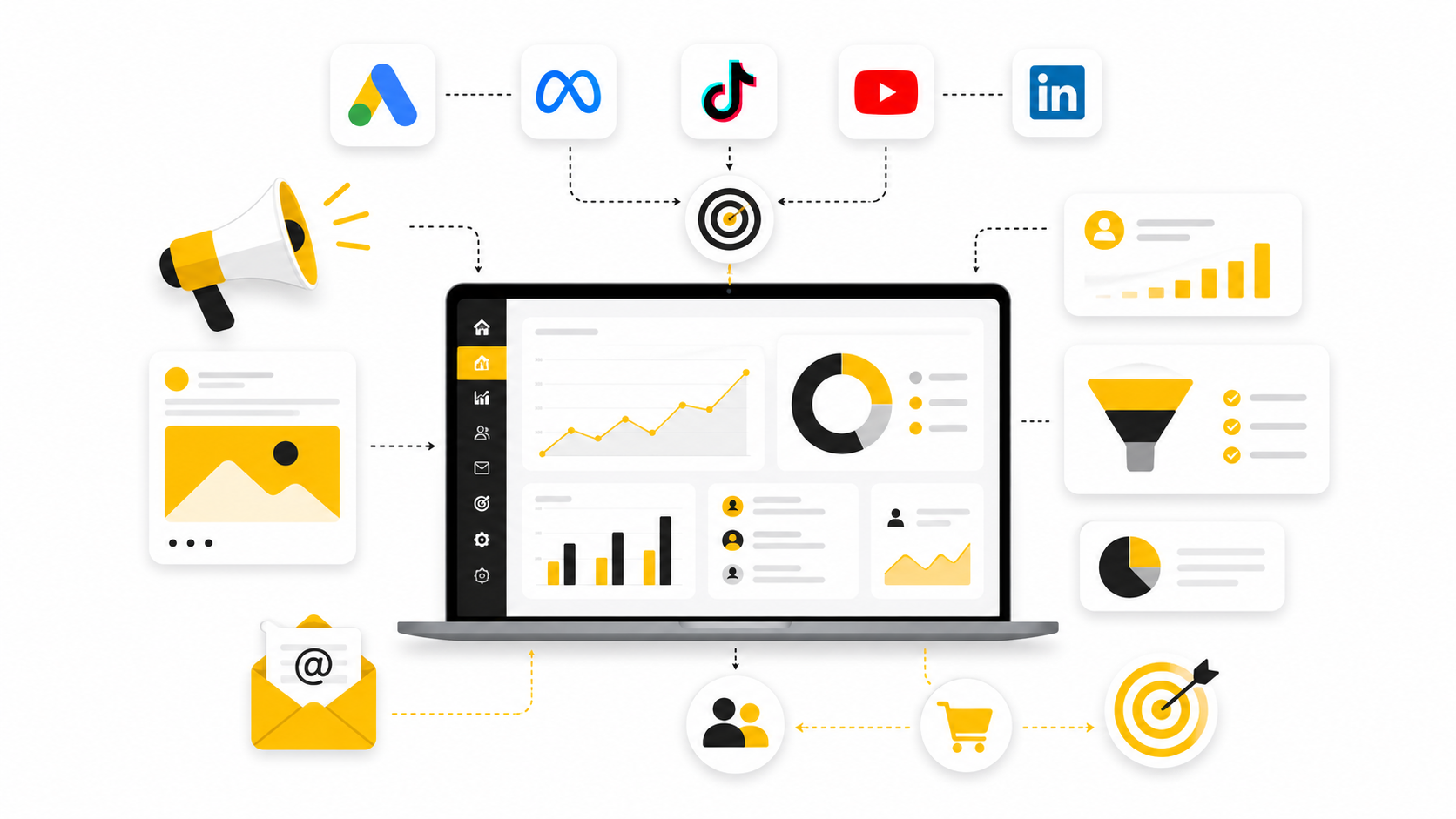
This article will use a six-part structure so the strategy builds step by step instead of jumping between random tactics.
- Part 1: Digital Media Marketing Fundamentals and Article Roadmap
- Part 2: Why Digital Media Marketing Matters Now
- Part 3: The Digital Media Marketing Framework
- Part 4: Core Components of a High-Performing Digital Media System
- Part 5: Professional Implementation, Tools, and Measurement
- Part 6: Optimization, Common Mistakes, and FAQ
Digital Media Marketing Fundamentals and Article Roadmap
Digital media marketing is not just posting on social media, running ads, or sending emails. Those are channels and tactics. The real work is building a connected system where audience research, content, distribution, conversion, automation, and measurement support each other.
A strong digital media marketing system starts with the buyer, not the platform. People may discover you on TikTok, research you on Google, compare you on YouTube, join your email list, chat with your brand through automation, and convert through a landing page. That means the strategy has to feel consistent across the whole journey.
The best teams do not treat every channel as a separate island. They use each channel for a specific job. Search captures intent, social creates demand, email and messaging deepen relationships, landing pages convert interest, and analytics show what deserves more budget.
Why This Topic Matters
Digital media marketing matters because attention is fragmented, expensive, and easier to waste than ever. Buyers are not waiting patiently for one perfect ad. They are moving between feeds, inboxes, search results, creator content, review sites, private communities, and AI-assisted discovery.
That creates a serious opportunity for brands that can stay useful and consistent. It also creates risk for brands that chase every new platform without a strategy. The businesses that win are usually not the ones doing the most. They are the ones connecting the right message, channel, offer, and follow-up at the right time.
This is also why first-party data, personalization, and automation have become central. Google has warned that brands without stronger direct customer relationships and first-party data risk losing advertising effectiveness as measurement and targeting become harder. McKinsey has also found that consumers increasingly expect personalized interactions, with frustration rising when brands fail to deliver them through relevant experiences.
Framework Overview
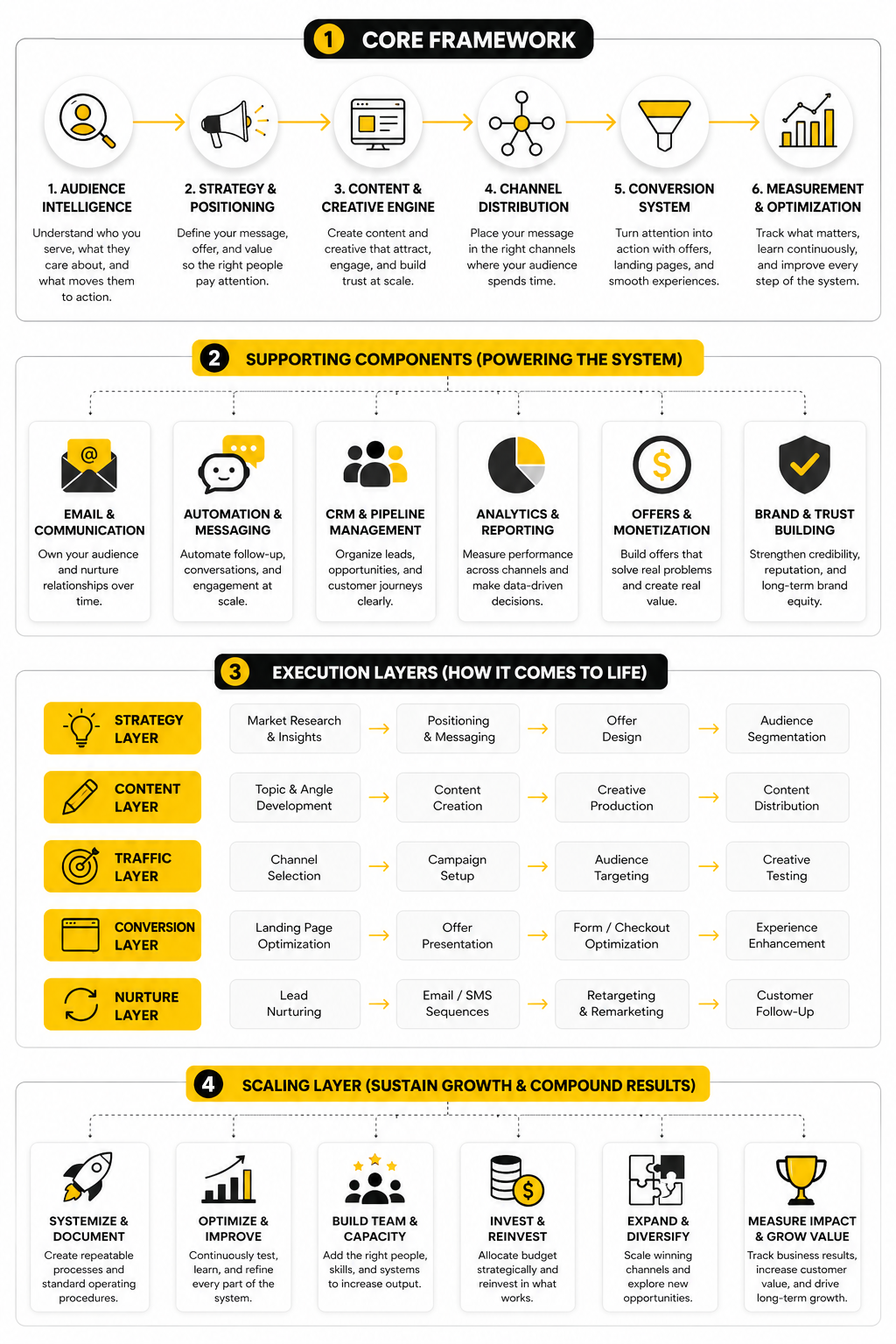
The framework in this article is simple: audience, message, media, conversion, retention, and measurement. Each layer has a job. When one layer is weak, the whole system becomes more expensive.
Audience defines who you are trying to reach and what they already believe. Message turns that understanding into positioning, offers, content angles, and creative. Media decides where and how the message gets distributed through organic, paid, owned, and partner channels.
Conversion turns attention into action. Retention turns one-time action into lifetime value. Measurement keeps the system honest by showing which activities create revenue, which only create noise, and which need to be cut.
Core Components of Digital Media Marketing
The core components are content, distribution, conversion assets, automation, customer data, and reporting. Content gives people a reason to notice you. Distribution makes sure the right people actually see it.
Conversion assets include landing pages, forms, checkout flows, booking pages, lead magnets, webinars, and product pages. Tools like ClickFunnels, Systeme.io, and Replo fit naturally here when the goal is to turn campaigns into focused pages and funnels instead of sending traffic to a generic website.
Automation connects the follow-up. For example, ManyChat can support messaging flows, while GoHighLevel can support CRM, pipeline, automation, and campaign management for service businesses and agencies. The tool is not the strategy, but the right tool helps the strategy run without constant manual work.
Professional Implementation
Professional implementation starts by choosing fewer priorities and executing them better. Most businesses do not need twelve channels. They need one clear offer, one strong acquisition path, one reliable conversion mechanism, and one follow-up system that does not leak leads.
The first practical step is to map the customer journey from first touch to repeat purchase. Then identify where the business is weakest. If people do not know you exist, distribution is the bottleneck. If traffic is coming in but nobody converts, the offer or landing page is the bottleneck. If leads arrive but disappear, follow-up and retention are the bottleneck.
This is the mindset that will guide the rest of the article. Digital media marketing is not about being everywhere. It is about building a system that earns attention, proves relevance, captures demand, and compounds over time.
Why Digital Media Marketing Matters Now
Digital media marketing matters now because the buyer journey is no longer linear. People do not simply see one ad, visit one website, and buy. They discover brands through short-form video, search for proof, compare alternatives, read reviews, ask peers, click retargeting ads, join email lists, and sometimes return weeks later when the timing finally makes sense.
That messy path is exactly why digital media marketing has become a growth system instead of a promotional add-on. Internet users passed the 6 billion mark globally, and social media user identities reached 5.66 billion worldwide. When that much attention, research, entertainment, and buying behavior happens online, digital media becomes the operating environment for modern marketing.
The pressure is also financial. Digital advertising revenue in the U.S. reached $294.6 billion in 2025, and global digital ad spend is forecast to represent 68.7% of total advertising investment in 2026. That does not mean every business should throw more money into ads. It means the market is already crowded, algorithmic, and performance-driven, so every campaign needs a sharper reason to exist.
Buyers Move Across Channels Before They Decide
A customer might first notice a brand through a creator video, then search the company name, then scan reviews, then check the website, then abandon the page, then come back through an email or retargeting ad. None of those moments is isolated. Each one either increases trust or quietly creates doubt.
This is where many businesses get digital media marketing wrong. They judge one channel as if it works alone. A search campaign may look like the closer, but the buyer may have been warmed up by weeks of content, social proof, email, and comparison research before they ever typed the keyword.
That is why attribution should be treated as a decision tool, not a perfect truth machine. The goal is not to worship a dashboard. The goal is to understand which channels create awareness, which channels capture intent, which assets help people believe, and which follow-up steps turn interest into revenue.
Attention Is Abundant, but Trust Is Scarce
There is more content than any person can consume. That makes attention easier to reach in theory but harder to hold in practice. People scroll fast, compare aggressively, and ignore anything that feels generic.
Trust is the real bottleneck. A brand can buy traffic today, but it cannot buy credibility at scale if the message, offer, reviews, website, and follow-up do not match. The more options buyers have, the more they look for signals that reduce risk.
Digital media marketing earns that trust through repeated useful contact. Helpful content, clear positioning, transparent offers, visible proof, and consistent follow-up all compound. No single post needs to carry the whole business when the system is doing its job.
Algorithms Changed the Rules
Algorithms now decide a huge amount of what people see, click, watch, and buy. Search rankings, recommendation feeds, social distribution, marketplace visibility, ad delivery, and email placement all shape demand before a person even reaches your website. That means digital media marketing is partly creative, partly technical, and partly operational.
This is not a reason to chase every algorithm update. That is a losing game. The smarter move is to create assets that algorithms can understand and people actually want: clear topics, strong hooks, useful answers, differentiated points of view, credible proof, and fast-loading conversion paths.
The businesses that adapt best are not just “posting more.” They are building content libraries, testing creative angles, improving landing pages, segmenting audiences, and using automation to respond faster. Tools can help here, but the strategy still has to come first.
Organic and Paid Media Need Each Other
Organic media builds familiarity and proof over time. Paid media accelerates distribution and testing. When the two are separated, the business usually wastes money or grows too slowly.
A strong organic presence gives paid campaigns better raw material. Winning posts, strong hooks, audience questions, and high-performing educational content can all become ad angles. At the same time, paid campaigns can reveal which messages, offers, and audiences deserve more organic support.
This is why digital media marketing should not be managed as random departments fighting for credit. Search, social, email, paid ads, landing pages, and CRM follow-up should all support the same commercial objective. When the system is aligned, each channel makes the next one more effective.
Measurement Has Become More Important and Less Perfect
Measurement is harder than it used to be. Privacy changes, cookie limitations, platform reporting differences, and cross-device behavior all make it difficult to know exactly what caused a conversion. That does not make measurement useless. It makes disciplined measurement more important.
The practical solution is to combine platform data with business data. Look at cost per lead, booked calls, conversion rate, qualified pipeline, revenue, repeat purchases, refund rates, and lifetime value. Vanity metrics can still be useful, but only when they connect to a real business question.
This is where many teams need to become more honest. A campaign with cheap clicks can still be a bad campaign. A post with fewer views can still attract better buyers. A channel that looks expensive on the surface can be profitable if it produces customers who stay, buy again, and refer others.
The Real Advantage Is System Thinking
The advantage in digital media marketing is no longer just knowing how to run ads or write posts. Plenty of people can do that. The advantage is knowing how the pieces work together and where the real constraint is.
If awareness is weak, you need better reach and stronger creative. If traffic is strong but conversions are poor, you need a better offer, page, proof, or call to action. If leads are coming in but revenue is flat, you need better qualification, follow-up, sales process, or retention.
This is the practical lens for the next part of the article. Once you understand why digital media marketing matters, the next step is building the framework. Not a vague theory. A working structure you can use to decide what to create, where to distribute it, how to convert attention, and how to improve the system over time.
The Digital Media Marketing Framework
A useful digital media marketing framework should make decisions easier. It should tell you who you are targeting, what you are saying, where the message should appear, how the audience should respond, and how the business will measure progress. If the framework does not help you make those calls, it is just decoration.
The structure here is built around six connected layers: audience, message, media, conversion, retention, and measurement. Each layer depends on the one before it. When teams skip the early layers and jump straight into posting, ads, or automation, they usually end up with more activity but no clear growth engine.
This is also where discipline matters. More channels do not automatically create more revenue. A focused system with clean execution usually beats a messy system with ten disconnected tactics.
Start With the Audience
Audience work is not just defining age, location, and job title. Those details can help with targeting, but they rarely explain why someone buys. The deeper questions are about pain, desire, urgency, objections, awareness level, buying triggers, and trust gaps.
In digital media marketing, audience research should also include behavior. Where do people search when the problem becomes urgent? Which creators, publications, newsletters, communities, or platforms influence their thinking? What proof do they need before they feel safe enough to take the next step?
This step matters because the channel does not create relevance for you. A bad message on the right platform is still a bad message. When the audience is clear, content ideas get sharper, ads become easier to write, and conversion pages stop sounding generic.
Build the Message Before the Media Plan
The message is the bridge between what the buyer wants and what the business offers. It includes positioning, promise, offer, proof, objections, and tone. If this part is weak, even a large media budget will struggle.
Strong messaging usually answers four practical questions. Who is this for? What problem does it solve? Why should the buyer believe it? What should they do next? Those questions sound simple, but most campaigns fail because at least one answer is vague.
This is where good marketers slow down before they speed up. They test angles, study customer language, compare offers, and remove friction from the promise. The goal is not to sound clever. The goal is to make the right buyer feel understood.
Choose Channels by Job, Not Hype
Every channel should have a job. Search is strong when people already know they have a problem and are looking for a solution. Social media is strong for discovery, education, proof, and demand creation. Email and messaging are strong for follow-up, segmentation, and relationship building.
This is why copying another brand’s channel mix can be dangerous. Their audience, budget, sales cycle, product category, creative strength, and brand awareness may be completely different from yours. A local service business, a SaaS company, an ecommerce brand, and a creator-led offer should not all use the same media plan.
The smarter question is simple: where does this audience already pay attention, and what role should each channel play in the buying journey? Once that is clear, you can decide whether to prioritize search content, paid social, newsletters, short-form video, webinars, partnerships, retargeting, or direct response funnels.
Turn the Framework Into an Execution Process
A framework only becomes useful when it changes what you do every week. The execution process should move from research to strategy, then into content, distribution, conversion, follow-up, and optimization. That gives the team a repeatable rhythm instead of a pile of random tasks.
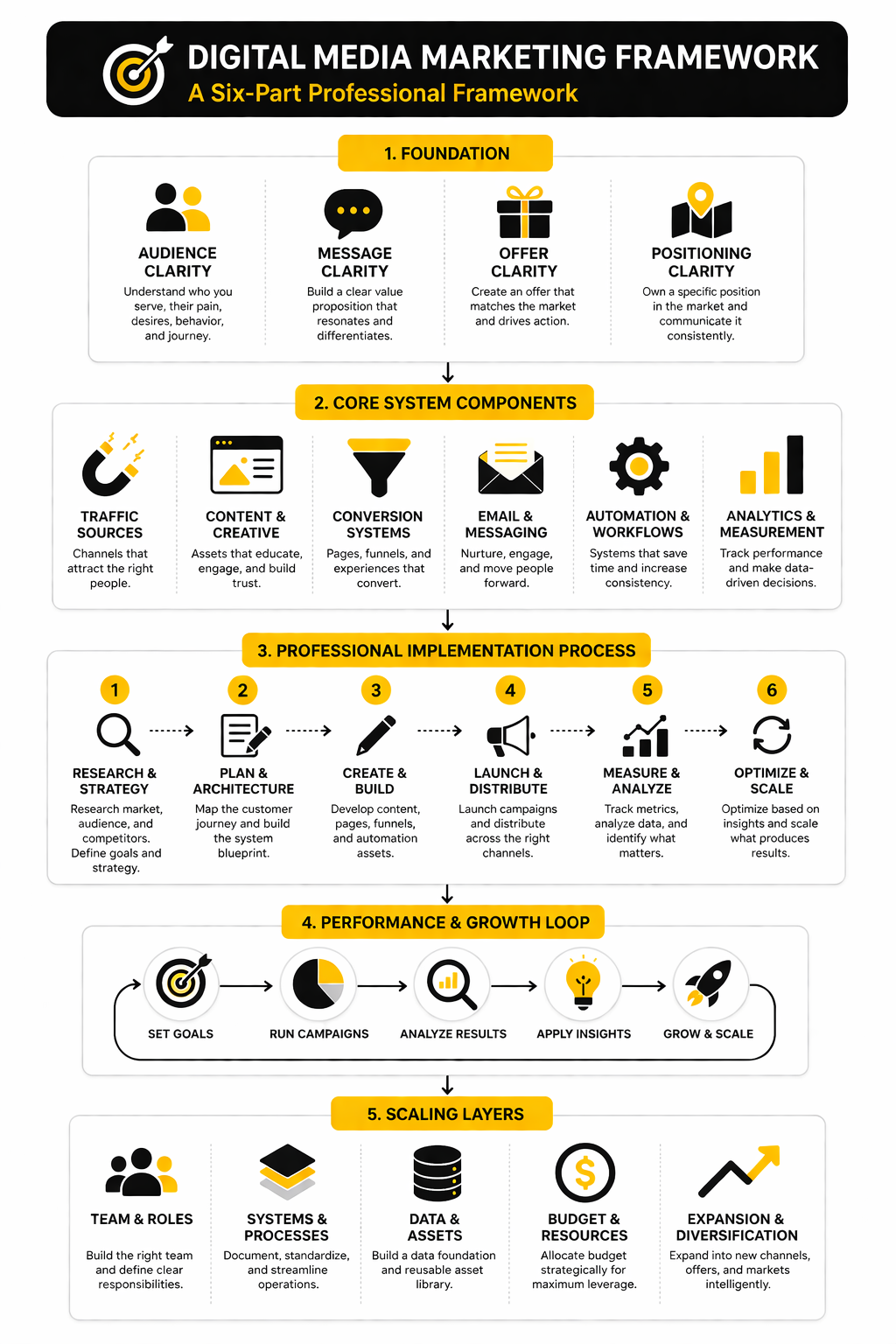
A practical execution process looks like this:
- Define the business goal and the primary conversion action.
- Identify the audience segment with the strongest buying intent.
- Clarify the offer, promise, objections, and proof.
- Choose the main acquisition channels based on buyer behavior.
- Create content and ads for each stage of awareness.
- Build the landing page, form, checkout, booking page, or funnel.
- Set up follow-up through email, messaging, CRM, or retargeting.
- Measure the full path from attention to revenue.
- Improve the weakest step before adding more channels.
That last step is critical. Most businesses add complexity too early. They launch more campaigns before fixing weak pages, slow follow-up, unclear offers, poor qualification, or missing proof.
Create Conversion Paths Before Scaling Traffic
Traffic is not the hard part anymore. You can buy clicks, publish content, partner with creators, rank pages, send emails, and build audiences. The hard part is turning that attention into qualified action without creating a clunky experience.
A conversion path is the route from first interest to next step. It may be a landing page, lead magnet, quiz, product page, booking calendar, webinar registration, chatbot flow, checkout page, or email sequence. The format depends on the offer, but the job is always the same: reduce confusion and make the next action feel obvious.
For campaigns that need dedicated pages or sales funnels, tools like ClickFunnels, Systeme.io, and Replo can be useful because they keep the conversion environment focused. For lead capture and qualification, Fillout can help when forms need to feel cleaner and more intentional. The point is not to collect tools. The point is to remove friction from the buyer’s next step.
Build Follow-Up Into the System
Most buyers do not convert the first time they see an offer. That is normal. The mistake is treating non-conversion as failure instead of building a follow-up system that keeps the relationship moving.
Follow-up should match intent. A high-intent lead who booked a call needs fast confirmation, reminders, context, and sales preparation. A lower-intent subscriber may need education, proof, comparison content, and a stronger reason to act later.
This is where automation becomes practical. ManyChat can support conversational flows, Brevo and Moosend can support email nurturing, and GoHighLevel can connect CRM, pipelines, campaigns, and reminders. The best follow-up does not feel robotic. It feels timely, relevant, and useful.
Measure the Path, Not Just the Platform
Platform dashboards are useful, but they only show part of the truth. A social platform may show strong engagement while the CRM shows weak lead quality. An ad platform may report conversions while the sales team sees poor close rates.
A better measurement view connects media metrics with business outcomes. Track reach and engagement when you need awareness. Track click-through rate and landing page conversion when you need demand capture. Track qualified leads, booked calls, sales, retention, and customer value when you need profit.
This is especially important as privacy changes make digital measurement less exact. Recent industry analysis has emphasized that digital advertising and measurement are being reshaped by privacy-first systems, consent requirements, browser changes, and new data solutions. In practice, that means brands need cleaner first-party data, better CRM discipline, and more confidence in directional decision-making instead of pretending every click can be perfectly attributed.
Improve the Constraint Before Expanding
The fastest way to waste money is to scale the wrong part of the system. If the landing page is weak, more traffic only exposes the weakness faster. If the offer is unclear, more ads will not magically create urgency.
Look for the constraint. It is usually one of five things: not enough qualified attention, weak message-market fit, poor conversion assets, slow follow-up, or unclear measurement. Fixing the constraint creates leverage across the whole digital media marketing system.
This is the mindset that separates professionals from tactic collectors. Professionals do not ask, “What should we post today?” as their first question. They ask, “Where is the system leaking, and what is the highest-impact move we can make next?”
Statistics and Data
Statistics only matter when they help you make a better decision. Random benchmarks can make a campaign look good or bad without explaining whether the business is actually moving in the right direction. In digital media marketing, the job of data is not to decorate reports. The job is to show what to fix, what to scale, and what to stop doing.
The first number to understand is market pressure. U.S. digital advertising revenue reached $294.6 billion in 2025, growing 13.9% year over year even without major cyclical events like an Olympics, FIFA World Cup, or U.S. election. That matters because it tells you competition is not slowing down. More brands are buying attention, so weak creative, vague offers, and messy conversion paths get punished faster.
Global ad spend is also moving deeper into digital environments. Worldwide advertising investment is forecast to pass $1 trillion in 2026, with algorithmic media playing a larger role in how budgets are allocated and optimized. This does not mean every business should increase spend immediately. It means measurement discipline becomes more important because the platforms are faster, more automated, and less forgiving.
What the Numbers Actually Mean
A benchmark is not a target by itself. An ecommerce conversion rate of 2% might be excellent for a premium product with high average order value and poor for a low-cost impulse offer. A lead cost of $80 might be terrible for a cheap digital download and excellent for a high-ticket service with strong close rates.
This is why digital media marketing data should always be interpreted against the business model. You need to know the margin, sales cycle, close rate, refund rate, repeat purchase rate, and lifetime value before deciding whether a campaign is healthy. Platform metrics can tell you what happened on the surface, but business metrics tell you whether the campaign deserves more money.
The practical question is not “Is this metric good?” The better question is “Good compared with what outcome?” A metric only becomes useful when it connects to a decision.
The Metrics That Matter at Each Stage
The easiest way to avoid data confusion is to measure each stage of the system separately. Awareness metrics are useful when the goal is reach and memory. Conversion metrics are useful when the goal is action. Revenue metrics are useful when the goal is profit.
At the awareness stage, track reach, impressions, video completion, branded search lift, audience growth, and share of voice where available. These numbers show whether more of the right people are encountering the brand. They do not prove revenue by themselves, so do not treat them like sales metrics.
At the conversion stage, track click-through rate, landing page conversion rate, cost per lead, add-to-cart rate, checkout completion, booking rate, and form completion rate. These numbers show whether people are moving forward once they show interest. If this layer is weak, scaling traffic usually makes the problem more expensive.
At the revenue stage, track qualified pipeline, customer acquisition cost, return on ad spend, gross margin, close rate, lifetime value, retention, and payback period. These numbers show whether the business can afford to keep acquiring customers through the channel. This is where serious decisions happen.
Build an Analytics System You Can Trust
A useful analytics system does not need to be complicated, but it does need to be consistent. Every campaign should have a clear source, medium, offer, audience, and conversion goal. Every lead should be traceable through the CRM or sales process. Every major decision should be based on a combination of platform data and owned business data.
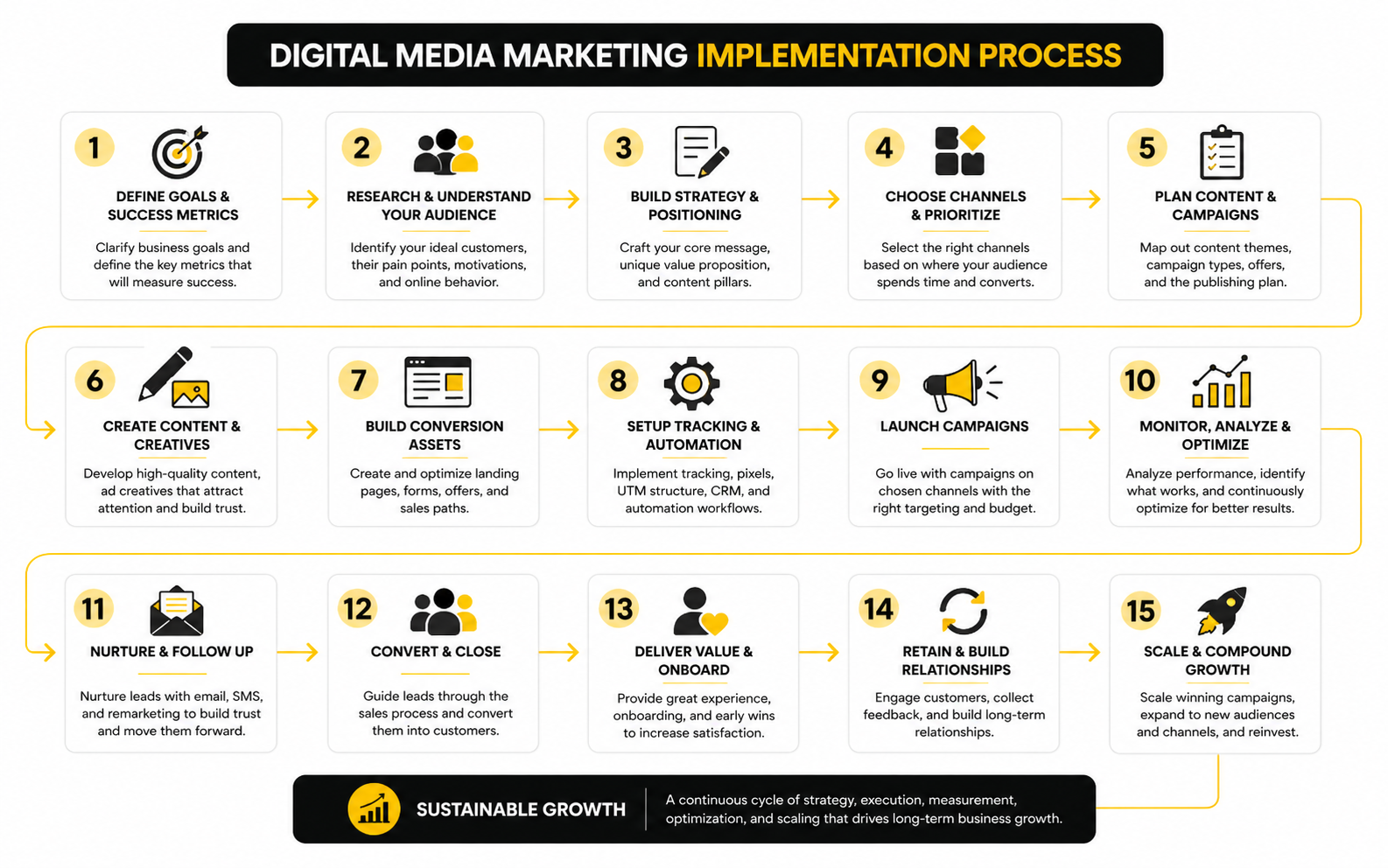
The system should connect four layers:
- Traffic data from ad platforms, search tools, social platforms, and referral sources.
- Behavior data from analytics platforms showing page views, scroll depth, events, clicks, and conversion actions.
- Lead and customer data from forms, CRM records, calendars, email systems, messaging flows, and purchase history.
- Revenue data from payments, sales reports, subscriptions, renewals, refunds, and lifetime value.
This is where tools become useful when they reduce gaps. A CRM and automation platform like GoHighLevel can help service businesses connect leads, pipelines, reminders, follow-up, and campaign tracking. Email and customer communication tools like Brevo can support segmentation and campaign reporting when email is part of the conversion path. The tool choice matters less than the discipline of keeping the data clean.
Benchmarks Should Guide, Not Control
Benchmarks are useful for spotting obvious problems, but they should not become the strategy. For ecommerce, current industry summaries often place average conversion rates around 2% to 3%, while broader lead-generation studies show average conversion rates can vary heavily by industry and offer value. That range is helpful as a reference, but it is not a universal standard.
A low conversion rate does not always mean the page is bad. It may mean the traffic is cold, the product is expensive, the buyer needs more education, or the offer asks for too much commitment too soon. A high conversion rate does not always mean the campaign is profitable either. It may be attracting low-quality leads, discount hunters, or customers who churn quickly.
Use benchmarks like a diagnostic tool. If your numbers are far below the range for your category, investigate. If your numbers are above the range but profit is weak, look deeper. The real goal is not to beat a generic benchmark. The goal is to improve the economics of your own system.
Performance Signals That Deserve Attention
Some metrics are early warning signs. If impressions are high but clicks are weak, the creative or message may not be relevant enough. If clicks are strong but conversions are weak, the landing page, offer, proof, or page speed may be the issue. If leads are cheap but sales are weak, the campaign may be attracting the wrong people.
Other signals show hidden strength. A campaign with average click-through rate but high close rate may be reaching a smaller, better-qualified audience. A content piece with modest traffic but strong assisted conversions may be doing important trust-building work. An email sequence with fewer subscribers but higher purchase intent may be more valuable than a large, inactive list.
This is why digital media marketing requires judgment. The dashboard can point to the problem, but it cannot always explain the cause. You still need to read the page, review the offer, inspect the traffic source, listen to sales calls, and compare lead quality.
Data Should Drive Action
Every report should end with a decision. If the data does not change what you do next, the report is too passive. Good analytics should lead to sharper creative, cleaner targeting, better pages, faster follow-up, stronger offers, or smarter budget allocation.
A practical monthly review can focus on five questions:
- Which channel produced the most qualified opportunities?
- Which message or offer created the strongest response?
- Where did the biggest drop-off happen?
- Which campaign looked good in platform data but weak in revenue data?
- What is the one constraint we should fix before increasing spend?
This keeps the team focused on improvement instead of reporting theater. Digital media marketing becomes much easier to manage when the data points to action. You stop asking whether a channel is “good” in general and start asking what role it should play, what it costs, what it produces, and how it can be improved.
Professional Implementation, Tools, and Measurement
At this stage, digital media marketing becomes less about knowing what to do and more about deciding what not to do. That is where most teams struggle. They see a new platform, a new ad format, a new AI feature, a new funnel tactic, or a competitor doing something flashy, and suddenly the plan starts drifting.
Professional implementation means building a system that can survive pressure. The pressure might come from rising acquisition costs, a platform algorithm change, a weak sales month, or a founder who wants to launch five campaigns at once. The system has to be clear enough to keep the team focused and flexible enough to adjust when the market changes.
The goal is not perfection. The goal is controlled progress. You want a digital media marketing machine where each campaign teaches you something useful, each asset has a job, and each improvement compounds instead of creating more chaos.
Strategic Tradeoffs That Actually Matter
Every digital media plan has tradeoffs. You can optimize for speed, but you may sacrifice depth. You can optimize for brand building, but the results may take longer to show up in revenue. You can optimize for direct response, but the brand may start sounding aggressive, generic, or discount-driven if nobody protects positioning.
The first major tradeoff is short-term performance versus long-term demand. Direct response campaigns can create fast feedback, which is useful when cash flow matters. But if every message is built around urgency, discounts, and immediate conversion, the brand can train buyers to wait, compare, and ignore anything that does not feel like a deal.
The second tradeoff is channel focus versus channel coverage. A small team should not try to act like a media company across every platform. It is better to dominate one or two channels with a strong conversion path than to spread thin across six channels and produce average work everywhere.
The Risk of Scaling Too Early
Scaling is dangerous when the foundation is weak. More budget will not fix unclear positioning. More traffic will not fix a confusing offer. More automation will not fix a bad customer experience.
The usual warning sign is when a campaign looks promising at a small budget but breaks when spend increases. Costs rise, lead quality drops, sales teams complain, and the business starts blaming the platform. Sometimes the platform is part of the issue, but often the real problem is that the campaign never had enough message depth, proof, audience segmentation, or conversion strength to scale.
A better approach is to scale in layers. First prove the offer. Then prove the landing page or funnel. Then prove follow-up. Then increase budget, audience size, and creative volume. This is slower than “just spend more,” but it protects the business from expensive guessing.
AI Is an Accelerator, Not a Strategy
AI is changing digital media marketing fast, especially in content production, research, personalization, creative testing, analytics, and workflow automation. Marketing teams are already using AI to move faster, build more campaign variations, summarize customer insights, and personalize communication at scale. The opportunity is real, but so is the trap.
The trap is thinking AI replaces strategy. It does not. AI can help generate angles, analyze patterns, draft copy, build workflows, and speed up production, but it still needs direction from people who understand the buyer, the offer, the market, and the brand.
The smartest use of AI is not mass-producing generic content. It is removing bottlenecks from the system. Use it to turn research into briefs, repurpose proven ideas, summarize sales call themes, create first drafts, cluster objections, test message variations, and speed up reporting. Keep human judgment in charge of positioning, claims, proof, ethics, and final decisions.
First-Party Data Is Becoming a Competitive Asset
The more privacy rules, platform changes, and tracking limitations affect measurement, the more valuable first-party data becomes. This includes email subscribers, customers, leads, survey responses, purchase history, CRM activity, content preferences, support conversations, and sales notes. It is not just data for reporting. It is fuel for better marketing.
First-party data helps you understand which audiences are valuable, which messages create action, which customers return, and which offers deserve more attention. It also helps you build stronger follow-up because you can segment based on behavior instead of blasting everyone with the same message.
This is where clean operations matter. If forms are messy, CRM stages are inconsistent, tags are random, and sales notes are missing, the business loses learning. Tools like GoHighLevel, Copper, or Brevo can help, but only if the team agrees on what should be captured and why.
Creative Volume Needs Creative Discipline
Modern platforms reward creative testing, but more creative does not automatically mean better marketing. A team can produce dozens of ads, posts, emails, and landing page variations and still learn nothing if every test is random. Volume without structure creates noise.
Creative discipline starts with hypotheses. You are not just making another ad. You are testing a message angle, audience pain, proof point, format, hook, offer, or objection. That gives the result meaning, even when the test fails.
A practical creative system should track what was tested and what changed. Was it the hook? The visual? The offer? The call to action? The audience? Without that clarity, teams keep making “new” creative that is actually the same idea with different packaging.
Brand and Performance Should Not Fight
One of the dumbest arguments in marketing is brand versus performance. A strong brand makes performance cheaper. Strong performance gives the brand more market feedback. They are not enemies unless the team manages them badly.
Brand work creates memory, preference, familiarity, and trust before the buyer is ready. Performance work captures and converts active demand when the buyer is closer to action. A healthy digital media marketing strategy needs both, even if the budget split changes by business stage.
Early-stage businesses may need more direct response because they need proof and cash flow. More mature businesses may need stronger brand investment because they have to defend demand, pricing power, and category presence. The key is to know which role each campaign is playing before judging it.
Operational Risks That Break Growth
Many digital media marketing problems are not creative problems. They are operational problems. Leads do not get called quickly. Tracking is inconsistent. Landing pages load slowly. Sales teams do not update CRM stages. Content gets approved too late. Campaigns launch without a clear owner.
These issues sound boring, but they kill growth. A brilliant campaign can underperform because nobody followed up with leads fast enough. A strong offer can look weak because the booking page created friction. A paid campaign can be misjudged because revenue was never connected back to the source.
This is why expert-level marketing includes process design. Who owns the campaign? Who approves creative? Who checks tracking? Who reviews lead quality? Who updates the dashboard? Who decides whether to scale, pause, or revise? When those answers are unclear, performance becomes unpredictable.
When to Add More Channels
Adding a new channel should be a strategic decision, not a reaction to hype. A new channel creates new creative requirements, reporting complexity, management time, and learning curves. That is fine when the business is ready. It is expensive when the core system is still leaking.
You should consider adding a channel when one of three things is true. First, your current channel is profitable but reaching saturation. Second, your audience clearly spends meaningful attention in another place. Third, the new channel plays a distinct role that your current mix does not cover.
Do not add a channel just because competitors are there. You do not know their economics. You do not know their margins. You do not know whether they are actually profitable. Your job is to build a system that fits your audience, offer, budget, and operational capacity.
The Expert Mindset
The expert mindset is calm, structured, and skeptical in the right way. It does not chase every tactic. It asks better questions. What constraint are we solving? What evidence do we have? What happens if this works? What happens if it fails? What do we learn either way?
This mindset is what turns digital media marketing from a list of tasks into a growth function. You stop treating campaigns like isolated events and start treating them like experiments inside a bigger system. That is where confidence comes from.
The next and final part will bring the article to a practical close. It will cover optimization, common mistakes, and the questions people usually ask before they commit serious time or budget to digital media marketing.
Optimization, Common Mistakes, and the Final System
Optimization is where digital media marketing becomes a real operating system. You are no longer guessing which channel is “best” or chasing every new tactic. You are looking at the whole ecosystem and asking which improvement will create the most leverage next.
The mature version of this system is simple to understand but hard to execute consistently. Audience insight shapes the message. The message shapes content and ads. Media distribution creates attention. Conversion assets turn attention into action. Follow-up turns action into revenue. Measurement shows where the next improvement should happen.
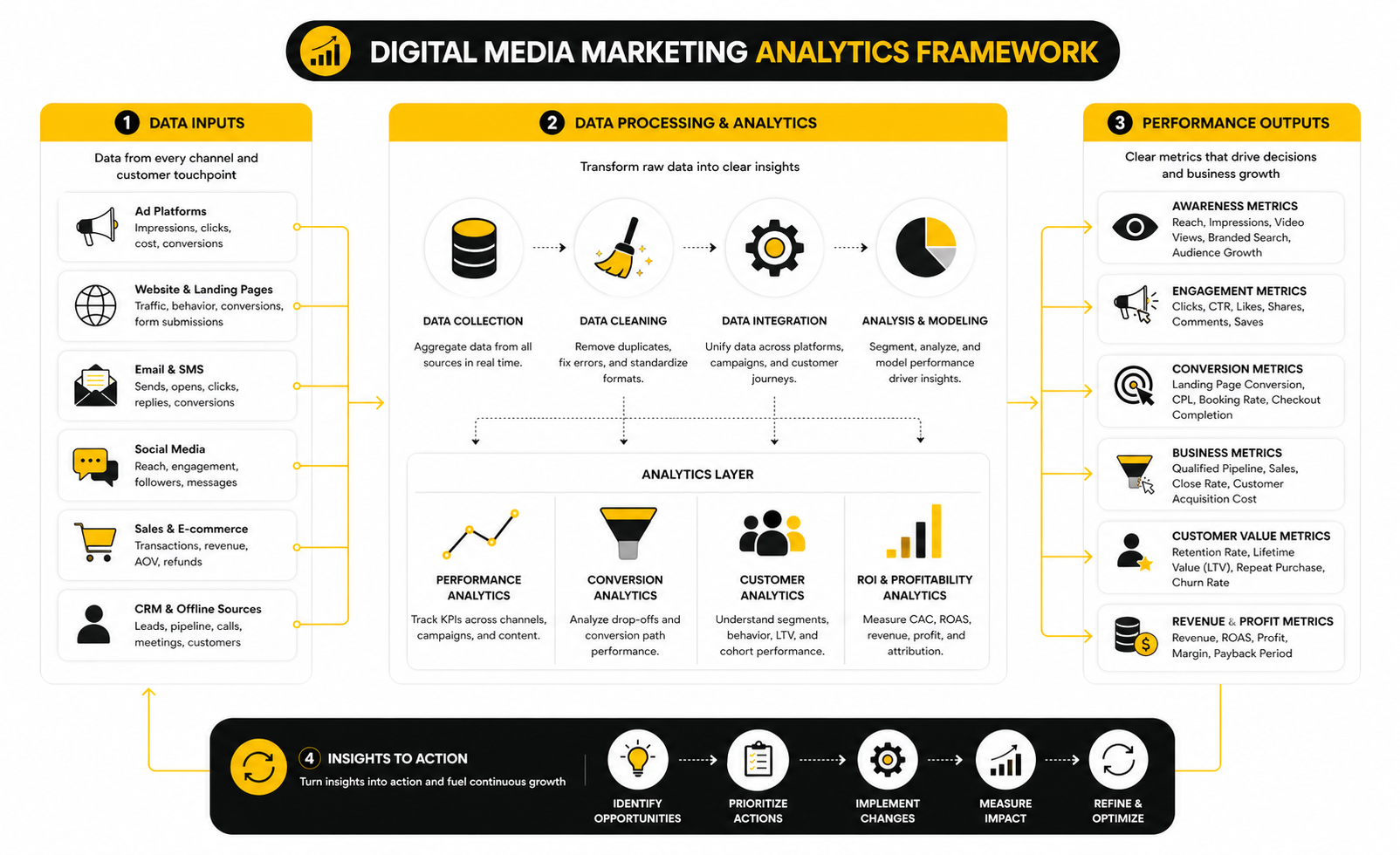
That loop is the point. Digital media marketing is not a one-time campaign that ends when the ads stop running. It is a cycle of learning, improving, and compounding.
Common Mistakes That Slow Growth
The first mistake is starting with tools instead of strategy. A new funnel builder, CRM, AI assistant, email platform, or social scheduler can help, but only when the offer, audience, message, and conversion path are clear. Without that foundation, better tools simply make weak execution happen faster.
The second mistake is measuring too shallowly. Clicks, impressions, views, and likes can be useful signals, but they are not the whole truth. If those numbers do not connect to qualified leads, sales, retention, or revenue, they should not control the strategy.
The third mistake is scaling before the system is ready. This usually looks exciting for a few weeks, then expensive afterward. Traffic increases, costs rise, lead quality drops, and nobody knows whether the problem is the audience, the offer, the page, the follow-up, or the sales process.
How to Optimize Without Creating Chaos
Optimization should be focused. Do not change the audience, offer, page, creative, pricing, and follow-up all at once, then pretend you know what caused the result. That is not testing. That is guessing with extra steps.
A better approach is to isolate the weakest point in the journey. If the ad is not earning clicks, improve the hook and creative angle. If people click but do not convert, improve the page, proof, offer, or call to action. If leads convert but do not buy, improve qualification, speed to lead, nurture, sales process, or retention.
The best teams keep a clean testing rhythm. They define the hypothesis, run the test long enough to collect useful data, compare the result against the previous baseline, and document what changed. Small improvements become powerful when they stack.
When the System Is Working
A working digital media marketing system feels calmer. The team knows which audience matters most, which messages are winning, which channels have a clear role, and which numbers deserve attention. Campaigns still fail sometimes, but failures become useful because they teach the next move.
You will know the system is getting stronger when fewer decisions are based on opinion. Creative direction comes from customer insight. Budget shifts come from performance and capacity. Follow-up improves because the team understands where leads are leaking.
The final sign is compounding. Content keeps attracting attention. Email and messaging keep nurturing demand. Paid campaigns keep testing and scaling winning angles. The CRM keeps storing useful customer data. The business gets smarter every month instead of starting over every campaign.
FAQ - Built for Complete Guide
What is digital media marketing?
Digital media marketing is the use of online channels, content, advertising, data, and automation to attract, convert, and retain customers. It includes search, social media, email, paid ads, video, websites, landing pages, messaging, analytics, and CRM systems. The goal is not just visibility. The goal is measurable business growth.
How is digital media marketing different from digital marketing?
Digital marketing is the broader category. Digital media marketing focuses more specifically on the media environments where attention is created, distributed, and converted. In practice, the two terms often overlap, but digital media marketing puts more emphasis on content, channels, paid and organic distribution, and audience behavior across platforms.
Why is digital media marketing important for businesses?
It matters because buyers now research, compare, discover, and purchase through digital channels. Global internet use reached 6.12 billion people in April 2026, which means digital behavior is not a niche channel anymore. For most businesses, it is where demand is created and captured.
What are the main parts of a digital media marketing strategy?
The main parts are audience research, messaging, channel selection, content, paid or organic distribution, conversion assets, follow-up, customer data, and measurement. Each part should support the next one. If one part is weak, the whole system becomes harder to scale.
Which digital media channels should a business use first?
Start with the channel closest to your buyer’s behavior. If people search actively for your solution, search content and paid search may matter first. If the market needs education or desire creation, social content, video, creator partnerships, and email may be more useful. Do not choose channels because they are trendy. Choose them because they fit the buying journey.
How much should a business spend on digital media marketing?
There is no universal number. Budget depends on margins, sales cycle, customer value, competition, growth goals, and how proven the offer already is. A small business should usually validate the offer and conversion path before increasing spend aggressively.
What metrics should digital media marketers track?
Track metrics based on the stage of the journey. For awareness, watch reach, impressions, video completion, branded search, and audience growth. For conversion, watch click-through rate, landing page conversion, lead cost, booking rate, and checkout completion. For business performance, watch qualified pipeline, customer acquisition cost, close rate, retention, lifetime value, and revenue.
Are paid ads necessary for digital media marketing?
Paid ads are not always necessary, but they can speed up learning and distribution. Organic channels can build trust and long-term demand, while paid media can test offers, creative angles, and audiences faster. The strongest systems often use both, but the balance depends on the business model.
How long does digital media marketing take to work?
Direct response campaigns can produce feedback quickly, especially when the offer and funnel are already strong. SEO, content, brand building, and email nurture usually take longer because trust and search visibility compound over time. The practical answer is that timelines depend on the channel, budget, offer strength, and execution quality.
What is the biggest mistake beginners make?
The biggest mistake is confusing activity with strategy. Posting every day, launching ads, building funnels, and buying tools can all feel productive, but they do not guarantee growth. The work has to connect to a clear audience, offer, conversion path, and measurement system.
How does AI affect digital media marketing?
AI can speed up research, content creation, creative testing, personalization, reporting, and automation. But AI does not replace positioning, judgment, customer understanding, or strategic tradeoffs. The best use of AI is to remove bottlenecks while keeping humans responsible for claims, brand voice, proof, ethics, and final decisions.
What tools are useful for digital media marketing?
Useful tools depend on the job. For funnels and conversion pages, ClickFunnels, Systeme.io, and Replo can help. For CRM, automation, and follow-up, GoHighLevel can be useful. For email and customer communication, Brevo and Moosend can support nurture and segmentation.
How do you know if digital media marketing is working?
You know it is working when the system produces more than surface-level engagement. The right people are finding you, the message is creating action, conversion paths are turning attention into leads or sales, and revenue data supports continued investment. Good marketing should eventually show up in pipeline, customers, retention, and profit.
Work With Professionals
Explore 10K+ Remote Marketing Contracts on MarkeWork.com
Most marketers spend too much time chasing clients, competing on crowded platforms, and losing a percentage of every project to middlemen.
MarkeWork gives you a better way. Browse thousands of remote marketing contracts and connect directly with companies desperate to hire skilled marketers like you, without platform commissions and without unnecessary gatekeepers.
If you're serious about finding better opportunities and keeping 100% of what you earn, explore available contracts and create a profile for free at MarkeWork.com.