

Direct mail marketing keeps getting underestimated because it looks old while behaving like a modern performance channel. The format is physical, but the best campaigns are driven by data, personalized offers, digital follow-up, and clear measurement. That is exactly why strong operators still use it when they need attention that lasts longer than a scroll.
The numbers behind the channel are hard to ignore. Recent mail-tracking data shows a typical direct mail piece can hold attention for well over two minutes across a 28-day period, while newer consumer research found 56% of people remember brands better from mail than from digital touchpoints alone. Just as important, direct mail is rarely a standalone play now. Consumer data shows 41% are more likely to engage when brands combine mail with digital touchpoints, and USPS frames modern mail as a channel that can amplify digital efforts and improve coordinated omnichannel campaigns.
Article Outline
- Why Direct Mail Marketing Still Matters
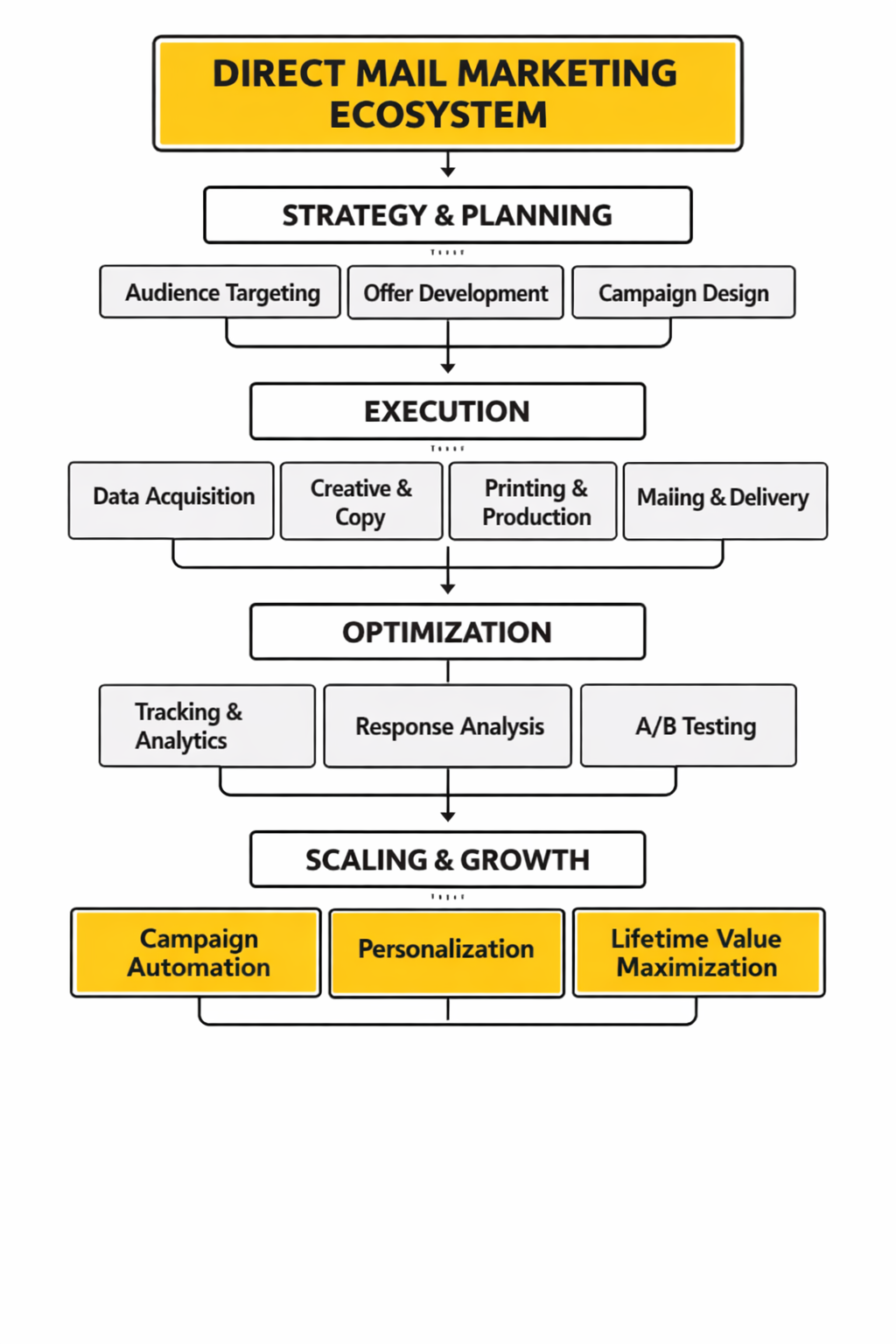
- The Direct Mail Marketing Framework
- Targeting the Right Audience, Offer, and List
- Designing Creative That Drives Response
- Measuring Results, Testing Variables, and Improving ROI
- Common Mistakes, Compliance, and the Final Action Plan
Why Direct Mail Marketing Still Matters
A lot of marketers assume direct mail marketing belongs to another era because inboxes, feeds, and paid ads move faster. That assumption breaks the moment you look at how people actually behave. Mail is handled, opened, set aside, revisited, shared, and often used as a trigger for a digital action later, which gives it a very different job from an impression that disappears in seconds.
That difference matters even more now because digital fatigue is real. In Lob’s 2025 consumer research, 58% of consumers said they feel overwhelmed by digital brand messages, while the same report found mail is more likely to feel credible, memorable, and worth keeping. JICMAIL’s market data points in the same direction, showing direct mail continues to generate strong read rates and sustained attention, including 133 seconds of interaction in Q4 2024 and 145 seconds in Q2 2025.
The bigger point is not that mail replaces digital. It is that mail changes the economics of attention. When a campaign reaches someone in their home, then pushes them to a landing page, QR code, phone call, or branded search, it can create a sequence that feels more deliberate and more trusted than a purely digital chase. That is one reason USPS now positions direct mail as an omnichannel growth lever rather than a legacy tactic.
The Direct Mail Marketing Framework
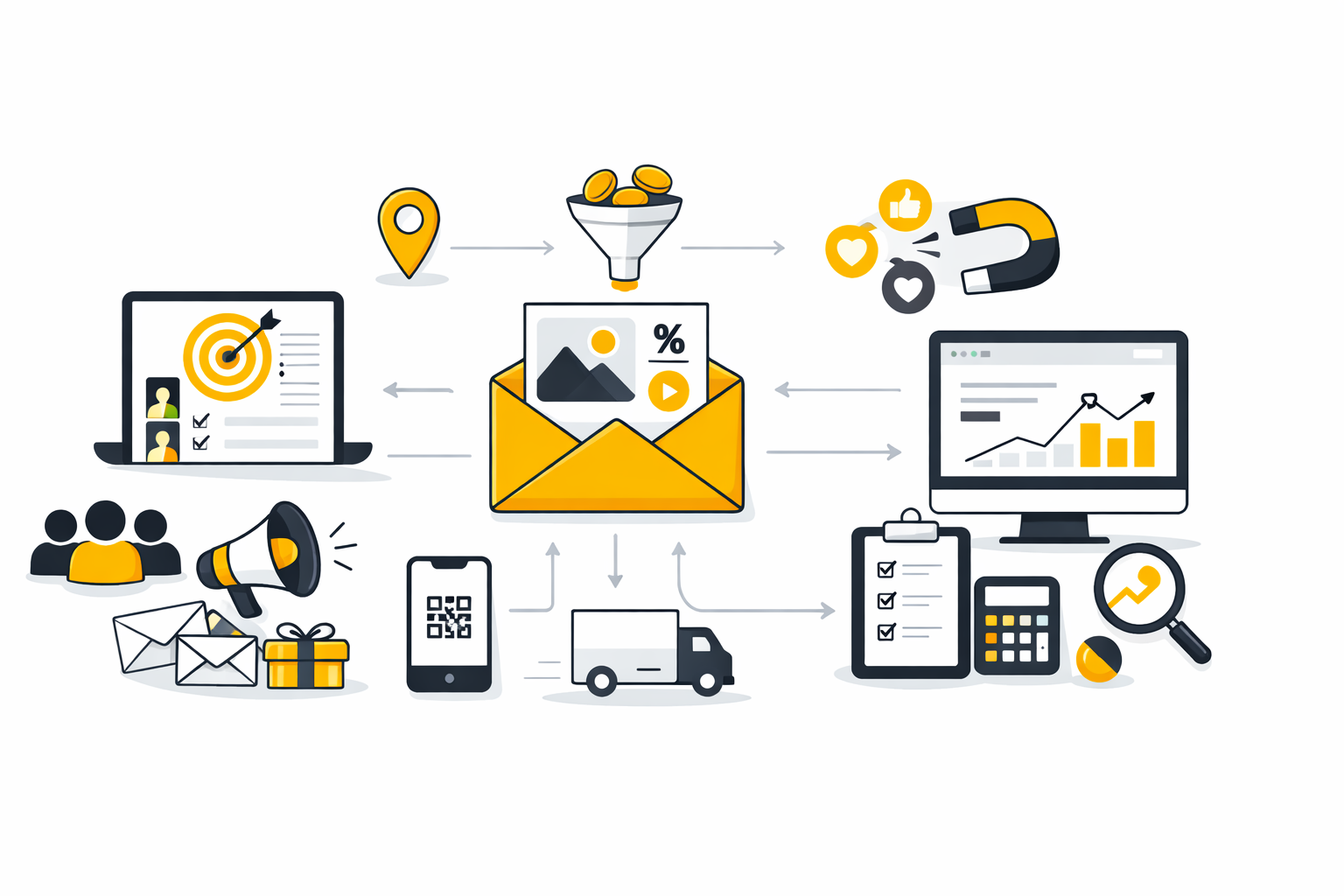
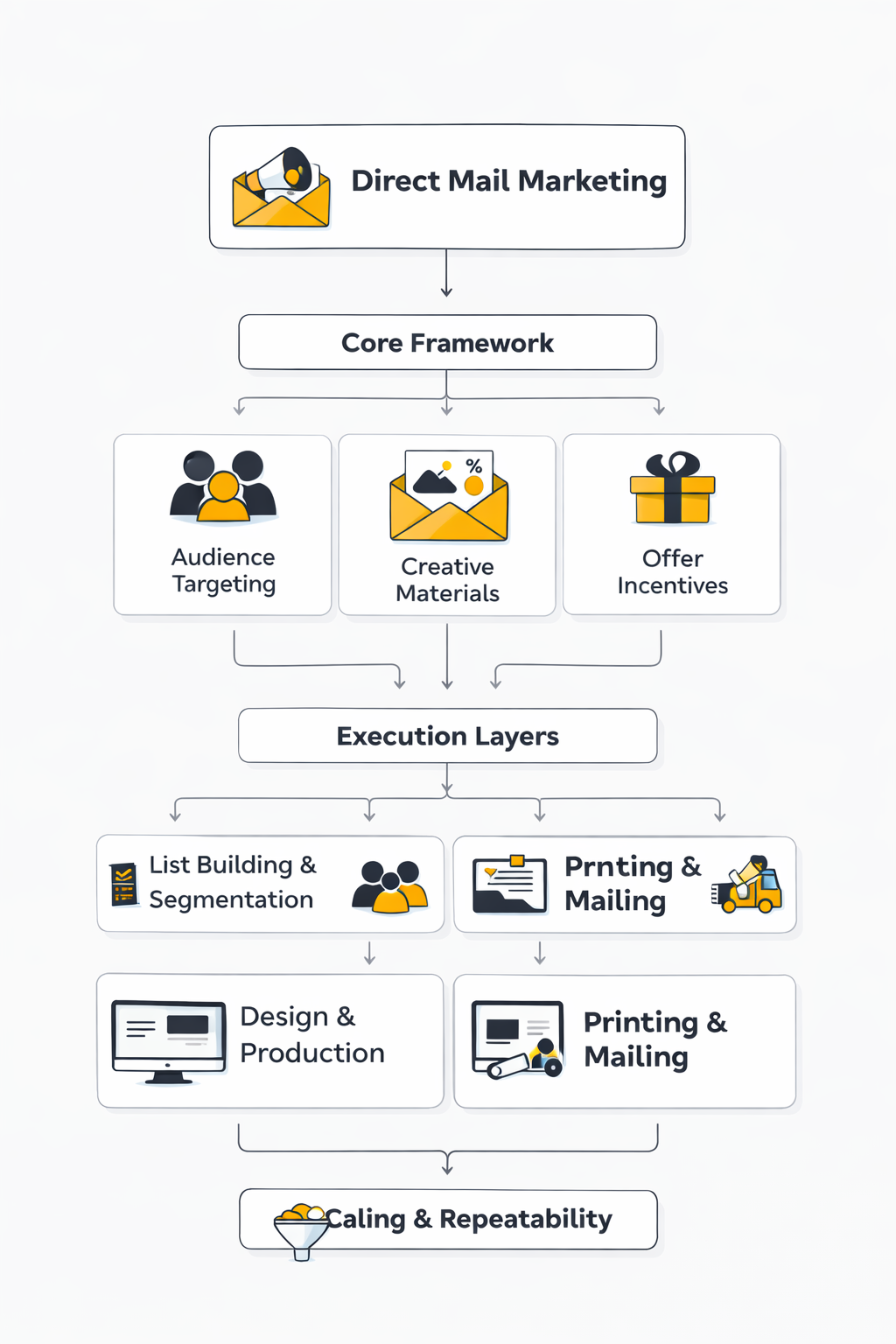
The simplest way to think about direct mail marketing is this: the campaign only works when the audience, offer, message, format, and follow-up all match. Most disappointing results are not caused by mail itself. They happen because one of those pieces is weak, usually the list, the offer, or the response path.
A solid framework starts with strategy before design. You decide who should receive the piece, what specific action they should take, why they should care right now, what format makes the offer easiest to understand, and how the campaign connects to the next step online or offline. That last part matters more than ever, because consumers increasingly move from mailbox to device, and Lob’s research shows 76% of people who engage with direct mail use a digital channel during that response journey.
Professional implementation also means building the response system before sending anything. If your mailer points people to a weak page, a confusing form, or a slow follow-up flow, you waste the most expensive part of the campaign. For brands that need a simple response path, tools like ClickFunnels, Systeme.io, or Brevo can help connect landing pages, forms, and follow-up automation without turning the campaign into a tech project.
There is also a discipline piece here that serious marketers do not skip. Claims in mail still need to be truthful and supportable, because the FTC requires advertising to be truthful, non-deceptive, and backed by evidence. So the framework is not just creative and targeting. It includes compliance, measurable intent, and a response process you can actually operate at scale.
Targeting the Right Audience, Offer, and List
This is where direct mail marketing becomes either a disciplined revenue channel or an expensive guessing game. You do not win because you mailed a beautiful piece to a huge audience. You win because the right people received the right message at the right moment, and the offer felt relevant enough to justify action.
That sounds obvious, but it is where many campaigns quietly fail. Teams obsess over format, paper stock, or design details while skipping the harder strategic questions about buyer intent, list quality, recency, and what kind of offer actually matches the audience. The campaign looks polished, goes out on time, and still underperforms because the fundamentals were off before the first piece hit the mailbox.
Modern data keeps reinforcing this point. USPS continues to position direct mail as a data-driven channel built around targeting, personalization, and coordinated timing with digital touchpoints in order to improve response and campaign efficiency through audience-led execution. JICMAIL’s latest response benchmarking, built from 3,800 campaigns across 15 organizations, points the same way: results improve when campaigns are measured and optimized around real response behavior rather than broad assumptions.
Start With Buyer Intent, Not a Broad Audience
The best direct mail marketing campaigns usually begin with a simple question: who is most likely to care right now? Not someday, not in theory, and not in a vague demographic bucket. Right now. That shift alone makes your targeting sharper because it forces you to think in terms of timing, need, and buying stage instead of generic reach.
A homeowner who just moved, a customer who has not reordered in six months, a high-value lead who stopped responding to email, and a prospect near a physical store are not the same audience. They might share age, income, or geography, but the trigger behind their next action is different. If you send the same mail piece to all of them, the campaign becomes less relevant the larger it gets.
This is why operators who treat direct mail marketing seriously segment around behaviors and signals, not just static profile data. USPS emphasizes that better campaign performance comes from using data to refine who receives mail and when, especially when brands connect customer insights with coordinated outreach across channels in targeted omnichannel programs. In practice, that means your segment definition is doing a lot more heavy lifting than your headline.
Build the Offer Before You Build the Mailer
A weak offer cannot be rescued by clever copy. That is true in email, paid ads, landing pages, and it is especially true in direct mail marketing because printing and postage make every weak decision more expensive. Before you choose the format, you need to know what the recipient is being asked to do and why they should do it now.
Good offers are concrete. They reduce friction, create clarity, and make the next step feel worthwhile. That could mean a limited-time discount, a consultation, a product sample, a location-based invitation, a reorder reminder, a service upgrade, or a benefit-driven lead magnet that actually solves a problem. What matters is not whether the offer sounds exciting in a brainstorming meeting. What matters is whether it matches the audience’s level of awareness and intent.
This is also where many brands overcomplicate things. They stuff too many benefits into one piece, stack multiple calls to action, or send people to a generic homepage. A better move is to build one offer around one desired action, then create a response path that feels frictionless. If the conversion step needs a focused landing page, a tool like ClickFunnels or Systeme.io can help keep the experience tight instead of dumping traffic into a messy website.
List Quality Is a Performance Lever, Not a Back-Office Detail
There is no polite way to say this: bad lists kill direct mail marketing. They waste budget, hurt response rates, distort testing, and make good creative look bad. Yet list quality still gets treated like an administrative task when it should be one of the core performance decisions in the campaign.
A strong list is accurate, current, relevant, and aligned with the buying logic behind the offer. That means verifying address quality, suppressing known non-responders when appropriate, removing internal duplicates, watching recency windows, and being honest about whether the source of the names actually fits the business objective. Mailing more people is not automatically smarter if those extra names lower match quality and dilute the economics of the campaign.
This matters because direct mail works best when precision beats volume. USPS keeps leaning into that point through its emphasis on data-driven targeting and personalization in modern direct mail strategy. The practical takeaway is simple: list hygiene, segmentation rules, and source selection deserve the same attention you give to copy, design, and budget.
House Lists Usually Beat Prospect Lists for a Reason
When brands already have customer data, house lists are often the smartest place to start. Existing customers, warm leads, lapsed buyers, and recent site visitors usually give you better odds because the relationship already exists in some form. There is context, some level of trust, and often a clearer understanding of what kind of offer might bring them back.
That does not mean prospecting is a mistake. It means prospecting needs tighter controls. Cold audiences generally require stronger audience modeling, more careful offer design, and more realistic expectations around conversion. If you skip those disciplines, prospecting mail can become a very expensive way to learn that broad targeting is broad for a reason.
This is one reason experienced teams often test direct mail marketing in concentric circles. They begin with warmest segments, validate message-to-market fit, tighten response tracking, and only then expand into colder prospect pools. It is slower than blasting a large list, but it gives you cleaner data and a much better chance of scaling intelligently.
Personalization Should Feel Useful, Not Creepy
Personalization in direct mail marketing is powerful because physical mail already feels more deliberate than a random ad impression. But personalization only works when it adds relevance. If it feels intrusive, unnecessary, or obviously automated, the effect can backfire fast.
The useful version of personalization is tied to the recipient’s real situation. Think purchase history, service category, store proximity, lifecycle stage, renewal timing, or content matched to known interests. The wrong version is forced familiarity, awkward data insertion, or hyper-specific references that make people wonder how much you know about them. Precision is good. Overreach is not.
Consumer research from Lob’s latest mail study shows people are more likely to engage when direct mail is relevant, personalized, and connected to a broader brand experience across channels in the 2025 consumer insights report. The practical lesson is that personalization should make the mail more helpful, easier to act on, and more aligned with what the recipient already cares about.
Geographic Targeting Still Has an Edge
One of the underrated strengths of direct mail marketing is how well it works when geography matters. That includes local service businesses, franchise systems, retail catchment areas, political outreach, healthcare networks, event promotion, and brands trying to drive foot traffic within a realistic travel radius. Mail can put a relevant message in the hands of households that are actually capable of acting on it.
This is especially valuable when the offer is tied to local context. A nearby store opening, seasonal service window, neighborhood-based promotion, or region-specific need often makes a mail piece feel instantly more grounded. The recipient does not have to translate the message into their situation because the piece already arrived in their situation.
USPS continues to highlight the value of aligning mail strategy with business goals, location intelligence, and channel coordination in its guidance on optimizing omnichannel campaigns. For practical marketers, that means geographic targeting is not just a media planning detail. It can be the difference between broad visibility and actual local response.
Match the Response Path to the Audience
The audience and the offer are only half the setup. The response mechanism matters just as much. Some recipients will scan a QR code, some will type in a short vanity URL, some will call, and some will respond only after seeing matching digital follow-up. If you force everyone into one path, you lose people who might have converted through a different one.
That is why strong direct mail marketing campaigns give recipients an easy next step that fits their level of intent. A high-consideration service might need a phone call or appointment page. A simple retail promotion might work better with a QR code and landing page. A B2B campaign may do best with a highly focused form and an email sequence that continues the conversation once the prospect raises a hand.
This is also where operational discipline matters. If your form is clunky, your routing is slow, or your follow-up sequence is weak, the campaign underperforms even if the targeting was right. Tools like Brevo, Moosend, or Fillout can help connect response capture, email follow-up, and cleaner handoff without turning a straightforward campaign into a systems headache.
Designing Creative That Drives Response
Once the audience, list, and offer are locked in, creative stops being decoration and starts doing real sales work. This is the part many people notice first, but in serious direct mail marketing it only performs when the strategy underneath it is already solid. Good creative makes the offer easier to understand, easier to trust, and easier to act on.
That means the next section needs to go beyond looks. Format, copy hierarchy, visual emphasis, CTA placement, landing-page continuity, and the physical experience of the mail piece all influence response. When those elements line up, the recipient does not just notice the piece. They know what it is, why it matters, and what to do next.
Designing Creative That Drives Response
Creative in direct mail marketing is not about looking impressive. It is about guiding attention, building trust fast, and making the next step obvious. When someone picks up your mail piece, you have a short window to answer three questions in their mind: what is this, why should I care, and what should I do next.
The strongest mail pieces follow a clear hierarchy. The headline pulls attention and communicates the core benefit. The supporting copy removes doubt and adds context. The call to action makes the next step feel simple and immediate. When this structure is missing, even a well-designed piece becomes confusing, and confusion kills response faster than anything else.
Recent consumer research reinforces how physical format influences engagement. JICMAIL’s tracking shows mail is often handled multiple times and shared within households, which means your message may be seen more than once before action happens. That makes clarity and consistency more important than cleverness, because the piece has to hold up across repeated exposure.
Keep the Message Focused and Action-Oriented
One of the most common mistakes in direct mail marketing is trying to say too much. Brands list every feature, every benefit, and every possible use case, hoping something will stick. What actually happens is that nothing stands out, and the reader moves on without taking action.
A better approach is ruthless focus. One audience, one offer, one primary action. Everything on the page should support that decision. If the reader understands exactly what they get and what to do next within a few seconds, you are already ahead of most campaigns.
This is also where alignment with your landing page matters. If your mail promises something specific, the page must deliver that exact promise without forcing the user to search for it. Platforms like ClickFunnels or Systeme.io make it easier to keep that continuity tight, so the transition from physical mail to digital action feels seamless.
Use Format and Physical Design Strategically
The physical format of your mail piece is not just a design decision. It directly affects how people interact with it. Postcards, letters, self-mailers, dimensional packages, and oversized formats all create different expectations and behaviors.
Postcards are fast and direct. They work well for simple offers where the message can be understood at a glance. Letters allow for more explanation and are often used when trust and detail matter more. Dimensional mail stands out the most but comes with higher costs, so it usually needs a higher-value offer to justify the investment.
The key is matching the format to the complexity of the message and the value of the conversion. USPS highlights that format selection should support campaign objectives and audience behavior, especially when mail is used as part of a broader omnichannel strategy in coordinated campaigns. In other words, format is not decoration. It is part of the strategy.
Make the Call to Action Impossible to Miss
If someone has to search for how to respond, you have already lost momentum. The call to action in direct mail marketing needs to be visible, repeated, and easy to follow. That usually means combining multiple response options without overwhelming the reader.
Common response mechanisms include:
- QR codes that lead directly to a landing page
- Short, memorable URLs
- Personalized URLs when relevant
- Phone numbers for immediate contact
- Promo codes for tracking and attribution
What matters is not how many options you include, but how clearly they are presented. If you use a QR code, it should be obvious where it leads and why scanning it is worth it. If you use a URL, it should be short enough to type without friction.
Lob’s consumer research shows that digital follow-up is part of the natural response journey, with a large portion of recipients moving from physical mail to online interaction during conversion. That makes your CTA design less about the mail piece alone and more about the entire response experience.
Professional Implementation: From Idea to Mailbox
Once strategy and creative are aligned, execution becomes the difference between a campaign that runs smoothly and one that breaks under its own complexity. Direct mail marketing involves more moving parts than most digital campaigns, which means small operational mistakes can create expensive problems.
At this stage, the work becomes procedural. You are translating strategy into production files, validating data, coordinating with printers and mailing services, and making sure every response path is live before anything is sent. The more structured your process is, the more predictable your results become.
Step-by-Step Execution Process
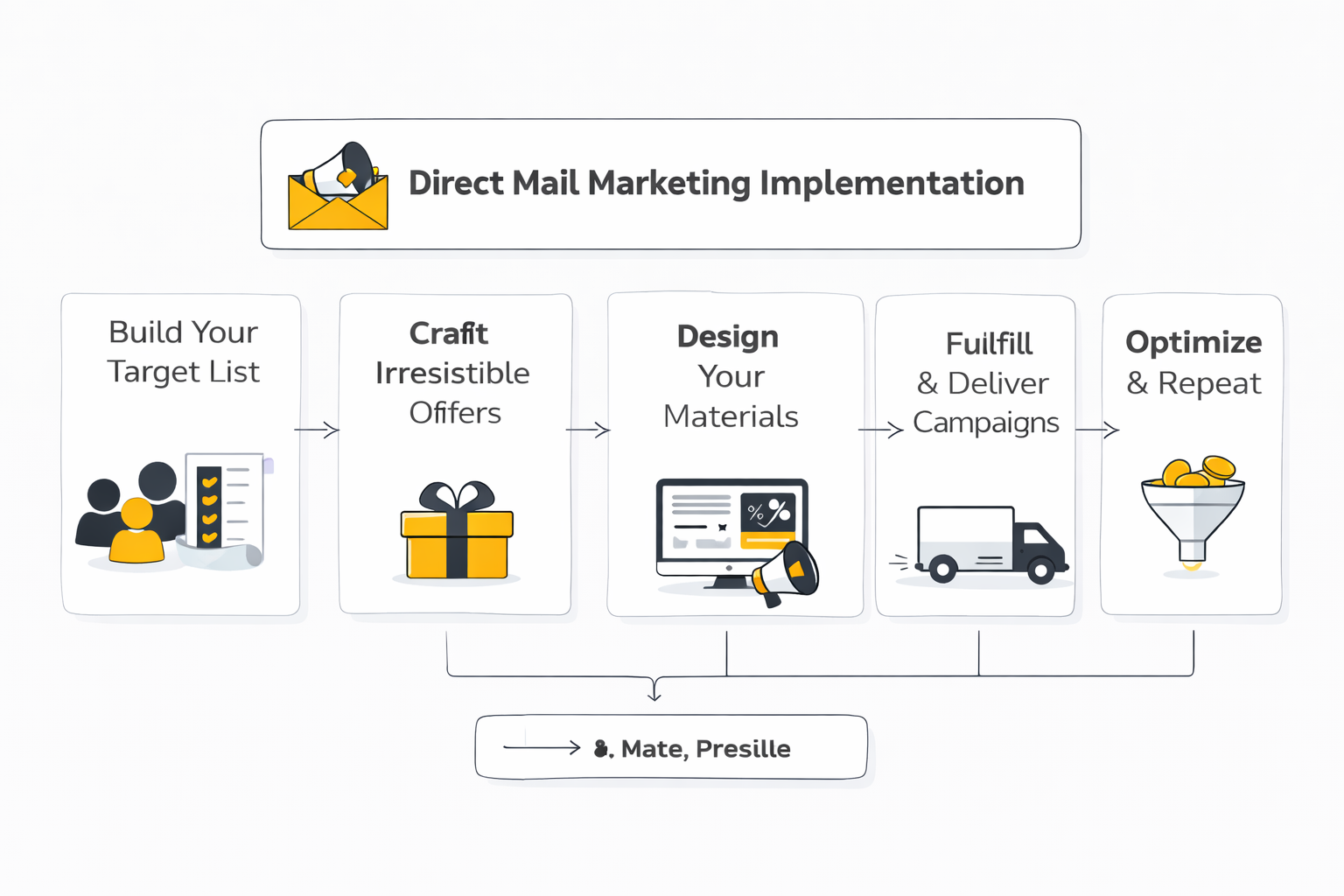
A reliable direct mail marketing workflow typically follows a structured sequence. Skipping steps or rushing through them is where most issues appear.
- Finalize audience segments and clean the list This includes deduplication, address validation, suppression rules, and segmentation checks. If the list is wrong, nothing downstream can fix it.
- Lock the offer and response mechanism Before design is finalized, confirm the CTA, landing page, tracking method, and follow-up flow. This prevents last-minute changes that break consistency.
- Prepare print-ready creative files Work with production specifications early. Bleeds, margins, color profiles, and variable data setup need to be correct to avoid delays or reprints.
- Set up tracking and attribution Use QR codes, unique URLs, promo codes, or call tracking numbers. Without this, you are guessing performance instead of measuring it.
- Coordinate printing and mailing logistics Timing matters. Production schedules, postage optimization, and delivery windows all affect when your audience actually receives the piece.
- Launch and monitor early response signals Watch initial engagement closely. Early data can reveal issues with targeting, messaging, or response paths before the full campaign impact unfolds.
This structured approach aligns with how USPS frames modern campaigns as coordinated systems where data, creative, and logistics work together to improve performance in data-driven direct mail execution.
Build the Follow-Up Before You Send Anything
One of the biggest missed opportunities in direct mail marketing is weak follow-up. The mail piece creates attention, but the conversion often happens later, after the recipient has had time to think, compare, or revisit the offer.
That means your follow-up system should already be live before the campaign drops. This could include:
- Email sequences triggered by form submissions
- Retargeting ads aligned with the same offer
- SMS reminders for time-sensitive promotions
- Sales team outreach for high-value leads
Tools like Brevo or Moosend can help automate these follow-ups without adding unnecessary complexity. The goal is not to overwhelm the recipient but to reinforce the message across channels in a way that feels consistent.
Timing, Frequency, and Coordination Matter More Than You Think
Direct mail marketing is not just about what you send. It is about when and how often you send it. A single drop can work, but many campaigns perform better when they are part of a sequence that builds familiarity and reinforces the offer.
Timing also affects how mail interacts with digital channels. If your email, ads, and mail are coordinated, you create multiple touchpoints that increase recall and response. If they are disconnected, you lose that compounding effect.
USPS continues to emphasize that synchronized campaigns improve overall effectiveness by combining physical and digital channels in integrated marketing strategies. In practice, that means planning your campaign as a sequence, not a one-off event.
Reduce Friction at Every Step
Every additional step, delay, or confusion point reduces response. That applies to the mail piece, the landing page, the form, and the follow-up. Strong direct mail marketing campaigns feel easy to respond to because they remove unnecessary effort.
This is where details matter. Fast-loading pages, short forms, clear instructions, and immediate confirmation all improve conversion rates. Even small improvements in these areas can significantly impact overall ROI, especially when you are scaling campaigns.
The implementation phase is where all of this comes together. Strategy, targeting, creative, and operations stop being separate pieces and become one system. When that system is built correctly, direct mail marketing stops feeling unpredictable and starts behaving like a channel you can actually control and scale.
Measuring Performance and Making the Numbers Work
Direct mail marketing becomes predictable the moment you stop treating it like a branding channel and start measuring it like a performance system. The difference is simple. Branding hopes people remember. Performance tracks what they actually do and improves from there.
The challenge is that direct mail does not give you instant dashboards the way digital ads do. Response is delayed, multi-touch, and often happens across channels. That is exactly why measurement needs to be designed before the campaign goes live, not after results start coming in.
When done correctly, direct mail marketing gives you clean signals. You can see who responded, how they responded, what it cost, and whether the campaign produced real revenue. When done poorly, you end up guessing, and guessing makes it impossible to scale.
The Metrics That Actually Matter
There is no shortage of metrics in marketing, but most of them are distractions if they do not connect to revenue. In direct mail marketing, a few core numbers tell you almost everything you need to know about performance.
Start with these:
- Response rate The percentage of recipients who take a measurable action. This is your first signal that the campaign is resonating with the audience and the offer.
- Conversion rate The percentage of responders who complete the desired outcome, such as a purchase, booking, or signup. This reflects how strong your landing page and follow-up process are.
- Cost per acquisition (CPA) The total campaign cost divided by the number of conversions. This is where direct mail marketing either proves itself or gets cut.
- Return on investment (ROI) The revenue generated compared to total campaign cost. This is the number that decides whether you scale or stop.
Industry benchmarking shows how these numbers can vary widely depending on targeting and list quality. The Data & Marketing Association reports response rates can reach around 9% for house lists and close to 5% for prospect lists when campaigns are executed well. That gap alone tells you how much targeting and list selection influence results.
Attention and Engagement Tell a Bigger Story
Response metrics are critical, but they do not tell the full story of how direct mail marketing works. One of the channel’s advantages is sustained attention, which influences behavior even when the response is not immediate.
JICMAIL tracking shows people spend over two minutes interacting with mail on average, often returning to it multiple times over several weeks in measured attention studies. That means a piece of mail can influence a decision long after it is first opened, especially when combined with digital follow-up.
This is where many marketers misread the data. They look for immediate conversions and underestimate delayed impact. In reality, direct mail often acts as a trigger that leads to branded search, direct website visits, or later conversions through other channels. If you do not account for that, you undervalue the campaign.
Building a Trackable System From Day One
Measurement only works when the campaign is built to be tracked. That means every response path needs a way to connect back to the original mail piece. Without that, performance becomes blurry and hard to trust.
A solid tracking setup typically includes:
- Unique QR codes tied to specific campaigns or segments
- Dedicated landing pages with clear attribution
- Promo codes linked to offers and audiences
- Call tracking numbers for phone-based responses
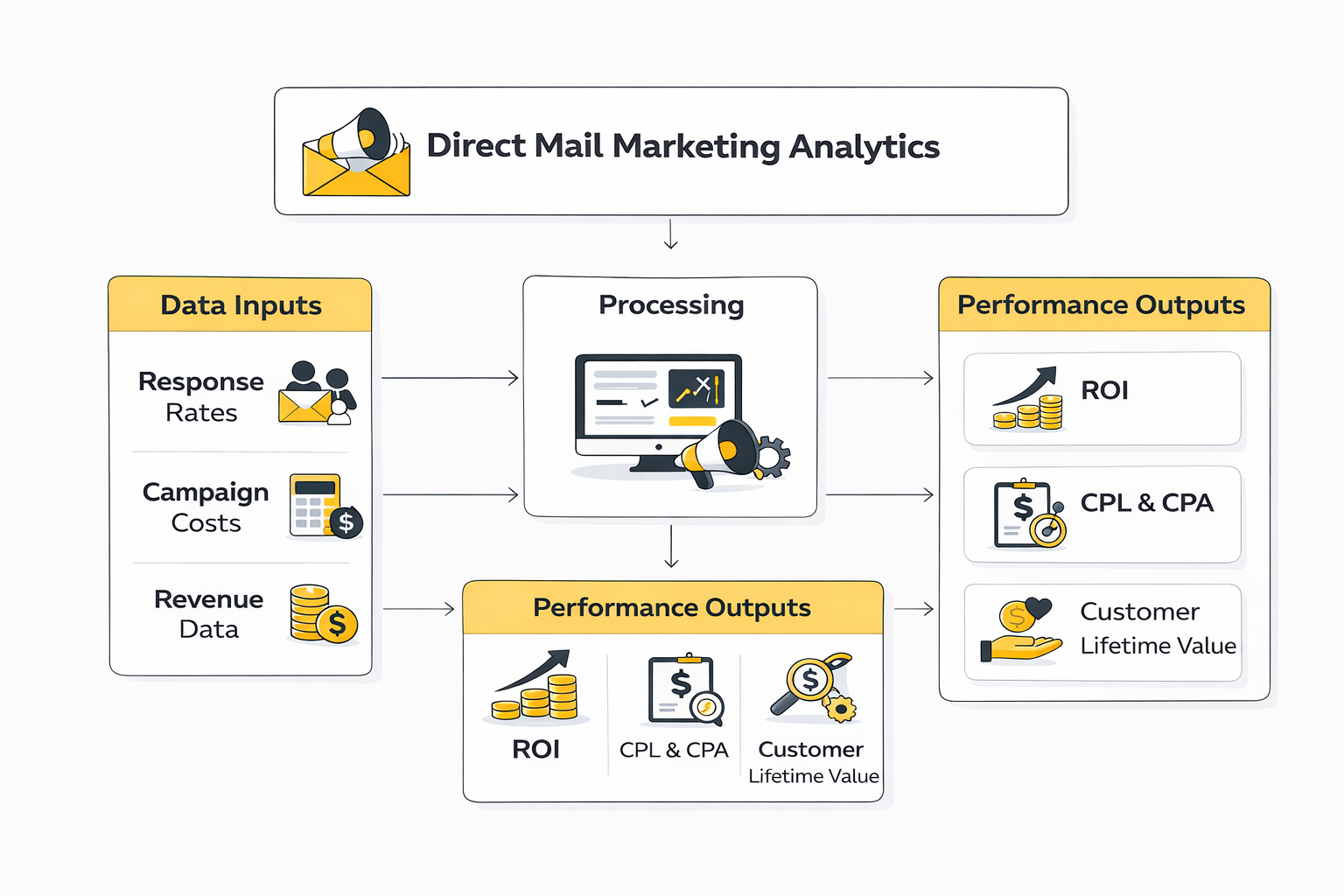
This is the point where direct mail marketing starts behaving like a digital channel. You can compare segments, test offers, and identify which variables actually move performance. USPS emphasizes that modern campaigns rely on this kind of data-driven measurement and optimization to improve ROI in direct mail analytics frameworks.
If you skip this step, you lose the ability to learn. And if you cannot learn, you cannot scale.
How to Interpret the Data Without Misleading Yourself
Raw numbers are not enough. What matters is how you interpret them and what decisions you make next. This is where many campaigns go wrong, not because the data is bad, but because the conclusions are rushed or incomplete.
For example, a low response rate does not automatically mean the campaign failed. It could mean:
- The audience was too broad
- The offer did not match intent
- The timing was off
- The response path created friction
On the other hand, a high response rate with poor conversion might indicate strong creative but weak follow-up. That is not a creative problem. It is a system problem.
This is why direct mail marketing needs to be evaluated as a full funnel. You are not just measuring who responded. You are measuring how the entire experience performed from mailbox to final action.
Benchmarking Against Reality, Not Assumptions
Benchmarks are useful, but only when you understand what drives them. Comparing your campaign to industry averages without context can lead to the wrong conclusions. A campaign targeting warm customers should not be judged by prospecting benchmarks, and a high-ticket offer should not be evaluated the same way as a low-cost promotion.
What matters more is internal benchmarking. Track your own campaigns over time. Compare segments, offers, formats, and timing. Look for patterns in what works and what does not.
JICMAIL’s large-scale tracking across thousands of campaigns shows that response and engagement improve when campaigns are continuously measured and refined, not treated as one-off efforts in longitudinal response studies. That reinforces a simple idea: consistency and iteration outperform isolated campaigns.
Testing Is Where Direct Mail Becomes Scalable
Testing is the bridge between one successful campaign and a repeatable system. Without testing, you might get lucky once. With testing, you build a process that improves over time.
In direct mail marketing, effective testing usually focuses on a few variables at a time:
- Different audience segments
- Variations in the offer
- Headline and messaging changes
- Format differences (postcard vs letter)
- Timing and frequency adjustments
The key is controlled testing. Change one major variable at a time so you can clearly see what caused the result. If you change everything at once, you lose clarity and learn nothing useful.
This is also where tools like Brevo or Moosend can support the digital side of testing, especially when follow-up sequences are part of the conversion path. Direct mail marketing does not exist in isolation anymore. Testing should reflect that reality.
What the Data Should Drive You to Do Next
The goal of measurement is not reporting. It is decision-making. Every campaign should leave you with clear answers about what to do next.
- If response is strong but conversion is weak, fix the landing and follow-up
- If conversion is strong but response is low, improve targeting or the offer
- If both are weak, revisit the fundamentals of audience, message, and timing
- If both are strong, scale carefully while continuing to test
This is where direct mail marketing becomes a system instead of a tactic. You stop asking whether it works and start understanding how to make it work better.
Common Mistakes, Compliance, and Scaling Without Wrecking ROI
At this stage, the basics should already be clear. Direct mail marketing works when targeting is sharp, the offer is strong, the creative is focused, and measurement is built in from the start. What separates average operators from serious ones is what happens next: they manage tradeoffs, avoid predictable mistakes, and scale only when the economics still make sense.
This is where discipline matters more than excitement. A campaign that looks promising at a small volume can fall apart when list quality drops, fulfillment slows down, or the response path gets overloaded. Direct mail marketing rewards ambition, but only when ambition is backed by process.
The Mistakes That Quietly Destroy Performance
Most failed direct mail marketing campaigns do not collapse because of one dramatic error. They die from a stack of smaller bad decisions that compound. Weak audience selection, vague offers, cluttered creative, bad follow-up, sloppy timing, and poor attribution are usually enough to turn a good channel into an expensive disappointment.
The first major mistake is mailing too broadly too early. Teams see a decent early result, assume they found a scalable winner, and expand volume before they fully understand what made the campaign work. The result is predictable: response rate drops, acquisition costs rise, and the original performance was never strong enough to survive weaker segments.
The second mistake is treating direct mail as self-contained. Mail almost always interacts with other channels now, whether you planned for that or not. USPS has been pushing this point hard in its recent guidance on omnichannel strategy and campaign optimization, because the mail piece often starts the interaction while digital channels help close it. If those channels are disconnected, the campaign loses a big part of its leverage.
Scaling Changes the Math
A lot of marketers think scaling means doing more of what worked. In direct mail marketing, scaling usually means entering a different game entirely. Costs shift, list quality changes, operational risk grows, and the easy wins disappear first.
That is why volume should not be your first scaling lever. Better segmentation, stronger creative control, cleaner follow-up, tighter testing, and more intelligent sequencing often produce better returns than simply increasing quantity. JICMAIL’s campaign-level benchmarking shows performance varies substantially by campaign type, warmth of audience, and repeat sends in the 2025 response tracker, which is a useful reminder that not all scale is healthy scale.
A practical way to scale direct mail marketing is to expand in layers. Start with the highest-intent segments. Then widen to adjacent lookalike or modeled audiences only after the unit economics still hold. That sounds less exciting than a massive rollout, but it is how you protect margin while learning what the channel can actually sustain.
Frequency Can Build Response or Burn Out the Audience
There is a lazy myth that more frequency is always better because repeated exposure improves recall. That is only half true. Frequency works when it reinforces relevance. It hurts when it turns into repetition without a reason.
This becomes especially important in direct mail marketing because physical mail feels more deliberate than digital impressions. If the same household keeps receiving similar pieces without a clear evolution in the offer, message, or timing, the campaign starts to feel wasteful instead of persuasive. Repetition without progression is one of the fastest ways to train your audience to ignore you.
The better approach is sequencing. Send the first piece to introduce the value proposition. Use the second to remove objections or add urgency. Use the third to close the loop with a clear next step. JICMAIL’s broader body of engagement data and recent campaign findings suggest repeat exposure can strengthen results when the mail program is intentionally structured rather than mechanically duplicated in mail response and engagement studies.
Compliance Is Not the Boring Part
A lot of teams treat compliance like a legal checkbox that happens after the creative work is done. That is backwards. In direct mail marketing, compliance directly affects trust, deliverability, brand risk, and whether the campaign can be scaled safely.
The baseline rule is simple and serious: advertising claims must be truthful, not misleading, and supported by evidence. The FTC states this clearly in its advertising and marketing basics and repeats the same standard in its small business advertising guidance. If your mail piece makes performance claims, savings claims, urgency claims, or product-origin claims, those claims need to be supportable before the campaign goes out.
This matters even more when direct mail marketing is paired with landing pages, forms, or retargeting. The same promise made in print has to stay accurate online. You do not get a separate truth standard just because one touchpoint is physical and the next one is digital. If the funnel exaggerates in the mailer and softens the details on the landing page, that is not clever marketing. That is unnecessary risk.
Operational Risk Shows Up Late and Costs More
The painful thing about operational problems is that they often appear after the spend is committed. A broken QR code, mismatched offer, landing page error, delayed follow-up, bad merge field, or printing issue can turn a strong strategy into a messy campaign fast. And unlike digital, you usually cannot patch the live asset once it is already in the mail stream.
That is why serious direct mail marketing teams use preflight checks obsessively. They validate lists, test response paths, confirm personalization logic, verify promo codes, review proofs carefully, and make sure the internal team can actually handle the response volume. This sounds basic until one missed detail contaminates the test and leaves you unable to trust the result.
Cost control matters here too. USPS points out that production decisions, format choices, and postage planning all influence total campaign economics in its guide to managing direct mail campaign costs. In practice, this means cost savings should never be evaluated in isolation. A cheaper format that hurts response is not cheaper. It is just a less obvious loss.
Advanced Teams Build Around Workflow, Not Just Creative
One of the clearest differences between beginner and advanced direct mail marketing programs is where the effort goes. Beginners spend most of their energy on the piece itself. Advanced teams spend more time building the workflow around the piece.
That workflow includes data handling, audience rules, approvals, production management, landing-page continuity, CRM syncing, sales follow-up, and reporting. When those systems are clean, the campaign becomes easier to repeat, test, and improve. When those systems are messy, every campaign feels like starting over.
This is where software can genuinely help, not because tools magically improve strategy, but because they reduce friction in execution. A tighter funnel in ClickFunnels, simpler automation in Systeme.io, cleaner email and CRM follow-up in Brevo, or better lead-routing support through Copper can make the post-mail experience more consistent. That consistency is not glamorous, but it is often what preserves ROI when campaigns scale.
The Strategic Tradeoff Most Marketers Miss
The biggest tradeoff in direct mail marketing is not digital versus physical. It is efficiency versus attention. Digital channels often look cheaper on the surface because distribution is instant and volume is easy. Direct mail looks more expensive because every piece has real production and delivery costs. But that is only the surface-level math.
The deeper math is about quality of attention, memory, and action. Recent JICMAIL results showed 9.2% of mail items prompted a website visit in Q2 2025, while USPS continues to frame modern mail as a measurable performance channel in data-driven ROI guidance. That does not mean mail is automatically superior. It means the channel can justify its cost when it is used where attention quality actually matters.
This is the expert-level view: do not ask whether direct mail marketing is cheaper than digital. Ask whether it improves total acquisition efficiency, conversion quality, retention, and revenue when added to the mix. That is a better question, and it usually leads to smarter decisions.
When to Push Harder and When to Pull Back
There are moments when you should absolutely lean in. If response is healthy, conversion is strong, attribution is clean, and fulfillment can handle demand, scaling makes sense. If repeated sends are improving economics and the channel is lifting performance across email, search, or sales outreach, that is usually a green light.
There are also moments when restraint is the smarter move. If you do not trust the attribution, if list quality is slipping, if the offer is getting tired, or if operational cracks are showing up, more spend will usually magnify the problem rather than solve it. Direct mail marketing is forgiving in some ways, but it is ruthless about weak systems.
That is the right place to pause before the final section. Once you understand the strategic tradeoffs, the common mistakes, and the compliance realities, the next move is not more theory. It is a practical action plan for building a campaign that can actually work in the real world.
Building a Direct Mail Marketing System That Compounds
By this point, direct mail marketing should feel less like a campaign and more like a system. The difference matters. Campaigns are temporary. Systems improve over time, get more efficient, and produce more predictable results with each iteration.
A strong system connects everything you have seen so far. Targeting feeds into creative. Creative feeds into response. Response feeds into follow-up. Follow-up feeds into data. And that data improves the next campaign. When that loop is working, direct mail stops being a one-time expense and becomes a repeatable growth channel.
This is also where integration becomes non-negotiable. JICMAIL’s latest findings show mail increasingly drives digital behavior, including measurable uplifts in website visits and online engagement after campaigns in cross-channel effectiveness studies. That means your system should not end at the mailbox. It should extend into landing pages, CRM, email sequences, and sales workflows.
If you are serious about building this properly, simplify wherever possible. Use one funnel system, one tracking logic, one follow-up structure, and one reporting model. Tools like ClickFunnels, Systeme.io, and Brevo are not the strategy, but they can help keep the system clean so execution does not break as you scale.
FAQ - Built for Complete Guide
What is direct mail marketing in simple terms?
Direct mail marketing is the practice of sending physical promotional materials to a targeted audience to drive a specific action. That action can be a purchase, a website visit, a phone call, or a booking. The key difference from digital channels is that the message arrives physically, which often creates higher attention and recall.
Does direct mail marketing still work in 2026?
Yes, and the data keeps reinforcing that. Consumers continue to engage with mail for longer periods compared to most digital formats, and studies show strong recall and response when campaigns are targeted and integrated with digital follow-up in recent consumer research. The channel works especially well when used as part of a broader system rather than in isolation.
How expensive is direct mail marketing?
Costs vary depending on format, volume, targeting, and postage. A simple postcard campaign might cost significantly less per piece than a dimensional package, but the real metric is cost per acquisition. A more expensive format can still be more profitable if it produces higher-quality conversions.
What response rate should I expect?
Response rates depend heavily on audience quality and offer strength. House lists can perform significantly better than prospect lists, with industry data showing response rates around 9% for warm audiences and lower for cold outreach in DMA benchmarks. The important part is tracking your own data and improving from there.
How do I track results from direct mail marketing?
Tracking typically uses QR codes, unique URLs, promo codes, or call tracking numbers. These methods connect each response back to the campaign, allowing you to measure performance accurately. Without tracking, you lose the ability to optimize.
Is direct mail better than digital marketing?
It is not a replacement. It is a complement. Direct mail marketing often performs best when it works alongside digital channels, reinforcing messages and improving conversion rates across the funnel. USPS continues to highlight this synergy in its guidance on integrated campaigns.
What types of businesses benefit most from direct mail?
Local businesses, service providers, healthcare organizations, financial services, real estate, and e-commerce brands all use direct mail effectively. The common factor is not industry. It is whether the business can target a specific audience and present a clear offer.
How often should I send direct mail?
Frequency depends on your audience and offer. Some campaigns work as one-time promotions, while others perform better as part of a sequence. Repeated exposure can improve results when the messaging evolves, but repetition without variation can reduce effectiveness.
What is the biggest mistake in direct mail marketing?
The most common mistake is poor targeting. Sending the right message to the wrong audience almost always fails, no matter how good the creative is. The second biggest mistake is weak follow-up, where the campaign generates interest but fails to convert it.
Can small businesses use direct mail effectively?
Yes, especially when targeting is local and specific. Smaller campaigns can be highly effective when focused on the right audience with a clear offer. In many cases, direct mail marketing gives small businesses a way to stand out in markets where digital channels are saturated.
How do I scale direct mail marketing safely?
Scaling should happen in stages. Start with your best-performing segments, validate the economics, and expand gradually. Monitor response rates, conversion, and cost per acquisition closely. Scaling without maintaining quality usually leads to declining performance.
What role does personalization play in direct mail?
Personalization increases relevance, which improves response. When done correctly, it makes the message feel tailored to the recipient’s situation. When done poorly, it can feel intrusive. The goal is to make the mail more useful, not just more customized.
Work With Professionals
Explore 10K+ Remote Marketing Contracts on MarkeWork.com
Most marketers spend too much time chasing clients, competing on crowded platforms, and losing a percentage of every project to middlemen.
MarkeWork gives you a better way. Browse thousands of remote marketing contracts and connect directly with companies desperate to hire skilled marketers like you, without platform commissions and without unnecessary gatekeepers.
If you're serious about finding better opportunities and keeping 100% of what you earn, explore available contracts and create a profile for free at MarkeWork.com.