

Direct mail marketing is easy to underestimate until you look at what still happens when a physical piece lands in the right mailbox at the right moment. Brands keep investing because mail does something crowded digital channels often struggle to do: it gets noticed, it gets handled, and it can move people from awareness to action without competing with twenty tabs and a flood of notifications. That matters even more now, when the U.S. Postal Service still handled 57.5 billion pieces of Marketing Mail in 2024 and reported $15.4 billion in Marketing Mail revenue, which tells you this is not some nostalgic side channel.
The bigger shift is that direct mail marketing no longer works best as a standalone tactic. The strongest campaigns are now built like systems. A mailer sparks attention, a landing page captures intent, a CRM tracks behavior, and follow-up channels close the loop. That is why this article focuses on how direct mail fits into a broader growth engine, not just how to design a postcard and hope for the best.
- Why Direct Mail Marketing Still Matters
- How a Modern Direct Mail Marketing Framework Works
- Audience, Data, and Offer Strategy
- Creative, Format, and Production Choices
- Campaign Execution, Measurement, and Optimization
- Common Mistakes, Best Practices, and FAQs
Direct mail marketing still matters because physical media creates a different kind of attention. Industry measurement from JICMAIL found the average piece of direct mail receives 108 seconds of attention across a month, and its Q4 2024 update pushed that average to 133 seconds during the peak trading period. That is a serious amount of time in a world where most marketing gets skipped in seconds.
It also matters because direct mail is not as saturated as many digital channels. In Lob and Comperemedia’s 2024 consumer study, only 23% of respondents said they receive direct mail too frequently, compared with much higher fatigue levels for email and digital ads. The same research showed 60% had taken action after receiving direct mail, which is exactly why smart operators still use it for both acquisition and retention.
Performance data backs that up. JICMAIL’s 2024 Response Rate Tracker, built from more than 2,300 campaigns, reported average response rates of 7.9% for warm direct mail and 0.9% for cold direct mail. Those numbers do not mean every campaign will perform like that, but they do make one thing clear: mail is still a measurable response channel, not just a branding exercise.
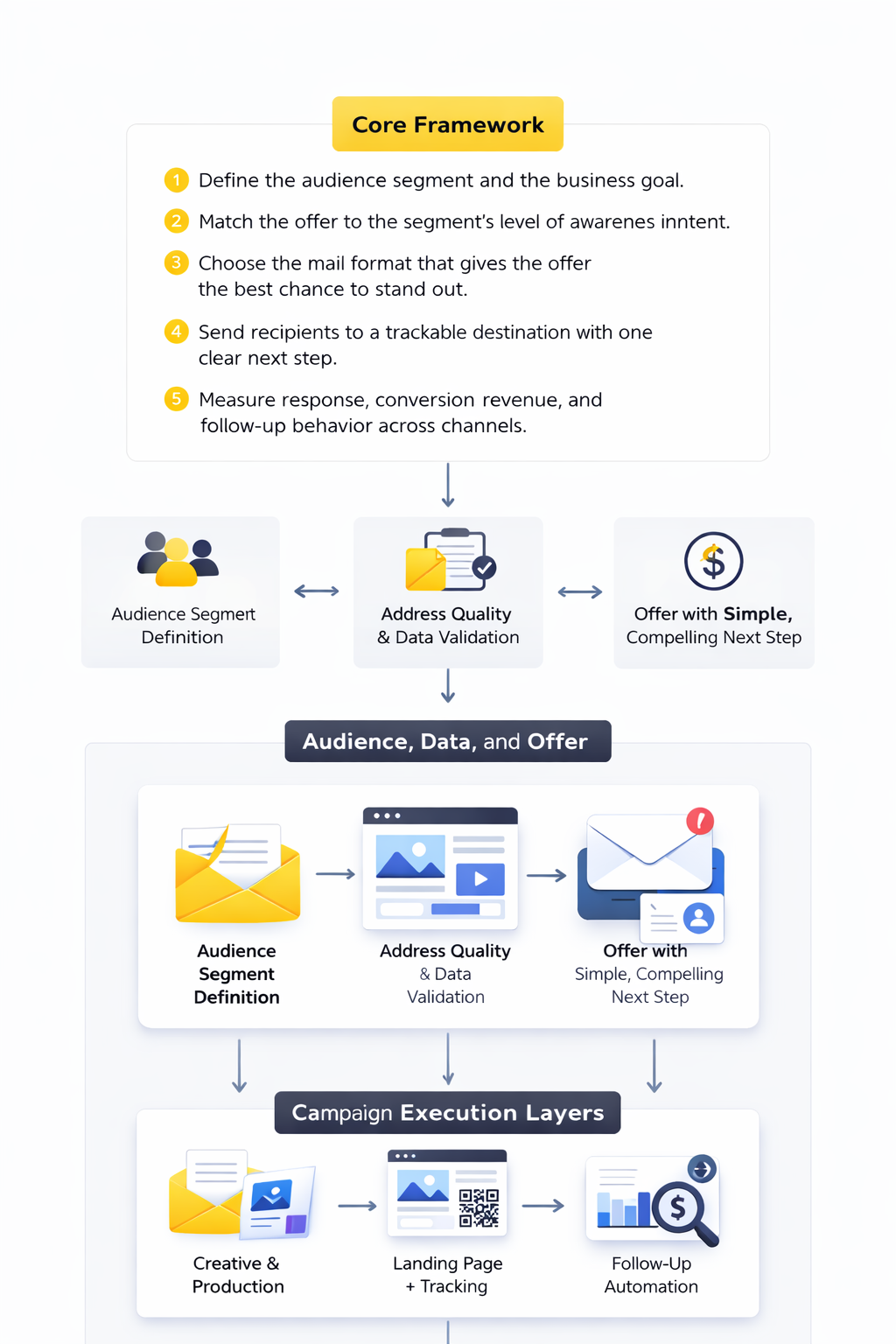
A modern direct mail marketing framework starts with one basic idea: mail should trigger the next action, not try to do every job by itself. The piece in the mailbox creates curiosity, trust, or urgency. The destination, whether that is a dedicated landing page, booking page, QR flow, or sales conversation, is where the conversion architecture does the heavy lifting.
The framework is simple enough to remember, but disciplined enough to scale:
- Define the audience segment and the business goal.
- Match the offer to the segment’s level of awareness and intent.
- Choose the mail format that gives the offer the best chance to stand out.
- Send recipients to a trackable destination with one clear next step.
- Measure response, conversion, revenue, and follow-up behavior across channels.
This is where a lot of marketers either win big or waste money. If your mailer sends people to a generic homepage, you break the chain. If it sends them to a focused funnel, scheduler, or lead form, you preserve intent and make attribution far easier. That is why direct mail marketing often performs better when paired with tools built for conversion paths, such as a dedicated landing page funnel or an email and automation platform like Brevo for follow-up after the first response.
Consumer behavior supports this connected approach. Lob’s 2024 study found that among people who acted on a mail piece, 55% visited the brand’s website and 42% searched for the product online. That tells you direct mail is often the spark, while digital completes the journey. The brands getting the best results understand that from the start and build their campaigns accordingly.
The next thing that decides whether direct mail marketing works is not the paper stock or the print finish. It is whether you are mailing the right people with an offer that actually fits where they are in the buying journey. Get that wrong and even a beautifully produced campaign turns into expensive clutter.
This is where modern direct mail starts acting more like serious performance marketing. You are not just renting attention from a mailbox. You are matching audience quality, address quality, and offer quality so the response path feels obvious instead of forced.
A lot of weak direct mail marketing campaigns begin with a big list and a vague hope that volume will save them. In practice, the better move is to start with a segment definition that reflects real buying behavior: recent buyers, lapsed customers, high-value households, specific geographies, abandoned leads, or customers approaching a renewal window. Personalization research from McKinsey’s 2025 marketing analysis makes the same point in broader terms: channel choice, discount depth, and product affinity all perform better when they are tied to observed customer preferences rather than broad assumptions.
That matters because direct mail marketing has a built-in cost every time you send a piece. Postage, printing, data processing, creative, and fulfillment all stack up fast, so a sloppy segment is not just inefficient, it is expensive. The strongest campaigns narrow the audience before the first design draft ever happens, then build the message around one clear reason that group should care now.
This also explains why direct mail often works best deeper in the funnel than people expect. If someone already knows your brand, stopped short of buying, or bought once and went quiet, mail has context to work with. That makes the piece feel relevant instead of random, and relevance is what gives physical mail its edge.
Bad data kills direct mail marketing faster than bad copy. If the address is wrong, incomplete, duplicated, or outdated, the campaign never gets a fair chance to perform. USPS keeps stressing this for a reason: NCOALink contains about 160 million permanent change-of-address records, and the Move Update standard requires commercial mail addresses to be updated within 95 days before the same address is used in a qualifying mailing.
That is the unglamorous part people skip, and it is usually a mistake. USPS also notes that address standardization through CASS and related address-quality tools improves formatting, spelling, abbreviations, and deliverability, which is exactly what you want before paying to print and send anything. Even the most persuasive postcard cannot overcome a broken record in your database.
The practical sequence is simple. Deduplicate the file, standardize the addresses, run move-update processing, suppress ineligible records, and only then hand the audience to creative. If you are managing customer segments inside a CRM, a tool like Copper can help keep contact history and lifecycle stages connected, but the bigger point is operational discipline: fix the data first, then scale the campaign.
Once the audience is right and the data is clean, the offer becomes the real engine of the campaign. Direct mail marketing works best when the recipient can understand the value in seconds. That usually means one core promise, one obvious next step, and one reason to move now, whether that is a deadline, a limited bonus, a local service slot, a renewal incentive, or a first-purchase discount.
The consumer side of the channel keeps pointing in the same direction. Lob’s 2024 consumer insights presentation highlights that direct mail performs best when promotions are easy to notice and the response path is frictionless, with strong examples using a prominent discount plus multiple ways to redeem, including QR code, website, and phone response options in one package from the DELIVERED 2024 session deck. That is not a design gimmick. It is a reminder that people respond when the offer is visible and the action step feels easy.
This is also where too many brands overcomplicate things. They try to stack three offers, explain the whole company, and send traffic to a generic homepage. A better approach is to make the mailer the trigger and the destination the closer, whether that destination is a focused ClickFunnels page, a clean Systeme.io funnel, or a short response form built in Fillout. The mail piece should create intent, and the destination should capture it without distraction.
One more thing really matters here: the offer has to match the audience temperature. Cold prospects usually need simplicity, credibility, and a low-friction ask. Warm leads and existing customers can handle more specificity because they already know who you are, which means your direct mail marketing can move from awareness into action much faster.
Once the audience and offer are locked, direct mail marketing becomes a production discipline. This is the point where strategy either turns into a piece people notice or into something that gets ignored in two seconds. The goal is not to make mail look expensive for the sake of it. The goal is to make the message instantly legible, physically noticeable, and easy to act on.
That usually means resisting the urge to overdesign. The strongest mailers tend to have one dominant promise, one visual hierarchy, and one clear action path. The more cognitive load you add, the more you dilute the thing that matters most: getting the recipient to do the next step.
Different formats do different work, and direct mail marketing gets better when you stop treating every campaign like it should be a postcard. Postcards are fast, visible, and often effective for simple offers or reminders because the message is exposed immediately. Letters can feel more personal and serious, which helps when the sale needs more explanation, more trust, or a higher-value decision.
Self-mailers, dimensional mail, and larger formats can also make sense when standing out is half the battle. USPS keeps incentivizing marketers to think about physical interaction, with promotions around tactile, sensory, and interactive mail on the PostalPro promotions calendar. That does not mean every brand needs special textures or complex folds. It means the physical form should support the response goal instead of being chosen by habit.
There is also a basic budget truth here. A more elaborate package can absolutely outperform a basic postcard, but only if the added cost helps response or conversion enough to justify it. Direct mail marketing works best when the format earns its way into the economics of the campaign.
The best creative decisions in direct mail marketing usually feel obvious in hindsight. A clear headline, a visible offer, readable typography, enough white space, and one strong call to action still beat crowded layouts full of competing claims. JICMAIL’s Q4 2024 results showed that 77% of all mail was read, looked at, or glanced at, which is encouraging, but it also means your piece still has to convert attention into understanding very quickly.
That is why response mechanics matter as much as the copy. The direct mail campaigns highlighted in Lob’s DELIVERED 2024 materials used prominent promotions and multiple redemption paths, including QR code, web page, and phone, because recipients do not all act the same way in the conference deck. Some will scan immediately. Others will type a URL later. Others will call if the purchase is higher friction.
If you want a useful rule, use one primary CTA and one or two backup response methods. That keeps the piece flexible without turning it into a menu. Direct mail marketing gets weaker when the recipient has to decide what you want them to do.
Personalization helps, but only when it improves clarity or relevance. Lob’s 2025 direct mail research reports that 88% of marketing executives say personalization significantly improves response rates. That does not mean every mailer needs variable images, personalized maps, and five data points pulled into the copy. It means the recipient should feel like the message was meant for someone like them.
In practice, the most effective personalization is often simple. Use the right segment, the right offer, the right timing, and maybe one or two contextual details that make the piece more useful. If you force personalization into places where it adds no value, it starts feeling artificial fast.
This is especially important in direct mail marketing because the medium feels more intimate than display advertising. People hold it, turn it over, and often read it in a less distracted setting. Relevance builds trust. Overpersonalization can do the opposite.
At this stage, direct mail marketing stops being a concept and starts becoming an operational system. This is where teams either create a repeatable pipeline or lose control across approvals, print files, list handling, timing, and tracking. The good news is the process is not mysterious. It just needs to be run in the right order.
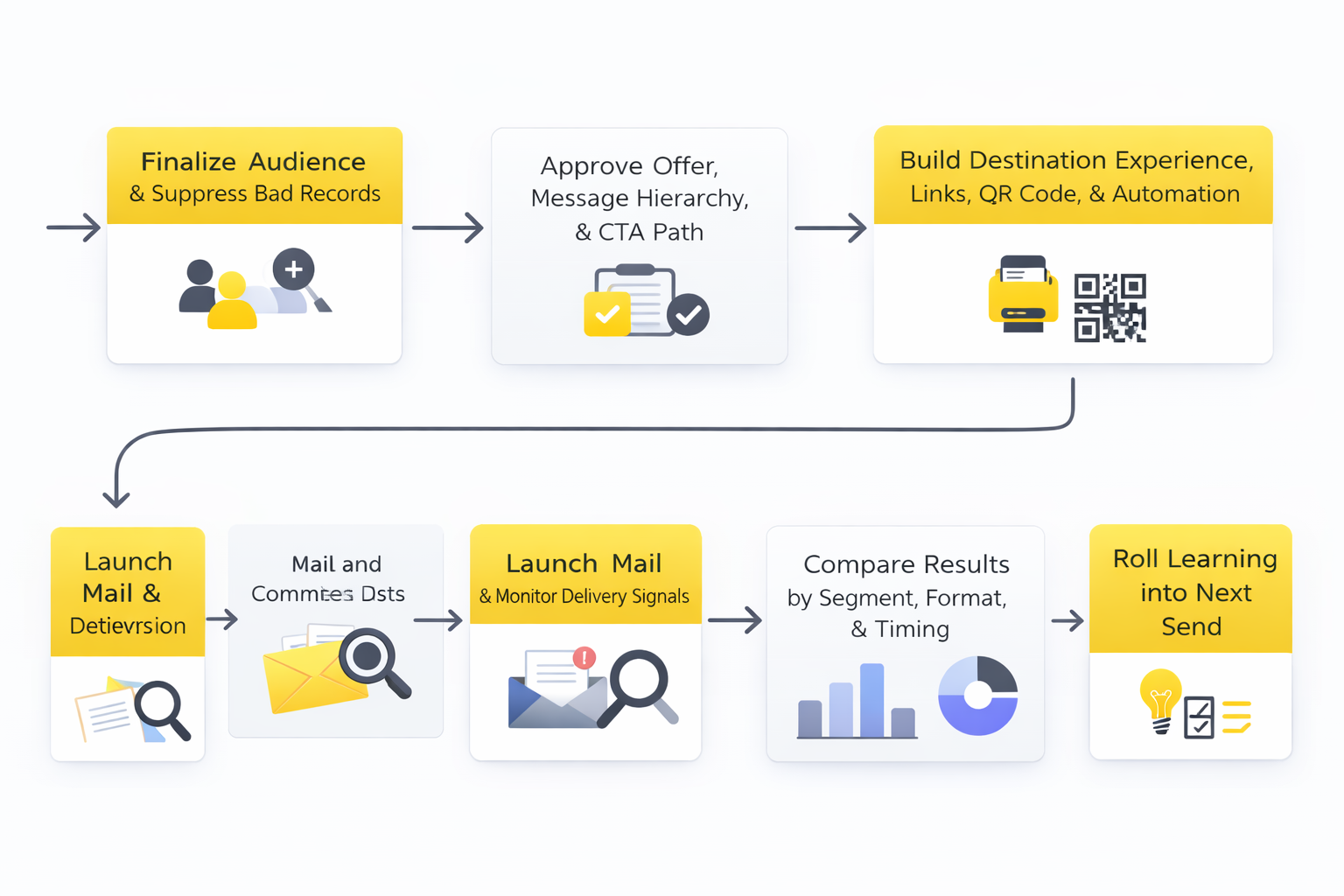
A practical campaign moves through a clear sequence:
- Finalize the audience and suppress bad or ineligible records.
- Approve the offer, message hierarchy, and CTA path.
- Build the destination experience, tracking links, QR code, and follow-up automation.
- Prepare production files and postal specifications.
- Launch the mail, monitor delivery signals, and track downstream actions.
- Compare results by segment, format, offer, and timing.
- Roll the learning into the next send instead of treating each campaign like a one-off.
One of the smartest moves in direct mail marketing is to let the mail piece open the loop and let the destination close it. That destination might be a landing page, appointment scheduler, checkout path, quote request, or lead form. USPS’s March 2024 best-practices guide for Informed Delivery makes the logic clear: a campaign can pair mail with a custom digital image and URL that directs the recipient into a digital experience through the Informed Delivery program.
This matters because response is no longer limited to what happens in the mailbox. Lob’s consumer data showed that many recipients who act on direct mail then continue online, including visits to brand websites and product searches in its consumer report. In other words, the mailer often creates momentum, but the digital path decides whether that momentum turns into revenue.
That is why generic homepages are such a waste here. A focused ClickFunnels funnel, a simplified Systeme.io page flow, or a short Fillout form gives direct mail marketing a much better chance to convert because the message continues cleanly instead of resetting the conversation.
This is one of those details that sounds small until it costs you a clean read on performance. Direct mail marketing becomes much easier to optimize when every response path is trackable from the start. That means campaign-specific URLs, QR codes tied to distinct destinations, call tracking where needed, CRM tags, and post-conversion automations that preserve source data.
A lot of marketers still treat attribution in mail as fuzzy, but that is usually a systems problem. Lob’s 2024 state-of-the-channel report noted that nearly two-thirds of respondents use multi-touch attribution, which is the right mindset because mail often influences conversion without being the final click. If your setup only credits the last digital interaction, you will understate what the mail actually did.
This is also where follow-up matters. A response from direct mail marketing should trigger the next action automatically, whether that is an email sequence in Brevo, a nurture flow in Moosend, or a sales callback routed through your CRM. Fast follow-up protects intent, and protecting intent is where a lot of campaign profit lives.
Execution is not just creative and tracking. Postal mechanics also shape performance. USPS Informed Delivery adds a digital preview layer that can extend visibility before the physical piece is even opened, and recent USPS materials show the program remains a core part of how business mailers connect mail with digital response experiences through official campaign guidance.
That does not mean every campaign needs every postal add-on. It means professional direct mail marketing pays attention to things that influence timing, visibility, and deliverability. Address preparation, mailing class, drop timing, commingling decisions, and production deadlines all affect the real-world performance window.
The important shift is mental. Stop thinking of execution as “send the mail.” Think of it as orchestrating the full path from print file to mailbox to scan to click to conversion. That is what separates random campaigns from a direct mail program that can actually scale.
Direct mail marketing becomes far more powerful once you stop treating it like a branding exercise and start treating it like a measurable acquisition channel. The channel has decades of performance data behind it, but the important part is understanding what the numbers actually represent and how they should influence your decisions.
Raw statistics alone do not make a campaign better. What matters is how those numbers connect to response behavior, conversion paths, and revenue per mailed piece. Once those connections are clear, direct mail marketing becomes something you can refine and scale rather than something you test occasionally and hope works.
Several industry tracking programs now monitor real campaign performance across thousands of mailings. One of the most widely referenced datasets comes from JICMAIL’s response rate tracker, which compiles results from more than 2,300 campaigns across multiple industries. The tracker reported average response rates of 7.9% for house lists and about 0.9% for prospect lists in recent campaign analysis published by JICMAIL.
Those numbers tell an important story about direct mail marketing strategy. House lists consistently outperform cold lists because the recipient already recognizes the brand or previously engaged with it. That familiarity reduces skepticism and shortens the path to action.
The Data & Marketing Association (DMA) has tracked similar patterns across the industry for years. Its most recent marketing response research continues to show that direct mail response rates remain significantly higher for existing customer files than for acquisition lists, a pattern summarized in DMA response rate reporting. The takeaway is simple: mail performs best when the audience relationship already exists.
That does not mean prospect mail does not work. It simply means acquisition campaigns must compensate with stronger offers, better targeting, or more distinctive creative.
One of the reasons direct mail marketing still produces measurable response is that people spend real time with physical mail. JICMAIL’s measurement framework found that the average piece of mail receives over 100 seconds of attention during its lifecycle in the home, based on household observation studies summarized in the organization’s attention research library at JICMAIL attention data.
That level of engagement is extremely rare in digital advertising environments. Banner ads often struggle to hold attention for more than a few seconds, while email inbox competition keeps increasing. Mail benefits from a completely different behavioral context. It enters a household environment where recipients sort, scan, and sometimes keep pieces for later.
For marketers, this means creative clarity matters even more. If someone spends a minute or two interacting with a piece, that time must quickly translate into understanding the offer and recognizing the next step.
Another useful signal comes from consumer response behavior after a mail piece is received. Lob’s consumer insights research shows that many people respond to direct mail marketing by moving online to investigate further, including website visits, product searches, or digital browsing triggered by the physical mail piece.
Those behavior patterns were summarized in Lob’s consumer insights report available at Lob direct mail consumer insights. The research highlighted that the majority of recipients who act on direct mail interact with digital channels during the decision process.
This reinforces an earlier point from the framework section: the mailer itself rarely completes the sale. It usually initiates intent, while the conversion happens through a landing page, form, booking link, or follow-up email.
For direct mail marketing to become a repeatable system, every response path needs to connect to measurable analytics. Without that connection, it becomes difficult to understand which audiences, offers, or formats are producing revenue.
The core analytics stack usually includes:
- unique campaign URLs
- QR codes tied to dedicated landing pages
- call tracking numbers
- CRM tagging for each campaign segment
- automated follow-up sequences after conversion
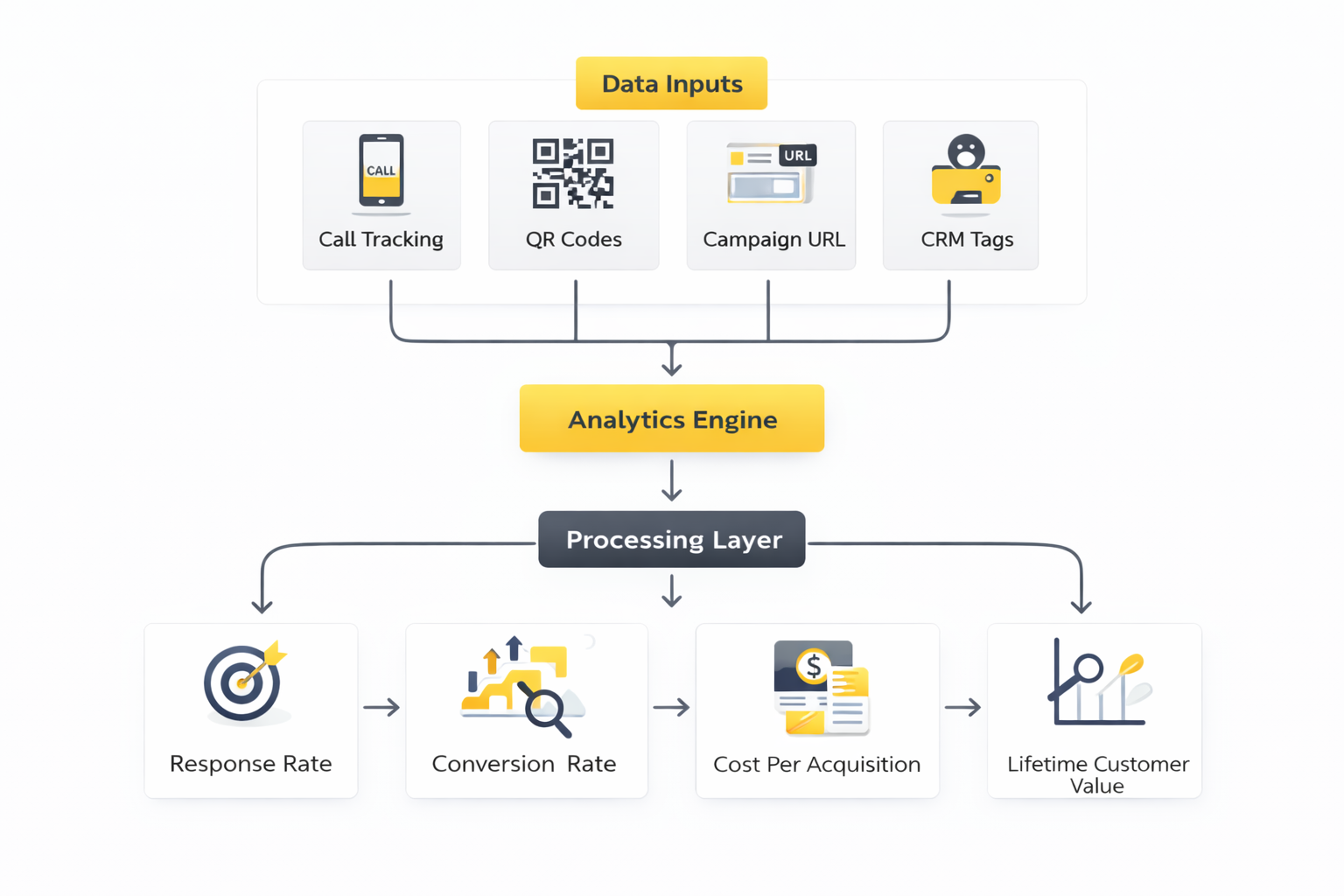
This system creates a full attribution chain that connects the mailbox to revenue. A recipient scans a QR code, lands on a campaign page, submits a form, and then enters a CRM workflow that tracks downstream behavior. Over time, this structure allows marketers to compare segments, offers, creative formats, and mailing schedules with much greater clarity.
Platforms that combine landing pages, automation, and funnel tracking often simplify this setup. For example, many marketers route direct mail traffic into a focused funnel built with tools like ClickFunnels or an automation platform such as Systeme.io. Once that connection exists, campaign performance becomes much easier to monitor.
Many marketers track the wrong numbers when evaluating direct mail marketing performance. Vanity metrics such as impressions or total mail volume rarely reveal the true effectiveness of a campaign.
The signals that actually matter include:
- response rate — percentage of recipients who take the first action
- conversion rate — percentage of responders who become customers
- cost per acquisition — total mailing cost divided by customers generated
- revenue per mailed piece — total campaign revenue divided by pieces sent
- lifetime value of acquired customers
Revenue per mailed piece is especially useful because it connects the entire campaign economics to a single number. If the average mailed piece generates more revenue than it costs to produce and send, the campaign has a path to scale.
One of the most common mistakes in direct mail marketing analytics is drawing conclusions from a single campaign. Mail performance can vary based on seasonality, audience timing, competitive promotions, and delivery windows.
Instead of reacting to one result, strong programs compare results across multiple sends. They analyze response patterns by segment, format, and offer. Over time, these comparisons reveal which elements consistently drive performance and which ones should be removed from future campaigns.
This long-term view is what turns direct mail marketing from a one-off tactic into a reliable growth channel. When the data loop stays intact, every campaign improves the next one.
Scaling direct mail marketing sounds simple until the economics start shifting underneath you. A campaign that works at 5,000 pieces can break at 50,000 if the audience gets broader, the offer weakens, or the follow-up system cannot handle the extra demand. That is why scaling is not really about sending more mail. It is about protecting response quality while volume increases.
The strongest operators scale in layers. They expand the winning segment first, then test adjacent segments, then adjust format, timing, or offer only after the original control is stable. That approach sounds less exciting than a huge rollout, but it is usually what keeps direct mail marketing profitable instead of turning it into an expensive guessing game.
Every direct mail marketing program has a limiting factor. Sometimes it is audience quality. Sometimes it is creative fatigue. Sometimes it is operational, like slow sales follow-up or inconsistent landing-page performance after the mail drops. If you do not know which constraint is most likely to fail, scaling gets messy fast.
This is where channel integration matters more than most teams expect. Lob’s direct mail research has repeatedly emphasized that direct mail increasingly performs as part of an orchestrated cross-channel journey rather than as a self-contained campaign, which is one reason marketers keep investing in automation and triggered workflows through studies published in the State of Direct Mail research hub. The mail can generate interest, but if the digital handoff is weak, the campaign starts leaking revenue after the response.
A practical rule helps here: before you scale mail volume, stress-test the downstream path. Make sure the page loads fast, the form is short enough, the appointment flow works on mobile, and the follow-up sequence actually fires. Direct mail marketing can create demand in bursts, and weak systems get exposed very quickly when that happens.
A lot of marketers talk about format and list quality while underestimating timing. But direct mail marketing is heavily affected by when a piece arrives, what else is happening around that date, and how quickly the recipient can act once interest is triggered. Even a solid offer can underperform if it lands at the wrong moment in the customer cycle.
USPS continues to push marketers toward more coordinated campaign planning through programs like Informed Delivery, which exists partly because delivery timing and digital reinforcement can compound each other. JICMAIL’s wider body of campaign analysis also keeps showing that mail’s value increases when it is considered part of a broader purchase journey rather than an isolated touchpoint, as reflected in its mail effectiveness reporting.
For real operators, this means timing should be planned against events that matter: renewal windows, seasonal demand, local buying cycles, onboarding stages, abandoned-quote periods, or reactivation gaps. When timing is strategic, direct mail marketing feels relevant. When timing is random, it feels interruptive.
There is a point where some teams become too impressed by big send numbers. That is usually the moment performance starts slipping. Direct mail marketing should be judged by profitable response, not by how many pieces went out the door.
The better metric set is brutally simple. Watch cost per response, cost per acquisition, revenue per mailed piece, and downstream customer value. USPS’s own annual reporting shows how much real money still flows through Marketing Mail as a category in the broader mailing economy, with $15.4 billion in Marketing Mail revenue reported in fiscal 2024. That scale is a reminder that this channel is commercially significant, but it is not proof that your campaign deserves more budget. Your unit economics have to earn that.
This is exactly why scaling should happen through control groups, holdouts, and measured expansion rather than enthusiasm. Direct mail marketing is powerful, but it is not magical. If your economics degrade as volume rises, the market is telling you something important.
By this point, the big pattern should be clear. Most direct mail marketing failures do not happen because the channel stopped working. They happen because execution broke somewhere between targeting, offer, delivery, and follow-up. The good news is that the same mistakes show up again and again, which makes them easier to prevent.
This is probably the most expensive mistake on the list. Teams get optimistic, expand the audience too early, and assume the original winner will keep performing at broader scale. Usually it does not.
The smarter move is tighter audience logic and more disciplined rollout stages. JICMAIL’s tracking has consistently shown a strong gap between warm and cold mail response environments in its response rate tracking work, which should immediately push you toward segment-specific expectations instead of one universal benchmark. Direct mail marketing gets stronger when the audience definition is precise enough to support a relevant message.
This one still hurts a lot of otherwise capable teams. They invest in design, print, and postage, then send traffic to a generic page with no message continuity, weak tracking, and no clear next step. At that point the campaign is not broken because of the mail. It is broken because the handoff is broken.
Professionals build the response path first. The mail piece then becomes the trigger into that path. A dedicated ClickFunnels setup, a lean Systeme.io flow, or a clean Fillout response page makes much more sense than a homepage detour because it keeps the intent alive. That is not a nice extra. It is a core part of modern direct mail marketing.
Nothing feels more frustrating than paying to mail records that never had a fair chance of being delivered correctly. Address quality, duplication control, and move-update processing are not admin tasks to leave for later. They are campaign performance tasks.
USPS keeps formal guidance in place for address maintenance through programs like NCOALink and Move Update compliance because deliverability directly affects campaign waste. Professionals do this work before the creative is finalized, not after the print file is ready. Direct mail marketing gets expensive very fast when the file is sloppy.
Another common mistake is using only last-click attribution or only counting direct scans from a QR code. That will almost always undercount the channel’s influence. Many recipients see the mail, think about it, search later, or convert through another path.
Lob’s research on consumer behavior after receiving mail keeps reinforcing that recipients often continue online after the initial exposure, including website visits and product searches documented in its consumer insights report. That should push you toward broader attribution logic and post-mail observation windows. If you measure too narrowly, direct mail marketing can look weaker than it actually is.
A direct mail response is not the finish line. It is the moment you need to move. If someone scans, clicks, or fills out a form and then waits too long for the next contact, a big chunk of the opportunity disappears.
This is where automation quietly becomes one of the best force multipliers in direct mail marketing. Triggered email sequences through Brevo or Moosend, plus proper contact routing inside a CRM like Copper, can keep that interest alive while it is still fresh. Fast follow-up is not glamorous, but it is often where the extra profit is hiding.
Experienced marketers usually approach direct mail marketing with more restraint and more confidence at the same time. They are restrained because they know bad expansion, weak data, and fuzzy tracking can ruin a campaign quickly. They are confident because once the system is built correctly, direct mail can do things digital channels often struggle to replicate: command attention, create trust, and trigger meaningful action.
That is the real expert-level view. Direct mail marketing is neither old-fashioned nor automatically effective. It is a physical response channel that becomes extremely useful when it is treated with modern discipline.
The final piece is simple, and it matters. The best campaigns do not try to prove that mail beats every other channel. They use mail where it has the clearest advantage, then connect it to the rest of the funnel so the whole system performs better. That is how the channel stops being a one-off experiment and starts becoming part of a real growth strategy.
At this point the full system should be clear. Direct mail marketing works best when it is treated as one piece of a connected acquisition engine, not a standalone tactic. The mailer creates attention, the landing page captures intent, automation nurtures the lead, and CRM systems track the entire customer lifecycle.
This ecosystem approach is becoming the standard because consumer behavior rarely stays inside one channel. Lob’s consumer research shows many recipients who receive mail continue their journey online, including visiting websites, searching products, or interacting with digital content after exposure to the mail piece in the household environment documented in its consumer insights report.
The implication is straightforward. If your campaign stops at the mailbox, it is incomplete. If the mail connects to a clear funnel, response tracking, and automated follow-up, the entire system becomes much more powerful.
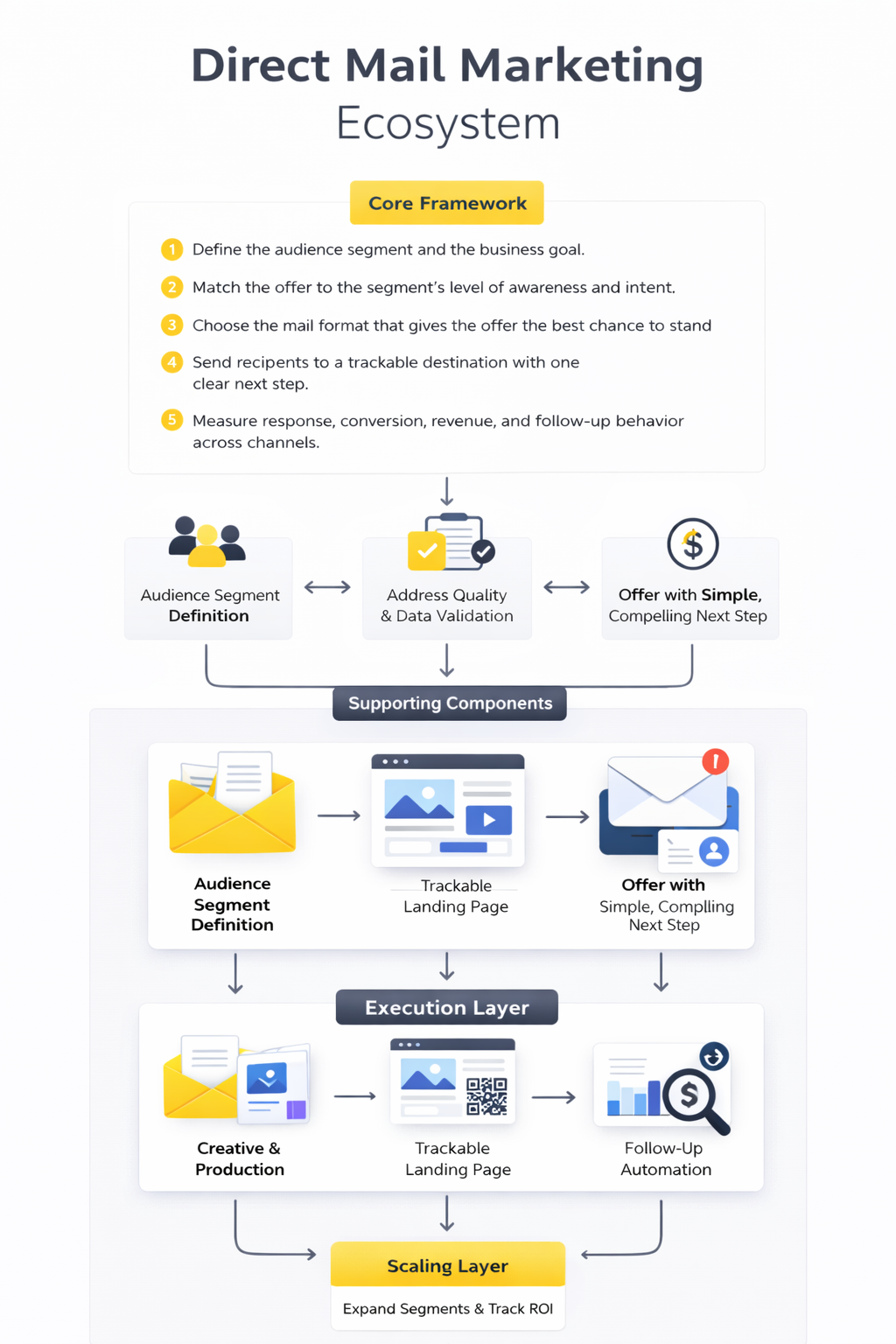
A typical ecosystem for modern direct mail marketing now includes:
- Audience segmentation and CRM management
- Creative production and print logistics
- Dedicated landing pages or funnel destinations
- Tracking infrastructure with QR codes and campaign URLs
- Email and automation follow-up sequences
- Analytics dashboards connecting mail to revenue
When those pieces work together, direct mail stops being a nostalgic channel and becomes a reliable performance driver.
Direct mail marketing is a promotional strategy where businesses send physical mail pieces such as postcards, letters, catalogs, or promotional packages directly to targeted recipients. The goal is usually to generate leads, sales, appointments, or brand awareness. Despite the rise of digital channels, the mailing industry remains large, with USPS reporting tens of billions of marketing mail pieces delivered annually in its official financial and operational reports.
Direct mail marketing works because physical media attracts attention in a way digital ads often cannot. Mail arrives in a less crowded environment and is physically handled by the recipient, which increases the likelihood of engagement. Research from JICMAIL shows the average mail piece can receive more than a minute of household attention over its lifecycle in the home, based on behavioral observation studies in its mail attention database.
Response rates vary significantly depending on list quality, offer strength, and targeting accuracy. Industry tracking programs show that house lists typically outperform prospect lists by a wide margin. JICMAIL campaign analysis reported response rates around 7.9% for warm lists and roughly 0.9% for prospect lists, summarized in the organization’s response rate tracker reporting.
These numbers are benchmarks rather than guarantees. The actual outcome depends heavily on segmentation and offer relevance.
Tracking in direct mail marketing usually relies on campaign-specific response paths. Common methods include QR codes, unique URLs, dedicated landing pages, call tracking numbers, and CRM tagging. When recipients scan or visit these links, their activity can be recorded and attributed to the mailing campaign.
This system allows marketers to connect the physical mail piece to digital analytics and revenue metrics.
Direct mail marketing tends to perform well for businesses with clear geographic audiences or high-value services. Local service providers, financial services companies, healthcare providers, insurance agencies, and subscription businesses frequently use mail to generate qualified leads. It is also widely used in customer retention programs where existing customers receive offers, renewals, or reactivation messages.
The key factor is whether the business has a definable audience and a clear offer that motivates action.
Costs vary depending on format, printing quality, mailing volume, and postage class. A basic postcard campaign may cost significantly less per piece than dimensional mail packages or large catalogs. The real economic metric is not cost per piece but revenue per mailed piece, which measures whether the campaign generates more revenue than it costs to produce and distribute.
When that number is positive and repeatable, the campaign can scale.
Frequency depends on the buying cycle and audience tolerance. Some industries send monthly mailers, while others use quarterly campaigns tied to seasonal demand or renewal periods. Consumer research shows most households are not overwhelmed by direct mail compared with digital messaging volume, which helps maintain attention in the channel documented in the Lob consumer insights study.
Consistency tends to outperform one-time sends because familiarity improves response.
Postcards, letters, self-mailers, and dimensional packages are the most common formats. Postcards are effective for simple offers because the message is visible immediately. Letters work well when the message requires more explanation or credibility. Dimensional packages can stand out in crowded mailboxes but cost more to produce.
Choosing the format should depend on the campaign objective rather than design preference.
Modern direct mail marketing often triggers digital follow-up behavior. Recipients scan QR codes, visit landing pages, or search online after seeing the mail piece. This is why many campaigns connect mail to digital funnels built with platforms like ClickFunnels or automation systems such as Systeme.io.
Once the user enters the funnel, email automation platforms like Brevo or Moosend can continue the conversation.
Several mistakes appear repeatedly in failed campaigns:
- sending to poorly segmented lists
- using weak or unclear offers
- directing traffic to generic webpages
- ignoring data hygiene and address validation
- measuring performance using incomplete attribution models
Avoiding these issues dramatically improves the odds of campaign success.
Yes, but only when the economics support scaling. Successful campaigns gradually expand winning segments rather than mailing massive lists immediately. Marketers typically test audiences, formats, and offers in controlled batches before increasing volume.
When response rates, conversion rates, and customer lifetime value remain profitable, direct mail marketing can become a repeatable growth channel.
Most marketers spend too much time chasing clients, competing on crowded platforms, and losing a percentage of every project to middlemen.
MarkeWork gives you a better way.
Browse thousands of remote marketing contracts and connect directly with companies desperate to hire skilled marketers like you, without platform commissions and without unnecessary gatekeepers.
If you're serious about finding better opportunities and keeping 100% of what you earn, explore available contracts and create a profile for free at MarkeWork.com.