

Direct mail gets dismissed all the time as old-school marketing. That usually happens when people picture generic postcards, bloated mailing lists, and campaigns nobody can track. That version exists, but it is not the version serious operators are using now.
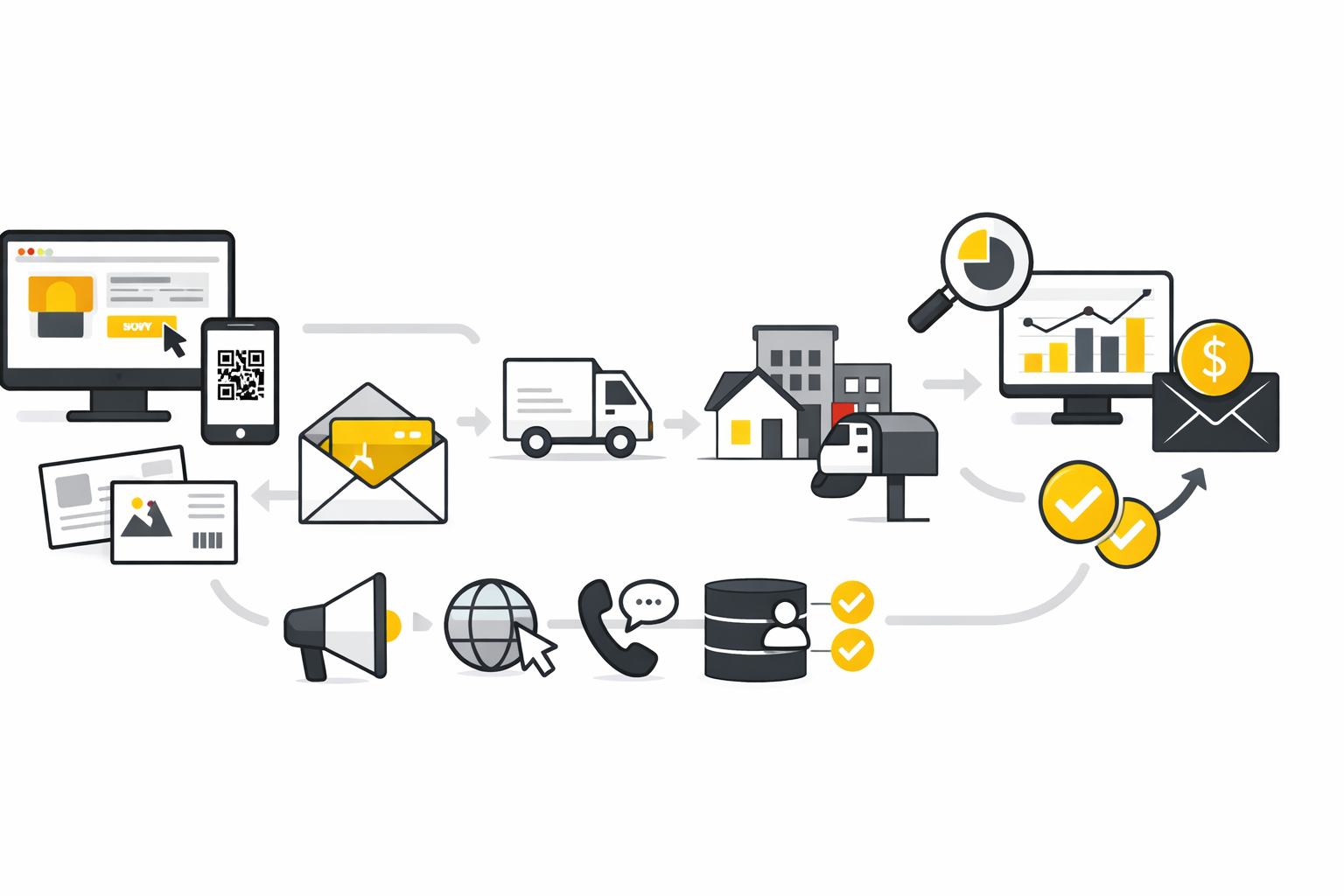
Modern direct mail is a targeted physical message sent to a specific household or business with a clear goal behind it. The goal might be to generate a lead, reactivate a customer, recover an abandoned cart, drive a store visit, or push someone to a landing page with a code, QR scan, or personalized URL. In other words, direct mail is no longer separate from digital. It works best when it connects to it. about.usps.com+2
That matters because attention is harder to win than ever. Email inboxes are crowded, paid social is noisy, and a lot of digital traffic disappears before it turns into revenue. A well-timed mail piece plays a different game. It shows up in a physical space, stays around longer, and often gets read in a calmer context than another pop-up or ad impression. USPS Delivers+2
Article Outline
- Why Direct Mail Still Matters
- The Direct Mail Framework
- Choosing the Right Audience, Format, and Offer
- Personalization, Timing, and Omnichannel Execution
- Measuring Response, Cost, and ROI
- Common Mistakes, Best Practices, and FAQ
Why Direct Mail Still Matters
The biggest reason direct mail still works is simple: it earns attention differently. Lob’s 2024 consumer research found that two-thirds of people read direct mail the same day it arrives, and 51% say they often or sometimes share it with friends or family. USPS-backed research also notes that advertising mailers are kept in the home for an average of 17 days. That is a very different shelf life from a digital ad that flashes by in seconds. Lob+1
There is also a trust angle here that too many marketers overlook. The same Lob research shows that 65% of respondents are likely to engage with mail from brands they already know, while direct mail also performs well for reaching unfamiliar brands, especially with older audiences. That makes direct mail useful at both ends of the funnel: retention when you already have the relationship, and acquisition when you need a more credible first impression. Lob
Performance is another reason direct mail refuses to go away. JICMAIL’s 2024 response tracker, built from more than 2,300 campaigns, reported an average 7.9% response rate for warm direct mail. That does not mean every campaign will hit that number. It does mean direct mail still has real response power when the audience is qualified and the offer is relevant. jicmail.org.uk
One more point is worth saying clearly: direct mail is not surviving on nostalgia. USPS describes mail as a channel that can now be tracked and tied to KPIs with digital enhancements, and PostalPro explains that the Intelligent Mail barcode expands visibility into individual mailpieces. So the modern case for direct mail is not “people like getting mail.” The real case is that it can capture attention, support brand trust, and plug into a measurable performance system. USPS Delivers+2
The Direct Mail Framework
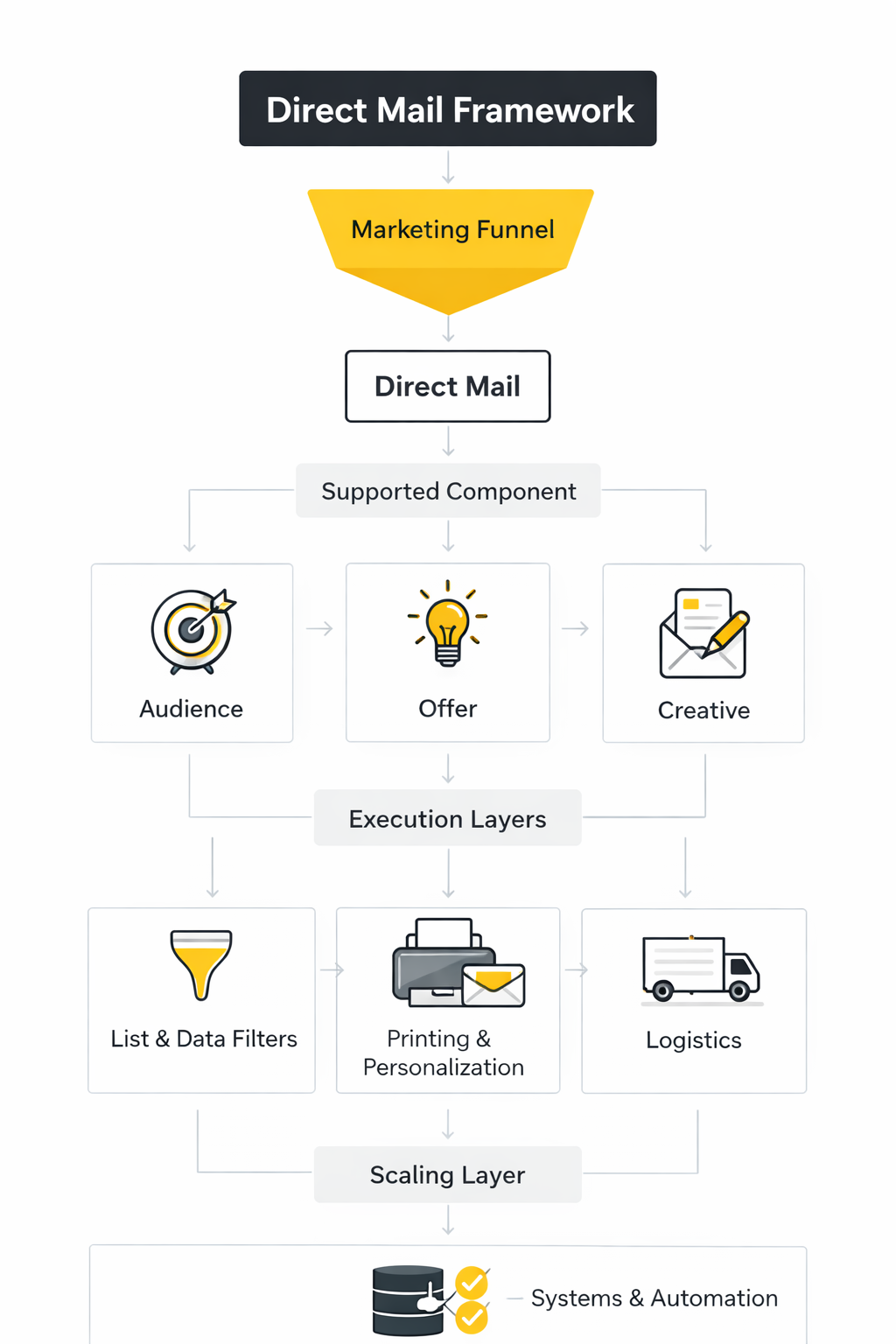
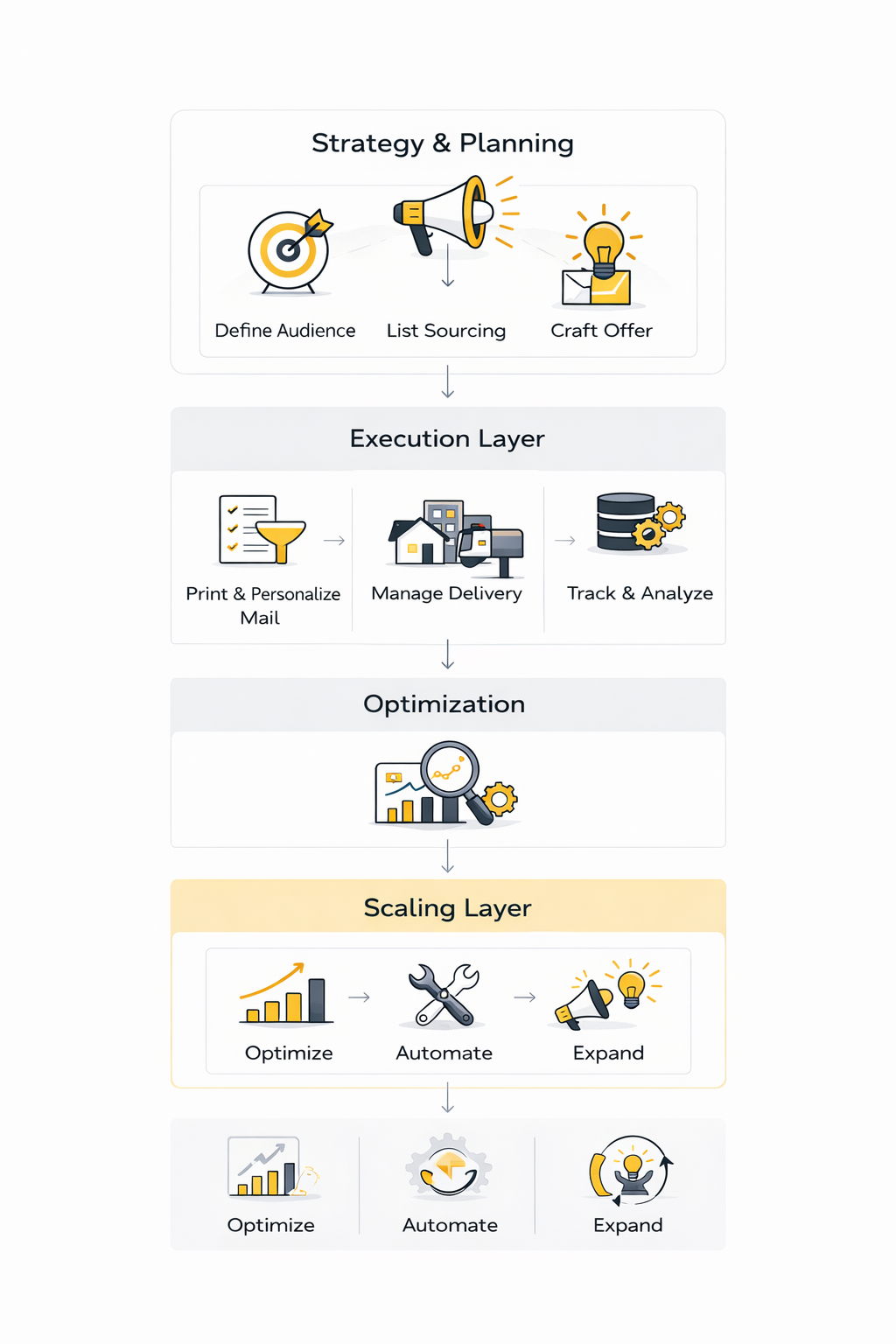
The easiest way to think about direct mail is this: the channel works when four things line up at the same time. You need the right audience, the right message, the right moment, and a response path that is friction-free. Most failed campaigns break because one of those pieces is weakusps.com+1USPS Delivers+1
Lob+1postalpro.usps.com+1Lobusps.comusps.com+1Lobusps.com+1Lob
Personalization, Timing, and Omnichannel Execution
Once the audience, format, and offer are locked, direct mail shifts from planning into execution. This is where most campaigns either become sharp and coordinated or fall apart into disconnected steps. The difference is how well personalization, timing, and channel integration are handled together.
The biggest shift in modern direct mail is that it is no longer static. It is driven by data, triggered by behavior, and connected to digital systems that continue the conversation after the mail piece lands. Lob’s 2025 research shows that 76% of marketers are increasing their investment in direct mail automation, which reflects a move away from batch campaigns toward ongoing, event-driven execution. (lob.com)
Go Beyond Surface-Level Personalization
Personalization used to mean inserting a first name into a headline. That still happens, but it rarely moves the needle on its own. What actually improves response is aligning the message with something real about the recipient’s situation.
That could be behavior, timing, or context. For example, someone who recently browsed a product category should not receive the same message as someone who has not interacted with the brand in months. The content, offer, and urgency should reflect that difference.
This is exactly where modern direct mail is evolving. The same Lob report highlights that variable data printing and automated workflows are now core tools, allowing brands to adjust copy, images, and offers at scale. When done well, the mail piece feels less like a broadcast and more like a continuation of a conversation already in motion. (lob.com)
Timing Is Where Most Campaigns Break
A well-designed mail piece that arrives at the wrong moment is still a weak campaign. Timing determines whether the message feels relevant or random, and direct mail has a built-in delay that needs to be managed intentionally.
USPS notes that delivery timelines for Marketing Mail typically range between 2 to 9 business days depending on distance and logistics. That delay is not a flaw, but it means campaigns need to be planned backward from the moment the message needs to be received, not forward from when it is sent. (usps.com)
The strongest campaigns treat timing as a trigger, not a schedule. Instead of mailing once a month or once a quarter, they send based on events:
- A cart is abandoned
- A subscription is about to expire
- A customer becomes inactive
- A lead requests a quote but does not convert
- A seasonal need becomes urgent
When direct mail hits inside that window, it reinforces intent instead of trying to create it from scratch.
Build a Seamless Online Handoff
The mail piece is only the first step. What happens next determines whether attention turns into action. If the recipient scans a QR code, types a URL, or calls a number, the experience must feel like a continuation of the same message.
This is where many campaigns quietly lose performance. The mail promises something specific, but the landing page is generic or cluttered. The result is friction at the exact moment momentum should increase.
To avoid that, the handoff should be tight:
- One message -> one landing page -> one clear action
- Matching language between mail and digital
- Minimal distractions or competing offers
- Fast load times and mobile optimization
Tools like ClickFunnels, systeme.io, or Brevo help keep that flow consistent by connecting pages, forms, and follow-up sequences in one place. That matters because the faster the response path feels, the higher the conversion rate tends to be.
Combine Direct Mail With Digital Reinforcement
Direct mail works even better when it is not operating alone. The most effective campaigns layer multiple touchpoints around the same audience and timing window.
USPS highlights this approach through programs like Informed Delivery, which lets recipients preview mail digitally before it arrives. That means a campaign can reach the same person twice, once in their inbox and once in their physical mailbox, without increasing list size. (usps.com)
Beyond that, coordinated campaigns often include:
- Retargeting ads triggered when a mail drop is delivered
- Follow-up emails that reinforce the same offer
- SMS reminders for time-sensitive actions
- Sales outreach for high-value leads
This is where direct mail stops being a standalone channel and becomes part of a system. It creates the initial interruption in a low-noise environment, and digital channels capture and extend that attention.
The Step-by-Step Execution Flow
This is the point where everything becomes tangible. A strong direct mail campaign follows a clear sequence from data to delivery to conversion.
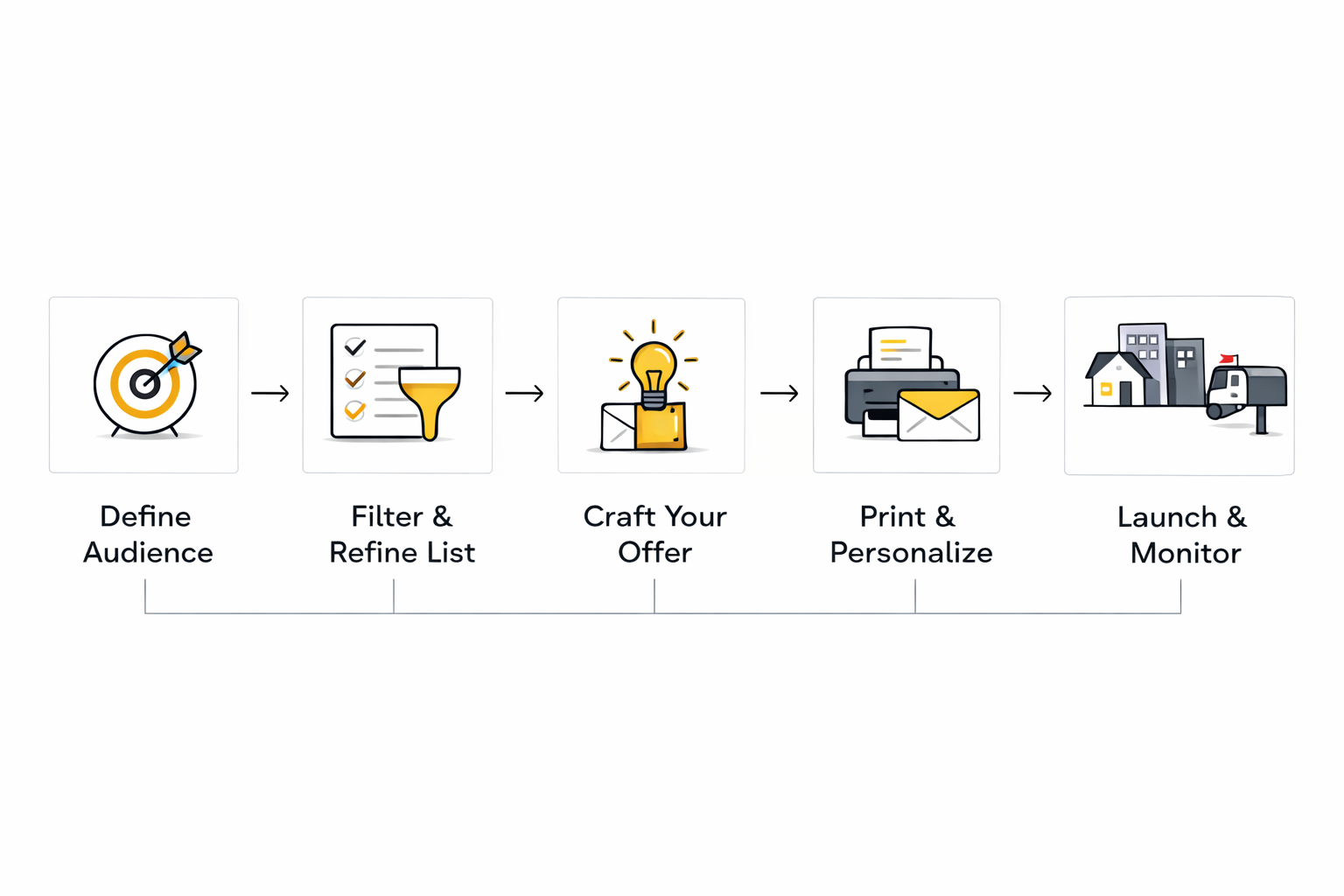
- Define the trigger or campaign objective Start with a specific reason to send the mail. This could be acquisition, reactivation, retention, or a time-sensitive promotion. The clearer the objective, the easier it is to design the rest of the system.
- Build and validate the audience list Use clean, updated data and segment based on behavior or relevance. This step directly impacts both cost and performance, so it is worth extra attention before moving forward.
- Create the offer and message Focus on clarity and relevance. The recipient should understand what is being offered and why it matters within seconds of seeing the piece.
- Choose format and design for action The design should support the goal, not distract from it. That means clear hierarchy, visible calls to action, and a format that fits the complexity of the message.
- Set up the landing page and response tracking Build a dedicated destination that matches the mail piece exactly. Use tracking methods such as QR codes, personalized URLs, or unique promo codes to measure response.
- Plan delivery timing and logistics Work backward from the ideal arrival date and coordinate printing, mailing, and digital support channels. This is where execution discipline matters most.
- Launch and reinforce across channels Support the mail drop with digital touchpoints such as email, ads, or SMS. This increases the chances that the recipient takes action while the message is still fresh.
- Measure, learn, and iterate Track response rates, conversions, and cost per acquisition. Use those insights to refine targeting, messaging, and timing for the next cycle.
Execution Is Where Advantage Builds
Most businesses can design a decent mail piece. Far fewer can execute a coordinated system that consistently turns physical attention into measurable results. That gap is where the real advantage lives.
Direct mail rewards discipline. When targeting is tight, timing is intentional, and the online handoff is seamless, the channel becomes predictable instead of experimental. And once it becomes predictable, it stops being a risk and starts becoming a reliable part of the growth system.
Measuring Response, Cost, and ROI
This is where direct mail stops being a creative exercise and becomes a business system. You are not measuring a postcard or a letter just to admire the campaign. You are measuring whether the campaign created profitable action, whether it reached the right people, and whether the next version should be scaled, changed, or cut.
That sounds basic, but a lot of teams still treat direct mail reporting as a delivery update plus a handful of vanity numbers. The smarter approach is to read the channel the same way you would read paid media or lifecycle email: inputs, response signals, conversions, cost, and downstream revenue. Lob’s 2026 business report makes that shift explicit by framing direct mail as a measurable growth engine and showing that high-ROI teams are more than 3x as likely to integrate analytics than lower-ROI teams. (lob.com)
Direct Mail Statistics and What They Actually Mean
The first mistake people make with direct mail statistics is treating them as universal truth. They are not. A response rate that looks excellent in one category can be weak in another, and a high response rate can still hide poor economics if the wrong people are responding or if the offer attracts low-value buyers.
So when you look at direct mail data, start with what the number is actually describing. Is it measuring attention, engagement, response, conversion, or revenue? Those are not the same thing, and mixing them together creates bad decisions fast.
For example, Lob’s 2026 report says 94% of leaders believe direct mail enhances engagement and conversions in digital channels, and 94% say it performs better when integrated with other channels. That does not mean every campaign is profitable. It means the channel often creates lift beyond the mailbox, so the right interpretation is not “mail works in isolation,” but “mail often works best as part of a connected system.” (lob.com)
The Core Metrics That Matter
Direct mail gets easier to manage when you separate metrics into layers. The first layer tells you whether the campaign reached and engaged people. The second tells you whether that engagement turned into business results. The third tells you whether the economics justify repeating the campaign.
The core scorecard usually includes:
- delivery and in-home timing
- response rate
- conversion rate
- cost per response
- cost per acquisition
- average order value or customer value
- revenue attributed to the campaign
- return on ad spend or overall ROI
That mix matters because one metric alone can mislead you. Lob’s 2026 report notes that marketers are getting a clearer view of performance when they track multiple response signals rather than relying on one input, especially because web visits can be noisy and incomplete on their own. (lob.com)
Why Response Rate Is Useful but Incomplete
Response rate is still one of the first numbers teams look at, and that makes sense. It tells you what percentage of recipients took a measurable action after receiving the mail piece. That action might be a QR scan, a personalized URL visit, a phone call, a code redemption, or a form submission tied to the campaign. (lob.com; lob.com)
But response rate should not be treated like a final verdict. A campaign can generate plenty of responses from curious but low-intent recipients and still produce weak revenue. On the other side, a campaign aimed at high-value accounts may show a lower response rate but deliver much stronger profit per conversion.
That is why response rate works best as a diagnostic metric. If response is low, the problem may be the audience, the offer, the timing, or the creative. If response is healthy but revenue is weak, the issue is probably deeper in the funnel, usually in qualification, sales follow-up, or landing-page continuity. (lob.com)
Track Conversions, Not Just Curiosity
A direct mail campaign should always define what counts as a real conversion before anything gets sent. Otherwise the reporting gets muddy, and teams start celebrating surface-level engagement that does not move the business. A scan is interesting. A booked consult, completed purchase, renewed subscription, or qualified lead is what actually matters.
That is where tracking methods become practical, not technical. Lob’s guidance on direct mail measurement highlights QR codes, personalized URLs, promo codes, and downstream purchase tracking as ways to connect physical mail to online behavior and actual revenue. The reason this matters is simple: it lets you see not just who reacted, but who converted and what those conversions were worth. (lob.com; lob.com)
This is also why a campaign needs one clean next step. If recipients land on a generic page with too many choices, measurement gets weaker because intent gets diluted. The tighter the path, the cleaner the data.
Build an Attribution System You Can Actually Trust
Attribution in direct mail is never perfect, but it can be much better than many teams assume. The key is to stop looking for one magical tracking method and instead build a layered system that captures several signals at once.
Lob’s 2026 report argues for exactly that approach, noting that performance becomes clearer when brands combine PURLs, QR codes, promo codes, redemptions, and other signals rather than depending on one measurement source. The report also points out that only 22% track QR codes and 31% capture in-store redemptions, which means many teams are still leaving visibility on the table. (lob.com)
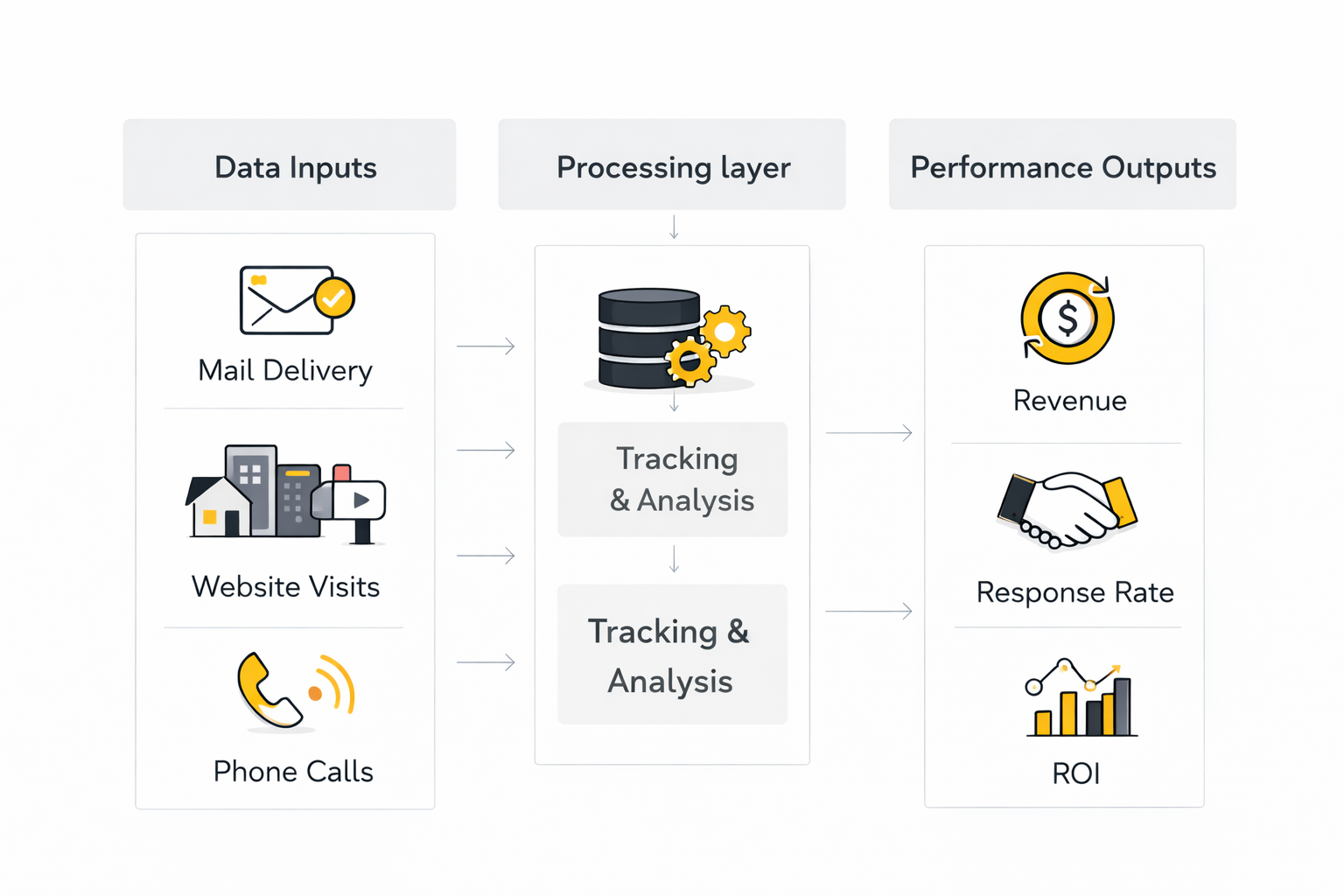
A practical attribution stack for direct mail usually includes:
- Unique QR codes for fast mobile response
- Personalized URLs for recipient-level tracking
- Offer or promo codes for ecommerce or in-store matching
- Dedicated phone numbers when calls matter
- CRM tagging so downstream pipeline and revenue can be tied back to the mail drop
- Time-window analysis to spot lift after the campaign lands
That kind of setup does not just tell you whether mail “worked.” It tells you how it worked, which segments responded, and where the response turned into money. That is the level where optimization becomes real.
Cost Per Acquisition Is Usually the Deciding Metric
If there is one number that forces honesty, it is cost per acquisition. Response rate can flatter a campaign. Click activity can flatter a campaign. Even conversion rate can flatter a campaign if the buyers are low value. Cost per acquisition pulls everything back to reality.
The reason is straightforward. Direct mail has real hard costs: data, design, printing, postage, and fulfillment. If those costs produce customers at an efficient acquisition cost, the campaign has room to scale. If not, the campaign may still be strategically useful, but it is not yet proven.
This is also why bigger budgets do not automatically mean better performance. Lob’s 2026 report shows that high-ROI teams do not just spend more. They connect analytics, third-party data, logistics visibility, and measurement more effectively than lower-performing teams. So when acquisition cost is high, the right action is not always to lower spend. Often it is to improve targeting, timing, or attribution quality first. (lob.com)
Delivery Data Matters More Than Most Marketers Think
One of the easiest ways to misread direct mail performance is to ignore delivery timing. If a campaign hits homes later than expected, your response curve shifts. If the mail lands unevenly across regions, your test results get messy. And if you are coordinating email, retargeting, or sales follow-up around the wrong in-home assumption, you can create friction instead of lift.
That is why operational visibility matters so much. Lob’s 2026 report shows that companies with higher ROI are more likely to have complete visibility into delivery logistics, and it ties stronger outcomes to better control over execution and timing. This is not glamorous, but it is important. Bad logistics can make good strategy look mediocre. (lob.com)
In practical terms, this means your analytics should include not just campaign launch date, but estimated and actual in-home windows. When performance spikes or dips, that timing context often explains more than the creative does.
What Good Benchmarks Should Drive You To Do
Benchmarks are useful when they create better questions, not when they create false confidence. If your response rate is below expectations, the immediate question is not “is direct mail dead?” It is “which part of this campaign logic was weakest?” If your numbers are strong, the next question is not “can we declare victory?” It is “what exactly should we scale without breaking performance?”
Good benchmarks should push action in three directions:
- improve list quality if response is weak
- improve offer and landing-page alignment if response is fine but conversion is soft
- improve attribution and follow-up if revenue seems lower than engagement suggests
That is the real job of the data. It is not there to decorate a report. It is there to tell you whether to expand, refine, or stop.
A Clean Way to Read the Numbers After a Campaign
After the campaign runs, review the results in order. Start with delivery and timing, then move to response, then to conversion, then to cost, then to revenue. That sequence keeps you from jumping to conclusions too early.
If delivery looked normal but response was low, you probably have a targeting or offer problem. If response was solid but conversion lagged, the issue is likely on the landing page or in the sales process. If conversions were strong but cost per acquisition stayed too high, the next move is usually tightening the audience rather than changing the whole channel.
That is how direct mail becomes manageable. You stop guessing based on whether the piece “looked good” and start reading the system the way operators read every other growth channel. When the numbers are interpreted in the right order, they do not just describe performance. They tell you what to do next.
Common Mistakes, Best Practices, and Strategic Tradeoffs
By this point, the mechanics of direct mail should be clear. The harder question is how to keep the channel profitable as volume grows, costs shift, compliance gets tighter, and teams start adding more data, vendors, and automation. That is where direct mail stops being a campaign tactic and becomes an operational discipline. (lob.com; postalpro.usps.com)
A lot of businesses do fine with one-off mail drops. Far fewer build a system that still works when they scale list volume, increase creative variations, run triggered campaigns, and coordinate mail with digital follow-up. Lob’s 2026 business report points out that growing adoption is coming with more complexity around personalization, tech-stack integration, delivery timing, and vendor coordination, which is exactly why direct mail gets harder before it gets easier at scale. (lob.com)
The Biggest Mistake Is Treating Direct Mail Like a Standalone Channel
This is still the trap. Teams create a mail piece, send it, and then judge the whole channel by the immediate response without looking at what happened across the rest of the customer journey. That approach leaves too much value invisible and usually leads to bad conclusions.
The better view is that direct mail often creates assisted conversions rather than perfectly isolated ones. Lob’s 2026 data says most leaders see stronger performance when direct mail is integrated with digital channels, which means a campaign can influence branded search, return visits, retargeting performance, or delayed conversion even when the first tracked action did not happen on the mail piece itself. (lob.com)
So the practical rule is simple: do not ask whether a postcard alone closed the sale. Ask whether the mail piece improved the economics of the full conversion path. That is a much smarter question, and it usually gives you better decisions.
Scaling Exposes Weak Data Fast
At small volumes, weak data is annoying. At scale, it becomes expensive. Bad addresses, stale records, duplicate households, and fuzzy segmentation create waste that compounds as you mail more often or automate more triggers.
USPS requires Move Update compliance for commercial First-Class Mail and USPS Marketing Mail, with address data needing to be updated within 95 days before mailing when the same address is used for those mailings. That is not just a postal technicality. It is a direct warning that data hygiene is part of campaign performance, not a back-office detail. (postalpro.usps.com)
This is one reason high-performing teams tend to look more disciplined than creative. They suppress bad records, deduplicate aggressively, monitor address quality, and define segments carefully before they scale. It sounds boring, but this is where profit gets protected.
More Personalization Is Not Always Better
Advanced personalization sounds impressive, and sometimes it genuinely improves response. But more variable fields do not automatically create a better campaign. The real question is whether the added personalization makes the offer more relevant or just makes production more complicated.
Lob’s 2026 report identifies advanced personalization as one of the main challenges leaders are trying to solve, which says a lot by itself. The issue is not whether personalization matters. It does. The issue is whether the additional complexity improves conversion enough to justify the operational burden, approval cycles, data dependencies, and QA risk that come with it. (lob.com)
That tradeoff matters. A campaign with three well-built variants tied to real audience differences often beats a campaign with twenty micro-versions nobody can manage cleanly. In direct mail, complexity only pays when it changes economics.
The Wrong Vendor Setup Can Quietly Kill Performance
This is one of the least glamorous parts of direct mail, and one of the most important. If your print, personalization, postal prep, and tracking workflow is scattered across too many disconnected vendors, small delays turn into inconsistent in-home timing, extra QA risk, and murky reporting.
Lob’s 2026 findings put vendor complexity and delivery control near the center of modern direct mail performance, while USPS offers Informed Visibility as a near real-time source for domestic-bound mail and aggregate tracking data. Taken together, that tells you something important: logistics visibility is no longer optional for serious programs. (lob.com; postalpro.usps.com)
The expert move here is not necessarily to consolidate everything with one provider. It is to make ownership obvious. One team needs to own timeline accuracy, mail tracking, handoff quality, and post-campaign reconciliation, or the whole program becomes too blurry to optimize.
Rising Postal Complexity Changes the Math
Direct mail economics are never fixed. Postal rules change, prices move, promotions come and go, and even labeling list updates can affect how campaigns should be prepared and inducted. That means the same campaign can perform differently year to year even if your audience and offer are similar.
PostalPro already has 2026 Promotions Guidebooks available, and Postal Explorer is showing proposed July 2026 price files, which is a reminder that mailers need to watch incentives and pricing as part of planning, not after the budget is locked. USPS Marketing Mail also remains a bulk product with a minimum threshold of 200 pieces or 50 pounds, which matters for smaller tests and localized rollouts. (postalpro.usps.com; pe.usps.com; pe.usps.com)
That does not mean direct mail is suddenly unstable. It means the channel rewards operators who pay attention to structure. If you ignore postage strategy, format efficiency, and eligibility for incentives, you can lose margin without realizing why.
Compliance Risk Is Becoming a Bigger Strategic Issue
The more direct mail relies on behavioral targeting, customer data, and cross-channel orchestration, the more privacy and compliance matter. This is especially true in regulated categories like finance, insurance, healthcare, and legal services, where a mailed offer can create both marketing upside and legal exposure.
That pressure is not theoretical. California’s privacy regulator announced finalized regulations in September 2025, including risk assessment requirements beginning January 1, 2026 for covered businesses, and California also has a law affecting mailed solicitations tied to consumer financial products and services effective January 1, 2025. Those are two clear signals that direct mail strategy now overlaps more directly with privacy governance and advertising compliance than many teams are used to. (cppa.ca.gov; darwill.com)
The smart response is not panic. It is process. Define approved audience sources, document suppression logic, review offer language in sensitive categories, and make sure legal and marketing are not meeting for the first time after the campaign is already designed.
Testing Should Get Smarter as You Scale
A lot of direct mail testing starts well and then gets lazy. Teams run one or two early tests, find something that works, and then stop learning because the campaign is “good enough.” That is dangerous, especially when audience fatigue, postal costs, and channel mix keep moving.
At scale, testing should shift from basic creative debates to higher-value questions. Instead of only asking postcard versus letter, ask which trigger window works best, which audience tier deserves the richer format, which incentive improves contribution margin rather than just response, and which landing-page structure converts mail traffic most efficiently. The more mature the program gets, the more testing should move upstream into strategy. (lob.com; postalpro.usps.com)
This is also where digital infrastructure matters. If you are testing multiple offers, pages, and follow-up sequences tied to direct mail traffic, platforms like ClickFunnels, systeme.io, or Brevo can help keep the post-mail journey easier to manage. The direct mail piece gets the attention, but the testing environment around it often determines how much of that attention becomes revenue.
When to Scale and When to Stay Selective
Not every winning direct mail campaign should be expanded immediately. Sometimes the profitable version is profitable because it is narrow, well-timed, and aimed at a segment with unusually strong intent. Scaling too quickly can dilute the audience quality that made the campaign work in the first place.
A safer way to scale is to widen one variable at a time. Expand geography, or frequency, or audience definition, or format richness, but do not loosen everything at once. That preserves signal quality and makes it easier to see what changed if performance softens.
This is the mindset that separates operators from enthusiasts. Operators understand that direct mail is not just about finding a winner. It is about protecting a winner while extending it carefully.
What Expert-Level Direct Mail Really Looks Like
At the expert level, direct mail is not “creative plus postage.” It is a coordinated system built on clean data, controlled logistics, compliant targeting, measurable response paths, and disciplined iteration. That is why the best programs often look calm from the outside. The drama has been removed from the workflow.
And honestly, that is the real goal. You want direct mail to become boring in the best possible way: predictable, trackable, and commercially useful. When it reaches that point, you stop debating whether the channel still works and start using it as one more reliable lever in the growth mix.
FAQ - Built for Complete Guide
What is direct mail in simple terms?
Direct mail is a physical marketing message sent to a specific person or household with a clear goal, usually to drive an action like visiting a website, making a purchase, or booking a service. What makes it powerful today is not the paper itself, but how it connects to digital tracking, personalization, and follow-up systems. When done well, it is not isolated offline marketing but part of a coordinated funnel.
Does direct mail still work in 2026?
Yes, and not just in niche cases. Recent industry data shows strong engagement and response when direct mail is targeted and integrated with digital channels. What has changed is how it is used. It performs best when it reinforces existing intent rather than trying to create demand from scratch.
How much does direct mail cost?
Costs vary based on format, volume, targeting, and postage. USPS Marketing Mail has minimum thresholds like 200 pieces or 50 pounds, and pricing depends on size, automation level, and preparation. The real number to watch is not cost per piece but cost per acquisition, because that tells you whether the campaign is profitable.
What response rate should I expect?
There is no universal benchmark that guarantees success. Warm audiences usually perform better than cold lists, and triggered campaigns outperform generic batch sends. Instead of chasing a fixed percentage, focus on whether your response rate is improving over time and whether those responses convert into revenue.
How do you track direct mail performance?
The most reliable approach combines multiple methods:
- QR codes for fast mobile access
- personalized URLs for individual tracking
- promo codes for purchases
- call tracking numbers for phone leads
- CRM tagging for revenue attribution
When these signals are combined, you get a much clearer picture of what is actually working.
Is direct mail better than email or paid ads?
It is not a replacement. It is a complement. Direct mail often performs best when it supports digital channels by capturing attention in a low-noise environment and then pushing recipients into a digital journey where conversion happens. The real advantage comes from combining channels, not choosing one over another.
What types of businesses benefit most from direct mail?
Direct mail tends to work especially well for:
- local services like roofing, dental, and home improvement
- financial services, insurance, and healthcare
- ecommerce brands with strong lifecycle marketing
- B2B companies targeting high-value accounts
The common thread is that the audience has either clear intent or meaningful lifetime value.
How long does a direct mail campaign take?
From planning to delivery, campaigns usually take 2 to 4 weeks depending on complexity. USPS Marketing Mail delivery itself typically takes a few business days after induction, but the full timeline includes data prep, creative, printing, and logistics. Timing needs to be planned backward from the desired in-home date.
What is the biggest mistake beginners make?
The biggest mistake is weak targeting. Sending to the wrong audience wastes money no matter how good the design looks. The second biggest mistake is poor follow-up, where the mail piece works but the landing page or conversion path fails.
Should I use postcards or letters?
It depends on the situation. Postcards work well for simple offers and quick decisions. Letters are better when trust, privacy, or explanation matter. The right format is the one that matches how much information the recipient needs before taking action.
Can direct mail be automated?
Yes, and that is where the channel is heading. Trigger-based campaigns can send mail automatically based on behavior like abandoned carts, inactivity, or lead actions. Platforms like systeme.io or Brevo help manage the digital side of these workflows, while direct mail platforms handle printing and delivery.
When should I scale a direct mail campaign?
Scale when three conditions are met:
- the audience is clearly defined and repeatable
- the cost per acquisition is stable and profitable
- the attribution system is reliable
If any of those are weak, scaling too early usually reduces performance instead of improving it.
Work With Professionals
Explore 10K+ Remote Marketing Contracts on MarkeWork.com
Most marketers spend too much time chasing clients, competing on crowded platforms, and losing a percentage of every project to middlemen.
MarkeWork gives you a better way. Browse thousands of remote marketing contracts and connect directly with companies desperate to hire skilled marketers like you, without platform commissions and without unnecessary gatekeepers.
If you're serious about finding better opportunities and keeping 100% of what you earn, explore available contracts and create a profile for free at MarkeWork.com.