

Direct response marketing is marketing built to make someone act now, not vaguely remember you later. The action can be a purchase, booking, form submission, message reply, demo request, quiz completion, or email signup. The point is simple: every campaign has a clear offer, a clear next step, and a way to measure what happened.
That matters because attention is expensive. Global digital ad spend keeps rising, and channels are getting more competitive, which means “brand exposure” alone is not enough for most growing businesses. A strong direct response marketing system connects the message, offer, audience, channel, and follow-up so you can see what drives revenue instead of guessing.
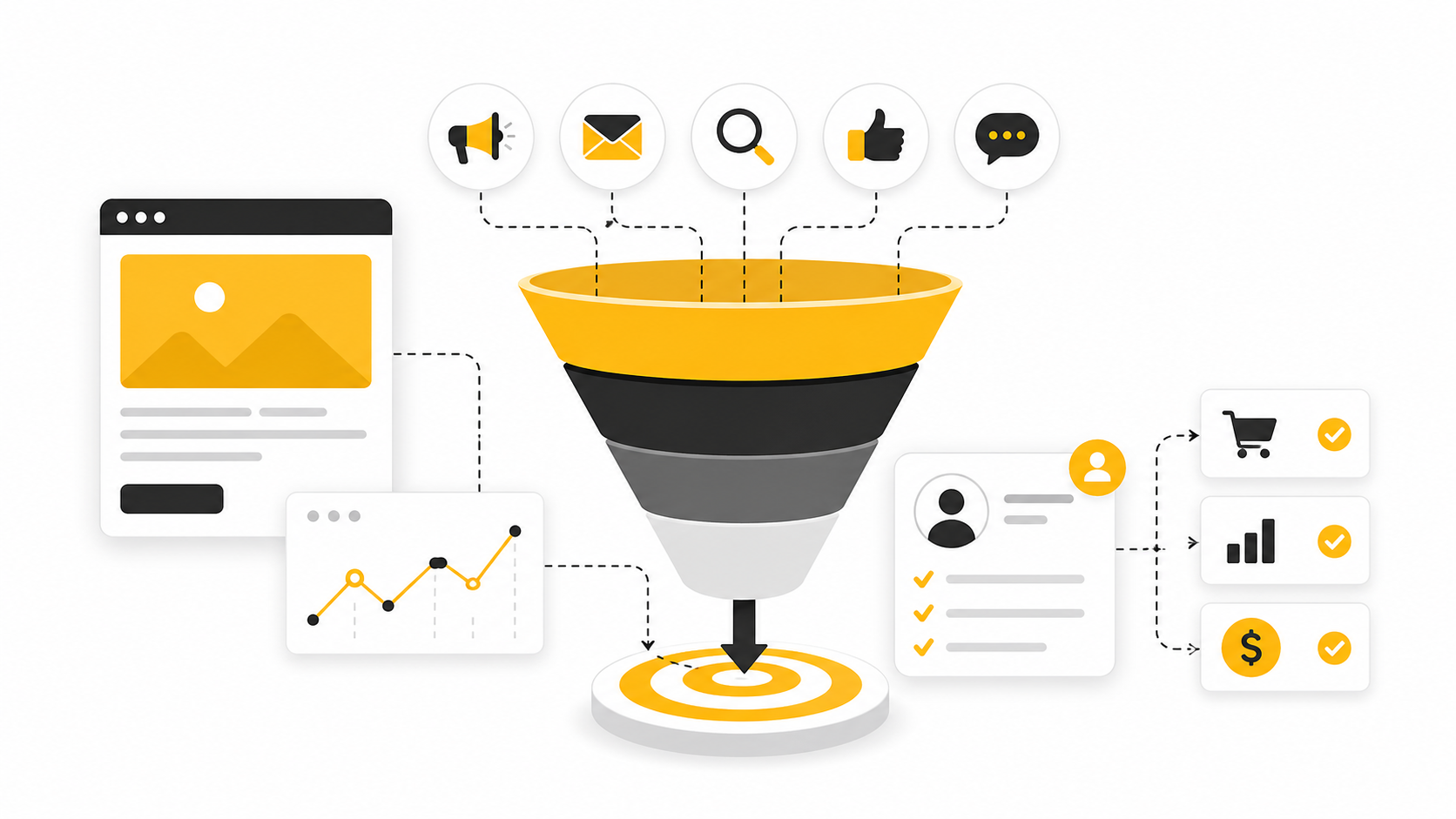
This article will break direct response marketing into a practical six-part framework:
- Part 1: What Direct Response Marketing Is and Why It Matters
- Part 2: The Direct Response Marketing Framework
- Part 3: Core Components of a High-Converting Campaign
- Part 4: Channels, Funnels, and Follow-Up Systems
- Part 5: Professional Implementation and Optimization
- Part 6: Common Mistakes, Best Practices, and FAQ
What Direct Response Marketing Is and Why It Matters
Direct response marketing is built around a measurable response. Instead of asking people to “learn more someday,” it gives them a reason to take a specific action now. That action is usually tied to a business outcome, which is why this approach works so well for lead generation, ecommerce, coaching, SaaS, local services, agencies, and creators.
The key difference is accountability. A direct response campaign can be judged by clicks, leads, cost per acquisition, booked calls, revenue, retention, and profit. That makes it easier to improve because you are not debating opinions; you are looking at behavior.
This does not mean brand no longer matters. In reality, brand trust makes direct response marketing work better because people respond faster when the promise feels credible. The mistake is treating brand and response as enemies when the best campaigns use both.
Why Direct Response Marketing Works Now
Direct response marketing works because buyers have more choices and less patience. They expect relevance, speed, and clarity before they give a company their time or money. Research on personalization has shown that companies using personalization effectively can generate meaningful revenue lift, which reinforces the core direct response idea: the right message to the right person matters more than a generic campaign sent to everyone.
Measurement is another reason this approach keeps growing. Google’s modern measurement guidance emphasizes that marketing effectiveness depends on defining success clearly and using quality data before optimizing media decisions. That is exactly the mindset behind direct response marketing: define the goal first, then build the campaign around that goal.
Email also shows why response-driven channels still matter. Litmus reports that email remains one of the strongest ROI channels, with many companies seeing substantial returns per dollar spent when campaigns are properly measured and optimized. Direct response marketing takes that same discipline and applies it across ads, landing pages, SMS, chat, webinars, direct mail, and sales follow-up.
Framework Overview
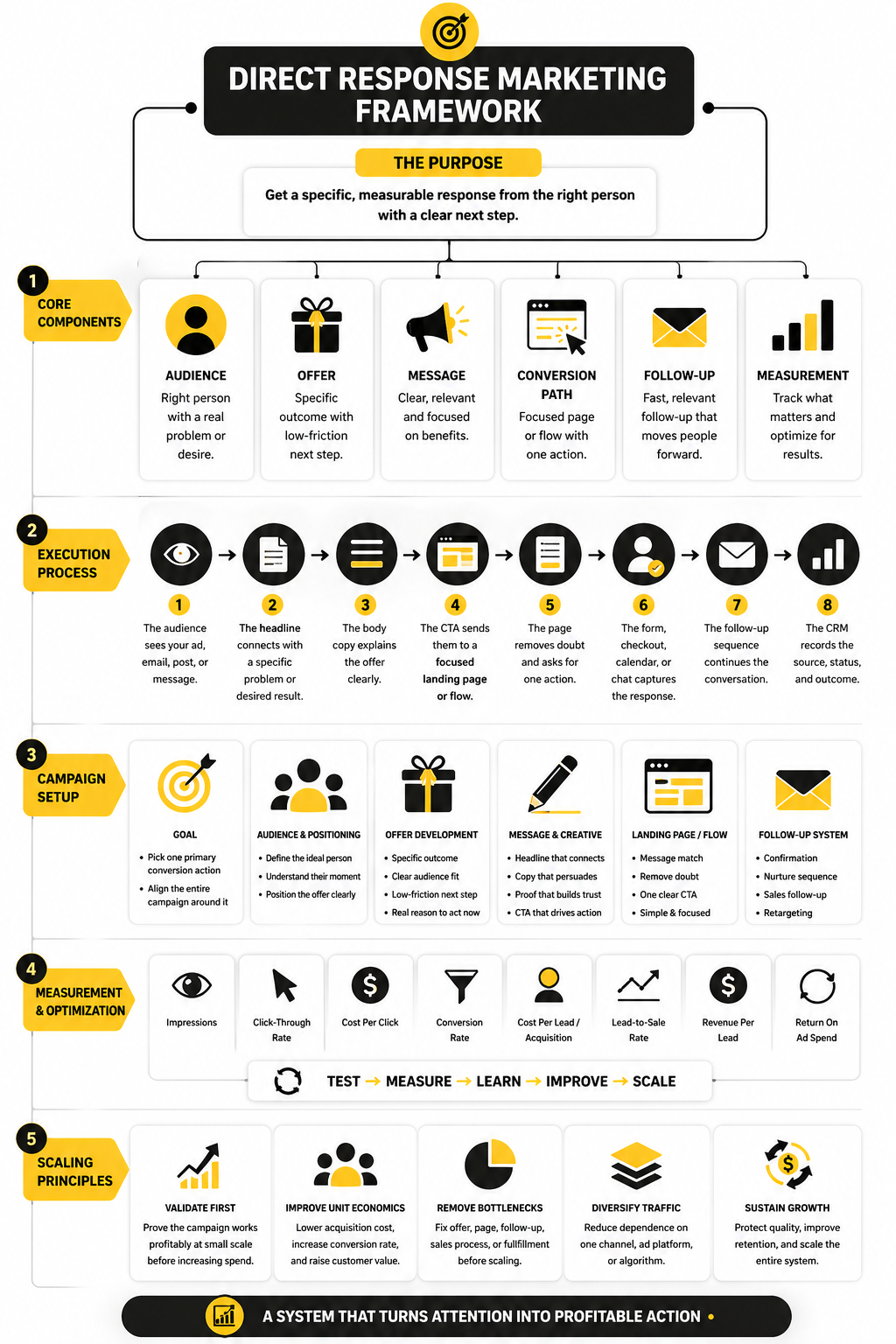
A direct response marketing campaign is not just a clever ad. It is a chain of decisions that starts with the market and ends with a measurable conversion. When one link is weak, the whole campaign usually suffers.
The framework used throughout this article has five moving parts: audience, offer, message, mechanism, and measurement. The audience defines who you are speaking to. The offer gives them a reason to act. The message explains why the offer matters. The mechanism creates the path to conversion. Measurement shows whether the system is profitable.
This structure is useful because it keeps campaigns practical. You are not trying to “do marketing” in a vague way. You are building a controlled system where each part can be tested, improved, and scaled.
The Direct Response Marketing Framework
The framework starts with one uncomfortable truth: people do not respond because you want them to. They respond because the message meets a real need, the offer feels worth the effort, and the next step is obvious. Direct response marketing works best when every part of that chain is intentional.
A useful campaign can be built around five questions:
- Who exactly should respond?
- What problem or desire is urgent enough to move them?
- What offer makes action feel worthwhile?
- What path turns attention into a measurable response?
- What data proves whether the campaign worked?
This keeps the campaign grounded. You are not writing random ads, building random landing pages, or hoping a funnel magically converts. You are designing a response system.
Audience: Know Who You Are Trying to Move
The first job is not writing copy. The first job is choosing the right audience. A weak audience match makes even great creative look bad because the people seeing the message were never likely to care.
Good direct response marketing starts with specific buyer intent. That means looking at what people already want, what they are trying to solve, what they have tried before, and what would make them act now. Broad demographic labels are rarely enough because “business owners” or “busy parents” can include people with completely different motivations.
This is where personalization matters. McKinsey’s research found that companies getting personalization right often see a 10 to 15 percent revenue lift, which supports a simple point: relevance is not decoration. It is a performance lever.
Offer: Give People a Reason to Act Now
The offer is the center of the campaign. It is not just the product, and it is not just a discount. It is the full reason someone should take the next step today instead of ignoring the message.
A strong offer usually combines a clear outcome, a low-friction action, and a believable reason to respond now. That could be a free audit, limited trial, consultation, sample, checklist, webinar, quote, bundle, or direct purchase incentive. The format matters less than the perceived value.
The offer also has to match the buyer’s temperature. Cold traffic usually needs a softer step, while warm traffic can handle a stronger sales ask. That is why a quiz, lead magnet, or booking page can outperform a direct checkout page when the audience still needs education.
Message: Make the Value Obvious Fast
The message explains why the offer matters. It should connect the audience’s current situation with the outcome they want and show why this next step is worth taking. Clear beats clever here almost every time.
A strong message usually answers three questions quickly: what is this, why should I care, and what should I do next? If the reader has to work too hard to understand the promise, the campaign loses momentum. That is especially true on paid traffic, where attention is rented by the second.
This does not mean every message should be aggressive. The best direct response marketing often feels calm, specific, and useful. It earns the response by making the next step feel logical, not by shouting at the reader.
Mechanism: Build the Path From Click to Conversion
The mechanism is the route someone takes after they notice the message. It can include an ad, landing page, form, checkout, calendar, chatbot, email sequence, SMS follow-up, CRM workflow, and sales handoff. This is where many campaigns break.
A good mechanism removes friction. The page loads quickly, the form asks only what it needs, the CTA is clear, and the follow-up happens while intent is still fresh. Google’s measurement guidance emphasizes the importance of collecting accurate first-party data and connecting online and offline actions, which matters because broken tracking leads to broken optimization.
Tools can help, but the process matters more than the tool. A funnel builder like ClickFunnels, an all-in-one CRM like GoHighLevel, or a landing page platform like Replo can support the system when there is a clear campaign strategy behind it.
Measurement: Track What Actually Creates Revenue
Direct response marketing becomes powerful when measurement is tied to business outcomes. Clicks and impressions can be useful, but they are not the finish line. The real question is whether the campaign produces qualified leads, customers, revenue, and profit.
The minimum measurement setup should track the source, offer, landing page, conversion action, follow-up stage, and final outcome. Without that, you may know which ad got attention but not which campaign created a customer. That gap is expensive.
Benchmarks can help with context, but they should not become the strategy. WordStream’s 2025 Google Ads benchmark data shows that costs and conversion performance vary widely by industry, which is why every campaign needs its own baseline before scaling. Direct response marketing is not about chasing universal numbers; it is about improving the economics of your own system.
Core Components of a High-Converting Campaign
A direct response marketing campaign becomes easier to build when you stop treating it like a creative project and start treating it like a conversion process. Creativity still matters, but it has to serve the response. Every element should help the right person understand the offer, trust the promise, and take the next step.
The core components are not complicated. You need a clear goal, a focused audience, a strong offer, persuasive messaging, a conversion path, follow-up, and measurement. The hard part is making those pieces work together instead of building them in isolation.
This is where most campaigns either become profitable or fall apart. An ad might get attention, but the landing page loses clarity. A landing page might convert, but the follow-up is slow. A form might collect leads, but the CRM does not show which campaign produced actual revenue.
Start With One Conversion Goal
The first implementation decision is the conversion goal. Pick one primary action for the campaign and build everything around it. That action could be a purchase, booked call, quote request, webinar registration, free trial, lead magnet download, SMS opt-in, or chatbot conversation.
One campaign can have secondary metrics, but it should not have five competing goals. When the CTA asks for too much, the reader has to think harder, and hesitation kills response. A simple direct response marketing campaign usually performs better because the next step is obvious.
The goal also shapes the level of commitment you can ask for. A cold audience may not be ready to book a sales call, but they might complete a quiz or download a useful guide. A warm audience that already knows the brand can usually handle a stronger offer because trust already exists.
Build the Offer Before the Page
The offer should be decided before the ad, page, or email sequence is written. That sounds obvious, but many campaigns start with design or copy and only later figure out what the person is actually being asked to do. That creates weak campaigns because the message has nothing sharp to sell.
A strong offer usually has four parts:
- A specific outcome
- A clear audience fit
- A low-friction next step
- A reason to act sooner rather than later
The urgency does not need to be fake. It can come from limited appointment slots, a deadline, seasonal timing, implementation capacity, a launch window, or the pain of leaving the problem unsolved. Real urgency is useful because it helps serious buyers make a decision.
Map the Conversion Path
Once the goal and offer are clear, map the path someone takes from first touch to response. This is where the campaign becomes tangible. You are no longer thinking about “marketing assets”; you are thinking about the exact journey from attention to action.
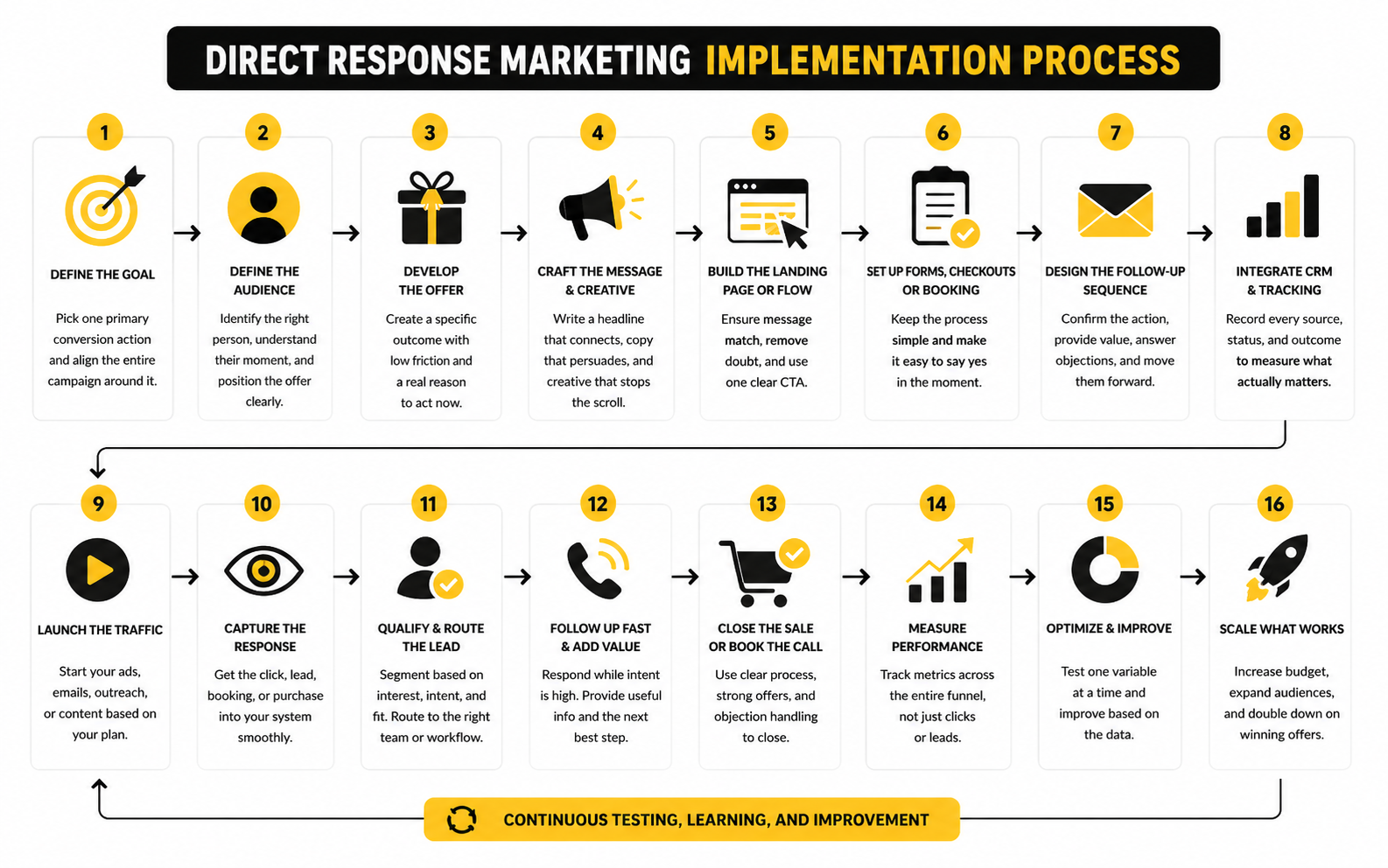
A practical conversion path might look like this:
- The audience sees an ad, email, post, or message.
- The headline connects with a specific problem or desired result.
- The body copy explains the offer clearly.
- The CTA sends the person to a focused landing page or conversation flow.
- The page or flow removes doubt and asks for one action.
- The form, checkout, calendar, or chat captures the response.
- The follow-up sequence continues the conversation.
- The CRM records the source, status, and outcome.
This process matters because direct response marketing is only as strong as its weakest step. If the ad is good but the page is confusing, response drops. If the form works but follow-up takes two days, intent goes cold.
Write the Message Around the Buyer’s Moment
The best campaign message is not just “what we sell.” It is “why this matters right now.” The buyer’s moment is the situation that makes the offer relevant. That might be a missed target, a painful bottleneck, a deadline, a failed previous attempt, or a new opportunity they do not want to waste.
Good copy usually moves through a simple sequence. It names the situation, shows the cost of staying where they are, introduces the offer, reduces risk, and asks for the next step. That structure works because it follows how people actually decide.
This is also where proof matters. Proof can come from product details, customer outcomes, reviews, demonstrations, guarantees, transparent pricing, screenshots, or side-by-side explanations. Do not overload the reader with proof, but do not expect them to believe a big promise without support.
Choose the Right Mechanism for the Action
Different conversion goals need different mechanisms. A low-ticket ecommerce offer may need a product page and checkout. A high-ticket service usually needs a form, qualification step, calendar, and sales follow-up. A local business may need calls, SMS reminders, and fast lead routing.
For funnel-heavy campaigns, ClickFunnels can make sense when the main job is moving visitors through a focused sales path. For agencies, local businesses, and service teams that need CRM, automation, pipelines, calls, forms, and follow-up in one place, GoHighLevel fits naturally. For ecommerce teams that need high-converting landing pages connected to product campaigns, Replo is more relevant.
The tool should never define the strategy. Pick the mechanism after the campaign goal is clear. Otherwise, you end up forcing the business into a platform instead of building the simplest path to response.
Set Up Follow-Up Before Traffic Starts
Follow-up is not something to add later. It should be ready before the campaign goes live because the first few minutes after a response often matter most. If someone fills out a form, books a call, starts checkout, or replies to a message, the system should know exactly what happens next.
For lead generation, that usually means confirmation emails, SMS reminders, sales notifications, pipeline stages, and a nurture sequence. For ecommerce, it can include abandoned cart flows, post-purchase emails, review requests, replenishment reminders, and win-back campaigns. For chat-based campaigns, a tool like ManyChat can support fast, conversational response when the audience is already engaging through messaging channels.
This is not about annoying people. It is about continuing the conversation while the problem is still active in their mind. If the campaign creates intent and the follow-up wastes it, the business pays twice: once for the traffic and again for the missed opportunity.
Launch With a Testing Plan
A direct response marketing campaign should launch with a testing plan, not just a budget. Decide in advance what you are testing and what metric will tell you whether the test worked. That keeps optimization focused instead of emotional.
Start with the biggest levers first. Test the offer before obsessing over button color. Test the audience before rewriting ten headlines. Test the landing page promise before changing tiny design details.
A clean first testing plan might include:
- One audience hypothesis
- One primary offer
- Two to three message angles
- One focused landing page
- One follow-up sequence
- One primary success metric
- One secondary quality metric
This gives you enough variation to learn without creating chaos. The goal is not to test everything at once. The goal is to find the first version of the campaign that produces a measurable response, then improve it with discipline.
Statistics and Data That Actually Matter
Data should make direct response marketing easier to manage, not harder to understand. The goal is not to collect every possible number. The goal is to know which numbers explain where money is being made, where money is leaking, and what should be improved next.
A campaign can look healthy on the surface and still be weak underneath. High click-through rates can hide poor lead quality. Cheap leads can hide bad sales outcomes. Strong conversion rates can hide low average order value or weak retention.
That is why performance data has to be read as a system. One metric rarely tells the full truth. The useful question is not “is this number good?” but “what does this number mean in this campaign?”
The Metrics That Diagnose the Funnel
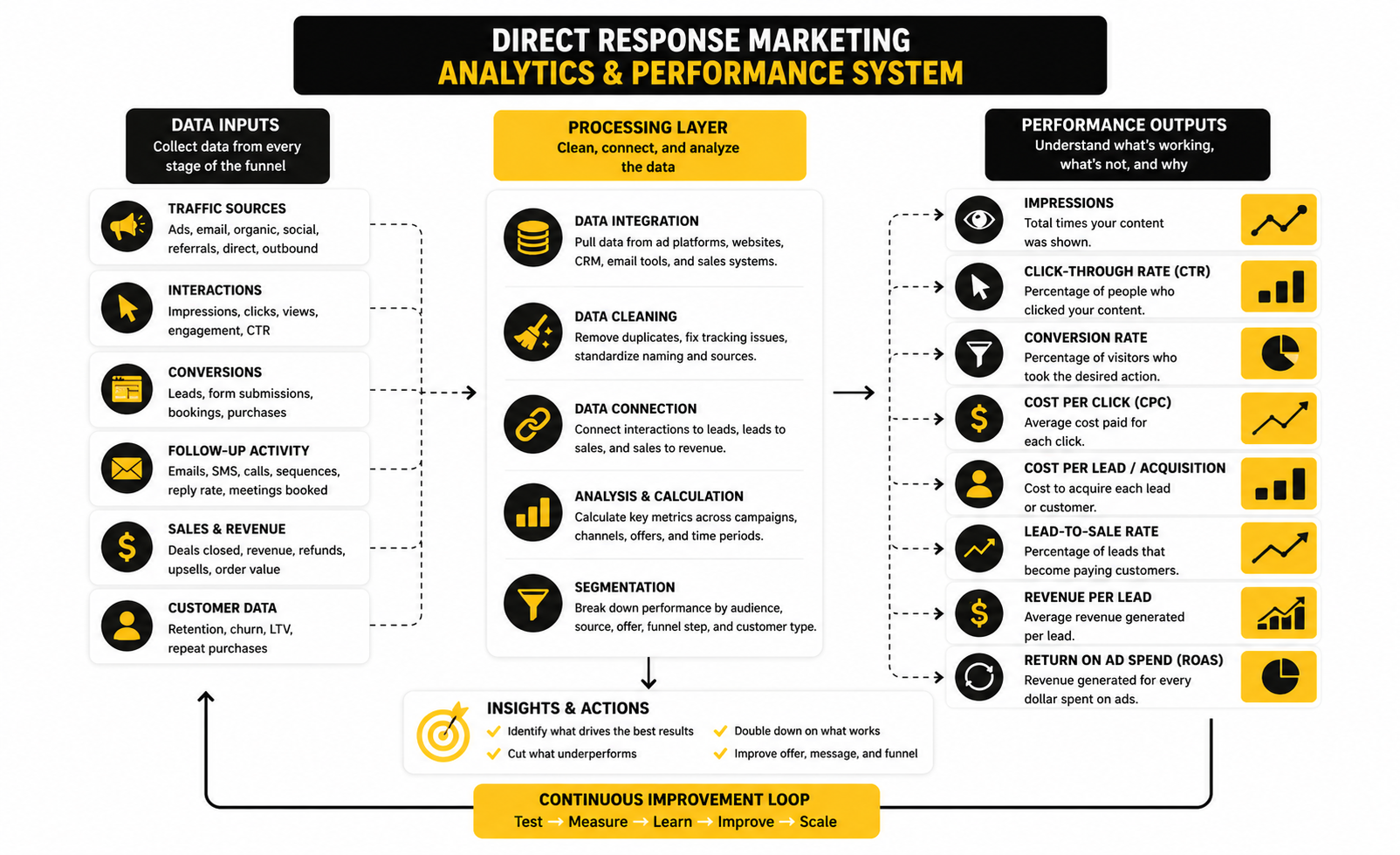
Every campaign should be measured in layers. At the top, you measure attention. In the middle, you measure intent. At the bottom, you measure revenue. When those layers are separated, it becomes much easier to find the real problem.
A simple direct response marketing dashboard should include:
- Impressions
- Click-through rate
- Cost per click
- Landing page conversion rate
- Cost per lead or cost per acquisition
- Lead-to-sale rate
- Average order value or customer value
- Revenue per lead
- Return on ad spend
- Payback period
These numbers work best when they are connected. If cost per click rises but conversion rate improves, the campaign may still be profitable. If cost per lead drops but lead-to-sale rate collapses, the campaign is probably attracting the wrong people.
Benchmarks Are Context, Not Targets
Benchmarks are useful, but they are not commandments. WordStream’s 2025 Google Ads benchmark report shows that average search advertising costs and conversion performance vary heavily by industry, which is exactly why copying another company’s target numbers can be dangerous. A campaign selling emergency plumbing, legal consultations, software demos, and low-ticket ecommerce products will not have the same economics.
Use benchmarks to spot obvious red flags. If your cost per lead is far above the market and your close rate is average, the campaign may need better targeting, creative, or landing page work. If your conversion rate is below the industry range but lead quality is strong, the offer or page may need tightening before you blame the channel.
The most important benchmark is your own baseline. Once a campaign has enough data, compare each new test against your previous performance. That keeps optimization practical because you are improving your own economics instead of chasing generic averages.
Attribution Should Help Decisions, Not Create Arguments
Attribution is where many teams lose the plot. They argue about which channel “deserves credit” instead of asking what decision the data should support. For direct response marketing, attribution should help you decide where to spend more, where to spend less, and where follow-up needs to improve.
Modern tracking is also less perfect than marketers want it to be. Privacy changes, cookie limitations, device switching, and offline sales steps can all create gaps. Google’s enhanced conversions documentation explains how first-party data can help create a more complete picture of cross-channel attribution when some ad interactions are otherwise unobservable.
That means the best measurement setup is usually a blend. Use platform data to manage campaigns, analytics data to understand behavior, CRM data to judge lead quality, and revenue data to confirm business impact. Do not expect one dashboard to tell the whole story.
What Strong Performance Signals Look Like
Strong performance is not just a low cost per lead. A campaign is healthy when the numbers improve together across the funnel. You want to see the right people clicking, enough of them converting, and a meaningful percentage becoming customers.
Good signals include rising conversion rate without falling lead quality, lower acquisition cost without weaker sales outcomes, and faster speed from inquiry to booked call or purchase. In lead generation, a smaller number of qualified leads can beat a larger number of weak leads. In ecommerce, a slightly higher cost per purchase can still work if average order value and repeat purchase behavior are strong.
Weak signals are just as important. If clicks are high and conversions are low, the message may be overpromising or the landing page may be unclear. If conversions are high and sales are low, the offer may be attracting curiosity instead of real intent. If sales are strong but payback is too slow, the campaign may need a better upsell, retention strategy, or pricing model.
Read Email, SMS, and Follow-Up Data Separately
Follow-up performance deserves its own view because it often decides whether the campaign becomes profitable. A paid ad can create the first response, but email, SMS, phone calls, chat, and retargeting often turn that response into revenue. Treating all follow-up as one vague nurture bucket hides useful signals.
For email, track open rate carefully but do not worship it because privacy features can make it less reliable than it used to be. Clicks, replies, booked calls, purchases, and unsubscribe rates usually tell a more useful story. Litmus has highlighted low engagement, data quality, ROI measurement, and personalization as major email challenges in 2025, which is a good reminder that email performance needs both creative and operational discipline.
For SMS and chat, speed and relevance matter. If a prospect asks for information and gets a generic message hours later, the system is wasting intent. Tools like ManyChat can help when conversational follow-up is part of the response path, while platforms like Brevo or Moosend can support structured email campaigns when the list and offer are clear.
Turn Data Into Action
Data only matters when it changes what you do next. If the campaign is getting clicks but not conversions, work on message match and landing page clarity. If leads are coming in but not closing, work on qualification, follow-up speed, sales scripts, or offer fit.
A practical optimization rhythm looks like this:
- Check whether tracking is working before judging performance.
- Separate traffic problems from conversion problems.
- Compare lead volume with lead quality.
- Review sales outcomes before scaling spend.
- Change one major variable at a time.
- Keep the winning baseline before testing the next improvement.
This is where direct response marketing becomes a management system. You are not guessing which idea feels best. You are using performance signals to decide what deserves more budget, what needs to be fixed, and what should be cut.
Professional Implementation and Optimization
At this stage, direct response marketing becomes less about launching campaigns and more about managing a system. The beginner question is, “How do we get more leads?” The professional question is, “Which leads can we acquire profitably, serve well, retain longer, and scale without breaking the business?”
That shift matters. A campaign that works at small spend can fail at higher volume because the audience gets broader, lead quality changes, sales teams get overloaded, and follow-up becomes inconsistent. Scaling is not just spending more. Scaling is increasing volume while protecting the economics.
Scale the Constraint, Not Just the Budget
The biggest mistake is assuming the ad budget is the only lever. Sometimes the real constraint is the offer. Sometimes it is the landing page. Sometimes it is sales capacity, onboarding, fulfillment, retention, cash flow, or attribution quality.
Before scaling, identify the bottleneck. If the campaign has high click intent but weak conversion, fix the page. If the page converts but sales quality is poor, fix qualification. If customers buy but churn fast, fix the promise or delivery before buying more traffic.
This is why direct response marketing should be reviewed beyond the ad account. Paid media data tells you what happens before the lead or sale. CRM, sales, support, and retention data tell you whether the campaign is actually creating a customer worth acquiring.
Protect the Offer From Fatigue
Every strong offer has a shelf life. Audiences get used to seeing it, competitors copy it, ad frequency rises, and the message loses sharpness. That does not mean the business needs a new strategy every month, but it does mean the campaign needs planned variation.
Offer fatigue usually shows up as rising acquisition cost, lower click-through rate, weaker landing page conversion, or declining lead quality. The fix is not always a bigger discount. Often, it is a sharper angle, a stronger proof point, a different entry offer, or a more specific audience segment.
Think in offer families. One core promise can support multiple entry points: a calculator, audit, demo, checklist, webinar, trial, bundle, or consultation. That gives the campaign room to adapt without changing the entire business model.
Balance Speed With Trust
Direct response marketing pushes for action, but pressure without trust can damage performance. The best campaigns reduce hesitation instead of manufacturing panic. They make the next step feel safe, useful, and relevant.
This is especially important in higher-ticket, regulated, or relationship-driven markets. Aggressive urgency may get more clicks in the short term, but it can also create refund requests, poor-fit leads, support friction, and weaker brand perception. Strong response marketing is direct, not desperate.
Trust comes from clarity. Show what happens after the form is submitted. Explain what the buyer gets. Make pricing, terms, timelines, guarantees, and limitations easy to understand when they matter. If the campaign needs confusion to convert, the system is fragile.
Use Automation Without Losing the Human Moment
Automation should remove delay, not remove judgment. A fast confirmation email, reminder sequence, lead routing workflow, or abandoned cart flow can improve response because the system follows up while intent is fresh. But automation becomes a problem when every person gets the same message regardless of what they need.
The practical move is to automate the predictable parts and personalize the decision points. Use forms, quizzes, chat, and CRM fields to segment the follow-up. Route high-intent leads faster. Send different messages to people who booked a call, abandoned a checkout, clicked a pricing page, or replied with a specific objection.
For service businesses and agencies, GoHighLevel can support this kind of pipeline-based follow-up when the business needs forms, automations, calendars, SMS, calls, and CRM stages in one place. For teams focused mainly on email campaigns and segmentation, Brevo or Moosend can be a cleaner fit.
Separate Creative Testing From Business Testing
Not every test is equal. Changing a headline is a creative test. Changing the offer is a business test. Changing the price, guarantee, qualification criteria, or sales process can affect the entire economics of the campaign.
This distinction matters because teams often over-test small creative details while ignoring the bigger constraint. If the offer is weak, button copy will not save it. If the sales process cannot close the leads, another ad angle only creates more waste.
A mature testing system separates variables into levels:
- Audience tests decide who should see the campaign.
- Offer tests decide what action is worth asking for.
- Message tests decide which promise creates intent.
- Page tests decide how clearly the offer converts.
- Follow-up tests decide how intent becomes revenue.
- Economics tests decide whether the campaign can scale.
That structure keeps optimization honest. It also prevents the team from treating every result as a creative problem when the real issue may be positioning, pricing, qualification, or fulfillment.
Watch the Hidden Costs of Growth
A campaign can be profitable in the ad platform and still be unhealthy for the business. This happens when reporting stops at cost per lead or return on ad spend and ignores refunds, sales time, support load, onboarding costs, chargebacks, churn, and delayed cash collection.
Direct response marketing should be connected to contribution margin whenever possible. The campaign does not just need to generate revenue. It needs to generate revenue the business can keep after media costs, software costs, labor, fulfillment, and follow-up are accounted for.
This is where payback period becomes important. A campaign with a lower immediate ROAS can still be worth scaling if customers retain well and cash flow supports the delay. A campaign with a high front-end ROAS can still be dangerous if it attracts buyers who refund, complain, or never purchase again.
Build a Campaign Operating Rhythm
Professional implementation needs rhythm. Without it, teams either panic over daily noise or ignore problems until the budget is already wasted. A campaign should have a clear cadence for checking numbers, reviewing quality, making decisions, and documenting what changed.
Daily checks should focus on tracking, spend, obvious errors, and lead flow. Weekly reviews should focus on conversion rates, lead quality, sales feedback, creative fatigue, and follow-up performance. Monthly reviews should focus on profitability, retention, offer strategy, and what deserves more investment.
The rhythm does not need to be complicated. It needs to be consistent. Direct response marketing rewards teams that make clear decisions from clean data and punish teams that keep changing things without learning anything.
Common Mistakes and Best Practices
Direct response marketing gets weaker when teams chase tactics before they understand the system. A new funnel, AI tool, ad format, or automation platform can help, but only when the offer, audience, message, path, and measurement are already clear. Without that foundation, better tools usually just make bad execution happen faster.
The biggest mistake is optimizing for the wrong response. More leads are not always better. More clicks are not always better. More automation is not always better. The right response is the one that moves the business closer to profitable growth.
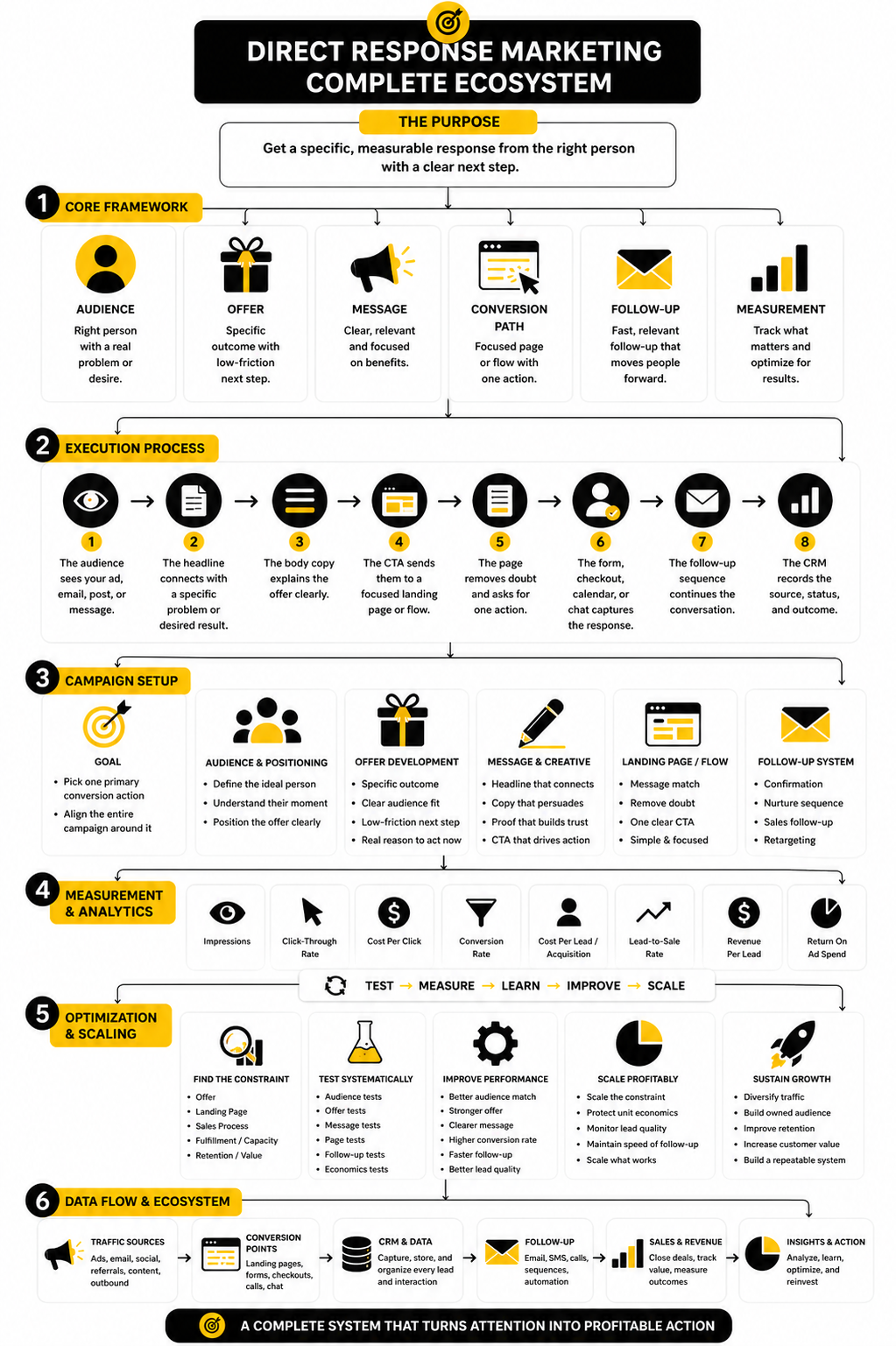
A strong final system has three layers. The first layer creates attention through ads, email, search, social, partnerships, or direct outreach. The second layer converts that attention through landing pages, forms, calendars, checkouts, chat, or sales conversations. The third layer turns response into revenue through follow-up, qualification, onboarding, retention, and measurement.
Best Practices for Direct Response Marketing
Start with one clear offer and one clear action. If the campaign needs five CTAs to make sense, it is probably not focused enough. People should know exactly what they are getting and exactly what to do next.
Keep the message specific. Avoid vague promises like “grow your business” when you can say what outcome, problem, audience, or moment the campaign is built around. Specificity makes the offer easier to believe and easier to act on.
Match the channel to the buyer’s intent. Search traffic often captures people already looking for a solution, while social traffic usually needs stronger education and a lower-friction next step. Email and SMS work best when the list has permission, relevance, and a reason to keep engaging.
Make follow-up fast and useful. A lead who responds today should not wait days for a meaningful next step. The follow-up should confirm the action, set expectations, answer the obvious objections, and move the person forward without sounding robotic.
Review the full customer path before scaling. Do not scale a campaign just because the front-end numbers look good. Check lead quality, sales outcomes, refunds, retention, and support burden before deciding a campaign is truly working.
Risks to Avoid
The first risk is overpromising. Direct response marketing needs strong claims, but strong does not mean careless. If the campaign uses testimonials, reviews, income claims, health claims, performance claims, or before-and-after proof, the claims need to be truthful, representative, and properly disclosed under guidance like the FTC’s rules for endorsements, influencers, and reviews.
The second risk is weak consent. Email, SMS, retargeting, and CRM automation should be built on clear permission and clean data. If your growth depends on confusing people into opting in, the campaign is not only risky; it is also a bad long-term asset.
The third risk is platform dependency. If one ad account, one algorithm, or one tracking method controls the entire growth engine, the business is fragile. A healthier system combines paid traffic, owned audience, organic demand, referral paths, CRM data, and repeatable follow-up.
FAQ - Built for Complete Guide
What is direct response marketing?
Direct response marketing is marketing designed to get a specific, measurable action from the audience. That action might be a purchase, signup, booking, quote request, reply, or form submission. The key is that the campaign is built around response, not vague awareness.
How is direct response marketing different from brand marketing?
Brand marketing focuses on recognition, perception, and long-term trust. Direct response marketing focuses on measurable action and performance. The best businesses use both because trust improves response and response data helps sharpen the brand message.
What is the most important part of a direct response campaign?
The offer is usually the most important part because it gives people a reason to act. A great headline can get attention, but the offer determines whether the action feels worth it. If the offer is weak, the rest of the campaign has to work too hard.
What channels work best for direct response marketing?
Search ads, social ads, email, SMS, landing pages, direct mail, webinars, chat, affiliate campaigns, and outbound outreach can all work. The best channel depends on the buyer’s intent, the price point, the sales cycle, and the offer. A high-ticket service usually needs more qualification and follow-up than a low-ticket impulse purchase.
Is direct response marketing only for ecommerce?
No. Ecommerce uses direct response heavily, but the same principles work for agencies, consultants, SaaS companies, local services, creators, coaches, B2B firms, and marketplaces. Any business that can define a clear action and measure the result can use it.
What metrics should I track first?
Start with conversion rate, cost per lead or sale, lead quality, close rate, customer value, and payback period. Clicks and impressions are useful, but they do not prove the campaign is profitable. The deeper numbers show whether the response actually creates revenue.
How long should I test a campaign before changing it?
Test long enough to collect meaningful data, but do not ignore obvious problems. If tracking is broken, the page does not load, or leads are unqualified from the start, fix the issue quickly. If the campaign is functioning properly, change one major variable at a time so the results are actually useful.
Do I need a funnel builder for direct response marketing?
Not always. A funnel builder helps when you need landing pages, checkout flows, upsells, lead capture, and campaign-specific pages without heavy development. Tools like ClickFunnels, Systeme.io, and GoHighLevel can help, but the strategy still matters more than the software.
What makes a landing page convert better?
A strong landing page has message match, a clear headline, a specific offer, believable proof, low friction, and one obvious CTA. It should continue the promise from the ad or email instead of making the visitor re-interpret the offer. The page should also remove common doubts before asking for the action.
How does AI fit into direct response marketing?
AI can help with research, segmentation, creative variations, chat, lead routing, summaries, personalization, and testing workflows. It should support the strategy, not replace it. The strongest use is speeding up execution while humans still control the offer, positioning, proof, compliance, and final judgment.
What is the biggest beginner mistake?
The biggest beginner mistake is launching traffic before the conversion path is ready. The ad may be good, but the page, form, follow-up, CRM, and sales process are not prepared to handle intent. That creates wasted spend and misleading data.
Can direct response marketing hurt a brand?
Yes, if it relies on exaggerated claims, fake urgency, spammy follow-up, or pressure tactics. Strong direct response should make the next step clear and compelling without damaging trust. The goal is profitable action, not short-term manipulation.
Work With Professionals
Explore 10K+ Remote Marketing Contracts on MarkeWork.com
Most marketers spend too much time chasing clients, competing on crowded platforms, and losing a percentage of every project to middlemen.
MarkeWork gives you a better way. Browse thousands of remote marketing contracts and connect directly with companies desperate to hire skilled marketers like you, without platform commissions and without unnecessary gatekeepers.
If you're serious about finding better opportunities and keeping 100% of what you earn, explore available contracts and create a profile for free at MarkeWork.com.