

Most businesses don’t struggle with traffic. They struggle with what happens after someone shows interest.
That’s where a drip campaign quietly does the heavy lifting.
Instead of blasting one-off messages and hoping for conversions, a drip campaign builds momentum over time. It turns cold leads into warm conversations, and warm conversations into predictable revenue. And the difference isn’t small—automated email flows can generate up to 320% more revenue than non-automated campaigns (source).
The real power comes from timing, sequencing, and relevance. You’re not just sending emails—you’re guiding decisions.
Article Outline
- What a drip campaign actually is
- Why drip campaigns matter more than ever
- Drip campaign framework overview
- Core components of a high-performing drip campaign
- How professionals implement drip campaigns at scale
- Advanced optimization and scaling strategies
What a Drip Campaign Actually Is
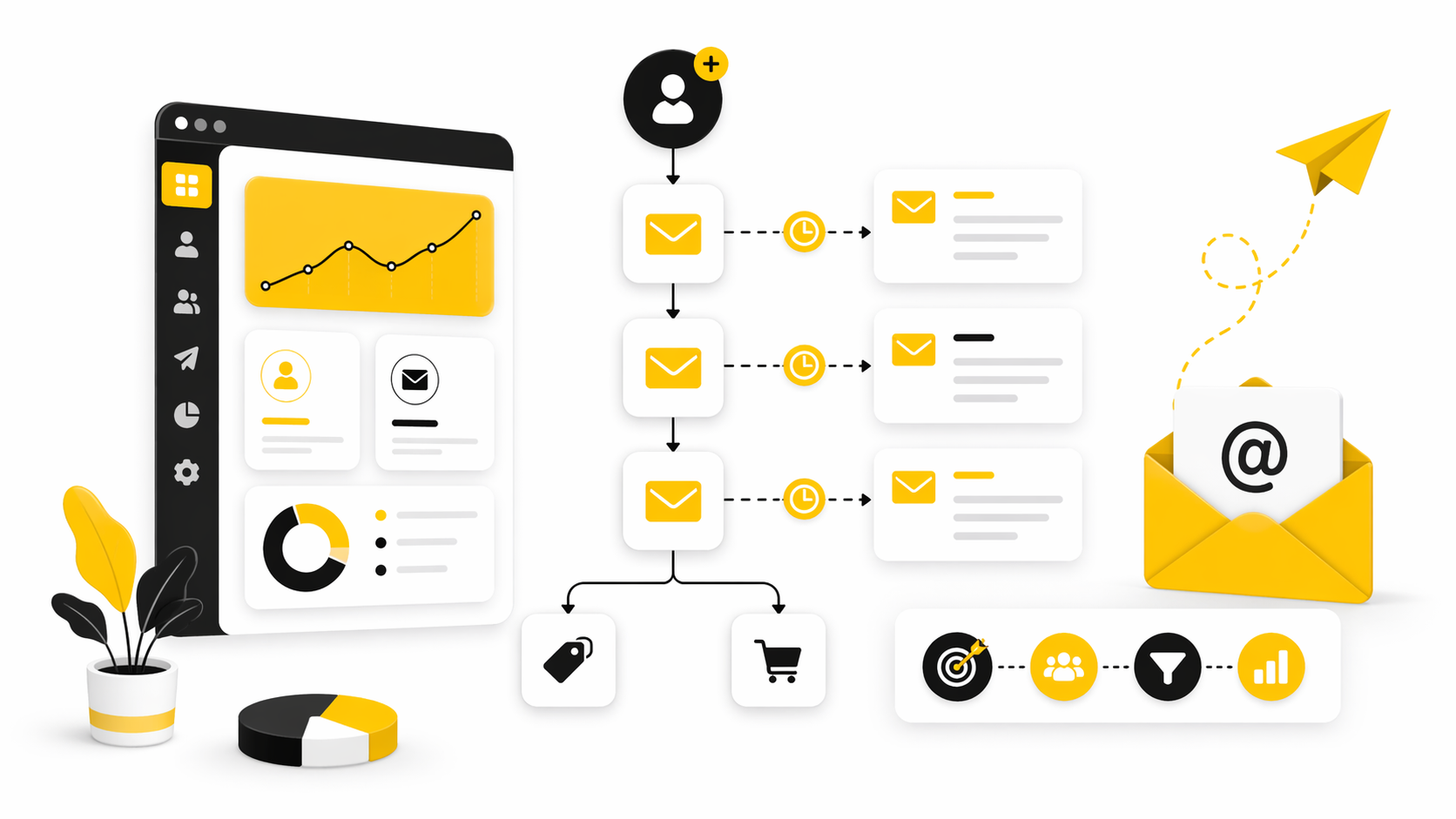
A drip campaign is a sequence of pre-written messages sent automatically based on timing or user behavior.
Think of it like controlled communication instead of random outreach. When someone signs up, downloads something, or abandons a cart, the system triggers a series of emails spaced out over time. Each message builds on the previous one, gradually moving the person closer to a decision.
This isn’t just theory. Across hundreds of thousands of campaigns, automated sequences consistently outperform one-off emails with significantly higher engagement and conversion rates (source).
The name comes from drip irrigation—small, consistent delivery instead of overwhelming floods. That analogy matters because attention is limited. People don’t want everything at once. They want the right message at the right moment.
Why Drip Campaigns Matter More Than Ever
Email is still one of the most powerful channels available, even in a world dominated by social media and paid ads.
Almost 99% of people check their email daily, and 59% say marketing emails influence their purchase decisions (source). That means your audience is already there—you just need to show up strategically.
But here’s the problem: most businesses treat email like a megaphone instead of a system.
A drip campaign fixes that by creating:
- Consistent touchpoints without manual effort
- Personalized communication based on behavior
- Higher engagement compared to broadcast emails
- Scalable relationship-building
More importantly, drip campaigns compound. One good sequence can generate results for months or years without constant input.
This is why platforms like GoHighLevel have become central to modern marketing stacks—they allow businesses to automate follow-ups, nurture leads, and manage entire customer journeys from one place.
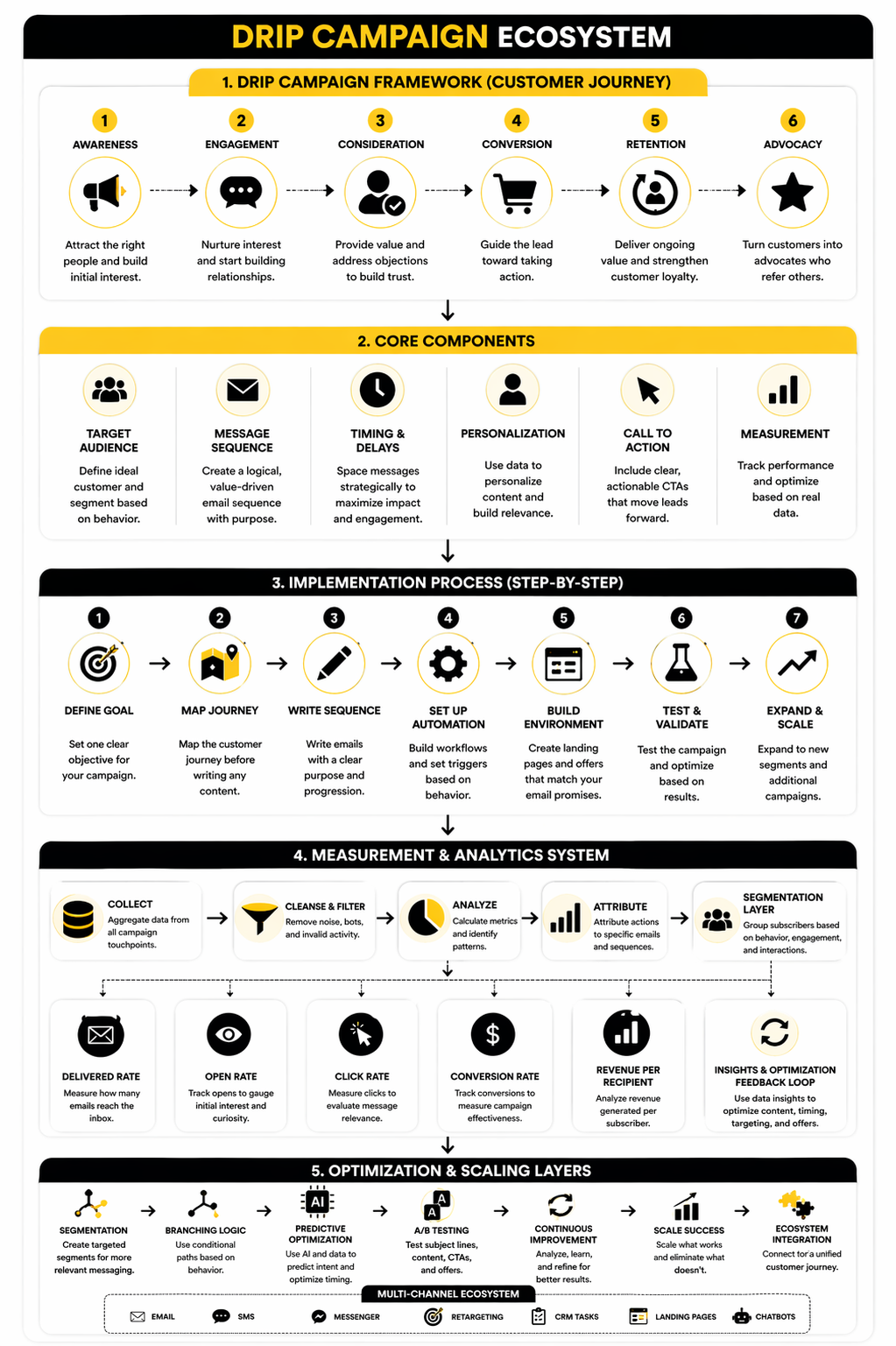
Drip Campaign Framework Overview
At a high level, every effective drip campaign follows a simple structure.
You start with a trigger, define a sequence, and guide the user through a journey.
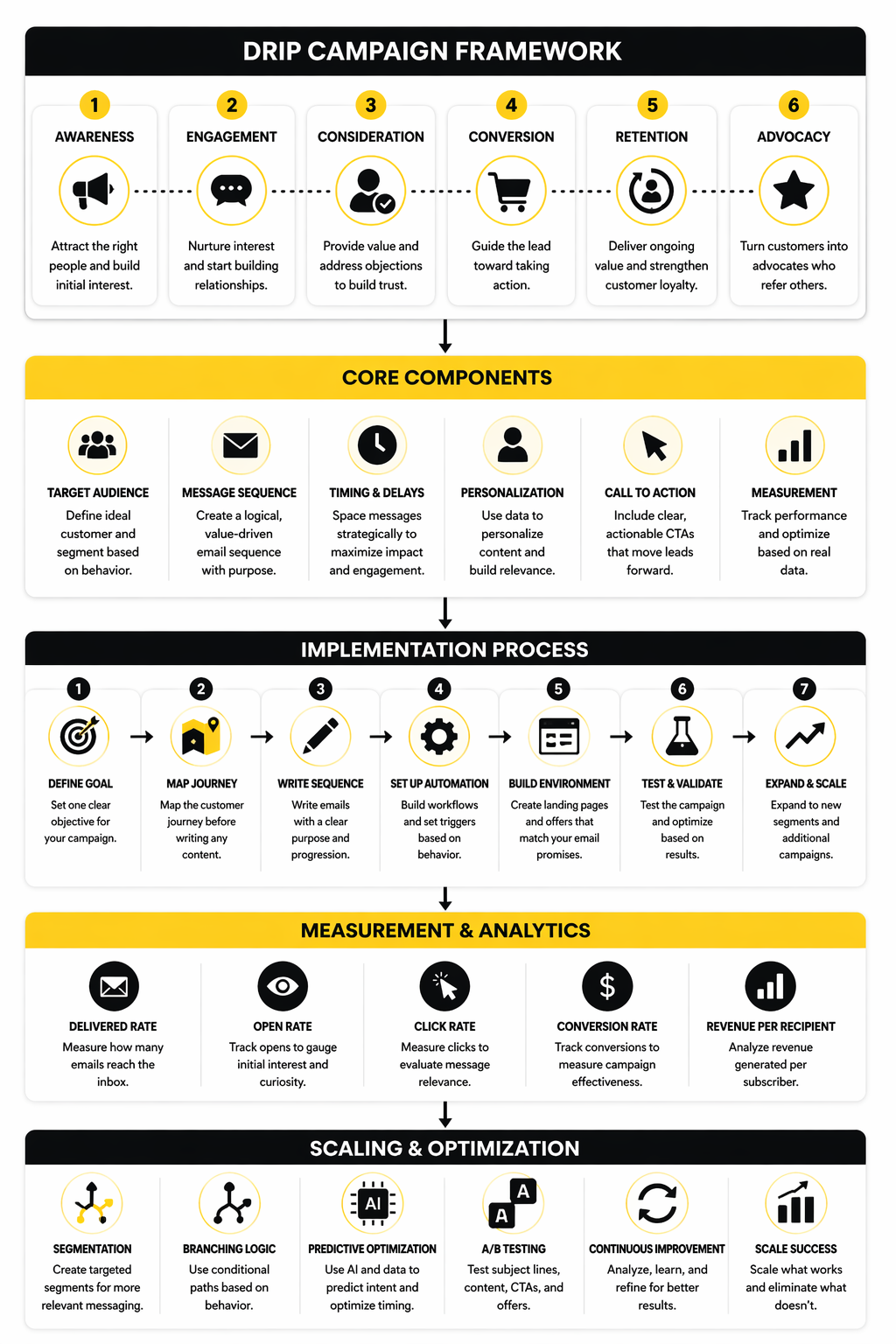
The framework looks like this:
- Trigger
A user action starts the sequence (signup, purchase, click, inactivity).
- Segmentation
The system categorizes the user based on behavior, interests, or stage.
- Sequence Timing
Messages are spaced intentionally (Day 0, Day 2, Day 5, etc.).
- Message Progression
Each email builds logically—education, trust, offer, reinforcement.
- Conversion Event
The sequence drives toward a specific outcome (purchase, booking, activation).
This structure works because it mirrors how decisions actually happen. People rarely convert after one interaction. They need context, repetition, and clarity.
And drip campaigns deliver exactly that—without overwhelming the user or the business running them.
Core Components of a High-Performing Drip Campaign
Once the framework is clear, execution comes down to components. This is where most drip campaigns either quietly print revenue—or completely fall flat.
A high-performing drip campaign isn’t about writing a few emails and setting delays. It’s about combining data, timing, and messaging into a system that adapts to behavior.
Audience Segmentation That Actually Matters
Segmentation is where relevance starts. Without it, even the best-written emails feel generic.
Instead of grouping users by surface-level traits, strong campaigns segment based on intent signals:
- Actions taken (clicked, downloaded, purchased)
- Stage in the funnel
- Engagement level over time
- Specific interests or product categories
This matters because segmented campaigns can drive up to 760% higher revenue compared to non-segmented campaigns (source).
Tools like Brevo or Moosend allow you to build these dynamic segments automatically, so your drip campaign evolves as your audience interacts.
Trigger Logic That Feels Timely, Not Automated
Triggers define when your drip campaign begins—and how it branches.
Most businesses stop at simple triggers like “user signs up.” That works, but it leaves a lot of opportunity on the table. The real performance comes from behavior-based triggers:
- Cart abandonment
- Page visits or product views
- Inactivity over a defined period
- Re-engagement after past purchases
When done right, these triggers make the campaign feel personal. The message arrives exactly when it makes sense, not when your schedule says it should.
This is also where platforms like ManyChat extend beyond email by triggering conversations across channels like Messenger or SMS, keeping the experience consistent.
Message Sequencing That Builds Momentum
A drip campaign is only as strong as its sequence.
Each message needs a clear role. If every email tries to sell, the sequence collapses. If every email only educates, conversions stall.
A strong progression usually looks like this:
- Welcome or acknowledgment – confirms the action and sets expectations
- Value delivery – gives something useful or insightful
- Trust building – reinforces credibility through proof or clarity
- Offer introduction – presents the next step naturally
- Reinforcement – addresses objections and nudges action
This progression works because it mirrors how people make decisions. They don’t jump from curiosity to purchase instantly—they move step by step.
Timing and Frequency That Respect Attention
Timing is one of the most underestimated parts of a drip campaign.
Send too frequently, and you burn attention. Wait too long, and you lose momentum. The balance depends on context, but the principle is simple: stay relevant without becoming noise.
Data across multiple email platforms shows that engagement drops sharply when frequency feels excessive, while consistent but spaced communication maintains higher open and click rates (source).
A practical baseline:
- Day 0: Immediate response
- Day 2–3: Follow-up with value
- Day 5–7: Deeper engagement or offer
- Weekly thereafter: Continued nurturing
The exact cadence should evolve based on behavior. Highly engaged users can handle faster sequences, while colder leads need more space.
Clear Conversion Paths
Every drip campaign needs a defined outcome.
Without it, you’re just sending content with no direction. That outcome could be:
- Booking a call
- Completing a purchase
- Starting a free trial
- Returning to a product
The key is clarity. Each message should point toward the next logical step without overwhelming the reader.
This is where funnel builders like ClickFunnels or Systeme.io integrate directly with drip campaigns, ensuring that when someone clicks, they land in a conversion environment designed to close.
How Professionals Implement Drip Campaigns at Scale
Understanding components is one thing. Scaling them is another.
Professionals don’t just create one drip campaign—they build systems of interconnected sequences that cover the entire customer lifecycle.
Lifecycle-Based Campaign Architecture
Instead of a single sequence, high-level marketers structure drip campaigns around stages:
- Lead acquisition
- Lead nurturing
- Conversion
- Onboarding
- Retention
- Re-engagement
Each stage has its own logic, messaging, and goals. Together, they form a complete ecosystem.
This approach works because it removes gaps. No matter where someone enters your world, there’s always a relevant sequence guiding them forward.
Automation Stacking Across Channels
Email alone is powerful, but multi-channel automation is where things accelerate.
Professionals combine:
- Email sequences
- SMS follow-ups
- Messenger automation
- Retargeting ads
This creates multiple touchpoints without increasing manual work. A user might ignore an email but respond to a message notification. The system adapts instead of relying on a single channel.
Platforms like GoHighLevel make this possible by centralizing communication and automation into one workflow, reducing fragmentation and improving consistency.
Continuous Optimization Instead of One-Time Setup
The biggest mistake is treating a drip campaign as a “set it and forget it” system.
Professionals treat it as a living asset.
They constantly refine:
- Subject lines
- Timing intervals
- Message angles
- Conversion points
Even small improvements compound. Increasing open rates by a few percentage points or improving click-through rates slightly can translate into significant revenue over time.
This is why the best-performing drip campaigns don’t look dramatically different on the surface—but they outperform because they’ve been optimized relentlessly behind the scenes.
In the next part, we’ll break down how to design and build your own drip campaign step by step, so it’s not just theory—you can actually implement it.
Designing and Building Your Drip Campaign Step by Step
At this point, the strategy is clear. Now it’s about execution.
This is where most people overcomplicate things. They try to build everything at once, connect too many tools, or write dozens of emails before testing anything. That approach usually leads to delays and underperformance.
A better way is to build your drip campaign in layers—starting simple, then expanding once it works.
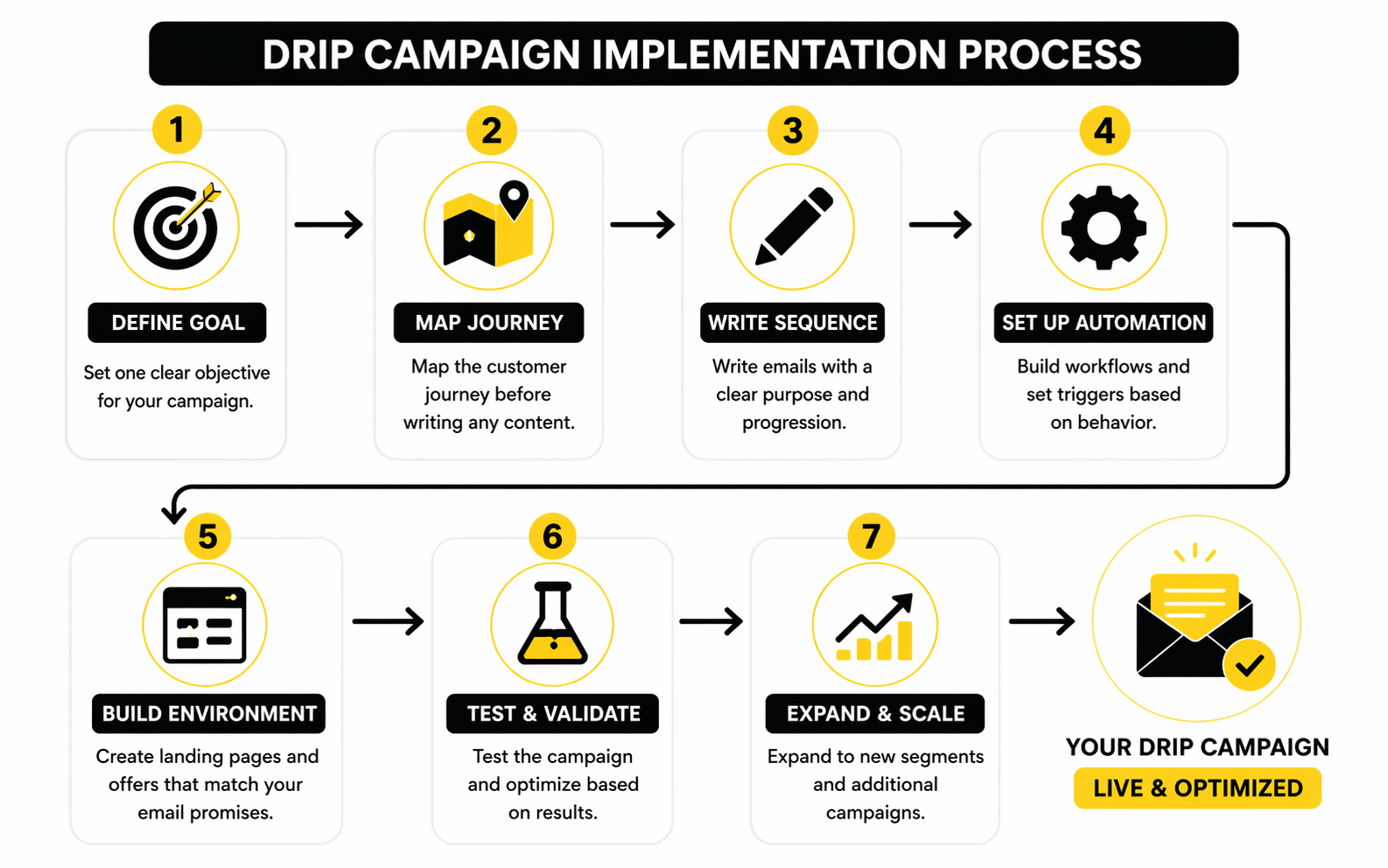
Step 1: Define One Clear Goal
Every drip campaign should do one thing extremely well.
Not three things. Not five different outcomes. One.
That goal might be:
- Turning new subscribers into booked calls
- Converting trial users into paid customers
- Re-engaging inactive users
When you define a single outcome, everything becomes easier. The messaging gets sharper, the sequence becomes more focused, and the conversion path becomes obvious.
Without this clarity, campaigns drift—and results follow.
Step 2: Map the Customer Journey Before Writing Anything
Before you touch email copy, map the journey.
This is where most professionals gain a huge advantage. They don’t guess what to send—they design the experience first.
Ask yourself:
- What does the user know at the start?
- What doubts or objections will come up?
- What needs to happen before they take action?
When you map this out, your drip campaign becomes logical instead of reactive. Each message exists for a reason, not just because “we should send something here.”
This also helps you avoid repetition, which is one of the biggest silent killers of engagement.
Step 3: Write the Sequence With Purpose
Now you build the actual messages.
Instead of writing randomly, anchor each email to a specific function inside the sequence:
- Email 1: Set expectations and deliver immediate value
- Email 2: Expand understanding or introduce a key concept
- Email 3: Address friction or uncertainty
- Email 4: Present the offer naturally
- Email 5: Reinforce and push toward action
The key is progression. If someone reads all emails in order, it should feel like a conversation—not disconnected broadcasts.
Campaigns with structured sequences consistently outperform isolated emails because they guide decision-making step by step (source).
Step 4: Set Up Automation and Triggers
This is where your drip campaign becomes real.
You take your sequence and connect it to triggers inside your platform. That might be email software, CRM, or an all-in-one system.
Tools like GoHighLevel allow you to:
- Create workflows visually
- Assign triggers based on behavior
- Route users into different paths automatically
At this stage, keep it simple. One trigger, one sequence, one goal. Complexity can come later once the foundation is proven.
Step 5: Build the Conversion Environment
A drip campaign doesn’t convert on its own—it drives people somewhere.
That destination matters more than most people think.
If your emails are strong but your landing page is weak, results collapse. This is why professionals pair drip campaigns with optimized funnels using platforms like ClickFunnels or Replo.
The transition should feel seamless:
- Email promise → Landing page headline
- Email context → Page content
- Email CTA → Page action
When this alignment is tight, conversion rates increase dramatically without needing more traffic.
Step 6: Test Before Scaling
Before you drive volume into your drip campaign, validate it.
This doesn’t require thousands of users. Even small datasets can reveal patterns:
- Are people opening emails?
- Are they clicking through?
- Where do they drop off?
Small adjustments here can unlock disproportionate gains later. For example, improving a subject line can increase opens, which increases clicks, which increases conversions—compounding across the entire sequence.
Step 7: Expand Once It Works
Only after your first campaign performs should you expand.
This is where most people go wrong—they scale broken systems.
Instead, build additional sequences around:
- Different entry points
- Different audience segments
- Different lifecycle stages
At this stage, tools like Systeme.io or Brevo become valuable because they let you manage multiple campaigns without losing control.
The result isn’t just one drip campaign—it’s a system of campaigns working together.
And once that system is in place, growth stops being unpredictable. It becomes engineered.
Measuring Whether Your Drip Campaign Is Actually Working
A drip campaign is easy to launch and surprisingly easy to misread. Plenty of marketers look at a dashboard, see decent opens, and assume the system is healthy when the real leaks are happening later in the journey.
That’s why measurement matters. Not because more dashboards are exciting, but because the right numbers tell you whether your sequencing, targeting, and offer are doing real business work or just generating activity. Recent benchmark reports show that email performance can look solid on the surface while clicks, inbox placement, and downstream conversions tell a very different story.
Start With a Simple Analytics Stack
You do not need a complicated attribution warehouse to evaluate a drip campaign well. You need a clean measurement system that connects delivery, engagement, and revenue.
The simplest useful stack tracks five layers in order: delivered, opened, clicked, converted, and revenue generated. Once those are visible in one place, you can stop guessing where the sequence is weak and start fixing the actual bottleneck.
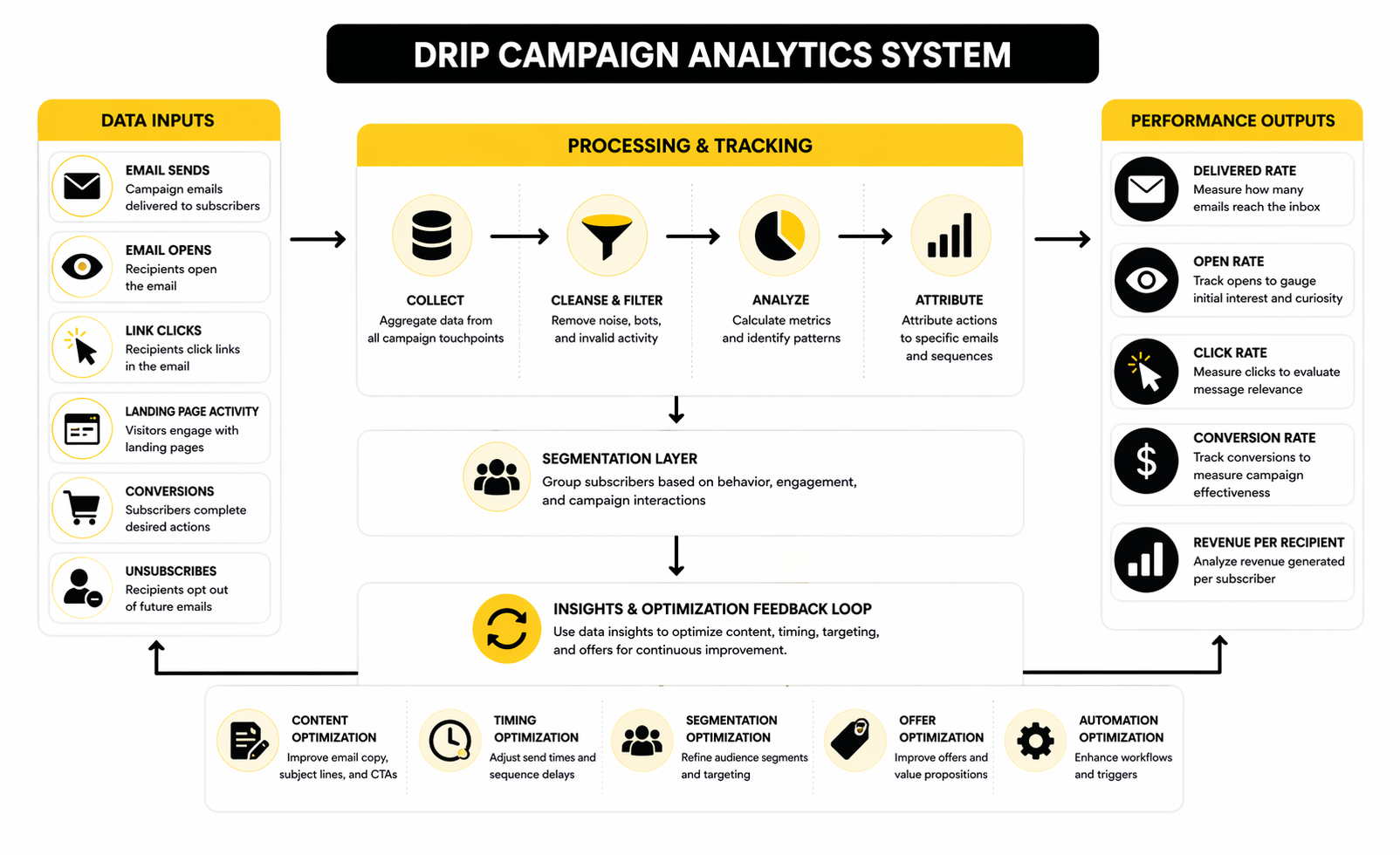
This is also why reporting inside platforms matters more than people admit. If you are running automation inside GoHighLevel, Brevo, or ClickFunnels, the goal is not just to see campaign stats. The goal is to see which message moved someone to the next step and which one caused momentum to die.
Open Rate Is Directional, Not Definitive
Open rate still matters, but it is no longer a clean truth signal. Apple Mail Privacy Protection and mailbox prefetching have made opens noisier, which is why some platforms now separate total opens from more reliable human-opened metrics.
That context matters because benchmark numbers can look stronger than the underlying reality. DMA’s 2025 benchmarking report put average open rates at 35.9% in 2024, while MailerLite reported a 43.46% average open rate in 2025 and also noted that privacy protections inflate those figures. Customer.io now explicitly distinguishes human opens from machine opens for the same reason.
The right move is simple: use opens as an early warning system, not as final proof of success. If opens are weak, your subject line, sender identity, or deliverability may need work. If opens look strong but clicks and conversions stay weak, the problem is probably inside the email or further down the funnel.
Clicks Tell You Whether the Message Earned Attention
Clicks are where a drip campaign becomes measurable in a more honest way. A click means the recipient did more than glance at the message—they decided the next step was worth taking.
This is why click rate and click-to-open rate are more useful than vanity open numbers. DMA reported a 2.3% unique click rate in 2024, while MailerLite reported a 2.09% average click rate and a 6.81% click-to-open rate in 2025. Those numbers are not there to depress you. They are there to show that every improvement in relevance, offer clarity, or CTA strength matters because clicks are scarce and valuable.
When click performance is low, the action is usually obvious. Tighten the message-to-offer match, reduce competing links, sharpen the call to action, and make sure the promise in the email is completed on the landing page.
Conversion Rate Is the Metric That Forces Honesty
A drip campaign does not exist to win open-rate screenshots. It exists to produce movement that matters—trials, demos, purchases, activations, renewals.
That is why conversion rate should sit near the center of your reporting. Omnisend’s 2025 ecommerce report found that automated emails drove 37% of email-driven sales from just 2% of email volume, and one in three people who clicked an automated message made a purchase, compared with one in 18 for scheduled messages. MoEngage’s benchmark work also found that behavior-based and journey-based emails outperform generic broadcast messages, in some cases by huge multiples.
The interpretation is practical. If your drip campaign has average engagement but strong conversion, it may already be healthy. If engagement looks impressive but conversions lag, the sequence is attracting attention without creating decision momentum.
Revenue Per Recipient Changes How You Prioritize
Once a drip campaign is live, revenue per recipient becomes one of the most useful metrics in the whole system. It tells you how much economic value each message or workflow creates relative to the audience it touches.
This is where automation usually pulls away from one-off campaigns. Drip’s automation report found that ecommerce merchants using segmentation earned five times more revenue than those who did not, and merchants using two or more segments earned dramatically more than those relying on a single segment. That kind of data changes how you prioritize improvements because it shows that better targeting is not just a messaging upgrade—it is a revenue multiplier.
In practice, this means you should not judge every workflow only by open or click benchmarks. Some sequences exist to educate. Some exist to recover carts. Some exist to reactivate dormant users. Revenue per recipient helps you compare them in terms that actually matter to the business.
Deliverability Metrics Protect Everything Else
A drip campaign cannot perform if it does not land in the inbox. That sounds obvious, but it is where a lot of good strategy quietly gets wrecked.
Deliverability metrics deserve more attention than they usually get: inbox placement, hard bounces, spam complaints, and unsubscribe rates. DMA reported delivery rates of 98% in 2024, while MailerLite’s 2025 benchmark showed average unsubscribe rates climbing to 0.22%. Validity’s 2025 deliverability benchmark warned that inbox placement declined in 2024, which means senders have to work harder to maintain reach even before creative performance is evaluated.
The action here is not glamorous, but it is critical. Clean the list, tighten consent practices, remove chronically inactive subscribers, and monitor complaint patterns. A healthier list will usually outperform a larger sloppy one.
Benchmarks Are Useful Only When You Use Them Correctly
Benchmarks are not goals by themselves. They are context.
If your drip campaign has a lower open rate than a published benchmark but a stronger conversion rate, you may be doing fine. If your campaign beats average opens but underperforms on revenue, the benchmark is flattering you while the business result is telling the truth.
That is the real job of statistics inside lifecycle marketing. They are supposed to guide decisions, not decorate reports. Customer.io’s lifecycle research shows teams still see email as a proven ROI channel, but reporting and attribution remain major blockers—which is exactly why disciplined measurement matters so much.
The Signals That Should Trigger Action
A strong drip campaign analytics routine is not about watching numbers drift. It is about knowing what each pattern means and what to do next.
Here is the practical interpretation:
- High opens, low clicks usually point to weak message relevance or a soft CTA
- High clicks, low conversions usually point to landing page friction or offer mismatch
- Low delivery or rising complaints usually point to list quality or frequency problems
- Strong conversion on one workflow usually means that trigger logic should be expanded elsewhere
- Weak revenue per recipient usually means the sequence is active but not strategically valuable
That’s the mindset shift. You are not reading a dashboard for entertainment. You are using performance signals to decide where to rewrite, where to retarget, where to slow down, and where to scale.
In the next part, we’ll move from measurement into advanced optimization—how to improve a drip campaign once the baseline is working and where the biggest gains usually hide.
Advanced Optimization and Scaling Strategies
Once your drip campaign is working, the game changes.
At the beginning, you’re focused on getting something live and functional. At this stage, the focus shifts to leverage. Small improvements start producing disproportionate results, and the difference between average and high-performing campaigns becomes very real.
This is where most businesses plateau—because they stop refining once the campaign “works.”
Personalization Beyond First Names
Basic personalization is easy. Using someone’s name or company is table stakes.
What actually moves performance is behavioral personalization. This means your drip campaign adapts based on what users do, not just who they are.
For example:
- Showing different offers based on pages visited
- Changing messaging depending on engagement level
- Skipping emails if a user already took action
This type of personalization works because it removes friction. Instead of forcing every user through the same path, the system adjusts in real time.
Platforms like GoHighLevel and Brevo allow this level of dynamic logic without requiring complex custom development.
Branching Logic and Conditional Paths
A linear drip campaign works—but a branching campaign performs better.
Instead of one fixed sequence, advanced campaigns use conditional paths:
- If the user clicks → move to a more aggressive sequence
- If the user ignores → slow down or change angle
- If the user converts → exit or shift into onboarding
This creates a system that feels responsive rather than scripted.
The key benefit is efficiency. You’re no longer sending irrelevant emails to people who already moved forward—or lost interest. You’re aligning communication with intent.
Frequency Tradeoffs and Fatigue Management
Scaling a drip campaign introduces a hidden risk: fatigue.
As you add more sequences across the lifecycle, users can end up receiving overlapping messages. Even if each campaign is well-designed individually, the combined experience can feel overwhelming.
This is where prioritization matters.
You need rules like:
- Which campaign overrides others
- Maximum messages per user per week
- Cooldown periods between sequences
Ignoring this leads to rising unsubscribe rates and declining engagement over time. MailerLite’s 2025 benchmarks show unsubscribe rates increasing as frequency climbs, reinforcing how sensitive audiences are to over-communication. (mailerlite.com)
Managing this properly turns your drip campaign system from chaotic to controlled.
Offer Timing and Revenue Optimization
Most campaigns underperform not because of bad copy—but because of bad timing.
Present the offer too early, and trust isn’t built yet. Wait too long, and attention fades.
The solution is not guessing. It’s testing structured variations:
- Early offer vs delayed offer
- Soft CTA vs direct CTA
- Single offer vs multiple touchpoints
Automated campaigns are particularly strong here because they allow controlled experiments over time. Even small improvements in timing can significantly impact revenue, especially when applied across large audiences.
Integrating AI and Predictive Signals
Modern drip campaigns are starting to move beyond fixed rules into predictive behavior.
Instead of waiting for explicit actions, systems can anticipate:
- Likelihood to convert
- Risk of churn
- Optimal send time
This shifts campaigns from reactive to proactive.
Tools like GoHighLevel AI and conversational layers like Chatbase allow businesses to combine automation with intelligent interaction, creating a more adaptive experience.
The result is not just higher engagement—it’s more efficient use of attention.
Scaling Without Breaking the System
Scaling a drip campaign is not just adding more emails or more users.
It’s maintaining performance while complexity increases.
This requires:
- Clear campaign architecture
- Centralized tracking and reporting
- Consistent naming and structure
- Regular audits of active workflows
Without this discipline, campaigns start conflicting, data becomes harder to interpret, and optimization slows down.
This is why many teams eventually consolidate into platforms like Systeme.io or ClickFunnels, where funnels, automation, and tracking live in one environment.
The Strategic Tradeoff Most People Miss
There’s a tension at the core of every drip campaign:
- More automation increases efficiency
- More personalization increases effectiveness
But doing both well requires structure.
If you over-automate without personalization, campaigns feel generic and performance drops. If you over-personalize without structure, the system becomes unmanageable.
The best-performing setups balance both. They automate the predictable parts and personalize the moments that matter.
That balance is what turns a drip campaign from a marketing tactic into a growth engine.
In the final part, we’ll bring everything together with practical answers to the most common questions and decisions people face when building and scaling drip campaigns.
Bringing the Full Drip Campaign System Together
By now, the picture should be clear.
A drip campaign is not just a sequence of automated emails. It is a full operating system for lead nurturing, conversion, onboarding, retention, and reactivation. When the strategy, timing, analytics, and infrastructure all line up, the campaign stops feeling like a marketing asset and starts functioning like revenue infrastructure.
That is the real end goal. Not more emails. Not more automation for the sake of automation. A better system that creates the right message, at the right time, for the right person, with less manual effort and more consistent results.
If you are building seriously, this is also where your tool stack needs to support the full ecosystem. A platform like GoHighLevel can centralize workflows and follow-up logic, ClickFunnels can handle conversion paths, and Brevo or Moosend can support segmentation and deliverability. The exact stack matters less than the architecture. What matters is that the whole system works together.
FAQ - Built for Complete Guide
What is the main goal of a drip campaign?
The main goal of a drip campaign is to move someone from one stage of the customer journey to the next without relying on manual follow-up every time. That could mean turning a subscriber into a lead, a lead into a customer, or a customer into a repeat buyer.
The point is controlled progression. A good drip campaign builds momentum instead of hoping one message does all the work.
How long should a drip campaign be?
There is no perfect universal length because campaign length depends on the buying cycle, offer complexity, and audience intent. A simple lead magnet follow-up might take three to five emails, while a higher-ticket service sequence might need a longer nurture window.
The right question is not “how many emails should I send?” It is “how many steps does this decision actually require?” If the sequence earns attention and keeps moving people forward, length becomes a strategic choice rather than a fixed rule.
How often should I send messages in a drip campaign?
Frequency should match urgency and audience temperature. Someone who just requested a demo can usually handle faster follow-up than someone who downloaded a general guide two weeks ago.
The danger is not frequency by itself. The danger is irrelevant frequency. Recent benchmark guidance from Brevo and cadence research from MailerLite shows that poor timing and inconsistent sending can hurt unsubscribes and engagement faster than most teams expect.
What is the difference between a drip campaign and a newsletter?
A newsletter is usually a recurring broadcast sent to a broad audience. A drip campaign is behavior-based, sequenced, and tied to a specific goal or stage in the journey.
That difference matters because newsletters inform, while drip campaigns are designed to guide. You can use both, but they solve different problems.
Are drip campaigns only for email?
No. Email is the most common channel, but a drip campaign can include SMS, Messenger, CRM tasks, retargeting ads, and even chatbot interactions.
That is why multi-channel systems often outperform single-channel setups. Tools like ManyChat and Chatbase can extend the sequence beyond the inbox and make the full customer journey feel more connected.
When should I use a behavior-based trigger instead of a time-based trigger?
Use a behavior-based trigger when the user’s action reveals meaningful intent. Visiting a pricing page, abandoning a cart, or starting a signup flow tells you far more than simply waiting three days and sending the next email.
Time-based delays still matter because they control pacing. But the strongest drip campaign usually combines both: behavior decides direction, and timing controls pressure.
What metrics matter most in a drip campaign?
The most important metrics are the ones that show business movement, not just surface activity. Delivered rate, click rate, conversion rate, unsubscribe rate, and revenue per recipient tell a much more useful story than open rate alone.
This is especially important now that privacy protections make opens less reliable as a standalone signal. Benchmarks from Omnisend continue to show that automated flows produce outsized revenue compared with one-off campaigns, which is why downstream metrics matter so much more than vanity numbers.
How do I know if my drip campaign is underperforming?
You usually see it in one of four patterns. Opens are weak, which suggests deliverability or subject-line issues. Clicks are weak, which points to message relevance or CTA problems. Conversions are weak, which usually means landing-page friction or offer mismatch. Unsubscribes are rising, which often signals fatigue or poor audience fit.
The key is to diagnose the exact stage where the leak happens. Guessing wastes time. Sequence-level analytics saves it.
Should every business build multiple drip campaigns?
Eventually, yes. But not at the start.
The smartest move is to build one high-value sequence first, prove it works, then expand into lifecycle coverage. That usually means starting with a welcome or lead nurture flow, then adding onboarding, retention, cart recovery, or reactivation sequences later.
Can a drip campaign work for service businesses, not just ecommerce?
Absolutely. Service businesses often benefit even more because their sales cycles involve more trust, more explanation, and more follow-up.
A consultant, agency, or B2B company can use a drip campaign to educate prospects, handle objections, share proof, and guide people toward a booked call. In many cases, the sequence becomes the bridge between first interest and qualified pipeline.
What are the biggest mistakes people make with drip campaigns?
The biggest mistakes are usually structural, not technical. People build sequences with no clear goal, send the same message to everyone, or pile on automation without a strong conversion path behind it.
Another major mistake is scaling too early. A broken drip campaign does not become profitable because you add more traffic. It just fails faster.
Do I need expensive software to run a good drip campaign?
No, but you do need software that matches your current stage. A lean setup can absolutely work if the logic is clean and the reporting is usable.
As the system grows, though, better tooling becomes more valuable. Platforms like Systeme.io, GoHighLevel, and ClickFunnels become useful when you need tighter control over funnels, segmentation, workflows, and reporting.
How much personalization is enough?
Enough personalization means the user feels the sequence is relevant without the system becoming impossible to manage. That usually starts with segmentation by intent and behavior, then adds branching logic where it has a measurable payoff.
You do not need infinite versions of every message. You need smarter paths at the moments that matter most.
Is AI making drip campaigns better or just faster?
Right now, AI is doing both, but only when used carefully. It can speed up copy testing, help generate variations, identify patterns, and support predictive decisions like optimal send timing or risk scoring.
What AI should not do is replace strategy. A bad sequence written faster is still a bad sequence. The win comes when AI supports a strong system instead of pretending to be one.
Work With Professionals
Explore 10K+ Remote Marketing Contracts on MarkeWork.com
Most marketers spend too much time chasing clients, competing on crowded platforms, and losing a percentage of every project to middlemen.
MarkeWork gives you a better way. Browse thousands of remote marketing contracts and connect directly with companies desperate to hire skilled marketers like you, without platform commissions and without unnecessary gatekeepers.
If you're serious about finding better opportunities and keeping 100% of what you earn, explore available contracts and create a profile for free at MarkeWork.com.