

E marketing is not just “marketing on the internet.” It is the system a business uses to attract attention, turn that attention into trust, and convert trust into measurable revenue through digital channels.
That matters because digital is now the center of commercial attention. Global internet users passed 5.56 billion in 2025, and U.S. internet advertising revenue reached nearly $300 billion in 2025. In other words, customers are already online, competitors are already spending, and the gap between casual posting and structured e marketing is getting expensive.
This article will break e marketing into a practical six-part system you can actually use. We will avoid vague advice and focus on the pieces that help a business move from random activity to repeatable growth.
- Why E Marketing Matters Now
- The E Marketing Framework
- Core Channels And How They Work Together
- Building A Professional E Marketing System
- Measurement, Optimization, And Automation
- Common Mistakes, Tool Choices, And FAQ
Why E Marketing Matters Now
E marketing matters because the buyer journey is no longer linear. A person might discover a brand through search, compare it on social media, join an email list, read reviews, watch a short video, and only then decide whether to buy. If those touchpoints feel disconnected, the business leaks trust before the sale even has a chance.
It also matters because performance is becoming harder to fake. Rising ad costs, privacy changes, AI-generated content, and crowded channels mean businesses need better strategy, not just more output. Salesforce’s marketing research shows that marketers are heavily focused on AI, data, and personalization because generic campaigns are becoming easier to ignore and harder to justify.
The practical takeaway is simple: e marketing works best when it is treated as a connected system. Search, email, paid ads, social content, landing pages, automation, and analytics should support the same customer journey. When each channel has a clear job, marketing becomes easier to manage and much easier to improve.
The E Marketing Framework
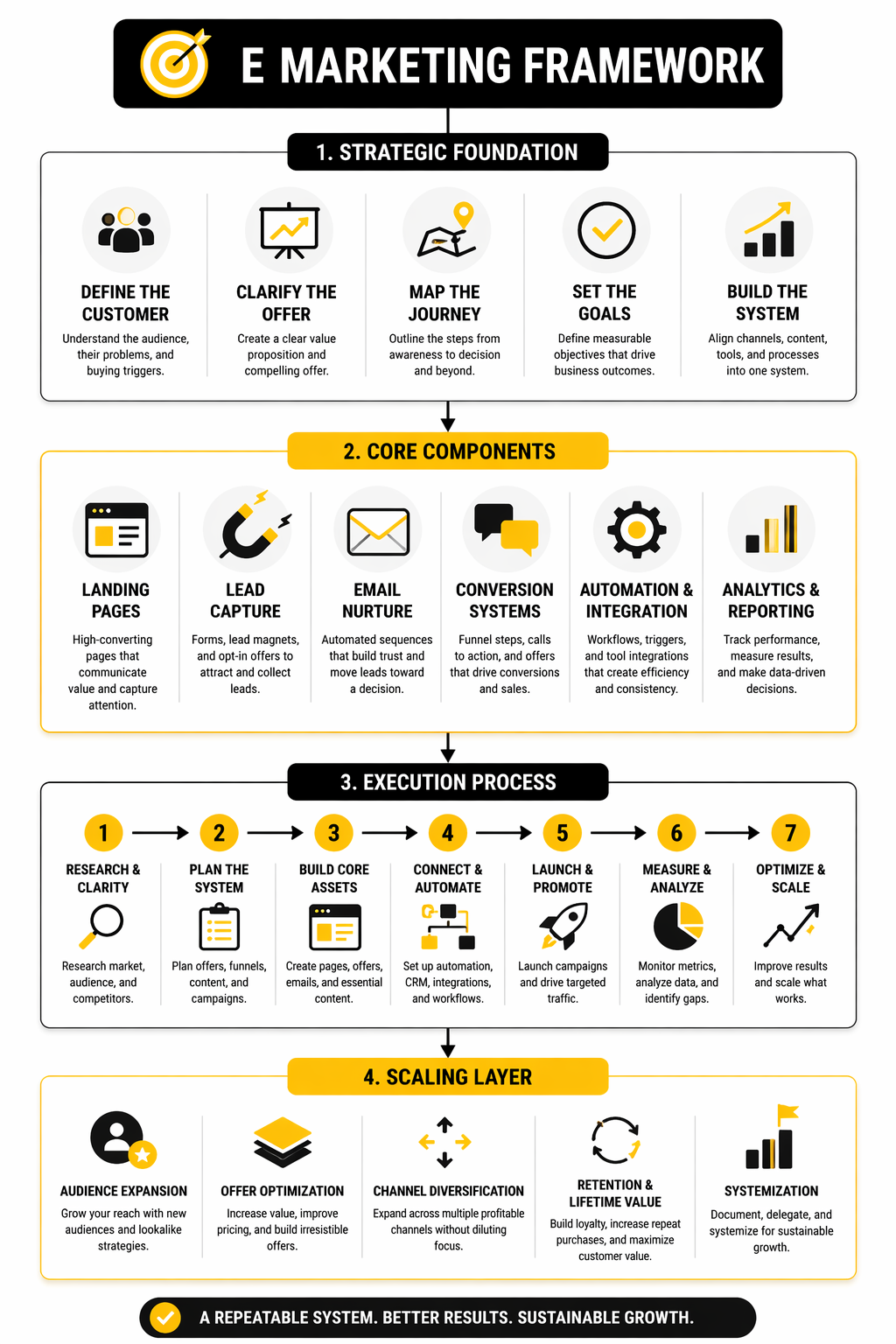
A strong e marketing framework has four layers: audience, offer, channels, and measurement. Audience defines who you are trying to reach and what they care about. Offer defines why they should act now instead of postponing the decision.
Channels decide where the message appears, but channels should never come first. A business that starts with “we need TikTok” or “we need email automation” can easily build activity without direction. The better question is: where does the customer already spend attention, and what information do they need before they trust us?
Measurement closes the loop. Without tracking, e marketing becomes opinion-driven. With tracking, every campaign can be judged by useful signals such as qualified leads, conversion rate, customer acquisition cost, revenue, retention, and lifetime value.
Core Channels And How They Work Together
E marketing becomes easier when you stop treating channels like separate islands. Search, social, email, paid ads, funnels, websites, chat, and CRM all play different roles in the same customer journey. The goal is not to be everywhere; the goal is to make each channel useful at the right moment.
Search usually captures intent. Social creates familiarity and demand. Email, SMS, chat, and retargeting help turn early interest into action because most people do not buy the first time they see a brand.
That is why the strongest e marketing systems connect discovery, education, conversion, and follow-up. A visitor may find you through Google, click a comparison page, join your list, receive a helpful email sequence, book a call, and later see a reminder ad. None of that should feel random.
Search And Content
Search is still one of the most valuable e marketing channels because it reaches people while they are actively looking for answers. The best content does not simply chase keywords; it solves real problems with enough depth to earn trust. That means clear pages for services, useful educational articles, comparison content, and conversion-focused landing pages.
Search also forces discipline. If your messaging is vague, your content will struggle because search users want specific answers. A strong content strategy should map pages to the buyer’s questions, not just to traffic volume.
For most businesses, search content should cover three levels:
- Problems the customer is trying to understand
- Solutions they are comparing
- Reasons they should choose your offer
Social Media And Demand Creation
Social media works differently because people are usually not searching for your product in that moment. They are scrolling, watching, reacting, and deciding what deserves attention. That makes social powerful for demand creation, but weak when it is used like a brochure.
The practical job of social in e marketing is to make your brand familiar before the customer needs you. Short videos, useful posts, founder insights, customer education, behind-the-scenes content, and timely opinions can all build trust when they are tied to a clear market position. Global reports continue to show social platforms as major discovery and attention environments, with DataReportal’s 2025 research estimating more than 5.2 billion social media user identities worldwide.
Still, social media should not be the whole strategy. Algorithms change, reach fluctuates, and rented attention can disappear quickly. Use social to create attention, then move serious prospects toward owned assets like email lists, communities, webinars, calls, or product demos.
Email, Messaging, And Follow-Up
Email remains essential because it gives you a direct line to people who already showed interest. Unlike a social post, an email sequence can be structured around timing, behavior, and intent. That makes it especially useful for lead nurturing, launches, onboarding, abandoned carts, reactivation, and long sales cycles.
Messaging tools add speed to the same system. For brands that sell through conversations, a tool like ManyChat can help turn comments, DMs, and campaign responses into automated follow-up paths. Used well, this does not replace human selling; it removes friction before a human needs to step in.
The key is relevance. A welcome email should not sound like a random promotion. A cart reminder should not feel desperate. A follow-up sequence should help the buyer make a better decision, then ask for the next step when the timing makes sense.
Paid Ads And Funnel Traffic
Paid ads can scale e marketing quickly, but only when the offer and funnel are already clear. Ads amplify what exists. If the message is weak, the landing page is confusing, or the follow-up is missing, paid traffic simply makes the leak more expensive.
A good paid traffic system starts with one clear conversion goal. That might be a purchase, booking, webinar registration, free trial, quote request, or lead magnet opt-in. Once the goal is clear, the ad, landing page, proof, call to action, and follow-up sequence can all point in the same direction.
For funnel-heavy campaigns, platforms such as ClickFunnels, Systeme.io, or GoHighLevel can be useful because they combine pages, forms, automation, and sales flow in one place. The tool is not the strategy, though. The strategy is making the journey obvious enough that the right person knows what to do next.
Websites, Landing Pages, And Conversion Paths
Your website is not just a digital business card. It is the place where attention either turns into action or quietly disappears. That is why every important page needs a clear job.
A homepage should quickly explain who you help, what problem you solve, and where the visitor should go next. A service page should show the offer, proof, process, objections, and call to action. A landing page should remove distractions and focus on one decision.
This is where e marketing becomes very practical. Better conversion paths often come from small improvements: clearer headlines, stronger proof, fewer form fields, faster pages, better mobile layout, and more specific calls to action. If traffic is already coming in, improving the page can sometimes beat buying more clicks.
Building A Professional E Marketing System
A professional e marketing system starts with the customer journey, not the tool stack. Before you choose software, write emails, build funnels, or launch ads, you need to understand the path someone takes from first problem awareness to final decision. When that path is clear, every marketing asset has a job.
The mistake many businesses make is building from the middle. They start with a landing page, an ad campaign, or an automation workflow before defining the promise, the audience, and the decision they want the prospect to make. That creates busy marketing, not effective marketing.
The better approach is to build the system in layers. First, clarify the offer. Then map the journey. Then create the content, pages, messages, and follow-up that move people from one step to the next.
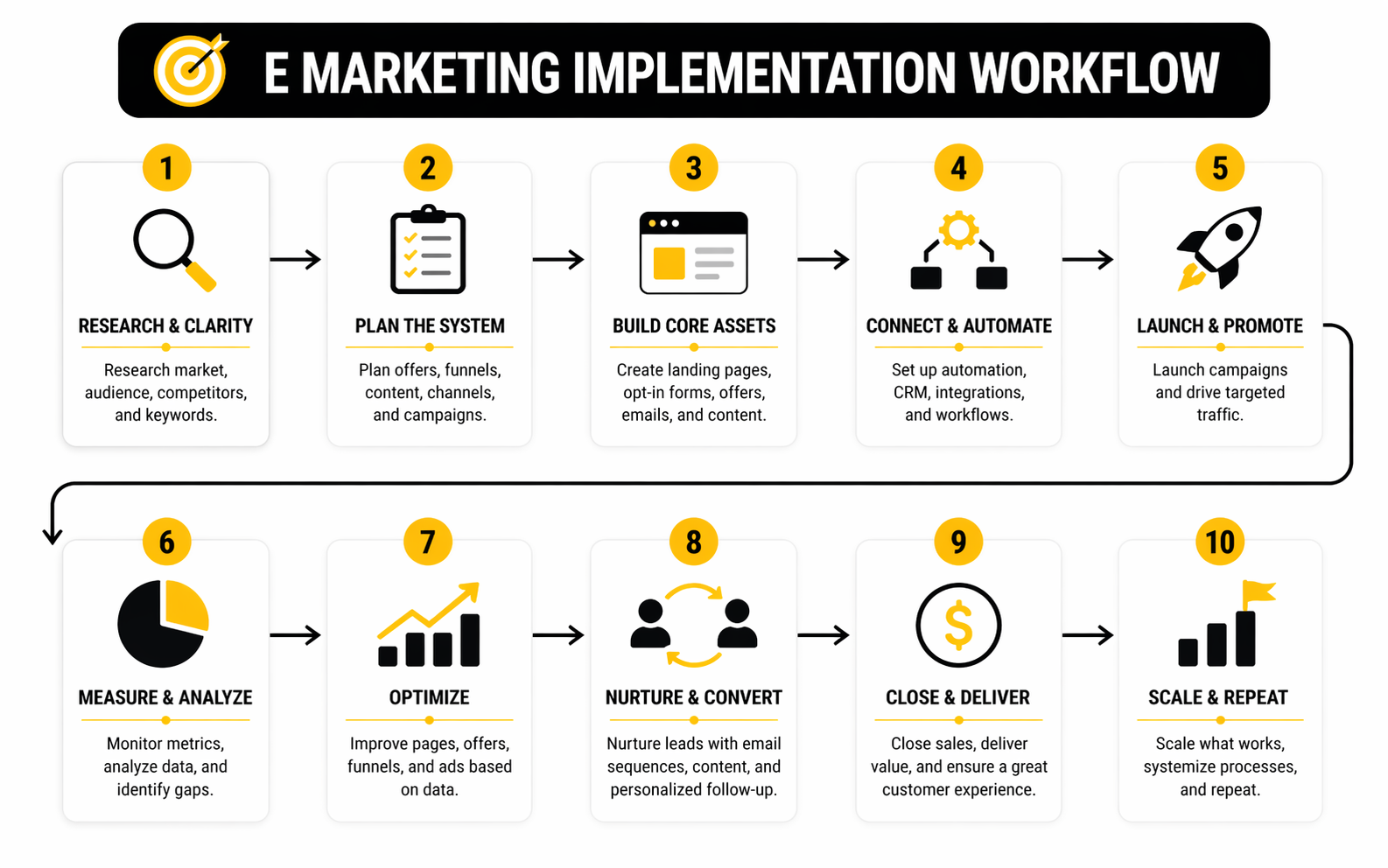
Step 1: Define The Customer And The Buying Trigger
Start with the person who has the problem, not the product you want to sell. What changed in their world that makes the problem urgent now? What are they already trying, and why is it not working well enough?
This matters because most e marketing fails when the message is too broad. A business says “we help companies grow” when the buyer is actually thinking, “I need more booked calls without hiring another salesperson.” Specific pain creates specific messaging.
A useful customer profile should include:
- The buyer’s current situation
- The problem they are trying to solve
- The trigger that makes action urgent
- The objections that delay the decision
- The outcome they want most
- The proof they need before trusting you
Step 2: Turn The Offer Into A Clear Conversion Path
Once the buyer is clear, the offer needs to become easy to understand. A good offer explains the outcome, the mechanism, the next step, and the reason to act. It should not require the visitor to decode what you mean.
This is where conversion paths become important. For a simple ecommerce product, the path might be product page, cart, checkout, post-purchase email, and review request. For a service business, it might be landing page, lead magnet, email sequence, booking page, sales call, proposal, and onboarding.
The point is not to make the funnel complicated. The point is to remove confusion. If a prospect does not know what to do next, the e marketing system is not finished.
Step 3: Build The Core Assets First
Core assets are the pages, messages, and follow-up pieces that support the main buying journey. These usually include a homepage or main landing page, service or product pages, a lead capture asset, email sequences, retargeting audiences, and a basic reporting dashboard. Without these assets, traffic has nowhere strong to go.
For landing pages and funnel campaigns, tools like ClickFunnels, Systeme.io, and Replo can help move faster when the offer is already clear. The speed is useful, but speed only helps when the message, proof, and call to action are sharp. A fast-built page with weak positioning is still weak.
Your first version does not need every possible feature. It needs enough structure to test whether the market understands the offer and takes the next step. Build the minimum serious system, then improve it with real behavior.
Step 4: Connect Capture, Nurture, And Sales
Lead capture is not the finish line. It is the start of the relationship. If someone joins your list, downloads a guide, books a webinar, or asks for more information, the next few interactions decide whether trust grows or disappears.
A good nurture sequence should help the buyer think more clearly. It can explain the problem, compare options, answer objections, show proof, and invite action when the timing is right. McKinsey’s 2025 work on personalized marketing highlights how AI and better data can help companies tailor interactions at scale, but the principle is older and simpler: relevance wins.
For businesses that sell through forms, calls, pipelines, and follow-up, GoHighLevel can be useful because it combines CRM, automation, booking, messaging, and pipeline management. For email-heavy campaigns, Brevo or Moosend can support structured follow-up without making the system unnecessarily complex.
Step 5: Launch With One Main Goal
A professional launch does not mean doing everything at once. It means choosing one measurable goal and aligning the system around it. That goal might be booked calls, qualified leads, trial signups, sales, demo requests, or repeat purchases.
This focus keeps the team honest. If the goal is booked calls, then traffic quality, page conversion, form completion, calendar show-up rate, and sales outcome all matter. If the goal is ecommerce revenue, then product page conversion, cart abandonment, average order value, repeat purchase, and email revenue matter more.
This is also where many campaigns get cleaned up fast. You stop asking, “Did people like the campaign?” and start asking, “Did the right people take the right next step?” That shift is small, but it changes everything.
Step 6: Improve The System From Real Data
After launch, the work becomes diagnosis. If people click ads but do not convert, the page may be unclear or the audience may be wrong. If people opt in but do not buy, the nurture path may not be building enough belief.
Do not optimize everything at once. Start with the biggest leak closest to revenue. A 20 percent improvement in a key conversion step often matters more than publishing more content that nobody acts on.
The strongest e marketing systems improve through a simple rhythm:
- Review the numbers.
- Find the biggest drop-off.
- Form one practical hypothesis.
- Change one meaningful thing.
- Measure the result.
- Keep, refine, or reverse the change.
Step 7: Document The Operating System
Documentation sounds boring until a campaign breaks, a team member leaves, or nobody remembers why something was built a certain way. A professional system should have simple notes for audiences, offers, landing pages, email sequences, tracking, campaign goals, and reporting. This makes the work repeatable instead of dependent on memory.
Documentation also improves collaboration. Designers understand the conversion goal. Writers understand the buyer’s objections. Media buyers understand what happens after the click.
E marketing becomes much more powerful when the business can repeat what works. That is the real goal of implementation: not one lucky campaign, but a system that can be understood, managed, and improved.
Statistics And Data
Data only helps when it changes a decision. In e marketing, the point of measurement is not to collect pretty dashboards or quote industry averages. The point is to understand where attention becomes interest, where interest becomes action, and where action becomes revenue.
The market itself is still moving toward digital. U.S. internet advertising revenue reached nearly $300 billion in 2025, while global digital adoption remains massive, with 5.56 billion internet users at the start of 2025. Those numbers matter because they show why weak tracking is no longer a small operational issue; when most commercial attention is digital, unclear measurement means unclear growth.
But benchmarks are not targets. A landing page conversion rate, email click rate, cost per lead, or cart abandonment rate only becomes useful when you compare it against your own offer, audience, price point, traffic source, and buying cycle. A high-ticket consulting funnel should not be judged the same way as a low-priced ecommerce product.
The Metrics That Actually Matter
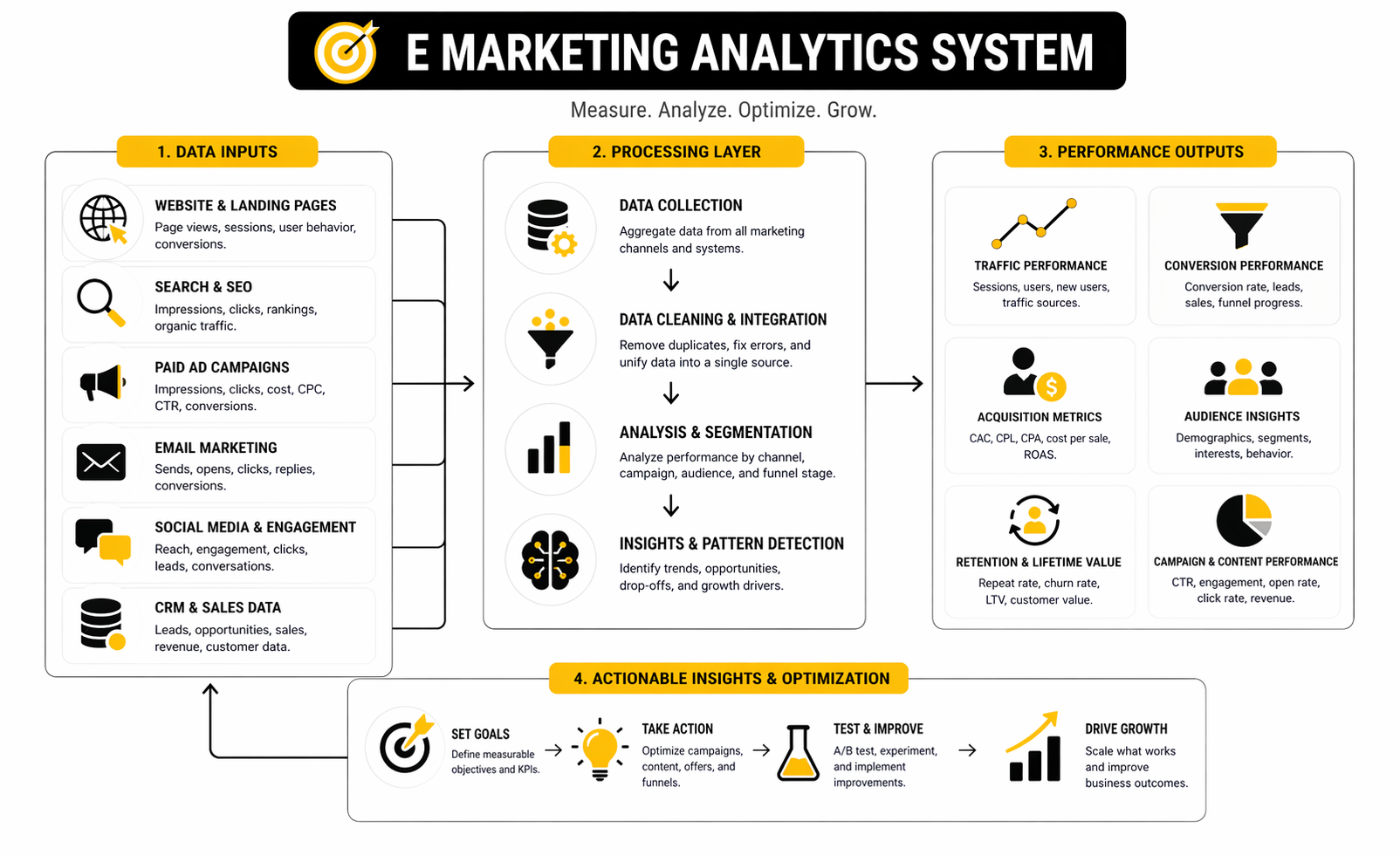
The most useful e marketing metrics follow the customer journey. At the top, you measure reach, impressions, search visibility, video views, and traffic quality. In the middle, you measure engagement, lead capture, email activity, return visits, and sales conversations.
Near the bottom, the numbers become stricter. Conversion rate, cost per acquisition, average order value, sales close rate, refund rate, retention, and lifetime value show whether the system is producing real business value. This is where vanity metrics either become useful or get exposed.
A simple measurement stack should answer these questions:
- Where did the right people come from?
- What message made them pay attention?
- Which page or offer moved them forward?
- Where did they drop off?
- What did each lead, customer, or sale cost?
- What did each customer become worth over time?
How To Interpret Benchmarks Without Fooling Yourself
Benchmarks are helpful for context, not for self-esteem. If a report says average conversion rates vary widely by industry, that does not mean your campaign is automatically good or bad. It means the business model matters.
For example, industry conversion benchmarks often show major differences between categories, with some 2025 landing page benchmarks ranging from low single digits in complex B2B categories to much higher rates in local or urgent-intent markets. That range matters because intent changes behavior. Someone comparing enterprise software behaves differently from someone searching for a lawyer after an urgent problem.
So use benchmarks carefully. If your conversion rate is far below the range for similar offers, investigate the page, traffic match, proof, pricing clarity, and call to action. If your conversion rate is above average but leads are poor, the campaign may be attracting easy clicks instead of serious buyers.
The Difference Between Leading And Lagging Signals
Lagging signals tell you what already happened. Revenue, profit, closed deals, churn, and customer lifetime value are lagging indicators because they arrive after the customer has moved through the system. They are important, but they are not always fast enough for day-to-day optimization.
Leading signals appear earlier. Search impressions, ad click-through rate, landing page scroll depth, lead magnet opt-ins, demo bookings, reply rates, cart additions, and email clicks can warn you before revenue changes. They are not final proof, but they help you diagnose momentum.
A practical e marketing dashboard should include both. If leading signals improve but revenue does not, the middle or bottom of the funnel may be weak. If revenue improves while early engagement falls, you may be attracting fewer people but better-fit buyers.
Attribution Is Useful, But It Is Never Perfect
Attribution tries to answer a messy question: which marketing activity deserves credit for the result? The problem is that buyers rarely behave in clean lines. They may click a search result, watch a video, ignore three emails, return through a retargeting ad, and convert after a direct visit.
That is why attribution should guide decisions, not replace judgment. Last-click attribution can undervalue content and social discovery. First-click attribution can overvalue early awareness and ignore the follow-up that closed the sale.
Use attribution to spot patterns. If paid search consistently brings high-intent leads, protect that channel. If social rarely gets last-click credit but assisted conversions rise when content volume increases, do not dismiss it too quickly. The smart move is to combine platform data, CRM data, sales feedback, and customer self-reported attribution.
What To Do When The Numbers Look Bad
Bad numbers are not a crisis. They are a map. The worst response is to change everything at once because then you will never know what fixed the problem.
Start by locating the leak. If traffic is low, the issue may be distribution, search demand, ad budget, or content visibility. If traffic is strong but leads are weak, the issue may be message match, offer clarity, page trust, or form friction.
If leads are strong but sales are weak, look at lead quality, sales process, pricing expectations, follow-up speed, and proof. If customers buy once but do not return, the issue may be onboarding, product experience, post-purchase communication, or retention strategy. Each number should point to a next action, not just create anxiety.
Reporting Rhythm For Professional E Marketing
Daily reporting should stay narrow. Check spend, broken pages, lead flow, campaign delivery, and obvious tracking issues. This protects the system without creating noise.
Weekly reporting is where optimization happens. Review channel performance, conversion rates, lead quality, sales conversations, email engagement, and the biggest drop-off in the journey. Choose one or two meaningful changes instead of creating a random task list.
Monthly reporting should connect marketing to business outcomes. Look at revenue, acquisition cost, return on ad spend, lifetime value, retention, and the campaigns that deserve more investment. This is where e marketing becomes a management system, not just a set of promotional activities.
Advanced E Marketing Decisions
Once the basics are working, e marketing becomes a game of tradeoffs. More channels can create more reach, but they also create more complexity. More automation can improve speed, but it can also make the brand feel cold if the customer experience is not designed properly.
This is where mature businesses separate activity from strategy. They stop asking whether a tactic is popular and start asking whether it strengthens the system. A new channel, tool, campaign, or automation should either improve acquisition, conversion, retention, margin, or learning speed.
The smartest move is not always to scale immediately. Sometimes the best move is to simplify, tighten the offer, improve the sales handoff, clean up tracking, or increase retention before spending more on traffic. Growth gets much easier when the foundation is not leaking.
Acquisition Versus Retention
Acquisition gets attention because it feels like growth. More traffic, more leads, and more customers look exciting on a dashboard. But if customers do not stay, buy again, refer others, or increase in value, acquisition becomes a very expensive treadmill.
Retention deserves more respect in e marketing because it changes the math. Publicis Sapient and Adobe research found that from 2022 to 2025, acquisition costs rose 35 percent while customer lifetime value grew only 4.5 percent. That gap matters because a business cannot keep paying more for customers who do not become more valuable.
The practical answer is balance. Keep building acquisition, but do not ignore onboarding, email follow-up, customer education, loyalty, upsells, referrals, and post-purchase support. A customer who buys again is not just extra revenue; they are proof that the marketing promise matched the real experience.
First-Party Data Is Becoming A Competitive Advantage
Privacy changes have made lazy targeting less reliable. Third-party signals are weaker, platform reporting is less complete, and buyers are more sensitive about how their data is used. That does not kill e marketing, but it does punish businesses that never built direct relationships with their audience.
First-party data is the information people give you through your own channels. That can include email signups, purchase behavior, quiz answers, form submissions, booking data, CRM activity, product usage, and stated preferences. A clear first-party data strategy helps you personalize without guessing.
The important part is trust. Ask for useful information, explain the value, and use it to improve the customer experience. If someone tells you what they care about, your follow-up should become more relevant, not more annoying.
Automation Should Remove Friction, Not Judgment
Automation is powerful when it handles repetitive steps that slow the business down. Welcome sequences, booking confirmations, lead routing, abandoned cart reminders, review requests, reactivation campaigns, and pipeline reminders can all make e marketing more consistent. Deloitte’s 2025 marketing trends emphasize AI-driven automation as a way to improve efficiency, personalization, and omnichannel experiences.
But automation becomes dangerous when it replaces thinking. Sending more messages does not automatically create more trust. Triggering a sequence does not mean the prospect is ready to buy.
Use automation where timing and consistency matter. Keep human judgment where context, emotion, negotiation, or high-value decisions matter. That balance is especially important for service businesses, agencies, consultants, and high-ticket offers where one thoughtful response can outperform ten automated nudges.
AI Content Needs A Strong Editorial System
AI can speed up research, drafting, repurposing, personalization, and campaign production. That is useful. But faster content is not automatically better content.
The risk is sameness. If every business uses the same prompts, the same generic advice, and the same recycled hooks, the market gets flooded with content that looks polished but says nothing. In e marketing, that is a real problem because trust is built through specificity.
A strong AI workflow still needs human strategy. Define the audience, angle, proof, offer, and point of view before generating assets. Then edit for accuracy, usefulness, voice, and originality before anything goes live.
Scaling Creates Operational Pressure
Scaling e marketing usually exposes weak operations. More leads can overwhelm sales. More orders can stress fulfillment. More campaigns can create inconsistent messaging. More data can create confusion if nobody owns the dashboard.
Before scaling spend, check whether the business can handle the growth it wants. Response time, lead quality review, sales scripts, CRM hygiene, fulfillment capacity, customer support, and reporting ownership all become more important as volume rises. If these pieces are weak, scaling simply makes the weakness louder.
A practical scaling checklist should include:
- Clear ownership for each channel
- One source of truth for campaign reporting
- Documented follow-up rules
- Lead qualification criteria
- Sales handoff process
- Customer onboarding process
- Retention and reactivation plan
- Weekly review rhythm
Tool Stacks Should Stay Boring Until The Strategy Is Clear
Tools should support the system, not become the system. It is easy to lose weeks comparing platforms when the real issue is unclear positioning, weak proof, or an offer nobody understands. Do not hide strategy problems behind software shopping.
For many businesses, a simple stack is enough: website or funnel builder, email platform, CRM, analytics, calendar booking, payment system, and a way to manage content. Tools like GoHighLevel, ClickFunnels, Systeme.io, Brevo, and Buffer can all fit different parts of that setup.
The best tool is the one your team will actually use well. If a platform makes the process clearer, faster, and easier to measure, it is probably helping. If it adds complexity without improving decisions or results, it is just another subscription.
The Biggest Risk Is Losing Customer Trust
Trust is the real currency behind e marketing. You can buy clicks, rent attention, and automate follow-up, but you cannot force belief. Every touchpoint either strengthens trust or weakens it.
Overpromising is one way to lose it. So is aggressive retargeting, irrelevant email, fake urgency, weak support, confusing pricing, and content that exists only to rank. These tactics may create short-term movement, but they damage the relationship that makes long-term marketing cheaper.
The better strategy is simple and harder to fake: be clear, be useful, prove what you claim, and make the next step obvious. That is not soft advice. It is how serious e marketing survives when channels get crowded, platforms change rules, and buyers become harder to impress.
Common Mistakes, Tool Choices, And FAQ
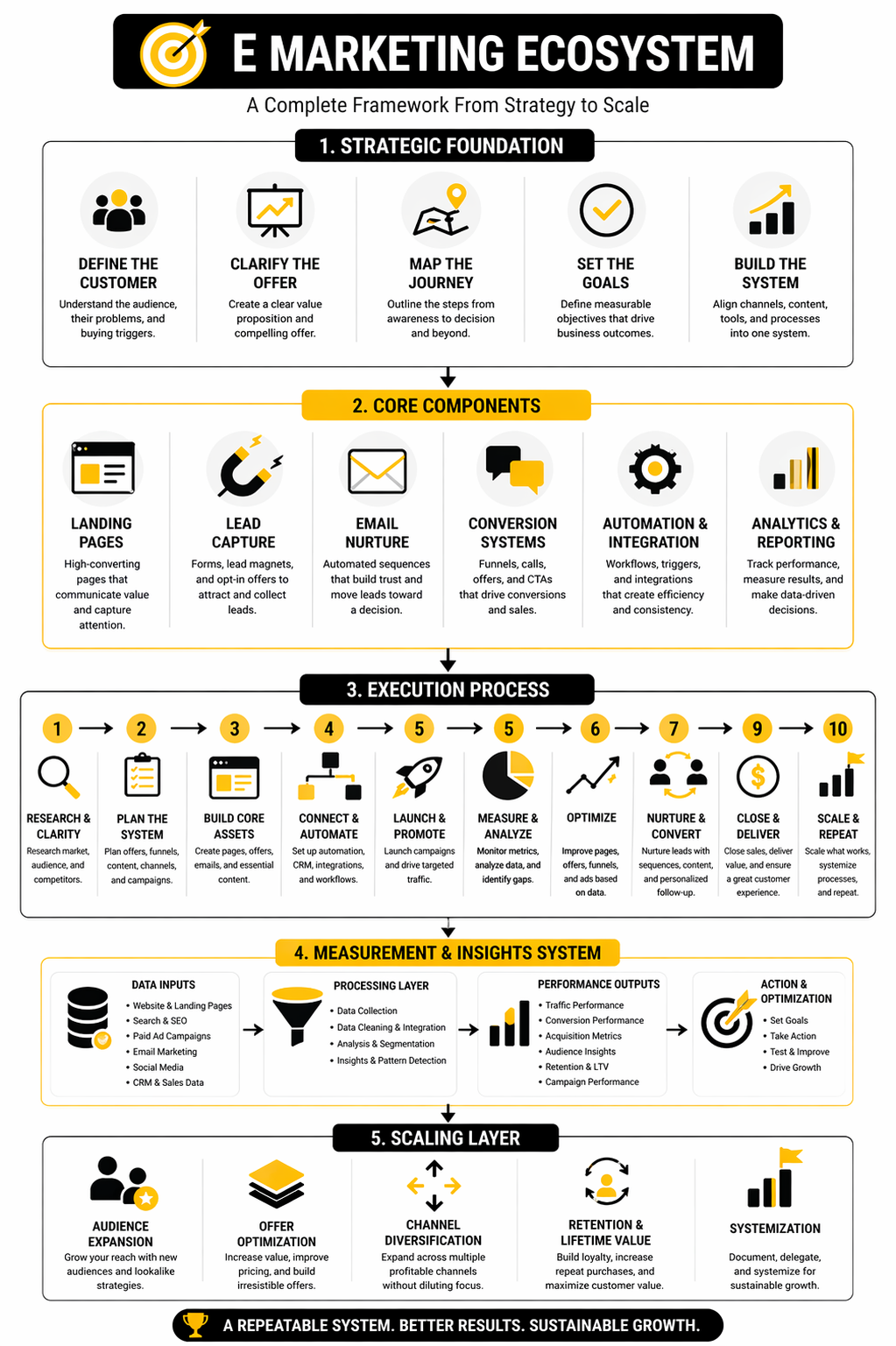
The final layer of e marketing is the ecosystem view. By this point, the goal is not to keep adding tactics. The goal is to make the whole system easier to understand, easier to manage, and easier to improve.
That means choosing tools carefully, avoiding unnecessary complexity, and building around the customer journey instead of chasing whatever looks new. Search, social, email, paid ads, landing pages, CRM, analytics, automation, and retention all need to work together. When they do, marketing stops feeling like a pile of tasks and starts behaving like a real growth engine.
Common Mistakes To Avoid
The first mistake is starting with channels before strategy. A business might launch ads, post daily, build a newsletter, and redesign its website without ever clarifying the offer or the buying trigger. That creates motion, but not momentum.
The second mistake is confusing activity with progress. More content, more tools, more automations, and more dashboards do not automatically create better results. If the message is weak or the next step is unclear, adding volume usually makes the problem louder.
The third mistake is ignoring trust. Buyers are more informed, more skeptical, and more exposed to competing messages than ever before. Strong e marketing does not pressure people into action; it earns attention, reduces uncertainty, and makes the decision feel safe.
Choosing The Right Tools
A good tool stack should make the system simpler, not heavier. Start with the jobs that need to be done: capture leads, publish content, send emails, manage conversations, book calls, track performance, and follow up consistently. Then choose tools that support those jobs without forcing the team into a workflow nobody wants to use.
For funnel building, ClickFunnels, Systeme.io, and Replo can help create focused conversion paths. For CRM, automation, booking, and pipeline workflows, GoHighLevel can be a strong all-in-one option. For email campaigns, Brevo and Moosend fit businesses that want structured follow-up without building a custom system from scratch.
For social scheduling, Buffer can keep publishing organized. For conversational automation, ManyChat can help turn comments, DMs, and campaign responses into cleaner follow-up. The right choice depends on your business model, but the principle stays the same: pick the tool that strengthens the process, not the one with the longest feature list.
FAQ - Built For Complete Guide
What Is E Marketing?
E marketing is the use of digital channels to attract, engage, convert, and retain customers. It includes search, social media, email, paid ads, landing pages, automation, analytics, and CRM workflows. The best version is not random online promotion; it is a connected system built around the buyer journey.
Is E Marketing The Same As Digital Marketing?
In most practical conversations, e marketing and digital marketing mean almost the same thing. Both describe marketing through electronic and online channels. The difference is usually wording, not strategy, so the real focus should be how well the system attracts and converts the right people.
Why Is E Marketing Important For Small Businesses?
Small businesses need e marketing because customers research, compare, and make decisions online. A strong system helps a smaller company look credible, capture leads, follow up professionally, and compete without needing a massive offline presence. It also makes performance easier to measure than many traditional marketing activities.
What Are The Main Channels In E Marketing?
The main channels include search engines, websites, landing pages, email, social media, paid ads, messaging, content, affiliate partnerships, and CRM-based follow-up. Each channel should have a clear role in the journey. Search may capture intent, social may build familiarity, and email may nurture people toward a decision.
How Do I Start With E Marketing?
Start by defining the customer, the problem, the offer, and the next action you want people to take. Then build one simple conversion path before expanding into more channels. A focused landing page, lead capture method, follow-up sequence, and basic tracking setup are often enough to begin testing seriously.
How Much Should A Business Spend On E Marketing?
There is no universal number because the right budget depends on margins, sales cycle, customer lifetime value, and growth goals. A business with high-ticket services can afford a very different acquisition cost than a low-margin ecommerce store. The smarter approach is to start with a controlled test budget, measure the economics, then scale what proves it can produce profitable customers.
What Metrics Matter Most In E Marketing?
The most important metrics are the ones closest to business outcomes. Traffic, reach, and clicks matter, but only when they connect to leads, sales, acquisition cost, conversion rate, retention, and lifetime value. A healthy dashboard should show where people come from, where they drop off, and what each customer is worth.
Is Email Still Useful In E Marketing?
Yes, email is still useful because it gives businesses a direct way to follow up with people who already showed interest. It works especially well for nurturing leads, recovering abandoned carts, onboarding customers, promoting offers, and reactivating past buyers. The key is relevance, not blasting the same message to everyone.
How Does AI Change E Marketing?
AI makes e marketing faster by helping with research, segmentation, content production, personalization, reporting, and automation. But AI does not replace positioning, proof, offer strategy, or customer understanding. The businesses that win with AI will use it to improve decisions and execution, not to flood the internet with generic content.
What Is The Biggest Mistake In E Marketing?
The biggest mistake is building campaigns before understanding the buyer. When the audience, problem, offer, and next step are unclear, every channel becomes harder to manage. Strong e marketing starts with clarity, then uses tools and traffic to amplify that clarity.
How Long Does E Marketing Take To Work?
Some channels can produce signals quickly, especially paid ads, email campaigns, and direct-response landing pages. Search, organic social, and brand-building usually take longer because they rely on consistency, trust, and accumulated visibility. The real question is not only speed; it is whether the system is learning from every campaign and getting better over time.
Can E Marketing Work Without Paid Ads?
Yes, e marketing can work without paid ads, especially through search, content, referrals, partnerships, email, and organic social. Paid ads simply speed up testing and distribution when the offer is ready. If the foundation is weak, paid traffic can waste money fast.
What Tools Do Beginners Need For E Marketing?
Beginners usually need a website or funnel builder, an email platform, basic analytics, a simple CRM, and a way to publish content consistently. Do not overbuild the stack too early. A simple system that gets used every week beats a complicated setup nobody maintains.
How Do I Know If My E Marketing Is Working?
Your e marketing is working when the right people are taking the right next steps at a cost the business can sustain. That could mean qualified leads, booked calls, purchases, repeat orders, or higher lifetime value. Good marketing should create measurable movement, not just impressions and activity.
Work With Professionals
Explore 10K+ Remote Marketing Contracts on MarkeWork.com
Most marketers spend too much time chasing clients, competing on crowded platforms, and losing a percentage of every project to middlemen.
MarkeWork gives you a better way. Browse thousands of remote marketing contracts and connect directly with companies desperate to hire skilled marketers like you, without platform commissions and without unnecessary gatekeepers.
If you're serious about finding better opportunities and keeping 100% of what you earn, explore available contracts and create a profile for free at MarkeWork.com.