

An ecommerce agency is no longer just a team that “builds online stores.” The best agencies now sit across strategy, creative, conversion, paid acquisition, retention, automation, analytics, and customer experience. That matters because ecommerce growth has become more complex, not simpler.
A good ecommerce agency helps a brand turn scattered marketing activity into a working growth system. It connects the storefront, traffic, offers, email and SMS, landing pages, checkout, tracking, and reporting into one measurable machine. When that system is weak, brands usually do not have one big problem; they have several small leaks compounding every day.

This guide will break the topic into six connected parts, moving from basic definition to professional implementation. The goal is to help you understand what an ecommerce agency actually does, when hiring one makes sense, what services matter most, and how to evaluate whether an agency can genuinely grow revenue.
Article Outline
- What An Ecommerce Agency Does
- Why An Ecommerce Agency Matters
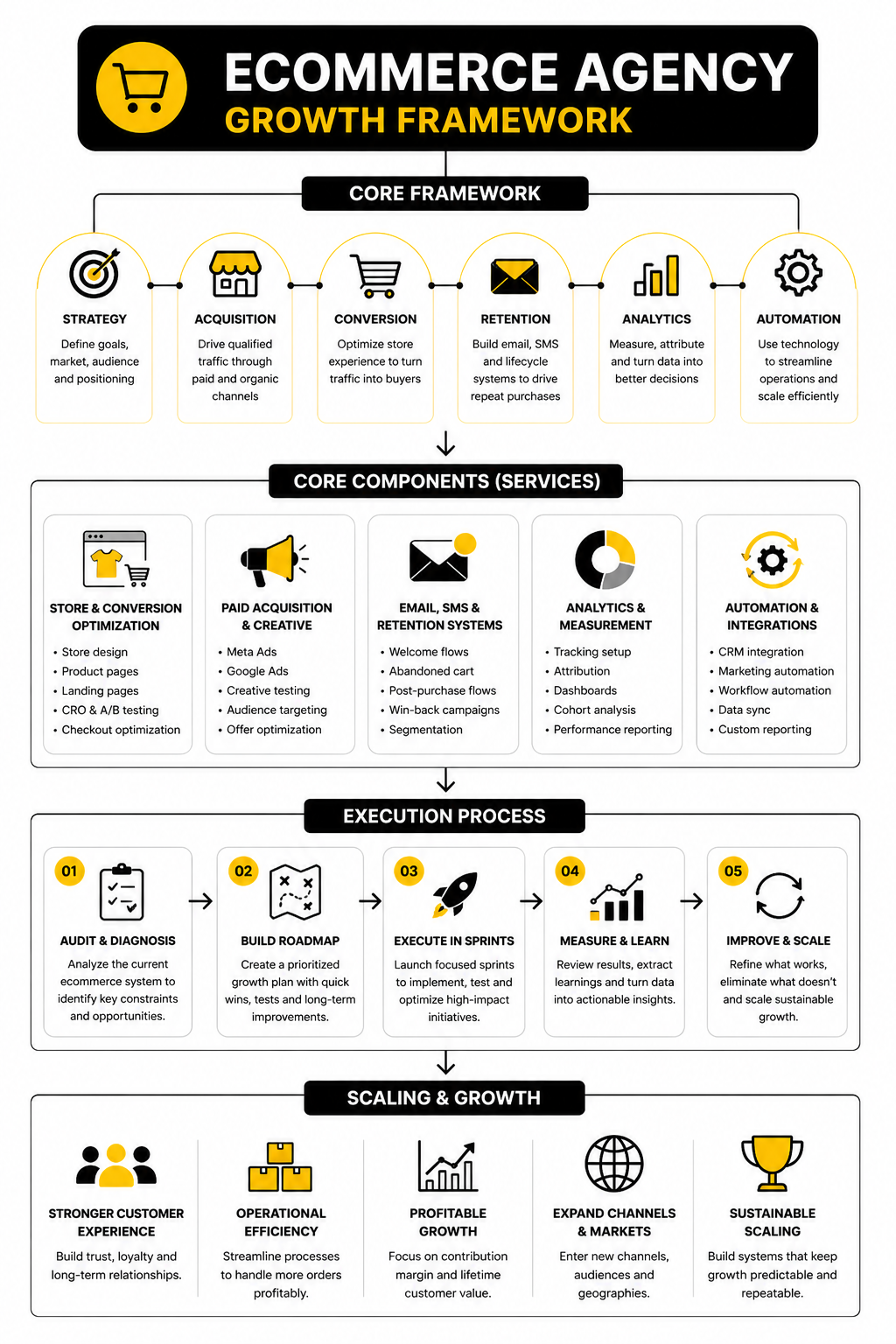
- The Ecommerce Growth Framework
- Core Services Inside A Strong Ecommerce Agency
- How Professional Implementation Works
- How To Choose The Right Ecommerce Agency
What An Ecommerce Agency Does
An ecommerce agency helps online brands improve the systems that create, convert, and retain customers. That can include store design, product page optimization, landing pages, paid ads, email marketing, SMS, analytics, automation, content, influencer workflows, and customer journey strategy. The exact scope depends on the agency, but the core job is simple: make ecommerce revenue more predictable.
Some agencies specialize in one narrow channel, such as paid media or lifecycle marketing. Others operate as full-service partners that handle everything from strategy to execution. The important thing is not how many services they list, but whether those services work together instead of creating disconnected campaigns.
For example, a brand might use ManyChat for conversational automation, Replo for high-converting landing pages, and GoHighLevel for CRM-style follow-up workflows. Tools like these can be powerful, but only when the agency knows how to fit them into a clear acquisition and retention system.
Why An Ecommerce Agency Matters
Ecommerce is competitive because customers compare products, prices, delivery promises, reviews, and brand trust in seconds. A weak product page, slow follow-up sequence, confusing offer, or poorly tracked ad campaign can quietly drain profit before a founder realizes what is happening. An ecommerce agency matters because it brings structure to decisions that many brands otherwise make reactively.
The real value is not just execution speed. It is prioritization. A strong agency can identify whether the biggest constraint is traffic quality, conversion rate, average order value, retention, creative fatigue, tracking accuracy, or offer positioning.
That distinction matters because fixing the wrong problem wastes budget. More ad spend will not solve a broken checkout. A prettier homepage will not fix poor retention. Better email automation will not compensate for a product page that fails to answer buying objections.
The Ecommerce Growth Framework
A useful ecommerce agency framework starts with four connected layers: acquisition, conversion, retention, and measurement. Acquisition brings the right people into the ecosystem. Conversion turns attention into orders. Retention increases repeat purchases and customer lifetime value. Measurement shows what is actually working.
This framework prevents random marketing. Instead of treating ads, landing pages, email, SMS, and analytics as separate tasks, the agency looks at how each part affects the next. That is where ecommerce growth becomes more stable.
The best agencies also understand sequencing. They do not immediately chase every trend or install every tool. They diagnose the business first, then decide what should be built, fixed, tested, or removed.
Core Services Inside A Strong Ecommerce Agency
A strong ecommerce agency is not just a vendor that completes tasks. It should be able to look at the whole buying journey and understand where growth is being created, where it is leaking, and what should happen next. That means the service mix has to support both short-term revenue and long-term brand health.
The most useful agencies usually combine strategy, execution, and measurement. Strategy decides what matters. Execution turns that decision into campaigns, pages, automations, creative, and reporting. Measurement keeps everyone honest, because ecommerce can get expensive fast when teams mistake activity for progress.
This is where many brands get agency hiring wrong. They hire for one visible pain, like ads or web design, when the real problem is the connection between channels. A better ecommerce agency thinks in systems.
Storefront And Conversion Optimization
The storefront is where customer intent either turns into revenue or disappears. Product pages, collection pages, landing pages, navigation, search, filters, checkout, trust signals, reviews, shipping information, and returns policies all affect whether someone feels ready to buy. When these pieces are unclear, traffic quality can look worse than it really is.
Conversion optimization is not about changing button colors and hoping for magic. It is about reducing friction, answering objections, improving clarity, and making the next step obvious. Checkout matters especially because the documented average cart abandonment rate sits around 70% across ecommerce studies, which means a lot of revenue is often lost after the customer has already shown buying intent.
A serious agency should review the customer journey before recommending new campaigns. If the store cannot convert qualified visitors, scaling traffic simply scales waste. Tools like Replo can help teams build focused landing pages faster, but the real advantage comes from the thinking behind the page: the offer, the proof, the message, and the path to purchase.
Paid Acquisition And Creative Testing
Paid acquisition is often the fastest way to learn what the market responds to. It can show which offers attract attention, which angles create buying intent, and which audiences are actually profitable. But paid media only works when the agency understands contribution margin, customer lifetime value, and the difference between revenue growth and profitable growth.
Creative testing is now central to paid acquisition. The ad account is not the whole game; the creative pipeline is. A good ecommerce agency should be able to test hooks, formats, product demonstrations, founder-led content, social proof, comparison angles, and offer framing without turning every test into a random guess.
This is also why reporting needs context. A campaign with a high return on ad spend can still be bad if it only captures existing demand and does not create incremental growth. A campaign with a lower first-purchase return can still make sense if retention and repeat purchase economics support it.
Email, SMS, And Retention Systems
Retention is where ecommerce profit often gets protected. New customers are expensive to acquire, so the brand needs a clear plan for turning first-time buyers into repeat buyers. That includes welcome flows, abandoned cart recovery, post-purchase education, replenishment reminders, win-back campaigns, loyalty messaging, and segmentation based on behavior.
An ecommerce agency should not treat email and SMS as blast channels. They should be used to continue the conversation customers started on the website, in ads, or through social content. The goal is not to send more messages; the goal is to send more relevant messages at moments when they can actually help the buyer.
This is where automation tools can be useful when they are implemented properly. A brand may use ManyChat for social and chat-based flows, Brevo for email campaigns, or Moosend for marketing automation. The agency’s job is to make sure those tools support the customer journey instead of adding more disconnected noise.
Analytics, Attribution, And Decision Making
Analytics is the part most brands say they care about, then underinvest in. That is risky because ecommerce decisions depend on clean tracking, consistent reporting, and a shared understanding of what the numbers actually mean. Without that, teams argue from screenshots, platform dashboards, and gut feeling.
A strong ecommerce agency should define the metrics that matter before work begins. That usually includes conversion rate, average order value, gross margin, returning customer revenue, customer acquisition cost, contribution margin, payback period, and lifetime value. Not every metric needs to be perfect, but the team needs a reliable operating dashboard.
Attribution also needs maturity. Platform-reported results can be useful, but they should not be treated as absolute truth. Better decision making comes from combining platform data, store analytics, CRM data, customer behavior, post-purchase surveys, and profit-level reporting.
How Professional Implementation Works
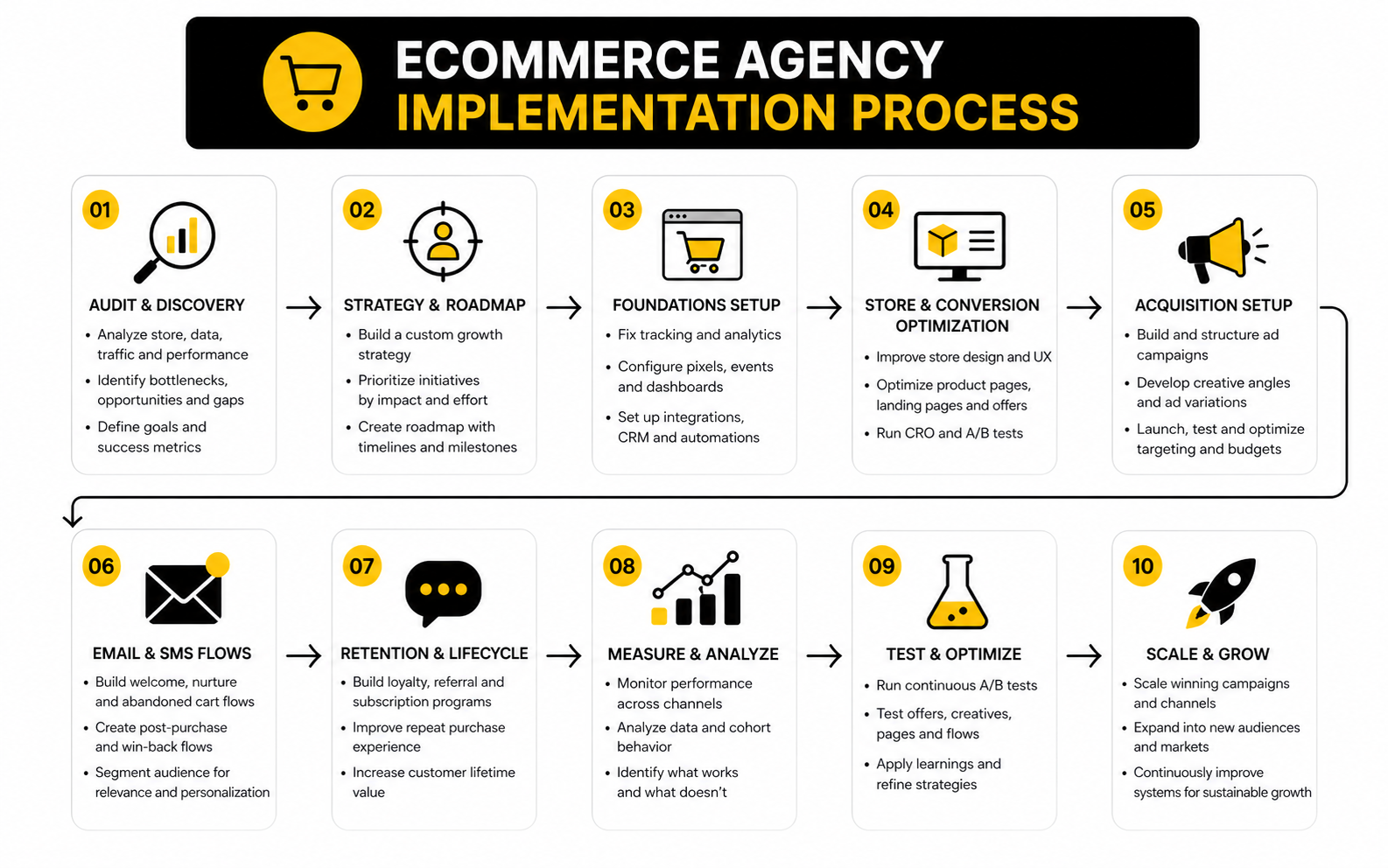
Professional implementation is where an ecommerce agency proves whether it is strategic or just busy. The work should not start with random campaigns, a redesigned homepage, or a new stack of tools. It should start with diagnosis, because the wrong execution done quickly is still the wrong execution.
A good implementation process turns messy business problems into a clear operating plan. The agency should understand the brand’s margins, traffic mix, offer structure, customer journey, retention patterns, creative performance, and technical constraints before making big recommendations. That early work may feel slower than jumping straight into production, but it usually saves money because the team stops guessing.
The process also needs ownership. Every major workstream should have a clear owner, deadline, success metric, and review rhythm. Without that, the agency-client relationship becomes a stream of meetings, screenshots, and unfinished ideas.
Step 1: Audit The Current Ecommerce System
The first step is a practical audit of the current ecommerce system. That means looking at the store experience, analytics setup, paid media performance, email and SMS flows, landing pages, customer reviews, support tickets, checkout friction, and repeat purchase behavior. The goal is not to create a huge document nobody reads; the goal is to find the highest-value constraints.
A useful audit separates symptoms from causes. Low revenue might be caused by weak traffic, poor offer clarity, broken tracking, slow pages, low trust, weak retention, or bad margins. The agency needs to identify which problem is actually limiting growth right now.
This is also where benchmarks can be helpful, but only as context. For example, cart abandonment remains a major ecommerce issue, with Baymard’s ongoing research placing the documented average around 70%. That does not mean every store should obsess over the same number, but it does mean checkout and pre-checkout friction deserve serious attention.
Step 2: Build The Growth Roadmap
Once the audit is complete, the ecommerce agency should turn findings into a prioritized growth roadmap. This roadmap should explain what will be fixed first, what will be tested, what will be delayed, and what will not be touched yet. Prioritization matters because most ecommerce teams have more possible work than available time.
A strong roadmap usually balances quick wins with structural improvements. Quick wins might include fixing broken tracking, improving abandoned cart messaging, clarifying shipping information, or rebuilding a weak landing page. Structural improvements might include a new creative testing system, better lifecycle segmentation, cleaner reporting, or a stronger offer architecture.
This is where tools should enter the conversation carefully. If the brand needs faster landing page production, Replo can fit naturally. If the team needs CRM, pipeline, and follow-up infrastructure, GoHighLevel may make sense. If the roadmap needs forms, quizzes, or intake flows, Fillout can help collect cleaner customer data.
Step 3: Execute In Focused Sprints
Execution should happen in focused sprints, not endless scattered tasks. A sprint gives the agency and the brand a clear window to build, launch, measure, and learn. That rhythm keeps momentum high while still leaving enough room for analysis.
A practical sprint might focus on one major constraint at a time. One sprint could rebuild a product landing page. Another could improve lifecycle flows. Another could test new creative angles. The point is to create enough focus that results are actually interpretable.
This is where many agency relationships get messy. If five different initiatives launch at once, nobody knows what caused the change in performance. Focused sprints make growth easier to manage because each round of work has a clear hypothesis, a defined output, and a measurable result.
Step 4: Measure, Learn, And Improve
Measurement is not the final step in implementation. It is part of the operating rhythm. The agency should review results regularly, explain what changed, and decide whether to scale, refine, or stop the work.
The best reporting is simple enough to guide decisions. It should show what happened, why it likely happened, what the team learned, and what will happen next. A dashboard full of metrics is not useful if it does not lead to better action.
This matters because ecommerce growth is never perfectly linear. Campaigns fatigue, competitors react, customer behavior shifts, and platforms change. A strong ecommerce agency does not pretend it can control everything; it builds a process that learns faster than the market moves.
Statistics And Data
Numbers are useful only when they lead to better decisions. An ecommerce agency should not throw benchmarks into a report just to look analytical. The real job is to explain what each number means, what might be causing it, and what action the brand should take next.
The most common mistake is treating benchmarks like universal targets. A luxury furniture brand, a skincare subscription brand, and a low-ticket impulse-buy store will not have the same conversion rate, repeat purchase cycle, or customer acquisition economics. Benchmarks create context, but your own margin, offer, audience, and customer behavior decide what is actually healthy.
A good agency uses data to answer practical questions. Is the store converting the traffic it already has? Are returning customers becoming a bigger share of revenue? Is paid acquisition profitable after cost of goods, shipping, discounts, agency fees, and returns? Those questions matter more than isolated dashboard screenshots.
The Metrics That Actually Matter
The core ecommerce metrics are conversion rate, average order value, customer acquisition cost, gross margin, repeat purchase rate, customer lifetime value, cart abandonment rate, refund rate, and contribution profit. Each one tells part of the story. None of them tells the whole story alone.
Conversion rate shows how well the store turns visitors into buyers, but it can be misleading without traffic context. A store might improve conversion rate by attracting warmer traffic, offering heavier discounts, or removing low-intent visitors from the mix. That is why an ecommerce agency should interpret conversion rate alongside traffic source, offer type, device, landing page, and margin.
Cart abandonment is one of the clearest leak indicators because the customer has already shown intent. The documented average sits around 70.22% across cart abandonment studies, which means checkout friction is not a small issue. If a brand has strong add-to-cart behavior but weak purchase completion, the next move is not always more traffic; it may be clearer shipping costs, better payment options, stronger trust signals, or a simpler checkout flow.
Turning Analytics Into An Operating System
Analytics should work like an operating system for the ecommerce business. It should connect what happened in acquisition, what happened on the website, what happened after purchase, and what happened to profit. When those views are separated, teams end up optimizing channels instead of optimizing the business.
A clean analytics system usually starts with a few layers. The first layer is store performance: sessions, conversion rate, average order value, revenue, refunds, and returning customer revenue. The second layer is marketing performance: spend, customer acquisition cost, creative performance, channel mix, and campaign efficiency. The third layer is customer quality: repeat purchase rate, cohort behavior, lifetime value, churn risk, and support issues.
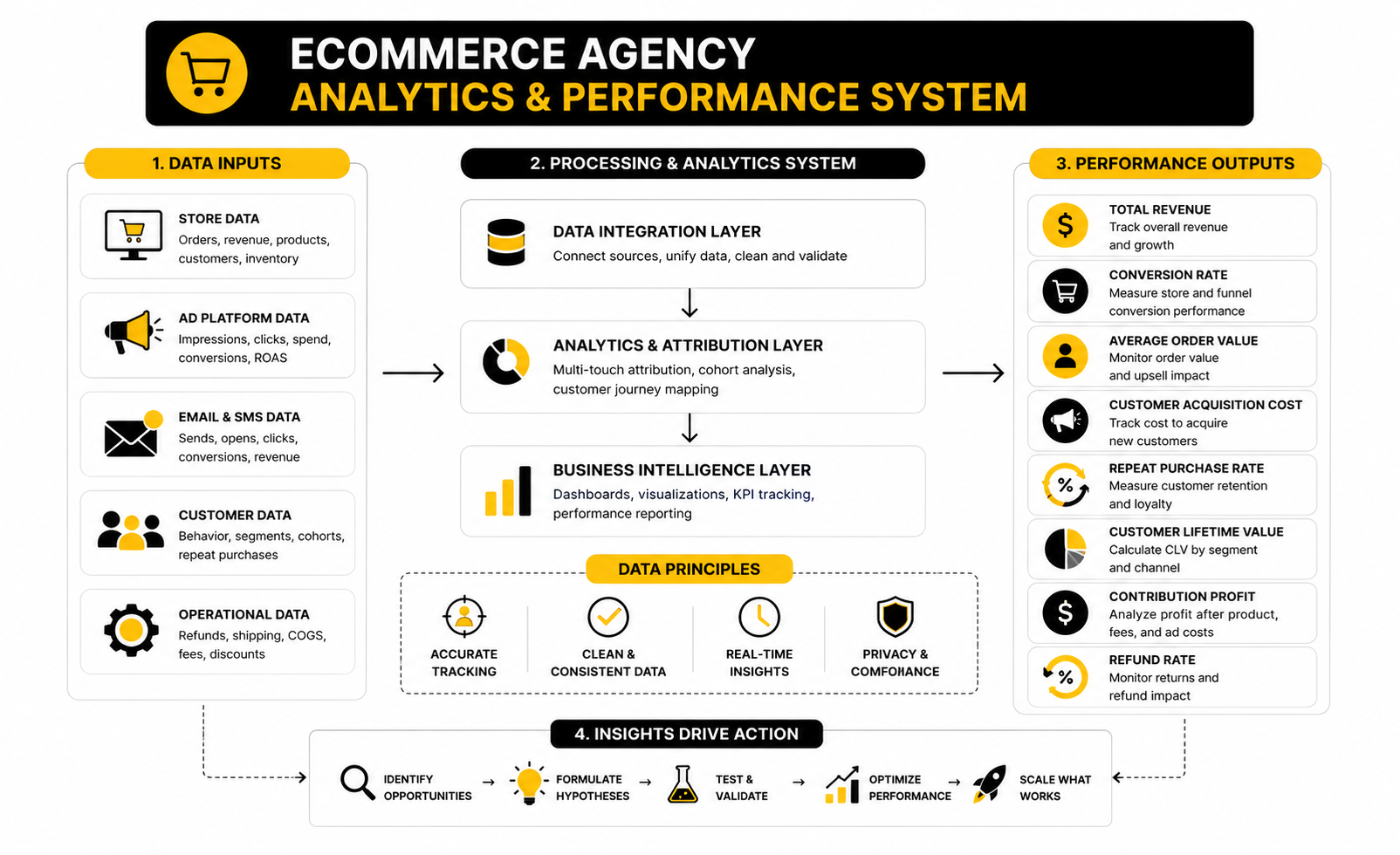
This is where the agency’s reporting discipline matters. A weekly report should not be a wall of numbers. It should show what changed, why it likely changed, what the team learned, and what decision comes next.
If reporting does not change behavior, it is decoration. Strong measurement makes the team sharper. Weak measurement makes everyone louder.
Benchmarks Should Trigger Questions, Not Panic
Benchmarks are helpful when they trigger better questions. If the average ecommerce conversion rate in many benchmark studies sits roughly in the low single digits, that does not automatically mean a store below that range is broken. It may sell expensive products, rely on longer consideration cycles, or drive a lot of educational top-of-funnel traffic.
The same applies to customer acquisition cost. A high CAC is not automatically bad if repeat purchase behavior, margin, and lifetime value support it. A low CAC is not automatically good if those customers only buy once, return products often, or require heavy discounts to convert.
This is why an ecommerce agency should avoid lazy benchmark comparisons. The better question is whether the number is improving for the right reason. A conversion rate increase caused by discounting can look good in a dashboard while damaging margin and brand positioning.
Performance Signals That Deserve Attention
Some signals are worth watching closely because they usually point to deeper problems. If traffic is rising but revenue is flat, the brand may be attracting the wrong visitors or sending them to the wrong experience. If add-to-cart rate is strong but checkout completion is weak, friction near purchase is probably the issue.
If first-purchase revenue looks healthy but returning customer revenue is weak, retention needs attention. That may mean the product experience is not creating enough satisfaction, post-purchase communication is thin, replenishment timing is off, or the brand has no clear reason for customers to come back. Retention work is not just email; it is product, experience, timing, and trust.
If paid ads keep needing fresh budget just to maintain revenue, the business may be too dependent on acquisition. That is not sustainable forever. The agency should look for ways to improve lifecycle marketing, organic demand, customer referrals, bundles, subscriptions, and higher-value customer journeys.
What Data Should Drive Next
Good data should create action. If checkout abandonment is high, the next step might be a checkout audit, clearer delivery messaging, stronger payment options, and recovery flows. If landing page performance is weak, the next step might be sharper offer framing, better product education, stronger proof, and faster testing with a builder like Replo.
If lead capture is weak, the agency might build quizzes, forms, or guided product finders using tools such as Fillout or Guideless. If follow-up is inconsistent, the brand may need a cleaner CRM and automation workflow through GoHighLevel. The tool is not the strategy, but the right tool can make the strategy easier to execute.
The point is simple: data should remove confusion. It should help the ecommerce agency and the brand decide what to fix, what to test, what to scale, and what to stop doing. When measurement does that, it becomes a growth advantage instead of another dashboard nobody trusts.
Advanced Considerations Before Scaling
Scaling with an ecommerce agency is not just doing more of what already works. It usually changes the pressure on the whole business. More traffic can expose weak merchandising, slow fulfillment, poor customer support, thin margins, bad inventory planning, and unclear positioning.
That is why advanced ecommerce growth is less glamorous than people expect. It is not only bigger campaigns and nicer creative. It is sharper tradeoffs, better operating discipline, and a willingness to fix the unsexy parts of the business before they become expensive.
A mature ecommerce agency should help the brand understand what kind of growth it is pursuing. Fast revenue growth, profitable growth, international growth, marketplace growth, subscription growth, and retention-led growth all require different decisions. Treating them like the same goal creates confusion.
The Tradeoff Between Speed And Stability
Speed matters in ecommerce because markets move quickly. Creative fatigue, platform changes, competitor discounts, seasonality, and product trends can all shift performance. A slow agency can miss opportunities simply because it takes too long to ship.
But speed without stability creates chaos. If campaigns launch without clean tracking, landing pages go live without QA, or lifecycle flows change without review, the brand may create more problems than it solves. Moving fast is useful only when the process protects the basics.
The best ecommerce agency relationships create controlled speed. They use clear briefs, fast approval loops, testing calendars, QA checklists, and simple reporting. That allows the team to move quickly without turning every launch into a rescue mission.
Profit Is More Important Than Platform ROAS
Platform ROAS is useful, but it is not the same as profit. A campaign can look strong inside an ad account while the business is still losing money after discounts, shipping, product costs, returns, payment fees, and agency costs. This is one of the biggest traps in ecommerce reporting.
A better agency will push the conversation toward contribution margin. That means looking at revenue after the real costs required to generate and fulfill the order. It is less exciting than a big ROAS screenshot, but it is much closer to the truth.
This matters even more when acquisition costs rise. Recent ecommerce benchmark data shows paid acquisition pressure clearly, with one large benchmark set reporting a 2.01% paid ads conversion rate and rising CPA across more than 30,000 brands. The action is not to panic; the action is to improve the full system around paid traffic so each customer becomes more valuable.
Creative Volume Can Become A Bottleneck
Many ecommerce brands underestimate how much creative they need to scale. Ads fatigue, audiences change, hooks get copied, and platforms reward fresh signals. If the agency cannot produce, test, and learn from creative consistently, paid acquisition eventually stalls.
Creative volume does not mean producing random videos in bulk. It means building a repeatable creative system around customer objections, product benefits, use cases, comparison angles, social proof, creator content, and offer testing. The agency should know what each creative test is trying to learn.
This is where content operations matter. A brand may need better creator sourcing, faster editing, stronger scripts, tighter product demonstrations, or cleaner approvals. Tools like Buffer can help with publishing discipline, while the agency’s real job is to build a creative feedback loop that connects content performance to business outcomes.
Technology Should Simplify The Business
A bigger tech stack does not automatically make a brand more advanced. In fact, too many tools can create messy data, duplicated workflows, higher costs, and unclear ownership. The right question is not “What else can we add?” but “What makes the buying journey and operating system cleaner?”
An ecommerce agency should be careful with technology recommendations. If a tool improves speed, clarity, personalization, automation, or measurement, it may be worth adding. If it only adds complexity, it should probably wait.
For example, GoHighLevel can make sense when the brand needs stronger CRM, follow-up, lead management, or multi-step automation. Chatbase can be useful when customer questions repeat often and the brand wants a smarter support layer. Firecrawl can support data collection workflows, but only when the use case is clear and compliant.
Retention Becomes A Strategic Advantage
Retention becomes more important as the brand scales because acquisition alone gets expensive. A healthy ecommerce business should not need to reacquire every sale from scratch. Repeat purchases, replenishment, subscriptions, referrals, loyalty, and better post-purchase experiences all reduce pressure on paid media.
Repeat customer rates vary widely by category, but ecommerce retention benchmarks commonly place average repeat purchase behavior around the mid-to-high 20% range. That number should not be used as a universal target, but it should push the agency to ask better questions about product satisfaction, timing, segmentation, and customer reasons to return.
The strongest retention work starts after the first order. Customers need reassurance, education, delivery clarity, usage guidance, support, and relevant next steps. If the ecommerce agency only thinks about retention when it is time to send another promotion, it is missing the bigger opportunity.
The Risk Of Outsourcing Too Much Thinking
Hiring an ecommerce agency does not mean the brand should stop thinking. The agency brings expertise, systems, and execution capacity, but the brand still owns the customer, the product, the positioning, and the long-term direction. When the founder or internal team disappears from strategy, the work usually gets weaker.
The healthiest setup is collaborative. The brand brings customer insight, product knowledge, margin reality, and business priorities. The agency brings channel expertise, process, testing discipline, creative execution, and outside perspective.
This balance is important because agencies can optimize what they can see. If they are not given context about inventory, product plans, customer feedback, operational limits, or profitability, they may make recommendations that look smart in marketing but fail in the business. Good agencies ask for that context. Good clients share it.
How To Choose The Right Ecommerce Agency
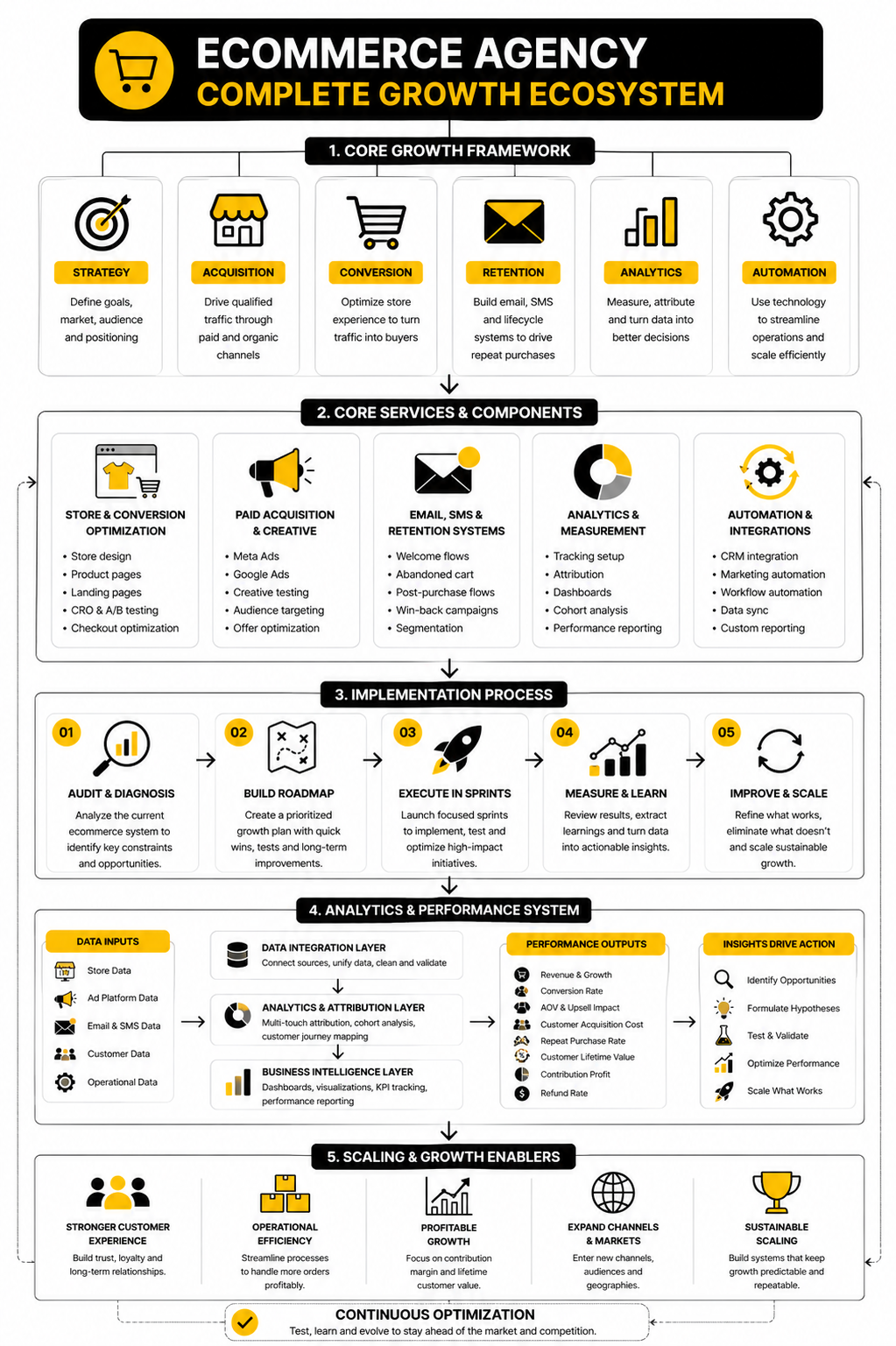
Choosing an ecommerce agency is not about finding the loudest promise. It is about finding the partner that understands your business model, asks uncomfortable questions, and can explain exactly how their work should improve the numbers that matter. If an agency talks only about traffic, creatives, funnels, or ROAS without asking about margin, retention, inventory, and fulfillment, be careful.
The right agency should make your business feel clearer, not more confusing. You should understand what they are doing, why they are doing it, how success will be measured, and what tradeoffs are involved. Great agencies simplify the path forward without pretending ecommerce is easy.
Questions To Ask Before Hiring
Before signing a contract, ask questions that reveal how the agency thinks. Their answers should be specific enough to show experience, but honest enough to admit where more diagnosis is needed. Vague confidence is not strategy.
Useful questions include:
- What part of our ecommerce system would you audit first?
- Which metrics would you use to judge success?
- How do you separate platform-reported performance from real profit?
- What do you need from our internal team to do good work?
- How do you prioritize tests when everything feels urgent?
- What work should we not do yet?
- How do you report learning, not just activity?
- What happens if the first strategy does not work?
- Who will actually work on the account?
- How do you handle creative fatigue, retention, and measurement together?
The best answers will usually be practical, not flashy. A serious ecommerce agency will talk about constraints, sequencing, ownership, and decision quality. That is what you want.
FAQ - Built for Complete Guide
What is an ecommerce agency?
An ecommerce agency is a specialist partner that helps online brands grow revenue through strategy, execution, and measurement. Its work can include storefront optimization, landing pages, paid advertising, email marketing, SMS, retention, analytics, creative testing, and automation. The strongest agencies connect these pieces into one operating system instead of treating them as separate tasks.
What does an ecommerce agency actually do?
An ecommerce agency identifies what is limiting growth, builds a plan to fix it, and executes the work needed to improve performance. That might mean improving conversion rate, testing new creative, building lifecycle flows, cleaning up tracking, or strengthening retention. The best agencies do not just “do marketing”; they help the business make better growth decisions.
When should a brand hire an ecommerce agency?
A brand should consider hiring an ecommerce agency when growth has become too complex for the internal team to manage well. Common signs include rising acquisition costs, weak conversion rates, unclear reporting, slow creative production, poor retention, or a team that is busy but not making measurable progress. Hiring makes the most sense when the brand has enough traction for expert execution to create real leverage.
How much does an ecommerce agency cost?
Costs vary widely depending on scope, specialization, team seniority, and whether the agency handles strategy, execution, creative, paid media, development, or retention. A small project may be priced very differently from a full growth partnership. The better question is whether the agency’s work can improve contribution profit enough to justify the fee.
Is a full-service ecommerce agency better than a specialist agency?
Not always. A full-service ecommerce agency can be valuable when the brand needs one team to coordinate multiple growth areas. A specialist agency can be better when the brand already has strong internal leadership and only needs deep expertise in one channel, such as paid media, CRO, or lifecycle marketing.
What metrics should an ecommerce agency report?
An ecommerce agency should report the metrics that connect marketing activity to business outcomes. That usually includes revenue, conversion rate, average order value, customer acquisition cost, gross margin, repeat purchase rate, returning customer revenue, refund rate, contribution profit, and customer lifetime value. Platform metrics are useful, but they should not replace business-level reporting.
How long does it take to see results from an ecommerce agency?
Some improvements can show quickly, especially technical fixes, clearer landing pages, stronger abandoned cart flows, or better offer messaging. Larger gains usually take longer because they require testing, learning, creative development, retention work, and cleaner measurement. A good agency should explain which results may appear early and which ones require a longer operating rhythm.
What are the biggest risks when hiring an ecommerce agency?
The biggest risks are unclear ownership, weak reporting, overreliance on platform ROAS, poor communication, and strategy that does not match the brand’s economics. Another major risk is outsourcing too much thinking and expecting the agency to understand the business without enough context. The relationship works best when both sides bring useful information to the table.
Should an ecommerce agency handle email and SMS?
Yes, if retention is part of the growth problem. Email and SMS are not just promotional channels; they support education, cart recovery, post-purchase confidence, replenishment, loyalty, and win-back campaigns. If the agency only focuses on acquisition and ignores retention, the brand may keep paying to replace customers it should have kept.
What tools should an ecommerce agency use?
The tool stack should match the strategy. A landing page workflow may involve Replo, automation may involve GoHighLevel, conversational flows may involve ManyChat, and email may involve Brevo or Moosend. Tools matter, but the agency’s process matters more.
How do I know if an ecommerce agency is good?
A good ecommerce agency asks sharp questions, explains tradeoffs, prioritizes clearly, reports honestly, and connects marketing decisions to profit. It should be able to explain what it will do first and why. It should also be comfortable saying no to work that sounds exciting but does not solve the current constraint.
Can an ecommerce agency guarantee results?
Be skeptical of hard guarantees. Ecommerce performance depends on product quality, pricing, margin, inventory, offer strength, customer experience, market demand, competition, and operational execution. A strong agency can improve the odds, create a better system, and make smarter decisions, but it should not pretend to control every variable.
Work With Professionals
Explore 10K+ Remote Marketing Contracts on MarkeWork.com
Most marketers spend too much time chasing clients, competing on crowded platforms, and losing a percentage of every project to middlemen.
MarkeWork gives you a better way. Browse thousands of remote marketing contracts and connect directly with companies desperate to hire skilled marketers like you, without platform commissions and without unnecessary gatekeepers.
If you're serious about finding better opportunities and keeping 100% of what you earn, explore available contracts and create a profile for free at MarkeWork.com.